• Yesterday I wrote a post about the ways in which online teaching and supervision can be superior to physical teaching and supervision, and today I want to follow up with a short post about what aspects of online gaming can be transferred to physical gaming. I finished my Coriolis campaign online, and we have started the Archipelago campaign online too. Gaming online at this time has been necessary to avoid a physical TPK[1], but it has had several advantages:

    • We were able to include a former Coriolis player who moved overseas in the final part of that campaign, which was a good way to end the campaign and reconnect with an old player
    • One of our players is managing a very young child and another is living a large part of their time outside of Tokyo, so we’ve been able to include them in sessions
    • We’ve been able to meet more regularly because we can set weekday evenings without having to worry about commuting or finding a convenient venue

    In Tokyo there are lots of venues you can hire on weekday evenings for gaming, so we can find a mutually agreeable location, but the physical meetings are short and interrupted by eating, commuting and so on. When we game online during the week we can start later – 8pm to enable children to settle – and have already eaten and relaxed after the day. I also don’t have to lug my gaming material through the summer heat, and if we finish at 11 with a solid 3 hours’ gaming done, we can still be to bed early without worrying about commuting. We usually start an hour earlier for socialization, and people just join when they can.

    For Coriolis we used roll20, and for the Archipelago campaign we are using a system called RPG Sessions for characters and dice, run partly through discord, and roll20 for mapping[2]. As the number of coronavirus cases stabilizes in Tokyo and maybe begins to curve down, we’re thinking about returning to physical gaming sometime in September, but I think we are going to continue with some online sessions permanently, because it’s difficult to gather the whole group regularly on weekends and easy to gather them on a weekday night. Also I think when we do game physically we will retain a few aspects of online gaming.

    In particular I aim to keep using roll20 for mapping. There is this constant problem with maps and tabletop RPGs that they have to be put in the centre of the table, where there is usually a huge pile of snacks, and some people always have to stand to look at them, and then also the map is oriented towards half the group and upside down to the rest. I think we can get around this by having each person see the map on their own tablet, and also have it on a big screen at the end of the table (I have a tv in my kitchen that I can share with chromecast). Thus we will all be able to see the map but have a shared map at the same time. Players can move their own PCs on the map, and we can maintain the sense of physical space without having to invest in horrific things like miniatures and the like[3].

    Using roll20 for mapping also avoids the annoying situation where players are supposed to navigate their way around a physical map based entirely on my descriptions, when I can just use the fog of war on a map software to immediately reveal the rooms they can see, and the monsters they can see, when they see them. This is a vast improvement over physical maps or – worst of all – the horrible 1980s tradition of having a “mapper” who mapped out the dungeon as you explored it and always got it wrong. Having virtual maps also enables us to flick between them quickly, to have pictures of enemies and so on. Why go back to printed stuff?!

    I think we will also continue to use RPG sessions for character sheets. It is very nicely integrated with the Genesys system so that for example it even records criticals, which is great. Instead of having my PCs note down the name of the critical and its details they just hit a button and roll one up and it gets added directly to their character sheet. I am using onenote to track campaign sessions, so now we just put the date of the crit into the character sheet and we know exactly when to attempt crit recovery, etc. There is also no risk anyone will ever forget a character sheet, since there’s zero chance they’ll leave home without a phone.

    I have recently subscribed to the new Twilight 2000 kickstarter (and I suggest you do too!) which funded in 7 minutes, and is now up to its 9 billionth stretch goal. One of those stretch goals was the development of virtual tabletop tools for all the major applications, so that when you receive the game it is ready out of the box to be played online. I hope all new RPGs will do this in future, so that we can have a fully integrated virtual mapping, gaming and dice rolling system all in one. Of course some players like to roll dice (even though they’re shit at it[5]), which they will still be able to do, but the availability of ubiquitous online gaming platforms also opens the possibility of arbitrarily complex dice systems, since there’s no reason to physically assemble them or calculate the results. Who needs ideal polygonal forms for your dice when you can just roll d73? We could have dice systems based entirely on prime numbers! Or just go straight to arbitrary probability distributions … why go back?

    This pandemic has forced the world to deal with the fact that the internet is no longer an ersatz reality. It’s no longer the case that things done online are not relevant to or close to real life. We should accept this, and instead of seeing online experiences as inferior to physical experiences, things we were forced to compromise on for our health, we should see them as ways to improve our past physical experiences to make them better. Rather than going back to how things used to be, let’s use the improvisations we had to make during this time to improve our physical lives when we are able to reconnect. I am trying to do this with my teaching, and I aim to do it for my gaming too!


    fn1: Touch wood none of our players have got coronavirus, though two have been through some health scares, but some of us are older and some of us overweight, so we’re in the risk group for getting it badly if it does happen, and a gaming group is a perfect scenario for a cluster

    fn2: Roll20 supposedly has an api for genesys dice but it is completely broken so I had to give up on using it. This was frustrating!

    fn3: I’ve never been a great fan of miniatures for gaming, because I can’t paint them and they’re an absolute bastard to lug around, and for the first 15 or so years of my gaming experience they were only available in lead[4], which was heavy and ugly

    fn4: Yes in the 1980s parents willingly allowed their still-developing children to participate in a hobby that involved casting lead, and playing with things made of lead. WTF

    fn5: Jesus christ people, have some dice discipline will you!

  • We are now eight months into the coronavirus pandemic with little sign that most countries will be able to get it under control without a vaccine, which means that many countries are now attempting to return to normal while managing the virus. For most countries I predict this is going to be disastrous, and even countries that have not yet fully reopened – like France and the UK – are seeing resurgence in cases with the potential for a return of a major epidemic. But some of these countries are planning to reopen schools and universities in the Autumn, despite the risks, on the assumption that personal protective measures can contain those risks. I have expressed before my discomfort with personal protective measures, which will never be as effective at containing an infectious disease as good policy and robust treatment access, but this seems to be the dangerous path most countries have chosen to take. Given this, many universities are now trying to figure out how to return to in-person classes in Autumn, and many professors seem to want to do this. However, after a full semester of teaching entirely online I am unsure why there is so much pressure to return to in-person teaching and supervision. If we are going to move to a new normal I think we should consider the possibility that for some (many?) classes online is better than in-person, and here I would like to outline some of the benefits of online teaching and supervision.

    Brief background

    I teach classes in basic statistics, basic statistical programming, and some advanced statistics courses, to graduate students who are primarily mature age students working in health and studying part time. Here in Japan the first semester starts in April and in February I pushed for us to go entirely online, because I was working with Chinese colleagues on the coronavirus response in China and I knew how bad it was going to get. Our university already had a partially online component of teaching, to enable working people to take classes – basically students can choose to take an online or physical class for all of our required and many of our elective classes, and those who take the online component get to view recordings of the lectures, along with pre-recorded slides, and a slide set translated into Japanese. We have an online forum for asking questions and students can also join the physical class if they are taking the online component but able to get free time (this doesn’t happen much). Given our university already had this experience with online teaching it was very easy to switch entirely online and the faculty agreed, so we had about 6 weeks to prepare. This was a very good decision: many of our students are clinicians and some work directly in covid-19 treatment and care, so having them gather physically in a room is extremely high risk.

    I originally planned to just switch the physical classes to the online component, upload last year’s recordings and use the lectures as a Q&A, but students don’t always have time for this, so I started teaching the classes in zoom (using slide sharing and so on), and I have found many aspects of lecturing in zoom to be superior to physical lecturing. I also reconfigured the statistical programming class to be done in zoom using breakout rooms. The statistical programming class was traditionally taught entirely physically, with me and two teaching assistants (TAs) running around the class answering questions and then reproducing errors on the teacher’s computer to explain specific problems that are relevant to everyone’s education. I could not physically do this anyway this year because I dislocated my kneecap in mid-February and had surgery in mid-April, but even if I had been able to, I found ways to make this work better in zoom. My students this year are learning more and better than last year, using zoom.

    Benefits of online teaching

    In my experience of first semester there are many aspects of holding classes online that are superior to holding them physically. In no particular order, here they are.

    Reduced commuting: Some of my students join the lecture from their workplace, or from locations that vary weekly depending on their schedule. They don’t have to commute, so physically it’s much easier for them. Commuting in Japan is obviously high-risk for coronavirus, but it also reduces pressure on students if they don’t have to bounce from work to school to home. I think surveys in Japan have shown an overwhelming desire for normal workers to continue working from home and commuting is a part of the reason for this.

    Better quality lecture materials: Nobody has to squint from the back of the room, or worry about audibility, or any of that stuff. They can see the slides clearly when I share them and can hear my voice clearly, plus can control the audio when they need to. The lecture recordings are also better quality, because instead of recording me standing there against a white screen in a dark room with dubious audio the students can clearly see the high quality of the slides and hear my voice directly in the microphone. This is especially useful for the programming class because it was very hard for students to read the Stata code on the lecture screen but in the zoom lectures it’s very clear

    Disability friendly: We have one student who has mobility issues and would find getting into class very exhausting and time consuming, but none of this is a problem for them with zoom. Students also don’t have to suffer a one-size-fits-all computer arrangement for the programming class, and can use whatever ergonomic keyboard or weird screen setup they want. They can also learn in their native operating system and now I can teach in both – I have a mac and one of my TAs has a PC, so we can share screens to show differences (plus we can share students’ screens so we can learn how to work in their setup).

    Full computer access: In the past I taught on a shared work laptop in a lecture theatre, or on the bodgy old PC in the computer room, with no access to my own full suite of materials. But now I have my entire setup available, so I can dig back through old files to show code I wrote years ago, or data examples that respond directly to a question rather than being prepared ahead. Obviously I could do this if I brought my laptop to the class but it’s so much more convenient to do this in my own office with all my stuff already set up (and it also means I can access external hard drives connected to my office desktop, etc). Students, too, can share the data they’re working with for their projects if they need to.

    Shy and quiet students win: Asian students are generally shy and retiring and don’t like to ask questions but it is much easier for them if their face is not shown or they can do it in a chat window. Questions asked in chat can also be shelved and returned to later (since they’re written down where they can’t be forgotten) or answered by TAs in chat or by other students – in the programming class if someone asks a question we aren’t sure about one of the TAs can google the solution (or dig around in help files) and post the answer in chat while I continue managing the class. I think this makes Q&A better, and also encourages more class involvement by shy or quiet students. In my main stats class this isn’t a huge problem (since it’s just straight lectures) but even there being able to hide your face and/or voice helps shy, insecure, uncertain or scared students, all of whom can be found in a stats class. Also note that in a more interactive class a lecturer could strictly control students’ speaking time using the mute button, and I think in some systems can monitor how much students have spoken so that they can see directly if they’re allowing one student to dominate the class.

    Convenience: Students can eat while they watch the lecture, can drink things other than water, can use their own bathroom when they want to, and can even sleep if they need to, knowing they won’t be caught out, won’t be embarrassing themselves in front of peers or lecturers, and won’t miss the class, since it’s recorded. Students are in general more comfortable in their own home or study or in the environment they chose for study, than in a lecture theatre with students they don’t know.

    Recorded classes: My older students in particular find the recording of the programming classes very helpful. They have told me they review the same sections over and over while they try to figure out what to do for certain problems and tasks. Also for mathematics they can simply rewind and play again, which is a huge benefit for the slower or less confident students. I think the security of knowing they can’t miss anything makes it easier for students to take in the class, especially since it’s in their second language

    Overseas and traveling students can participate: Three of our students were unable to enter Japan because the borders slammed shut the week before they were scheduled to arrive, and one more just slipped through. Given that most of our students are basically self-quarantining to avoid infection, two of our students are eager to return to their home country early so they can take these protective measures in a better environment. Online classes enables these students to continue studying even though they’re overseas. It enables us to maintain a diverse class even though we have pandemic border closures, and potentially in future to extend our classes to students who cannot get a scholarship and cannot afford to study in Japan. This is good!

    Given these benefits, I’m not sure why people are eager to return to in-person teaching.

    Online supervision and anti-harassment countermeasures

    For me, supervising students usually involves working through statistical problems, often on a computer in my office. Last year I investigated ways to set up a shared, easily-accessible screen in my office so that we didn’t have to hunker around a laptop and more than two people could see a person’s work at a time, but the administrative details made me give up. This year of course that’s not a problem – it’s easy for me to supervise groups of students and share screens between them if I want. Nonetheless I still find in-person supervision preferable to online – visual and body-language cues are helpful for understanding whether someone understands what you’re saying, and somehow I feel something missing in online supervision that I don’t feel in online teaching. Also, in-person supervision can mean having a student down the hall who drops in and pesters you with the next stage of a problem on the regular, and this can be a very convenient way to get through difficult parts of a project quickly, but you can’t do this so well online. (You could, of course, just set your zoom on at 9am with your students logged in and working quietly and just use it when you need to, like a shared office – but we haven’t got there yet). So I still somehow prefer in-person supervision. However, there is one way in which I think online supervision is going to radically change the way professor/student and professor/staff relationships work, and that is its use in preventing harassment.

    There are many forms of harassment in universities but one of the commonest is power harassment (pawahara in Japanese), in which a senior figure uses their power and authority to ruin the lives of students and junior staff. This is done through straightforward bullying – yelling, threats, insults and the like – as well as through things like taking authorship, demanding excessive work, refusing to share connections, giving unfair assessments, and so on. Things like sharing connections are the sorts of subtle power relations that can never be fought effectively, but the bullying aspects of power harassment take on a very different tone when all meetings need to be conducted online. I was myself bullied by a boss for years, and when I made a formal complaint against him a big problem I had was that much of his behavior – the threats to sack me, the unreasonable demands, the unfair statements about my work and personality, the threats towards my students – was verbal and not recorded, so in the formal complaint this became a case of my word against his. I won that complaint but it was a long slog and the outcome was not as good as I had hoped because the entire part of my complaint about his manners and inter-personal behavior could not be confirmed. This isn’t a problem when your relationships are done through zoom, and it will completely change the balance of power, for the following reasons.

    The bully cannot get the same pleasure online: Bullies do what they do for personal pleasure and to bolster their own fragile personalities, so they need a reaction. Sure they do a lot of stuff that has no visible response – threatening emails, yelling over the phone, bitching about you to others – but none of this means anything to them if they can’t also hurt you visibly and viscerally enjoy the pleasure of watching you collapse. This pleasure is obviously going to be reduced if it’s done through a camera but worse still, on zoom you can turn off your own camera and mute yourself and they simply cannot get any pleasure from their words at all. They can try and force you to turn your camera and mic on but you are the one who controls your computer’s settings, and they cannot enjoy bullying as much. If it doesn’t make them feel better they’ll still do it – bullies are bullies after all – but they will have less personal incentive to do it and maybe, just maybe, as a result they won’t do it as much. Also, obviously, the bully cannot do the physical things bullies love – throwing small office objects, throwing paper at you, pushing you or touching you.

    Bullies hate to be recorded: This is the real killer for a bully. Bullies always know how power works and are very aware of the risks of power being used against them. This is why the threats and insults are much more commonly and forcefully delivered in person, away from witnesses and not in writing. If you can record your meetings with your boss then he or she is going to have to be super careful about what he or she says, and even if the bully can stop you from recording the zoom session itself they cannot stop you putting your phone next to the speaker and hitting record. The threats to sack me always happened in unplanned ad hoc meetings where I did not have time to surreptitiously bring in my phone and hit record, and in any case it is hard to surreptitiously record people when they can see what you’re doing. But online they cannot guarantee they aren’t being recorded, and this means they will have to be careful. Furthermore, one of the responses a university might consider to bullying is to have a witness present at meetings, but the university cannot do this for ad hoc meetings, hallway interactions and the like. But zoom eliminates those meetings – all meetings need to be scheduled and can be recorded. So you can simply request during mediation to have all meetings recorded, and you already have your bully on a leash. It’s worth noting too that universities are going to be much, much more careful about dismissing bullying claims if they are aware that the recordings of the situation they determined was “not bullying” could end up going viral on twitter. I am aware for example of one famous economist who has a terrible reputation, but no one has ever recorded his rants. Good luck to him supervising online!

    Witnesses: One of the great things about zoom is that you don’t know what’s going on on the other side of the computer. Even if the video is on and mute is off, a quiet witness can sit on the other side of the computer listening to the behavior of your bully, and stand as a witness in a complaint. Bullies often gaslight their victims, making sure they say derogatory things in private and then either denying them or saying that they didn’t mean it that way or that you misinterpreted their tone. They can’t get away with that if someone you trust is listening in and can tell what they really meant, and give you feedback later. This is a protection for strict or unreasonable senior staff who are not bullies, because that witness will potentially tell their subordinate that the behavior is unpleasant or unreasonable but not bullying. But for bullies this is a disaster. They can’t break your confidence in your own judgment if there are witnesses to dispute their gaslighting, and they can’t even know the witnesses are there. Also it’s much easier for a victim to strike back verbally if they have a person there offering emotional support, even silently – especially if the conversation is muted and the camera off so that the victim can consult with the witness about what to say. And of course you can have that witness occasionally drift by in the background, so that the bully suddenly discovers that the last 30 minutes of bad behavior may have been heard by an outsider.

    Bullies love chaos and unstructured interactions: One thing my boss was fond of doing was barging into my office and yelling at me, or calling me into an impromptu meeting and demanding answers to things I hadn’t prepared for, or catching me after group meetings with unreasonable and unrealistic requests plus insults. Bullies love to have everyone on edge, never sure when they’re going to make demands or suddenly turn foul. Of course they can be erratic and chaotic in zoom meetings but they cannot just barge into your work and yell at you over zoom – they need to schedule appointments by email, and that means telling you what it’s about so you can prepare, or at least leaving a paper trail of failed information. Also when meetings are organized like this you can try to rustle in co-supervisors, colleagues and collaborators to diffuse the aggression – and of course you can schedule a witness to hover behind your computer.

    Given these reasons I think online supervision actually takes a lot of power away from senior staff and puts it in the hands of their victims. With tele-working and home-based teaching and research becoming the new normal, I think there is a strong chance that even after the pandemic people will be able to manipulate the new normal to allow for greater amounts of online meetings and supervision, with the ability to get greater control over the environment in which bullying happens. If you are being bullied by your supervisor now, I recommend finding ways to turn the zoom meetings and lack of physical meetings into a tool to collect evidence on your mistreatment, and to gather support from partners and friends to help weather it. A couple of recorded zoom sessions with a powerful bully could transform a workplace harassment case, and especially the implied threat of viral attention will really serve to focus the minds of campus administrators on what to do about bullying senior staff. It is my hope that online supervision and telework in the new normal will revolutionize the way academics work and in particular will enable students and junior staff to better manage the misbehavior of unruly and unpleasant senior faculty.

    Online conferences and virtual meetings

    One thing I really hate about academia is the conference world. I think it’s a scam that was developed by a previous era of academics to enable international travel for free, and for a while it was great – people could go to exotic locations and take a break on the government’s money. But now that administrators have become aware of the scam and the grant money is getting more competitive conferences are a drag. Even very senior staff now are not allowed to fly business, are required to turn up the day of or the day before a conference and are not allowed to take time off before they fly home, and often have to present certificates of attendance or reports. I find conference attendance exhausting and distracting, and I don’t think it enhances my academic life at all. Shlepping halfway across the world to present a 5 minute presentation at a conference where 90% of the material isn’t relevant to my work, then going straight from the final day to the airport to shlepp all the way back, arriving the day after I left and having to go back to work the next day – it’s just an exhausting and tedious waste of time. The fact that it is relevant to our careers – that junior staff have to take time out from all the other stuff they’re doing to faff on the other side of the world without any pleasurable side benefits in order to pad their CV – is incredibly infuriating. And on so many occasions it is completely unproductive – if you’re not the keynote speaker at an international conference you’re likely to be presenting a 5 minute speech in a windowless room to 5 or 10 other people (3 of whom are from your work anyway) who won’t have any questions and may not even care about your work (5 of them are the other presenters!) It’s very rare that there is any significant interaction or anything productive arises from it. What a waste of time!

    Online conferences, on the other hand, are great! You only have to attend the presentations that are interesting, you can do it as part of your day job, and because nobody needs to blow half their grant money on a plane ticket many more people will attend. My Chinese colleague recently attended one where she presented her work to 300 people, rather than the 10 people she would expect at a physical conference – and she did it from her bedroom! This means that way more people see your work, there is much more interaction as a result, time limits can be strictly adhered to, people without grant money or from poorer universities can attend, students can attend … it’s a huge win. I hope that in the new normal conferences will become a thing of the past, and will be recognized as the wasteful scam that they were. Let’s make all our conferences online and save physical work travel for actually meaningful trips to do real work!

    Conclusion: Online teaching is great

    I have been raised to think of online learning as a scam, a way for unscrupulous universities to fleece low-quality students for second rate degrees. But in the modern world of high connectivity and good quality shared work apps, I think we can move past this and begin to see a way to improve our teaching using the online tools available to us. We can make our classes more inclusive, more interactive and more engaging, and we can find new ways to teach hard topics, using the online tools available to us. We can also change the nature of workplace meetings and hopefully even begin to make real progress on eliminating bullying. And we can finally do away with the ludicrous scam of physical conferences, which will enable us to use our grant money more effectively and get our work out to a wider range of people than we have in the past. Let’s embrace this new normal and use it to make our teaching genuinely inclusive and higher quality!

  • Hugo Tuya’s guards have defeated a bandit gang and stolen their treasure, and now they make their way to the town of Ibara to rest. After the battle they chose to rest near the site of their victory, because Yoog was still recovering from poison and they had wasted half their day’s travel fighting. They set up camp on a small hillock near the road, where they could keep sight of their wagon, and slept well. The Archipelago has no moon, but the night is often illuminated by sepctral fingers of silvery-grey light that flicker high overhead in the night sky. Called the sunshard, these are generally believed to be the sun’s promise that it will return in the morning, and are generally seen as a good omen for the coming day. On this night they appeared in their fullest glory, waxing so bright at times that they glowed a pale green. The guards enjoyed this show and the strange, otherworldly form that the world around them took on under the ghost lights before they slept, hopeful for good things to come with the dawn. The roster for today’s session:

    • Bao Tap, human stormcaller
    • Calim “Ambros” Nefari, human rimewarden
    • Itzel, elven astrologer
    • Kyansei of the Eilika Tribe, wildling barbarian
    • Quangbae, human explorer with an interest in crafting and metalwork
    • Yoog, changeling scoundrel on the run from a job gone wrong

    The following day they resumed their journey, and two days later arrived in Ibara without incident.

    Ibara

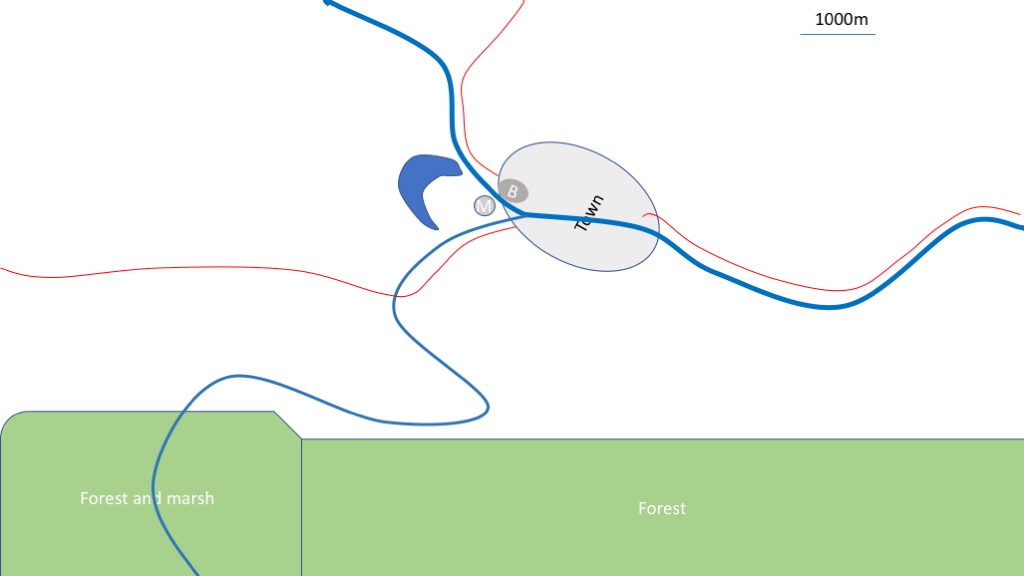
    Ibara is a small town of perhaps 1500 people built at the fork of a river. A stream from the great forest to the south and the highlands to the north join here before taking a more sedate course eastwards to the sea, along the road the PCs had taken from Inorat. Ibara stood at this confluence, with most of the town sprawled over the northern banks of the rivers and a small portion on the southern side. The town’s Bailey rose from the north bank of the river, built on a natural rise that ran perhaps 300m along the river bank. The Motte stood on the south side of the river in the fork, connected to the Bailey by a strong wood and stone bridge. The area west of the Motte was partially protected by an oxbow lake and a wide marsh linking the two streams, so that attacking from the west would require wading through sodden fields and reeds. In this marsh the people of Ibara harvested their famous frogs, while in the farms on the eastern side of the town they grew corn and barley. The town itself was surrounded by a low and largely decorative palisade, and the Bailey barely maintained its basic defensive structure, because Ibara had not been seriously attacked by deepfolk or any other major force for perhaps a century.

    The PCs entered the town towards late afternoon under a light rain, and took accomodation in a hotel called the Precipice that stood on the rise next to the Bailey, commanding an impressive view of the river below and the looming Motte. They took dinner with Tuya, his “niece” and assistants, and here deployed on him the lie that they had determined to use to escape his watch for the two days they needed to go and find Verbere’s iron stash. They told him that Yoog’s poison remained bad, and that they needed to travel outside of town to find certain herbs and other materials necessary for an elven cure that would work against the poison and finally rid Yoog of it. They guessed it would take two days – one to go to the area where the herbs could be found and one to return. Hugo Tuya’s “niece” perked up at the possibility of two days resting in town, and as they had expected Hugo Tuya agreed to the plan in order to placate her. They would set off early the next morning while Tuya enjoyed a day’s rest in the hotel.

    The iron

    The next morning, bright and early, the PCs left Ibara heading north east to find the location of the iron cache. They traveled all day to the approximate area noted on the map that came with Verbere’s letter, reaching it towards afternoon as the second of the season’s storms began to roll in from the sea. Against the increasingly heavy rain and the driving winds they searched calmly and patiently for clues, losing energy and patience as day darkened to night and their clothes and equipment became soaking wet.

    Finally, after some hours of searching, as the sun sank below the horizon and the storm crouched angrily over the forests, they found a small path leading off the main trail and into a dense patch of trees. Something about it resembled the notes on their map so they struck inward, pushing through dripping branches and slipping and sliding on the mossy ground until they broke into a small clearing on a slight rise. Here the trees drew back from the high ground, seeming strangely twisted and stunted, and they found a circle of four rough-hewn stones standing at the four compass points, just as the map had promised. In the centre of the circle a large stone lay on the ground, partly submerged and slippery with moss. All the stones were ancient, cracked and worn, but clearly placed there by someone. Tuya’s guards gathered at the edge of the circle, staring at the ominous standing stones in the dim circle of light thrown from their lanterns, and looked uneasily at each other. Lightning flashed overhead and the trees creaked and rumbled in the heavy wind, but the centre of the stone circle felt still, as if somehow the wind had blown around it. Somewhere beyond the comfortable orange circle of light from their weak lanterns a shadow moved, and Itzel jumped at the though that something stalked them.

    Still, there was iron to be had. They moved to the location the map noted and began to dig. Using the bone pick and rough scrap shovel they had bought in Ibara the going was initially difficult, but after perhaps an hour they opened a hole into some kind of underground chamber, and suddenly a large section of ground collapsed, dragging Calim knee deep into the ground and revealing a low-ceilinged room beneath the rise. The room stretched back underground into darkness, and in the faint light of the lanterns held above him Calim could see bones gleaming white on the ground. He looked up into the shadowed faces of his colleagues standing around the rim, suddenly framed in stark brilliance by a flash of lightning, shrugged, grabbed a lantern, and began to crawl inside.

    Once in the room the earth above stilled the sounds of the storm and he found himself in a cold, dark, damp cave. The floor was littered with white bones, obviously humanoid, perhaps mostly arm and leg bones, that had been scattered seemingly with no order and purpose across the whole space. Strange, whispering sounds emerged from the darkness beyond his weak lantern light but when he moved towards them and shone the light inward all he could see was the dark wall of earth at the back of the cave. He moved in a little more, doing his best to resist the urge to flee, and saw it: an oiled leather sack leaning against the standing stone. He slithered forward through the wet earth, trying not to touch the bones, until he could reach out and grab it. Behind him the light of his colleagues’ lanterns disappeared in the gloom, and all he had was his own weak orange light to press back against the whispered warnings and strange sounds coming from the darkness. Telling himself it was just some strange sound effect from the storm, perhaps channeled down from the stone above, he dragged the sack forward. It clinked satisfactorily and carved a track through the dirt with its weight. Grunting with pleasure, Callim began to drag himself backward until he saw his friends’ light again. He scuttled backward rapidly then, dragging the sack with him, and was relieved to emerge back into the orange glow and feel the cold rain on his face. They helped him out of the hole and gathered around the sack. Inside, as they expected, they found 10 perfect ingots of high quality iron, stamped with a horrid emblem of a leering skull. It must be a deepfolk emblem.

    In any case, they did not care: they had iron! They hurriedly filled in the hole they had made, packing it so it would not collapse again as it had done when they had first dug it open, and scuttled back to the road, casting anxious glances over their shoulders at the strange, silent circle of stones. Who had built it? What was buried there and why? Why had Aveld the Foul been there, and why had he left the iron? Questions to be asked in the sunlight no doubt.

    The greed and the lies

    They spent an uncomfortable night huddled on the road in the waning storm, and woke early the next day to clear skies and reassuring sunlight. They set off early after a cold breakfast, and returned to Ibara by mid-afternoon with their treasure carefully hidden on Itzel’s faun[1]. They bathed, rested, and carefully secreted the iron where they hoped Hugo Tuya would not see it by accident, but in the late afternoon their careful activities were interrupted by a messenger from the hotel staff: a woman waited to talk to them downstairs.

    Not expecting visitors, they dressed quickly for a meeting – carefully managing to remember not to wear armour or carry weapons – and descended to find a harrowed, tired-looking middle-aged woman waiting for them in the hotel restaurant, a brace of ales sitting on the table with her. She bade them sit and introduced herself: she was Verbere’s widow. She had heard they returned from breaking a bandit group and wondered if they had heard of him? He had set out some days ago “to make some money” and had not been seen since.

    They said they knew nothing of such a man, but she told them about his treasure box and they admitted they had it. They handed it over to her, and she opened it to read the letters. Once she learnt of the iron she explained to them that she and her husband had fallen on hard times and really needed this iron to escape from debt, which was why he had left to find it. The bandits must have killed him and stolen the iron – had they found it in the bandits’ possession? They told her no, they knew nothing of it[2].

    Then, she concluded, it must still be buried at the site noted on the map. She asked them if they would be willing to go and get it for her, and split the proceeds of selling it? They requested time to confer and then decided as a group that no, this iron was theirs, not hers, and they would not share any of it with her. They returned to the table and told her that though they would like to help her they could not: they were contracted to Hugo Tuya and could not, sadly, accept a double contract. So it was that sadly they must decline her generous offer. Perhaps someone else could help her? Calim and Bao Tap gave her a little money to tide her over while during her difficult time, and they again apologized sadly for not being able to help her. She gave them a resigned expression of disappointment, and left them to their ales.

    They had lied to a poor bereaved woman, while upstairs her dead husband’s armour lay in their closet along with the treasure he had died searching for. Had that been wise? And had it been worth it?

    They concluded yes on both counts, and did not think on it further. The iron was theirs and the past, like Verbere, was dead and gone.


    fn1: Itzel is an elf, and has a small deer-like creature as a beast of burden

    fn2: A small Genesys rules footnote here. When the PCs buried the hole in the ground they did a check to make sure they properly covered it, and they rolled two advantages. I asked Kyansei’s player how to use the advantages, and she said they enabled her to shore up the hole so that it would not collapse if dug into again. She did <em>not</em> say that she covered it up so that it was not clear it had been recently disturbed. So should Verbere’s widow lead an expedition to the cache in the next few days, she will no doubt discover that it has been very recently dug up and the iron taken. She may even see the drag marks in the underground chamber from Calim’s amateur efforts at moving the iron. It won’t be hard for her to figure out what that means, and who knows? Maybe she can rile the town up in defense of her recently bereaved husband’s legacy. Would she do that? I guess we’ll find out in session 4 …

  • I am made of stone
    Walk the narrow line where nothing cuts you
    Deeper than your own blade
    I am the storm, my voice is the river
    Take from me I fade into you
    Fade the warriors, fade the black world into this fairytale
    Fade, take to the sky

    – Eilika Tribe meditational (Before the Battle, Psalm 4)

    Hugo Tuya’s Guards have been attacked by bandits on the road to Ibara, but drove them off in a short and vicious battle. They now collect themselves, check their charges, and prepare to follow the surviving bandits to their camp. The roster for today’s adventure:

    • Bao Tap, human stormcaller
    • Calim “Ambros” Nefari, human rimewarden
    • Itzel, elven astrologer
    • Kyansei of the Eilika Tribe, wildling barbarian
    • Quangbae, human explorer with an interest in crafting and metalwork
    • Yoog, changeling scoundrel on the run from a job gone wrong

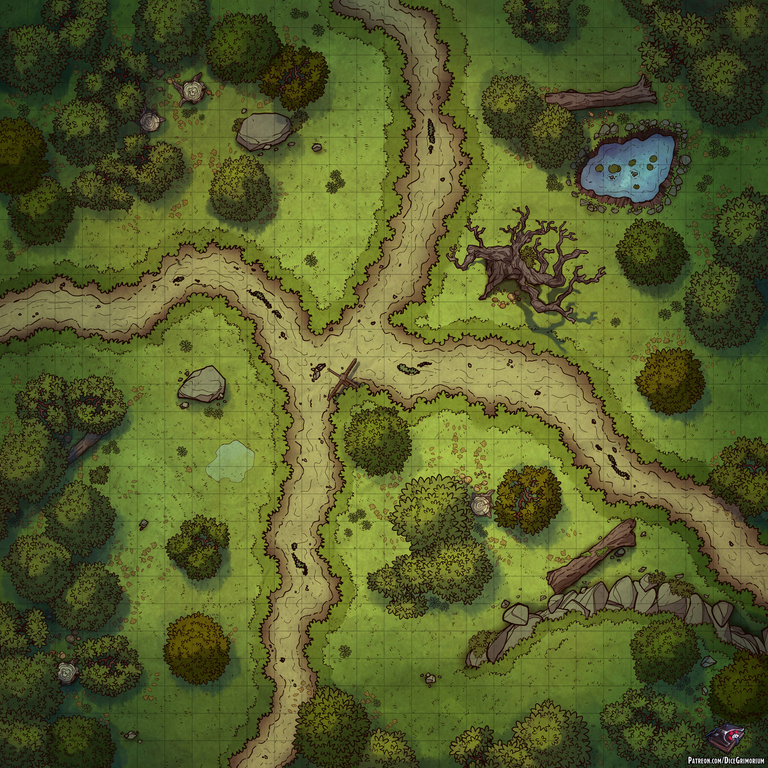
    The guards think there is money in this, and perhaps some stolen treasures, so they quickly organized themselves. Calim tried his medicine skills on some of their wounds (thankfully light) and failed, and then they set off after the fleeing bandits, following their fresh tracks back along the road to a narrow trail they had not noticed on their journey. They cut into the woods and followed the trail up a gentle slope until they reached the bandits’ camp, nestled amongst maple and alder trees perhaps half an hour’s walk from the road.

    The bandit camp

    The camp was a ragged collection of wagons and tents arranged around a central fire and table. They had obviously been based here a while and were not planning to move on – it was not even clear how they had managed to move the wagons (no doubt stolen) into the small clearing in the first place. Hugo Tuya’s Guards approached carefully, but it was obvious that the camp was largely unoccupied. The two guards they had chased were hiding behind wagons near the entrance to the clearing, bows in hand, waiting for the inevitable.

    They attacked. Their plan was simple: they fired their bows into the camp and then Kyansei charged forward into battle. Unfortunately they had underestimated the numbers and guile of the bandits. There were six more hidden in the forest, who opened fire as the battle started. Their leader was also lurking in the trees, firing his bow. Within moments Yoog and Quanbae were brought down by arrow fire, and the situation began to turn against the guards. Fortunately they had Kyansei, who tore into one group of archers and killed them very quickly, while Calim and Bao Tap tussled with the leader. Behind them Itzel cast shrouds of fire on the warriors, hoping to burn their enemies. It worked, and after a few more seconds of brutal hack and slash the battle was over. All but one of the bandits lay dead, and the camp was theirs. They took the final bandit captive and searched the wreckage.

    The treasure box

    They found little to justify their valiant attack: a few coins, a suit of leather armour and a healing potion. At the back of the tent they found a dead semi-naked man but with characteristic sense did not bother to investigate the cause of his death. On the table in the centre of the camp they also found a small, well-crafted box that appeared to be of dwarven make, and unopened. Yoog, just recovered from the battle, attempted to pick the lock on this box and opened it easily, but also was struck by a small needle trap. The poison began working immediately, and Yoog sickened horribly[1].

    Inside the treasure box was a map and a letter. They read the letter:


    Siladan the Elder

    Sundered Cliffs

    Third watch road, the red house


    23rd of the Harvesting, 1011

    Verbere of the Flame

    Ibara

    My dear Verbere

    I confess to some trepidation in writing this letter, for I know how deeply you felt Ashen’s loss and you blame me for it. I hope you will read it with a milder heart than 20 years hence, and will accept this token of remembrance and restitution for my mistakes.

    I hear you are living comfortably and quietly in Ibara, with a good wife and family, and plying your trade still though in quieter and humbler manner than during our fiery youth. I do not pretend to believe that you care about my current situation, given the manner of our parting, but I tell you briefly that you may sense whether to trust my information. I have taken a position as archaeologist in an Academy in Estona, where I teach a little and also do a little research. After our parting I gave up on harsh living on the road, overcame my anger at the academy, and finished my studies as an astrologer. Here then, you see I know something of what I speak.

    I have learnt in my studies that near Ibara there is a small cache of deepfolk iron, pure in form, cast in ingots, that was left forgotten there some centuries ago. I stumbled on word of it in the footnotes of a scholar known only as Aveld the Foul. Why he left it there I do not know but Aveld the Foul was a famous coward and endowed with a sixth sense for danger, so it is unlikely he would have found it if there were any risk. Perhaps a raiding party stashed it and fled, then died before the knowledge could be passed on, and perhaps Aveld the Foul left it there because he had no strength to carry the load. In any case, whatever the reason, I know the land around Ibara is safe and little-traveled by deepfolk, and no rumours have come to me of walkers, so I give you this information freely and ask nothing of you in return – not even a response to this message – except to hold some kindness in your heart for me as you grow older, and remember me for the better things we did together, and not for that tragic last night in the hills. I hope this small token of my regret for those events will help you in your future, though I hold no hope that it will soften your hear to me.

    I owe you at least this. The map is copied from the notes of Aveld the Foul, and I expect it will take no more than a day or two from Ibara to find the cache. From Aveld’s notes it is not so heavy that you will need a horse, but worth considerable amounts regardless. My best wishes to you and yours, and know that I remain ever,

    Your comrade in arms

    Siladan the Elder


    So, there was a treasure buried outside Ibara, the very town they were heading to. All they needed was perhaps a day of spare time and they could liberate it. It appeared that this “Verbere”, whoever he was, had gone to find the treasure and been ambushed by these bandits – at first the guards assumed it was his body in the ditch, but their captive informed them that the body had been the bandit who first tried to open the box. Now all the bandits were dead no one knew about it – except perhaps Verbere’s wife and children, but what did they matter? The guards packed up what they had found, tied a rope around the sole survivor’s neck, and trooped back to the wagons. They were just a few days away from riches, and the glorious fame that awaited bandit hunters in Ibara!


    fn1: I don’t know anything about poison rules in Genesys yet, so I just made it up. Basically you do a hard resilience check every hour and if you fail you take a crit. The first two crits Yoog took were pretty nasty, and I’m using this house rule that if the number of levels of your crits is greater than your wound threshold you die, so pretty much within 4-6 hours Yoog was going to be in big trouble

  • Hadun Bay from the shores of Inorat

    This the first session of the new campaign I am running, set in the Archipelago. The campaign begins in the small town of Inorat, on the east coast of Hadun just north of the great forest that separates Hadun from Ariaki. The PCs as a group do not know each other, but all for their own reasons have joined a merchant’s caravan as guards. The PCs are:

    • Bao Tap, a human stormcaller who was raised by dwarves but abandoned by his dwarven farmer on the coast near Inorat with instructions to find his own way in life
    • Calim “Ambros” Nefari, a human rimewarden who is something of a playboy, possibly in need of urgent work to escape a tricky situation with a local man and his wife
    • Itzel, an elven astrologer who emerged from the great forest to explore human lands, and only discovered on arrival in Inorat that when in human towns elves need money just like humans
    • Kyansei of the Eilika Tribe, a wildling barbarian looking for clues to a strange blight afflicting her tribal lands, and seeking travel to the Spine to begin learning about deepfolk and deep magic, which she suspects are responsible
    • Quangbae, a human explorer with an interest in crafting and metalwork, who has attached himself to the merchant caravan because it is run by an iron trader
    • Yoog, a changeling scoundrel on the run for a job gone wrong, and looking for obscurity in the wilds of Hadun for a short time

    The caravan the PCs are guarding is owned by a merchant named Hugo Tuya, and for the rest of the first chapter of this campaign our heroes will be known as Hugo Tuya’s Guards.

    Hadun Bay from the verandah of the Simpering Maiden

    Meeting Hugo Tuya

    The campaign begins in Inorat. Inorat is a small fishing town of perhaps 15,000 people with a long beach, surrounded by cornfields and within view of the distant great forest. The characters were interviewed for their escort work on the last day of the Drying Season, each visiting Hugo Tuya separately in a small interview room in a hotel called the Simpering Maiden and receiving the same story:

    I need a small group of guards to protect my caravan. I’m taking a shipment of iron from here to Estona on the far side of Hadun. I want to arrive before the Traveling season, when demand is high, so we set off immediately after The Harrowing. It’s a peaceful journey but we will pass through a small pass in the southern Spine called the Middlemarch. It’s a little known travel route but relatively safe and only a few days’ journey, but I need guards just in case. I have no upfront payment but you will get an installment before Middlemarch, when we arrive at the town of Estala. There will be three people in the caravan: me, my wagoneer, and a cook and assistant. I expect the journey to go smoothly but you will be my insurance should anything go wrong

    All having their own separate reasons for needing an urgent job despite the lack of upfront payment, the PCs agreed to his terms, and spent the three days of prayer and fasting that followed in relative peace of mind. On the third evening of The Harrowing they met Hugo Tuya and each other for the first time at the Simpering Maiden to break their fast, introduce themselves and discuss details of their mission.

    Hugo Toya was a relatively tall, thin and slightly out of shape middle aged man, with straggly white hair cut in the shoulder-length bowl typical of his merchant class. He wore a simple tunic and trousers of comfortable cotton, and held himself in the party with the comfortable and easy manner of a man used to being treated with respect and deference wherever he went. The meal itself was pleasant and enjoyable, a fine spread of small dishes including the steamed shellfish in which Inorat specialized. Though the storm season would officially start in the morning the sky over the sea was clear and the weather comfortable, so the verandah doors had been thrown open to allow them an uninterrupted view of the Hadun Bay. In the cool evening air they discussed the mission, and Toya again assured them that the Middlemarch was safe, obscure and relatively little traveled. He again pressed upon them the urgency of his mission: people usually did not travel in the Storm season, and by the time it ended there was often a need for iron trade on the west coast, where maritime trade almost completely stopped for the month. By arriving nearly at the end of the Storm season they would be the first on hand with iron for a depleted market, with rich pickings to be made before other merchants could arrive.

    Doesn’t matter the weather, everyone needs horseshoes

    Tuya observed, and they nodded at his business acumen. Minor discussion followed about itineraries and camping and who would take what role, but in truth it seemed easy, at least as far as Estala, and they soon relaxed to enjoy light conversation and the pleasures of the sea at dusk. With the last flash of evening light and the emergence of the Whalestar on the Eastern horizon they called it a night, and left the table to make ready for an early start.

    A typical traveler’s hut

    Storms and travails

    They gathered at the west gate of the bailey early the next morning, to find two women sitting on the rear folding gate of Tuya’s wagon. They introduced themselves as Selena, Tuya’s niece, and Laeia her maidservant. He had not mentioned this and indeed when he emerged looking hungover and exhausted from the cart he seemed none too happy with their presence. Atta, too, Tuya’s likeable and well-mannered assistant, also seemed somewhat perturbed by their presence, though he was too circumspect to say anything. They took it in their stride and headed out, just an hour or two later than expected, to begin the journey. Their first waypoint was Ibara, a small town of some 2000 souls about 4-5 days’ travel inland.

    The day’s travel was uneventful, with the guards taking turns on point duty, the girls riding on the back gate of the wagon, and Tuya nursing his hangover inside. They arrived at a small hostelry before sundown and settled in to rest. The hostelry was a typical country rest for this area, the main building cut slightly into the ground so that they had to walk down a few steps into a dark, cozy alehouse. The building was ringed with a low wall of stone fragments topped with broken glass, and the stables were a covered space next to the main building. They slept in semi-private rooms on a balcony overlooking the dining area, their rooms separated by thin walls of bamboo and hanging curtains on the doors. It was during that night’s rest that Kyansei discovered Selena was not Tuya’s niece, and judging from the sounds coming from their cubicle had a much closer relationship. She had seen his marriage tattoo on that first night at the Simpering Maiden but she guessed Selena could not be the beneficiary of that promise, judging by the age of the tattoo. Perhaps this was why Tuya had been so unhappy to see Selena at his staging point in the morning – had he been hoping to give her the slip? Was his wife waiting for them at one of the towns on the road?

    The next morning, tired and dispirited, Kyansei tried to explain the situation to the rest of the guards, though her language skills were still weak. They let it slide, and continued the journey. What harm could it do, really, and what business was it of theirs?

    By mid-afternoon they had lost sight of the sea, and the road was winding through rough terrain on the edge of the forest. Behind them the sky darkened and the first storm of the Storm season blew in. It gained on them rapidly, stealing the light and assailing them with strong winds, and by late afternoon Kyansei was sure it would reach them before dark. For this night their plan had been to sleep rough, so they broke their forward march and scoured the area for somewhere to hide from the storm. They soon found an old traveler’s hut, a little distance removed from the road and seemingly abandoned, nestled among some low hills that might provide shelter from the worst of the storm. They hastened their animals into the lee of the hut, someone gathered water, and they managed to retreat inside the hut just as the rain began to pound the broken ground of the wasteland around the road. The storm settled in an hour later, casting the land in darkness and raging over their hut, but snug inside they slept well, and woke refreshed in the morning to a clear day. They returned to the road.

    The ambush

    The road was joined by a stream after an hour or two of travel, and having wandered away from the verge of the great forest entered into an area of scattered copses of trees. Many of the trees had been damaged by the storm, and leaves and broken branches littered the road, so at first they did not think much when they found a fallen tree blocking the road  – it was storm season, after all. However, as they began to cut it apart to make way for the wagon one of them realized its base appeared cut with an axe of some kind, not lightning struck, and they realized they were in a trap. They began moving back to the wagon for their weapons, and the trap sprang shut.

    Arrows flew from the trees on both sides of the road, some hitting Kyansei and some falling harmlessly around the wagon. They all scrambled back for weapons and cover and the fight began. There were archers in the trees up a small slope on the right side of the road, and more hidden in the trees across the stream on the left side. Kyansei charged the archers across the river and while Bao Tap, Quangbae and Callim moved to take on the ones on the near side. Yoog moved into a covered archery position while Itzel attempted to cast a fire armour spell on her allies, failing miserably. Those crossing the river failed, and stood trapped in its strong flow as arrows rained down on them; on the other side of the bank Quangbae found the archers and began to attack them with his club. Kyansei dragged herself out of the stream, catching sight of the archers as she flopped onto the bank, and made short work of them when she caught up to them. As the archers wilted under their attack four more men emerged at the far end of the road, charging for the wagon and the unarmed Tuya. Yoog fired on them, bringing them up short for a moment and giving Callim time to intercede. By the time the four men reached him Kyansei had dragged herself across the river and thrown herself into the fray, wreathed in fire from Itzel’s spell, and Quangbae had finished off the archers on his side. The four men were rapidly cut down to two and, seeing their fate written in the salt, turned to flee.

    The guards watched them go, caught their breath, and prepared to follow. Bandits should be scourged, and where there are bandits there is always money. They gathered together and hurled themselves down the road after the fleeing fighters, rage in their fists and coin in their eyes …


    Image notes

    The seascapes are from the Instagram accounts of Christina Mittenmeier and Morgan Massen. The hut is from the instagram account of Alexey Gupolov. I recommend following all of them!

  • Distance  Separation
    Leaving  Terra Firma

    Darkness  Ringing empty
    Lights out  Resurrection

    Burn it down and start over
    I want to leave this all behind
    Abandon all the trepidation
    Weighing heavy on my mind

     – Catechism of the Cult of the Dancer

    Our heroes have ground their way through waves of soldiers defending the secret base of Samina’s Corsairs. Having destroyed more than 40 enemies, they stand in control of the elevator hall that leads to all levels of the remote star base, ready to descend to their final confrontation with Samina and her few remaining soldiers. The roster for this (last) session:

    • Clementine, technologist
    • Siladan Hatshepsut, archaeologist and data djinn
    • Dr. Banu Delecta, medic
    • Al Hamra, captain and mystic
    • Adam, soldier and gunner
    • Saqr, pilot
    • Kaarlina, mystic and technologist

    Oliver Greenstar remains on the Beast of Burden, ready to leave and warn the world of the corsairs’ location if the rest of the party are killed.

    The PCs had been given floorplans for the corsair base, so they knew that the level above their current location was a public area, gardens and a few rest spaces. Immediately below them was the station’s main hangar, a space 100m long, 200m wide and 40m deep. Below that was a residential level, almost certainly mostly empty now they had killed nearly all the station’s guards, and below that the secret prison and medical level where Samina herself lived and worked. They needed to get down there, but only one elevator went all the way down and they could not fit their whole team into it. Two other elevators descended to the level below the hangar, and they could fit their whole squad into those two, then transfer to the elevator that went all the way down, and travel to the last level in two trips. They decided that Kaarlina would use her technomancy skills to control all the lifts, sending them down to the sub-level but sending signals to the central computer to indicate they were going up. They would skip the hangar and head down to surprise Samina in her lair while she thought they were heading up.

    The monster in the hangar

    Unfortunately their strategy failed, because Samina took control of all the elevators over Kaarlina’s mystic powers, and opened them all one level down, in the hangar. The doors opened into darkness, lit only by the faint red emergency lights in the elevators, and by one or two of the party’s suit lights. In the faint glow of these lights they saw a huge hall stretching out into darkness, scattered with crates and equipment in seemingly random piles around the elevator shafts. Somewhere nearby they could hear sounds of sniffling and desperate breathing, and the air of the room seemed to be faintly misty or suffused with a fine smoke.

    This fine mist saved their lives. Adam saw it first, a beam of laser light questing towards them through the mist, and in the last moment realized there was a sniper about to target them. Since he was in overwatch he immediately opened fire, sending a wave of automatic fire in the direction of the laser. Clementine followed him but neither could hit their target, and a moment later a wave of thermal energy struck Adam in the head, almost shredding his remaining ear. Saqr, also in overwatch and carrying an accelerator rifle, fired along the line of the beam and killed the sniper with a single shot as the rest of the crew piled out of the elevator and into cover.

    It was as the first of them began to emerge from the elevator that they saw it: a huge, hulking figure in the darkness just beyond their vision, charging towards them. It stopped and raised an arm and a moment later one of their entire teams of support marines died, cut down by a wave of thermal energy. Moments later the beast rushed into the light, and they saw what it was: an automaton constructed out of the twisted, still-bleeding and twitching bodies of Samina’s remaining soldiers. Two men in battle exos had been slaughtered and draggd into the mess of flesh, to be surrounded by the twisted bodies of 12 other men. It had misshapen, thick legs and arms wielding huge thermal rifles, with two more arms holding massive axes compiled from all the crew’s dura swords. Lights flickered inside the frame of its twisted flesh, and strange machine noises came from its joints and chest. It roared and stumbled forward.

    Out of the elevator to meet it came Siladan, walking now in his own battle exo and eager to put its powers to the test. He surged forward and hit the thing in the chest, stopping it in its tracks, and the two began a monumental battle on the floor of the hangar. As they fought Adam, Clementine and Kaarlina poured rifle fire into the beast, seemingly doing nothing. Saqr could not join the battle, however, because moments after the marines in front of him were cooked to death by the beast’s weapons they reanimated as darkbound, undead humans bound by the Dark between the stars, and turned to attack him. Though they struck at him only with fists, they blocked his exit from the elevator and he was forced to deal with them before he could leave.

    As the battle raged Al Hamra moved away from the elevator to the source of the sniffling, finding one of Samina’s soldiers crouched behind a crate, weapon at his side, panting heavily. Al Hamra wasted no time in conversation, going straight to mind reading using his mystic powers. The images that poured from the distressed soldier’s mind confirmed his suspicions: Samina had gathered all the soldiers in the hangar and enacted some horrific ritual that had slain them all and drawn them and their equipment together into the monster before them. Two of her soldiers, seeing the deaths begin and realizing they were betrayed by their own master, managed to break her mental control and flee, hopeless though this act was; now they crouched in the dark of the hangar, waiting to see which side would prevail in the battle and who would hunt them down and kill them.

    Al Hamra saved this man the wait: he dominated his mind and sent him in to melee against the beast, in support of Siladan. The monster had been briefly stunned by Siladan’s first attack but soon recovered, unleashing some kind of mental blast that staggered Siladan and stunned him. It then smashed him once with one fist and marched past him to kill more marines. By the time Siladan could come back to melee the beast had beaten down the remaining marines and was in melee combat with Adam, smashing him with its fists as he tried to stab it with his dura knife. Fortunately Kaarlina had disabled its dura axes, so it could not cut through his armour the way it wanted. Adam had done furious damage on it with his machine gun, and in its rage it tried desperately to kill it as Siladan struck it with his dura halberd, Saqr fought off the darkbound that trapped him in the elevator, and the others poured fire into the beast’s heavily-armoured back. At the same time Samina poured healing magic into it from her remote location, somehow keeping it upright despite all the damage it endured.

    Finally, however, Dr. Delekta was able to put a bullet into its back somewhere vulnerable. A battery pack from one of the absorbed battle exos exploded and the thing fell dead to the ground. They quickly killed the darkbound attacking Saqr, and the battle was done. All of Samina’s remaining soldiers lay in a rotting heap on the hangar floor, along with most of the party’s marines and almost all of their remaining sanity.

    The Cadaver Clock

    They rested briefly, Dr. Delekta providing medical care to the injured members and Saqr easing their wounds with his mystic powers. Al Hamra gathered the two corsairs who had escaped the ritual and gave them a choice: join their sole remaining marine in helping them clear out the base, or die. They took the better part of the choice, and once everyone had restocked and taken a breather they took the elevator down to the bottom level.

    Following the marines’ instructions they passed a prison, where they found four starving victims of a past raid, who they released. They moved on to Samina’s personal quarters, at the back of which they found a tunnel leading down through the rock. They followed it, and at the bottom rushed into Samina’s lair.

    Their three marines died as they entered the room, brought down by Samina’s mystic powers, but the rest of them were able to break into the room before she could act again. She stood in the centre of a terrifying construction of cogs and chains, arranged in a large rough-cut stone chamber. The cogs were ancient iron, embedded in the wall and connected with a complex network of heavy old chains. At points around the network of chains dead bodies were hung from the chains by meat hooks, slowly rotting and suppurating in the slightly stuffy air of the room. On one side of the room stood an ancient stone altar, covered in dried blood. In the middle of the room, under the dripping corpses, stood a collection of plinths of different heights. On two of these plinths stood the strange ugly statuettes of the dancer, and between them stood Samina. She was tall, impossibly skinny, obviously old but not worn or wrinkled. She wore simple silk robes, her hands empty and free, and looked at them from dark, deep-set eyes.

    As they came to a halt in the room facing her, the collection of cogs and chains shuddered and the entire apparatus took a single, lurching movement according to some strange geometry. A loud tick! rang around the room as all the cogs turned over once, the bodies shuddered and jolted on their hooks, and a drop of rotting gore fell onto Samina’s cheek.

    She ignored it, and said to them, “I am your only way out of this darkness.”

    They ignored her, and opened fire.

    The battle was short but almost deadly for them. At her waist Samina had a gravitic sink, which absorbed the first four shots from their weapons. She unleashed a dark mystical energy from her cadaver clock, which wracked their bodies with pain and, had she had a second chance to unleash it, would surely have killed them all[1]. Fortunately before she could do so her gravitic sink expired, and they slaughtered her where she stood.

    Epilogue

    They searched the base and found a huge stock of money and artifacts, which they stole. They should have rushed to escape before the portal out of the area degraded, but Al Hamra announced that since he had died twice and his soul was trapped inside a machine, he chose to end his time here. He would use the cadaver clock to hold the gate open until they all could flee, and then wait in the dark until his batteries powered down. He gave a stirring speech that convinced all the PCs that their captain would choose to die in this dark and lonely rock, but all the players knew that Al Hamra was going to use the cadaver clock to become the next Samina.

    They left, having destroyed the corsairs that had plagued the Horizon for 30 years, and became fabulously rich and famous selling off their story and success across the Horizon. All that remained was to recapture the space station they had lost to an Efrit, and to establish their new Order, a movement committed to hunting down and killing evil mystics.

    Here the Coriolis campaign ended, after 41 sessions. A challenging, bloody and sinister ending to an excellent 18 months of gaming!


    fn1: The first wave of the attack did 7 damage I think, though I rolled very well, and it was pretty likely that the second one – due after three more actions – would finish the job. I rolled randomly for the gravitic sink’s charges and got 4. Had it held two more, things would have been dire, especially since her dancer’s talent guaranteed she could evade Siladan’s halberd. I did warn the group that I was happy to end the campaign on a TPK, but actually that was a lie: Oliver Greenstar was going to rescue them at the last if Samina prevailed.


  • Give yourself unto your god
    Sacrifice yourself again
    Burn your thoughts, erase your will
    To gods of suffering and tears
    Tie hallowed bonds around your hands
    Kneel before this seat of shame
    To gods as lost, gods as blind
    Gods of suffering and pain

               – Catechism of the Dancer Cult

    Our heroes have invaded the sanctum of Samina’s Corsairs, which is the home of an ancient, vile and long lost cult to a degraded form of the dancer. At its heart is Samina, a powerful mystic who possesses all the secrets of her long lost and abominable cult, and uses them to guide a vicious lair of pirates in raids across all of the Third Horizon, striking safe from within their asteroid base far outside of any star system. Our heroes have found this base and aim to kill Samina and tear down her cult; between them and her stand her last few score soldiers, their leaders and champions in battle exos. Dominated by Samina’s mystical powers, they feel no fear and throw themselves into the defense of their leader, which is why the PCs have already slaughtered 36 of them in a vicious battle at the docking station where they entered the station. Now they must move on, and begin to penetrate the base. There remain 32 soldiers, with 4 leader and 4 champions in battle exos. The roster for today’s mission:

    • Clementine, technologist
    • Siladan Hatshepsut, archaeologist and data djinn
    • Dr. Banu Delecta, medic
    • Al Hamra, captain and mystic
    • Adam, soldier and gunner
    • Saqr, pilot
    • Kaarlina, mystic and technologist

    In the docking station battle Al Hamra had taken control of the mind of two of the leaders, and used their voice to tell the station’s central command lies necessary to buy the team a little time. Now they stood among the ruins of the battle, in a smoking and bullet-scarred welcome area, injured and exhausted. On one side of the room Al Hamra’s droid body lay smoking and sparking, shattered beyond repair. They had perhaps one hour to transfer Al Hamra’s consciousness to their last remaining drone, attach a weapon to it, repair several jammed weapons, rest, and heal minor injuries.

    They set about this task with resigned exhaustion, catching their breath as they cleaned up, reloaded, and repaired. Al Hamra successfully transferred to a new droid, to which Siladan attached a thermal cricket pistol, with a spare reload; further reloads would require someone to attend to the machine. Dr. Delekta provided medical care, and Saqr risked the Dark between the stars to heal a groin injury on Adam that threatened to wear him down before they had traveled too much further. They all rested, recovered their wind, and prepared to push on.

    From the docking station a corridor ran perhaps 100m to a central elevator shaft. They guessed a large contingent of soldiers would be waiting for them there, and they were right: a brief scouting excursion by Al Hamra confirmed 8 soldiers, a leader and a champion in a battle exo. Kaarlina took control of the blast doors facing them using her mystic powers, they prepared their moves, and triggered the battle.

    Al Hamra used his droid movements to trigger the door to open, and used his mystic powers to take control of the mind of the exo champion, forcing it to fire on the soldiers’ leader. Saqr threw in a grenade and Adam fired a rocket at the main team of soldiers.

    At least that was the plan, except that everyone in the room was on overwatch, and as soon as Al Hamra triggred the door a nightmare storm of vulcan shells, thermal blast and accelerator slugs poured through the door. One of their teams of soldiers was eviscerated and several of them took damage before Adam could squeeze off his rocket, which eliminated several of the soldiers. They charged into the room to find cover where they could while Al Hamra dominated the champion in the exo suit, and the battle began. Reinforcements immediately began rising up one elevator, which Kaarlina stopped with her mystic powers, but they were not able to stop another elevator, which arrived after a short time bearing the Oracle, the old man they had fought in Hamurabi station. He dominated their other marine team and turned it on them, but fortunately the dominated exo champion was there, and was able to immediately melt the Oracle to slag with its thermal rifle.

    By the time they had dealt with the remaining soldiers in the room more reinforcements had arrived in a third elevator, but by now they were ready. They set a careful cordon around the elevator and destroyed the entire team as it rushed to emerge. Within seconds the entire team lay smoking and bleeding on the floor, and by Siladan’s count they had slain another 16 soldiers, two champions in battle exos, and all but two remaining leaders. Very few of Samina’s fearsome corsairs remained.

    They checked their weapons, tended to their wounds, and prepared to head down to the final showdown. They would burn this whole cult and destroy all its hideous ancient secrets, or die trying.


  • Today’s looming disaster

    Where I live in Japan mask-wearing is now pretty much universal – almost no one goes out in public and to see someone without a mask on in public is a kind of shock. The economy reopened after lockdown, in Tokyo, on 23rd May, on which date the number of cases had dropped to 5. Today the Tokyo Governor’s office released the daily update on COVID-19 (pictured above), and we have now returned to 107 cases, with the 7-day smoothed average hitting 65. Depending on how charitable you’re feeling that’s either a 21-fold or 13-fold increase in cases in 5-6 weeks. At its most charitable then we can say that cases have been doubling every 7 days. Today’s peak of 107 cases comes pretty much 5 days after the Tokyo government allowed bars and night clubs to reopen. All of the personal measures we have been asked to adopt – maintaining social distancing, wearing masks in public, and reducing our social interactions, have amounted to a hill of beans. In particular I think mask-wearing has been a completely useless strategy, and worse than that, I think the misguided possibility that widespread mask use will prevent transmission has led many countries to take unnecessary and stupid risks with reopening their economies. This is particularly tragic in the case of Tokyo, because Japan had a very good early response to the epidemic and Tokyo was down to just 5 cases when the government ended the lockdown early. One or two more weeks of actually effective strategies would have ended the epidemic in Japan but instead the government chose to begin reopening the economy early and rely on personal behavior change to prevent its spread.

    This was a disaster, and anyone who understands public health should have seen how disastrous this idea is. Infectious diseases are never stopped by individual behavioral change or personal responsibility: they are only ever affected by social changes and policy. We know this from 40 years of responding to HIV, and in this blog post I want to explain how the terrible failures of the early response to HIV should have served as a warning about relying on barrier methods and personal responsibility for preventing the spread of the disease. What is happening in America was entirely predictable based on 70 years of public health knowledge, and it’s a depressing indictment of public health policy-makers that they did not do more to stop it.

    The narrative of mask use and economic reopening

    First let us examine the history of moves to reopen economies from lockdown and the heavy dependence on mask use to achieve this reopening. Some academics at Stanford University recommended mask use as a way to prevent further shutdowns after reopening in late April. In an April 22 news report the governor of Louisiana made clear that mask use was a key part of his reopening strategy:

    It’s just like opening a door for them, or saying good morning or whatever it’s being kind and being courteous, and when others wear masks they protect you. So we’re all in this together. When we all wear masks we’ll effectively protect one another which is why I’m calling upon Louisiana to mask-up.

    The governor of Georgia suggested mask use could help with reopening that state in mid-May. The governing.com website lists individual state’s reopening plans and makes clear that almost every state mandated, requested or advised face covering and mask use as a form of protection in sites that were considered high risk but were now slated for reopening. For example California has moved to Stage 2 of its resilience roadmap, and recommends

    Crowded settings increase your risk of exposure to COVID-19. Wear a face covering or cloth mask, stay 6 feet away from others, avoid touching your face, and wash your hands when you get home.

    Rather than limit access to crowded settings, the government simply advises people to cover themselves and take individual actions to protect themselves and others.

    On 1st July Louisiana saw 2083 cases, a five-fold increase on the number it saw on April 22nd; Georgia saw 2,946, probably a 4-fold increase on mid-May; and California saw 6,497, a 3-fold increase over the number it saw when it moved to stage 2 of its “resilience roadmap”. All these states are now at the inflection point of a major upward surge in cases. All the personal responsibility and individual actions they advised to prevent the spread of the virus have done very little to protect their citizens from this epidemic.

    The scientific evidence for masks and social distancing

    On 1st June the Lancet published a systematic review of the evidence for face masks as a protection against coronaviruses. It found only 3 studies with quantifiable evidence of the effect of masks in non-health-care settings, and pooling the results of these studies found a 44% reduction in risk, which is shown in the figure above. While mask use in health care settings has a very large protective effect (70% reduction in infection, with a narrow range of effect from 57 – 78%), it is nowhere near as effective in non-healthcare settings, and there is little evidence to support it. This is why at the time of writing the CDC still does not suggest there is any evidence for the effectiveness of surgical masks, and why the WHO was unwilling to recommend their use during the early stages of the epidemic.

    Why is there so little evidence and why would masks not work in public when they’re so effective in hospitals? The lack of evidence is because most countries don’t use masks in any disease-prevention way in public, and so it is very hard to conduct studies. The lack of effectiveness probably arises from the fact we aren’t trained to use them: we don’t know how to take them off properly or even which side to place on our face, we don’t treat them as single-use items, we often don’t carry spare ones so we need to lower them in public to eat and drink and then raise them again, they get damp and become ineffective because we wear them too long, we wear the wrong masks for settings with high infection risk, and we don’t combine their use with the regular, intensive and disciplined hand hygiene that medical personnel use. I have recently spent a week in hospital during lockdown for surgery, and the aggressive and disciplined pursuit of hand hygiene was noticeable and completely different to community life. If you don’t know how to use a mask and don’t practice proper hand hygiene it is not much use. Here are some examples of mask use I have seen in Japan, when commuting or wandering my suburb (in a mask):

    • A man pulling his mask down on the train so he can pick his nose and wipe it on the poles people hold
    • People wearing their mask pulled down so their nose is uncovered (so common)
    • People folding their mask up and putting it in their pocket or a bag
    • People putting their mask on a table or other unwashed surface and then putting it back on again
    • People putting their mask on backwards
    • People taking their mask off to use a shared microphone in a public meeting
    • People wearing masks to karaoke and taking them off to sing

    It is of course also impossible to maintain social distance on commuter trains in Japan. I have also noticed that everyone complains that when they wear a mask their breath steams up their glasses, which means constantly fiddling with the mask and wearing it too loose. If your breath is getting out of your mask rather than through it, you are not protecting anyone and you aren’t protected.

    Even if masks were 90-100% effective though, we still know that a strategy of mask wearing will not work. We know this because we tried the exact same strategy for HIV and failed.

    The failure of barrier methods for HIV prevention

    HIV first entered western consciousness in the early 1980s. It was initially identified in men who have sex with men (MSM) in America but the pandemic really took off in heterosexual people in sub-Saharan Africa, probably because it was already widespread by the 1980s. The first treatment was introduced in 1987 but the first really effective treatments, highly active antiretroviral therapy (HAART), were only introduced in 1997. In the early 2000s HAART was discovered to reduce the transmissibility of HIV, meaning that people taking HAART were less likely to pass the infection to others even if they were having unprotected sex. This discovery came at about the same time as George W Bush introduced PEPFAR, a massive program of HIV testing and treatment in sub-Saharan Africa, and this widespread testing plus availability of a treatment that could render people non-infectious led to some gains in the battle against HIV.

    Now that HAART is available the fight against HIV is almost exclusively based on testing and treatment, but until the mid 1990s the only effective strategy we had for prevention was condom use. Condoms are 90-100% effective in preventing the spread of HIV, and we ran aggressive condom promotion and distribution schemes in the 1980s and 1990s to encourage safer sex and prevention of HIV. Despite dumping huge amounts of money and resources into these programs in the 1980s and 1990s HIV continued to spread rapidly in both heterosexual communities in Africa and MSM and some other at-risk communities in the rest of the world. Condom promotion strategies did not work to prevent the spread of HIV even though we knew that they were highly effective tools for prevention. Barrier methods were all we had – our entire strategy was based on behavioral change and personal actions – and it failed miserably.

    The same is also true of all the other STIs: gonorrhea, chlamydia, and syphilis are all still widespread in heterosexual and MSM communities despite the sure knowledge that they are easily prevented by condoms. Indeed, these diseases are much more prevalent in communities that have easy access to condoms but poor access to testing and rapid treatment, such as indigenous populations in Australia or very poor communities in the USA. It is the structural factors of access to testing and treatment that determine the spread of these diseases, not the ability of individuals to take individual action to protect themselves or others.

    Why is this possible? How did this program fail so monumentally when the individual preventive action it was based on is so well known to be highly effective? The reason is that sex is a social act, and social acts are mediated by complex social forces that it is difficult for us to navigate and control on our own. When people have sex they choose to flout social rules, they don’t always plan ahead, they are sometimes under the influence of drugs or alcohol or in a rush or not quite sure of exactly what is safe. Power relations are common in sex and can lead to people not being able or willing to negotiate condom use. Just as masks interfere with the ease and enjoyment of basic social interactions, so condoms interfere with the ease and enjoyment of sex, and people sometimes choose not to use them for this and other personal reasons. People also often make judgments about who and what is “safe”, and make these decisions with partial information in very emotionally fraught circumstances. And of course if you want children – a fundamental consequence of and reason for this social interaction – you can’t wear a condom. And so HIV spreads.

    There are communities where condom distribution has worked but this is rare. It was probably partially successful among MSM in Australia, but probably because the campaign to use protection and beat HIV was explicitly tied in with the campaign for rights for MSM. It has been successful among sex workers, but this is because sex workers have no social incentive not to use condoms and have powerful tools at their disposal to enforce their own protection, and this is only true in some communities of sex workers who are strongly protected by cultural, social and legal norms that give them the social power to control their sexual interactions. There are many communities of sex workers in the world who cannot negotiate condom use precisely because these structural factors are aligned against their personal protective choices.

    In contrast, we can identify a group of people who are at very high risk of HIV but have very low rates and among whom outbreaks of HIV are quickly identified and shut down: porn actors. Porn actors have large amounts of completely unprotected and often high-risk sex with multiple partners regularly, but have low risk of HIV. This is because they work in an industry with rigorous, regular testing policies that ensure that HIV cases are caught before they can become widespread. This is an example of how high-risk behavior can be safe if it is regularly tested and treated, but low risk behavior (for example among heterosexual people in Africa) can be dangerous if it is forced to rely on personal protective actions without the support of a health infrastructure.

    Against infectious diseases, social and policy actions are always more powerful than individual actions, because infectious diseases are a consequence of our social interactions, not our personal decisions.

    The difference between strategies and individual actions

    Public health strategies obviously always rely on individual actions: we need people to report symptoms, to attend clinics for medical care, to comply with test and trace strategies, and to cooperate with the health system. Many of these actions can be guaranteed to happen under the right circumstances because they benefit the individual: if you can afford care, getting care is good for you, so you are likely to do it. But any policy which requires people to do the right thing in a burdensome way runs up against a huge problem: many people do not want to, or are not able to, do the right thing. This is why states have to mandate seatbelt wearing and introduce random breath testing to prevent drunk driving: the action they request of individuals is burdensome and unpleasant, so people won’t do it if they aren’t forced. The same is true of mask-wearing and social distancing, which is fundamentally against all of our social and cultural norms and obviously, objectively makes social interactions worse. Any policy based on requiring (or expecting) people to perform these actions is bound to fail, especially if no one is trained in how to do these actions safely and is not receiving the correct equipment. The policy is particularly likely to fail because the people who don’t conform will spread their virus in ways that people who are conforming cannot see and prevent (such as touching surfaces that mask-wearers touch).

    A good public health strategy needs to take into account what people are willing and able to do, and not assume everyone will act correctly and in good faith. A policy which plans to increase risk in other ways – by reopening the economy – while relying on people doing these difficult and unpleasant individual actions to offset the risk is guaranteed to fail. And as we see in America, and now increasingly in Japan, that is exactly what has happened.

    What does this say about the future of COVID-19 policy

    There is only one safe and reliable way to control this epidemic: lockdown your cities until there are 0 cases, then reopen slowly and carefully with immediate and aggressive lockdowns as soon as outbreaks happen. Coupled with rigorous control of national (and sometimes sub-national) borders, this will ensure that states can get to 0 cases and stay there with minimal future risk. If every country proceeds on this basis we can slowly reconnect countries that have eliminated the virus, and reopen the global economy. But so long as governments think they can reopen the economy provided that individual citizens take reasonable actions to protect themselves in the presence of remnant cases, the epidemic will restart and countries will continually bounce between lockdown and tragic, fatal reopening. This does not mean that you should not wear a mask – as we saw above, they probably have some mild protective effect. But you should not – and your government should not expect you to – use it as the only defense against this virus just so that economies can reopen. In the face of a virus this transmissible and deadly, there is no way your individual actions will make any difference. We need to work together through collective action to destroy this thing. Until a vaccine comes along, our individual effort is meaningless: we rely on policy and social action to end this scourge. Whenever a government asks you to wear a mask to protect yourself and your friends, that government is asking you to take the blame for its failures. Don’t let it happen. Demand real collective action to end this epidemic and restart our lives.


  • [UPDATE 2026/1/2]: If you enjoy Coriolis and are interested in my contributions to this setting, please consider reading my novel Shadows of the Firstcome, serialized for free at Royal Road or available for complete download if you wish to buy it from my Patreon.

    I have been running a Coriolis campaign for 39 sessions now, with the PCs having accrued a lot of experience and a large number of talents and skills. The Coriolis rules are generally very tight and have been very easy to work with (except perhaps the space combat rules), but some parts of the basic rules lack a little depth as you gain levels, and there have been some ways in which my group and I have worked together to enhance the rules and in some ways to change them. Here I list some of those changes, and one change I should have implemented but didn’t.

    Talent tiers

    Pretty early on we realized that talents should have tiers, with more powerful and versatile effects at higher tiers. So we have made some additional talents that apply beyond the first tier. They still only cost 5xp to buy, but they require the previous talent in the tier first. Here are three examples of these tiers in action.

    Tenth life: This is absolutely fundamental to enjoying this game. Once you’ve invested 50 xp in your pc you want some way to cheat death, and this is it. It’s the second tier of Nine Lives, and it has one purpose: you burn the talent to nullify a critical roll of 66. This is the game’s only one use talent, meaning you have to buy it again every time you used it. In our most recent session the PC Al Hamra used this to nullify a 66, and then got hit later in the same battle with another 66, which he could not nullify, and two other PCs (I think) have been forced to use their Tenth Life (then immediately bought it again). This talent is tier 2, with Nine Lives at Tier 1, but I think actually Nine Lives is a massively over-powered talent and should itself be Tier 2 – Tier 1 of this talent tree should be something like rerolling a crit and being forced to take the second roll, or being able to use Nine Lives only once a combat or something. But given how lethal this game is we haven’t quibbled with it: Nine Lives is basically a mandatory talent.

    Machine gunner: The Machine Gunner talent now has two additional tiers. The first enables the PC to ignore the bulky quality of weapons (enabling them to carry vulcan machine guns as if they were carbines) and the second to fire full auto using 2AP. Adam has all three tiers, which means he can ignore an extra 1 when he fires his machine gun, he can carry a full vulcan machine gun as if it were a normal weapon, and can reload and fire in one round (he has rapid reload too). This makes Adam absolutely lethal when he rolls well, since he can ignore the first two 1s in an auto fire attack and do it every round even if he exhausts his ammunition. This is just as well since Adam’s player always rolls really badly.

    Executioner: Tier 2 of the executioner allows the player to roll a second critical and choose the best one before reversing the dice. It partially nullifies Nine Lives and is used by Siladan, who is a melee fighter and consistently suffers the disadvantage of having to charge through a round of missile fire before he can engage. This is a very bad disadvantage in melee! I suspect that if combined with machine gunner this talent would be horrific.

    Combat medic: Tier 2 of the combat medic talent enables the PC to heal damage when stabilizing a crit (but only when stabilizing a crit) so that each additional success grants one wound. Until we expanded mystic powers this was the only way that the PCs could recover damage during combat if they weren’t broken, and avoided this weird and unholy ping pong in which Dr Delekta had to wait for a player to be broken, heal them up a few wounds, and then let them be broken again (I think this ping pong happened in the first few sessions because we misunderstood the healing rules). In any case it’s super important because things spiral down the tube really fast if you can’t heal wounds along with stabilizing criticals. I think this system is far more lethal than even Rolemaster and a lot of our house rules were developed to make it survivable[1].

    Expanded mystic powers

    These have been described before but I include them here for completeness. In particular the higher levels of the Stop power (which give domination ability with almost no resistance) and the healing powers have been very useful. One of our mystics, Saqr, usually keeps an action point spare for a reaction that increases his armour. Another PC, Kaarlina, has all the levels of technomage and has found them very useful in a lot of situations, and of course Al Hamra loves both the second tier of the mind reading power and his domination abilities. I haven’t really deployed these powers to great effect against the PCs yet but I feel this will come soon.

    Enhanced minion powers

    I have been following the rule that minions add one die to their attack for each extra member of the group, but I have further enhanced the rules to make them a little more dangerous, enabling extra dice in additional situations.

    • Observation checks: Obviously with more people looking the chance of success should increase
    • Dexterity and force checks: When an entire team tries to get out of combat someone should be able to break through, so I increase dexterity checks accordingly; similarly for force checks, even in grappling-type situations (it’s hard to grapple one mook when three others are whaling on you).
    • Auto-fire: This is the key enhancement. Every extra minion in a group increases the number of 1s that need to be rolled to exhaust their weapons’ ammunition, so for example if there are four minions in a team they need to roll four 1s (the first 1, plus 3 more) in order to exhaust their weapons ammunition when using auto-fire. This makes minions with vulcan carbines absolutely lethal and ensures that my PCs are forced to take minions seriously, especially if I have enough darkness points to pray…

    Group and individual skill checks

    I follow a ruthless rule for adjudicating skill checks now: if the entire group fails from a single failure, everyone must roll separately; if the entire group benefits from a single success, the person with the highest pool rolls once and gains a +1 for each supporting person. This is done to ensure that the PCs do not basically automatically succeed at everything just from luck, and is something I learnt in D&D. Basically even if an observation check is super hard, if everyone rolls for it one of the group is likely to roll high. So I force the players to roll a single pool for observation checks, research, negotiations and the like – anything where even a single success from one PC is sufficient. In contrast, for stealth checks, where even one failure affects the whole group, I require everyone to roll separately and the entire group suffers from the worst roll. I recommend everyone apply this rule to a party with a fighter in plate mail!

    You can really take this rule to new heights of nastiness by rolling some of the players’ dice pool secretly, yourself, so that they don’t know the exact result. I tried this a few times but the uproar led me to give it up. In this embellishment you roll perhaps a third of the dice yourself, so that if the players get no successes they don’t know whether to pray or not (since you might have rolled the one success they need); and if they don’t pray, they cannot guess whether the information they have received is untrue. It also means they cannot tell if they have got a critical success unless they see three dice in their part of the pool.

    This is a real dick move, but if you like that sort of thing I strongly recommend it.

    Strain from armour

    When I played in a long (and excellent) Cyberpunk campaign we had to make a lot of house rules, and one modification we had to make was to armour, which proved invincible once you had more than a certain amount. We house-ruled there that if your armour fully absorbs damage you still take a point of stun damage, to ensure that no one can stay in combat for an infinite period of time just absorbing damage, because armour was so obviously over-powered in those rules[2]. Armour is not over-powered in Coriolis, but I think it would still be good to have a rule that if your armour absorbs all physical damage you still take a point of mental damage. Since absorbing physical damage often means avoiding a potentially lethal[3] critical, it seems reasonable that this should be a stressful experience. This also means that if you’re crouching behind cover absorbing huge amounts of incoming fire without taking damage, you will slowly lose your shit, which also seems reasonable. Unfortunately, however, I forgot this rule until recently and it’s definitely too late to implement it[4]. I recommend that you do!

    Final comment on the rules

    I have found the Coriolis rules to be very smooth, enjoyable and easy to use, with very little need for house ruling beyond judgements about positives and negatives, and winging it a bit with the use of darkness points. It’s a really well-designed and smooth system that is very fun to use. My only criticism would be that the talents and mystic powers are a bit superficial, and don’t allow the richness and depth of character creation that players demand over a long campaign. But this is a very minor criticism, and embellishing rules is much more fun than hacking them because they don’t work. So I present these rule modifications in that spirit, with the clear qualification that the system works completely fine as it is. Nonetheless, I hope you will consider using some of these rules in your own campaign, and even if you decide to ignore all of them, I strongly recommend the enhanced auto-fire rules for minions. Because, let’s face it, your players deserve the best!


    fn1: Perhaps if my players were less reckless this wouldn’t be an issue … but they would argue I’m an arsehole GM and they have no choice. There were good people on both sides of the debate …

    fn2: Don’t play Cyberpunk, the rules are thoroughly broken.

    fn3: 50% of the time!

    fn4: I suspect if my players read this they’ll be clamouring for me to implement the rule, since they’re about to face off with four guys in battle exos.


  • Inert flesh
    A bloody tomb
    A decorated splatter brightens the room
    An execution, a sadist ritual
    Mad intervals of mind residuals

    Close your eyes
    Look deep in your soul
    Step outside yourself
    And let your mind go

    – Catechism of the Dancer cult


    Our heroes have invaded a docking station of Samina’s Corsairs’ main base, and having broken through the inner door are about to begin their final assault. Inside the station are 60-something soldiers, a small number of leaders and some elite fighters in exo armour. Our roster for this session:

    • Clementine, technologist
    • Siladan Hatshepsut, archaeologist and data djinn
    • Dr. Banu Delecta, medic
    • Al Hamra, captain and mystic
    • Adam, soldier and gunner
    • Saqr, pilot

    They are accompanied by two teams of four mercenaries. As ever they burst into the station without a plan, hoping to prevail by superior grit and better weapons. They were, of course, right, though the battle was a close call[1].

    Beyond the docking station was the standard entry chamber, perhaps 10m in diameter and interspersed with standing steel defensive barriers, behind which two teams of corsairs and a leader hid. Two of the PCs ran into the room to take cover behind the closest barrier and were immediately fired upon by all the teams in the room, to little avail. Behind them Saqr threw a thermal grenade over the barriers, failing to do much damage to the defenders, and their back-up mercenaries laid down covering fire as the rest of them moved slowly into the room. Adam used one of his only two rockets to clear the back of the room, and they soon overwhelmed the first defenders.

    They had no chance at respite though, because no sooner had the first team died than a second entered the room, laying down a carpet of automatic fire as they came[2]: 8 more soldiers with their leader. Fortunately however, as soon as the group arrived Al Hamra used a dominate spell on their leader, forcing him to attack his own team, and the squad broken down into internecine combat as one team of soldiers traded fire with their own leader. The others, however, were in cover, and the PCs did not deal with the second wave as well – some were still barely alive when the third wave hit.

    The third wave walked straight into the full fury of Adam’s machine gun, and were cut down viciously. As soon as the second wave’s leader had been put down by his own men Al Hamra dominated the third wave’s leader and forced him to attack his own men, and also to tell the station’s central command that the intruders had been killed. This strategy only partially worked; the fourth wave hit while they were cleaning up the remains of the third wave, and finally they were forced into a pitched battle with the remaining troops. By this time Siladan had been disarmed of his dura halberd and was fighting with his hand fan, several of the team’s weapons had overheated or malfunctioned (including Clementine’s meson pistol, which they needed intact to fight the exo armours), and finally Al Hamra took a hit from a vulcan carbine that completely destroyed his droid casing, killing his robot shell and forcing his consciousness back to the ship.

    When the battle was over they had severely depleted their ammunition and reloads, taken several light criticals, lost their Firstcome battle droid and one mercenary, and ground out quite a few wounds across the party, but they had prevailed. A total of 36 men – 32 soldiers and 4 leaders – lay dead in the small room, which was coated with blood, smoke stains and bullet holes. Al Hamra’s domination of the leaders meant that for a short time the corsair’s central command believed they had been neutralized and their ship was being searched, so that they had bought themselves perhaps an hour of rest time. During this time they had much to do: restocking ammunition, repairing weapons, restoring Al Hamra’s consciousness to a floating camera drone (the only freely mobile drone remaining in their arsenal) and attaching a weapon to it, and some basic medical care.

    And after that one hour of breathing space, on to the next charnel house …


    fn1: In fact Al Hamra used his 10th life talent and then got a second 66 crit, so he has gone from storing his soul in a Firstcome defense droid to using a simple camera drone. How the mighty have fallen!

    fn2: I set this up so that the number of successes on Saqr’s piloting roll to deceive the defenders determined the speed at which reinforcements arrived: Saqr got 1 success, so this meant that there would be 1 round of respite between new waves of 8 soldiers and 1 leader. Given that these teams of soldiers are all able to use automatic fire, and I have significantly beefed up the auto-fire rules for groups of minions, this is a pretty challenging battle.