[Stalin] should have gone further still. Then Hitler wouldn’t have reached the Volga.
General Gudz, Life and Fate
Having just finished Vassily Grossman’s The People Immortal, and angered by my criticisms of its translators, I tried to find books in English about Operation Barbarossa that were written by Soviet historians. Unfortunately I could only find books by westerners (Glantz, Beevor, Merridale, etc), many of which seem hellbent on an anti-Soviet description of this existential battle. They often seem to repeat standard stereotypes about the war, and indeed in an afterword to The People Immortal the translator Chandler even admits that he for many years believed a direct lie about Grossman (that he was denied the Stalin prize for literature on the orders of Stalin himself). These anti-communist interpretations of Soviet wartime life are quite ubiquitous and subtle, and reveal themselves even in “objective” information like basic statistics about the war. The above-linked Wikipedia article on Operation Barbarossa, for example, has very different casualty breakdowns for each side of the campaign, which make Nazi and Soviet figures non-comparable. For some reason the figure for Soviet “casualties” includes “sick or wounded due to combat and non-combat causes” and the death figure has a bracketed number for those who died of their wounds in hospital, while the Nazi figure just gives the number of casualties, with a ludicrously small separate figure for illness, and gives no details about deaths in hospital. This is a sly attempt to inflate and obfuscate Soviet casualties while minimizing Nazi casualties (no German was injured of non-combat causes? Not a single drunk German was run over by a tank or died of hypothermia in a ditch?)
This subtle digging at Soviet efforts is part of a long-standing tradition of open derision for the Soviet war effort. It goes alongside the general principle that the Soviet response to German invasion in 1941 was incompetent and poorly managed, that the Soviet army was inferior in organization and strategy to those of democratic nations, and that its catastrophic first six months were of its own making. This is a weird story to tell, since it was the Soviet Union – not those supposedly better-organized western armies – that won the war, and the Soviet Union was facing off against a more experienced foe that had already thoroughly and comprehensively smashed the larger, technologically and industrially more advanced armies of the western democracies. It’s a little incongruous.
Part of this story about Soviet ill-preparedness rests on the idea that Stalin purged the top generals from his army, and as a result it was in chaos and disorganization in 1941, while the western armies were not purged and were left alone to do their own thing. In fact the translator of The People Immortal mentions this in the introduction and backnotes, and it seems to be a general preamble to every description of the Soviet war effort. But is it true? In this post I aim to use a few basic statistics and facts about the various campaigns of the war, along with a brief assessment of the biographies of the Soviet generals who were purged and those who led the defense of the Union, to argue that this may not have been true, and in fact that the western democracies performed worse than the Red Army, even at its worst in 1941.
A brief comparison of the invasions of France and Eastern Europe
The Nazi invasion of France and the Low Countries took 45 days, pitted 3.6 million Axis troops against 3.45 million Allied troops, and ended with the complete capitulation of France, Luxembourg and Belgium. The British Expeditionary Force of ~400,000 men was routed, and would have been captured in its entirety if not for the brave last stand of French soldiers around Dunkirk, and the desperate small boats evacuation. This invasion enabled the German Army to capture approximately 600,000 km2 of land area covering three countries, with a maximum distance from Berlin of about 900 km (Berlin to Calais). In this 45 days the German Army defeated what was then considered one of the most powerful armies in the world (the French), overcame the supposedly impregnable Maginot defensive line, and showed a remarkable and unprecedented degree of combined arms tactical skill. In that 45 days the Nazi army captured three national capitals and all the most important cities of western Europe.
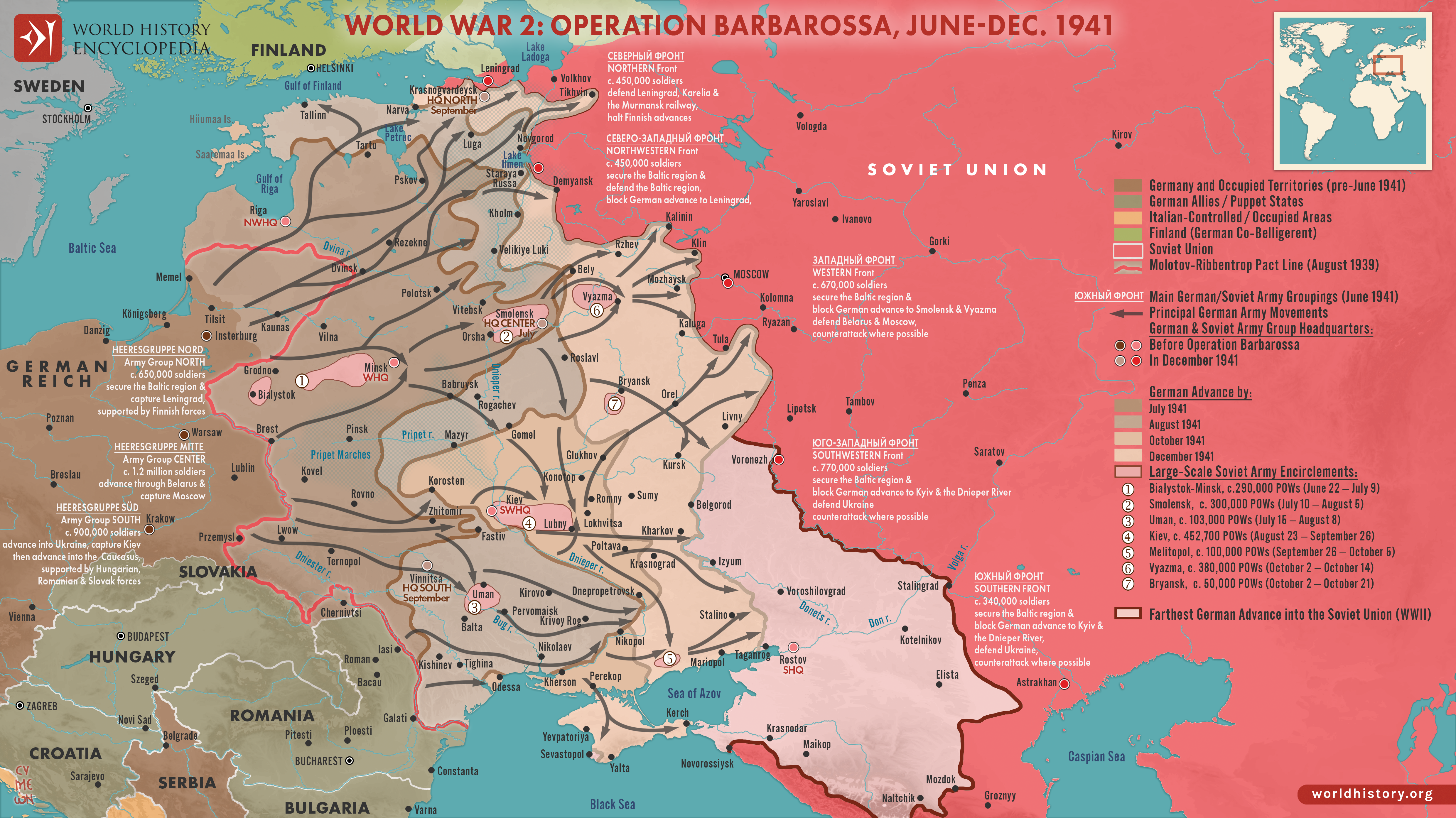
The Nazi invasion of Eastern Europe, Operation Barbarossa, pitted 3.8 million Axis troops against 2.9 million Soviet soldiers[1], and ended with the Nazi army forced to a grinding halt outside Moscow. Operation Barbarossa lasted 163 days, was launched by surprise (without a preceding “phony war”), and involved multiple massive tactical sub-battles. Although it was able to capture small countries like Estonia and Latvia, it failed to completely capture Ukraine and it also failed to destroy the Soviet arms industry, which was moved behind the Urals successfully ahead of the German army. Operation Barbarossa captured about 1.9 million km2 of land over 163 days, with a maximum distance from Berlin of about 1800 km (Berlin to Moscow). In this 163 days the Nazi army failed to capture key cities like Leningrad, Moscow, Rostov, or Stalingrad.
These figures tell us that it took the Germans almost 4 times as long to travel twice as far[2], and to capture three times as much land area. At least at the beginning of the operation (see footnote 1) they did this against a smaller army than they had faced in the west, spread out over a longer defensive line, with less preparation, from an industrially less-developed nation. Looked at like this, it doesn’t seem like such an achievement does it?
The statistics of World War 2 military campaigns
Another way to examine the effectiveness of the different armies is to consider the deaths and injuries they incurred and inflicted during their victories or defeats. Using Wikipedia, I obtained approximate counts of the forces involved in five major world war 2 campaigns, and their mortality rates. I could not analyze injury rates because the easily-available data for Operation Barbarossa had very weird numbers for injuries (see above), and I didn’t analyze numbers of soldiers captured because, since the French lost, basically everyone in the western campaign was, effectively, captured[3].
Table 1 shows the numbers of soldiers deployed by Nazi and non-Nazi forces in four separate campaigns, along with the number of deaths, the mortality rate per 100 person-years[5], and the rate ratio. Rate ratios for Nazi forces are calculated relative to the death rate of Nazis in France, and rate ratios for non-Nazis are calculated relative to the death rate of non-Nazis in France. This enables us to compare, for example, the mortality rate for Nazis in Operation Barbarossa, which lasted 163 days, against the mortality rate for Nazis in France, which last 45 days; and to compare the Red Army’s death rate in Barbarossa with the Allied forces in France.
Table 1: Mortality rates in four different WW2 campaigns
| Force | Campaign | Time | Soldiers | Deaths | Mortality rate (/100 py) | Rate ratio |
| Nazi | France | 45 | 3,600,000 | 27,074 | 6.1 | 1 |
| Not Nazi | France | 45 | 3,450,000 | 73,000 | 17.2 | 1 |
| Nazi | Barbarossa | 163 | 3,800,000 | 185,452 | 10.9 | 1.79 |
| Not Nazi | Barbarossa | 163 | 2,900,000 | 567,000 | 43.8 | 2.55[4] |
| Nazi | Torch | 8 | 125,000 | 1,350 | 49.3 | 8.08 |
| Not Nazi | Torch | 8 | 107,000 | 1,800 | 76.8 | 4.47 |
| Nazi | Case Blue | 147 | 1,800,000 | 350,000 | 48.3 | 7.91 |
| Not Nazi | Case Blue | 147 | 1,715,000 | 1,200,000 | 173.7 | 10.12 |
| Nazi | Kutuzov | 36 | 301,000 | 86,454 | 291.2 | 47.74 |
| Not Nazi | Kutuzov | 36 | 800,000 | 429,890 | 544.83 | 31.74 |
The five campaigns are listed here.
- France: The invasion of France, from 10 May – 14 June 1940, that ended with the complete capitulation of Western Europe
- Barbarossa: The Nazi invasion of the Soviet Union, that began with the surprise attack on 22nd June 1941 and ended with the failed attack on Moscow on 5th December 1941.
- Torch: Operation Torch, the Allied invasion of Africa from 8th – 15th November 1942, which took place at three separate landing sites in Egypt, Libya and Morocco. I wanted to use the entire Africa campaign but there are no reliable numbers. Note that Torch happened after the Nazis were well-and-truly sucked into the quagmire in Russia.
- Case Blue: The Nazi summer offensive in the Soviet Union from 28th June – 24th November 1942, when they captured the rest of Ukraine and rushed for the Caucasus, ending with the encirclement of the German 6th Army in Stalingrad, but not including the subsequent battle of Stalingrad
- Kutuzov: Operation Kutuzov, the Soviet counter-offensive against the German army in the north of Russia, which took place from 12th July – 18th August 1943, and began the process of destroying the Nazi abomination
It should be noted that the destruction of France was a remarkably bloodless campaign compared to the rest of the war, and had very low mortality rates compared to later campaigns. For the Nazis the death rate was 6.1 per 100 person-years, meaning that if 100 soldiers had fought a campaign like this for a year 6 of them would have died; for the Allies the rate was nearly 3 times that, at 17.2 per 100 person-years.
In comparison to this Operation Barbarossa was worse for both sides. Nazi soldiers died at 1.79 times the rate of Nazi soldiers in France, while Red Army soldiers died at 2.29 times the rate of their allies on the Western front. It should be noted that these rates dilute slightly if we include soldiers thrown into the meat grinder in the middle of the campaign, but since we don’t know when they joined or how many (from a trivial websearch) we can’t come up with better numbers.
After Barbarossa, the eastern front became a real bloodbath. Nazi soldiers in Case Blue (which was, from their perspective, mostly successful) died at 7.91 times the rate of soldiers who had invaded France two years earlier, while Red Army died at 10.12 times the rate of Allies in the breezy French campaign. After this Kutuzov was brutal, with Nazis dying at some 47 times the rate of just three years earlier in the West, and Red Army soldiers dying at 32 times the rate of the Allies in the French campaign. These are insane numbers, and show how brutal the eastern front became once the initial rush stalled.
By way of perspective, it is about 500 km from Taganrog to Stalingrad, and about 1000 km from Lwow to Taganrog. In Operation Barbarossa Nazi soldiers, dying at a rate of about 1000 a day, pushed 1000km from Lwow to Taganrog by December 1941, where they settled into warm requisitioned local homes to sit out the winter. The following summer, in Case Blue, those same soldiers died at a rate of about 2400 a day to travel half as far, to end up squatting in freezing cellars in Stalingrad while fat Goebbels parachuted them tins of spam that they had to risk death to catch. Then in 1943 when Operation Kutuzov began their compatriots further north retreated backward 240 km, dying at a rate of 2400 a day, to settle into slit trenches around Bryansk. Things were very nasty once the Soviets dug in!
In any case, the conclusion is that Red Army and Nazi soldiers died in Operation Barbarossa at about 1.5 to 2.5 times the rate of Allied or Nazi soldiers in the French campaign, and that this higher death rate was sustained for a much longer period, over which the Nazi army did not capture land, distance or strategic objectives at the same rate they had done on the Western front.
Essentially the Soviet army, less well-prepared than the French, attacked by surprise, with less soldiers spread over a wider front, inflicted greater losses on the Nazis than the Allies had done, over a much longer period, and gave up about a half to a third as much area as they would have done if they had fought as badly as the Allies had. Even though they faced many obstacles against a better-armed and more experienced enemy, they out-performed the French and the English in defending against and slowing the Nazi juggernaut. This occurred at a greater loss of lives, but that loss was not significantly different to the losses they inflicted on the Nazis. It should be noted that the greater loss of life inflicted on the Red Army also partially reflects the brutality of the Nazis, who fire-bombed the city of Gomel, had the infamous Commissar order, and treated Soviet prisoners of war with previously unheard-of brutality.
In the face of all this the Red Army did okay! There’s certainly no reason to expect that the surrender monkeys of 1939 Western Europe, who retreated 900 km in a big hurry and also lost every contact with the Nazis, could have done any better in the much more difficult conditions of the east. And the Red Army held its own in these circumstances despite the fact that their entire leadership had been reorganized by the purges. So let’s look at the purges.
The Purged and the Elevated
There are a surprising number of generals in an army, and I couldn’t be bothered with a full survey, but I grabbed a list of the most senior five generals who were purged in the 1935-38 frenzy, and compared them with the top five generals listed as leaders for Operation Barbarossa, which I show in Table 2
Table 2: Characteristics of purged and unpurged generals
| Name | Age in 1939 | WW1 service | Civil war service | Frunze |
| Purged | ||||
| Tukhachevsky | 46 | Yes | Yes | No |
| Yakir | 43 | No | Yes | No |
| Uborevich | 43 | No | Yes | No |
| Blyukher | 50 | Yes | Yes | No |
| Primakov | 42 | No | Yes | No |
| Unpurged | ||||
| Zhukov | 43 | Yes | Yes | Yes |
| Shaposhnikov | 57 | Yes | No | Director |
| Vasilevsky | 44 | Yes | Yes | Teacher? |
| Voroshilov | 58 | No | Yes | No |
| Timoshenko | 44 | Yes | Yes | No |
There isn’t really any noticeable difference between the generals who were purged and those who were not except that maybe the unpurged were a little older, and they had a close connection to the Frunze Military Academy. This Academy was established in 1918 and was named after Mikhail Frunze. Graduates of the Frunze academy earned a total of 244 Hero of the Soviet Union medals during world war 2, and its students were spread throughout the army. Although two of the five unpurged generals listed in Table 2 had no connection to Frunze, it should be noted that Voroshilov, who is credited with orchestrating the purge of Soviet generals, was the guy who directed the removal of Soviet war industries behind the Urals, recognizing that the biggest threat to Soviet survival would be their capture by a belligerent invader from the west (who could he have been thinking of!?) If he had not done that, we’d all be speaking German now! He also lost his job for a while because of failures in the winter war, but was not purged.
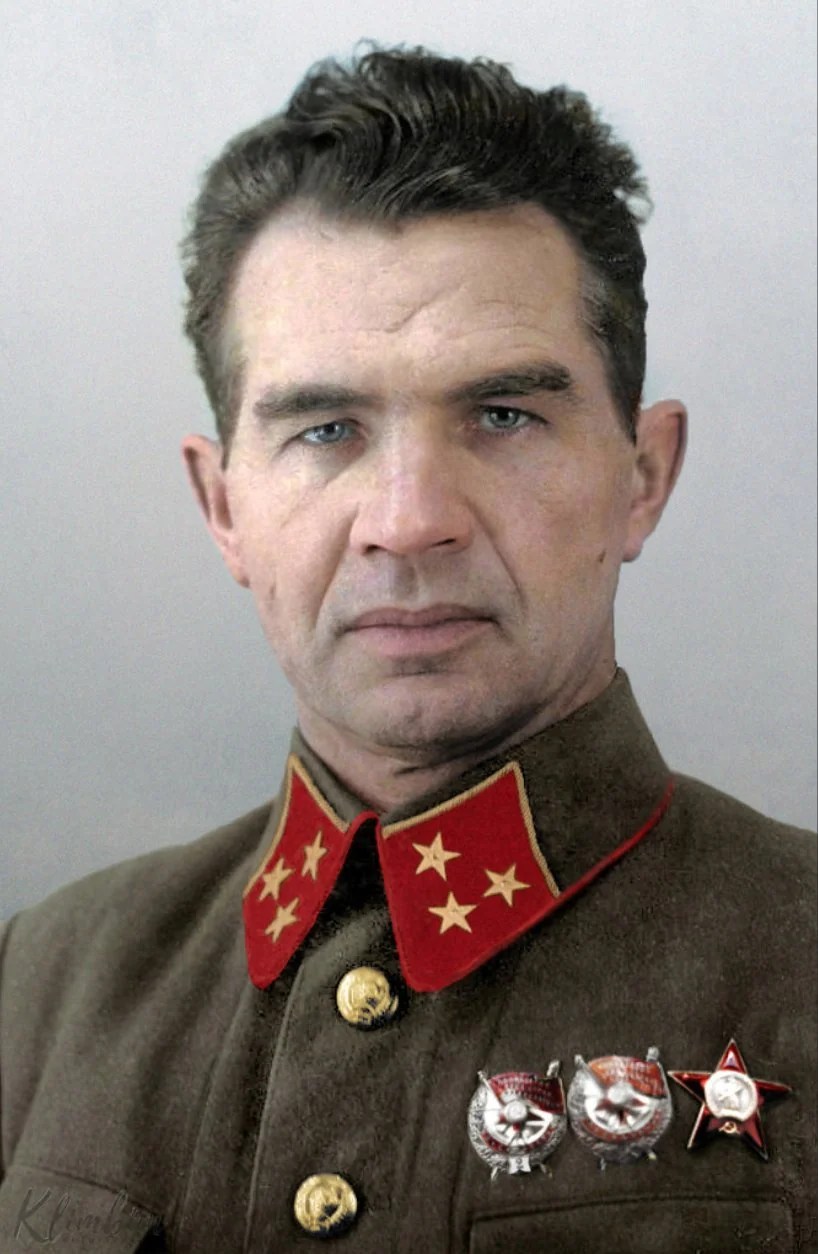
Maybe – just maybe – if the generals who were not purged had been in charge in 1941, the Red Army’s response to Nazi surprise attack would have been worse, uninformed by the elite education offered to the newly-elevated generals by the Frunze academy, and dominated by civil war doctrine that was no longer relevant in the era of combined arms warfare. This possibility is best illustrated by the great man whose image is at the top of this post, Vasily Chuikov. Chuikov was born in 1900 to a peasant family and left school at 12. He became a Bolshevik at 17 and attended the Frunze academy in 1921, where he learnt to read and write and also learnt Mandarin. He was later posted to China, where he spent a year traveling and learning the language before working as military attache. In September 1942 he was given responsibility for the defense of the city of Stalingrad itself, and in his book The Battle for Stalingrad he describes the development of the new doctrine of urban combat that had to be applied in the specific circumstances of close urban warfare with no retreat. After the victory at Stalingrad he fought all the way to Berlin, where he accepted the surrender of German generals. He received the Hero of the Soviet Union award twice, and is buried at the Mamayev Kurgan in Volgograd (which was then Stalingrad), so that he could be at rest alongside the men who died fighting for the city.
Chuikov is a classic new Soviet man, the kind of soldier, scholar and activist who could not exist in any other time and place. He was also the ideal kind of soldier to be fighting an existential war against an exterminationist ideology that cannot be reasoned with or placated. No French or English or American general could possibly understand Vasily Chuikov, his mission, the circumstances in which he grew up and fought, the decisions he had to make or the pressures he and his nation faced. Men like Chuikov are the reason that Western Europeans are still able to speak their own languages and the reason that any Jewish people survived the European conflagration. Men like Chuikov were elevated to positions of command because Stalin trusted them, because they were trained by the pre-eminent military academy, and because places became available when other generals were purged. Sure, maybe Tukhachevsky didn’t need to be sent to prison, maybe Yakir could have just got a nice retirement package, but it was imperative for human history that by 1942 people like Chuikov were able to take charge.
Conclusion
I don’t think it’s necessarily the case that the purges affected Red Army morale or effectiveness negatively, or indeed at all. I don’t think the western armies could have performed better, and indeed the only evidence we have is that they performed worse, giving up land faster and refusing to make difficult decisions to preserve the independence of their own nations. I think if the Red Army had been led by the men who capitulated in western Europe the Russian people would have been exterminated to the last man and woman by 1950. I don’t know if the purges were essential for the replacement of the Soviet Union’s top military leadership with people who were more flexible and better-trained soldiers, but I think it’s possible that some kind of reshuffle was necessary to allow the ascension of a new cadre of soldiers who were equal to the monumental task they were about to face. I certainly do not see any evidence in either the actual performance of these armies, or the statistics from the war, to support the idea that the Red Army performed worse than the western armies, or that its performance was necessarily affected by the purges.
I think we should be very careful about interpreting the history of 1933-1945 through the lens of modern liberalism, and we should read the opinions of non-Soviet historians of the war with extreme care, since almost all of them are staunchly anti-communist. Millions of Soviet men and women died to preserve their freedom and to save western Europe from itself, and we should honor and respect their sacrifice by attempting to look at the war through their eyes, and understanding it from their perspective. And that means, ultimately, that we have to consider the possibility that the leadership they chose, and the leaders they fought for, and the tactics they followed, were the best for the time.
And most of all we should always recognize that they saved us from an ideology we created and unleashed on them, at enormous cost to themselves, their society and their nation. We should not think that our armies would have done any better, or that our ways of organizing our political institutions and militaries are superior to the methods that actually won the war while we watched.
fn1: It’s difficult to judge the exact number involved, because over 163 days of campaign a lot of additional soldiers were thrown into the battle, plus of course there were partisans and militias and auxiliaries involved on both sides. There is a map on Reddit that suggests 5 million Soviet soldiers over the whole course of the battle, and the Wikipedia numbers are very weird. I’m not going to go to a library for a blog post, so this will have to be approximate.
fn2: They started from the Ribbentropp line, which perhaps practically means they had to travel 1300 km, but this isn’t a great improvement – it took them 4 times as long to travel 1.5 times further.
fn3: I think the capture rates are better on the eastern front though: approximately 3 million soldiers out of 5 million, maybe; vs. 3.2 million out of 3.5 million in the French campaign.
fn4: If we assume 5 million soldiers over the campaign, these numebrs change to a mortality rate of 25.4 per 100 person-years for the Red Army, which is a relative risk of death of 1.48 times that of the Allies in the invasion of France – lower than the relative risk the Nazis faced in the east!
fn5: Deaths per 100 person-years are a standard epidemiological method for comparing exposures of differing length. Basically it uses the number of soldiers in the field multiplied by the length of the campaign, rather than just the number of soldiers. If we had individual data we could calculate person-years from each person’s deployment history, which would be particularly valuable in Barbarossa since we could count 2.1 million Soviet soldiers being thrown into the fray later in the campaign, each contributing 50-80 days of time in the campaign (rather than the full 163 days). Also if we had individual exposure records we could account for the fact that most deaths in the Eastern front happened in the first month, while a great many of the deaths in France happened near the end (so many Soviet soldiers only fought for a few person-days before dying). We don’t have this data, but we can at least account for the length of the campaign.


Leave a Reply