• Daniel Defoe is the author most famous for Robinson Crusoe, an awful story not worth reading, but he also wrote an account of the great plague of London, which I recently read. This plague was apparently the Black Death, which is spread by fleas of a rat, so it attacks more effectively in summer and requires different prevention methods to influenza. Daniel Defoe wasn’t present in London when the plague happened (just as he never was stranded on an island), but instead wrote his account based on journals and other notes he obtained from his uncle. I suspect his account is not especially reliable, though I think he may have gained more raw material for his book than just that of his uncle, but it remains one of the few surviving accounts of the time, so it is worth considering, and in many respects this book shows us that the UK is making the same mistakes in dealing with Coronavirus that it made 350 years ago dealing with plague. Responding to pandemics is actually theoretically quite easy, though politically the necessary measures can be unpalatable; Defoe’s report shows us that the UK government has learnt nothing from 350 years of experience.

    Ignoring the coming wave

    One of the more common pieces of misinformation about Coronavirus is that the Chinese government hid information about the disease. This is far from true: in fact by mid-January the Chinese government was yelling from the rooftops about how dangerous this virus was, and trying to warn the whole world to be ready. On 23rd January they did something almost unprecedented in human history, closing a city of 12 million people to stop the spread of the virus. Nobody in Europe or the Americas bothered to listen to these widely-broadcast warnings, and in mid-February the pandemic spread to Italy, where it exploded. By mid-March the rest of Europe and the US finally realized – when white people were dying – that Chinese warnings were serious, but by then it was too late and the virus was wreaking havoc in the UK and much of Europe. The same happened in Defoe’s account of London. The plague was wreaking havoc in the Netherlands in the 1660s but action to stop it entering London was late and weak, even though everyone in Europe knew how bad it could be, and so in 1664 the first cases reached London. By summer it was widespread and killing thousands a week. The British government had been given plenty of warning but they let it in, and after it got in they did nothing to stop it.

    Failure of Case Isolation

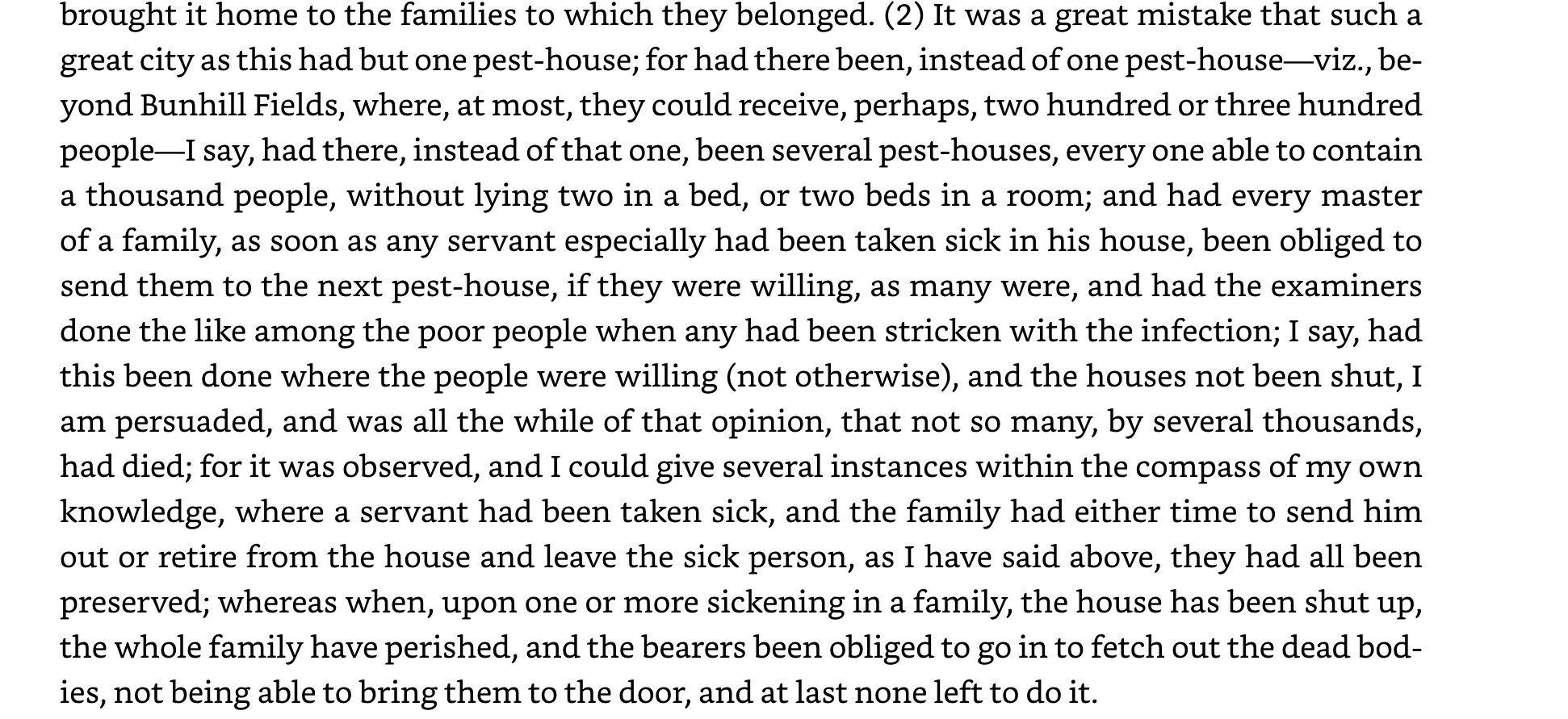
    Daniel Defoe spends most of the book complaining about the policy of shuttering houses, in which houses with even one plague victim were locked shut and guarded by hired guards until everyone inside either died or recovered. He recounts many stories about the horrors of shuttered houses, and also the efforts residents made to escape, including burrowing through walls and attempting to kill their guards. This is the 17th century version of self-isolation, and just as with coronavirus, it did not work. Self-isolation in crowded living quarters – such as were common in London in 1665, and are common in London now – simply ensures that each case infects everyone in their house. It guarantees that the reproduction number of the disease is not the natural number of the virus, but the household size of the affected community. Instead case isolation, in which infected people are separated from the community, is much more effective to prevent the spread. For coronavirus case isolation was the standard response in Asia, which is why China, South Korea, Japan, Vietnam and Thailand were so much better able to manage this virus than the Europeans. Defoe notes this failure, as we see here:

    In 350 years the British have learnt nothing about how to handle a serious epidemic, to the extent that they have done worse than the government of Charles II. While the city of London in 1665 organized inadequate numbers of “pest-houses”, in 2020 they couldn’t organize any, and the epidemic raged in “shuttered houses”, which Defoe deplored (though for the wrong reasons).

    The impact of austerity and poor choices

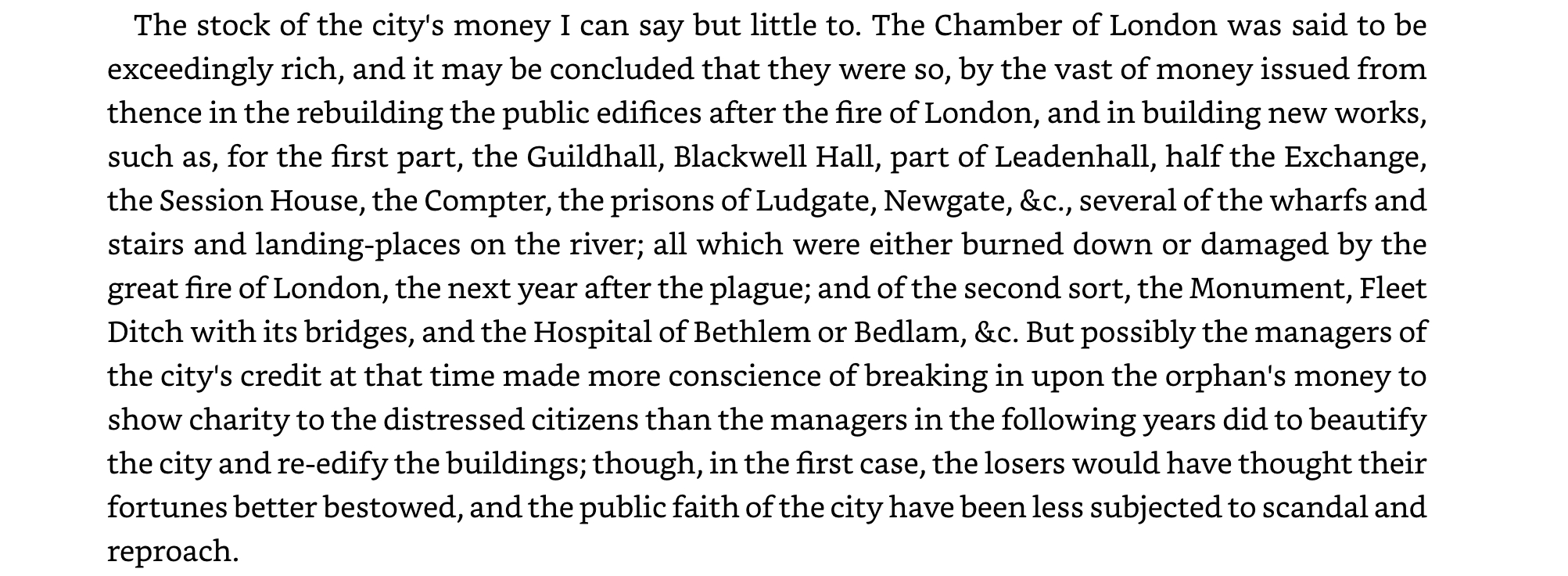
    Defoe also comments on the city of London’s priorities about spending money. He notes that people need to stay inside, and in particular that many people who work on day labour (yes, zero-hour contracts are not new in the UK) cannot stop working without some independent source of money, and talks about the need for the government to support people’s housing costs. But he notes that the government was much less interested in supporting the basic needs of poor people during the epidemic, than they were in vanity projects after:

    Clearly, priorities have not changed much in the 350 years since the plague. If only there were another political party with a coherent project to change the spending priorities of the British government, who could have been elected to government just before the epidemic hit…

    The frenzy of reopening

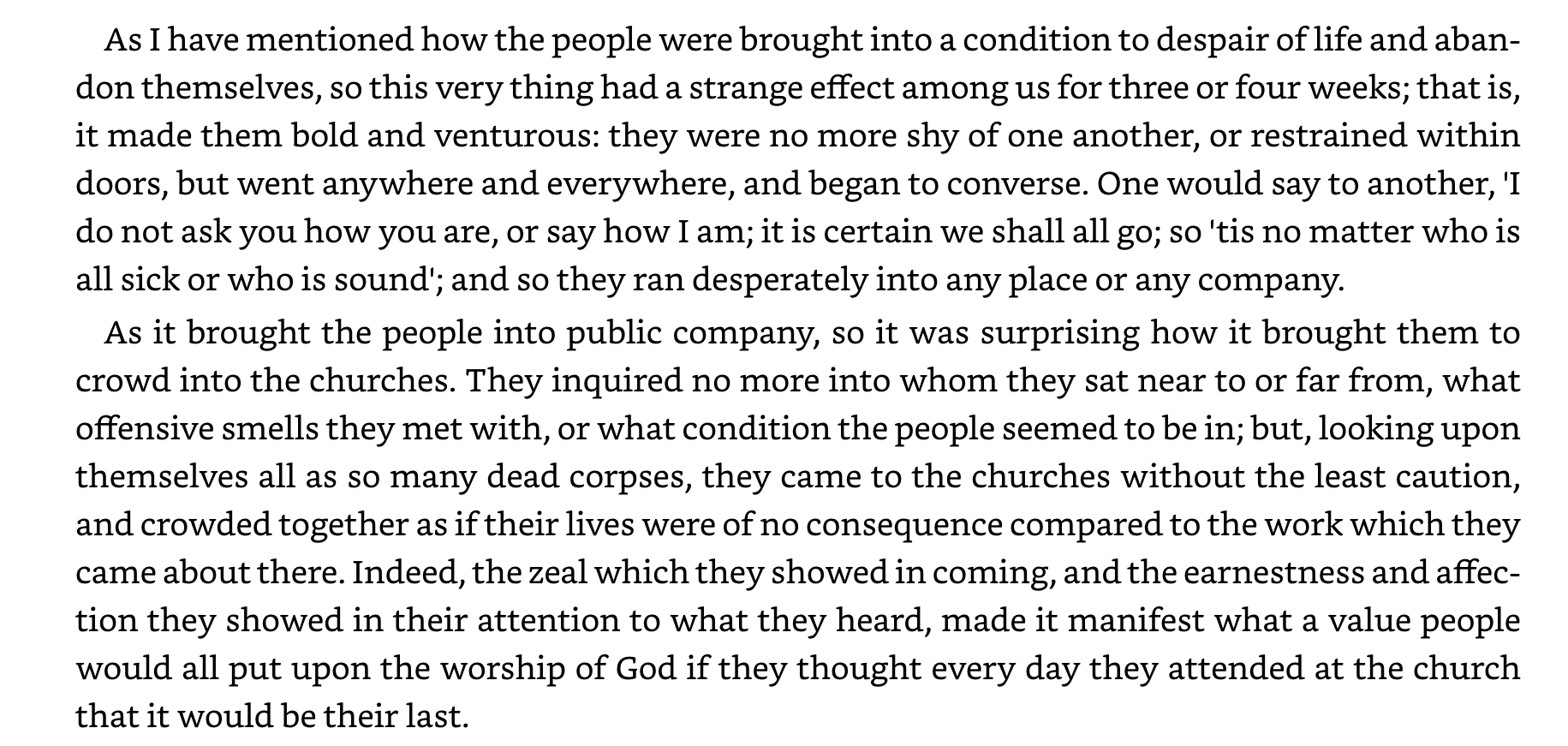
    We are now seeing Europe and the English speaking world reopen, with tragic consequences in the USA and, no doubt, similar disasters impending for the UK. In Victoria, Australia, there is a new wave of cases brewing after reopening, and here in otherwise-sensible Japan the government ended lockdown a week or two early and is seeing a resurgence of cases it cannot stop. Experience around the world shows that the only way to be safe from this disease is to strangle it until it is dead – as New Zealand and China did – and then to be hyper-vigilant about importing new cases. Any attempt to live with it will lead only to catastrophe. But in their eagerness to return to normal life the people of Europe and the USA have failed to understand this and are now beginning to pay the price. Defoe noted this strange zeal for life in the last stages of the plague in London:

    We can only sustain so much isolation and restrictions and death before we go crazy, a fact that has not changed since the 17th century. It is incumbent on us, then, to make sure that those lockdowns and restrictions are worth it. Many countries have failed to do that, either by making the lockdowns ineffective (as appears to have been the case in the UK and many US states) or by opening just a little early (as happened in Australia and Japan). Defoe understood this; it appears that 350 years later the British government does not.

    History repeating as tragedy

    We all know the quote, and it appears that the UK government has failed to learn anything from 350 years of experience of epidemics. Defoe’s book isn’t very good and it has a lot of ascientific nonsense as Defoe tries to understand the plague in terms of divine vengeance or weird theories of miasma, but even with that poor fundamental science background the people of Britain in 1665 understood that infectious diseases spread and certain things need to be done. They made mistakes in dealing with the plague, mistakes that are to be expected given their limited scientific knowledge. But Defoe’s book also shows that the secrets of controlling infectious diseases aren’t rocket science and have been known to us for a very long time. To fail to apply those well-known and very basic principles in 2020, with all our wealth and resources, is just a ridiculous failure of civilization. There is no excuse for letting this virus overwhelm us, as it is now doing in the USA and Brazil and will soon do again in the UK and Europe. We know what needs to be done and have the capacity to do it; failure to do so is simply a tragedy, with no excuse or justification. And Defoe’s book shows that some countries are going to repeat the mistakes of hundreds of years ago, as if the governments of those countries have learnt nothing in all that time. It’s a disaster, that even the man who wrote a book as terrible as Robinson Crusoe could have predicted.

  • America is currently Having a Moment, and various historical works have been identified as having predicted or foretold her Current Predicament, including Sinclair Lewis in his 1935 novel It Can’t Happen Here. Since I am interested in tracing the cultural and historical origins of the Present Unpleasantness – and since I have already made the effort to read the US fascists’ utopian vision so you don’t have to – I thought I would give this book a go and find out how prescient it was. I was interested in seeing how much of the current trends in the Republican party had their roots in longstanding cultural phenomena that Americans themselves could identify, what mistakes they though the left wing opposition made to allow this to happen, and how they got out of it. Unfortunately, this book was largely a disappointment on all of these counts.

    The book chronicles the rise of an all-American dictator, Buzz Windrip, as he first wins the presidency in an election and then proceeds to rapidly dismantle all America’s constitutional protections and political institutions on a rapid road to dictatorship. The story is told through the perspective of Doremus Jessup, editor of a small-town newspaper in rural Vermont, as he tries to first understand, then live with, and finally fight back against the regime of the Corpos, as Windrip’s party come to be known, and the struggles of his family and friends as they try to accommodate, collaborate with, or oppose the new order. Doremus is near retirement when the Corpos come to power, and is presented as the kind of soul of America or something (it’s not very clear); his viewpoint is given authority and superiority even though he is obviously a blinkered, naive man with a massive investment in exactly the system of capitalist exploitation that Windrip pretends to want to tame but ultimately takes over. He is a biased and self-serving narrator at best and, compared to the ideologically pure and driven characters at the centre of the Turner Diaries, very ignorant about how class and race interests drive American society. He is also, in the context of modern America, something of an anachronism. There is very little independent local media in America now, the entire media industry is now much more dependent on advertising revenue and corporate interests than it was in the 1930s, there is now a major mainstream media organization directly dedicated to promoting fascism in the USA[1], the editors of most major newspapers in the USA are now openly right-wing and happy to enable the kind of illiberal politicians that Windrip is modeled on, and it is highly unlikely that someone of his age and class position in the USA now would be “objective” or “open-minded” or have a balanced view about things like unions, which Doremus pretends to do in this book.

    Doremus’s class position makes him a poor judge of Windrip, and a bad character through which to view the political realities of Windrip’s ascent to power. He doesn’t understand class politics, is completely ignorant of the racial character of American oligarchy, and is deeply wedded to an ideal of free speech and debate as valid tools for resolving conflicting social interests. He also has a sneering disregard for poor and working class people and is openly dismissive of people who go off the rails or live differently to a very straight and narrow vision of work and family. It’s really obvious why his handyman, Shad Ledue, hates him and why he is viewed with so little respect by the local fascists once they have America in their grip. Right to the end he seems to think that running a printing press and handing out a few pamphlets about how bad Buzz Windrip is will convince people in the grip of a fascist terror regime to rise up and restore democracy; and he genuinely seems to believe that America can return to its old settled system after Windrip is gone as if all the class and race conflicts that divide America will just disappear overnight – because fundamentally he doesn’t understand where they come from. The protagonists of the Turner Diaries don’t have any such difficulties: they have analyzed all of America’s situation on race lines and have a very clear idea of where it is going wrong and what is needed to fix it. Doremus is almost the perfect depiction of the stereotypical liberal that Twitter leftists despise, or the embodiment of the kind of squishy liberal Lenin would sneer at (or King would warn black Americans against). Wikipedia tells me this book is meant to be a satire, so maybe this choice is deliberate, but I’m not sure – the book ends with a paean to Doremus’s fundamental importance to the American condition, so I suspect it is meant to be lauding him while gently laughing at his more sedate personal characteristics. Whatever it is doing, it doesn’t work, and it is hard to have much sympathy for Doremus as the fascist regime closes its grip around him and the only effort he makes to struggle is against the ruddy crassness of it all, until it is too late and he realizes how he has been done in.

    The book does find some interesting similarities with Trump in Windrip’s pre-dictatorial rise. He is supposed to be crass and lewd, a witty entertainer who is capable of bewitching people at his rallies (yes, he holds lots of rallies) and swaying skeptics with his folksy speeches and ribald style. He rises through the Democrats (who were the party of racists at that time I think), and some think of him as a communist because he promises to improve the rights of workers and the poor, with vague promises that Jessup is sure will never be delivered on; at the same time he is appealing to corporate oligarchs with promises of increasing their strength and control and removing the fetters on their business, and appealing to religious conservatives with a promise of a new American dawn. In this he is very much like Trump, who somehow managed to get away with being seen as more left-wing than Clinton (remember “Hilary the Hawk, Donald the Dove”? Or that primary debate where he somehow managed to convince otherwise Serious People that he was serious about healthcare reform?) When he gets into power of course he doesn’t deliver on any of this: the $5000 each household has been promised never materializes, unions are destroyed and all the oligarchs become his personal agents, in a perfect recreation of European fascism in America (perhaps we could call it Fascism with American Characteristics). Doremus seems to just dismiss this obvious fakery as typical politicians’ dishonesty, which is exactly why he is such a dupe for this shit. Another similarity between Trump and Windrip is Windrip’s slimy advisor Sarason, who is a bit of an enigma and is sometimes seen as the real power behind the throne, with some vague parallels with Stephen Miller. It also implies that Sarason is the real force behind Windrip’s politics, and Windrip is just a blowhard – this is exactly the same stupid and naive idea that gets people thinking Trump isn’t really serious about his racism, or that he doesn’t believe in the fascist stuff he’s doing. But this implication at least isn’t clear in the book, unlike in the Twitter feeds of modern pundits who are always so sure that Trump doesn’t really mean what he says. Windrip’s regime is also incompetent and chaotic, with senior leadership constantly changing and also fighting with each other for promotion and favours, and it’s just as corrupt as the Trump regime (more, obviously, once it gets full and unfettered control of all branches of government). Windrip has also written a book, which I guess is the same as Trump, who has a book written in his name.

    But here the differences also become clear. Windrip’s book – and his speeches generally – are coherent, he is not a man sliding into dementia. Windrip didn’t run for office to cover up his tax fraud and to close off the tightening investigations into his Russian money-laundering, but to actually implement a full fascist program, which he does. Windrip is not enabled by a corrupt party, he doesn’t win senate or house and has to take power from them by imprisoning his political opponents “for their own protection”. Windrip is backed up by a huge and very well organized stormtrooper organization called the Minute Men who he deploys almost immediately to destroy all political opposition, including the Supreme Court – in 1935 America the political institutions are much less supine and partisan than they are for Trump, and Windrip has to destroy them rather than relying on them to do his bidding. Windrip is, in short, much more competent and organized and coherently fascist than Trump. He has a network of secret prisons and concentration camps set up pretty much immediately after dissolving congress, and after that he quickly completely reorganizes American life beyond recognition. So no, he’s no Trump.

    The book is also strangely vague on the actual reasons for Windrip’s appeal or partial electoral success. What exactly about him do people like, and what about his appeal is so slippery that the supposedly all-powerful media organizations can’t see and counter? He promises everyone $5000 and the media point out that this is obviously bullshit, but everyone ignores them, and there is no explanation for how he hand-waves away all these problems in his platform or with his obvious slide into fascism. At the beginning a lot of people in Doremus’s circle dismiss the worst possibilities with the eponymous phrase “it can’t happen here” but nobody at any point bothers to explain why it can’t or why it did. The only clear “political” opinion that flows through the book is the scorn everyone in Doremus Jessup’s social circle feels for poor and working-class Americans, and the huge gulf between his class and theirs. Windrip appeals across this gulf to the “forgotten men” of America but the book cannot explain why this contempt is so clear (and can’t seem to judge it, except perhaps to gently rib it) and can’t explain why or how Windrip has seen it or how to manipulate it. It can’t really even say if this is what helped Windrip win – there is no analysis of what coalition of voters he built, who he appealed to, or how the vote worked out, so we have no idea how this supposedly vulgar and empty suit managed to pull off his coup. The centre of the book is strangely empty of any attempt at analysis. It’s just a story, and not very well told. Compare this with Orwell’s description of the collapse of the Republicans in Homage to Catalonia, or his explanation of the ideology of the Party in 1984; or consider Koestler’s description of the party and its ideology in Darkness at Noon. There’s just nothing to explain anything at the heart of the political events in this book. I was recommended it as a way to make sense of how Trump rose and won, but this is exactly the only part of the story where there is no information. In the end the book is as much of an empty shell as Windrip himself.

    It’s also quite boring. It’s not particularly well written, aside from a few nice descriptions of Vermont countryside. The characters all have awful and weird names, and are generally insufferable. I’ve never read Dickens but I think this might be riffing on that style? In any case it’s just horrible and I can’t take them or their opinions seriously, nor can I care about their fates when they’re so stupid and vacuous and judgy. There is essentially little plot – Windrip wins, then there is some faffing around with watching America fall in line, then Jessup finally loses his shit (for no special reason) and writes a stirring editorial that gets him arrested (and of course achieves nothing); he is spared and starts to secretly work for a comically inept opposition coordinated from Canada; finally gets caught and put in prison; then is rescued improbably and ends up fleeing to Canada to recover before returning as an agent to America, when the story ends. Boring. Even when his son-in-law is killed no one seems to really get roused, and you just can’t get much energy to side with these characters. It’s all just weak. If a book was intended to make you side accidentally with fascists it would be this book when Jessup’s former handyman Shad Ledue gets the chance to lord it over scornful, contemptuous and patronizing Jessup (who thinks himself so good and decent).

    As an example of this inspidity there is one section where Jessup takes it on himself to attend a Windrip rally before the election, during which he describes the violence of the Minute Men and the fervour of the crowd. In the audience he is almost beguiled by Windrip despite having seen his men beat up people outside (and knowing what is happening in Germany and Italy); he goes home without much further comment and doesn’t make any attempt to join any dots or inquire any deeper into what is happening to make this movement grow. He simply doesn’t have the critical tools to understand what is happening in his own country, and doesn’t have the curiosity to figure it out. He then writes an editorial that basically just boils down to “isn’t this guy and his followers a bit of a crass oaf, who could support that?” He is an empty shell, and the book doesn’t offer anything to flesh him out personally or politically.

    So, this book is very boring and poorly written, with annoying and frustrating characters who don’t seem to have a clue or get one at any point in their political and personal journey. As an insight into America’s Current Predicament it is of little use, since it comes from a different time with different politics and it is, in any case, politically shallow and incurious. It lacks any of the passion and invective – or the insight – of its better peers from Europe and the UK. Attempting to understand what’s going on in America from this book would be a waste of time. There is no insight here, so don’t bother.


    fn1: Which, incidentally, is why Chomsky’s Manufacturing Consent is now irrelevant

  • I was very excited to discover Max Brooks, author of World War Z, has a new book out, Devolution: A Firsthand Account of The Rainier Sasquatch Massacre, and bought it as soon as it was released. It turns out to be excellent airplane reading (I went to Okinawa for a few days’ relaxation) and not so great night time reading, because it is a very disturbing and well-crafted tale. This is a review of that book, hopefully basically spoiler free.

    The novel purports to be “found footage”, based on the journal of a woman called Katie who was part of a small alternative off-grid community deep in the wilderness outside Seattle. This high-tech community consists of a few rich oddballs living around a central common house, intended to recreate some kind of image of native American traditional community living while also merging the high-tech lives of the modern urban rich with sustainable living blended deep into the nature in which the community is embedded. There are only a handful of people living in this off-grid place, which is served by drone deliveries from Seattle, has solar power, methane fuel from human waste, careful insulation and water recycling, fiber optic internet, etc. It is serviced by one road that may get cut off in winter, and is intended to be completely self-sufficient once you factor in the regular drone deliveries. Katie and her husband are borrowing their friend’s home for a winter to reconnect or somesuch American bullshit, and as part of this conscious recoupling or whatever it is Katie is keeping an extensive daily journal of her thoughts and feelings (for her therapist of course!). The journal is supplemented by interviews the putative author of the book mixes in with the park ranger who found the journal, the family member who sent Katie and her husband to the shack, and a few newspaper or science articles. This is a bit of a challenge for Brooks to pull off since he has only really ever been able to write in one voice, a criticism I had when I read World War Z, but brave of him to try. The events are set in approximately now, obviously under a Trump presidency, with America involved in an intervention in Venezuela and already experiencing significant internal dissent, as well of course as the kind of anti-science and anti-public service cuts that characterize this particular period in American history. There is major civil unrest happening around Seattle at the time the story is written, which really makes it perfect reading for the current climate.

    The first few chapters of the book are spent introducing the other characters and then the shit hits the fan: Mt. Rainier erupts, cuts off their path back to the city with huge rivers of lava, and wipes out just enough other local communities to create major chaos in the emergency response (which is already underfunded and incompetent). To make matters worse the community’s internet and cell connections are destroyed, and there is a strong implication that their drone deliveries are cut off because their drone took out a rescue helicopter. But this is just the beginning; as the characters are settling into the knowledge they may be cut off all winter and are going to have to get very creative with food, they discover something much worse: a small colony of Sasquatch (Bigfoot in the popular parlance) has been driven from their secret home in the slopes of Mt. Rainier by the eruption, and having had no food for days they settle on the people living in the little isolated community as their main calorie source. This is when the novel turns from a slightly ham-fisted exploration of rich urbanites’ insecurities and vanities to a rapidly escalating tale of survival horror.

    Because this is a Max Brooks book the horror is interspersed with snippets of science and wisdom from various sources, so that we get a full and rich disquisition on the history of Bigfoot scares in the US, the possible genetic and evolutionary tale of the Sasquatch, detailed description of how primates hunt and kill each other and why, critical assessment of modern rich urban Americans’ obsession with anthropomorphizing and misunderstanding “nature”, and Max Brooks’s personal view of the role of survival and experience in shaping refugees’ lives in the US. These interludes are probably essential, because over the course of the middle half of the book he ratchets up the tension with excruciating care, taking us from hints of Sasquatch presence (stolen berries, a bad smell) to pitched battles in the middle of the community space. Because it’s found footage we, the readers, know approximately what is going to happen: we know that the whole thing is caused by Bigfoot and we know everyone dies. This, too, is frankly a relief – if you were sitting through the increasingly desperate and disturbing middle parts of the book hoping anyone would survive you would be close to an apoplexy by the end of this novel. The fact that it’s essentially an After Action Report means that we don’t get to find out exactly what happened to the author (since they can’t journal their own death) and so it enables Brooks to close off the whole story with a sense of mystery and a slight lack of fulfillment for the reader, which to me is perfect, since the story itself is so improbable and the possibility of anyone surviving so remote that leaving the fate of the group’s last member unexplained is a fitting end.

    The strength of the novel is in this careful ratcheting up of pressure over its middle period, the growing sense of dread and impending destruction, and the reader’s helplessness as various members of the community completely Fail to Get It and make accordingly increasingly stupid mistakes. This is helped by the way that various characters either get it together or come undone as the intensity grows, though three of the characters go through changes that are too rapid and sudden to make sense (see below). Brooks supports this by quotes at chapter headings and a few interludes with references to other times in history or other peoples’ speculation about how events might have unfolded, which helps to get the reader engaged in the characters’ struggle even though they’re actually quite unpleasant people who you mostly just want to die. Which, of course, they do. Horribly. It’s quite satisfying but also very nasty, and although I’m not easily scared this book gave me the shivers by the time the tension reached its peak. This is good survival horror!

    It’s not without its flaws though, primarily three: the pretentiousness and narrowness of some of the theorizing in the interludes; the clumsy and personally quite awful characters; and Brooks’s inability to diversify his writing voice.

    The interludes involve a lot of speculation about science and evolution and group psychology and the conflict between humanity and nature that struck me as overly pretentious and often quite simplistic or weak. I also wondered if some of the facts Brooks presents are actually facts or just things he has heard and just accepted as true (I didn’t bother to check). This is a hallmark of his work in World War Z too (I guess worse in that book because fact-checking was harder back then and he probably had less support). I always read this kind of stuff as bar-room waffle, but it’s presented in this book as serious inquiry, and it’s a bit cringey (not very though!) Also he has this big problem of stereotyping cultures, which he does in the interludes and also in some of the character archetypes: one of the characters in particular is a survivor of the Yugoslavian civil war, a refugee of a particularly vicious part of it, and is obviously just Brooks’s stereotype of what a refugee from a war zone would have learnt about survival and human nature that has made them wise and resourceful and insightful, in a way that is a bit like if you could noble-savage a refugee. (Brooks always does this with Israeli soldiers, who also feature in the interludes in what I thought was the clumsiest piece of writing in the book). To be clear though I enjoy this kind of speculation and waffle even as I’m cringing, and somehow Brooks manages to pull it all off, which is why I guess I loved World War Z. I think it was a bit weaker in this book but it still really helped to pull the whole story together. The brief quotes and discursions on how and why primates kill each other, and how in particular chimpanzees hunt other primates, really sets the tone for the Coming Bigfoot Apocalypse, and serves as a forewarning of just how nasty the humans’ end is going to be; and when the humans start going primal it also serves to orient them as just another kind of primate cast back into a bigger evolutionary game. So though occasionally cringey and quite possibly wrong or distorted, these interludes work really well to establish the framework for the horror. That is vintage Brooks.

    The characters, when they’re not stereotypes, are just generically awful Americans. The lesbian parents of an adopted Bangladeshi child who’re so sensitive to her culture but haven’t figured out she’s Muslim (yeah right); the pretentious GRR Martin-esque anthropologist who’s a man-splainer and is wrong about everything; the mild-mannered vegans who can’t be convinced to harm an animal to survive; and Katie herself, the very perfect stereotype of a neurotic upper class white American girl. Ugh. They all need to die. You start the book knowing they’re going to die but you still can’t wait. It makes you wonder if Brooks designed them to make you want them to die, which may not have been a bad thing given how excruciating their ends are. But still, it would be nice if I could enjoy pop culture stories with actually nice characters in them! These characters go through rapid development over the story as the pressure of their collapsing civilization comes to bear on them but three – Katie’s husband and the couple who established the community – go through lightning-fast changes that don’t make sense to me. In particular the psychological changes in the owners hint at a much bigger back story to how and why they established the community, and in my reading of the book suggested some form of culpability or guilt for what happened, which Brooks fails to explore. This lets us down a bit, since some important characters just suddenly get slotted into new roles without any reason. I think this is meant to be linked implicitly to the concept of Devolution introduced in the title and the discussion of Sasquatch’s evolutionary niche, but that discussion is too tightly focused on the Sasquatch to work in the context of the humans’ changes until the very end of the book, by which time it is half-forgotten and buried under a frenzy of destruction and bloodlust. So some of these sudden transformations don’t quite work, but the new roles they get are great, so who cares, really?

    Finally, Brooks’s inability to modify his writing voice lets him down again, so that everyone the curator of the story interviews sounds just a bit too close to Katie herself to be able to separate them from her. I guess Brooks isn’t aware of this problem, because if he was he might not write these kinds of curated multi-part interview/story novels, since it’s a recipe for having your own shortcomings found out. It doesn’t let the novel down in the end – I devoured this book like a Sasquatch on a psychiatrist – but it does stop it from being the pitch perfect masterpiece it could have been in the hands of a more capable prose-wrangler. Brooks is a great writer, capable of great plot and perfect timing, very good at establishing and changing mood and a very good judge of pace and tension, but this one thing he can’t quite get right.

    Despite these flaws though this is an absolute barnstormer of a book. It is tense, gripping, vicious and callous, as all good survival horror should be, and it plays out perfectly. It’s a quick but incredibly absorbing read that will have you thinking back on it for days after, wondering “what would I have done” and “how would I have coped”, and marveling at the horrific monsters you would be expected to face. It’s an excellent addition to the horror genre for those with a strong stomach and iron will, and I strongly recommend it to horror fans and Brooks aficionados alike.


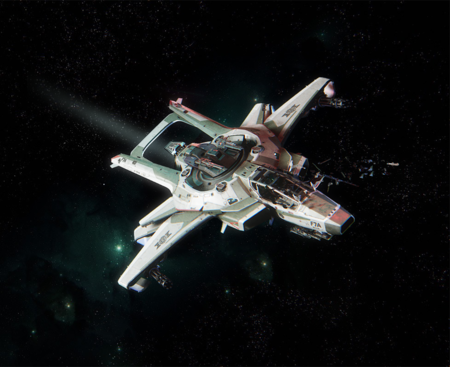
  • Our heroes have jumped through a mystical portal into the vicinity of the hidden Corsair base, where they have immediately been attacked by a detachment of Corsair attack ships. The roster for this session:

    • Clementine, technologist
    • Siladan Hatshepsut, archaeologist and data djinn
    • Dr. Banu Delecta, medic
    • Al Hamra, captain and mystic
    • Adam, soldier and gunner
    • Oliver Greenstar, colonist and roustabout
    • Saqr, pilot

    The four ships arrived in sensor range together, captain Saqr’s attempts to manoeuvre away from them having proved unsuccessful. They swooped in to attack, and the Beast of Burden faced off against them in the cold Dark.

    The destruction of the Corsair Fleet

    The four corsair ships were small class II gunships, perhaps 30m long and designed purely for space battle around the corsair base. They moved in fast but disorderly, each trying to be the first to kill the intruder, so one rushed ahead and into the Beast of Burden‘s missile range. Using the ship’s advanced sensors Siladan was able to quickly lock onto it; they fired a torpedo while Adam opened fire, Saqr throwing the Beast of Burden into complex defensive manoeuvres just in case the incoming ships secured a lock.

    They did not, and as the remaining three ships moved more cautiously into range they finished off the frontrunner, hitting it with data pulse and the energy weapon they had stolen from the First Horizon holdovers. Two more ships entered torpedo range but failed to secure locks, and before they could close into a better range Clementine and Siladan hit them with data pulses[1], cutting their systems and leaving them drifting helpless in space.

    Now the battle had become easy. It is easy to imagine the corsair crew running around in their disabled ships, desperately trying to restart their reactors and sending djinn into the computer system to fight the data attack as torpedos streamed in and Adam picked away at the hull with the Beast of Burden‘s new energy weapons. Perhaps they were still fighting to regain control of their systems when the torpedo hit and blew away the entire bridge; maybe they were desperately repairing hull damage, praying loudly to the Dancer, as Adam carved their ship open from bow to stern with a single concentrated pulse of energy, and spilled them all into the Dark, still struggling and begging their disfigured Icon for aid. In any case, once the middle two ships were disabled the tide of battle turned quickly and they were soon left facing four disabled hulks. Three were breached and collapsed, mere salvage with perhaps a few dead crew left onboard who had not been sucked into the Dark when Adam burnt their hull away, but one was simply disabled, floating helpless as they moved into board, Siladan bombarding it with data pulses to keep its reactor quiescent as the rest of the crew suited up to move in for the kill.

    Assault on the base

    They boarded the remaining ship and captured the remaining surviving crew member easily, dragging him back to the Beast of Burden for interrogation. They were not gentle, but extreme measures were unnecessary – Al Hamra read his mind when they asked him questions, and they soon learnt all they needed to know about the Corsair base. It had no remaining defenses, Samina having assumed that sequestering her base in the Dark between the stars and hiding it behind a mystic portal, defended by four class 2 gunships, was a sufficient defense in itself. They could cruise in and take it at their leisure. Except that its remaining complement was formidable:

    • 64 soldiers, in teams of 4
    • 8 sergeants, each responsible for 2 teams
    • 4 champions, elite soldiers in battle exos
    • Samina
    • the Oracle
    • Whatever Darkbound Samina and the Oracle chose to summon

    And of course, the Oracle could teleport between statues, so no doubt could appear behind them, perhaps to animate the dead they left in their wake.

    They headed to the base. Sometimes you just need to take a risk. They had taken floor plans from the captive’s ship, so they knew that it had a large hangar section that their ship could not enter, and above that a level with four docking stations connected by wide corridors to a central elevator shaft. Each docking station was defended by two teams of soldiers and their leader. Saqr moved in fast and purposively to one of the docking stations, then diverted the ship and cut a rapid loop to a different station. Siladan hit the docking station fast and hacked its lock and they were through, into the first docking station, piling in to attack the soldiers on the other side before reinforcements could come from the other stations.

    The final fight was on. It was five to one, but they would prevail. Right?


    fn1: There is a lot wrong with the space combat rules in Coriolis, and in amongst them is the fact that the data pulse is massively overpowered. I suspect ion cannons are even worse.


  • As my Coriolis campaign comes to its extremely violent conclusion, I am completing preparations for the next campaign I plan to GM. The last few campaigns I have GM’d have been science fiction: Coriolis, before that the Spiral Confederacy (Traveler), and before that a post-apocalyptic water-world campaign called Flood (using Cyberpunk rules, natch). My players are craving some high fantasy and so am I, but I am completely over D&D and incapable of running it or playing it any more – I just find it boring in all its incarnations and although I loved it when I was younger I can’t enjoy it past about 5th level, so I don’t want to run it anymore. I considered Warhammer, but I think my players would like to move away from worlds saturated in darkness and I know that when I GM Warhammer I make it altogether very grimdark, which some of my players don’t need. So, I decided to make my own sunny and upbeat campaign world for Genesys, using a classic fantasy RPG setting with orcs and magic and mediaeval scenes and monsters and completely arbitrary but fixed notions of good and evil which mean the PCs can slay any evil monster they want without fear of repercussions or any moral quandaries. The setting I chose is based on a map I found on the internet, and I choose at this stage to call it the Archipelago Campaign.

    The Archipelago

    The Archipelago is a collection of island kingdoms of manageable size, isolated from any major landmasses and connected by stormy but navigable seas. There are 8 nations of human settlements, a large wild area occupied by human-like tribespeople called wildlings, a single island for dwarves, and a couple of forests where elves live. There are also a few members of a race of people called Changelings, who are like humans but smaller and a bit weird, who live in hunter-gatherer societies and can change their form to perfectly resemble any human they have ever seen. The entire area is also plagued by deepfolk: orcs, goblins, ogres, dark elves and deep gnomes who are implacably evil and hate humans with all their heart and soul (if they have a soul). The deepfolk live underground and come out through hidden entrances and lairs in mountains, hillsides and forests, and there is constant conflict between these nasty creatures and humans. There are also other monsters in the forests and mountains, and one island has been ravaged and taken over by a dragon.

    The refugee history of humans

    The human society in this land is relatively light on history and politics. Humans arrived in the Archipelago 1000 years ago as refugees, but were immediately plunged into 200 years of constant flight and conflict as the deepfolk tried to destroy them. As a result of these 200 Lost Years they have forgotten their origins and lost all documents and written stories about their past, and so they know nothing about where they came from, why they fled, or how they came to the Archipelago. After 200 years the dwarves took pity on them and helped them found a few pathetic settlements, and after that they slowly formed kingdoms. They had to learn to read and write from the dwarves, either because they had no written language or all those details were destroyed during the Lost Years. They brought a kind of magic with them, learnt a new kind from the dwarves and a third kind from the elves, and slowly settled and spread across the Archipelago. Out of respect for their refugee history they have no systems of slavery or kings or queens, and generally there is not much conflict between kingdoms – I have set this society up to be light on politics and history so the PCs can focus on uncovering secrets and killing orcs, but without having the stultifying and boring influence of feudalism on the society.

    In general human society is at the technology level of Britain in the 9th century, with the caveat that they have little access to iron – all iron and jewels are hoarded by deepfolk and can only be obtained through war. So weapons and armour are slightly neolithic. This introduces a new tier of weapons between mundane weapons and magic weapons, and gives additional reasons to kill those pale-skinned underground bastards.

    Magic and religion

    There are three forms of magic in the world, each connected to a religion: Salt, the magic humans brought with them; Storm, the magic dwarves love, which helps them become consummate sailors; and sun, the magic the elves prefer, which is most like the arcane magic we all know and love. There is no heaven and hell, no demons, no afterlife and no special moral restrictions from religion, so religion is primarily a reassuring force to make pathetic humans feel they have a place in the world, rather than a strong moral code. PCs can be one of the three religions but can never mix magical forms. There is a fourth kind of magic, deep magic, used by deepfolk, which is the only way that one can learn necromancy or enchantments, but no human has ever used it so domination spells and vampires are entirely the province of the deepfolk. Deepfolk are evil!

    Races and classes

    In this world as in all my worlds elves are dodgy, shonky wild creatures who can’t be understood or trusted, but players can choose an elven PC if that is their thing. Dwarves are simply small, thin folk who live on the sea and are masters of art, culture and craft – kind of like erudite 16th century explorers compared to the 9th century barbarian humans. The wildlings of the north are maybe a lost tribe of humans or maybe a different indigenous race, no one knows, but they’re bigger and kind of more savage than humans. Changelings live in small hunter-gatherer societies on the fringe of human nations, and don’t seem to have much wealth or care for human activities, but are much sought after for their transformation powers. No one can play any form of deepfolk, because deepfolk are evil.

    Resources and plans

    The document I have prepared for my players to read can be found here, with detailed information about the world and rules for the Genesys system. We will be starting in the next month or two, depending on brutally the players are able to end the Coriolis campaign. I am looking forward to a long, leisurely exploration of a fantasy realm after many years of science fiction!

  • Our heroes are trapped in a ransacked cultist sanctuary in Hamurabi station, facing off with a draconite hit squad that has surprised them. They were here to capture an Oracle and learn from him how to travel to the secret lair of Samina’s Corsairs, but he has teleported away using a large and ominous statue of the Dancer, their secondary objective; they cannot now move to take it, because they stand under the readied guns of a draconite hit team[4]. The roster for today’s adventure:

    • Clementine, technologist
    • Siladan Hatshepsut, archaeologist and data djinn
    • Dr. Banu Delecta, medic
    • Al Hamra, captain and mystic
    • Adam, soldier and gunner
    • Oliver Greenstar, colonist and roustabout
    • Saqr, pilot

    They decided that in this case discretion was better than bloody valour, especially considering they had had no time to recover from the many injuries they had incurred over the past week of frantic pursuit, and now even a light smattering of damage would likely go badly for them. Adam and Clementine eyed up that meson pistol, and considered the options for killing the draconites and taking it, but even though they both thought their team would prevail, likely one or more of them would die in the exchange. They decided to talk.

    The draconites also seemed disinclined to fight, a good sign given that they had held the element of surprise. Al Hamra asked them what they wanted and they indicated that they had come for the statue. He suggested to them that he would happily hand it over if they helped him catch the Oracle, which offer the draconites declined: they did not care for the oracle, and would not waste their time helping the PCs. They wanted to get the statue and go.

    Here the party had a small advantage over the draconites: Al Hamra could read minds. He asked a question and applied his mind-reading mystic power, learning quickly that the leader was in telepathic conversation with another, hidden draconite, presumably a mystic and definitely their leader[2]. From this little exchange Al Hamra also discovered that the draconites thought they could control Adam[5], and with that he realized that they really were going to need to talk their way out; but he also learnt that the draconites genuinely only cared about the statue. “Why do you need it?” He asked, and a moment later, against all expectations, the negotiator told them:

    “It holds the soul of our founder.”

    Well, that drew their attention. Realizing that this statue must be very valuable to them, Al Hamra decided to cut a deal: he offered to have Saqr bring it to them if they would hand over the leader’s meson pistol and leave in peace. It took the leader only a minute to accept this deal, and he even threw in the kind consideration of not killing dr. Delecta and taking back the draconite technology she carried. An agreement was reached, and Saqr walked over to pick up the statue.

    As soon as he touched it Saqr was assaulted by a mystic wave of horror, fear and rage, an ancient and powerful force desperate not to be contained. He fought with all his will to resist the force possessing him, and resisted it long enough to hand the statue over to the draconite. Unable to tell anyone what he had experienced, he could only hope that the same force would not overwhelm the draconite. It appeared not to, and the draconite calmy took the statue, and handed the meson pistol over to Saqr. All five men then withdrew carefully, maintaining a cautious watch on the PCs until they were out of sight.

    They had lost the statue, and for little prize. They retreated to the ship to nurse their pride and think about the next step in their mission against the Corsairs.

    The legacy of the Dancer

    Back at the Beast of Burden Saqr performed a mystic powers search, and located the Oracle in the Corsair base. They guessed then that he had teleported there to warn the Corsairs, who they could expect to be readying a welcome party. They guessed that the only way to get to the Corsair base was to travel to the coordinates they had found on the tabula, and there find some lost portal that would take them to the base. They guessed that they only had three days before the coordinates in the tabula expired, and they did not expect another message to arrive, so they had to act fast. However, they wanted to go in with some basic knowledge of what they were doing, and with a little recovery time. They took a full day to recover, during which time Al Hamra and Adam went in search of a weaponsmith to improve their weapons, and Siladan dug into his tomes of ancient knowledge to try and learn something about the connections between the corsairs and the cult of the Dancer that seemed to be so widespread throughout this part of the Horizon.

    From fragments of text, stories and hints in the ancient histories of the Dabaran Circle, Siladan was able to piece together an outline of the story of the Dancer in this part of the Horizon. He learnt that when the Dabaran Shipbuilders came to the Third Horizon from the First Horizon they brought with them a dark cult, some kind of heretical nonsense connected with the original religion that they had believed in Al Ardha. This cult had survived for a while in the community those first shipbuilders formed around Atuta, the Unbroken, in Dabaran, but evnetually they were found and driven out, their terrible rites deemed despicable and evil. They fled to neighbouring systems, and in their flight they either discovered or were taken over by some power from the Dark between the Stars – or perhaps it had infected them in the long flight from the First Horizon and corrupted their religion that way. It was possible they laired in some ancient Portal Builder ruin, where they learnt dark secrets, but in any case somehow in this time of flight and conflict they mixed stories of some feminine energy called Lilith, from their original religion, with images and iconography of the Dancer. So their cult formed, hiding in the dark reaches of the lonely systems at the extreme edge of the Dabaran Circle, an area ignored by much of the rest of the Firstcome as they expanded into richer systems in the rest of the Third Horizon. Stories then told of a fresh assault on the cult by forces of the Nomad Federation, in allegiance with the Shipbuilders of Dabaran, in which a small militarist cult of the Messenger (or perhaps the Messenger himself; legends differed on the details) finally vanquished the emissaries of this twisted shadow of the Dancer. The cult was scattered, but over the succeeding centuries tales would arise hinting at the continued existence of fragments of the cult. Stories were also told about lost stars, dark stars, portal builder ruins far away from the portals themselves, wandering portals, and tears in the Dark itself which some creatures from the Dark between the Stars could use to travel between systems.

    The PCs had been told before that the Corsairs were a kind of cult, and in the writings of the Collector at the space station in Algebar they had learnt of rumours that Samina herself was a powerful mystic in possession of a horrifying artifact that could boost her powers. Siladan surmised that the remnants of this ancient, corrupted cult of the Dancer had somehow formed Samina’s Corsairs and that Samina herself was the leader of this cult, perhaps taking on the form of the Dancer herself, or some twisted version thereof. This cult must have been twisted by exposure to the Dark between the Stars, and now dwelt in some lost Portal Builder ruin, from whence Samina used her strange powers to send ships to raid any system they chose. Perhaps the Corsairs’ plan to take over a small mining community in the Kua system, near Coriolis station itself, had been more sinister than a mere attempt to have a presence near Coriolis – perhaps she had known about the Cadaver Clock on Kua and aimed to take control of it or study it, with Rockhome 3 as a staging post for the mission. Or perhaps her plan had been to take over that community and slowly convert it to a cult, giving her a base of religious affairs from which she could easily touch Coriolis itself …

    Whatever the reason, Siladan’s research confirmed for all the group that the Corsairs needed to be exterminated. Their mission was personal, religious, and essential. The next day they set off for the coordinates on the tabula, taking the Beast of Burden, the Grace of the Icons 7132, and the Shield of the Faceless. The Grace of the Icons 7132 had been reconfigured as a gunship at Dabaran, and the Shield of the Faceless, originally an Order of the Pariah troopship, had been reconfigured as a multipurpose attack ship with more weapons and a different signature. They hired 8 mercenaries, who took positions on the Beast of Burden, and left Hamura station in force.

    The Corsair Base

    They traveled for a day to reach the coordinates and when they arrived found themselves floating in empty space. They were an astronomical unit further away from the Hamura portals, far from any planet, and there was nothing to see but empty space. Unfazed, Al Hamra retired to the Beast of Burden’s observatory with a pair of spectacles of mystic vision, and under the glass dome lay back to stare into empty space through the spectacles. With their special power to see the Dark between the Stars the emptiness of space was transformed into a horrifying web of darkness, as if some hideous gigantic spider had stretched its lethal gossamers over an entire star system. Hanging in space in the midst of that web, some distance from their ship but visible through the lenses, was a ghostly portal wreathed in shadow. Their portal was a mystical gateway, and they would have to fly through it.

    Using their two sets of glasses, Al Hamra and Saqr plotted a course through the portal. Everyone retired to their stasis pods, Saqr set a course, and the three ships entered the Dark Gate.

    An hour later they awoke to the sound of proximity warnings, alarms ringing to warn them of incoming ships. They rushed to the bridge, activated sensors, and found themselves in uncharted space. The ship’s astrolabe told them they were in the centre of the Dabaran circle, equidistant from all of its stars, in a part of space with no star. Visual scanners showed them a stunning vista of stars, their sparkling light undiminished by any nearby star, and far away in the distance a single rock floating in space – the Corsair base. And from that rock had come four attack ships, which now bore down on them from four distant points. They had been warned, and had been waiting in orbit of the portal exit, and now they were incoming. Worse still, the Beast of Burden was alone: the Grace of the Icons 7132 and the Shield of the Faceless had not come through the portal, and were now lost in the Dark between the Stars, no doubt being torn apart by horrifying beasts of gigantic and terrible form. Only the Beast of Burden stood against four class 2 attack ships.

    Saqr desperately manoeuvred to try and make space between some of the ships, so that they could fight at least one on its own before the whole squadron arrived, but he failed. All four ships came hurtling in, and the crew of the Beast of Burden turned their ship about, and prepared for the fight of their lives …


    fn1: In game terms this means that all 5 of the draconites are in overwatch, and will get an automatic attack as soon as anyone tries to do anything aggressive. The leader is carrying a meson pistol, which ignores armour; as one player noted, Dr. Delekta is wearing an invisibility sphere stolen from the draconites, so it is likely that there are more scattered about, invisible, also in overwatch, possibly with meson rifles.

    fn2: Just as that player predicted, I had a sixth draconite hidden, with another meson pistol, in overwatch, using telepathy. So there was a very good chance that in the first round of combat these two would eliminate two of the PCs, since their weapons can cut through armour, and then things would get very nasty very quickly[3]

    fn3: This might seem like overkill but my party by now have accrued probably 80xp each, three attribute increases, a second group talent, and a shit-ton of high quality weaponry[4], and it is almost impossible to set them a challenge when they’re geared up; the draconites know this, because they aren’t stupid, and have acted accordingly.

    fn4: We are a couple of sessions from the end of the campaign and they deserve every hard-earned point of advantage they have accrued so far; indeed, the denoument of this campaign is going to be a raid on their own space station to dislodge an ifrit they accidentally teleported in there. They still have a lot of work to do!

    fn5: At the very beginning of the campaign Adam’s player chose “creature of the draconites” as his personal problem and, well, that’s really too luscious a peach not to pluck at a time like this isn’t it? Had the PCs decided to fight these guys, Adam – their machine gunner and most powerful combatant – was going to be forced to switch sides, or at least to make very difficult skill checks to resist commands.

  • Our heroes have defeated a squad of assassins sent by Samina’s Corsairs, though they do not know how they are being tracked, and are ready to move on to Hamura station. The roster for today’s session:

    • Clementine, technologist
    • Siladan Hatshepsut, archaeologist and data djinn
    • Dr. Banu Delecta, medic
    • Al Hamra, captain and mystic
    • Adam, soldier and gunner

    The trip to Hamura was easy enough, their whole fleet arriving with no mishaps in the Dark between the stars, and docking comfortably with the Hamurabi portal station. As they docked they noticed a small Draconite ship, the Elegy, sitting on one of the station’s landing platforms. Could it be a coincidence that this sleek and beautiful vessel from the Third Horizon’s most enigmatic faction was here at the same station as them? The Draconites were too dangerous a faction to meddle with, so they hoped they were not, and guessed that if the draconites shared their purpose they would discover soon enough, one way or another.

    Hamura has only two planets, one a barren rock and one a water world, and a single gas giant that is mined extensively for ice and minerals. They arrived at Hamurabi station during a mining period, so the roughneck miners were not clogging its old and dusty corridors to spend their hard-earned money, and the station had an air of emptiness and decay about it. They were met by obsequious local officials who had heard much of their reputation on the Dabaran circle, and were eager to make their acquaintance and take their money. They found accommodation in Hamurabi station’s most expensive hotel, and set about searching for information on the Oracle, the strange mystic who was rumoured to hold the key to traveling to the Corsairs’ secret base.

    Their first attempts to make conversation with local workers did not go well, with the off-duty station hands that Siladan approached being completely uninterested in sharing any of their precious downtime with a stranger. After this attempt failed, however, they were lucky: the local Colonial Agent, Yasintra Hur, invited them to dinner, and they were able to pass a comfortable time with her eating luxuriantly and discussing the problems of the station. From Yasintra they learnt of a strange cult that operated beneath an old water reclamation plant in the bowels of the station, that was run by an old man who claimed to his followers to have a direct insight into the soul of the universe. It was said that this cult had an obssession with the dancer, though Yasintra herself had not confirmed it.

    This was enough for the characters: they set off to deal with the cult.

    The Statuette of Souls

    They learnt that the station had a fairly relaxed approach to weapons, and that the route to the water tower would take them mostly on deserted corridors linked by a service elevator, so they decided to risk traveling through the station fully armed and armoured. This was a good idea, because they soon discovered the cult was not a friendly operation. They found it where they had been told it would be, a small chapel with a couple of side rooms on the first floor, and a second floor they guessed held living quarters for the cultists. Its position under the water reclamation system made it hot and humid, and the environment around the cult entrance was squalid and foreboding. There were two entrances to the chapel, both surmounted by poor quality frescoes of the Dancer.

    When they opened the doors they found a small room occupied by four skinny cultists in rough robes, praying before a small dais. A large black statuette, perhaps a meter high, stood on the dais: it was a carbon copy of the statuette they had found in Ahura, and lost on Coriolis, and their guess was that it was of similar age and provenance. The cultists seemed to be worshiping it. Dr. Delekta engaged her invisibility sphere and crept around the edge of the room to stand near it, just in case, as the cultists broke from their religious reverie and turned to face the PCs. At the same time an old man emerged from a side room and walked over to stand in front of the statue – apparently unaware of Delekta’s presence – where he began berating the characters for their impertinence.

    The following discussion fell apart rapidly, and after a couple of seconds of poor negotiation the angry old man ordered his followers to attack the PCs. Another group of wretched cultists charged out of a side room to attack, and the PCs prepared to put them down like dogs. Delekta, seeing a chance to save lives, put her gun against the old man’s temple and ordered him to call off his followers or die. He merely looked at her and with a simple act of will forced her to turn and shoot her fellows. Fortunately she missed, and Al Hamra, realizing the oracle had mystic powers, used his own power of domination to force the old man to call off his followers. No sooner had he done so, however, than four horrible creatures came slinking out of another room and attacked Siladan. They were darkbound, bodies of dead humans that had been taken over by some power from the dark between the stars. These darkbound wore tattered cultists robes, and they guessed must be former members of the church. Was the oracle a necromancer!?

    As Siladan, Clementine and Al Hamra dealt with the darkbound Adam and Dr. Delekta attempted to tackle the old man. They grabbed him successfully but he was able to reach out and touch the statue and a moment later he was gone, physically removed from the room. His followers fled, though Al Hamra was able to grab one as he passed, and the temple was theirs.

    Old Friends

    They searched the temple, finding nothing but the stinking rags of the cultists and a few worthless religious items. In the room that the darkbound had emerged from they found a set of spectacles, of the same kind used by Saqr, that enable the user to see mystic powers and the influence of the dark between the stars. They also found a tabula, which was completely blank except for a single message chain that consisted of messages arriving once per week containing a set of coordinates. The sender had no address or connection details, and the old man had never replied. They took the tabula and spectacles and interrogated their captured cultist.

    The unfortunate man revealed that they all worshiped the dancer, and the statuette of the dancer. The oracle had told them that this statuette contained all the memories of anyone who had ever lived in the Third Horizon, and by worshiping it they could learn the secrets of all of history and humanity. Every time they attended rituals with him, the statuette would share a little glimpse into the soul of a long dead person, and they would gain a little insight into humanity. Once their insight was complete they would transcend the mortal realm and become like Icons themselves. There were four small empty plinths next to the large statuette, on which the cultist told them the old man would sometimes place a smaller statue. These plinths were just the right size for the smaller statuettes the PCs had seen in Coriolis station, and now possessed one of themselves.

    This interview wound up prematurely, however, when they heard a cough from the door and turned to find themselves facing a draconite hit squad. Four men in full draconite armour and their leader, all carrying meson pistols, stood at the door looking in, with their weapons trained on the characters.

    They had been found, and now they would have to reckon with the draconites.

  • The PCs have returned to Presidium station, and made preparations to travel to Taoan, the next system on the journey to Hamurabi. The roster for today’s adventure:

    • Clementine, technologist
    • Siladan Hatshepsut, archaeologist and data djinn
    • Saqr, pilot and mystic
    • Oliver Greenstar, colonist
    • Dr. Banu Delecta, medic
    • Kaarlina, mystic

    Before they could leave for Taoan the PCs needed to gather their belongings from their luxury hotel. From their ship they crossed Presidium station to the small plaza where their hotel was located. The plaza was deserted, most of its shops closed. They were familiar now with its lonely air: a fountain bubbled in the middle of the square, flanked by two raised flowerbeds where no one ever sat, and two of the shops lining the plaza – a raw fish restaurant and a tailor – appeared to be permanently closed. The only places that were routinely open were a small coffee stand near the tunnel entering the plaza and a delapidated game centre, which seemed never to have any customers.

    Ambushed

    As they entered the plaza three of them were shot, hit by bullets from accelerator pistols. Oliver took a bullet to the heart, falling immediately, and everyone else retreated to cover. Saqr ran to the coffee stall and vaulted over the counter into cover, but the others continued to take fire as they retreated. They could not immediately see their attackers, who were in cover in shops around the plaza, shooting accelerator pistols that are deadly accurate and deadly silent. After a few moments of confusion Kaarlina ran out to the plaza to give first aid to Oliver, and Siladan dashed to the flowerbeds to take cover until he could see their attackers. Saqr saw one hiding in the raw fish restaurant and took a shot, but in return received sustained fire that burst open the second artery in his leg; he fell behind the counter, painting its decorated coffee pots crimson as he fell.

    Finally Siladan saw two of their ambushers hiding behind counters in the gaming arcade and charged over to attack, barrelling into the attacker and trying to grapple him as the other shooter tried to find a good aim. Dr. Delecta vaulted the coffee counter and rushed to staunch Saqr’s wounds as Kaarlina helped Oliver back to the hallway under covering fire from Clementine. Now their two injured members were restored the tide of battle turned, and they began to pick off their attackers. They found a second one in the raw fish shop and laid down sustained fire on it, as Siladan disarmed and then proceeded to stab and mangle the two in the gaming arcade. Finally, after a few more seconds of desperate battle, they managed to kill all their attackers. This battle had been close – ambushed by silent assassins while not wearing their armour or carrying their heavy weapons, they had come close to a bad end. But who had attacked them?

    Backlach the Feeder

    They searched the bodies and found nothing to identify their assailants except room cards for a hotel. They also discovered that the assassins had killed two customers of the game arcade when they entered, presumably so as to eliminate witnesses. Realizing that someone would call for help soon they quickly retired to their hotel, where they packed up their gear quickly while Siladan jury-rigged a hotel room card reader from the readers in their hotel. From this he was able to learn that the assassins had stayed in room 12 of the Strontium Dog hotel, and had come into Presidium station from Taoan a day earlier. They had little else to go on so they left the hotel and sought out an old contact of Kaarlina’s, a data djinn known as Backlach[1].

    They found Backlach in the water purification section of Presidium station, surrounded as always by a small squad/harem of immensely overweight young women, who he trained as data djinn and fed until they were enormously obese. He and Kaarlina had not parted on good terms after their last mission together, so their meeting was tense, but he Backlach agreed to do a little work for them, and with the information they gave him was able to track down surveillance video of some of their activities. They had arrived a day earlier from Taoan on a passenger ship called the Harrowing, which was now the subject of some legal dispute: apparently it had left Taoan two days ahead of schedule without warning, and a family of pilgrims were now suing its parent company for spiritual damages. They watched random video footage of the team disembarking, moving around and going to the hotel; it appeared that they had killed the entire team and no one was left over. Satisfied and with little time left to them, they thanked Backlach and left him to feeding his girls.

    Back at the ship they guessed that this was an assassination team from Samina’s Corsairs. Somehow the Corsairs knew they were coming, probably because when Saqr fumbled his first attempt to scry on the Corsairs’ base he had been seen by some dark power and could now be tracked. This meant that from now they would need to be on the alert for assassins. They also needed to be on the alert for the police, so they abandoned Presidium station as quickly as possible and set off for Taoan.

    The Taoan Blockade

    They passed through the portals at Taoan without difficulty, but as soon as they arrived they found themselves confronted by a Legion fleet. The Legion Battleship Sister of Darkness hung in the Dark near the portals, and hailed them as soon as they arrived with a simple warning: Taoan was under a blockade and they were only allowed to visit the Taoan portal station, no one could travel into the system itself. The Sister of Darkness was nearly three times the size of the Beast of Burden, 700m long, 100m wide and 200m tall, packed with heavy weapons and accompanied by a crusier, the Tidebreaker, a 200m long class IV gunship that was easily a match for the PCs’ entire fleet. A cursory check of publicly available data on these ships soon informed them that the Sister of Darkness carried a class III gunship, the Emissary of the Gambler, and the Tidebreaker held four more class 1 gunships. Any attempt to break the blockade and enter the Taoan system to find out the truth of what was happening there would see them confronted by a fleet of vast destructive power. They meekly accepted the warning, and took their suddenly powerless ragtag fleet to dock at Taoan’s portal station. They would head straight to Hamura, and their looming confrontation with Samina’s Corsairs.


    fn1: This is the “friend in every port” talent, which is way overpowered and very fun.

  • On Tuesday 26th May Japan’s COVID-19 state of emergency ended, five days earlier than expected and with deaths down to low double digits every day. The state of emergency was accompanied by a voluntary lockdown that started on 8th April for Tokyo and six other prefectures, extending to the rest of Japan a week later and ending in the rest of Japan a week before the lockdown ended in Tokyo. This means that the lockdown affected Tokyo for just 7.5 weeks, and the rest of Japan for about 6 weeks. At its peak the epidemic generated about 1200 cases in one day (on 17th April), dropping from 1200 to 30 in just 5 weeks.

    In contrast, the UK essentially introduced its lockdown on 23rd March and is still slowly relaxing the lockdown. The UK lockdown was stricter than that in Japan, with enforceable restrictions on movement and activities[1], it involved the complete closure of many businesses, and it effectively lasted 3 weeks longer than Japan’s. At its peak the UK saw 8700 cases in one day (on 10th April, a week before Japan’s peak) and dropped much slower, only going below 2000 cases on 25th May – the same day Japan reached 30 cases. This is a quite remarkable difference in pace of decline: dropping by 97.5% in 5 weeks for Japan, compared to 75% in 6 weeks for the UK. These differences show very starkly when plotted, as I have done in Figure 1. This figure shows daily new cases in the two countries by day since the 10th confirmed case, using data obtained from the Johns Hopkins School of Public Health coronavirus tracker[2]. From this figure it is clear that Japan saw its 10th case much earlier than the UK (on 30th January compared to 24th February) yet experienced a much more gradual increase and a much more rapid decline than did the UK.

    Figure 1: Daily new COVID-19 cases in the UK and Japan by day since the 10th confirmed case

    Why was Japan’s response to the coronavirus so much more effective than that of so many other high-income countries? In this post I will explore a little the key factors that affected the Japanese response, what made the numbers grow so slowly and why the lockdown was more effective than in many other countries. In particular I will compare Japan with the UK, as a model of the differences between an effective and an ineffective response.

    Figure 2: Health education materials are essential to good pandemic prevention

    A timeline of interventions

    Japan saw its first case on the 16th January, compared to 31st January in the UK. However, Japan took action sooner and more aggressively. Here are some key actions and when they were taken by each country.

    The difference in public response to the issue of mass events is a key example of the quality of the response in the two countries. While the UK was faffing about with discussion about which responses to take, Japan was already canceling and closing events. My own work events began to be postponed in the last week of February, but so did major public events:

    • J league (soccer) halted all games on 25th February (170 cases)
    • Japan National Pro Baseball league held all preseason games without an audience from 26th February (189 cases)
    • Japan boxing commission and pro-boxing association canceled or postponed all bouts from 26th February
    • Rise kickboxing was canceled on 26th February
    • Sumo was held without an audience from 8th March (502 cases) (5 days after Boris Johnson bragged about “shaking hands with everybody” (51 cases))

    In contrast in the UK:

    • An England-Wales Rugby match was held on 7th March with a live audience and the PM in attendance (206 cases)
    • Premier league events were held on 8th March with a live audience (283 cases)
    • Cheltenham races were held on 10th – 14th March (382 – 1140 cases)
    • League one games were held on 10th March (382 cases)
    • UEFA champions league games were held on 12th March (in Scotland) (456 cases)

    The UEFA champions league match brought a large number of German fans to Scotland, and a week earlier I think Liverpool visited Spain and another team visited Italy, where the epidemic was already booming. These events had huge numbers of fans – 81,000 people attended the England-Wales rugby match, and many soccer games host tens of thousands of fans. In contrast, the only major event to be held in March in Japan that I know of, with an audience, was K1 on 22nd March, which attracted 6500 fans who were all given a mask at the door (and this event still attracted huge controversy and anger in Japan).

    Because of the slow growth of the epidemic the lockdowns also happened at different stages of the epidemic. Japan’s lockdown came on 8th April, when there were 5120 cases; the UK’s, on the 23rd March, when the UK had reached 6600 cases and was already on a much more rapid upward trajectory. It took 4 days from the announcement of lockdown for the UK’s case load to double, whereas it took Japan 8 days. The next doubling took the UK another 4 days, and never happened for Japan.

    Finally of course there is the attitude of the leadership: on 3rd March Sadiq Khan announced no risk of catching coronavirus on the London Underground, the same day that Boris Johnson was bragging about shaking everyone’s hand at a hospital (and thus caught coronavirus himself).

    It should be clear from this that while in some cases the UK government acted with about the same speed as the Japanese government, in general the Japanese government acted when it had much lower numbers of cases than the UK, and implemented more far-reaching and aggressive strategies that were likely to have greater impact. But beyond basic actions on mass events and action plans, there was one additional major difference in the Japanese government’s response: case isolation.

    Contact tracing and case isolation

    From the very beginning of the epidemic, Japan introduced a system of “test, trace and isolate” that follows WHO guidelines for emerging infectious diseases. Under this system, once someone was identified as a likely COVID-19 case and tested positive, they were immediately moved to a nominated hospital into a special management ward designed for highly infectious diseases, to have their condition managed by specialist medical teams. This case isolation reduces the risk that they will infect their family, and prevents them from spreading the disease through basic daily functions like shopping if they live alone and cannot be helped by others. This strategy was also used in China and Vietnam, and it is a core part of the reason why the lockdowns in these countries were so much more effective than they were in the UK, USA or much of Europe. When a confirmed case of COVID-19 self-isolates at home they are highly likely to infect family or housemates, who will then continue to spread the virus amongst themselves and to others. This is particularly bad in cities with high levels of inequality like London, where essential workers live in cramped share houses and lack the resources to stop working even if infected. These people infect their housemates, who must continue working as bus drivers, cleaners, care workers or shop assistants, and cannot help but infect others. If the first case is quickly isolated, this reduces the risk that subsequent cases will be infected. As stressed by the WHO, case isolation is key to cracking this highly infectious virus. Case isolation early in the epidemic slows the growth of the epidemic and buys more time to scale up testing and other responses, while case isolation once the lockdown is in place helps to push down the number of infections more rapidly, reducing both the severity and length of the lockdown.

    Case isolation was key to Japan’s successful management of this epidemic, but many people have suggested that the epidemic was controlled also because of cultural and social factors that make Japan more successful at managing infectious diseases. I do not think these played a major role in Japan’s response.

    Japan’s “unique” social and cultural factors

    Some have suggested that Japan’s culture of hygiene, its long-standing mask-wearing habits, and high quality public infrastructure might have played a role in slowing the growth of the epidemic. It is certainly true that Japanese people have a tradition of washing their hands when they get home (and gargling), wear masks when they are sick, and have remarkably clean and hygienic public spaces, with readily available public toilets throughout the country. The trains are super clean and stations are also very hygienic, and it is never difficult to find somewhere to wash your hands. Japanese people also don’t wear shoes in the house (and in some workplaces!) and often have a habit of changing out of “outside clothes” when they come home. But I think these cultural benefits need to be stacked against the many disadvantages of Japanese life: Japan’s trains are incredibly crowded, and everyone has to use them (unlike say California, which was much worse hit than Japan); Japanese shops and public accommodations in general are very cramped and crowded, so it is not possible to socially distance in e.g. supermarkets or public facilities; because Japan’s weather is generally awful and its insects are the worst things you have seen outside of anime specials, most of Japan’s restaurants and bars are highly enclosed and poorly ventilated; and Japanese homes are often very cramped and small. When viewed like this, Japan is a disease breeding facility, a veritable petri dish for a rapidly spreading and easily-transmissible disease. Japan’s population is also very much older than the UK’s, which should suggest further high rates of transmission, and from mid-February we have terrible hay fever which turns half the country into snot cannons. Not to mention the huge outdoor party that is held at the end of March, where everyone gets drunk and nobody socially distances. Japan’s work culture also does not support home working, in general, and everyone has to stamp documents by the hour and we still use fax machines, so I really don’t think that this is a strong environment to resist the disease. I think these social and cultural factors balance out to nothing in the end.

    Differences in Personal Protective Equipment

    I do not know what the general situation for PPE was in Japan, but certainly the hospital attached to my university, which is a major nominated infectious disease university, sent around a circular in mid-February describing our state of readiness, and at that time we had 230 days’ supply of COVID-rated gowns at the current infection rate, as well as ample stocks of all other PPE and plans in place to secure more. There was a shortage of masks for public use in March, which was over by April, but I do not get the impression that there was such a shortage in the designated hospitals. Japan also has a very large number of hospital beds per capita compared to other high-income countries, but this figure is misleading: most of these beds are for elderly care and not ICU, and in fact its ICU capacity is not particularly large. However, by keeping the new cases low and moving isolated patients to hotels once the hospitals became full, Japan managed to mostly avoid shortages of ICU beds (though it was touch and go for a week or two in Tokyo). I think in the Japanese hospital system the lack of ventilators and ICU beds would have become a major problem long before the country ran out of PPE.

    Inequality and disease transmission

    One way that Japan differs from a lot of other high-income countries is its relatively low levels of inequality. In particular it is possible for young people to live alone in Tokyo even if they do not have high incomes, which means share housing does not really exist here, and all the young people who move to the big cities for work mostly live by themselves where they cannot infect anyone. Although it is a very densely-populated country and houses are much smaller than in the UK, there is less overcrowding because housing is affordable and there is a lot of it. Most people can afford health care and have ready access to it (waiting times are not a thing here). This low inequality plays an important role in elderly care homes, where staff are better paid and treated than in the UK care sector, and less likely to move between facilities on zero-hour contracts as they do in the UK. There is a higher level of care paid to basic public facilities like hospitals, railway stations, public toilets and other facilities which ensures they are relatively hygienic, and cleaning staff here tend to be paid as part of a standard company structure rather than through zero-hours contracts, with good equipment and basic working rights. Also there is a much lower level of obesity here, and obesity is not as class-based, so there is less risk of transmission and serious illness through this risk factor. There is a very high level of smoking, which is a major risk factor for serious illness and death from COVID-19, but it is the only risk factor that is comparable to or higher than those in the UK. In general I think Japan’s low level of inequality helped in the battle against this disease, by preventing the country from developing communities where the disease would spread like wildfire, or having strata of the population (like young renters) at increased risk, or forcing increased risk onto the poor elderly as we saw in the UK.

    A note on masks

    I think masks are a distraction in the battle against this disease. I think most people don’t know how to wear them properly and use them in risky ways – touching them a lot, reusing them, wearing them too long, storing them unsafely, and generally treating them as part of their face rather than a protective barrier. I think that this can create a false sense of security which leads people to think that opening up the economy and dropping lockdown can be safely done because everyone is protected by masks. This is a dangerous mistake. That is not to say one shouldn’t wear them, but one should not see them as a solution to the more basic responsibility of social distancing and isolation, and one definitely should not drop one’s hand hygiene just because one is wearing a mask: hand hygiene is much more important for protecting against this disease. It’s worth remembering that on the days that Japan was seeing 300 or 500 or 1000 cases a day everyone was wearing masks, but somehow the disease was still spreading. They are not a panacaea, and if treated as an alternative to really effective social measures they may even be dangerously misleading.

    Conclusion: Early, sensible action and strong case isolation are the key

    Japan took an early, rapid response to the virus which saw it screening people at airports, educating the population, and implementing sensible measures early on in the epidemic to prevent the spread of the disease. The first measures at airports and in case isolation were taken early in February, major events were cancelled and gatherings suspended from mid- to late-February, and additional social distancing measures introduced in March. Throughout the growth of the epidemic the Japanese response focused on the WHO guideline of testing, tracing, and isolating, with case isolation a routine strategy when cases were confirmed. This case isolation slowed the growth of the epidemic and once lockdown was in place helped to crush it quickly. This in clear contrast to the countries experiencing a larger epidemic, which typically reacted slowly, introduced weak measures, and did not implement case isolation at all or until it was too late. Lockdowns with self-isolation will work, but as Figure 1 shows, they are much less effective, causing more economic damage and much slower epidemic decline, than lockdowns with case isolation.

    Finally I should say I think Japan ended its lockdown a week early, when cases in Tokyo were still in the 10s, and we should have waited another week. I fear we will see a resurgence over the next month, and another lockdown required by summer if our contact tracing is not perfect. But it is much better to end your lockdown prematurely on 10 cases a day than on 2000 a day, which is where the UK is now!


    fn1: With certain notably rare exceptions, of course…

    fn2: I have had to do a little cleaning with the data, which contains some errors, and I think the JHSPH data doesn’t quite match that of national health bodies, but it is much more easily accessible, so that is the data I have used here. All case numbers are taken from that dataset, unless otherwise stated.

  • Flesh
    Your temple screaming
    To be heard
    To be in love
    Your flesh a kingdom approaching
    An ocean raging wild into the ideas surround
    You are flesh

    Our heroes have freed a group of young men from a tyrannical matriarchal cult, and in exchange received information about the location of a statuette similar to one that was stolen from them a year ago. They now prepare to enter the abandoned mine where the statue is hidden. The roster for this session:


    • Clementine, technologist
    • Siladan Hatshepsut, archaeologist and data djinn
    • Saqr, pilot and mystic
    • Al Hamra, captain and droid (with mystic powers)
    • Dr. Banu Delecta, medic
    • Kaarlina, mystic
    • Adam, gunner

    They had been warned that something very dangerous guarded the statue, and guessed that it was a Sentinel, a portal builder remnant they had not encountered in person but had witnessed in action on some found footage from a dig in Kua. They flew to the dig site and prepared themselves for a deadly confrontation.

    The abandoned mine

    The statuette was located in an abandoned mine a few hours’ crawler ride from the matriarchal cult. They flew in on the Beast of Burden, taking their most powerful ship in order to have some defense should the matriarchs have some heavy weapons in reserve. They landed the Beast of Burden about 100m from the abandoned mine and left Oliver Greenstar with the energy cannon pointed at the entrance. The rest of the team took their flyer to the mine entrance and parked it there, the loading bay facing the entrance. They expected to be making a very rapid exit and wanted the flyer ready to move quickly.

    The mine entrance was unblocked, a wide cutting hacked into a cliff face composed of a strange mixture of hard rock and a fine, fibrous material that wound between the rocks like sinews in some ancient beast. They followed the cutting on a slope down and into the earth, lighting their suit lamps as the cutting merged into a tunnel and curved into the ground. They followed the tunnel down into the cold dark, weapons ready, searching the walls carefully for signs of pillars or any rough texture that might indicate the sentinels they feared. All they saw were smooth stone walls and long-dead lamps.

    After some distance and a drop of perhaps a few hundred metres the small entry tunnel opened into a long, dark gallery. They stumbled into the open space, suddenly submerged in darkness: their suit lamps were not powerful enough to illuminate the entire gallery, and all they could see was the vague shadow of walls and then blank emptiness.

    Here is where ambushes happen. They bunched together and crept over to one side of the gallery, moving slowly along the walls in a tight group. Nothing emerged from the shadows to warp their flesh but halfway down the gallery they found two corpses, twisted and ruined by strange forces, their equipment scattered around them. They investigated the bodies enough to confirm that they had been killed by Sentinels, but their guess was that the bodies had been dragged here and not killed in this place. They moved on.

    A short distance further they came to a rockfall, which was obviously blocking a tunnel entrance. They had found the room they sought.

    The statuette

    They took their time to open the rockfall, carefully clearing rocks away from the entrance while they guarded each others’ position and prepared themselves for the worst. Nothing attacked them, and after a few hours of heavy work they had broken a gap wide enough for two people to pass through side by side. Adam set up his machine gun on the rocky outcrop, Siladan laid some breach charges in the gap as a defensive measure, and they entered the room beyond.

    The room was small, a 10m by 10m cube, with a large mosaic across the far wall, a rockfall obscuring the far corner of the room, and four pillars supporting the ceiling. The pillars, obviously, were what they needed to worry about. They fanned out across the room, covering the pillars with their weapons while Siladan investigated them.

    There was nothing to see. They were simple pillars, old and weathered but not threatening in any way. Siladan could see nothing to indicate they might be alive or active, though he had no doubt they were, so he moved on to look at the statuette. It was nestled in an alcove on the bottom right corner of the mosaic, a squat, ugly little black stone thing that was exactly the same as the one they had seen in Coriolis. Above it, at the top of the mosaic, a similar alcove was empty, as if someone had stolen the statuette that sat inside it. How many of these things were there?

    The sentinels

    With nothing else to do here, Siladan did what obviously had to be done: he picked up the statuette and put it in his bag. The pillar nearest to him immediately came to life, warping and twisting in a disturbing preternatural fashion and attacking him with a strange rocky outcropping that whipped out of its body with incredible speed and force. He managed to dodge the blow, and then another statue on the far side of the room rippled to life, attacking the nearest member of the team. The ambush had begun.

    Within seconds one of their team was down, badly injured, and they had to retreat from the room rapidly. Under the heavy, thundering roar of Adam’s machine gun they withdrew from the room, but as they ran to the door the remaining two pillars activated and began attacking people as they passed. After a tense couple of seconds of battle they were able to break out, Adam dragging their injured colleague as they fled the room. One of the sentinels rushed after them into the gallery, but Siladan was able to trigger the breach charges and bury the remaining three inside the room. They rushed down the hall with the sentinel chasing them, moving too fast for a stone pillar animated after a year of slumber. They engaged it at the point where the two bodies lay, all of them shooting it or stabbing it. Clementine’s monosword broke on the thing’s armour and most of their shots bounced off its stone skin but eventually they managed to shatter its guard and beat it down. It fell and shattered into a thousand pieces of stone. Saqr grabbed a tabula lying next to one of the bodies and they dashed out of the gallery, terrified that the remaining three sentinels would find a way through the rockfall. One of their number was nearly dead and they had only killed one of the sentinels, even with a heavy machine gun and breach charges to defend them. They piled into the flyer and rushed to the Beast of Burden as Oliver Greenstar opened fire with the energy cannon on the mining entrance. As Saqr hurled the flyer into the Beast of Burden‘s hangar the entire cliff face collapsed on the mine entrance, covering it completely. They took off immediately, and no one breathed until they were in low orbit, the sentinels far below them in the bowels of the earth.

    They had the statuette, and the mining team’s tabula. The final scenes on the tabula were exactly as they expected: a mining team investigating the room, finding the statuette in the top alcove, picking it up, and being attacked by the Sentinels. Three people escaped, one carrying the statuette and one injured woman dragging another, as they collapsed the rocks on the room. When the two injured women collapsed the remaining woman carrying the statuette panicked and abandoned them, leaving them to die rather than risk facing the sentinels. The statuette had been liberated, and they guessed then the sentinels had returned to their slumber.

    Saqr used his mystic powers to track the statuette, and found it in the place they all had least expected: in a spaceship near the lair of Samina’s Corsairs. He took the risk and used his scrying power to look in on the statuette. It was sitting on a control panel in the bridge of a small spaceship that was heading away from the Corsairs’ lair, which could be seen on a screen in the bridge. The ship was heading to a set of coordinates, which Saqr memorized and shared with the group. What were these statuettes, and why were they so entangled with the Corsairs?

    There was only one way to find out. They returned to Presidium station, and prepared to set a course for Hamura.