• I have just finished season 3 of The Expanse, the near-future science fiction series based on the books by James S.A. Corey, and although some aspects of the ending of season 3 were disappointing I have been really enjoying this show. There’s a lot to like about it – the setting itself, the aesthetic, the fundamentals of the inter-system conflict, the main characters, the ideologies at the centre of the conflicts, and the plot are all excellent aspects of this show – but for me the thing that really stands out, the thing that has kept me really strongly engaged with this show is the Belters and their culture. I think it is the best example of how to build a synthetic culture that I have seen in science fiction or fantasy for a long, long time, and the Belters present a rich and detailed culture that serves to reflect ideas and ideologies from our real world, while also standing alone as a fascinating, rich and deep vision of a culture all of its own. The Belters feel simultaneously very alien, like a society raised in space 500 years in our future and yet also viscerally close to us, as if they had sprung straight from the present to taunt us with visions of our own failings. Even their invented language is simultaneously alien and yet so close you feel that you can understand it without subtitles.

    The Belters are a culture defined by both the harsh environment of their upbringing, and their political struggle for rights and freedom. The broad parameters of their political struggle are very much like something we would have seen in the colonial era on earth: a people born and raised on a land they don’t own, who yearn to liberate that land from its distant owners but who have to work for those owners in harsh and unrelenting conditions. They are dependent on those distant overlords for much of their technology and supplies, just as surely as the Indians or Irish were forced into dependency on their colonial masters by a deliberate program of economic and industrial destruction. Their liberation struggle aims to free them from this yoke, but cannot act decisively out of fear of losing that essential lifeline, which in space is a much more punitive and restrictive relationship of dependency than we ever saw in the colonial era. This a really well defined model of how a colonial relationship would look in a capitalist and highly militaristic near-earth future, a brilliant depiction of the property relations that would arise in space 500 years after the Cyberpunk era.

    This deeply exploitative pseudo-colonial relationship is perfectly tied to the general character traits of the Belters we meet in the series. They are fatalistic, cynical and prone to despair, but they are also full of energy, indomitable and apparently immune to fear. They are resourceful, capable of making something out of almost nothing, independent and smart, but also cramped by their physical space, the constant imposing emptiness beyond the walls of their tiny communities, and the poverty they are forced to grow up and live within. Belter society is obviously rife with crime and people trying to get one over on one another – and who could blame them? – but their society is also rich from solidarity and a shared sense of struggle, and many of the characters we meet are ferociously committed to the long-term goal of national liberation.

    This Belter personality, and the political complexity of Belter life, is perfectly summarized in the character Anderson Dawes, the OPA leader on Ceres Station. Anderson Dawes is simultaneously a union leader, a gangster and a revolutionary, making sure that he is personally enriched and empowered by his central role as a union organizer on the station, while also being intensely (and often violently) committed to his people’s struggle. His public persona alternates between lazy, corrupt gangster and committed unionist, but occasionally we also see his ruthless devotion to the cause of freeing the Belters and making a Belter nation. We also see this later in season 3 in the form of Ashford, captain of the Behemoth and former pirate, but Anderson Dawes is the quintessential Belter revolutionary, simultaneously venal and ideological, selfish and selfless. These people are a really good science fiction depiction of the kind of colourful characters who arose from the national liberation movements of the 20th century, activists who were ferociously and single-mindedly committed to the liberation of their people but who were also often personally very corrupt. Anderson Dawes and the OPA are also excellent representations of the way in which national liberation movements of the 20th century overlapped with worker’s movements, and show the ease with which Marxism was able to infiltrate nationalism in developing (but not developed) nations. It makes perfect sense to viewers of the Expanse that Anderson Dawes should be simultaneously a criminal, a union leader and a revolutionary nationalist – wouldn’t you be? – and this perfect logic is exactly why so many national liberation movements in the 20th century adopted Marxism. Europe’s colonial subjects were also largely exploited workers, and their political activists saw very quickly where those two oppressions overlapped. In The Expanse we see a very believable model for how such oppression would be exported into space, and how its victims would respond in a similar vein to the Arafats and Sukarnos of the 20th Century.

    Belter culture differs from 20th century colonial cultures by its existence as a colonized diaspora, rather than a simple single landmass under the control of a foreign power, and the Expanse handles this especially well in showing their relationship with the Martians. The Martians in the Expanse serve as a kind of model of New Zealand, white South Africa or Australia, the colonies that made good by dint of being built on “empty” land (which, of course, was stolen in the real world but was genuinely empty on Mars). Farmers, land owners and rich workers, they view the “skinnies” of the belt with disdain, just as Americans sneered at the Irish diaspora, and Australians looked down on the Chinese workers who provided them with essential services during the gold rush. The Martians think they’re better because they have their own land, although of course really they’re just lucky. The relationship between dusters and skinnies is thus driven by a dynamic of scorn and envy, with both depending on each other and unable to separate, and both looked down on by Earth natives, but unwilling to admit their shared interests. We see in season 3 what it takes to make them put those interests aside and fight for a shared humanity, but I think we will also see in future seasons that the new threats they face will wash away the dynamic of their struggle, and with it the most interesting parts of this excellent television series.

    With all of these details, The Expanse offers a masterclass in how to make a new culture: drawing on existing social history for its key ingredients, it adds in new threats and environmental constraints, and builds the character, society and motivations of the new culture carefully on this basis. The result is a rich, believable and highly appealing society that quickly draws you into its struggle, and keeps you deeply engaged in it until the bittersweet ending. This is world building at its finest!

    Addendum

    If you appreciate my views on science fiction and fantasy, please consider reading some of my fiction at Royal Road.

  • In starlit nights I saw you
    So cruelly you kissed me
    Your lips a magic world
    Your sky all hung with jewels
    The killing moon
    Will come too soon


    Our heroes have returned to Coriolis station after breaking Samina’s Corsairs at the Rockhome 3 mining colony. Now they have a mystery to explore – in a previous adventure they learnt of an archaeological dig on Kua that was attacked by some kind of force from the Dark Between the Stars, and they wished to go and explore the dig site, to see if they could recover the artifacts that the fleeing archaeologists had abandoned.

    The cast for this session:

    • Gunner Adam (Soldier)
    • Oliver Greenstar (Colonist)
    • Engineer Reiko Ando (Deckhand)
    • Pilot Saqr Geroushi (Pilot)
    • Captain Al Hamra (Mystic)
    • Ship’s Doctor Banu Delecta (Medicurg)

    They knew the coordinates of the dig but they were not sure of who else might be there or what the situation was on the surface of Kua so they first decided to do some research on the location, on other archaeologists active in the area, and on the statuette that they had lost to the Draconites. Doctor Banu Delecta knew an old friend from medical school who had married a rich benefactor of the Infoteca, so she pulled some strings to get them into the library. Once there they separated, and spent a few days investigating the background of the dig and its contents.

    The statuette and their Nemesis

    Saqr and Banu investigated the statuette itself, digging through old books and video memories until somewhere in the back of the library Saqr found a strange headset that could be used to upload mystical impressions, which would then be searched through an extensive and mysterious library of recorded impressions. This strange technology from the Portal Builders matched his impressions from when he held the statuette to a series of obscure poems from a long lost nomad prophet. This prophet had been studied by an archaeologist called Shahr Bhaga, who had recorded details in the marginalia of one of his early notebooks that described a statue very similar in form to that which Saqr had held. This statuette, so old it had no name, was said to be able to store any memory that the holder projected into it – and could recall that memory at any time in the future, perfectly vividly. Shahr Bhaga speculated that this statuette must use a technology similar to that of the fabled Spirit Ray, a legendary artifact of the portal builders that was rumoured to steal souls and store them in its dimensionless memory banks. This piqued everyone’s interest – could that mysterious and storied gun be hidden in the dig? And what would be protecting such a monstrous device …?

    While Saqr and Banu chased ghosts through the dusty depths of the poetry section Reiko and Al Hamra dug up information on the dig site itself. They confirmed that there was no official record of a dig being conducted at the coordinates they had been given, which seemed to correspond to a network of tunnels under a large rock that rose out of the Kuan jungle like a plateau. However, they did discover that their nemesis, Dr. Wana, was running a dig nearby, at an old collection of ruins by a river that flowed east of the plateau. They could find no evidence that she had interfered in the dig under the plateau, but she was renowned for her unorthodox and sometimes unethical methods – had she done something to disrupt the dig, or laid a trap of sometime? Could she control darkmorphs, or summon them!? Surely not …

    The rest of the area appeared to be a slightly fraught environment. There was a small encampment of Sogoi, the Firstcome people who lived in relatively primitive conditions in the jungles of Kua, and nearby also was a small logging settlement. Reiko Ando intercepted a fragment of a colonial agency report that suggested there was growing tension in the area between the Sogoi and the Zenithian intruders, who they accused of stirring up the spirits of the dead. Everyone guessed it would surely be typical of Dr. Wana to dig up some ancient evil, but somehow misdirect it to kill the innocent labourers on a nearby dig site. They would have to proceed carefully…

    The Kuan Swamps

    They decided to take a quiet approach to the site, so they did not take the Beast of Burden to the surface. Instead they took its small shuttle, loaded with two grav bikes, a grav crawler and camping supplies, and flew load and as stealthily as their shuttle would allow, passing over the forest and landing on the eastern bank of the river, on the far side of the river from the plateau where the abandoned dig lay. They set the shuttle down on a wide stretch of sandy beach on the edge of a clear lake. A river flowed into the lake from the north, and on the southern side the lake tumbled over a narrow waterfall into a lower valley, where the loggers’ camp was built. To the east of the sandy beach was a narrow line of trees and then broken land that formed into a wide, long swamp. They set up an awning on the edge of the shuttle, laid out their supplies, and rested until evening. It was incredibly hot during the afternoon and intensely humid, so that just setting up camp and exploring the perimeter of the beach left them completely exhausted. They rested for an hour and then, when the sun was low on the horizon, set off on their grav vehicles for the Sogoi village, which lay on the eastern side of the swamp.

    The Sogoi village was a small collection of mud huts, surrounded by a low stockade. The Sogoi were poor, with no sign that they had benefited from any of the business being conducted on their land. When the PCs landed their grav bikes they were approached by a small group of young men and women, carrying spears and bows, and led by an older, solid-looking warrior man and a very old, grey-haired woman. These two were obviously the leaders of the group: He was called Kubu-Ghan and she was the shaman, Ixra. The conversation went poorly until they handed over two vulcan pistols and a small amount of ammunition to Kubu-Ghan, at which point he became much more voluble. He told them that yes the archaeologists and loggers were definitely riling up the spirits of ancestors, and defiling their territory, and though they had asked repeatedly for them to stop, and tried to negotiate with them, their wishes were ignored. They indicated that they would be very happy to receive help in driving the archaeologists off the land. The PCs suggested they would help, but first wanted to explore the area, and left the Sogoi as night approached.

    Djanna

    Uncertain of how safe they would be in this tense wilderness, they decided to set a watch on the camp, and as night fell it was Al Hamra and Oliver Greenstar who took the first watch. They noticed some strange lights hanging over the swamp just out of sight, lights which Oliver dismissed as perhaps the lamps of Sogoi swamp harvesters, or some strange gas phenomenon over the swamp; Al Hamra, however, heard a strange and alluring music, and enchanted by the lights headed out to find them. Oliver barely noticed him until it was almost too late, when two crocodiles emerged from the still waters of the swamp to ambush Al Hamra as he stumbled heedlessly past them. Calling the others, Oliver raced forward, noticing as he did so that the lights drew together around Al Hamra and began to intensify. Saqr zipped past him on a grav bike, while Adam and Delecta and Reiko charged along behind. Al Hamra woke from his strange dream when the crocodiles attacked him, confused and bruised and looking up into strange, flickering blue lights that hung all around him, forming into pale, luminous faces in the dark that stretched incorporeal greedy mouths towards him, and smacked their lips in soundless joy as the crocodiles bashed into him.

    Djanna! He had been lured into the swamp by those strange corpse lights, which would wait for him to die and then manifest to drain sustenance from his dying fears. He could not strike such formless beasts, but he could fight the crocodiles, which he tried to do as Saqr raced towards him on the grav bike. Vulcan bullets zipped past him in the dark as the rest of the group tried to drive the crocodiles away, and a moment later he was able to haul himself, badly mauled, onto Saqr’s bike, firing down at one of the crocodiles with his accelerator pistol as he did. Saqr wheeled around and away while the others fired at the crocodiles. Their meal lost, the serpents slid back into the forest and with a final ripple of disappointed fire the djanna winked out of existence.

    They returned to the camp, where Delecta treated Al Hamra’s wounds. They had survived their first evening in the jungles of Kua – but would every night be like this? They settled down to dream unsettled dreams and wait for the suffocating heat of morning.

  • I am the harlequin – diamonded costume dripping shades of green
    I am the harlequin – sense strangers violate my sanctuary
    Prowl my dreams
    Plundering your diaries, I’ll steal your thoughts innocence
    Ravaging your letters, unearth your plots innocence
    To don the robes of Torquemada, resurrect the inquisition
    In that tortured subtle manner inflict questions within questions
    Looking in shades of green through shades of blue
    I trust you trust in me to mistrust you

    Our heroes have defeated King Grol, captured Yeermik, the goblin who betrayed them, and a Drow called Vyerlith that they somehow managed to put to sleep magically. They cast both into the pit trap they had dug, to lie bound amongst the bodies of the fallen goblins. Next to the pit lay the body of King Grol, torn and shattered and still faintly flickering with the light of Tyge’s wrathful gods. Beyond his huge steaming corpse the road was littered with dead goblins and bugbears, some with arrows in their backs, some burnt, some dismembered. The battle was done and the victory complete, and the time had come to learn who and why they fought.

    They waited for the Drow to wake up and Mostly Smithson cast a Zone of Truth spell into the pit. Under this compulsion they slowly drew the truth out of the Drow. First they discovered that she was not a Drow at all, but a Doppelganger. As she explained to them what this meant, a slow and growing horror overwhelmed Mostly Smithson, who began advocating for her immediate execution. Who can trust a creature that can change its form to perfectly mimic any humanoid, read minds, and that works for the highest bidder? Though not evil, no one can trust a Doppelganger. Fortunately for the Doppelganger, she was able to reveal to them a secret of her kind: that if they knew her true name, they could force her to reveal her true form, thus ensuring that they could always reveal her disguise. They tested it under the Zone of Truth, revealing the truth of the Doppelganger called Horza: a hideous grey-skinned monster, sexless and expressionless, clawed and vicious-looking. In her true guise Horza offered them a promise: for this group in exchange for her life she would perform three missions as a spy, starting with a mission to destroy her current employer, the Black Spider.

    They dug further. She told them that the Black Spider had found Wave Echo Cave, and wanted to explore it, but while he was beginning to explore it two of the Rockseeker brothers had arrived and he had been forced to kill one and take one captive. Concerned that more dwarves might be coming, he had withdrawn and organized for his agents in the area to look for people coming to Wave Echo Cave or Phandalin, and in particular for dwarves. Having heard that the third Rockseeker brother had been caught he decided to begin exploring Wave Echo Cave, and had sent Horza to collect the dwarf and bring him to the cave, in case he knew anything. The Black Spider’s real name was Nezznar, and he was a male Drow. He had only just begun exploring the cave, and Horza assured them that she could lead them safely to him, whereupon they could set a simple trap to destroy him when he least expected it. They would disguise themselves as Redcoats, and she would tell Nezznar that a group of adventurers had destroyed their gang, but she had brought the survivors to the cave to help defend it in case the adventurers came to the cave. While she told him this she would come close to him and ambush him, and then they could kill him.

    They agreed to this plan and turned their attention to Yeermik. He was exactly the sniveling liar they expected, and after he told them that he had betrayed them because he thought King Grol was stronger and his best interests lay with Grol, they killed him.

    Cragmaw Castle

    Enough talk! They had killed creatures, and now they must steal their stuff! They returned to Cragmaw castle and stalked its abandoned halls, killing the last few goblins they found and searching through treasuries and grubby bedding looking for stray coins. They found a woeful, half-starved owlbear locked in one of the ruined towers of the castle, and took an hour to kill it and pluck its feathers to make magical arrows. In King Grol’s bedchamber they found Gundren Rockseeker, tied up and beaten and half-starved and alive, and freed him from his long captivity. He was shocked and amazed to find the adventurers he had paid to guard his caravan rescuing him here, in an abandoned castle, long hard days after he had given up hope, and urged them to finish their search and go to Wave Echo Cave to find his brothers. They agreed, scooped up King Grol’s paltry treasures, and set off for Phandalin.

    Ambushing Nezznar

    Their next target was the Black Spider. They spent a day resting in Phandalin and then headed east into the Sword Mountains. Wave Echo Cave was hidden in a narrow valley in one of the first jagged uprisings of the mountains themselves, just a day’s travel from Phandalin. They arrived at its entrance in the late afternoon, finding the narrow valley already cloaked in shadow and silent as the grave. Horza told them that Nezznar was based in a ruined temple on the far side of the caves from the entrance, in a location that was easily reached by safe paths from the entrance. Between the entrance and the temple two teams of bugbears who served him were camped out and trying to explore the cave, but had run into trouble with undead and monsters in the cave. The PCs could likely move past them without much trouble, kill Nezznar and then turn their attention to the rest of the cave. They agreed, though they still did not fully trust her – what if the Zone of Truth does not work on these slippery beasts – and decided to enter the cave. At the entrance they found a dwarven camp, with a single dead dwarf – Gundren’s younger brother – and a lot of supplies. Horza told them that two dwarves had come to the caves and camped here, and Nezznar’s soldiers had ambushed them at night, killing one and taking the other prisoner. They searched the supplies, and moved into the caves.

    Horza led them through dark tunnels to a large cave where the path led past a limpid pool. Here stairs led down into the cave, and they estimated that this would be a good spot to set a trap – they could run down the stairs and leap over the trap, and whoever followed them would hit the trap. They chose to set a grease trap, because at the dwarven camp they had found a large tiffin full of Dwarven Cooking Grease, a concoction of goose bile and beef fat that was very viscous and completely non-reflective, so that when smeared on the ground it would be invisible in any light. Anyone rushing down the stairs would slip on the fat and slide straight into the pond, where they would be struggling to find their feet as whatever monster dwelt in the pond ate them.

    Mouser was crouching by the pond waving a light stone over it, trying to find whatever monster lived in it, when in the pond’s reflection he saw a strange shape moving on the ceiling of the cave. Turning around, he realized that the entire cave roof above them was covered in a strange brownish-yellow mass that moved as if by some collective musculature and was slowly positioning itself above them. He warned the others and they stood ready as the mass began to ooze down in a column-like structure towards the ground, obviously intending to form up as a huge lump and begin attacking them. DeCantrus acted quickly, casting Levitate on the ooze so that as it flowed towards the ground it formed into a perfect blob hanging in the air, unable to move or attack. Slowly the mass gathered, forming a massive droplet, 3 metres in diameter, pulsating and hanging in the air and occasionally lashing out with ugly pseudopods of thick ochrish snot that failed to hit anyone. They stood back and rained crossbow bolts and firebolts onto it until it finally died, after which DeCantrus released his spell and allowed it to fall. The lifeless mess hit the ground with a wet slopping thud and began to ooze slowly into the pool.

    They moved on. Smithson cast a silence spell at a junction near the cave and they crept in darkness past a cave full of Bugbears, moving down a tunnel to the cave where Nezznar hid. Here they put on their red cloaks, Horza took her Drow form, and they entered.

    They passed through double doors into a large, carefully cut stone chamber, perhaps 20m long and 15m wide with 10m high ceilings. Stone columns supported the ceiling, but now they were wreathed in spider’s webs. A large fire burnt in a pit at the far end of the room, throwing flickering orange light over a statue of an ancient dwarven god that had clearly been defaced by the temple’s more recent occupants. Nezznar stood near the fire, a dark elf in black leather carrying a staff with a carved spider on top. In the shadows, amongst the webs covering the columns, four huge spiders lurked, moving slowly through the webs. Multiple flickering eyes followed the PCs as they entered the stuffy temple.

    Horza called out to Nezznar, telling him her story, and he bid her approach. Gesturing the characters to stay back, she walked up to Nezznar, explaining that they were the surviving red cloaks from Phandalin and she had brought them here to help in the defense of the cave. Nezznar yelled something to the characters about failure and service, leaned in to Horza to whisper some conspiratorial thing to her …

    … and she stabbed him in the guts. At the last moment he realized what had befallen him, and tried to throw up a shield spell to protect himself, but he was too late – the glistening cowl of the shield wrapped around her wrist as the dagger sank to its hilt in his belly. Moments later Mouser emerged from the shadows of the door and fired a crossbow bolt into the Drow’s face, killing him instantly.

    The Black Spider was dead, but his spiders were not. Enraged by his attack, they stormed forward, hurling the quills on their hairy thoraces and trying to web the party. One bit Mostly Smithson and flooded him with crippling poison, but he survived the attack and hit back with lightning and vicious stabbing madness. Within seconds the spiders were dead, burnt or stabbed into oblivion. They had won – Nezznar was dead!

    Time for the looting to begin!

  • Did I dream you dreamed about me?
    Were you here when I was forced out
    Now my foolish boat is leaning
    Broken lovelorn on your rocks
    For you sing, “Touch me not, touch me not, come back tomorrow
    Oh my heart, Oh my heart shies from the sorrow”
    The cast for this session:
    • Gunner Adam (Soldier)
    • Oliver Greenstar (Colonist)
    • Engineer Reiko Ando (Deckhand)
    • Pilot Saqr Geroushi (Pilot)
    • Sensor Operator Siladan Hatshepsut (Archaeologist)
    • Ship’s Doctor Banu Delecta (Medicurg)

    The PCs are on Rockhome 3, where they have made a significant profit selling spare parts to the desperate colonists, but they have been asked to stay and investigate the reason the mining colony was sabotaged. Ingrid Silverstern, the Consortium representative on the mining colony, asked them to find out who sabotaged the colony’s reactor, gravitron drives and life support systems, afraid that a full-blown miners’ mutiny was in the offing. The PCs are confident that the colony is not under threat from a mutiny, but they suspect that a rich and arrogant young man, Aslam, child of one of the colony’s rich founding families, sabotaged the colony and has some kind of plan to take over complete control of the colonists. The PCs were just marching across the lush gardens of the luxury quarters to challenge him when they heard word of the arrival of a new ship, the Algebraic Escalation. Because Adam and Oliver Greenstar were staying on their ship, the Beast of Burden, the group decided to split along convenient lines: Reiko, Saqr, Siladan and Banu would interrogate Aslam in his luxury apartment while Adam and Oliver waited in their ship.

    Aslam’s Redoubt

    Reiko’s group pursued Aslam to his luxury apartment, using tools to open the front door. Siladan was carrying a proximity sensor, which they jury rigged to give them a precise assessment of the location of anything moving or alive in the apartment, so they were able to quickly pursue Aslam down two levels to a kind of basement tunnel. Here they found themselves confounded by a security door that they could not penetrate. They first tried electronic tools to break through, to no avail, and then attempted to break it with force, but this too failed. Banu called up schematics for the building and they concluded that this was not just a blast door, but a secure airlock door leading down to a private dock. They made some desultory attempts to communicate with Aslam, to no avail, and so gave up and searched his house as best they could.

    The Algebraic Escalation

    While they were attempting to hack the door, Oliver and Adam were lounging around in the bridge of the Beast of Burden, failing to make small talk as Adam stared obstinately into space and grunted monosyllabic replies to all of Oliver’s cheerful attempts at communication. Bored, they stared out of the window at the hangar, and so were easily able to see three men, obvious miners, come running into the hangar and begin frantically open a shuttered and locked storage area on the hangar’s far wall. Moments later the men were dragging out carbines, loading them and pointing in rapid, angry gestures back towards the main entrance. Intrigued, Adam and Oliver decided to grab their guns and head outside to see what was going on.

    Outside the ship was chaos, the sound of gunfire and the faint smell of burning. The three men ran ahead of them to the hangar entrance, one being shot down as soon as they entered the hallway outside and the other two disappearing from view, firing wildly down the hallway. Oliver and Adam approached the doorway more cautiously, and peering outside found a scene of devastation and pitched battle. The two men who had run into the hallway were already dying, gunned down before they could reach cover further down the hall. There were other dead and injured Rockhome residents in the hallway, which stank of smoke and explosives. At the far end of the hallway a group of soldiers of some kind had taken cover at the entrance to hangar 2, and were professionally and carefully opening fire on anyone who came down or into the hallway. People in the main residential area of the colony were firing back, but it was obvious that the intruders at hangar 2 were better armed and better trained, and they appeared to already have established a bridgehead on the far side of the hallway, from where they could begin to invade the colony proper. The doors to hangar 2 were not closing, and all the emergency doors that should have sealed the colony off from the hangar section were still open.

    Hangar 2 was the hangar that had received the Algebraic Escalation. The station was under attack!

    Panic and chaos in the hallways

    Oliver and Adam made contact with the rest of the group and they quickly joined the dots. His involvement in the sabotage discovered, Aslam had called in his collaborators and they had approached the station in the guise of merchants, then attacked as soon as they landed. It was likely that with Aslam’s help they knew the layout of the station and had secured access to the security station above the hangar. Their motives were not clear but everyone guessed their goal was to take over the station or to rob it of some valuable artifact or relic. They decided to help the station. Their plan was rough and uncertain, because they had no time to make decisions. Saqr would travel back to the Beast of Burden to prepare it for escape, running along the viewing corridor above the entrance hallway. While Saqr did this Banu, Siladan and Reiko would go to the security station and secure it, and try to use it to close the doors on hangar 2. Oliver and Adam would go into battle in the hallway, to try and buy time and even up the odds for the station’s defenders. Oliver and Adam were not wearing their battle armour, but they had no time to go back and change. Battle was joined!

    The next few minutes were a storm of chaos and blood. Adam and Oliver fought valiantly in the hallway but were overwhelmed by the superior force of the intruders, and would have died in the hallway along with the miners if Banu had not come to them in time. As the battle raged in the hangar zone the rest of the party were able to invade the security station, kill the intruders who had taken it, and return it to the control of the colony. They tried to interrogate an intruder but had no time, and were forced to leave him tied in the hallway so that they could rush to the aid of Oliver and Adam, who were being cut down in the lower level. With Banu’s medical help and Reiko and Saqr providing melee support they were able to push back some of the intruders, giving the colony enough time to seal the doors on the hangar. As the doors sealed shut and the miners mopped up one or two remaining intruders the party were able to breathe a sigh of relief, reload, and take a moment to rest.

    It was then that the Algebraic Escalation fired her railgun through the hangar doors.

    And then fired again.

    Capitulation

    The railgun wrought enormous damage on the colony’s ancient structure. It smashed a massive hole in the hangar door and carved a 100m long track of ruin through the centre of the residence district, caving in a part of a wall and leaving a steaming, smoking path of ruin in its wake. The second shot punched the hole wider and careered off through the residential section, tearing down a piece of wall and exploding in a cloud of dust and shards of rock on the far side of the asteroid. The PCs had to recoil from splatters of molten metal from the door, and crouched on the far side of the hallway watching the ragged fringes of the railgun’s hole fade from white hot to red to purple, dripping chunks of molten metal onto the steel floor. The whole hallway filled with the rank stench of burning insulation and singed steel, and people panicked and ran away in horror.

    Everyone waited as the smoke cleared, and then the colony leader, Abraham, contacted them. The captain of the Algebraic Escalation had contacted him and told him he would lay waste to the colony using the railgun if they did not surrender. He had perhaps 10 minutes to make a decision. The captain of the ship and his soldiers were waiting inside the hangar for Abraham to step through the doors and surrender. What would the PCs do?

    Their plan was suicidal but fast. Saqr and Reiko put on their exo suits and flew to a small airlock on the outside of Hangar 2, where they let themselves into the hangar. Then, when they were in place, Abraham opened the hangar doors enough for the rest of the group to enter, and they attacked.

    With the benefit of the flank attack their operation was brutally effective. There were only five remaining soldiers waiting on the inside of the door, wearing exo suits and carrying carbines, but they were not expecting a rear attack. The PCs managed to kill most of the captain’s guard, and cut him down before he could retreat inside his ship. With the captain down the rest of the ship’s crew surrendered, and the battle was over.

    Execution

    The PCs realized that in order to find out what had happened they would need to offer at least one crew member mercy, but Abraham was not feeling magnanimous. He made clear that there was no circumstance under which the ship’s gunners would be allowed to live, and neither Aslam nor the captain were getting away safely. They narrowed the surviving crew down to three people who did not have to be executed, and offered the three of them a deal, prisoner’s dilemma style: the first one to reveal everything would be spared. Fortunately they identified that two of the three were a mother-daughter pair, and they offered the mother an easy death and freedom for her daughter if she would tell them everything. She immediately agreed, so they spaced the third crew member and took her story. Everyone else from the crew was spaced once the mother offered up her testimony.

    The ship and the crew were from Samina’s Corsairs, a pirate outfit in the Hamura system. They had made contact with Aslam and used his greed to take over the colony. Aslam would sabotage it and they would arrive with the supplies the colony needed, offering the colony a simple deal: survival in exchange for becoming servants of Samina’s Corsairs. Their life would continue as before, though now they would be ruled by Aslam, but in exchange for their continued survival they would become agents of the Corsairs, with pirates based in the colony and using it to spy on activity in the Kua system, and as an outpost of their smuggling enterprise. By seizing Rockhome 3 the corsairs would gain a foothold in Kua, with all the intelligence and smuggling benefits such an outpost offered. Obviously a few people would have to be killed to send a message, and some of Aslam’s baser instincts would have to be tolerated, but the corsairs would ensure that life continued on the colony. A simple plan! Unfortunately the Beast of Burden had destroyed the picket ships that the corsairs had set in place to prevent anyone interfering with their plan, and had ruined the entire scheme.

    Denouement

    As they had promised, they gave the mother a quick death, and locked the daughter in their ship, to return her penniless to Coriolis station. They looted the Algebraic Escalation but left the ship itself to the colony, who had lost so much to the corsairs, though Abraham allowed them to take its encrypted data core with them. Abraham promised them safe harbour in the colony if ever they would need it, and after a few days spent recovering from battle they returned to Coriolis, releasing the daughter to find her own way in the Cellar. With the spoils of their victory they had enough money to pay off the first month of the debt for their ship, and to replenish their supplies.

    Their exercise in disaster capitalism had been both more profitable and more ethical than they had expected. They had secured both a safe house and a contact in the Consortium. They had an encrypted data core from a corsair ship, which if they could hack it might provide them the location of the corsairs’ base, a very valuable piece of information. Their first excursion on the Beast of Burden had proved a huge success.

    Now their gaze turned to the planet of Kua and the ancient secrets hidden in its fertile jungles. Could they be as successful delving into the secrets of the ancients as they had been in uncovering the fatal lies of the pirates? Let us see …


  • Grindelwald apologizes for his crimes

    On the plane back from Bangladesh I made the mistake of watching The Crimes of Grindelwald, the latest instalment in Rowling’s exploration of the Potter universe. In this sequel to Fantastic Beasts and Where to Find Them, Grindelwald has escaped from imprisonment by the wizards in the USA and headed off to Europe to find Credence and begin to rouse a following of wizards who will help him achieve his goals. We follow Newt Scamander, Tina, Queenie and Jacob as they attempt to head off Grindelwald and stop him doing whatever he is trying to do.

    I cannot give much more of a review of the movie than that because to be honest I didn’t have a clue what was going on in this messy and confusing story, and I was too incensed by a few details of the movie to care too much about the story anyway. What is Johnny Depp doing in this thing? Quite apart from the fact of recent revelations about his personal life, he is well past his use-by date and should be taken out the back of the studios and quietly put out of his misery. To be fair his performance as Grindelwald is better than pretty much anything else he has done in a long time, but this simply means it could have been replaced with pretty much anyone else. But I persevered! Only to find that fat ugly stupid boring Jacob gets his girl, because while in Hollywood every woman has to be stunningly good looking and have a flawless body and perfect make up and clothes, any fat dude in an ill-fitting suit with the personality of a wet blanket can pull any hot chick. There’s hope for you yet, Homer Simpsons of the world! Also, what happened to the sweet and happy Queenie of the first movie, that she makes a sudden Luke Skywalker-esque zig zag to amoral monster in the beat of an eye? Why can’t modern movie-makers figure this simple shit out? Or at least give us some hint of the change in personality that a much-loved character is going to undergo, so we can at least try and understand it[1]? So having overlooked Queenie’s monstrous change, I am left none the wiser as to what Grindelwald is really trying to do or in fact what his actual crimes are. Has he killed anyone yet? Has he actually done anything? Also, what’s with the incredibly complex and twisted family tale involving baby-swapping on the Titanic? Does everything have to have these super complicated antecedents? Can’t Credence just be, well, Credence? Does he have to be someone important? Is it something weird about Americans that everybody in their movies has to be a fucking Kardashian? Heaven forbid that a powerful wizard should just be an ordinary orphan boy (or worse still, a girl!) with nothing to recommend them except their own innate character and talent! Not that anyone in this putrid sequel had any character … even Scamander was a second-rate version of himself from the previous movie, and Tina and Queenie had lost all of the ethereal beauty and charm they had in the first episode.

    So, really, this movie had nothing to recommend it overall and is a good reminder of why I skipped most of the Harry Potter movies. But it offers us a fascinating case study in the problem I identified in my review of Fantastic Beasts: This world we are watching is fucked up, and the sooner the Muggles burn it all down, hoist every wizard on a lamppost, and rid the world of their evil, the better. In my review of the first movie I noted that the magical administration seems to have brainwashed its participants and is cool with summary execution, and I also noted that there is a big inequality between muggles and wizards, that the wizards know about and are doing nothing to stop. In this movie the fascism of the wizards becomes even clearer. In addition to the summary executions of the first episode, we now learn that the administration has complete control of your travel rights and a wizard who travels without permission from the administration gets locked in Azkaban for life; we see that they have a well-organized and extensive secret police; we see that they have surveillance and control measures that they can apply even to famous intellectuals (i.e. Dumbledore) with impunity; and we see no semblance of due process for any of this. We also discover that they have strict anti-miscegenation laws – no one is allowed to love a muggle, and the punishment is terrible. Finally we learn that a lot of them think of muggles as inferior and not human, and want to exterminate all of them. Or, in the case of Grindelwald, exterminate most of them but keep a few around as cattle. So basically the wizards are running a parallel world to the muggles that is much much wealthier than the muggle world, could intervene at any time to make the muggle world much wealthier, healthier and better developed, but doesn’t want to and maintains a strict fascist administration that murders and imprisons anyone who opposes it or tries to help the muggles in any way. Dumbledore is in on the whole thing, and even people who break the rules (like Scamander) don’t do so out of any deep dislike of the system – they just break the rules because they want to have a fling in Paris with their American girlfriend.

    Nice people all round.

    We also get to see that Grindelwald has seen the future and has seen that in a couple of years the muggles are going to go to war and develop new weapons (nuclear weapons and aircraft) that will make wizards look like chickenshit, and his proposed solution to this problem is the mass extermination of all muggles. When he reveals this information to his followers they gasp in horror at the “arrogance” of the muggles in developing such weapons. Nobody seems to put any thought into the possibility that the muggles wouldn’t have to lift a finger to produce anything like nuclear weapons if the wizards would just share their power to breach the laws of thermodynamics with those who are not lucky enough to be born magical. But such a solution would be a step too far – why would they share their wealth with inferior muggles when it’s much more logical just to wipe them out?

    Also why am I watching this movie about a couple of servants of a fascist organization (Tina and Scamander) who are working hard to prevent a radical fascist splinter group of their fascist organization from enacting a global program of genocide to stop a movement of non-magical fascists who share exactly the same principles as they do? It’s fascists all the way down. It seems like the only way that this series could turn a moral corner is if we discover that actually Stalin was industrializing the Soviet Union for the sole purpose of exterminating wizards, the real enemies of global prosperity[2]. By the end of this I was cheering for everyone to kill themselves.

    So that’s the problem with this movie: everyone in it needs to die. But the movie does give us something of an insight into how confused Americans (I guess; and Rowling, who is British) are getting about fascism. Grindelwald’s organization had obviously Nazi imagery – his thuggish aides wore obviously Nazi style clothes, he himself is suspiciously German, etc. – and his goal of exterminating all the untermenschen[3] is explicitly Nazi. But the organization he is in opposition to is also a straight-up fascist dictatorship, with far-reaching powers of surveillance and secret investigation, enamoured of torture and extra-judicial killings, who control every aspect of their citizens lives. And the organization he is ultimately scared of and trying to stop is also a Nazi organization[4], which will attempt to do all the things he and his opponents in the wizarding world want to do. Yet, the placement of heroes and villains in this movie in the traditional sense tells me that I’m supposed to be supporting one side in opposition to the other, which means I’m supposed to be supporting fascists who are trying to stop some splinter fascists from fighting some fascists. This is both terrible story-writing and also a sign that modern writers have lost their ability to understand Who are the Real Fascists. Usually stories about people opposed to fascists involve brave, good people who generally stand on the side of freedom and liberty – not Other Fascists. So either the writers have got a really vicious sting in the tail of this trilogy, or the writers have some kind of grimdark vision in which we all side with the fascists, or the writers have not got a fucking clue what a fascist is, and are so unmoored from a basic understanding of politics that they can’t any longer tell the difference between Fascists and Anti-Fascists. There are, we are led to believe, good people on both sides! Or at least on one side, which is a significant advance on “there were no good people on either side”, which was (I would have thought) the standard view of fascists fighting fascists until relatively recently.

    My inference from all this is that the people writing this movie actually want us to pick a side, and just haven’t noticed that the side we’re supposed to pick is actually a fascist world government that executes people on a whim and imprisons you for life in a hellish prison with soul-eating demons if you have the wrong boarding pass. The writers are so politically ignorant that they don’t understand the difference between fascism and freedom, and/or are so used by now to the creeping fascism overwhelming their nation that they haven’t noticed that the things the magical administration does are deeply wrong. This is consistent with a lot of other warning signs we’re seeing coming from America at the moment: the fact that Elliot Abrams was defended by almost everyone in “serious” political journalism when a politician pointed out his history of treason and lying to congress; the fact that so many movies now have the good guys using torture and summary execution without any moral qualms; the fact that 23 Republican congressmen can vote against a resolution opposing hate because hate is now cool. I could go on. The moral collapse in the US (and the UK?) is now so far gone that the people who produce its propaganda can no longer tell the difference between themselves and the things that their nation once fought. And so it is that we get subjected to movies like The Crimes of Grindelwald, where we are asked to pick a side when all the sides need to die in a fire.

    The only pure people in Rowling’s world are the muggles. They need to rise up and destroy the wizards, or at least enslave them, before the wizards try to exterminate everyone on earth. If we’re lucky that will be the sting in the tail of the final movie, but I doubt it. More likely, we’ll be cheering the fascist government as it beats its fascist splinter movement, and then stands back to watch as fascists burn Europe to ashes. And somewhere along the way the writers will assume that we have lost our own moral code, so that we think this hell makes moral sense. I never thought I would have to say this, but I think the fascists have won.


    Other reviews you might be interested in

    Why the Last Jedi is shit.

    The problems underlying Rowling’s world.

    Why Avengers: Infinity War is a bullying disaster.

    Mad Max: Fury Road as a perfect political vision of ecofeminist violence.


    fn1: Also a shout-out here to the way Rowling pissed away one of the fundamental parts of Voldemort’s back story with the Queenie-Jacob shenanigans. Apparently Voldemort is evil because he is the child of a union that was forced by love magic, and that’s why he’s a psychopath who doesn’t understand love. This is a super important message from the original books! So in this movie we see Queenie rock up with Jacob under the exact same spell, and it is just a passing gag, nothing serious, no reflection on her personality or on the nature of wizards. These moments – like the newfound hyperspace killer trick in Star Wars: The Last Jedi – undermine the seriousness and impact of whole story arcs in previous canon, and are a really fucking stupid thing to do.

    fn2: I guess there’s another bridge-too-far story in which Hitler set up the Nazi Party as a movement dedicated to the destruction of wizards, but somewhere along the way the wizards used mind control powers to change its platform into exterminating other muggles instead, thus avoiding being identified as the real threat facing the world, and accidentally sparking the holocaust as a by-blow of their plan. This might seem tasteless, but what are the alternatives when you have fallen down the rabbit hole into a world where you are supporting fascists in their fight against splinter fascists who want to kill other fascists they consider inferior? It’s a kaleidoscope of fascists down here.

    fn3: Sorry I don’t know the German word for “magically unendowed and therefore subhuman subhumans”

    fn4: It could be said that because he and his little nazi mates are scared of nuclear weapons that they aren’t just opposed to Nazi Germany but to the technological achievements of all of muggledom, but we all know that this would be a weak excuse since the Nazis are blamed for world war 2 and when any movie hero or villain says that they’re trying to stop ww2 we assume that they are trying to stop the Nazis, not the Allies, because it’s the Nazis who started the war. So I don’t think it’s a stretch to say that his primary enemy in muggledom are the Nazis.

  • Dhaka by night

    I’m currently on an extended work trip to Bangladesh, teaching a couple of intensive seminars on epidemiology and related topics in Dhaka. This is the second time I have come here, and I plan to write a separate post soon on my impressions of this country – there is a lot to say about it. For those of you who don’t know, Bangladesh is a Muslim-majority country of 170 million people neighbouring India, and is very poor. It is currently ranked 136th out of 189 countries on the Human Development Index, putting it in about the bottom third of national wealth globally. Per capita GDP is about 1,800 USD, with huge inequality. Although the government of Bangladesh is angling to have the country ranked as a lower middle-income country it is still very poor, with no serious functioning health insurance system, limited skilled employment and a weak industrial sector outside of an extremely well-performing garment sector. Even the Tuk-tuks are imported from India. Bangladesh is something of a success story in health, outperforming expectations for its HDI and in particular making huge gains on maternal and child health. Nonetheless, life here is tough for all but its wealthiest residents. For example a basic garment worker job, which is a sought after thing here, pays about 80USD per month. I learnt this from my local colleagues, who are running a project on the health of these women, and I also helped interview a senior researcher position for a local organization, which was looking to pay a person with a master’s degree and several publications about $500 per month. It’s not a rich place! In particular there is a very large population of unskilled and/or illiterate young people, who are not able to engage in the garment sector or any higher-paid work, and for whom employment opportunities are limited. So it is that these people go to quite outrageous lengths to earn money, including some quite entertaining scams. Here I report on two, one of which I was told about and one of which I and my colleagues almost became entangled in.

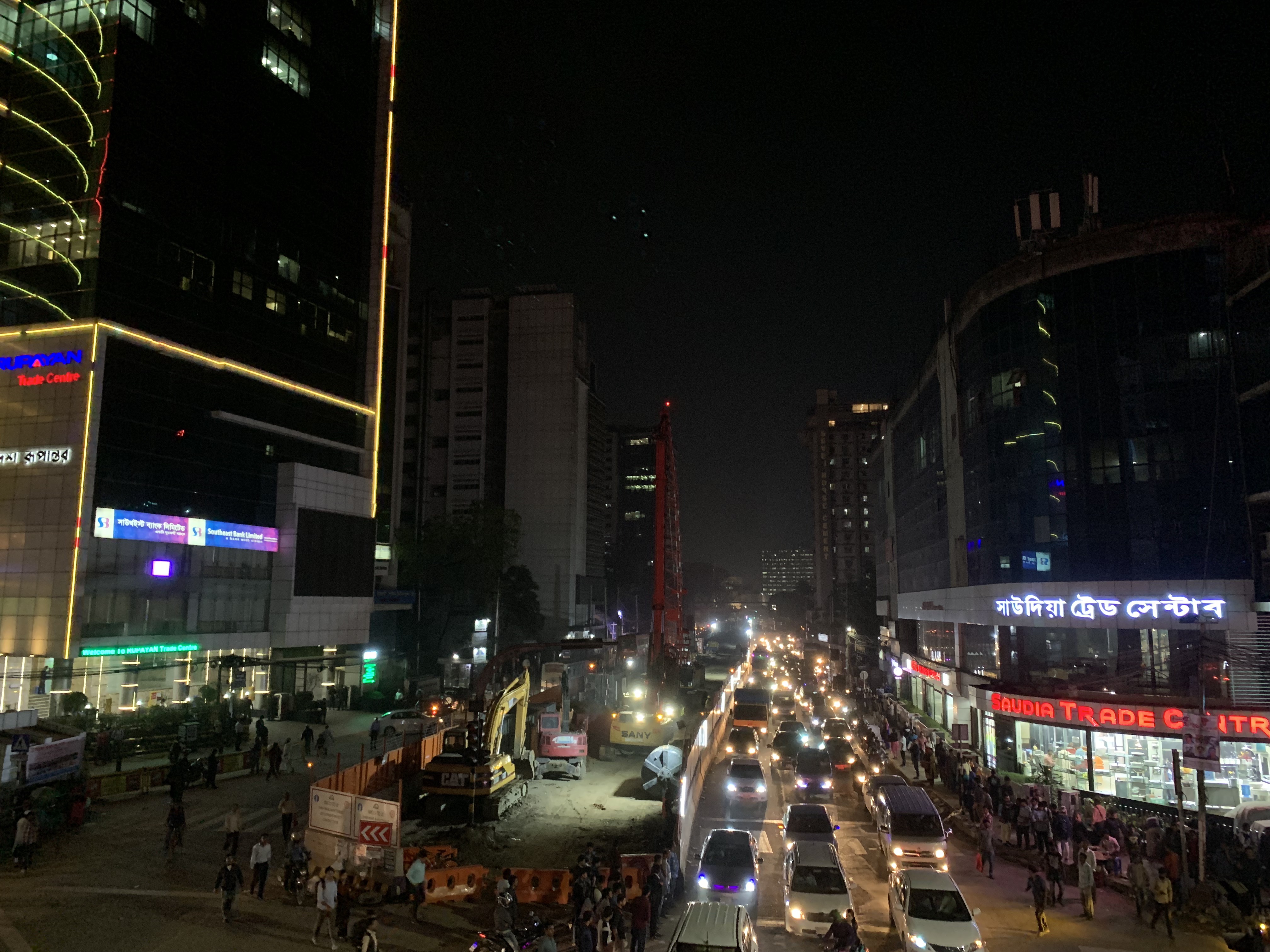
    Dhaka city centre, with metro works (I think)

    The Elephant Man

    I took a few hours after work this week to visit a tailor that my colleague Doughty S recommends. This tailor could make me a tailor-made suit, three shirts and a pair of trousers for a mere 170 USD, so is probably worth the two hour slog I had to endure to get there, and the 3 hour slog home. Did I mention that traffic in Dhaka is insane? Traffic in Dhaka is literally insane. It’s exhausting, depressing and soul-destroying, a problem of many cities in developing nations, and about this I will write more in my report on Bangladesh. At one point, driving relatively fast for the time of day, we passed an elephant standing by the side of the road, eating grass from a building site while its rider lounged about atop its broad back. It wasn’t huge as elephants go, but it was still big and more to the point I have never in my life seen an elephant just ambling along in public doing its thing. So I naturally declared “elephant!” and tried (and failed) to get a photo from the car that was suddenly and perversely actually moving for once.

    My colleague Doughty S informed me that this elephant wasn’t a working elephant in the sense that it lifts and carries and drags things like an elephant should; rather, it was an essential participant in a money-making scam. Basically the dude on top of the elephant will manoeuvre it in front of your car, forcing you to stop, and then refuse to move the elephant until you pay him. Since it’s an elephant, you probably aren’t going to try and hit it; and if you’re in Dhaka traffic you probably won’t be able to outmanoeuvre it; and you can’t reach the dude to punch him since he’s on an elephant. It’s really a quite foolproof way of extorting a bit of money from passing motorists. So the scam unfolds, but on this occasion we were fortunate enough to be on the opposite side of the road, so no elephant extortion came our way.

    Doughty S also told me that the same people who ride the elephant also sometimes have a box with a snake in that they threaten to curse you with unless you cough up some money. But I think we can all agree the elephant scam is way more elegant.

    The Sand Gang in action

    The Sand Gang

    This is a devilishly cunning plan that seems worth far less than the effort and risk required to pull it off, but you have to admire the chutzpah of its architects. I spent two days at a resort town, Cox’s Bazar, during the break between seminars, to unwind a little and get some beach air. Cox’s Bazar is a kind of peninsula, with a single road heading south along the beach side, and over a line of hills the Rohingya refugee camps. The Rohingya fled violence in Myanmar to camps near Coxs Bazar, and there is now a huge industry of aid groups and Bangladesh army tending to their needs[1]. Most of the aid workers stay in Coxs Bazar, and every morning they drive along the road south to the camp. However, recently the government closed a 200m section of road near the hotels for repairs, and now there is no road south from the southern part of the town. Rather than head north and around, the aid workers drive onto the beach in their white SUVs and use the beach as a short cut, as do all the locals who live in the southern stretch of Coxs Bazar. It’s ridiculous that there is only one road and that it has been closed now, but this is Bangladesh so everyone just rolls with the punches.

    So, when our time came to do a little beach tourism our driver took us onto the beach – me, Doughty S, his wife and child, in a rundown old van without seatbelts, along the beach and up to the part of the beach where we are to rejoin the road – where we found a couple of cars bogged down, and a queue of cars waiting to get up the hill. You can see the scene pictured above. We sat here for perhaps 10 or 15 minutes waiting our chance to drive up the hill but it seemed every time we tried to gun the engine and go up the hill someone let a tuk-tuk down in front of us, or someone cut in, or a group of people got in our way. Doughty S got out of the car and went up to direct traffic, and we watched as various cars floundered and then got pushed up the hill of sand by gangs of eager men. Eventually a gap appeared, our driver took a risk, and even though a woman in a sari and a tuk-tuk nearly cut us off we gunned up the sand hill, the driver throwing the car left and right with ferocious energy until we bounced up a huge lump and onto smoother, firmer sand, then onto the road where Doughty S rejoined us.

    Doughty S reported to us the real story of the floundering cars: a kind of local syndicate of young men had set up a scheme where every time a car attempted to take the hill at speed someone would step in front of it, or they would direct a car coming in the opposite direction into its path. They made sure that children were the ones stepping in front of the car, so that it was guaranteed to slow down, though not so carelessly as to make it stop entirely. Its power gone the car would then hit the bank and flounder, and then the men would offer to push it out for a small fee. The fee was about 30 taka (30 cents or so) for a Tuk-tuk, up to perhaps 100 taka for a car like ours. Many of the drivers were not locals or were not used to driving on sand, and were easy marks; somehow the UN vehicles were never affected by this scam, and neither was the military truck that was just rolling away when we arrived. They obviously knew how to select their targets. Doughty S also told us some drivers suspected the sand gang had sabotaged the road to start with, undermining the sand bank.

    Dhaka traffic comes to the bazar

    By the time we returned from our tourism trip, the sand gang had also managed to expand to the other slope near our hotel, where I witnessed the traffic jam above. When you see a picture of Bangladesh traffic it is important to remember it’s not just a throng of cars; it’s also a cacophony of horns, because everyone uses their horn all the time for everything, and even the small jam pictured above was raising an enormous racket. Needless to say, we jumped out here and walked the rest of the way to our hotel.

    Libertarian dreams

    There is a cyberpunk air to Dhaka, in the sense that there is no smooth and ordered government-run system and everything is a chaotic mesh of competing businesses and money makers. There are no traffic lights or traffic police, no road rules, most of the time not even any lanes, and in the chaos of the traffic it’s every man for himself. With a weak state and a populace with limited work opportunities and not much money there is a big atmosphere of scamming, grift and graft. Funnily enough despite this lack of oversight no enterprising soul has managed to set up a toll road, or offer some advanced business plan that can cut through the dust haze and klaxon roar to somehow make money distilling all this essence of chaos down to pure profit. It just remains barely controlled chaos, mostly held together not by profit motives so much as by the common decency people usually show each other despite their situation. It’s a bit of a cliche to tell libertarians that if they want a world without a government they should move to Somalia or something, but I think for your everyday Bangladeshi worker that’s pretty much what they face: undiluted libertarianism. Out of pocket payments for healthcare and rubbish disposal, a completely uncontrolled transport system with very little public investment, a government sector where everyone accepts that services are purchased not given, and some dude with an elephant making a living (of some dubious kind) by extorting motorists. This is the reality of unimpeded libertarianism: the elephant man and the sand gang. If you want to see where it takes you, come and enjoy the traffic in Dhaka… but look out for the elephants!


    fn1: The Rohingya are a sad story but I don’t get the impression that anyone here resents them. The Bangladesh army set up camps early, and have done what they can given their resources, and the town is generally welcoming of the aid workers and happy to take their money. Bangladeshis I speak to are universally proud of the social harmony in their country, “unlike India,” and don’t consider for example Hindus or tribal people (who apparently live around here) to be lesser people. The government wants to send the Rohingya back but seems willing to not force them while they are still at risk, and although it’s not a pleasant situation everyone seems to be doing what they can. I wonder if the Rohingya have elephants …?

  • Recently Democratic senator Amy Klobuchar announced that she will be running for president, only to be confronted with reports that she is a nasty boss. The media are avoiding calling it bullying, but the reports are bad and suggest that she is genuinely terrible: throwing things at staff, making them do personal chores, humiliating them publicly and terrorizing them personally. Until 2017 she had the highest staff turnover of any senator, and rumours suggest she was warned about her treatment of staff by a senior colleague. This is bullying, plain and simple, and these actions should be called bullying. Her defense has been that she’s a “tough boss”, and others have suggested that she is just “demanding”, but throwing things at staff and humiliating staff publicly is not “tough”, it’s abusive.

    Besides the obvious moral failings of bullies, there are three important reasons why a bully should not be nominated for, or run for, and certainly not become, president.

    • Bullied staff are bad staff: When you’re bullied you avoid reporting mistakes, you bury issues you know will trigger your boss, you avoid communicating with your boss, and all communication and information is carefully managed and manipulated to ensure it doesn’t trigger the boss. This means that errors compound and grow, the boss only hears what they want to hear, and decisions get made on the basis of what the boss wants, not what is best for the organization or what is right. Many people will claim that they wouldn’t behave this way if faced with a bullying boss but I can assure you from experience: Everyone does. Bullies run dysfunctional organizations, and often ultimately destroy those organizations.
    • Bullied staff are vindictive staff: If Klobuchar is a bully and she wins the nomination, you can bet that all through the general election there will be a constant dribble of negative reports about her, as her staff try to stop her from becoming the world’s top bully. This will hamper her effectiveness and ultimately risks Trump winning.
    • Bullies do not play well with others: There is only one way to stop a bully’s bad behavior: smash the bully. The only way to restrain a bully is with power – it is the only language they understand. Bullies always punch down and suck up, they have a natural power to understand where power lies and who uses it, and they don’t collaborate or cooperate with peers or weaker people. This is bad at school but it’s monstrously dangerous in a nuclear-armed and powerful nation. This shouldn’t be a difficult thing to see – we can see how Trump doesn’t play well with others, and he’s obviously a bully.

    Public responses to reports of Klobuchar’s bullying have largely ignored these points. This Washington Post article, for example, starts with the question “does it matter?” and finishes with this pearler:

    If you think about it, the problem with [President] Trump is not that he’s a crappy boss, it’s that he doesn’t get along well with peers and with the people he needs to work with to get legislation passed … I’m not sure the job of being president is a job of management in the sense of being a CEO, but frankly as I see it, it’s about convincing people to do what needs to be done.

    This is exactly why Trump being a bully is a problem: he can’t get along with his peers because he has a history of bullying and attacking them, and he can’t convince people to do what needs to be done because they refuse to cooperate with such an outrageous arsehole. These things are all linked!

    On Twitter another response I have seen to these reports is that it’s a double standard, that no man has been subject to these complaints and that it’s just another way of bringing down a “tough” woman (with the addendum if she were a man she’d be called “tough” but because she’s a woman she’s “unreasonable”). I am sympathetic to these arguments and I can see that if Klobuchar were just tough she might well be derided as unreasonable, but that is not what is happening, and conflating the reports with “tough boss” is wrong. Furthermore, it’s not a double standard: reporters were reporting on Sanders’ mistreatment of his staff in 2015, Trump’s bullying was well known and well reported on, and Tim Kaine (Clinton’s VP pick) made Trump’s bullying a central part of his address at the Democratic National Convention. While it’s true Sanders didn’t get hauled over the coals for this, it’s true that in a lot of other ways coverage of Sanders was ludicrously biased (he’s not a Democrat, for example, but he was taken seriously by the Democrats wtf), and the broader issue of how poorly the media handled Clinton’s candidacy is about way more than this issue – and largely unrelated, I think. The fact is that Trump’s bullying was widely reported on, as was his sexual assault. It’s just that a lot of Americans didn’t care, only watch Fox News, or were too stupid to understand how to check the candidates before they voted.

    Of course it’s possible all the reports about Klobuchar are lies, but I doubt it. I haven’t bothered investigating in detail because it’s not worth my time – Harris is going to win the nomination, so it doesn’t matter what Klobuchar did – and because if Klobuchar does win the nomination it doesn’t matter, since she’s obviously better than Trump. But the fact that this comes up now shows the importance of a simple principle: At all levels of society, at all times, we have to confront and beat down bullies, and we need to always be aware that a lot of people love and support bullies, and we need to confront and deal with them too. I will talk about the importance of this at a more prosaic and local level: the US role-playing scene known as the “Old School Renaissance”, or OSR, where a major figure in that scene has recently been uncovered as a rapist and a shocking bully and power abuser.

    Zak S and the personal politics of bullying

    Zak S is a major figure in the OSR, who runs the Playing D&D with Porn Stars blog and has been involved in a great many OSR projects, especially Lamentations of the Flame Princess. Zak S has been involved in the OSR since about 2009, when he started the blog, and in his early days was well enough behaved. He occasionally commented here in 2009/2010, before he discovered he had bigger fish to fry, and then I lost interest in the OSR and stopped paying attention to the recycled junk they produce for many years. But somehow in Twitter I stumbled upon a report that Zak S’s porn star players – who, it turns out, were all his lovers as well – have started posting reports on Facebook about how he raped them and abused them for many years. He was apparently a gaslighting, emotionally manipulative abuser, since probably about the time he started blogging. As it stands at the time of writing two women have reported similar behavior and abuse, and it seems pretty unlikely that this is some kind of political campaign. The truth is out and it’s not pretty.

    I was not surprised, because Zak S is an obvious bully. He has been bullying people for years, with help from a coterie of vicious internet allies, and has been an incredibly disruptive presence in the OSR. Multiple producers of OSR content and various bloggers have had to bow out of the whole scene or disappear because of his behavior; in 2016(?) a group of women marched out of the Ennies in protest at him winning prizes (they walked out on political grounds; aesthetic grounds would have been sufficient!); he was banned from one of the big forums (RPG.net I think) with an epic post listing his behaviors that I can’t now find; and various people have taken sides over his behavior over the years. It’s no surprise that a man who showed the kind of public aggressiveness and rudeness he showed should turn out to be a manipulative rapist, because bullies only listen to power, not to moral claims, and rape is a crime of power. But by the time this came out he had managed to leverage his vicious public behavior into a role as a “consultant” on D&D 5th Edition and some kind of advisor to Vampire: The Masquerade[1]. He had also ingratiated himself with Lamentations of the Flame Princess to the extent that he is one of their main contributors, and was involved with various other OSR/DIY gaming[2] outfits. Somehow this thoroughly unpleasant man had managed to become popular with a lot of people despite his repeated public bullying of weaker figures. How did this happen?

    It’s instructive to compare the response of some people to this news today with the way they defended him for years. People have known about the claims about Zak S and they defended him, over and over, for years. They repeatedly dismissed any criticisms of his behaviour as lies, slander, “social justice warrior” posturing, jealousy, conspiracies, or people being delicate snowflakes. But all the criticisms were true, and all the defenses were the usual bullshit that the enablers always give for bullies. The reality is that a lot of people in the OSR were willing to side with Zak S and supported or defended his behavior when they realized that he was going places. They didn’t dissociate quietly from him, they didn’t refuse to support him, they didn’t confront him – they actively defended and encouraged him. Now they’re all acting ooooh so surprised that he’s a rapist and that all the tactics he deployed online were deployed to devastating effect in his personal life, and a lot of them even now are trying to back out of responsibility by claiming it’s a social media storm, or blaming the women or pretending that they were blinded by political considerations. It’s all bullshit: these people were the sycophants to the bully. Just like every bully in school has a gaggle of hangers-on who applaud his every tawdry move, the leading lights of the OSR clung to Zak S. They hung on his every word. Even now Raggi at Lamentations of the Flame Princess is waiting to see how everyone reacts before he makes comment, because that’s the kind of coward he is. The rest of them are trying to pretend that they had no clue – no clue! – that this guy who had been banned from multiple forums for abuse, who was a known sock puppeter, who broke every social norm and paraded around like the Sun King on Meth, was completely unknowably bad. How could they have guessed? They could not have known!

    Well they’re lying. Bullies are nothing without their enablers, and the enablers always crawl out from under their rocks when they see someone who might be going places, someone who they can suck up to for some benefit, even if it’s just the vicarious coolness of being around someone who is “popular” – and even if that popularity is just other morally backward people like themselves cheering the bully as he hurts others. That’s what happened with Zak S, and now we’re watching all these people come to terms with the fact that they spent years helping a rapist and a bully get popular and famous in their sordid little scene.

    That’s what happens when you don’t confront bullies. That’s what happens when you stand by while they act like shitlords, and tear up the communities that welcomed them. Every single one of us has a personal responsibility to confront bullies and to drag them down, to shame them and humiliate them. If we all did this from the very beginning there would be no Zak S’s, no Klobuchars, no Trumps – they would all have learnt that it doesn’t work, and they would have stopped. But too many people make excuses, say that Zak S is just confrontational, that Klobuchar is tough, that Trump says what he means and means what he says, and ignore what is really happening. They let it pass, and then someone genuinely weak and helpless – someone like Mandy Morbid, Zak S’s girlfriend, who has serious disabilities and is a foreigner in America – has to finally break everything and make the stand that everyone else could easily have done years ago. The burden falls on the weakest, the victims, instead of on people like Raggi from Lamentations of the Flame Princess who could have sent Zak S a very strong message years ago by telling him “fuck off Zak, you’re a fuckwit.” Instead of years of humiliation for being a fuckwit, Zak S got years of support and ennoblement, and learnt repeatedly that there is no penalty for being evil.

    Not everyone can stand up to bullies. Bullies know power, and often their victims have no power to say no. But bullies always seek the powerful for approval and support, and they know how to accrue power, social and financial resources, and the kinds of capital that protect them. If you control that power, those social resources, or that capital, then the responsibility is on you to attack those bullies. If you have money, a steady job, love, physical strength, tenure, stable and supportive networks – it is your responsibility to confront these people and tell them to fuck off. You may fail or they may try to hurt you but if you don’t it comes down to this – a disabled sex worker crying for help on facebook, anonymous staffers having their stories dismissed in the national press because they’re anonymous cowards, victims of Trump U taking him to court in a fevered national election environment – vulnerable and scared people, risking everything to tell the rest of us what we already knew. But if every day those of us with power and position used that power and that position to tell these people how they are wrong, and to take away their power to do wrong, then those vulnerable people would not have to risk everything to warn the rest of us about what is coming.

    The responsibility to smash the bully lies with you, not with anyone else. And if we all use that responsibility, if we do what we should do, then the bullies will never thrive, and the world will be a better place. Or we could be like the cowards in the OSR, and achieve some measure of temporary fame by sucking up to a known bully.

    The choice is yours.


    fn1: I have always hated Vampire, which is a classic attempt to tell the story from the bully’s perspective, and it doesn’t surprise me at all that they would be attracted to a bully and a rapist.

    fn2: “DIY gaming” appears to be some sort of euphemism for “we do D&D”


  • rockhopping
    No Satisfaction prowling the asteroid belt
    Holy water cannot help you now
    See I’ve had to burn your kingdom down
    And no rivers and no lakes can put the fire out
    I’m gonna raise the stakes, I’m gonna smoke you out
    Seven devils all around you
    Seven devils in my house
    See they were there when I woke up this morning
    I’ll be dead before the day is done

    The cast for this session[1]:

    • Captain Al Hamra (Mystic)
    • Engineer Reiko Ando (Deckhand)
    • Pilot Saqr Geroushi (Pilot)
    • Sensor Operator Siladan Hatshepsut (Archaeologist)
    • Ship’s Doctor Banu Delecta (Medicurg)

    Having fought off the unidentified pirate ships on their way to Rockhome 3, the PCs came to a halt in the dusty darkness of the asteroid belt, and spent a few hours repairing the hull of their heavily-damaged ship. Their repairs were barely enough to make the ship safe for travel, though, so they hurried forward to Rockhome 3, in hopes of finding safe harbour and repairs for their damaged ship. They arrived a few hours later and drifted into one of the space station’s four hangars, finally finding some safety on the 6th day of their journey.

    The hangar they landed in was large enough to dwarf their ship, perhaps 400m square, big enough for a small class V vessel. Their ship was the only ship in the hangar, which was a battered and filthy affair, low-tech in all its components and rundown. When they emerged from their ship they noticed the air was freezing cold, so their breath misted in front of them, and had a rank smell. A group of about 15 locals were walking towards their ship, led by a thing, greying, tall man in a dirty flight suit. As he approached Al Hamra to shake hands Al Hamra noticed that he stank of body odour. Everyone in the group looked worried, and they were all wearing flight suits, coats and scarves or mufflers. The place was unusually silent for a working dock.

    The man introduced himself as Abraham, colony spokesperson, and immediately cut to business: did they have spare parts? They assured him they did, and moved to the conference room of their yacht to negotiate prices. They managed to cut an excellent deal, selling the goods for more than twice the price they had bought them and selling him more than he immediately needed, leaving them with just a small stock of advanced and ordinary parts. He also agreed to have his dock workers repair their ship, and as final icing on the cake offered them accomodation in the luxury section of Rockhome 3, adding, “I hope the gravity will be stabilized by the end of the day.”

    He did not, however, offer to let them investigate the sabotage that had nearly brought his community to its knees. Al Hamra attempted to read his mind, but found only a vision of the community as a vulnerable and wounded animal surrounded by predators, that would be torn apart the moment it showed weakness. Abraham intended to find the saboteur himself.

    Al Hamra did not care who the saboteur was. But the group thought back to those two fighters in the debris of the asteroid belt, and wondered what else would be coming for the colony, and if they would be gone before it came. They retired to the luxury quarters to think and to plan, leaving Adam and Oliver Greenstar on the ship to guard it.

    Rockhome3

    Rockhome 3

    Rockhome 3 was actually a spacious and pleasant living space, though so primitive that even the PCs with a station background were uncomfortable living there. It had been built out of five asteroids, four smaller rocks connected to a larger central living space by strong tunnels. The whole thing was held together by gravitron projectors and connected to a large dock and mining complex, large enough to hold five large spaceships and about 12 small mining ships. The centre living space was a nearly spherical asteroid about 3km long by 2km wide, hollowed out and divided into two large residential sections and a central business section. The centre of all three of these spaces and the luxury sector were graced with wide, pleasant parks, and the walls of all the sectors were covered in creepers, ivy, and hanging plants. Large windows on one side of all the asteroids gave a view of the distant sun, and the slow rotation of the entire structure allowed this weak sunlight to shine into all the sectors for about 10 hours every day. Living spaces were primitive but spacious, and about 400 people lived there. No one was registered and no one could say exactly how many people lived there, but everyone knew everyone else’s comings and goings. By the time the PCs reached their luxury apartments they were already known to the entire colony.

    Before the day was done they had received their first invitation to intrigue: an invitation to dinner from Ingrid Silwerstern. Ingrid was a representative for the Consortium, who had also sent a doctor called Dr. Angbat. It was only natural that she should invite them to dinner to give her the latest updates on news from Coriolis, and all the intrigues of that distant and splendid metropolis. They agreed, and soon found themselves in the company of an agreeable and charming middle-aged ambassador and the willowy young Dr. Angbat, eating Green Ahi[2] and discussing fashion trends in the Spring Plaza. However, before the night was over Ingrid made them a clear offer: find out who the saboteur was and she would give them 5000 birr (which they managed to negotiate down to 4000 birr). Ingrid’s fear was that the sabotage had been caused by the miners themselves and that they were planning an uprising – something that was always fatal for a large portion of a station, and something she wanted to avoid. Of course the PCs agreed, and went home to plan their moves.

    They decided to make themselves useful, and in doing so to begin to find out what had happened in the colony. Reiko set off to help the colony’s workers repair the facilities that had been damaged by sabotage, while Al Hamra oversaw the unloading of the cargo and Siladan attempted to use the ship’s equipment to monitor outgoing broadcasts. Unfortunately Siladan’s personal problem distracted him, and instead of looking for signs of sabotage he found himself examining mining colony culture and trying to understand their life cycle. By evening he had learnt nothing. Banu offered her services as a doctor in the local medicenter, but after her first consultation – with a young domestic violence victim called Ilthid, who told her he could not leave his abuser because he was “rich and powerful offers me so much when he achieves his full potential here”[3] – was sent home for her terrible bedside manner, having learnt nothing about the local community[4].

    They regathered in the luxury apartments in the evening, and Reiko was able to confirm that the sabotage had been caused by explosives, though she had not been given time to find out exactly what explosives had been used. They decided that next day Banu and Reiko would investigate the explosives in detail, while Saqr went outside in the No Satisfaction and searched the vicinity, and spent some hours eavesdropping on the communications between the miners as they worked on remote asteroids.

    They set out the next day to these tasks. Reiko and Banu were able to determine that the explosives used were low-yield shaped explosives of the type used by miners, and Reiko – by chatting with the friends she made while doing repair work – learned that the mining ship docks were equipped with a kind of vending machine system for dispensing exactly the kind of explosives they suspected had been used. Only one mining ship was out at present, so they guessed that it would be easy to trace who took the explosives. All they needed to do was get into the security control centre and download footage of security cameras watching the docks. Meanwhile Saqr, listening in on miners’ talk, was able to confirm that the miners had not planned any sabotage, and showed no signs of rebelliousness. Whatever motivated their saboteur was much more sinister than mere plebeian discontent!

    In the afternoon they gathered and decided to get into the security center. Reiko, Banu and Al Hamra approached the guards at the centre and, using Reiko’s newfound camaraderie with the locals, struck up a conversation about a place to get a decent bath. The guards let them in on the secret of Edith’s Repose, a Courtesan’s establishment in the centre of the business area, and with a few snide insinuations and offers of payment they managed to lure the guards away for an evening of drinking and relaxation. While they were gone Saqr and Siladan crept in and downloaded the camera footage they needed.

    Algebraic Escalation

    That night, looking at the footage, they found a picture of the likely perpetrator, a young man who accessed the vending machine after the last mining ship left, and showed no signs of going out mining. They thought of asking Ingrid Silwerstern to identify the man but there was no need: Banu recognized his picture as the picture on the file of the boyfriend of Ilthid, the abused man whose case she had handled so badly the day before.

    They visited Ilthid immediately, finding him at his home in the first residence. After some pressure he revealed that his lover, Aslam, was a rich man, the youngest child of the Founders, a rich family descended from the original Founders of the colony. The Founders were rich from their historical possessions but had little power on the station, and most of them were now distributed around the colony’s diaspora, on Coriolis or Lubau. Aslam had stayed on Rockhome 3 and was not happy about it, but had recently started talking about how great his future would be. He assured Ilthid that he would soon be a powerful and great figure, and Ilthid tolerated violence and unspeakable acts in hopes of having great favour in the future. The PCs realized that Aslam had some plan, and decided to confront him. They left Ilthid crying softly in his rooms, and returned to their accomodation to send Aslam an invitation to a breakfast meeting to discuss investments.

    Their breakfast meeting with Aslam did not go well. He was arrogant and insufferable, but gave them no evidence of his plans. Eventually when he realized they were confronting him about the sabotage he told them they would be well-served leaving the colony immediately, and then walked out. After a few minutes’ discussion the PCs decided to follow him to his residence, and were halfway across the gardens of the luxury quarter when a large screen over the entryway to the quarter came to life and provided them with a simple announcement:

    Incoming ship

    Docking: Hangar 2

    Name: Algebraic Escalation

    They were no longer alone on these distant rocks. Something had emerged from the Dark.


    fn1: for this campaign we have 7 players but usually we don’t have a full group, so we get different players attending every session. So I think I will give a cast at the beginning of each report so we can see what is happening and who is present.

    fn2: A kind of large grasshopper, grilled alive.

    fn3: All the players missed this opportunity to find out things about Ilthid’s lover, and promptly forgot Ilthid’s name, because they are – like all players everywhere – completely useless.

    fn4: Banu is a rich girl slumming it, so you can see where things went wrong when she tried to provide medical care to a belter victim of domestic violence during her gap year …

  • And down there somewhere among the noise
    The magazine dolls and the big money boys
    Move silently on their easy heels
    They move silently on their greasy wheels
    This town has turned me into what I have become
    This town dresses you up like a stranger
    This town hangs around in the doorway and tells me I’m late
    This town takes us down, takes us down
    I feel like I’m losing you to this town

    The PCs are trying to find Lavim Tamm, a young man who is in possession of a valuable statue that their employer, Merez, hopes to buy. They visited the White Tugur and the owner told them that they could find Lavim at a boarding house called the Quiet Eunuch. So they set off along the promenade to find his flophouse.

    The promenade is a broad and beautiful thoroughfare, but as one climbs higher up its walls the beauty fades, first to functional and practical walkways lined with lawyers and computer businesses and recruiters and other practical, sensible but unromantic businesses; and then to a narrow, shabby and cramped line of dubious cut-rate opportunists. Up near where the arc of the promenade reaches its apex the shops are small, grubby and sometimes indecent: barber shops, cheap masseurs, cyber doctors, flophouses, the occasional capsule apartment, brothels and pawnshops. Up near the arc the two sides of the promenade are close enough to almost touch, or to jump across if one is desperate, criss-crossed frequently with bridges and festooned with cables and conduits. Outside the shops shifty-looking men lounged and argued, chewing kat and smoking cheap tabak to pass the time. In between these sections of bustling but despairing business the promenade would fall into disrepair, and the walkways would pass into dimly-lit and unpopulated stretches through which people hurried, looking around carefully as they stepped through the shadows.

    At the edge of one of these patches of blank steel wall the PCs found the Quiet Eunuch, a boarding house with a narrow door and a single reception room looking out over the promenade through a grubby window. They ventured inside to find a small reception at the foot of stairs leading up to two floors of narrow rooms. The receptionist was unhelpful until they flashed some birr, then gestured them up to a room on the third floor. They took the stairs carefully, listening at doors and checking for trouble. Finally they found Lavim Tamm’s room, and knocked on its flimsy door.

    Lavim Tamm’s Story

    Lavim Tamm was suspicious, and refused to let them in at first, arguing with them through a viewing slot in the door. After they spent a little time convincing him of their good intentions – and flashed him a bottle of Fire Kohol – he let them in, and they found themselves facing off with him in a narrow room with a bed, a screen and a tiny shower booth. It stank of Kohol, and Lavim was drunk. He stood swaying in the middle of the room, wearing the dirty hotel gown and looking worn and tired. Adam noticed that he was obviously sick, his hair shaved to hide the possibility that it was falling out and his skin sallow and almost jaundiced. As he dragged out some plastic cups for them to pour Fire Kohol into, the pilot Saqr noticed that he had bundled up a worker’s uniform of some kind and thrown it onto the floor of the shower room, but from the door Saqr could see it had been burnt in places and was bloodstained.

    Over Fire Kohol they slowly put Lavim Tamm at his ease, and learnt his story. He had been part of an archaeological dig on the surface of Kua, a simple worker lifting and digging, when something happened and they were attacked by creatures from the Dark Between the Stars. He could not explain the beasts he saw in any other way – they attacked with fire that was made of shadow and cold, and tore his comrades apart with contemptuous ease. Lavim hid and somehow escaped the battle, carrying a single artifact from the dig, the weird black statuette he had been dusting off when the attack started. Now he was back on the station and wanted to forget the whole experience, but he was convinced someone was watching him, and that people were after the statuette. He was terrified, but had no idea about how to escape his situation. The overalls in the bathroom were the only clothing he owned, and it was covered in his comrades’ dried blood. He was in trouble.

    The PCs offered to escort him to their ship, and told him they had a potential buyer for the statuette. If he would trust them they could give him medical care on the Beast of Burden, and then he could negotiate the sale of the statuette, and be free of all his worries. Lavim Tamm agreed, telling them he had hidden the statue in a bridge over the promenade, along with a tag that contained the coordinates of the dig location, and if they agreed to take him to the ship he would collect the statuette on the way. They set off.

    Merez intercedes on his own behalf

    The bridge where Lavim Tamm had hidden the statuette was a level down from the flophouse and some distance away. Looking over the bridge the PCs could see down the dizzying heights to the base of the promenade, busy and cheerful far below, but the view was obscured by layers of conduits, cables, wires and nets. They accompanied Lavim onto the bridge and stood patiently while he dug around in a loose panel of the bridge and pulled out a small sack and a tag. Adam took the tag, while Saqr and Siladan Hatshepset investigated the statuette. Neither of them saw anything worthwhile in it, and in fact Siladan – who had some training as an archaeologist – was convinced it was a fake, of no value at all. Still, somebody valued it, so they figured they could sell it for Lavim Tamm anyway, so they turned to leave the bridge …

    … and found themselves facing Merez, the man who had employed them to find Lavim, accompanied by three goons. The goons were armed, wearing light combat armour, and quite obviously hired Syndicate muscle. This situation did not look quite the way they had envisaged their reunion with their employer.

    “Well done boys,” Merez congratulated them. “Now, I want to take possession of that statuette, and I don’t want to pay market price, so I’m going to cut a deal with you. You hand me the statuette, I pay you the 3,000 birr for finding it, and nobody gets hurt.” He waved a tag at them. “This is all the money you’re going to make today, my friends, so I suggest you make the most of my good mood and do as I ask.”

    Behind him the Syndicate thugs flicked aside their coats to reveal Vulcan pistols and knives. They appeared to be ready to commit serious violence if things went awry. With most of the PCs back on the ship and only three on the bridge[1] they did not feel they were in a position to argue. With a resigned shrug Adam handed over the statuette and took the tag, quickly transferring its contents to his own.

    “Good, very wise,” Merez crooned as he pocketed the statuette. Then he turned, waved his hands to the thugs, and ordered them to kill the entire group in an airy voice. They drew weapons and moved in for the kill as he walked away into the darkness.

    The fight was brutal and over quickly, ending with two of the goons bleeding on the bridge, and Adam choking the third into unconsciousness and banging his head on the rails. They waited for him to come around and asked him a few pointed questions, from which they received little joy. He and his mates were hired guards, with no interest in whatever Merez wanted the statuette for. They had been paid and as far as he was concerned their job was done. He happily told the group where Merez was based in exchange for being allowed to drag his friends away for medical care, and they agreed to let him go.

    They returned to their ship to recover and fix the teeth that Saqr had lost in the fight, and then decided to pay Merez a visit and ask for the statuette back, or for proper payment. Before they left Siladan spent a little time investigating the area where Merez was based. Saqr, the ship pilot, also had a mystical power, and he decided to use this to locate the statuette. To everyone’s surprise, it was not in Merez’s office – it had somehow been moved in just a few hours to a location near the docks under the Spring Plaza.

    Confused, they decided to see if they could steal the statuette from wherever Merez was storing it.

    The Draconites intercede on their own behalf

    Unfortunately the statuette was not in any warehouse belonging to Merez. When they arrived at the location that Saqr’s mystical powers identified, they found themselves staring at the locked gate of a Draconite compound, guarded by two heavily-armed soldiers. Was Merez working with the Draconites, or had he already sold it on to the Draconites? They decided that if he had sold it on already they would force him to pay them the money for it. They had promised to keep Lavim Tamm safe, and now he had basically been robbed while they were trying to help him.

    Angry and determined, they headed to the small Souk near the Spice Plaza where Merez had his office. His office was a small demountable building in the centre of the Souk, reached through winding paths through mercenary brokers, Syndicate fronts and gambling dens. It was a nondescript affair, a building with no sign, a simple door flanked by large tinted windows, and no guards. The door was open, the view inside blocked only by a beaded curtain. From inside they could hear Merez on his phone, yelling at an underlying:

    “What do you mean they’re not at the ship? They have to be!”

    “… I don’t fucking care! They stole my statue! Get in there and find it!”

    “How can I fucking know?! I know the fucking things big, you’ll just have to search it you useless fucking mook! And make it snappy, I pay you no good shits by the hour!”

    “… Yes! And if they come back I want you to fuck them up! Those fuckers stole my statue!”

    He was still yelling on the phone when they entered his office, but their entrance stopped him dead. After a moment he said, in a desultory voice, “Forget it. They’re here now,” and put the phone down. Adam noticed he probably tripped an alarm of some kind as he stood to meet them.

    “Where’s my fucking statue!?” He demanded. From there the conversation did not improve. Merez was certain that they had stolen the statuette, and they would have been sure he was bluffing if they had not overheard his instructions on the phone. Someone had stolen his statuette almost as soon as he returned it to his office – and that thief was either a Draconite, or a friend of the Draconites. Not a pleasant prospect.

    After about a minute of pointless low-grade gangster dialogue the PCs noticed Merez looking over their shoulders, as if someone was standing outside. They dropped to the floor in the nick of time, as two guards outside opened fire on full automatic. The PCs rolled in to cover near the door, covering themselves as the windows fell all around them in shattered piles, and watched and winced as Merez’s guards turned the room into a killing zone. Merez himself had ducked behind his desk, which was obviously bullet proof, and was laughing maniacally as his guards shredded the room.

    None of the bullets touched the PCs, and when the guards had exhausted their magazines the PCs returned fire. A short battle followed, in which Saqr leapt over the desk and destroyed Merez’s knee before he could run, one of the guards shot Siladan’s foot into a bloody mess, and Adam fought with ruthless efficiency from the cover of the window. In just a few moments both guards were dead, and their relationship with Merez was finally and irrevocably finished. They took what they could from his belongings and left him bleeding and squealing behind his desk.

    To the asteroid belt

    The PCs decided that discretion was the better part of valour, and that it would be better not to enter the lair of the Draconites for a statuette that their archaeologist was convinced was worthless. They had the tag with the coordinates of the dig, and the promise of further Firstcome artifacts if they were willing to brave it, so they decided to cut their losses with Merez and find a way to make money.

    Before they met Merez they had been told a rumour about a mining colony in the asteroid belt that had been sabotaged and was about to become desperate for spare parts. They had also heard about a shipment of spare parts on the Divine Grace, that was so large it had pushed down prices in the station. They decided to buy a large supply and head for the asteroid colony, to profiteer from the misery of belters. What could possibly go wrong with that plan?

    They bought the spare parts at a good price and organized their delivery over the next two days. By the time the parts were safely in their cargo hold the Beast of Burden had been fully refit, and was ready to leave Coriolis station. They set off that same day, heading to the mining colony Rockhome 3, six days’ travel through the Dark Between the Stars.

    Their journey was uneventful until the last day. As they neared Rockhome 3 they were ambushed by two small fighters, which refused to identify themselves but fired torpedos at their ship and threatened to blow them away unless they jettisoned their cargo and left the area. They refused to do so and instead turned to join battle, trusting to their larger size to win out over two class I fighters. This almost proved to be a grave misjudgment, and their ship was heavily damaged by repeated attacks with an Accelerator cannon before they could finally destroy their attackers. In the frozen darkness of the belt, flying through clouds of dust and ice, lines of hyper-velocity metal shards glittered like stars in the dark, their torpedo counter-measures spread like squid ink in a starry sea, and torpedos streaked past their ship like vengeful demons. Finally they closed on the torpedo ship and rammed it, tearing it apart so thoroughly that the pilot’s ejector pod exploded in its mount, and the ship tumbled away in shattered chunks. The second ship would not relent and closed for the kill, damaging their weapon systems and tearing holes in their reactor, before they managed to score a lucky hit that blew away its engines and sent it spiralling off into the darkness. The pilot ejected and disappeared amongst the detritus of the belt, leaving their ship limping and bleeding oxygen in the cold and merciless Dark.

    They had survived their first space battle – just. Ahead of them lay the sanctuary of Rockhome 3, and the mystery of its sabotage. Ignorant of its politics and uncaring of its politics, they headed to the asteroid to profit from whatever petty feud had brought it to ruin.


    fn1: A bunch of players had to cancel …

  • It’s just not cricket …

    It’s that time of the year again, and the newspapers are full of reports about the Superbowl. Vox has been flooded with articles about why we hate the Patriots or why players keep getting bigger, and everyone is expected to have an opinion on this sport. Apparently this year’s effort was extra boring, and the half-time adverts were crap, and the Maroon 5 dude revealed that he has a tattoo in Times New Roman font[1]. This year I didn’t bother with this whole thing, because I have tried to get into American Football and I just simply cannot. I have tried, and I just can’t really enjoy it.

    This is a bit of a surprise to me, because I can enjoy most sports if I understand them. Indeed, I put in a bit of effort over the past two years to learn the rules of NFL, I spent time watching matches (which are broadcast live here in Japan if you have cable tv, and which on replay are stripped of adverts and quite easy to watch), I put a bit of effort into studying some of the rules and trying to figure out what was going on. It’s my view that the single biggest reason most people don’t enjoy most sports is that they simply don’t know the rules, and that if a sport is played well by elite athletes and you understand the rules you will probably enjoy it. So I was surprised when I tried to learn the rules of NFL and I still found it simply unenjoyable. I have tried to find reports from others about why they don’t enjoy NFL, but there are precious few, or they are reports like this one that don’t really seem to explain the game’s problems. So I thought I would write a post about why I can’t get into NFL. Perhaps someone will comment to give their own opinion, or to explain why I’m wrong (nicely, I hope!) or perhaps not, but here I would like to outline some of my reasons.

    Here I am not going to waste time talking about the many political problems of the NFL – the blackouts, the teams’ insatiable demands for government money, the racist team names, the fact that college football players aren’t paid, the disgraceful treatment of cheerleaders, the concussion scandals, the awful mismanagement of the knee issue or the blatant disgusting militarization of the whole thing – which are well known and are a good reason to boycott it on principle, but not an explanation for why the game itself is simply not enjoyable. I also don’t intend to talk about this as “my favourite sport is better than yours” or to suggest that NFL players aren’t great athletes or that rugby dudes are tougher than NFL dudes or anything silly like that. I thought I should like NFL – I like ball sports with heavy contact, I approve of violent sport, and I like watching men smash each other, and I enjoy most other ball sports when I watch them – but I don’t enjoy it. I also don’t intend to tell people what sports they shouldn’t like, or laugh at people for watching weird shit – if you like snooker or darts or curling that’s all cool and not my business – but I wanted to try and pin down why I don’t enjoy NFL, and see what other people have to say about that. For the record, my favourite sports in approximate order would be kickboxing/MMA/boxing, rugby, high quality English premier league soccer, AFL, some olympic-level sports, lower quality soccer, and then a bunch of other stuff in no particular order. I’m not anti-sport, and I’m not opposed to violent sport (I thoroughly oppose any efforts to ban boxing, for example, on pure civil liberties grounds). I also have done kickboxing (and other martial arts) for 25 years, fought in an amateur fight once, and enjoy regular training with rough men. I’m not squeamish about violent sport. So, here are my reasons, in no particular order.

    • The weird stops and starts: I really cannot get used to the strange way the game stops, waits, everyone changes, and then it restarts. It doesn’t feel like sport to me, and it all feels strangely pre-determined. It feels more like work than sport. I just can’t get into the pre-organized changing of sides and ordering of attack and defense. Weird, given I am into turn-based combat in RPGs, but there you go.
    • The lack of ebb and flow: This is a big one for me and I think the single biggest spoiler. When the QB gets sacked or a pass is incomplete the game just … stops. No one fights for the ball, there is very rarely a change in direction of the attack, and it seems impossible that the flow of the game would change several times. When you watch soccer or rugby there is a constant shift and flow of possession, attack and defense, and no reprieve for either team when they have or don’t have the ball. If an NFL team is defending at 4th and goal, there is no sense in which they are under the cosh as they would be in a concerted soccer or rugby attack – they just have to foil one more play and then they are guaranteed the ball. Worse still, the attacking team don’t need to worry about the possibility that a pass will be interrupted or that they will miss the pass, because there is no penalty for this in the flow of the game. The only way the flow changes is if someone intercepts and catches the ball or a player straight drops it and the opposition scoop it up. This gives the game a really dead flavour. Nobody is risking anything, nobody is pressed, strategy isn’t built on what-ifs. So many times you get the 5th play and the team brings on a whole different set of players to punt, because there is this regular process that doesn’t change, shift or move around. It’s weird and I cannot think of any other sport except perhaps cricket which is so completely lacking in these sudden shifts of play.
    • The weird timing: There is something really strange about the way that time is calculated in NFL, as if time were not a thing at all. Teams have time-outs during which they keep playing, a one hour game seems to take 3 hours to play, the last 5 minutes just goes on forever, and every player has to be insanely careful about the implications for timing of e.g. an incomplete pass vs. being pushed out of bounds. I appreciate that rules are rules but why do there have to be so many weird and complex ways of simply keeping track of time? In any other game it’s simple: time passes at its usual rate until the game is over, and injuries are handled either by stopping the clock when they happen or adding time on. I don’t understand why there have to be so many weird ways of keeping track of time.
    • The strangely hypocritical rules: The weird timing brings me to the most frustrating thing I have ever witnessed in sport – a player being penalized for throwing a ball down in frustration and wasting 3 seconds of time, right before the game cuts to 2 minutes of adverts. What is going on with that? Why is time-wasting punished harshly in a game that takes 3 hours to play an hour’s football? Similarly, why is it a terrible offense to touch someone’s helmet but completely cool to hit them with a head-high tackle that is guaranteed to cause serious injury? It’s so pernickety, so finnicky, and so arbitrary.
    • The enormously complex rules: Most games have a simple set of penalties for all infringements, with at most two levels of escalation to deal with more serious incidents. But NFL has this intense system of penalties which involve decisions about whether to reset the downs and whether to penalize with distance, and seem to have an enormously complex set of rules that can be broken. It also seems in comparison to other games to have a lot of indecipherable decision points about basic aspects of basic gameplay, such as what constitutes a catch or pass interference. Every game has ambiguities and inconsistencies, but NFL seems to be consistent only in its ambiguities and complexity. It can be frustrating watching rugby and having to depend heavily on the referee’s judgment, but this pales to insignificance compared to the opacity of referee decisions in NFL.
    • The action is everywhere at once: When a play starts there is action happening all across the line and further downfield, and it’s very hard to follow all of it. I think this also means that in every play there are multiple infractions and it’s just luck if the referees see them. This is fine if complexity is your thing but it’s a uniquely weird experience that this is a ballgame yet almost all the action is off the ball.
    • The messy sideline situation: It really weirds me out that for the whole game there is this unruly mob of random people standing all along the sideline. Hundreds of people just shuffling around doing their thing. It’s so messy and weird. Every other ballgame has allocated places – a bunker or a coach’s area or something – but in NFL everyone is standing right down by the sideline crowding the game and just being messy. I guess it’s necessary because of the constant substitutions and changes of team (and we wouldn’t want to waste time!!!) but it’s just weird to me, like a pitch invasion is constantly being threatened.
    • The specialization: Every game has its specialist players but the level of specialization in NFL seems extreme, and not really much fun to watch. Vox tells me this wasn’t always the case, and that when substitutions were allowed more freely this led to the growth of specialization. It’s particularly focused on the quarterback, and I have never seen a game as focused on a single position as NFL. I guess this is a nice analogy for America’s political system, which is obsessively focused on the actions of one man, and I think it’s just as frustrating in sport as in politics. What kind of team game boils down to the decisions of one man? A weird one.
    • The weird camp machismo: I know it’s a bit of a cliche to say this but NFL players are really really camp, and it’s weird that Americans think they look super macho. I recall watching an interlude in a Japanese broadcast[2], and the American review was focused on some player from some team and talking about how incredibly tough and powerful he is. While the narrator was going on about this the camera was doing a slow-motion reel of this dude walking along, helmet in hand, with aggressive and threatening music playing. It was all a big and theatrical build-up to describe how aggressive and manly this dude was. The dude in question was walking slowly along the sideline with his shirt rolled up and tucked into his chest armour, showing off his powerful abs. So basically this super macho dude was walking along in spandex tights and a midriff top, and I’m meant to think that this is tough and not camp. It just doesn’t work for me. Don’t get me wrong, I know these guys are hard as nails, but what is wrong with Americans that they confuse camp and macho? You see the same thing in WWE, which is outrageously camp, and in super hero movies, which are wall-to-wall spandex and glowsticks. I guess there’s a reason that the players have to wear tight spandex tights with gussets, and have a towel hanging out of their back pocket that makes them look like a glistening furry or something, but I don’t know what that reason is and I suspect I wouldn’t be convinced even if it were explained to me. I just can’t get into the American vision of macho, and I think there’s a deep cultural insight somewhere in the fact that a country whose politics is steeped in misogyny and homophobia has so much difficulty distinguishing between camp and macho.
    • It’s dangerous by design: As I said, I’m into violent sports, but I’m not into sport that is designed to damage its participants. Even boxing has limits on the amount of damage its players are allowed to sustain. But much of NFL seems to be designed to damage the players, or specifically allows tactics that are at their most effective when designed to hurt. The bit where the linesmen crash into each other is obviously dangerous by design, but also the complete lack of any sanction for head-high tackles and neck grips means that players are rewarded for injuring each other. With players getting bigger and stronger every year, and no limit on their strength due to exhaustion as the game wears on, it’s inevitable that people will be seriously injured as a necessary consequence of playing the game. This is particularly shit if you’re a college football player who isn’t even getting minimum wage for your work, you’re betting your whole economic future on making it to the next tier, and then the game fucks you up because that is what the game is designed to do. Most sports have a pretty sharp pyramid shape and most people fall by the wayside and never make it to the top, but to be wrecked before you get anywhere good because that is what the game is designed to do isn’t very fair. Other games have introduced specific systems or rule changes to minimize the risk to players, without necessarily changing the overall level of violence or aggression, but NFL seems uniquely unwilling to do this. There’s a limit to how much I can enjoy a sport I know is designed to ruin its participants, and there are so many moments when the dangerous acts are gratuitous. It’s possible that NFL, being dangerous by design, can’t be changed, but in that case it will likely die as American parents forbid their kids from playing it. I won’t miss it if it does.
    • There’s no endurance penalty: In rugby and soccer players have to play for the full length of the game, which means that they have to balance the energy they put into individual plays against the need to go the distance. This is a natural part of any competitive system in nature. But in NFL the constant switches of teams mean that players don’t have to balance these things, and don’t get exhausted near the end as far as I can tell. This takes a lot of tension out of the game, and also eliminates one form of extreme effort from the enjoyment of the game. Particularly in rugby and boxing the last 10 minutes are a test of endurance and will as much as anything else, and losing teams have the chance to win something back by ruthlessly capitalizing on mistakes that happen when people are exhausted. The game also has a natural sense of having run its course, as the players are completely done for at the end, rather than having come to a bitter end because a weird unbalanced and unnatural clock finally reached 0. I also don’t really feel like I’m there alongside the players when they aren’t even sweating. It makes all the drama seem manufactured and culturally mandated rather than arising from the game, an impression that is simply reinforced by the injection of high drama through the narrative efforts of the announcers rather than arising organically from the contest itself.

    Put together these things make the game seem dry and sterile to me, a manufactured contest rather than a real game. It doesn’t help that there aren’t many teams and a short season, which just increases the sense that all the drama is manufactured. The crowd also doesn’t have anything resembling the passion of similarly-sized European soccer crowds. Also what’s going on with every player saying which university they’re from when they introduce themselves in the pre-game team review? That’s super weird.

    So those are the reasons I can’t enjoy NFL. Apart from “dangerous by design” I don’t think any of them are objectively bad things – they’re just things I don’t like, and obviously you’re welcome to not not like them. I would be happy to hear explanations or alternative interpretations of some of these things (except “you’re dumb for not liking this thing you don’t like”), or other comments on things that stop you enjoying this game. Also, tips on how to enjoy it! (Except “drink more” because the games are broadcast in the morning here).


    fn1: And he’s not even a millenial!

    fn2: Because Japan doesn’t broadcast the American ads and doesn’t play its own (because Japanese tv isn’t as rapacious as American I guess) they fill the advertising breaks with a review of the previous week’s games, which is prepared by the NFL. I guess the NFL has to prepare this for its overseas affiliates because we aren’t used to intense advertising and need something to fill the space. Or maybe it’s some weekly show. Anyway, it features weird overblown narration with a mixture of faux-highbrow imagery and bad puns, and we also get to see a lot of the sideline behavior of the players, which is frankly fucking awful.