
I am currently working through a Warhammer 4th Edition Enemy Within campaign, and am finally beginning to get annoyed with the combat rules. I am playing online using Foundry, which handles all the fiddliness of success levels (ugh!) and critical rolls and the like, so it’s relatively smooth, but I imagine if I were playing this the old pen-and-paper way I would be dead with rage by now. It’s very fiddly! It’s mostly fun though, and probably better than WFRP 2, but there are some aspects of combat in particular that I would like to improve.
Two things about combat that are really getting my blood pressure up are:
- The ability to do a critical hit on a parry without doing damage
- The possibility of suffering catastrophic critical wounds from a strike that did no damage
I feel these two preposterous outcomes are linked, and I would like to fix them. I also have some more radical proposals to streamline the combat system that take advantage of the symmetric nature of challenged skill checks, along with some probably fiddly suggestions for (largely theoretical) limits on what a PC can do. Let’s start simple and work up.
Reforming criticals with no damage
In last week’s session my character Aliza, who was a shop keeper and is now a river recruit, got struck by a giant cat (don’t ask) for 0 wounds of damage, and then suffered a Major Chest Wound that caused 4 additional wounds, 4 stacks of bleeding, and inflicted an additional injury that will require surgery to cure and will cause all additional body blows to inflict 2 stacks of bleeding on her. This major chest wound that caused 0 wounds inflicted this major chest wound through her layered leather jerkin and mail coat.
That’s ridiculous! In other systems if you suffer a 0 wound injury you either don’t take a critical wound or the wound is rolled with a large penalty, reflecting the simple assumption that if you suffered no bruising you probably didn’t also get your head chopped off. I don’t think that’s an unreasonable assumption!
To implement this approach in WFRP 4 I propose a simple amendment to the critical injury rules. Every critical injury has a wound rating from 1 – 4, which is the additional damage you take when it is inflicted on you. I propose that if the damage you took from the wound itself is less than the wound rating of critical injury, you do not suffer the effects of the injury but only the additional wounds. Consider two examples:
- Aliza is struck for 6 points of damage, but her armor and toughness absorb 5, so she only takes 1 wound. Since the opponent also inflicted a critical she rolls this and gets a 32, winded. This is a 2 wound injury that should give her a stunned condition and possibly also knock her prone. However, since 2 wounds is greater than the 1 she suffered, she ignores the effects of the critical wound, and takes only the 2 wounds.
- Aliza is struck for 11 points of damage, which is reduced to 6 after armor and toughness. She rolls on the critical table and gets a 98, sliced tendons. Since this is a 5 wound critical, less than the 6 she took, she suffers the full impact of the critical. Aliza’s in big trouble!
This system acts as a natural limit on the severity of criticals resulting from minor injuries. You can’t, for example, take 0 points of damage but roll “brutal dismemberment” on the critical table. You can imagine you would have been brutally dismembered if the blow had pierced your armor, but breath a sigh of relief that it didn’t. I think it’s much more reasonable and gives armor an additional benefit that makes it worth lugging around. Even the best armors in WFRP 4e don’t actually absorb much damage, but if they take the damage you suffer from 5 to 4 they’ll at least keep you alive a little longer. This also means that small increases in damage could have an additional non-incremental benefit, if they would get your attacks past the threshold needed to do more damage, and it makes piercing weapons considerably better at killing people. Now they don’t just enable you to do 1 or 2 points of extra damage, they significantly improve the chance that you’ll do a serious critical.
Combat in WFRP 4e is lethal, and I think all players will appreciate the chance to emerge from combat against much weaker opponents without campaign-derailing injuries. This rule won’t do anything to boss battles, but it will improve the incidental fights that make campaigning fun and dangerous.
A simple change to parry criticals
The fact that you can do a critical on a parry, but no damage, is so stupid. You roll on your challenged parry check against your opponent’s attack, and if you get doubles you do a crit. But you don’t do damage! So you can, for example, defend your opponent’s strike and then dismember them. But do no damage.
Why? You’re going to get an attack roll against your opponent, so why do you get this extra benefit? I assume this little rule was introduced to make defending using melee skills a bit more interesting than defending using dodge, and to penalize non-combative characters with good dodge skills, since they can avoid being hit but can’t advance the combat. While I appreciate this reasoning, it annoys me.
As a simple alternative I propose that a successful parry that rolls doubles does damage to the attacker equal to the number rolled. So for example if you roll a 77 and succesfully defend yourself you do 7 damage to your opponent. This is absorbed by armor and toughness as usual, but it means that if you’re good and your opponent is not heavily armored they’ll suffer a bit of damage.
This rule could be made more dangerous by adding the weapon damage to the number, recognizing that most of the time successful parries will only occur with lower rolls, where doubles will likely be 2s or 3s. In this case if you parry with a hand weapon you would do the number you rolled plus strength plus 4, so typically a number like 9 or 10 damage. This is still a lot to take from a parry!
Another option could be to use the success level of the parry roll, plus weapon damage, so that the critical result simply indicates that you got to freely damage your opponent without doing a critical. That’s a free attack, basically! Let us consider these simple examples:
- Aliza is defending against a great cat, which rolls a 47 (-1 SL). She rolls 22, which is +2 SL, so she defends herself against the cat, gains an advantage for a successful defense check, and does 2 damage on the cat. The cat’s armor and toughness absorb the damage, and combat proceeds
- Aliza is defending against a great cat using her sword. It rolls a 47 (-1 SL) and she rolls 11, for +3 SL. Again she has defended herself against the cat, but now she does damage equal to her weapon damage plus the double she rolled (a 1), for a total of 9 damage. The cat’s armor and toughness takes some of that damage, but it’s in trouble.
- Aliza is defending against a great cat using her sword. It rolls a 47 (-1 SL) and she rolls 22, for +2 SL. She has defended herself with a total of +1 SL, so she gains advantage but since she rolled a critical she also does damage as if she had struck the cat with 1SL. This is a total of 9 damage. The cat snarls and runs away!
Regardless of whether you prefer the less or more lethal version of these rules, they have the advantage that they’re significantly simpler than the standard parry rules, since they require no reference to critical tables, and also much more realistic.
A critical table for parries
Another way to make parries interesting is to introduce a critical system for parries, so that when you roll a critical on a successful parry you get to experience some unique effect that isn’t necessarily a standard combat outcome. Here is an example critical table.
| Roll | Result |
| 01-10 | Whew! You gain 1 additional advantage from your parry |
| 11 – 20 | Sniping blow: You do 1 wound of damage on your opponent, ignoring armor and toughness |
| 21 – 30 | Reinvigorated: Your defensive acumen protected you from a serious blow. You breath a sigh of relief and regain 1 point of fortune or resolve (your choice, too bad if you haven’t used any!) |
| 31 – 40 | Press the advantage: You maneuver yourself into a superior position. Gain additional advantage equal to the success levels of your parry |
| 41 – 50 | Rallying cry: You slipped a sure death! Any of your allies who are in a position to witness your good luck gain 1 point of advantage, modified by any appropriate leadership skills you have |
| 51 – 60 | Return strike: You are able to slip in a light riposte. You do damage equal to your weapon damage plus the success level of the parry check. |
| 61 – 70 | Sly trip: While defending yourself you trip your opponent, who gains the prone condition. Gain an additional advantage. |
| 71 – 80 | Deadly engagement: Any allies of yours engaged with this enemy immediately do their weapon damage to the enemy, +1 if they are flanking it. |
| 81 – 90 | Disarm: You send the enemy’s weapon flying out of the engagement. Where did you learn that slick move? If they want to get it they will need to disengage and use their movement + action to retrieve it. Nasty! If they cannot be disarmed, they lose their next action. |
| 91 – 100 | Deadly riposte: You do your weapon damage plus the success level of this parry check +1, and also inflict a critical on your opponent. Now is your chance! Press the advantage! |
Note that these criticals offer some opportunities that do not arise in standard melee criticals, such as the opportunity to recover a fortune or to give advantage to allies. Recovering resolve or fortune during an engagement can be vital, and means that successful parries can enliven the battle.
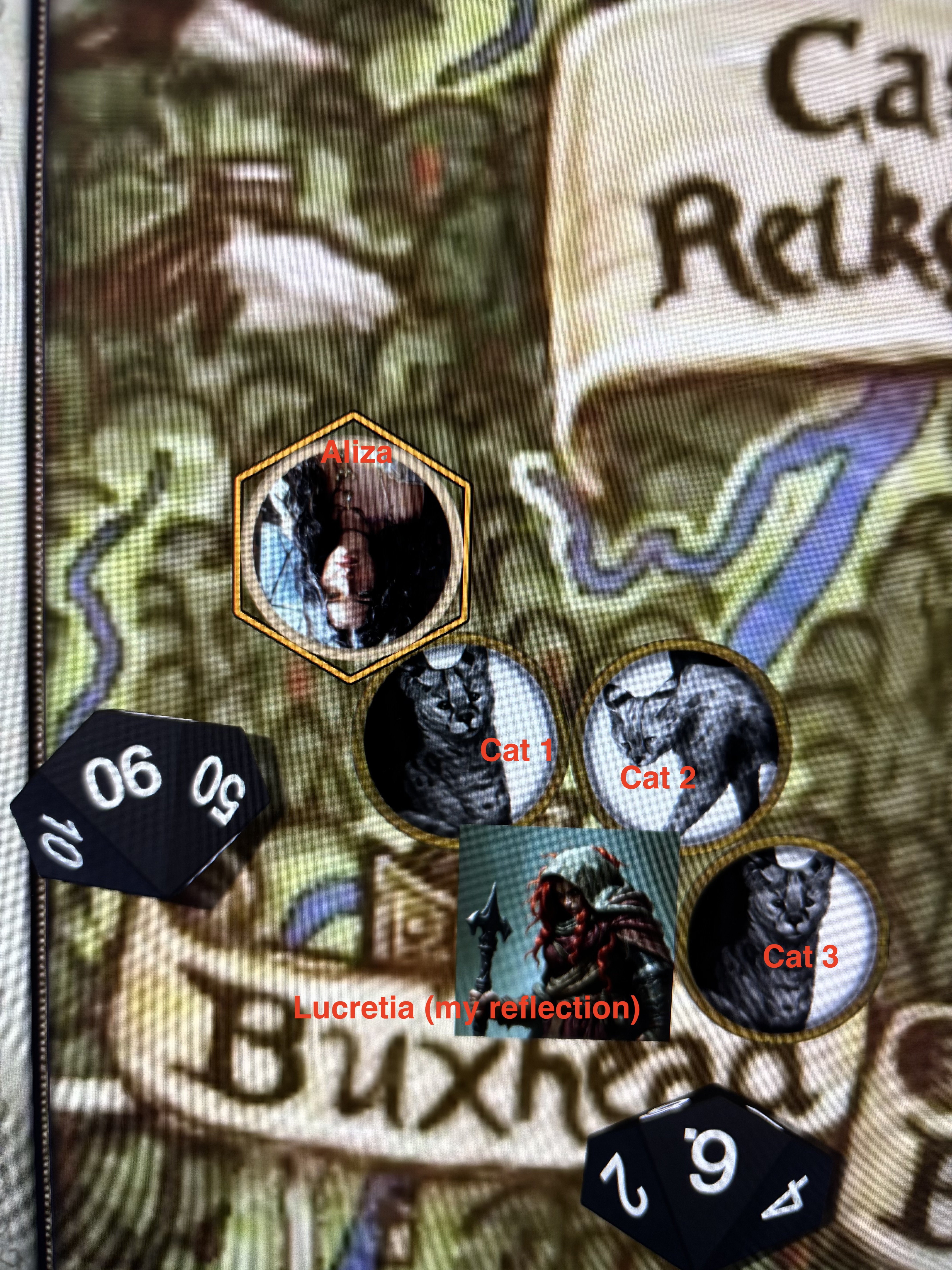
Symmetric combat rolls
This is a more radical proposal for reforming combat than any of the above ideas, and I have no idea what its effects will be. Consider the battle depicted above, where for reasons I can’t explain Aliza is upside down[1]. Here Lucretia is in battle with cats 2 and 3, and Aliza is facing cat 1. In this battle in one round there will be five attack rolls, all opposed skill checks. When the cats attack Lucretia or Aliza these will be opposed melee (brawl) vs. melee (basic), and when we attack them it will be melee (basic) vs. dodge.
Since these attack rolls are symmetric there is no reason to have two. Instead, we can reduce this to three combat rolls:
- A contested roll between cat 3 and Lucretia
- A contested roll between cat 2 and Lucretia
- A contested roll between cat 1 and Aliza
In these rolls, whoever succeeds gets to score damage and a critical on the opponent as if they had done a full combat roll. The cats defend with their melee (brawl), and dodge doesn’t come into it (we will introduce the use of dodge below). This slightly reduces the role of initiative in many fights, although spells and missile attacks will still benefit from high initiative, but it reduces the number of attack rolls and also removes all the nonsense rules for parrying. So what happens here? In this case the cats won the initiative, so they initiate the attacks, as follows:
- Cat 3 rolls an opposed skill check against Lucretia, who wins and does damage to cat 3
- Cat 2 rolls an opposed skill check against Lucretia, who loses and takes 0 damage because of good armor and toughness
- Cat 1 rolls an opposed skill check against Aliza, who loses and takes 0 damage and a major chest wound (wtf)
The damage Lucretia does to cat 3 is determined by the SL of her check, and that’s that. No dumb parry rules or extra crits, just three contested skill checks that take advantage of the symmetry of the opposed skill check system.
Complications: The role of dodge and flanking
Let us suppose now that in the figure above all three cats are attacking Lucretia (who is a dog person, let’s face it) and Aliza is attacking cat 1. Let us assume that cat 1 is flanking Lucretia and Aliza is flanking cat 1. Let’s establish the following rules:
- Flanked characters cannot parry, but they can dodge
- All fighters are allowed one parry only per round unless they are carrying a shield
- Shields grant additional parries equal to the size of the shield: +1 for a buckler, +2 for round, +3 for tower
- Standard outnumbering bonuses apply
Lucretia is wearing a round shield, so in theory she can parry three times in a round (her basic parry plus the two the shield allows) but she can’t parry cat 1 because it’s flanking her, and cat 1 can’t parry Aliza because she’s flanking it. Now we have four combat rolls, as follows:
- Cat 3 attacks Lucretia, melee (brawn) vs. melee (basic), with +20 for outnumbered, Lucretia wins this contest and does damage on the cat
- Cat 2 attacks Lucretia, melee (brawn) vs. melee (basic), with +20 for outnumbered, Lucretia loses this and takes some damage
- Cat 1 attacks Lucretia, but now it is melee (brawn) vs. dodge because it flanks her, and now with +40 for outnumbered and flanked. Lucretia loses this badly and takes damage
- Aliza attacks cat 1, melee (basic) vs. dodge because the cat is flanked, at +20 for flanking, and wins, doing damage on the cat but sadly not inflicting a major chest wound
We see here that the flanking has yielded large benefits, as has Lucretia’s shield – her dodge is terrible and if she did not have her round shield cat 2 would have been able to challenge her lower dodge skill. There are still four simple opposed skill checks to resolve the whole battle. Simple!
Further complications: Agility limits
Let’s add a further limit: no character can easily perform more actions than their agility bonus. We could say that this means they can’t defend more than their agility bonus in attacks, but this would actually penalize the attacker, because (by a weird flaw in the system), non-opposed skill checks in WFRP 4e have lower success limits than opposed checks[2]. Instead, let us say that for every additional action beyond the agility bonus limit, all actions in the round suffer a -10 penalty. In the above case let us suppose Lucretia has an agility of 22. Then her agility bonus is 2, but she is doing three defensive actions – so all of them are conducted at a -10 penalty.
This rule would be particularly good when applied to characters in heavy armor with low agility. They can be outflanked and overwhelmed by large numbers of snotlings, so that (for example) they have to do three melee (basic) parry checks and three dodges, at -50 each. Finally mobs of snotlings can have their day!
Conclusion
I think most of these rule changes won’t be applied in my game for two simple reasons: a) my GM is a curmudgeon (aren’t they all?[3]) and b) we’re using Foundry, and Foundry doesn’t have these rules built in. I think they would be most beneficial if they were applied to pen-and-paper versions, played at the table top, where the SL calculations and crit rolls are fiddly and time-consuming. On a computer system you can do as many rolls as you like, but in tabletop play every additional roll where you have to subtract a double-digit number from a double-digit threshold twice, divide by ten and round, add the result, then roll a critical if one of those rolls was a double, then roll damage dice and add the results of the previous calculation, is an additional drag on smooth action. So if you’re playing this at the table try it, and let me know what you get!
fn1: I could also explain the “My reflection” text, but if you know you’ll want to dance the ghost with me
fn2: This is simple to prove. If my skill is 50 and your skill is 50, if I do an unopposed check against you my best success level will be +5 (if I roll like a 5). If I do an opposed skill check though I can roll 5 and you can roll 95, which means I get +10 SL. Weird! In fact for full consistency this system should allow the environment to do skill checks against some base difficulty!
fn3: Except me, of course


Leave a Reply