I have been reading The Rise and Fall of the Galactic Empire by Chris Kempshall, in hopes of learning something new about the sprawling creative failure that is the Star Wars universe. I think it’s going to be a Did Not Finish (DNF) for me, because it’s boring and completely unenlightening, but I thought I would put a review here. The review will discuss some of the problems with the book, but I also want to take this opportunity to dwell on the tedious normality of the evil empire as it is described in this book. It’s literally just a kind of washed-out version of modern America, with almost nothing unique or intriguing or, well, sci-fi about it, which represents a massive failure of imagination, if not also political analysis. I am interested in describing this tedious similarity with our own world, and inquiring a little into what it is about the modern liberal west that makes it incapable of seeing itself.
This review will contain no spoilers because a) the book itself contains no spoilers and b) I don’t care about spoiling Star Wars, which has been reduced to trash.
The premise
The book presents itself as a detailed study of the origins, structure, function and failures of the Galactic Empire by a scholar of antiquities, who was part of the rebellion and after the final peace was given unprecedented access to Imperial, Republican and rebel archives, along with direct involvement in the excavation of the Sith planet of Exegol. It is obviously intended to riff on Shirer’s Rise and Fall of the Third Reich, which I think itself riffed on Gibbon’s Decline and Fall of the Roman Empire. It maintains this fiction through the occasional insertion of the author’s voice, when he talks about his own contribution to the galactic civil war and his personal feelings about and experiences of the empire; and by use of footnotes that reference Imperial archives, interrogations of surrendered Imperial leaders, Republican reports, and other publications (all fictitious, obviously). Consistent with the style of Shirer’s Rise and Fall or any other mid 19th-century popular history, there are pictures in the center of the book, with references to the chapter they represent. You may remember those books, with their yellowing pages and the shiny dense photo paper in the center that made it hard to keep the book open to the page you wanted. Apparently the post-Imperial New Republic reverted to this style, which is good to see.
The book is divided into sections and supposedly aims to describe the background, motivations and actions of the Emperor himself, the organization of Imperial propaganda, social systems, the legal and political structure, how the military operated, and how the Empire conducted the war. Since it has reference to all these secret documents, it is supposed to shed new light on the mysteries of the workings of the Empire, why it failed, what it was really trying to achieve, and how the people thought of it. It regularly references events from the nine movies but also the comics and anime – for example it regularly references the Spectres, who I think have an anime series, and battles like Lothal that are not part of any of the movies. I thought this meant it would give me a deeper understanding of some of the flaws and plot themes in the original series, as well as a clear sense of how all the different parts of the story linked together, a clear timeline, and additional insight into the plans and schemes of the leading figures. A kind of condensed Wookiepedia with attached Cliff’s notes, if you will. Sadly, it did none of these things. In particular, it gave me less information than Wookiepedia, or even than the movies themselves.
The book is empty of content
Probably the most frustrating thing about this book is that it simply does not give any new information. Did you want to know what Cassian Andor was forced to build during prison labor? It doesn’t know. Want to know how many Inquisitorus Vader commanded? It’s impossible to say. Want to know why they disappeared from the Imperial army? We can only speculate. Want to know what Vader was doing before the Death Star project began? Nobody knows. Did Mas Amedda know all along what the Emperor was doing on Exegol? Sadly after the war the interrogators failed to ask this question, so we will never know. Why did some non-human species serve the Emperor in the senate even though he was a known xenophobe and regularly did genocides? Your guess is as good as mine.
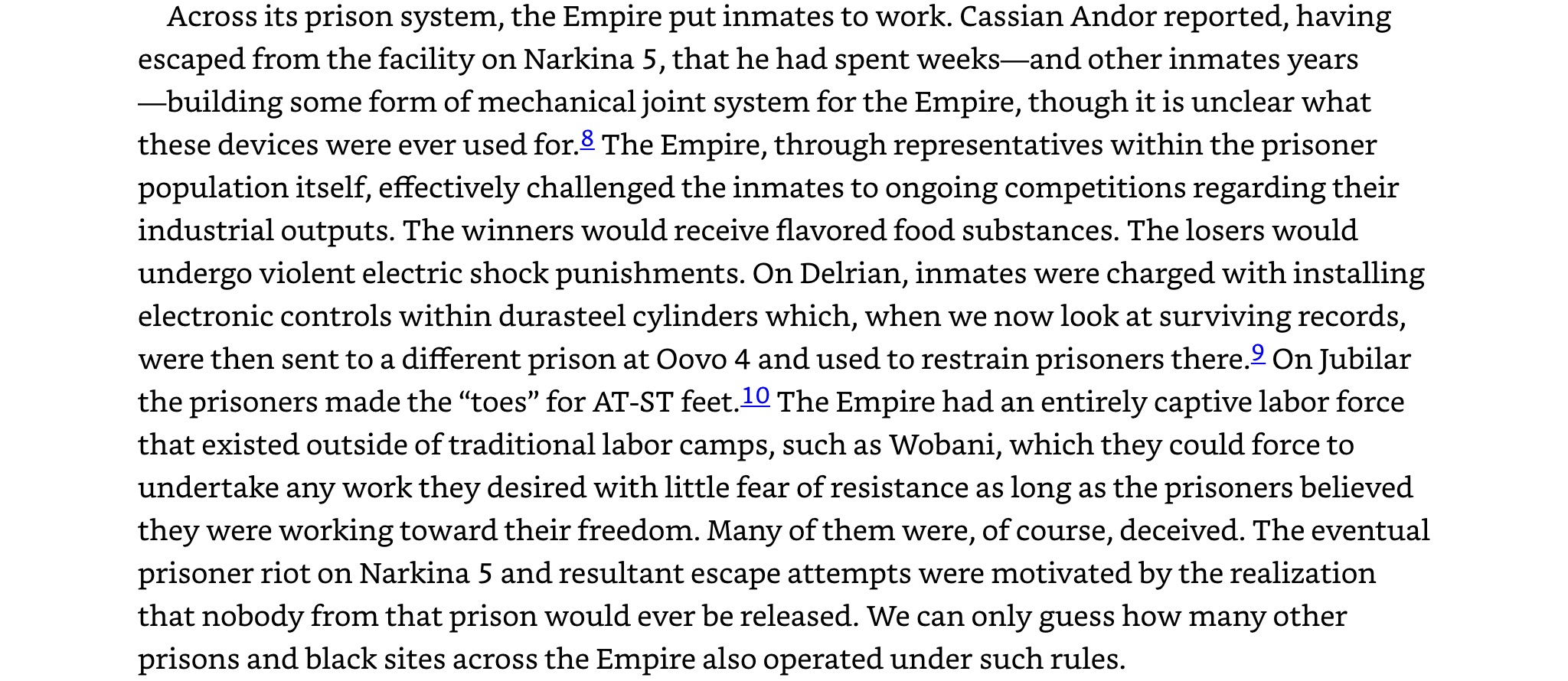
The text above is a good example of this lack of information. It starts by failing to tell us what Cassian Andor was making or what it was used for (but gives us a reference!) then finishes by telling us we don’t know how many prisons and black sites across the Empire used prison labor. What, you didn’t count them as you liberated them? Didn’t you care?
In many cases the book reports on events from the movies, but does so from the perspective of historical remove, so actually presents less to us than we ourselves gleaned from the movies. For example, the scene on the Death Star in Episode IV where Vader strangles admiral Motti is mentioned, but the author of this book knows nothing about it. He knows that it happened because Motti filed an incident report, but the contents of that report appear to have been accidentally deleted so we only know that something happened.
Why did you make me fucking read that? Couldn’t you have given me some interesting insight from Motti, and a little bit of information about how Vader ran around the universe killing his own soldiers and was constantly protected? Wouldn’t it be interesting if the incident report had a chain of escalation that went all the way to the Emperor? Or not? No, we just get a hint of a rumor of something we know happened. What a waste of my time.
This is particularly weird given that early on we are told that many of the major players in the Galactic Empire survived and thrived in the New Republic. You would think, given their boss destroyed a whole planet and regularly dispatched his underlings to do genocides, given that whole planets were laid waste by brutal extractive industries, that millions of people were imprisoned for life on prison planets for minor things like damaging a statue or graffiti, that maybe these public figures would have been rushing to write self-exculpatory memoirs and reports, falling on their knees before the interrogators to yield up all they knew about their superiors, and just generally trying to be first to put the knife into their immediate boss. You would think there would be an enormous amount of information about what these people did! But sadly, wherever we discuss anything that is actually interesting and relevant to the material we actually watched, the author cannot know, can only speculate, wonders if more information will be revealed in future, etc.
Maybe this is cute in some other book, maybe if we were reading the first person account of an interrogator trying to find Admiral Motti it would be cynically funny that he filed an incident report on a force-choking by a body-armored witch and then that incident report disappeared. But in a supposedly academic historical report? It’s just annoying. You won’t learn anything reading this book, and you’ll be bored as hell trying.
The writing is awful
A large part of the reason this book will be a DNF for me is the amateurish writing. It reads like the first draft of an undergraduate essay, with overly complex but contentless sentences meandering to their point over a stumbling field of filler words. It is filled with “As mentioned previously” or “As we will see” and grating sentence structures like “With regards to X, we find that X…” It often confuses prepositions and uses passive language that winds its way to the point through bloated sentences.

Consider the fragment above. The second sentence could say “The theft of a large amount of Imperial payroll on Aldhani triggered many of the most serious flags in this security hierarchy.” The structure “Following the event X, the event triggered …” is just awful. There are pages and pages of this stuff, entire sections that reference other sections obliquely and use long, rambling sentences to tell us nothing. The references to other parts of the book don’t even have chapter numbers, so we can’t skip ahead or refer back, and the footnotes never, ever contain any information in any other voice. It’s an incredibly tedious read.
The political perspective is mundane
The imagined author of this book is a scholar with a long and well-respected record, but his description of the politics and economics of the Empire is no better than a child’s. There are no references to historical perspectives (e.g. “A Twi’lek dualectic analysis would suggest that…” or “Revanchist Monarchic scholars on Coruscant have argued …”) but there are also not even any simplistic modern interpretations of the forces at work in the empire. No Marx, no Rawls, no Hayek, no deeper insight into the economics of the empire than “they sometimes took over planets to build stuff”, no deeper insight into the political forces supporting the Emperor than “lots of people liked the stability.” What were the Galaxy-wide social forces at work to support the Emperor? Where was his political base? Were there factions within the Empire that he played off against each other, bought out, or murdered? What was the political motivation of the people supporting the Rebellion? Why did the Old Republic fail to respond to any of the crises it faced? I have previously discussed the intense inequality in the Galaxy, almost entirely a product of the Old Republic’s economic system – did the Empire address this? Did people actually hate the Republic?
Sadly we can’t learn anything about this because the book strips all political struggle down to the opinions of a few men and women, and presents the trillions of beings in the Galaxy as an impotent, unresponsive mass whose only need is to be pacified with goods. And to emphasize the lumpen nature of these trillions, it reduces the entire history of the Empire to the actions and thoughts of a handful of people.
The strange parochialism of the Galactic Empire
Lucas said that he originally envisioned the Rebel Alliance as the North Vietnamese army, and the Empire as the USA. According to our current records the Galactic Empire lasted 34 years, and the Galactic Civil War about 9 of those years. So imagine if you will a period of history approximately centered on the American invasion of Vietnam, stretching from about 1955 to 1985. Think of all the major figures in politics, business, media and public intellectual life who emerged in that time. It covers five presidents (Eisenhower, Nixon, Carter, Johnson, Reagan), has multiple famous generals (Patton, Westmoreland, Vo Nguyen Giap, Guevara), revolutionaries like Mao and Castro, famous actors like John Wayne, Sean Connery, Jane Fonda, bands like Led Zeppelin and the Beatles, intellectuals like Baldwin and Foucault, and political movements like the ALF and the Weather Underground. Imagine all of that, and now imagine a Galaxy with thousands or hundreds of thousands as many sentient people in it, with access to orders of magnitude more energy and vast swathes of cultural output we have no ability to even comprehend. In a thirty year period we would expect to see a lot of famous people, wouldn’t we?
This book barely describes any. Political decisions across thirty years come down to the actions of a handful of people; a single sport is mentioned, and the names of a couple of media figures and sportspeople, in connection with perhaps one or two media conglomerates. I think it mentions less military-industrial companies than existed in Nazi Germany. It really only mentions a handful of planets, certainly no more than a dozen. Something like ten billion people died in the Galactic Civil War, but to the best of our knowledge reading this book it took place in a neighborhood about the size of the Eastern Seaboard of the USA – if it had the population of the 1860s. It is simply impossible to comprehend the scale of the conflict, the stakes, or the civilizations involved, from this work.
It’s not like this is impossible to do, though I agree it is difficult. Banks does it admirably in his Culture books, Grossman manages to name check more people, villages, battles and generals in describing one year of world war 2 than this book does. The Altered Carbon books manage to draw a decent picture of a multi-system war and the forces involved without getting bogged down in detail. I think if you’re going to write a book that purports to be a history of a Galactic Civil War you need to at least try to make it feel Galactic.
Part of this is of course Lucas’s fault for turning the whole thing into a family drama. But I think the author has also run aground on his inability to conceive of any political ideologies, thoughts or systems that are not grounded in modern-day America. And this, ultimately, is what interests me about this book: the tedious American-ness of the Empire.
The American Galaxy
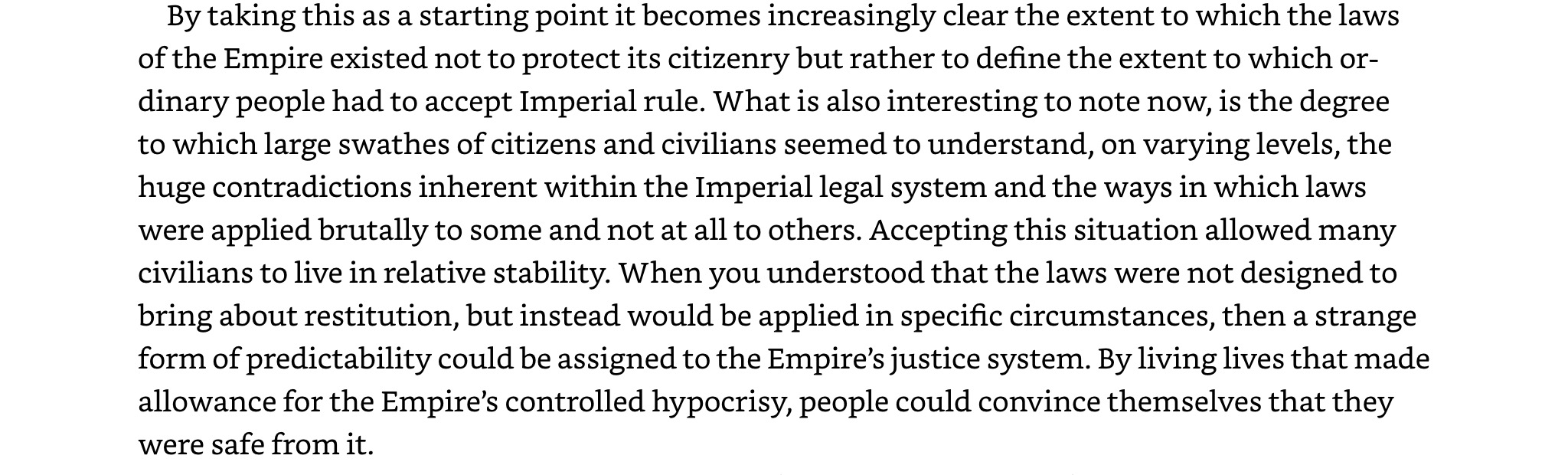
Early in the book our scholar lets us in on an interesting but slightly perplexing (to him) fact: Many of the great families and industrial concerns that thrived in the Old Republic moved seamlessly into defense-industrial work for the Empire, then after it fell were welcomed without penalty or social stigma back into the New Republic. Almost as if the society barely changed during the transfer of power from Republican to Imperial to Republican, and the actions of the Emperor – while devastating for 10 billion people – had no effect on the ruling elite of the Galaxy. Kind of like how American corporations and ruling elites suffer no ill consequences from supporting one or other political side, even as the people at the bottom go through waves of poverty, war, capitalist crisis and political violence.
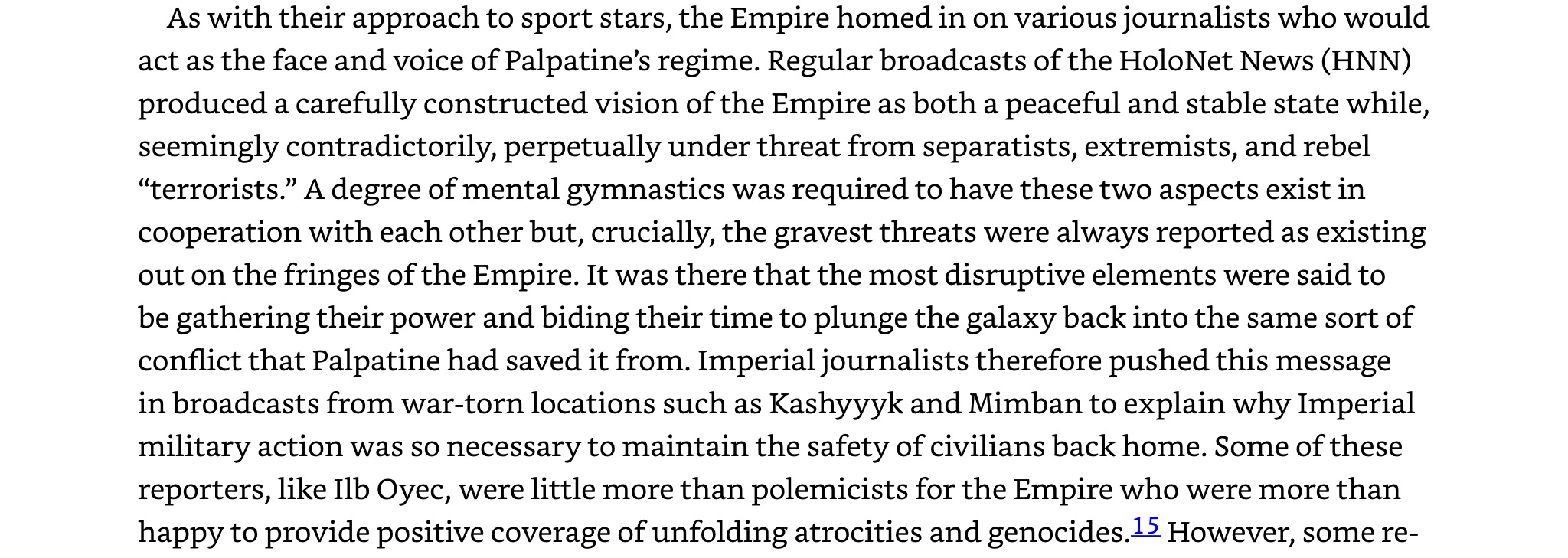
We also learn – and surely are expected to be shocked! – that many journalists became effectively mouthpieces for the Empire, even traveling with the Imperial military to war zones to report on them. They were embedded with the war machine, if you will, reporting on the importance of suppressing terrrorists.
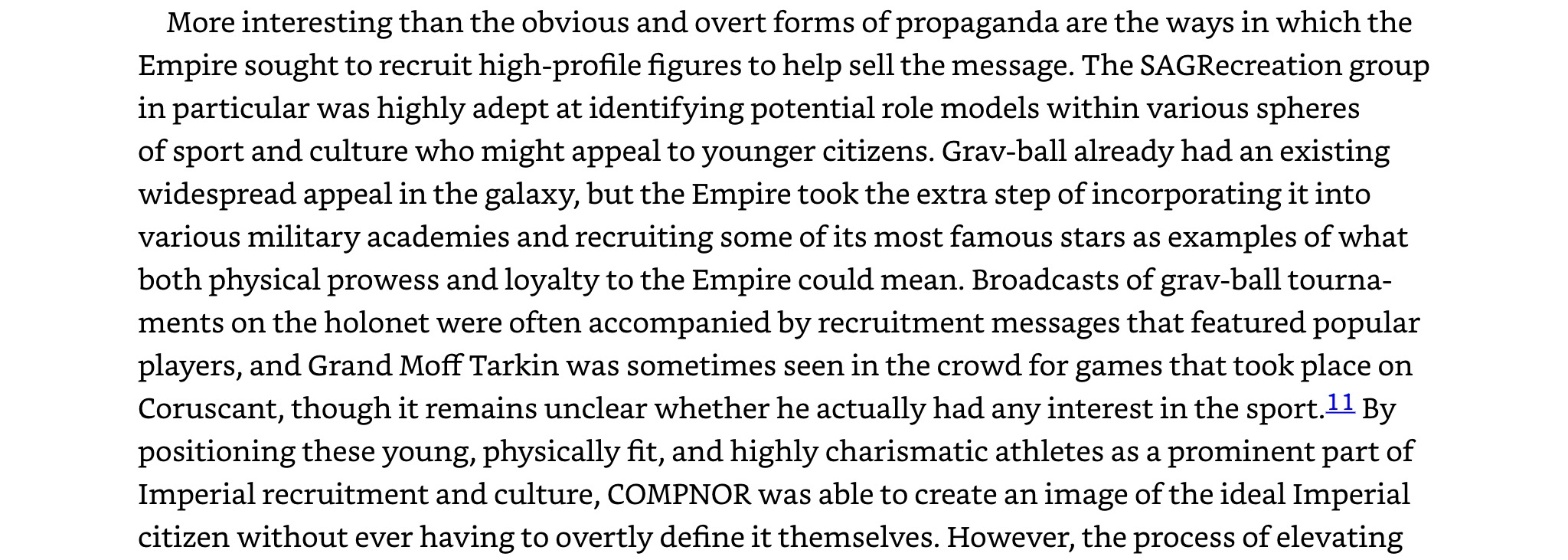
We also learn that the Empire used sports to disseminate its political message, selecting popular sportspeople to support it and even advertising recruitment to the armed forces at events. Sometimes senior political figures were in the audience! I don’t think the author of this book is aware of it, but in 2023 the Professional Fighter’s League held a swearing-in ceremony for Air Force Reserve soldiers at one of its live events, in between fights. This was part of a four year partnership that was renewed in 2024 and to the best of my knowledge continues today. That swearing-in ceremony was held under a Democratic president, while his military was providing material support to a genocide in Gaza; in 2026 I reported on renewed efforts to use the UFC to support the proto-fascist aims of the current president, while a war of aggression is stalled in the Middle East under his “command”. I think the author thought using sporting events to advertise a political leadership was extreme behavior, possibly because he associated it with Hitler’s Olympics, and didn’t realize that both political parties in his own country routinely do far more open forms of militarist advertising at sporting events. The Empire’s propaganda appears, in this respect at least, to be timid compared to the shameless behavior of the American military.
The author also consistently refers to the leadership meetings of the Imperial war machine as the Joint Chiefs of Staff. He surely understands that this is a direct reference to his own war machine, but I somehow doubt that Disney commissioned him to write a book that is directly satirizing the US government by comparison to the Empire. I think what is happening here is that he has scoured history and his own imagination for examples of Imperial behavior in propaganda, the rule of law, prison management, and anti-terrorism, and somehow come up with a system that is less fascist than his own country. For example, in his description of prisons he makes clear that people could be given a 10 year sentence for damaging a statue of the Emperor as a side consequence of an accident while driving drunk, and he also suggests that once people enter the prison system many are never allowed to leave. Last week, an anti-ICE activist in the USA was handed a 70 year prison sentence simply for being present at a demonstration where someone fired a gun; and prison labor is not only routine across the USA but is a widely-used source of cheap goods for libraries, universities and public institutions.
It’s also worth noting that the death toll from the Galactic Civil War is widely estimated at about 10 billion people, in a population of perhaps 100 trillion. The Iraq war killed probably 1-2 million people, in a planet with a population of 8 billion. The Galactic Civil War was less violent across the entire galaxy than the Iraq war was on earth. It had a death rate about 1/3 that of the Vietnam war, and an order of magnitude lower than the Korean war. It was, in comparison to almost any of the major military actions that the USA has conducted since world war 2, a trivial concern. Nothing that Darth Vader and Emperor Palpatine did over the nine years of the Galactic Civil War compares to what the USA did in Iraq, Vietnam, or Korea. It probably also does not compare to the various famines induced in the British Empire during its reign.
It’s interesting that the modern US cultural establishment is unable to conceive of itself. When they describe the propaganda used by evil people in their imagined worlds, modern American artists come up with art and media that is tame in comparison to the actual work of the society they live in. When they try to imagine atrocities they fall short of the acts of their own empire, sometimes by orders of magnitude. They construct imagined political systems that are no different in form and effect than the one they live in, presided over by people who would probably be seen as paragons of morality by modern American voters[1]. They do this partly by not talking about the actual political matters that exercise ordinary people’s attention – access to abortion, healthcare financing, public safety, child protection – and instead focusing on abstract matters of war and interstellar security, so we do not get a chance to compare life in their evil empire materially with life in our own[2]. But even when they describe the evils of their bad guys in those domains they touch on, they seem unable to grasp the full magnitude of what their own society has done. And so they construct for us monolithic evil empires that would be orders of magnitude better for most people to live in than the society that actually rules our actual world. Far better to be a non-human resident of the outer rim in Kempshall’s Galactic Empire than to be at the pointy end of US imperialism today, whether in Iran or Gaza or Syria or any of the devastated neighborhoods of 1980s inner-city America.
I think this is both a failure of imagination and a reflection of the political priorities and sensibilities of the author. If you have written a book about the rise and fall of an Empire everyone agrees is evil, but in total what you have described is no worse than and sometimes less intrusive than the actual world you live in, and the death toll of its nine year war is lower by an order of magnitude than what your own country did in three, well … you’ve missing something haven’t you?
So, don’t read this book. And if you want to see how bad the Empire could have been, don’t watch Star Wars – just turn on the news.
fn1: There is no Jeffrey Epstein in the Empire, no pedophile cult surrounding elite figures, not even a hint of it. In fact, aside from the movie Strange Days such considerations remain only in the realm of vampire movies, where the bad vampires routinely behave like, well, like Tuesday on Epstein Island.
fn2: I once created an enormous fight in my role-playing group by pointing out that the “dystopia” of Feng Shui’s world of the Architects of the Flesh was better than Tony Blair’s London. People pay 30% of their income on rent! Everyone wears the same clothes! No one can earn more than 40 times the average! Horror!


Leave a Reply