• Some commentators on Twitter and in the media are saying that Labour lost the 2019 General Election because it lost too many votes to remain parties, and that failure to retain support from remainers was the problem. Angry Labour activists on Twitter have been listing off the remain seats that were lost, and saying that a strong remain strategy would have saved the party.

    This is completely wrong, and I will show this using data from the 2019 election and the 2016 referendum.

    Methods

    First I used the dataset of constituency-level results I assembled over the weekend, which contains results for 339 constituencies, semi-randomly sampled from the list of all constituencies on the BBC election site and linked to leave voting data from the 2016 EU referendum. The detailed methodology for assembling this dataset is given here. I then assembled a separate data set of only the seats Labour lost, using this handy (but not quite alphabetical) guide from the Metro newspaper. I merged these with EU referendum data.

    Using the full constituency data set, I created a logistic regression model of probability of retaining a seat against constituency leave vote, for all the seats that were held by Labour at the 2017 election. I plotted the predicted probability of losing a seat against the proportion of the population in that seat. Then, I conducted a crosstabs and chi-squared test for the seats held by Labour in 2017, showing the probability of losing a seat in 2019 by whether or not it was a leave-voting constituency. I defined a “leave-voting constituency” as any constituency voting above the median leave vote (which was 53.55).

    Next, using the data set of the 59 constituencies Labour lost, I calculated the mean vote in this set of constituencies, and the proportion of constituencies that were leave-voting constituencies. I compared this with data for all Labour held seats that were not lost in the 2019 election.

    Results

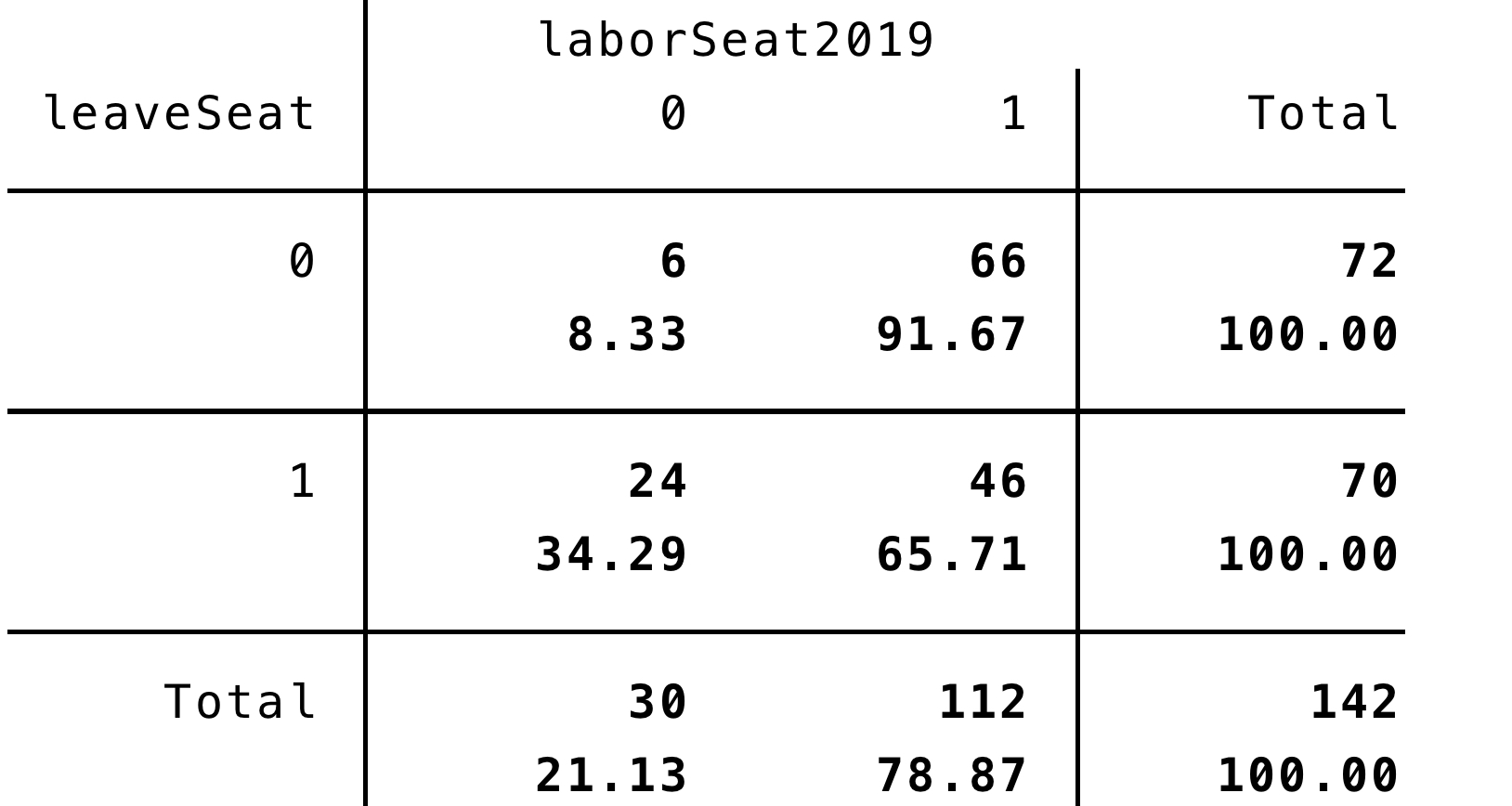
    In my constituency data set there were 142 seats held by Labour in the 2017 election, of which 30 (21%) were lost in the 2019 election. Figure 1 shows the cross tabulation of leave seats with seats Labour held in 2019[1].

    Figure 1: (Hideously ugly) cross tabulation of Labour-held seats by whether those seats voted leave

    As can be seen, 92% of remain seats were held, compared to 66% of leave seats. This is extremely statistically significant (chi-squared statistic 14.35, p<0.001). That’s a nasty sign that the main risk of losing a seat was that it was a leave seat, not a remain seat.

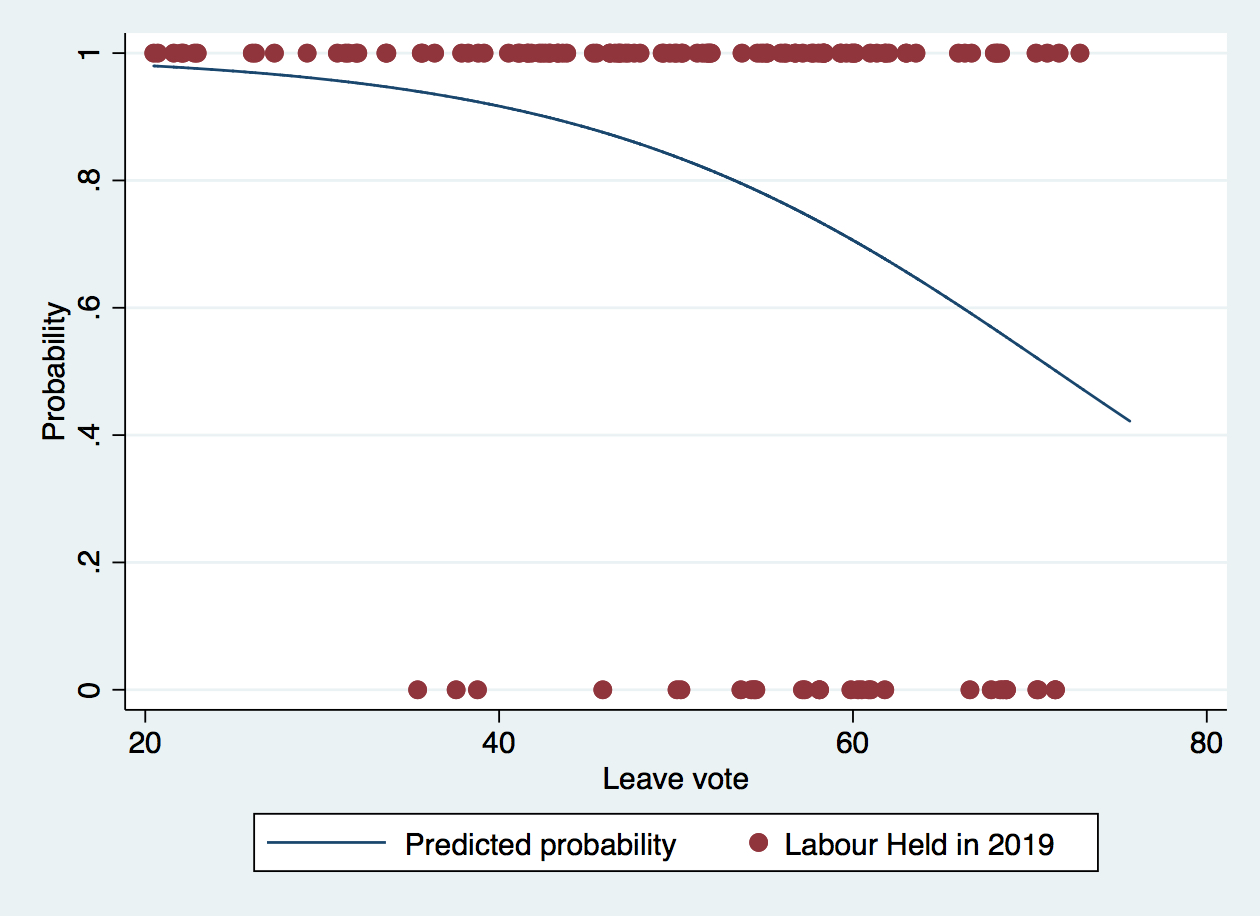
    We can show this explicitly using logistic regression. Figure 2 shows the predicted probability of a seat being held by Labour in 2019, plotted against the proportion of the seat that voted to leave in the EU referendum. The red dots on this figure indicate whether it was held by Labour in 2019: red dots on the top of the figure are seats retained, plotted at the value of their leave vote; red dots at the bottom are seats that were lost, plotted at the value of their leave vote.

    Figure 2: Probability of losing a seat in 2019 by leave vote

    This model was highly significant, and showed that every 1% point in the leave vote reduced the odds of Labour holding the seat by 7%. Note that this figure includes Scotland, so the results might be slightly different if only England were considered, but even the strongest remain-voting seat that was lost – even were it in Scotland – is well above the remain vote of some seats that were held. This model shows that at the extreme end of the leave spectrum, up above 60% of the electorate voting for leave, the probability that Labour retained the seat dropped to around 50%. That’s terrible!

    My constituency data set contains only 142 Labour seats, and 30 seats that were lost, but actually 59 seats were lost. Since my data set is semi-random, there is a small chance that it will misrepresent the results. So I checked with the dataset of all seats that were lost. This data set contains 59 seats. Here are some basic facts about this data set, and comparisons with the constituency data set and the full list of Labour-held seats:

    • Labour lost 14 remain-voting seats (24% of all seats lost) and 45 leave-voting seats (76%). This is very similar to my crosstabs, where 24 of 30 seats lost (80%) were leave
    • The average leave vote in the 59 seats that were lost was 57.7%, slightly above the median, ranging from 31.2 – 71.4%.
    • In contrast, the average leave vote in the 112 seats in my constituency data set that Labour held was 48.8%, ranging from 20.5 – 72.8%
    • The average leave vote in all seats held by Labour going into this election was 51.1%, ranging from 20.5 – 72.8%

    This is clear statistical evidence that Labour went into this election having a slightly remain-leaning set of constituencies, primarily lost leave-voting constituencies, and emerged from the election even more remain-focused than when it went in.

    Conclusion

    Labour did not lose this election because of a large swing in votes to the remain parties. It did not lose a large number of remain-voting seats, but was decimated in the leave-voting areas. Labour held on to all of its most heavily remain-focused seats. In attempting to appeal to both leavers and remainers, Labour managed to retain most of the remainers and lose a lot more leavers. Labour emerged from this election even more remain-focused than it was when it went in[2]. There are some very simple reasons for this:

    • The swing to the Tories and away from Labour was much bigger in leave-voting seats
    • The Brexit party was only active in Labour-held seats, and got its largest vote share in the strongly leave seats
    • The swing to the Lib Dems was much less closely related to the leave vote than was the swing away from Labour (see my last blog post, Figure 4)
    • The intensity of the relationship between leave voting and swinging to Lib Dems was lower in Labour-held seats than Tory-held seats (see my last blog post, Figure 4)

    In trying to please both sides of the Brexit divide, Labour failed to satisfy the leavers. Pro-brexit Labour voters were simply much, much more committed to Brexit than pro-remain Labour voters were to remain, and so Labour lost the leave areas. There are lots of remainers out there who want to claim that remain is wot did it, but they are simply wrong. I’m super pro-remain myself, but the data makes it very clear: British Labour voters want to leave, and they were willing to pack in their allegiance to the Labour movement to get that done. Whatever you might think of their politics, that is the simple hard fact of the electorates Labour represented.

    It’s worth noting that in 2017 Corbyn campaigned on Brexit. The Labour manifesto explicitly accepted Brexit and said Labour would negotiate and leave. At that election Labour won a historically high share for a party in opposition, a higher share of the vote in fact than Blair won in 2005 (when he retained government). In that election they came within a bees’ dick of winning government, and in that period before Corbyn accepted the compromise of a second referendum two Tory PMs left, and Johnson only held onto government by the skin of his teeth (recall there was talk of a unity government). Blair and Cameron have both shown it’s possible to hold government with 35% of the vote, so it’s perfectly possible that had Corbyn gone into this election on a leave platform he would have seen a much smaller swing against him, and could have won it. We don’t know, but on the basis of all the evidence here it seems like the second referendum policy was a disaster for Labour.

    This gives two clear lessons for Labour to take in over the next few years and as they choose a new leader:

    1. Labour’s policies and Corbyn were not the primary problem, and dropping them is not going to help. Obviously Corbyn is going to go, it’s traditional, but the manifesto’s policies were not the problem. The Labour right is going to push for the party to throw the Corbyn years down the memory hole (in today’s Guardian we have Suzanne Moore begging for a vet to “sedate” the Corbyn supporters!), because they are and have always been intent on fighting these genuinely left wing policies. Ignore them, and stick to the real Labour platform that will really help the country as it recovers from the horrors of this Tory leadership
    2. Labour – and the British left generally – have to get over Brexit. There is no option left to remain, and no chance it will ever happen now. The Labour right want to claim that Corbyn doesn’t understand working class voters but his original policy – of full-throated Lexit – was much more in tune with what ordinary working class Labour supporters want than anything that the Blairist rump have to say. The debate now for Labour has to be about the type of Brexit, and how to make it work. This means fighting Johnson’s bullshit deal, but on the basis that they can make a better one – obviously this doesn’t matter now but it is the job of the opposition to hold the government to account, and they should do so from the clear perspective of their voters, that Brexit has to happen. This is going to be hard for some of the urban remainers from the south and east, but that’s life if you’re a politician. Further talk of remain just has to end

    For 20 years the EU was a thorn in the Tory side, constantly causing them trouble. Cameron ripped that thorn out with this referendum, and although May spent some time botching the healing process Johnson has patched up the damage and squeezed out the last remainer pus from the Tory body politic. If Labour don’t face the reality of Brexit and what it did to this party at the 2019 election, then the issue will fester for them – as it did over so many years for the Tories – and hold them back just as it did the Tories. It is time for Britain to move on from Brexit, and for the Labour movement to accept the reality of the disaster that is coming. Once people realize how Johnson’s Brexit has screwed them, they will turn to Labour – and Labour needs to be ready with a transformative, genuinely left wing agenda in order to recapture its heartland and do what is right for working people. Corbyn was right about Brexit, right about the policies Britain needs, and after he is gone he will still be right about what has to be done. Don’t repudiate those lessons, and in the process destroy the movement.


    fn1: My apologies for pasting this as a picture directly copied from Stata, instead of making a nice pretty table – I hate it when people do this but it’s late and I hate making tables in html. Stata offers an option to copy as html but it doesn’t work. Sorry!

    fn2: This final conclusion is shakey because it depends on my constituency data set, and I don’t know if it would still be true once all the remaining Labour-held seats are entered into the dataset. I think it will, but there’s a chance the final data set will end up the same level of leaviness as the 2017 constituencies, statistically speaking. But this conclusion is not a very important one anyway, so it doesn’t matter if it isn’t held up by the full dataset.

  • The UK General Election has just finished, with Labour losing badly to Boris Johnson’s Brexit-fetishizing Tories. The media are describing Labour’s loss as the worst since 1935, which is true if you look at seats lost but not at the vote – with 32.2% of the vote share it’s the best result for a losing Labour party since 1992, and although the swing against Labour was very large – 7.2% – this is partly because the previous share of the vote that Labour achieved, at 40%, was phenomenally high – Blair only beat 40% once, and many post-war Labour governments have ruled a majority with a much lower share of the vote than Corbyn achieved in 2017.

    In the early post-election recriminations people are laying the fault entirely at the feet of Corbyn and the Labour manifesto, but I’m not convinced that a different leader or a less radical manifesto could have helped. The 2019 election was a historic election, similar to the 1945 election, with a huge decision about the future of the UK to be made and a major recent event hanging over the election. In the 1945 election the huge decision to be taken was the establishment of the modern welfare state, and the recent event was the war. In the 2019 election the decision is Brexit, and the EU referendum is the major event overshadowing the election.

    This Brexit issue overshadowed the whole election, and in this blog post I will show that it had a huge impact on the Labour vote, which made this election almost impossible for the Labour party to lose. I will show this using a statistical analysis of 2019 election results.

    Methods

    I obtained 2017 election results and 2015 EU Referendum results from the UK Parliamentary Research Briefings website. I merged these data sets together using ONS ID (the unique number that identifies parliamentary constituencies) so that I had the percentage of each constituency that voted leave in 2016, and their 2017 election results, in one dataset. I then conducted a semi-random sample of the 2019 General Election results using the BBC Election results website. The sample was semi-random because there is no publicly available official dataset at this stage, so I had to enter them by hand looking at each constituency in turn on the BBC website[1]. I started by ordering my dataset by constituency name from A-Z and working sequentially through them on the assumption that I have limitless patience and 10 hours of my life to give to this, but gave up somewhere around “D” and took a random sample of another 100 or so constituencies. Because names are approximately random, this means I have 200 or so approximately random samples from the first stage, and another 100 or so genuinely random samples from the second stage. I may have had a hangover, but there are limits to how much time and effort I am willing to put into rescuing the UK Labour party from bad analysis!

    I dropped Northern Ireland from my analysis because a) I don’t understand their political parties b) Sinn Fein’s decision not to enter parliament is weird and c) Northern Ireland should be part of Ireland, not the UK. I kept Scotland but excluded it from some of my figures (see specific figures for more details). I excluded the Speaker’s seat (which was Labour) from analyses of the Labour swing because there was no opponent so the swing was weird; I also excluded another Labour seat with a very high positive swing from these analyses, and dropped one Conservative seat (Buckingham) with the same problem.

    Once I had done this I then calculated the swing against Labour, Lib Dems and Tories by subtracting their 2017 result from their 2019 result. I confirmed this works by comparing calculated Labour swing with actual Labour swing from the BBC website (which I entered as I went through my semi-random sampling). I obtained Brexit party vote shares from the BBC website, leaving this field blank if the Brexit party did not stand a candidate[2].

    I then conducted several linear regressions of the swing:

    • A linear regression of conservative party swing as a function of leave vote in the EU Referendum
    • A linear regression of Labour party swing as a function of leave vote in the EU Referendum
    • A linear regression of Lib Dem swing as a function of leave vote in the EU Referendum
    • A linear regression of Labour party swing as a function of Brexit party vote

    For all regressions I tested a quadratic term in leave vote, and I included a term for whether the constituency was in Scotland or Wales. I included a term for whether or not the constituency experienced a Brexit party challenge in the first three regressions, and tested an interaction with leave vote. I dropped any non-significant terms in order of their non-significance to get the best model. I also centered the EU referendum vote at its median (53.5% of people voting to leave), so that the constant term in all linear regressions measured the swing against the party in question in the median leave-voting seat.

    I then obtained predicted values from all regressions to include in the plots of the swing against the leave vote or the Brexit party vote. Brexit party vote is effectively being used here as a proxy for Labour voters’ decision to abandon Labour over Brexit. I did not model the relationship between swing against Labour and Brexit vote because I think this swing is the Brexit party’s fault, but because I expect it represents the likelihood that Labour voters abandoned Labour over Brexit. One might suppose they abandoned Labour for Tory over general policy, or because they respect BoJo, but the only reason for abandoning to the Brexit party is Brexit, and so this acts a proxy for the possibility that they also jumped ship to the Tory party over Brexit. Because the Brexit party only stood candidates in Labour-held constituencies it is impossible to test what might have happened if the Brexit party stood against a Tory incumbent.

    Results

    I had data on 341 constituencies, just over half of all eligible constituencies. Among these 341 constituencies 146 (43%) had a Brexit party challenger. Of the 142 seats that were Labour held in 2017, 112 (79%) survived to be Labour-held in 2019. None of the 199 non Labour-held seats in my dataset switched to Labour in 2019. The mean swing against Labour in seats it held was 8.7%, and the mean swing against it in seats it did not hold was 7.5%.

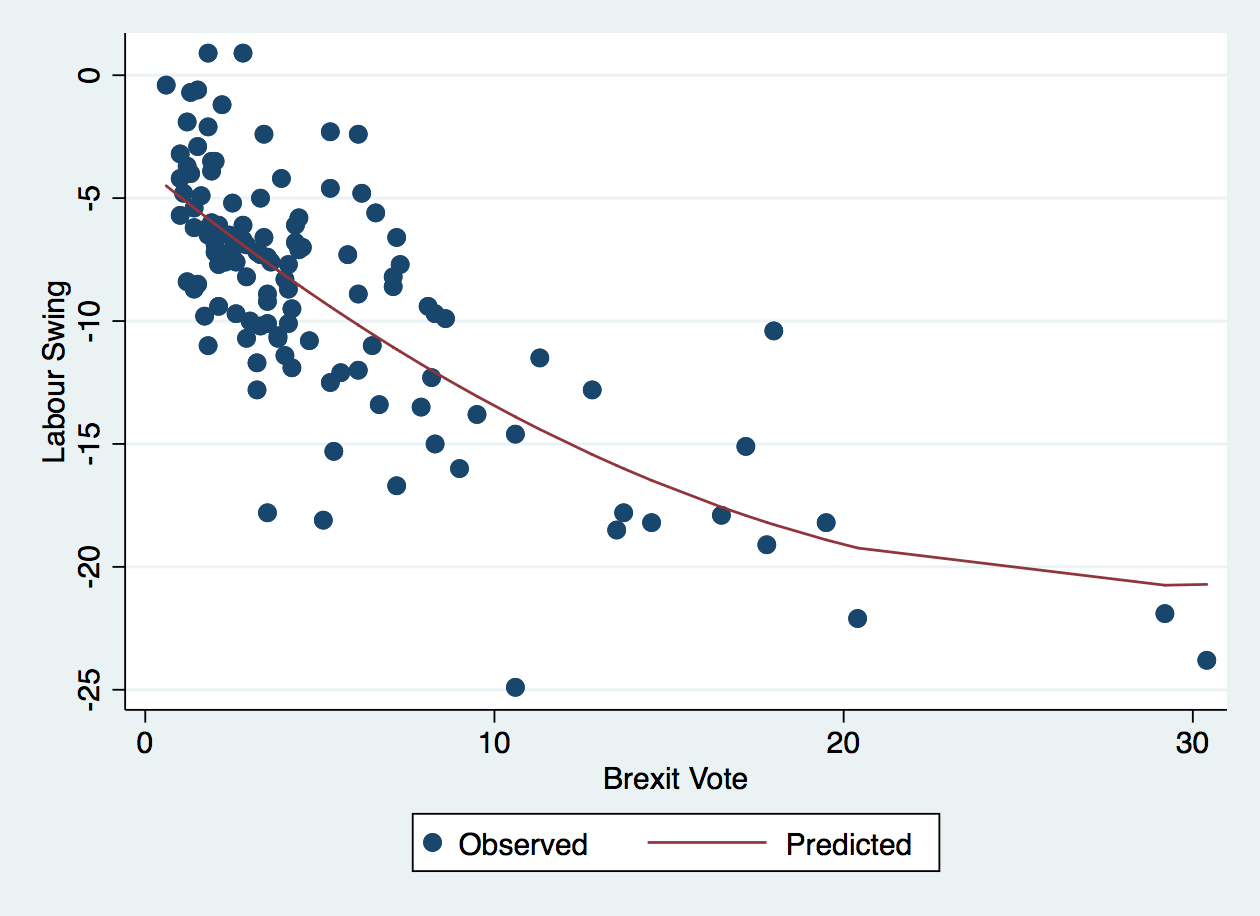
    Let us consider the relationship between the swing against Labour and the Brexit vote in seats where it was challenged by this party. Figure 1 shows the swing against Labour in England plotted against the proportion of the vote that the Brexit party won, with the predicted trend in the swing from my final regression model. The final regression model explained 54% of the variation in the swing against Labour, included a quadratic term for the Brexit vote, and included significant terms for Scotland (a 3.5% larger swing against Labour) and Wales (a 2.2% smaller swing against Labour). The intercept term in this model was -3.8, which indicates that in the absence of a Brexit party challenge these seats would have seen a mean swing against Labour of about 3.8% (95% confidence interval 2.6% to 5.0%). In this counter-factual[3], most of these seats would not have changed hands if there was no Brexit party challenge.

    Figure 1: Russian Ratfuckery, in its most exquisite form

    It is very clear from Figure 1 that the Brexit party had a massive impact on the Labour vote, pulling it down by a huge amount in the seats where they ran a candidate. The Brexit party did not win a single seat in this election, but they cost Labour a lot of seats. Once again, Farage had a huge impact on British politics without ever sitting in parliament. In some of the northern seats the Brexit party got a huge share of the vote, and it is very likely that almost all of it came from Labour. In the seats with a middling Brexit vote, between perhaps 5 and 15% of the total vote, Labour lost between 10 and 20% of the vote share. I think this is a strong indicator that Labour was bleeding votes due to Brexit.

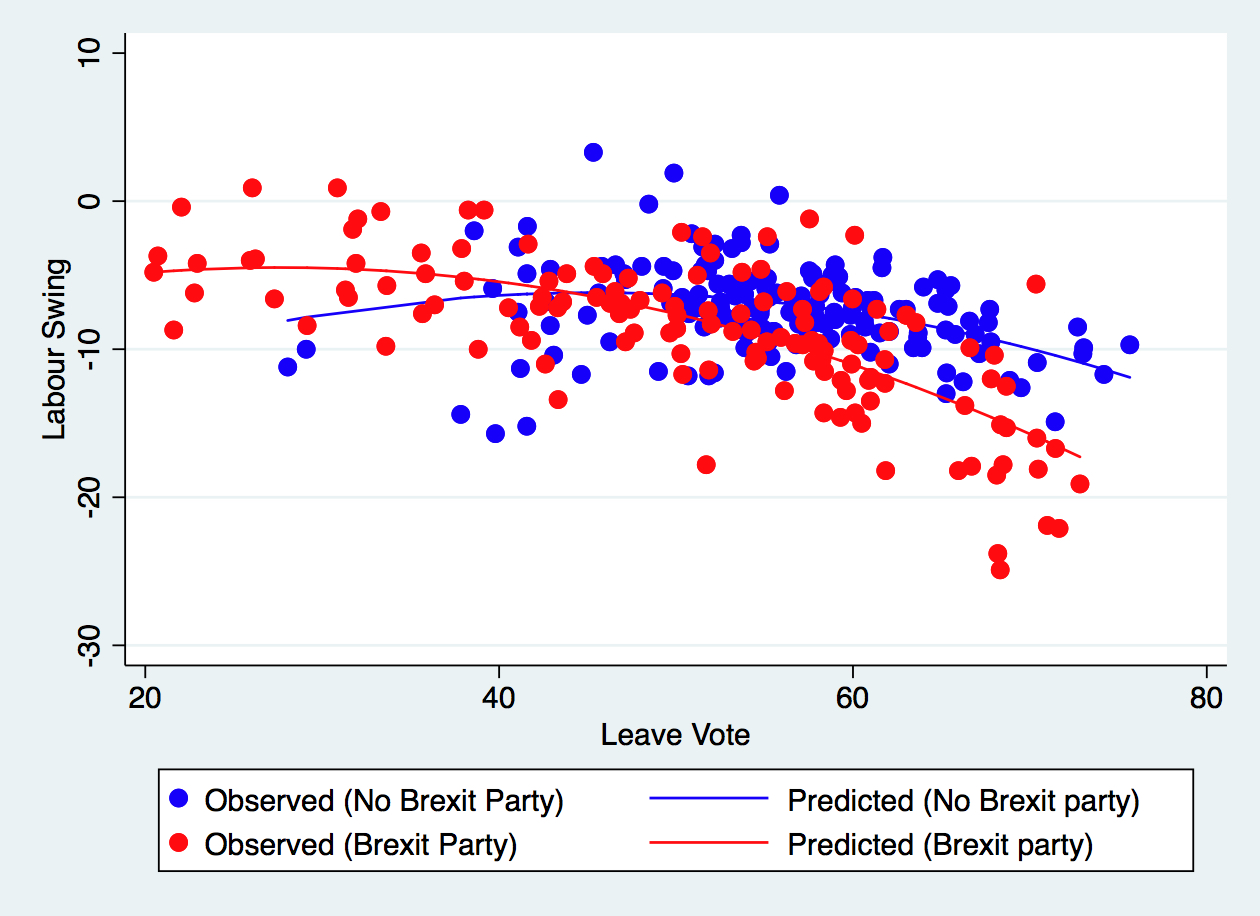
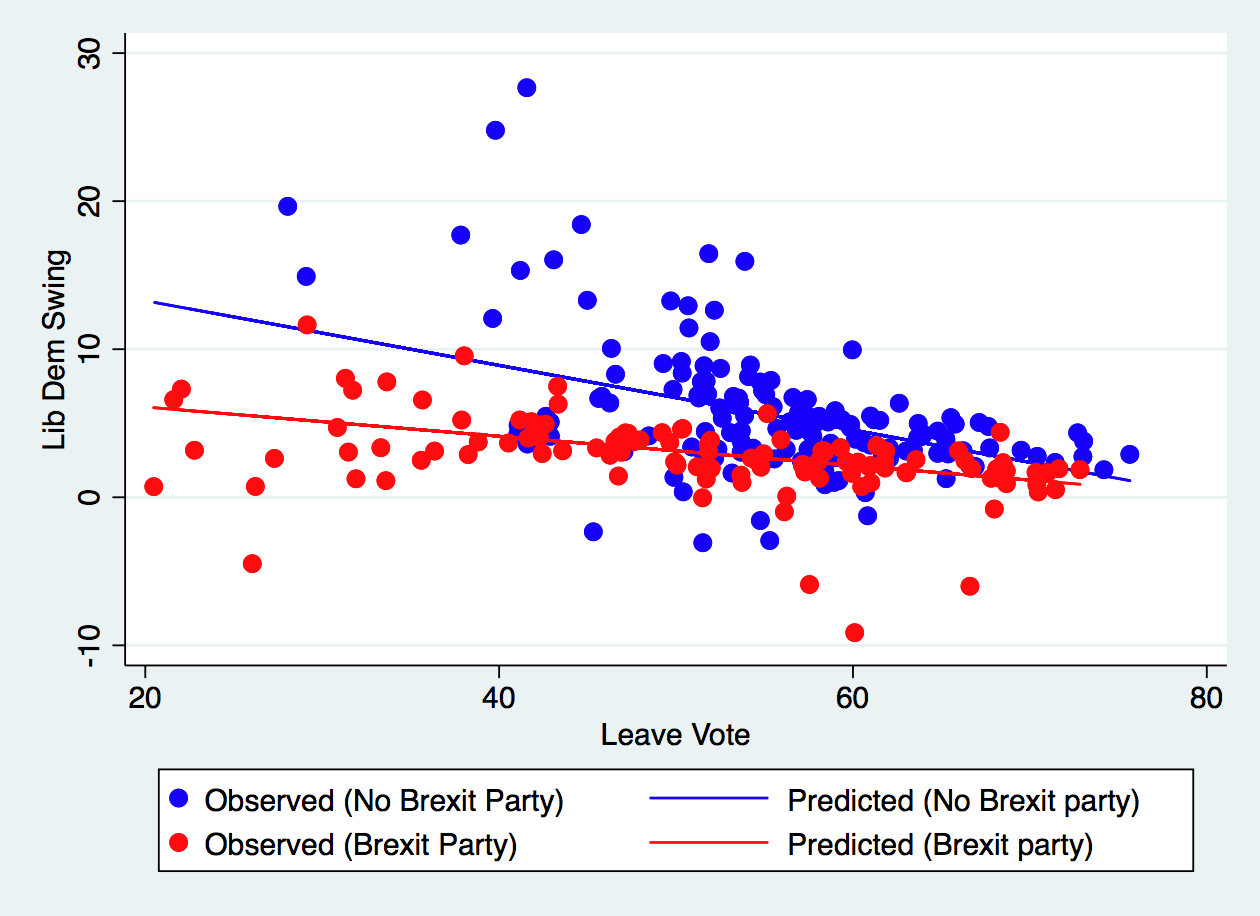
    We can confirm this by examining the relationship between the swing against Labour and the proportion of the electorate who voted for leave in the 2016 EU referendum. Figure 2 shows the swing against Labour in England and Wales plotted against the leave vote, separately for constituencies with a Brexit party challenger (red) and those without a Brexit party challenger (blue). Most seats with a Brexit party challenger were Labour seats, while those without a challenger were mostly Tory. The blue and red lines show the predicted swing against Labour from my linear regression model, which explains 39% of the variation in the swing against Labour. This model had a term for Scotland (which had a 2.4% larger swing against Labour), a quadratic term for the leave vote, and an additional effect on the swing due to the leave vote in areas with a Brexit challenger. In the median 2016 EU referendum leave-voting constituency, the swing against Labour was 6.5%, and this was 2.1% higher in seats with a Brexit challenger.

    Figure 2: Relationship between the swing against Labour and the leave vote

    It is clear from Figure 2 that the swing against Labour was smaller in seats with a Brexit party challenger that voted to remain in the EU. In seats not held by Labour, the swing against Labour was larger in seats that were either strong leave-voting seats or strong remain seats. In these seats – the seats Labour had to win to win government – Labour was being squeezed in both strongly remain and strongly leave seats. In the seats Labour already held (mostly with a Brexit party challenger), or that it did not hold but faced a Brexit party challenger and a Lib Dem or SNP incumbent, the party faced intense pressure due to brexit. In seats it held that had a large leave vote Labour was completely smashed. These seats are mostly in the famed “red wall”, the northern seats that Labour has always been able to rely on. Note the largest positive swing to Labour occurred at about the median leave vote, between 45 and 55.

    An interesting phenomenon in this election is the failure of the conservatives to gain a large swing from Labour. The national swing against Labour was 7.9%, but the conservatives only gained a 1.2% swing. The primary beneficiaries of that swing were the Lib Dems and the Brexit party. Of course, these national figures hide major variations within constituencies, which are easy to see if we look at the swing to the Tories at the constituency level. Figure 3 shows the swing to/against the conservatives in England, plotted against the leave vote in the 2016 EU referendum. Red points are points where there is a Brexit party challenger, and blue points are those without a Brexit party challenger (mostly Tory-held seats) At the median leave vote my model estimated a swing to the Tories of 1.3%, with a further swing to them of 1.4% in Wales. This model included a quadratic term in the leave vote, and explained 57% of the variance in the Tory swing.

    Figure 3: Observed and predicted swing to the conservative party, by EU referendum leave vote

    It is noteworthy that in the seats that voted to remain the Tories experienced a swing against them of as much as 10%, but in the strong leave-voting seats they experienced a huge swing to them. This swing was larger in seats without a Brexit party challenger, presumably because there was no Brexit party to absorb the leave sentiment, but even in pro-leave constituencies with a Brexit party challenger the Tories gained a very large swing. Note, however, that in some pro-leave seats there was a swing against the Tories where there was a Brexit party challenger. These were Labour seats that saw all their pro-leave vote go to the Brexit party. But in pro-leave seats with no Brexit party challenger – the seats that Labour needed to win to form government – there was a consistent large swing to the Tories. We again see here the value of Farage’s decision to stand candidates only in Labour seats.

    Finally let us consider the role of the Liberal Democrats, the greatest frauds in modern politics, in destroying the UK. Figure 4 shows the swing to or against the Lib Dems in England, plotted against the 2016 EU referendum leave vote, with the predicted swing from my regression model. Again, red points are for seats with a Brexit party challenger (Labour- or Lib Dem-held seats) and blue points are for seats without a Brexit party challenger (mostly Tory-held seats). This model has no quadratic term for the leave vote: in non-Brexit party seats every percentage point increase in the leave vote was associated with a swing against Lib Dems of 0.2%, but in seats with a Brexit party challenger this swing was only 0.1%. At the median leave vote the Lib Dems experienced a swing towards them of 6.0%, reducing to 2.8% in seats without a Brexit party challenger. Scotland and Wales saw large reductions in this swing to the Lib Dems, of 5.3% in Scotland and 2.1% in Wales. Basically, the Lib Dems performed best in Labour seats in England that voted to remain in 2016. In these seats the swing against the Labour party was often almost entirely towards the Lib Dems. This model explained only 29% of the variance in the swing, probably because the Lib Dems win by very local-specific campaigns, not so strongly affected by national factors.

    Figure 4: Look at these arseholes spoiling the Labour vote

    Note that in some Tory-held remain seats (the blue dots to the left of the figure) the Lib Dems had huge swings to them, but in many seats they did not win. A good example of this is Cities of London and Westminster, which was Tory before this election and did not have a Brexit Party challenger. The Lib Dems fielded Chuka Umunna, a class traitor who abandoned Labour to join TIG, then jumped ship from them to join the Lib Dems, natural home of fickle and untrustworthy people. He won 30.7% of the vote, scoring a swing to the Lib Dems of 19.6%. This enabled the Tories to hold this seat with just 39.9% of the vote, against Labour’s 27.2%. Had he not stood, it is possible that a large proportion of that vote might have gone to Labour. In the seat he used to represent for Labour, Streatham, Labour held on despite a surge of 17.0% in the Lib Dem vote (this seat is not in my data set so you can’t find it in Figure 4). Cities of London and Westminster voted 28.1% leave in the EU referendum, making it one of the least leave-voting seats in the country; Streatham voted 20.5% leave, making it the second least Brexity in the country. Thanks to Chuka’s “efforts”, the citizens of both these seats will now have to leave the EU.

    What it all means

    These figures and the associated regression models should make very clear that Labour was screwed by Brexit. The Tories scored huge swings in pro-leave seats, which shored up their vote in seats that Labour had to win and forced Labour to defend seats it could normally rely on. Worse still, Farage’s decision to stand Brexit party candidates only in Labour seats meant that Labour lost large numbers of voters to this no-good Russian con-job, while also facing defection to the Tories. At the remain end the Lib Dems were stealing their votes, so they were bleeding votes at both ends of the leave spectrum. The only way they could have averted this problem would have been to go to the election with a full-throated Brexit strategy – a Lexit manifesto – which would have shored up the red wall and ensured they didn’t lose many of those seats. However, even if this had been successful in the North, it would have cost seats in the cities, where the Lib Dems would have stolen many seats. This is worse than useless, since we know from experience that if they have the choice the Lib Dems will betray the country to the Tories, and will never form a government with Labour.

    I don’t think a Lexit strategy would even have been that successful. Just as when Labour goes full racist, the people they’re trying to win back just don’t believe it, and vote for the Tories anyway. Had Corbyn gone to the election with a full-throated Lexit manifesto a lot of the people he was trying to convince would have assumed he was lying, and he would have lost the northern voters anyway, at the cost of the cities and the youth vote. Jo Swinson truly could have become PM!

    Given this squeeze I think Corbyn made a sensible decision to run on a big left-wing manifesto and try to make the election about something other than Brexit. This was especially important given the Labour position on Brexit was consistently misrepresented by the media. I saw multiple media figures on Twitter claiming Labour did not support free movement (they did; it was in the manifesto) and saying their position on Brexit was “too complicated” (it wasn’t: they were going to negotiate a good deal and put it to a referendum). Given this their best bet was to try and turn the debate to one on honesty, the NHS, poverty and inequality. I think this is wise messaging and important: the UK is heading into the abyss, and at some point the Labour party is going to have to save the UK from ruin, so why not make this point at a time when you can’t win the Brexit debate?

    I think it’s also important to consider what would happen if the party had made a choice to go full Remain or full Lexit. In the former case they’re abandoning their northern seats, telling them that they don’t care about their concerns and won’t listen to their democratic voice. In the latter case they’re abandoning young people, who are much more likely to be Labour supporters, and telling them they will destroy their future. Given that the future is all that young people in the UK have, this is political suicide. The only way to square this circle is to present a policy that offers hope to both these core groups. Labour is the party of the urban poor, industrial labour and young people, but when these three constituencies have radically different demands on the overwhelming issue of the time it’s impossible for Labour to win.

    If Labour failed in this election I think it was in failing to convince the electorate of the value of their Brexit policy. But given they weren’t able to express it without the media mangling it and misrepresenting it, and given how dishonest and vicious the campaign was, I don’t see how any other leader could have done better. Even if you credit the notion that Corbyn is hugely unpopular, and assume some part of the swing was hatred of this genuinely decent guy, it makes no difference: the figures I’ve shown here make clear that Labour were fucked no matter who their leader was and what their manifesto was. This was a Brexit election, and the Tories are obviously the party of Brexit.

    Three years after he exploded the Brexit bomb, and 30 years after he face-fucked a dead pig so he could win Johnson’s approval, David Cameron has achieved what he originally intended: the destruction of the Labour party by unleashing a racist monster in the UK. History will not judge any of these awful men well.

    Where to now for the Labour party?

    I think the Labour party should keep Corbyn and keep his manifesto. They aren’t going to win with another Blairist monstrosity – Ed Milliband tried that in 2015 and was sunk by a viciously anti-semitic media campaign that portrayed him as a Jewish communist with dual loyalties[4] who can’t eat a bacon sandwich. By the time the next election comes around the world is going to be desperate, trapped in the throes of global warming and looking for new ways out. Why throw away what the country needs? This election Labour’s manifesto was the best and most inspiring left-wing project in the UK for 30 years, and it was right. Jeremy Corbyn is right – he won the arguments. He just couldn’t beat Brexit.

    I have seen rumours that some on the Labour right were cheering when MPs lost their seats. I have seen in the media and on Twitter Corbyn’s old enemies in the Labour party gloating over the Tory victory, laughing at the Labour movement’s disappointment and salivating at their chance to retake control of the party. Perhaps they envisage another illegal war, where they can kill another million muslims? Or perhaps they look forward to palling around with rich non-doms, being “intensely relaxed about people being filthy rich”. Oh, the larks! These people are not part of the labour movement. They’re scabs, and their obvious joy at this defeat is disgusting. They need to leave the movement, and leave it to those British people who actually want to save the country from ruin. During this period of reflection, we should be clear: it was Brexit that defeated Labour at this election, and the direction it was headed under Corbyn is the only future for Britain other than ruin. So these scabs need to get out of the party and leave it for people who actually care about the future of the UK and the future of the world.

    Once Brexit is past, and these class traitors are out of the labour movement, we can hold the Tories responsible for what they have done. We couldn’t beat Brexit, but we can hold its architects responsible for the great evil they have perpetrated on ordinary British people.


    fn1: It’s okay, I had a hangover and nothing better to do on Saturday

    fn2: Or “chump”, to use the preferred terminology for these sad-sacks

    fn3: Which is bullshit

    fn4: Oh the irony …

  • Inevitable

    Our PCs have made contact with an illicit Skavarra smuggler called Mr Ting, and after a vicious battle made some progress towards their goal. They are hiding a Skavara with mystic powers, which someone attempted to smuggle on their spaceship, and are now trying to find out who the Skavarra was being smuggled to and why. To this end, after ambushing Mr Ting they learnt that they need to speak to a man called Thrall, who works directly for whoever ultimately purchased the Skavarra. Thrall will return to Algebar station in 11 days, so they have time to kill while they wait for his arrival. They have taken Mr Ting’s million birr – which he was supposed to pay to the Skavarra smugglers – but left him alive in a moment of mercy. They have also learned that Mr Ting has a powerful ally somewhere in the station heirarchy, but due to various deceptions it is unlikely that they can be identified easily as the people who stole Mr Ting’s money, except by Ting himself, and Ting has been cowed.

    The roster for today’s adventure:


    • Adam, gunner and acting captain
    • Reiko Ando, deckhand
    • Siladan Hatshepsut, archaeologist and data djinn
    • Saqr, pilot and mystic
    • Dr Banu Delecta, medic

    Ship modifications

    Using the million birr they stole from Mr Ting, the PCs decided to go on a spending spree. The station at Algebar 3 is large and full of opportunities, so they used the money to make two quick upgrades to their ship: they purchased the Supersensors and Supercharged reactor features, both of which are relatively fast to add to the ship and do not require much engineering. They wanted to buy extra modules, but this will require months of work, so they settled for these simpler features. They also spent some time hunting the Souks of the lower, inner decks for weapons licenses, as they had become increasingly aware of the dangers of engaging in battle in metropolis stations like Algebar 3 without the limited protection even sidearms and light armour offered.

    These purchases and upgrades took 7 days, and on the evening of the 7th day they received a visitor, a slick young man called Sarcuptra who had heard they were purchasing weapons licenses and was interested in selling them some advanced weaponry. He might, he intimated, even have access to rocket launchers. They interviewed him in the Beast of Burden‘s Arboretum, and after a short conversation – during which he seemed completely unfazed by their increasingly rumbunctious and menacing menagerie – they decided to do business with him. He told them he would send them a location and bade them farewell, taking with him a list of weapons they wanted.

    The ambush

    Adam was sure it was an ambush, but they went anyway. Sarcuptra told them to meet him two days later at a park on a lower, inner level. He assured them he had a method to get the weapons to their ship without any trouble with the law, and although they doubted the weapons were going to arrive they played along with his plan. The park was a small grassy zone with windows offering views of the space stations inner underside, a disused door in one corner, and a couple of children’s play spots in the middle. The central object was a slide in the shape of a strange grey animal that was fat with short legs, very large ears and a long nose that curled down from its dumb-looking head to the ground. This was the slide, and its fat grey body could form good cover if they needed it. Adam, Delecta and Siladan gathered here while Reiko took position at a place behind cover on the far side of the garden, and Saqr went to investigate the door, which turned out to be an emergency airlock – common installations throughout the space station. They waited, Adam nervously eying the buildings across the road from the park.

    After a few minutes Adam’s tabula registered a call, which he answered. Mr Ting’s face emerged on a grainy video, and they realized that yes indeed, it was an ambush. He told them that they had a choice: exit through the emergency airlock to a waiting shuttle, which would take them to a passenger ship called the Selenium Dream, which they would ride back to Coriolis, leaving their ship and all their belongings and money here; or die. He gave them one minute to decide. The call ended.

    Of course they weren’t going to do what he wanted. Saqr came running back to the weird grey animal, and they talked about what to do. After 20 seconds the doors of the buildings across the road opened and four men emerged, carrying vulcan carbines and wearing light armour. A window upstairs opened too. Siladan ran forward to a flower bed near the front of the garden to take cover, ready to charge into combat. In the upper floor window someone propped a rocket launcher on the windowsill. They opened fire.

    They fought viciously in a dizzying haze of bullets and blood. Siladan and Reiko charged into melee, splitting the four men into two groups of two, but two more men emerged from the emergency airlock, opening fire on the group hidden behind the strange animal and forcing Delecta into remarkable feats of athleticism to avoid being gunned down. The man with the rocket launcher was gunned down by Adam and Delecta but managed to stagger to his feet long enough to fire a rocket at the stupid grey animal, eliminating their cover but doing no serious damage against any of them. Siladan and Reiko did a professional job of murdering all four of the armed men in close combat (except one who fled), and finally as Adam and Delecta mopped up the two men by the emergency airlock Reiko was able to run upstairs and take the man with the rocket launcher hostage. They dragged him downstairs and through the airlock onto the small shuttle that was docked there. The entrance area of the shuttle was covered in plastic and strewn with the necessary tools to disappear bodies – there had obviously never been any intention that they would be flown alive to the Selenium Dream. With all their soldiers dead and their leader captive the flight crew of the shuttle surrendered, and they tied everyone into the shuttle’s few passenger seats. They loaded everyone’s weapons in and flew back to the Beast of Burden in the shuttle.

    Mr Ting’s grisly end

    At the Beast of Burden their assailant proved himself to be a very reasonable captive. His name was Jazir and he had been hired by Ting to do the job. He was very angry with Mr Ting for telling him that the PCs would be an easy target, and when told he would be released if he revealed Ting’s location he offered to go one better – give him back his guns and he would kill Ting himself, then share the loot with them. They agreed with this plan and let him loose.

    A day later they received a video call from Jazir in Ting’s safe house. Against a backdrop of blood and gore he assured them he had done the job, and they should come down to gather up the loot and get Ting’s secured tabula. They took the tube and walked down to the location he sent them, and found him and a few of his friends standing in a room with five bodies. It was a messy, small room, one of Ting’s safe houses, and it was sheeted with blood and damage. He assured them he would clean up the mess, and showed them Ting’s secured tabula and a slew of weapons. They split birr, guns and armour, and then Jazir set about dismembering the bodies. He flipped them a casual salute as they left, and they parted on “no hard feelings” terms.

    Tracking Thrall

    Back at the Beast of Burden they hacked the tabula and learned a little more about Thrall. They discovered that a few days after his visit a supply ship would arrive, to pick up cargo to take to whatever location he was based in. Rather than confront Thrall directly they decided to use this information to track him. They found the cargo that the supply ship would be loading, and placed a small image of one of the Icons inside one of the crates. Ten days after the ship left Algebar 3 station Saqr used his mystic power of tracking, and located it in a part of the system’s asteroid field. They had a location for their Skavarra trafficker. It was time to go and kill him – and find out who exactly was behind this strange plan, so they could kill them too.


  • Artifact traders on Algebar 3

    Our heroes have rumbled a trafficking ring in Algebar, which is willing to pay a huge amount of money for shipment of a single Skavara with mystic powers. Seeing an opportunity to take a very large amount of money from some very undeserving people, they decided to raid the agent in Algebar who was going to purchase the Skavara, take the million birr he had intended to pay for it, and find out why this Skavara was so valuable.

    The cast for today’s adventure:

    • Adam, gunner and acting captain
    • Reiko Ando, deckhand
    • Siladan Hatshepsut, archaeologist and data djinn
    • Saqr, pilot and mystic
    • Dr Banu Delecta, medic
    • Oliver Greenstar, colonist

    They traveled to the main planet in the Algebar system, Tufsur, and settled into its spaceport in preparation for a raid.

    The Algebar system

    Algebar is a single main-sequence yellow star, similar to Sol, with 12 planets, an asteroid belt and a gas giant. Its unstable portal has isolated it from the rest of the Horizon, and most trading companies do not risk traveling past Amedo into Algebar. This means that the worlds beyond Algebar are relatively lawless, and primarily visited by free traders, and it also means that Algebar has developed relatively independently of the Horizon. Originally settled by Firstcome, Algebar is characterized by three main stellar objects: the planet Paru (Algebar 4), Tufsur (Algebar 3) and the asteroid belt, called Assager’s Ghost.

    Paru is a large, earth-like planet, relatively cool compared to earth and characterized by seven moderately-sized continents separated from each other by wide seas. Its population of five million is spread over these continents and has slowly devolved to a technological level equivalent to that of the age of sail. The seven continents have slowly diverged culturally, having their own languages and cultures, due to the poor interconnections between nations using sail ships. The population grows slowly, and the planet is something of a backwater. Its people know of those on other planets, but their xenophobia and lack of education causes them not to care too much, nor to change. They trade foodstuffs for trinkets from space, giving them a science-fantasy culture something like that in Silverberg’s Majipoor books. In addition to foodstuffs, the people of Paru have two unique trade objects: Paru fabrics and their own people. Paru fabric is made from a shellfish that grows widely in the shallow seas of the planet. It fastens itself to the seabed using silk strands which, when extracted from the shell, can be spun into a fabric of extreme tensile strength and power, that can be used to make advanced armours. The people of Paru are famously beautiful, and are traded legally into courtesan work by Ahlam’s Temple, and illegally into slavery by the Syndicate. As a result of these trade goods, a bustling space port hangs over Paru, but its people itself have failed to benefit from the trade they provide.

    In turn Tufsur, the third planet in the system, completely depends on Paru. Its population of 900,000 live on a desert planet with no water, in domed firstcome cities that have been maintained by a cult of technologists, the Emirs of Tufsur, who hold total power on the planet. The largest industry on Tufsur is spinning Paru fabrics into armour and advanced materials; they trade for food and the raw silk from Paru, and buy ice in bulk from free traders who collect it from Assager’s Ghost. There is no freedom on Tufsur, just religion and work; but the huge station hanging in orbit offers welcome relief and riotous freedom from all the religious restrictions of the planet below, its wealth built on trade in goods from Paru and ice from the asteroid belt.

    This asteroid belt is a huge monstrosity, 10 AU wide and 10 AU wide, blocking sunlight to the outer planets and casting a gravitational pall over the entire system. Many theorize that this asteroid belt is the reason for the system’s unstable portal, but little can be done with it except to mine it for rare metals and ice. The rare metals are sold to free traders as they pass through, primarily from the spaceport at Paru, and the ice to Tufsur. The system maintains a bustling sub-stellar network of mining ships and ice-haulers, but interstellar vessels are rarer and their crew a foolhardy bunch at best.

    Thus does Algebar’s business proceed slowly, as it has always done, largely isolated from the rest of the Horizon by its bad portal. And into this ossified network fell the PCs, carrying a miracle semi-intelligence, and a thirst for justice.

    On Tufsur Space Station

    Tufsur space station is a huge torus, 3km in radius on its inner face and 1km in diameter. It looks like a disc as a visitor approaches, because the entire toroidal central space is devoted to huge sheets of solar panels, which power the entire station. There are about 100,000 people living on the station, giving it a relatively low population density. The station is firstcome, old and slowly crumbling but still a millenium away from becoming unusable. It has several docking space internally that are large enough for class IV ships or smaller, and an array of external docking stations for class V ships. Ice Haulers typically dock away from the ship and their ice is hauled to special trade platforms by tug boats. Although large interstellar vessels rarely visit, a constant stream of class II and class III sub-stellar trade ships streams into and out of the station, and down to the planet below. The station has four primary residential levels, each perhaps 100m in height, with a simple structure consisting of an outer promenade and an inner promenade separated by a tube train that connects 9 stations (one for each icon) set not-quite-equidistantly around the tube. Central decks are the poorest, since their inner promenade has no windows, and there is a modest criminal population on the station consisting of a mixture of people running from other systems, people hiding from the Emirs of Tufsur, human traffickers, smugglers, and general criminals.

    The PCs docked at an internal dock and found accommodation on an upper outer promenade, in a large villa with views of the system, near a pleasant park. They immediately set about finding criminal connections, and quite quickly managed to arrange a meeting in The Doldurms, a network of ancient fighter-repair bays that had been repurposed into markets. Here they bought themselves armour enhancements and armoured underweave made of Paru fabric, and also found the location of the Skavara dealer’s local contact, a certain Mr. Ting. They purchased some fake identities for themselves, and paid him a visit.

    An unfortunate escalation of hostilities at Mr Ting’s warehouse

    Mr Ting was based in a small warehouse with a view over the inner disc, next to a small and rundown park. They stopped outside and prepared themselves. Unfortunately the strict weapons laws on the station prevented them from being heavy weapons or armour, so they were wearing their new underweave and carrying only knives and small pistols. Siladan attempted (and failed) to access some local computer systems to see what was inside but was unsuccessful, so they pulled out their weapons, heaved up the main roller door on the warehouse, and entered…

    … to be greeted by a hail of gunfire from a vulcan machine gun, that hit everyone on the front row but fortunately did not do any serious damage. The guards in the warehouse had been alerted by Siladan’s failed computer access attempt, and were on overwatch. Battle was joined!

    The fight was short and sharp. Two men upstairs at the machine gun nest were quickly overpowered by Adam and Siladan, while a third man downstairs revealed himself by shooting at Oliver, and was taken down by Reiko, Oliver and Banu. Upstairs, Mr. Ting shot Adam in the head and almost killed him[1], but once his guards were down he surrendered and agreed to talk.

    Unfortunately, as they were talking Siladan made an attempt to search Mr. Ting’s computers, and made another dismal failure. This alerted some guards, who came to the warehouse to investigate. After another short fight Mr. Ting gave up, and two of the three guards survived. Mr. Ting gave the PCs the million birr he was holding to pay for the Skavara. He warned them that he was just an agent for a greater power, and they would regret this intervention. They offered to let him live if he told them who he was dealing for, but he did not know. Instead he told them he had a contact, a man called Thrall, who would be returning to the station in 11 days. They could ask him.

    The PCs let Mr. Ting live, took his 1 million birr and the information, and left. They would find this Thrall, track down his boss, and learn the truth about the Skavara in their hold. They had a feeling that something big was moving behind this scheme, and they intended to find out what … and get rich as they did so!


    fn1: I rolled a crit of 66, but Adam’s player had just bought the new talent Tenth Life, which enables a PC to ignore a single 66. This is a one use talent, so Adam basically burnt 5xp.

  • Today the riots in Hong Kong seem to be grinding down to their bitter end. This week the fascist street thugs killed a 70 year old street cleaner with a brick and set a man alight for arguing with them, and now they are trapped in university campuses and running out of food and options[1]. Hopefully the people who killed that old man will be brought to justice, and this remaining hard core of violent thugs who have spent the last few weeks running around Hong Kong beating up mainland Chinese people will be taken off the streets.

    A disappointing part of this whole saga of racist street violence for me has been the way many in the international left have supported the racist thugs. This started with a complete misrepresentation and misunderstanding of the extradition law that started the whole movement, and some on the international left even supported the movement as it spiraled into street violence and calls for independence – or even a return to colonial rule. Now obviously, in some times and places, it is necessary (from a left wing perspective) to support radical action on the streets for some political goal, but obviously if you’re going to support such actions you need to be thinking: what is that goal, and what left wing vision will it achieve? In the case of this violent movement – after the racist street thugs splintered off the original antiElab movement and started the five demands – the question has to be: What is the ultimate left wing vision for an independent Hong Kong? These guys are throwing molotovs on the street in pursuit of separating from China, so if they were to do that, what would an independent Hong Kong look like? What leftist vision do we have for that?

    Hong Kong has very little industry, no agricultural land, no natural resources, even its water is piped in from Mainland China. If it separated from China it would basically have two industries: land speculation and banking. Now those are completely viable industries, I’m sure, and there is certainly a place for an independent financial hub in Asia, but how could this city-state be a left wing vision? We already have a kind of model for that, Singapore, and although it is a nice place and has some very strong socialist principles going on (such as the huge public investment in housing and the central planning of much of the economic activity) it is also a libertarian dream. It is not a great vision for an independent Hong Kong, and it’s also not possible for Hong Kong to achieve: a large part of Singapore’s success is built on social harmony and a lot of that is built on some repressive free speech laws and the strong public investment in housing. Given that housing speculation is one of Hong Kong’s main industries, it’s unlikely that an independent Hong Kong will suddenly nationalise 80% of the housing stock. Furthermore, Hong Kong is basically run by four families, and any left wing version of an independent Hong Kong would very quickly have to run into conflict with those tycoons[2].

    I can’t see a left wing vision for an independent Hong Kong, so I wonder – what do left wing people hope to achieve by supporting these rioters as they run around Hong Kong beating up Chinese girls with iron bars? What is the future of Hong Kong that the left would support, if it split off from mainland China under the pressure of these thugs and their firebombs? And if you cannot see a path to economic security and an egalitarian society, why would you support independence, even if independence were in and of itself right?

    Which brings me to the second part of my disappointment with western leftists’ support for the independence rioters. The return of Hong Kong to mainland China is an essential part of the decolonization process. There can be no effective, genuine left wing ideology that does not support decolonization, and although there are legitimate reasons to argue against violent decolonization, a peaceful decolonization – as happened when Hong Kong was returned to China – is something that all leftists should support. The National Liberation struggle may have a bit of a ’70s whiff to it, and it may be a bit beardy and uncool, but it is still a fundamental plank of any real left wing vision for a fairer and more egalitarian world. That means that Hong Kong needs to be part of mainland China and ultimately so too does Taiwan. Supporting an independence movement in Hong Kong means reversing that decolonization process, and if you are going to support recolonization, or oppose decolonization, you need a very good reason. “A strong, independent, left wing state” isn’t enough, especially given that’s exactly what China is anyway; but given Hong Kong has no possible pathway to becoming a strong, independent left wing state (or any kind of left wing state), you’re simply betraying left wing principles by supporting it.

    Now you might argue that freedom is more important than decolonization. This might be true under some circumstances, depending on the nature of the state you’re supporting separation from, but I don’t think it’s possible to argue that under the one country two systems ideal; and it certainly isn’t possible given the vanguard of this movement are fascist street thugs who want to return to colonial rule. There is no freedom under British colonial rule, and any movement that advocates for that – and waves the British colonial flag – while beating up people on the basis of the language they speak, is never going to be a movement for freedom and democracy.

    This movement of racist thugs is a dead-end for the left. It’s not a movement for freedom, it’s opposed to the decolonization project that is essential to modern left wing ideals, and its only end point is a right wing tax hell hole squatting on the edge of China causing trouble. Left wing people should not support this movement, and as its last dead enders stumble bleary-eyed out of the universities they’re holed up in, we shouldn’t give them our support!


    fn1: Their decision to occupy the university seems to me to be a sign of how little connection they have to the international left. University sit-ins only work if the government is at least slightly willing to play along with the game, if there is the possibility that they are going to make concessions, and the government is only likely to do that if they think the activists are honest and aren’t going to engage in an orgy of property violence. Anyone who has done a university sit-in (as I have, once) will know that they are extremely hard to do well, and when the police decide to finish them up the process is ugly. Looking at photos of these kids’ activities in the university cafeterias and common spaces, I don’t get the impression they are very well organized or familiar with how sit-ins work. I don’t think they have much connection to the international left if they haven’t been able to learn these things.

    fn2: These tycoons are the real reason Hong Kong’s young people feel so hopeless, and they have done a very very good job of distracting Hong Kongers into thinking mainland China is the cause of their problems.

  • On the islands of Amedo

    After a short interlude to rest and recuperate at the Lithofor, the PCs have returned to their luxury yacht and traveled onward, to Amedo, experiencing no threats or challenges along the way and arriving at the Amedo system’s main planet, Amedo, without incident. Amedo is the fourth planet in the Amedo system, circling its large star. Its population is small and scattered over primarily small islands far from its main continent. Amedo is the ancestral home of the Skavara, semi-intelligences that are exploited as trainable troops and labourers, and as a result the planet has a large and active spaceport despite its small surface population, as a brisk trade in Skavara attracts traders and businesspeople. The PCs arrived with the intention of passing on directly to Algebar, but decided to stay while they looked for passengers, and to explore the wonders and famed beauty of the planet’s archipelagoes.

    Visit to a White Temple

    The PCs’ main aim was to visit one of the planet’s famed white temples, temples scattered across the ocean surface that had been built by the firstcome and which had an ancient history of strict devotion to the Icons. Unfortunately there was no information available about the white temples either in the ship’s database or in any physical or digital media in the planet’s spaceport, and they were forced to travel to the surface and randomly select a white temple to visit. Siladan did a little investigation and was able to determine a likely order for the distribution of temples, so that they could find the temple they sought, so they took their shuttle and headed down to the planet.

    The only way to approach the white temples was by boat, so they landed at a nearby chain of islands called the Resiler Isles, and took accommodation here in an old whaling facility called the Death Factory. Here they learnt that the Resiler Isles were a haven for people escaping harsh lives in the rest of the Horizon: former gangsters, soldiers, political activists, failed prophets and washed up adventurers all found their way here, to live in peace amongst the waves and storms of Amedo’s oceans. The PCs, too, took this opportunity to rest for a few days before they took a boat from the Resiler Isles and headed into the wild ocean, looking for one of the White Temple Islands.

    They reached the white temple island after an uneventful few days of primitive sailing across calm blue seas. It was a small island built on a base of white coral, ancient and bleached to sparkling beauty by sun and wind. Their boat docked at a small pier of coral, and they ascended glittering white steps through a long chain of gateways made from the huge rib bones of long-dead whales. The stairs curved around the island and led them to a building constructed entirely of whalebone, its windows made of single discs of a strange, semi-translucent plastic-like material. At the top they were met by a monk, an old woman dressed in simple robes, and led into the small compound within the whalebone walls. For the next week they prayed and did simple menial work on the island, polishing coral and scrubbing whalebone floors and spars, and flagellating themselves regularly in the presence of the Icons. During this week they learnt that the White Island Temples were the reason for the extinction of the planet’s great whales, and also their prey, the huge jellyfish-like creatures whose internal gelatinous organ was used to make the windows and semi-translucent skylights of the temples.

    After this week of devotions they left, enlightened, with new skills and talents, and returned to the Beast of Burden to continue their explorations of the Horizon.

    The Hidden Cargo

    Once they were back on the Amedo space station the PCs were contacted by a man called Elifim who wanted them to carry some cargo for him to Algebar 3, Tufsur. This cargo was a simple job, and he was not paying a lot – 10,000 birr to transport a crate of electronic goods plus himself, his assistant and four staff through the portal to Algebar. They agreed, and set off the next day.

    The journey to the portal was uneventful, although some of the crew were troubled by strange dreams, and they passed through the portal uneventfully. The next day, as they traveled towards Tufsur 3, Saqr was woken from a nightmare, rearing from his bed with a scream of anguish and torn by visions of being trapped in darkness. Realizing that these dreams were definitely not right, he decided to go and find his cat, which had recently been spending a lot of time in the cargo hold.

    In the hold Saqr found his cat sitting alert on the crate they were transporting as if he were looking at something. Saqr approached, and saw that the cargo crate was open. Something moved rapidly past him, and he realized he might not be alone in the hold. His cat jumped down from the crate to go after the movement and Saqr followed, waking up the others (finally!) as he did so. Following his cat he found himself facing a Skavara, hidden in the shadows at the back of the cargo hold. It was smaller than Saqr, had dark, matted fur and looked confused and scared. Saqr guessed it must have been in the crate – either as a stowaway or as cargo. Remembering his nightmares, he began to guess that Elifim had for some reason been trafficking this thing.

    That was when he was attacked by one of their passengers.

    The others reached the hold at this time, but Dr. Delecta had the sense to bring her motion detector, so they knew that there were 8 figures in the hold – their passengers, Saqr and something else. With Saqr’s warning they entered the hold fully armed and began shooting. The battle that followed was short and brutal, but not easy. Elifim’s assistant was revealed to be a mystic, who used his powers to stop them from acting, and the four “staff” Elifim had brought on board were actually fighters of some kind.

    During this short and vicious battle they also discovered that the Skavara had mystic powers – it used them to cause panic and terror in anyone who came to close to it. It was this mystic power that finally won the battle for them, and after a few blood-drenched seconds they had subdued the passengers and had Elifim at their mercy, panting in terror and trying to crawl out of the cargo hold even though one of his legs had been partially severed by Siladan’s halberd.

    A short and harsh interrogation of Elifim told them what they suspected. The Skavara was the first of its kind with mystic powers, and Elifim had captured it and was shipping it to a man on Tufsur 3 who he expected would pay a lot of money for it. He offered to cut the PCs a deal if they let him live – he would put them in touch with the agent and give them half of the million birr he expected to make from the sale. It’s only a Skavara, what could they care?

    They did care, and they showed Elifim this in no uncertain terms. Once they had the name of his contact on Tufsur 3 they spaced him and his dead crew. They would meet his contact, but only to finish what they had started with Elifim. They welcomed their new crew member on board, and resumed their journey to Tufsur 3.

  • In April 2018 I was struck by Ramsay-Hunt syndrome, and half my face was paralyzed. For about two months I had to somehow struggle through a new job with my face sliding off and my entire body completely exhausted and stricken with pain. I recovered over the following year until my face was about (in my estimation) 90-95% better, and probably no long term consequences. Then two weeks ago this awful condition hit me again, though this time I felt it coming, got the treatment early, and avoided any serious trouble. After this last 18 months of face-eating hell, I feel like I’m an experienced Ramsay-Hunter, but when I was trying to understand this disease last year I found precious little information on the internet about it. So, I have decided to use this blog for what blogs are good for, and to give my experience of Ramsay-Hunt Syndrome, as well as some suppositions and general suggestions for dealing with it based on what I experienced, my own hazy research and discussions with different people. Ramsay-Hunt Syndrome (hereafter referred to as RHS) has a very wide range of effects, if the internet is to be trusted, and a lot of them are pretty subtle and unpleasant. So I’d like to outline here what I experienced, some things I think about the disease based on my experience, and some stuff I picked up around the internet. To be clear if you read on: I am not a doctor, I have no medical advice for you, and if you’re coming to me for medical advice you’re in a dire place. This is just my experience, and you should not use it as anything except supportive anecdotal knowledge. Nonetheless, I hope it will help you. If you have experienced RHS yourself and want to add your own experiences in the comments, or are experiencing it and have questions (or want reassurance) then please also comment.

    What is this godawful disease?

    Ramsay-Hunt Syndrome is basically shingles inside your face. It is caused by Herpes Zoster (shingles) which is a consequence of being infected with chicken pox when you were a child. Basically the chicken pox reactivates, but instead of coming back as an intensely painful rash on your skin (as happens with most people) it comes back as a vicious, cruel, and completely godless infection of your facial nerve. Once it gets its hooks in it does the following things:

    • It causes intense pain in the back of your neck/head/jaw, that is like no other pain you have experienced
    • It causes a rash in one of your ears and/or your tongue
    • It paralyzes half of your face so that nothing moves. Nothing.

    This facial paralysis is the worst part of the disease, because it completely disables half of your face, which makes speaking and eating difficult, and also stops you closing your eye[1].

    There is no cure for this disease, because it’s one of the herpes family, a cluster of diseases that were designed by satan to annoy human beings. It is easily treated into remission however using acyclovir, an anti-viral drug. If you’ve had cold sores or genital herpes then you’ll probably be familiar with this family of stupid little viruses and their treatments.

    Chickenpox is very common, since the vaccine was only available in 1984 and isn’t on the mandatory vaccination schedule of many countries. So if you’re older than about 38 years old chances are you had it, and if you are younger than 38 but from one of the many countries that don’t (or didn’t) have the vaccine in their schedule you may well have had it. If you’re like me you carry the scars of that idiot little disease on your face, but if you don’t have the scars you may not remember if you ever had it, in which case check with your parents. You need to know what’s coming for you.

    The common view seems to be that RHS is triggered by stress, just as shingles is. So if you had chickenpox as a kid there’s basically only one way to prevent it: don’t get stressed. Hrmph!

    Also RHS is not the same as Bell’s Palsy. Bell’s palsy is a sudden paralysis of the facial nerve, but it doesn’t come with the rash and intense, unrelenting pain, and it doesn’t do the other dodgy shit that RHS prides itself on (see below). I had Bell’s Palsy about 20 years ago, probably as a result of stress in combination with some stupid infection. Bell’s Palsy is a walk in the park compared to RHS.

    What happened to me?

    So let’s describe my experience. I was just finishing an extremely stressful job where I had been bullied for years by the most vicious pig of a man you can conceive of, and had secured a new job. I was taking a few weeks off and exercising daily, doing two hour morning kickboxing sessions. One Friday in mid-March I visited my new employer to fill in some forms and was informed that my job was guaranteed and I would definitely be starting on 1st April. When I left the workplace I could feel the stress falling off of me like water, and my spirits uplifted, really uplifted, for the first time in a long time. Since I had been training all week I was tired and I had muscle pain in my left shoulder but I didn’t think much of it.

    On Saturday morning I woke up relatively early to go to role-playing, and noticed in the bathroom mirror that my eye and face was a bit weird, but I again didn’t think much of it. It was a bit weird but I’d gone to bed late and I think I’d been having celebratory drinks, so I just figured whatever and headed off to role-playing. By the time role-playing started two hours later I was in great pain that intensified over the day. At first I assumed it was some strain from kickboxing, but by mid-afternoon my face was beginning to fail and my speech was noticeably slurred. The pain by then was intense so I was icing the spot and trying to keep my shit together (fortunately I was playing not GMing). My friends started suggesting the possibility that I was having a stroke (I was 45), but as my face slid off I realized what was happening, and assumed I was just having a bad bout of Bell’s Palsy, brought on by the relief of stress on the Friday[2]. Since I’d experienced Bell’s Palsy before I knew what needed to be done: I had to go to a doctor to get some eye drops, buy an eye patch, and wait a few months. A pretty depressing start to a new job but whatever. So I finished the game, went home, slept as best I could, and the next morning I went to a doctor.

    So Sunday morning my face was wrecked, and I felt like an operation was being conducted on my jaw. My eye was also now open permanently so things were touch and go, but I got to a doctor by lunchtime. The doctor was a standard internal medicine specialist (in Japan this is basically what you go to when you don’t know what’s up) with a nice surgery who I trusted, and he was very sure it was not Bell’s Palsy. He made me sit in the waiting room while he booked some urgent tests at the local hospital, to rule out a stroke, but then came out after ten minutes or so to check my forehead. He made me raise my brow like a reverse frown (what do you call that?) and upon seeing that my left forehead was completely static – not moving even a millimetre – he decided it must be RHS, canceled the tests, and gave me the medicine I needed. He gave me acyclovir to kill the herpes, pain killers, steroids to help my face recover, and eye drops for my eye. I went to a local pharmacist, hit the drugs, and crashed.

    Acyclovir is a miracle drug, it works on the virus fast and within maybe two days the pain was gone, but my face was done for. I had to go into my new job the next week to begin preparing classes, setting up my work space, transferring grants (which takes sooo many forms!) and so on, but I couldn’t work my face at all and also I was exhausted. I could only work perhaps 3-4 hours a day before I had to struggle home and crash. But the worst was yet to come. After 5-6 days the acyclovir finished, and the disease came back within a day – worse than before. The pain was even worse, and it was hellish. This was when the other symptoms began (see below). Fortunately my new work has a very good hospital attached, so I saw a doctor there and they told me that I had been given an older, weaker version of acyclovir, and the steroid dose I’d been given was way too low to help my face. This doctor gave me valacyclovir, which is I guess the incredible hulk of acyclovirs, and nearly doubled my steroid dose. The pain subsided pretty quickly and over the next two weeks things calmed down. By the time April finished the secondary symptoms had gone and my face was beginning to move. In May the doctor shifted me to a rehabilitation plan, and I set about the long path to recovery.

    What are the secondary symptoms?

    If you google around you’ll hear all sorts of horror stories about this nasty little bug. I read people saying they lost their sense of balance, that they were always dizzy, that they nearly went blind, and that their ability to think or calculate was messed up. I found this out because in that first week I noticed I was doing things that are really unusual for me, including:

    • Taking the wrong train home
    • Getting confused about where in the train platform to go to get to my work
    • Forgetting names, words and basic facts
    • Confusing chats and sending the wrong messages to the wrong people

    I went to hanami at my former work near the end of March and met a PhD student who I had known for three years, who had completed a master’s degree in my department and gone on to finish her first year of her PhD: I asked her when she was starting her PhD. I sent messages for my role-playing group to non-roleplaying friends, and vice versa. Also I was getting tired very quickly, and putting on weight (which may have been the steroids I guess). I went back to kickboxing after maybe a month, and that was okay, but for the first two weeks my whole body was a mess. I also discovered, once my eye could close again, that I had become photophobic. I didn’t notice this until mid May, which is when the sun really comes out in Tokyo, and it made my eyes tear up as soon as I went outside.

    I’m also sure that this disease fucked my eyesight. I am longsighted and wear reading glasses but between March and May my eyesight suddenly deteriorated so I had to get new glasses. I also thought I was seeing double, but couldn’t get anyone at the eye doctor to believe me or confirm it.

    I also had small pings of pain in the back of my jaw and neck for months after the main source of horror had gone away. It was there, reminding me that I was its bitch.

    In preparing this post I did some searching and discovered this review article which describes the peripheral nervous system consequences of RHS. It can do a wicked and wondrous array of nasty little things to you, many of which resolve with rehabilitation and treatment, but some of which I think are permanent.

    Rehabilitation experience

    Rehabilitation for RHS is primarily the task of recovering facial movement, since this is the main physical consequence of it. For this I was given facial exercises (gurning, basically) and massages to do to try and regain facial function. The recovery rates for RHS are apparently not very good – less than 70% of people get full facial recovery, and the chance declines with age of course. I did my exercises reasonably assiduously, and the facial massages, and after a year I think I got back to about 90% function. I have two remaining problems with my face:

    • If I read while I’m eating my left eye gets strained and sometimes lets a few tears out (it can hurt a bit)
    • If I purse my lips my left eye closes slightly

    I can also feel a bit of plasticity in the cheek around my mouth on the left side, and I can see a little pocket of muscle above the tip of my mouth on the left side that is dead and just kind of sits there like a lump of uselessness whenever I smile. That’s not a killer – I’ve never thought much of my smile, and whatever charm I have for the ladies is built on something else I’m sure. Most people don’t notice my face is lopsided, I haven’t lost any speech or anything, so I’m mostly good.

    In fact, during rehabilitation I learnt finally how to wink with my left eye, something I never used to be able to do. A career of comedy awaits …

    Rehabilitation for this disease isn’t hard. I noticed that my face hurt to touch, all over the left side, which the doctors told me was because the nerves are waking up and getting aggravated, and some of the rehabilitation exercises would make my face hurt as I strained to move shit around. Just like exercising your body, the muscles were weak and underworked, and they got worn down by practice. I also noticed some parts recovered quicker than others, and sadly the fine motor control around my eyes is the slowest to recover.

    The doctors also warned me against starting rehabilitation before my viral symptoms were fully gone. They told me that if you begin rehabilitation too soon you can develop bad habits, like for example closing your eye every time you bite, because the nerves learn new pathways (like how I got my new left-eye wink superpower). In fact I think I have this when I yawn – my left eye shuts involuntarily.

    The doctors also told me – and I also saw through google sensei – that getting the anti viral medication in early is important. Basically, if you don’t start the miracle acyclovir within 72 hours you’re done for, and the earlier you start the better. I waited a day and then started the weaker old one, so I guess that made my experience worse than if I had scuttled straight down to the best hospital in town, begged my way in on the claim that I was having a stroke, and got myself on valacyclovir from the morning it started. I won’t make that mistake again! But it’s also possible the doctors wouldn’t have recognized the problem and would have sent me in for a series of pointless and expensive stroke checks, and started me late on the anti-virals. The anti-virals really are key.

    Actually when I went to the doctor at my university hospital after the pain returned (and got the stronger acyclovir) he wanted to hospitalize me, and put me on a drip for the medicines. He confessed to me that he didn’t think I needed IV acyclovir especially, but he wanted to force me into a bed away from my work so that the stress would stop and my face would recover. He thought stress was the real problem here, driving the whole thing, and was worried the medicine wouldn’t work until I get my work under control. But the thing is I had just started a new job, and he wanted to hospitalize me on the day of my first lecture. It’s not a good look! And in truth I couldn’t stand to spend a week in bed with nothing to do, so I begged off of that. Maybe my recovery would have been better if I’d agreed to that.

    So if you want a good recovery:

    • Get on the antivirals as soon as possible (and if your doctor offers bog-standard acyclovir tell him to go jump – go straight for the strong stuff)
    • Get the stress out of your life, including by hospitalization if necessary
    • Don’t start rehabilitation until the awfulness is settled down a bit
    • Do your gurning exercises ruthlessly, and keep an eye out for weird new facial behaviors

    Then bingo, a year later you’ll be able to (mostly) get your face back.

    And trust me: you don’t realize how important your face is until it falls off. Life without a face sucks!

    The second bout and the prodrome

    So this year I went on a series of business trips and had quite a bit of stress, and a week ago I could feel this bastard disease creeping in again. I could feel my face getting a bit tired, and when I took a selfie on Monday night last week I could see my smile had retrogressed. Bastards! I could also feel a twinge in the back of my jaw, and when I went to work on Wednesday I was getting confused about train doors and having strange emotions. So I went to the hospital again, explained the whole thing to an otolaryngologist and got the miracle valacyclovir into me before the disease was fully up and running. My face sagged a bit but I’m already doing rehabilitation a week later, because the virus never got started. This time I caught the stupid thing as it was sneaking in the door, and slammed it shut. This time also the doctors were worried it was something else and so put me through some tests: MRI and some blood tests. The MRI came up completely clean and pure, even confirmed I have a brain (who knew!), and after a long and exhausting conversation with the neurologist in which he refused to believe any of the symptoms I just exhaustively described here, I was free to get out and begin the rehabilitation. My next appointment to track facial progress is in two weeks.

    This tells me two things about this disease. First of all, it tells me that stress is really bad once you’re at risk of this disease, and you need to keep it well under control. No one warned me that this little shit would come crawling around scratching at my door a second time, but it did. So if you have RHS, and there seems to be a good chance it was triggered by stress, then you need to get that stress out of your life. I would say this means doing whatever you have to do – change jobs, meditate, murder your boss (don’t get caught obviously), whatever it takes. My new job is relatively low stress and all the stress I experienced was from a cataclysmic series of tightly timed overseas trips, and I think I can control that easily by never again making such a series of business trips in such a short time. Compared to the stress that triggered the first bout of RHS what I’m going through now is trivial, and I didn’t even notice I was stressed until this disease hit. I guess I’m weaker than I used to be.

    The second thing this tells me – and this is not medical science here – is that this disease has a prodrome. It has early symptoms that warn you it’s coming, and if you notice them you might be able to sense its presence. Looking back at my first experience of this neuropathic party, the neck pain and the slight tiredness in my face were there before the evil little bastard stuck the shank in behind my jaw, and had I known I might have been able to react more quickly[3]. Those same symptoms came this time around, so I went to the doctor early and started the valacyclovir before it could take hold. This theory makes sense to me because it is well known that other herpes viruses have a prodrome: Herpes 1 and 2 both have a kind of itchy weirdness in the area where the sores are going to arise, and if you hit the acyclovir then you may be able to prevent or lessen the resulting outbreak. So I guess chickenpox – which is a herpes virus – could have a similar course. I couldn’t find anything on this on the internet, but it’s my feeling that this is what happens.

    A brief note on UHC

    Japan has Universal Health Coverage. I don’t recall how much this disease set me back last year but this time the tests, drugs and bothering the hospital doctors without a referral cost me a total of about 30,000 yen, so it would have set me back 100,000 yen (about $US800) if I didn’t have insurance. I’m sure that it would cost a lot more in America’s weird-arsed system, since Japan has strict price controls, but I think it’s safe to say that 100,000 yen is tough for a lot of people to fork out, and the prospect of not being able to get treatment for this because you can’t afford it, and having to live your life with this intense, unbearable pain and the slow degradation of your face for what I can only assume would be weeks before the virus gave up and left – that’s awful. UHC is an absolutely fundamental part of a civilized society, and every political party should be 100% about getting it if you don’t have it, or protecting it if you do. Never let that wonderful part of modern social democracy slide away or be weakened by the vicious jackals who control our conservative parties. Or your face will fall off.

    Preventing this disease

    The best way to prevent this hairy bastard from coming and fucking your face through your ear is to get vaccinated against chickenpox. Sadly though the varicella vaccine is not in most countries’ mandatory schedules, so you won’t have received it even if you were born after 1984 unless you’re in one of the few that does cover it. Therefore, if you’re a parent in a country without this vaccine on the schedule, and you’re reading this, my advice is: pay the extra amount to get this vaccine for your kids. They will never thank you, partly because they’re ungrateful bastards but also because they’ll never know the fun they’re missing, but trust me it’s worth it. If you’re a policy-maker in a country that doesn’t have this vaccine on the schedule, hurry up and add it.

    If you’re an adult who had chickenpox as a child then the first line of defense against this nasty thing is to avoid stress, make a life for yourself that has manageable stress and don’t let whatever stress you do experience last for too long. I went through years of intense stress before the first bout was triggered, but once it was there my next bout required a much lower threshold. So be careful with stress, and get control of your work as much as you can (I appreciate that this is useless advice for a lot of people, whose industry or career options are top-heavy with unpaid work, bullying superiors, and shitty conditions, but it’s the only advice that I have, sorry).

    There is some evidence that the varicella vaccine, given to adults who had chickenpox, may reduce the risk of this disease. I’m thinking of getting it once this shit has died down, but it’s also possible that the same people whose low-paid high stress jobs put them at risk of RHS are also unable to afford the out-of-pocket costs for this vaccine. If you’re reading this I’m sorry, I’m out of options. Kill your boss, or find a way to move to a country with a better health system. Or vote Democrat and get that shit fixed[4].

    Conclusion

    The most important lesson for this is that you need to reduce the stress in your life to avoid this disease, and that as you get older the risk will increase so you need to purge that stress as you age. It might also help to get a vaccine against varicella even if you’re an adult who had chickenpox in childhood, just to get that extra bit of protection, but your doctor may not like that idea.

    If you go to a doctor with the first symptoms of this and he/she offers you mere acyclovir, tell him/her you’ll pay the extra for valacyclovir. Wave this blog post at them, and explain the issue. What do they care?! Trust me you don’t want this thing hanging around, so push for it. Then take your rehabilitation seriously, and you may be able to get to a fully functional face once the shitshower passes on. Another thing I think I should have done but didn’t was demand a second course of valacyclovir, to really curbstomp this ugly fucker. Once those drugs are done though, you’re going to be looking at an unpleasant couple of months regardless, so good luck.

    If you had other experiences of RHS, or want to rant about this nasty little hitchiker, or are having it now and need reassurance or have questions, put them in the comments. I’d love to hear how other people got through this virus, and I really hope that this blog post can help someone to deal with the horrors of this disease. You are going to get better and you will get your face back, I promise you!


    fn1: I don’t know what kind of person designed human beings but requiring a muscle to activate to close your eye, rather than open it, is phenomenally stupid. You don’t realize how stupid that design flaw is until you can’t use that muscle, and suddenly you’re staring at everyone like a pscyhopathic cyclops.

    fn2: I have this weird thing, that has existed since my teenage years, where I handle stress well but then when the stress disappears my body completely breaks. Used to happen with migraines, seems to happen with RHS. Others get sick during their stress but my response appears to be delayed.

    fn3: I wouldn’t have, because I’d have thought it was Bell’s Palsy and just gone and bought an eyepatch.

    fn4: I’m not American, but I’m aware that most people who read blogs like mine are, for some reason, and I have to remain aware of your society’s … shortcomings … when I write medical-related things.

  • On the weekend I watched the Director’s cut of the Exorcist for the second time in my life. I think I previously watched this version back in the 2000s when it was first released, and it remains impressive on a second viewing, though the special effects let it down a little. It is creepy, nasty, disturbing and ultimately also a beautiful story about one man losing his faith and purpose and finding it again at the last. Fundamentally I think it’s a very christian movie, which revels in the rituals and imagery of the Catholic church and ultimately redeems that church in the face of a deep evil that only the Catholic church is able to understand. Reading William Peter Blatty’s wikipedia, it appears he was a devout Catholic who remained committed to his religion until his death, so it seems likely that he wrote this book with the intention that it was a paean to Catholic tradition, and I think it does this job very well.

    There is a lot of careful attention to detail in this movie, which I think is intended both to ground it in the ordinary life experience of people at the time, and also to enhance its creepiness, and a lot of that detail was added into the director’s cut. For example, the coffee conversation between the detective and Chris MacNeil (Regan’s mother) was added in the director’s cut, and in this conversation we see that Regan made the clay statuette that the detective found at the base of the steps. The sets are also very rich, so that for example Father Karras’s little room or his mother’s shabby apartment are full of tiny details about his life that serve to make him seem very normal and to place his class background, his history and educational achievements. This movie is very richly and carefully prepared.

    This time when I watched the movie I noticed this detail at its scary best in the language lab scene. This scene was apparently added in the 2000 DVD release along with the coffee scene and the upside-down crabwalk down the stairs. In the language lab scene Karras is listening to the recording he took of Regan when he threw “holy” water on her. He sits in a booth in the language lab, and behind him at the back of the room is a doorway to an office of some kind. The only sources of light in the room are Karras’s listening booth, and the light from that office. Above the door of that office the word “Tasukete!” is written in red on white butcher paper. There are other similar banners in other parts of the room but this is the most obvious and the only one easily read during the brief moment of the scene.

    “Tasukete” means “Help me!” in Japanese. It’s an imperative, a demand for help. If you look around the room in the picture above you will see that the other banners in the room are written in whatever the native script of the language is, so presumably are not readable for the vast majority of the movie’s intended audience. Only this one piece of script is transliterated into roman characters that the audience can read, and this is in the place where the reader’s eye is drawn. It seems quite clear that this writing is intended to be read by the viewer.

    In the very next scene, Karras is called by Sharon, Chris MacNeil’s live-in assistant, and rushed to the house to see a new phenomenon in Regan’s degeneration. Sharon pulls back Regan’s pyjamas and we see the words “Help me” emerge from the skin on Regan’s belly. The very next scene! These are obviously linked. The director put a Japanese cry for help in a form the viewer could read, before seguing immediately to an English plea for help from Regan herself. He did this in the era before google, when no one could look it up – likely 99.9% of people who saw the movie on its release would never have understood that moment, but he put it in anyway.

    But there is another Japanese banner in that language lab. I haven’t been able to find anything about it online, but on the top left of the screen there is a banner written in Swedish, which seems completely normal (the last word is the Swedish for Swedish, so I guess it’s not a special phrase). Beneath it is a short imprecation in Japanese, with two kanji and some hiragana. It’s very hard to see, and the first kanji in particular is impossible to read, but the second one appears to be 惧, a kanji for terror. Writing the first unreadable kanji as a hyphen, it appears to say -u yori osoreyo!, which could be loosely translated as “rather than doing (something), be afraid!” or, more bluntly, “terror over (something)!” I think the first kanji is either osou (襲う, to attack) or 救う (sukuu, to save). So it is either “Terror over salvation!” or “Don’t fight, be afraid!” That’s a very apt warning for Damian Karras given how this movie ends, but it is too subtle for him to understand – no one in this story can read Japanese. So why is it there?

    I cannot find anything in the history of any of the people who made this movie which suggests that they had any connection to Japan, and at the time that this movie was made I don’t think Japan was very much in the conscious of Americans – fear about Japanese influence in the west started in the early 1980s, and is best reflected in later movies like Die Hard or Big Trouble in Little Tokyo, and most obviously heralded by Bladerunner (1982). This Japanese is in this movie 10 years before Japan became a common aesthetic influence on Hollywood. So why is it there? And what is the writing on the right hand side wall? It might be radicals for kanji, or perhaps it’s some other writing system I know nothing about.

    If only Father Karras had heeded that warning on that banner, this movie might have ended very differently …

  • This session was shortened because my travel schedule was exhausting and complex and I had no time to prepare anything fun or interesting. So here I list the few things that were done in this two hour session.

    The PCs have finished solving the problem of the disease outbreak on Marfik 4, and have learnt that there is a Horizon-wide program by the Draconites to collect samples of xeno-organisms that cause disease in humans. The PCs’ guess is that this is part of a bio-weapons program, and they are very concerned about what this means. Recall that in session 2 the Draconites stole a powerful ancient artifact from the PCs. Could their efforts to obtain artifacts be related to this bio-weapons program?

    As insurance the PCs decided to go to the site from which the infected ice had been dug up, and bury it. Some data djinn work enabled them to find the site, and they destroyed it effectively with only a little risk to themselves. They then returned to the settlement on Marfik 4 and produced a small stock of vaccines against the agent that had been in the ice, as well as a tool for identifying whether other diseases were derived from this agent, in case in future they ran into a bioweapon based on Draconite technology.

    After this they left the planet of Marfik 4 and traveled to the Lithofor, where Adam purchased cybernetic implants and the whole team rested for a few weeks. Their next step will be to travel onward to Amedo, and at the Lithofor they started looking for work to pay their way.

    New ship power: Binding Vacuum Beasts

    I think it hasn’t been mentioned in my write-ups up until now, but in an earlier session one of the PCs died and his consciousness was uploaded into the ship. The PC was a mystic and so now the ship has mystic powers. When the PCs fought the vacuum beasts in the previous session they decided to use some XP to give the ship a new mystic power: the ability to bind vacuum beasts to the ship. Their idea was that this would give them a kind of companion animal to their space ship, which would be able to fight alongside it in battle. However, when they looked at the stats of the beasts, and recognized the difficulties they would have keeping them for long periods of time, docking at civilized space stations, etc. they decided not to invest in this power.

    It is possible, however, that other groups they encounter in future will have this power, and will have bound vacuum beasts to their fleet. Perhaps then they should invest in a mystic power to repel these beasts, or to attack them mentally, so that they have a defense against them when they do finally meet them …

  • Fucking muppets!


    I have spent the last 4 weeks on a series of fairly demanding business trips to two continents, and since I am bound by the tyranny of miles to a single airline I have been forced to watch movies on only one channel during the flights. This has been really challenging because aside from the enjoyable John Wick 3 the only action movies on offer have been super hero movies, and derivative schlock from other series (like Godzilla). Here I give my brief thoughts on the movies I watched, and ask some questions about the terrible decline of the modern action movie.

    X-Men: Apocalypse

    I can’t believe how ordinary this movie is. Does it even have a plot or a purpose? The acting is terrible and the entire cast of mutants is boring and shallow, with no possible reason for me to care about them. As a movie it only holds you because there are some other movies in the same series and you need to see what they do – but since I haven’t seen any other movies in the series I really can’t feel anything for these characters and can’t be led to even understand why they bother turning up. There are some good actors in this movie but you wouldn’t know it. This movie also has one of the most execrable scenes in modern cinematic history which is also one of the most execrable plot hooks in human history, and which is performed so poorly by Michael Fassbender that the depth of its depravity almost slips by you through the power of its banality. I am, of course, talking about the scene where a dude called Apocalypse tries to convince a Jewish concentration camp survivor to join in with his plan for genocide by having him destroy Auschwitz. There’s something really wrong about watching a fictitious character destroy the Auschwitz memorial – it’s just so horribly wrong – but to do so as part of a scheme to enlist a genocide survivor as a genocide perpetrator is really … well, it’s a chef’s kiss moment in modern cinema, isn’t it? But it’s all done so badly that you almost don’t realize how terrible it is until you wake up from the stupor this movie has sunk you into and realize what you’re being tricked into nodding along to. I gave the movie perhaps 20 minutes after that pearler but it didn’t offer anything remotely interesting, so I gave up and decided that staring at the ceiling of the plane was a better use of my time.

    Deadpool 2

    Deadpool 2 isn’t bad – at least I managed to finish it – but it’s a really lame and weak follow up to the freshness of the original. Standing on its own as a piss-take of super hero movies, Deadpool is entertaining and creative, but as a series in its own right it has nothing to hold it together. Deadpool’s smut and the particular conceit of his humour gets old fast, and watching Deadpool 2 I realized that the original movie was good primarily for its freshness in what is otherwise a stale, juvenile and worn out genre. Since Deadpool was made this genre has gone from needing a healthy dose of satire to needing a bullet, and is such a weak and overworked formula that satire no longer works. Indeed, when you look at the poor mixture of humour and pathos in Avengers: Infinity War you realize that the genre has been satirizing itself accidentally for quite some time now, and satire doesn’t work any more.

    Avengers: Endgame

    I hate-watched this after reviewing the awful sack of shit that was Infinity War, and had such low expectations after that wretched abomination that I was pleasantly surprised by the movie’s failure to be abysmally awful. It was, however, too long and way too boring, and it ended exactly as I expected: with the universe being saved by a rich white guy (what are the chances!) Plot spoiler folks: our world is not going to be saved by a rich white guy, and the fantasy of the rich white dude who does good has got old fast. The movie still had so many bad points that it was almost unwatchable, but I struggled through so I could see how this horrible shitshow ends (or, rather, restarts). I still didn’t know (or care) who most of these boring, caricatured white people were. Hulk was, if anything, worse than he was in Infinity War, transformed from a metaphor for erectile dysfunction into a sad mocking image of middle-aged ennui. Iron Man had lost his last redeeming feature (his sense of humour, which had already grown old and tired) and was now just annoying. Black Widow at least had a speaking part, though the rush between her and the other dude to kill themselves was just pathetic – neither of them are of any use to anyone, so why didn’t they just toss a coin? And why did they undo the extinction of half the universe anyway? Wiping out half of all life in the universe seems like a bargain if it will get rid of spiderman and space douche in the process. Why bring them back? I mean I know you love your mother and you’re sad she’s dead but five minutes in a room with either spiderman or space douche and you’d kill your own mother to escape. So why on earth would anyone bring them back, and are we meant to really believe that this cast of nobodies is sad about the deaths of their colleagues, who were the most forgettable characters in cinematic history? I’m surprised they could even remember who they used to work with, let alone want them back (I still don’t know the names of most of these incompetents, let alone work myself up into any kind of sweat as to whether they might die or not). This movie also went on a walk through about 8 other Marvel movies, as a reminder that by now these movies are so self-referential and self-involved that you have to do 20 hours of homework through the back catalogue just to understand what’s going on in multiple scenes. What was that shit between Thor and the blonde chicks? I get the impression one was his mother, who he used to live with and see daily, who didn’t notice that apparently overnight he had turned into a fat stoner. How’s that for a maternal bond! (Also Thor was one of the few redeeming features of Infinity War so of course they ruined him in this movie). I guess I should be happy that this entire tired story got a resolution but given that the final scene is just all these people getting back to more adventures it seems like more of a sigh of exhaustion than of relief.

    Godzilla: King of the Monsters

    Apparently this is a thing now, with multiple Godzilla movies, which are also somehow linked to King Kong because why not? Also it has this novel plot idea that the beasts are dangerous but some people think they’re part of the natural order and we should try to co-exist with them which is definitely not at all an idea that was old when Jaws was made, and we definitely need to sit through those debates again, especially when they’re done by people who could only be loosely described as “actors”. In this one there are bad guys who are actually environmentalists who want to wake up all these giant monsters to restore the balance of the earth (read: wipe out humans). Because absolutely, definitely, as the world slides into climate crisis and multiple environmental disasters that the environmental movement has been trying to warn us about for 60 years what we absolutely, definitely need are more movies where the end of the world is the environmentalists’ fault and the good people in the government have to fight them to stop them wiping out humanity. Definitely that’s a message we need right now! I would tell you what the moral of the story was but I stopped halfway through because the movie was so pathetic, the action scenes so contrived, and the plot so silly that I just gave up. This movie included Charles Dance and the chick who was Eleven in Stranger Things but even they couldn’t rescue this junk.

    Men In Black: International

    Boring daddy issues that can’t figure out if they’re serious or a joke, no appreciable plot and the worst acting since Liam Neeson apologized for his racism.

    What’s going on with American action movies?

    Looking at the menu of the plane’s entertainment system was depressing: just a long chain of superhero movies, with a couple of remakes and a few sequels. There was almost nothing original on the screen at all, and if you wanted to watch something original you would have to look outside the action movie genre. I’m now writing this in the same week that Martin Scorsese derided superhero movies as “theme park junk” and I have to agree with him[1]: action movies were once a great part of Hollywood, but in recent years they have degenerated to the point where they are reliably the worst. They’re just an endless series of rehashed super hero movies, which can be best characterized as second rate pro wrestling, with a scattering of other “franchises”[2] like Men In Black, Star Wars, Batman, or – god forbid – Rambo. There’s nothing original in this at all, it’s just microwaved kara age for the soul. There are even remakes of great movies (like Death Wish, the remake of which was abominable). I think the last original action movie I saw was Atomic Blonde, which was genuinely brilliant but what three years ago now? Since then it’s been spandex as far as the eye can see.

    I don’t know why this is happening – why people pay to watch this junk, or what kind of business model the production companies are running that requires them to return to this artistically and culturally desolate fare rather than doing anything original. The best I can think is that it’s the cinematic equivalent of outsourcing risk. They’re guaranteed to be able to make these movies easily and on time, since the plots don’t matter and there are so many characters in your average super hero movie that plot is almost superfluous, and you pay for the movie before you see it so by the time you realize it’s shit it’s too late. I can’t think of any other reason for why people would make super hero movies at all: the original material by Stan Lee is just obviously low-rent, juvenile crap for teenage boys in the 1960s and it is laughably bad, so why would anyone think to draw on it for a movie? Recall that Stan Lee’s material – all the American comic legends – for years followed the Comic Code Alliance, which is a recipe for transparently nationalist and vapid material, and although Stan Lee is said to have broken with this[3] in 1971, this is just post hoc valorization. American comic books were drek for decades, and building a successful movie series on them is going to necessarily require dipping into some of the most juvenile trash that has ever been written down on paper.

    Which is fine if these are occasional movies, but the cinematic landscape has been dominated by what is essentially adolescent drivel for the past 10 years. There are now something like 20 Marvel movies, almost all of them shit, and a similar number of DC Comics movies in probably just the past 10 years (apparently there are 71 in total). This is not including the awful TV shows that have now almost all been cancelled because they are so bad. Why has American cinema been overwhelmed by this flood of movies from the same universe about the same characters? And why this universe and these characters, which are specifically and particularly so stunningly low quality?

    I don’t have an answer for this, although I suspect it lies somewhere in the toxic witch’s brew of American pop culture’s growing venality, the terrible education system in the US, concentration of American media in the hands of a very small number of companies, and the complete intellectual and artistic emptiness of the money men in those companies. But it’s a depressing turn for American culture to take, because for a long time America was a reliable producer of good quality, exciting and enjoyable action movies. But that industry – the industry that brought us movies like The Last of the Mohicans, Jaws, the original three Star Wars movies, Aliens, Blackhawk Down and Bladerunner – appears to have shriveled and died, and come back as a zombie monstrosity that just lurches from movie to movie, slowly eating our brains.

    Someone needs to chop its head off, before the entirety of western cinema culture becomes an empty wasteland.


    fn1: Overall Scorsese seems like a man of vulgar tastes, since he seems to think that the only real movies are movies where a young woman falls in love with an older man (or as he puts it, “human beings trying to convey emotional, psychological experiences to another human being”), and he seems to think anything where things blow up or people die isn’t real film, so he’s obviously basically wrong. (I mean, if you want to experience “human beings trying to convey emotional, psychological experiences to another human being” you could hang out with your family, or read a book – cinema is definitely not the best place to experience that!) But in this case he is just by pure good fortune correct: this is theme park junk.

    fn2: I fucking hate this word when it’s applied to movies or games but when you’re talking about super hero movies or these other long-running bullshit series like Star Wars you’re basically using the right word. They’re the McDonalds of cinema.

    fn3: Incidentally, check out the quote of Stan Lee in the linked article. My god, what a prat he must have been.