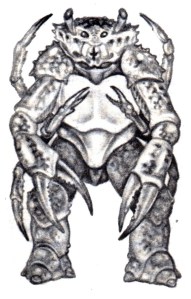
• From Monsters and Manuals, via Sir Grognard, and I thought I’d take it up since I’m passing half an hour before I go out clubbing (to Slimelight in fact). Can I conjure 10? Let’s see:

    1. Dragons, not the pissy way they’re laid out in AD&D like big fire-breathing lizards, but the God-like beasts of yore, the ones you see in A Wizard of Earthsea. I have only ever had one as an adversary in my campaigns, it was 100′ long and roared into the characters’ castle from nowhere. By the time they killed it it had torn their skyship apart, knocked off half their castle, and even the Hungarian Fire Lances they used (which can knock down a building at 50 yards) just dented it; it slaughtered half of  them in the battle, and even after they “killed” it, it mesmerised one of them when he approached the dying corpse, and the other characters had  to take him out as well. Rolemaster dragons are the coolest I have seen in an official system – I can’t imagine a party powerful enough to actually take on fully grown one.
    2. Orcs, because they are the quintessential swarming, nasty adversary and they’re fun for a large part of the early parts of one’s campaign. How would we get fulfilll our secret genocidal wishes without this race of evil-by-birth losers to wipe out at every turn?
    3. Trolls, because they really are a lot more trouble than they should be with the regeneration thing, and in Rolemaster they were actually really scary.
    4. Vampires, and all other forms of magic-using super-Undead, because they make excellent NPCs and really dangerous adversaries.
    5. Spectres, because ghosts are stupid but Spectres aren’t. In fact I am a big fan in general of Undead, which  you can always pile a fresh new supernatural ability on, and which are preternaturally tough on account of not feeling fear and not being stunnable. In Rolemaster the more powerful Undead are also very very dangerous, having fear and magic and a plethora of special nasty attacks.
    6. Demons and Devils, either of the looks-human-but-isn’t or the massive-scaled-bastard ilk, because they are literally the quintessence of evil, and that’s good
    7. The Huron, who are the current bogeyman in my Compromise and Conceit campaign, and even though the PCs haven’t fought any yet, they live in fear of the time they do.
    8. Githyanki, a kind of silver-sword wielding exceptionally xenophobic straight-edge punk from Beyond Hell. That’s likeable!
    9. Giant Spiders, because they are excellent to describe (how can they not be scary?) and if you are ever in doubt for a bad monster to use, you can choose one of these and just adapt the size.
    10. NPCS, who always seem to be the most powerful adversaries. They can be as powerful as you like, they always seem to get away to fight another day, and all players hate it when you backstab them they way they are used to backstabbing others. Oh the sweet, sweet pleasure!

    But unlike the other websites mentioned above, I’m  not a big fan of mind flayers. They have their place, sure, but physically are really weak (just as well!) and look stupid and kind of unbelievable. But they do eat brains, which is a plus. And in Baldur’s Gate they were real trouble.

    Maybe I should make a list of my 10 least-favourite monsters…

  • Over at Grognardia, Sir Grognard had a long-standing objection to the Thief character class, primarily on the basis that it takes a single character out of play for a short time and leaves the other players twiddling their thumbs[1], and he slates this as the cause of the ultimate play-wrecker, the Cyberspace hacker character, which basically has its own little side-adventures in astral space every couple of sessions. Sir Grognard’s objection and his willingness to blame subsequent RPG developments like the hacker on the Thief seem to rest heavily on his critical attitude towards the inclusion of anything resembling a skill system in the rules.

    Over at SOB, Chad Perrin has a brief discussion of a common point presented in favour of 4e by its defenders: that combat is quicker than 3rd edition, and “we can have more than one combat per session”. I agree with Chad that combat is not quicker in 4e, but I think part of the reason that 3rd edition games only had one combat per session is that the 3rd edition skill system was rich and detailed, and provided DMs and players alike with a wide range of opportunities to do many non-combat things. This inevitably leads to more varied adventuring and as a consequence less combat. Of course, at times the skill system gets bogged down in its own complexity (it has many idiosyncracies) but this is not the main cause of its time-eating properties. D&D 3rd edition had less combat per session because it encouraged other activities.

    Now, I think I anticipate Sir Grognard arguing that this is not better, because any skill system adds a layer of abstractness to the actions one performs, and makes them less fun. I think I have read him argue,  for example, that traps should be disabled by players working out a solution based on what they see, social interaction should depend on interactions between players and DM, etc. But the problem with this in practice is that it relies too much on the DM and players’ imagination[3]. Consider, for example, the trap. In order for a trap to be a fun challenge in the Grognard vein, it requires that a) the DM be able to design it creatively and coherently, b) the DM be able to describe it in a way that the players understand, and be able to develop hints they are likely to get, and c) that the players aren’t stupid[4]. The less said about c) the better, but I can’t build or design anything myself and any trap I designed would be completely shite, so a) is out of the window, and though I’m good at b) it can be very tricky to do in general. In these instances, abstraction enables DMs to set a rich range of non-combat challenges which the players are guaranteed to be able to interact with, and as a consequence DMs put in more challenges of this sort. The abstraction makes them slightly less endearing, I supppose, but if one is going to rest on this argument, I feel a need to point out that Grognards everywhere will cheerfully defend OD&D’s combat system, in which the hit roll doesn’t actually represent a single attack, but a full minute of dodging and feinting and taking tea with the neighbours.

    Consider the full range of activities which a 3rd edition party can undertake at will: setting and removing traps, tracking things, interacting with strangers the DM hasn’t come up with a coherent plot for, spotting hidden bastards, hiding and stalking, understanding local lore, climbing walls, and more esoteric things like analysing battles to see who will win, etc. This diversity of skills means that the players can suggest actions to the DM which he didn’t expect, setting new directions to the adventure, circumventing big challenges, etc. It also means that in a pinch the DM can come up with new challenges without having to fear being uncreative on the spot, and can set multiple different adventure directions which are chosen by a roll of the dice (e.g. if the Thief can open the door they get in easily, otherwise they have to visit the sly witch, etc.) [5]

    Skill use also gives a framework for the resolution of non-combat actions which enables DMs to pull off plot hooks and force players in a certain direction without looking like they are using DM Fiat. This is a good thing. I think all of these elements of skill use appealed to a lot of players around the time 3e was released,  which is why systems like world of darkness, Ars Magic etc. were starting to take off. Rolemaster has a terribly complex combat system but its skill system kept me away from AD&D until I discovered the 3e. I think D&D has always been a bit cannibalistic, taking ideas from other places, and they did this in 3e too. In fact they did it so well that the d20 system became the monolith of  the gaming world.

    Of course, 4e is ripping off the computer game world, and as a consequence it is going to be skill lite. Certainly the two sessions I played only used two skills, stealth and perception (from memory) and everything else was just slaughter. I think that some people defending 4e like this, because although they enjoyed the skill-use aspects of 3e, they mostly just love killin’ shit. I certainly have had players throughout my DMing life who essentially sit out the conversations, the complex problem-solving and the political interaction, and only get interested when the blood starts flowing. For these people 4e is a better balance of combat and skill-use; but for me, based on my limited experience of 4e (and my long experience of AD&D), a slightly abstract skill system with a good engine and a good framework within which DMs can make judgements is the key to a diverse and interesting gaming experience.

    [1] I reference no particular post in support of this claim, and my apologies if my interpretation of the justification is wrong.

    [2] I think Sir Grognard is right about the play-wrecking properties of the hacker, but wrong to say the hacker itself is a bad character: it’s essential to the cyberspace milieu and the cyberspace milieu is a good place to play. I also don’t think the hacker’s problems can be slated home to the AD&D Thief either.

    [3] I know that sounds really bad, but it’s true. Every DM has had an experience where the players can’t quite get into the adventure because they can’t see things his or her way, or they think something is unrealistic, or the idea he or she thought was clever on paper on Sunday doesn’t work in practice. Everyone’s imagination is limited, which is part of the reason why so many role-playing adventures consist entirely of fightin’ and lootin’. Giving people an imagination-lite way of diversfying their activities seems to me to be a good thing.

    [4] I would add too that when they aren’t being stupid, players tend to spend a lot of time being argumentative, and the Trap is the classic example  of this. Before you know it, some prat who couldn’t write an adventure if he had a module beside him is telling you that your  cunningly thought-out trap would never work because of blah blah blah and couldn’t we just do blah which is what the prat in question wanted to do all along, i.e. he didn’t get your hint so he blames you.

    [5] I would add that this happens a lot, where the cunningly laid plan a DM set is completely wrecked by creative skill use, and in my view that is a good thing.

  • A while ago I mentioned that I used to like skill systems which incorporate partial success/ partial failure, but now I am not so enamoured of them. Since I wrote that I had to rejig my magic system slightly, because I had configured it to be a little too easy. As my magic system was constructed, every spell came with a casting DC. Beating the DC meant that the caster cast the spell with no fatigue, and the degree of success determined by the amount over the target DC which the player rolled, subject to some maximum (which partially determined the spell DC). Failure to beat the DC meant the spell was cast, but the caster suffered fatigue; in some cases the spell fails and in all cases, the save DC of the spell is the player’s roll.

    The problem with this system is that one of the characters in my system has the spell Grendel’s Demise which rips off a target’s arm; and another has The Angel of Death, which just slaughters everyone in sight. With no risk of not being able to cast the spell, these characters get to basically try and kill one monster every round, at risk of a mere fatigue.

    So I introduced a new rule for failures: if the player rolled lower than [casting DC – level] the spell automatically failed, and the character suffered fatigue. Grendel’s Demise has a spell DC of 23 and the characters are 5th level, so any roll of 18 or less means the spell completely fails. As the characters gain levels, the risk of complete failure decreases. This means I can continue to give low level characters very dangerous spells, knowing that they won’t use them unless they’re really desperate, until they’re high enough level to guarantee success.

    But this new system introduces partial failure into the system. Given that the system already allows for partial success, this means I have essentially reproduced the Rolemaster skill paradigm (minus a lot of categories and tables of course).

    Consider, for example, a 5th level wizard with magic skill of 8, casting a 4th level spell (casting DC 19) which stuns the opponent for 1 round per point of success. Partial success with this system is always possible; for example, if the caster rolls 19 the spell is cast with no fatigue, and the victim has to roll over 19 on a saving throw or is stunned for 1 rd per point of failure. Partial failure occurs on rolls of 14-19; in this instance, the target still has to roll to save,  but the roll is easier, so there will be less rounds of stun (on average) and the caster takes a fatigue. On rolls less than 14 there is complete failure – caster incurs fatigue, spell never happens, victim never notices.

    At first I thought that this would only apply to magic but now I realise it can be applied across the entire skill system. Consider, for example, a 3rd level thief on a rooftop who decides to do a sneak attack by dropping off the roof onto a passing guard. Adjudicate this attack thus: the rooftop attack could give a maximum +2 damage, so the DC is 19 (15+2*maximum effect is my current guideline). The actual effect is determined by the player’s acrobatics roll minus the DC, with a maximum of +2. On rolls of 16-19 the character can still attack but is judged to have landed badly and attacks at a penalty equal to [DC – roll]. Anything less than 16 and the character takes damage and loses the attack.

    Note also that under this system the maximum penalty a character can take is limited by their level, which makes me think that levels can also serve to put a limit on the maximum benefit a character can gain (and thus also the maximum DC they ever have to beat). This ties the skill system and the levels together more tightly than just allowing levels to determine skill points. In my system this means that a character’s development, saving throws, skills and actual DCs are all joined together through the skill system and the level system.

    Unification baby!

    And note that none of this is incompatible with D&D3.5 or Pathfinder or whatever. This is another example of how, I think, the D20 skill system is a really natural and flexible way to resolve all the actions which characters face. You really don’t need anything except skill points and levels!

  • Anyone who knows anything about me knows that I don’t like theatre much, though I do go to see a play on the odd occasion (approximately every 2 years). Generally theatre is like bad television, in my opinion, only confronting. However, when it’s good, theatre is just great. So it was with the play Shunkin, which is produced by the complicite company and is somehow related to some stories by Junichiro Tanizaki, who incidentally wrote the essay “In Praise of Shadows”. This essay is said to have particular relevance to the area of Japan where I lived, which is called the “Shadow of the Mountains Coast” and is meant to have a more shadowy feel about it. But I digress…

    Shunkin is a play about a blind rich woman in 19th century Japan, who takes her servant as a lover and proceeds to treat him very sadistically. Her servant is a masochist so he loves it, and the play is about how their love develops and how their life proceeds. The lead character, Shunkin, is mostly played by a doll, but the doll is led around the stage by a famous Japanese actress, Eri Fukatsu (I think),  who does the voice and movements of the doll brilliantly. The set is also populated by mysterious crew in black, who move the props around in a very inobtrusive but effective manner to produce, using just some sticks and pieces of paper, various cunning effects : swaying overhanging tree branches, sliding doors, gravestones, a fragmented screen on which Shunkin’s face is projected, and nightingales amongst other things. Sometimes the doll swaps for a human actress and one doesn’t even notice, and the stage slips between light and darkness with brilliant effect. The stage is always populated with very simple objects – sticks, paper and tatami mats mostly, and very little else. The scenes flick  between 20th century Japan and the Meiji era, with the narration alternating between a woman in the modern era and the voice of Shunkin’s servant, and the voice of Tanizaki himself. This has the eery effect of linking the eras of the servant’s youth, his dotage and modern Japan in a kind of mutually critical framework – so Tanizaki criticises modern aesthetics, the aging servant criticises his young self, and the female narrator in the modern era criticises her lover and adjusts her own life in light of what she reads and sees.

    This play also uses silence and simple sounds in a way which in my opinion is characteristic of the Japanese aesthetic of simplicity. When shoji screens slide back, it’s like a mime reinforced by the movmeent of a single stick, and the sound of someone breathing out; there is occasional careful use of silence, just as we are used to seeing in modern anime like Nausicaa and Akira. Simple sounds and tones, and the use of light and fragmentary images, combine to produce ghostly and highly emotive effects.

    The story itself is simple, cruel and engaging, though it takes a bit of time to adapt to the frequent shifts of perspective and the various narrative voices. The ending was breathtakingly beautiful, as well as unexpected, and contains a simple message (not necessarily good) about what people will do for love, and its cruel power.

    Also there is doll sex.

    I strongly recommend seeing this play, and I will be keeping an eye out for other works by this theatre group: Complicite, make a note of it!

  • My post on how I don’t like 4th edition D&D (apparently I mustn’t call it AD&D anymore!) was reddited a few months back and has received 4 comments, the last of which claims that I don’t know what I’m talking about because “There’s no Orc race in 4e”. Now, this is very hard for me to believe because Orcs are the meat and drink of D&D (how else would we get our genocidal mojo on?), and if there were no Orc race there would be 6 million generations of pissed off D&D fans (can you imagine the emo-style whingeing that would evoke?)

    But more importantly, I was there and I played it and there were Orcs. Now I don’t recall if they were officially Orcs or not but I definitely played one – and then I definitely slew some. That was the whole point of the two sessions I played. I have references, dammit (but they’re mad, and Scottish, so I don’t want to actually use them, so don’t ask for them). I don’t know for sure if the game I played was part of an official module or not (I get a sense it might have been but I wasn’t the DM so I don’t know).

    But here’s the weirdness – I google 4e Orc and I can’t find much info, when I do a search on the D&D website I don’t get any 4e info (but then, there doesn’t seem to be any 4e info on the website, it’s all legacy stuff), but I do find references to half-Orcs.  You can’t get a half-Orc without the assistance of an Orc (yuck). But on DeviantArt there are pictures of 4e Orcs selling for 200 pounds. So what gives – do they exist or not?

    And if there are no Orcs, is D&D still D&D? What do 1st level characters cut their teeth on?

    It’s still boring though…

  • This man knows how to ride
    This man knows how to ride

    This review is completely free of spoilers. I went to see the Korean movie The Good The Bad The Weird last night, it was completely Feng Shui (ish). It’s a Korean cowboy movie set in 30s Manchuria, with big elements of Hard Boiled built in and no martial arts. This is refreshing – don’t get me wrong, I love a good martial arts movie, but a Korean cowboy movie is (to me at least) completely novel. And the Chinese desert is really really impressive. As, incidentally, is the star who played “the bad”, Lee Byung-Hun (pictured above).

    The basic premise of this movie is that there is a map, and it points to some treasure (of course), and there are a couple of bandits and a bounty hunter after it, as well as a couple of bandit gangs and the Japanese army. There is a nationalist tone to the efforts of some of the bandits (what is it about Eastern bandits being nationalist?) and of course a tiny bit of hating on the Chinese and the  Japanese (is this de rigeur for Koreans?) But it’s soooo much fun. A classic combination of slapstick, confusion, crazy shootin’, hyper-cool East Asian fashion, and train robbery. The map passes from hand to hand, secrets are revealed, many people die in very stupid ways, and the jokes fly thick and fast. In the end of course nothing turns out how you expect, and on at least 88 different occasions you get confused about who wants the map, what they are doing and why. But it’s a lot of fun! I strongly recommend it.

    Also the soundtrack rocks.

  • A few months ago I had a weird run-in with a DM, which I blogged about, most annoying it was too. It happened in a pub in South London, so I never went back to the group that plays there.

    Since then I have had two more moments of trouble at the role-playing club where I play, and I have been forced to conclude that while meeting role-players in a pub is a really good way to avoid having arseholes come to your house, it’s a really good way to meet arseholes. It would also appear that role-playing is going through a bit of a renaissance in London at the moment – our club has become so busy that they’ve had to split over multiple nights, and it is still really really noisy, with maybe 30 people upstairs in the venue (which has no aircon, and in winter has all the windows closed… hmmm, stuffy role-player-boy smells…)

    If you can imagine the scenario of 30 people yelling for attention, while drunk, in a stuffy room, and then throw into the mix a really frustrating player who can’t pay attention, doesn’t ever remember any names or details, continually texts his mates on his phone, and interrupts every description or conversation to talk about something that happened 5 minutes ago (which he genuinely seems to think is still happening) you can well imagine that playing was getting frustrating. So last week we cut loose the frustrating player, and decided to move to someone’s house. Last night we played, it was quiet and calm and pleasant, and it was soooooooo fun.

    I’ve got a real role-playing group back! It’s great!!!

  • This is another off-topic rant which I’m going to cross-post with my other blog, because I’m a grump after watching a fortnight of insane british racism. The Guardian is the UK’s supposedly intellectual, left-wing newspaper, ostensibly well-respected internationally for its quality. Unfortunately it is in reality a propaganda organ for the labour party (who are currently in power), which is probably the world’s most illiberal left-wing party, and is best characterised by its being the only left-wing party in government to join the Iraq war. Need we say more? I suppose we could excuse them for being spineless lickspittles and quislings, but if that’s their defense against allegations of racist mendacity, well, they can use it as much as they like.

    I’ve been watching the Guardian defending racist language, standing by anti-foreign strikers, and supporting the government’s open racism (in the form of the slogan “British Jobs for British Workers”) and feeling my ire slowly rise for a week, but the straw that broke the camel’s back is this piece of unmitigated shite – disguised as opinion, by a supposed academic – which tries to lay the blame for all anti-semitism in Asia at the feet of the Japanese. The Japanese! Who, let’s not forget, rescued Jews through their German embassy in world war 2, even though Germany was their  ally.

    Now, I have tried to give this “academic” the benefit of the doubt but I find only one fact in his whole article which isn’t straight from Wikipedia, but the breadth and scope of his assertions leaves me stunned. For someone who has studied the orient, he shows two types of nasty racism which really, really annoy me: first, he wants desperately to smear Japan specifically; and second, he sees the entire rest of Asia as in their thrall.

    First, to Japan, which he claims has long been anti-semitic based on citations of books which coincidentally all appear in this wikipedia article labelled as “tondemo bon” (outrageous or dodgy books)[1]. He expects us to believe further that this anti-semitism – which is apparently confined to a bunch of phantasmagorical fringe texts – was exported all through Asia. He sites one book from China, and then proceeds to mention that Malaysia – a majority muslim country – also has anti-semitism. His support for this claim? Statements by the ex-Prime Minister. So Japan is the well-spring of anti-semitism in Asia, as proven by a few dodgy fringe books, while Malaysia “are not immune” even though their PM was publicly anti-semitic. This weak phrase suggests contagion from abroad, which seems a little topsy-turvy when one considers the relative importance of the media through which this anti-semitism is expressed in the two countries. But did our hero stop to consider this? No, he didn’t, he certainly didn’t. Japan, you see, is our misfortune. Sound like a familiar trope?

    Our worthy scholar then proceeds to the usual claims about Japan – that it is a closed society with a short history of democracy, and so vulnerable to conspiracy theories. Of course, Japan introduced male suffrage in the Meiji restoration, 150 years ago, so its history of democracy is no worse than many other countries, and the “closed society” claim is just the usual ignorant rubbish. Perhaps not unusually, our noble inquirer then proceeds to link anti-semitism to anti-colonialism [2], which rather contradicts the implication that Japan is the well-spring of Asian anti-semitism, since it was never colonised (though Malaysia was…)

    I’m sure I could write a piece of software which can assemble 3 or 4 stereotypes about Japan into a single paragraph, and then use them to justify any racist claim you want to make. Why employ shonky academics to do it when you can just do it with dice and a couple of slips of paper?

    Buruma’s other piece of racism, though, seems to me much nastier. His claim that Japan is the well-spring of anti-semitism in the region depends on the assumption that all the other Asian nations are weak, easily influenced and vulnerable to superior western ideals. Which claim, incidentally, relies on some sort of view of the Japanese as super-human politically and culturally[3]. But more importantly it relies on the idea that these societies are not capable of self-determination. Witness, for example, the breathtaking claim that The Chinese picked up many modern western ideas from the Japanese. Now, correct me if I’m wrong, but I recall the Chinese taking a somewhat different path to the Japanese in the ’30s, through this chap Mao and this idea “communism” which he definitely didn’t get from an itinerant Shinto monk. And you know, I think China might have a 1000 year long association with the West through this thing called “the Silk Road”. They might have some independent ability to get ideas there, including anti-semitism, if they want it. Which they probably don’t, Buruma’s entire evidence being the claim that an anti-semitic book is selling well and even read by members of the government. The Chinese Governments’ reading patterns are well known on account of its high level of public accountability, you see.

    But this claim is obviously made about those nations – Malaysia, the Phillipines – which are generally viewed as less sophisticated. They’re not, of course, but ranking them according to their similarity to western ideals is the classic stance of the cheap orientalist. This is slipshod academic work, and sloppy journalism to publish it. But it suits two combined tasks that the Guardian has to cope with. On the one hand, they have to fight off the hordes of right-wing Israel supporters who claim their coverage of the war in Gaza is anti-semitic, which defense they mount by regularly running critiques of anti-semitism; and on the other hand they have to remind themselves that yes, the British did win the war, and the Japanese are sub-human. Which they do by regularly running articles which assemble as many nasty stereotypes as possible, with the express purpose of reminding the reader of how awful those Japanese are. The final conclusion is irrelevant – it’s the body, where the gentle reader is reminded that Japanese are inscrutable aliens with great powers, that is the important bit. And if that tactic sounds familiar to you, there’s a reason…

    So, this week, I have concluded that the Guardian is racist. Don’t even get me started on the Daily Mail!

    [1] The only fact he changes from the wikipedia article is the date of translation of the Protocols of the Elders of Zion into Japanese, which he claimed occurred in 1905 (two years after they were “discovered” during the war with Russia), while the wiki claims the translation at 1936. Tel Aviv University puts it at 1924. Obviously a true scholar! Japan was so anti-semitic that it only translated the text of the chief anti-semitic coda 21 years after its original publication, and only because some soldiers stumbled on it and brought it home. Imagine if the Nazis had been as anti-semitic as the Japanese!

    [2] a fine trope, incidentally, for right-wingers who want to tar all national liberation movements with the same brush. I’m surprised he didn’t fit a critique of Mao and Ho Chi Minh in there somewhere.

    [3] projection much?

  • According to this awesomely stupid article in the New Zealand 3 news, I may have a methamphetamine addiction – apparently being into Dungeons and Dragons and “other violent stuff” is the big giveaway.

    So before I continue planning for next week’s campaign, I’m just gonna go smoke some “P”, and hack up a baby or two. Any of you role-players want to join me?

  • Being a brief guide to the peoples and concerns of the New World, prepared for the discerning reader of The Ladies Illustrated Quarterly by M Scott Momaday, whose recent novel The Last of the Mohicans, though not in any wise a truthful account of matters Indian, is humbly presented in serialized form in this same publication, for the edification and pleasure of Good Christian Ladies, from this Quarter.

    The Fulfiller: Delaware war-chieftain, based on the Western edge of Delaware land, near the French, in Southern Ohio. Fought with the British against the French in the French and Indian War, but his prime interest is to secure land for the Delaware.

    Captain Pipe: Delaware war-chieftain, based Further North in Ohio

    Who would not help this man?
    Who would not help this man?

    Magua: Renegade Huron of the Mohawks, has moved South with his tribe in rejection of Huron deals with the French. His treachery against the British in the French and Indian war completed, the British are none the wiser about him and he has returned to deal with them again. A brutal savage possessed only of dark dreams and motives.

    The Imposter: A mad Delaware prophet, sadly much loved of the Delaware themselves, who advocates renunciation of French and English goods and Infernalism, and a return to traditional values. Has had some success in convincing the Delaware to negotiate rules of trade with the British, but is neither respected nor feared by any British counsel.

    Leaning wood: Cherokee Principal Chief, who has traveled to England and met His Highness King George V. Continually puts on airs for himself, and treats himself as a King when his British contemporaries see him as little more than a court jester. A sad figure.

    Half King: An Iroquois tribal leader called the Half-King by the British, fought alongside George Washington at the Battle of Monongahela. Rumoured to have killed the French Ensign Joseph Coulon de Jumonville by taking out his brains and washing his hands with them while saying “Thou are not dead yet, my father” in French. Much hated by the French.