• Having learnt all they can from la Belle Dame sans Merci about the sinister plans of the various factions involved in the New World – and perhaps learnt of a few new factions besides – our heroes find themselves on the horns of a familiar dilemma: who should they slaughter next?

    Knowing as they did that there was much evidence to implicate Washington and his ilk in schemes most sinister, some of the group were all for a return to Albany, thereupon to raid the offices of the Northwest Frontier Company and, hopefully, uncover evidence of everyone’s treachery. Others were in favour of capturing the ship which had been sent to rescue la Belle Dame sans Merci, for surely therein would be found yet more incriminating evidence linking the French to Washington and Madame Custis. After debate had ranged far and wide over many topics, and no decisions had been made, our heroes settled on their usual solution to all such quandaries – they decided to head for the closest enemies, and kill them all.

    Thus they found themselves on a windswept beach, where la Belle Dame sans Merci had been intended to be collected by her French saviours. They could see the ship approaching, its glittering lights sweeping in fast over the dark waters. With barely a moments’ indecision they came to a rapid decision to gain access to the ship by subterfuge rather than violence. Rendering la Belle Dame sans Merci unconscious with a swift spell, they garbed themselves in the clothes of her now dead guards, and Anna Labrousse disguised herself as their leader. They waited for la Belle Dame’s rescuers, ready to bluff their way onto the ship.

    The ship swept to a halt some hundred yards out from shore, and soon 2 rowing boats swept in on the breakers. As they neared shore a single massive armoured form leapt down from each longboat and hauled it through the surf to the shore. Barely used to Myrmidons, the characters were shocked to discover that their French adversaries also possessed a kind of hugely infernally enhanced body armour, like a carapace, which could move through water with the facility of a crab, and which could haul massive weights. Within that Myrmidon-like shell a French elite commando waited to tear them limb from limb. And from each boat emerged 8 more men, carrying rifles and lightly armoured in the fashion of French marines. Had our heroes prepared a frontal assault they would by now be just wasted flesh and bloody spindrift.

    Fortunately, however, the characters were in disguise. There on the windswept and desolate beach they soon talked their way aboard ship, claiming to be la Belle Dame sans Merci’s protectors, and no way were they going to leave their injured charge now, dammit! And so they found themselves taken as passengers to their target, the ship Unfortunate Lapse of Discipline, which was aptly named indeed considering their means of egress.

    An Unfortunate Lapse Indeed...
    An Unfortunate Lapse Indeed…

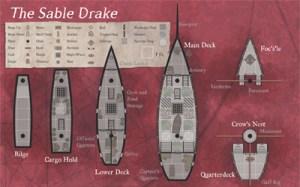
    Once aboard, the characters waited for their hosts to shuck their host armour and head below, secured la Belle Dame sans Merci’s inert body, and then set about another fine round of slaughter. Waiting until the majority of the soldiers were below, they sealed the entrance to the hold and cast a spell to paralyse the soldiers on deck. Their followed a vicious battle, in which the characters had to force their way below decks against the mass gunfire of the marines, take on the Captain, and were ultimately charged from behind by a group of enterprising marines who had used grappling hooks to escape the slaughter belowdecks. Dave Black was nearly killed in this last rousing charge, but the characters prevailed and at the end of a good couple of minutes’ hard work stood atop the blood-slicked decks of their new possession, the light Corvette Unfortunate Lapse of Discipline, her dead complement of marines, her two cannon, her (living, and cowed) crew, and all the secret plots which she contained.

    All that remained was a decision on what to do with her…

  • I have seen two presentations in the last week in which the William Gibson quote “The future is already here, it’s just not evenly distributed” has been used. This elevates it, in my view, to the level of a fly-blown cliche. I’m now officially starting a game of Cyberpunk Bingo. When I get four of these events in a row, I get to cry “FUUUUCK!” and murder the speaker with my cybernetically enhanced skull-gun, and you guys (if you exist) have to arrange my legal defense. I am going to claim diminished responsibility. I think it’s reasonable.

  • Much joking has been occurring among those playing the Feng Shui future of 2056, where the world is ruled by the ruthlessly benevolent “Architects of the Flesh” about how much it looks like London now. In short:

    • excessive amounts of money are spent on rent
    • the food is grey and tasteless
    • police violence is the norm
    • mindless consumption is heavily encouraged
    • everyone wears the same clothes
    • the transport system is hideously overcrowded
    • everyone is paid crap, even though anything nice is really expensive
    • There is omnipresent cctv

    The Feng Shui authors were fond of attaching numbers to their dystopic world. But I bet if you challenged them to tell you how many cctv camers were present in the entire world in 2056, they would still underestimate the number in London now. All that remains is to have the current government ban cars and introduce a legal limit on maximum wages, and we’re there. Although the real limit in Feng Shui –  about 1 million pounds by my calculations – is more than anyone in England can ever hope to earn, so it’s the same difference really.

    Anyway, this led me to think that perhaps the authors of Feng Shui were dyed-in-the-wool social democrats, and their vision of a dystopia was therefore a vision of what happens when social democracy goes horribly wrong. An illiberal version of social democracy, if you like. They just didn’t realise that a year later Tony Blair would take their future world as a manifesto for change…

  • Goddamn! The things one has to do just to get an argument these days!

    This is a response to my friend’s response to my previous post about Feng Shui’s 2056 dystopia. In essence, Paul objects to everything I say on principle, which makes it easy to argue with him. I just need to disagree with every sentence line by line. I’m cross-posting as well as commenting on his blog, because arguing is fun and dystopias are fun. All indents are Paul’s arguments, everything else is my response. I’ve indented for clarity, and so I can italicise lots of wanky references to George Orwell. Fuck, it makes me feel like a Decent. Quick! Invade Sri Lanka!

    I’m going to take what the book says at face value

    …. why would anyone do that? Kind of kills my review right there doesn’t it? so we’ll just pass right by that…

    the central argument Stuart is advancing is that dystopian (and utopian) settings give us an insight into the writer’s politics

    and yes, criticism of those settings also gives an insight into the reviewer. This is not a shock. But if anyone wants to read 1984, Brave New World, The Dispossessed and any of those weird anarchist tracts from the 19th century as anything but transparent screeds, they’re really pushing it[1]. In fact, we know they’re pushing it because everyone who ever wrote a utopia or a dystopia has identified their political reasons for so doing, and then gone on to write about it (or, in Orwell’s case, gone to war for it). That should count as a bit of a hint.

    I assume that all factions in the game are meant to have some attractive angle to view them from

    This has got to be arguing for the sake of it, right? We are talking about role-playing here, a sordid little corner of the world whose central  focus for the last 30 years has been developing worlds where the bad guys are so relentlessly and completely evil that you are morally justified in exterminating their entire race. The only games which don’t do that have tended to be based on morally grey novels. There is no sense in taking “the benefit of the doubt” as your point of departure for rpg criticism because chances are that the kung fu game you are playing – you know, the one where you are self-consciously playing a good superhero in battle with the supervillains – isn’t planning on showing any uncertainty about the moral fibre of its participants.

    In short, there is no reason to assume that 2056 under the Architects is anything but the Mordor of our world. They stole my god (and my virginity, to boot![2]) so they could destroy the world. They’re made of poison, folks. Also, they’re called “the Architects of the Flesh”. I recommend taking this as a hint that you don’t want them shagging your sister.

    Given this, I think it’s reasonable to assume that this world is designed and presented as a dystopia.

    But everyone gets enough food. This is morally ambiguous because the setting also has hunger wiped out from the world, at the cost of food that makes McDonalds look tasty. Because of this, the food is a subverted utopian element, not a dystopian one.

    Despite living in one, I’m no expert on dystopias, but I don’t think they are intended to be the same as “untopias” (or whatever). I think they are meant to represent a world corrupted by good intentions, which is why no-one in 1984 goes without food, and everyone in Soylent Green is happy. So a world you look at and don’t like, full of subverted utopian elements, is a dystopia. (This is why a lot of people refer to The Dispossessed as an anarchist dystopia).

    The reason I saw in it [here Paul refers to the wierd 40x wage differential] was to contrast the gleaming ideals of the future (reasonable wage restraint) with the actual implementation (all the good stuff is still owned by elites). Again a utopian element is presented and then subverted.

    I’m thinking of coming back to this on my blog, because it occurs to me now that if a bunch of hard-core (hah!) social democrats living in 1996 wanted to imagine a dystopia caused by social democracy gone wrong they could well have written this Feng Shui world. Alternatively, they could have waited until 1997, voted for Tony Blair, and sat back to enjoy the ride…

    This assumes that a dystopia must be written as if everything is bad.

    I think more one assumes that a dystopia is written as if everything is failed. The central tenet of good dystopian writing is that the human traits of the characters give hope for the future (which should be crushed, obviously) despite the huge power advantages of the world they are in. Hence Vincent finds true love (briefly), Shevek and Takver struggle to reclaim the revolution, etc. Part of the beauty of The Dispossessed, and the reason it is a genuinely “morally grey” dystopia (if it is a dystopia at all) is that Shevek and Takver do offer hope to reclaim the revolution at the end, in a triumph of human will (and love!) over systemic oppression. So adding a few elements of playability doesn’t render something dystopian[3]. Having a social system based on good intentions gone horribly wrong does, however.

    By default it would [here Paul means it would be reasonable to assume that a dystopia represents a writer’s views, except that…] any reasonable amount of work will allow an author to drown their bias in the appropriate biases for other political views – unless you want to argue that a social democrat is totally incapable of writing 1984?

    I’m going to go out on a limb here and say that a Social Democrat did write 1984. We’re talking here  about a man who cashed in his commie mates to MI5 (with quite nasty comments about their intellect too) yet wrote a very nasty book about pre-war Imperialism (Burmese Days, where the protagonist passes the moral event horizon at the end of the book by literally kicking the dog), as well as a viciously bitter attack on communism (Homage to Catalonia) whose final chapter is a clear intimation of 1984’s genesis. He is a hero of the so-called Decent Left. I don’t think we need to assume he was anything else, even if he briefly flirted with anarchism in the 30s[5].

    The scenarios you call dystopian contain a summary of your political views.
    Certainly. If I say something is dystopic and you disagree, we might as well be arguing about politics. But there are some clear signals of dystopian writing, tropes if you will, and “grey food”, “no cars” and an all-powerful time-travelling government who want to control your thoughts are usually a big giveaway. Also, yes, when I claim London looks like a dystopia, I am making a claim which reflects my politics. I am, in effect, writing a text (shudder) and by inferring my politics/morality from that text you are engaging in literary criticism (though I don’t think either of us are being post-modern here except in the cliched sense).

    Regarding London, we can safely assume that the govt doesn’t intend to create a dystopia. It’s their failed “good intentions” which make it so. My labelling it so enables you to (rightly) infer things about me politically – that I dislike high rents, police violence and cctv would be a good guess, because that’s what people generally criticise about this government. Alternatively you could infer I spend a lot of money at cheap brothels.

    But if you did either you would be critiquing the text and before you know it, you’ll be having post-modern gay abortions, and snorting cocaine from baby’s bottoms. Also, you would be conceding my argument – unless you want to argue that FS 2056 has any good points strong enough to redeem it from the claim it is dystopic?

    PS I really really ought to look up the definition of dystopia. But I don’t think that’s going to get us anywhere, is it?

    fn 1: I have an excellent one about pirates, btw.

    fn 2:  Not that it was doing me any good at the time

    fn 3: consider The Culture, who you can’t help but sympathise with, and who are clearly a good place to live, but who also seem somehow fundamentally rotten[4]. And the process of viewing them as rotten – inevitable for most readers – is, I think, intended to cause one to question one’s own assumptions about how the world could be. This makes the Culture a morally ambiguous dystopia in a really subtle way. I think Iain Banks has written about this aspect of the dystopia himself.

    fn 4: Interestingly, Iain Banks is a strong opponent of the Iraq war, even though The Culture are the apotheosis of Decent Liberalism.

    fn 5: which at the time didn’t count for much anyway. Social Democratic unions were pro-anarchist until the Central Committee called them off (a central criticism of the Stalinists in homage to catalonia), and if that’s not enough proof: my Grandfather fought for the POUM, but voted Thatcher 40 years later.

  • I am not a big fan of Pixar productions, for the prime and simple reason that, like most western cartoons, and particularly like their Masters at Disney, they are overbearingly misogynist. Well, not as much as Disney itself, which I contend employs a misogynator, a special staff member whose job is running around the creative department butchering any scene or plot which threatens to represent women in a good light. But Pixar comes a close second, ensuring that, for example, in Monsters Inc the only female characters are a jealous clingy bimbo or an old hag. Their stories are also transparently boys-own-adventures, not aimed at or even thinking about potential girl viewers. For one or two movies this is bearable, but when you start to see the pattern, it becomes a real turn-off. Particularly compared to Studio Ghibli.

    This is not true for Dreamworks, though I grant you I’m not that familiar with their work and Antz was certainly a shocking piece of (how come woody allen gets to do nothing but whine and squeal, and then gets credit for everything at the end?) But Shrek ran a very fine line in girl-targeted viewing, as well as being an excellent adventure and really funny. Monsters vs. Aliens is a similar type of movie, but with an even more transparently girl-power storyline, and applying the genre-bending fun-and-games of Shrek to science-fiction and horror movies.

    Genre-bending is of course an excellent way to make a childrens’ movie fun for adults, and this movie is no exception. I think it has a nod to every major sci-fi ever made, as well as some cool references to anime, old-school Japanese monster movies, and some b-grade horror references. I’m sure insectosaurus starts off as a weird insecty totoro, which is a perfect nod to Miyazaki’s most famous 2 movies. There are also visual moments – such as when the lead character is hanging from the bottom of the alien ship – which are obviously nods to screen captures from famous movies. And the whole thing has a liberating feeling of empowerment and joy. The final message is even positive, which I can’t say I thought of the original Shrek movie[1]. The first half of this movie is unrelentingly funny, as well.

    My flatmate, who is a computer graphics researcher but doesn’t have his own blog (wtf omg) tells me that Pixar’s animation is slightly more sophisticated. Well, I don’t know much about animation, but I know what I like, and I prefer my animation to be at least 10% non-sexist, so I can’t bear Pixar anymore (and what was with the rat-in-the-soup movie anyway?) In any case, there were scenes in this movie which were art, sweety-dahling, even if they weren’t perfectly animated (not that I could have noticed, my eyes have a 3 fps limit). And the key to a good animation is not the animation, anyway, but the plot and the action sequences. This is why Castle of Cagliostro is better than Toy Story

    Anyway, having padded out this post with a whole series of obviously completely subjective comparisons of “A is better than B so nyaaaah I’m right!”[3], I should finish by recommending this movie highly. Go and see it, especially if you like sci-fi genre-bending.

    —-

    [1] Shrek claims to have a moral that even the ugliest person is beautiful to someone, but this isn’t strictly true. What it actually says is that if you are of the same race or class as another ugly person, they will find you pretty because they are cosmologically designed to, even if to everyone else you are a butt-ugly troll. The princess’s ugliness was an objective fact to the viewer, it just so happened that the lead character is not human, so has different standards. This isn’t quite as nasty an ending as the Breakfast Club[2], which has to be the most misinterpreted and deceitful ending in cinema.

    [2] which, how the fuck can anyone think this movie has a positive ending? Halfway through the movie the nerdy kid predicts that on monday everyone will go back to being themselves, and pretend the weekend never happened, which is exactly what happens, except that the gothy girl pulls the jock and so therefore throws away her gothiness, which was all just an act until she could get in with the popular crowd. This is treachery on so many levels, particularly because you’re led to believe that the nerdy kid was going to be wrong until the very end, when the writer sticks the knife in and twists.

    [3] It’s an internet movie review kids, what were you expecting, deconstructionist marxism?

  • Our DM (who is so old-fashioned he doesn’ t even have a blog) is drip-feeding us information about the Feng Shui world, so I can’t say too much about where we are or what we are doing, but our characters have ended up in 2056 in a strange future “dystopia” controlled by a bunch of transdimensional lunatics called the Architects of the Flesh. I suggested to the other players last night that this dystopia’s properties say a lot more about the politcs and insecurities of the authors than it does about the evils of the Architects of the Flesh. I originally thought that the properties of the 2056 dystopia marked out the writers as a bunch of libertarians, but now I’m not sure if they are right-wing or moderate liberal Americans. Here’s a list of the properties of the world in 2056 which are supposedly different from the world of 1996, and what political leanings I think they point to:

    • There are no cars: In 2056, cars have been banned “for environmental and health reasons”, which is a classic fear of libertarians and small govt right-wingers everywhere. First they imposed speed limits, then they took your cars, etc. Margaret Thatcher once made a beautiful comment about how every new car on the road was a new conservative voter, and followed it up with some nice observations about how the Tory party were trying to change peoples’ minds as well as the economy (look it up in Prospect magazine ). So this is a tick for “writers are crazed libertarians”. Even East Germany had private cars!
    • First they came for our guns…: In 2056, the Architects are trying to abolish the study of martial arts, having already banned all guns. This is a classic fear of libertarians everywhere, and the American right generally. Compare this dystopia with the classic cyberpunk dystopia, where everyone has access to guns. Obviously a choice was made in this regard. And the slippery slope logic that since they banned guns, now they’re going to ban martial arts, is just classic unmarked-helicopter stuff.
    • There is a minimum wage!: Obviously most societies have a minimum wage now. Making a point about this when describing your vision of a dystopia as if it’s a bad thing is like a big neon sign saying “I’m a libertarian fuckstick”.
    • You can’t earn more than £1 million!!!: The guidelines state explicitly that there is an upper limit to the amount a person can earn, which is 40 times the minimum wage. It’s also pretty clear from the text that there is no tax in this dystopia (bit weird, that, we’ll get onto it…). In London today the minimum wage is £5.73 before tax, which means that this dystopia would have a maximum wage of about £240 an hour before tax. That’s about £500,000 a year. Of course, on the minimum wage you don’t pay much tax – to get an after-tax income 40 times the after tax income of the minimum wage, you would need to be earning close to £1 million in London. The text states that this wage can only be earned by 60 categories of person. Doesn’t sound so bad to me! And in these straitened times, it’s hard to imagine many people getting up in arms over the fact that they can only earn a million a year. This seems like a classic libertarian fear – that people will be banned from earning more money than they will ever actually get a chance to earn.
    • Rent is 30% of your after-tax income: this is presented as if it were a bad thing. For the last 10 years of the housing bubble, you’d be pretty hard-pressed to find someone who paid this low a proportion of their after tax income in rent or mortgage. In fact, it’s below most definitions of housing distress. But in the text it’s presented as if it’s a catastrophe. (Admittedly in the tax-free dystopia (?!) this also means you pay 30% of your before-tax income on rent. But I know people in London working full time who pay 70% or more of their  before-tax income on rent – on a room). I’m not sure what political streak this shows, except perhaps “trustifarian” (I live in mummy’s house, and the thought of paying more than nominal rent frightens me) or council estate bludger (ditto, but replace “mummy” with “govt”) or, I suppose, cheeto eating wingnut who lives in mummy’s basement and doesn’t know the price of eggs
    • There are no taxes: This is a big hint at socialist writers. Only socialists would imagine that you don’t pay taxes in dystopia.
    • Everything is pay-per-use: even the slidewalks! This suggests the writers aren’t libertarians, since libertarians would have this property in their utopia. But maybe it just means they’re stupid? Or socialists? Imagine a pay-per-use NHS…

    On balance this suggests to me that the writers are naive or libertarians or both (the two go together don’t they?) They could be just trying to make an original dystopia, but a dystopia which suits feng shui would be cyberpunk, not this weird version of socialism.

    A few other small points would be in order about how futuristic and dystopic their vision of 1996 is. In this dystopia:

    • the food is tasteless
    • the clothes are grey and everyone wears the same style
    • the cops kill people by pushing them over until they die
    • there are CCTV cameras everywhere
    • all the products are sold by one shop

    Now, correct me if I’m wrong, but a society where everyone wears the same clothes, eats tasteless food, lives under the gaze of cctv cameras, pays for everything as they use it, and doesn’t have any guns, buys everything from one shop , and lives in terror of the police sounds an awful lot like London now. They just need to ban cars and put a limit on how much you can earn (a popular suggestion at present, due to the credit crunch) and they can rebrand the government as the Architects. If the wage limit is more than most people ever have a chance of earning (say, a million pounds) and one works inside the congestion zone, one pretty much wouldn’t notice the difference…

  • …by Rudolf Klein.

    Sometimes I feel my contribution at work is entirely too technical, so I have decided to broaden my knowledge of the political context of my work by reading this excellent introduction. This seems particularly apt since although I lived in England as a child, and have a British Citizenship, I am essentially Australian and my knowledge of the National Health Service (NHS) must necessarily be at something of a remove. So I hauled it out of the King’s Fund Information Centre on Friday and have read quite a bit already during the long and complex railway meanderings of my weekend.

    This book traces the philosophical and political debates surrounding the formation, management and renewal of the NHS since its inception in 1948. Given that the NHS was the first single payer national health system in the world, and radical at the time, this makes the topic marginally interesting even from the perspective of someone whose job does not directly involve this well-respected institution. The book gives both a context for the “radicalism” that the NHS represented, and a cogent analysis of the competing interests of its progenitors and its management. It’s interesting that things which can seem so radical and new from the outside can actually, upon closer inspection, be seen to have been at least in part just the natural consequence of the muddled ideas of a bunch of pragmatists, and the NHS is no exception, as one sees in the first chapter. And really, I think in the end this is a more interesting discovery than if one were to learn that the NHS sprang fully-formed and novel from the madcap ideas of a pure Socialist dictator. It makes it seem simultaneously both grander and more humble than such a project, and makes clear that while from the outside the NHS may have seemed a radical idea worth copying (as indeed it has been), from within it was a natural continuation of more than ten years of tinkering.

    So far this book has been interesting and insightful, and already I’m able to draw parallels and contrasts between the policy debates of then and now. It will help at the very least in establishing a context for what I do. But for a non-professional reader, who can stand a little dry historical writing – and particularly for my American reader, for whom the topic of health care reform remains rather more topical than perhaps it is in England – I recommend it (or at least the first few chapters) as an insight into the nature of a single payer health system, and the political realities which drive its creation. I think it will be fascinating to read, 50 years from now, the equivalent account of the health care reform which America has to have…

  • Following the discussion of RPG systems with class vs. those without class, I feel now is the perfect time to present my “classless” (but tasteful!) version of the d20 character development system. I hope the brief notes presented here serve to outline how it works without too much concentration on the detail.

    Liberating hit points and saves from class

    The main way in which class is important in D&D3.5 is in the assignment of feats, saving throws and HPs to classes. The feats part is easy to change, but liberating saving throws and HPs from their class origins requires a little more care. This is done in Compromise and Conceit by turning both Hit Points and saving throws into skills. The four skills for all saving throws are:

    Fortitude: Fortitude is the skill which determines your resistance to poison, disease, etc., and also the number of wounds you can suffer before dying.

    Reflexes: Your save against traps, elemental spells, and also your difficulty to hit in combat.

    Will: Your save vs. mind attack spells

    Presence: Your coolness under fire, used to determine intiative and for resistance to  fear

    Every wound suffered is a -1 penalty on all actions; so there is a direct trade-off between ranks in fortitude and other key skills.

    Other key skills: Base Attack, Spellcraft and Concentration

    Concentration: serves the same role as in the d20 system, but also determines how many fatigues a spell-caster can suffer from failing to beat spell DCs

    Spellcraft: spell attacks are resolved as a challenged skill check between spellcraft and the appropriate saving throw skill.

    Base Attack: Combat attacks are resolved as a challenged skill check between base attack and reflexes. The DC to hit the target is 10+reflexes, or 2d10+reflexes if the target has the dodge feat.

    All these actions are penalised by wounds taken. The damage done by a spell or attack is given by the difference between the skill roll and the target, with a maximum determined by the weapon or the spell. For example, maximum damage for a dagger is 1 wound. Armour can reduce this by up to the damage reduction value of the armour, but a successful attack always does at least one non-fatal wound.

    Ability scores

    The character gets 2 points to distribute between the six scores (strength, dexterity, constitution, intelligence, wisdom, charisma), which are represented as positive or negative effects on all the skills they affect. So for example a fighter might choose +2 on strength and constitution, +1 on dexterity, and -1 on the remaining scores.

    Class and non-class skills

    At first level, all players choose 5 skills to be class skills, and the remainder are non-class skills.

    Skill development points

    Characters at first level have 20 skill development points, and then 5 at every level thereafter. Skills are bought at 1 rank for 1 point (class skills) or 1 rank for 2 points (non-class skills).

    Class skills can have a maximum of [level+3] ranks; non-class skills half that (rounded up).

    Feats

    At first level characters take 5 feats. Characters can opt to spend 1 feat on minor magic, 2 feats on major magic, or 1 feat on extra skills.

    Magic and skill feats

    Minor magic: character can use spells of a level up to that of the character. Spells are resolved using a skill appropriate to the realm of magic (e.g. presence for the  Regency School).

    Major magic: characters can use spells of up to [level +3]. Characters need to choose spellcraft as a class skill.

    Extra skills: character gains 24 skill points at first level and 6 per level thereafter.

    Fatal and non-fatal wounds

    Fatal wounds can be healed slowly or by magic, and when a character receives more wounds than their fortitude skill total they are dying.

    Non-fatal wounds are bruising and shock, and heal at a rate of 1 per hour of full rest. If the last wound a character takes before exceeding their fortitude skill total is non-fatal, they go unconscious and do not die.

    That’s the whole character creation system. Characters gain a new feat every 2 levels (including level 2), and a stat increase of +1 every 5 levels. Gaining levels is essentially trivial – distribute 5 skill points and choose a feat. I tend to be pretty casual about what feats can be (witness Anna Labrousse’s powerful voice) and have broken most of the rules at some stage, but that’s because I like characters to be interesting rather than balanced. Does it work? Comments welcome…

  • There has been some talk on other blogs of the benefits of class vs. classlessness (in character creation of course) in RPG systems, to which I would like to contribute by presenting an example of an enchantress developed using a classless system. Here is Anna Labrousse at her current level (6) from the Compromise and Conceit game.

    Anna Labrousse: Level 6

    Ability Scores

    Strength -2, Dexterity 0, Constitution 0, Intelligence +3, Wisdom -1, Charisma +3

    Class Skills

    Spellcraft +12, Concentration +6, Social +9, Perception +3, Presence +8

    Non-class skills

    Reflexes +4, Fortitude +4, Attack (Missile) +0, Attack (Melee) -2, Knowledge(Arcane) +4, Will +0

    Feats

    Major Spell-casting (Regency School); Adventurer (+1 fortitude and perception); Powerful Voice (3/day suggestion effect, presence vs. will);  Supernatural Calm (+2 Presence); Proficiencies (Infernal weapon and Infernal Armour); Alertness (check for secret doors automatically within 3m); Combat casting (make concentration checks to cast spells in combat)

    Spells

    Spell Name DC Note
    The Garden of Proserpine 19+1 per additional target Range 10m; puts target to sleep for 1rd/pt of success; vs. will
    Moll’s Cunning 20 Range self; disguises Anna as someone else for 1 hour per point of success
    Bosch’s Folly 16+1 per lvl of creature Summons a single monster for 1 rd/pt of success
    Honour of the King 17 Increases Anna’s presence by +2 for 1 rd/pt of success
    Spellbinding 21+1 per additional creature Range 10m;Paralyses target for 1 rd. per point of success; vs. will
    Milton’s Grace 19 Increases target’s reflexes and will by +2 for 1 rd/pt of success. Range: touch.
    Grendel’s Demise 24 Rips of target’s arm. Vs. Fortitude

    Weapons and Armour

    Infernal Webbing (Damage Reduction 2, no activity penalty)

    Native Coup-belt (Damage Reduction +1)

    Infernal Pistol (Max. wounds 1, critical 20/+1, range 10m, ignores armour)

    Confustor Field Rod (Range 10m, DC 10 ranged touch, DC 17 fortitude save, 3m radius effect, 10 charges)

  • What follows is some background material related to session 10 of the current section of the Compromise and Conceit campaign. Essentially, it is the result of interrogating la Belle Dame sans Merci and a single Irish mercenary.

    Answers to questions: la belle dame sans Merci

    French plans

    • The French are helping the colonials in order to destabilize America and create trouble for the British
    • America is a testing ground for new Infernal technology
    • La Belle Dame facilitates the trade of essentials between the colonials and the French
    • The French primarily provide low-grade weapons, money and raw materials to the colonials through traders like foul-mouthed Jacques
    • The French also provide access to high-grade new Infernal technology through the NWFC
    • The genocide plan at Delaware was not French (la Belle Dame clearly considers this plan distasteful) but was the idea of the colonials around Washington, and the NWFC, which is attempting to clear Delaware lands for its own dubious purposesGenocide of natives in British America strengthens French relations with the natives of New France, which comparatively treats its natives very well.
    • The French think British colonial philosophy is entirely wrong, being brutal and uncompromising, and they think it will always fail. They are happy to encourage the colonials and the British in their foolish conflict, because while they are divided against each other and treat the natives poorly, they are guaranteed to lose America, which will make the French wealthier, and their position in America stronger

    The Arrangement with the North West Frontier Company

    • The North West Frontier Company  (NWFC) is developing a variety of new infernal technology with the help of the French
    • Primarily the NWFC are doing this because they don’t believe Britain can keep a grip on North America in the long term, and they would prefer the colonials and/or the French to take on North America than the Indians
    • The French and the Colonials are negotiating for the NWFC to gain a large stretch of land, probably in Delaware, as sovereign territory in exchange for their help
    • The NWFC partially bank rolls the colonial acquisition of infernal technology. Partly they do this so they can test their new inventions, but also partly they do it so that they can guarantee the colonials remain wedded to infernal technology
    • There are elements in the colonial leadership – particularly in more rural areas –  who are opposed to infernalism in its most naked forms. The NWFC aims to destroy these peoples’ influence through feeding the other factions – particularly those around Washington – with powerful new infernal inventions
    • Part of the cost of these developments is defrayed by the French, who get to share the technology once it is developed
    • The French also have their own equivalent company to the NWFC, the Hudson Bay Company (the HBC), but they don’t want to involve the HBC in these actions because
      1. It would make their seditious activity more obvious, since the HBC isn’t very active in English lands, usually
      2. The French consider this sort of dirty behaviour beneath their own companies, and particularly odious things like the genocide in Delaware are best left to companies “with the moral fibre for that sort of thing” – i.e. British companies
      3. If the activities of the NWFC were uncovered, a conspiracy linking them to the French would not necessarily be obvious
    • La Belle dame sans Merci chiefly dealt with the NWFC through foul-mouthed Jacques, but she also has had dealings with Madame Custis for some more delicate matters.


    The arrangement with the Irish

    This is strictly no business of the French. La Belle dame sans Merci didn’t even know there were Irish mercenaries involved in her rescue until she heard them speaking – and even then she thought they were Scottish (no offence).

    Where was she going?

    To a small beach called Stoneforge, to be picked up by the French Corvette Unfortunate lapse of Discipline. From there, to return to a much-needed retirement in France.

    What is a corvette?

    A small, lightly armed ship of modern design that skims over the water.

    Answers to questions: the Irish Mercenary

    • The Irish mercenary (Danny) was hired in New York 6 months ago
    • The company he works for, The New Shadow Army, is run by a rich Irish businessman based in a small independent island in Newfoundland
    • No-one knows why he is in Newfoundland, but presumably he is an exile from Ireland. No-one knows how he makes his money or why he supports the colonials
    • Currently, most of the New Shadow Army is working for the colonials in security roles, except those guarding the island
    • Soldiers of the New Shadow Army can be ransomed back to their employer, though Danny is only worth 50 gps.