• I discovered recently a blog post on Racial Essentialism which describes some definitions of racial essentialism, something which has been debated (and confused) here.

    I also discovered a blog entirely devoted to race in D&D, though it hasn’t been updated since this time last year. It includes a lecture on race in D&D that was presented at the rather ominously entitled Nerd night. I haven’t had a chance to read it in depth, as I’m in the middle of a profane and sacrilegious ritual of great evil; but when I’m done despoiling all that is good in the world I’m going to give it more thought.

    This is a particularly appropriate topic given how I just wrote a fake Indian myth for my own role-playing campaign…

  • Wile_E_Coyote_1
    Going down, down to the Underworld…

    A long time before this story starts, Coyote’s wife died. He tried to get her back, but as ever he was impatient and silly, and he thought he lost her forever.

    One day long after that mistake, while he was wandering in the plains, causing trouble, Coyote met a priest of the white men, who told him that their god can bring back the dead. Coyote asked where his wife went, that a priest can bring her back.

    The priest told him she must have gone to the underworld because she is an indian. Coyote asked the priest to bring her back but  the Priest told him that only the gods can do that. And the priest told Coyote that once a great priest of the white people died and came back after 3 days. So Coyote realised that priests’ bones are the key to the underworld, and he killed the priest and took one of his bones as a key and went into the underworld to find his dead wife and bring her back, like he failed to do before. The Nez Perce said it would take 5 days to bring her back; this priest said it takes 3, so he must have had powerful spirits to help him!

    Coyote  found the place where all the dead people were, but there were no dead indians there, only white people. He thought that the priest lied to him, and hewas sad, and he thought that the underworld was a very poor and desolate place full of sad dead people but he wanted to have something interesting to take back with him, because he had come all this way. He snuffled about and he discovered from snuffling and listening and being tricky that the Great Father of the Underworld keeps a special garden, and in this garden there are special magical flowers, and if you have one of these flowers you can do special magical things. So he sneaked into the Great Father’s garden and took a bunch of the flowers. But the Great Father of the Underworld realised Coyote was stealing his magic flowers and got angry, because he needs the nectar from the magic flowers to give the priests of the white people their magic. So he sent his soldiers to admonish Coyote.

    But Coyote doesn’t like being admonished, so he ran all the way back the way he had come, and used the Priest’s bone key to close the gate to the underworld; but in his haste he dropped one of the flowers there, and it stayed stuck in the door, and grew into a great big horrible thorntree in the canyon, that can’t be cut down and won’t go away. So from then on all the People knew where Coyote went into the Underworld to find his wife, and never found her, and came back but didn’t close the door properly because he jammed a thorny rose stem in it in his haste when he was locking it.

    Once he was back in the sun, Coyote didn’t like the flowers anymore, so he gave one of each of the bunch of flowers to one of each of the tribes of the People, and that is how they got their special powers.

    Some people say that Coyote never closed the door properly, and that someone who knew how to kill the thornbush could open it again, because it would be unjammed. And other people say that the Thornbush is evil and eats souls. Yet other people say that the soldiers of the Great Father are waiting behind the thornbush, and if it is cut down and the gate is opened they will come swarming out to punish the People for Coyote’s trickery. None of the People can agree about the meaning of the place. But everyone agrees that the place where Coyote went into the underworld is a bad place, and noone goes there.

  • Kenmare
    Here be dragons (bones)…

    Having rested for some weeks in Iceland, and having cavorted to their hearts content in the snowy Autumn of that matriarchal and faerie-touched land, our heroes returned to their quest, setting off now to head to the West coast of Ireland and the mountains of Carron Tuohill, where they hoped to find clues as to who made the Assassin that was sent after them.

    The sea between Iceland and Ireland is wild and rough, and indeed the characters found themselves in some trouble as they crossed it. In the far distance they saw pirates, and for some days a small cluster of Sea Sprites – harmless floating balls of magical energy – surfed the invisible arcane waves of the Inappropriate Response‘s bow wave. These encounters were relatively harmless, however, and Sea Sprites are in any case counted a friend by most sailors, since the disappear at times of storm or when any of the more frightening beasts of the ocean approach.

    And so indeed the Sprites fled the bow of the ship after some days, and within half a day the characters could see flying beasts approaching. These hideous creatures had the body of a fish-scaled snake, a vaguely human yet monstrous head crowned with writhing eels, and a set of bestial wings. The ships pilot identified them as Sirens and fled below. The characters set about stopping their ears with magic, demonology or wax – whatever they were able – before the Sirens disappeared into the sea, their final move before they ambushed the ship.

    However, the Sirens had misjudged their prey, and when they launched themselves into the air over the ship they flew into a storm of bullets and infernal energy. Although their first screams forced Anna Labrousse and Dave Black to surge, fascinated, to the edge of the ship, the Sirens were dead before they could do much damage. One, descending into the water, conjured a stunning burst of electrical power around Brian’s dog matilda, but it did nothing, and soon the final Siren was dead. The ship sailed on, unthreatened by such weak beasts. The only other beast our heroes saw in the Ocean was a vast, silent sea monster which passed beneath them and cast a shadow under the sea as if it were the reflection of a giant cloud, or some submerged island; it did not molest the boat, though, perhaps thinking it nothing more than flotsam scudding by. From whence it came, or whither it went as it plunged into the deeps, they could only hope to guess…

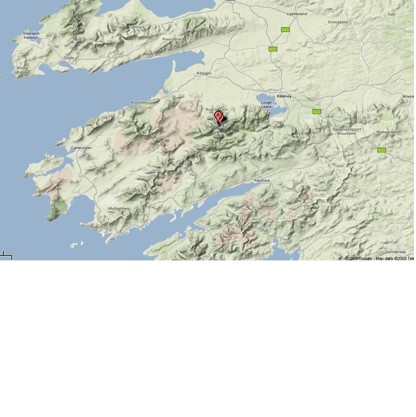
    And so then the characters arrived at the port of Kenmare, a tiny town on the Western coast of Ireland and the closest port to Caron Tuohill, the mountain which the characters aimed to visit. Kenmare was a tiny, ramshackle town, nothing more than a collection of warehouses and mud huts in a narrow valley, above which loomed a sorry excuse for a Castle on a low hill. The suspicious and nasty-looking locals who met them directed them to the Castle, where clearly English speakers were supposed to stay; they travelled there immediately, and were greeted by the Lord of the Castle, his guards and a slimy, suspicious-looking advisor. They spent an evening with this misbegotten bunch, during which the advisor – clearly an upstart hedge-wizard of some sort – revealed himself to be a sneering, offensive little oik from London. He was rude to the characters and did his best to attract their ire – never, as George Washington discovered, a good idea.

    The following morning the characters set out for Caron Tuohill, following the advice given them by the lord of the castle – they first would travel by horse for 2 days to the town of Killarney, on the lake East of the mountain, and from there obtain advice on how to ascend the mountain, for at this time of year the weather was treacherous and a mountain such as Caron Tuohill best climbed with caution. They did as they were bid, though the path took them through thick forest from which they were sure they were watched. Suspicious of tales of elves and faerie, the characters pursued their watchers into the woods but found nothing except thick brambles and silence. They continued, suspicious, to Killarney, where they found an even sorrier, sadder town, consisting of a few boarded up shops and some rundown homes clustered around a market square. The Market Square had clearly been the location of some kind of infernal ritual – there was a stake of wood, an extensive area of burnt grass, and faded markings of a magic circle. The town populace were a bunch of scared women and their children, hiding behind their doors and refusing to come to meet the characters – except one grumpy old lady, who attacked them with a broom and told them to leave. While she did so, the characters saw an old woman hiding behind a barn, and realised that she was wearing the symbol, which had been associated with the death angels in America. They gave chase to her, thinking she might be some kind of wizard, but caught her easily and discovered she was merely a scared old lady.

    She revealed to them that she had been outside the town when “they” came and enacted the ritual – the ritual with the dead dragon, which bound all the men of the town to the service of “them” and forced the women and children to stay locked forever in the tiny town, never ageing or dying. The woman had been safe from the ritual by her distance, and while the ritual was being conducted she had stolen some things from one of “them”:

    • a chest which contained the shirt and a few other personal items of the person
    • an infernal pistol (in the woman’s possession)
    • ammunition (powder, ball etc.) for a long rifle (10 shots)
    • a Trajector’s telescope (use for 1 round; no penalty on long range shots for 6 rounds thereafter)
    • a ticket stub for a stagecoach from Bodmin Station to London Paddington
    • a letter addressed to “Tom Stoppard” at the station house in Bodmin Station, containing inconsequential information about his mother’s life in London (Whitechapel)
    • a pay slip from “The Iron House” for a reasonable sum of money, to be drawn at the Bodmin Post Office
    • a lock of hair in a locket

    It was clear from this conversation that the woman had seen a group of soldiers and their wizard master, bringing a dead dragon into the town to enact the ritual. They had then left with all the men of the town, and all the remains of the dragon. Someone who had a part of the dragon and the right knowledge could, perhaps, reverse the ritual…

    The characters returned to Kenmare with this knowledge, but as they approached the foothills of the hills Southeast of Killarney they were attacked by a squad of 32 soldiers, a Trajector, and the wizard of Kenmare. They slew them easily with magic and infernal fire, and took the wizard prisoner.

    This was very convenient, because the soul of a wizard “only tainted a little by the compromise” is listed in the characters’ Tome of Lore Demon Summoning as “quite valuable in the preparation of the summoning ritual” if used properly. It would appear that the characters might have the ingredients for a ritual of Lore Demon Summoning by which they might be able to learn the necessary process for undoing the curse at Killarney. Were they to do so, they would be able to weaken the armies of this “Iron House” which surely they must visit soon…

  • Now that this monkey is finally off my back I can write about it. I just finished the third book of this hideously long trilogy (Assassin’s Apprentice, Royal Assassin and Assassin’s Quest) by Robin Hobb, which I have seen about for many years and never got around to reading – partly because I’ve largely given up on trashy fantasy trilogies. However, my friend recommended it to me, and I regretted it within about 1000 pages of starting (which is 999 more than most fantasy trilogies, I grant you).

    These novels are nicely written, with a prose style my fellow sufferers have described as “lyrical”. I’m not sure what this means but it seems to fit so I’ll run with it. It’s not lyrical like The Wanderer (that beautiful old english poem) but it’s got a kind of flow and lilt[1] to it and a careful choice of words which makes it quite powerfully evocative of a simple, romantic fantasy world. It also (apart from 300 or so pages in the last part of the third book) has a wicked plot that keeps you well engaged and needing to find out what happens next.

    Unfortunately it has a significant problem – it constantly requires suspension of disbelief. Not disbelief as in “you can’t do that” when someone uses magic. Disbelief as in “no-one could be that stupid” when for the 88th time a supposedly intelligent person fails to see the obvious glaring risk to their life, wealth, future and loved ones that is right under their nose. FitzChivalry, particularly, must be the stupidest character in print. He makes Thomas Covenant the Unbeliever seem like a happy-go-lucky, proactive kind of guy. Particularly in the third book, where it seems like the plot slips a bit and everything starts to wander.

    Also, for a series of books about an assassin, there really weren’t enough assassinations. However, this was balanced by some quite nice ideas about magic, time, prophecies and the like which I thought quite refreshing for a trashy fantasy trilogy. Also, mostly, there were no elves or Dwarves or monsters of any kind. Yay.

    Overall, original and fun but very very frustrating. Make sure nothing valuable is in front of you when you read the second and third books!

    fn1: mostly. There are occasional jarring moments where modern business speak intrudes. But one can’t fault it really – I can’t imagine the editor who could plough through 2500 pages of this stuff and find all the little moments where the style slips

  • We rejoin our heroes in the snow flurries created by the departure of the Greenland dragon, and in a new bind. Their task now is to journey to the ruined old town of Good Hope, and invade the church there to kill a lich. They have been geased by the dragon, and so have no choice but to do this as quickly as possible.

    So, Brian the Hunter set about making a pool of frozen mermaid blood on the ground, and used it to scry across the Island, seeking the church in which the Lich resided. His vision was drawn initially to a church far away from Good Hope, but then the vision flickered and changed to the main church in Good Hope. The church was damaged in the dragon’s assault all those years ago, but not so badly that it was not covered and protected against prying eyes; however, Brian could see Ghasts moving about the churchyard and the docks of Good Hope, and the characters realised they would need some tactic to enter the church undetected. Their goal was to get as close to the Church as possible before revealing their presence, because Liches are renowned spell-users, and were the lich given sufficient chance to cast protective and summoning magic, they would all be doomed.

    To this end the characters realised they needed to scry inside the Church, to find a way in and to know where the Lich hid, and what its defences were. They returned to their ship, and then sailed back to the main port, where they again enjoyed a night of dubious hospitality in Erik’s Longhall. This time, however, they sought something specific – any relic from inside the church of Good Hope. They found an old bronze ewer inside a cabinet in the long hall, and with Erik’s permission Brian the Hunter pretended to check the value of the ewer. He filled it with water and a drop of his blood and then sought, through the water, to view the inside of the church. Though Erik stopped him quickly, he was able to at least identify two doors, a stairwell, and a confessional box in which sat the Lich.

    Thus apprised of the Lich’s location, the characters set off for Good Hope. Arriving at the docks, they were attacked by 5 Ghasts, but Brian cast a spell of entanglement which called forth great tendrils of goose barnacles from below the quay to envelop the Ghasts, and while they staggered, trapped, on the docks, Merton, Russell and Brian shot them down. From there they docked, and Dave Black and Merton crept up the hillside through the ruined old town of Good Hope to the churchyard to look for a way in. They slipped past the Ghasts in the churchyard and identified a side door, unlocked, which they could move through, though the door would obviously creak. However, none of the other characters – except perhaps Brian – would be able to slip by the Ghasts, and so they would need a distraction.

    Brian provided the distraction in the form of Matilda, his wolf companion. She loped on ahead and, once she had drawn the attention of the Ghasts, led them away from the church while the characters took up position around the doors. Anna Labrousse summoned her Monster, which appeared as a beast made of shattered tombstones and ice; Russell summoned a demon with great webbed limbs to enter the building first, as cover against any powerful spells that would be directed at the door. These beasts smashed through the main doors while Merton and Dave Black slipped through the side door. The Lich, surprised, emerged from its confessional box but was quickly overwhelmed. Anna Labrousse ripped off its left arm with her spell, sending it clattering to the floor in a hail of bones; and then Brian and Merton shot it down before it could muster any powerful magic. Under the protective cover of demon and monster, Russell Ganymede destroyed the Ghasts.

    Having destroyed the lich they investigated its treasure. First they had to defuse the altar, which had protective magic cast on it. This magic hurled Brian back from the altar and almost killed him, but David Cantrus healed him and dispelled the trap on the altar. They then examined the books and items on the altar and its nearby lecterns. The book with the dragon’s name in was written in Dragonspeech, which Anna could read; resisting the lure of the geas, she read the name and flicked back through the previous pages of the book, which gave something of the history of the destruction of the Church. It would appear that, having discovered the presence of the Dragon on the Island (through its demand for sacrifice) the priest of the Church summoned a powerful Knowledge Demon and sold his soul in exchange for the Dragon’s name. The dragon, discovering that someone knew its name, raided the town with the intention of slaying him before he could learn to use it. Unfortunately, in the first attack the Dragon killed the Priest’s whole family. The Priest, incensed, turned his family’s ashes into a phylactery and prepared to become a lich. In the second battle he confronted the Dragon, driving it away with its name, but was mortally wounded and died. Before he could return as a lich the Dragon ravaged the whole island looking for him, so that when he came back he was bound to the church and surrounded only by the dead of his old village. So the Dragon and the lich were stalemated, until the characters came to kill it.

    Having learnt this, the characters are now ready to travel on to Ireland, to find the killer of the Dragon whose bone they carried; and whose bone Anna Labrousse turned into a corset when they stopped at Iceland en route to Ireland…

  • Things one just leaves lying about...
    Things one just leaves lying about…

    I visited Denmark for a week last week, and amongst other places I visited was the National Museum of Photography, which was hosting an exhibition entitled Unintended Sculptures by the Danish photographer Henrik Saxgren. I was drawn to it by this picture on the poster, which is from Iceland. The exhibition is essentially a series of very large pictures of artificial objects left in natural environments, and is meant to provide a contrast of the two. Most of the pictures didn’t do this very well but the ones from Iceland were very stark and impressive. I like the idea of this type of art, found items or whatever it is called – but in this case the exhibition ultimately seemed like a bunch of fancily rebadged holiday snaps. And anyway, everything I have seen of Iceland suggests that anyone who goes there with a half-decent camera could open an exhibition of their holiday snaps and people would pay to see them.

    So overall the exhibition was a bit disappointing – some shots of walls, a few weird cactusses and some big plastic stuff in a forest, and 4 amazing snapshots from Iceland. Go and see it if you’re in Copenhagen, it’s better than the Design Centre, but probably if you have to choose you’re better off going to the botanic gardens (where I saw a red squirrel!)

    Also, Denmark is awesome and Danes are like vikings in suits! And they love Australians!

  • We find our heroes sailing into view of the small town of Good Hope, Greenland, where they aim to settle their ship and head inland to find a dragon – or, more likely, to be found by it. However, as they approached, still some distance from the port, they found themselves under attack by a team of 6 horrid, slug-like creatures, with the lower parts of a fish and the upper parts of a malformed seal-shaped human – mermaids! These scourges of the sea attack with their horrible screaming voices, causing their victims first to cower in terror and then to leap overboard into the sea, where they can be torn apart at leisure by the shark-like mouths of these vicious predators. Fortunately, some of our heroes are made of sterner stuff than mere sailors, and were able to resist the initial terror-scream. While some of the group fired infernal weaponry at the swimming beasts, others attempted to cast anti-magic spells on those of their fellows who had fallen prey to the horrid voice of the deep. Anna Labrousse, healed of this magical terror, set about ripping the mermaid’s limbs off, while Brian the Hunter entangled one of them in wreaths of seaweed, and Merton and Russell Ganymede fired their infernal weapons into the sea. However, before they could pick off their foes, Merton was enticed overboard by a mermaid’s screams, and had to be rescued from its magic thrall at the last moment by David Cantrus’s invocation of the Good Lord. Once more rescued from a watery grave, Merton set about firing into the pack of mermaids with a vengeance. Once four of their kin had been dismembered or shot to death, the remaining pair set sail and fled. The characters dragged one on board to investigate in greater detail and then, covering it with tarpaulin, sailed into Good Hope.

    At Good Hope they were greeted by a man called Erik, tall and powerful-seeming, who carried a sword, wore leather armour and was draped in a cloak made of mermaid skin. He was accompanied by two extremely short and grim looking bearded men, whom the characters took to be Dwarves when they discvered that Erik was a Danish mermaid-hunter. He was initially friendly when he met them, though he seemed dubious of their intention to “explore the island”. He took them back to the longhall of Good Hope, where they met more men like him – dour, grim chaps who drank and ate a lot and spared nasty glances for Anna Labrousse. There were also more Dwarves scattered about, also looking dour and grim. Over an evening of drinking and merriment the characters learnt that Erik and his colleagues were an official mission from Denmark, intended to reclaim Greenland for the Danish people after 200 years of extinction. They hunt mermaids and trade in their magical parts and skin – though some of the men at the table hinted that they find a use for the mermaids before, as well as after, their deaths. The men seemed an unpleasant and offensive bunch, and the characters were suspicious enough of them to ensure Anna Labrousse always had an escort during the evening.

    Late at night the characters saw Erik deep in conversation with a sinister looking, very short rakish chap, a man shorter and skinnier than a Dwarf. They had sequestered themselves in the kitchen and were behaving suspiciously. Merton, creeping in to listen, established that perhaps the small man was going to be heading inland immediately for some suspicious purpose. Fearing the worst, the characters took their leave of the longhall and set out inland to capture the gnome. Brian the Hunter sent his dog Matilda ahead, and in the morning they found their target caught against a massive stone in the hills out of town, Matilda sitting on his chest, his leg broken. He revealed himself to be a gnome scout called Gdernak. His mission – to go to a remote spot on the glacier some days’ march north, and warn the dragon of the glaciers that the characters were coming to kill it. No-one in town believed that they were here for any other mission, and Gdernak revealed that they had a long-standing agreement with the dragon – once a year they brought it a live mermaid to kill, and they warned it of any adventurers who had come to kill it. The characters learnt the location of the sacrificial stone on which the mermaids would be laid out, and to which Gdernak had been travelling, and then took him with them to the shore North of Good Hope, where they met their ship. From the ship they took some Bison as a sacrifice to the dragon, as well as the body of the mermaid, and headed North to the sacrifice point. Gdernak was kept out of harms way on the ship for 6 days, the time it would have taken him to visit the dragon and return.

    At the sacrifice point the characters found a long slab of stone, crusted with ice and old frozen blood, and a single stone pillar with a silver bell on it. They dumped the mermaid on the stone, and retreated out of sight. Anna Labrousse rang the bell and retreated out of sight, to prepare the ritual of the eagle-hunting herb. Using the best telescope from the ship, they waited until they could see the dragon, far away in the grey arctic sky; Russell thrust the dragon bone into Anna’s hand, and her mind expanded outward, flicking across the vast open air between her and the Dragon to place her mind inside its ancient and alien consciousness.

    The dragon noticed her presence immediately, and engaged in conversation with her. She revealed the reason for her presence, and the nature of the bargain they wanted to strike with it; the dragon agreed, in exchange for the right to occupy her mind briefly as she had done to it. She agreed, and moments later found herself back in her own mind, with the dragon’s great and frightening intellect staring through her eyes. After a moment it retreated, and she was herself again – cast out from the brooding, evil presence which just a moment ago had been all around her. Though they had heard and felt nothing, the other characters knew that something must have happened – Anna Labrousse’s skin had turned so pale it was almost transparent, and her eyes had turned silver, the whites bleached perfect white like marble. Anna Labrousse was dragon-touched.

    The dragon swept in then, and it was mighty. Its body the length of two viking longships, its wings wider still, it was shaped like a dagger or a shard of ice, white in colour on its belly but silver-blue on its back and sides, with scales of such hardness and texture that it appeared to be made of ice and crystal. As it swept in it unleashed a cloud of frozen air from its huge and glistening maw, freezing the mermaid carcass instantly before executing a tight turn, swooping in and landing in a great, cat-like pounce on the body. The body, frozen solid, shattered into massive chunks as soon as the dragon landed, and the dragon commenced gulping them up, crouched over the stone like a cat at its prey. Even from their distance and hidden location, the characters could hear its breathing and the gentle sussurration of its wingtips against the ice of the glacier and the rock wall behind the sacrifice point – and they could see one great, watery blue lizardlike eye focussed on their hiding place.

    They emerged from this spot and approached the dragon to speak with it. Soon the conversation turned to what they must do in exchange for the information they sought. The dragon agreed to tell them from which of its kin the infernal assassin had been made, if they would do a simple thing for it – venture into the ruined church at Hvalsney, the old capital of Greenland, kill the lich that dwelt there, and destroy all the books that it owned as soon as they could. They agreed to do this, and the dragon cast upon them a powerful geas, which would force them all to do its bidding. Satisfied that they were bound to it, the Dragon then told them the information they sought. The dragon bone they had brought with them was the remains of the dragon called commonly Cinderstone, once resident in the mountain of Corrán Tuathail in Western Ireland, near the lake and town of Killarney. Were the characters to visit the town of Killarney they would, perhaps, be able to discover the identity of Cinderstone’s killer.

    The conversation finished, the Dragon leapt into the air and soared away, to what sinister cave the characters did not know. But here before them lay a chance – the Lich’s lair contained a book with the Dragon’s true name written in it. Should they be able to fight their geas for long enough to learn that name, they could perhaps return and slay this dragon themselves. Then its treasure – the treasure of all the adventurers who had come before them to slay it, as well as all the treasure of Greenland of old – would be theirs. Could they breach the geas for long enough to steal the name from that book which they must then destroy – and what other knowledge did the book contain, that they must destroy? The Dragon’s geas was sloppily done – could they copy the contents of the book before they destroyed it?

    What, indeed, are the limits of a Dragon’s magical power, and what are the limits of a promise made to a Dragon?

  • Having slain an Infernal Remade Chimaeric Assassin, the characters visited a cheap infernalist and his houri in Albany, where they discovered that:

    • they would need to find an infernalist in New York to identify the source of the brass components of the beast
    • The white substance in its arms and ribs was dragon bone
    • every dragon knows every other dragon and can identify every dragon’s bone
    • There is a dragon in Greenland

    Anna Labrousse pointed out that, using Miss Cora Munro’s eagle hunting herb and their dragonbone, the characters could invade the mind of a dragon and perhaps control or calm it.

    With this lunatic plan in mind, they set off for Greenland.

    Deciding on the way to pursue further sources of information on their recently deceased Infernal Remade Chimaeric assassin, the characters travelled by ship to the sea near New York, and from there were dispatched in a longboat to New York. Unfortunately they were spied at the harbour mouth by two remade British wizards and their Grindylow attack beast, and a brief battle ensued. The wizards, fully submerged, initially proved a difficult target, but after some cunning conjuring of monsters, and once Father David Cantrus had shown one of them the promise of hellfire to come, they were subdued. Also, Russell Ganymede was under the boat in his Cancer Labora armour, and tore the Grindylow apart with a single flick of his enchitinised arm. The Grindylow, a 5m long crocodilian monstrosity with semi-humanoid head and massively-muscled arms, sank to the sea floor in several pieces.

    From there the characters alighted at New York and went seeking a suitable infernalist. This nameless chap had moved from his dockside warehouse to a smaller, cosier haunt below a bar on Manhattan Island. The characters found him there and spoke with him at length, learning only that the Fleur-de-lys with the characters SPM was not from France, but from Sheffield Precision Machinery in Sheffield, a company which produces clockwork and brass items for infernal industry.

    Their assassin was English. But why? Perhaps the best way to find out would be to find the organisation which made it – and their second best clue was a suicidal conversation with a dragon in Greenland. So, off to Greenland they went, in their appropriately named ship, Inappropriate Response.

  • The characters find themselves wondering at the many puzzles which present themselves, in light of both the recent attempt on their lives, and the unfinished matters from the last year of warfare and slaughter. There are some questions they need to have answered, and some things they might want to do…

    1. What is this Remade Infernal Assassin? Who sent it?
    2. Who was the Satanic figure they killed on the deck of the boat in Albany? What was he doing?
    3. What were the Irish doing with the Satanic figure from Newfoundland?
    4. What is really happening with Infernal Magic, and do the Indians have an insight not available in the Old World?
    5. Why were the Northwest Frontier Company, nominally British, helping Washington, and in such a nasty way? Money and power, or something more sinister?

    To investigate these things, the characters can:

    1. Find an expert in Infernal Remaking, either in Montreal or in New York. The former will involve avoiding the attention of the French; the latter will require infiltrating the British forces in New York, where the characters are not popular
    2. For this the characters can visit Newfoundland, and try to find clues to the man’s real identity and purpose
    3. Though the characters may find answers to this in Newfoundland, they may need to go to Ireland or track down the remnants of the Irish forces in Montreal or New York
    4. The characters might be able to learn something from a spirit walk… or from a physical journey into the Black Hills, which hold powerful spirits that could help (or hinder!) the characters
    5. This would involve a trip to NW Frontier company headquarters in New York, and possibly elsewhere.

    Note that some of these things can be done together, especially the tasks in Montreal or New York.

    No doubt other distractions will arise in the course of the characters’ adventures. But if they select one of these paths, perhaps it will lead them somewhere useful…

  • We rejoin our heroes in the town of Albany, where they found themselves coming to terms with the new landscape of the colonial world. They were now welcome in Albany as heroes, and trusted advisors to its new Council of Elders. Their house remained their possession, and now also they had possession of their own kingdom bordering on the French and Indian territories, which they now needed to find a way to administer. The war had reached a stalemate to their South and for the time being, as Spring passed into the sultry heat of Summer, the three conflicting peoples of the new world paused to consider their next steps, to bury their dead and to honour or shame those who had brought the world to its current pass.

    And so it was that the characters found themselves facing a ferocious delegation, consisting of 2 farmers and a fisherman from the town of Rouse’s Point, the furthest point from Albany in their new kingdom. These men, shuffling nervously before the great men and women before them, had travelled far from their home to present the  characters with a document swearing their fealty in poorly-spelt English, and also to present them with a list of requests. These worthies wished to discuss matters of taxation, defense and native land rights, which weighty matters were soon dealt with by Lord Merton, using his usual even-handedness. Their first subjects departed, satisfied…

    After this the characters took the opportunity to meet Miss Cora Munro, her silent and distant younger Sister Alice, and of course Alice’s husband Magua. Alice spoke little and seemed little interested in anything except her husband. She presented in the manner of an English lady, in skirt and bustles with a parasol, but the faraway look in her eye, the braided hair, and the tattood lines on her arms and chest made it clear that she was no longer in accord with the formalities of British society. Magua attended her dressed in his inimical style, imitating an English gentleman. He wore torn breeches, a red English soldier’s jacket looted from an unfortunate casualty (and still stained with that poor soul’s lifesblood), his tomahawk festooned with the torn remnants of a British flag, and his chest bared to show tattoos, rippling muscle and a wide variety of scars. He had indeed made every effort to oblige the fashion and customs of the colonial gentry…

    What better place to hunt Eagles?
    What better place to hunt Eagles?

    The Munros, Magua and the characters took a picnic at dusk on the hill overlooking Albany. They had hoped to see fireflies, since it was the season; but the smoke and poison of war had driven the fragile insects away, and the only such lights they could see were the distant fires and explosions of the siege of New York. At this picnic Miss Munro presented the characters with a detailed contract outlining her claim to prospect the hills of their new kingdom for rare herbs, and they agreed to consider her request if she would consider acting as their regent. She, of course, agreed to this and as a token of her good faith invited the  characters into the hills North of Ticonderoga, there to indulge in a spot of Eagle Hunting. Somewhat dubious as to the nature of this activity, the characters agreed. So it was that they found themselves, several days later, sitting on a remote bluff deep in the hills of their new kingdom. Before them to the Northwest lay a splendid view of hills and plains, falling away to the distant glint of the St. Lawrence River. They sat, with four of Magua’s braves, around a fire over which Cora had boiled some water. As the braves began drumming, Magua threw a herb on the fire and  a strange smoke began to envelope the clifftop, where as if by magic the wind had  stopped blowing. Cora poured herbs into the water and stirred, and an acrid and disgusting smell covered them. Then Cora asked which of them would proceed with the hunt first, and Merton, ever willing to sample a new drug, of course raised his hand first. Cora offered him a small shot of the boiled water and then, as Merton drank it down, Magua leapt forward in one of his customary unexpected changes of mood. Towering ominously over Merton, he drew from his beltan Eagle’s feather and cast it into Merton’s hand. Merton, suddenly struck numb by the liquid, fell backwards clutching the arrow; and as he did so he heard and saw an Eagle, circling far overhead. In moments his senses had exploded outward and, in a rush of wind, sun and sky he found himself in possession of the Eagle, looking through its eyes, feeling the wind in its feathers, even sensing its feelings. He circled high in the sky for a long, silent, wind-stroked time before his host’s questing eyes found the rabbit they sought; and then, still fully aware of all around him, he was siezed by the Eagle’s lust for blood as it plummeted earthwards to its quarry…

    … only to be hauled from his reverie by Magua, who snatched the feather from his hand and thus dragged him, groggy and confused, back to the leaden grip of Earth. It would be unwise, Magua warned him, to be in the Eagle when it catches its prey. There is always the ominous threat of not returning, or of being changed.

    In turn each of the characters was offered their flight, in an Eagle, a Falcon, or finally a swift. So they experienced their kingdom from the air, and looking down saw its beauty, or felt its ferocity. As Magua and his braves cleaned their camp, Cora told them that the herb used for this effect was grown in their kingdom and could no doubt be used on other beasts provided a part of the beast was available to them. She had merely to find it – and who knew what other uses it might have?

    So convinced of her claim’s usefulness, the characters returned to Albany. However, when they reached their house they discovered their Butler missing, and the house silent and dark. Immediately suspicious, they went looking for him, prepared for battle. Outside the butler’s chambers they were attacked by a mysterious assassin-creature, a wiry beast of some 8′ in height, demon-possessed, with remade arms composed of demon-flesh, brass and bone. From one arm snaked a chain of brass links and wicked bone-and-brass spiked balls, and from the other protruded a sinister set of blades. The beast could turn invisible and struck with stealth, attempting to dismember Brian the woodsman. Eventually they subdued it, and searched it for signs of its provenance. It was clearly a sophisticated mixture of infernal and Remade technology, its chain powered by clockwork and its body enhanced with a strange white, bone-like substance mixed with bronze. There was no other clue to its origins but for a symbol on one of the brass strakes of its weapon arm, consisting of a Fleur-de-lys with the letters SPM engraved underneath.

    Once again, do the characters find themselves embroiled with the French?