• この投稿はプレイヤーの一二三んさんに書いてくれました。

    このキャンペーンは、私に作られたシナリオ、そしてルールブックの「目には目を」というシナリオで続ける予定です。この投稿は私が作ったシナリオの終わりです。

    ーーー

    前回の続き

    シュゼットは村長さんの家へ呼ばれ、何も疑うことなくトコトコとついていく。
    あまり豪華とは言えない玄関を通ると、応接室に通された。
    応接間には、3人の先客が居た。

    ******************
    PL:スローラーナーさん
    名前:シュルツ
    種族:人間
    性別:男
    年齢:25歳
    職業:見習い魔術師
    ******************

    彼は首都アルトドロフで魔術を学ぶ学生だ。
    魔術師の位は見習い魔術師。
    年齢が25にして見習い魔術師なら、少々遅咲きだろうか?

    ただ魔術の才能を見るのに、年齢はあまり関係ない。
    魔術の才能があっても、周りの環境によってはその才能が埋もれてしまう事など良くある。
    10代前半から魔術学院に通える子もいれば、シュルツの様に20を過ぎて魔術の基礎を学ぶ人も居る。

    彼は中肉中背の目立たない男で、粗末なローブを着ている。
    今は学園の冬休みを利用して、国内を探索してるらしい。

    ******************
    PL:楓君
    名前:ハインツ
    種族:人間
    性別:男
    年齢:21歳
    職業:兵士
    ******************

    手に槍をもった、厳つい兵士である。
    身に着けてる盾や鎧は、歴戦の証である傷跡が無数に刻まれてる。
    年齢はまだ若く、熟練と呼ぶほど年をとってないが、若輩と呼ぶほどではないようだ。
    当然、それなりに腕が立つだろう。

    彼がどこの地域の兵士かはしらないが、どことなくドワーフの臭いがした。

    ******************
    PL:てんちょーさん
    名前:アルソン
    種族:エルフ
    性別:男
    年齢:80歳
    職業:盗賊
    ******************

    茶色いフードが、その男の全身を隠すように覆ってる。
    背中を壁に預けてあまり目立たない。
    口数も少ないので、最初シュゼットがこの部屋に入ったとき、彼の事に気づかなかった程だ。

    シュゼットは遠慮なく、彼のフードを覗き込む。
    彼女の行動に悪気はない、ただこういった世間知らずで無神経な行動は、あとあと痛い目をみるだろう。

    フードの中を覗き込んで、シュゼットはびっくりした。
    エルフだ!この人、エルフだ!

    このアルトドロフでは、エルフはあまり見かけない。
    大概のエルフはローレローンの森から、一歩も外に出ようとしないのだ。
    どこにでも居るドワーフやハーフリングとは、偉い違いである。

    *** *** ***

    という訳で一同は村長さんの家にあつまった。
    そこでこんな依頼をされた。

    「この村の周りに居たビーストマンとグリーンスキンが、急に居なくなった。居なくなってうれしいが、原因を調べてほしい」

    村長は報酬として、一人頭銀貨20枚を提示した。
    この金額は1ヶ月分の衣食を満たすのに、十分な金額だ。
    4人は少し悩んだりもしたが、結局は依頼を受けることにした。

    村長に詳しい話を聞くと、以下の事が分かった。

    ・グリーンスキンのキャンプは、簡単に見つかるらしい。
    ・数も少ない。
    ・キャンプはこの村から徒歩で1日程の距離。

    PCは他にも情報を集めるべく、村を散策する。
    調べるとグリーンスキンに一番詳しい村人が【汚い象】という酒場で飲んだくれてるらしい。
    さっそくその酒場へ向かう。

    *** *** ***

    この酒場は【汚い】象と言う名前を表してるとおり、えらく汚い酒場だ。
    店の床にはあまり見たくない汚物が飛び散っており、嫌な臭いが鼻を突く。

    酒場には3人の客がいた。
    飲んだくれてるオッサンと、飲んだくれてるドワーフと、そのドワーフにまとわり付いてる商売女だ。

    グリーンスキンに詳しい人というのは、飲んだくれてるオッサンだ。
    一行は話を聞くために、店の中へ足を踏み入れた。

    すると一向に目をつけたドワーフが、エルフを睨んでこう言った。

    「エルフくさいです!フ○ッキン!」

    ドワーフは鼻を摘みながら、店を出て行く。
    出て行く際に、中指を立てるのを忘れない。

    ドワーフとエルフの仲が悪いのは、この世界の常識だ。
    両者の因縁は長く、こう言ったやり取りも、さして珍しくは無い。

    だが問題はこれで終わらなかった。
    ドワーフにまとわり付いてた商売女が、エルフに突っかかってきたのだ。

    「よくもあたしの商売を邪魔しやがって!このままじゃすまないよ!」

    商売女は仕事の邪魔をした賠償として、エルフに銀貨2枚を要求してきたのだ。
    エルフの森と違って、人間の住む場所ではこういう事が多々ある。

    続く

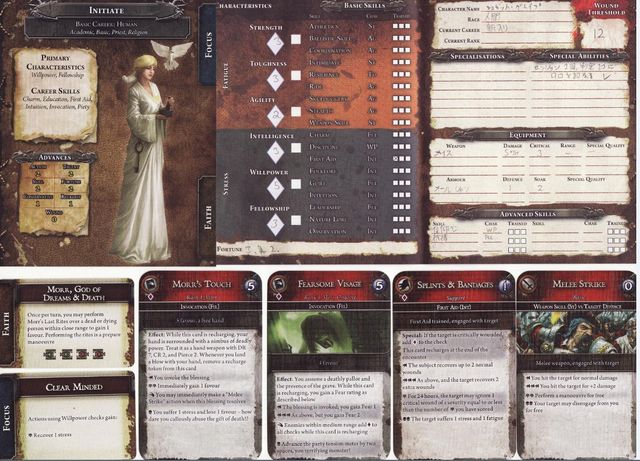
    ウォーハンマー3版のシステムの感想

    ※リングテイルのプログで今回のレポを上げてます。
    http://www.ring-tail.com/blog.php
    あわせて以下の文章を読むと、より分かります。・・・たぶん。

    僕が上げた一枚目の画像を見ても分かるとおり、もう2版とはまったく違うシステムです。
    最初キャラクターシートやカードを渡された時は「ボードゲームみたいだな」と思いました。

    キャラクターシートを見ると、2版では47あった技能が3版では18に減ってます。
    これが良くなったのか悪くなったのかは、まだプレイが浅いので分かりません。
    ただPCがかなり万能になったんじゃないかな?と思います。

    攻撃や異能は、全てカードになったみたいです。
    見た目はとても分かりやすいですね。
    英語が分からない僕でも、イラストを見てすんなり分かりました。

    またこのカードを使った戦闘は、とてもユニークです。
    ただ場所を多くとってしまうのが、難点ですね。

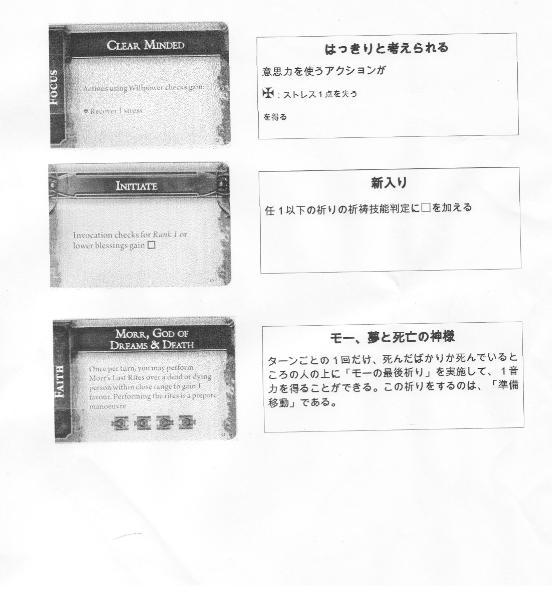
    スチュさんの翻訳

    スチュさんがカードを翻訳したので、その画像を乗せます。(2枚目と3枚目ですね)
    彼は全員のカードを、こうして丁寧に翻訳してくれたのです。(それも無料で!)

    翻訳も意味が分からないという事はないです。
    むしろいい味が出てます。
    洋ゲー好きなくせに英語が弱い僕は、あばばばばばーです。

  • ブログのノート:これはー二三んさんというプレイヤーに書いてくれた投稿です。かれのMixiページからコピーされています。

    プレイーの日日は7月21日でした。最近忙しかったから少し遅く投稿しました。。。

    A note from the Blog: this is a guest post by Mr. 123, one of my players in the Japanese Warhammer 3 I am running. I didn’t write any of this, but copied it (with permission) from his social networking site, Mixi.

    昨日夜7時、俺は別府のリングテイルに到着した。
    何をする為かと言うと、ここ

    ウォーハンマー3(以下WH3)をプレイするためだ。

    まだ日本語に翻訳されてないこのゲーム、とても遊べるものではない。わたし、えいごわっかりませーん。
    ただし今回は力強い味方が居る。それは日本語が達者なオーストラリア人のスチュさんだ。彼がこのWH3を日本語に翻訳してくれた。

    昨日リングテイルのお店に集まったのは、以下の5人。

    ① オイラ、一二三んです。
    ② WH3を翻訳し、GMを勤めるスチュさん。
    ③ 店長さん。
    ④ 楓君。
    ⑤ スローラーナーさん。

    全員ともリングテイルを通して知り合い、全員がWH好きな人ばかりだ。だから普通の人なら引いてしまう洋ゲーでも、バッチこい。

    さっそくゲームを開始。
    GMが必要なシートの類を準備してる。
    んでね、その時、GMが僕にこう言ったんですよ。

    「一二三んさん、僕が準備してる間、他の人達にWHの世界観を説明してください」

    僕は言いました。

    「なーに、ここに居る人達にWHの世界観の説明など不要です」

    楓さんとスローラーナーさんはWH2をプレイ済み。
    プレイしてない店長さんにも、世界観の説明は不要でしょう。
    みなこの混沌でダークな世界観が好きで、この店に来たのだから。

    さてGMのセッティングが終わった。
    PL4人は恭しくキャラクターシートを受け取る。
    さて、WH3とはどのようなゲームなのか・・・!

    用意されたキャラクターは以下の4名。
    ① 兵士
    ② エルフの盗賊
    ③ 入信者
    ④ 見習い魔術師
    ※各キャラクターの詳しい情報は、WHのHPをご覧ください。    http://www.hobbyjapan.co.jp/wh/career/

    皆さんならどの職業を選びます?
    僕は速効で ③入信者 を選びました。
    今回は猛ったシグマー教徒でプレイしようという気分だったのです。混沌ぬっころすお。
    ただ入信者の宗派はモールでした。ちょっと残念。

    キャラクターシートには既に能力値等が書き込まれてました。
    サンプルキャラなんでしょうか?英語の分からない僕にとってはとてもありがたかったです。

    さてまだ名前も決めてないが、さっそくプレイ。
    今PCが要る場所は首都アルトドロフの南にある小さな村。
    季節はまだ寒い2月で、各PCは別々の宿屋で寝転がっている。

    まだPC同士が知り合いで無い、という設定でした。

    そしてGMから
    「じゃあ君が泊まってる宿の名前を言ってね」
    と振られる。
    僕はとっさにこう言った。

    「ええと・・・【ウルリックの牙】という酒場です」

    おいおい・・・モール信者にありましき名前。
    【モールの墓場】
    【モールの棺桶】
    【モールの葬式まんじゅう】
    なんて名前の方がよかった。

    僕が酒場の名前を言うと、各PCも泊まってる酒場の名前を言います。

    ・見習い魔術師のスローラーナーさん 【白い蜥蜴】
    ・兵士の楓さん 【青い小鳥】
    ・盗賊の店長さん 【リングテイル】

    酒場の名前を伝えたところで、冒険が始まりました。

    *** *** *** ***

    店の外がガヤガヤと騒がしい。
    飲んだくれてた一同は、何事かと店の外に出る。

    外には仕事が終わったばかりの街道巡視員が居て、この村における道路状況を説明してる。

    この村の周りには悪い奴等(ビーストマンやグリーンスキン)が多くて、物不足が起こっていた。
    悪いやつらを退治しようにも、お上はなかなか動かない。
    涙目な村民、こんな感じです。

    しかし今来た街道巡視員の話に聞くと、急に悪い奴等が消えてしまったとの事。
    何か分からないが、これで商人の往来も増えて村が豊かになる。旨いビールが飲めるぜ、って感じで、村民は嬉しさで踊ってます。

    いい気分なのはPCも同じ。またビールを一杯頂こうとすると、フードを被った怪しい人がPCに近づきます。

    「この村の総理大臣があなたに会いたがってる。来れば報酬で銀1枚です」

    この村の総理大臣・・・?
    たぶん村長さんの事でしょう。
    なに、ゲームに国境など関係ない、GMの言いたい事はよく分かる。
    村の総理大臣って言ったら、村で一番偉い人の事でしょ。
    おーけーおーけー、一二三ん日本語わっかるよー。

    PCは快くこの村の総理大臣(以下村長さん)に会う事にした。

    この話を持ってきたのは一人だけでなかった。
    他のPCも同じ事を言われてたのだ。

    そうして一行は村長さん宅で、顔を合わせることになった。

    GM「それじゃ、各PCの名前とかお願いします」

    ここで初めてキャラクター紹介だ。
    能力値や装備はあらかじめシートに書き込まれてたが

    キャラの名前
    年齢
    性別
    生い立ち

    等はPLが自由に決めていい。
    さてどうするか、と悩む僕。

    うん、決めた。僕はこのキャラで行こう。

    ******************
    名前:シュゼット・クレイプ
    種族:人間
    性別:女
    年齢:14歳
    職業:入信者
    ******************

    説明:
    裕福な商人の一人娘で、何不自由なく暮らしていた。
    とても愛らしい容姿をしており、性格の方も容姿同様に綺麗で可愛らしく、純白そのものである。

    好きな飲み物はミルクティー。
    好きなお菓子はスコーン。
    好きな言葉は博愛。

    シュゼットは、とってつけたようなお嬢様なのだ。

    だからだろうか。その容姿や振る舞い故に、皆からは【ミルクティー・プリンセス】と呼ばれていた。
    彼女は商人の娘でも、プリンセスと呼んでも差し支えない気品を備えてた。誰もが彼女をプリンセスと呼ぶ事に、疑問は持たなかった。
    愛しきミルクティー・プリンセスは、みんなの誇りであった。

    12歳の時、シュゼットは勉学のため生まれた街を離れ、モールの教会へ行く事になる。
    そこで悲劇は起こった。

    彼女は生まれて始めて飲んだでビールを気に入り、暇さえあれば一杯かますようになった。
    以後彼女辛党になり、ミルクティーを捨てる。好きなお菓子だったスコーンも捨てて、変わりに燻製のウィンナー・ソーセージを食らう。

    今は全国のビールと乾き物巡りのため、メイスを片手に旅に出てる。
    まさに親泣かせ。父親のガレットの悲しみを思うと、涙を禁じえない。
    ちなみにご両親は共に健在だ。故郷に帰れば大きな屋敷と大勢の使用人が待ってる。どこぞの世界のシュゼットはゆすり屋に痛めつけられる等の不幸な目にあってるみたいだが、この世界のシュゼットは幸せそのものだ。

    【ミルクティー・プリンセス】 改め 【ビールぷはー!プリンセス】

    彼女の冒険は始まったばかりだ。

    続く

    追記
    今日は付き添いでジムに行く予定なので、もう日記書いてる時間が無い。また後日に続きを書きます。

    追記 その2
    スローラーナーさんと前回ソロで遊んだWH2の話をしたんです。
    そしたら衝撃な一言を貰いました。
    「一二三んさん、僕のPCの名前はエルストンでなくて、エルンストなんですよ」

    まじで!?あばばばばー。失礼しました。

  • Last night my players gathered at my house for the second session of our Warhammer 3 campaign (for that is what it appears to have become). We’re running through the module in the WFRP Adventure Book, An Eye for an Eye. We started a little late due to address confusion and eating, and there aren’t really any additional details I need to add about the Japanese element of the experience, except:

    • It really helps to prepare language – I consistently go into situations like this thinking I’ll just “work it out” but there is no way to work out words in a language completely different to English. You need to find them and memorize them ahead
    • Japanese players really do get down to business quicker than English-language players, in my experience
    • One of my players forgot his translated cards, but between us we muddled through without too much difficulty. He could either read them himself, or I helped him, or people shared theirs with him. The main problem he had was in skimming them to make a decision – the titles are meaningless, and it’s from the titles and names (of powers, spells, cards, whatever) that you primarily decide what to do
    • I put an explicit ban on purchasing new action cards with advances, because I want my players to become more familiar with the cards they have and I need time for translation. This worked out- we soon identified that the thief character needs a “firing into combat” card, and by next session I aim to translate some suggested cards for the soldier
    • I had an amusing language stuff-up that I’m going to have to retroactively reversed. In negotiating their fee for their adventure, I told the characters they would be paid “1 gin” (1 silver) for uncovering the mystery, when I was meant to say “1 kin” (1 gold). They were all like “we’re out of here” (1 silver is not much money!) and I couldn’t fathom why. One of them said “let’s negotiate” and pushed it up to “4 gin” (4 silver), and they were all still saying “fuck this for a game of soldiers.” Finally someone realised I might be confusing two common words and checked with me, and now they’re all earning way more than they should be. I’m going to correct that by email. Oops.

    Translating cards makes things slower, but the combination of “false beginners” (everyone actually knows a lot of English words) and the Warhammer 2 translation means that people are getting along okay. Despite starting late (9pm) and language difficulties, and the distraction of a visitor coming to meet the cat, we managed to get through the following stages of the adventure in 3.5 hours:

    • purchasing some stuff in town
    • spending experience points
    • learning about the mission and making a deal
    • travelling to Grunewald Lodge, and the fight with the beastmen
    • Meeting the head of the Lodge and discussing their job

    I think that is  a pretty good run of events for 3.5 hours in the second session of a new system.

    I only have 2 points to make about warhammer 3 as a whole, which I’m still really enjoying. First of all, I really like the progress tracker, it’s a really useful tool in any situation where you need to handle time-dependent conflict, and secondly, it’s really really deadly.

    On the deadliness of Warhammer 3.

    Mr. Kaede is playing a soldier who has a mail shirt, a kite shield, and has spent his first experience points on combat-related bonusses. In a pinch, he can and does add 7 misfortune dice to an opponent’s attack on him. He has 13 wounds, the most of the party, and his reckless cleave action is nasty as potted doom. The thief character has an awesome ranged attack, rapid fire, which mows down opponents. I pitted the party of 4 against a group of beastmen, consisting of 2 Gors and 10 ungor henchmen. They attacked in 2 waves, the first consisting of 1 Gor and 5 ungors, the second arriving 2 rounds later and suffering fatigues in order to reach the battle quickly (fatigues count as wounds for bad guys, so they arrived weakened). The first leader, fighting the soldier, suffered damage fast. The thief and wizard mowed down 4 of the Ungors in one round, so at the end of the round all that remained was a wounded leader and a wounded ungor. But this Ungor reduced the thief to two wounds. The way initiative works in Warhammer 3, when the second round commenced the round was set to start with one PC and one monster acting. The players’ initial decision was to have the soldier finish off the Gor, but I pointed out to them that regardless of their decision, I was going to have the Ungor kill the thief, so they needed to adjust their initiative order to save the thief.

    I really like this flexibility! In the first round the first people to act were the soldier and the Gor, on an initiative of 3, then everyone else on 2. In the second round, both enemy and party can change who acts when. So the characters had to decide who would save the Thief. The thief himself is a crap fighter and the wizard had no power, so the cleric – 14 year old Suzette – had to charge in to kill the ungor (the soldier was engaged in a separate area). She failed, despite using all her luck points on the task, so then the thief’s fate hung in the balance. He threw his luck points, parried, did all he could – and the ungor just missed. The soldier then followed up with a support action which emabled the thief to disengage from combat so he could use his missile attack, which he did, to kill off some ungors.

    In the following round, the other Gor charged in to attack the soldier, using its special charge power. Even though he added 7 misfortune dice, it seriously wounded and critically wounded him, getting him down to 5 wounds, before he could kill it. There is no healing in the place they have arrived at, so when the final boss battle arrives their soldier is going to be critically wounded and 1 good hit away from death – and their only archer is on 2 wounds.

    Also, they chewed through 12 beastmen in 2 rounds. This game is deadly, even if your character has combat skills.

  • Over in the UK, the long period of flirting with market-based solutions to the NHS’s problems has finally come to a head, with the new coalition government deciding to abolish the cap on fee-paying patients at public hospitals. This means that the big hospitals can compete for a supposedly lucrative health tourism and private health market to top up their income, which will in theory enable them to increase their revenues at a time when the government (for no reason I can understand) thinks that it needs to cut government spending viciously.

    Market reforms of the British NHS have been proceeding under Labour for about 10 years, using a softly-softly approach to liberalization which I think was probably necessary. There are probably a lot of people in the UK and America who think that a universal health care system is not compatible with private markets (for different reasons in each case) but this is very far from the truth – most “government-funded” health systems involve significant amounts of private health care, either on the provider side (in Germany and Japan) or on the provider and the insurer side (in Australia and Ireland)[1]. So, broadly speaking, market reforms in the UK will finally bring the NHS more into line with the better-quality systems of the rest of the developed world (outside of the US) where healthcare is (relatively) cheap and generally very high quality.

    However, I think the Tory reforms won’t achieve any of their stated goals, and will have the added side effect of setting back health equality in the UK. I think they will have an effect similar to the reforms in Russia immediately after the collapse of communism, in that they will produce a few winners and a lot of losers; and the winners will largely be those who are politically connected or have a lot of luck. This doesn’t have to be the case with a well-managed market reform, and there are particular reasons why I think that the reforms will have this effect. I want to describe what I think will happen in the UK, but first I need to explain the two key problems that the NHS currently faces, which will be the cause of the reforms’ failure.

    The NHS’s two main problems

    Underfunding: By some kind of ephemeral standard, all health systems are underfunded, since we always want to spend more on making people better. However, by the more concrete standard of EU spending on health, the NHS has been underfunded for about 20-25 years. The NHS only recent returned to funding levels equal to the EU average, after a long period of underfunding under Thatcher, followed by a slow year-on-year increase in funding under Labour. This increase may have been “slow” but it’s an indication of how under-funded the NHS was that before the election Labour was talking about figures for funding increases above 10% relative to 1997[2]. A system that is 10% below EU standards for 20-25 years is pretty seriously underfunded, and this has ramifications in many areas. The most obvious is capital investment, which will be significantly poorer in an underfunded system, and this is a really big problem in health where new treatments and systems require significant capital investment. There are also significant quality-of-life issues in the NHS, such as the mixed-sex dorms that the tabloids love getting heated up about, which can only be redressed through capital investment and which, while not life-threatening, are certainly noticeable to the average patient. Also, of course, overcrowding has always been a problem in the UK and it is through capital investment that overcrowding is reduced.

    But further to this, defunding your health system has significant effects on its workforce, and not just of the “overworked and underpaid” kind. If you consistently underfund your workforce for 20 years, whole disciplines will stagnate and become underperforming relative to their European peers. Particularly, the kind of “back office” “managers” that the Daily Mail loves to hate are the first to go in a cash-strapped system, and over the years are slowly replaced by inferior versions of themselves, who are underpaid and undertrained. These “paper pushers” do the unimportant stuff – you know, scrutinizing contracts for services, investigating quality of care, overseeing equipment purchases, managing demand – the sorts of things that actually require considerable skills and industry-specific experience. It doesn’t come as a surprise to me that after years of underfunding and calls to “quarantine frontline services” from cuts, the NHS embarked on a massive IT contract that ended up running over time and over budget. It’s as if they had lost expertise in managing projects and negotiating contracts…This can have ramifications outside of health too. Because the health system in most countries is a significant part of the economy, and its activities drive the development and maintenance of small but highly-specialised disciplines (like statistics, radiology, etc.), when you underfund your health system you also cause a drain in the numbers of skilled experts from those fields. In this regard the underfunding of the NHS has done the world a disservice – the UK, traditionally a world leader in statistics and epidemiology, has slowly given ground to the US and Australia in this field.

    This phenomenon will also create new cultures. The NHS has a cash-strapped “make do” culture, and an expectation that patients will grin and bear the threadbare atmosphere[3]. This ain’t good for a health system, and it doesn’t surprise me that one of the main causes of safety problems in the modern NHS is hospital infection – an issue which is easily avoided by good staff training, modern equipment, good funding for cleaning services, and a culture of patient comfort rather than patient endurance.

    Waiting times: The other big problem in the UK, partially but not entirely related to the first, is waiting times. The waiting time target for non-emergency surgery in the NHS is 13 weeks, and it varies significantly depending on the area you live in. Waiting times aren’t quite the horror story that people make them out to be, but they are a significant cause of discomfort, alarm, and sometimes death, and it’s not very nice that they’re so long, although in reality most British people when surveyed indicate satisfaction with their own waiting time – while it’s a good idea to campaign for instant access, everyone understands that reality interferes with a good political story and it’s okay to wait a few weeks for non-essential surgery. But waiting times in the UK are too long and seem to be related to inequality, with poor people in general waiting longer even though the system serves everyone equally. A large portion of this waiting time effect may be caused by inefficiencies and confusion within the system, however, not by underfunding, and it’s possible that they could be reduced by better service provision.

    Why the Tory reforms won’t work

    So having looked at that, let’s see what I think will happen when the Tory reforms are introduced. In the broad, I think they won’t make as much money as the Tories claim for the hospitals; they will create a set of winning hospitals through luck and connections; and they will exacerbate Britain’s (already woeful) inequality in health outcomes. In order, then…

    They won’t make the money the Tories claim: The Tories are going to open hospitals to allow more private fee-payers, and it seems like the general idea that the hospitals have is that they will attract health tourists, rich people from Europe and the Emirates who want to come to the UK for treatment based on the NHS’s excellent reputation. Unfortunately, most UK hospitals, having been underfunded for years, are not in a position to compete with most hospitals anywhere else in Europe or America, either on their presentation or the quality of their service. They don’t have enough beds or up to date equipment, and they look nasty. Also, the UK has a very unfavourable exchange rate for exporting what is essentially a highly-skilled service, in competition against, for example, German or Australian hospitals. They may be able to argue that their English language base is an advantage (how many Arabs speak German?) but I don’t think this will work so well in their favour – a large proportion of doctors in the English system aren’t native speakers, and in any case Germans speak English better than the British do, and far more politely. They may be able to trade on the NHS’s reputation, but a reputation in the press is very different to the kind of reputation your hospital needs when a rich Arab starts investigating the actual rates of success in your hospital and discovers that they’re below EU standards, and in some cases criminally poor. In order to compete on this market your hospital needs to:

    • be more than just presentable
    • have very good hotel facilities
    • have very low infection and death rates, and high success rates

    which is not generally true for British hospitals. So I don’t think that it’s going to draw in as many health tourists as the hospitals expect, except for a small number of lucky or politically-connected hospitals (see below).

    Finally, the market they’re aiming at is small, while in the UK there is a large potential market of middle class baby boomers who are worried about their health, are willing to use the NHS and respect it greatly, but would really like to pay extra to jump the queue and/or get better facilities, especially private rooms and better food. Unfortunately, these people don’t have the money to pay upfront and don’t have a culture of private health insurance, and the government won’t fund them if they pay privately. So, it seems to me that there is a large untapped market in the UK that the hospitals could tap if there were significant reform of the UK’s funding structure. We’ll come back to this…

    They’ll create winners and losers: Winners and losers being, of course, inevitable in any society based around markets, but in this case – just as in the Soviet Union – the winners won’t be the people who work best in the market, but will be a cadre of lucky and/or politically connected hospitals. The lucky hospitals can be divided into two camps:

    • Those in a region of high wealth and good health: The UK has extremely unequal health outcomes, and they’re very regionally based. Wealthy areas have more hospitals and GPs, and far better health outcomes than poor areas – up to 10 years of extra life expectancy. Famously, every stop you head west along the Jubilee line in London grants a year of life expectancy, and in general the further west you go the better is the infrastructure, the wealthier the population, and the better their average health. If you’re a hospital in one of these regions, this means that during that 20 year funding squeeze you had less demands on your services, less pressure to focus on basic emergency funding, and more opportunity to develop staff and skills, and you were much more likely to attract good staff, since the working environment was better. On top of this, the regional funding allocation formula in the UK – in which money is parcelled out to Primary Care Trusts (PCTs – kind of like regional health boards) to purchase services – assigns the money quite unevenly, with a large part of the “socioeconomic” determinant of funding being based on age, such that older areas get more money. But older areas are wealthier, and often have better health outcomes. So many of the wealthiest, healthiest areas in the UK have also been receiving the most funding. These hospitals are in better condition than those in areas of poor health and low incomes, and so are best placed to compete for private money; but they’re also the areas that least need the extra money that their competitive advantage will give them.
    • Those who experienced capital investment recently: NHS funding has been increasing for 10 years but over that period it hasn’t been distributed evenly. If your hospital invested in new equipment and facilities 10 years ago, it’s now old, while a hospital that refitted last year is in a much better position to present itself to wealthy foreigners. A hospital that is about to refit is now in a position to rejig its renovations to suit a market model, while a hospital that just finished renovations can’t reasonably be expected to do further work for years. This is purely a lottery, though it’s likely that, given the nature of Labour’s reforms in the last 10 years, the hospitals that were refitted first were in the poorest areas. This issue has some bearing on the issue of political connectedness…

    Some hospitals have extremely well-connected CEOs and boards, who have connections to political parties and health advisory bodies, while some are more parochial, either through distance or political choice. Some are connected to both parties, some to one. If you were connected to the Labour party you probably stood to benefit from their reforms, or at least to know what reforms were coming and to adapt to them. But the most well-connected of the hospitals are the big urban hospitals, whose directors and CEOs are easily able to move through the policy development/think tank/political circles in which one can get an insight into policy development, are in the same clubs as the Big Boys, and have often got university, academic and old school connections to public servants and political advisors. Just as the Party was the main way in which heads of industry learnt about and planned for the changes in the USSR, so these society connections are going to serve hospital leaders in the UK as they prepare for these market reforms. The market plans of the Lib Dems and the Tories were floating around 2 years ago, and no doubt the heads of the big urban hospitals had inside knowledge of what was coming. Is it any surprise that the big Foundation Trust hospitals, which are the ones most able to prepare flexibly for a new policy environment, have been investing heavily in market-oriented developments? Meanwhile, managers of small, poor hospitals outside the London Teaching Hospital hub won’t have the same connections, and the poorer large hospitals in the East of London or the other poor cities, like Manchester, are so crisis-struck and cash-strapped that their management will be too busy managing day-to-day business to engage in the kind of politics that is required to prepare for a big new political change.

    This is a natural and unavoidable way of creating winners by dumb luck. It’s the sort of situation which requires a transition period to enable the unlucky but gifted to scrabble their way over the lucky but stupid. Unfortunately, the government has created such an atmosphere of panic over their public debt, that they are able to get away with introducing radical changes without transition periods, adjustment funding, or any of the other arrangements a large, complex and slow-moving system needs to adapt to a radical new policy.

    They will exacerbate inequality: It should be pretty clear from the above that through a combination of design, happenstance and history the NHS is set up to ensure that a sudden market reform will benefit the rich and healthy over the poor and sick. The hospitals with the most cash and the best reputations in the wealthiest areas will draw in the most foreign funds, and will then be free to use the proceeds to improve services to their already well-served populations. Meanwhile the government will use the new revenue as an excuse to squeeze funding on all hospitals, which will fall disproportionately on those in poor and sick areas because a) they can’t make up the shortfall and b) UK government funding always benefits rich areas more than poor areas. The most obvious way in which this is going to happen is waiting times. Hospitals in wealthy areas are working at below capacity in beds and theatres, and can absorb a small number of wealthy private payers without much effect on their waiting times, while those in poor areas are working at near full capacity and can only accept new payers by dumping a non-payer from a bed, and blowing out waiting times[5]. It’s worth noting that even the wealthy hospitals, if they react too quickly to fill up spare beds with paying patients, risk lowering quality – it’s apparently something of a mantra amongst hospital managers that optimal outcomes occur when you run at 80% capacity, and I’d wager there are very few hospitals in the UK that can manage to take on patients and stay near this mark. But this problem will fall disproportionately on the poorer hospitals, which will then naturally give up competition for private patients (if they ever had any chance of pulling any in the first place – areas like Lewisham and West Ham are not exactly the places wealthy health tourists are going to be visiting for a quiet week of R&R). Once the hospitals give up this competition (or fail at it), they will become poorer still and inequality will increase. The UK does not need more inequality in health outcomes.

    What should the NHS do?

    In my opinion, the market that the NHS should be developing is not the supposedly lucrative health tourism market, but the much larger, lower profit local market for improved services to middle class British people. It’s a sad fact that money buys better health, and especially in the UK, but it’s an even sadder fact that after 50 years of eschewing markets the UK has failed to address very high levels of inequality. Given this, and the poor health outcomes experienced by British people generally, it’s probably time to recognise that the NHS model is flawed and move it to the mixed private/public model that works best in every other industrialized economy (except the US and Switzerland). This is best done by opening up a market for private services, as follows:

    • set benchmark fees for services provided by hospitals (this is already underway in the NHS, and was due to be completed soon) that are sufficient to cover the costs of the service under ideal conditions plus an amount of money sufficient for a cash-strapped hospital with good management to use the money for expansion/investment over time
    • allow private hospitals to compete for this benchmark fee when providing services to eligible citizens, and to then top up the fee from private insurers. This model offers a significant benefit over a model in which private hospitals provide the whole service to privately-insured patients outside the public system, because it makes the private insurance affordable and enables the private hospitals to compete essentially for a middle class market through offering NHS-standard medical care with additional hotel services and faster access as the main selling points. A private insurance model where the private insurer covers all the costs of the service is both highly expensive (as we have seen in the US) and completely incapable of establishing a decent foothold in a country with an established universal system; but a model offering queue jumping and better hotel services is cheap and easily able to compete, provided it can get that block grant for the medical care
    • allow public hospitals to compete with private hospitals for these private patients, but establish certain conditions for their entry into this market – minimum waiting times or infection control achievements are two obvious examples – so that even if they’re tempted to skimp on care for the public patients, they’re already skimping on a high standard
    • allow public hospitals to close services which aren’t profitable, to merge with other hospitals, to establish new hospitals and to engage in partnerships with hospitals and GPs, to set up innovative systems for providing the same services at lower cost[6].

    All of this needs to be developed slowly, and first and foremost the poorer hospitals need to be given significant capital grants to develop their service capacity. A lot of innovative thinking needs to go into ways of improving both the infrastructure of the British system and the workforce, which has been slowly decaying under 20 or 30 years of no planning and no development. The Labour party made big inroads into redressing the infrastructure problems of the NHS, but they neglected workforce development and they didn’t fund it up nearly fast enough. Without improving those two aspects of the NHS, it will never be able to compete internationally, so won’t make the money the Tories expect; and it won’t be able to provide better service to UK patients regardless of its private activities.

    The model I’ve proposed above is essentially an extension of the Australian model for GP services to hospitals in England. It’s also roughly how the German and Japanese systems work, I think. It’s high time the NHS modernized and allowed the increased investment, competition and efficiency that comes with increased private investment, without risking further failings in health inequality. Suddenly opening up the hospital network to rich private buyers is not the way to do this, and won’t have the benefits the Tories envisage, but will have significant disadvantages.

    Update: Paul in comments has suggested that this policy could reduce inequality if it came with a redistributive mechanism (e.g. 50% of all profits go to poor hospitals). The NHS already has a supposedly redistributive funding model, in which resources are allocated to PCTs under the weighted capitation formula, and private income could easily be factored into this formula to reduce the amount of government money that PCTs with high-performing hospitals receive. This wouldn’t be a very effective redistributive mechanism because the funding allocation includes a large pool of non-hospital funds, so it wouldn’t make much difference to the overall allocation to the PCT, but it would create some level of redistribution and thus could, in theory, reduce inequality. There are three problems with this (rather hopeful) analysis:

    • This seems to be a health-specific version of the new labour model for funding welfare – get lots of money from rich foreigners in finance, and use it to swell govt coffers to give to the poor. We can see where this has left Britain
    • The Tories are all about localism, and have been threatening to do away with the capitation formula (I think). They’re much more inclined towards letting hospitals keep the money, and towards funneling money directly to hospital boards. This kind of localism in the UK is what has given rise to the charming “postcode lottery” and is historically part of the reason for the area-based inequalities in the UK. Any model that reproduces this in health is not looking rosy in historical terms
    • The weighted capitation formula is what I was thinking of above when I mentioned that historically, government allocation of funds has tended to benefit wealthy areas even when it claims to be adjusting for inequality. Redistributing through this formula won’t work until the formula is rejigged. My personal theory (and I was going to write a paper on this but didn’t get a chance, but may return to it this year or next) is that allocating money to areas on the basis of their difference in health from a mean standard (the formula uses male life expectancy of 70) does not work to reduce inequality where the stated goal is to draw the area’s mean health towards the standard. (What follows is theory I aim to test through simulation): This is because the most efficient way to spend the money to get your area closer to the standard is to spend it on the already wealthy and healthy. You can lift a mean life expectancy in your area by spending money on everyone, by preferentially targetting the poor, or by preferentially targetting the rich. The most efficient use of your money is to do the latter. The best way to reduce inequality per se is to assign money to areas on the basis of health need (e.g. difference from the standard) and then penalise them for inequality measured on the Gini Index (or some other measure of disparity within the area). The areas will get more money next year by raising the standard of health in their area and reducing inequality[7].

    The last point in this set of concerns also serves to show (maybe) that “targets” can be implicitly inequality-increasing. If you set a strict target to a hospital of, say, 6 week waits, and penalise them for failing to make that target, they will naturally find the most efficient way to avoid the penalty. And in almost every aspect of health care, the most efficient method of doing something is to focus on the rich and kick the poor out of bed. So if your concern is inequality, and you also really need to force your non-responsive healthcare system to respond to some sensible targets, then you need to very carefully balance the healthcare standards (e.g. waiting times) with inequality standards. New Labour didn’t do this, but I think the main reason is that the discussion of how to fix inequality at a system level has been very poor[8]. Had I stayed in the UK for another year I would have done something to add to this debate.

    fn1:The main reason for this is that the health system is complex, and there is no longer a strong ideological driver in most countries for maintaining government control of all forms of healthcare. As a practical measure, government control of large swathes of the insurance system and the major hospitals is essential; but equally practically, without significant private investment and activity, the system becomes inefficient and unresponsive. The most obvious example of private partners of a public system are General Practitioners, who in Australia are properly private entities, receiving money for services from a government insurer. In Japan and Germany hospitals are also often private providers receiving money from a government insurer.

    fn2: I understand that the British have a lot of reasons for hating New Labour, though nowhere near as many as the Iraqis have; however, one thing that makes me sad about their demise is that they will never receive credit for the sterling work they did rescuing the NHS.

    fn3: Actually, I think this is a problem in the UK in private as well as public spheres. You can see it in Heathrow, the railway stations, and any cafe anywhere – even US imports like Starbucks – and of course in the filthy, squalid pubs. There is a general attitude that people will tolerate under-investment and a continual squeezing of the little details that make life presentable, like cleaning the couch covers or sweeping the floor. And of course, everywhere, you have to wait. Why invest in a second espresso machine and another Polish worker when everyone tolerates queuing? That Polish worker costs 3.50 an hour[4] that the boss can pocket…

    fn4: I know, the minimum wage is 5.73, but no-one earns that in cafes and pubs. Note the difference between Australia and the UK here. The basic unit of daily living – a unit of beer – costs 3.30 in the UK, and staff get paid maybe 20% more than it. In Australia it costs about $5, and staff get paid about 250% more than it.

    fn5: There is a sense in which this isn’t strictly true because we know waiting times aren’t entirely caused by capacity constraints, but are also caused by poor management, inefficient use of resources, etc. But you don’t get to a 13 week waiting time simply by mismanaging a list – there are structural issues involved here too.

    fn6: For example, some hospitals in semi-rural ares are considering joining together to establish offsite consulting rooms for specialists, and rotate the same specialists through all their facilities. This is a huge benefit because, in order to lure a specialist to your hospital you need to be able to offer them a certain minimum number of days working on their specialty. If you need the specialist for 1 day a week but they want 3 days of specialty clinics, you have to open 2 days worth of clinics that are used inefficiently. But if you have 2 other hospitals in the area who also need that specialist for a day a week… this is the sort of thing private organisations handle well but public ones tend to have been pretty poor at adapting too. It doesn’t have to be this way, if the hospitals are freed up to be able to make changes to their services

    fn7: Note that the funding model in which areas further from the standard get more money assumes implicitly that receiving the money is not an incentive, because if so they would depress health to get more money. You can get around this by including a component of incremental improvement, so an area gets more money for big improvements in health relative to last year. But essentially the funding model assumes that everyone’s main goal is to improve health, not get funds. This is possibly one of the problems with block-grant-based health funding models. I really should do more work on this!

    fn8: Incidentally, none of what I just said should count as an argument for or against targets by me. I don’t generally approve of them, but I don’t have strong opinions either way. If that’s what your healthcare culture responds to, then by all means, jackboot-to-the-head. I don’t think that doctors, nurses and healthcare administrators do respond best to targets; but I didn’t work at the coalface of an English hospital so I could be wrong.

  • When I find who did this to me…

    My little foundling came home from the vet today, and as predicted he has to wear a cone around his head to stop him picking out the stitches on his many injuries. This means he can’t wash himself at all. An interesting thing is happening though – before he sleeps (as he is about to do now, on my lap) he tries to go through the pre-sleep washing ritual, even though the cone is still around his face. So he just licks the cone instead, while contorting his body as if he were actually cleaning himself. Once he’s done, he takes on an extremely hard-suffering expression, as if he’s read desCartes and knows that, deep down inside, he’s just a machine that responds to external stimuli.

    You’re not, Arashi-chan, you’re not!!!

  • The release of the wikileaks data on the “secret story” of Afghanistan has led to a frenzy of the usual shallow reportage one comes to expect of the media, and nowhere more shallow than in the sensational finding that death rates of coalition soldiers have increased over the last 7 years. The Guardian even has a “datablog” on this topic, and  a rather sad film about the realities of soldiering in that country[1]. According to the datablogs there has been a “sharp rise” in deaths, and everywhere I look on the internet I just seem to find numbers of deaths.

    I’ve been wondering about this for a while because the rhetoric around these numbers – in both opposing and supporting camps – seems to present these deaths as a sign of the catastrophic failure of the project, or the International Security Assistance Force (ISAF) or something. But I’m sure that over the years that “we” have been in Afghanistan, numbers of troops have also been increasing. And as the number of troops increases, so naturally should the number of deaths, yet something as simple as rates of death by available combat troops is not presented anywhere on the internet[2]. The same seems even more likely of IEDs, which have been a central focus of the recent discussion, and the missile attacks on helicopters. If you have 10 times as many troops in the field, you probably have more than 10 times as many flights, which means that there are more than 10 times as many chances for the enemy to finally successfully shoot you down.

    A graph of counts of deaths is shown in Figure 1, and it clearly appears that the number of deaths in Afghanistan is sky-rocketing. If one makes the (apparently reasonable) assumption that the number of troops in Afghanistan was at its highest during the “war” then it seems like evidence of a “growing insurgency” and other cliches much-loved by our journalistic “friends.”

    Figure 1: Coalition Deaths in Afghanistan, January 2004 - December 2009

    However, this isn’t actually the case. It’s hard to find numbers of soldiers in Afghanistan on the internet, though Wikipedia has numbers past 2007. However, I found a report (pdf) from the Congressional Research Service which gives the number of soldiers in terms of “Boots on the Ground”[3].  This is an estimate of the number of soldiers actually at risk of combat, and is presented in the report as the average per month from Fiscal Year 2002 to 2012. This makes it very easy to link the death numbers being bandied about to the number of soldiers actually likely to get shot at, and to calculate a rate. I’ve done this, and the result is shown in Figure 2.

    Figure 2: Rate of deaths per 1000 Boots On The Ground in Afghanistan, January 2004 - December 2009

    It’s pretty obvious from Figure 2 that the death rate has not changed over 5 years in Afghanistan. What has happened is that the army has poured into the provinces and engaged the Taliban more extensively. It might be considered a failure of military policy to have allowed the death rate to stay static after 5 years but it’s not exactly a sign of a conflict out of control. The same conclusion should probably apply in spades to the IED numbers, and to the success rate for anti-helicopter attacks. In fact I wold argue that a static death rate is merely an example of a conflict not yet won, and one metric by which the US military should be able to assess the security of the provinces – it’s a useful tool, and provided it doesn’t go up they know they aren’t on the wrong track, though they could probably do better (and looking at the figures from the Guardian, in December 2009 a total of 87 civilians, 65 Afghan soldiers, 35 NATO soldiers, and 287 “Taliban” would agree with me if they were still alive).

    Other things to note from this data are a clear sign of spikes in deaths at yearly intervals, corresponding roughly to the summer months of June – August[4]. That pattern may not have existed in the first 12 months, which could be due to small numbers or might represent a 12 month period with no insurgency. If they had had 50000 “Boots on the Ground” in January 2004 would things be different now? This is a very feeble possible data point in favour of the conclusion that they might have been.

    This data is a really good example of how one has to consider the size of the risk pool in an analysis. I made this point about the HIP scheme, and it applies here too. There are many reasons to oppose the Afghanistan war, but there are enough casualties in this war without adding epidemiology to the list[5].

    As a final note, I’m opposed to both America’s current wars, though I understand how it was hard for the US to take any other approach to Afghanistan in 2001. I think it’s a tragic waste of life, especially Afghan, with little benefit for anyone involved in (or subjected) to the thing, and ultimately won’t be successful. Watching that movie on the Guardian website, with some young man dying on screen, his face blurred out because of the damage done, a piece of meat in the hands of both his medical team and his geopolitical masters, makes me angry at the evil futility of modern politics – and of course I don’t even get to see the nastiness dished out to the Afghans (except when wikileaks work their sinister magic). But boutique wars and vengeance dealt cold from 11000′ can be argued against without reference to bad stats. Especially stats as bad as some of what has been presented about Afghanistan!

    Oh, and finally, a few caveats:

    • The population I used was for American soldiers only, but I don’t get the impression that the balance of US to non-US soldiers has changed a lot since 2004, and obviously the conclusions here would be weakened if the relative ratios changed significantly recently
    • The death figures I used were ultimately the NATO official figures, not the additional ones from the wikileaks data. This is because the NATO official figures are usually higher than the wikileaks numbers I got from the Guardian. Interesting, that…?
    • This analysis could be made more sophisticated using monthly actual figures of boots on the ground, which are presented in a chart in the linked report, but I couldn’t be bothered because it wouldn’t change the outcome one whit

    fn1: watching that certainly puts my nervousness about a kickboxing fight into perspective!

    fn2: if you can find a rate, please show me!

    fn3: This is apparently a technical term. Secure that shit, Hudson!

    fn4: And who wouldn’t jump at the opportunity to spend 3 months lugging a backpack, a heavy weapon, and 5 litres of water into a combat zone in 55C heat? I really do think that this war asks too much of too many young people.

    fn5: And lord knows epidemiology has suffered badly in Iraq because of the American right and their objection to all forms of reason or logic.

  • Video of my kickboxing fight is here, at blogger… WordPress don’t allow it. The first video is very small and hard to see but the second one is clearer.

  • Found on the street in front of my house, an alley cat with two broken legs.

    Big Eyes Small Leg

    The leg in this picture has a compound fracture, the bone completely severed and moved around inside. He spat and hissed a lot, but once I got him by the scruff he gave in.

    Alley Cat Power… NULLIFY!

    I think he was injured by a car after he dashed from cover during the storm that happened that day (I found him just after the storm), so we called him “arashi” (嵐), Japanese for Storm.Currently he can’t run, but drags himself along at the speed of lightning with his mashed up back legs flipping and dragging on the ground. I love cats, I couldn’t bear to see a kitten like that, so I took him in.

    The vet said that he would be fine without any surgery, would learn to run on three legs (one leg is not really badly broken) and would be able to scavenge food with no problem. But until his leg heals, he is a likely victim of crows. I can’t stand the thought of a cat I walked past being eaten alive by crows, so he got the surgery required to rejoin the bits of his legs. 40,000 yen ($AUS500) later, he survived, and no phone call from the vet, so I presume that means no internal injuries. He spits and hisses and doesn’t like people, so if he doesn’t fit in as a house cat we’ll get him desexed and let him go. Otherwise, we’ll try and keep him.

    As an interesting aside, between my kickboxing fight and the trip to the vet, I’ve had a lot of opportunities to talk about smashing things, hitting things, attacking things, and being injured. My recent role-playing efforts qualified me adequately for these conversations – injury, attack, enemy, bruise, broken, wound, etc. are all words I learnt for role-playing. Survival, living, dying … the material of role-playing games is the material of a 3 month old alley cat’s world.

    Handy when I visit the vet, but not so great for poor arashi-chan!

  • On Friday night I had my first ever amateur kickboxing fight, in a ring at a summer festival by the beach here in Beppu. I was up against a local pimp, who is the same age as me but perhaps 5 kg heavier, and from the same gym as me. I think he lied about his weight because there is another chap in the gym who is REALLY scary who he would have fought if he were heavier. I was the 7th fight out of 10, in the main bout section of the evening, so my bout had ring girls and fireworks. I even had a boxing/K-1 style entrance with my own song (Shared Creation by Garden of Delight).

    The ring girls were supplied by my opponent – he works with them.

    Anyway, I lost the fight, due to a combination of a) only doing 4 weeks of half-arsed preparation, including a total of 3 rounds of sparring training 4 weeks ago b) being shorter and lighter than him and c) not really wanting to be there in the first place. I’m not sure why I agreed to do a fight or why I decided to only train twice a week and not do special sparring sessions, knowing I’d be up against it on Friday. But that’s what happens when you aren’t really into the thing in the first place, I suppose! I’ve been kickboxing for 15 years and turned down opportunities like this before, and I think I just felt like I had to do it, so accepted my teacher’s offer of a place in the festival without thinking too much about where I’d be 6 weeks later… then took 2 weeks off, and then started training…

    Anyway, the details of the fight go something like this:

    2 x 2 minute rounds
    1 minute rests
    Full protective gear (helmet, shinpads, 12 oz rather than 10 oz gloves)
    Maximum of two standing 8 counts
    Knees allowed but not to the head
    No elbows
    i.e. kickboxing rules, though often kickboxing rules don’t allow knees. Incidentally, I’ve seen a “no-knees-to-the-head” bout go wrong, with one woman deliberately kneeing the other in the head and getting a knockout. It’s very easy for that to look like an accident, and the referee has to decide whether to award the match over a mistake – that woman was not popular with the crowd, but I didn’t want to be on the receiving end of a repeat performance by my opponent. In the ring you do rely a bit on your opponent’s good manners, but I think me and my opponent get along okay usually…

    Also, the refereeing was conservative, so the ref stopped fights before he allowed anyone to get knocked out – no bloodbaths to be allowed.

    Round 1: We started off pretty equal but he signalled his serious intentions early with 3 really savage kicks to my legs, none of which I managed to block. When the third one came in I realised that I had to pick up my game or I was going to be a Technical Knock Out (I’ve seen this a few times at K-1, where a man’s legs give out and the fight is over). Did I mention 3 rounds of sparring 4 weeks ago? I was running primarily on my memory of serious sparring years ago! So I picked that up, and after that his kicks didn’t land. I delivered some vicious blows in return (and oh what a satisfying sound that is) and in the second half of hte round I heard the commentator (our sensei) saying how I am renowned for my strong punching, and realized that I hadn’t really tried any, so I closed in and boxed him into a corner, landing a nice hard right at some point that rocked his head – he didn’t like that, and pushed his way out of the corner with a series of ferocious kicks and punches. For some reason my usually tight guard was loose, and his punches were coming straight down the centre, which doesn’t usually happen to me in sparring at all – I don’t know what I was thinking[1]. I must have tightened up at some point though because I don’t have any facial bruising, though this could be because he moved to hooks, all of which I defended against. I copped him with a few nice hooks actually, he didn’t seem to be able to defend punches at all. But because he was tall, and using front kicks effectively, it was hard to move in and land punches, and everything was happening so fast that I didn’t have time to work out ways around his guard – typically against a taller man you have to work the outside, or duck and weave, and did I mention I only did 3 rounds of sparring preparation, against a shorter man? Also bobbing and weaving is a very bad plan when you’re in a fight where knees are allowed, so one of my two main range-closing tactics was out of whack.

    Round 2: So round 1 ended probably with him slightly up on points, but it was a good showing by both sides. Round 2 went pretty much the same way for the first half, with us exchanging heavy leg kicks, and I think all of mine landed actually but I checked most of his. I also got in a good middle kick that slipped half under his guard, but when you have a savage bastard trying to rip your head off you start thinking conservatively about middle kicks. Every time either of us hit each other you could hear it all the way across the beach, I think. I certainly heard it. Unfortunately things took a turn for the worse in the last half of round 2, because at about the 1 minute mark I managed a fairly solid series of boxing combinations, and in his desperation to get away he delivered a vicious knee to my stomach. I took it without being winded, even though it was a few inches from my solar plexus, but it was followed by this tiny moment frozen in time, where we looked at each other and both simultaneously realised that I don’t have any defences against knees. The next 20 or 30 seconds were spent with him trying to get in close enough to land some solid knee strikes, and he succeeded at least twice, and they FUCKING HURT, and I realised that this was not going to keep up, so I had to start backpedalling and trying to hold him off with kicks, while he hunted me down. There was no getting around this – it wasn’t a matter of me doing anything, because I don’t know how to defend against knees (I’ve done maybe 8 rounds of training with knees in the last 10 years), and he knew it, and every time he threw one I was going to cop it. As a sign of how tall he is, today my upper chest is hurting from the knees that landed on my ribs. I managed to get him in a clinch and nearly threw him despite his bigger size, but kubi zumo (neck wrestling) is also not my area of expertise and I only did that out of desperation. So the last 30 seconds of both rounds won him the fight, and the last 30 seconds of round 2 sealed it. I did think about mentioning a no-knees rule when the fights were organised, but didn’t. Oh well, silly me. How was I to know that being kneed in the chest by 75kgs of enraged pimp would hurt?

    But, on the bright side, I didn’t suffer any standing 8 counts – maybe the first fight of the night to get through without standing 8s – and I landed some decent blows myself, and I think if I had been fitter and had some more sparring preparation under my belt, I probably would have given him a really solid challenge. Unfortunately, that “I don’t want to be here” feeling that pervaded the last 4 weeks kind of prevented me from putting in a decent showing. I have only myself to blame though – I could have turned up on two of the last 4 sundays for example, and done an hour of decent sparring each day,  and probably would have been a lot tighter on the night. Today my left leg is sore from those missed checks, and my chest aches, but I am otherwise in good nick and feeling very relieved that a busy period of my life and a stressful fight are out of the way.

    It was not fun! But it was a good experience that I almost certainly won’t repeat. I don’t recommend it to any of my readers either. Once I figure out my partner’s snazzy phone, I’ll put up some video. It actually looks quite good, though I’m not recognizable in amongst the helmet and the sweat and the flying limbs, but I think I look reasonably professional. I hope my readers wince watching it as much as I did when it happened.

    fn1: actually I was mostly thinking nothing. I was nervous and flat before the fight started and then everything was going so fast that I didn’t get to think much at all, bar the crystallized moments of the emergencies. Usually when I spar it takes me a few rounds to get into the groove, and I didn’t have that luxury this time around!

  • A few weeks ago I played in a Double Cross 3 session, and wrote up a few reports on it. This post constitutes the final report on that session, in which I describe my experience of the Lois and Titus rules and how they affect gameplay.

    Lois and Titus

    When you roll up a character in Double Cross 3, you are also required to generate a set of Lois‘s. Lois’s are people you know, connected to you through your life path, who help to keep you connected to the real world of ordinary human life. They can be colleagues, school-friends, family members, or people who helped you in your earlier life. When you develop these relationships you have to roll up a negative and positive trait for them, which will be things like “envy” and “charity” or “rivarly” and “love,” and you then choose one of these traits to define your relationship to the Lois when you start the game. Lois’s don’t have to be present in your life during play – they can be memories, distant figures, or the legacy of dead people.

    Ideally, as you adventure in a rich world of secrets and superheroes, you gain more Lois’s. Your Lois’s have three direct effects on the game-play:

    • They give you allies and contacts you can call upon. These people aren’t henchmen, but people tied intimately to your lives who will aid you when you need help
    • They give the GM (and the players) adventure hooks. Just as they will come to you when you need their help, so they also will come to you when they need your help, which gives the GM a lot of opportunities to start or interfere with adventures
    • They save you from corruption. As you adventure, your use of your virus-related powers increases your level of corruption, which draws you ever closer to losing your humanity and becoming a germ. At the end of every session you get to roll 1d10 for every Lois you have, and subtract this from your corruption total. The lower your corruption the weaker your powers, but the higher your corruption the greater the risk of permanently sliding into darkness and ruin

    This type of relationship could actually be introduced to Warhammer, come to think of it…

    But there is another aspect to the Lois’s which makes them particularly potent. Their kindness (or their memory) can be abused, at which point they become Titus, so-named after the Shakespearean character of that name. A Titus is a lover spurned, a friend whose kindness was abused one time too many, a family member with a grudge… they pursue you to the end, wrathful as only someone once-loved can be. A Lois can become a Titus through your own stupidity, or through the game-mechanics device of sublimating a Lois.

    Sublimation

    When you sublimate a Lois you get rid of them from your life altogether, passing them from Titus through to gone. In the process of doing this you gain one of a series of in game benefits – adding 10 dice to a single roll, or healing a certain number of hit points, and so on. The in-game benefits that derive from this are quite significant in some cases – 10 dice is a phenomenal bonus – and well worth tossing your grandmother in front of a bus for. I think you can also do this with Lois’s who have become Tituses through the story (rather than a deliberate choice by the player). I’m not sure what the downside of burning a Titus is, besides that you have lost a story hook – this seems to be a way to get a vengeful ex-lover out of your life, which is only a good thing, right?

    I haven’t read the section in the rulebook about this yet (I’ve been very busy) and we didn’t get around to seeing the benefits or disadvantages of a Titus in the game I played. So I’m not sure why one would allow the process of deLoisification to stop at merely producing a Titus, but I’m sure there’s a good reason.

    The big downside of burning a Lois, of course, is that you then lose the ability to call on them for corruption amelioration, which will make your adventuring life a lot shorter than it would otherwise be (not that your Titus will care).

    Game example

    In my game, I sublimated my mother and the memory of an old, long-dead client of the Robot-driving business he worked for. I sublimated both of these Lois’s in order to regain 1d10 Hps each time (hey! what can I say? I sell my loyalties cheaply). My relationship with my mother was characterised by hostility, due to anger at her tolerating my Father’s secret membership of the False Hearts; my relationship with the memory of my dead ex-client was ishi, the will of the dead, some long-carried-over request or obligation to his memory.

    So how did I burn these Lois’s to get a healing surge? The first was my Mother, whose memory I discarded like an oily rag after the minions of the False Hearts struck me down in an alley. I imagined this as my character realising he had been ambushed and outdone by the False Hearts, and as he struggled to retain his consciousness, recognising that all his life he had been thwarted and ruined by that hateful organisation first manipulated and preyed upon by his father in pursuit of a secret goal, then pursued through the dangerous underworld of Tokyo when he worked in the mecha business – perhaps even to the death of his client – and now to be hounded to death? All this was too much! And then I imagined that his mother called him on his cellphone, just as his last breaths were ebbing away, and that call (of course it has a special ringtone) penetrated the fog of impending unconsciousness – here was all his anger at the False Hearts crystallized in the form of the woman who he had always felt had betrayed him and who would not relent from constantly trying to get him to forgive her. Why should he forgive anyone for the harms done to him? I imagined him surging back to life, anger at his mother charging through him in the form of his viral payload, generating a healing surge at the same time as it destroyed his cellphone in a vicious series of sparks and lightning bolts. Just as every anime character has to surge to wakefulness with a scream at least once [1], so Kintaro regained consciousness surrounded by clouds of electric rage, blasting his phone and symbolically eliminating his mother from his life.

    The next was his client. This time Kintaro had been knocked down by the False Hearts leader, his life’s blood ebbing away in some shitty Tokyo Snack. Again, as he felt his defeat looming, he remembered all the failures and defeats thrust upon him by this sinister organisation and raged against them. This time I imagined Kintaro had given up on his hopes of a normal life, and realised he had to fully embrace the powers he had inherited, rather than pretending he could continue to live like a normal person. He would have to cast aside his past life and devote himself to destroying the organisation that had so plagued him. So thinking, he cast aside his last contact with the ordinary world – his last Lois from outside of UGN – and all the long-overdue obligations it had shackled him with. Surging back from that fading state, again imbued with electrical power, he screamed his rage at the world that had wronged him, and reentered the fight…

    Conclusion

    Lois’s offer excellent game hooks, dramatic opportunities and mechanical advantages. They also offer an excellent narrative technique for justifying (and stunting) healing surges, recovery from corruption, and other phenomena that might otherwise just seem like in-game fixes. I think they could be repackaged in some way as an excellent addition to Warhammer as a mechanism for helping draw PCs back from insanity or corruption. They are another example of the differences between Japanese RPGs and Western RPGs, and an interesting example of incorporation of a dramatic element into the game through the rule system.

    fn1: I’m reminded of when only one company distributed anime in Australia – was it madman entertainment? – and their adverts always involved a screaming guy, and someone else yelling “what’s going on in here?!!!”