• Having outlined my thoughts on my first Warhammer 3 session, I will now give the actual session report. This adventure is a preliminary adventure for the adventure An Eye for an Eye, which comes with the basic rules pack and seems a perfectly decent introductory adventure to try out. The plan for today was to give the characters a reason for being together, and being at Grunewald lodge. Some of the background material I’ll present here probably represents my own take on the warhammer world – I didn’t do too much reading about the region where the adventure was set so I don’t know if it’s a reasonable depiction of the area.

    Winter in Bogenhafen

    The characters had gathered separately for their own reasons in the small town of Bogenhafen. The adventure starts in early January, deep winter in the region, with the characters choosing to weather the snows and storms of the Reikland in the (relative) comfort and (relative) austerity of Bogenhafen, due primarily to a lack of money, and perhaps to look for the traditionally easy and relatively safe work that most small- to medium-sized towns in the Reikland offer in winter – relatively low-risk escort and town guard work.Typically north-south caravans reduce in number during the winter months, due to inclement weather in the Grey Mountains, and the normal work that PCs do in Bogenhafen during this period is the safe and low-paying work of escorting caravans between Bogenhafen and the towns of Helmgart, Ubersreik, Stromdorf and Auerswald, further to the east and on the far side of the Reikwald forests. This winter trade is very important to Bogenhafen, because it brings in traditional winter fare that makes the otherwise tedious and dark days of deep winter more fun. There is honeyed mead, smoked ale, black rye bread and treats from the South East, and in February after the coldest part of winter is over,  a large festival is held south of the Reikwald, culminating in a society ball in which the young women of those towns who came of age during the winter get to enter society proper.

    Unfortunately life in Bogenhafen this winter has proven exceptionally boring, because a large tribe of beastmen moved into the southern Reikwald forests to the East of Bogenhafen, and have been molesting the Reikwald road, preventing the usual small trading caravans from getting through. In the absence of large numbers of soldiers to protect these caravans, the traders of Bogenhafen have stopped trading, and for the last 2 months nothing has moved East from Bogenhafen. Since adventurers are only hired for caravans with soldiers already attached, there is no work for the characters in Bogenhafen, and they have spent the winter so far drinking, lounging, and getting into fights.

    The traders have not been able to find soldiers for their caravans because most mercenaries commonly in the area during winter have moved south to the Grey Mountains, where significant greenskin trouble has led to a great demand for mercenaries; and the usual regular soldiers that might be supplied by nobles of the area have been held back, due to land disputes between the nobility that require them to deploy their soldiers in border skirmishes. Bogenhafen, finding itself on its own for the winter, has opted to wait out the winter without the usual trade caravans, and to appeal to Altdorf for soldiers in Spring when the troubles in the Grey Mountains are expected to subside.

    It is against this backdrop that the characters find themselves slumming it in Bogenhafen, perhaps aware of each others’ presence in town but not yet acquainted.

    The characters

    The characters are

    • Suzette, Initiate, of the Cult of Morr, a 14-year-old girl recently fled from the Chaos incursion to the North
    • Shultz, Apprentice Wizard, of the Celestial Order, who usually trains in Altdorf but has decided to spend his winter holidays in Bogenhafen, taking in the country air
    • Aruson, elven thief, who is wandering around the lands north of the Grey Mountains looking to find out what the human world is all about
    • Heinze, soldier, who has taken some time off from his standard career and finds himself stranded for the winter in Bogenhafen without much money

    They are staying at different pubs in the town, and not finding much to do in the depths of an adventure-less winter. All are first level. I fudged the money a little to give Heinze and Suzette slightly better arms and armour than they would get as standard, primarily for variety. I don’t like a party where everyone is wearing leather armour. I think I also fudged on the training rules a bit to ensure that at least one character (Shultz) had the ability to read.

    The Road Opens

    One day in January, in the late afternoon, with snow falling gently and the world grey and frozen as ever, the characters in their separate pubs all hear a sudden uproar. Emerging from their cups to investigate, they find a crowd gathered around two roadwardens, who are striding muddied and exhausted into town along the main road from the East. Eager to find out more, the characters join the throng as it enters the town square and the two Roadwardens mount the ever-present gallows, to give the following speech:

    Men and women of Bogenhafen! We are roadwardens from Ubersreik, and we find ourselves here in Bogenhafen after a week on the roads, walking here from the towns of that distant region. We have scouted the lands to every side of the road, most carefully and at great risk to ourselves, and bar a small encounter with some greenskins who will eternally regret their impertinence, we now find ourselves arrived safe here in Bogenhafen

    Men and women of Bogenhafen, we can tell you now – the road to Ubersreik is open! The beastmen have left the Southern Reikwald en masse, abandoned their camp and left only a few greenskins to guard their old stomping grounds. Something or someone has driven them off, and the road is again yours!!! Even now, without rest, we two roadwardens aim to turn around and leave this town as soon as we are able, the sooner to return to Ubersreik and inform the good Burghers of that town that they should send forthwith a large cargo of their best ales and sweetmeats!!!!

    With this final declaration the crowd was immediately in uproar, cheering and yelling, but when they calmed a little, Suzette was able to yell in her clear and child-like voice the question on everyone’s lips: Will the Winter Solstice Coming of Age party happen?

    The roadwarden’s response, so flattering as to have been uttered by a Tilean, was to say

    Good men and women of Bogenhafen, let us not be rash! It is well known that across all the lands of the Southern Reikland, the young women of Bogenhafen are famed as the sweetest, gentlest and prettiest lasses to be had for work or wedding; and it would be a tragedy whose cost could not be counted in tears were those pretty young ladies to be sent rashly to a horrible death on the lakeshores south of the Reikwald. Before any decisions are made as to whether to hold a party to celebrate these flowers of Reikland maidenhood, we need more roadwardens to be sent from the towns to investigate the safety of the Southern Reikwald in more detail, and a meeting of Burghers from all the towns. Heaven itself would spare us no wrath if such beauties were to be endangered by poor planning!!!

    But I can tell you, friends, based on my 10 years wandering these roads, that my judgement of the situation is optimistic, and our burghers when they meet will judge the lands of the Reikwald to be safe, and the party will go ahead, though preparations be a little rushed. And who will care if the garlands are not as splendid as last year, or the board does not groan so strongly with the weight of good Reikland beer? For men of standing will eat bread and drink water under torn newssheets, for the chance to make eyes at a pretty Bogenhafen lass!!!!

    So saying, he roused another great cheer from the crowd, and an enterprising inkeep leapt to the gallows to yell “Bring these doughty men to my pub, The White Lizard, that we may all toast their bravery. The first toast is on me!!”

    Receiving no complaint from the crowd, the roadwardens descended the gallows and set off to The White Lizard, the PCs in tow.

    The Mayor’s request

    The characters sat separately and alone at the White Lizard, drinking a little and watching the party, but soon their reverie was, separately, broken, by  a surreptitious message delivered in a variety of different ways by a carefully inconspicuous man, who made to all of them the same request: the Mayor wants to meet you upstairs at the Purple Chick, to discuss possible work, and mere attendance there, if done subtly and without raising suspicion, will earn you a silver shilling.

    They all, of course, jumped at the opportunity and after a suitably subtle interlude found themselves meeting the mayor in a well-appointed meeting room upstairs in the Purple Chick. Here the mayor, a portly red-faced chap with preposterous claims to a youth spent soldiering, outlined to them his basic problem: what, exactly, made the Beastmen go away? Had they been driven off only to be replaced by something worse, something more subtle and devious? He needed brave souls to find out what that thing was, but he also needed those brave souls to be unconnected to the normal populace of the town, for if a group of the town’s militia were sent out they would surely arouse panic. So the characters were offered 20 shillings each, and a month’s free accomodation in the rather upmarket Golden Bell, if they would  depart, in secret, tonight, and investigate the cause of this turn of events. They would be paid upon their return with information, and there would be no payment for a report that stated “no reason.”

    The PCs, of course, agreed, and so they asked a few questions about where to find the Beastman lair. In short: the Beastmen maintained a small nest of goblins to keep an eye on the road, and from that nest the characters could easily track their way back to the Beastman camp. They merely had to set off on the road, in dead of night, looking for a nest of goblins… understandably concerned, the PCs asked as to the whereabouts of anyone in town who might know the area and the goblins, and the mayor directed them to a drunkard in a poor tavern at the southern edge of town. They set off to learn more about the local greenskins.

    Four brash young fools walk into a bar…

    The characters soon found themselves entering one of the seediest establishments in Bogenhafen, the White Elephant. With a big party going on in the middle of town, this bar was nearly empty, occupied only by an irascible dwarf, a rather shoddily-dressed young lady of dubious profession, and their mark, a drunken middle-aged man already well into his cups. The Dwarf, as soon as he saw Aruson, stood up, threw down his cup, said something unpleasant about a bad smell in the room, and stalked out. The dubious young lady marched up to the elf and told him, “You just messed up my evenin’s work, hoity toity! That was 2 shillin’s I was up for there. You gonna make it up to me, free of obligation, or do I ‘ave to raise ‘ell?!!!”

    The elf, being an elf, stood in a state of confusion, staring down at this strange creature, and then threw her 2 silver shillings. [game terms: the player, Mr. Miyao, declined to make any social check to get rid of her, and just wanted her out of his way]

    They approached the table, and after a short conversation and some purchasing of drinks, set about getting the information they needed. Heinze the soldier took the lead, speaking as one soldier to another to try and draw out the drunken sop’s feelings of camaraderie and responsibility for the purpose of helping a fellow soldier. Although this worked beautifully, it took many hours of drinking and it was a near thing – when they left the pub their mark was passed out under the table, having drunk his weight in strong liquor, the PCs had spent 3 shillings, and several hours had passed. However, they had precise details on the number of beastmen – about 40 – and the number of goblins – about 12, mostly henchmen, usually with one acting as a scout along the road. [game terms: Mr. Kaede used leadership skill to enact this conversation, and exhausted his “I know a guy…” talent to boost it, perhaps calling on superiors they both knew to back up his claim to deserve good information. He rolled a phenomenal number of successes but he also somehow managed to dredge up quite a few misfortunes, so I decided he got all the information they needed, but at a very high price in liquor].

    The Goblin Scout

    And so the characters set out, to find the goblin nest. Within a few hours they had noticed that they were being tailed by a scout, but in the dark with the woods so near they couldn’t find him. They knew that he was there though, and when they began searching for him they also knew that he was making a run for it. They gave chase, into the forest at night. After a couple of hours they stumbled into a starlit clearing and there he was, in the open, trying to cross the clearing towards them, all unsuspecting. They had caught him! [game terms: I set this up to test the progress tracker and it worked beautifully. I had them do challenged observation checks, with one character (the elf thief) doing the main roll and the others explaining how they used a skill to support him. The soldier used leadership to direct the search, the initiate used minor blessings to keep everyone calm and functioning, and the wizard used light spells to help with the search, giving the thief 3 extra fortune dice. Still, the first few rolls were atrocious and the goblin was halfway up the progress tracker before they finally got him].

    Battle was joined, and the goblin was soon defeated and forced to reveal the location of his nest. They then set out for the nest, and arrived at the first blush of dawn.

    The nest 1: killing the guards

    The nest was a two-level cave set on a hillside overlooking the forest and the distant road, with a cairn of rocks on top that could serve as a sniper’s nest. The characters were some distance from the nest in the forest, but they could see a goblin leader lounging at the main entrance to the cave, and Shultz noticed a goblin hiding in the cairn, carrying what looked like a very powerful blunderbuss of some kind [this was actually a fumbled observation check]. They couldn’t think of a way to get to the nest without being spotted, so they came up with a plan. Heinze the soldier hid near the entrance to the forest and Aruson the wood elf thief made a suitable animal noise, that would sound like the Goblins’ favourite food animal, in pain and close, i.e. easy food. Shultz would cast a cantrip to make a few dazzling spots of light – like dawn sun on falling snow – to prevent the goblin from looking too closely at Heinze’s hiding spot, and they would draw out the leader for Heinze to kill quickly from the shadows. Four one one with an ambush set would surely happen too fast for the goblin sniper to notice, and then they could perhaps sneak up on the sniper.

    This they did, and Aruson’s call was so effective in making the goblin leader think a young deer was trapped just inside the forest that he called down his sniper too, and they both came to get their breakfast. [game terms: the wizard’s cantrip added a fortune die to Heinze’s poor stealth skill, and Mr. Kaede discharged his Reiklander special ability to add another 2, which won him just enough successes to make his stealth. Aruson got the usual benefits for being a wood elf doing this sort of thing, and he also got his thief’s extra die on skullduggery. He rolled up a big success and a sigmar’s comet, so I ruled that the underling joined the leader].

    The ambush was over in a few seconds, Heinze landing a savage attack that tore the goblin leader apart with one blow of his spear[1], and Aruson ambushing the underling to deadly effect. They had opened a path to the cave without alerting anyone.

    The nest 2: killing everyone else

    They moved quickly to the cave mouth, and Aruson sneaked inside to see what they were up against. Unfortunately he failed his stealth check; but since he also got a sigmar’s comet (again!) I decided to rule that he realised before it was too late, and ducked out again without being seen but without getting the information he needed. Lacking the information they needed, the characters charged in, to take on 2 Goblin leaders and 8 henchmen in the final battle.

    This battle was over in, I think, 4 rounds. In the first round the goblin henchmen unleashed concerted fire on the wizard (one group of 4) and the soldier (one group of 4). Somehow they shredded Heinze but missed Shultz consistently for all but 1 round (when he took a critical). The goblin leaders also moved for Heinze, and failed magnificently – a bad situation, since Heinze’s main talent is recklessly destroying everyone in his path. Shultz deployed a Cerulean Shield to block incoming crossbow bolts (to considerable effect!)[2] and then unleashing magic darts at the goblin leaders[3]. Suzette deployed some supporting magic and then charged into battle with Morr’s Touch enveloping her tiny fist. Aruson tried to disengage from combat and use missile weapons, which I ruled meant that he suffered a free attack (let’s call it an opportunity attack!) and took some damage. Everyone took some damage, and Heinze was so badly damaged that Suzette had to try administering first aid during combat, but they survived (just).

    So, after a short but brutal battle the goblins were vanquished and the PCs were able to take their stuff. Amongst their stuff they found a note, written by the beastman leader to the Goblins in common, that declared:

    We are moving North to some human hovel called “Grunewald Lodge,” at the other end of this forest, where there is a great artifact of chaos that we can devote to our gods. Maintain an eye on that road, for our return, and don’t even think about raiding the remains of our camp, unless you want to be the first additions to the midden pile when we get back.

    They had the information they needed for the Mayor, and a tantalizing clue to a new adventure. Should someone go and warn the folk of Grunewald Lodge of what was coming? Did they know about this “chaos treasure”? What secrets lay beneath that distant Lodge? Curiosity, as they say, killed the cat – will it kill our intrepid heroes?

    fn1: I like the weapon rules in Warhammer 3. The spear has been transformed from a “why bother” weapon in D&D to a nasty piece of badness. You can parry with it every round, it has a good critical chance, and your special abilites are fast with it. These rules also make a dagger a wise investment for someone who can’t use a shield. Very good thinking!!!

    fn2: the shield’s property of rerolling fortune dice means it’s very useful deployed against groups of henchmen, since a group of 4 henchmen will likely have 4 fortune dice in total, one for the main guy using an aggression point and 1 for each of his mates.

    fn3: He also has the shooting star spell but it seems weaker than magic dart, so I can’t make sense of it.

  • Last night I had the pleasure of running my first ever Warhammer 3 session at my local FLGS. Because my local FLGS is run by a Japanese man in Japan, I naturally had to run the session in Japanese. This obviously raises a lot of challenges, including:

    • Explaining the rules
    • Helping players use cards in a language they don’t understand
    • Choosing language for a whole bunch of things I am completely unfamiliar with

    So, here is a brief description of how I handled this stuff.

    Brash Young Fools indeed!

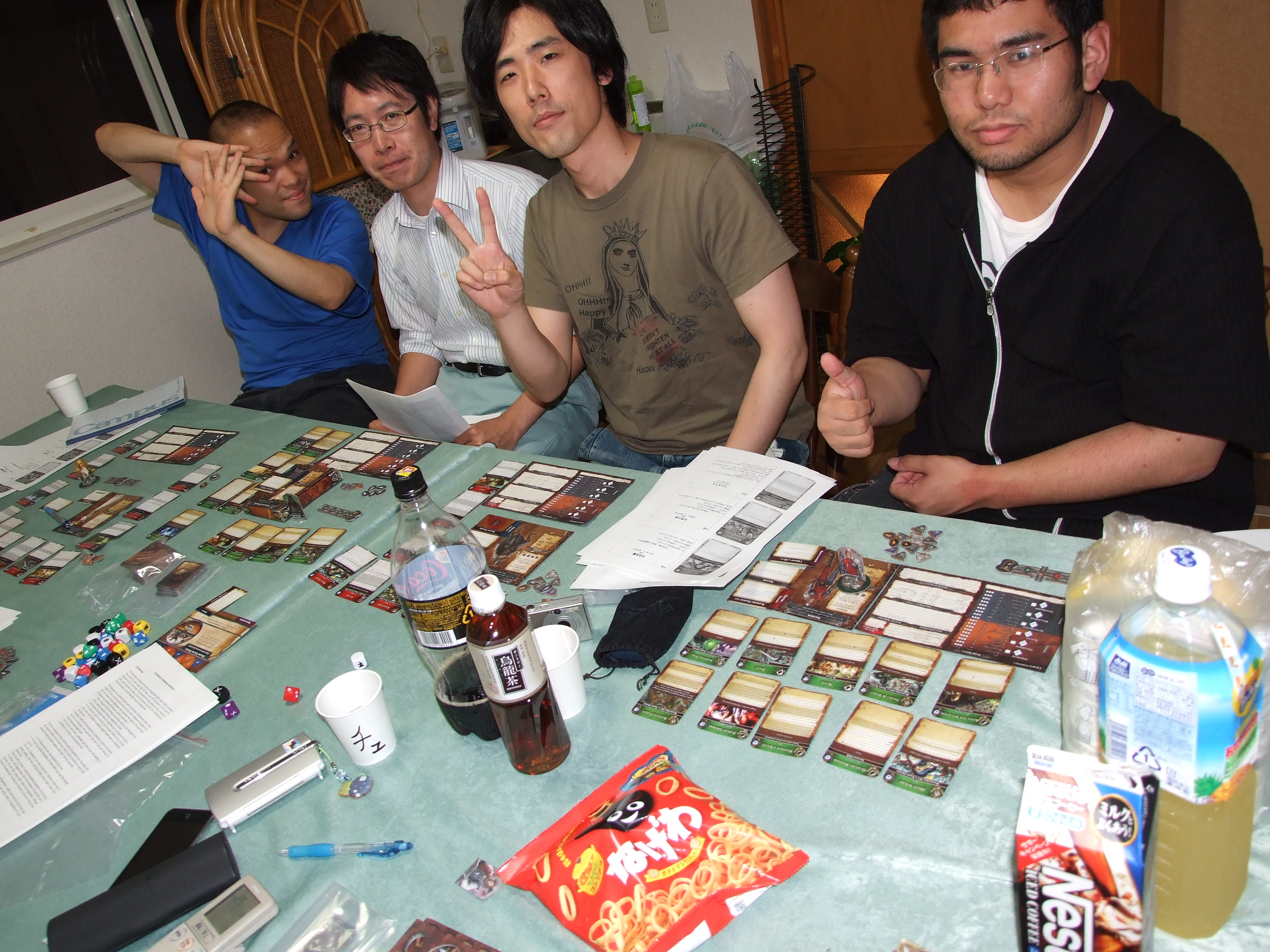
    The group Our group of Brash Young Fools is shown in the picture, from left to right – Mr. 123, Mr. Shuto, Mr. Ringtail (the shop owner) and Mr. Kaede. Mr. 123 has previously GMd Warhammer 2, using the Japanese version, so is very familiar with a lot of the world, and Mr. Ringtail is a big fan of warhammer wargames, which have been translated, so he’s familiar with the world too. Both Mr. Kaede and Mr. Shuto have played in Warhammer campaigns at least once, so the background didn’t have to be explained so much. The characters they played were:

    • Mr. 123: A 14 year old Initiate, called Suzette (a girl, related to the adventure he ran for me)
    • Mr. Shuto: An apprentice wizard
    • Mr. Ringtail: A thief
    • Mr. Kaede: A soldier

    It should be pretty obvious that these characters weren’t chosen randomly – I selected them to give maximum exposure to the rules, maybe not such a wise plan, since it meant a lot more language-related work (and rules-learning). We played on level 2 of the FLGS, and we were running a kind of introductory hack-and-slash that was going to run into a reason to play the adventure from the adventure book, An Eye for an Eye. I’ll give a game report separately. The language problem Unlike pathfinder, which involves a lot of transliterations and has an online wiki from which I can learn all the language I need, the tradition in warhammer is to give often quite prosaic Japanese translations to all the details. With so many careers, actions and talents at hand, this makes for some translation difficulties. The attributes, careers and skills are covered partially by Warhammer 2, which gives these translations (even bone-picker is translated!) However, the action cards and all the specific language of the progress meter, dice etc. I had to cobble together. I also had to find a way to explain all this. I bought the Japanese version of Warhammer 2 but it only arrived on the day of the game, so instead I had to make a lot of headway on preparatory work myself. I approached this in the haphazard way I approach all my Japanese language tasks, and basically it went like this:

    • I scanned in the reckless side of the action cards the players would be using, and inserted them into a word document with translations along the same structure on the same page (you can see an example in the photo).
    • I cobbled together language from the pathfinder wiki[1], and using JDIC and the only Japanese RPG I know, Double Cross 3, which meant that some of the work I did was a little off-beam, and some of the words I found unusual or archaic
    • I assumed that my players would be able to read some basic sentences, so we could work out the details of the differences between red and green cards as we went (this only created a problem once)
    • I did some pre-translation work for the players to read on my blog, with an example, here and here
    • All the key language I used I put into tables of words to distribute on the day (which I then only made one copy of, because I’m stupid)

    Based on this, I was able to give an explanation of the basic rules when we started, and leave the players to muddle through the cards without making too many suggestions. For the soldier and the thief it was pretty much plain sailing, but for the wizard and initiate it was harder, especially since I don’t know the spell rules very well and they aren’t … um… clear in the original document. Game flow Things were a bit slow at first, primarily because it took some time for people to work out what to do, and I had to check the odd rule (particularly about magic). The first opportunity at a skill check – getting a “dirty woman of unclear profession” to leave the thief alone after he was responsible for driving away her, ah, business associate – ended in disaster because Mr. Ringtail didn’t want to test out his guile skill; but then Mr. Kaede took on the leadership skill very well and constructed a skill check to influence their informant which he was well able to stunt – I added a few fortune dice to his roll, and everyone immediately became aware of the role-playing benefits of the dice system. They used this well later on, with the thief mimicking an animal, the wizard using a cantrip to confuse matters, and the soldier hiding ready to ambush the goblin they were luring. This was a great stunt, and also enabled me to use the fortune pool in the party sheet well. So in terms of grasping the broad concepts, the players caught on well. Mr. Kaede’s use of his soldier’s reckless cleave was good, and he grasped the details pretty quickly, as did Mr. 123, though sorting through all his Initiate’s cards was a bit of a challenge. The main challenges to flow came from establishing how to use magic, which seemed to involve a lot of different types of check with very little clarity about the order. I revised that today and will give the players a brief list of what they have to do to help with that. Otherwise, we managed to fit in all of the following in 4 hours:

    • rules explanation
    • adventure introduction
    • one incidental encounter with the woman of dubious profession
    • one social challenge to get information
    • one physical challenge, using a progress tracker to pursue a goblin scout (resolved well, at night, by the elven thief with the help of everyone else) followed by a brief and bloody end for the poor greenskin
    • two combats, the first an ambush outside the goblin lair, and the second a vicious bashing fest inside

    So even though things went quite slowly in individual encounter moments, overall the adventure fitted in quite a bit of material, and some really good role-playing opportunities. The players have taken home their action card explanation sheets, which they can study, and I’m going to forbid them from spending their advances on new actions or talents until they’re more familiar with the basics (and I have more time to translate cards!!!) Kaede san’s soldier certainly needs some more wounds anyway. Some final observations As I’ve noted before, Warhammer’s blend of dark fantasy and European realism seems to really appeal to the Japanese RPG sentiment, and everyone really got into the grotty winter world of Bogenhafen. They also seemed to appreciate the role-playing opportunities in the dice, which is good. We’re meeting again in two weeks. A few other notes:

    • The probabilities can be a  bit skewy. My goblin underlings concentrated fire equally on the soldier and the mage, and over 4 or 5 rounds they nearly killed the soldier but the mage was unharmed. That’s weird!
    • The rules are vague in places and sometimes I’m not sure whether I’m house-ruling well
    • I can’t tell how challenging an adventure will be, which is a problem I’m not used to. I need more experience with dice pools, but even then the unique mechanics of Warhammer 3 mean it will take some time before I know what’s going on
    • This game is cool! The dice give a lot of role-playing opportunities and the rules have liberated Warhammer from the two grinding problems that made Warhammer 2 so hard to enjoy: the inability of beginning PCs to actually do anything, and the intense, grinding tedium of the battles.

    I think my players agree with most of that, and are getting into the gaming quickly. I’ve got a feeling that the warhammer 3 system may be very well designed to encourage the type of GMing and gaming I prefer – loose adherence to rules, stunting of actions, descriptive content and encouragement of diversity in outcomes from individual rolls. It also has the kind of death spirals and critical-heavy combat system I like, without bogging it down in detail (as far as I can tell). I think it may also have resolved the issue of henchmen vs. main enemies. Both D&D 4 and Feng Shui have a system of henchmen (“mooks”) and main enemies, but the henchmen serve only to bog down and slow the game, rather than to add quickly-overcome challenges. In this session, at least, the henchmen were both a threat and easily killed, which is what henchmen should be. Game report to come. — fn1:The pathfinder wiki is useful because like most translations of foreign RPGs into Japanese it puts the English names next to important Japanese phrases (for things like skills and feats), so it makes it really easy to find the right word for the concept I’m looking for. I know Pathfinder well, so I know for example the difference between “proficient” and “specialised” and I can be confident that the translations in the wiki will be useful for me. Then I get around the problem of millions of kanji I don’t know very simply using rikaichan, which has to be the most useful software ever invented[2]. You wave your mouse over a word and it gives you the reading and the English translation, so then you can type it yourself. fn2: This has to be an example of the benefits of whatever licensing procedure is being used by the firefox team. I don’t like firefox much, but until someone comes up with a version of rikaichan for safari or chrome, I am only ever going to use firefox. This, I think, is why Windows is ubiquitous – for years the only functional spreadsheet was excel for windows, so windows spread through the corporate world regardless of its inherent crappiness. Excel is the best there is, and that’s all Microsoft needed.

  • How does he keep the hat on…?

    This post, third in a series describing my recent experience playing the Japanese role-playing game Double Cross 3, which I have been reading and recently had the chance to play-test, describes the character I played, Kintaro.

    Character Concept

    Kintaro, aka “The Noble,” is a pure-breed Black Dog syndrome male in his mid-20s, who works for the UGN company and hails from a wealthy family. He is a section chief at UGN, and like most Black Dog Overed, relies on physical strength and the power of lightning and storms to do battle. Black Dog powers don’t have much subtlety or information-gathering power. They smash and fry things. Kintaro’s work history is as a mecha-driver and engineer, using equipment similar to that seen in Aliens or Avatar.

    Statistics

    Kintaro’s stats are:

    • Physical: 6 (melee 4, resistance 1, Robot-driving 2)
    • Sense: 2
    • Spirit: 3 (Will 1)
    • Social: 1 (Provisions 2, Knowledge-UGN 1)

    Hit points: 35

    Effects

    Kintaro knows the following effects:

    • Resurrect (lvl 1): regain 1d10 Hps, but must have a corruption score below 100 to use
    • Warding (lvl 1): Turns non-overed NPCs into “extras” for the duration of a scene
    • Concentrate (lvl 2): Reduces the critical number required for any effect with which it is combined by the level of this power
    • Cyber Arm (lvl 3): Kintaro has a nasty-looking cyber arm that does bad stuff to bad people
    • Arms Link (lvl 2): Adds [lvl] in dice to Kintaro’s attack roll with his melee skill
    • Lightning Attack (lvl 2): Adds 2x[lvl] to Kintaro’s attack power (the damage he does with his attacks)
    • Shield of ball lightning (lvl 2): Adds 2x[lvl] to Kintaro’s guard value (for resisting damage)

    Kintaro has one power which he composed of a combination of 4 of these abilities.

    Strike of the thunder arm (雷腕の攻撃): Combining the Cyber arm, concentrate, Arms link and lightning attack effects, Kintaro can add 2 dice to his next attack, reduce the critical target from 10 to 8,  and increase the attack damage by 4. His total dice pool using this combination is 8, and he adds 10 to damage after rolling the damage dice resulting from his attack. A potent strike indeed!

    Life path

    I rolled for life path in the book, and obtained the following details:

    Origin

    A noble family.

    Experience

    A dangerous job.

    Encounter

    Old clients, perhaps people in the world of his dangerous job.

    Awakening

    Sacrifice

    Impulse

    Hate

    Lois

    From the above life-path details, we obtain Kintaro’s Lois:

    • His mother: Kintaro’s relationship with his mother is characterised by hostility
    • A client of his old work: This client is dead, and Kintaro honours his memory
    • Silk Spider: A UGN agent who values Kintaro’s happiness
    • Fellow Traveller: Kanamoto Saburota, one of the NPCs, whose relationship with Kintaro is characterised by “alienation.”
    • Domeki, a PC, in whom Kintaro sees much promise

    (The last two of these were generated for the adventure).

    Putting the threads together: Kintaro’s story

    Kintaro was born the youngest son of a wealthy family, inheritors of a network of nuclear power stations scattered across Japan. In his late teens Kintaro’s power began to manifest and his father, up until then a remote figure, began to draw him into the family business, rewarding his expression of super-power talents and slowly revealing their shared knowledge of the Black Dog skills. Perhaps proximity to the nuclear power plant induced this particular expression of the Renegade virus, but Kintaro’s powers were never strong, and ultimately his father despaired of him, tired of him, and became angry and hateful towards him. Somehow, Kintaro discovered that in fact his father was an agent of the False Hearts organisation, and confronting him with this knowledge, was offered the chance to join the organization by his father. He refused, and his father said terrible things about Kintaro’s weakness and lack of proper renegade manifestation. Kintaro, angered, suddenly manifested his full power and, in a burst of anger, set off such a cataclysm of electrical power that the power station in which their confrontation occurred collapsed around them. Kintaro, severely injured, fled his home and never returned. Somehow in the cataclysm his body fashioned itself a cyber arm from discarded pieces of the powerplant, and he left his home behind him.This explains the awakening of sacrifice.

    Showing an affinity for machines, Kintaro took up dangerous work as a robot operator, heavy machinery operator and ultimately mecha driver. In between he associated with Yakuza, Yanki, and all the dangerous elements of the underworld that surround jobs associated with hard physical labour. He had some confrontations with his mother during this time, but discovered she had always known about and tolerated her father’s secret contacts. Angered, he withdrew from his mother, though she constantly calls and contacts him, and disappeared for years into the simple world of hard labour. It was here that he met one of his Lois’s, the client of one of his companies, who was perhaps a yakuza boss or brothel-owner but was like a mentor for Kintaro, helping him to control his anger. This man died, perhaps in an encounter with people connected with the False Hearts.

    Eventually Kintaro’s occasional encounters with the False Hearts brought him to the attention of UGN, and they recruited him. Discovering the truth about the False Hearts and the plans his father had had – and his mother had tolerated – enabled Kintaro to find a new depth of hatred for this organisation and its fellow travellers, and this became his driving impulse. He threw himself into his work, becoming friends with the UGN contacts Silk Spider and Saburota, but his devotion to his work and dangerous manner alienated him from Saburota, so they trust one another but have awkward daily dealings. Kintaro took up working in a UGN mecha shop as his cover, but does a lot of agent work.

    Characteristics

    It should be clear from this description that Kintaro is a driven character, full of hatred for his enemies and impatience with those who cannot aid him. He is quick to anger and slow to forget, capable of bearing grudges against those he loves and who love him, and driven by personal demons and a strong sense of mission. Though he may not be stupid, he is clearly a man of action, unwilling to tolerate the niceties of diplomacy or social graces. People are a tool in his main goal, which is to avenge himself on and ultimately destroy the organisation which changed his life – the False Hearts. This probably suggests an equivocal view of his own powers, which he sacrificed much to gain, and possibly even a quite calculating view of his own employer. But one thing is certain – his mission is destruction, and he has the tools to carry it out.

    About the image

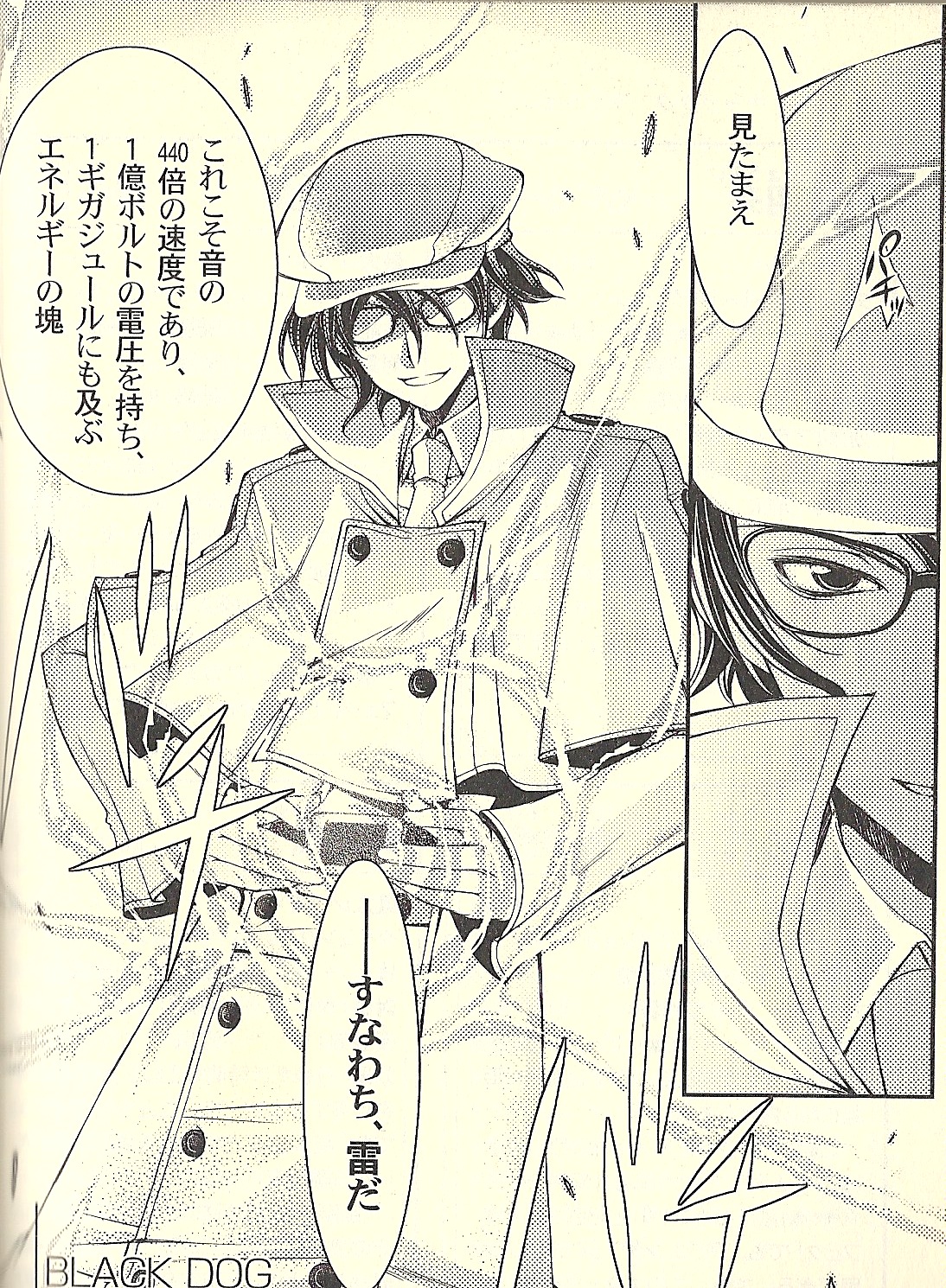
    The image is from the Black Dog chapter of the Double Cross rulebook. The inset panel says “before you look,” and the main panel says something like, “A bolt of energy that is surely 440 times the speed of sound, a million volts of power, and as much as a gigajoule of energy… that is to say, LIGHTNING.”

  • I’m not the first person to have considered the possibility that Paul the Octopus is the spawn of Cthulhu, based on his “remarkable” predictive powers. However, being unconvinced, I presented the possibility that he is not a normal octopus to my students last week, as an example of a basic non-parametric test (the runs test). I thought I’d present a couple of results here, and contemplate some of the complexities of hypothesis testing against a backdrop of crawling chaos.

    Introduction

    So the basic tale is that Paul predicted the outcome of 5 German games and then one Holland/Spain game successfully, and he had an 80% success rate in the European cup (4 games out of 5 predicted correctly). We will present some statistical tests of this situation, and finish up with a few discussion details.

    Aim

    To test whether or not the Oberhausen Sea Life aquarium is housing one of the gibbering dark ones from beyond time and space, or whether, in fact, Paul is just a normal octopus who happens to be lucky. Additionally, are the cult of the Ancient Ones who surround him actually a bunch of charlatans making money from our credulous belief in the crawling abominations of the netherworld? Should we sacrifice Paul, perhaps lightly-battered with a slice of lemon, for the good of all humanity; or should we accept his fundamental normality and get on with our lives safe in the knowledge that the Nameless Ones do not, in fact, inhabit our mortal realm?[1]

    Method

    We can posit the fundamental question as to Paul’s normality or infinite evil in terms of the null and alternative hypothesis of a non-parametric statistical test, as follows. Let the random variable X measure the outcome of Paul’s attempt to guess the result of the next Germany match. Then let X=1 if Paul is successful in his prediction, and X=0 if he fails. Define the probability that Paul successfully predicts a soccer match as p=P(X=1). Then, we can write the null and alternative hypotheses as:

    H0: Paul is a normal octopus (p=1/2)

    H1: Paul is a crawling abomination from the pits of hell (p>1/2)

    In this case we can test the possibility that p>1/2 by means of a runs test. That is, under the null hypothesis, is the chance that Paul would predict 5 games correctly in a row unusually low, such that we might reject the null hypothesis with some confidence? We will choose a confidence of 95% and reject the null hypothesis if the probability of 5 games predicted correctly in a row is less than 5%. Note that we are using a runs test here, requiring sequential successes; we might want to allow the possibility that he can make a mistake at any point in the process, in which case we are interested in the probability that he gets 5 games out of 5 correct in any order.

    This second test is important because in 2008 Paul predicted 4 games out of 5, for 80% accuracy. I’m not sure whether this happened sequentially or not, but it seems reasonable to suppose that his mistake could occur at any point in the chain of games, so then we need to calculate the probability of 4 games correct out of 5, in any order, and identify whether this is less than 5% (for a one-sided test), in order to reject the null hypothesis in favour of the terrible omens of destruction and chaos.

    Results

    So, the probability that he correctly predicts 5 games in a row under the null is (1/2)^5, because the predictions are independent events and the probability is thus the product of their separate probabilities. This gives a probability of 1/32=3%, or less than 5%. We reject the null hypothesis of normality, and conclude that in fact the Elder Gods stalk the (aquariums of the) Earth.

    However, the probability of 4 out of 5 correct in any order is (5 4) (1/2)^5 under the null hypothesis, where (5 4) is my crappy non-latex way of writing “5 choose 4”. This gives us 5/32=1/6=16% (approximately) so we retain the null hypothesis, that Paul is a normal octopus. Note the probability of 4 predictions in a row is 1/16 (exactly) or 6%,so no dice…

    So, we have contradictory results concerning the nature of evil. Having proven statistically that British people are idiots and the Australian government didn’t burn the house down, I’m a little disappointed at this mixed result. I’m sure no priest of Sigmar would accept such equivocation where the agents of chaos are concerned. What to do?

    Discussion

    We could combine the results of the two football matches, to get a total of 10 games with 9 correct results, but we don’t really have 10 games, because the 5 predictions of each series are correlated – Paul was a younger, and presumably less infinitely evil, octopus 2 years ago, and maybe had a different predictive method/ ritual, plus of course his cult followers were probably making different/smaller human sacrifices. So we need to consider the possibility that those 5 games are more similar to each other than they are to the next 5 games. Without any knowledge of the degree of correlation in the octopus’s predictions under the null hypothesis, we can’t make a judgement.

    There is also a question of inter-rater agreement here. It’s possible that Paul always goes for the same box, and the staff don’t randomly assign flags to boxes, or just by luck the Germany box is more likely to be on the side Paul favours. We should probably consider the randomization sequence of the boxes in some way. A variable for the side on which the box is placed, or better still random assignment of the flags to the boxes, would have solved this problem.

    But I think there is a more sinister trick at work here. We know that Germany are a strong team, and we know that Paul is lured into the boxes by mussels. So, since the staff can be confident that the German team will likely win most games, it is quite easy to rig the process by training Paul to prefer the German flag[2]. Remember that Octopi have strong colour vision and are very smart, so it could be possible to train a preference. Then, the probability of success in each predictive effort increases significantly. The Probability of success is P(Paul picks Germany and Germany win)+ P(Paul picks the opposition and Germany lose)=P(Paul picks Germany)*P(Germany win)+(1-P(Paul Picks Germany))*P(Germany lose), by the independence of the prediction and the outcome. But if P(Paul picks Germany)>1/2 and P(Germany win)>1/2, the total probability increases a lot. We know Germany won 3 games out of 5 this time around, so we could estimate P(Germany win)=0.6; if P(Paul picks Germany)=0.8, then we have the total p=0.8*0.6+0.4*0.2=0.56, p>1/2. If Germany’s win probability is really 0.8 (because Serbia were a pack of cheating bastards), then the probability increases to p=0.68.

    Of course, because Germany win most games and Paul predicts they win most games, the actual fact that Paul is going to pick Germany more often anyway gets missed.

    A final couple of notes. First, in this analysis[3], I have ignored the Holland/Spain prediction, because I read somewhere that Paul used to only predict on games involving Germany. This means that the Holland/Spain game is well outside the range of data on which the predictive model is based, and we shouldn’t assume it represents the same underlying probability structure or process (or manifestation of ultimate evil). So I’ve excluded this observation from my data set.

    Secondly, it’s worth bearing in mind that statisticians should never, ever use statistical tests to test theoretically implausible events[4]. Because there is a small chance of type 1 error (rejecting the null hypothesis when the null is true), as soon as you apply a statistical test to a ridiculously implausible theory, you open the risk that you will prove it to be “true” by mistake. So all that is required to prove the existence of God is for some nong to conduct a statistical test of an apparent “miracle” that is really just a carefully trained Octopus, get a spurious result, and before you know it you have people worshipping his tentacly appendages.

    Conclusion

    Two non-parametric statistical tests have produced inconclusive results as to whether or not the shambling horrors of cthulhu walk among us, predicting our soccer matches. However, the test that rejected the null hypothesis was borderline, and consistent with the possibility that Paul has been trained to pick the German flag more often than other flags, thus ensuring increased predictive success and a high likelihood of a run of successful predictions, provided that Germany remain a strong team. This report concludes that Paul should probably not be burnt at the stake (or grilled) as a heretic, tentacled avatar of the brooding darkness; but it might be worthwhile to monitor him, his aquarium shrine, and the Cult that surround him, for further signs of the manifestations of chaos and, if witnessed, liquidate them and extirpate their teachings from the annals of history in the interests of the human race.

    Update: Looking at the Wikipedia entry on our dark and tentacled oppressor, I note that actually he got 7 out of 7 results correct in this world cup, and only 4 out of 6 in the European cup. This doesn’t change the conclusion of our runs test (which simply becomes an even more powerful indication of his brooding and ultimate evil), but it makes his success rate in the European cup look even more merely mortal. Also the wikipedia entry correctly points out that in the group games there is a chance of a draw, so what we actually have here is a sequence of multinomial events with probability 1/3 of three outcomes in the first 3 tests, then 1/2 of two outcomes in the remainder (under the null). We would need to adjust the probabilities accordingly, for both the runs and the binomial test. This actually makes the binomial test a bit fiddly, but my guess is that it reduces the p-value slightly (due to the probabilities of success being lower). I think the wikipedia entry is slightly wrong on the odds of “at least 12 successes in 14 trials” due to the issue of correlation (as mentioned above)[5].

    fn1: yet

    fn2: My suspicion is that they ran a series of dummy runs with Paul before the cup, and either gave him a second mussel when he picked Germany, and/or sacrificed a virgin and offered her blood to the elder gods to enhance his magical powers; statistical testing seems to suggest the former was the case, but we can never be sure…

    fn3: and I do use the term loosely

    fn4: this applies to the kids at home too, obviously

    fn5: also, has anyone else noticed that the wikipedia entry on the ecological fallacy confuses confounding and the ecological fallacy? At least, I thought it did last time I read it.

  • … and I will give you the world cup winning team[1]. This from the Spanish coach, in support of my comments about the demise of European soccer. I wonder if Holland has a similar approach? At the end of this article the Spanish coach mentions that the Germans developed the same approach to fostering young talent, but that Spain have been doing it longer.

    This is similar in aspect to the remarkable phenomenon of the UK doing better than Australia in the 2008 Olympics. This was a direct result of money being poured into elite sports in preparation for 2012, and will undoubtedly be repeated in London.

    But, lest one think that this makes for better sportspeople… the guardian had a graphic showing the most successful teams by GDP, and they largely weren’t from rich nations. But I can’t find it anymore.

    Incidentally, my kick-boxing gym is training children as young as (my guess) 5 years old, and it’s very, very cute (you can see them in the third picture)… the teacher was trained in Thailand, and I wonder if he’s thinking of a Thai model for developing fighters – get them at 5 and make it their life. There’s an 8 or 10 year old boy (on the right in the pic) who is ferociously good, though apparently he bottles it a bit during fights. But it will be interesting to see the results when they’re adults…

    fn1: yes, yes, I know, it’s premature. But the Octopus said so.

  • In my previous post about playing this game on Sunday, I mentioned that we used a type of module called “Scenario Craft,” in which every element of the module except a vague skeleton of the plot is random. This post gives a little more detail about the scenario craft process.

    The book

    The scenario craft book we used was called “Public Enemy” and can be viewed here (Japanese). I’m not sure what the background to this module is, but it contained some expansion information for the game, some new NPCs, and the website indicates it has information on the history and development of the False Hearts organisation, which is the evil underworld for crazy superheroes. I didn’t see much of the module book itself, since the GM was using it a lot. The book presents 4 types of adventure based around interaction with this organisation.

    The basic idea

    The basic idea of the Scenario Craft plan appears to be that the adventures are built collaboratively by the GM and players, through some outline decisions and choice of scenario that the players and GM decide on together, followed by a kind of collaborative decision-making process about some aspects of the PCs that are required to fit the adventure. After this, the players and the GM between them roll up all aspects of the main NPCs, including the bad guy, so we all know what we’re up against and its relationship to the party. The remainder of the adventure plays out through a semi-structured flow chart of action, and a lot of random events, clues and conflicts rolled up during the different stages of the adventure.

    The scenario choices

    The scenario choices are presented as a vague outline idea, and each scenario choice affects the structure of the action flow chart, the nature of the adversaries/NPCs, and the random tables on which the action is determined. We were presented with 4 possibilities, but I can’t remember the other 3. The one we chose was “Everyday life should be protected” (mamoru beki nichijou, 守るべき日常). The outline idea was that someone in the False Heart organisation was about to find a way to reveal the virus infecting our superheroes, and we need to find a way to stop it.

    Scenario plots

    Each scenario comes with its own plot, which is very broadly outlined. Here is ours:

    The “cooperating NPC” approaches the PCs to tell them he thinks that his underling, the “Rival NPC,” has joined the False Hearts. Simultaneously, the “Heroine NPC” tells one of the players (with whom she has a close relationship) that she is worried about her friend, the “Rival NPC.” The PCs agree to find the “Rival NPC” and bring him back to UGN for questioning.

    That’s it. These NPCs are worked into our characters’ lives through a very simple plot mechanism, the Lois (see later).

    The action flow chart

    Almost all of the adventuring is constrained to two pages of the book. The right-hand page contains necessary tables for randomly generating everything, and the left hand page contains some outline information and a flow chart which breaks the adventure down into 5 main scenes. The scenes are:

    • PC Opening, 4 separate subscenes in which each PC appears briefly to have their intro to the adventure explained
    • Grand Opening, in which the four PCs join together to determine their attitude to the adventure
    • Middle Phase, in which the majority of the adventure happens
    • Climax, in which the PCs get in a big fat fight
    • Flashback, in which the PCs attempt to return to normal life and shed the corruption of the adventure, get XPs, etc.

    The main action happens in the middle phase, which is divided up into separate stages in the flow chart. These stages may or may not be sequential or conditional (I think in our case they were sequential). Our main stage within the Middle Phase was “Research Event,” in which we did investigative stuff which triggered encounters.

    This action flow chart provides the GM with a structure around which to hang an actual adventure, just like in any normal module, but it really only provides an outline from which to hang all the random tables.The Middle Phase here is also set up to include a lot of random variation in how long and diverse it is, how many encounters there are, and what they are, through the use of a progress tracker.

    The progress tracker

    The progress tracker seems very similar to the method of Warhammer 3rd edition for resolving drawn-out challenged tasks. Basically, the GM sets a target number of “successes” for some investigative or challenged action occurring in the Middle Phase. Every day, the PCs set about resolving this action, using some kind of skill check (we used our social skill for information gathering). We have to accrue a certain number of successes before we can proceed to the next section, and can only get one each a day. Every day we adventure trying to gain these successes we incur a d10 of corruption points and a risk of a minor encounter, which we will win at the cost of further corruption points. Corruption points make us more powerful in battle but also drag us closer to becoming irredeemably infected (“germs”) and at risk of having to burn all our social contacts to drag ourselves back to reality, so rapid progress up the tracker is a good thing.

    There is a separate progress tracker for “prize points,” which are bonusses gained from very high skill rolls. These prize points are rolled randomly on a table, and are essentially hints as to the nature of the problem we are trying to solve. More prize points makes it easier for us to find the correct solution and progress along the tracker to the next stage, i.e. ideally they will help us choose a way of solving the problem which gives bonusses to our rolls, increases our combined successes, and kicks us along the tracker. In fact, this didn’t happen in our game because our GM was a little weak in this regard, but the idea is solid I think. At the end, if you get to the end of the progress tracker, you learn the solution to the problem and go to the next stage (though I presume the GM can short circuit the tracker if the players solve the problem).

    I like this because a) it gives an idea of how long the task takes to solve, and solving the task quickly is useful, b) the prize points thing can be used to give XP rewards – particularly if creative thinking gives players bonusses on their rolls and thus more prize points and c) if the PCs are having success in the tasks but the players just aren’t thinking the problem through, the GM has a trigger point at which to allow the skill rolls to determine the outcome, and stop the game getting bogged down because the players just can’t figure it out (or the GM can’t explain it).

    Choosing the NPCs

    We chose the NPCs by rolling, together, the details of their relationships to us, their appearance, name, their goals, and pretty much every other aspect of their personality except their stats and powers (which were either already chosen, or secretly rolled by the GM). There’s no reason these couldn’t be rolled too, I suppose. But then, would you even need a GM? We also had to choose a PC to be linked to the Heroine NPC and the Cooperative NPC, which was done semi-randomly (scissor-paper-stone). These relationships are a really important part of Double Cross 3, and being able to choose even relationships with NPCs and enemies is interesting too. Especially when you burn them for an extra 10 dice in your attack pool.

    Random tables and the progress of the adventure

    The random tables included information about where we went to do our research into what the Rival PC was up to. Every day we did research, we rolled up a possible encounter, so on the third day we stumbled into an area that had been “warded” by False Hearts agents, and on other days nothing happened. There were also random tables for where we finally confronted the boss guy, and I think our adversaries in non-boss encounters may have been randomly generated too. Also, the “prize points” were randomly generated, only we kept generating the same two prize points, until we reached the end of the progress track.

    Reaching the end of the progress tracker showed up one of the big flaws of any kind of randomized adventure scheme, because our GM wasn’t up to the task of wrapping up all the random encounters into an information package from which we could extract the clues we needed, so he ended up just kind of … handing us the information we needed. This is a good aspect of the progress track if the failure to draw a conclusion is the players’ fault, since we incur a corruption cost but don’t fail the adventure; but if it’s the GM’s fault it leaves you feeling like you didn’t succeed in the adventure. I don’t think there’s a way around this aspect of randomized gaming, except to have adventures without a plot or a conclusion. The progress tracker at least gives the GM a trigger at which to get rid of the investigative phase of the adventure and get to the finish.

    Conclusions

    I like this schema for mostly-randomized adventures, and the layout of the module was such that it was very easy for the GM to run the whole game collaboratively with us without giving away any details early, or getting too confused. It was fun generating our own adventure as we went, but it was also frustrating when it wasn’t tied together properly and we just skipped from progress track to ending, a problem I’ve always had with adventures that aren’t fully prepared by the GM beforehand. in truth this can happen with traditional modules that have been badly designed, or with work that a GM does by him/herself. I think when a GM writes their own adventure they tend to go through a wider range of scenarios in their head, and know the plan better, so that they are more flexible at adapting to player stupidity/their own gaffes. GM-written adventures are hardly immune to the problem though.

    In general the Double Cross stuff I’ve seen so far has been very well laid out and clear, and they’re fond of very easily understood flowcharts and diagrams. I think that this is a strength of this adventure setting too, and a lot of careful thought has gone into making these modules playable on the fly. Also, of course, they’re ideally suited to day-long conventions.

  • Prophetic, even…

    I don’t usually open up this blog to political debate, but my only commenter has been challenging me over the “incompetence” of the Australian Home Insulation Program recently, so I thought I’d try my statistical skills at investigating it, given that I’ve already used them so effectively to prove that all British people are ignorant. In this post I’m going to analyse the rate of fires occurring in houses before the advent of the Home Insulation Program, and after, and show that under a wide range of assumptions (some realistic, some unrealistic), the Insulation Program probably led to a reduction in the rate of house fires after newly-installed insulation relative to the time before its implementation. I will also attempt to give some explanations for this. This builds heavily on the work of Possum at Crikey, but with the addition of a time-dependent element to the analysis, a wider range of assumptions (within which Possum’s are special cases), and a bit of risk analysis. This isn’t to say Possum can’t do such things, but he/she didn’t, and since the linked analysis the Coalition have released new figures showing that the program is “even worse” than previously believed.

    Introduction (skip if you’re Australian)

    For my foreign reader(s), it may be a little puzzling that I’m diverting from discussion of Double Cross 3 to a relatively trivial statistical analysis of something as tedious as home insulation in Australia. In 2007 the Australian government changed after 11 years to become a Labor Government (left wing by standard definitions), and its response to the Global Financial Crisis (GFC) was to introduce a bunch of Keynesian pump-priming, including the Home Insulation Program (HIP). The then government became the opposition Coalition, and ran a heavy campaign against the pump-priming under its ludicrously maniacal leader, a failed monk called (appropriately) Tony Abbott. Their campaign relies heavily on accusations of wasteful spending and inefficiency, and they attacked all aspects of the government’s programs.

    The HIP was intended to provide householders money to install installation in their home, generally through the use of contractors, whose numbers exploded overnight. The Coalition quickly realised that post-insulated homes have a heightened fire risk, and started making hay out of the fact that there were lots of insulation-related fires. They just didn’t mention that there have always been insulation-related house fires in Australia, and Possum’s analysis above was the first anyone has seen (as far as I’m aware) that compares pre- and post-HIP rates of fires. The central Coalition claim – that the government endangered householders through its poorly-run program – depends on the assumption that rates of house fires went up, since these insulation installations were a choice people made, so if the rate stayed the same there is no argument[1].

    Method

    Numbers of fires before the HIP, and numbers of installations per year before and after the HIP, along with total numbers of houses already with insulation installed, were obtained from the ABS and the Federal Government via the above-linked Possum post. The number of post-HIP fires was helpfully provided by Coalition press-release today[2]. Details of the length of time the HIP was running and some other minor figures were obtained from the Department Secretary’s statement linked to by Possum at http://blogs.crikey.com.au/pollytics/files/2010/02/Secretarys-opening-statement-220210.pdf.

    The number of fires was converted into a rate of fires per insulated house-year. That is, a single house that was insulated for a full year was considered to contribute 1 insulated house-year (IHY) to the risk pool, and the rate was presented as a rate of fires per 1000 IHY. The number of IHY was calculated under a set of analysis cases.

    Case 1: All fires were caused by insulation installations in the year that the fire was recorded, and all such installations happened in the first day of that year, contributing a full IHY to the period of the study.

    Case 2: All fires were caused by insulation installations in the year that the fire was recorded, but the installations occurred smoothly over the year. If there were N installations in the period, then 1/365 of these occurred in the first day of the year, 1/365 in the second, and so on. This means that N/365 installations contributed 1 IHY to the risk pool, N/365 contributed 364/365 IHY to the risk pool, and so on.

    Case 3: All installations from before the HIP were assumed to have an equal risk of a fire, so that every insulated house in Australia before the HIP was in the risk pool for one full year; these houses were also in the risk pool for the post-HIP period.

    Case 4: An exponential rate of decay of risk was assumed over years, so that the risk of a fire decayed by exp(alpha) for every year since the installation. So in year 0, all houses contributed to the risk pool; in year 1, exp(alpha) houses, and so on. alpha was chosen for this case so that 25% of houses in year 1 contribute to the risk (but we will also present some sensitivity analysis).

    Case 5: Information from the Secretary’s letter was used to identify the total pool of risk post-HIP, and compared to the year before the HIP under the conditions of case 1 (a full year’s risk). Under this case, the post-HIP period was assumed to be 15 months long. 176000 homes were installed in November 2009, 3300 in March 2009, and the remainder were assumed to be installed in between these periods, at an arbitrary point assumed to be September 2009.

    As an additional note: Cases 1 to 4 were calculated based on a silly piece of rhetoric from the Coalition, which claimed that “reported house fires from her [Julia Gilllard’s] program [are] still running at around one a day.” There were 191 fires post-HIP in the same press release, so the Coalition seem to think the post-HIP period was only 200 days, when in fact it’s 15 months. However, assuming the 200 day period benefits the Coalition in this analysis, since a shorter post-HIP period means a smaller risk pool and thus a higher rate of fires. This is conservative statistics at its best (literally!).

    Headline figures

    The headline figures used here are:

    Pre-HIP fires: 85

    Pre-HIP installations per year: 70000

    Houses insulated pre-HIP: 3183625

    Post-HIP fires: 189

    Houses insulated post-HIP: 1100000 (1.1 million)

    Post-HIP period: 200 days (15 months in case 6).

    Results

    Case 1:Assuming fires occur due to installations in the year of the fire only, and all installations at the first day of the year

    This gives us 85 fires in 70,000 IHY pre-HIP, and 189 fires in 1100000 IHY post-HIP.

    Rate of fires pre-HIP: 1.21 per 1000 IHY

    Rate of fires post-HIP: 0.31 per 1000 IHY

    Relative risk of a house fire post-HIP vs. pre-HIP: 0.26

    Case 2: Assuming fires occur due to installations in the year of the fire only, but installations are evenly distributed over the year

    This gives 85 fires in 35095 IHY pre-HIP, and 189 fires in 165959 IHY post-HIP.

    Rate of fires pre-HIP: 2.42 per 1000 IHY

    Rate of fires post-HIP: 1.14 per 1000 IHY

    Relative risk of fire post-HIP vs. pre-HIP: 0.47

    Case 3:Fires in a given year are due to any house ever insulated up until that point; all post-HIP insulations occurred in the start of the year

    This gives 85 fires in 3183625 IHY pre-HIP, and 189 fires in 3786364 IHY post-HIP.

    Rate of fires pre-HIP: 0.027 per 1000 IHY

    Rate of fires post-HIP: 0.050 per 1000 IHY

    Relative risk of fire post-HIP vs. pre-HIP: 1.87

    Case 4: Assume exponential decay of risk, all installations post-HIP at the start of the period

    Assuming a exp(-0.3)% decay in risk per year, this gives 85 fires in 270,080 IHY pre-HIP, and 189 fires in 802820 IHY post-HIP. In this model we assume 70000 houses a year were insulated over 46 years until the start of the HIP period, when 1.1 million more were insulated in 200 days.

    Rate of fires pre-HIP: 0.31 per 1000 IHY

    Rate of fires post-HIP: 0.24 per 1000 IHY

    Relative risk of fire post-HIP vs. pre-HIP: 0.74

    This case can be modified to incorporate the assumptions of case 2 or 5 about the distribution of installations post-HIP (smooth over the period or end-loaded), but it likely won’t make much difference, since in this case large amounts of the risk pool come from previous years of data, which are the same for both the pre-HIP and post-HIP installations.

    Case 5: Using the departments figures to approximate the risk pool post-HIP

    We can do this using the assumptions of Case 1 or Case 2 for the pre-HIP risk pool. Case 1 is more favourable to the Coalition, so we use that one.

    This gives 85 fires in 70,000 IHY pre-HIP, and 189 in 829792 post-HIP.

    Rate of fires pre-HIP: 1.21 per 1000 IHY

    Rate of fires post-HIP: 0.23 per 1000 IHY

    Relative risk of fire post-HIP vs. pre-HIP: 0.19

    Sensitivity analysis of the exponentially decaying risk

    The analysis that is most consistent with any kind of modern frailty or risk analysis is case 4, where the most at-risk houses are assumed to go up soonest. That is, the bodgiest ones burn first. The model I have used above assumes that, effectively, the risk of a fire decays at a rate of exp(alpha*year)% , so in the year of its installation a house contributes 100% to the risk pool, but in the next year it contributes only exp(alpha)%, and then exp(2alpha)%, and so on. We can change this rate by fiddling with alpha. I’ve fixed alpha in the assumption at -0.3, which means the year after installation a house contributes 75% to the risk pool, then 58% and so on. We can fiddle with these figures to estimate the decay rate of risk at which the pre-HIP and post-HIP rates of fire would be equal. It’s actually alpha=-0.175, which corresponds to 83% of the risk transferring from the first year after installation, 70% from the 3rd year, and 17% from the 10th year. Note that case 4, where all houses are assumed to contribute equally to the risk pool no matter when they were built, corresponds with alpha=0, and represents the maximum relative risk of a fire that could occur under any assumptions for the post-HIP period.

    I don’t think it’s reasonable to assume that houses insulated 10 years ago are still significantly contributing to the risk of fires today, and I think in fact a decay to almost no contribution over 3 or 5 years is better; hence my choice of -0.3 for alpha. I think everyone would agree that alpha is likely to be between -0.3 and 0, but the 0 assumption is silly. If we fix alpha at between -0.3 and -0.15, the highest Relative Risk of fires for the post-HIP period vs. the pre-HIP period is 1.07. This is a meaningless increase in risk, but it corresponds to houses from 10 years ago still contributing 22% to the risk pool[3].

    This sensitivity analysis suggest to me that there is no sense in which the HIP has increased the risk of house fires; in fact, it has decreased the risk of house fires. I should note though that I’m no expert on risk analysis, though I’m good at survival/frailty analysis. So someone else could probably handle this better.

    Discussion

    It’s easy to imagine that an increase in risk of house fires is inevitable with an expansion of a program that, individually, carries a risk of house fires. But it’s not actually a contradictory finding when considered in light of other types of risk we are familiar with in our lives. It is often the case that the more an activity is performed, the more accurately and efficiently it is performed. Contrary to the claims of the Coalition that the HIP has unleashed an army of “cowboy contractors” risking the lives of ordinary Australians, what may actually have happened is a three-fold reduction in the main risk factors of fires, specifically:

    1. Homeowners are less likely to do it themselves, and this is probably the single biggest risk factor for insulation-related fires
    2. Where previously insulation was installed by general builders on an occasional basis, we now have an army of dedicated installers. Though their initial efforts may have been bodgy, the scale of their work – repeatedly doing the same installations for months – may have led to a significant improvement in the quality of installations. We see this with hospitals, where error rates reduce significantly as the number of operations performed increases, and transport, where professional drivers have much lower rates of accidents due to experience. Specialisation is a key way of reducing error-rates, and the HIP may have led to a massive increase in the specialist workforce[4]
    3. If it’s true that this program is “throwing money” at these contractors, with all the associated inefficiency and waste, presumably their profit margins are much higher than used to be the case for insulation installers. So with higher profit margins, maybe there is actually an increased incentive for them to use higher-quality materials, not cut corners, and actually do the job better – particularly if a quality job leads to referrals, and easier business. In this case these people, in addition to becoming very efficient at the work they do, might actually be doing it to a higher standard of care than was previously the case[5]

    My money is on 2) as the cause, in this case, of a possibly quite significant reduction in the risk of fires due to insulation installations in Australia.

    Conclusion

    This report has found that under a wide range of conditions, including a general model of risk relating existing and new installations of insulation, the HIP likely led to a reduction in the rate of house fires in Australia. The relative risk of house fire after the HIP compared to before was probably about 0.75, though it may have been as low as 0.2. The highest possible relative risk that can be realistically obtained under any set of assumptions appears to be about 1.05, which represents a level of risk broadly similar to that existing before the HIP was introduced. The findings of reduced risk apply even when using the Coalition’s stated estimate of the post-HIP period as 200 days, which approximately doubles the post-HIP rate of fires.

    In addition to reducing recipients’ electricity costs, the HIP has reduced the risk of fires in most homes compared to insulation installations done under the pre-HIP program. The most likely explanation for this reduction in risk is the increased specialization of the installers and the scale of their work; but there may also be a contribution due to reductions in poorly-installed home DIY jobs, and also the purported high profit margins of the work may inspire the use of higher-quality materials. Regardless of the explanation, the statistics do not appear to support Coalition claims of reckless endangerment of human life due to the HIP.

    fn1: of course this Coalition campaign flounders a bit on the fact that it’s private contractors doing the work, and they love encouraging private contractors, so if the contractors did lead to an increase in fires, there is a bit of a credibility problem for subsequent arguments in favour of private sector contractors doing government services cheaper than the state can.

    fn2: This is High Science we’re doing here, kiddies

    fn3:Finally note that the three scenarios assumed by Possum in his/her modelling fit into the risk model presented here. Scenario 3 (90% of fires from existing stock) corresponds to a value of alpha=-0.1, while Scenario 1 (10% of fires from existing stock) corresponds to alpha=-2.2. Both of these values are, in my view, outside the reasonable range of values we can assign to the relative mix of risks from existing and new stock, but obviously this is just a matter of opinion.

    fn4: This could have negative ramifications for the employment rate when the scheme stops and a bunch of insulation specialists have to find new work, I suppose

    fn5: I remember a hospital I once worked in did the whole “lowest cost bid” thing for some wiring, and employed a bunch of unqualified building contractors to lay down the ethernet cables. The result was fire and electricity risks, and a network that didn’t work. A year or two later, when a state government renewal project was launched in our area, the project managers visited our hospital and were appalled at the quality of work. They told me that in the early dotcom boom lots of building contractors switched to computer infrastructure jobs like this, and offered bodgy jobs done dirt cheap to people who didn’t know any better. It’s not necessarily the case that a process aimed at driving down bidding prices and ruthless competition will increase quality, especially in a newly-growing industry where the standards aren’t well understood and the job is being commissioned by non-experts

  • At this month’s Oita Evil Spirts Konkon convention, I got a chance to play in a session of Double Cross 3 (DX3), which is the Japanese RPG I’ve been putting up information about here. This was my first (and only?!) chance to play this game, and so even though I was sorely tempted to join in a Japanese Old School D&D session, I took it. This proved to be a good plan, since it was in the DX 3 adventure where all the sandboxing was happening.

    A few outline notes

    We completed character creation and a full adventure in the single session, which lasted from 10:30 to 18:30. The game we played used Rule Book 1 (which I have), Rule Book 2 (which I don’t) and some additional information from the Advanced Rules in combination with a module book called “Public Enemies,” which is based on a mechanism the DX3 company, FEAR, appear to have pioneered, called Scenario Craft. There were 4 players – 2 women and 2 men – and the GM. We were playing characters with a little bit of experience, so we didn’t start entirely fresh-faced; but three of the players were beginners, and one very experienced. I will talk about Scenario Craft separately, but essentially it’s a way of introducing as much randomness as possible to the strict structure of a module format. We rolled up every aspect of this game except our characters (though we rolled up a lot of them too!)

    The Characters

    The players and characters were:

    • Handleless Mr. Mutabe, who played Rugaru, a High School student with the Chimaera power
    • Ms. Furudera, with whom I’ve played a few times, who played Watermelon (that’s the codename), a High School student with the cross-breed Orcus/Salamandra powers
    • Ms. Ryo, who played Doumeki Rin, a Housewife with combined powers of Orcus and Solaris
    • Me, playing Kintaro “The Noble,” a Section Head in the UGN organisation whose cover is Robot Engineering (i.e., Mecha) and who is a purebreed Black Dog (electricity) user

    I’ll put up the details of my character later. I had 3 Lois’s at the start of the game: My mother, the memory of a dead client from back in my Robot driving days, and Silk Spider, a UGN agent. I also had to choose an NPC as a Lois. There are 3 NPCs in this adventure, and I chose the NPC who cooperates with us as my Lois. Now that I’ve played, I understand the whole Lois/Titus thing better and will explain its effects in practice later.

    The story

    The cooperative NPC, Kanamoto Saburota, my Lois, is a doctor within UGN who has failed to realise his true purpose in life, but loves collecting information and learning things. He aims to nurture and support the PCs, but his serious and gentle character is hidden behind a cheap, gaudy exterior – this is a doctor who wears Hawaiian shirts and cheap jewellery. He approached Kintaro, his Lois, to tell him that he thinks his underling, a UGN agent called Hasebe Kappei, has joined the False Hearts and is working as their agent in my area. Simultaneously, the Heroine of the story, Kano Kasumi, approached Rugaru to tell him she was afraid for Hasebe, who had gone missing. The characters convene at Kintaro’s mecha workshop, and decide to find Hasebe.

    Kano Kasumi, the heroine, is also a High School student. She is a mere slip of a girl, described in the book as being “in every way like a fairy in appearance” (we rolled this randomly). I take this to mean she’s tiny, thin, birdlike, with elaborate and complex eye makeup, fake eyelashes, nails, and glitter and colour wherever she can put it. Definitely thick white knee-socks and lots of cellphone straps. I didn’t write down the details of her relationship with Rugaru, but I think it might have been brotherly love. Kasumi is in every way ordinary – but she’s guessed that Rugaru is not ordinary (must be the Wolverine-style claws and powerful physique that gave it away; or maybe it was his 21 Jump Street style not-really-high-school-age look?)

    Saburota Kappei is another High School student, described in the book as being “so gigantic in physique as to be almost entirely unusual,” and having a relationship to Watermelon that I also failed to write down (along with Watermelon’s proper name). Anyway, he’s going to be our enemy, so his personality matters not a whit[1].

    So, having identified the threat (the big guy) and the goal (protect the chick), we move into the “middle phase” of scenario craft, which is primarily the “Research Event.” Every day we went information-gathering to find out where Kappei might be, and rolled up random events. Kintaro mostly worked his UGN contacts, Watermelon and Domeki did the whole computer intel thing, and our wolverine-y Rugaru did the streetwise gossip thing. The GM was keeping some kind of progress tracker a la Warhammer 3, with a certain number of successful checks required for us to meet our goal. There was a lot of incentive for us to get these successes early, because every day spent researching increased the risk of an encounter with False Heart agents, and every day we researched we also had to add 1d10 to our corruption level. Corruption level determines the risk that you’ll go native, turn into a Germ, and become an NPC on a rampage. You finish an adventure on a certain level of corruption, and there’s only so much you can recover, so efficient resolution of scenes is important if you want your character to last a long time and not have to be hunted down by your mates and put down like a dog.

    During the research phase, we discovered rumours that if we stick around near Kasumi, something’s bound to happen; and we also worked out pretty fast that Kappei is a False Heart. Then, suddenly, Kasumi manifested as an Overed (infected with the virus we have), and had to be hospitalized. At this point we moved on to the climax.

    In fact, before we could finally work out where kappei was, we ran into an area that had been warded by False Hearts thugs, and when Watermelon worked out that they were doing this, we had to have a fight with them.

    False Hearts Encounter: My first DX3 Fight

    So, there were four of them, two who attacked with darts formed from their own hair, and had bodies covered with spikes; and two who were using some sort of disruptive light-flash attack. I charged straight into battle using my patented Thunder Arm combination, and Rugaru sprouted talons like scimitars and leapt to join me using his Child of the Supreme Wolf combination (that’s a lyrical interpretation – there was a word I couldn’t read in the combo name, but it was something about a wolf-child, so bugger it, there you go). Combat was slow because we were learning, but in essence everything was over fast. The sequence of events was something like this:

    • Round 1: thorny guys attack with a flurry of darts, everyone takes half their HPs in damage
    • Round 1: the two girls in our group cast disruptive attacks on the False Heart light-wave kids, knocking them into a dazed bad status effect, and keeping them out of the battle
    • Round 1: I charge into the first thorny guy, turn him into a human battery with a powerful smash in the face and blast of lightning, and he nearly dies
    • Round 1: Rugaru charges into the other thorny guy, and tears him nearly limb-from-limb (both thorn guys are nearly dead)
    • Round 2: Thorny guy 1 hits me, killing me. I use my resurrect power to regain 8 hps at the expense of 8 corruption, and come roaring back from the dead
    • Round 2: Thorny guy 2 hits Rugaru, nearly killing him
    • Round 2: Domeki heals me for another 13 or so hit points, so I’m back just past halfway
    • Round 2: Watermelon destroys one of the dazzly-light kids
    • Round 2: I fry my guy while punching his face out the back of his head
    • Round 2: Rugaru dismembers his thorny guy
    • Round 3: I turn the remaining dazzly-light guy into a flesh-based capacitor, fight over

    So, 3 rounds, 4 people vs. 4 people, one of us died once but used the DX3 version of a healing surge, and now we’re all up near 70 or 80 corruption risk. This becomes significant soon.

    Resolution

    So we visited Kasumi in hospital and Watermelon identified that Kappei was watching us using a scrying power, and traced it back to its source – his favourite bar. We paid him a visit. Moving to the final scene cost us all a lot of corruption points, and by the time we arrived there Kintaro and Watermelon were up above 100 corruption. This, you will see, causes significant problems, as well as making your powers much more powerful, and leads to some interesting character decisions, as you’ll see. I imagined my character crackling constantly with undischarged static.

    We had a short chat with Kappei, during which I helped myself to shots from his Keep Bottle (High School Students shouldn’t drink anyway!) He revealed that Kasumi had manifested a power which causes normal people near her to manifest their virus too (recall that 80% of humans are infected with this virus but most never manifest), and the False Hearts – who happen to have a remedy for this power – want to take her as a way of using her to spread the number of manifestations of the virus. Having established motive, we went to work killing him. The fight went like this:

    • Round 1: Kappei wins initative by a long shot (he’s fast) and blasts us all with a massive ball of lightning that does 28 damage and dazzles us. Me and Watermelon die instantly.
    • Round 1: I’m above 100 corruption, so I can’t use my healing surges anymore. Instead I have to “burn a Lois,” meaning I have to permanently sever all ties with a Lois, render them outcast from my life, and then I get to regain 16 hps. I chose Mum, and came screaming back from death (see my next post on Lois/Titus/Corruption for my interpretation of what this means)
    • Round 1: Watermelon is just below 100, so she uses  a healing surge to recover, and this tipped her past 100, so no going back for her either
    • Round 1: Domeki casts some kind of awesome combination of powers which adds 6 to all our dice pools, reduces the number we need for criticals by 2 (see here for the task resolution system), and adds 6 to all our ability scores
    • Round 1: Rugaru charges in, thorns out, Child of the Supreme Wolf in every way, rolls a 22 dice pool for a total of 77, does 62 damage, but Kappei is still up and running
    • Round 2: Kappei attacks Rugaru for quite a large amount of damage, knocking him down, but Rugaru does a healing surge and hauls himself out of a pile of his own fried entrails to reenter combat
    • Round 2: Domeki heals everyone for 2d10 of hps, very timely. I think now everyone was over 100 corruption
    • Round 2: I attack, rolling an 18 die pool for a total of about 50 damage with my Thunder Arm combo; Kappei shrugs it off.
    • Round 2: Watermelon does some kind of supporty thing
    • Round 3: Kappei attacks me and kills me. Again. I’m past having any healing surges, so I have to burn another Lois. This time it’s the good memories of my dead customer from my mecha days, he’s out the window and I’m back on 16 hps.
    • Round 3: Domeki does another round of healing
    • Round 3: Rugaru attacks Kappei,  doing negligible amounts of damage
    • Round 3: Watermelon does a beam attack on Kappei. To boost it, she decides to burn a Lois, and add 10 dice to her pool. I didn’t realise I could do this. Furudera san, a mild-mannered and soft-spoken young lady who blinks a lot, yells “Sayonara, Mother!” checks her mother off the Lois list, and picks up a veritable handbag-load of dice. Kappei shrugs off the resulting attack, and that’s it
    • Round 4: Kappei kills Watermelon again
    • Round 4: Watermelon says, “Bye bye, Kintaro Sensei” and crosses me off her Lois list, back from the dead (again)
    • Round 4: Domeki gives everyone the die pool boost effect again
    • Round 4: Me and Rugaru give Kappei everything we’ve got (but I don’t burn a Lois – had I done so I would have had a total dice pool of 29!)
    • Round 4: Watermelon scratches a third Lois (I think Furudera san was enjoying the tabula rasa approach to family history) and rolls another massive dice pool. This time whatever beam attack she was using manages to finally smash through Kappei’s armour, and he goes down like the oversized sack of overripe DNA that he is.

    Now that the battle is over, we get to regain 2d10 corruption points for killing the boss guy, and then we do “Flashback,” in which memories of our ordinary lives draw us back from the brink of corruption. This is represented in game terms as a reduction in our corruption risk of 1d10 per remaining Lois. I started the game with 4, picked up 1 during the middle phase (that 1 being Domeki) and burnt two staying alive, which leaves me 3. I remove 3d10 from my corruption, leaving me with a grand total of 77. I started this game with 35 corruption and end up 32 further along, having made a conscious decision to abandon all the memories and attachments of my pre-UGN days. I have been cast adrift from the mortal world, and only my UGN associates (not all of whom do I trust or feel affection for) are keeping me tethered. I need to make some new connections to the real world fast, or I’m going to be a germ before my 3rd adventure is out…

    That’s it for the day’s slaughter.

    Some opinions

    1. this game is deadly. Once we’re used to the rules and the dice pools, this system will churn through battles very fast. Also, a conservative approach to combat is needed – 4 rounds of combat using my Thunder Arm increase my corruption by 24, and I only have 3 Lois to get that back with. So two or three combats in a session and I’m already tipping over the edge into becoming a reckless will-o-wisp on a mission from hell.
    2. this game really encourages you to think about the relationships you have with your other PCs and the world in general, and represents the importance of those relationships in terms of their ability to keep you from becoming inhuman. I like that a lot, and I think it would be a really interesting thing to explore in a campaign setting.
    3. with the correct descriptive passages and attention to character detail, this game really encourages a lot of role-playing.
    4. the Scenario Craft idea is kind of cool, and means that the adventure was collaborative and interesting. Unfortunately, our GM was indecisive, weak and a little shy, so every time he was presented with a random choice he would say “oo, this is tough,” and um and ah, and Ms. Ryo had to help him through quite a bit, which made gameplay slow and meant we lost a lot of the opportunities the randomness offered. This is a problem with these types of approach to gaming, they rely on a certain robustness that not every GM has.
    5. the dice pools are fiddly, but they are also fun.

    Conclusions

    Once again the world is safe from the corrupting influence of the secret evil superhero, so you can rest safe in your bed, dear reader. And I will be playing DX3 again if I get the chance.


    fn1: DX3 is definitely set up so that these kind of “just gimme the fight” sentiments don’t really work.

  • Is what happened today, at my monthly convention. I turned up at 9:30 with Ms. Uma, on time, carrying a huge bag of rice balls, and thus well placed to hear the introductions to the various games that were being played today. One of the choices, by Mr. 123, was a session of old school D&D, based on the Japanese D&D Rules Cyclopaedia, which you can see examples of here. Now, Mr. 123 ran a Warhammer 2nd edition adventure, in which I participated, two conventions ago, and now he’s running an OD&D adventure. Which makes me think: he is a Japanese Grognard. I think I will have to interview him about this.

    I didn’t play in this session, because another DM was running a session of Double Cross 3, which I’ve been presenting piecewise on this blog, and which I couldn’t turn down a chance to join in (and it was worth the effort). However, during the breaks I managed to have a look at Mr. 123’s presentation style and it was the same for this OD&D session as it was for his warhammer session – a heavy focus on set-piece scenes and talking (as opposed to combat). My Japanese ain’t up to that style of play, especially in a small and crowded room, so I made the right decision (though I sorely wanted to do Japanese OD&D). However, I think it’s interesting if we can identify the presence of cross-cultural grognards. The Grognard scene certainly gives the impression of being transnational, but the possibility that it had hit East Asia hadn’t occurred to me before today. I now need to find out if Mr. 123 shares Mr. Maliszewski’s views on Conan, art, movies and Appendix D… stay tuned, gentle reader…

  • Bring out your dead…!

    Based on the Robert E Howard novel of the same name, this movie will probably attract the usual ire of Howard fans, who worry perenially that his work will be mocked in film – a fear I can understand, though I don’t agree with it. In any case, in this situation it doesn’t matter, since I’d never heard of Solomon Kane or read the novels, and in fact I barely knew it was based on one when I watched it. So I was forced to watch it not as a grumpy fanboy, but as a person watching a movie.

    The basic story (of the movie) is about a chap called Solomon Kane, originally a local of 16th Century Devon, who spent most of his life being thoroughly evil, until he discovered that were he ever to kill again, he would go straight to hell. His evilness, his viciousness, his skill and his fate are all shown very nicely in an action-packed first five minutes, in which it is also hinted that all his evil acts were performed in the service of Christendom (a nice touch, fortunately not explored further). Pacified by this sword of Damocles hanging over his head, he retreats to a monastery to begin a life of contemplation and prayer, which is cut short abruptly when he is cast out by the abbot, out of fear that he is bringing doom upon the church. He is forced to return to his homelands, and on the way he encounters what could perhaps mildly be described as a … situation … in which he has to decide between his soul and a girl’s life. The purifying power of a year in a 16th century church being what it is, he chooses to lose his soul, and this is all the pretext we need for an hour of outrageous slaughter and destruction, as he carves his way through everything and anything in his path. How can he redeem himself? Your guess is as good as mine, dear reader, but I feel his sins can be washed away if the river of blood is wide enough, and flows fast enough.

    So, on the plus side, this movie has a simple and reliable plot (but for a silly and kind of pointless hiatus in the second third). I’m a fan of simple plots in action movies. I don’t care about the hero’s third cousin’s secret plot to sideline the third prince of Umar – I want to see who the hero kills, and how, and the third cousin might as well join the pile, and I don’t need to see much of a reason for it. It also has an excellent lead character (within the standards of an action movie), who fits a nice trope – used to be evil, balancing on a razor’s edge, hair-string temper – and a simple moral (redemption). All we need is a suitably thick red line to join these dots, and some nice fight scenes.

    Which we get, in spades. It’s pretty standard choreography, but keeps a good pace and manages to introduce new and improved adversaries just when you’re getting bored of the current crop. There’s a lot of blood and gore and some very nasty death scenes, and there’s really no mercy to be seen anywhere in this story. No-one deserves any, and no-one gets any. So far so good.

    The best part, though, is the style. I was reminded often of The Brotherhood of the Wolf, which I really love, by both the setting and the costumes. Solomon Kane himself looks very nice in his swish 16th century outfit, the bad guys are suitably freakish and feral, and the landscape he wanders through (and kills in) is blighted by war, mud and constant rain. It combines the mud and rain of Brotherhood of the Wolf with the by-now derigeur olden-days poverty depicted so well in Robin of Sherwood. Mud and rain is a good setting in which to carve your redemption out of the flesh of the Evil-doers, and my loungeroom is a suitably safe remove from which to view it. Also, at the beginning and the end the nature of the magic of the bad guys, using mirrors and shadows, is very nicely done. It’s reminiscent of the scenes in Alien when they find the hall full of eggs. If ever I walk into a room under a castle full of strangely non-reflective mirrors, here’s my plan: a) don’t stand too close to them, b) get out fast.

    Also the guy who plays Solomon Kane, Michael Purefoy, is really very good. His acting was good and his voice perfect for the role of the irredeemably damned.

    So, overall, unless you’re a Howard fan-boy and really can’t stand to see any version of his writing except the one in your head, I recommend this movie. But with one caveat: it is very violent. There is a scene of infanticide which I think will shock many viewers just a tad too much, and there’s quite a bit of gratuitous cold-blooded murder (by the hero). So, if you like your movies to remain fixed above a certain lower moral bound, probably don’t bother seeing this one.

    Oh, and as a postscript: I stumbled on the advert at the website for The Daily Mash, which I strongly recommend.

    Update: I was right to notice the similarities with Brotherhood of the Wolf – it had the same cinematographer.