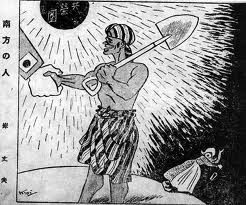
• Japan's light puts all in their place...Continuing my series on War Without Mercy, Professor Dower’s analysis of race propaganda and its role in World War 2, we get to the last main section, on Japanese racist propaganda. This is a very different section to that on US propaganda, because the Japanese approached the problem of how to portray their enemies very differently to the Americans, and had a very different historical perspective on the bad guy. The section also includes a dissection of a fascinating piece of wartime Japanese research, a massive document setting out a vision for Asia and ultimately the world if Japan won the war. This document was written by an obscure section of the Ministry of Health and Welfare, was almost 4000 pages long, and was only discovered in 1981. It essentially sets out the racial policy of the future East Asian Co-prosperity Sphere, so gives a meticulous insight into not only how the wartime authorities viewed race, but how they intended to enact their race policy in the future.

    Dower portrays the Japanese as having their own race trap, deriving from their admiration of America and Britain during the Meiji era, and the fact that many of their achievements in the 50 years since the restoration were based on western industry, technology and ideas. So they couldn’t dismiss the source of these ideas as necessarily inherently inferior, and instead had to find an ideology which would enable them to strip the best out of the western way of life, while making it somehow appear undesirable. They did this through the application of ancient folklore and imagery that had a strong social acceptance in Japan: establishment of the Emperor as direct descendant of god; exaltation of the concept of purity, and its links to race, emperor and war (and death); and depiction of the enemy as demons and outsiders.

    The Emperor

    I don’t want to talk about this in too much detail, because it’s not the focus of the book and the Emperor remains a much-revered part of Japanese life; a lot of western interpretations of the Emperor’s role in world war 2 are wont to cast the institution as eternally bad, when it’s more a case of the position being forced into service to a militarized state. I have mentioned before that Basil Chamberlain identified the exaltation of Emperor to religion, and the uses this religion was going to be put to, in a famous essay in 1905, and Power’s book reiterates this point. To quote Chamberlain:

    Mikado-worship and Japan-worship—for that is the new Japanese religion—is, of course, no spontaneously generated phenomenon. Every manufacture presupposes a material out of which it is made, every present a past on which it rests. But the twentieth-century Japanese religion of loyalty and patriotism is quite new, for in it pre-existing ideas have been sifted, altered, freshly compounded, turned to new uses, and have found a new centre of gravity. Not only is it new, it is not yet completed; it is still in process of being consciously or semi-consciously put together by the official class, in order to serve the interests of that class, and, incidentally, the interests of the nation at large.

    The purpose, of course, and “the interests of the nation at large” was war, military dictatorship, and the subjugation of the individual to the state. Indeed, in some ways Japanese racist propaganda served not so much to make the Japanese hate the enemy, as to bind them together against the enemy. As Chamberlain put it, in his foresightful essay:

    On the one hand, it must make good to the outer world the new claim that Japan differs in no essential way from the nations of the West, unless, indeed, it be by way of superiority. On the other hand, it has to manage restive steeds at home, where ancestral ideas and habits clash with new dangers arising from an alien material civilisation hastily absorbed.

    Professor Power observes too that Japanese wartime propaganda didn’t aim to make the Americans look lesser so much as it aimed to make the Japanese look better. And it did this through the Emperor and the notion of the Japanese as unique, of divine descent, and pure. These concepts were all embodied in the emperor, and the propaganda had it that they could be preserved through filial service to the emperor; indeed, the entire vision for the future was of the Emperor as father of the nation, and by extension as the guiding hand over all the races of the world, set into their proper place according to a theory of racial superiority that had Japanese as the only “pure” blooded people on earth, pre-destined to lead all the others.

    Purity

    Purity is an important and enduring concept in Shintoism, and was reconceived in political and nationalist terms by Japan’s propagandists. Foreign social ideas – especially those of individualism, freedom, and the self – were portrayed as impurities in the Japanese body politic, and Japan’s citizens encouraged to purge themselves of such filth. War, of course, would be the purifying fire into which this slag would be melted down. One powerful image in Power’s book shows a woman brushing the dandruff out of her hair, and the dandruff as it falls turns into American and British political ideals – selfishness, liberalism, etc.

    Japanese racial theory also had Japan as the only “pure” race, untouched by significant immigration or miscegenation and thus retaining a unique set of characteristics. Maybe such an ideal doesn’t have to be prima facie racist, but the pretty clear understanding in racial theory in Japan was that this purity of heritage (which was almost certainly fictitious anyway) made them superior, and the picture in this post shows pretty clearly how they viewed the “impure” south East Asian races – as dark-skinned labourers beneath the light of Japan’s sun. And the report from the Ministry of Health and Welfare makes this goal clear, in the section entitled An Investigation of Global Policy with the Yamato Race as Nucleus. The Japanese, pure through divine right and selective isolation, were best placed to “lead” the other races of Asia into the future, and the other races would have their future direction and role decided according to a racist doctrine based on foolish 1940s conceptions of what each race was good at. Largely, they were to be consigned to the role of labourers and suppliers of resources to the advanced Japanese economy.

    There’s nothing of exterminationism in this propaganda, but a lot of material that skirts close to advocating slavery and colonialism. It doesn’t really differ from the views of many colonialists in Europe at that time, I suppose – I’ve even heard defenses of slavery on the “it’s for their own good” line – but this is the nature of the grubby racial politics of the west in the interwar era. A newcomer to the global scene could make up a fanciful political theory based on a silly superstition and a fabricated history, and elaborate a systematic process of enslavement and exploitation for half a hemisphere, and in their defense they would be able to say “it’s no different to what everyone else is doing!” And in fact a lot of Japanese propaganda presented the “purifying” light of the Japanese sun either driving out the colonialist westerners, or revealing their true form as demons, necromancers and evil interlopers.

    Demons and Strangers

    This brings us to the third and most prevalent part of Japanese propaganda, the representation of Americans, British and Dutch as demons and outsiders. Power describes the role these creatures play in Japanese folklore as two-sided: they can be forces for evil, or they can be helpful. This makes them the perfect double-sided image for the western powers, whose technology the Japanese imported (and in many cases improved), but whose ideals they wanted to cast out, along with their physical presence in Asia. In propaganda aimed at their Asian colonies they could portray the west as colonialist and outdated powers being driven out; but to their own people they portrayed them as demons with two faces, presenting a human or pure image to Japan while hiding an evil face. They could also present them as outsiders, a powerful concept in Japanese that can be both liberating and terrifying. Thus they can (literally) demonize their enemy without reverting to any of the forms of scientific racism that infected western depictions other nations, while at the same time excusing their enemies’ former teaching role. In some ways this image hasn’t changed – the ideas outsiders bring to Japan are often seen as simultaneously threatening and empowering, and Japanese people’s fascination with foreigners is often mixed with fear and trepidation. After the war ended, Power observes that this propaganda proved remarkably malleable – the demons and outsiders just changed their face, and went from being the terrible demonic other to the helpful, inspiring, slightly strange other – just as American propaganda turned the Japanese from petulant children who couldn’t be reasoned with to a young democracy in need of tutelage and guidance.

    This demonization of the other also shows that you don’t need to construct directly exterminationist, vile racist propaganda to convince a people to fight bitterly to the very end. A complex synergism of religious imagery, faux history and carefully-adapted folklore ideals will do the job just fine, if you tune it correctly. In fact, I think this has many elements in common with a lot of the propaganda we see in support of the global war on terror. The better stuff (I am referring here to that which our more reasonable supporters of the war give us, not the loony American right) doesn’t tell us that muslims are animals who need to be put down; the village doesn’t have to be destroyed to be saved. Rather, we are presented with a (mythical) ideal of western liberal democracy as pure and perfect, built up through long trial and testing, yet fragile and vulnerable to the influence and impact of the other. If we attack them and overcome them in the correct way we can guide them to a society like ours, and lead them forward to a better tomorrow – which is what we’re trying to do in Iraq and Afghanistan now, and failing at in both cases (probably). On the way, of course, just as the Japanese did, we reveal ourselves to not be the pure and ideal society we pretend – Abu Ghraib, Guantanamo Bay, and regular wedding party slaughters in Afghanistan prove that our society is not quite what we say it is – but our propagandists overlook these small inconsistencies and the faux history (divorced of the native genocide, colonialism and extermination that made our societies rich in the first place) in order to present the greater myth. And, just as at some times and some places in Japan’s 15 year war in the Pacific, these images really did seem to present a better future, so too the simple story of liberal democracy shining a light into the darkness can present the same hope for a better world. But the Japanese experience perhaps shows us that better worlds aren’t made through war, or if they are it probably isn’t worth the suffering, and certainly isn’t the only way.

    The Japanese propaganda of the war liked to present them as purer than Americans, driven by greater ideals and united by stronger bonds, and also depicted the Japanese as liberators casting colonialism out of the Pacific. Power points out that they really did serve this role in some ways, showing the people of the Pacific that the colonial powers weren’t invincible and that sufficiently energized Asians could turn the colonialists’ own tools and technology against them. At the same time their scorn for the moral inferiority of Americans led the Japanese to completely misunderstand America’s willingness to fight – just as American propaganda overestimated Japanese obstinacy in the last year of the war. Both sides’ propaganda may have worked against Japan, leading to a situation of frenzied violence where both sides refused to believe what the other side really wanted. But there’s a lesson in this that is particularly compelling – the propagandist really does believe their own work. Propaganda goals are set on high, and propagandists listen to a lot of material being written in their own and other countries about the enemy – they don’t form their opinions in a vacuum. In the pre-war era, and during the war, this material was facile, shallow and wrong, but it was incorporated into the propaganda and really seems to have been believed by the planners and policy-makers of the era. American and British military planners really did believe that Japanese pilots were inferior due to Japanese child-rearing practices; Japanese war planners really did believe that the Americans would give up after 6 months because they were morally weak and lazy. For my next post on this book, I’ll look at how propaganda serves to reinforce rather than reflect prevailing views, and can be a negative form of information in a war. Certainly in world war 2, it appears to have served the role of reinforcing a vicious spiral that was circling in towards genocide, and although fortunately for the Japanese cooler heads prevailed, the experience of that war shows that propaganda of this kind isn’t just a tool of war, but can become a driving force and, at its worst, a self-fulfilling prophecy. What does this tell us about the decision-making that led to the fire-bombing of Japanese cities and ultimately the use of nuclear weapons? What would the Japanese have done with nuclear weapons if they had them, given their use of images of purification through fire and death? This is also something I want to explore in a future post about this book.


  • Manifest Destiny

    Returning to Hearts of Iron 2 after a long hiatus, I finally struck the motherlode and annexed the USA after months of trans-atlantic hide-and-seek. The forces of imperialism and racism refused to surrender, showing much more bravery and persistence than my top social researchers had credited them with, and after I captured all of mainland USA they moved their capital to their offshore imperial holdings: first some godforsaken place on the Atlantic coast of latin America, which of course I liberated; then Greenland, which is easy to invade because there is nowhere for US soldiers to hide; then their colonial possessions in Iceland. Getting to Iceland required that I declare war on Portugal and capture the Azores, sinking the Portuguese Atlantic fleet in the process. This was unfortunate, but ultimately my continental European campaign will be made easier by the availability of a second front – I am after all at war with Republican Spain, and a second leaping-off point for the invasion of Britain will be handy.

    Once I had overrun Iceland the USA continued its flight, like Gaddafi or Hussein; they moved their capital step by step across the Aleutians and the Manchukuo 8th Division followed them, in concert with one of my more hardened units of marines; after the Aleutians had been entirely occupied they disappeared for a month or two, but I finally discovered them cowering on a slip of land in the Pacific called Tinian Island – right under my nose, in fact, because the neighbouring islands were garrisoned by my home guard. So, in went Manchukuo’s famous 8th, once again, and the final battle was joined. This was a battle of bureaucrats as much as anything else, because the US lacked soldiers, industry or equipment, and was hiding in what was essentially a coral atoll. The president himself, his family and the few retainers and functionaries of the surviving government of the USA were all that remained and, I’m sad to say, they fought to the last family member. Or so the grizzled veterans of the Manchukuo 8th told me. Only the most barbaric of peoples would force even primary-school aged children to fight! Such a shame they all had to die … though I hear there was rejoicing on the streets of America (or what’s left of them, in most cases) after 6 years of war were finally brought to an end.

    So now I find myself facing off against China, who declared war on me 2 years ago and in the first heady stages of that war managed to seize huge amounts of territory from me – all of India, Burma, Nepal and Tibet, in fact. I hold them in a line from the border of Burma through Guangzhou and up to Qingdao, and also the northern areas around Beijing, but it’s been a desperate slog for both sides, as huge numbers of my soldiers have been tied up in the USA and getting them back can take months of reorganization. I’ve now started landing forces around Qingdao and western Thailand ready for the big counter-attack: my aim is to cut off huge chunks of the Chinese army at Tianjin in the North and Sittang in the south, and then destroy them, before pushing into the inland from Beijing and Guilin and working an encirclement the size of a continent.

    In many ways China have been harder than the US, because they US focused its industry on naval and airforce units, and when I finally landed on the mainland they had very little infantry for me to roll up – in fact a good 3-6 month period of the war on the west coast was taken up with defeating a large Canadian land army. But the Chinese have an enormous land army, that is fielded in great clots of men – 100,000 here, 200,000 there, maybe a million in total camped around Beijing and Tianjin and constantly trying to break through that poor beleaguered city. Every victory is followed by a defeat, and battlezones like the plains south of Beijing or the karst landscapes of Guilin have seen our armies crossing and re-crossing the killing zones for months. The nature of the Chinese campaign, with so many soldiers, makes it very hard to conduct encirclement operations, because they have so many soldiers that they have an excellent defense in depth. I have to wait for them to push a salient towards the sea, then snap it off in counter-attacks that are costly in time and men. So far I think I’ve captured about 100,000 men (10-12 divisions) at the loss of 20,000 of mine, and I have the enemy teetering on the brink of collapse. I regularly devastate their industrial centres, and their capital is a smoking, radioactive hole – Chengdu and Chongqing have both been nuked, and thrice hit with conventional missile attacks, as have many of their industrial centres. I’ve captured Nanjing, Guangzhou and some of the mountain approaches to the South, and hope soon to overrun Guilin. I know that they’re unable to maintain reinforcements for their army, feed their populace and keep dissent under control without abandoning all other industrial tasks. I think soon they will lose the ability even to control dissent and reinforce their troops.

    In anticipation of this, I’m now reorganizing my naval forces to start starving the British, with a naval blockade of Britain itself and a submarine force set to prowl the Caribbean. China is going to take another year to beat, and I’m going to need to leave a huge force there in readiness for any aggression by the Soviets, but I think in a year’s time I’ll be in a position to start attacking Western Europe. I hold the Azores and Iceland, so a simultaneous attack on Portugal and the UK is a distinct possibility. But first I’m going to clean up the UK’s Caribbean territories, to ensure there is no way they can stage counter-attacks on the US.

    The big problem I’m having with this game is that the computer never surrenders. Even when I have reduced it to a rump of two provinces, with no military or industry, it still refuses to surrender. This drives me crazy, because it means I waste months trying to find and capture every single territory the enemy possesses, even coral atolls like Tinian. I even once tried starting the game from a saved game as my enemy, and suing for peace with myself, but the computer wouldn’t accept my generous offer. This makes the endgame of every war unrealistic and is going to be a particular pain in the arse with Britain – conquering Africa is sooooo tedious.

    Other than that, though, I’m having  a great time. The main question I have to put to my readers: what shall I call America? It’s clearly no longer the USA, so what should I call it?

  •  

    The characters were wooden, the setting not credible


    What beast do they seek? What monstrosity this way came…?

  • When I was a student of physics I remember having to answer a question about what faster-than-light travel would look like, from the windows of a spaceship. I think it was in Mathematical Methods and Classical Field Theory[1], though it may have been Relativistic Field Theory[7], and I vaguely recall the answer involved stars from behind the spaceship (that you couldn’t see from the windscreen) slowly moving into the front view; as the ship got further from the lightspeed limit, more of these stars would come into the front and if you got fast enough you would eventually see all the stars visible to the eye in a kind of field in front of you, surrounded by darkness (or something). This, of course, would be when the gibbering madness set in, and one of your crew decided to torch the ship in honour of an unnamed god[9]. Note that this is very different to the Star Wars image, where all the stars blur. In fact, I think our solutions explicitly stated that at faster than the speed of light, stars can’t  blur (I can’t remember why).

    It’s a mark of how far we had come by the time we got to MM&CFT (3rd year, I seem to recall) to compare that question and its solution to the question we got in first year Newtonian Mechanics: do you get less wet if you run through rain?

    Currently I’m reading China Mieville’s Embassytown, and he’s writing about hyperspace quite a bit – he calls it the immer – which got me to thinking about different visions of hyperspace and how it can be represented in science fiction. It’s a topic of enduring interest to sci-fi authors, and there’s a lot of different ways of representing it. I can only remember four now, but here goes:

    • Mieville’s strange ocean: The immer is a kind of ocean of darkness and chaos, with its own predators that may or may not be life-forms, and strange beings that sometimes hitch into the realm of the living. There are tides, currents, and deeps, and it is navigated by humans who learn to work their way through these precarious shoals. It also makes humans sick to be in it, and it is conceived as running through or between the material of the universe. The universe we are in is the third universe, with two previous ones having grown and then collapsed; but the immer was there through all of them. This immer is dark and dangerous, rich in its own life and history.
    • Iain M. Banks’s strange geometry: in contrast, Banks’s Culture novels have a representation of hyperspace as a barren, mathematical substrate underlying physical reality; ships travel at hyperspeed through this substrate, and as far as I can remember there are no dangers or risks to them, except when they emerge too close to a gravitational source, which warps the substrate and increases the risk that the ship will be torn apart by entering or leaving the substrate. While Mieville’s hyperspace speaks of a mysterious and wild universe that humans explore at their peril, Banks’s vision speaks of a universe subjugated to human will, reduced to a toll-road with a few tricky interchanges. These different visions are very suited to the cultural backdrops of the novel, I think – an interesting pairing of the cosmological and the sociological.
    • Stephen Baxter’s Bubble: In Ark (the sequel to Flood) we get a description of an early attempt at inerstellar FTL flight. This time it’s a fragile bubble surrounding a spaceship, held together with huge amounts of energy, which draws the ship forward into a kind of gap in the space-time continuum. Anything touching the bubble from the inside is instantly torn apart, and once the bubble is set on its path it can’t be diverted or its direction changed. It’s very “realistic” sci-fi (he even gives a reference) and the whole story, both inside the Ark and in the science guiding its use, is based primarily around the constraints the science poses on action. The opposite of the Culture in every way.
    • Gateway Catapults: The staple of shows like Babylon 5, these present us with hyperspace as a kind of insoluble problem. Instead of navigating it, you get chucked through it by a massive catapult. Some ships (usually military) can open their own gateways into the swirling mystery of hyperspace, but others just hurl themselves at the gate and hope for the best. This is a vision of high science fiction where one of the fundamental mechanisms of the social order is actually quite primitive. We also see this in Dan Simmons’ Hyperion, where the decision to close the gates destroys whole societies – and is driven by the realization that the human “masters” of the gates never understood them or their real purpose at all.

    Hyperspace in its many forms seems like it plays a more important role in the universes of its setting than mere substance. It’s not just a scientific backdrop or a constraint on action; it takes a form which often reinforces or complements the style and cultural background of the novel. It’s a very good example of how the best sci-fi is not about the science at all, but about what it can be used to tell us about ourselves.

    fn1:literally the most evil subject you can take. This subject ate Electromagnetism and Advanced Quantum Mechanics[2] for breakfast and shat them out as a tensor problem you couldn’t solve by graduation, then laughed at your poor mortal brain and ate your soul for lunch. It was an evil subject, worth a paltry 2 credit points (out of 24 in my year), but which consisted of 6 assignments and an exam, and each assignment took – this is not an exaggeration – at least 50 pages of scrap paper, and at least 12 hours of our time. My friends and I had a shift system going in Lab (which, by comparison, was 9 hours a week and worth 8 credit points). One of us would work on the experiment while the other three used up copious amounts of paper trying to solve impossible problems in gravitational dipoles[3]. Then after lab we would charge off to our tutor’s room and he would infuriatingly refuse to give us the answers[4], even though it meant we would pester him again. Finally we would get a breakthrough, and off we would go to reduce the romantic image of moonlight and the gentle slap of waves on the beach to a series of Bessel Functions[5].

    fn2: for which I got 94%, yay![6]

    fn3: seriously, who knew the tides were soooo fucking complex?

    fn4: what can I say, we weren’t really paying fees at this university, we got in on merit and we survived by luck, effort and the regular application of sleepless nights and cask wine to every problem. No one thought we had any right to pass anything, and everybody forced us to study.

    fn5: Which, also, can I say, you guys suck.

    fn6: Which reminds me that the pure maths subject Lie Algebras – which apparently, people who understand it tell me, has some relationship to Advanced Quantum Mechanics – may have been harder than CFT&MM; but that subject was taught by a Mind Flayer, so I’m not sure if my memory of it is correct

    fn7: I’m pretty sure we had a subject called this. It had a lot of Tensor equations in it, and when me and my buddies arrived in our Honours Year[8] there was an equation pinned to the door of our room (from the previous poor bastard to study there) which consisted entirely of Tensor expressions, and took up a whole page of A4 paper (in a not-very-large font). We all stood looking at it, and said “fuck. What have we done?”

    fn8: Honours is an Australian idea, I think: because Australians are smarter than you lot, we do our undergraduate degree in three years, then our masters degree (and thesis) is compressed into one year with two extra subjects and called “honours” even though there’s nothing honourable about brutalizing young people in this way. In addition to having the kind of discipline and brains and educational background required to survive this kind of nasty, Australia also has one of the best rugby teams in the world. Dwell on that, Northern Hemisphere Losers!

    fn9: This part wasn’t in the official solutions, but I should think it’s pretty obvious.

  • Commenter Paul suggested that a Harry Potter RPG would be limited by the problem of knowing the characters and the world too much, in his words:

    1. You’re stuck playing a game where the grandest things that can happen are the books and your characters a left with a feast of crumbs. Harry Potter is facing Voldemort! Can you keep the Dementors from the folk of Hogsmeade while he saves the world?! Or
    2. You avoid the Harry Potter setting either in time or location, but these strip the familiar elements from the novels and rob you of the reason you’re playing it in the first place. Or
    3. You play Harry and friends, but you already know the plot that you’re playing through

    I think this is a similar problem to the kinds of situations you’d run into with, for example, a Dresden game or a LoTR RPG (or Dragonlance, as Paul noted). I’ve got around this in LoTR by choosing option 2), for example – and once ran a LoTR game where the players did 1), in Mordor – they were captured soldiers just trying to escape while the war of the ring continued somewhere far away. There’s no reason to think that the problem couldn’t be surmounted in a Harry Potter RPG.

    So here’s some ideas for two different layers of a Harry Potter RPG.

    For Younger Children

    You could have quite an entertaining little game getting up to hijinks in Hogwarts itself – it’s virtually a sandbox campaign if you want to play it that way, but there are specific inter-house rivalries and shenanigans that can play out against quite a deadly backdrop. I did this for a group of schoolkids I was GMing in Japan, having them start in their school club house and save the town of Matsue from a demon-conjuring older student[2]. You could set up a kind of Ars Magica style of multiple-PC setting, where all the PCs are from the same house, but with different (house-specific) skills, and perhaps with the players having a starting preference. Then, for different challenges in Hogwarts you choose your PCs to match. Maybe there isn’t even a death option, but if something goes horribly wrong you don’t die, you get Dumbledored: one of the teachers turns up and saves you, but then you’re in detention and suffer an xp penalty, or you have to play a different member of your school’s house while you wait for your previous member to get out of detention. Also the goal of some adventures could be mischief against older kids, and you could even define a term or school-year timing process, so that at the end of a fixed number of adventures all the students gain a level; the amount of individual adventuring the kids did in their year partially determines how much they gain from their year’s education (so you tie the adventuring to doing better in school). Thus a good campaign arc also follows the arc of the stories across multiple years; you could have event tables for the summer holidays and for the school as a whole that follow a Make You Kingdom kind of style. This gives the game a more campaign-y, abstracted style, with the players not having to care about getting too bogged down in individual PCs and getting to fully explore the environs of Hogwarts (and maybe it’s a different Hogwarts each time, if enough random tables are used). They can move onto the hard stuff as they get older.

    For “Young Adults”

    (To be said in a yobby English accent, while dancing[1]). Here the game gets darker and more focussed, with a more intensive character generation process and the assumption that the stories will involve only one PC each, in a more traditional style (we’re making a gateway drug here, remember – we need these kids to grow up and head over to the rest of the RPG world). So they can die or get injured, can carry psychological baggage with them (they’re teenagers, so there should be a lot of psychological baggage tables!) and they can come from multiple houses, with the possibility that they’re working for the interests of their own house as much as the group. This style of gaming can allow for hidden magic, forbidden magic, secret exits to town, wandering monsters in and outside Hogwarts, and the possibility of statting-up and fighting some of the teachers, who of course have their own agenda. It could also allow for post-graduation adventures, and the possibility that the PCs go on missions or quests either during or after their training – basically using Hogwarts, the Ministry of Magic and the strict rules of the Harry Potter world to construct a standard exploration/adventure campaign – with some additional mechanics for teenage angst, and a lot of cool narrative tricks for avoiding death, and for deus ex machina-type GM interventions (via Dumbledore). In fact, student-teacher relations could act as a kind of resource in the game, which would encourage players to hide their PCs shenanigans from teachers.

    I reckon that could be a lot of fun. There are fun spells from the books, monsters, lost secrets, there’d be pocket dimensions and monsters and forbidden potions and shagging behind the broomstick sheds – who wouldn’t love it? But in progressing through the system the innocent Harry Potter fans learn to love role-playing, and then at some point they think “ooh, I can do this in a world of my own invention!” and then we have a million new converts to our hobby.

    Mwahahahahahaha.


    fn1: gratuitous Young Ones reference!
    fn2: looking back on that post, the note I left the students as a clue really should have had a classic English translation of Japanese like “Let’s enjoy summoning a Demon together!!!!”

  • I recently watched the last of the Harry Potter movies,which was fun (and had a good dragon!), and thinking about it afterwards was struck by the absence of an RPG for this world. As far as I can tell, there is no official RPG. There are a lot of forum-based RPGs, but no apparent real ones. I’m pretty sure that this has something to do with the strict licensing rules that J.K. Rowling has put on her world, but I was also wondering if it might be related to the snootiness of RPG players and developers, who often seem to dismiss Harry Potter as either a) not serious or b) a rip-off of “better” books or c) too popular. Often I hear complaints from role-players about Harry Potter that seem to include all three at once. I wonder if this influenced developers’ decisions about whether to try? I also guess that Rowling doesn’t have much connection to the role-playing world, unlike, say, Jim Butcher or George Martin, and so didn’t entertain requests from developers with the same openness that she might have treated, say, movie-makers. Finally, I’m guessing that acquiring the rights to Harry Potter for an official RPG would have been expensive and would have involved a lot of development work

    Anyway, regardless of the reason for the non-appearance of such a game, I think it’s a missed opportunity for the RPG world. Harry Potter is as popular as Star Wars, and its appeal mainly lies with impressionable kids. A good, age-appropriate RPG for this mob, even if not a “proper” RPG by the standards of your average traditionalist, would be an excellent gateway drug for a huge cross-section of the non-nerdy community. Rather than expecting them to read a bunch of obscure texts from Appendix N before they can get into the game, they’d turn up at the ripe age of 13 having already absorbed the entire setting, and eager to get into it and do their own thing. For younger gamers even a semi-board game system, heavy on the fluff, or barely more advanced than a choose-your-own-adventure, would be fine. With a captive audience, a well-established world and a set of references that they’ve all read, there would be the potential to draw in a very large number of people who could be trained up for the fantasy genre and introduced to the ideal of RPGs. After that, I would say, some small proportion of them would stick it out.

    The Potter books are unique, too, for drawing an age cohort through them. People start reading these books at somewhere between the age of 8 and 12, and keep going all the way up to 16 or 17. A whole cohort of high-school leavers spent their entire school lives reading this stuff. Just as the books get darker as they progress, a well-designed Basic-Expert-Master style of game design could hook them in to a semi-RPG at 8 and spit them out the other end at 16, fully versed in demonology and necromancy. Even a lot of the spells have been written already, and there’s a whole bunch of stuff that could be run as a spin-off – an attractive miniature-based Quidditch system, a series of campaign books based on innovative involvement in the original story, some kind of card game based on all the Hogwarts characters (sold by house) – that could be either directly related to the game or just released by the same company. It’s the kind of thing that Fantasy Flight Games could surely excel at. And those 16 or 17 year olds would naturally start looking for other systems to play in their own fantasy worlds at some point – the benefits would soon spread across the entire RPG scene.

    It’s a shame this hasn’t happened, because I think it would invigorate the scene, draw in a lot of new blood from diverse backgrounds, and maybe give whatever company did it a sufficient revenue stream to enable them to not bastardize their other RPGs for maximum profits. I wonder if anyone thought of it, tried, and failed, or if the developers overlooked it from the very start? Whatever the reason, it’s a shame it didn’t happen.

  • Can you rise to the challenge?

    The most important sports tournament in the world starts in three weeks: The Rugby World Cup, which is being held in New Zealand, home to the best and the most under-achieving team in the world. Historically famous for choking at the crucial moment, this time around they’re serious. Very serious. So serious, in fact, that the Sydney Morning Herald reports that they’re going to invoke a nation-wide ritual of sexual abstinence, presumably hoping that they can funnel the sexual frustration of 2 million NZ men direct to the team. Do they need to kill a virgin to complete the ritual? Perhaps all that energy will be channeled through the haka.

    Truly, rugby is the most infernal of games.

  • When Britpop was Beautiful

    Summer is the festival season in Japan, and the music festivals come with it. My partner and I went to Summersonic this year, primarily to see Suede, and because the line up was a little boring, we went later than usual, arriving at about 4pm and missing some of the minor bands. Nonetheless, we had a good afternoon and evening. Of course the Japanese do music festivals the way they do everything – quietly, politely, and with a hefty dose of civilization. No watered-down beer and long queues for food here, because there were about 15 bars and about 50 food shops, as well as 5 or 6 stages, so that people were spread well throughout the place. The stage times were staggered so that there was no simultaneous throng of people leaving stages all at the same time, and there was a wide range of chill-out places. Unlike my disastrous experience with Snap, C&C Music Factory and “the KLF Experience” in Sydney many years ago, there was a huge amount of seating, so people were in good humour, well-fed and relaxed, with lots to do while they waited for their favourite band. This was despite the intense summer heat – it was 33C and intensely humid yesterday, and all the bands were sweating buckets, but everyone was chilled and there was no sign of violence or trouble. Ah, Japan… So here’s an overview of what we saw.

    Upcoming Chinese Music at the Island Stage

    The Island Stage was one of the smaller stages, and not many people were watching at any time, but it was particularly interesting because it had been set aside for a range of new bands from Asia – mainly Chinese, I think – and they were really interesting. First we saw Muma and Third Party, who I only saw one song by before they finished, but they seemed very promising. Next we saw Queen Sea Big Shark, who were like a slightly more New Romantic version of La Roux, slightly poppier and less electronic but very good and energetic. We then stuck around for the highlight, Rebuilding the Rights of Statues, who were a kind of Editors-meets-Bauhaus, frantic guitar rock goth crossover with a lot of energy and passion. Their first song, Bela Lugosi is Back, was a great reinterpretation of the classic original, a bit more speedy and with some frantic guitar loaded on. We liked these bands so much that we bought their CDs, and I’ll be keeping an eye on Chinese acts in Tokyo – the impression I got from this stage was of a lot of gothic/electronic crossover work going on in this particular music scene. Very interesting!

    Jon Spencer Blues Explosion

    Shit, stayed around for two songs. If you’re going to be a pretentious music-type wanking your guitar on stage, you have to be good.

    Public Image Limited

    I have my issues with Johnny Rotten, and I have my issues with bands steaming on past their old-age use by date (I saw Motorhead at another Summersonic, and they were good, but they just seemed like a bunch of old men going through the motions, and there’s something about rock that is young and stupid and at some point people need to give it up), and I quite frankly couldn’t care less if the Sex Pistols had never climbed out of their own vomit long enough to divert punk into its inevitable musical cul-de-sac (though without them we wouldn’t have the excellent Megadeth cover of Anarchy). But despite this, and a slightly doddery and past-it Johnny Rotten looking just a bit out of place in a rock gig rather than an old people’s home, PiL were good. He really can do that vibrato intense voice live, despite his age and the heat, and the guitar work was really really cool. I only stuck around for half of PiL (sorry Johnny, but I was more interested in Rebuilding the Rights of Statues and Suede) but what I saw was very nice, and I’m encouraged to listen to a little more – I didn’t realize PiL was so swirly and intense, having only heard a couple of their songs. So that was nice. But we had to flee before the end to get to the main act…

    Suede

    Now, I’m not so into bands reforming and doing money-making reunion tours, at least, not as a concept, but I can’t really criticize Suede for doing this. I’ve seen Brett Anderson live by himself and also in the Tears, and I know he can continue to produce quite beautiful and intense music – his creativity isn’t trapped in his youth. I also know he can produce passionate work (his solo rendition of Asphalt World at the Mermaid was amazing), and I’m pretty sure he has reinvigorated Suede for the simple reason that a whole bunch of his fans didn’t get to enjoy him live back in the day, and Suede always had a feeling of having ended before its time. So he’s not making anything new with them, just giving people what they didn’t get enough of back then. And I can’t fault it, because what he gives us is such vintage Suede, and so full of the original passion and grand intensity of the band, that one can only be carried along. Brett Anderson is intense, energetic, still astoundingly sexy (and beautiful) and if anything he’s better than he was back in the day. I’ve seen him in different guises four or five times now and every time he does this thing where, about half way through the performance, he really starts to get into it – gets transported to a different place, and really takes the crowd with him. And the crowd really were obssesively good, singing along to all the words and bouncing and screaming (and nearly crushing me when he came to touch the front rows). You can tell Brett Anderson really loves performing, and you can tell that his fans really love the attention he gives them. This was a vintage live performance, full of the classic songs delivered with the original passion, and if you get a chance to see the reformed Suede, I strongly recommend it.

    So, overall, Summersonic was a blast even though I only really went to see one band. I got to find out about a few new bands, enjoyed some really solid performances, and had a good (but exhausting) day out. Next year I probably won’t be going – the line up has been declining in interest every year, from the high point (2006?) when I saw Metallica perform the 20th anniversary rendition of the album Master of Puppets, and also The Editors and Tears. But it’s worth it if one of your favourite bands is there, because you’re bound to stumble on something else you like. Give it a try if you can!

  • Boromir Meets the Witch

    It’s a Sean Bean boom over here in Kichijoji, with 10 episodes of A Game of Thrones followed up this weekend with the 2010 Sean Bean movie Black Death. In fact, a few weeks ago I watched Red Riding too, where Sean Bean plays an evil paedophile shopping mall developer. He’s always good, is our Sean.

    Anyway, so Black Death is a fairly basic story: it’s 1348, and the black death is ravaging Europe. Sean Bean is a holy warrior serving the church, who is leading an expedition to a village that, rumour has it, has managed to avoid the plague through necromancy. On the way he picks up a novice monk, Osmund (essentially the main character) who lived in the forest near the swamp that protects this village; he has his own reasons for wanting to go back there, and offers to lead Bean’s character (Ulrich) and their motley crew of degenerate witch-hunters into the swamp.

    Once at the village, of course, things start to go wrong, and the treachery and magic of the villagers leads the group into trouble. Unfortunately, things also went wrong for me, because one of the main characters in the village, supposedly quite a menacing chap, is played by the chap who was Percy in Blackadder. Can you take a necromancer seriously after you’ve seen this? How terribly menacing…

    However, if you haven’t seen Percy for four whole seasons of the funniest show ever made, then you can probably appreciate him in this movie, and then the last half of the movie, though a little slow, is still very good, and you get a reasonably disturbing, thriller-style ending to a good story. The movie is generally well-filmed, the plot is simple and straightforward (and thus has no holes), and the exposition is reasonably well done. The setting is quite splendid (Germany in summer, I think) and fits into the gritty/dark/realistic zone of the fantasy spectrum. The acting is a tad wooden at times but generally fine, and although it’s brutal and a bit gory it’s not too disturbing. I found the ending and resolution of the story a little disappointing, and it could have been a little more … decisive, but at least there were no pointless twists. There are no unbelievable monsters to kick the movie off onto a crazy tangent, either, so it’s more psychological thriller than horror. Overall, a reasonably enjoyable movie but nothing outstanding.

  • Britain’s rioters have been returning Games Workshop products, it has emerged.