This post continues my thoughts on ideas and inspirations from Iceland. It’s another post about both the social and political structure of a norse campaign, and about insights into how medieval worlds functioned. Again, it’s based largely on what I saw, was told by guides, and read during my stay in Iceland, with maybe a little influence from Bernard Cornwell’s Warlord Chronicles. Slavery The early Icelanders kept slaves. Slaves in Icelandic society don’t seem to have been the storybook slaves of legend, kept in pens and treated like animals – rather, they appear to be a particularly low and over-worked form of indentured servant. They seemed to be able to escape, sometimes they would be freed, and I get the impression they could also be accorded honour (though I have no concrete proof of this). This random site describes the class structure of norse society and the types of abuse (and freedom) that slaves experienced, and suggests that slaves could own property and save money to free themselves. Like all GMs I tend to have rules about what I will and won’t allow my players to do, and in general keeping slaves has been one of the things that I have avoided. I know this is ridiculous – my players do a lot of slaughter, and occasional human sacrifice and more than their fair share of demonology -but it’s just one of those things, and I think every GM has them. So I’m guessing that if I ran a norse campaign I’d probably be omitting the slavery part from it. I guess also that if I did allow it I would probably require the PCs to be “good” slave-keepers, which doesn’t seem impossible given the accounts but isn’t really much of a step up. Of course slavery also opens up alternative adventure ideas – the PCs could start off as escaped slaves or slaves who had bought their freedom, and of course slavery would be an interesting alternative to the TPK – but in general I would be avoiding it. Norse society in the 12th century was nasty enough without introducing this as well! Also, slavery was an abomination of the early part of Icelandic history – the norse world banned slavery between the 12th and 13th centuries, i.e. a good 4 centuries before the UK did, and half a millenium ahead of the US. So it’s pretty easy to choose a setting where slavery is optional. The Cultural Sophistication of the Medieval World We moderns are used to thinking of the medieval world as unsophisticated and brutal because of their lack of scientific knowledge, and it’s true that their lives were nasty and brutish and their ideas silly, but the ideas they lived by take on a very different meaning if the fantastical and magical backing for those ideas were real. This has been a central theme of my Compromise and Conceit campaign, which is an attempt to imagine how the post-enlightenment world would look if all of the religious ideas its people subscribed to were true, and backed up by real temporal power (i.e. magic). The same can be done in any other setting, of course, and when you play this game suddenly the medieval world is no longer unsophisticated and backward, just very very different. It’s a fun game to play. For example, the Vikings had particular beliefs about the origins of the Northern Lights. One of these, that the Northern Lights were caused by stored light in glaciers being emitted into the atmosphere at night, opens the possibility of a mad wizard’s adventure to collect the light for some crazed ritual, and of course in our magical world this could really happen. Or the PCs could reach the point of the light, and discover that the Northern Lights really do come from light reflected from the armour of warrior’s souls as they travel to Valhalla – the PCs discover a pathway to Valhalla at the “foot” of the Northern Lights and thus an extra-dimensional campaign commences. The same kind of backwards sophistication is true for much of the rest of medieval thought, much of which was the topic of frenzied debate at the time. The PCs can even get caught up in these debates, as they are employed by scientists to explore the kingdom beneath the earth, or taken on a trip to Japan to find Jesus. Umberto Eco’s Baudolino gives some amusing examples of the crazy stuff medievals believed (and his Island of the Day Before gives some funny examples of what might happen if enlightenment-era science were taken seriously). Many of these ideas are also quite fluid, so potentially by taking sides in a debate the PCs may get their chance to shape the structure of the world. Obviously in a norse world a lot of these ideas will be tied up with Valhalla and Viking cosmology – why not explore it and see what kind of world you can create if these ideas are true? War is Costly The Icelanders set up their parliament, the althing, in 980 AD, and one of the key reasons they did this was that they could not afford to continue waging wars over petty slights and land disputes. War in the dark ages was a costly business, and in the absence of modern medical and agricultural technology, the Icelanders simply didn’t have the ability to maintain civil society and keep fighting wars. Bernard Cornwell’s Warlord Chronicles makes this problem very clear, as each Autumn all wars cease so that soldiers can take in the harvest. Society at this time was a single failed harvest away from chaos, and any society that failed to produce enough food had no choice but to invade its neighbours and steal theirs. In the precarious conditions of Iceland on the raggedy edge, everyone saw that this was going to be a disaster. And so the althing was formed. It seems like a lot of medieval kingdoms were more than happy to wage war at will, but I guess this is largely because the ruling class were so divorced from those who did most of the fighting (the levied ranks of ordinary soldiers) and those who paid for it (their peasants). In free 980 AD Iceland this wasn’t the case – chieftains didn’t have peasants to fall back on, and had to get some form of consent to pay for war, so I guess they had to find ways to avoid fighting. A lot of political entities in gaming are actually too sophisticated for their putative time – democratic or oligarchical city-states in an otherwise medieval setting, for example, or even societies coming close to constitutional democracy, which is really a post-enlightenment phenomenon – and it’s hard to imagine those types of state being able to venture willy-nilly into costly wars against the backward communities around them. Where such states exist – or where hard-scrabble societies live on the fringe of e.g. Orc-controlled territory – it’s likely that there will be a lot of espionage work for PCs that is primarily aimed at preventing wars. While in our fantastic worlds we tend to find that the main method for avoiding war with Orcs is genocide, the more likely real world compromise would be tribute, and it could well be that the PCs would be paid to either organize, guard or renegotiate tributes. In a norse world that takes slaves, tribute could be an unpleasant business as well, with unwanted slaves being sent to the Orc lair along with trade goods. PCs could also be charged with all sorts of black ops to prevent, avoid or delay wars, or to guarantee their victory through economic sabotage. Taking into account the real cost of political error in the dark ages when planning campaigns means, I suspect, that there would be a lot of careful skullduggery being thrust upon the PCs, and some very nasty espionage jobs. When war does come to a kingdom the PCs may find themselves in a land plunged into near total chaos as food shortages, disease and social breakdown spread. If they gain their own strongholds they may even find themselves going to great lengths to pacify their neighbours, and doing very unsavoury things to avoid conflict. Forcing players to these kinds of unwanted compromises can be a truly pleasurable experience for a GM with a sadistic streak, and if you set just a few real world constraints on the political and economic climate the PCs operate in, you may find them becoming very creative in their endeavours to control their neighbours and enemies… Religions can Coexist For much of Icelandic history it appears that christianity and paganism have co-existed, with christianity gaining the upper hand by simultaneously co-opting pagan ceremonies and ignoring minor pagan rituals. This situation also obtains in Japan, where Buddhism and Shintoism get along very nicely side by side. In a magical norse campaign, this means that Druids and Clerics (both Christian and Odinic) can coexist, maybe even sharing worship space, spells and political goals. Alternatively you can envisage a society where they coexist in the minds of the people but fight viciously for political supremacy at the level of the clergy. This makes for some very interesting political crises to thrust the characters into the middle of, and introduces a kind of industrial espionage-style adventuring, where the PCs are paid to undermine the religious rituals and powers of an enemy church. Ultimately, of course, one church might want to destroy the Gods of the other – a nice high level goal for any PC! In an alternative-history Iceland this opens up the possibility of completely changing Iceland’s future direction (christian fascist? Pagan dictatorship? Roman-style pagan democracy?) I’m going to be exploring this in my Svalbard campaign once I can get it running, and for me the role of religion in determining politics in such societies is very interesting – especially since their real magical powers means that people will listen to them in a way they never would in the real world. We know that the christian church was very active in politics throughout Europe, and it’s very interesting to imagine how that involvement would have turned out if their beliefs were true, and backed up by real magical powers. Conclusion GMs can make a great deal of headway in campaign planning with very little real background work by choosing a historical point in a well-understood culture, backing up the religious ideas and fanciful scientific notions of the time with real magic, and then choosing a crisis point to dump the PCs into the middle of. The results can be history-changing, which is satisfying for everyone and sets up further adventures in the future. It’s also easy to do both geographical and political sandboxing – you know what major events are coming up, and can fit the players into a narrative that they have every opportunity to change. Incorporating some of the constraints and social problems of the real world can force creative (and often challenging) decision-making, but magic prevents the players from being completely constrained by these forces. The results can be a very interesting and exciting campaign world, with minimal GM effort. With the background ideas I’ve written here, a map of Iceland and a few pages of background material, I think a GM could easily come up with a fruitful and challenging campaign.
-
I am reading the Warlord Chronicles by Bernard Cornwell at the moment. I’m really enjoying it and will have more to say when I’m done, but as an initial thought I would like to mention that I am struck by how much like a Daily Mail reader Merlin is. He wants to purge all foreigners from Britain, thinks their religions are savage and weak even though his own is pretty debauched, appears to be pretty fast and loose with his own faith when it suits him, and enjoys shagging women much younger than himself. Sure, the Saxons are actually a violent and bloodthirsty race but I’ve yet to see any sign of anything except moral equivalence in the story. The only thing they’ve done worse than the Britons so far is to paint their shields with blood. And in any case, when did the facts about foreigners sway a Daily Mail reader’s views?
Arthur, on the other hand, is clearly a Guardian reader. He accepts all religions and wants peace, and won’t do anything barbaric himself, but is too much the moral relativist to do anything about the terrible behavior of his fellow tribesmen, and obviously has a wide streak of viciousness himself when push comes to shove. Polly Toynbee with a sword, that is. Also, he likes to think he’s all about peace and justice but you’ll never catch him genuinely doing anything radical to overthrow the accepted order of things.
I guess that means Nimue reads the Sun, and Lancelot – like Elle McPherson – has never read anything he didn’t write himself. The rest of them don’t seem to be able to read at all, or maybe they only buy the Daily Mail for the crossword, so I suppose nothing’s really changed in 1500 years. You were a failure, Arthur, face it!
-

You must gather your party before venturing forth … I gained a great deal of inspiration for role-playing from my trip to Iceland, and I hope that much of what I saw and experienced there will inform a Compromise and Conceit campaign run in Svalbard. Much of the inspiration gained from my trip to Iceland will come simply from amazement at the stark beauty of the landscape (useful background information for an Australian planning to set a campaign in the far north) and from an appreciation of the general coolness of the Nordic universe[1]. But there were also some particular ideas, and some specific information, that I gleaned from this trip, which I think is useful for grounding a campaign in particular historical periods. Some of what I learnt is very general, some specific to Iceland, some generalizable (perhaps) to a Norse-specific campaign. I was simultaneously reading Bernard Cornwell’s Warlord Chronicles, so I can’t guarantee it hasn’t been coloured by his very specific view of how pre-medieval pagan societies worked, but I hope that at least some of what I found in Iceland has currency beyond my own campaign ideas. So here it is, in no particular order. A lot of these ideas serve to establish a campaign in which the majority of the community is living in poverty and pretty low settings; this may not be to everyone’s tastes, and so some of what’s suggested here may not be worth adopting (and it may be exaggerating the state of life in 12th century Iceland, which I’ll use as my focus for a campaign setting).
Travel and the Weather as Adversary
Until the 19th century Iceland had no proper roads, and to travel from one part of the country to another required trudging over essentially wilderness on tracks beaten out by other travellers. In winter this meant passing over snowy ground, and the path was not kept clear. Instead it was marked by little cairns of stones every couple of hundred metres, and travellers simply moved from cairn to cairn. Traveling a modern road in a comfortable bus on a perfect Autumn day it was easy to forget what this means for your average 12th century traveler, but our guide told us that in winter or fog the weather could be so bad that, even quite close to Reykjavik, travelers could easily lose sight of the next cairn, and become lost on the moors easily. Getting lost in a winter storm in Iceland would be a death sentence for all but the very lucky, and the natural consequence of this is that one would not travel in winter. This has huge ramifications for much of human society – trade, war, adventuring and life in general would grind to a halt, and the whole world would be waiting with baited breath for spring. In turn this places huge stress on festivals that mark the thresholds of seasons and changes, because they also represent the return of life, motion, and human congress.
I remember speaking with an Afghan doctor about his research project when I was teaching statistics a few years ago. His interest was in reducing maternal mortality (a huge problem in Afghanistan, and intricately related to infant mortality), and he told me about a very simple problem that does not exist in modern Nordic countries. In winter in many parts of Afghanistan the heavy snows block passes and roads and prevent all forms of travel. This means that if you’re giving birth in winter, you get no support of any kind beyond that which is available from your immediate neighbours. Given the single best protection against maternal mortality is access to medical care (or, in a fantasy world, clerics) when complications occur, this basic lack of infrastructure (cleared roads) that we in the west take for granted presents a huge barrier for Afghan women’s health. The same would apply in any rural town in 12th century Iceland, but even worse – food and other vital supplies would also be frozen in, making preparation for the winter of crucial importance. One need look no further than this to understand why brutal strongmen were capable of popular rule in such societies: no one cares that they demand a virgin a year, if they guarantee security for your winter preparations. To return to Afghanistan, an interesting article in today’s Guardian suggests westerners have misunderstood Afghan support for the Taliban for these kinds of reasons:
Most ordinary people associate the [national] government with practices and behaviours they dislike: the inability to provide security, dependence on foreign military, eradication of a basic livelihood crop (poppy), and as having a history of partisanship (the perceived preferential treatment of Northerners).
and they credited the “good Taliban” with not doing these things, as well as the ability to provide justice swiftly and fairly. In dark ages societies this was no doubt a very easy way to be liked: guarantee your subjects security to prepare for winter, and you can take what you want from them (within reason) in spring.
Food

Hang it, smoke it, mash it, and wash it down with ammonia This brings us to the topic of Icelandic food, which is an interesting mix of the delicious and the horrific and, in some ways, still recalls the food culture of old. Iceland still relies on imports for most of the things we take for granted, and until the 1930s couldn’t grow most vegetables or fruits locally, so a lot of the old-fashioned foods still persist. The worst examples of these are thoramatur, a disgusting series of foods that obviously derive from a period of history when food was less reliable than it is now, nothing could be wasted, and much had to be cured or preserved using gross or stinky methods[2]. More generally, the food that Icelanders ate 100 years ago was very limited in its variety, very simple, and indicates a very limited palate. I have found in GMing that food can be used to add elements of vivid realism to a campaign setting, and can serve as an indicator of e.g. hostility, poverty, welcome, and the importance ascribed to meetings or deals[3], and food in an Iceland-style setting could be easily used to establish that sense of living-on-the-edge that a medieval Icelandic setting should have. Consider the examples in the picture above, which I ate at the Loki Cafe near the main church in Reykjavik. From top right, going clockwise, we have smoked trout, smoked lamb, mashed fish, in the middle we have wind-dried cod with butter, and at the rear (thankfully hidden from view), rotten shark. For Icelanders over a certain age, these last two are a delicacy. I have to say the wind-dried cod is palatable compared to your average Japanese dried smelt (though I didn’t try it with beer – Japanese dried fish tastes fishy before you have a beer, and then it literally explodes with a new dimension of fishiness once you take your first sip). The dried shark, hakarl, tastes very strongly of ammonia – it goes up your nose like horseradish or mustard, only it’s ammonia. Why anyone would eat this I don’t know, but I guess historically this served a very useful purpose. Your village catches a 5m long Greenland shark, which would provide enough meat for your whole town for a week, but it’s poisonous, so you have to rot it to get rid of the poison. You lay it down in Autumn, stick it in barrels before the snow comes, and by mid-winter you have a week’s supply of meat when everything else has run out. Imagine sitting in your wind-blasted, freezing 12th century hut, with 3-5 hours of sunlight a day, down to your last few kilos of smoked lamb, drinking nothing but intensely strong rye spirits (because beer doesn’t exist), eating stale rye bread, and knowing that in a week you’ll be down to nothing but the rotten shark. That, my friends, is living on the raggedy edge. I don’t know if Iceland was that poor in the 12th century (they also had trade items that may have made them very rich) but I’m guessing that away from the centres of cultural life things could go this way in lean times – and remember that the little ice age struck Iceland at that time too. By varying the food culture as your PCs travel across the frozen land, you can easily give them a sense of increasing poverty and/or desperation, as well as a sense of realism.
Women’s roles and Inequality

Not a nice way to end an affair Iceland prides itself on its feminism and its advances in women’s status, and there is some evidence that women had some form of equal voting rights to men (at least at a local level) before they did in the rest of Europe, enacted through the peculiar system of Iceland’s local parliament and its local voting system. Early rules in the settlement era (from 980 AD onward) suggest that women were allowed to own land (as much as they could walk a heifer around in a day!) and be the head of a household. During the reign of the Danish monarchy it’s likely that a lot of these rights were ignored or stripped away, but in general it seems like Iceland had a (relatively) progressive outlook on women’s rights from an early era. My guidebook suggests this may have had a lot to do with the precarious environment – not many Icelanders would have had much leeway to keep women sequestered in the farmhouse in this period, and the right to work is a huge driver of women’s equality. More generally, this tells us something about women’s equality in medieval societies in general, and how it is a much more nuanced and complex issue than modern lay interpreters of medieval history generally believe. Modern views of women’s rights in history seem to generally be that women had none, had few leadership chances (either covert or open) and were victims of an intensely patriarchal society. I don’t think it’s that simple, and my general guess is that women’s equality was actually at times and places quite advanced amongst the peasantry, and quite restricted amongst the nobility; conversely, the poverty of the lower classes worked against women’s health and welfare much more harshly than it did men. For example, most modern images of marriage in the medieval era see it as a restrictive bond on women, but in fact before the Victorian era in the UK (for example) marriage was a pretty haphazard institution, not particularly well adhered to amongst the lower classes and implemented in very different ways at a local level. Thomas Hardy’s description of a registry office in Jude the Obscure gives a nice insight into the way the lower classes may have looked on marriage at that time. Meanwhile, of course, high-class women in the medieval era were definitely used as pawns in political games, but this may not have been a general problem for other women. One common feminist critique of Victorian and Regency literature is that it was propaganda for a new form of marriage that took an absolute and regressive view of women’s bondage to men within the marriage compact[4]. As another example, two of Britain’s most vigorous, most expansionist and most culturally active and successful periods were under the reign of powerful and well-respected female leaders (Elizabeth and Victoria), and I think it would be hard to say that they were figureheads.
So while the popular fantasy of medieval countries may be of women oppressed and powerless, the reality is likely much more nuanced. Obviously in our fantasy worlds female warriors, thieves and wizards are a dime a dozen and this is completely ahistorical and something most of us aren’t going to ditch from our campaigns, but it’s not necessarily ahistorical to have these women supported by a culture in which women’s rights may be contested, diverse, and at times quite liberal. Women farmers, spokespeople, politicians and criminal masterminds are not outside the realms of possibility in the real world, so it’s perfectly possible to extend that further in the fantastical world without stretching the truth overmuch; and it’s perfectly possible to smooth out the worst historical abuses of women in the interests of having a campaign world that isn’t completely detestable, without making the political and cultural landscape unrecognizable.
Which isn’t to say that women’s life in Iceland was easy. The picture above is of the “drowning pool” at the historical parliament, where women were drowned for “sexual crimes” and infanticide. Men were burnt at the stake or hanged for the same crimes.
Inclusion and Consensus
Having shown that rather disturbing picture, it’s worth noting that very few people were executed in Iceland during the era of drowning pools and burnings; although empowered to use capital punishment, Icelanders generally considered this punishment abhorrent, and opted instead for blood money or outlawry as an alternative. The worst punishment in Iceland was considered to be outlawry, in which a criminal was driven out of society. In fact, this is how Greenland was settled. This points to a society which considered exclusion to be a terrible fate, and I think there is a very simple reason for this: in a place like Iceland, being driven out of the polity is a death sentence, because of the need to work together to survive the harsh climate. In other places (especially, e.g. large parts of Asia and Europe) it would be very easy to make one’s life anew if cast out of one’s local society, because the land was bountiful enough to live off of without much support. Not so in Iceland. I think the same thing applied historically in Australia, and the result is a political and cultural system based on consensus rather than conflict. It was for this reason that the althing (the parliament) was established, and it drives a certain type of politics. The flipside of consensus cultural models is that there is an extremely strong pressure not to deviate from cultural norms: witness the restricted range of roles available to men in Australia, and its historical disapproval of homosexuality, as an example. Most British will tell you they find Australian men alarmingly macho, and this is because British men have a more diverse range of roles and available characters. There’s more space for cultural play in a society which doesn’t value consensus so highly. This type of politics will go to huge lengths not to exclude people, and will respond warmly to a cultural group once they are granted the status of “included” (see, e.g. Australia’s rapidly changing views of Aborigines since the 1960s). The downside is that once you’re out, you’re really out. You don’t get to live in a contested space like, say, the Travellers or asylum seekers in Britain – you’re gone. In historical Iceland you were also, literally, gone – you sailed over the seas and that was that.
In gaming terms a consensus society probably doesn’t figure highly until it comes time to resolve conflicts between powerful groups. Then, the players will need to find subtle ways to deal with their political opponents, and may need to come to terms with the fact that they can’t kill them but have to settle for subversion, or even maintaining their enemy’s public facade while removing the source of their power. In my experience this type of adventuring – political intrigues, problems that can’t be resolved with a blaster – is harder to do and very hard to do well. But many players like games of subtle intrigue where covert action is essential, and it certainly enables the GM to keep his favorite bad guys alive and causing trouble for longer. Even though Iceland comes from a Viking heritage, it doesn’t necessarily present the kind of climate where you can just bash your enemy until he hands over his potions – unlike a lot of classic fantasy adventuring worlds. Such a world probably also means that the PCs will be accepted even by communities that might side with their enemies, but once they cross the rubicon they are doomed – no one will take them in even if threatened, and even if not on the run from the law they will face a miserable existence. Can they turn this on their enemies? And how does it change play to be aware of these rules?
I think it’s for these kinds of reasons that the Icelanders came to a parliament so early, and in the next post on this topic I’ll try to talk about the costs of war, variants of slavery, and the cultural sophistication of the early medieval period.
—
fn1: I guess it’s hard for Europeans to grasp, but for Australians a place like Norway or Denmark is exotic; for Japanese, the UK is exotic. So while Europeans might look at Norway and think, “meh, Vikings” and consider Australia a foreign and alien landscape, for me everything Nordic is new and exciting.
fn2: It’s worth noting that the Wikipedia entry on the mid-winter foods and festival of Iceland makes it clear the festival was revived (or created!) in the 50s, and that although it was based on historical foods these foods weren’t necessarily staples of the diet. This is a really cool and interesting example of invented culture, but I’m guessing that the foods used served the role I ascribe to them here, as mid-winter survival foods – just like sausages and smoked meats elsewhere in Europe, or that weird and disgusting rotten fish in Sweden.
fn3: I think I should elaborate on this in future
fn4: I don’t claim to agree with this view, or to know much of anything about it
-
Tripods are for Pussies Iceland, where elves and volcanoes meet a high-tech viking society with a history that blends into myth. I visited for 4 days, and I was enchanted.
I went to Iceland because my partner has always wanted to go to Iceland, and I was in London for two weeks for work so it seemed like a good idea for us to go. Of course, I’d also heard things about Iceland as inspiration for myth and legend, and as perhaps the last living repository of the kind of stories that inspired Tolkien. Iceland is a christian society, but it’s clear as well that the Icelandic people retain a strong connection with their folklore, and like all successful implementations of christianity, the Icelandic church has made sure that it appropriates, or deals flexibly with, the pre-christian forces in Icelandic culture. I don’t think you can go past the excellent documentary Screaming Masterpiece as an example of the careful blend of the fantastic and the religious in shaping Icelandic culture (in this case, their music), and the result of all this blending is a fascinatingly different island that on the surface is completely accessible to your average uncultured Australian – everyone speaks English, the place looks and behaves like a chilly version of an Australian country town[1], even the landscape is strangely familiar – but is at the same time intoxicatingly different.
Here are a few of my observations on Iceland, based on four days in the country (and thus thoroughly authoritative) with pictures.
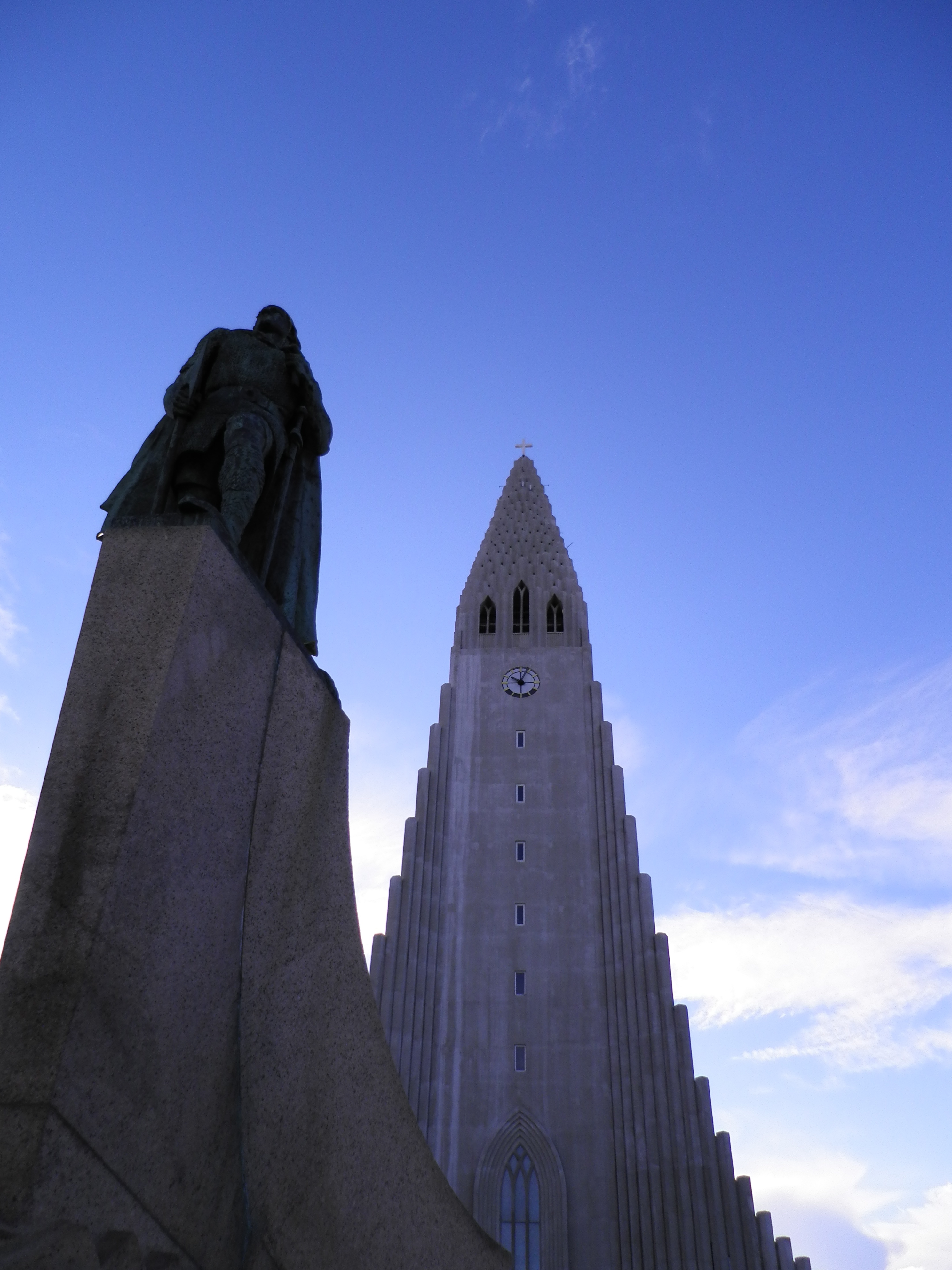
Icelanders do Churches Better than You
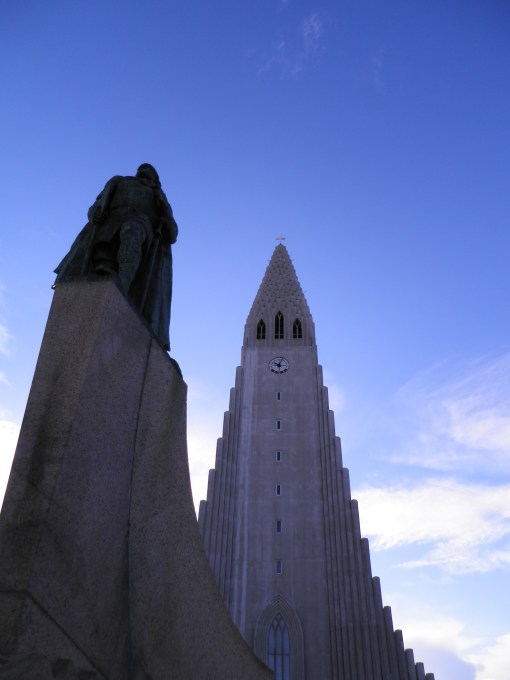
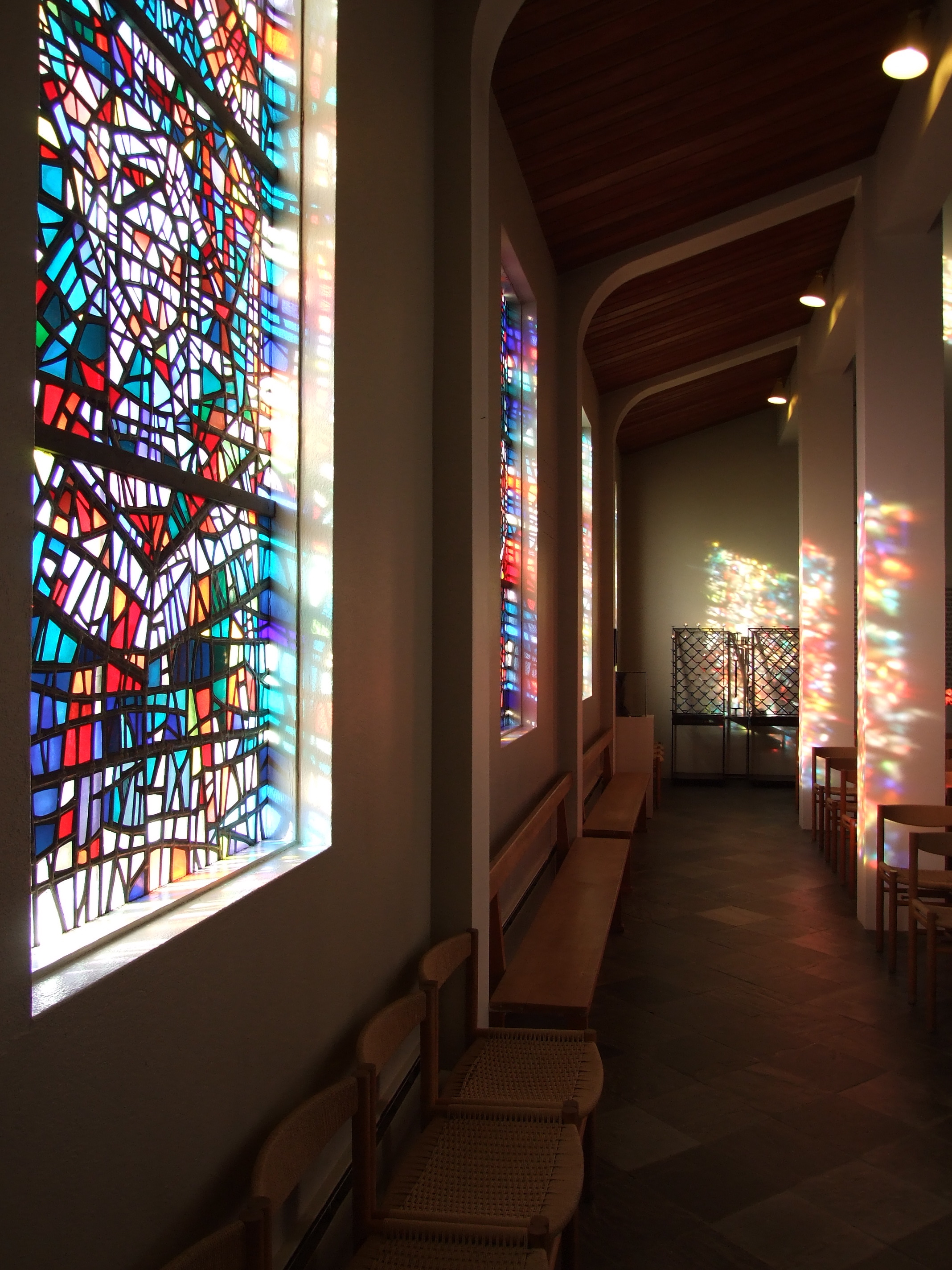
Could you pray here? The Churches in Iceland are amazing. I’m guessing this is a unique combination of the nordic sense of design, the Pagan sense of the joy of devotion (as opposed to its dour protestant alternative) and a peculiar Icelandic appreciation of the joys of light and airy spaces. The main church in Reykjavik is a joy to behold, and also has an amazing organ; but I passed many other beautiful churches in Iceland during my brief time there. The stained glass depicted below is from Skaraholt, the church that the bishop of Iceland occupied for many years before he moved to Iceland, and this is now rebuilt as a cultural monument; it is designed in every way to maximize the light available to its worshippers.
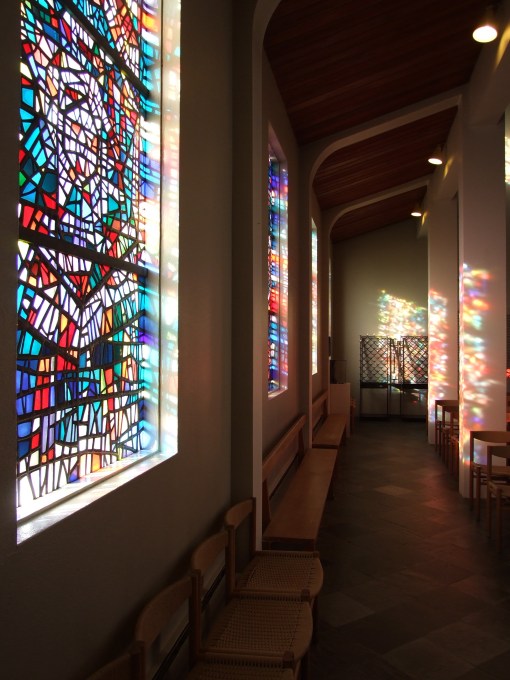
Icelandic Disco Jesus wants You, Baby When I go to London I’m always struck by the difference between Britain and other Northern European countries – British people squat in the cold dark eating their own young, while Scandinavians build houses with enormous windows to catch every bit of available light, and also make good coffee by default – and Iceland has extended this tradition to churches. British churches are splendid in their architecture, but dark and cold and silent (and sometimes grim) inside; Icelandic churches are not so splendid (though their design is beautiful) but they are brilliant and airy inside. I blame this on the elves.
A Land on the Edge of the Earth
You genuinely feel, in Iceland, that you are on the edge of the world. You could go the same distance away from the equator in the opposite direction, to New Zealand, and you will feel like you’re in a country that isn’t, to quote a great man, on the raggedy edge. But Iceland is a country where you really feel like civilization stops beyond your porch. It’s the kind of country where anything imported is genuinely expensive, where the population is so small that they endure monopolies (including import monopolies!) on products we take for granted. A country that could not grow its own fruit until the 1930s, when they designed their first geothermally heated greenhouses. This is a country that has traditionally eschewed the death penalty, because the worst possible penalty to an Icelander is exile – in Iceland, exile means you take ship for a new land or you die.
A Parliament So Old it is Myth
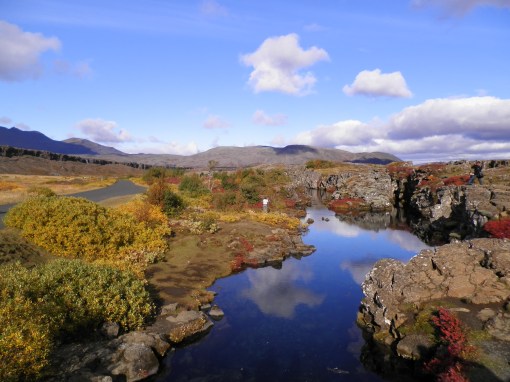
Cast your vote into the rift Iceland’s parliament, the Althing, was formed in 980 AD, and is the oldest extant parliament on earth. The early years of the parliament are recorded in the Book of Settlements, a book so unreliable that scholars have rejected its description of Iceland’s natural environment; the parliament itself is so old that no one is 100% sure of where the famous Law Rock was placed, though they have a good idea. For the rest of the world, this is like not knowing where the Speaker of Parliament sits, or where the president lives. And democracy was no easy task for the early Icelanders, either: the parliament was held every year in the gap between the Asian and American tectonic plates, in a gradually sinking zone called the Thingvellir, which was in the geographical centre of Iceland but was a good two weeks’ march from many communities. How’s that for getting out the vote!
A Land of Astounding Vistas
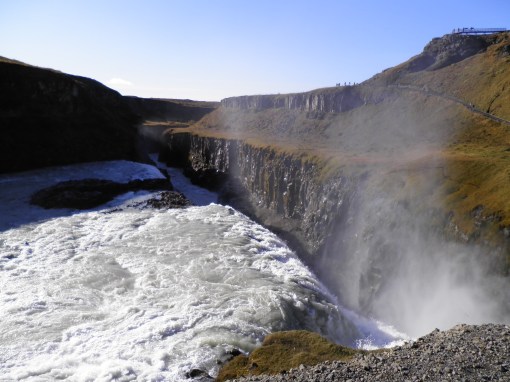
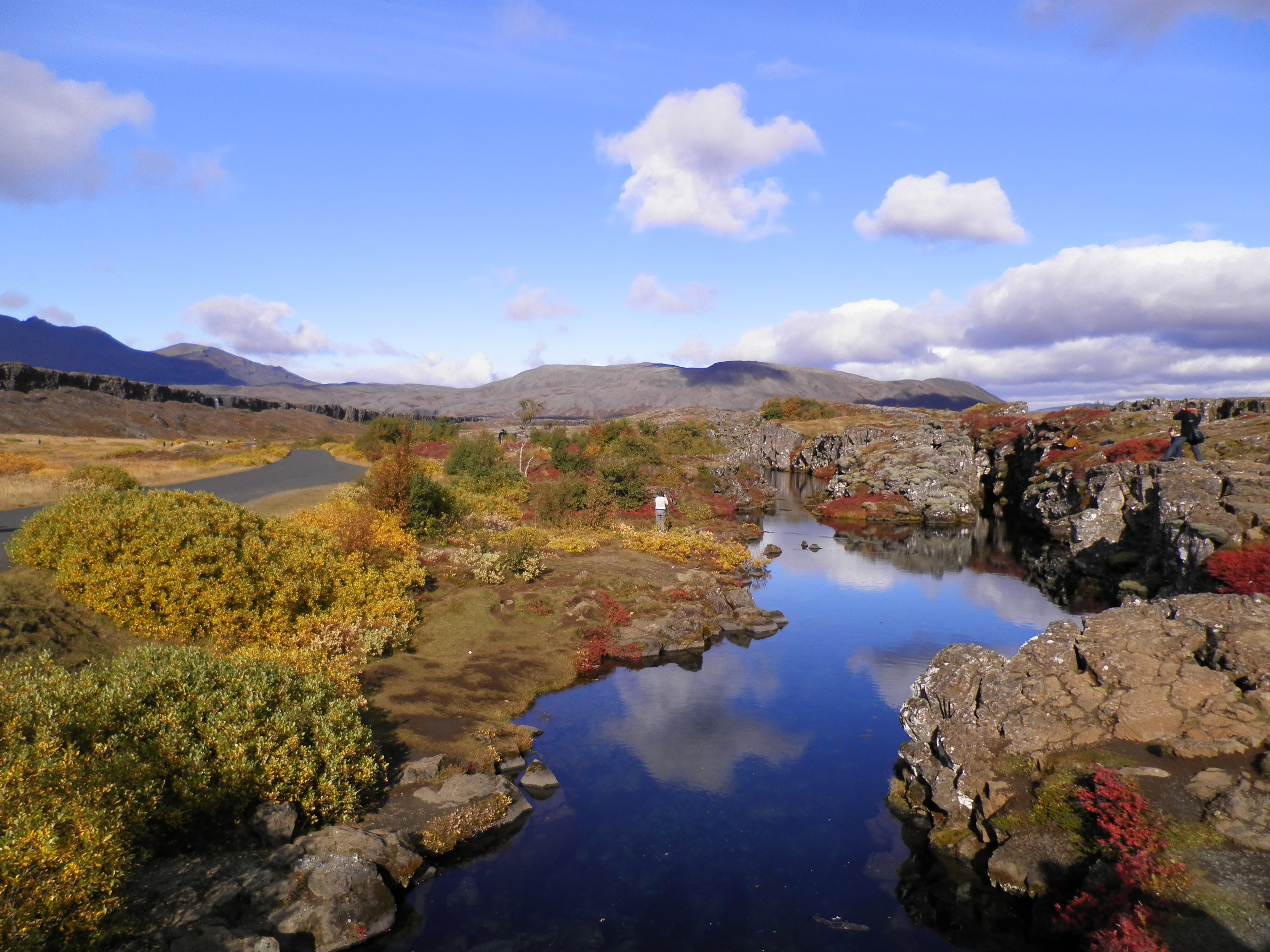
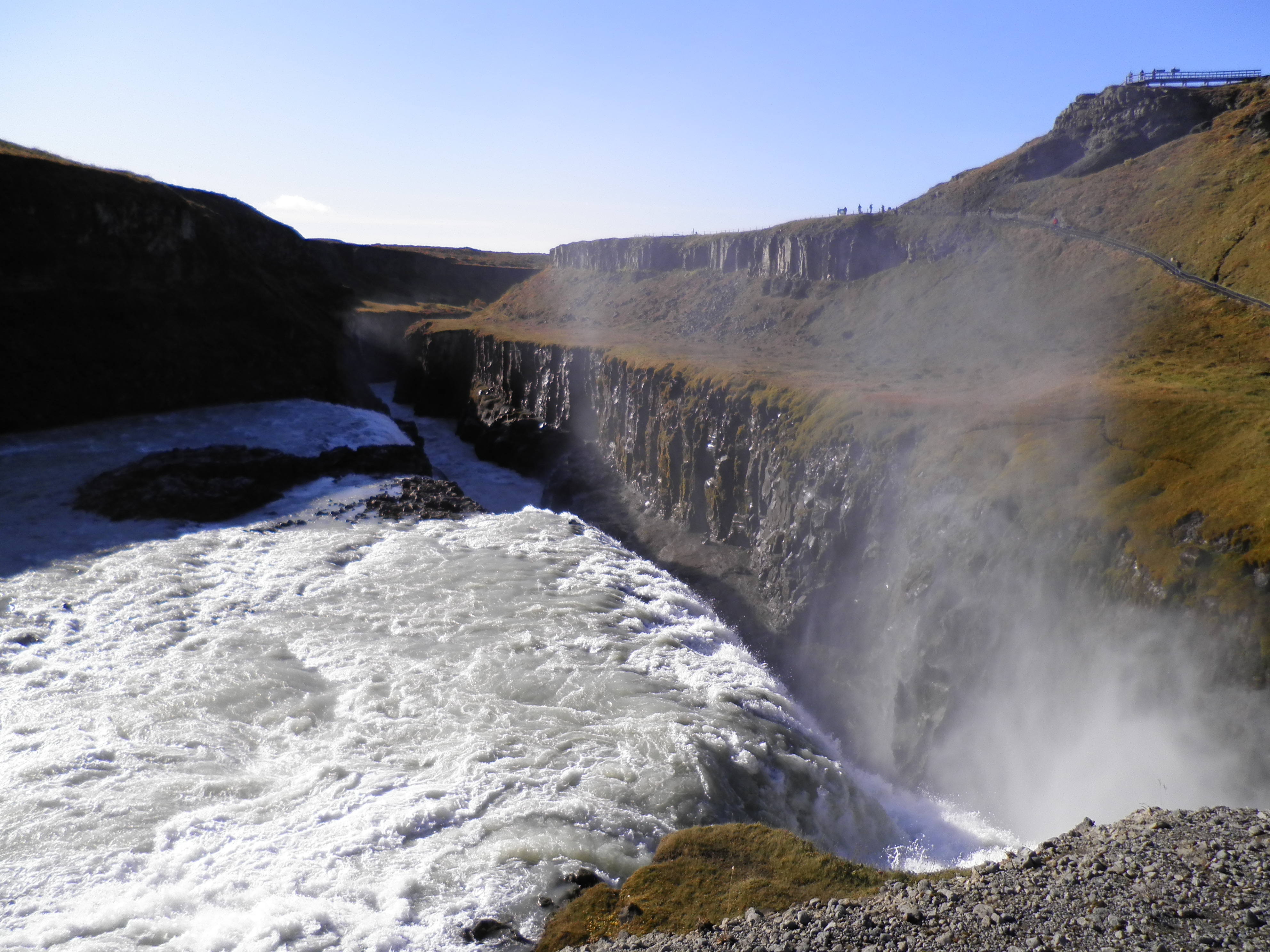
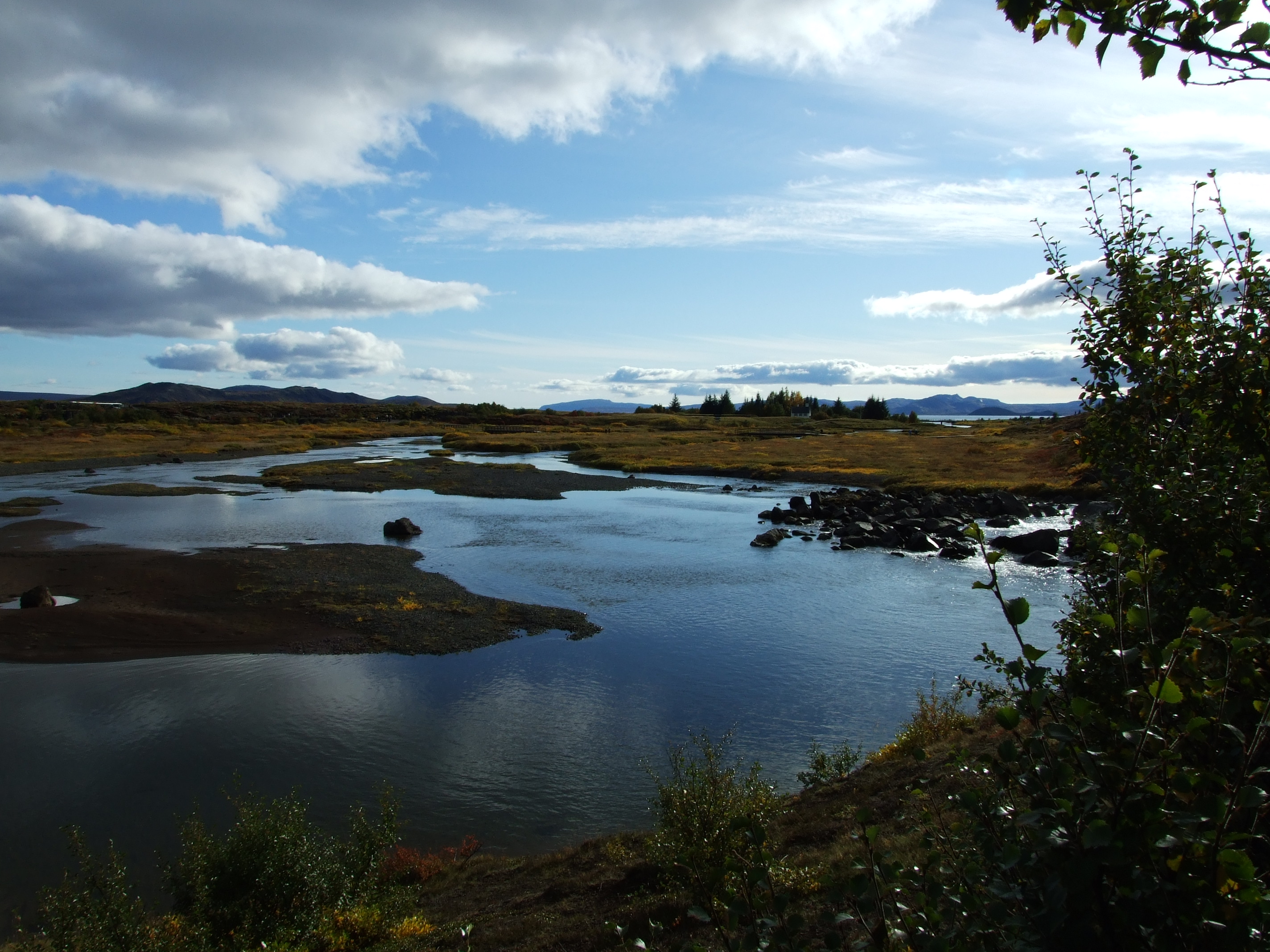
When glaciers run to the sea The countryside in Iceland is breathtaking, and very changeable. It has deserts of volcanic rock, plains of lichen, little forests of stunted and hardy trees, mountains, glaciers, farmlands and waterfalls all in a few hours drive. The open spaces, compounded by the clear air, give the feeling of vast openness that all Australians are familiar with, and some of the colours are the same; but it also reproduces the russets, yellows and reds of a British autumn in its mosses and lichens, with mountains, glaciers and volcanoes glittering icily on the far horizon, further than you’ve ever seen in your life before. This is countryside to inspire legends.
Environmental Purity is Underrated
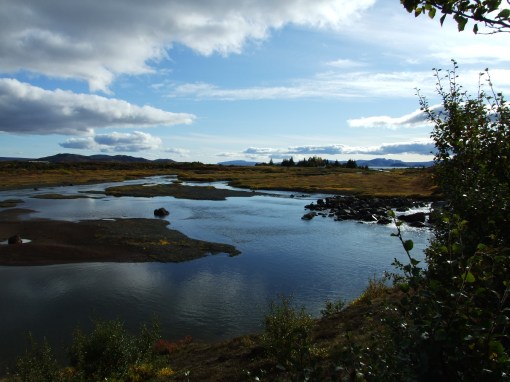
How's the tranquility? I had never experienced an environment as pure as Iceland’s before. With such a low population density, and entirely renewable energy, as well as Atlantic winds to carry away vehicle fumes, Iceland’s air and water is clean in a way that most of the rest of the world has probably forgotten is possible. You can see further than you thought possible on a sunny day, and the rivers and streams are so clear they’re almost not there. There’s also very little noise in most of the country I explored – just you and the sky, and the ever-present wind. I think until you experience a genuinely pure environment, you don’t realize what you’ve been missing – just as, until you experience a genuinely low-crime society you don’t realize how horrible living with the threat of crime really is.
Role-playing Inspirations
All of these properties make Iceland a really inspiring place to visit for your average nerd, and also a very useful source of ideas and source material. I’ll be revisiting this in a subsequent post…
—
fn1: minus the restrictive gender stereotypes and dogs called “blue,” of course[2]
fn2: I should do a blogpost on my Australian Deliverance moment, really
-
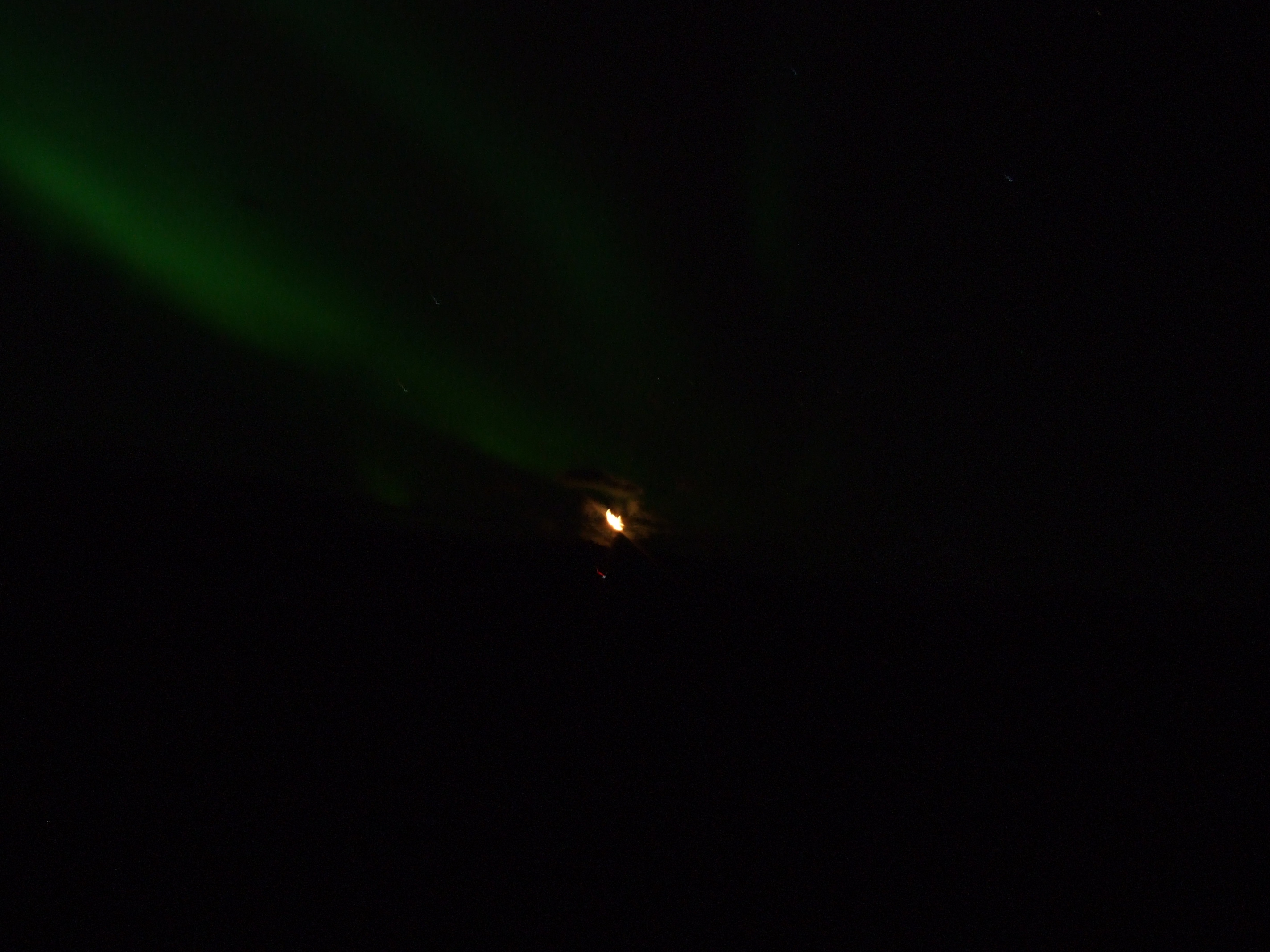
I made two trips to see the Northern Lights, because the first was unsuccessful. During the first, unsuccessful trip, our guide was a cheerful middle-aged Icelander who seemed to have a great love for the Northern Lights. Our tour guides on both nights gave us an explanation of the science underlying the phenomenon and on the first night our guide was particularly interested in explaining the details. He was halfway through describing the role sunspots play in generating charged particles when our bus passed a pair of large rocks on the side of the road, and he broke off his explanation to tell us about the other half of Icelandic natural lore, with a tale of the elves who lived in the rocks.
The elves and the motorway
When the motorway was built it was only two lanes wide, so in the ’70s it had to be widened. The process of widening the road would have put the two huge rocks squarely in the median strip between the two sides of the road, and this would be a huge problem. The rocks were home to a couple of elves, and it would be unseemly to expect them to cross the motorway. The rocks would have to be moved. So, as any sensible road-building company would, the engineers called in a local resident with knowledge of elves, and she (?) gave them the advice they needed to move the rocks outside the motorway in a sufficiently respectful manner. Our guide explained to us that “only” about 20% of Icelanders believe in elves, but the rest of Icelandic society respects this belief and try wherever possible to be respectful around places where elves are believed to live “as if we were in someone else’s garden.”He then went on to explain the effect of charged particles on the excitation states of atoms, and the role of valence band transition in determining the colour of the aurora. Once he had got through that he gave some theories the Icelandic people came up with to explain the aurora before the advent of atomic science. They actually came charmingly close: one theory held that the aurora was caused by glaciers re-radiating light captured during the day. But my favorite theory, which he explained on the way home, links the aurora with the milky way and Viking religion, and I think includes a much nicer explanation for the milky way than the greeks gave us.
The winter road
Icelanders call the milky way the “winter road,” because it is only visible in winter. This is because of the high longitude, but actually when we saw it the milky way was stunning, really like a road paved with stars rather than a faint smattering of stars (of course you can’t see it at all in Tokyo[1]). So the early Vikings saw this and imagined that the Winter Road was the path that their warriors took to Valhalla. They then guessed that the Valkyrie met the warriors halfway, and the Northern Lights are the reflection of the valkyrie’s radiance from the warriors’ armour.I think that’s much more romantic than milk sprayed from a jealous goddess’s breast. Iceland itself is a romantic, wild and majestic place, and its history seems to merge with myth in some ways, lending its politics and culture a similar air of romance. I’ll be saying more about this soon, and also talking about historical Iceland as a role-playing setting.
—
fn1: actually the clarity of light in Iceland and the purity of the water really is stunning, and has me thinking that we who live in more polluted countries really underestimate the value of clean air. In the debate about nuclear power, for example, opponents of nukes tend to assign clean air a very low value in their arguments, even though air pollution is a significant cause of mortality. Iceland with it’s entirely renewable power system, low population density, and atlantic winds to blow away car exhausts, has incredibly clean air and water, and it’s noticeable as soon as you arrive here. It’s amazing, actually. -
Standing on a frozen plain under the milky way, listening to Sigur Ros and watching great shimmering sheets of light dance across the sky in gossamer waves. That’s why I came to Iceland!
-
Following my thoughts on post-scarcity fantasy, I found myself reading the Chronicles of the Black Company, which presented me with a range of examples of a world where the relationship between magic and culture is not static, and magic is not treated as a technology that fell from the sky. Where a lot of fantasy worlds seem to have been designed as straight depictions of a medieval world with magic unthinkingly bolted on, Cook treats it as a living part of the world, rare but subject to innovation and capable both of causing social change and being adapted and enhanced by it’s society, as well as interacting with undone technology. We are also presented with an idea that is often ignored or under-played in classic fantasy: the importance of research, literacy and the historical record.
There are many examples of innovative use of magic in this book, mostly in the military context. The simplest example is its use in spying and finding spies. The Black Company keeps its use of wizards very secret, like Guinness and its use of statistics, and as a result its enemies never understand how the Company can know so much about them, nor how they can catch spies and scouts so well. The Company exploits this by spreading misinformation and suspicion, giving the impression that it has spies everywhere and deliberately spreading a reputation for cunning and counter-espionage. Wizards in this world are rare, and the Company ruthlessly exploits the relative advantage they give it, as well as both protecting them and keeping them secret.
The wizards also fashion minor amulets and magic items when they are really essential, and though they aren’t powerful they serve to give Company members a slight edge at certain times. Their mighty leaders, the Taken, go further than this, however, employing magic liberally in battle to destroy, mislead and hamper the enemy. Storms, powerful chemical weapons, fireballs, illusions and all manner of enchantment tricks are employed, as well as magic to rally the troops. The Taken also have flying carpets, which early on in the war they use primarily for their own personal missions. Later on, as matters get more pressing, they use them to ferry key Company members about and later still for troop transport. Finally they start building larger carpets which are designed to glide, fitted with ballistas, and used as aerial attack platforms. Eventually simple bombs are designed, and they enter a kind of aerial warfare arms race with their enemy. This is the kind of thing that I expect magic to do in the world, but very rarely see described with any sense in the genre. Cook further backs this up with occasional references to other innovations: at one point, for example, Croaker is given a painkiller derived from a rare locally-sourced herb. He immediately seeks out it’s name and suggests stockpiling it for the Company, only to discover that the Taken are considering cultivating it after the war for civilian use. This is how I expect any rational person to react to a magic or medicinal herb, but in most fantasy stories this knowledge remains strangely sequestered, and is never converted into any benefit for the wider community. In this book, the eternal bad guys think about it as soon as they see the possibilities it contains.
The most refreshing aspect of Cook’s approach to fantasy in his world is his depiction of research. Croaker,being the Annalist, is literate and aware of the importance of documents, and his Company consider documents to be more important than loot. At one point they stumble on a cache of key rebel documents in a captured camp and as soon as they learn what they’ve got they become ruthless beyond compare. They kill every rebel captive who might identify that they were there, set a trap to delay reinforcements, and flee with the documents before the soldiers have had any time for pillage. Amongst these documents they find evidence that they may be able to learn the true names and history of the Taken, and possession of these documents becomes the most important consideration of the story. At later stages of the series Croaker and some of the Taken prioritize the safety of these documents over that of their men or their treasure, and exhaust themselves researching them. Even the knowledge that they possess them is a death sentence for anyone not of the Company. I don’t think I have ever read a fantasy story where research is so explicitly worked into the narrative and so key to military success, and it’s both refreshing and enlightening. Obviously other stories – e.g. The Lord of the Rings – have the success of research as a trigger in the narrative, but this story works the ideas of research, espionage and secrecy into the fabric of the story in a much more sophisticated way.
This book’s treatment of magic as an integral and living component of the world is a good example of what I was pining for in my discussion of post-scarcity fantasy. It shows how much richer and more interesting the fantasy genre can be when people think more deeply about the role magic plays in the world than just seeing it as the domain of pre-destined teenagers and bearded old men.
-
In my reading of Glen Cook’s Chronicles of the Black Company I was, of course, confronted with scenes of violence and rapine such as one might expect of a company of mercenaries fighting on the side of an undead evil. However, I was also struck by the difference between the depiction of this aspect of the story and it’s depiction in, for example, the tv adaptation of A Game of Thrones, about which I have complained previously.
Taking A Game of Thrones as an example, we see a modern “gritty” fantasy writer’s view of the behavior we might expect of men and soldiers in a world where women have few rights, war has no laws, and the all moral decisions are supposedly painted in shades of grey. In Martin’s depiction, men are constantly spouting venomous, misogynist language, sex work is ubiquitous and glamorized, women are under constant threat of rape and rape culture is omnipresent and accepted. There is very little sense that men even see rape as wrong (except perhaps as a property crime), or that soldiers and victors should (or even could) be expected to act with any decency. We also don’t see any evidence that gender inequality might be differently constructed in a world of magic and dragons. Instead we have a vision of a world that you can’t help but think of as a misogynist teenager’s daydreams.
In Cook’s Chronicles of the Black Company we see the same setting, of gender inequality and war with no laws, but instead of reading the tale of men who have to make hard moral decisions to win, we find ourselves squarely on the side of a bunch of famously bad-arsed mercenaries fighting on behalf of an ancient and powerful evil. This is an evil that takes no prisoners and allows it’s favorites to commit any crime. So how is this setting depicted?
First of all, we see that our soldiers take no prisoners – they often kill their captives, and torture is done wherever necessary. They also use rape as both a tool of war and a reward. But neither activity is dwelt on in the text at all, and there is not really any point in the story where the plot takes a turn such as to make these unsavoury activities necessary to the story or to bring them to the fore in the narrative. Furthermore, although we get the impression that some of the main characters may be capable of it or may have done it – certainly Croaker orders or condones the murder of both military and civilian prisoners, including the elderly – we don’t see it as necessarily pleasant for them, and we don’t get the impression they think it is not wrong. In general rape is seen as a crime that soldiers can get away with, those who don’t want to are respected for it, and men who commit acts of violence to protect e.g. children are even given extra leniency in considering their punishments. There is no revelling in rape culture here, but a kind of guilty acceptance of it as one of the many bad things that happen in war. The Black Company is composed of exiles and criminals and held together only by it’s own internal honor and allegiances, so it is generally expected that soldiers don’t turn on their own over external moral principles, but this doesn’t stop them from condemning the crimes their members commit, and it certainly doesn’t require that the author revel in them, or enable his readers to. This is rape culture with a context, not stripped of its historical and social meaning and presented to the reader as a kind of warporn.
We also see a very different depiction of female characters in this story. Being a story about a company of male soldiers, most characters are male, but two characters in particular are women, and some are of indeterminate gender for much of the story. The women come from both sides, and both wield great power. One is perhaps supernatural and both are magical. Both expect equality as a consequence of their temporal power and the men around them give it without question. These women, like most of the characters in the story, have human flaws, but their flaws are not the usual kind of gender-specific hysterics and weaknesses one expects of a fantasy story. Indeed, one of these women is a rape survivor, but it’s not particularly relevant to her character and she has no obvious weaknesses or flaws as a consequence of it. Certainly her character and narrative role remain largely unrelated to this, so she is not defined by the acts of men. Indeed, although both characters enter the story initially in relation to the evil acts of the men around them, they soon define their own place in the world and supplant the men whose shadow they might otherwise have been expected to remain within. And there is certainly no way you can claim, as some do in relation to Martin’s work, that only a terrible fate befalls powerful and successful women.
Another aspect of this story that I really liked was the ability of these women to form non-sexual relationships with men. There is one relationship particularly that would surely be expected to become sexual under the standard fantasy conventions, but in this story it remains a friendship, and neither member of the friendship seems challenged by this. These are real human relations as we might imagine them in a medieval world where gender inequality is commonplace.
This book offers us examples of how we should expect modern writers to provide us a realistic view of a dark and vicious fantasy world, without either sugar-coating the bad stuff or revelling in it. Cook manages to present a world of gender inequality where vile deeds are commonplace without making us think that he admires it or we should enjoy it. He also asks questions about how women’s role might change in the presence of magic, and assumes that essentially our relations would retain their fundamental humanity in such a world. This is very different from what I saw in A Game of Thrones, and, I submit, a far more mature approach to the sub-genre and to fantasy writer’s interpretation of misogyny and violence in the medieval world.
Addendum
If you appreciate my views on science fiction and fantasy writing, please consider visiting my Royal Road account to read some of my writing.
-
This book offers a masterclass in “gritty,” “dark” fantasy to its more modern proponents. Written in the ’80s by Glen Cook, the blurb claims that it “changed the face of modern fantasy,” but I had never heard of it. Nonetheless, I am tempted to support the claim. It is a work of dark fantasy that- unlike the over-inflated claims of some of the sub-genre’s more modern authors – genuinely does play with the standard ideas of the fantasy genre, and in my opinion presents a much more nuanced version of a fantasy world based on “realism.”
The chronicles are a trilogy of books about the eponymous thousand-year-old mercenary company, famous across the majority of the known world for it’s fighting prowess, brutality and amorality. The company has been in a long period of decline but is still much sought-after and much feared, but at the start of the tale finds itself facing a terminal situation. The company exits its contract through treachery, a very rare event in it’s history, and enters the employ of an undead wizard called Soulcatcher, who is one of a mysterious and evil group called The Ten who were Taken. These ten had been buried under the earth along with their leader, the Lady, for a thousand years until some fool freed them, and have taken over a Northern empire, where they are fighting a bitter civil war against a group of wizards who want the Taken reburied. It is into this war that the Company is thrown, on the side of the Taken, and we follow their actions in the war through the writing of their physician, Croaker, who shares his medical duties with the role of Annalist, recording the history of the Company.
This means that we are reading a story about an amoral mercenary in the employ of the great evil force that fantasy heroes usually find themselves destined to destroy. It’s certainly fine material for gritty fantasy and offers a lot of opportunities for an undisciplined author to indulge their vicious and misogynist fantasies, like a fantasy-trilogy Quentin Tarantino[1]. But to his credit Cook rises above this cheap schlock, and offers us instead a nuanced attempt to understand the morality of ordinary soldiers on the wrong side of a moral divide. He also avoids the trap modern writers seem to have fallen into, of letting their own sexist fantasies run riot against the backdrop of a world rife with gender inequality, or failing to consider how gender roles might change in a world where magic is real. This world is also not static, so we see magic developed as a technique of war over the decade or so in which the novels are set. The Company itself has three wizards, none of them particularly powerful or clever, and uses them cunningly in ways that make them far more valuable than their raw power would imply. The book has some resonances with recent opinions I have posted here about both post-scarcity fantasy and misogyny in modern fantasy, and I will try and write some separate posts on both these topics.
The novels are well-written and easy to read, with neither the overblown prose and melodrama of high fantasy nor the swearing and gutter language of modern “dark” fantasy. The first book, especially, also manages to eschew casual contemporary speech without becoming stilted, though the last two become a little more casual and at times too modern for my tastes. The settings are majestic and fantastic but still within the bounds of classic settings (except the plains of the last book) and the battles range from minor skirmishes to a monumental siege in which a quarter of a million people die. The later stages of the story are over-shadowed by the possible return of the Lady’s husband and supposed master, the Dominator, and the dual threat of his return and her ascendancy sees our heroes making much more complex moral choices than we are used to seeing in fantasy.
The characters are also well-developed and subtle, and even the nasty ones get a sympathetic description. We see subtle insights into the reasons why they have chosen the crooked path, and ultimately the evil characters are not so easy to judge, nor the good characters so easy to acclaim.
For this reason I can recommend this book to both readers of fantasy in general, and admirers of “realism” in fantasy. For those who think that the George Martins of the world have rewritten the genre or – worse still – shown fantasy worlds as they really would be, I recommend revising your judgments in light of this book. I think some people may claim it started this particular sub-genre, though I am not sure about this claim, but certainly it offers those authors a lesson in how to depict the complexities of realism in fantasy, and how to rewrite the conventions of high fantasy without being obnoxious. It’s also an excellent story, that is a lot of fun to read.
—
fn1: shudder -
This is a cute variant on chess that I bought in Japan as a souvenir for a friend. I wasn’t expecting it to be anything but a cute example of Japanese children’s game design, but it actually proved really interesting. The game layout and images of the pieces can be seen here: it’s obviously just a cute little chess game. The rules are similar to chess but with simpler moves and an additional way of winning. The board is a 3×4 matrix, with sky at the top and forest at the bottom. These regions constitute the players’ “areas”, which are similar to the back row of a chess board.
The pieces
Each side has only four pieces:- The lion, essentially the king in chess, that can move one square in any direction, making it as powerful as the queen on this board.
- The Elephant, essentially a bishop, that can move one square diagonally
- The Giraffe, essentially a rook, that can move one square horizontally or vertically
- The Chick, essentially a pawn, that starts in the middle of the second row and can move forward one space. If it reaches the enemy area the chick becomes a chicken (which in play my friend called a “magic chicken” ) that can move sideways or forward diagonally, and backwards one step
The objective
Winning is possible by catching your opponent’s lion or by advancing your lion into your opponent’s area. Catching the lion is called “catch” and winning by advance is a “try.”Replacable pieces
The main change from the standard rules of chess is the ability to return captured pieces to the board. After you catch your enemy’s piece you put it next to your side of the board and can then place it on the board instead of moving an existing piece. You have to place them in the order you caught them, and you can put them in any empty square. It wasn’t clear from the explanation but the rules stated that the chick has to advance into the opponent’s area to become magical, so we figured that means you can’t enchant a chick by placing it in your opponent’s area.Differences from chess
Replacable pieces on a board this size makes for an interesting variation on chess. You can see from the diagram that the chicks start off facing each other and able to take each other. This is of no benefit to the person who starts because both players end up with a chick in hand, but one player has his lion in the middle of the board. The lion is strong, not weak, so this is a good position to start.This is the other main difference from standard chess. Because no piece can take from range the lion is the strongest piece on the board, and moving it out early is good. Also, the ability to win by a try makes aggressive use of the lion a good tactic. In fact, over 10 or 12 games I got the impression that this game encourages aggressive play.
Another difference from chess is the use of diversionary tactics, especially using captured pieces. For example, if you threaten the king with a newly-placed elephant from one side of the board, the king will have to take it. This gives your king a free run up the board on the other side. I don’t think these tactics are used as much in standard chess.
Three special rules
This game is a training game for child chess players (the website is on the women’s chess society homepage), and as such intended to introduce children to chess culture. So it introduces three special rules for all players:- Always say “please be good to me” (yoroshiku onegaishimasu) before you play and “thank you” at the end
- Never let anyone help you: play under your own effort
- Never say “again”: in mistakes are the foundation of learning, so try to accept your errors and play without taking moves back
Each game takes only 5 to 10 minutes, so it’s a pretty quick learning curve compared to chess and it’s cute and fun to play. I recommend giving it a go. It also has me wondering what other variations on chess might be possible. For example, if you doubled or tripled the board size could you play chess like a modern war-game, with great sprawling battles, and wargame-style tactics? I’ve not really seen variations of chess based on changing the board size and distribution of pieces, but it appears to offer opportunities to use the basic rules of chess to play a very different style of game. An interesting idea…