• Our guide for this trip is Mr. Geiger ...
    Our guide for this trip is Mr. Geiger …

    Recently I visited some collaborators in Minamisoma, Fukushima, and after our work was done they took me to the exclusion zone around the nuclear plant. We didn’t enter the innermost zone, but traveled right up to edge of it. Similar to Chernobyl, the area is slowly being reclaimed by the wilds, and its level of radiation contamination means this area hasn’t been cleaned up yet, so it still carries a lot of evidence of the destructive power of the tsunami that damaged the plant.

    For this drive we first headed in the direction of Namie, then turned off the road to head towards the beach and the tsunami zone. We took a radiation counter with us (shown above) that measures external exposure in micro-Sieverts per hour estimated from 30 second averages. This means you can tell what your exposure would be if you stayed in the particular spot for an hour. Wikipedia tells me that normal background radiation levels are about 0.4 milli-Sieverts per year, which would be about 0.05 micro-Sieverts per hour, so the background level in the car is not so bad.

    You shall not pass...
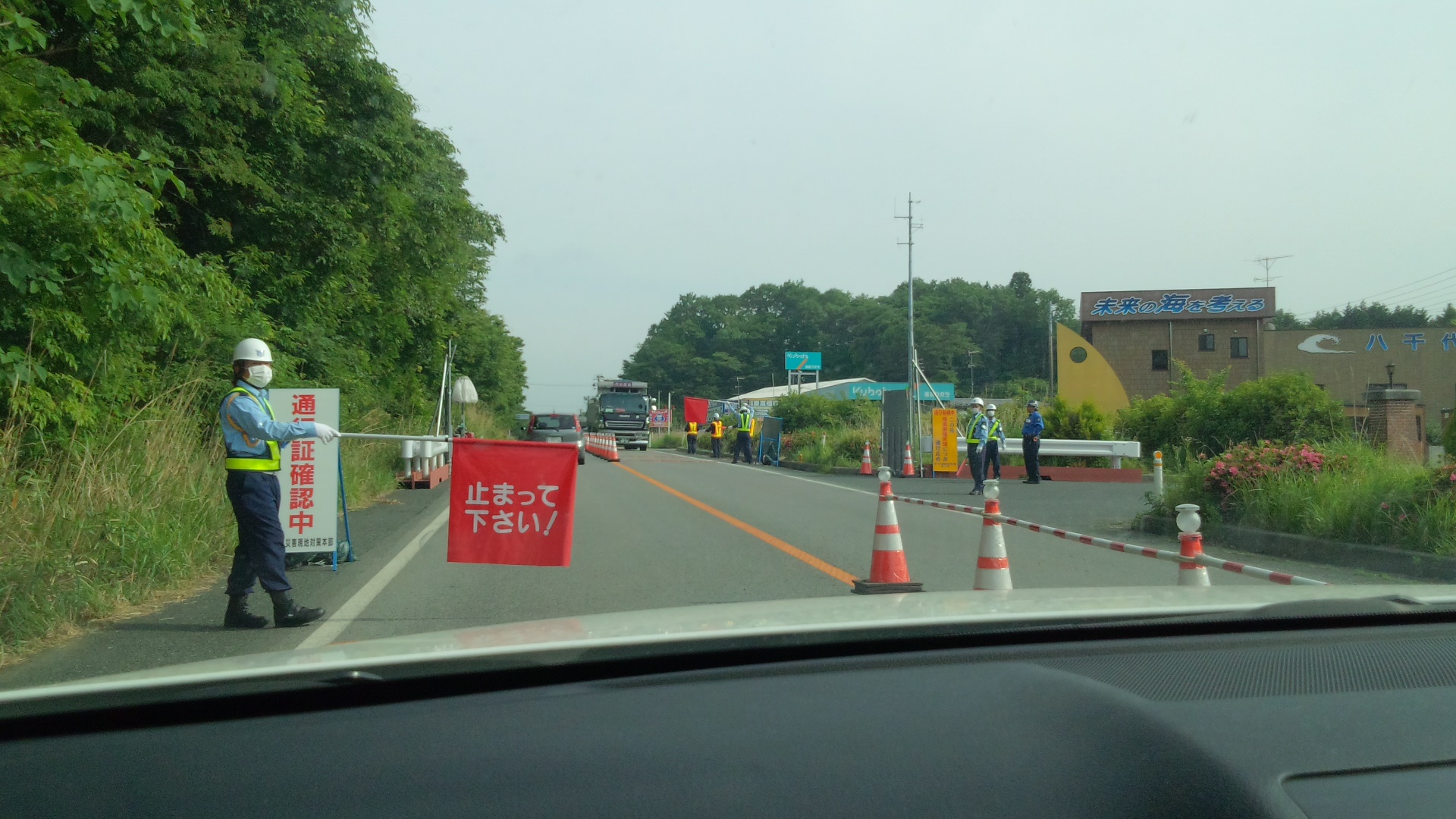
    You shall not pass…

    We were refused permission to continue to Namie, because that area is directly under the original radiation plume and the only people allowed in or out are those with a reason to be there. I think it’s safe to say that no car with a foreigner in it is going to Namie for a valid reason, since it’s a tiny town (now empty, I think) that probably has never had a resident foreigner. You need a special permission to pass through, and we didn’t have it, so we turned back and headed to the sea. Note the sign on the roof of the house in the distance: it says “Thinking about the seas of the future.” I find this quite ironic.

    The rubble two years on
    The rubble two years on

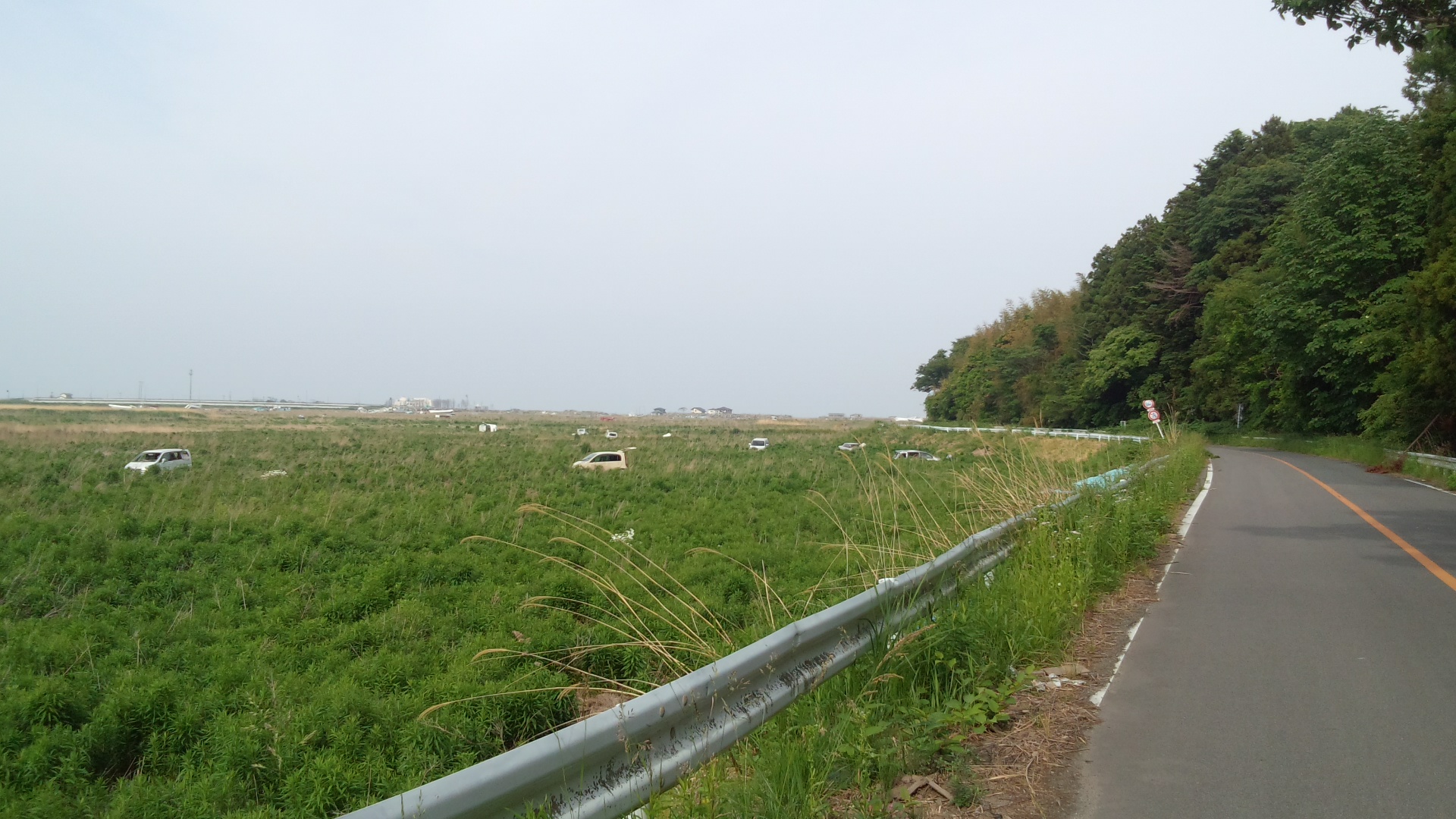
    Turning off the road, we traveled down this small side road towards the sea. In this picture it’s about 2km distant, just audible when one steps out of the car. The land to the side of the road used to be a mixture of rice paddies and houses, but now it’s all overgrown. In the distance along the road you can see the barriers being reclaimed by the forest, and the trees growing over the road. The cars in the field are in the position where the tsunami left them two years ago. In case anyone doubts what the nuclear plant was up against, let’s just think on this for a moment: the tsunami washed this far inland over a sea wall and a mixed community of houses and farmland, carrying a brace of cars with it. It must have come to its end about here, because the road is relatively intact and the cars upright and uncrushed.

    A name is not enough...
    A name is not enough…

    The boat in the picture above is the Number One Lucky Omen (dai ichi kichijo maru). I don’t know if it was dragged here by a clean up team or the tsunami, but the area around has other, larger boats scattered about. It’s some kind of fishing boat, I think. In the background on the left are the remains of a few cars. Now we’re perhaps a kilometre from the sea, and it should be obvious that the tsunami at this point is not being so merciful as to leave cars upright and uncrushed. In the background is a primary school, almost completely intact. It is a quite modern building, obviously designed to withstand real damage. I was told that all the children in that school survived. Schools have catchment areas, but this school is standing on its own in a huge field. Its catchment area was washed away.

    Over the wall...
    Over the wall…

    This picture shows a kind of tetrapod, cast aside on the landward side of the sea wall. The sea wall is just visible in the background as the horizon. Tetrapods are huge chunks of geometric concrete that are piled up on beaches in Japan as wave breaks. They interlock with each other and form a kind of barrier at the edge of the sand. They are huge and made entirely of concrete. The tsunami picked up these tetrapods and carried them over the sea wall, dropping them perhaps a hundred metres inland of the wall as it raged forward. The area around these tetrapods was populated – just behind me as I took this picture stood the remains of a house, and a flattened area that once held a shrine. That means these tetrapods were smashing through houses as they came inland. If you look at the sea wall in the background you can see things sticking out of it, pointing upwards at the sky. These are the innards of the wall. The tsunami didn’t just rush over this wall, it tore it apart as it came.

    ずれた!
    ずれた!

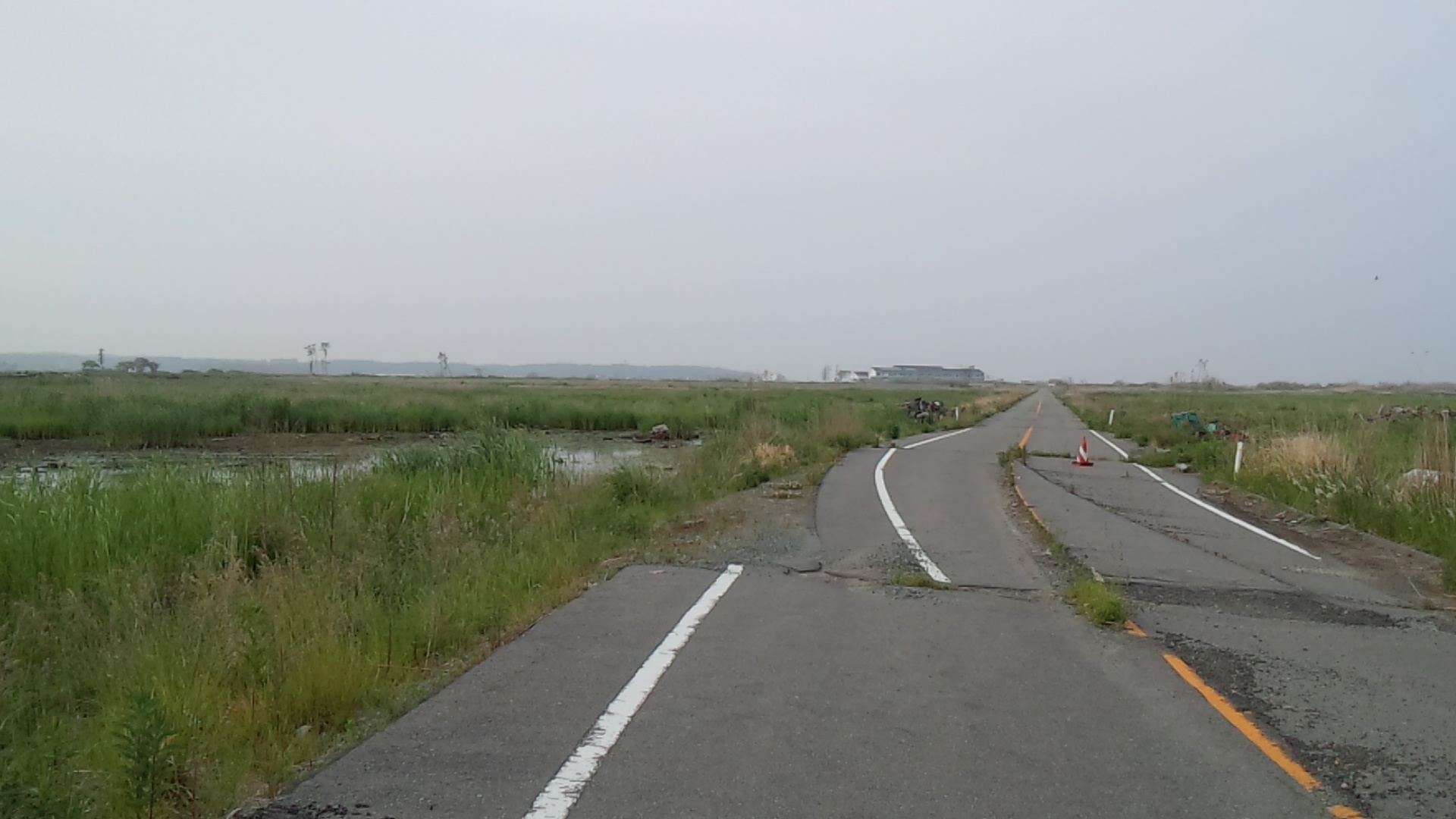
    From that point we headed south towards the exclusion zone. This shot is looking back the way I came (you can see the same primary school looming on the horizon just to the left of the road). The road is, obviously, in a bad state:  those traveling with me thought this was likely the effect of the original earthquake rather than the tsunami. I don’t like to think about how terrifying that earthquake was, because it was pretty scary in Tokyo and we didn’t see anything twisted or broken. The nuclear powerplant had to be resistant against this earthquake, and then the tsunami that followed, even though it was built 40 years ago. It’s quite a miracle really that it didn’t collapse completely. Note the pond to the left of the road: this is another example of nature reclaiming the area, and was rich with the sound of frogs and insects. Soon after I took this photo an enormous crane took off from the reeds and flew to the distant forest.

    The exclusion zone
    The exclusion zone

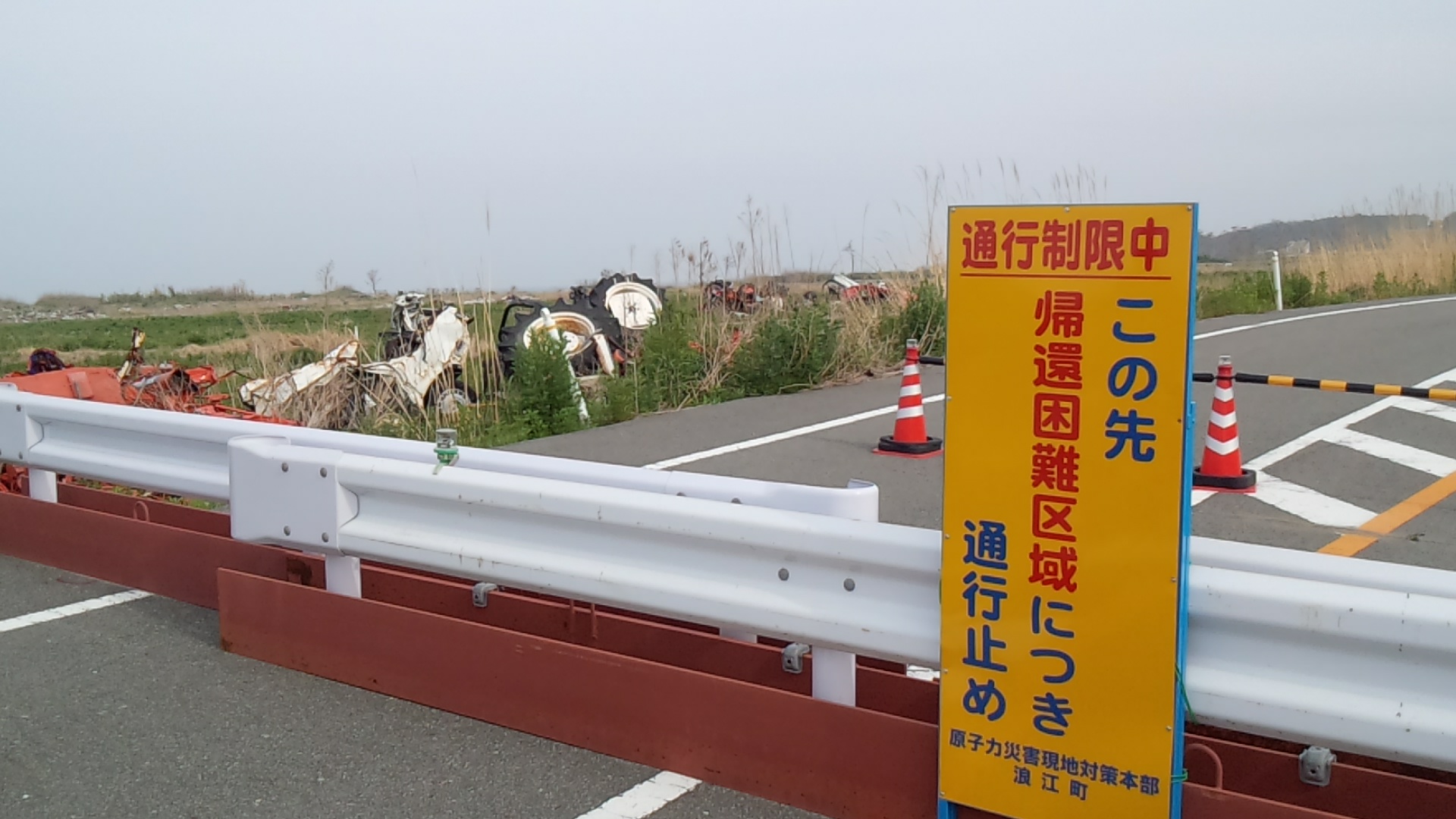
    Turning around from that picture we find ourselves facing the barrier to the inner exclusion zone. This is the 10km zone: you can see the roof of the powerplant in the distance over the trees. No one is supposed to enter this region, because a little further south and west of here you will enter the area most heavily affected by the plume. We didn’t cross the barrier. Note the ruined tractor on the verge of the road.

    Satoyama
    Satoyama

    This is a picture of the landscape immediately to the right of the barrier. There is a swampy area full of frogs, insects and small birds, and then beyond that a small hill that would once have been a satoyama, surrounded by local homes and rice paddies and probably with a small shrine in the middle. Satoyama are a unique form of ecosphere intimately connected with Japanese farming techniques, but the satoyama around here have gone wild. This area was thick with birdlife, so standing here I could hear a cacophony of bird song such as I have never heard in rural Japan before. Usually birdsong in Japan is limited to a few common croaking and sqwarking birds, but here there was a symphony of singers. High, warbling birdsong like something from Europe mingled with strange, throaty cries and a kind of laughing whoop that I have never heard before. The area was alive with animal life. In just two years, this whole area has become a huge wildlife sanctuary, and birds that would not normally come near human settlement have proliferated. I think usually you would only hear these birds in the deepest forests, or perhaps in some rare farming communities; but here they are easily accessible in amongst the new growth of the devastated area. I think the people of Minamisoma should leave this area as it is; as a kind of combined wildlife park and memorial, so people can visit to enjoy the sight of Japan how it once would have been, before it was cultivated; and simultaneously appreciate the fury of the ocean, and the damage that was done because the post-war builders ignored the stories handed down to them from previous generations.

    Eight times, my friend, eight times!
    Eight times, my friend, eight times!

    Finally, here is a photo of our Geiger counter, taken at the barrier. It was hard to get a clear shot due to the frequency of the screen, but it now reads 0.42. This is approximately eight times the background level of Japan (maybe five or six times if you take into account cosmic rays and backscatter from the ground). It’s probably not actually a serious enough level of radiation to preclude redeveloping this area and allowing people to live here again, but I think it would be better if they didn’t. Japan doesn’t lack for wild places (about 70% of Japan’s surface area is forest) but it would be a fitting memorial to the triple disaster and an interesting exercise in ecosystem development to let this place return to nature. I think it’s also very apt for a pagan society to make a memorial out of the wilderness. So, here’s to the lives lost in this stretch of coast, and hopefully they can be honoured through some kind of wildlife sanctuary – a terrestrial mirror of the wild ocean that originally took those lives, and cast this place back to nature.


  • Steve and Zack at something awful have a review of some kickstarter for a 3rd Edition of Exalted. They seem pretty angry about the direction Exalted has taken. I played Exalted briefly and really liked it, as well as its over-the-top anime-D&D cross-over style. I didn’t realize it was full of rape magic … is this a new thing? Has Exalted changed, or was it always dubious in this way?

    I previously reviewed the 2nd edition of Carcosa positively, and my main reason for being accepting of the child rape and sacrifice in that book was that I thought the tone and context made it clear that it was evil, and that the players could take sides on the issue – it was built into the world but not essential to the construction of characters – if anything, people would make characters who would be fighting against the sorcerers who engage this stuff. From reading the Exalted review, it appears that the opposite situation will apply in the new edition of Exalted – that the morality of the succubus is not clearly evil, and it may be hard for players to avoid engaging with magic that really should be NPC-only stuff. Zack in the review was particularly angry about the demon child rape shown in the page of the review, and it certainly seems like the tone and style of depiction there is very different to the calm, cold, matter-of-fact description of sacrifice in Carcosa … it’s more salacious, as if it contains a shred of approval. It’s interesting how context and tone can shape our interpretation of elements of a story that might otherwise superficially appear to be the same. If so, perhaps everyone’s interpretation of context is unique and the 3280 “little idiots” who supported the Exalted kickstarter would have found Carcosa terribly offensive. Do we have some objective barometer for this stuff?

    Also, has anyone reading this blog actually ever tried playing an RPG full of sex powers and rape? Given the game scene consists mostly of men, it seems like this would be a very awkward scene. Also, describing combat would be a weird mixture of embarrassing and disturbing, like watching The Human Centipede with your mother. And how would you design adventures? I just can’t see this style of gaming having much appeal to 99.9% of the gaming world. Is it a common feature of White Wolf that its players enjoy getting together and talking really graphically about sex, with dice?

    Footnote: the title of this post is taken from the Something Awful review.

  • A recent statement from a spokesperson for House Lannister:

    House Lannister has heard of the recent events at The Twins, and are shocked by the brutality rumoured to have occurred there. Suggestions that the Lannister family had any connection with these horrendous events are a slander on our good name, and anyone repeating them is obviously subscribing to the craziest and most preposterous of conspiracy theories. What is said to have happened at The Twins is abhorrent and inconsistent with the moral principles by which all Westerosians live, and there is no way that the Lannister family would have any connection with such cruel and un-Westerosian behaviour.

    At this point, an enterprising journalist should ask, “if this behavior is ‘un-Westerosian’, how come we have a song called The Rains of Castermere?” Or, “If this brutality is so inconsistent with Westerosian ethics, what do you say to claims that your own son was forced to kill the mad king to prevent him burning down all of King’s Landing?” But they never do ask, do they? They take these glib denials as fact, when in fact the very essence of the claim that the behavior being decried is “un-Westerosian” is completely false.

    The above statement follows the lines of standard dismissals of bad behavior that are issued by politicians all the time, and a common element of those dismissals is a call to a common ideal of the ethics of the country in question that is, in general, a historical fallacy. Opposition figures also use the same call to fantasies of goodness when they decry acts that they were either complicit in during the previous government, or will continue when in government. For example, after today’s revelations that the NSA is spying on our communications[1],  one of the authors of the Patriot Act, Jim Sensenbrenner, said:

    I do not believe the broadly drafted Fisa order is consistent with the requirements of the Patriot Act. Seizing phone records of millions of innocent people is excessive and un-American.

    Really? UnAmerican? What about Cointelpro? What about the House un-American Affairs Committee? What about the Patriot Act that you wrote? It seems to me that the USA has a long history of this kind of thing, and it’s not “un-American” at all to get up to this sort of mischief. The scope might be greater but so what? It’s a matter of degrees, and it doesn’t seem unlikely to me that if he could have, McCarthy would have spied on emails.

    The same thing applies with the recent expression of regret (and pathetic compensation) to Mau Mau rebels by the British government, which refuses to directly apologize because it might set a legal precedent, but which also somehow manages to claim that

    It is an enduring feature of our democracy that we are willing to learn from our history.

    Really? The Mau Mau tortures occurred in the 1950s, but the UK was still operating secret torture camps in Northern Ireland in the 1980s. Is that how the British government “learn from our history”? Is burying the documents in a secret location (“if we are going to sin, we should sin quietly”) and fighting compensation in the courts how the government “learn from our history”? I don’t think so. Meanwhile the Guardian refer in an editorial to Britain’s “battered moral authority.” Really? You think your country has moral authority? Does that perhaps derive from your willingness to send people you don’t like to Libya to be tortured by Ghadaffi? Your cooperation with secret rendition and torture programs run by the USA? Or your long history of torturing and murdering political opponents in the colonies? Where, exactly, does Britain’s “moral authority” derive from – having sinned quietly rather than publicly?

    For the same reason I am expected to believe that when the two major parties in Australia try to find ways to “stop the boats” they are doing so out of genuine concern for human welfare – not because they are the same two parties that oversaw the White Australia Policy and a long term policy of racially-based child abduction. I am supposed to believe them when they assure me that racism has no place in modern Australian politics, and really they’re just trying to solve a problem.

    It seems to me that when politicians make these claims, drawing on long traditions of moral authority, they’re either:

    1. setting themselves up to deny something they’re actively involved in, or
    2. trying to gain false moral ground so they can use a bipartisan policy for partisan political gain

    So the best thing to do, as soon as a politician calls on a long-standing “principle” of their own society as defense or source of moral outrage, is to assume they’re lying, they will do that very thing if they get a chance, and they’re already up to their neck in it. And for final proof, I present this perfect quote from Jack Straw when he denied – in parliament, I think – the initial rumours of British involvement in rendition and torture:

    Unless we all start to believe in conspiracy theories and that the officials are lying, that I am lying, that behind this there is some kind of secret state which is in league with some dark forces in the United States… there simply is no truth in the claims that the United Kingdom has been involved in rendition.

    All those claims about complicity with rendition were subsequently shown to be true. Perhaps Jack Straw should apply for a job at King’s Landing …

    fn1: note to my secret NSA readers: don’t bother using PRISM to catch this subversive document, I upload them to a public site.

  • I thought it was blue ...
    I thought it was blue …

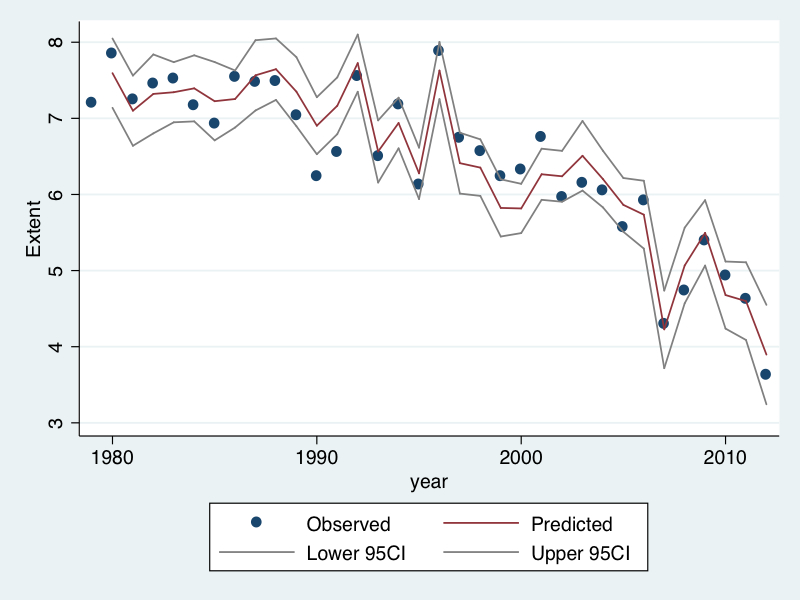
    Despite the bleating in the Guardian, I think it is still the case that there is a surprising dearth of global warming-related science fiction. This lack of effort by sci-fi writers is despite the fact that the changes are fast approaching, and most surprisingly one of the changes expected to take longest – arctic ice loss – is happening at an incredible pace before our very eyes, with potentially huge effects. We have already seen major crop losses in the UK due to flooding, and I am convinced that the flooding in the UK is due to arctic sea ice loss (or I will be convinced, I should say, if it is a regular phenomenon in the next few years). So, I’m wondering if the world faces the possibility of a major, generalized agricultural failure in our lifetime, and what that will look like. Let’s have a go at imagining it, but first let’s look at what it might be and how it might happen.

    Describing a generalized agricultural failure

    Only a small number of countries provide a large amount of food for the majority of the world. Wheat, for example, is primarily produced in China, the USA, EU, Australia and Canada; rice is clustered in a small number of Asian countries and is highly dependent on monsoonal weather and water supplies. A generalized agricultural failure would easily occur if just a couple of countries experienced a simultaneous loss of productive capacity. Particularly, crop failures in the USA, China, the EU and Australia would seriously disrupt the balance of food supply. Furthermore, there are a lot of countries that due to either economic decisions or environment are heavily dependent on imports of food. Middle eastern countries with large areas of non-arable land and African nations that are heavily committed to cash cropping are examples of this. Many of these countries are also low- or middle-income nations with very limited emergency food supplies, which makes them very vulnerable to disruptions in international trade. Finally, some major high-income economies with serious military power – such as Japan and the UK – do not have food security, and are currently heavily dependent on international food markets. Collapses in supply for these countries would make them extremely itchy about guaranteeing overseas trade supplies.

    Much of the world’s food is devoted to supplying cattle, and a lot of arable land is currently devoted to biofuels or other “non-essential” supplies (such as sugar cane or oil-producing crops). However, food is not an immediately replaceable good – being dependent on seasonal patterns, it can take a year to switch crops, but societies with poor food reserves can’t go a year while they wait. Also some crops that might be replaced in that year have a huge investment in infrastructure that their owners might not want to reverse in times of national emergency: cork, olives, vineyards and all forms of orchards can take 10 or 15 years to bring to productive capacity, so ploughing them under to grow essential foods means a potentially quite long-term reduction in food diversity. The global agricultural system is not nimble in the way that a manufacturing system might be, and is also often heavily subsidized and protected.

    So a general agricultural failure would involve failure of crops in a couple of independent producers for a couple of different food types all in the same year – possibly after a couple of years of build up in which reserves were strained – and in both the northern and southern hemispheres. For maximum effect it would need to occur in some high- and some low- or middle-income countries, disrupting not just the production of food but consumption and export patterns. It would have to affect a couple of exporters to have a truly global impact, and it would have to affect foods that are used for human as well as animal consumption.

    How would agricultural failure happen?

    In the short- to medium-term, a generalized agricultural collapse is only going to happen if it combines some global-warming-related phenomena with some bad luck. The only global-warming-related phenomenon that seems to be reliably weird at the moment is the arctic, but this is having fairly large effects and they can probably be expected to grow more extreme. They seem to be particularly affecting the food producers in the EU and North America, so a viable near-term scenario for agricultural failure would probably be:

    • serious flooding in Autumn in the EU and/or UK: due to the arctic sea ice loss increasing rainfall over northern europe
    • crop failure due to late spring and severe winters in Canada and northern/western europe: due to weakening jetstreams around the poles allowing cold air to flow further south and disrupting the Atlantic climate
    • a massive el nino causing drought and crop failure in Australia and latin America: obviously this is completely unrelated to global warming but the chances of a switch to el nino over any 5-10 year period are very high, and in a warming world the next el nino is going to be associated with some very unpleasant high temperatures
    • a random failure of monsoon or rainy season in east or southeast Asia: also (probably) not global warming related, but for example this year Japan’s rainy season – important for its rice crop – is already late and showing no signs of starting

    In combination, these effects could lead to a huge loss of wheat, rice and corn crops in several major food producing nations. The likelihood is that the full global implications of the failure would not be understood until after the northern hemisphere harvest, by which time (maybe) the crops for the following season would already be laid down in the southern hemisphere. Even if governments were quick thinking enough to see the risk for the following year and mandate changes in crops, this would mean the southern hemisphere would have wasted a lot of arable land on non-essential plantings. Of course, the chances that governments would respond in time to the crisis to be able to mandate planting of only essential crops are pretty small, and although price signals might encourage some farmers to switch to essential crops, it is likely that this would take more than a year to happen – especially given the highly protected nature of agriculture in most parts of the world. So after the initial food collapse shock it is likely that there would be a second year of weak harvests, even if the weather turned good. Collapses in wheat and corn crops would be followed by a glut of cheap meat as farmers killed off unprofitable herds; the following year would see a spike in meat prices (I think this happened this year, actually).

    What would a generalized agricultural collapse look like?

    The collapse would likely be seen in the most vulnerable nations first, most likely those countries with limited food security and heavy subsidization of food prices. I think a lot of these countries are in the middle east and there have already been suggestions that the Arab spring was related to food markets. Jared Diamond famously blamed the Rwanda massacre on pressure for farmland, and other historians have suggested an economic imperative driving the holocaust. Even where it is not obvious, pressure over food and food prices can lead to political instability, upheaval and chaos, and this will likely be the first symptom of the collapse, as prices rise and food importers in the middle east respond rapidly to the collapse of stocks. Unfortunately, market liberalization doesn’t happen quickly and in any case, in the face of a general loss of supply there will be no solution for these countries: they will fall into an increasingly desperate round of riots and political upheaval, and possibly also major population movements.

    Following internal tensions in the most food insecure nations, international tensions will begin to develop between major traders and their clients. Faced with generalized crop failures in major wheat trading partners, countries will try to find new markets, but some of these (such as Australia) will also be facing lost supplies, and will likely restrict trade to ensure security of domestic supply. This would lead to tensions between trading partners, followed by a desperate scramble as countries like the UK and Japan rushed to secure supplies. The first casualty of these efforts would be the poorest nations, who would suddenly find food suppliers deserting them for lucrative western markets. At its worst this could lead to riots, seizure of property, and expulsion of businesses and representatives from high-income nations. Emergency food aid would also collapse as countries conserved resources, and this would lead to famine and disaster in countries like North Korea and parts of sub-Saharan Africa, as well as countries newly thrown into food insecurity – especially poorer middle eastern countries like Yemen and Iraq.

    Finally, as food reserves dwindled, tensions would rise between high income nations as they competed with each other for food supplies. Particularly, the EU, Japan and China would run into conflict as they sought to outbid each other for the remaining food supplies from the Russian breadbasket areas and the Americas. In southeast Asia, piracy would become commonplace, as it also would around the horn of Africa, and the second-tier powers would probably finance or trade with pirates as an alternative to direct conflict with the major powers. To protect these sea lanes countries with traditional rivalries – such as Iran and Iraq in the Gulf, and China and Japan in Asia – would have to send expeditionary forces. Although Japan currently has the ability to defeat China on the high seas, a war over something as fundamental as food is one of the few situations where China might be willing to deploy its nuclear arsenal. Imagine also what would happen if America suffered a general crop failure due to widespread drought, but Canada’s crop failure was only partial…

    Small countries with the ability to protect their borders and a smart farming community or government could stand to benefit from these changes, however. For example, a small country with no bad weather that responded rapidly to food collapse by switching from cash crops to high-intensity farming of a particular food supply could feed its own community and potentially make huge amounts of money selling to major trading partners; in such a case, for a developing nation, centrally mandated rationing and calorie restriction could enable a huge accumulation of wealth through trade that could completely change the country’s future. On the other hand, countries in such a situation who are near a major regional power might suddenly find themselves annexed and subject to strict rationing as the regional power confiscated the fruits of their clever planning.

    In the broad, we would see major famines across much of Africa and the middle east, and for the first time in perhaps 50 years we would see generalized famines outside of a small region of Africa, including potentially on other continents. Political upheaval and chaos in the middle east and parts of southeast Asia would bring down governments and lead to major population movements. Piracy and low-level national conflicts, as well as breakup of unstable nations, would lead to violence and conflict on a large scale through complex regions like southeast Asia or East Africa. Finally, there would be the risk of major conflict between the high-income nations, ending in nuclear attacks if the collapse was broad enough.

    I think this would be quite a good campaign setting … but let’s hope it stays in the realm of the imagination …

  • Figure 1: Absenteeism by level of deprivation, UK, 2004
    Figure 1: Absenteeism by level of deprivation, England, 2004

    The Guardian today reports that Britain’s top 50 state-funded comprehensive schools and academies have become more unequal over recent years, and are not reflective of the social composition of their surrounding areas, or of the remainder of the schools in England. Those of us from more equal societies might think this is not a big deal but the research is quite stark in showing very large differences between the schools and their surrounding communities. Of course, inequality in educational outcomes in the UK is stark and scary compared to other OECD nations, and to help digest this I’ve provided two figures. Figure 1 above shows rates of authorized (i.e. with parental request) and total absenteeism (i.e. including truancy) for small areas in the UK, by the level of poverty of the area; the further left you go, the poorer the community becomes. Figure 2 below shows GCSE achievement on the same scale. In this case, “deprivation” is measured by the Index of Multiple Deprivation, which I think is the scale for measuring poverty that is favoured by the UK Office of National Statistics.

    Figure 2: GCSE Scores by level of deprivation, England, 2004
    Figure 2: GCSE Scores by level of deprivation, England, 2004

    School outcomes in the UK are obviously heavily determined by wealth. The Guardian report suggests that amongst state-funded schools this effect is most obvious in the elite schools, the comprehensives and academies. This, it suggests, is due to increasing income inequality in the UK, and because of the power of house prices. Basically, middle class families in the UK are able to buy houses in the catchment areas of the best schools, ensuring their children can access those schools. This in turn has the effect of pushing up property prices in those areas, forcing out poorer people and preserving the schools for the wealthier incomers. It appears that some of these schools have a policy of guaranteeing access not just on the basis of catchment area but on distance from the school, which guarantees that people with better purchasing power can push out poorer people.

    The statistics about differences between school socioeconomics and that of the surrounding communities are pretty stark. They report that

    uptake of free school meals – which is most often linked to parents receiving low-income benefits – was lower than half the national average: 7.6% in the 500 leading schools compared with 16.5% in almost 3,000 state secondary schools in England.

    Just putting aside the fact that this suggests 16.5% of British families are too poor to provide their children with lunch, we can see that the communities served by these schools are, on average, wealthier than the rest of the country. They are also wealthier than the communities they are embedded in. Measured in terms of whether the schools enrol equal or higher numbers of students on free school meals as are present in the local community, the report found

    only 25 also exceeded their local average, and they were well outnumbered by the 106 schools that had fewer than 3% of their pupils eligible.

    Most of these elite state-funded schools were somehow managing to recruit on income, even though they are ostensibly open for all. This isn’t inevitable, and some schools have shown that it is possible both to recruit above-average numbers of poorer children and to have good academic results. For example, Chesterton community sports college in Staffordshire:

    Chesterton college in Newcastle-under-Lyme has 22% of its pupils on free school meals, compared with its local authority average of just 9.8%. In 2012, 72% of its pupils achieved five good grades at GCSE, well above the national and Staffordshire local authority average of 59%.

    This shows that in a good school, poverty is neither a barrier to access nor to success. So what’s going on? This Guardian article is citing a report by the Sutton Trust, which recommends some interesting solutions to the problem, including the use of lotteries or banding (basically, stratified random sampling) to ensure equal access (or, at least, better access). These are interesting ideas for short term solutions, but they don’t address the basic problem: massive inequality in British society somehow ensures that even with free-to-access services (like health and education), those with the assets manage to seize the advantage. The report makes this clear through one simple stark claim: some proportion of this elitism in state-funded schools is only possible because some parents are willing and able to move houses to be in the catchment area (and to push others out of that catchment area). People are required and willing to move homes just to get these superior education services. Should a good high school education be worth that much? Why are people moving homes to secure education outcomes? And should they have to?

    I think this problem is driven by two factors: 1) investment in the majority of British state-funded education is so poor that people are willing to move homes to ensure their kids don’t have to go to some schools; and 2) the middle class in Britain now see their situation as so precarious that they are willing to make major asset purchase decisions (home purchase) simply to guarantee their children continued membership of the class they grew up in.  It seems to me that neither of these things should be necessary, and that there are alternative ways to manage society that would prevent these two situations – in my opinion, in a way that benefits everyone.

    Increase investment in the worst schools

    Looking at the two charts above, and considering the success reported by some of these elite academies, it’s pretty obvious that there must be some terrible schools in the UK, and some schools in serious need of extra investment. This won’t work by itself, since a lot of these areas need major cultural and economic change of their own, but better schools, and better teachers in those schools, supported in their work and properly able to deal with challenging students, will make a difference to the outcomes at those schools. It won’t completely change the phenomenon of rich and middle class parents fleeing to the state-funded comprehensives, but it will reduce the incentive as parents realize that attending a completely ordinary local school won’t kill their child’s future. I’m willing to bet as well that part of the reason poor schools in poor areas do so badly is a lack of educational diversity – no high achieving children, no historic record of achievement to inspire subsequent generations of students, and no reward for teachers to encourage them. If all these teachers have to look forward to is another year full of future criminals and children whose parents make no effort, then they will soon give up. And parents with any desire for their children to achieve will see that and move on. I’m also suspicious that the worst schools in Britain aren’t just educationally tatty: their facilities are, I’m willing to bet, also terrible, and the entire community lack pride in them. That can be fixed.

    Increase attention on negative outcomes

    Figure 1 shows rates of absenteeism in the poorest schools, but unauthorized absenteeism is something that police and social services can intervene in. Why don’t they? Because they’re dealing with other pressing problems. I think a lot of people in politics in the UK don’t realize just how pressing those problems are, or how much they degrade poor communities and depress the people living in them. Better attention on those problems, and greater efforts to ensure that the community in which children live is supportive of the learning needs of children, will in time lead to reductions in inequalities in behavior related to childhood delinquency – less absenteeism, less casual violence, less malicious fires, less vandalism. But there is no easy way to achieve this except through more funding: more funding for social services, police, teachers, council beautification programs, and activities for children. I don’t think any political party in the UK sees these things as essential state services anymore, and instead of funding these services they’re squeezing them, at the same time as they squeeze the general education budget and the welfare budget. While that happens, sensible people will take their children out of poor areas, making those areas more intense areas of community dislocation, reducing the likelihood that the existing social services will be successful in fighting the problems, and creating a vicious circle of social exclusion. I don’t see this vicious circle being stopped without concerted community effort.

    Reduce the social mobility hard scrabble

    Why is an education in Britain so crucial that parents will buy a new house in a new area just to ensure it? I think it’s because the middle class in the UK and US has become precarious, and a lot of people in that class are aware that their children risk falling out of it. Securing a position in that class is becoming a desperate struggle, with increasing numbers of losers who are falling out the bottom end of the class and into the increasing pool of poor and socially excluded. This is Ed Milliband’s “squeezed middle,” the middle class who in America and the UK have increasingly turned to debt and the housing “ladder” ponzi scheme to stay ahead of the Joneses. This race has to end, and there is a very simple way to end it: shift from a society focused on social mobility to one focused on social sustainability. I’ve written about this on my blog before: social mobility is a false promise of wealth and advancement, and a better alternative is to find ways to ensure that all jobs are socially sustainable. That is, find ways to ensure that even people at the “bottom” of the ladder can raise a family and live a halfway decent life, rather than having to scrabble up. In such a society education is still important, but because there is less urgency to achieve a ticket to success – because all careers are sufficient to support a happy life – education is not commoditized. Such societies exist, in Northern Europe and Japan, and to a certain extent Australia and Canada; and in these societies, people do not have to fight their neighbours to push them out of a precious school place. And if they do, the people pushed out will still grow up to a functioning life. The UK needs to move away from its competitive, inequalitarian social model towards these models.

    Engage corporate power

    A society built on social sustainability can only be built in two ways[3]: through a powerful system of taxes and transfers, or through a system in which corporations agree to some kind of social contract. Of course, in reality most such societies see a little of both, but I think a lot of thinkers in the anglosphere see social sustainability as only possible through the former, and I think they see it this way because they think corporations will not give up their wealth for a greater good, but need to be coerced into it. This is, I think, fundamentally defeatist. An alternative to a punitive system of taxes and transfers is a Japanese style system of shared corporate responsibility, in which companies pay their lowest staff a living wage, and don’t pay their highest staff stellar wages. Just because corporations won’t do these things of their own volition doesn’t mean they have to be forced to at gunpoint, but I think the natural assumption in the UK is that no one will give up anything without being forced to. That needs to change. In this respect I think Britain could learn a huge amount from Japan, which has a very strong social contract based around individual and corporate responsibility – something which I think a lot of British people don’t believe is possible.

    I think Britain’s inequality is heading into a very bad place, and it’s not going to be an option to ignore it for much longer. It’s cruel, counter-productive and embarrassing. The huge inequalities developing in education can’t be solved just by throwing money at the poorest schools, though this is an essential minimum: changes need to be made in the way that the government tackles social disunity in poor areas, and also in the way that British society views “upward mobility,” competition and social sustainability. But with proper attention on improving schools in the short term, and a shift in social and economic priorities in the long term, Britain can reverse its inexorable slide into a failed state. Can they do it? I’m not hopeful, but I think it can be done.

    fn3: that I can see. I think a third option is colonialism and theft of other nations resources, but let’s put that side for now.

  • Friday’s Guardian editorial featured a spit-flecked rant against internet pornography, starting and finishing with a demand to ban all of it. At the same time, the Daily Mail was putting up a strident demand for more efforts to police child porn. These articles are both profoundly wrong on facts and science, and breath-takingly hypocritical, not to mention steeped in conservative morality.

    These articles are inaccurate in both their description of the content of internet pornography (and pornography generally), and the science of its effects. In its first incarnation, the Guardian editorial claimed that all internet pornography was abusive and violent, a claim it updated within hours on the same day to reduce the focus of the article to “violent pornography.” Internet pornography covers a very, very wide gamut and is not necessarily violent or abusive at all, and characterizing it as such is ignorant at best, misleading at worst. The Daily Mail claimed that

    Experts say Google can combat abuse by paedophiles by simply popping up messages when users type in search terms such as ‘teen sex’ or ‘barely legal’, warning them that they may be about to access illegal material.

    There is almost zero chance of finding kiddy porn by those search terms, just a huge number of sites with young adults pretending to be teenagers, and any “expert” who thinks targeting these search terms is going to stop child porn is a fool. I note that the Daily Mail doesn’t bother identifying these so-called “experts.”

    These opinion pieces are even more misleading and disingenuous when they talk about the science of porn’s supposed effects. The Guardian provides a range of links to its claim that the science is under dispute and there may be good effects to porn, but is strangely lacking links to any evidence when it makes the ludicrous claim that

    there is strong evidence that at the very least it is addictive, can normalise violence, and at the same time diminishes sympathy for its victims

    The Daily Mail at least tries to give some science, when it cites a British scientist and says

    He pointed to a British study from 2007, which found a ‘substantial minority’ of those who watch child porn go on to attack children.

    David Middleton, of De Montfort University, analysed 213 online offenders and 191 paedophiles who had physically abused children.

    ‘The majority of people [who watch child porn] don’t appear to escalate their behaviour. But a substantial minority do,’ Professor Middleton said.

    ‘Various studies have looked at this and put it somewhere between one in six and one in ten.

    The problem with drawing the conclusion in the first line from the findings of this study is that it runs afoul of Bayes’s theorem. Unless the prevalence of child abuse is very high, the probability of abusing children after watching child porn is much, much lower than the one in six found in the study of child abusers, and the link can’t be properly described until we know how many people view child porn – a figure that is never going to be known, despite the best efforts of the Daily Mail to suggest that watching “barely legal” videos is somehow the same thing.

    The big problem with claims that internet porn or child porn desensitize criminals to their victims or encourage crime is that we don’t know the causal order. We know that Mark Bridger had a violent rape scene from a slasher film on loop the night before he went and abducted April Jones. But was this the cause, or the symptom, of his violent disorder? This is a thorny scientific question, and one that will be very hard to answer because of the difficulty of collecting data (and the woeful state of scientific research).

    The thing about these articles that really flabbergasts me though, and makes me angry, is their rank hypocrisy. They complain that internet porn is a big business and people have vested interests against stopping it, and that this needs to be fought, but on the morning that I read the Guardian article the newspaper was saturated with adverts for a Thai dating website that featured an upskirt shot of a barely legal Thai girl in pigtails and semi school uniform. What’s that trying to tell readers about the content of the women on that site? And isn’t the Guardian a strong anti-trafficking campaigner? What’s the subtext of Thai dating websites in the UK, if not trafficking? So the Guardian can demand action against internet porn on moral grounds, at the same time as it is broadcasting adverts with barely legal girls showing their crotch? Meanwhile, read any article on the Daily Mail website and you will see the disgustingly named “Femail” sidebar, that contains links to hundreds of articles salivating over young women’s bodies. Yesterday when I read the article on child porn there was a link to an article about a barely legal starlet which started with the words “no daddy’s girl anymore!” And isn’t this the newspaper that, more than any other, reduced the Duchess of Cambridge’s sister to an arse? A crime that all the British media participated in.

    The Daily Mail has a heavy investment in salivating over barely dressed women, putting up pictures of wardrobe malfunctions (i.e. upskirts and nipple shots), and reducing “it” girls to a collection of body parts. This is the moral equivalent of porn, just dressed up enough to escape the moral outrage associated with page 3 girls. Make no mistake: the Daily Mail is up to its eyeballs in fetishization of “barely legal” girls; and if the Guardian want to protect “vulnerable women” by banning things, they can start with the advertising on their own website.

    It’s also not clear what the Daily Mail hopes to gain by hounding google about child porn, which is already highly illegal and hard to get. The implication of the article is that there is lots of child porn out there, just a google search away. I think the only such “child porn” that anyone will find is actually legal pictures of legal age women pretending to be 16. Is that what the Daily Mail wants to ban? And why can’t they say so?

    The reality is that we have no evidence that porn is addictive, desensitizing or dangerous, and porn has been around a lot longer than the internet. There are strong reasons to be uncomfortable with the messages that modern children are getting from online porn, and to think that child porn is linked to child abuse, but the causal nature of these links is far from established. Also, let’s look at some things that are absent from the discussion of children’s safety and causative agents in these articles: there is no mention anywhere of parental supervision, of educating children about sexuality (rather than just sex education), or of ways of “protecting” children other than by banning porn. There is also no mention, anywhere, of the fact that Mark Bridger – who killed April Jones horribly and probably sexually abused her – had spent years working in abbatoirs, killing and dismembering animals. The evidence that cruelty to animals is linked with cruelty to adult women is just as strong as the evidence on child porn (i.e. weak and subject to huge assumptions) and banning abbatoirs is very easy to do. Why are we hearing no calls for this? Or at least, for careful monitoring of and intervention in abbatoir workers? Could it be, to quote the Guardian article, because the meat industry “is a global business” and one that the Guardian supports? Would that be hypocrisy?

    Like attacks on sex workers, calls to ban porn are one of the easiest and most successful moral scares for small-minded people to drum up. But they aren’t going to protect women and children, and certainly are going to be of very limited effect compared to the huge benefits to be derived from careful police work tracing and capturing child pornographers. Furthermore, there is almost no link between the mainstream porn industry and child porn, and targeting the former is simply going to divert resources from the latter. The British tabloid media are eager to show that they are strongly against child porn – so long as you don’t look too closely at the barely legal smut they’re peddling in their sidebars. Are these articles a distraction from the real issues in media representation of women? I’m sure they wouldn’t like you to ask …

  • Imagine our planet sends out a colony ship, to colonize some distant planet. It’s flying at near light speed, but the journey is still expected to take about 300 years; time dilation effects on the ship mean shipboard it’s only, say, 150 years – 5 or 6 generations. While the ship is speeding to its destination, development continues on earth, and about 100 years after launch they discover faster-than-light travel. By the time the colony ship reaches its destination the planet has already been colonized, populated, developed and matured. The colonists arrive to a huge party, to discover their mission was pointless.

    If you were one of the middle-aged residents of that colony ship, would you be happy with the society that sent your great-grandparents out into the dark? You spent your entire youth and young adulthood in a tin can, for nothing except the promise that soon – in your lifetime – you would arrive at a new world and have the chance to make a unique contribution to human history. Instead, some bunch of cosseted earth-siders got their first, because they had the good fortune to be born 200 years later. Your contribution becomes a footnote, for which you waited 40 years in the freezing dark, drinking your own piss.

    Crooked Timber has an interesting discussion about the viability of colonizing interstellar space, started from one of John Quiggin’s economists’ assumptions. In amongst all the technical jiggery-pokery about giga-joules and the Great Filter, a few people have pointed out the moral bankruptcy of colony ships, based on the simple and obvious fact that the children are being born into a tin can, and have no way out. Thinking about this at the gym (which, presumably for weight purposes, a colony-ship wouldn’t have), it occurred to me that the moral issues associated with colonization are getting a lot more real than those discussed in the Crooked Timber post, and that we need to be aware of a serious risk of moral hazard, and of serious ethical challenges, in our lifetime. I speak, of course, of the Mars One private mission to Mars.

    Mars One and moral hazard

    Mars One aims to settle up to 40 humans on Mars by 2025, on a one way mission. The mission will be financed by some kind of Big Brother style TV show documenting the (no doubt fascinating) process of colonizing Mars. The settlement is intended to slowly develop, even to ultimately be able to expand using local materials – hopefully to even build a dome of some kind large enough to grow trees. But it is likely that for the foreseeable future it will be dependent on supplies from Earth, and that these supplies will be coming through the parent company – which is financing itself through the sale of research opportunities and the TV options. For a few years this seems like a pretty viable source of income, but people will get bored of the Mars TV, and anyway we don’t know what will happen to that parent company. This all raises the very real possibility that the company will fail, at which point those people on Mars are ostensibly going to be cut off from their supplies. There is also the possibility that they will breed out there in the Red, and that their children won’t be happy about their birth situation. Which raises two scenarios demanding attention from the people of earth:

    1. The company goes bust, and suddenly the task of supplying those 40+ people (80 if the adults have been breeding efficiently) falls on … who? A government will have to step in and bail out those people, because no one on Earth is going to tolerate the possibility that 40 or more people in the world’s first ever interstellar colony will starve to death because of a corporate bankruptcy. This project is too hope-y to fail. Once the company gets those shmucks onto Mars, the rest of the world is going to be basically strong-armed by morality and sentiment into backing the project no matter what. And given that currently there are only three groups – NASA, ESA and Russia – capable of getting stuff to Mars, this means it will be Europe, the USA and Russia that foot the bill if anything goes wrong. This is classic moral hazard, banker bailouts on an interstellar scale (if not financial magnitude): the private company raises a couple of billion bucks to sink into a stupid high-risk project and then, when it collapses, for reasons not predicted by the regulatory authorities, it can’t be allowed to go down.
    2. The company continues, and the settlement is a success, but the Children of Mars decide they would like to swim in the sea. They point out to their earthbound cousins that they didn’t ask to be born in a Mars colony and they would like to go home. If the original company is gone under this problem will be even more pronounced: not only is the ESA and NASA supplying the adults, but now the kids point out (quite reasonably) that they want out of their squalid little collection of domes. But nobody has the means to get them out. That wasn’t planned for. To get them out, space agencies will have to send the component parts for a rocket, then the fuel, and the folks on Mars will have to assemble that rocket, and with no option for test flights, the kids will hop on and come back to Earth. That’s a hideously expensive project, but someone on Earth is going to have to foot the bill and it’s going to be very hard to deny that responsibility. Of course, once the kids start going back, the adults will demand the same right. Which means that Earth has to either tell them – we’ll keep supplying you till you die, in a society with no children (who’s going to care for you?), or “sure, you made this decision 20 years ago when you were young and stupid, but we’ll bail you out now.” That’s classic moral hazard.

    You can see the way this will play out on earth, but in case 2) it is possible that the original inventors of the project will be dead. No one will even be around to be angry at. And, in a really visceral way, no one is going to be able to say no. Of course one can imagine other scenarios: imagine that the first settlement was made by the USA under Kennedy, and they were willing to spend 2% of their GDP on it; 40 years and a couple of financial crises later, with an increasingly oligarchical and corrupt government, suddenly Americans have a huge public debt and a weird resistance to growing more, their economy is declining, economic power is shifting east – but they still have to commit to sending supplies to That Stupid Colony. The kids of the new era might think they had been shackled with an unreasonable burden (“we could spend that money on Obamacare”) but of course, their choices about it are restricted to either abandoning the colony to starve, or paying some fantabulous amount of money to bring them back. This is hardly a fair choice to saddle your grandkids with. And of course, the original colonists are the people who made the stupid choice to go there, but even if you made them pay they wouldn’t be able to – no human being can work off a debt that size.

    Note also the costs of supply will escalate if there are unforeseen medical problems associated with low gravity: then money will have to be sunk into solving the problem, and not by the company that sent them up there. And who is going to educate the kids? That is usually a state responsibility, but no one is going to be setting up a school on Mars. A solution will have to be found based on some kind of school of the air.

    But there are other, unpleasant moral issues that will arise in the future of such a colony.

    The morality of forced interstellar stardom

    Mars One aim to pay for their project through some kind of television project, that will start from 2025. No doubt for a short time this will be hugely popular, but after a few years of watching people wandering around in a couple of inflatable domes the viewers are going to get tired. Revenues will decline. The company will have growing costs though, as the colony needs supplies to feed more members. What will the company do? It might be able to make up the shortfall in research services (“you want to investigate that crater? We’ll send a rover”) but there will be a limit to this, and of course as they try to sell more research services the price will go down. So then, naturally, they will begin to try to make the TV show more appealing. And how are they going to do that?

    Zero-G porn.

    Of course, for starters they’ll use the usual run of Big Brother-style offerings: stupid game shows, conflict, diary-room confessions, titillating shower scenes (well, maybe not, on Mars). But this will pale after a few years, and we all know what will happen next. Pressure will be brought to bear. Things will be done. People’s relationships will be laid bare. The failing relationships will be filmed; the young couples getting together; people’s most private moments. And the colonists will face an unpleasant choice: the person who supplies your water is telling you you need to make your tv show more “appealing” by doing X. Will you refuse? Probably not. And then, of course, there will be children in all this. Will they even be told about the cameras? At some point they will realize that all their earliest years of development were being filmed against their will by some arseholes a billion kms away, and watched by a million more arseholes. When they come of age, into their tiny domed town of 100 people, they’re probably going to have some righteous wrath saved up.

    What will they do? What should we do about what they’re going to do, what has been done to them? When these kids, who have never been to a prom (but have seen prom-date movies), who have never been to a nightclub (but have watched music videos), who have a choice of, like, 6 partners (but have watched a thousand rom-coms) demand to return to a land with trees and standing water, what are the people on earth going to say to them? “We enjoyed watching you grow up on a strange planet, but we can’t afford to have you back”?

    What does a riot look like, in a domed city made of plastic on a world with no atmosphere?

    There is also, of course, the endless possibility for horror in this settlement. Suppose a dome blows, and the usual emergency systems don’t work properly: the colony loses its farm section, and no matter how hard we try we can’t get the food to them in time because it’s physically impossible. There’ll be no eating grass roots and insects and watching children with swollen bellies but knowing a precious few will survive, like Ethiopia in the 1980s. Everyone will have the certain knowledge that they will die. Will we be forced to watch as they turn to cannibalism? Who will turn off the tv feed? What if they have a broadcast installation? Then the videos will be going up on youtube no matter what the company does, and anyone with a dish will be able to see the sordid terrible end of our first stellar mission. We can all imagine hundreds of similar scenarios, and all of them on film by design.

    Preparing for the moral hazard of Mars One

    It’s not looking likely that anyone is going to ban Mars One, but it seems to me that as a society we need to come up with a plan for what will happen as a result of it. This isn’t Jonestown or even Greenland in the 15th century: whether we as individuals agree with the project, once it is in place on Mars we will all be watching it and cheering it on. Which means that we need to recognize that there is a risk that things will go wrong, and future generations – or us, in 30 years time – will have to bail out at enormous cost a project which was marginal from the beginning. I think governments need to find a way to prepare for that, and I don’t think it’s unreasonable to suggest that the first step in that preparation is to make Mars One think about the future. At the very least, some of the capital they raise needs to be put aside against eventualities. Some possible uses for a Mars wealth fund include:

    1. Simple investment, to ensure that by the time things go wrong there is a stock of money available to finance special projects
    2. Trust funds for the kids. They’re going to want stuff, and we’re going to need to provide it, so we should prepare
    3. Funding directly to government-run space research projects, especially projects for deep space propulsion and Mars exploration. If the funds are used to develop alternative ways of getting to and living on Mars, it improves the options for those people in the future
    4. Contingency funds for if the Mars population grows too fast
    5. Profits could be invested in sending extra supplies to Mars, to build redundancy and stockpiles

    With mechanisms like this in place, bailouts will be less costly, and there will be insurance against risk.

    Laws also need to be passed. Governments need to look very carefully at the contracts these colonists are signing, and add clauses about the rights of colonists to refuse new entertainment demands, and the way that those contracts might extend (or be inferred to extend) to children. Anything involving porn or cam-girl type stuff needs to be carefully discussed. Some kind of dispute resolution system is going to be necessary, possibly even independent oversight. Imagine, for example, that a Mars colonist is being pressured to do some semi-nude stuff, but doesn’t want to: what options does he have to resolve that? What if the company refuses him access to a workplace rights lawyer? The company at the very least should be forced to establish an independent communications system, guaranteed by government, so that people on Mars can have a reliable and independent way to contact friends, relatives and conciliation bodies. Otherwise they will essentially be slaves.

    I don’t think any of this has been considered.

    Are Mars One taking the piss?

    I’m noting that there is an application fee of between $5 and $75 for potential Martians, and they are hoping to recruit a million applicants. If the Mars One people are planning to fold before the project is initiated they will make a lot of money. It seems like a lot of aspects of this project are going to run on a very tight deadline, and haven’t been thought through. Is it possible that the whole thing is a get-rich-quick scheme that is never going to see reality? It seems very possible to me. But if not, we as a society need to be thinking very carefully about what we want to tolerate up there, and how we’re going to manage the ethical challenges and moral hazards of a private initiative to colonize Mars.

  • Every girl wants some ...
    Every girl wants some …

    While I was in Greece working for two weeks I had no internet access, something of a catastrophe for my millions of fans but a strange chance to chill out for me[1]. Fortunately I had downloaded a couple of books to my kindle before I left[2] so I had plenty to occupy me, and first on my list was the Richard Morgan series The Steel Remains and The Cold Commands. In this post I will give a brief review of the two books, but what I’m really interested in with these books is the subtext, and the underlying implications of the world structure of the sub-genre they are derived from.

    I have previously read and reviewed Richard Morgan’s cyberpunk/space opera cross-over novels, Altered Carbon and Woken Furies, both of which I really enjoyed for dubious reasons. Richard Morgan’s two new novels are fantasies rather than science fiction, and are also a departure from his previous style in that they are clearly intended to be “grimdark,” that new style of fantasy realism that embraces violence, rape and brutality but, most especially, rape. In his sci fi, Morgan kept the sexual violence repressed and simmering on the edge of the story: sure, there were snuff movie makers and some nasty criminal undergrounds, but they were just that – some kind of tiny minority who traded cruelty to a tiny minority. In The Steel Remains series, Morgan has moved the sexual violence to the centre of the story, along with a heavy dose of brutality, and embraced all the lowest aspects of grimdark. I have previously commented critically on his justification for doing this, and also on the general trend towards misogyny and violence in stories like A Game of Thrones, so I entered these two novels with very mixed views on what to expect.

    First of all, I enjoyed these books for all the same reasons I enjoyed his previous works. In their broad outline they haven’t really deviated much from the basic themes of Altered Carbon. The story features on some elite soldiers who are veterans of a great war to save civilization. The war was brutal and they are scarred from it; but even more by the the cruelties they were forced to commit when they were deployed to put down civil revolts near the end of the war. They have emerged as scarred survivors with a very short fuse and a strong drive to hurt bullies and criminals, largely to try and rectify their own past complicity in horrible crimes. This means we get to see a healthy dose of bully-smashing, which I always find thoroughly enjoyable: child rapists, murderers, slavers, torturers and bastards get all manner of cruel and just desserts in this story, and it’s really hard to feel any pity for them. The world they’re in shows no shortage of such people, and in fact if our heroes were to set out on a mission to do in every bully and cruel bastard on the planet, they would end up very lonely. The world is divided into two main countries, a northern and southern empire that are basically equivalent to Europe and Asia Minor: the southern continent is clearly meant to be Muslim. One of our heroes is a gay son of a very privileged family, in a world where homosexuality is a deep sin; another is an outlander from horse tribes generally seen as barbarians. The main character (the gay man) is a picture in repressed rage, basically a shirt-lifting version of Kovacs from Altered Carbon. There’s a lot to like in watching these two men dispense with anyone who offends their sense of rightness which is, in general, the same as the reader’s. I think this means they are relatively (for fantasy) deep and complex characters, and generally in the right in a degraded and mediaeval kind of way. Unfortunately the story is not as tight as in his previous works: there are parts that don’t make sense and at times it feels like I missed a book, though I’m pretty sure I didn’t. Some sections, particularly those set in the faerie world, just don’t make any sense to me. There’s also a strong deus ex machina running through the whole latter part of the story, with one of the characters basically getting out of any situation through his role as vessel for some ancient darkness, the role of which is not explained. That aspect of the novels is pretty shit, actually, and I was disappointed with those elements of the story. So, although the novels retain some aspects of Richard Morgan’s best works, they represent both a structural and moral degeneration from his previous highs.

    Which brings us to the issue of the grimdark. If the moral universe in which our heroes operate were to be characterized in two easy themes, it would be: every man rapes, and the strong can kill with impunity. This is grimdark, you see. At the time the story is set, the northern kingdom has instituted a new system of debt slavery, in which basically anyone who cannot pay a debt can be sold, along with their family, into permanent and brutal slavery. That is, if your neighbour goes underwater on their mortgage, you can buy them, and then rape them with impunity – and even pay for them to be sent to a special training school which will somehow (probably, the implication is, through rape and violence) turn them into willing sex slaves.

    Furthermore, as far as I could tell in this world, free women seem to be divided into only two types of person: noblewomen and sex workers (who of course are routinely referred to as “whores,” a noun which in this story basically replaces “woman” in the narrative flow). The men could fill more roles, but no matter what they did, unless they were very very high in society, our heroes could murder them in the street without paying any penalty. It appears that in this world of grimdark, slaughtering people who spill your beer is pretty standard practice. I guess beer is expensive.

    The implications of these setting elements are obvious and abhorrent. What kind of world can pass a law to enslave ordinary people’s neighbours? How is that going to work? Sure, one of our heroes is employed to rescue a girl from his extended family who is sold into this situation, but we’re somehow meant to believe that they are the first and only family to decide to take independent action against slavery, and that the rest of the world is just going along with it. This seems hardly credible. There is not, in general, any particular group targeted for exclusion and enslavement, and no sense that “it won’t happen to me.” Just ordinary families getting swept up in slavery because they went into debt. This scenario is just impossible to credit, even in a mediaeval dictatorship. Who would tolerate this? How long would it last before people started rebelling? Especially in a world where heroes can kill ordinary men with impunity, it seems pretty likely that a village would scrape up the money to pay a few mercenaries to go and liberate their enslaved members. It seems far less likely that they would buy those enslaved members and then subject them to the full cruelties of lifelong slavery. “Hi Bob, yes, I always enjoyed chatting with you at the pub, but from now on I own your family because you didn’t pay the beer tab, so I’m going to rape your wife and daughter every day.” Doesn’t figure, does it? But the society of these novels seems to just go along with it, as if they had a missing moral bone … which they certainly seem to lack when it comes to prostitution and murder.

    There are prostitutes – sorry, “whores” – everywhere in this story. In one notable scene, our hero is stalking through some random street and hears a prostitute – sorry, a “whore” – busily sucking off a sailor in an alley, then notices a whole queue of sailors waiting for her services. This is … phenomenally weird. Everywhere we turn there are “whores,” but these men have to queue up; or is it the case that demand outstrips supply? In which case how can these sailors afford a blow job, and why are there “whores” everywhere we look? In this story “whores” serve as a kind of scenery or background the way trees, birds and carriages might be in a more standard story. Whereas in the Belgariad our heroes would be leaning against a wall and an ale cart or a bird seller might walk by, in this world it’s always a perfumed “whore,” who trails behind her (in a particularly odious moment of poor writing) “the smell of used woman.” Scanning the world Morgan lays out for us, there seem to be no female shop-keepers, apiarists, porters or grocers: just noblewoman and “whores.” And there are an awful lot of them, too. Also, just as in A Game of Thrones, these “whores” appear to be completely expendable, so if you have ever wondered what it’s like to kill a girl, you just hire one of those expendable “whore” things that are on every street corner, and no one will care if you do her in horribly. How does such a world come about, especially when there is a huge stock of slaves available to be used however one sees fit? The only way I can see this working is if there is a massive gender imbalance, but the female majority hasn’t yet figured out it can gang up and take over just from sheer weight of numbers. It’s just economically and politically weird. It seems, for example, that men care about their daughters – so how are they tolerating a world where every second daughter grows up to become an expendable “whore”? The observable nature of the world seems to run repeatedly up against the moral framework, in a way that ultimately cannot be reconciled.

    The same applies with the weird phenomenon of people being able to murder each other with impunity, and also the cold-blooded way that men routinely dispose of all injured opponents by killing them. No world that works this way would stay civilized, and typically these kinds of extra-legal killings have only been possible in special places or at special times. The degree of casual murder on display in this story would be out of place in Japanese-occupied Manchuria or modern Afghanistan (as, for that matter, would the degree of misogynist violence). Those places were devastated war-zones under occupation; we’re meant to believe that this world is a functioning and stable society, bar a little bit of war recovery.

    There is no place and time in history that has managed to stay civilized and maintain this degree of sexual and non-sexual violence. The setting is impossible, unless we are to imagine that the obviously basically human societies being portrayed are fundamentally amoral and alien, which they’re clearly not meant to be. It’s as if Morgan wanted to portray the moral exigencies of men trapped in total war (which is certainly the implication of his self-exculpatory musings linked to above) but couldn’t be bothered stepping outside the standard fantasy setting – as if it was too much effort to create the physical backdrop for the moral story. And who would want to write this moral story anyway?

    I think this is a problem with “grimdark” generally: they want to write a world where men have unparalleled rights over and access to women, but they want to imagine a world where women can still walk the streets freely; they want men to be able to kill bullies without punishment, but they want a world where men still drink together with strangers in pubs. The reality is that these worlds don’t coincide, and the failure of the grimdark authors to realize this makes me think that they’re actually just using a cheap, knock-off fantasy setting to work through their unresolved adolescent issues: they want to get back at all the women who rejected them and all the men who bullied them, but they haven’t the imagination to construct a setting where this is possible; so they just dial our assumptions about the barbarity of mediaeval worlds up to 11, and get to work on the non-consensual sex. To me, this is lazy and weak world creation, and yet another example of how over the past 30 years the fantasy genre has consistently failed to live up to its transformative and speculative potential[3]. I guess I shouldn’t be surprised that, as the nerds of the 80s grow into the peak of their spending power, and also start to experience their mid-life crises, their fiction will begin to be dominated by stories that appeal to their unresolved adolescent angst. But if it’s going to do that, I would prefer that it would at least do so in a slightly more mature and creative way than “grimdark” has so far managed to present me with. I guess I was hoping for too much …


    fn1: That’s a lie actually, I was very angry about it.
    fn2: Kindles are worth their weight in gold when you are travelling

    fn3: Actually the soft-porn bdsm series Gor from the 70s(?) did this. In that story the author constructed a moral framework in which women fundamentally want to be used by men, and are turned on by male power. Although superficially based on capture and forced enslavement, willing were actually consenting to their own slavery, thus didn’t rebel and could be turned into willing sex slaves. Whether or not you think this is horrible (I don’t; I think it’s just porn) it is, at least, an attempt to make the moral underpinnings of the story match the actions of the protagonists. It’s an attempt to explore what the world would be like (from a pornographic perspective) if humans were morally different to how we actually are. Grimdark doesn’t bother with this speculation: it just rapes people[4].

    fn4: that sentence sounds clumsy if it ends with the word “women,” but let’s be clear about this: by and large, grimdark doesn’t rape men (or if it does, they are generally deserving of it). It rapes women. Over and over again.

  • Outside the city ...
    Outside the city …

    I am finally away from my Greek Island and the “five star” resort with no internet access, so I am able to resume blogging. Yesterday evening I arrived in Athens for a three day stay, and as is my wont in a new city, the first thing I did was go out for a wander. My hotel has a rooftop bar with a view direct to the acropolis, which is pretty amazing, and is on the temple slopes so it’s a short walk to the old town. Walking through the old town one can catch regular glimpses of the acropolis from the streets, and also experience the pleasures of a summer night in the city. The streets were heaving with people, all out to enjoy the evening air. All the restaurants in Greece seem to be open to the sky, and alfresco dining is the norm, so everywhere you look people are enjoying eating under the stars. I passed a Suleimanese punch-and-judy show, where the puppets are dressed in Persian-style pantaloons and curled hats (but still beating each other) and the horde of gathered children scream at the villain in Greek. I passed a concert being held in an old temple ruin, all lit up with red spotlights. Every square was full of people sitting chatting and drinking; the main square was absolutely heaving with young people in groups just enjoying the night air. The weather was dry and warm, the temperature perfect, the sky a million miles away and clear and the whole balmy evening cupped within the bowl of the distant mountains, with the Acropolis the gleaming jewel set in the middle of that frame, seen occasionally between buildings and lit up against the night sky.

    I found a stylish open restaurant in the old town, that served excellent food and had a massively camp Swiss host. They serve a chicken cooked whole inside a loaf of bread and cut up on your plate for you, and an exquisite lemon-flavoured pumpkin soup garnished with little cthulhu-esque octopuslets. I didn’t have my camera with me so didn’t order the cockerel; I may return to experience this strangeness this evening. I have to say, the way Greek people use lemons in their cooking – and the predominance of citrus throughout their cuisine – is excellent and commendable.

    After dinner I wandered a little more, enjoying the chaos and light-heartedness of the city. I found myself in the area just west of the Syntagma square, which is supposedy full of bars and night clubs, and in front of a rock bar called Six Dogs. They were hosting an American band called The Shrine, some sort of classic heavy rock outfit that I’ve never heard of, so in I went, for my first experience of Greek punk/metal fans.

    What is on your playlist, Archilokos?
    What is on your playlist, Archilokos?

    The band was average, I have to say, and somewhat hamstrung by the fact that their singer has exactly the same accent as the weird zoo-owner from the Mighty Boosh. They were a pacey, hard rocking classic metal outfit with a bit of skate-punk overtone, so pretty likeable overall. The crowd, however, were fascinating. First of all they were really lively and cheerful, bouncing around with way more energy than the band deserved, and managing to do spontaneous crowd-surfing efforts even though there were only about 50 of them. This meant that whenever one of their number wanted to go up, he had to get the others to lift him, and then a group of 10 or 15 fans would go charging around the room in a little chaotic loop, carrying the surfer aloft, and then drop him. It’s not quite lollapalooza, is it? But they were really into it. But the best thing about them was the way they looked so … classical.

    I think every second rocker in the crowd was basically a classical Greek stereotype, come to life then covered in tattoos and stuffed into a pair of skate-punk shorts and a band t-shirt. They all had the broad shoulders and narrow waste of the classic Greek pottery or statues, and that particular style of Greek beard that you see in the classic pictures: the one that is cropped close to the skin along the jaw and near the ears, but extends to a block or point out from the chin, and merges in a perfect gradient with short-cropped hair. It works perfectly with the classical Greek profile of aquiline nose and strong jaw. The rockers also had the same classical hair style, that is neatly cropped at the back but then a little unruly or longer and forward-pointing near the front.

    It was like moshing with the guys from 300, if they had bothered to put on t-shirts. It was one of those classic moments, like when a French waiter pulls a 110% expressive face, or a German man says very precisely about one of his most memorable experiences, “it was in general perfect” with German precision, or a Japanese person bows on the phone – one of those moments where the person you are talking to is subconsciously channelling a million years of cultural history and to the rest of the world they’re a stereotype of fantastic proportions, but to them it is so completely normal that they would never realize they were doing it, even if you could play them a video of the moment. So it was that these Greek rockers were moshing not to the tune of an ordinary Venice Beach band, but to a couple of thousand years of classical Greek history. The Pelopennese war through hardcore, or something. I think I will dub this style of Greek counter-culture “300-core.” I hope to see more of it as I wander this city of romance and history!

  • Yesterday I arrived in Rhodes, Greece on a two week work-related trip. Rhodes is a very nice spot, and Greece generally excellent, after a day here I can recommend it to anyone looking for a warm, pleasant and friendly place to spend a little time. And really, what could be a better way to spend two weeks of work time than on a Greek island? However, as soon as I arrived in Rhodes I was struck by a hint of something going wrong in Greece, something which I think may not be the fault of ordinary Greek people, and which maybe serves as a harbinger of all of Europe’s fate. I thought I’d blog on my first impressions of Greece, with perhaps a little added opinionating about how Greece’s economic problems are presented by the pro-austerity gang who are in the ascendant in America and Europe. I’ve only been here a day so nothing I say is even worth of elevation to the level of considered opinion; it’s just idle musings on my first impressions of one (very rural) part of Greece.

    Before I came I had visions of the islands from Porco Rosso, and pretty much everything else I knew about Greece I got from Gerald Durrell and sir Lawrence Alma-Tadema, so I think it’s safe to say that I was arriving here with a pretty blank slate as far as cultural expectations go. However, Greece has been in the news a bit recently, with its economic woes being seen as a barometer for the trouble spreading over all of Europe. So I was interested, given my limited knowledge of life in Greece, to see how the land of capricious gods compares with the scary stories and hype that are broadcast across the western print media.

    The first thing that I have to say is that everyone I have met (except the scary tattooed guy on the plane) has been friendly and warm, and embarrassingly multilingual. The food is excellent and the weather perfect – the only noticeable drawback of May weather in Greece appears to be that it is bone dry, and I really don’t know where the water for the hotel pool is coming from – I have seen precious little evidence of any water that isn’t in the sea. And there is a lot of sea, cobalt blue and amazingly pure. But then, I am on an Island… and the sea wasn’t very kind to me. Within minutes of dipping my toe in, I was stung by something.

    However, as soon as I arrived in Greece I noticed a kind of neglect and decay that I really wasn’t expecting from a European nation. I don’t think it’s new either, and I have a suspicion that what I see hereabouts has very little to do with the global financial crisis and its effects on Greece. I think it’s part of an older, deeper malaise that is moving through all of Europe and just happens to have affected Greece first. Amongst the countries I’m familiar with, I think it will hit Britain next (or already has). What I see in Greece makes me think of many of the things I see in Britain, only without the patina of aggressive British defensiveness, and with sunshine.

    This decay was obvious at the airport, which is a kind of cute but crumbling 70s relic, with holes in the ceiling through which the wiring can be seen, those low and oppressive ceilings so common in 70s public architecture, and a barely functioning arrivals lounge – there is no passport control, but it hardly matters anyway because the doors for non-EU passport holders are broken and don’t open. Once you’re outside that and out into the sunshine, you’re greeted immediately by a site that is quite rare in most of the rest of Western Europe and certainly very rare in Japan or Australia: a horde of extremely old passenger cars. They’re tiny, dusty relics from before the era of pollution controls – 80s and early 90s vehicles mostly, and battered, obviously heavily used. The taxis are all new Mercedes, but ordinary passenger vehicles are often much older than I am used to seeing in Europe. The city bus is also very old and battered, the seats obviously replaced many times and the shell battered and scuffed.

    The next thing I noticed, once in my taxi, was how overgrown and neglected the countryside looks. Thick, wild shrub and grasses that were obviously untended reached right up to the roads (which are also in quite bad shape), and there was rubbish everywhere. It doesn’t appear that any effort has been made to maintain the unused land near roads and public facilities, and it’s turned into a kind of wasteland. I don’t think this the Greek government, local city authorities, or residents intend to let the countryside go wild, and in a dry and fire-prone area like Greece it’s probably not a very good idea to allow wild shrub to encroach on roads to the extent that they do here. I think this is neglect, and this sense is only enhanced by the state of the buildings I saw on my journeys through Rhodes.

    Rhodes is littered with abandoned, half-finished buildings, and also with the deserted shells of abandoned businesses – especially hotels. Many of these buildings are obviously in the early stages of construction, and obviously no one is coming back to them. Some appear to have been abandoned a long time ago, not as far as I can tell during Greece’s most recent economic problems. This reminded me of Beppu, which is also a town undergoing a collapse in tourism revenue, and also has abandoned hotels and pachinko parlours scattered across the urban landscape – as well as areas of overgrown landscape that should be (and probably once was) carefully tended. It’s as if the Greek municipal authorities don’t really care about the impression that their town gives when people first arrive, or don’t have the money to do anything about it, or both.

    We hear much about the infamous Greek government’s “profligate” spending and taxing policies, but looking around Rhodes I don’t see much evidence that ordinary Greek tax-payers are getting much bang for their buck. Whatever municipal services Greece provides don’t seem to be showing up in the most obvious and immediate way – rubbish disposal and parks management. I suspect that there are many Greeks who observe the same thing, and wonder why they’re suddenly having to tighten their belts when they don’t get much in the way of visible public services to start with.

    I think Rhodes has in common with Beppu a long-term collapse in its main industry – tourism. This isn’t a novel, post-GFC phenomenon, but is a long-term, sustained trend that isn’t going away and reflects a brutal reality for peripheral tourism towns in developed nations. These towns grew during the boom eras of population growth and tourism, before globalizaion, and in the period when the working class of the developed world had relative purchasing power and free time. These factors combined meant that it was easy for these towns to sustain a huge tourist industry, and areas like Beppu or Rhodes grew rapidly on tourist money. But after the purchasing power of the working and middle classes began to decline, and as Asia developed, I think these tourist towns began to run into trouble. They had to compete with Asian countries for tourists, but comparatively they aren’t a great deal cheaper – travelling to Beppu, for example, costs a Japanese worker only half as much as a trip to Thailand or Cambodia, but hotels cost more. I suspect the same is true for Europeans, who now have options in Eastern Europe (places like Latvia and Croatia) for short trips, and Asia for longer trips. In such a situation, former tourist towns have to either adapt and find new industries, or they will become fading remnants. Beppu may adapt or may fade, depending on the success of its new university; but Beppu has easy road and rail connections with population centres like Kokura and Fukuoka that have huge industrial bases and thriving economies. Rhodes is an island in a country that doesn’t have a large industrial base to start with. What is it going to do?

    This is another example of how the GFC may be a symptom of a bigger economic shift, and of western nations’ inability to find a solution to that shift. Industry and economic growth is heading East, and with the development of the East huge sections of traditional western economic activity are being hollowed out. In response to this the west has tried to sustain its economic growth through bubbles, and each successive collapse has simply destroyed more jobs. Greece’s economic problems aren’t solely caused by the GFC, which is simply a symptom of the desperate measures western economic policy-makers have taken to try to deal with the loss of real economic power. The result of this long-term economic decline in Rhodes is a countryside festooned with abandoned, half-finished buildings and sad, empty hotels. The same phenomenon is hitting the UK now, but instead of too many buildings unfinished, the UK has too few buildings, and too many ordinary people up to their eyeballs in debt trying to keep hold of the home they have. They do have the empty businesses though, as whole towns lose their retail sectors and corporate lending dries up.

    I’ve got no idea what western policy-makers should do to stave off this change. I don’t know if they can, but I think that “wait for Asia to collapse” is not a policy option, and neither is it wise to seek new and innovative ways to reinflate the housing bubble. I think that maybe they need to revitalize industry policy: pick things they’re good at and make them work. Spend taxpayer money on finding ways to make stuff again. Industry policy is what made Japan, Korea and Thailand successful, and the fruit of that policy can be seen in their theft of western business. But fighting off Asia is going to mean a return to deficit spending, an acceptance of government debt, and a recognition that the market doesn’t just pick winners: it strangles losers. And currently, Europe and the USA are looking like the losers. Rhodes is the sign of things to come, and I think the UK is next if they can’t begin to reflect on the underlying causes of the GFC, and the best way of coming to terms with the new world order.