• The Grounds and the Kaiji School
    The Grounds and the Kaichi School

    Yesterday I visited Matsumoto with my friend from London, Dr. M. We were unburdened by annoying Germans, and able to enjoy the full glories of this small town nestled in the foothills of the Japanese Alps. Matsumoto’s castle is a national treasure, as well as a deathtrap for elderly people, and like most castles in Japan more fun to view from the outside than from within. It gave some interesting insights into feudal life, including a wide selection of firearms and examples of the tribulations of daily life in Sengoku Japan. That was all fun, but Matsumoto’s real hidden gem is the Kaichi School, a museum about education in Japan that is located in the building of the old Kaichi Elementary school, next to the new Kaichi school. It seems strange to say that a museum about education and education policy can be fun (can you imagine anything more boring?) but it actually really was. I think for those of us who set our gaming worlds in the not-so-distant past, this kind of information is invaluable for creating a rich and believable fantasy setting, so I thought I’d describe a little of what I saw here. Plus, of course, we all went to school, so we can compare our own experiences with those of the children of two very different countries: the past, in Japan.

    The Dragons and the Nameplate
    The Dragons and the Nameplate

    The Kaichi school is important in Japanese education policy because it was a leader in education policy at the time it was built, and it was one of the first schools built after the Meiji restoration. The Kaichi school was active in the Freedom and People’s Rights movement, and so important to that movement that the Emperor Meiji himself visited Matsumoto to try and calm the demands of that movement. He stayed in the school, which has a room dedicated to his memory. As a result of its role in education reform, the modern school museum is a repository of historical material on education reform in Japan. The school building is itself a very beautiful whitewashed building in a European style, with many Japanese touches – such as the dragons over the entrance and carved into doors in the interior. The old classrooms have been turned into exhibits, depicting education in Japan from the era of the samurai to the modern day.

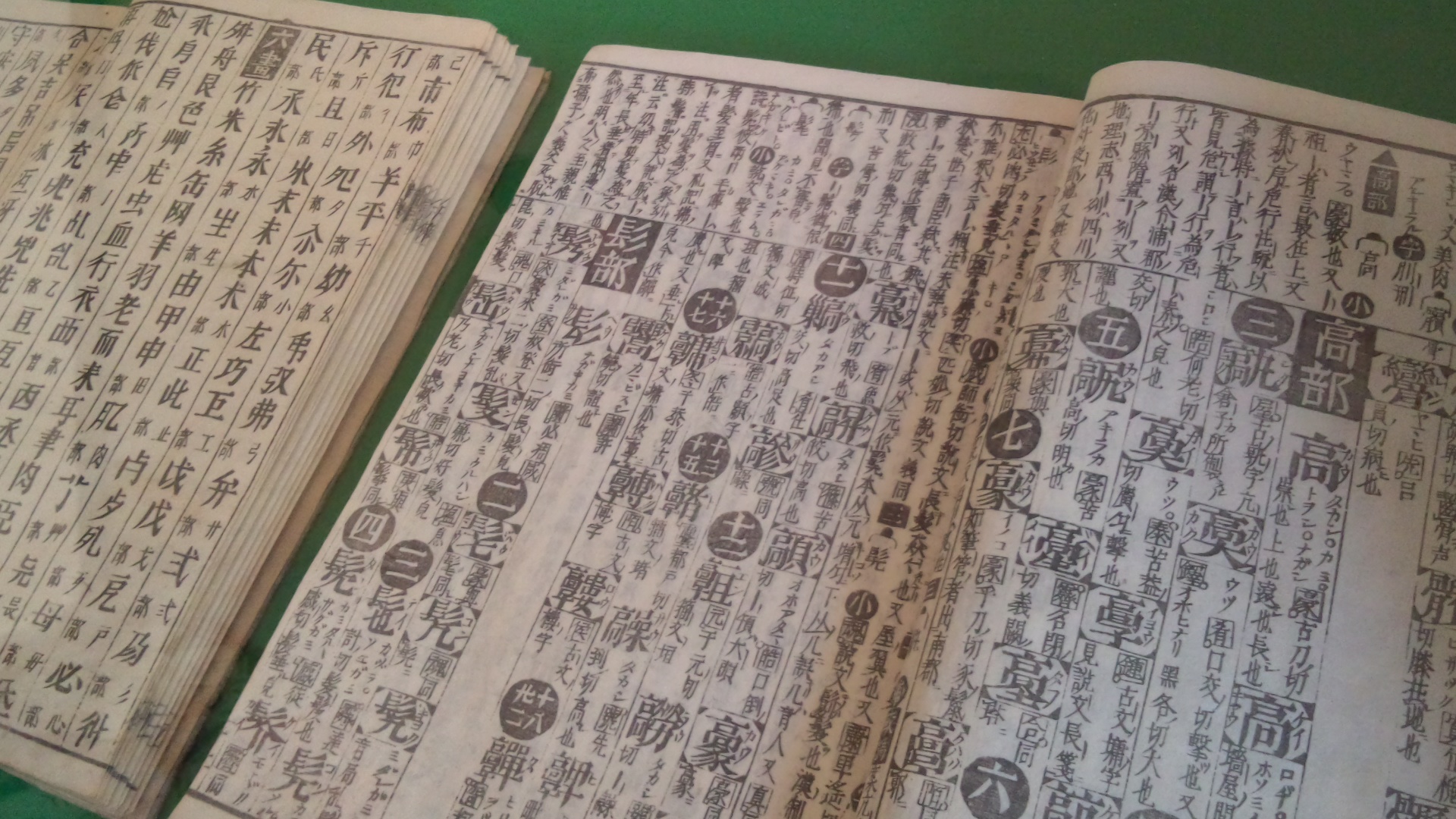
    A samurai child's schoolbook
    A samurai child’s schoolbook

    I was surprised to discover that education before the Meiji era was actually already quite universal, though not particularly good quality or equitable. Most education was carried out by temples, until the law in 1880 which made education mandatory for all children. Before then different children received different levels of education, with samurai receiving the most impressive while farmers simply learnt to count and write basic information. By 1880 about 90% of the population was in some kind of education and literacy rates were 45% for men and 15% for women. The museum had examples of the schoolbooks of the pre-Meiji era, and some woodcuts depicting children being educated; it also had photos from the late Meiji era, showing for example girls from poor families who were paid to work as baby-sitters, studying with their charges slung on their backs because their master was required to pay for their education. They learnt to write things like “Thank you master, it is due to your kindness that I am able to learn to read.” The museum had lots of photos of the school over time, and also woodcuts depicting education before that era. It also had a selection of documents from the opening of the school, showing what gifts were given. When the school was opened, they held a Shinto ceremony to sanctify it, and the local farmers and citizens donated rice, sake and fish (Bream) as gifts to the shrine and the school. The school opened in 1876 and universal education was mandated in 1880, so until then parents paid the teachers gifts of rice, fish and other farm products. Looking at these exhibits, one is reminded of how incredibly poor Japanese society was before 1873, and how incredibly rapidly it developed after the restoration.

    Destroy!
    Destroy!

    Of course, Japan’s development in the modern era is bracketed by two extreme events, the Meiji restoration in 1873 and the Pacific War from 1931-1945. The museum spends a lot of time on the Meiji reforms but doesn’t shy away from the role of education in promoting and supporting war in the Pacific War. It has a room devoted to the Pacific war, in which it shows the activities of the school and its students during the war. The picture above is an example of what students learnt during that time. On the right of the lower picture are two caricatures of American and English soldiers (the American is smoking, and the Englishman looks suave); on the left of the (female?) soldier with the naginata the two kanji say gekimetsu, destruction. In the picture above this, a sad-looking man salutes under the caption “Young men going to the sky” (Japanese depictions of the war in the air often use this romantic language of the sky, rather than more technical language about “air war” or “aerial”, I don’t know why – maybe there’s a clue in the new Ghibli movie).
    DCIM0087

    The second to last room of the exhibition is a room full of different textbooks over time. This includes textboooks from the war and the immediate post-war period; the picture above shows a textbook from the war era, while the picture below shows a textbook from immediately after the war that has been censored to within an inch of its life. The textbook is open to a page that says the following:

    Mr Soldier, please look at the words and pictures I draw

    Please also show them to the children of Korea

    When you capture new lands, please wave the flag of Japan and yell “banzai.”

    Mr Soldier, please work hard and happily.

    We visit the shrine to pray for you on the first day of every month

    I guess the Japanese were too poor and there was too much policy chaos after the war to write new textbooks, but they couldn’t exactly deploy the war-era textbooks untouched, since they would have been full of the worst imperialist and racist tripe, and the kind of disturbing language used in the textbook above. But I can’t help thinking that this kind of heavy-handed censorship would merely encourage children of that era to investigate the “truth” about the war. (Which they would have to do – the Japanese explanation below indicates that in some cases 30% of the text book was censored!)

    How is this helping Yamato kun learn?
    How is this helping Yamato kun learn?

    Of course life after the war changed a lot, and the next set of textbooks shows this: they are luminous, beautifully-written affairs. As far as I can tell the same age of children would be expected to read the textbook shown in the picture above and in the picture below. The text on the picture above is all about asking soldiers of Japan to struggle in war – it is supplicative and futile. The text in the rightmost book below simply states that “the sky glowed, the sea glowed, the roofs glowed” – it describes a pastoral idyll. Which is it better for children to learn?

    A sudden change for the better ...
    A sudden change for the better …

    These installations really show how text books can vary rapidly across time, and how closely education policy supports and reflects national policy at any time. I guess if the education system had been allowed to continue in its chaotic private form after 1880, it would have been a lot harder for the government to exert a common propaganda line – though the counterfactual would likely have been little better, since by 1940 all arms of society had been sucked into the war economy and it is unlikely that the private educators would have been able to escape this trend to the glorification of war (not to mention that the state was basically seized by the army, who probably would not have tolerated freedom in educational curricula after 1931). I guess one of the downsides of a standardized curriculum that enables a country to go from post-feudal rural basket case to world power in 50 years is that it is vulnerable to misuse as a propaganda tool…

    After its “textbooks through the ages” exhibition, the single biggest room in the school was devoted to a “desks through the ages” installation, shown in the picture below. The desk furthest at the right is from before the Meiji era and is called a 天神机, heavenly desk. It doesn’t look heavenly. Some of these desks were quite ornately made, though they looked rather uncomfortable. I think most nerdy types have spent a lot of our childhood crouched over a desk learning what makes the world tick – it’s interesting to see how people in a completely different time and place were doing it. Mostly worse, by the looks of things.

    A desk! A desk! My empire for a desk!
    A desk! A desk! My empire for a desk!

    This picture also gives a sense of how beautiful the inside of this school is. I really recommend this little museum for a visit if you are in Matsumoto. The castle is also interesting, and the town as a whole is a pretty little place full of old buildings – it is apparently one of the few cities in Japan that has maintained its old buildings, and so riding around in it is a really pleasant experience. For foreigners visiting Japan it is an excellent side trip. It is 2.5 hours from Shinjuku, it is close to skiing, monkey onsens and highland walks, the town itself is pretty and it has an excellent website. There are many old warehouses in the town that have been converted into shops or restaurants, and it is very easy to get around. If you are looking for somewhere to stay I recommend the Dormy Inn – the staff are excellent, the breakfast delicious, and the onsen relaxing. If you go, try to spend at least two nights here so you can explore the surrounding countryside, the castle and at least one of the museums or galleries. And head to the 女鳥川 (a river whose English translation I don’t know) because there is a cute set of streets lining it that have really old buildings and interesting restaurants, overlooking the river. It’s a really nice escape from the hustle and bustle of the big city, nestled equidistant between Tokyo and Osaka, with a lot of cultural information to keep you interested. And if you go there, visit the school!

    [Updated late at night on 26th September to correct the spelling of Kaichi school (how dumb am I?) and to include the translation of a textbook page, which I checked with a friend].

  • I have recently been spending a lot of time around (white) foreigners in Japan, much more than usual, and a recent experience with a particular pair of them has helped me to understand a kind of increasing discomfort I have with the way westerners interact and the way they perceive Asia. I guess being largely removed from the brute force of western interactive style, I notice it more when it is laid before me in its full glory. I want to report on some of my feelings about this here.

    I have been travelling – not by choice – with a German man and his wife, in their late 20s. The woman is shy and the man won’t shut up, but not just in an annoyingly tiring way. He speaks over and for his wife in a terribly obvious way, even about things asked directly of her about her. But worse still, if you try to short-circuit this behavior by addressing her directly, she looks to her husband and waits for him to speak. For all the presence she has in the group, she might as well just be veiled and sat behind him. His behavior is really depressing and irritating and her quiescence – I would like to guess it is due to exhaustion but I am worried from her manner that it may actually be a preference – is saddening. Furthermore, this man feels himself an expert on Japan having read some stuff before his (first) visit, and needs to prove himself knowledgable on all things. He is also very convinced of the importance of expressing his own opinion, and me and my friend being not averse to bloviating ourselves, the time we spend together is a constant frustrating round of opinion-exchange and fact-boasting. I can’t help getting sucked into this but I get so tired of it. Of course being a westerner myself I’m really at home in and good at this type of conversation, but 7 years out of the loop means I now look down on myself engaging in it and don’t reflect well on myself.

    I believe this style of fact-boasting interaction is just a form of empty chest-beating, it doesn’t change anything about the world or each others’ opinions – it isn’t communication in any sense that the word is really understood. A phenomenon I notice a lot around foreigners and that I think is related to this is their complete inability to take in other cultures (most especially Asian cultures) without judging them. In sum this behavior has me thinking: I really hate Western so-called “enlightenment.” This guy has mentioned once or twice Japan’s reputation for sexism, in the usual tone and context as to imply that we Westerners are so enlightened and over that shit (his country even has a female Chancellor, for god’s sake!) but all of his behavior stinks of sexism, classic unconscious sexism of the patriarchal ignorance kind. He’s not alone in this: I can’t count the number of times western men and women have spoken to my partner and I as a couple but looked only at me when talking; the number of western women who completely blank my partner and only engage with men, or worse still friend me but not her after a meeting; the western men who speak on one side of their mouths about how sexist Japan is while bragging out of the other side of their mouths about how sexually and domestically submissive their Japanese woman is; the number of foreign men here who have no use for Japanese men and never engage with them; the number of foreign men whose Japanese wives are “not like other Japanese women” because they aren’t “weak”; the number of foreigners who judge anyone who is not loud and opinionated to be stupid.

    I hate the way westerners have to judge everything around them as if everything around them is waiting for their shallow, half-considered opinions to affirm its validity. I hate the way every half-baked racist trope that they conjure up to misinform them about the value of behavior they witness but don’t understand is reinterpreted as proof of their own superiority. I hate the way this happens as they blow their noses; stand in the way of patient, polite Japanese people; put their dirty feet places they shouldn’t; speak too loud; and generally explode into every space they are currently judging like a cloud of massive, usually fat and underdressed obnoxiousity.

    I hate the way every time anything untoward or unexpected happens white westerners immediately start wondering if it might be because they’re foreign and experiencing racism. Invariably they aren’t, but it reveals so much about their implicit recognition of how hard it is to be foreign in a white country. I hate how they project every seedy element of their own culture onto others and then when the confirmation bias kicks in, interpret it as proof that their own culture is superior. Spare me this self-aggrandizing cultural blindness!

    I’m sure many of the feminists are familiar with and quite irritated by this kind of hypocrisy. Over here I see it leavened with racism and colonialism, and I am thoroughly and heartily sick of it. Westerners aren’t enlightened or any more advanced than much of the rest of the world, we’re just full of our own self-righteous opinionated rubbish. And so much of what is constantly passing for opinion and argument in our much-vaunted “individualist” culture is just ill-informed, hypocritical cant with a healthy side serve of colonialism. I really, really wish that as a culture we could just shut up and listen for five minutes of our incredibly short, dirty and plague-ridden history. I would like to parley this into some kind of set of rules for westerners visiting Japan – not rules about how to treat the locals, but about how to understand them and how to take away from Japan something more than just “ooh, cute shrines and everyone’s polite but oh hasn’t everything I already ‘thought’ about Japan just been confirmed in spades!?”

    I can’t though, because this is just a rant.

  • Approaching the crypt at dusk
    Approaching the crypt at dusk

    When last we left our PCs they had cleared out a goblin nest near their onsen, at great personal cost to Azahi the Troll-slayer, and put paid to a potential threat to their new demesne. Upon returning to the onsen they were called back to Separation City by Baroness von Jungfreud and, after a day of rest and healing for poor Azahi, they returned to town. This time they took with them Grunstein, the Jade order mage, who had recovered from his case of hideous Blacklegge disease.

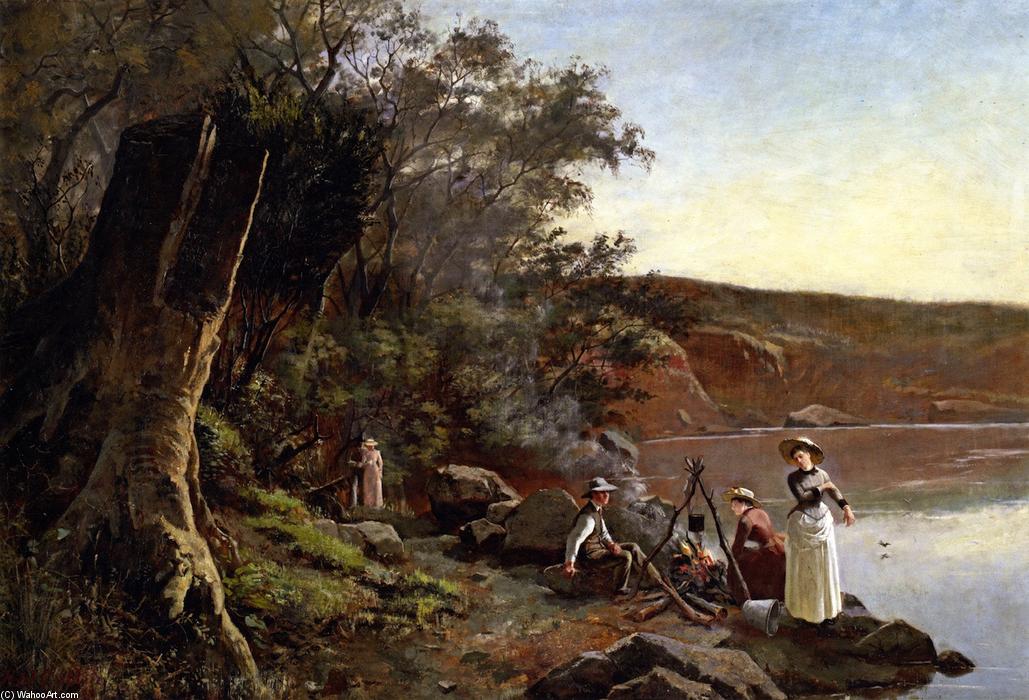
    When they returned to Separation City Baroness von Jungfreud arranged to meet them for a picnic, perhaps her last of the spring. As is typical for such a notable’s picnic, she had brought with her several servants, a fire to cook upon, and even a small tent beneath which to retire from the sun. She had also brought with her a scraggly, wild-eyed man in a battered hat and leathers, who traveled under the name Gregor Thorveld and claimed to be one of that rare and feared breed, a witch-hunter. Judging by his nervous manner, continually jittering eyes and uncertain speech he was either constitutionally a coward, or had seen far too many witches.

    The Baroness's servants prepare the picnic
    The Baroness’s servants prepare the picnic

    Baroness von Jungfreud told the characters that there were rumours of disturbance in the graveyard, that one of the graveyard guards had been ambushed with a rusty old arrow and that she wanted them to investigate. The graveyard had been used to bury the victims of the recent plague – about 50 to 100 in all – and she was worried that the PCs had failed to kill off all the plague cultists. Perhaps one had stolen back into the graveyard and was hiding there amidst the corpses of his victims? When asked why the victims had not been burnt, Baroness von Jungfreud somewhat sheepishly confessed that in fact the town Physician had overseen the burial … that same town Physician, of course, who was working for the plague cult. Thus all the groundwork had been laid for even a minor functionary of the cult to dig up some hunk of ghoulpox’d rotten corpse and dump it in the water supply – again.

    It was then that she introduced Gregor, who she assured them sternly would help them to make up for any mistakes they had made in eradicating the cult. Through clenched teeth they introduced themselves, and discovered that he had come to Separation City on the strength of rumours of chaos and murder, and had offered to aid Baroness von Jungfreud as part of his role as a witch hunter. The town currently lacking any sturdy fighters, she had agreed to take him on and would send him with the PCs. Although she was dismissive and hypocritical about the responsibility for the plague cult survivor, she did give some implicit indication that she understood her responsibility – she offered them 5 gold coins each to clear the graveyard, a huge amount for such a simple task. Assured of reward, they set off immediately.

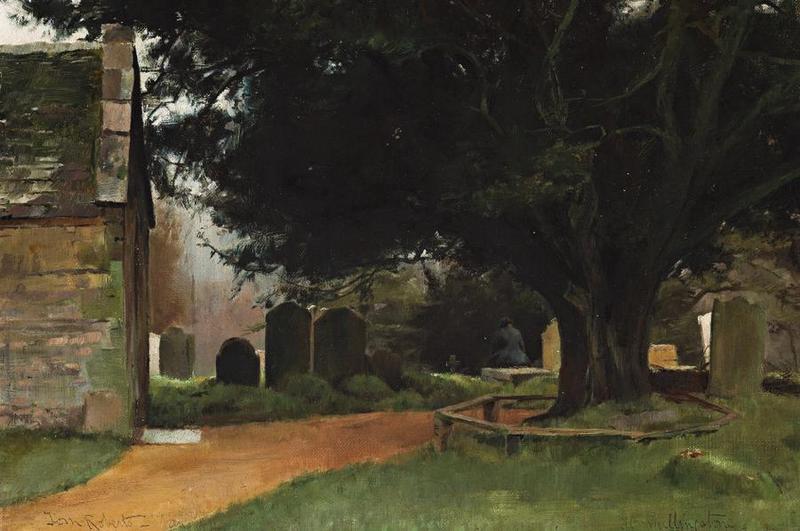
    Separation City graveyard is separated from the town by some distance, and set on a hillside that backs onto the forested mountains beyond. It is surrounded by the typical wall that surrounds any Steamlands graveyard, about 4 metres high and designed to be hard to scale from the inside. This graveyard had two entrances, one main entrance facing the Iron Ring section of town (distantly visible to the south) and one, higher up along the wall near the end of the cemetery, that was much smaller, much less secure, and opened to a small path that led to a “secret hot spring,” a hot spring that has no real facilities and is used in the open air by anyone who cares to visit. Why this was located in the graveyard was a mystery to everyone, but the PCs immediately recognized the risk – the plague cult seemed to have a thing for causing trouble in hot springs. They had the town guards bar the main gates and set forth for the hot spring. By the time they had arranged all the details it was dusk, but they didn’t let this deter them, and approached the spring.

    The spring itself was just a small pool, perhaps thrice as long as it was wide and large enough for four people to bathe together. On one side was a rundown shack; on the other, thick bushes. As they investigated the spring Grunstein noted a disturbance in the Winds of Magic, and was able to warn the rest of the group before a spirit manifested over the pool and drifted forward to the attack.

    The battle was over quickly. The spirit attacked Azahi but could not harm him, and the four of them soon dispatched it, though its ethereal form made it hard for their weapons to hit it. Finally Grunstein’s magic dart destroyed it, and it drifted away in a cloud of sparkling motes. The place from hence it had come was now revealed to be an opening in the woods, with a narrow and overgrown path leading further up the hill. This path had obviously been hidden by some kind of illusion that the spirit’s presence maintained; with the spirit gone they were able to see the path. The path itself had obviously not been used for a long time, and was covered in vines and brush. Somewhere down that path in the gloom, Laren thought she saw movement. After a pause to gather their thoughts, they plunged into the path.

    After about 30 metres the path veered left and out of sight beyond thick brush. As they approached the corner two skeleton archers emerged from the shadows of the trees ahead. One fired two arrows at Azahi in rapid succession, hitting him in chest and shoulder; the other did the same at Gregor, hitting him once. Laren returned fire and they charged into battle, again rapidly destroying their enemy. These enemies carried arrows that appeared similar to those described by the graveyard guards. Obviously they were getting closer.

    Moving further along the path after only the briefest of pauses, the characters saw a rundown and overgrown crypt ahead of them. Laren approached stealthily, finding the door open. From within came the smell of roasting flesh and incense, accompanied by a querulous voice chanting rhythmically and beating some form of small drum. As the others cautiously approached she moved to the doorway and looked in upon a horrifying sight.

    The inside of the crypt contained a large sarcophagus at one end, and several smaller sarcophagi upright around the walls. Hanging from one of these on a portable umbrella hook was a coat and hat. On the main sarcophagus was a collection of magical paraphernalia: burning incense, a silver dagger, some gems, candles, a shrivelled newt. Facing them but some distance away stood a tall, angular man in a perfect threepiece suit, fob-watch in pocket, monocle in one eye. In front of him was a strange device, a kind of travelling lectern such as some preachers or musicians sometimes use, made of polished brass and obviously quite expensive, robust enough to hold a large book from which the man was reading. Between this scene of scholarly fastidiousness and the somewhat chaotic collection of magic items on the sarcophagus a magic circle had been painted on the floor in blood. Inside the circle a small child roasted on a spit over a small fire, still vaguely alive and burbling and gasping its last horrified breaths. A small skeletal familiar turned the spit rhythmically.

    Laren gasped in horror and opened fire on the wizard. As he turned to face her, hideous beasts materialized from the gloom. Two crypt ghouls came prowling out from behind the sarcophagus and shambled forward to the attack; a darker, more terrifying spirit form coalesced near Laren and drifted forward to strike at her. Battle was joined. Gregor moved forward to take a shot at the ghouls but was so horrified by what he saw that he turned and fled. Azahi charged forward to attack the ghouls but was also shaken by the horror of the scene, and so terrified of the undead and enraged that he opted instead to strike at the wizard. As he did so a ghoul leapt on his back and began gnawing at him, digging closer and closer to his jugular with its teeth. Overwhelmed by the terror and burdened by the weight of magic and beast, he fought poorly and increasingly desperately. Grunstein helped as he could, his powers bolstered by drawing on a shard of wyrdstone that lay on the sarcophagus, but he had to leave to support Laren as she withdrew across the overgrown path. She and Grunstein prepared to sell their lives dearly in the gloom of the path, facing up against the Cairn Wraith and one ghoul. Grunstein was close to death when Gregor, regretting his flight, returned to the fray and helped to dispatch their enemies. Inside, Azahi managed to slay the wizard, shake off the ghoul and destroy it; but so desperate and exhausted was he that he simply sunk to the ground, hand gripped around his falchion blade so tight that it bled. The others flocked to him and helped him back to himself, but he would never be the same again.

    They destroyed the magic items and looted the bodies. On closer inspection the wyrdstone Grunstein had been using was discovered to be that most foul substance, Warpstone, obviously being used by the necromancer to fuel his foul rites. Grunstein investigated the book from which these rites were read and found it was a speak with dead spell; the necromancer had been planning to raise the ghost of a resident of this crypt. Such a terrible book and such an evil substance would need to be destroyed, and not just in the local Sigmar temple – a journey to Heavenbalm would be necessary soon to destroy such abominations.

    Notes on the necromancer’s body suggested he was looking for a member of the Family Azeem, who were buried here. This family ruled Separation City until the von Jungfreuds arrived 12 years earlier, and the necromancer’s notes suggested that the person he was attempting to bring back from beyond had been murdered by the von Jungfreuds. He had traveled here from Heavenbalm to find out something about the past in Separation City, and he was not alone; he was a member of a clique based in Heavenbalm, who met at a tavern there called the Seventh Banner.

    Now the PCs began to wonder – was there something special about Separation City? Why was it that all these people had an interest in this town? Twelve years ago the von Jungfreuds had come here, and had been willing to do murder to take control of the town. How had they been able to arrange their possession of this town and why? How come this tomb was so forgotten and hidden? Then, was it a coincidence that a powerful disease cultist based in Store – the mysterious “F” – had sent a strong disease cult to overwhelm the town, coincidentally using von Jungfreud as the centre of the plot and killing her husband? And why was this necromancer here trying to turn up secrets from 12 years ago?

    The PCs realized that there was a mystery about the town, and that it could be answered only through investigations in Separation City, Heavenbalm and Store. Since they had an evil book and warpstone to destroy, there next course of action was obvious – they would travel to Heavenbalm to the temple of Eight Banners, to destroy the book and the stone; and while there they would hunt down this necromantic clique, and find what it aimed to achieve. They would regret the day one of their number crossed paths with Azahi, Laren, Grunstein and Gregor …

    A few mechanical notes: upon sight of the ritual all the PCs had to do corruption checks and several failed. Somehow Grunstein managed to use the warpstone four times and only incurred one point of corruption. By way of contrast, Azahi gained the frightened condition and once the ghoul attacked him he started incurring serious fatigue and stress, ultimately accruing four temporary insanities – one of which was permanent. This battle was a very close-fought thing indeed.

  • I GM’d session 7 of the Steamlands campaign on Saturday (report to go up shortly), with an old friend from London joining for the day. The session was essentially an extended encounter with two rally steps and three ferocious battles. This was an in-between session, setting up some story elements and run to enable my old London player to give WFRP3 a whirl without having to spend $200. In discussion with players afterwards a few things became apparent:

    • WFRP3’s stress/fatigue/insanity mechanism can be quite nasty
    • A long encounter (in this case a four hour session had probably three hours devoted to the encounter) can be exhausting for everyone
    • Some magic is really under-powered
    • Diversity in combat action cards doesn’t in practice produce anything

    I’ll talk about some or all of these points in time, but for now I am interested in the last point. We had three types of combatant – Troll slayer, scout (archer) and witch hunter (both). In all cases, they deployed a variety of action cards, and pretty much all of those action cards end up with the same results – damage ranging from normal to +3, and occasionally a free manoeuvre.

    Given the lack of diversity in outcomes, I’m wondering if combat-based action cards aren’t a complete waste of time. Not only do the different cards produce very similar outcomes, but the use of cards restricts my creativity to do interesting things with the dice pool. For example, if the card has a line for two boons and a comet, we all expect those lines will be used. But the two boons often produce results that the player doesn’t want, or that don’t matter in the context (especially e.g. a free manoeuvre when you don’t need to manoeuvre, or healing fatigue when you don’t have any). However, if we were just using a straight attack with dice pool, then I would set benefits according to the context – e.g. two boons means you get a fortune die on your next attack; three boons gives you an intimidate check to try and put a permanent misfortune die on their actions; a comet means the wizard’s spell is disrupted. Instead it’s just the cards. This would be fine if the cards granted diversity but they don’t.

    So I’m wondering if I should move away from action cards altogether for anything except spells, and resort to just being creative with people’s attacks. I could introduce a very simple mechanic:

    • all fighters can select to use a fancy attack or a basic attack
    • Basic attacks get a free manoeuvre or remove one fatigue on two boons
    • Fancy attacks incur one misfortune die, cause fatigue on two banes, and get a context specific benefit on two boons
    • Comets and stars are at my discretion
    • All attacks get normal damage + number of successes if they are successful

    I’m also thinking the talent tree idea I introduced in response to reading the Star Wars game might be a more interesting way of getting diverse outcomes in combat with less effort than action cards.

    I might discuss this with my players in more detail.

  • Never won an election, but won every battle he fought
    Never won an election, but won every battle he fought

    A little-remarked upon aspect of this most recent Australian federal election has been the performance of the Greens. It’s not surprising that the media don’t report on the Greens’ results, since they hate the Greens and they can’t take them seriously as a party, but it is a little disappointing that they haven’t commented on the Greens’ performance in this particular election, since in many ways the last three years have seen their coming of age as a party, and this election presents strong evidence that they are a mature and robust member of the electoral mainstream.

    By way of comparison, let’s consider the Australian Democrats, who in 1999 passed the legislation for the Goods and Services Tax (GST) through the Senate, in support of the Liberal government of the time. This decision was made under the leadership of Meg Lees, who had taken the position in 1997 just before the 1998 election, and was determined to stamp out the Democrats as a responsible party of the mainstream. The GST was extremely unpopular, and in the 2001 election the party lost 12% of its vote and one senator. At the following election the Australian electorate took them out the back and quietly shot them, as the saying goes, and now they no longer exist as a party. Basically, the party had shackled itself to an unpopular government and specifically an unpopular piece of legislation, it was struggling to define itself after the loss of a charismatic leader (Kernot, 1997) and in its flounderings it slowly destroyed itself.

    The Greens took found themselves in a similar position in 2010, but in spades: having won a seat in the lower house they explicitly joined a minority government with Labor and passed a very unpopular piece of legislation, the carbon price, and they also experienced the loss of an inspirational and visionary leader – their founder, Bob Brown – just after forming government. So they went to the 2013 electorate shackled to an extremely unpopular government, identified directly with an extremely unpopular policy, and with a leader the electorate didn’t recognize. They suffered a swing against them of about 3.2% (about 25% of their total vote) but they retained their lower house seat with a swing against them of only 0.7%, and gained a Senate seat (they had 9 in 2010 and now have 10). Furthermore, the swing to them in 2010 was 4.0%, so despite their position in the minority government and the unpopular carbon price, they haven’t lost all the gains of the 2010 election. So although the swing against them is not pretty, they are still in a better position than when they went into the previous election (unlike the Democrats in 2001), they have shown themselves able to hold a lower house seat, and they have improved their representation in the Senate. This result arose despite them having been continuously painted as reckless by the major parties and the media, a very strong campaign against them in their lower house seat, the arrival of a new and seriously cashed-up independent party campaigning strongly federally (the PUP), and the Liberals preferencing them last in every state. The Democrats have never faced an electoral landscape as hostile as the Greens, and yet the Greens have survived and gained relative to 2010.

    One interpretation of the swing against the Greens is that a proportion of their vote is simply anti-mainstream-parties protest voting, and that once PUP arrived on the scene some of those protesters switched. I think this is only partially true – a large portion of that vote loss is protest against the carbon price and the Greens’ role in minority government. But in this lies the key difference between the Greens and the Democrats. The Democrat rank-and-file largely opposed the GST, and Lees voted for it against the interests of her base. The Greens performed largely in the interests of their base during their period of minority government, and somehow where they voted pragmatically or compromised they have been able to communicate effectively with their voters about this. And most specifically, in exchange for all the compromises of government they won the thing they and most of their supporters most wanted, an effective carbon price. There were other policies they failed to deliver – they wanted the resources tax to be stronger – but by securing a few key gains they managed to convince their voters that they were working for their vision.

    In a very well written and thoughtful essay in the Guardian recently Julia Gillard, ex-PM, stated that the most important thing for a political party is to show purpose and to stick with its purpose. For all her and her government’s faults this was a strong and clear principle of her time in office – on the whole she sailed a steady course and didn’t allow policy to be dictated to by polls or fancies. In comparison her predecessor and successor Rudd made policy like a weather vane, pointing whichever way the wind blows. I think the Greens have confirmed the truth of Gillard’s simple principle, and it can be seen in comparison with the Democrats: by sticking with their principles in minority government, explaining clearly to their voters why they do what they do, and not allowing themselves to be governed by flights of fancy or concerns of popularity or media trifles, they have retained their core vote and advanced their agenda. I am confident that the Greens would have been willing to accept electoral destruction in exchange for a sustainable and effective carbon reduction scheme, but they have shown that by sticking to what you believe and acting responsibly and rationally you can make progress in politics. I think this has marked them out as a mature and responsible party in a way that Labor under Rudd definitely was not.

    A corollary of this is the possibility that Labor could have done better at the election under Gillard. I still think this could have happened – she might not have won, but I think she would have done no worse. Then at least the ALP could sit in opposition with their heads held high. Sadly, that wasn’t to be. Perhaps it’s time they took some lessons on responsible government from the Greens.

  • Abbott and Whitlam's only common ground?
    Abbott and Whitlam’s only common ground?

    It’s been a long time since Australia had a double-dissolution election, but I have a suspicion we will get this singular pleasure soon, and that it will be fought out between the major parties as a referendum on climate change. I refuse to elevate my suspicion to the level of a prediction, but I’m going to lay out my reasoning here. [obviously this post is on Australian politics so if you’re from overseas you may find it a little mind-bending].

    Perusing the senate election results today I noticed that the Australian Sex Party are likely to get into the Senate through Tasmania. From July 2014 the make up of the upper house will be:

    • 33 Liberal/National
    • 35 Labor/Greens
    • 1 Xenophon
    • 1 Palmer United
    • 1 Australian Motor Enthusiasts (!)
    • 1 Australian Sports Party (!)
    • 1 Liberal Democrats (!!)
    • 1 Australian Sex Party (!)
    • 1 Family First Party
    • 1 Democratic Labor Party (DLP)

    So, assuming that on most crucial topics (except abortion) the DLP vote with Labor/Greens, it will be 36 vs. 33 in favour of the left, with 7 independents. To get legislation through the house the new prime minister (PM) Tony Abbott – who holds a vast majority in the lower house – will need the support of at least 6 of the independents. If we assume that the DLP and sex party vote with ALP/Greens on the carbon price, then it will be 37 vs. 39. So if one other independent – e.g. the Aussie sports party or Xenophon – refuse to unravel the carbon price legislation then Tony Abbott’s core election promise is toast. Of course it’s possible that the Aussie sports party will agree with him that “climate change is crap” but it’s also possible Xenophon will refuse to unwind legislation passed by the last government (he seems that type). From the perspective of September 2013, having promised to revoke the carbon price immediately, waiting until July 2014 and then being rejected in the senate probably won’t sit well with Abbott’s reputation.

    This isn’t his only problem either. If he wants to get socially conservative legislation – on RU486, gay marriage or whatever – through the parliament he will almost certainly face opposition from the Liberal Democrats (insane libertarians) and Sex Party. For weakening tobacco legislation he will face opposition from Xenophon and the Sports Party. Basically, the range of possible permutations amongst 7 senators hailing from a range of political perspectives – from the socially extremely liberal to the batshit insane – mean that negotiating with the new senate is going to be a big challenge for Abbott even if he can be confident it will deliver him his big ticket options. It’s even possible his paid parenting leave scheme could fail, since the ALP might be able to muster enough independents to squish it even if the Greens go with Abbott.

    On top of that, most of the independents will surely be aware that they are only going to be in the Senate for one sitting. The Liberal Democrats know they are simply a fluke of the ballot paper; the motorists, sexers and sporties will also be thinking that they were flukes (some of these parties got less than 1% of the vote). If they ponder on this a little, one or more of these guys are surely going to realize that this is their only chance to “make Australia better,” and that they can’t lose anything by tough negotiating. Palmer United have already suggested that support for repeal of the carbon tax may be contingent on repayment of all money already raised, and I think it’s possible that the Liberal Democrats might make their support conditional on abolishing Abbott’s Direct Action plan. The Liberal Democrats are opposed to gun control, speed limits and medicare, and at some point Abbott is going to be faced with a deal that puts those things on the table. Gun control being a matter of faith in Australian politics, he’s going to find himself over a barrel at some point if he doesn’t deal with these people.

    These considerations, plus the fact that he promised to unwind the carbon price as soon as he was elected, make me think that it is in both his short term and long-term interests to run a double dissolution election before the new senate sits. He has promised a government free of surprises and chaos, “the adults are back in charge,” but he’s going to get more chaos than he can handle trying to negotiate with 7 radically different political independents, especially if they decide to use their six year term to make tough calls. He knows that he can get the trigger for a double dissolution in place before July next year, and so I suspect he will choose to pull it rather than face such an uncertain terrain.

    If he does this though – or if he is forced to by intransigence on carbon pricing in the new senate after July – then he is going to face the prospect of an election fought over one topic: carbon pricing. This is going to be extremely hard for him to pull off, especially if the opposition get organized. He will need to pull off a big win too, since a double dissolution raises the risk of more Greens getting into parliament, not less. If he has introduced some nasty public service cuts this could be a very challenging election for him. It might appear that this is too risky, but I think it is going to be very hard for Abbott to maintain his popularity long term if he has to do extreme horse-trading every time he wants to get any legislation through parliament. Just as an example, today there is talk about overriding ACT legislation on same sex marriage. To do this requires approval from the federal house and senate. It is basically a guarantee that he would fail to pull this off from July next year, because the Liberal Democrats, Sex Party, and probably also Xenophon would oppose it. He will also face the continual problem of putting contentious legislation (or for that matter routine legislation) into the parliament, and having it rejected in the senate. This is going to be a goldmine for any remotely crafty opposition, and the media love this ready-made story of “legislative incompetence.” Looking at this, and with a conservative agenda to follow as well as some big corporate mates to satisfy, I think he is going to have to do something about the senate. So my suspicion is he will try to push through a double dissolution – if not on carbon then on the mining tax or paid parental leave – to try and grab a clear majority in the senate.

    If he does, it will be the first democracy to go to the vote directly over global warming. Interesting times …

  • Magic License: Rie 518967301
    Magic License: Rie 518967301

    On Sunday I played in a short Shadowrun (5th Edition) adventure, which is likely to become a campaign. I think Shadowrun is a brilliant idea, and I can’t play it without playing some kind of magic-user: the idea of playing a wizard or a shaman skipping through the shadows of a corporate dystopia is too cool to pass up for something mundane like a gun-toting maniac, so I have to do it. For this adventure I decided to make a character reminiscent of my Feng Shui shrine maiden, who I played three years ago in London and who was a huge amount of fun to play. This time I made a Gothic Lolita mage called Rie of the Fallen.

    Rie is a classic Gothic Lolita girl, who happens to be a magician. She has no appreciable physical strength, robustness or skills, and as much as possible she avoids any form of exertion or physical activity. All she does is cast spells. She maintains an extremely high class and expensive lifestyle, in order to afford a wide range of expensive clothes and cosmetics, and when asked she will assure you that this is why she is a shadow-runner. She has basically no skills except magic, hiding and looking good. She’s short, a little bit chubby, a little bit haughty and suffers from the negative quality Distinctive Style, which means she can’t hide in a crowd (I wonder why?) Her magic is a mix of attack spells, investigative magic, and support magic – she is not the kind of mage who expects to be ‘running on her own, but as part of a team.

    Rie is from the Shamanic tradition, though her particular tradition does not so much ally with its spirits as worship them. She is a follower of the Nephilim, the Watchers Out of Time, angels who fell from heaven after a war with god and who are popular in such diverse cultural traditions as the works of John Dee (16th century British mystic), the Angel Sanctuary manga, and gothic bands like Garden of Delight or Fields of the Nephilim. In fact she has a mentor spirit, Alexiel, who is one of the minor Nephilim.

    Mentoring in an Angelic Fashion
    Mentoring in an Angelic Fashion

    Rie is also an active member of the Gothic Lolita scene, which in 2070 has become a little more active and shamanic than it is now – a scene like that will get very magical once magic becomes real. In the present, Gothic Lolita events often involve fashion shows and also people selling their own home-made fashion items – there is a big amateur fashion scene. Rie makes hairpieces and lockets for this scene, but uses her alchemy and artificing skills to imbue them with minor magics that might be useful. She also has contacts in this scene, and in the media and entertainment world generally, as well as some knowledge of corporate etiquette connected with this world.

    As an example of Rie’s general character and style, we did a brief shadowrun on Sunday, just doing a delivery run from Denver to the UCAS. This was nothing unusual, just a couple of border crossings and a fight with two rival gangs who “ambushed” us in a traffic jam. When our Face had failed to get the two bands to fight each other, Rie realized that the fight was on, so she tapped the man in the car next to her (giving him combat sense), told him to prepare for battle, and started it herself with a manaball. She spent the entire fight sitting primly in the back of the Face’s Ford Americar, directing spells at one gang using her make-up mirror and not bothering to duck or panic. When the gang finally shot the car to shit she simply stepped out on the far side before it could catch fire.

    When that battle was over and the last ganger had surrendered, Rie walked over to him, squatted down in that classic Japanese girl way, and pulled a pair of containment manacles from her pristine little bag. Lacy, of course.

    Rie’s basic Shadowrun stats are set out below.


    Attributes

    Body 2 Agility 4
    Reaction 3 Strength 1
    Willpower 5 Logic 2
    Intuition 6 Charisma 3
    Edge 3 Magic 6
    Essence 6

    Skills

    ACTING 1 CONJURING 1
      Con 2   Summoning 5
      Performance 5 Spellcasting 6
    INFLUENCE 1
      Etiquette 4 Counter-spelling 3
    ENCHANTING 1 Artisan 5
      Alchemy 4 Assensing 3
      Artificing 3 Drive 4
    STEALTH 1 Perception 2
      Sneaking 4
      Disguise 4

    Qualities

    • Bilingual (English and Japanese)
    • Focussed Concentration 3
    • Mentor Spirit
    • Quick Healer
    • Distinctive Style (negative)

    Spells

    • Lightning Bolt
    • Manaball
    • Analyze magic
    • Detect Magic
    • Clairaudience
    • Clairvoyance
    • Combat sense
    • Heal
    • Armor
    • Trid Phantasm

    Rie owns a Honda Spirit, a wide selection of fake SINs, a Gold Docwagon subscription for one year, and various other stuff. Some of her outfits are armored with mesh-weave, and her cosmetics are very high class; it’s possible that with the next job she will be investing in some flash- and fire-proof cosmetics. She uses a traditional clam-shell mobile phone for communication, always carries a bag with her and usually has an extra bag or two that look like they contain shopping (but probably actually contain adventuring gear). Her magic is a fairly innate and antinomial thing (she doesn’t study) and she isn’t that bright, really, but she has a canny sense of what is going on and doesn’t usually miss things, even if she appears to be paying no attention. She is not pretty or sexy, but her careful attention to style means that she always draws attention. She is the very model of a modern-day wizard, walking around completely out of place and time but acting as if it is of no importance whatsoever that the whole world has noticed her difference; and far more dangerous than her weak and timid manner would imply. She also keeps her own counsel: no one will ever know what she really wants or believes.

    The perfect companion on a run, she probably is not.

  • This is a summary of three sessions of World of Darkness which I recently played. Since describing three sessions of gaming in one go is a Herculean task to write and mythically impossible to read, I’m presenting it in the form of a post-mission chat-room debrief between the PCs. This WoD campaign is set in 2018 in America, all the PCs are normal and as far as we know there is nothing specially supernatural in the world. Europe is in a state of chaos due to some form of new virus/plague, and President McCain’s America is not the nicest of places. We are new employees of a mysterious corp called Aesir, on a three month probation, so this chat room conversation is intended to ensure our probation continues despite an adventure that, ultimately, ended in complete failure.

    The PCs are:

    • John Mickson (me): a failed communist and ageing hippy, who never amounted to anything and was drifting through his 40s with nothing to show for his life until Aesir picked him up. If John can do anything (doubtful) it is talk and get people to talk; his main slogan appears to be “if you want anything done properly, don’t ask me.”
    • Nick Drake: ex-private Investigator; a mysterious figure, just some guy whose skills and background aren’t really clear, but he appears to be pretty handy with a tyre-iron
    • Meredith Archer: A forensic scientist and all around whiz-kid
    • Jade: Thug from the Brazilian favelas, the kind of chilled-out hard case who has seen enough of the gutter and its inhabitants, and dealt out enough violence, to be pretty unswayed by the usual run of human grime, treachery and decay

    We also have a guy called “Andrew” shadowing us, who is charged with assessing our performance for Aesir, but who was mysteriously missing for part of this adventure. We were sent to a Native American reservation to negotiate a land deal between Strauss Industries and the local tribe (“The Tribe”). The previous negotiator, Mr. Matheson, had gone missing and we were to bring him back if possible.

    —Secure Chat Log, 28 July 2018.

    JM: Okay everyone, thanks for coming. I’ve asked us to do this chat because our debriefs start tomorrow and I want to be sure we all get the story straight. We agreed before we left the reservation that we want to tell the truth to Aesir, but we need to work out what we’re going to leave out. We obviously fucked this mission up completely, and if we are gonna keep our gig with Aesir they’re gonna have to judge us on our decisions and processes, not results. That means we gotta look good. Agreed?

    J: Yeah sure. The less we talk about it the better I feel, though.

    MA: Plan. Just gimme a moment to get some food.

    ND: Yeah we better. We gonna do this consensus style with a talking stick like one of your dippy hippy groups, John?

    JM: Fuck off, Nick.

    JM: You don’t need a talking stick if you’re online. Fuck.

    MA: Back. Gummy bears.

    ND: You gonna blow your whole bonus on that crap, Meredith? You’ll get fat.

    MA: It’s a statistical fact that snacking on small low sugar products can’t make you fat so long as you’re active, Nick. Don’t you read?!

    J: I’m already 15 rums in. Been drinking a lot since I met the kids.

    JM: Okay okay. So we know Aesir wanted the land deal to go through, and we think the Chief of the Tribe wanted it to go through, but only if he could keep the house at the centre of the land deal out of it. But Strauss Industries wouldn’t budge on dropping the house from the land. We think that’s because they knew what was in the house and their purpose was getting to it at any cost. So they weren’t honest. But now that history’s changed and the entire Tribe has been wiped from history, Aesir still seem to know all about the situation, so they must have known something about it before they sent us in. So we have to tell a story that shows we’re being honest, but we don’t want to let on some of the tougher decisions we had to take. We need to work out what to leave in and what to drop.

    J: Meredith’s the smart-arse with the sparkling fucking memory. Meredith, why don’t you list the basic story from start to end so we can decide what to drop.

    ND: Good idea. Get your fingers out of the gummy bears and start typing, Merry.

    MA: Okay. So here’s the deal.

    MA: We got into the reservation on the 24th July. It was all fine but the comms were weird and it was all a bit backward.

    MA: So we had a meeting with Chief Dion, and then next day we were meant to meet Mr. Gregor from Strauss Industries.

    ND: And we met that little punk Danny at Chief Dion’s. That’s important. We gotta work out what we’re gonna tell people about Danny.

    J: That he was a psycho fuckwit who nearly blew up the planet?

    MA: ANYWAY, Chief Dion was official about it but Danny also made it clear that they were NOT going to sell the house, no matter what. So we decided to go see what was going on in the house.

    J: Big FUCK OFF mistake right there.

    ND: Get another rum, J.

    J: Already on it, little man.

    MA: ANYWAY! So we went to the house and as soon as we went inside it all went weird. We went in the late afternoon through forest but it was daytime outside the windows, and corn fields as far as we could see. Then there were the screaming ghosts and the poems on the walls. We met the Judge on the third floor, freaked out and ran outside.

    J: Freaked out? Speak for yourself. I was making a tactical retreat.

    ND: The trail of piss you left behind you tells me a different story, amigo.

    JM: Also the screaming.

    MA: ANYWAY! We got outside and we all got ambushed by something and then we went unconscious.

    J: Fuckers.

    ND: Mother-fuckers.

    JM: I concur. Meredith?

    MA: Right. So then we woke up and we were somewhere else. Like it was the same place but all rusted and decayed, and nothing worked anymore, and a couple of months had passed.

    J: Do we mention that we woke up back in time, like we lost a day?

    JM: I reckon not. This story’s gonna be fucked up enough without complications we don’t need. You ever see a movie that was improved by adding time travel to the plot? Let’s just ignore it.

    ND: Yeah. ’cause when we drop the time travel shit, our credibility’s gonna be so high that the multi-dimensional travel and vengeful ghosts is gonna be suddenly completely believable.

    MA: You gotta do what you gotta do, Nick. I agree with dropping that bit.

    J: It doesn’t make sense anyway, does it? Why did we lose half a day? What’s the fucking point of that?

    MA: Yeah. Exactly. Anyway, it’s not important but let’s keep the story clean. So we went out looking for people and there was fog everywhere, and then we met the Wendigo.

    J: Not an experience the Wendigo enjoyed.

    ND: Until we discovered it was indestructible.

    JM: Yeah, indestructible zombie Native warriors. We need to stress how tough that fucker was. No offence J, but we’re gonna have to make it sound like that fight was a real struggle even before it reanimated.

    J: WTF? I kicked that thing to zombie juice like a fucking PRO, man, you gonna tell them I pussied out like you did?

    JM: I was superivsing, J, supervising. Someone’s gotta direct the industry.

    ND: Yeah, just like fucking Lenin.

    JM: I keep telling you Nick, I’m not a fucking Leninist. His vision for worker’s empowerment lacked any sense of the role of democracy and self-determination in realizing the goal of the worker’s utopia, and he established the political context for dictatorship.

    ND: Yadda yadda.

    J: So why the fuck do I have to have my arse-kicking pulled from the story?

    JM: Because we need our bosses to think our choices were limited. We don’t want them thinking we could just bounce around that pocket dimension kicking the snot out of the Wendigos until they came back from the dead, giving us lots of time to make whatever decisions we want. Remember our biggest fuck up was letting Strauss Industries steal Danny’s body, and the reason we made that decision is because we didn’t think we could protect ourselves from the Wendigos. That reasoning ain’t gonna wash if our bosses think you can just cock your leg and smash a Wendigo into next week. They freaked us out even after you kicked that one a new arsehole. We need to make sure our bosses understand that getting into a flat-out war with them was not a functioning plan. You don’t do that by making your first encounter sound like a turkey-shoot, do you?

    J: Alright. But that was my only moment of glory in this sad fucking affair, so if you’re gonna pull that I want everyone to know you were hiding behind a car sniveling.

    JM: I was not!

    ND: Were too

    JM: You weren’t there!

    MA: Boys! Let’s just say that there was a tough fight, all of us did our bit, but finally Jade managed to get it down and kick it to shit. Okay? We all make it sound hard, right?

    J: Okay. But you guys owe me a rum.

    JM: Take it out of my tab. When I’m allowed to drink again.

    J: Didn’t you see the sign at my bar? We don’t do tabs for commies.

    JM: How many times do I have to tell you I’m not a communist? More of an anarcho-syndicalist with deep green sympathies.

    ND: Yadda yadda. Get on with it Merry.

    MA: Alright. Oh yeah, I think we shouldn’t tell them that Nick wasn’t there with us when we left the hotel. If they’re questioning our decisions, splitting the group up in such a weird situation might make them think we can’t work together or something. So when we met the kids, we let them think Nick was there. And we let them think we were with Nick when he met that guy in the cheap suit.

    ND: Mister Opportunity?

    MA: Yeah.

    J: Who was that greasy rat-fucker?

    ND: Who knows, but he gave me a handy music box.

    JM: Too true. But we aren’t mentioning the music box, or it’ll be taken from us fast as we can blink.

    MA: Good point. Okay, so we stuck together and we never found a music box or any teddy bears.

    MA: Then we ran through the fog until we got to the chieftain’s meeting hall, and he was there.

    J: With Danny, that little mother-fucker. Should have smacked his arse when he was bad-mouthing our commie.

    JM: I am NOT a commie.

    ND: Yadda yadda.

    MA: So the chief told us what was happening. The basics. We tell the company the basics too, right?

    JM: Right.

    ND: Which are?

    J: Which are that we fell neck deep in weird fucked-up shit and we barely made it out alive.

    MA: There is a spirit in the house, that we call the Judge, and Danny was in touch with it through the voices in his head, and he gave Matheson to the spirit, and that enabled the spirit to enter the world.

    MA: Then the spirit dragged the reservation into some spirit world, and brought in its Wendigos, and started killing all the members of the Tribe.

    MA: And that this was all because of some ancient treachery 200 years ago. When Chief Dion’s ancestors went up to the house and killed the family that lived there.

    JM: So do we mention the kids?

    JM: I think we should. The kids are the key to the whole thing. It looks to me like the Judge used them to get into the world, then used his tenuous place in the world to get to Danny.

    MA: Like he kind of boot-strapped his way into our world.

    J: Boot-strapped?

    MA: Yes, it’s a term from statistics, when you resample data from a sample with replacement, and use it to calculate non-parametric confidence intervals. It’s named after Baron Munchausen who fell in a lake and pulled himself out by his bootstraps.

    ND: Sounds like bullshit to me.

    J: What’s statistics?

    JM: That’s maybe a good way to say it. First he used the ghosts of the kids, who were psychos, to get a foot-hold in the world, just enough to be able to communicate with people in the real world. But for some reason he can only communicate with people like Danny, who is a psycho just like the kids. So he waited for someone like Danny to enter the house, and then talked to him, and set up the deal with Danny to supply Mr. Matheson as a vessel.

    MA: That’s bootstrapping, for sure.

    JM: Our bosses are surely going to ask why the Judge was killing everyone.

    J: So that he could put their souls into Danny and turn Danny into a big powerful magic monster.

    JM: We agree we’re gonna tell them that?

    MA: I thought we did. After all, we gotta warn them that Strauss Industries kidnapped Danny.

    J: We should have killed Danny as soon as we had the chance.

    JM: Yeah, but we didn’t. We have to justify that. Why?

    ND: Because we had a deal with the Judge that gave us 12 hours of safe conduct, and we thought if we killed Danny the deal would be broken, so we wanted to keep him sedated until we had worked out how to deal with the Judge.

    MA: We didn’t know Strauss Industries were after him.

    JM: Which means we also don’t tell anyone that when we first woke up in the hotel, we found Gregor’s cigar in the lobby.

    J: Yeah, ’cause then they’d realize we should have known that Gregor was in the pocket universe with us.

    MA: And then they might think we should have been thinking more clearly.

    ND: Which we should have.

    JM: But if we had, we’d have ended up in a gunfight with Gregor and a very nasty trained assassin.

    J: Without any guns.

    JM: That’s another thing we have to talk up when we explain the situation. We had Danny sedated in the meeting halls, ’cause we knew he was being prepared by the Judge as a genocide machine. Then while we were trying to sort out a way to deal with the Judge, Gregor came into the infirmary through the window, killed a doctor and two nurses in cold blood, and stole Danny’s comatose body.

    JM: We need to make sure our bosses know just how nasty that assassin was.

    ND: Agreed.

    MA: Do we tell them about meeting the Judge?

    JM: Yeah.

    MA: Alright. So we tell them that after the Chief told us about the Judge, we went back to the house and confronted him. That’s where we discovered that the ghosts of the children who used to live in the house were there with the Judge, and had probably been his point of contact with our world.

    ND: And we also tell them that the Native Americans who killed the kids and their family had been captured by the Judge and turned into Wendigos.

    MA: Yeah. So we met the Judge and the kids, and talked to them, and the kids were completely freaky.

    ND: We should definitely stress how crazy the kids were.

    JM: Yeah. Make clear that they were capricious and stubborn and they couldn’t be reasoned with at all, and they enjoyed pain and suffering. That’ll help our bosses understand that there was nothing we could do to get out with all the mission goals intact.

    MA: Also we should tell them our suspicions that the kids were actually being used by the Judge, that it was manipulating their suffering and psychopathy to get its own ends.

    JM: And that it was not a friend of the tribe, that it was using them as soul-fuel for Danny, and all that shit about the tribe being cursed by Chief Dion’s ancestors actions was just convenient bullshit for the Judge. Or is that too much supposition?

    ND: Too much supposition. I mean, who gives a fuck? The Judge was a fucker and he fucked us.

    J: Amen to that. All else is secondary.

    JM: Alright. So we learnt those basic facts from the kids, we made a deal with the Judge to get us 12 hours to act, and Meredith stole his name.

    J: Yeah, we definitely need to tell them that. That was a stroke of fucking genius.

    MA: Thanks. I’m lucky I’ve got a good memory!

    JM: Yeah, but thinking to memorize what was written on the top of his robes, and having the balls to get close enough to him to do it, that’s arse-kicking genius that is.

    ND: Not that it mattered in the end, since Chief Dion was just a big lying sack of shit.

    MA: Yeah, we should tell them that. So we got the Judge’s true name, went back to the meeting hall and got Chief Dion to translate it and work out a way to get rid of the Judge.

    MA: Then a few hours later he arranged a magic circle and a ritual to send the Judge back, but didn’t tell us that it would destroy the entire pocket universe and us with it.

    MA: But he wanted to use us as sacrifices for the ritual.

    JM: Which was when Nick pulled out the music box and turned it on.

    MA: But we don’t mention the music box.

    J: So the Wendigos just came along luckily and ate all the tribal elders?

    JM: Couldn’t have happened to a nicer bunch of people.

    J: I could have done them in.

    MA: Undoubtedly. But the Wendigos got that job done. And then while we were fighting with the Chief Dion and his stupid toughs, Gregor snuck in and stole Danny’s comatose body.

    JM: And we had nothing else we could do. So we pushed the Chief outside the boundaries of the meeting hall, and the Judge took him.

    MA: So we should tell our bosses that was the deal? That if we gave the Chief to the Judge inside 12 hours he would let us out of the pocket universe?

    JM: Yes. And I think we should make it clear that we don’t know if Strauss Industries had a deal with the Judge or not, but maybe they did.

    ND: Yeah.

    J: And when I find Danny, I’m gonna make him glad he doesn’t have a soul.

    JM: Amen to that.

    J: Thought you commies weren’t religious?

    JM: How many times do I have to tell, you, I’m not a communist?

    ND: Yadda yadda.

    MA: So we’re agreed? We tell them just those facts. We should tell them why we didn’t chase Strauss operatives back to the hotel before we gave the Chief to the Judge?

    JM: Yeah. Two reasons right? One, we couldn’t leave the Chief alone but if we took him outside the boundaries of the meeting hall the Judge would eat him. And two, we were unarmed and the Strauss guy was a serious professional who would have whacked us as we approached the hotel.

    ND: Done.

    J: Done.

    JM: So that’s the deal right? We all have the same story. We went to the house; got hauled off to a pocket universe; helped the Chief find a way to get rid of the Judge; discovered Danny was being prepared as a genocide machine by the spirit he had conjured; discovered the Chief was going to try and trick us into being sacrifices in a ritual that would have destroyed the pocket universe; fought our way out of it; but Strauss industries stole Danny; so we handed the Chief over to the Judge and the Judge let us go.

    MA: Agreed.

    J: Agreed.

    ND: Agreed. Let’s hope they DO know something was up from the start, or we’re gonna be in a hell-crazy secure loony-bin by the end of tomorrow.

    JM: Yeah. We fucked this up but I think we did the best we could. We should be proud of our efforts, and I hope we can work together again. Good luck in the debriefs team, hope to see you on the other side.

    MA: Good luck everyone. See you soon!

    ND: Here’s hoping. See you!

    J: Fuck yeah. Good luck everyone! Out!

  • Chongching after necessary urban renewal, 1952
    Chongching after necessary urban renewal, 1952

    Since I began reading Antony Beevor’s The Second World War I have returned to my old Hearts of Iron 2 campaign. When last I played I had just defeat the perfidious USA, establishing am empire stretching from the east coast of the USA to Yemen, stretching as far North as the Canadian arctic and as far south as New Zealand. The only major powers still outside my control were the UK, Germany, the USSR and Nationalist China. The USSR has been largely ignoring me, but very soon after I had annexed the USA – in fact, before I had had a chance to repatriate my troops – that devious Generalissimo, Chiang Kai-Shek, declared war on me! I made several failed attempts to win that war, but gave up sometime in 1950 with a large portion of my army stuck on the eastern seaboard of mainland China, and being pushed back from my previous holdings in India and Burma. Many of my troops were still moving around the USA, and no matter what I did I couldn’t seem to defeat the Chinese. So, like all good gamers everywhere, I gave up and moved on to something else.

    Having had my interest in the war reignited by Beevor’s book I thought I’d give it another go. I decided to use a new strategy, at least for the short term: consolidate my holdings so that there was no risk of losing the parts of China I had gained, and then build a huge fleet of missiles that would destroy China’s industry, rendering them incapable of fighting, while I shifted my armies around and built new ones. I realized I was woefully short of land-based aircraft, tanks, mountain troops or for that matter unit attachments – a consequence of fighting the war in the Pacific. So, I would rebalance my army by building it up, while laying waste to Chinese industry and reorganizing my forces.

    China’s defense in depth and the role of strategic bombardment

    China’s armed forces basically consist of three types of unit: infantry, mountain infantry, and militia. It has vast numbers of all three, but limited industry with which to support them. To give a sense of contrast, when the war started China had perhaps 3-5 tank divisions, maybe 150 divisions of various forms of infantry, one obsolete air arm (soon eliminated) and total industrial capacity (IC) of 100. I had perhaps 80 divisions including marines, tanks, cavalry and mountain troops, three or four land-based air arms (also soon depreciated) and a total industrial capacity near 300 (I think). I could run a large productive enterprise, maintain an excess of supplies, and fully reinforce all those troops while upgrading them and fighting an aggressive war. China at 100 IC was already incapable of balancing all those tasks. When it started the war it was largely neglecting upgrades, but even a small drop in IC would force it to choose between income, supplies and reinforcements. Low income means growing dissent; low commitment to supplies can lead to complete social collapse very rapidly if not addressed; and low reinforcements means the slow attrition of forces, especially those in mountainous or jungle areas with poor supply – like a lot of the Nationalist Chinese troops who had waged an unjustifiable war of aggression on my peace-loving troops in Thailand and Burma.

    The Chinese strategy for deploying these soldiers appeared to be one of defense in depth: multiple layers of large armies all mutually reinforcing one another. This makes encirclement and destruction close to impossible, because although you can win against an army in a province, by the time you have moved troops there another army attacks from the rear and cleans you up. Fighting wars of encirclement and destruction is the only way to make headway against your enemy in the start of a war, but is extremely difficult to do if you don’t have the troop numbers, since you need to be able to advance, protect your flanks, and have reserves to smash the encircled army.  This is particularly difficult when you have poor infrastructure and tough terrain, so movement forward is slow – never a problem for defenders with reserves in depth. With my troops spread out from Rangoon in the south to Beijing in the north, and under attack along the entire front, it just wasn’t possible to make headway. I think around Beijing I tried encirclements of the province of Datong perhaps five times in one year, and every time I was beaten back before I could complete the snare. This is dangerous when you’re up against numerically superior but inferior troops, because if you destroy your own troops’ morale you can suffer highly effective counter-attacks, and when you are defending a strip of land only three provinces wide with the sea at your back, you don’t have much space to retreat.

    So, the simple solution in the short term was to hold what I had gained while I built up and reorganized forces; and simultaneously to destroy industry so that Nationalist China suffered growth in dissent, reduction in supplies, and the inability to reinforce troops. Even if in the short term I couldn’t gain ground from this, it would force the enemy to pay dearly for each province they recaptured, and prevent them from growing their forces while I grew mine. Then I could run a couple of counter-attacks once my forces were bigger.

    1950: reorganization, entrapment and strategic bombardment

    During the first year of the war I had to move troops from the far coast of the USA to China, then deploy them inland. I also needed to build specialist troops (mountaineers) and tanks to help me through the tough terrain of inland China. Later in the year I realized that China had no air force but that I lacked the planes to take advantage of it, so I established a large aircraft construction program, and I also needed to modernize and update much of my equipment. This is because for Japan the first stage of the war is naval and not land-based, and infantry power tends to be neglected compared to having an advanced (and huge) fleet.

    While I engaged in all this reorganization I tried to lay a few traps to whittle away my enemy. This involved withdrawing from attacks and letting my enemy penetrate inward by multiple provinces, then smashing into their rear lines to encircle the invader. This is a risky move because they can recapture key strategic areas, and I had to play this game near Nanjing or Beijing, both places I didn’t want to lose. The game never worked in the Beijing area – they would attack across too wide a front and I would have to repulse the entire front before I could do encirclements. But it worked just south of Nanjing, where I lured maybe 5 or 6 divisions into such a trap and manged to destroy them, though it took time and lost me a front line area in the process of relocating troops. Unfortunately, against an army the size of Nationalist China, five divisions isn’t worth the expenditure of reinforcements. By the time mid-1951 came around I was down to 400 manpower and losing 1 more a day in reinforcements, and it was looking like I wouldn’t actually be able to enlarge my army suffiiciently if I also had to bleed my population to reinforce brave divisions.

    Simultaneously with this tactic I also tried strategic bombardment. I built ICBMs 10 at a time and launched them at all China’s major industrial centres, usually managing to knock its base IC down by 40 in one night. There’s a lesson here for war planners in long wars: distribute your industry. One ICBM can do 10-12 points of IC damage, but if you only have 3 or 4 IC in a province you limit their effectiveness. Amongst China’s 80 points of base IC, 10-12 were in Chongqing, 6 in Chengdu and 6 in Urumqi, so three missiles could knock off a quarter of its value easily. This didn’t cause the collapse I hoped for, and Chinese IC seems to grow back ridiculously fast, but it is satisfying nonetheless to restart the game as China after one of these attacks and to see the lines of red in their production tab: no production of new soldiers at all, no reinforcements, no upgrades, and all industrial output committed to supplies and money. I compounded this by nuking Chonqing twice in two years (destroying 10 IC each time and slowing down its rate of regrowth) and also Xinyuang once. Nuking Xinyuang destroyed 3 points of IC but also wiped out 10 divisions of soldiers who were inconveniently perched there. By this time China could not replace lost units, so that was 10 divisions I would never have to face again. Nukes also cause an automatic 10% of dissent, which is extremely useful because it puts a further dent on IC and reduces the effectiveness of soldiers.

    Nonetheless, for this whole year I made no progress. Just gathered an enormous army in eastern and northern China, and watched as the Chinese army slowly recaptured parts of southeast Asia that I thought would be mine for eternity.

    1951: regaining the initiative

    From mid-1951 my armies from America and my newly-produced planes and tanks began to flood the eastern areas. I deployed them in the south near Sichuan, in the middle to protect my possessions around Nanjing (a very important area) and somewhat further north to try and trap large numbers of soldiers around Beijing. I also deployed tactical bombers and later close air support fighter-bombers into these campaign areas, and by the end of 1952 I had enough of these planes to be able to rotate them out when their strength began to wane. It’s a testament to the obstinacy and ferocity of the Chinese army that even though they had no functioning anti-aircraft guns and no air force, I still had to rotate my airplanes out or lose them (in fact I did lose a couple of divisions over the year). During this time I also continued my strategic bombardment. This was to prove useful for an unexpected but important subsidiary reason: with all its available IC constantly diverted to supplies and reducing dissent, the Chinese government could not build anti-tank or anti-aircraft attachments for its units, even though they are cheap and quick. With functioning industry it would have been able to flood its units with these counter-measures, which would have led to the very rapid destruction of my (still quite small) tactical support air wings. Unfortunately my strategic bombardment had forced the Chinese to put all military production of any kind on hold for a year.

    Once my forces were in place I began the long, slow process of encircling and destroying armies while gaining ground. This didn’t work so well in the south on the road to Chongching, with continual set backs and frustrations, but I had some success sealing off peninsulas and advancing down one side of a great river to the north. In each encirclement I would tend to liquidate 3-5 divisions. During this year I lost maybe 10 divisions of my own, who were trapped and destroyed before I realized (multi-tasking all this stuff can lead to slip ups). Progress was slow, grinding and frustrating, but the lack of Chinese reinforcements meant that over this year their armies weakened and became increasingly disorganized. They also began to spread more thinly as I chewed off smaller armies, and the defense in depth tactic began to weaken.

    1952: the big push

    By the beginning of 1952 I had managed to reorganize and assemble a spare army, which I used to recapture Rangoon in an amphibious assault. From there I pushed out north through the jungle with the Irawaddy River on my right, stomping Chinese units as I went. In the mountains of Burma and India isolated units of Chinese mountain troops were being destroyed by a combination of exposure, lack of supply and constant aerial attack. In mid-1952 I landed a second expeditionary force in western India, using new motorized units with rocket artillery to push rapidly across the sub-continent and completely separate the Indian armies from supply lines over the Himalayas. I soon ruthlessly put them down and moved to attack towards Calcutta, while simultaneously redeploying a huge army of marines to capture Chittagong and cut off more troops between my Irawaddy armies and the marine invasion. Within two months a horrific jungle war that had tied up 20 or 30 divisions for 2 years – including the complete annihilation of 5-10 – became a rout, with whole Nationalist armies being torn apart in the high mountains. Meanwhile the defensive line around Chongching collapsed and in one month I managed to surround 20 divisions in the capital area, eliminating all of them while capturing most of China’s industrial heartland. In the north, the Beijing front finally got encircled with a huge pincer movement into the Mongolian desert, and the Chinese army was finished as a fighting force. My newest nuke didn’t have to be deployed, and in three months the war had changed from a stalemate to complete destruction. With the simultaneous collapse of Indian, Burmese, Manchukuo and Sichuan fronts the Chinese lost their will to go on, and offered unconditional surrender.

    Of course I took it. I now possess an Empire of unparalleled size: from the Azores in the Atlantic through America and Asia to Oman, including all of India and China, Canada, every piece of land in the Pacific and all of Oceania. All that remains of foreign possessions in this Greater Co-prosperity Sphere is a ragtag group of starving British soldiers in Hong Kong. Only two allies stand between me and the complete destruction of the colonial powers: Britain and France. I have already destroyed half the British navy – can I conquer them before Germany does? And do I dare to take on the Soviet Union?

    Where next for the Empire of the Eternal Sun?

    Image credit: that picture is actually PLA soldiers entering North Korea at Yalu, but it looks like I imagine much of China looked after this 3 year war was over…

  • Today’s Guardian has a front-page article bemoaning the lack of imagination in science fiction cinema, with examples from Bladerunner, Elysium and the Fifth Element, among others. The basic claim is that SF cinema doesn’t try very hard to go outside of the context in which its writers live, and so fails to provide any really serious insights into how we think our society and technology might actually change in the future. The author, Joe Queenan, cites visible tattoos on gangsters, phone booths in Bladerunner, and background music in Star Trek. The examples aren’t powerful but on a superficial level I think they do combine to give an impression of imaginative failure in science fiction cinema. However, I think the article is largely incorrect and furthermore it fails to understand the true importance of science fiction, which, whether in film or literature, serves to give an insight into the society in which it was written just as much (or moreso) than it does the society in which it is set. Science fiction also doesn’t exist just to imagine technology that breaks all boundaries: it also serves to explore the limits of technology, or even to imagine settings which have been opened up by high technology, but simultaneously rendered into a form of new primitive. If one sees SF in terms of these imaginative goals, what a movie chooses to change and how it changes it, and what it doesn’t change, can be equally crucial aspects of the movie’s vision.

    Let us consider some examples that Queenan didn’t touch on, and one that he did. Why is it that the movie Star Wars, which came out in 1977, is able to simultaneously consider faster-than-light travel and planet destroying spaceships, yet when space battles occur between small jets they are essentially World War 2 dogfights? Everything in Star Wars is advanced to a space operatic level, yet the key battles in space  involve primitive aiming systems and lasers that appear to fire more slowly than bullets. What’s the story? By 1977 the USAF had access to the F-14 Tomcat, a plane capable of firing air-to-air missiles with a 100km range that enables it to take out opponents without even seeing them. But a long time ago in a galaxy far far away you need to have a wingman, and you need to get in close behind a spaceship and squeeze off some laser shots if you want to blow them up. Why? I think this is because by the 1970s the world was beginning to get a little bit fearful about the mechanization of war, and harking back to an era when victory depended on human bravery and skill rather than being the first person to notice the other one. By 1977 everyone in the USA knew (even if they didn’t want to admit it) that a plucky rebellion led by a cute princess would be so much burnt flesh if it actually tried to take on the US empire – there is no chance that they could field a small team of dedicated pilots and somehow take out Washington with a carefully-aimed rocket up Reagan’s secret shuttlepipe. They’d all be dead on take off. The final battle in Star Wars tells us more about the wishful thinking of the modern world and its insecurity about the way modern wars are fought as it does about the director’s inability to conceive of how future war might be conducted. It also makes a little bit of subversive anti-US government propagandizing possible. By reducing the final battle to a dogfight, but giving Darth Vader the power to destroy planets at the touch of a button, Lucas makes it clear what he thinks of aerial bombing, agent orange and all the other techniques of mass killing that had been deployed by the USA in its wars in Latin America and south-east Asia over the previous two decades. It’s like a kind of plea for a return to a purer form of war – and that plea wouldn’t be possible if the director stuck slavishly to the “truth” about what would happen in a space opera war. Iain M. Banks made a decent fist of describing how war might actually work in a space opera universe, and makes it pretty clear that once we free ourselves from the constraints of energy limitations, the temptation to free ourselves from all moral constraints in regards to the weapons we deploy is also going to be pretty strong. Is this more speculative by Queenan’s analysis? I don’t think so, I think it’s just a different kind of speculation.

    Another speculative example that Queenan didn’t consider is the hard-scrabble life on the frontier depicted in Serenity or Alien, and its antecedents in space opera, where faster-than-light travel exists but travel between the stars can take weeks and messages are no faster than space ships. Both of these situations arise from the possibility that FTL space travel will free humanity to explore and settle different stars, but the distance between settlements and the vast cost of the enterprise will limit the ability to develop and connect those stars. In Serenity and a lot of other stellar rim type settings this is obviously redolent of a sci-fi wild west; but in the Traveller game these problems are explicitly discussed – they are a feature not a bug – and compared with the great Age of Exploration when the societies of western Europe were spreading over vast areas, and fragmenting as they did so under the challenge of maintaining trade and contact. These settings aren’t a failure of imagination, but are an attempt to describe a particular type of future, in which technology has freed humanity but the freedom it grants comes with huge sacrifices and challenges. Sometimes when things change they go backwards (thing of the battery on your smarphone if this seems like a trite observation); exploring how humans handle the trade-offs their new technology gives them is a huge part of the speculative pleasure of science fiction.

    Queenan’s amusing example of the phonebooth in Bladerunner. Apparently in Deckard’s world they still have fixed landlines, and Queenan suggests that surely by 1983 in the west phone booths were already going out of fashion? Sadly, no. In the mid-70s in the UK most families still didn’t own their own phone – some communities shared a single phone line, and only one person in a street could use the phone at a time. I remember in the 1980s how rare and fantastic it was to make an overseas call, and even in the early 1990s phone ownership remained a kind of measure of poverty. The fact is that in the late 1970s and early 1980s telecommunications infrastructure was still a new phenomenon – not an established and taken-for-granted part of life like cars and planes, but a relatively modern and expensive technology. I think this is why in Bladerunner they could have flying cars but fixed phones: because cars were a settled technology, that everyone could imagine would change in the future because they are seen as an old technology; whereas phones are so new that people couldn’t imagine that they would take on a fundamentally new form within 50 years, let alone 10. I guess it’s kind of like people in a train in 1910 imagining that within 50 years it would be able to travel at hundreds of kms an hour. The technology is still too new for that. What is seen as changeable in Bladerunner – cars, humans – and what is not – phones, make up – tells us much more about the writer and the frailties of our society than it does about how technology might change.

    To me these speculative elements of science fiction are what make it so imaginative, at least compared to fantasy. Queenan, in viewing science fiction primarily through the prism of how it updates technology, misses all the real richness and importance of the genre. It’s like he’s focused on the pointing finger, and missed all the gory of the heavens.