And you thought an army of dolls must be sinister …
Today I visited Meiji Jingu to attend one of the stranger rituals I have seen in Japan: the Doll Appreciation Ceremony (oningyo kanshasai,お人形感謝祭). This ceremony takes place once a year under the sponsorship of the Doll Appreciation Society, and is held to venerate those dolls that are being passed out of use. The information we received when we entered the shrine told us that many Japanese people believe that dolls have souls, and that many shrines hold ceremonies to venerate or consecrate dolls when they are thrown out. The basic process is you bring your dolls (as many as you want) in a plastic bag, and get charged 3000 yen (about $US30) per bag. You are given a doll-shaped piece of paper to write a message on, and then the priests very carefully arrange the dolls within the shrine precinct. Once the viewing period is over, the good wishes you wrote on the piece of paper are incorporated into a ritual of consecration, and then the dolls pass on. It’s not clear what happens, but I’m guessing they go into landfill. But appropriately consecrated.
Were sacrifices ever cuter or more numerous?
This is a very sweet idea for a ceremony, and very well attended by people of all ages and descriptions. The dolls were arranged carefully in the eaves of the inner wall of the Meiji Jingu main compound, and there were so many by 2pm today that they took up two whole sides of the compound (which is not small). Interestingly, the shrine workers laid them out very carefully and respectfully, with that careful attention to detail that Japanese people always apply to any task that they consider responsible for.
The “traditional” section: new year’s animals and hina matsuri dolls. Disney was on the top shelf!
They also arranged the dolls in related categories as much as they could. There were whole sections full of Disney characters, a huge swathe of hinamatsuri dolls, squads of Doraemons and Winnie the Poohs, and of course lots of animals. Even toy soldiers and lizard souvenirs from museums were on display.
The bears await their fate
I think one year a group of war-gamers should get together all their old and unwanted warhammer figures and bring them along. Then they could watch as the shrine workers meticulously laid out huge armies of skaven and undead, knowing that after years of war and struggle those exhausted soldiers would be vouch-safed eternal rest, protected in the bosom of Japan’s 8 million gods: surely a worthy end for every war-gamer’s most dedicated heroes!
Recently I have been examining dice pool mechanisms in Shadowrun, to compare two methods for resolving opposed skill checks. In those posts I have found that for opponents with equally matched skill the probability of success tends to nearly 50% as skill increases, and that skill checks based on target numbers lead to sudden changes in success probability due to rounding error. In this post I thought I would examine the same problem in Warhammer Third Edition (WFRP3).
WFRP3 also uses a dice pool system, but it is much richer than other dice pools, being composed of seven different kinds of dice. It also doesn’t use the same dice for attacker and defender: the attacker adds some purple “challenge” dice to his or her dice pool, with the number dependent on the target attribute of the defender. The standard rule for determining this number in WFRP3 is:
Defender’s attribute is less than half the attacker’s: 0 dice
Defender’s attribute is less than the attacker’s: 1 dice
Defender’s attribute equals the attacker’s: 2 dice
Defender’s attribute less than twice the attacker’s: 3 dice
Defender’s attribute more than twice the attacker’s: 4 dice
This leads to some obvious problems: if you have an ability score of 8 and your target has an ability score of 8, the difficulty of your attack is 2 challenge dice; but this is the same difficulty if both of you have attribute scores of 4. So as your skill increases, your chance of success against someone with your own skill level increases markedly. Also, if you have an attribute score of 2 you will face the same difficulty on your check for all opponents with a score of 4 or more. You have the same chance of success whether your opponent is just slightly above average (4) or of god-like power (10).
I have considered two alternative ways of setting the difficulty based on the defender’s attribute: a number of challenge dice equal to half the attribute rounded down; and a similar method, but with the half value converted into black dice (so that someone with an attribute of 4 gives 2 challenge dice; while someone with an attribute of 5 gives 2 challenge and one misfortune dice). I have simulated the results of 10000 challenged skill checks – using only attribute dice – for skills from 2 to 6, against various defender attributes, using all three methods.
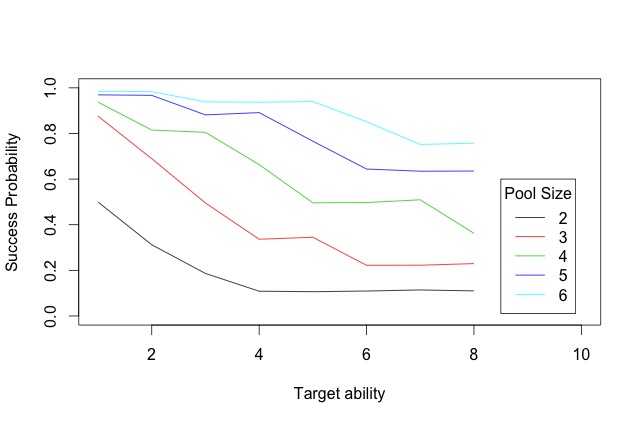
Figure 1 shows the probability of success using the standard rules described above, i.e. with difficulty set by comparing attacker and defender attributes. The high probability of success regardless of defender attribute is obvious for large attribute values, and the plateau effect at higher defender attributes is also visible.
Figure 1: Probability of success for various combinations of attributes, standard rules
For an attacker with an attribute score of 6, success is highly likely (about 80% chance!) even against targets with the very high attribute score of 8. Conversely, a wimpy attacker with an attribute score of 2 can be expected to be successful against anyone with attribute of 4 or more about 10% of the time – even if their attribute is 8. Remember, in WFRP3 a score of 8 in an attribute is almost impossible for a human, and mostly the province of giants and dragons. This means a party of 1st level mages could attack a giant and actually do physical damage against it! And this is before including stance dice, training, etc. A human with an attribute score of 6, a fortune die on that attribute, and two ranks of training could reasonably expect to hit a much more powerful opponent pretty much every time, unless that opponent burns through defense cards, cunning, etc.
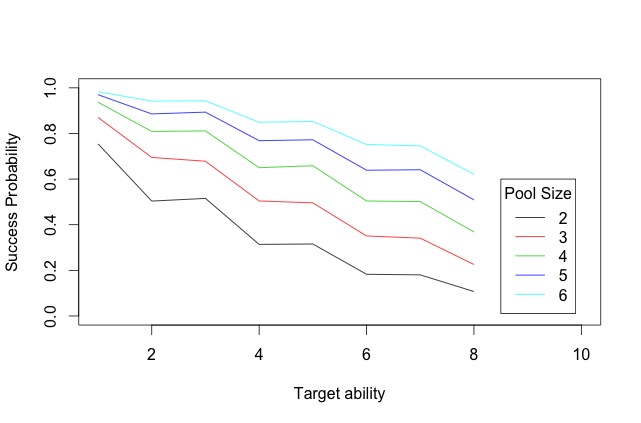
Figure 2 shows the probability of success for various combinations of attacker and defender attributes using a system in which difficulties are set at one challenge die per 2 points of attribute.
Figure 2: Success probability for difficulty set at half target attribute
This chart shows that probability of success declines with increasing target attribute score for all levels of the attacker’s attribute. It also doesn’t show the jagged pattern arising from rounding error that we saw for target numbers in Shadowrun or Exalted; rather, it plateaus for odd attributes. Note the generally high probability of success; a person with attribute of 6 can expect to beat someone with attribute of 8 about 80% of the time. This could be easily adjusted by making the base difficulty of all checks 1 challenge die; then all success probabilities in this chart would shift two steps to the right.
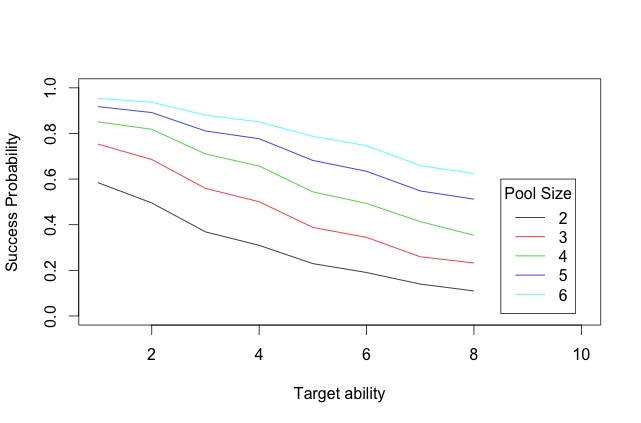
Figure 3 shows the probability of success when we eliminate the rounding effect by turning half points of attribute into misfortune dice. Under this system, the remainder from dividing the target attribute by 2 is turned into a misfortune die. The overall pattern is similar to that of Figure 2 but we see a smoother trend with rising ability.
Figure 3: Success probabilities without loss due to rounding
This is a very smooth success curve, with somewhat high overall success probabilities and no unexpected values due to rounding error. Furthermore, the probability of success against someone of equal attribute score decreases as attributes decrease, which I guess is what one might expect as one watches increasingly amateurish people trying to thump each other; in contrast, in Shadowrun and Exalted this probability tends to 0.5 as skills increase.
I think then that my final recommendation is to set difficulty for skill checks at 1+(defender attribute)/2, with the remainder from the division converted to misfortune dice. This will reduce the success probabilities compared to Figure 3 but retain the smoothness and other properties shown in that chart. For games where you want the PCs to have lots of success, make the base difficulty 0; for really challenging, gritty games make it 2.
By setting difficulty in this way and using challenge dice that are different to the attack dice, the WFRP3 system is able to generate a sophisticated and realistic set of probability results. Unfortunately, the method for setting difficulty provided in the original rules doesn’t take advantage of these properties at all, and should be revised.
The New York Times has an interesting and thoughtful article asking why so few women do science, a topic somewhat related to questions sometimes asked on this blog about women and role-playing, and dear to my heart since I graduated in physics and now live in Asia, where science is cool. Why do the English-speaking countries have a problem with women doing science?
The article has attracted 671 comments, which shows that the topic is of interest to a lot of people, and the author herself gives a strong example of why any form of barriers to participation in science are wrong. She studied physics, so in preparing the article she returns to her old notebooks, and she writes
The deeper I now tunnel into my four-inch-thick freshman physics textbook, the more equations I find festooned with comet-like exclamation points and theorems whose beauty I noted with exploding novas of hot-pink asterisks. The markings in the book return me to a time when, sitting in my cramped dorm room, I suddenly grasped some principle that governs the way objects interact, whether here on earth or light years distant, and I marveled that such vastness and complexity could be reducible to the equation I had highlighted in my book. Could anything have been more thrilling than comprehending an entirely new way of seeing, a reality more real than the real itself?
As someone who didn’t have what it takes to continue in physics, but really enjoyed my third year of study and really loved the topic, I can only say that it’s wrong! wrong! wrong! to construct any barriers that would prevent someone capable of exploring that world from so doing. And the article identifies a huge range of barriers that still exist to women trying to enter science. Despite these barriers, the statistics that the author quotes are reassuring for those of us who graduated from physics in the ’90s:
Only one-fifth of physics Ph.D.’s in this country are awarded to women, and only about half of those women are American; of all the physics professors in the United States, only 14 percent are women. The numbers of black and Hispanic scientists are even lower; in a typical year, 13 African-Americans and 20 Latinos of either sex receive Ph.D.’s in physics.
I think I also read somewhere once that there is a Native American professor of physics (I could be wrong, this is a very vague memory). In comparison: when I was studying physics there were no women in my year, and none had preceded me. In the year after me was a single woman, and we young idiot men as we were had already decided to interpret her tiger-skin mini-skirts and low-cut blouses as proof that she was “taking the easy way” and trying to impress the profs with her body[1]. How much has the field improved in the intervening 20 years!
The author also points out that there is a basic problem in the interpretation of femininity and its acceptance in English-speaking academia. She cites a scientist who worked in Europe, who states that women from France and Italy
dress very well, what Americans would call revealing. You’ll see a Frenchwoman in a short skirt and fishnets; that’s normal for them. The men in those countries seem able to keep someone’s sexual identity separate from her scientific identity. American men can’t seem to appreciate a woman as a woman and as a scientist; it’s one or the other.
This is also my experience in Japan. In Japan it is acceptable for women to be professional or experienced and feminine; it is not a case of either/or, and people are simply impressed that a woman is feminine and skilled – or even they take it for granted that a woman with technical skills will also be well dressed, elegant, womanly, etc. There isn’t the same sense that being feminine is a sign that one is unserious. While in the west femininity is seen as a kind of performance that young women do to pull a mate, and therefore somehow false or deceptive (though expected), in Japan it is just seen as a part of being a woman, not an accoutrement of femininity so much as a part of its essence. There is no expectation that women will walk away from their femininity in order to be taken seriously as scientists. And women’s place in Japan is judged on the basis of their position more than their sex. The way I have come to think of this does not reflect positively on the west: Japan has sexism, but the west has misogyny. There is a deep-seated fear and hatred of women in western culture, while in the east there is a strict set of roles. And in amongst those roles, women are allowed to be scientists. Or at least, that is my impression. This western fear and hatred of women is declining, of course, as we grow up and reject a fundamentally misogynist religious history, but it is still there. The article describes a much more subtle and weaker form of sexism though, that pervades the sciences and makes the task of women just that little bit harder than that of men; and making science just a bit harder means making it inaccessible to mortals, because doing science is difficult at the best of times. You don’t need people denying you lab space, salary and funding, especially on top of the inevitable requirement that young scientists move through several countries as part of the process of building their career. But that is what happens: straight out old-fashioned discrimination.
There are also subtler cultural factors at work: lack of encouragement, and the continual claim that women are not as smart or as talented as men. The writer of the article experienced both of these directly and speaks to other women who had the same problems. It’s a fascinating insight into how a million tiny cuts can drive a person away from a goal, and how those million tiny cuts can be strongly gendered. You may think you’re the first person in history to make an unsavoury joke about women in your engineering course; but to the woman you are talking to, it’s just another day on the frontlines. This kind of stuff adds up, and then women get to the decision point where they are looking at years of hard work, low pay and really, really difficult problems, and with that background of discrimination and discouragement they just think, “fuck it!”
That’s why there aren’t many women in science. It’s a fascinating article, and well worth reading for people outside science too. It really describes openly the subtle ways in which gender bias works to alienate women from a field. And this is obviously relevant to role-playing – a hobby where in the west there are very few women, but in the east there are many more, and for many of the same underlying reasons.
And obviously, excluding women from role-playing is a vastly more important issue than exclusion from science. Read the whole thing!
—
1: incidentally, I dropped out of physics ’cause I didn’t have what it takes[2], but she stuck around for a PhD. Probably now she’s working in the City, snorting cocaine off the bottoms of Abercrombie & Fitch models, and here I am living in a 2-room apartment in Tokyo on a completely moderate wage. Who was the loser in that story?
2: My friend got a PhD in Canberra. He dropped out for IT. He told me: “I realized I don’t have what it takes to be a physicist when this Russian physicist visited to do a 3 month placement. He had no funding. He had no money. He slept on the floor in his office and ate rice for 3 months. I can’t do that for any reason. I will never compete with people like that. I’m outta here!”
I have a friend in Sydney, Australia who has things a little tough. She has a decent professional job – though its a job in a woman’s career, so it doesn’t pay as well as professional jobs should – and she’s a good worker. She has been working ever since I met her without a break, and keeps the same job for years at a time, so no problems with her work life. Unfortunately she’s a single mother, not because she’s one of those dirty sluts who pop out sprogs by the month to get on welfare, but because after the birth of her child her husband turned into a weirdo Men’s Rights Activist and became insufferable, so they divorced. They have a custody arrangement (one week each) so she doesn’t fall afoul of any of the Men’s Right’s Movement demands for Good Women, but that’s not enough for him: when her child is at her ex’s house he denigrates her verbally, and he refuses to pay for any kind of extra-curricula or developmental activity, so if her child wants piano or ballet or rugby lessons, she has to fork it out herself. Nonetheless, her child is well-adjusted and she’s a good parent.
Unfortunately she has a minor mental disability which, although it doesn’t stop her working and raising children, means that she isn’t so good with money and she’s had a long history of financial troubles. It also means that she has a “pre-existing condition,” and anyone who has lived in Sydney knows that rents are punishing and being dodgy with money is not an easy trait to live with. She’s lucky because she has a good job, but for every person like my friend you can bet there’s another similar person whose job is not so great, who has serious financial troubles and is, as they say, a single pay-cheque away from disaster.
I think I know what this situation is like, though I can’t imagine the additional stress that gets piled on when you have a child, and I can imagine that my friend comes home from work sometimes, sits down and lets out one of those slow breaths, the one’s where you’re mentally thinking “Fuuuuuuck” as you wonder at what you can do and worry about what will happen to you if you don’t do it.
Fortunately, however, my friend lives in Australia, so she is guaranteed health care. She knows that no matter how badly things go, even if she isn’t working (which she is), neither she nor her child are going to lose their health. Which means that if it becomes her goal to shift down from her professional job to a manual labourer, cleaner or bar worker – she will still have guaranteed healthcare. Those weekly worries where she sits down and thinks about what she has to juggle don’t extend to her or her child’s health.
Not so in the USA. The same woman in the USA – changed jobs as an adult, pre-existing condition, child with same pre-existing condition – is likely unable to get health insurance even if she can afford it. The same woman in the USA will come home and she won’t just think “can I afford anything nice for my child this weekend or next,” but will also think “I hope I don’t get seriously sick before my child becomes an adult,” because if she does she will be facing ruin, and her child’s future will take a massive nose dive. Even though she can afford health insurance in any other country in the world, in the USA she will be denied it, or her entire income will be blown on it. And she’s not alone, nor is her case limited to single mothers who had the importunacy to refuse to tolerate Men’s Rights Movement husbands – there are between 10 and 40 million Americans who can’t get health insurance, and for a sizable proportion of them the problem is either that they have a pre-existing condition, or that as sole business operators or independent contractors they don’t have group purchasing power, and simply can’t afford individual insurance.
But not anymore. On Monday Obamacare started, and those millions of people have access to the health insurance exchanges. Insurance companies can no longer refuse them insurance, but have to offer them a basic plan, and the government will subsidize some plans. Medicaid has been expanded to cover the working poor. The primary beneficiaries of Obamacare will be the working poor, the lower middle class, and those with pre-existing conditions. The estimate for the first year is that 7 million people will gain access to health insurance, and the total number of people expected to gain access over the long term is 28 million. This isn’t a flight of fancy either – the Health Insurance Exchanges have been overwhelmed by the unexpected number of customers, just as happened to the NHS when it first opened.
This scares the Republicans. The next presidential election is in two years and they desperately need to win it, but they have a problem: they are implacably opposed to Obamacare. The election is in two years, and the prediction is that in one year 7 million people will take it up. This means that by the time of the election 7 million people will be benefiting from a Democratic policy that the Republicans will be campaigning to abolish. Judging by the scramble to the exchanges, many of those people will have been receiving their insurance for more than a year. For those people, that Friday night collapse onto the couch and “oh, what am I gonna do!?” will no longer include worries about healthcare. If they have two years to experience this level of relaxation and then, at the next election, the GOP and its Tea Party mates rock up claiming a virtue of abolishing the law, what are those 7 million people going to think? Will some of them perhaps think one option is voting?
Furthermore, the biggest beneficiaries of Obamacare are going to be working and lower-middle class white males with families. These are the stalwarts of the Tea Party’s campaign, and in the long term they are going to be looking at convincing up to 40 million people that gaining access to health insurance – including subsidies for the working poor – is a bad idea. What are their chances?
This is why they have to throw down now. This is why their specific condition was that Obamacare be delayed a year. They need those 7 million people to be naive, fresh to Obamacare, not yet settled in their new comfort zone, so that they can go to the election with a slogan that appeals to their base and doesn’t simultaneously alienate – or worse still, activate – 7 million early adopters. With a one year delay they have a chance; if Obamacare is enacted now they lose. And if they lose, they lose the following election too, because whoever wins the White House (Hilary Clinton?) is going to be able to say to more than 7 million new Democrat voters “do you trust these people? Last election they said they would remove your health insurance. Do you trust them this election?”
That’s why the GOP is willing to shut down the government, because in two years time they risk irrelevance. They have to destroy the tea party and accept universal health coverage, or they have to fight. And if they choose to fight there is going to be no room for compromise. Will they go so far as to force a default? Do they have any political reason not to, if they are facing a sea change at the next election? I guess not …
In comments to my post on balance in Shadowrun’s opposed skill checks, Paul asked me whether the distribution of success probabilities for opposed skill checks with equal numbers of dice is equal to the success probability you get from simply fixing an expected target number for your opponent. In practice what this means is that if the target number for success is, say, 5 or 6 on a d6 (probability 1/3) and both you and your opponent have, say, 6 dice, then you set an expected number of successes for your opponent as 6*1/3=2, and then try and roll over this expected target. Apparently Exalted 2e moved from challenged dice pools to using this process, fixing the target number to be half the opponent’s dice pool, and then having the attacker roll above it.
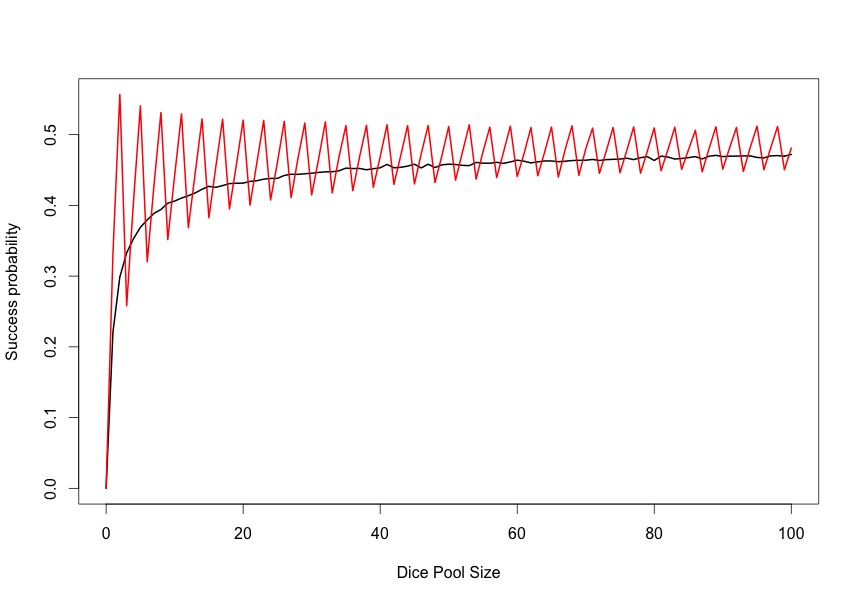
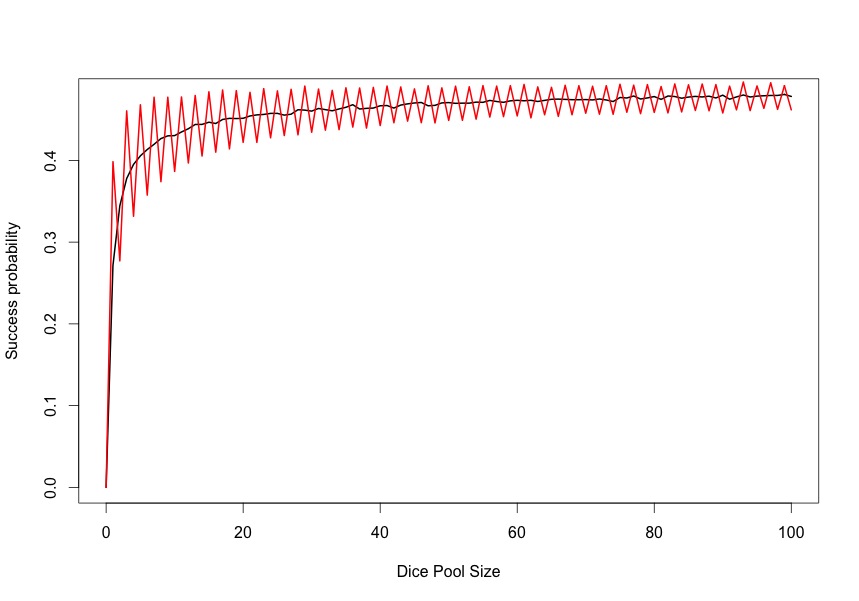
My guess in response was that this would be equivalent at larger dice pools. Turns out I was partially right and partially wrong. I ran a simulation in R, for dice pools from size 1 to 100, and set the target number of successes to be 1/3*(opponent’s dice pool), rounded down. So for a dice pool of 12, attacker rolls 12d6 and counts the number of successes (5 or 6s); they need to get over 12/3=4 to win. For 11 dice, the target is 11/3 rounded down, or 3. Figure 1 shows the results for opposed dice pools (black line) and the expected target number approach (red line).
Figure 1: Success probability with and without opposed dice pools
Note two interesting properties of this graph:
The probability of success for the expected target approach bounces around a lot, going from above 0.5 to below 0.5 in little jagged steps. This is because of the rounding problem in setting expected targets. This means that even at large dice pools (100! imagine that!) you can still get large variations in success probability depending on whether your dice pool is a multiple of 3 or not
The limiting value for opposed dice pools is not 0.5 as I thought, but actually closer to 0.47. I think this is because of the discrete nature of the probability distribution – there is a non-vanishing probability that both sides will roll the same number, whereas if the two dice pools were normally distributed this chance would be zero – someone always wins, and there is a 50% chance it will be you. In this case the normal approximation to the binomial distribution contains a small error even at dice pools of size 100 or more
The rounding problem is interesting because it is quite punishing at small dice pools. For example, if you have a dice pool of size 4 and your opponent also has size 4, then their expected target is rounded down to 1, which is actually the precise expected target for a dice pool of 3; you have actually gained a +1 to your dice pool through rounding error, and if your dice pools are both size 5 then this bonus increases to +2. We could use the opposite approach of rounding up, so then you would get a -1 or a -2 on your dice pool compared to your opponent. Rounding off smooths this problem a bit – in this case a target dice pool of size 4 gets an expected target of 1 (equivalent to 3d6); that of 5 gets an expected target of 2 (equivalent of 6d6). So your dice pool benefits or suffers. From the chart we can see that this effect is noticeable even at dice pools of 100d6 (which is why I extended it that far).
We can see more accurately what the true probability distributions would be like if we consider only dice pools that are multiples of 3 – that is dice pools of 3, 6, 12 etc. – because in this case there is no rounding error. This result is shown in figure 2, again with the opposed dice pool shown in black and the expected target number in red.
Figure 2: Results of dice pools with no rounding effect
Interestingly,with no rounding the expected target number method produces a slightly lower probability of success than the opposed dice pool method. This is because it restricts the range of extreme success available to the player – e.g. a player with a 6d6 pool can’t get success on a roll of 1 or 2 successes, even though this will (occasionally) happen.
I guess this means that the expected target number system is slightly broken, because rounding is very important at the scale of the dice pools that most people use. In the case of Shadowrun, for the first three dice pools (1d6 to 3d6) against a target with the same size dice pools, the probabilities of success are (respectively) 0.34, 0.56 and 0.26. So dice pools of 1 and 2 benefit hugely compared to dice pools of size 3. The same effect will exist in Exalted. What an expected target number system gains in simplicity, it loses in fairness (at least for small dice pools).
These kinds of considerations show that developing an effective system that is fun to use, simple and fair in all situations is fiendishly difficult. Next I am going to try and look at the WFRP 3 system to see if their methods based on opposed dice types are more robust to these kinds of concerns.
—
Update: Since Paul mentioned it in comments, Figure 3 shows an approximate example for Exalted 2e. It uses a target probability of 0.4 (7 or better on d10) but does not use exploding dice. The effect is still there but some of the jags are not as clear. Again, red line is the expected target number method, black line is the opposed check (so red=2e, black=1e?)
Figure 3: Target number vs. opposed check for Exalted dice pools
Update 2: apparently I got the dice pools wrong for Exalted, so I’ve updated Figure 3 using the correct numbers – a target probability of 0.5 and two successes on a roll of 10.
… Because they are so much more Dudalicious. In honour of the David Gilmour (not the guitarist!) school of teaching, from now on I will only use statistical techniques designed by men. Sure, I could use Generalized Linear Latent and Mixed Models (GLLAMM), but just listen to the name of the damned thing. It’s like the Jane Austen of stats, and unsurprisingly it was developed by a woman (Sophia Rabe-Hasketh). Hardin and Hilbe just had a much more indefinably cool … manliness … about them, so I think for clustered binomial or count data I’ll just wing it with Generalized Estimating Equations. Luckily I don’t do much in the way of RCTs, because the classic text on experimental design by Cochran and Cox is half-authored by a woman – I can’t tell which bit she wrote so I’ll just have to dump the lot to be sure. This could be a bit tricky, because that stuff is pretty fundamental to how we think about efficiency in experimental design. No problem really, though, I’ll just make sure I apply for bigger grants and recruit more subjects. Typical of a woman to write a book about how to be thrifty with sample sizes really, isn’t it? Real men just recruit more subjects.
David Gilmour also doesn’t like Chinese authors, so if I’m going to follow his approach I’ll probably have to drop any adjustment for probability sampling, since a lot of the development work for those methods was conducted by Indians after independence. That shouldn’t be too bad because there are still some low-grade journals that let you publish without adjusting for your sampling process. Of course, to be sure I think I should develop a few stock phrases to deploy in explanation of why I’m avoiding certain methods:
Although region-level variables were available, they were not incorporated in this analysis because the methods required were developed by a woman
or
To avoid feminization of statistics, the clustering effects of school and classroom were not adjusted for in this analysis
and maybe
Probability weights were not incorporated into the analysis, because that method was developed by Indians
I’m sure the peer reviewers will appreciate that, but just to be sure I’ll be sure to specify in all submissions that I not be reviewed by women. That should cover it.
Now, some of you might suggest that I should just relax and use all the techniques available to me, or at least not go through the canon with a fine-toothed comb checking the gender of every contributor – I mean, couldn’t I just drop the techniques only if I find out that they were written by a woman, without active screening? A kind of passive case-finding approach, if you will (but can I employ case-finding – it may have been invented by a woman. I should check that!) But this is not how the David Gilmour school works. You have to assess your authors first and foremost on their cool manliness:
Chekhov was the coolest guy in literature. I really think so. There’s a few volumes of his there, what a great looking guy. He is the coolest guy in literature; everyone who ever met Chekhov somehow felt that they should jack their behaviour up to a higher degree.
And really, when you look at the kinds of canon that are taught in English at high schools and first year uni courses, it is quite often the case that they are all (or almost all) male. Every statistician knows that those kinds of imbalances in a sample don’t happen by accident – that’s a deliberate selection bias. If it’s good enough for dudely English teachers it’s good enough for me, so I think from now on I should screen out any beastly feminized stats. Sure, you can’t get into any half-decent journals if you can’t use GLLAMM and good experimental design, but I say hell to that. It’s time to fight back! Men-only stats for the win!
—
In case anyone thinks I’m being serious[1], there’s been something of a storm of controversy about this David Gilmour chap, and I think you can see how stupid his approach is if you imagine trying it in a technical field. Stats being part of maths, it has its fair share of chick lit, but it is still male dominated; nonetheless, if you screen out the main work done by women, you suddenly lose a huge range of tools and techniques that are essential to the modern statistician. Surely the same applies in English literature, but moreso given the huge role women played in the development of the novel. Check this Crooked Timber thread for more entertaining take-downs of this position (with some prime grade Troll Meat thrown in the mix). It really is outstanding on so many levels that a literature teacher would judge who to teach in such a juvenile Boys Own Manual way; that they would take their responsibilities so lightly as to think that their sole task was to teach students their own opinion rather than … something useful … and that they would not try to hide it behind some more mealy-mouthed apologia. I mean really, there are a lot of very good female writers in the last two centuries and yet people like this David Gilmour chap manage to construct a syllabus without a single woman in it. Usually their argument would be along the lines of “I judge on merit” but you do have to wonder, don’t you? And then along comes a naif like Gilmour and makes it completely clear how these canons are really constructed – the women are screened out from the get go.
Shadowrun uses a skill check system based on dice pools and opposed checks. The basic mechanism for opposed checks is quite simple: each party constructs a pool of d6s based on their combined attribute and skill score, and success occurs on a 5 or 6. The person who rolls more successes wins, and the number of successes decides their degree of success.
When I saw this system I thought that there must be a way to recalculate it as a single dice roll. A dice pool of this kind is essentially binomial distributed, and the sum of binomial distributions is binomial, so I thought that the difference of binomial distributions would also be binomial distributed and it would be fairly easy to obtain analytically a formula for a new dice roll based on the probability of success (1/3) and the number of dice in each pool. In fact the difference of two binomial distributions is not binomial (see my appendix below) and the dice pool mechanism is quite complicated. In the case of dice pools of equal size it creates a symmetric, non-binomial distribution that tends towards normality as the size of the dice pools increases; for uneven numbers of dice it creates an appropriately skewed distribution that has no easy calculation formula. In fact, it is fairly easy to show that for equal numbers of dice in the conflicting pools, the probability of success tends towards 50% as the size of the dice pools increases.
To show this, I wrote a simple program in R that calculates the probability of success for opposed dice pools ranging in size from 1 die in each pool to 30 in each pool. I ran the simulation for 10000 rolls for each dice pool, and calculated the probability of success for each roll. In all cases the dice pool of the opponents are of equal size and the success probability is 1/3, as in the standard rules. Figure 1 shows that as the number of dice increases the chance of success tends towards 0.5. That is, a PC with skill and attribute of 10 each, and modifiers of 10, when doing an opposed check against an exactly equally matched PC, will be successful 50% of the time; whereas the same situation for characters with just an attribute and skill score of 1 will show a vastly reduced chance of success.
Figure 1: Probability of success in opposed checks for equal dice pool sizes
I’m not sure whether I like this outcome or not. Superficially, given low-skill characters are more likely to fail generally, it makes sense that they should be more likely to fail against an opponent of equal skill. But then, it seems reasonable to suppose that the chance of success when opposed by someone with the same skill as oneself should be constant. Which assumption is better? In WFRP3, difficulty of the check is set by the opponent’s skill but is not random, and usually involves competing against dice with a higher chance of generating failure than one’s own dice have of generating success. Is this a better model? Other dice pool systems probably use a fixed target number – is this better? Maybe a fixed target number can be manipulated to generate a fixed failure rate (if it is based on the contrast of the PC skill and the NPC skill). But then again, this opens the possibility that PCs can do better in opposed than unopposed checks. For example, in Shadowrun, when doing an unopposed check the maximum probability of success for a PC with attribute 1 and skill 0 is 1/3. Presumably when they oppose someone with attribute 1 and skill 0 their chance of success should be less than 1/3? If one accepts this proposition, then Shadowrun is perfectly balanced, and the only question is how long it takes to get to 50% success. This pace can be changed by using different success targets and dice sizes: for example, a success threshold of 7 on d10 slightly reduces the chance of success for any given dice pool.
Note that by the Strong Law of Large Numbers, it is impossible to change the limiting probability for opposed dice pool checks, no matter the threshold probability or the die size. This is because as the dice pool grows in size each dice pool becomes increasingly close to normally distributed; but when subtracting one normal distribution from exactly the same normal distribution there is, of course, a 50% chance of getting a positive number. So as the distributions get more normal, so too does the average chance of success tend to 50%. Increasing the dice size and reducing the success threshold will delay the onset of this 50%, but Figure 1 shows that for most PCs and most campaigns, d6 will suffice.
Given these results, I think that the Shadowrun dice pool system is pretty close to perfect; and there is no easy way to modify it or any similar dice system to get more nuanced results. I will shortly be examining WFRP 3 dice systems to see if they produce more subtle outcomes. Stay tuned!
—
Appendix: Proving that the difference of two Shadowrun dice pools is not binomial.
When both the PC and their opponent have a total skill of one, the opposed check becomes a challenge of 1d6 vs. 1d6. In this case there are three outcomes: -1 success (opponent wins and PC loses); 0 success (both win or both lose); +1 success (PC wins and opponent loses). For a single success probability of 1/3 the probability of each event can be easily calculated without special mathematics as 2/9, 5/9 and 2/9 respectively. This means that the probability of -1 and +1 are equal. If this distribution is binomial, then it can only occur from a binomial distribution with 2 trials and a probability of p, since this is the only binomial distribution that allows three distinct outcomes. Thus if we calculate the probability of 0 successes or 2 successes under such a distribution and set it equal to the extreme probabilities obtained for the 1 vs. 1 shadowrun check, we can see the conditions under which they are equal. Under a binomial distribution with probability p and 2 trials, the probability of 0 successes is (1-p)^2; the probability of 2 successes is p^2. Comparing with the 1 vs. 1 Shadowrun check, we see that these two probabilities must be equal (as they are in the Shadowrun check). That is, p^2=(1-p)^2. This is only possible if p=1/2. But in the Shadowrun check p=1/3. Thus, by contradiction, the Shadowrun check cannot be binomial. If any one check is not binomial then it follows that we cannot expect a general rule in which checks are binomial. Thus, through contradiction, Shadowrun opposed dice pools are not binomial and no formula can be deduced which will enable calculation of binomial probabilities in Shadowrun.
For general opposed dice pools, the probability distribution is obtained by calculating the cross-correlation of the two binomial probability densities. An equivalent calculation for the Poisson distribution is shown in Wikipedia (the Skellam distribution) and is obviously nasty – it involves Bessel functions, which is an immediate “do not enter” sign. The equivalent calculation for the binomial distribution involves a calculation of products of binomial coefficients, and my combinatorial kung fu is not up to it, but I think at least for opposed checks with equal numbers of dice it can be solved analytically, though not in a way that is useful for gamers. I think such a solution is available in a textbook by Ashkey (?) but I don’t have the book or the will to read it. So more complicated solutions to the problem will be found numerically or not at all. I may revisit this problem in order to compare Shadowrun with WFRP 3. But for now, I’m shying away from it for obvious reasons!
Yesterday I visited Matsumoto with my friend from London, Dr. M. We were unburdened by annoying Germans, and able to enjoy the full glories of this small town nestled in the foothills of the Japanese Alps. Matsumoto’s castle is a national treasure, as well as a deathtrap for elderly people, and like most castles in Japan more fun to view from the outside than from within. It gave some interesting insights into feudal life, including a wide selection of firearms and examples of the tribulations of daily life in Sengoku Japan. That was all fun, but Matsumoto’s real hidden gem is the Kaichi School, a museum about education in Japan that is located in the building of the old Kaichi Elementary school, next to the new Kaichi school. It seems strange to say that a museum about education and education policy can be fun (can you imagine anything more boring?) but it actually really was. I think for those of us who set our gaming worlds in the not-so-distant past, this kind of information is invaluable for creating a rich and believable fantasy setting, so I thought I’d describe a little of what I saw here. Plus, of course, we all went to school, so we can compare our own experiences with those of the children of two very different countries: the past, in Japan.
The Dragons and the Nameplate
The Kaichi school is important in Japanese education policy because it was a leader in education policy at the time it was built, and it was one of the first schools built after the Meiji restoration. The Kaichi school was active in the Freedom and People’s Rights movement, and so important to that movement that the Emperor Meiji himself visited Matsumoto to try and calm the demands of that movement. He stayed in the school, which has a room dedicated to his memory. As a result of its role in education reform, the modern school museum is a repository of historical material on education reform in Japan. The school building is itself a very beautiful whitewashed building in a European style, with many Japanese touches – such as the dragons over the entrance and carved into doors in the interior. The old classrooms have been turned into exhibits, depicting education in Japan from the era of the samurai to the modern day.
A samurai child’s schoolbook
I was surprised to discover that education before the Meiji era was actually already quite universal, though not particularly good quality or equitable. Most education was carried out by temples, until the law in 1880 which made education mandatory for all children. Before then different children received different levels of education, with samurai receiving the most impressive while farmers simply learnt to count and write basic information. By 1880 about 90% of the population was in some kind of education and literacy rates were 45% for men and 15% for women. The museum had examples of the schoolbooks of the pre-Meiji era, and some woodcuts depicting children being educated; it also had photos from the late Meiji era, showing for example girls from poor families who were paid to work as baby-sitters, studying with their charges slung on their backs because their master was required to pay for their education. They learnt to write things like “Thank you master, it is due to your kindness that I am able to learn to read.” The museum had lots of photos of the school over time, and also woodcuts depicting education before that era. It also had a selection of documents from the opening of the school, showing what gifts were given. When the school was opened, they held a Shinto ceremony to sanctify it, and the local farmers and citizens donated rice, sake and fish (Bream) as gifts to the shrine and the school. The school opened in 1876 and universal education was mandated in 1880, so until then parents paid the teachers gifts of rice, fish and other farm products. Looking at these exhibits, one is reminded of how incredibly poor Japanese society was before 1873, and how incredibly rapidly it developed after the restoration.
Destroy!
Of course, Japan’s development in the modern era is bracketed by two extreme events, the Meiji restoration in 1873 and the Pacific War from 1931-1945. The museum spends a lot of time on the Meiji reforms but doesn’t shy away from the role of education in promoting and supporting war in the Pacific War. It has a room devoted to the Pacific war, in which it shows the activities of the school and its students during the war. The picture above is an example of what students learnt during that time. On the right of the lower picture are two caricatures of American and English soldiers (the American is smoking, and the Englishman looks suave); on the left of the (female?) soldier with the naginata the two kanji say gekimetsu, destruction. In the picture above this, a sad-looking man salutes under the caption “Young men going to the sky” (Japanese depictions of the war in the air often use this romantic language of the sky, rather than more technical language about “air war” or “aerial”, I don’t know why – maybe there’s a clue in the new Ghibli movie).
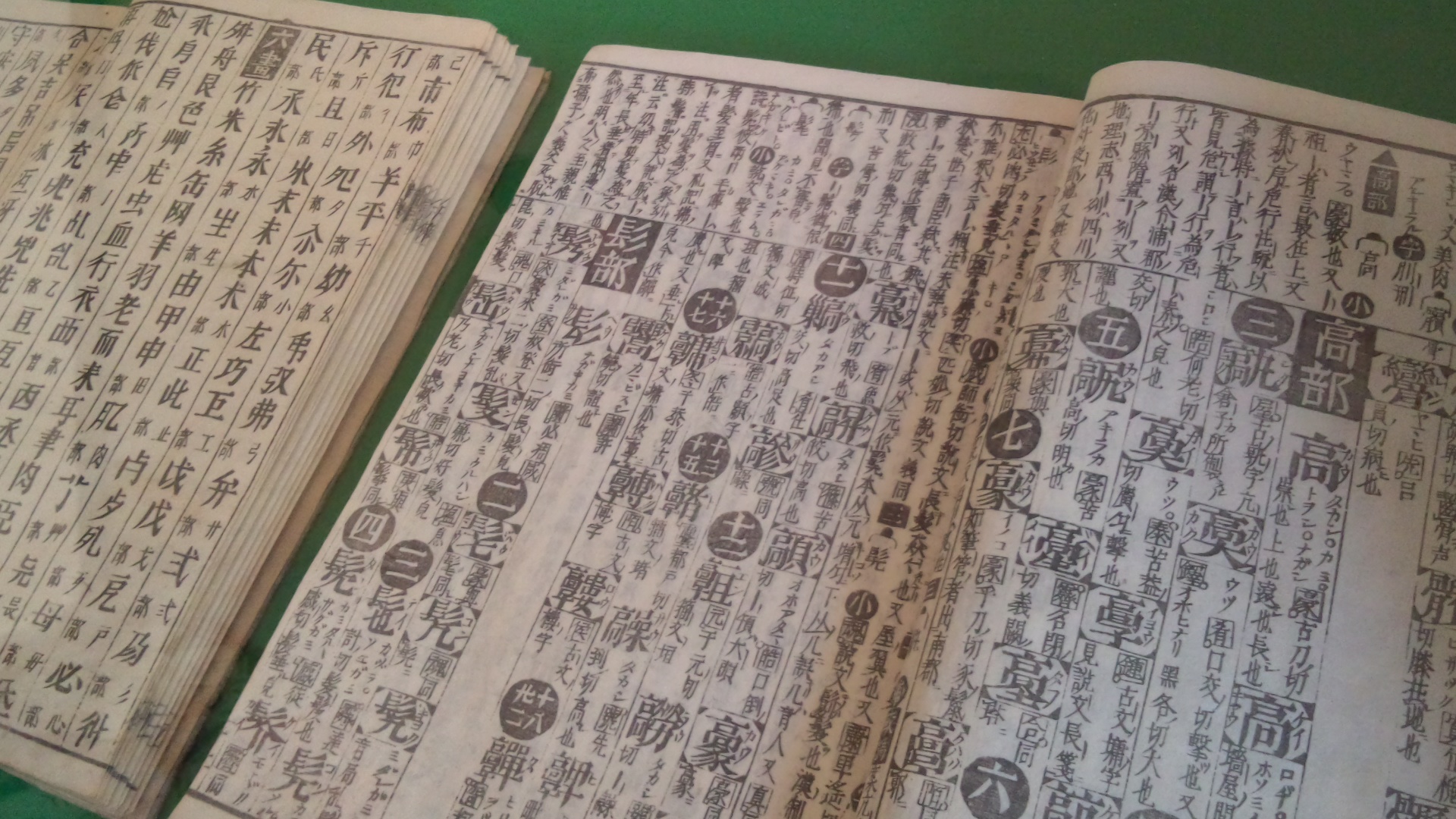
The second to last room of the exhibition is a room full of different textbooks over time. This includes textboooks from the war and the immediate post-war period; the picture above shows a textbook from the war era, while the picture below shows a textbook from immediately after the war that has been censored to within an inch of its life. The textbook is open to a page that says the following:
Mr Soldier, please look at the words and pictures I draw
Please also show them to the children of Korea
When you capture new lands, please wave the flag of Japan and yell “banzai.”
Mr Soldier, please work hard and happily.
We visit the shrine to pray for you on the first day of every month
I guess the Japanese were too poor and there was too much policy chaos after the war to write new textbooks, but they couldn’t exactly deploy the war-era textbooks untouched, since they would have been full of the worst imperialist and racist tripe, and the kind of disturbing language used in the textbook above. But I can’t help thinking that this kind of heavy-handed censorship would merely encourage children of that era to investigate the “truth” about the war. (Which they would have to do – the Japanese explanation below indicates that in some cases 30% of the text book was censored!)
How is this helping Yamato kun learn?
Of course life after the war changed a lot, and the next set of textbooks shows this: they are luminous, beautifully-written affairs. As far as I can tell the same age of children would be expected to read the textbook shown in the picture above and in the picture below. The text on the picture above is all about asking soldiers of Japan to struggle in war – it is supplicative and futile. The text in the rightmost book below simply states that “the sky glowed, the sea glowed, the roofs glowed” – it describes a pastoral idyll. Which is it better for children to learn?
A sudden change for the better …
These installations really show how text books can vary rapidly across time, and how closely education policy supports and reflects national policy at any time. I guess if the education system had been allowed to continue in its chaotic private form after 1880, it would have been a lot harder for the government to exert a common propaganda line – though the counterfactual would likely have been little better, since by 1940 all arms of society had been sucked into the war economy and it is unlikely that the private educators would have been able to escape this trend to the glorification of war (not to mention that the state was basically seized by the army, who probably would not have tolerated freedom in educational curricula after 1931). I guess one of the downsides of a standardized curriculum that enables a country to go from post-feudal rural basket case to world power in 50 years is that it is vulnerable to misuse as a propaganda tool…
After its “textbooks through the ages” exhibition, the single biggest room in the school was devoted to a “desks through the ages” installation, shown in the picture below. The desk furthest at the right is from before the Meiji era and is called a 天神机, heavenly desk. It doesn’t look heavenly. Some of these desks were quite ornately made, though they looked rather uncomfortable. I think most nerdy types have spent a lot of our childhood crouched over a desk learning what makes the world tick – it’s interesting to see how people in a completely different time and place were doing it. Mostly worse, by the looks of things.
A desk! A desk! My empire for a desk!
This picture also gives a sense of how beautiful the inside of this school is. I really recommend this little museum for a visit if you are in Matsumoto. The castle is also interesting, and the town as a whole is a pretty little place full of old buildings – it is apparently one of the few cities in Japan that has maintained its old buildings, and so riding around in it is a really pleasant experience. For foreigners visiting Japan it is an excellent side trip. It is 2.5 hours from Shinjuku, it is close to skiing, monkey onsens and highland walks, the town itself is pretty and it has an excellent website. There are many old warehouses in the town that have been converted into shops or restaurants, and it is very easy to get around. If you are looking for somewhere to stay I recommend the Dormy Inn – the staff are excellent, the breakfast delicious, and the onsen relaxing. If you go, try to spend at least two nights here so you can explore the surrounding countryside, the castle and at least one of the museums or galleries. And head to the 女鳥川 (a river whose English translation I don’t know) because there is a cute set of streets lining it that have really old buildings and interesting restaurants, overlooking the river. It’s a really nice escape from the hustle and bustle of the big city, nestled equidistant between Tokyo and Osaka, with a lot of cultural information to keep you interested. And if you go there, visit the school!
[Updated late at night on 26th September to correct the spelling of Kaichi school (how dumb am I?) and to include the translation of a textbook page, which I checked with a friend].
I have recently been spending a lot of time around (white) foreigners in Japan, much more than usual, and a recent experience with a particular pair of them has helped me to understand a kind of increasing discomfort I have with the way westerners interact and the way they perceive Asia. I guess being largely removed from the brute force of western interactive style, I notice it more when it is laid before me in its full glory. I want to report on some of my feelings about this here.
I have been travelling – not by choice – with a German man and his wife, in their late 20s. The woman is shy and the man won’t shut up, but not just in an annoyingly tiring way. He speaks over and for his wife in a terribly obvious way, even about things asked directly of her about her. But worse still, if you try to short-circuit this behavior by addressing her directly, she looks to her husband and waits for him to speak. For all the presence she has in the group, she might as well just be veiled and sat behind him. His behavior is really depressing and irritating and her quiescence – I would like to guess it is due to exhaustion but I am worried from her manner that it may actually be a preference – is saddening. Furthermore, this man feels himself an expert on Japan having read some stuff before his (first) visit, and needs to prove himself knowledgable on all things. He is also very convinced of the importance of expressing his own opinion, and me and my friend being not averse to bloviating ourselves, the time we spend together is a constant frustrating round of opinion-exchange and fact-boasting. I can’t help getting sucked into this but I get so tired of it. Of course being a westerner myself I’m really at home in and good at this type of conversation, but 7 years out of the loop means I now look down on myself engaging in it and don’t reflect well on myself.
I believe this style of fact-boasting interaction is just a form of empty chest-beating, it doesn’t change anything about the world or each others’ opinions – it isn’t communication in any sense that the word is really understood. A phenomenon I notice a lot around foreigners and that I think is related to this is their complete inability to take in other cultures (most especially Asian cultures) without judging them. In sum this behavior has me thinking: I really hate Western so-called “enlightenment.” This guy has mentioned once or twice Japan’s reputation for sexism, in the usual tone and context as to imply that we Westerners are so enlightened and over that shit (his country even has a female Chancellor, for god’s sake!) but all of his behavior stinks of sexism, classic unconscious sexism of the patriarchal ignorance kind. He’s not alone in this: I can’t count the number of times western men and women have spoken to my partner and I as a couple but looked only at me when talking; the number of western women who completely blank my partner and only engage with men, or worse still friend me but not her after a meeting; the western men who speak on one side of their mouths about how sexist Japan is while bragging out of the other side of their mouths about how sexually and domestically submissive their Japanese woman is; the number of foreign men here who have no use for Japanese men and never engage with them; the number of foreign men whose Japanese wives are “not like other Japanese women” because they aren’t “weak”; the number of foreigners who judge anyone who is not loud and opinionated to be stupid.
I hate the way westerners have to judge everything around them as if everything around them is waiting for their shallow, half-considered opinions to affirm its validity. I hate the way every half-baked racist trope that they conjure up to misinform them about the value of behavior they witness but don’t understand is reinterpreted as proof of their own superiority. I hate the way this happens as they blow their noses; stand in the way of patient, polite Japanese people; put their dirty feet places they shouldn’t; speak too loud; and generally explode into every space they are currently judging like a cloud of massive, usually fat and underdressed obnoxiousity.
I hate the way every time anything untoward or unexpected happens white westerners immediately start wondering if it might be because they’re foreign and experiencing racism. Invariably they aren’t, but it reveals so much about their implicit recognition of how hard it is to be foreign in a white country. I hate how they project every seedy element of their own culture onto others and then when the confirmation bias kicks in, interpret it as proof that their own culture is superior. Spare me this self-aggrandizing cultural blindness!
I’m sure many of the feminists are familiar with and quite irritated by this kind of hypocrisy. Over here I see it leavened with racism and colonialism, and I am thoroughly and heartily sick of it. Westerners aren’t enlightened or any more advanced than much of the rest of the world, we’re just full of our own self-righteous opinionated rubbish. And so much of what is constantly passing for opinion and argument in our much-vaunted “individualist” culture is just ill-informed, hypocritical cant with a healthy side serve of colonialism. I really, really wish that as a culture we could just shut up and listen for five minutes of our incredibly short, dirty and plague-ridden history. I would like to parley this into some kind of set of rules for westerners visiting Japan – not rules about how to treat the locals, but about how to understand them and how to take away from Japan something more than just “ooh, cute shrines and everyone’s polite but oh hasn’t everything I already ‘thought’ about Japan just been confirmed in spades!?”
When last we left our PCs they had cleared out a goblin nest near their onsen, at great personal cost to Azahi the Troll-slayer, and put paid to a potential threat to their new demesne. Upon returning to the onsen they were called back to Separation City by Baroness von Jungfreud and, after a day of rest and healing for poor Azahi, they returned to town. This time they took with them Grunstein, the Jade order mage, who had recovered from his case of hideous Blacklegge disease.
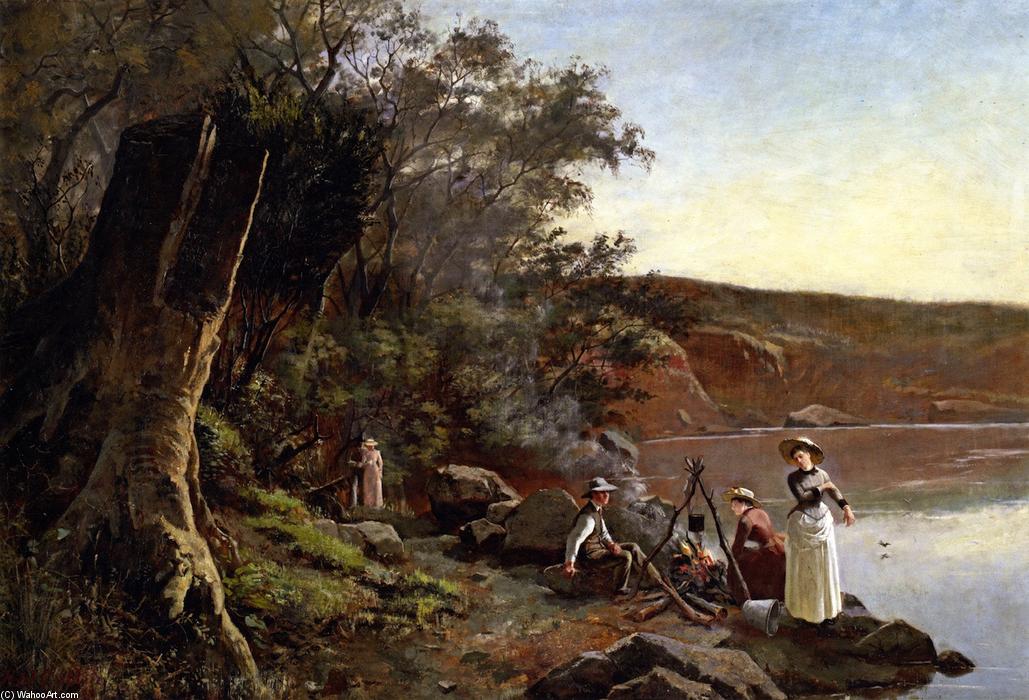
When they returned to Separation City Baroness von Jungfreud arranged to meet them for a picnic, perhaps her last of the spring. As is typical for such a notable’s picnic, she had brought with her several servants, a fire to cook upon, and even a small tent beneath which to retire from the sun. She had also brought with her a scraggly, wild-eyed man in a battered hat and leathers, who traveled under the name Gregor Thorveld and claimed to be one of that rare and feared breed, a witch-hunter. Judging by his nervous manner, continually jittering eyes and uncertain speech he was either constitutionally a coward, or had seen far too many witches.
The Baroness’s servants prepare the picnic
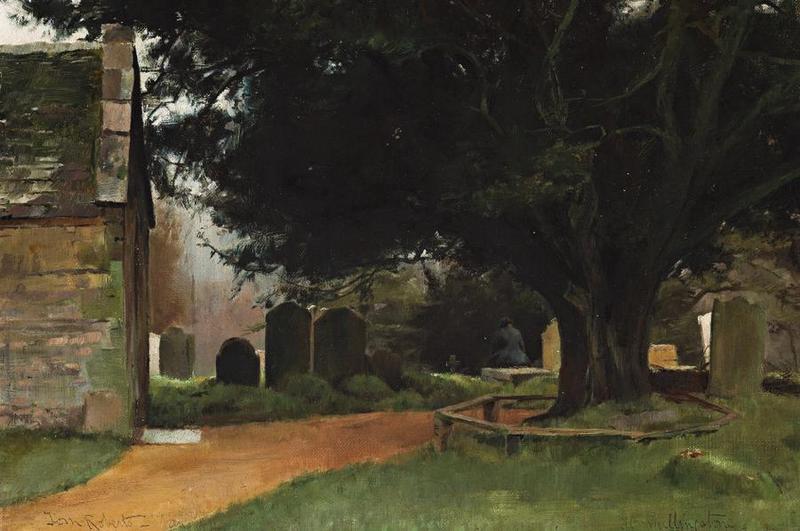
Baroness von Jungfreud told the characters that there were rumours of disturbance in the graveyard, that one of the graveyard guards had been ambushed with a rusty old arrow and that she wanted them to investigate. The graveyard had been used to bury the victims of the recent plague – about 50 to 100 in all – and she was worried that the PCs had failed to kill off all the plague cultists. Perhaps one had stolen back into the graveyard and was hiding there amidst the corpses of his victims? When asked why the victims had not been burnt, Baroness von Jungfreud somewhat sheepishly confessed that in fact the town Physician had overseen the burial … that same town Physician, of course, who was working for the plague cult. Thus all the groundwork had been laid for even a minor functionary of the cult to dig up some hunk of ghoulpox’d rotten corpse and dump it in the water supply – again.
It was then that she introduced Gregor, who she assured them sternly would help them to make up for any mistakes they had made in eradicating the cult. Through clenched teeth they introduced themselves, and discovered that he had come to Separation City on the strength of rumours of chaos and murder, and had offered to aid Baroness von Jungfreud as part of his role as a witch hunter. The town currently lacking any sturdy fighters, she had agreed to take him on and would send him with the PCs. Although she was dismissive and hypocritical about the responsibility for the plague cult survivor, she did give some implicit indication that she understood her responsibility – she offered them 5 gold coins each to clear the graveyard, a huge amount for such a simple task. Assured of reward, they set off immediately.
Separation City graveyard is separated from the town by some distance, and set on a hillside that backs onto the forested mountains beyond. It is surrounded by the typical wall that surrounds any Steamlands graveyard, about 4 metres high and designed to be hard to scale from the inside. This graveyard had two entrances, one main entrance facing the Iron Ring section of town (distantly visible to the south) and one, higher up along the wall near the end of the cemetery, that was much smaller, much less secure, and opened to a small path that led to a “secret hot spring,” a hot spring that has no real facilities and is used in the open air by anyone who cares to visit. Why this was located in the graveyard was a mystery to everyone, but the PCs immediately recognized the risk – the plague cult seemed to have a thing for causing trouble in hot springs. They had the town guards bar the main gates and set forth for the hot spring. By the time they had arranged all the details it was dusk, but they didn’t let this deter them, and approached the spring.
The spring itself was just a small pool, perhaps thrice as long as it was wide and large enough for four people to bathe together. On one side was a rundown shack; on the other, thick bushes. As they investigated the spring Grunstein noted a disturbance in the Winds of Magic, and was able to warn the rest of the group before a spirit manifested over the pool and drifted forward to the attack.
The battle was over quickly. The spirit attacked Azahi but could not harm him, and the four of them soon dispatched it, though its ethereal form made it hard for their weapons to hit it. Finally Grunstein’s magic dart destroyed it, and it drifted away in a cloud of sparkling motes. The place from hence it had come was now revealed to be an opening in the woods, with a narrow and overgrown path leading further up the hill. This path had obviously been hidden by some kind of illusion that the spirit’s presence maintained; with the spirit gone they were able to see the path. The path itself had obviously not been used for a long time, and was covered in vines and brush. Somewhere down that path in the gloom, Laren thought she saw movement. After a pause to gather their thoughts, they plunged into the path.
After about 30 metres the path veered left and out of sight beyond thick brush. As they approached the corner two skeleton archers emerged from the shadows of the trees ahead. One fired two arrows at Azahi in rapid succession, hitting him in chest and shoulder; the other did the same at Gregor, hitting him once. Laren returned fire and they charged into battle, again rapidly destroying their enemy. These enemies carried arrows that appeared similar to those described by the graveyard guards. Obviously they were getting closer.
Moving further along the path after only the briefest of pauses, the characters saw a rundown and overgrown crypt ahead of them. Laren approached stealthily, finding the door open. From within came the smell of roasting flesh and incense, accompanied by a querulous voice chanting rhythmically and beating some form of small drum. As the others cautiously approached she moved to the doorway and looked in upon a horrifying sight.
The inside of the crypt contained a large sarcophagus at one end, and several smaller sarcophagi upright around the walls. Hanging from one of these on a portable umbrella hook was a coat and hat. On the main sarcophagus was a collection of magical paraphernalia: burning incense, a silver dagger, some gems, candles, a shrivelled newt. Facing them but some distance away stood a tall, angular man in a perfect threepiece suit, fob-watch in pocket, monocle in one eye. In front of him was a strange device, a kind of travelling lectern such as some preachers or musicians sometimes use, made of polished brass and obviously quite expensive, robust enough to hold a large book from which the man was reading. Between this scene of scholarly fastidiousness and the somewhat chaotic collection of magic items on the sarcophagus a magic circle had been painted on the floor in blood. Inside the circle a small child roasted on a spit over a small fire, still vaguely alive and burbling and gasping its last horrified breaths. A small skeletal familiar turned the spit rhythmically.
Laren gasped in horror and opened fire on the wizard. As he turned to face her, hideous beasts materialized from the gloom. Two crypt ghouls came prowling out from behind the sarcophagus and shambled forward to the attack; a darker, more terrifying spirit form coalesced near Laren and drifted forward to strike at her. Battle was joined. Gregor moved forward to take a shot at the ghouls but was so horrified by what he saw that he turned and fled. Azahi charged forward to attack the ghouls but was also shaken by the horror of the scene, and so terrified of the undead and enraged that he opted instead to strike at the wizard. As he did so a ghoul leapt on his back and began gnawing at him, digging closer and closer to his jugular with its teeth. Overwhelmed by the terror and burdened by the weight of magic and beast, he fought poorly and increasingly desperately. Grunstein helped as he could, his powers bolstered by drawing on a shard of wyrdstone that lay on the sarcophagus, but he had to leave to support Laren as she withdrew across the overgrown path. She and Grunstein prepared to sell their lives dearly in the gloom of the path, facing up against the Cairn Wraith and one ghoul. Grunstein was close to death when Gregor, regretting his flight, returned to the fray and helped to dispatch their enemies. Inside, Azahi managed to slay the wizard, shake off the ghoul and destroy it; but so desperate and exhausted was he that he simply sunk to the ground, hand gripped around his falchion blade so tight that it bled. The others flocked to him and helped him back to himself, but he would never be the same again.
They destroyed the magic items and looted the bodies. On closer inspection the wyrdstone Grunstein had been using was discovered to be that most foul substance, Warpstone, obviously being used by the necromancer to fuel his foul rites. Grunstein investigated the book from which these rites were read and found it was a speak with dead spell; the necromancer had been planning to raise the ghost of a resident of this crypt. Such a terrible book and such an evil substance would need to be destroyed, and not just in the local Sigmar temple – a journey to Heavenbalm would be necessary soon to destroy such abominations.
Notes on the necromancer’s body suggested he was looking for a member of the Family Azeem, who were buried here. This family ruled Separation City until the von Jungfreuds arrived 12 years earlier, and the necromancer’s notes suggested that the person he was attempting to bring back from beyond had been murdered by the von Jungfreuds. He had traveled here from Heavenbalm to find out something about the past in Separation City, and he was not alone; he was a member of a clique based in Heavenbalm, who met at a tavern there called the Seventh Banner.
Now the PCs began to wonder – was there something special about Separation City? Why was it that all these people had an interest in this town? Twelve years ago the von Jungfreuds had come here, and had been willing to do murder to take control of the town. How had they been able to arrange their possession of this town and why? How come this tomb was so forgotten and hidden? Then, was it a coincidence that a powerful disease cultist based in Store – the mysterious “F” – had sent a strong disease cult to overwhelm the town, coincidentally using von Jungfreud as the centre of the plot and killing her husband? And why was this necromancer here trying to turn up secrets from 12 years ago?
The PCs realized that there was a mystery about the town, and that it could be answered only through investigations in Separation City, Heavenbalm and Store. Since they had an evil book and warpstone to destroy, there next course of action was obvious – they would travel to Heavenbalm to the temple of Eight Banners, to destroy the book and the stone; and while there they would hunt down this necromantic clique, and find what it aimed to achieve. They would regret the day one of their number crossed paths with Azahi, Laren, Grunstein and Gregor …
—
A few mechanical notes: upon sight of the ritual all the PCs had to do corruption checks and several failed. Somehow Grunstein managed to use the warpstone four times and only incurred one point of corruption. By way of contrast, Azahi gained the frightened condition and once the ghoul attacked him he started incurring serious fatigue and stress, ultimately accruing four temporary insanities – one of which was permanent. This battle was a very close-fought thing indeed.








 Compromise and Conceit