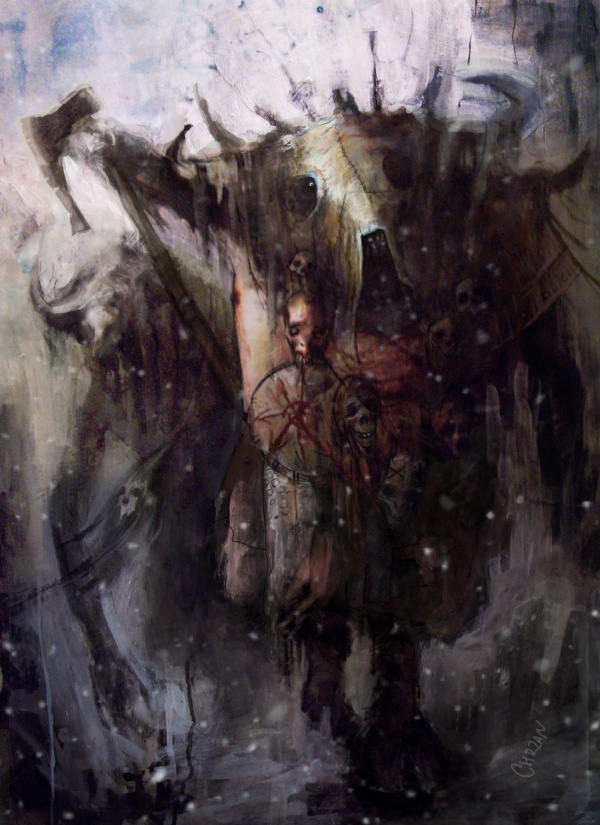
The crew roster having been established, let us cast off. The officers of El Pollo Diablo found themselves in Five Fingers with a ship in need of repairs and not even enough money to pay the docking fees. Fortunately they soon made contact with a local gangster – ostensibly head of the local stevedore’s union – who needed a ship to return “stolen” goods. These goods were, apparently, “stolen” from the Golden Crucible, the monopoly producers of black powder and other alchemical wonders in Caen. Furthermore, these goods were of such crucial importance that the union organizer in question was willing to pay to refit our heroes’ boat, give them a sizable cash reward, and arrange a Letter of Marque that would offer them warranty as privateers (and thus indemnify them against claims for the goods they hijacked). All they had to do was ambush a ship called Urcean’s Call, captained by a popular and famous man called Captain Mayhorn, and steal its cargo.
The PCs, naturally being solidly pro-union, and not seeing any reason to be distrustful of a powerful man who works on the docks at Five Fingers, naturally agreed. Also they needed the money.
Alyvia and Carmichael
El Pollo Diablo was soon ready for the tide, and while they waited for the ship to be prepared our heroes investigated the Urcean’s Call‘s itinerary. It appeared this ship would be making a long journey along the ports of Khador, then heading out to the deep ocean to pass around Cryx and far south towards Mennoth. If they could get its course they could easily ambush it on the high seas, northwest of Cryx, by pretending to be a ship in distress. No one would ever be any the wiser …
They sent Carmichael the warcaster north on a fast train. He met the ship on its passage north and arranged to join it as a warcaster, most important of crew. By the time it reached the northern town of Ohk the PCs were waiting, and Carmichael had stolen its shipping plans. He had also managed to gain control of one of its two warjacks. Carmichael stayed onboard the Urcean’s Call when it put out from Ohk, knowing full well that his friends would ambush it on its long journey southward …
Battle was joined on the high seas a week’s voyage out of Ohk. El Pollo Diablo wallowed in the swell, sending off smoke signals of distress, until noticed and approached by Urcaen. When she was pulling alongside the crew of the devil chicken unleashed a broadside, and battle was joined. Carlass and Hrif the Younger leapt over the railings to the deck, while Sharajin called upon Menoth’s wrath to lay fire on her enemies, and Alyvia fired from the deck. Hrif they Younger laid about with his huge axe, slaying crewmen five at a time. As Carlass, Alyvia, Sharajin and Hrif kept the crew beaten down Captain Breaker charged into the cabin of Captain Mayhorn. He unleashed a volley from one of the ship’s cannons – which he carried under one giant arm – but somehow it hit a pillar and rebounded, smashing Breaker to the deck. A strange battle followed as Carmichael tried to join the fight with his warjack, but the four of them could not fit into the captain’s cabin. The battle ended, however, when Hrif and Carlass emerged from belowdecks dragging the last of the ship’s crew. Carlass ordered the captain to stand down or Hrif would begin eating his crew; he refused; Hrif cheerfully began munching on a gunner.
Captain Mayhorn surrendered when he heard the gunner’s screams and saw Hrif cracking the still-living man’s legs and sucking out the warm marrow. The remaining 15 crew members, though shying away from the horrific sounds and sight of Hrif’s hunger, were not so foolish as to not see what happened next: Carmichael, showing neither joy nor sorrow, coolly cut Mayhorn’s throat before anyone with conscience could intervene, and the once-loved captain expired in a pool of ignominy on the deck of his own ship.
A hush descended over the decks. This act would, no doubt, have far-reaching consequences. The captive crew’s anger was guaranteed, as was the wrath of Mayhorn’s family and allies. But the characters had the ship…
In the aftermath of the raid they checked the cargo they had been sent to steal, and found it to be many vials of treatment against a vial disease often spread by the undead of Cryx. They took enough of the cargo to supply their own needs, and then arranged to sell it to the teamster. Their mission had been a success, they now had a galleon and a lot of money, but something sat ill with them … a feeling that they had done wrong, that they had stolen the wrong cargo and killed the wrong man. What, exactly, had they started?
Every time you criticize Mandela a fairy puppy dies
Nelson Mandela’s passing was only a few days ago and already the left-wing press and counter-press have managed to come up with a wide range of criticisms of someone who should, ostensibly, be their hero. Slavoj Zizek, that staunch opponent of anything modern in the left, is recycling the old claim that Mandela simply changed the skin colour of the overlords; Counterpunch is leading the charge to claim that he was just a neo-liberal friend of the rich, and black people didn’t benefit from the ANC at all; the Guardian managed to give a thoroughly negative review of his funeral, with the cherry on the icing being their focus on Obama rather than, you know, the South Africans who Mandela led; and they even managed to give Simon Jenkins a go at criticizing the coverage of Mandela’s death. I can’t decide which part of Simon Jenkins’s article is worst – the fact that he paraphrases the title of a profoundly important book about the holocaust in order to criticize coverage of a hugely liberating figure; or the fact that he is writing it at all, given that he is a confirmed HIV denialist and was directly involved in promoting HIV denialist science, which cost South African blacks so many lost lives and chances.
Now, I’ll be the first to admit that I’m no fan of hagiography and I’m happy to criticize my heroes, but I would have thought that in this case someone as profoundly important as Mandela could be given a week or two before the critical analysis of his legacy began. I mean, he only just died and the left – which historically was most broadly supportive of him – have been really quick to start pissing all over his legacy. I guess it’s largely the British left I’m quoting here, but over at Crooked Timber’s comment thread on Mandela a wide range of commenters seem to have joined in with this “he didn’t immediately undo all the economic wrongs of apartheid so he was bad” chorus, and a lot of the commenters there must be American. It makes me a bit uncomfortable, especially since those on the right who were famously opposed to Mandela at the time (people like Bush, the entire Israeli government, etc) have largely refrained from resurrecting their criticisms of the time. Surely if his opponents of the time don’t feel it’s right to say anything bad about him for a week or so, it might be worth one’s while to stow it for a bit?
One of the main threads of left-wing criticism of Mandela appears to be that he didn’t do much to reduce inequality, and we see various strengths of this argument ranging from “he blew a chance” through “he let down his communist allies” to the extreme “he just swapped racial oppression for economic oppression” or “swapped one set of overlords for another” type arguments. I think there are two huge flaws in these opinions (aside from their obviously terrible timing): the first is that the data from within South Africa is not so clearly supportive of the conclusion that Mandela (and more broadly the ANC) have failed to do anything about inequality; and the second is that progress on inequality and the related left-wing complaint of a failure to rein in neo-liberalism’s negative effects needs to be judged against the context of progress in the rest of the world over the same period, and against the backdrop of HIV in South Africa.
What does the data say on inequality in South Africa?
My first complaint with criticisms of these claims is that the data on inequality in South Africa is not being well assessed, and that the broader development issues South Africa faced are not being considered. Let’s consider that second complaint first. In the Counterpunch article I linked to above, for example, Patrick Bond writes critically:
the sustained overaccumulation problem in highly-monopolised sectors continued, as manufacturing capacity utilization continued to fall from levels around 85 percent in the early 1970s to 82 percent in 1994 to below 80 percent by the early 2000s
This seems hugely unfair to me. I don’t know a great deal about South Africa, but I’m guessing that “manufacturing capacity utilization” in the 1970s was highly dominated by the use of cheap, exploitable labour who had no rights and no capacity to control the extent to which they were “utilized.” Furthermore, the sanctions of the 1980s would have further restricted the ability of South African industry to modernize in a way that would improve capacity utilization, and by the time their investments were up and running in the early 2000s they faced … China. This capacity utilization also looks pretty favourable when compared to the USA, where in 2009 it was 64%. It doesn’t seem to me that this claim is fair.
We’ll come back to this problem of context and comparison with the USA later, but for now let’s look at the data. It’s true that South Africa has a terrible level of inequality, with a Gini index of between 0.6 and 0.7 depending on how you measure it. The world bank suggests that there has been an increase in inequality (measured using the Gini), with Gini values in 1995 of 57 and in 2010 of 63. That’s not a big change, though – this UNU working paper shows that World Bank estimates of the Gini coefficient in 1995 showed a wider range of values than the entire change recorded by the World Bank between 1995 and 2010. There is no clear method for calculating variance in Gini coefficients, and not enough data generally to establish what that variance might be, so whether or not the change from 1995 to 2010 is significant is hard to know.
The story becomes even more complicated than that when you consider the data challenges in nations like South Africa, and look at more nuanced research into inequality in South Africa. It’s difficult to believe that data on black South Africans collected before 1995 was really very good or complete, so the true depth of inequality in apartheid South Africa is hard to be confident about. Furthermore, assessment of wealth in low income countries is not so simple as simply calculating income – it is typically done through assessment of consumption expenditure. This is done because poor people in low income countries tend to underestimate or misreport their income, and much of their wealth can be tied up in informal markets and means of exchange (e.g. they have land and pigs but little money). Measures of Gini in South Africa based on consumption expenditure tend to be different to those based on income, and measures of wealth based on consumption are not readily available in earlier years. Furthermore, the Gini is a very poor measure of inequality – not only is uncertainty usually not calculated, but it doesn’t give any meaningful distinction between different types of inequality, and I seriously doubt it’s linear. For example, a change in Gini index from 0.35 to 0.40 may have a very different meaning to a change from 0.57 to 0.63. I don’t think any realistic work has been done on how useful the Gini index is for either within- or between-nation comparisons.
However, there is some recent research available on inequality in South Africa that paints a more nuanced picture. This research, from the University of Stellenbosch, suggests that poverty – measured in absolute and relative terms – has declined in South Africa, and that inequality within racial groups has increased while inequality between racial groups has decreased. In fact, according to this report:
The proportion of households with children reporting any form of hunger has declined by 15% in the past 6 years
The share of black people in the middle class has increased from 11% in 1994 to 22% in 2004
Poverty headcount rates have declined from a peak of 53% in 1996 to 44% now, a record low
Income growth over the period 1994-2010 has been approximately similar amongst whites and blacks
The proportion of total income earned by black people has grown from 33% to 39%, while amongst whites it has declined from 55% to 48%
Within-race inequality contributed only 39% to inequality in 1993 and now constitutes 60%
The report also points out that World Bank Gini coefficients don’t properly adjust for household size, and household-weighted Gini coefficients were 0.67 in 1993 and are 0.69 now. They write:
A decomposition of the Theil index shows that the decline in income inequality between race groups throughout the period offset the rising inequality within groups. This trend of falling inter-racial inequality coupled with rising intra-racial inequality is also a continuation of a phenomenon first observed in the 1970s (Whiteford & Van Seventer 2000). Note that these estimates of the population Gini are near the upper end of South African Gini estimates, although they remain smaller than those calculated by Ardington et al. (2005) using the 2001 census. The trends in inequality derived from the AMPS data are likely to be more reliable than the estimated levels, as the levels may be more affected by the nature of the data (household income estimates in income bands based on a single question).
The Gini coefficients shown here are higher than those often reported. The reason for that is that many Gini calculations use the weighting for the household, without multiplying that by the household size, as should be done: Larger households have more members, and this should be considered in calculating inequality. The Gini coefficients here are thus the correct ones, and much higher than those reported by among others the World Bank, which are based on inappropriate weights. The Gini coefficient of 0.685 reported for 2006 would have been only 0.638 if the more common, but incorrect, weights were used.
This report overall paints a picture of small but noticable reductions in inter-racial inequality, and reductions in the levels of absolute poverty seen before the end of Apartheid. It’s pretty modest, but overall it seems safe to say that South Africa may reduce inequality slightly and cannot be said to have significantly increased it. This claim may seem weak, but when we compare it to the rest of the world and consider it in its proper context, it’s important.
Considering South Africa’s economic changes in the global and regional context
In economics there is a simple method for assessing the effect of an intervention called the Difference-in-Difference model. In this model you compare the actual change in the group that received an intervention with the counter-factual that would be expected if they haven’t; you estimate the counter-factual from a control group measured before and after the intervention. In this case the intervention is the end of apartheid, and the control group is other countries. Consider, for example, how income inequality has changed in South Africa and the USA since the 1970s. According to the World Bank, the top decile of income earners in South Africa control 58% of all income in 2010. Research from Stanford University puts the equivalent number in the USA at 50%, but look at the curve: since the 1970s the share of income held by the top decile of US income earners has increased from about 35% to 50%. Income inequality has increased rapidly in many high income countries under the influence of various forms of neo-liberalism and/or trade liberalization. For example in the UK the Gini coefficient has increased from 0.35 to 0.41 since 1990, a much larger (proportionate) increase than observed in South Africa. Seen against the backdrop of international changes brought about by major international movements, it appears that Mandela and the ANC have managed to resist many of the worst changes that have swept through the industrialized west. It is this international context that is missing from the Counterpunch article linked above, where they provide critical statistics about South Africa’s industrial and economic performance without any comparison to overseas, where equal or far worse changes have occurred in the same time frame. The industrial economies of much of the rich west have been hollowed out by a mixture of ponzi economics and the rapid growth of Asia; South Africa seems to have escaped the worst of some of these changes, and though things clearly aren’t pretty in the economic statistics that South Africa presents, it is also clear that they have got vaguely better and certainly not much worse, against a backdrop of really challenging international and domestic changes.
The domestic changes also need to he emphasized when assessing Mandela’s legacy. He inherited a corrupt one party state with a political system built on state violence against a powerless minority, crippled by years of sanctions and sitting on the silent time bomb of HIV. While the ANC’s response to HIV was terrible, it’s worth noting that the first 10-20 years of growth of HIV happened under apartheid, and it’s really hard to believe that since HIV was identified in 1984 the white regime was doing much to prevent its spread. Against a backdrop of revolution, poverty, discrimination and chaos, what kinds of interventions did de Klerk have in place? And even after Mandela took the reins, most of Africa was still unaware of how to deal with HIV and just how terrible it was going to become; much of the context of the epidemic that unfolded subsequently had already been set and although the response could have been better handled since 1994, and certainly since 1997, it’s not unreasonable to suppose that even a really pro-active intervention would have failed under the circumstances. As a result of this epidemic, life expectancy in South Africa has collapsed, and South Africa is one of the countries facing serious economic challenges because of the epidemic. I have written before about how terrible this epidemic can be for societies suffering it, and challenged readers to consider alternative futures where it arose as a generalized epidemic in the USA or Europe. Does anyone think that the USA would have experienced the same economic growth and changes since 1994 if it had suffered the epidemic the way South Africa is? This needs to be considered when criticizing health spending and economic growth in South Africa.
Given this context, I can only summarize by saying that Mandela and the ANC did okay in handling inequality. Obviously not as well as anyone would have liked but also much better than, say, the US under (lefty) Clinton or the UK under (lefty) Blair. So I think leftists should perhaps be a little more circumspect in their criticisms of Mandela and the ANC’s legacy. Perhaps it would be good if they took a week to laud his obvious achievements, and to read the literature.
A final note about iconoclasm in coverage of Mandela’s death
In case you thought the mainstream left was alone in being a little too quick to criticize Mandela, spare a thought for the lunatic right. The National Review Online editors’ piece on Mandela was remarkable, managing to wrap a vicious and angry rant inside a thin shell of flattery; and its commenters still complained that the NRO has become too left wing in its coverage, and that Mandela committed genocide. But perhaps best is the efforts of the white power losers from the OSR blogosphere, who hate-bombed a thread about Mandela on Dragonsfoot with complaints about his terrorism and white genocide. Remember that next time an OSR blogger drifts over here to complain about my criticisms of Tolkien … still, the OSR being caught up in 1986 I guess they haven’t worked out that apartheid is over.
Anyway, I don’t feel like this has been a great week for the mainstream left media, such as it is, and I hope that some of Mandela’s critics on the left will find this piece and consider a slightly more nuanced understanding of what he did in power. I also hope that people will start using slightly better measures of inequality than Gini indices … but that’s a post for another day!
Yesterday my group began a three month long Iron Kingdoms (IK) campaign. We’re starting off on a small ship called El Pollo Diablo (The Devil Chicken), with piracy and mayhem to follow. We are not yet a fully-functioning party, having only joined together under duress: some of us were captives on a slave ship, saved by some other members of the group, and after much slaughter we found ourselves in charge of the ship. We have arrived in the town of Five Fingers, but we don’t have any money to refit the ship we have stolen, or even really any rightful claim to that ship. Nor do we really know each other. Surely a life of piracy awaits… Here then is the crew roster.
Carlass Doomecho, Trollkin Fell-caller/Warlock
Fell calling for a coffee
Carlass and her troll axer Hrif the Younger are the last survivors of their kriel, which was a small maritime kriel based in the Scharde Islands. The slowly expanding blight of Cryx overwhelmed their tribe, which slowly fell to darkness and decay, and eventually Carlass and Hrif the Younger made the wise but sad decision to leave the isle and make a new life away from the influence of death and dragons. Carlass, however, pines for a return to kriel life, and is filled with a deep rage at the loss of her home range and kriel. She aims to return and destroy the forces of Cryx one day. There she will reclaim her ancestral homelands and purify them in service to Dhunia.
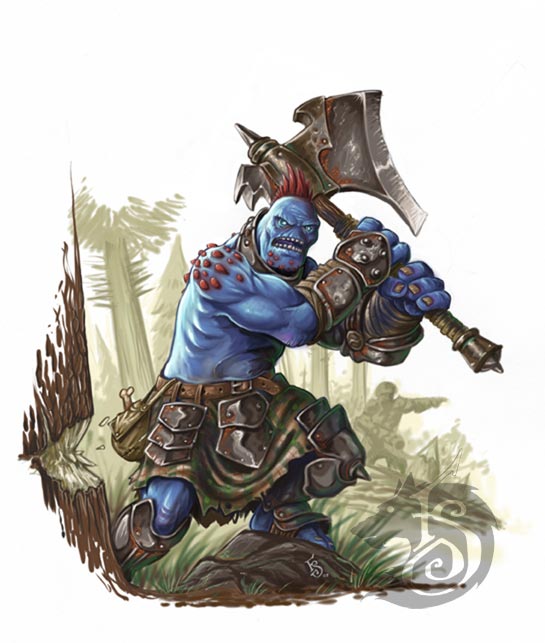
Hrif the Younger, expressing happiness
Carlass is a trollkin fell-caller, meaning that she has a powerful voice that can shatter stone and terrify ordinary mortals. Fell callers are revered amongst trollkin society, being seen as gifted by Dhunia, but Carlass has been further gifted with warlock powers. She can control the minds of pureblood trolls, those savage beasts of the wilderness that, though well loved by trollkin, are figures of myth and terror to all other races. The purebloods fell to the blight slowest, but fall they did, and Hrif would have followed his older brother into the darkness had he not been on a mission with Carlass at the time that the tribe finally sank into decay; returning home they discovered their entire tribe gone, either sunk into the sickness of Cryx’s blight, or dead fighting their corrupted kin. Rather than fight, Carlass and Hrif left, vowing to return and sow vengeance; though she was only an apprentice warlock when she left, the loss of their tribe deepened Carlass and Hrif’s bond so that they are now inseparable in war and peace.
Carlass is just under 2m tall, lean and savage looking, pale of skin and much weaker than most trollkin. Her powers arise from her deep booming voice, and her deep bond with Hrif, a 3m tall behemoth of bronze-coloured skin, warts and axes, a civilized beast of few words and resolute action. Where Carlass wills it, Hrif does it. And what Hrif does, remains done. Both of them are new to the world of humans, though, and have little understanding of or respect for their smallbodied kin. This makes them uncomfortable members of their party, and untrustworthy allies…
Sharajin, Mennite monk
Sharajin is a mysterious ascetic of the Mennite faith, far from home and perhaps lost to her people. She is apparently on a mission, though she will not divulge its divine purpose. She seems to have a husband and children back in Mennoth, though it’s hard to believe from her cold and imperious ways that she would ever soften for any love except that of her unforgiving god. She is a woman of few words and vast purpose, a talented artist in the dance of death, and a priest with no peer when it comes to the complex weavings of Mennite rhetoric. For all her cool ways and hard stares, though, Sharajin is quickly liked and trusted by her fellows, and respected by all.
Sharajin is a lean, dangerous looking woman of slightly above average height and supernatural composure. Her hair is short cropped but stylish, her clothing loose-fitting and designed for combat, her style ascetic but not dirty. She fights with her bare fists, sometimes wreathed with fire, and calls the fire and wrath of her distant and uncaring god to destroy her enemies. When she has to speak, she is sparing with words and clear of purpose; when she has to fight, she is sparing of movement, swift of fist, and devastating in impact. Though noone with any sense trusts the Mennites, everyone soon trusts this coiled demon of religious fury.
Alyvia, noble mechanic
Kaylee of the steampipes
Alyvia is a human arcane mechanic, of noble birth in the now-extinguished nation of Llael, forced to wandering the fringes of the human world trying to find a new place in a world torn apart by war and industry. She is equally at home on the battlefield or in the foundry, building things or breaking them. She fights with pistols, but can handle warjacks and other heavy equipment when the need arises. It was Alyvia who found the slaveship that held the others captive, and through her actions they were able to grasp the chance at freedom. Their newfound camaraderie does not extend so far as to allow her to tell them what happened to her noble family in now-forgotten Llael, or what she aims to do to restore her inheritance. Surely though a woman of her capabilities will bring down the Khadoran empire if that is what it takes to regain her rightful place in society. And maybe she will drag the rest of the crew with her on just such a suicidal mission …
Carmichael, warcaster of mystery
Carmichael is the group’s warcaster, and little more can be said of him than that. Thin, bespectacled and pale, he is hardly the classic image of the battlefield warjacker, but competence is measured in more than fancy frock coats, and Carmichael is a good man to have behind you in a pinch – or at least, he is when his Buccaneer warjack is up and steaming. Carmichael is armed with pistols and able to fend for himself when the need takes him; faced with bigger men, he shows no fear or trepidation, and deals with them as a man backed up by several tons of steel warbeast should be expected to. Carmichael’s history is a mystery to the group – they found him washed up on a desert island as they fled the scene of their mutiny, and took him with them more out of pity than calculation. Now that he has “recovered” a Buccaneer, they keep him despite his mysterious past, because it’s better to have a warjack at your back than on your trail …
The freebooter’s last vision
Captain Breaker, Ogrun bastard
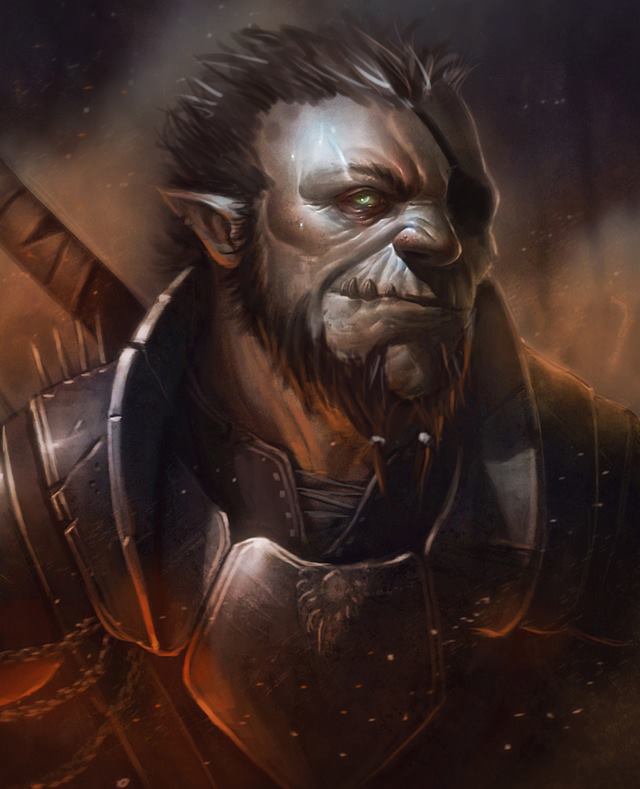
Captain Breaker is the ship’s captain by common consent. A 3m tall Ogrun warrior, Breaker carries a ship’s cannon under one arm as if it were a lady’s purse pistol, and fights with the courage of a man abandoned by civilization … which perhaps he has been. Ogrun are respected and feared in the Iron Kingdoms, so no one dares to hazard a guess as to how he ended up enslaved in a cheap Khadoran galley. Once he was free the carnage he rained down on their captors ensured that no one would ever find out, either. But his ebullient manner, overwhelming physique, and unquestionable bravery qualified him to take captaincy, and so duly it was voted on. When decisions need to be made it is often said that the Ogrun is the first to make them, and the most confident in executing the task; such a personality is the essential bond in a crew as diverse and as cantankerous as this one. So far the group have all united behind Breaker, and they fight for no higher ideal than the preservation of the group. Who better to lead them then, than a slightly mad seaborn Ogrun? And who, in any case, would dare to dissent…?
The Captain thinking, after speaking…
That, then, is the crew of El Pollo Diablo. Who knows what benighted shores they sail to, or what evil tides will rush against them over the next few months. But I have a strong feeling their adventures will be exciting and brutal, with little humanity and much humour, so let’s keep a weather eye on the horizon, and see where fickle wind and fate take them …
—
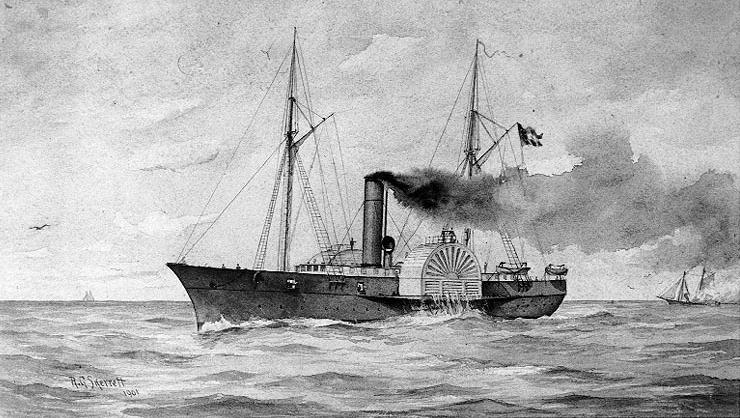
art note: all line drawings are by Eddie, who plays Captain Breaker. The other two are from Deviant Art; the Buccaneer is from the Privateer Press website.
Both of these disputes (and a few others) are about possession of the oil and gas resources under the South China Sea.
If the world is to avoid warming beyond 2C, all of the oil and gas under the South China Sea needs to stay buried there forever. If China and Japan resolve their disputes in any way that grants either side actual exploitation rights, the world will take one more small step towards being fucked. Some scientists are now arguing that even 2C is going to cause catastrophe; we need to get even tougher. This means that the best thing for the world is for China and its allies to continue locking horns over these islands for … about 1000 more years.
The best thing China, Japan and the Philippines can agree on is that exploiting these islands is against everyone’s interest. The whole region should be set aside as a marine park, and the military forces of every side of the dispute put to the task of sinking any oil research vessel, fishing boat or seismic survey ship that comes within a sniff of the place.
The Guardian reported recently that a researcher in the UK has developed a climate model for Middle Earth. Apparently he developed a climate model and ran it over six days in a super-computer at Bristol university, and has been able to identify different climate zones in Middle Earth. We now know that the Shire had a climate like Dunedin in New Zealand, and Mordor was like LA under smog. The paper contains some nice images of Middle Earth climate, you can see that the researcher treated it like a serious modeling task, divided the map into grids and ran a proper climate model.
For me this raises the immediate and obvious question: will industrialization in Mordor and Isengard lead to global warming, and if so how long will it be before all of Angmar is unfrozen? If so, should the peoples of northern Middle Earth be more worried about rising sea levels, or the undead beasts of Angmar being freed from the ice and descending like a scourge on Eriador?
Perhaps this is the real allegorical message of Lord of the Rings: that global warming will unleash Orcs. I wonder if Dr. Lunt included Orcs and Witch-kings in his climate model?
Or maybe Mordor is where the (illusory) “missing heat” is hiding … seems as good an explanation as any for such a fantasy …
I follow God on Facebook[1]. Not the real God, obviously, but this one has almost as many followers: just over a million people follow God. God does a couple of weekly regular updates that get a lot of attention: he does a weekly smite where he finds someone really annoying in public life and threatens to strike them down with some terrible curse; he posts pictures of new creations in which he has blended animals together; and he runs regular “Ask God” sessions where you can ask him questions about life. My favourite was the guy who asked God “why does my girlfriend yell your name when she is coming,” but he has a wide range of questioners. He also occasionally puts up hate mail he gets – he gets a lot of messages from people telling him to stop mocking God, and mostly these messages are full of hatred and anger.
I think it’s safe to say that God is a pretty forgiving, tolerant, inclusive kind of guy. He’s of the pro-gay-marriage, live-and-let-live, community-action-minded kind of viewpoint, not the kind of person who supports vengeance and judgment. He’s how God would be if God hadn’t written the Old Testament, and caused all manner of trouble with his violence and vengeance. This is not a God that will turn you to salt for disobeying him, and will refer you to a suicide helpline rather than tell you not to do it or you’ll go to hell. He’s also funny, sometimes hilarious, and a generally light-hearted and positive voice on my Facebook feed.
Sadly for God, recently his mother died, and he and his family were rightly distraught about it. He announced this on his website and received a huge outpouring of support. Perhaps buoyed by this, God revealed that the insurance company were being dickheads, and set up an Indiegogo website to raise $5000 to send his dad on a holiday. This got a huge response, and within a couple of days God had raised $20,000. You can read more details about the positive aspects of this story at this blogpost about God as a community phenomenon.
Sadly, God’s Indiegogo successes brought some trouble to his online community, and the very worst of humanity came crawling out from under their rocks to criticize him. The things they said were terrible, and the things they said about those who donated to him were also terrible. The worst of the comments have been weeded out now so I can’t copy them, but there are still some pearlers. For example, one person wrote:
like i said before…it is kind of sad that i asked for money to pay my mother’s cancer bills and did not receive a penny…but YOU raise thousands of dollar’s for ” a vacation”……what a shameful example of humanity !!!
Another wrote:
I’ve had enough. Man, it’s like a car wreck!! I can’t believe how many gullible people there are in the world! Yes this was a fun page to visit on occasion but folks….his reward for putting the page up in the first place is his million followers. That’s the reason he does it. He doesn’t get to expect money for making you laugh. To each their own but you are sending money to a cartoon image. You know nothing about this person except what he/she wants you to know. If you think he or she is going to visit you while on vacation with Dad, you’ve got another think coming. YOU ARE SENDING MONEY TO A CARTOON!!!
while someone else writes
like this god page, but i think asking for money and receiving over $20,000 is kind of bullshit in my eyes, sounds alot like gods taking this stuff to seriously and becoming like the church……
but the nastiest by far for me was a comment that has now been taken down, which I saw with my own eyes when it was put up, in which someone wrote
Both my parents died and I didn’t get a cent from anyone. Get a fucking job.
These comments to me seem to show the worst of humanity. Some guy with a million followers openly states that he wants to raise money for some personal, completely selfish purpose; people give him money because they like him and it’s no trouble to them; he raises more than expected and decides to use it for himself; but for a sizable minority of the population, this is a terrible terrible sin. The first quoted comment shows the reason for this: people can see a person getting something they couldn’t get, and they are angry about that. But they aren’t just angry – although they know that he is sad from a recent loss of a close family member, they post critical comments and accusations on his facebook wall where he can see them. These comments include personal attacks, accusations that he is lying about his family, that he is a scammer, and demands for him to drop his anonymity. Something that had originally been a source of joy for a person going through a difficult time has obviously turned into a huge and painful chore, simply because a sizable minority of people on this earth hate to see someone else gain something for nothing. And no doubt some of the attacks will rub off on God, making him feel like a dirty person for simply asking for help and receiving it. Is this a microcosm of the reasons why so many people are opposed to welfare in all its forms? And why charity is always expected to come with so many strings and so much shame?
I find this particularly amusing when I compare God’s honest and open request for money for jam with the way so many Indiegogo users scam their users through obvious deception. I defriended someone from my Facebook after they began spamming their friends with Indiegogo fundraisers for a project that was clearly dishonest and that they never intended to deliver on; and of course the role-playing world has been beset by very real scams involving large sums of money on undelivered projects, and an entire website devoted to uncovering vaporware. Strangely though, the Dwimmermount project still has supporters even though the author has disappeared for 18 months and taken $50k with him; while God cops a heavy dose of abuse for asking for $5k for the stated purpose of producing nothing. How can it be that the humans in this world can behave this way? What psychological or philosophical perspective makes people supportive of a scam with no product after 18 months, but critical of a direct and simple plea for money from someone who has been entertaining a million people for 3 years?
It’s as if God has managed to prove that there is no humanity out there, just a deep, untapped well of jealousy and immaturity.
—
fn1: yes, I am sufficiently shallow to have facebook. And no I don’t use google+.
The murderer was clearly in the volcano. Our heroes, having been asked to go and find him, set off up the mountainside to the location of his victim, from whence they hoped to track him. Now they were joined by Grunstein the wizard, who had travelled ahead to Steamline Spa on his own business. The slopes of the volcano loom over the northern side of Steamline Spa, and take some hours to climb to the misty summit; but all these slopes were smooth and perfect as an old Emperor’s burial mound, and a smooth path wound up the sides of the volcano, through fields scattered with sheep and dour shepherds. Brom Barca’s attempts to buy sheep having been rudely rebuffed, the group trudged on without incident until they reached the murder scene, a smear of blood and gore behind one of the volcano’s scattered basalt boulders. Rounding the rock, they found a scene of horror: the body of the dead shepherd had been torn apart and scattered across the land behind the boulder, disfigured so thoroughly and violently that it was almost impossible to say how the victim had died. Nonetheless, Leticia the elven swordmaster was able to piece together the clues; the attack had started with a sudden strike of the shepherd’s head against the boulder, and the shepherd had then been mercilessly mutilated while he yet lived. There was evidence that he had been drugged – perhaps with a soporific called Poggle’s Drakeboon – in order to ensure his unhappy compliance with his own dismal destruction. They could not find the head, though the ears were resting on a ledge of the boulder …
Having established they were most certainly dealing with a murder, the PCs set off up the mountainside to catch this evil Otto Mercads. Grunstein employed a new spell to transform himself into a wolf, and easily followed the scent of death and terror up the mountainside. They marched for another hour or so, into the mists that surrounded the top of the volcano. Here was a caldera, surrounded by high but broken walls of old volcanic stone. A narrow crevasse ran through the caldera wall, and they found themselves looking inside the volcano. The caldera was a rough bowl shape, filled with steam and a gentle rain from the higher steam as it emerged from the caldera to suddenly cool in the mountain air. A narrow path ran down from their crevasse to the bottom of the bowl, but it was impossible to see where it ended due to the steam billowing around the caldera. They reached the caldera a little after midday, so the bright mountain sunlight was streaming in great golden lances through the steam, but it was obvious that in just an hour or two this cloistered feature would be shrouded in clammy darkness as its walls cut out the sun. Realizing it best to do battle in the bright noon light, Azahi the dwarf marched forth down the narrow path. The others followed, and as they approached the bottom of the path they could hear the sounds of manic laughter echoing off the walls.
At the bottom of the path they found a small, neatly laid-out camp under a lean-to, with the shepherd’s severed head in pride of place in the middle. The steam parted for them as they fanned out in the caldera, revealing a large central pool of nearly-boiling water. A large stone jutted into the pool, and on this outcrop they could see Otto Mercad’s crouched and chuckling, painting pictures of blood with a loop of intestine and talking to himself. They approached carefully but he did not seem to care, and just laughed manically as they grabbed him, beat him a little, and tied him up.
Too easy. Just a few hours later they were leaving Steamline Spa with Otto chained in an empty wine barrel out of sight of prying eyes in their wagon …
The storm and the Drowning Well
That day’s travel was uneventful, but towards evening a vicious storm rolled in off the mountains, and they found themselves being pummeled by howling winds and heavy rain. Fortunately they had been told of an inn along the road, that most travelers a day out of Steamline Spa could expect to lodge at for the night. They redoubled their pace to this tavern, passing as they did a band of four road-wardens who had been called out in the inclement weather to attend a possible beastman raid. They were also surprised by a bounty hunter called Elizabeth, who emerged from the shadows of an old redgum to ask for their company on the final kilometre to the inn. She told them her horse had been lamed in the storm and, having killed it, she was walking to the inn to pick up the tail of her targets, two bandits who she had a mark on. A dour and tough-looking woman, she seemed more than capable of killing a horse and capturing two ruffians. All travellers on the road were focused now on the inn and respite from the rain, so few questions were asked; instead, they all slogged on through the gathering gloom, the howling winds and the mud.
By the time they arrived it was not yet sunset, but the storm was so intense that it had blocked out most of the light, and they arrived at the gates of the inn feeling as if it were already late. Grunstein the wizard had transformed into a raven and flown ahead, so he missed the strange arcane markings daubed on the wall by the gate, and none of the other PCs were able to decode them. Against the backdrop of the raging storm they pushed their way through the rain-soaked doors of the inn compound, and found themselves lodging within.
The inn was a large complex, consisting of a central three-storey mansion surrounded by stables, outhouses and gardens. The whole was ringed by a wall just over 2m high, made of dressed stone and thick enough both to repel any serious attempt at battery and to enable defenders standing atop the wall to fight back from crenelations. This kind of travelers rest is a common sight in the wilder fringes of civilization in the Steamlands, where local farmers are used to the predations of greenskins and, occasionally, beastmen. When a band is spotted approaching the neighbouring farms they lock up and flee to the travelers rest, from where they join together to fight off any siege and wait for roadwardens from other towns to relieve them. Like fighting summer fires, community defense is something that all remote farming hamlets practice at, and the scattered houses around the Drowning Well were no different, so it was no surprise to the PCs to find such a staunchly defensible tavern so far from civilization.
So, the PCs ducked into the tavern and booked a night’s accomodation, and a cellar for Otto Mercads. The cellar was as safe as a prison cell, pre-fit with chains and a portcullis that locked only from the outside, as well as a staunch outer door that only a minotaur could smash through. The Drowning Well was obviously used to hosting its share of passing prisoners, because the landlord locked Mercads down in this hole without a single word of complaint, and the group were able to repair quickly to drinking and relaxing. The evening passed uneventfully, and after a few hours’ rest the PCs were able to retire for a long, relaxing sleep.
The murders begin
The PCS were woken by the maid’s screams during the dead of night. The storm was still raging outside, but the maid was so disturbed that her anguished cries could be heard over the racket of howling wind, driving rain and banging shutters. Of course our heroes ran into the hallway to see the problem, and found themselves facing a familiar scene of horror: one of the guest rooms was open, and the occupant had been murdered in a very familiar way – the same way as Otto Mercad’s victim. There was blood and body parts everywhere, and guests gathering in the darkened hall to retch and cry in horror at the sight. The PCs, along with Elizabeth the bounty hunter, took charge, shepherding the guests downstairs to the common room and rushing to check on Mercads. They found Mercads sitting comfortably in his cell, chuckling and grinning and with not a drop of blood on him. How had he done it?
Other murders soon followed, with the maid, the landlord and his wife quick to succumb to some kind of brutish and supernatural force. Every time the murder was so reminiscent of Mercads’ artwork that the PCs just had to return to his cell to watch him, but the third time they returned they found him, too, dead, torn apart in the same way as the others. However this time they were fast enough to see the killer – a grotesque, incorporeal ghost, 3m tall and shaped like a beastman with a single eye. They attacked the ghost but it fled too fast, disappearing through a wall and out into the wilds of the night. Shocked, they realized that Mercads must have been the channel or conduit for some darker creature. They remembered finding a necklace made of a fleck of old beastman’s tusk when they captured him, and wondered if he might have been somehow connected with this ghost. While some of the PCs rushed to protect the guests in the common room, Gregor dashed to their own room to check on the chaos artifacts they were transporting to Heavenbalm, lest that should prove to be this beastman ghost’s true focus.
The ghost wasn’t there though, it was gone … but the beastmen were coming.
Artuta rises …
The beastmen come
Shortly after they saw the beastman ghost, the PCs heard yells and clamour from the front door. Residents from nearby farmhouses were gathering at the gate, telling urgent stories of a new horror: a horde of beastmen was gathering in the darkness to attack the inn. As they filed in, bedraggled and dishevelled from the storm, they and the residents began to prepare for a siege. The PCs, however, were distracted by a light in the corner of the compound. Approaching, they saw the vague outline of a ghostly form, glowing faintly and flickering in the onslaught of rain and wind. This was no beastman, but the remnant form of a witch hunter, obviously injured and looking desperate, and wearing clothes from a previous generation – the ghost of someone with something important to tell them? As they approached the ghost whispered to them with a voice that carried despite the snatching wind and rolling thunder:
The truth is beneath the words. The truth …
With these words he disappeared, revealing a slab of stone, scoured clean of earth by the rain and wind, on which a short passage was inscribed:
Here lies Artuta,
Most twisted of the changer’s brood,
Cleansed by Solkan’s hands.
He will not be the last.
The PCs dug up the stone quickly, and beneath it they found a waterproof scrollcase, laid carefully in a hollow beneath the stone. Dashing out of the rain, they opened the case to find a torn piece of parchment, on which someone’s story was written:
I do not know why I have written this but I feel death is close. Artuta stares up at me. His one eye is still, but maybe it watches. Foolish thoughts, but in the forest lurk the remains of his band, now led by the Shaman Grazzt. He has strange dark powers at his call. Who knows what he can do?
What has brought this disquiet upon me? I cannot say, although a strange dream came to me last night. I was guarding Artuta even though he lies dead. Even in death, he led them. Yet I could not escape from this task for a wall surrounded me on all sides, a tunnel above through which I could see the stars. It was difficult to move, for my limbs were heavy.
This vision fills me with fear.
May Solkan watch over me.
Were these the words of the ghostly witch hunter?
At this point the party fragmented. Gregor fled back to his room and began a frenzied effort to destroy the amulet of the beastman tooth; Leticia and Brom Barca headed to the walls to coordinate the defense of the inn against the gathering horde of beastmen, who could now be heard outside the walls howling and preparing their attack; and Azahi the dwarven Trollslayer ran with Grunstein the wizard to the well after which the inn was named. Azahi had interpreted the “tunnel above through which I could see the stars” as the well, and wished to explore it. As he and Grunstein lowered themselves into the well they heard behind them the first roars of beastmen preparing for battle…
Born under a subterranean star …
The well and the battle
In the well Azahi and Grunstein found a tunnel leading into the earth below the inn. They followed it inward, Grunstein lighting the way with a cantrip, and soon found a locked stone door, on which a clear warning was written:
Ye thatz enter here, beware
For liez here, Artuta
When he rizes
Come hiz brood
To spill the blood of all.
The door was locked, and neither Grunstein nor Azahi a thief, but Azahi managed to remember a few hints of technical trickery from his dwarven tribe and disabled the lock. They opened the door to find a crypt, rough-hewn from the earth. In the centre was a depression covered in brush and rubbish; leaning against the walls of the room were four skeletons of beastmen. The mark of Tzeentch was carved into the wall at the far side of the room, and it was obvious what this room was – the resting place of something called Artuta, probably an ancient and powerful beastman. Grunstein began breaking up the first beastman skeleton, but before he had done much damage the other three came to life and attacked Azahi. The dwarf braced himself, and battle was joined; but as he fought the ghost of Artuta arose from the central resting place and fled out of the door. Both he and Grunstein struck at it, but their attacks failed to kill it, though they seemed to wound it badly. The ghost was now obviously more corporeal, gaining in power from the murders it had managed to commit, but still able to shift to ghost form, in which shape it drifted rapidly down the tunnel and out of the well into the stormy night.
Upstairs, the beastmen had begun to gather together for battle. Their force was far larger than a normal beastman band, numbering perhaps 30 in all and with four beastman captains. Lurking at the rear near some kind of makeshift altar was a strange figure indeed – a smaller beastman similar in appearance to a Gor and lacking full horns, unarmed and dressed in tattered cloth but obviously in charge despite its small size. As Brom Barca and Leticia watched, this figure was joined by the ghost of Artuta the beastman, and the attack began.
The inn compound had two gates, and the beastmen attacked both at once. Their attack was artless and brutal. A beastman captain charged forward, and used his enormous strength to boost a couple of Gor onto the walls; these then hauled the massive captain on, and they attacked. Meanwhile a gang of larger Gors lined up and took turns charging at the main gate, trying to smash it in with their horns. By this means, should the captain fail to seize the wall itself, his minions would still eventually beat down the gates. Unfortunately for this beastman captain and his Gor minions, Leticia and Brom Barca guarded the gates; Brom himself almost the size of a Gor took on the three minions, and Leticia moved forward to engage the captain, fighting with delicate poise and grace despite the slippery stones, the howling wind and the beating rain. The battle was short but brutal, and within a few short exchanges Brom and Leticia had slain their enemies. Leticia hacked off the head of the slain captain, and as Brom Barca lifted it high for all the beastmen to see the captain at the other gate began a temporary retreat. At this point Gregor joined them on the wall, scattering the fragments of the beastman amulet before him into the wind. This seemed to have no effect – the distant shaman ignored it, and Artuta’s flickering form did not change except to howl in rage at the retreating beastmen. Now Azahi and Grunstein also trudged up onto the wall through the rain, and our heroes grouped together ready to receive the next charge.
As the beastmen milled about, preparing to make a new attack and being berated, beaten and enraged by their captains, Gregor remembered the Hochland long rifle he had looted from bandits on the journey to Steamline Spa. Though the ghost of Artuta was far from the walls and beyond easy range of a crossbow or longbow, it was not beyond the reach of a long rifle, and Artuta was obviously injured. Perhaps if Gregor were lucky … he carefully lined up the rifle, Brom Barca and Leticia holding their cloaks over him to try and prevent the worst of the rain from damping his powder. He fired as the beastmen formed their lines for another charge, and his bullet flew true … with a single howl of outrage and shock, Artuta’s ghost dissolved into the storm, vanquished by the witch hunter. The beastman shaman took one look back at the walls, screamed his rage to the uncaring tempest, and without further ado turned to flee into the distant woods. His followers, seeing the destruction of their plan, lost all their lust for battle and fled after him.
The battle was done. The beastmen had failed to break the gate, and Artuta had been killed before they could drag any prisoners back to sacrifice for his manifestation. Whatever sick plot had been laid to wait here in the courtyard of the drowning well, it was done now. Though the PCs had inadvertently brought about the invocation of Artuta’s ghost by bringing Otto Mercads to the inn, they had triumphed over Artuta and his whole tribe. They could rest, and enjoy the reward of heroes. And heroes they must be, for in the morning they must surely head off in pursuit of the shaman, to uncover the full story of how Otto Mercads had become the kingpin in a plot to bring back an undead beastman; and to slay the shaman before he could foment more mischief. Perhaps in those hills they could find more dark magic to take to Heavenbalm for destruction … or perhaps there they would find their doom …
Recently Myles Allen wrote a piece for the Guardian suggesting we should use direct action to mandate fossil fuel companies deliver carbon capture technology, and appears to be juxtaposing this with carbon taxes. A few global warming blogs I read tookissue with the piece. I’m suspicious about the feasibility of carbon capture technology, so the idea of forcing fossil fuel extractors to implement this technology seems far off to me, but I believe we need to get serious about carbon, so in principle the idea appeals to me, along with a whole bunch of emergency measures. Rational economics suggests that Allan’s policy is at best going to be no different to a carbon tax that applies an equivalent cost to carbon production, and probably less efficient, but I suspect that there is something going on here that lies outside of economic theory, and I think it can be well understood by reference to a couple of public health principles, and some successful public health campaigns. Basically, over the next 30 years we need to go carbon neutral, that is to a society that exhausts no carbon. If we delay, we may have to go negative. Some economists think we can do this simply by taxing carbon. I want to use the Framework Convention on Tobacco Control (FCTC) to show that’s probably impossible without broader measures; and then I will use the example of HIV to show that the debate about mitigation may also be a lost cause, or at least to show that we shouldn’t be too confident that humanity can solve a serious problem through mitigation measures alone.
Comparing Decarbonization with the FCTC
Let’s not beat around the bush: the purpose of the tobacco control movement is to eliminate the consumption of tobacco from the face of the earth. One day there will be no smokers, because smoking is a poison. But the goal of the FCTC is to achieve a non-smoking world through the free choice of individuals – through health promotion and intervention measures aimed at reducing smoking. The FCTC proposes a variety of methods to achieve this goal, but only one of them is taxation. Taxation has been a core tool deployed against tobacco, and with devastating effect, but it has not eliminated tobacco smoking. Taxes on tobacco in Australia, for example, have essentially increased exponentially since 1985, but they haven’t achieved their goal: something around about 20% of Australians smoke, and Australia (as the picture above shows) is one of the most aggressive anti-smoking nations on the planet.
And this is the thing that is relevant to decarbonization: 16% of Australians still smoke, despite huge legislative efforts to convince them to stop. Not just punitive taxation, but a whole raft of other measures: plain packaging, banning smoking in public areas, very strict measures against underage smoking, bans on advertising, forcing cigarettes to be hidden from shop counters, widespread distribution of subsidized treatments for tobacco addiction, huge investment in educating general practitioners about smoking cessation, investing overseas aid money in developing alternatives to tobacco crops and increased funding to police action against illicit tobacco trading. With regards to children, a whole range of laws have been passed to prevent them from getting access to tobacco. Companies and public organizations – especially hospitals – have gone further, passing laws to prevent teachers, doctors and nurses smoking within sight of such facilities. The WHO will not employ smokers. Some states and countries have suggested a gradually increasing age-related ban, so that everyone coming of age in the west is permanently banned from smoking – a kind of generational form of prohibition.
Yet despite this campaign, 16% of Australians still smoke. What would the equivalent measures be in a “voluntary” decarbonization scenario: finding that massive carbon taxes failed to prevent the use of carbon-based energy, governments would be required to ban certain uses of coal or oil, would force all petrol companies to use the same non-branded advertising, would require all public organizations to use non-fossil fuel energy and would push big private companies to do the same; would pass incredibly strict air quality laws; would invest aid money heavily in non-fossil fuel energy products; would introduce any other public measures against carbon that could be effectively policed; would heavily subsidize all alternative energy sources.
Without these interventions, smoking rates would not have dropped to 16%; and smoking is an addictive substance. If exponentially increasing taxes cannot prevent smoking, why do carbon tax advocates think it will work to reduce carbon emissions to the required level : zero?
The lessons of HIV and AGW mitigation strategies
In the early years of the HIV epidemic, before treatments became available, the only prevention was behavioral change: wearing a condom, and always using a clean needle. In a few settings, promotion of condom use worked, but in sub-Saharan Africa HIV became a generalized epidemic before people even knew what it was, and by the time the preventive measures were understood it was widespread and devastating. In this context, mitigation through behavioral change became a completely ineffectual tactic. From 2000 under PEPFAR, the Presidents Emergency Plan For AIDS Relief, testing and treatment strategies – essentially, adaptation strategies – became widespread in sub-Saharan Africa. This wasn’t due to any progressive plan of George Bush’s, but through dumb luck they were successful because treatment reduces the infectiousness of treated people by about 95%. In the long term, in the face of a complete failure to effectively disseminate behavioral change in Africa, testing and treatment made huge gains in combating HIV, and now there is a lot of confidence that if well managed and supported by international donors these strategies may be sufficient to eliminate HIV. Those of us (like me) who grew up in the era of HIV in the west, where HIV never became a generalized epidemic and gay men responded well to condom use initiatives, were initially unwilling to believe the success of test and treat strategies – we falsely believed that our mitigation strategies would work in all settings, but we were wrong. As the evidence came in, I changed my mind and now recognize that behavioural change for HIV (mitigation) is a tactic that works in unique settings (primarily, injecting drug users, politically connected gay men and unionized sex workers). In a generalized epidemic, such strategies fail.
Of course, global warming is a classic generalized epidemic. Mitigation won’t work by itself, but at the moment we have no alternatives – just like HIV in the 1980s. We need to do whatever is necessary to prevent further spread of the disease, but as soon as someone finds an effective treatment (carbon capture and storage) we need to switch.
Public health lessons for decarbonization
If we can’t eliminate smoking through exponentially increasing taxes, why do we think we will do better with carbon? No one really cares if people choose to smoke, it’s a personal choice and a non-zero smoking rate is no big deal. But we need to be carbon neutral within 30 years. We couldn’t do that through taxation alone for smoking, so why does anyone think we can do it for decarbonization? Such a goal is going to require measures well in advance of the FCTC, and those measures are pretty harsh. We also need to accept the possibility that mitigation measures aren’t going to work. In health, naturally, no one assumes that prevention is the only cure. We look for a cure. The same attitude needs to be applied to carbon. We need a range of strict legislative responses, and we need major investment in projects to find cures. And we need to treat this situation with the same urgency we applied to the HIV epidemic – or more. Carbon taxes alone will not be enough. We need a full range of legal interventions, now.
The 2013 Booker prize shortlist was released recently, and to my surprise I saw a book on the list that looked appealing: Jim Crace’s Harvest. I’ve never read a Booker prize winner and only read two books ever nominated – both by Margaret Atwood – so I thought it would be interesting to see if the prize functions as any kind of recommendation.
I won’t make that mistake again.
Harvest is a novel supposedly about the period of Enclosure in Britain, when land previously held in common was enclosed and privatized. As far as I understand it, the common view of history (and certainly the one I was taught in school in the UK when they taught this) was that Enclosure was an enormously important and beneficial land reform that improved productivity and wealth, and led to the modernization of Britain. An alternative theory of history that I think has some popularity amongst radical leftists (especially anarchists) and eco-radicals is that Enclosure was an act of theft, in which the wealthy and ruling classes of Britain expropriated land from their tenants, drove them out to form a landless labouring class, and then exploited them as cheap labour. I think there is some truth to this claim, though it needs to be counter-posed against whatever horrors subsistence farming on the feudal commons brought about for the peasantry; certainly when I was taught Enclosure at school in the UK, nobody mentioned sheep – it was presented as a way of improving productivity and the lives of peasants, and presented as having been introduced alongside the agricultural advances of crop rotation.
So I was interested in a novel which explored a social drama against this context, of a village life being rapidly changed through Enclosure. The basic story is summarized at the Picador website:
As late summer steals in and the final pearls of barley are gleaned, a village comes under threat. A trio of outsiders – two men and a dangerously magnetic woman – arrives on the woodland borders and puts up a make-shift camp. That same night, the local manor house is set on fire.
Over the course of seven days, Walter Thirsk sees his hamlet unmade: the harvest blackened by smoke and fear, the new arrivals cruelly punished, and his neighbours held captive on suspicion of witchcraft. But something even darker is at the heart of his story, and he will be the only man left to tell it . . .
Told in Jim Crace’s hypnotic prose, Harvest evokes the tragedy of land pillaged and communities scattered, as England’s fields are irrevocably enclosed. Timeless yet singular, mythical yet deeply personal, this beautiful novel of one man and his unnamed village speaks for a way of life lost for ever.
The story proceeds very quickly from the harvest to the events described above. It is a straightforward plot, viewed through the eyes of a man who slowly gets excluded from his community as events turn nasty. It’s well written and evocative, although one quickly begins to see the technical devices Crace is using, so the prose becomes a bit same-same after a while. This isn’t a bad thing though, since the consistent style and the nature of the imagery are evocative of a late summer in the country of the distant past – you do feel like you’re reading about a different, simpler world of growers and spinners. Crace also manages to very solidly ground the lead character, Thirsk, in the foreground while making many of the villagers distant and washed out figures, not really described in detail and their inner lives hidden, in such a way that you do feel like you stand only with Thirsk, that you are something of an outsider, and that the village has an inner life you don’t understand. I think this is good for looking back at a time that we can’t really understand or feel any common cause with.
However, the book has serious flaws. First and most importantly, the ending is completely unsatisfactory. You don’t find out most of the reasons why most of the things described in the blurb happened, and you certainly don’t get to see any kind of resolution of any of them. Maybe it was Crace’s intention to have 7 days of chaos fall on a village for no reason, to be left unresolved and confused at the end … if so, he’s a punishing and mean writer. I think more likely he thought that he had resolved the story, and didn’t realize he hadn’t at all. Walter Thirsk’s final actions are also incomprehensible and weak, and we don’t see in them what I think Crace intended us to see. The plot is building to an interesting resolution involving several forces – the villagers, the strangers, the two lords and Walter – but instead all these separate threads go basically unresolved (except perhaps the strangers). To the extent that any of these people are built up as characters in the novel (and most aren’t, or drift through it as archetypes), Crace betrays them by showing a complete lack of interest in their fate.
Second, Enclosure plays almost no role in this story. Enclosure does not happen to the village, and the technician charged with the central task of implementing it is treated in such a way as to give the reader the impression that no one is interested in Enclosure and it is not going to happen. We are told that the strangers are fleeing from the enclosure of their own lands but we see no evidence of this, and because we never meet those strangers properly we cannot hear their story of Enclosure or know if their flight was the correct response – maybe they were criminals at home, too? Much of the resistance to Enclosure described in the book is also based on cultural objections, with no deeper political or structural analysis. We don’t hear any hint of empoverishment or land theft, though there is the impression given that some villagers will have to leave; nonetheless the villagers’ objection to Enclosure (described entirely through the opinions of Walter Thirsk) is primarily cultural: they have a way of life they don’t want to change, and they don’t like sheep. I don’t think, given this, that it can be said that “Harvest evokes the tragedy of land pillaged and communities scattered, as England’s fields are irrevocably enclosed.” There is nothing irrevocable about the enclosure in this book (that doesn’t happen), and the reasons the community is scattered are to do with witchcraft and feudal terror, not enclosure – which most of the community are still ignorant of when they leave. Even the three we supposedly know are on the lam from their previous community are clearly criminals, and could be fleeing for that reason as much as any other. I guess we’re meant to see the interaction between village and strangers as a clash between the new, threatening post-enclosure world and the Britain of the rural past, but I don’t see it, and the villagers respond to the strangers solely on the basis of their foreignness – their response is that of old Britain, and not motivated by (or even aware of) the possibility that these strangers might be a new class of dangerous, land-less worker. There is no political struggle in this book. Which is fine, but I think the role of Enclosure in the story has been completely over-egged.
Finally, this story has no special underlying thread or deeper plot: it is not the case that “something even darker is at the heart of [Walter Thirsk’s] story.” It’s just a tale of stupidity and nastiness on the edge of the earth, and the nastiness is so disconnected from sense and so pointless and stupid that it’s hard to credit on its face, let alone as the surface manifestation of “something even darker.” This is a story of a bad lord and some stupid villagers. Maybe the bad lord has a bigger plot to what he is doing, but we don’t find out because his story is not resolved; and if he does have a bigger plot, it’s clear what it is, and it’s not “something even darker,” it’s just plain old-fashioned viciousness deployed in the economic interests of the ruling class – something the book studiously fails to draw out in any great detail.
So in the end I just can’t see what is special enough about this book to win it a nomination for a Booker prize. It’s just a simple though well-written story about some trouble in a village. What are their criteria? Why is this prize special? Certainly some of the winners look like insufferably self-conscious attempts at literary fiction, and I guess that being on the panel must be unrewarding drudgery if you have to read through 6 or 8 novels desperately trying to be “weighty” without offending anyone. Harvest certainly gave the impression of trying to be weighty and literary without actually having anything resembling a decent plot or systematic under-pinning. It’s good, but it’s not exceptional and it’s certainly not well-crafted.
I’ve noticed that the Booker prize has come in for a fair bit of criticism on the grounds that it is really just a sheltered workshop for a dying and falsely ring-fenced genre, “literary fiction,” and I think I’m inclined to agree. This blogger describes the panel as an “ethnically pure, upper middle class cartel” and bemoans the lack of science fiction or fantasy in the prize. Certainly, looking at the lists of past short-lists and winners it seems pretty clear that the “cartel” are restricting the prize to an in-group of a few authors. For example, the 1985 list includes Doris Lessing, Peter Carey and Iris Murdoch – 50% of the list are past winners or regular short-listers. How is it possible that amongst all the literature of the Commonwealth for a single year, the same three people can end up getting in the top 6? Is the pool of good literature in the Commonwealth really so limited? Iain M. Banks’s The Wasp Factory was released in 1984, and he has published almost every year since – yet he doesn’t appear in a single short list, and I can’t see any evidence that this novel made the longlist either. Similarly Mieville’s best-constructed three works (The Scar, Perdido Street Station and The City and The City) don’t appear, neither does Philip Pullman, Gaiman’s Neverwhere, and of course nothing from the crime and mystery genres. I would say that The Rivers of London is a better work than Harvest, yet nothing like it appears on the short list. As others have observed, this prize exists to police the perimeters of a dying genre of literature, whose purveyors are labouring under the false impression is not a genre, but somehow the essence of fiction. It isn’t – it’s a dull backwater for people who take themselves too seriously.
From next year, the Booker will be opened to American writers, and some see this as the end of the prize. I’m not a big fan of contemporary American fiction, so I don’t see that as a likely outcome, but were the Booker panel to consider science fiction, fantasy and genre fiction then yes, that would be it for the Commonwealth writers – and certainly for British writers. How amusing, then, that a Guardian critic of this decision writes:
When eligibility shifts from the UK, Commonwealth, Ireland and Zimbabwe to English-language novels published in the UK, it is hard to see how the American novel will fail to dominate. Not through excellence, necessarily, but simply through an economic super-power exerting its own literary tastes
Well, whether it’s an economic super-power exerting its literary tastes or a white upper middle class conspiracy theory, we’re not going to see a shift to any kind of recognition of actual quality in literature. At least if the Americans are let in, there might be a chance of introducing a bit of democratic diversity to the judging. Or will there? I bet next year’s prize will contain the same narrow range of “acceptable” lit-fic blandness, and not a whiff of genre fiction in sight. Which is a great thing for all 6 lit-fic authors still plugging away at that stuff, but a shame for all the unsung novelists who write genuinely good stuff that people actually want to read.
At least until it diversifies we can be fairly confident that the Booker prize is a warrant of mediocrity, and avoid wasting money on its nominees …
There are secrets in Separation City, but our heroes cannot plumb their depths from the confines of that small town – they must at some point follow the clues they have toward Heavenbalm and Store. Though they could stay a little longer to explore Separation City for further clues, our heroes now find themselves in possession of items of deep evil – a fragment of warpstone and a vile book of darkness – that they must take to Heavenbalm soon, before the essences of chaos should corrupt someone anew. They must also find a powerful priest who has some special blessings, that their minds can be put at ease from the horrors they have seen in these past months. With this in mind they decided to temporarily take their leave of Separation City, and head northwest to Heavenbalm. There they would destroy the evil items they had gathered, find ease in Sigmar’s peace, and investigate – probably brutally – the associates of the wizard they just recently vanquished in the crypts of Separation City.
Before they left though, our group of adventurers decided who would stay in Separation City, and who would venture forth. The journey to Heavenbalm is some 7 days in good weather, and knowing our party’s penchant for getting side-tracked in the war against evil, it seemed wise to expect the same band of adventurers would be together for some time. The newly-formed band included two new adventurers, once again introduced to the party by their patron, Baroness von Jungfreud. Four stalwart souls elected to leave the dubious sanctuary of Separation City:
Gregor Thornton, the witch-hunter who carried the evil items
Azahi, the dwarven troll-slayer, who would set out with the party in a covered wagon, so great was the affliction of his insanity
Brom Barca, human pit-fighter, a veritable giant of a man on a quest to find the only pit-fighter who ever beat him (and that through treachery)
Leticia, elven sword-master, of mysterious purpose as are all of her kind
Brom and Leticia were introduced to the party by von Jungfreud, and it was at this final meeting that the PCs were able to learn some things about her and her husband’s past that might in future help them to understand the importance of Separation City.
Meeting with Baroness von Jungfreud
With the spring weather becoming finer and warmer after the closing of the wattle-viewing season, Baroness von Jungfreud invited our heroes for a small party on her private yacht, perhaps also to do a little whale watching. With the sun glinting on the still waters of Separation Bay, a gentle breeze blowing through the canopied deck of her pretty little yacht, Baroness von Jungfreud treated our heroes to a fine repast of roasted meats, raw fish eaten fresh-landed and still dancing on the plate, bowls of preserved lilly-pillies, and rice wine in capacious quantities. As they ate and drank she freely answered all their questions, and the PCs learnt many things about her and her dead husband Mattix’s past:
Mattix was heir to a farming demesne in the sunlit highlands between Store and Heavenbalm. It was inland, on the slopes of Realmsight Mountain, in an area of rich forests and rice farms, and he stood to live a long, boring and healthy life taxing the local farmers
He never gave a clear reason for the move, except that he thought there were better prospects in Separation City – to do with trade between Dwarves, the Palace Cape and also opening up the inland
It was Mattix who set about establishing the Dwarven trading post and community. He employed a Dwarven architect, Archaex, to help build the ship spire and the associated underground storage and power source. He may still have the plans to it, and certainly still has the communications with the Dwarf amongst his personal possessions
Mattix had contacts in Store and Heavenbalm
Occasionally Mattix visited Store, always without the Baroness, and she thinks that he maybe had a lover there.
By the end of the meal they had come to understand that Mattix von Jungfreud had some plans involving the dwarves, and to know more about his past they would need to find this Dwarven architect Archaex. Baroness von Jungfreud, the dutiful wife and society socialite, gave no indication that she had any knowledge of whatever secrets his plans contained. They would need to investigate his lover, and his contact Archaex, to learn more.
But first, they needed to find solace and redemption at Heavenbalm, so they took their leave of Baroness von Jungfreud and headed into the hills
Bushrangers!
Springing the trap
Their journey would take them through Steamline Spa – about two days’ journey from Separation City – and then on to Heavenbalm, another three days’ journey beyond that. The roads in spring were easily passable and smooth, so they took with them a wagon, holding their travel supplies and their dwarf, inchoate with crawling terrors after the undead near feasted on him. The first day of their journey was uneventful, but on the second day they came upon a strange and sinister tableaux. At this point the road parted around a small satoyama, with the main road continuing to the northwest but a small, disused trail cutting left from the road to ascend the satoyama in switchbacks. A crumbling and fading shrine gate on this smaller road pointed to a disused shrine in the heart of the satoyama, but the switchbacks were overgrown and obviously unused. To the left of the road and behind them were loose and scrubby eucalypt forest; to their right, open land leading to a small stream, which was surrounded by reeds and thick grasses. In the junction of the road, where the smaller path split from the main road, lay a fallen horse and rider, both clearly dead. The PCs stopped their wagon and horses and approached the bodies to investigate, leaving their dwarf rambling to himself in the wagon. They tried to see where the body had come from, how long it was dead, and what killed it, but none of them had any facility with medicine, and perhaps the bright sun had already begun its hideous work on the corpse. Brom Barca noticed, however, that the horse’s saddlebags seemed full of coin, and all three of our heroes descended with glee upon the corpse.
It was as they began to tear open these saddlebags that the bushrangers sprung their trap. Small squads of archers appeared simultaneously from the streamside, the forest behind the wagon, and the switchbacks on the satoyama. Each squad had three archers and a leader: a wizard on the hillside, some thug with a long rifle in the trees, and a sword-armed maniac in the stream. Caught on all sides in a hail of gunfire, our party had to act fast. Gregor moved to the edge of the path and opened fire upon those attacking from the stream; Brom Barca hauled his huge body up the switchbacks of the satoyama, charging through loose scrub and undergrowth with roaring, frenzied abandon; Leticia moved to engage the archers from the forest as they dropped their crossbows and charged to close combat.
Things did not go well at first, though. Brom Barca was caught in entangling vines by the wizard’s magic; Leticia was forced to cut and run in the face of superior numbers; and Gregor found himself sorely pressed and beaten back by the force of his enemies. As Leticia ran she was cut down with arrows, but the archers left her to deal with Brom Barca, who soon hauled himself from his entanglement and slew the offending wizard, spattering his fellows with gore and causing them to flee. Gregor, it seemed, would be surrounded and cut down like a dog, but the sounds of battle roused Azahi from his insanity and, stumbling from the wagon, he engaged Leticia’s foes before they could reach Gregor. This gave Brom Barca time to return to the fray, and soon the tide turned: all the bushrangers died like pigs at a slaughterhouse, Brom Barca laughing with joy as their blood spattered his apron and smeared his face, and Gregor pale-faced and grim with the dark job of stabbing, smashing and shooting. Then the job was done, Leticia rescued from a bad fate, the dwarf Azahi regaining enough poise to return to future battles, and Brom Barca bloodied, joyous with the thrill of murder done righteously.
They chased the remaining few bandits to the abandoned shrine, where they found them taking cover behind a wagon at the entrance, firing down the path at the party. Brom Barca cared not for the sting of bolts, though, and charged forward, his huge bulk hitting the wagon with such force that it overturned, splintering, and crushed the last three men beneath it. Then it was a simple job of jumping on the wagon, driving its splintered axle and wheel-frames into the pinned and desperate bandits until they writhed no more, and their blood consecrated the entry of the shrine: a bloody and frenzied chozubachi this. Once Brom Barca had spilt the blood on his hands and face, he entered the shrine to see if anyone else dared worship at the altar of death; but none were there. So they looted the bandits temple, and continued on their way to Steamline Spa.
The murderer of the caldera
When they reached Steamline Spa they handed in evidence of the dead bandits, and found accomodation in a fine hotel near the central lake. They were soon approached by an elder of the town, Merschak the steward, who asked them to attend to a delicate matter: a murderer called Otto Mercads, last son of a noble house, had returned to Steamline Spa and begun his horrific killings again. So far no one in the town knew except Merschak and the local lord, and they wanted some out-of-towners with a good reputation to go and find Mercads, and bring him back alive. Once caught, Merschak wanted the PCs to escort Otto to Heavenbalm, where he would again be locked up in a secure place far from harm – being a scion of a wealthy family, he could not be subjected to the rough justice of commoners, but would be locked away from the rest of the world for good. For finding him and taking him to Heavenbalm, the PCs would be paid 5 gold each.
The PCs agreed, and said they would seek out Otto the next morning. His victim had been found on the slopes of Mount Steamline, and it seemed likely he was hiding in the caldera; they must travel up the mountain the next day and find him. So bid, they agreed to the deal, and settled down for a pleasant and restful sleep, free of dreams and worries …