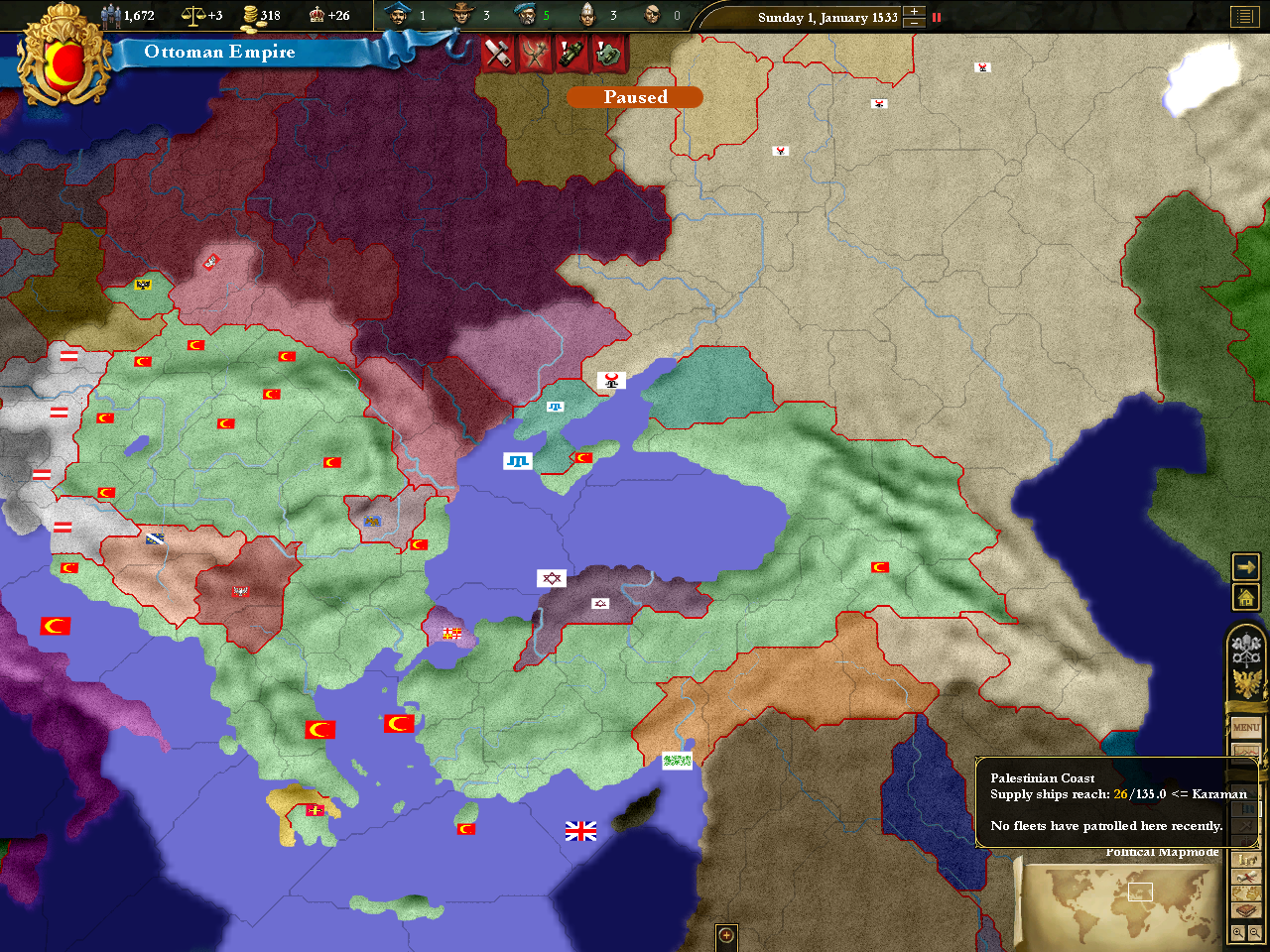
Once again, I must begin a letter to you with apologies. First I must apologize for the time since my last letter – it took a long time to get here and, though by the grace of Allah we did not suffer any trouble on the journey, nobody had prepared for our arrival and the first six months have been chaos as we establish our place here. Secondly, I must apologize as always for my Italian. Though I have always respected the wisdom of our great Padisha Mehmet II (did I not serve in his wars for 40 years with no greater word set against him than complaint about my blisters?!), and I have no doubt that his westernization program was of great benefit to all of our Empire, this old soldier’s brain cannot come to grips with Italian, and I fear I will never be as proficient with it as my children. So my apologies for the clumsiness of my expression.
But no matter! Why am I wasting your precious time with my shortcomings, when I have so much to ask you about your studies? How is the university in Firenze? Are you enjoying Italian life? Your grandfather spent a year in Firenze, but mostly digging latrines for a tent city as the siege engines pounded the walls. Do you remember that small glass perfume bottle your dear mother used to use on special occasions? That was his sole and single memento from a year in Firenze, which he bought during the two days he had free before his forced march to Siena. When he looked at that bottle he would become strangely still, and I think something happened in that one night in Firenze … Anyway, because all I know of the city is my father’s romantic memories and the smell of your mother’s perfume, it has always seemed especially romantic and faraway to me. Ha! But it could not be further away than it is now, could it?
It is unseemly for a man of my age to speak of his own deeds before affairs of family and state, but I know your restless and quicksilver mind, and I think that you are eager to hear reports of life in the colonies. So let me tell you a little about this place that I have come to, which is so strange and alien and yet in so many ways such a paradise. In truth it is a pleasure for me to tell you this (please do not tell others how this old man has begun to brag so), for although I cannot confess to understanding our purpose here, I have fallen in love with this place and I am beyond proud that our new Padisha has chosen me of all people to lead our troops in protecting it. It is unseemly to speak of regaining the garden of eden, but it feels as if I have been put in charge of protecting a new world that is within our Padisha’s care. Such a responsibilty! God willing, I will not fail our glorious empire.
But enough false humility (oh how this old man has fallen that he would try and cover his prideful boasting in such a tawdry cloak). To the story! We arrived (thanks be to Allah the Merciful) without incident on a mighty fleet of 40 ships, though truth be told my men and I only occupied four of them. The ships sailed into a sheltered bay that I am told is called “Cayenne” after the French word for a spice that they grow here, and I beheld the most verdant and unforgettable scenery that one can imagine. Our colonists have carved out a quaint little town on the flat land at the beach, but beyond that stretches a line of hills cloaked in the strangest and most ridiculous trees you have ever seen. Beyond that is a forest so thick that were one to fire a cannon into it, the ball might sink to a stop as if one had flicked a pea into a sponge. Truly amazing! And the heat! I must tell you now, it is as if every day one wakes up in a Turkish bath, and spends one’s day working and drilling and exercising and eating all in that bath. Oh, how I missed the breeze off the Aegean when I first came here! For at night, the weather does not change – it is just that the punishing sun disappears, but the heat does not relent. And I am told there is no winter, nor spring – just a time of rains, and a time of less rains. Truly, Allah the Creator has an imagination beyond that of his loyal subjects, that he could think of a whole land devoted to torture.
I am lucky though, for I have a huge house of two levels, set on a hill looking over the town. It is built in the Spanish style, for the Spanish have been colonizing this land longer than us, and have learnt of how to make a home habitable in a sauna – and being a resourceful and open-minded people, did we Turks ever see any idea we liked that we would not steal? So it is that I have a home fit for a family I do not have, and the ballroom now is devoted to maps and exploration plans, and my captains trek mud over the polished floors, and drink wine slouched on the expensive ironwood chairs as we discuss which place to explore next… but my study! Oh, it is a match for anything I had in our old home, a corner room with a view of the bay and this great mountain in the distance, which is so thickly forested that it turns a kind of bluish colour in the afternoon sun, and is darker than the pit of hell at night. The wind blows through here, and I can look out over the pretty little bay and keep a weather eye on the shipping as I pore over maps and supply plans and try to make myself busy … for in truth there is nothing to do here now that we have our barracks and our order.
I think you have probably heard wild stories of the natives, but I beg you not to credit them. They are a shy and reclusive people, who speak a quiet and dignified tongue and comport themselves with dignity when they are not hiding from us. I must say, they dress in a way that would bring shame to you were you to see them, and though tiny in comparison to my Maurician soldiers, they are tough beyond measure. As I write I can look out of my study window and see a group of them gathered by the quay, waiting for a fishing boat to come in that they might unload it. They work for small trifles but especially for weapons of steel, or guns; they return to the hills at night and have some fiendish magic by which they can work their way through the impenetrable forest of the inland, and though I do not speak their language my Italian linguist tells me they have enemies inland, who have never seen a Turk, and who cower and flee at the mere sound of a rifle. Our Austrian biologist warns me we should not give them guns – he claims that these people are like animals, and asks what would happen if we gave the wolf a rifle? – but I do not credit his strange imaginings. Whatever next, will he claim Turks are like unto the apes that the romans kept in their circuses? No, these people are but humans, humans who have strayed from the sight of god. We give them guns, and they will use them to kill other humans. Is it not like Europe?
In many ways though the colonists are more fascinating than the natives. Walking through our little town is like being in a souk in Smyrna, or the armies I told you about in the height of the conquest era! There are a thousand races, and a thousand languages being spoken, and everyone trying to make their little piece of home here on this strange wet land. And the army even more so! When I was a lad, our army was all Turkish, and it had no form or substance – just a gang of young men really, our lances glinting in the sun, intoxicated on bravery and conquest but with no sense of order or discipline. I remember none of us wore the same clothes, or even used the same weapons, and for a year somewhere in Hungary I wore a Hussar’s blue jacket with a Tatar hat I had taken somewhere in Sarai, and I never gave a thought to what anyone in my group was doing – I just went to war for the joy of it. But my men now, they all wear the same clothes, they march in line and they are scared of fighting. There is not a lance in sight – just muskets – and I think many of my men have never met a horse. But they would fight a dragon if they needed to! These tall dour Austrians, and my short but feisty Hungarians, and my laconic Italians – they have no courage, any of them, when they are by themselves, they would rather write poems and lie in bed than fight, but when they fight – my god! Had I met them when I was young, I would never have survived long enough to feel the pride of being your father. As our Mehmet westernized, so he dragged his army forward, and old men like me have to take up the habit of command, or we are forgotten – because our old habits are no good in a soldier.
But I must confess to you, I do not really understand why I am in command here. This land is verdant, but we do not know what to grow or do with it. To the east are the Castillians; to the west, the British. We have come to this colonial game far too late, and most of this land is already taken by the three great European powers. My Padisha tells me that we are not here to take land from the natives, but to take land for the natives – because if we do not, someone else will. But I think it is a pitiful effort – we cannot take but a scrap of land that has been left for us by the Spanish and the British, and meanwhile huge tracts of Asia lie smothered under the suffocating rule of barbaric empires like the Horde or the Nogai. If we must rescue someone, should we not rescue our Muslim brothers from barbary, rather than bringing western enlightenment to a people who will eventually meet the Spanish? And I am told that in the British quarters the natives die in their thousands from British disease. Is this what Allah the Merciful intended for the future of Islam, that most of its people would labour under barbary while its chosen people strived to bring the teachings of our holy book to a handful of benighted souls on the edge of the world? I think we should be looking to Asia if we wish to extend the munificence of our empire!
However, please do not mistake my cynicism for a lack of will – of course I serve our Padisha’s will. And I must confess, being here changes one! I know before you went to Italy I told you I would never accept that a daughter of mine would study, let alone work, but every night now when I take my evening walk I stumble on some marvel – a plant no one in our kingdom has ever seen, or a pretty spotted cat slinking away in the gloom, or some new flower – and I think that your impatient mind would find satiation here. Are you still planning to continue studying biology? Because if I comport myself well in the next few years of defending our colonists, I could perhaps ask our Padisha to send you here, and have you document some of these new flowers. Is that not the purpose you saw for yourself when you fought with me to study? And is not the central focus of Turkish life the collection of new knowledge? I bid you come here if you wish, to further your studies and collect knowledge of this strange new world for the glory of our Empire and Allah the Creator.
Please tell me more of your life in Italy, and reassure this aging soldier that your studies are going well. I will be here, sweating and cursing and making a new world for Islam. I hope that I can share it with you someday.
Yours in piety,
Your Father
ps I enclose some of this spice “cayenne”, taste it warily for it is deadly. Also a local drug called “coffee” that is rather good for when one needs to stay awake; and some sketches of the plants and animals I have seen. None of them have facility like yours, so I beg of you to consider coming here to further your studies. But, bring a fan!!!
Aggressiveness: 10. Ferocity: 10. Come visit his country …
As some of my readers know, I have been having fun conquering the world as Japan in Hearts of Iron 2, and that I’m reporting it all cynically in the tone of a Japanese leader forced to war to defend Asia against colonialism. Before I played Japan I had a go as Germany and didn’t do very well – the Soviets declared war on me in 1942 (I can’t think why!) and I got wiped out because my army was busy trying to secure oil in Africa.
Something noticeable about Hearts of Iron (HOI) and its successors is that there is no genocide option, even though some people believe the Holocaust was crucial to German war aims and so should probably be in the game. I understand that there is some debate about whether the Holocaust was a net benefit for the Nazi war machine, but some historians argue that the Holocaust policy developed slowly, piece-by-piece, in response to changing economic and industrial demands, and was actually primarily driven by the need to secure economic resources, especially food. Taking this as the basis for the Holocaust, it’s easy to imagine that a mechanism to represent it could be included in the game, to make it easier for certain countries to develop rapidly in the run-up to total war, or to respond to war needs.
The easiest way would be to incorporate a slider, that runs from 0 to 100 representing just how horrific your intended genocide is. Maybe 5 just means marriage and employment restrictions, while 100 is the fully mechanized destruction of entire races. The process is abstracted, and essentially represents a transformation of money, manpower and transport capacity into a reduction of supply needs and an increase in industrial capacity (or even an increase in supplies). This is pretty much what the historians I linked above argue: that the Holocaust was designed the way it was in the steps it was because it was aimed initially at seizing the economic assets of European Jews, to make production more efficient, and then at restricting their food consumption in order to ensure that other Germans didn’t starve. This is also what Stalin was doing with his “dekulakization” in the 1930s – forcing small, unproductive landholders off of their smallholdings into large collective farms, and because these farms were intended to feed many more people than those who worked in them, the excess population of smallholders would have been an economic deadweight – hence they were sent to the camps to die. Plus of course, when Germany invaded Eastern Europe they expropriated huge amounts of food and money, and essentially instituted a policy of starvation to ensure that no untermenschen used food that could have been feeding Germans. Under this analysis of the Holocaust, it was beneficial for the German war effort. If so, it should be modeled in the game in the interests of historical plausibility[1]. Wouldn’t it be great if when you were starting to lose you could slide your slider up to 100 so that you weren’t vulnerable to blockades? The computer could even use the demographic composition of your empire to give you options about which race to exterminate. We’re all about historical plausibility, right?
Suggesting such a process sounds kind of sick, doesn’t it? Which is why Paradox Interactive made a specific, explicit decision not to model this in the game. I remember somewhere a statement from Paradox about this, but I can’t find it any more – maybe it was in the Hearts of Iron manual that I no longer have. Anyway, we can find this on their forum rules for HOI3:
NOTE: There will not be any gulags or deathcamps (including POW camps) to build in Hearts of Iron3, nor will there be the ability to simulate the Holocaust or systematic purges, so I ask you not to discuss these topics as they are not related to this game. Thank You. Threads bringing up will be closed without discussion.
NOTE: Strategic bombing in HoI3 will be abstracted and not allow you to terror bomb civilians specifically. Chemical weapons will also not be included in the game. Any threads that complain about this issue will be closed without discussion.
Not only did they decide not to model these things, but they make very clear that they aren’t going to talk about their decision. We all know why: games that model the holocaust are beyond poor taste, and any gaming company that included such a mechanic in their wargame would be toast pretty fast.
It is, however, okay to model genocide in Europa Universalis 3. Yesterday commenter Paul pointed me to this post in which someone trying the game for the first time talks about how uneasy the colonization process makes her feel. I agree with a lot of this writer’s criticisms of the way the Native Americans are portrayed in the game, and I would like to add two.
Terra nullius: by making colonizable land grey and devoid of units or cultural structures of any type, the game essentially buys in to the legal fiction of terra nullius – that no one owned the land or had a use for it before white people came. This legal fiction was overturned in Australia in 1994, and where not openly declared the general principle often underlay the willingness of white invaders to breach treaty agreements (as they did again and again, for example, when dealing with native Americans). In the game, although the natives are known to be there (you get a count in the colony window), they are not represented as unit types and structures the way Europeans are – the land is not owned in the sense that European land is owned, it just has some people on it. Terra nullius is a pernicious and evil concept that does not reflect the actual state of indigenous life, only the racist perceptions of the colonizers, and it’s sad to see it being reflected so clearly in this game
Elision of native struggle: A common phenomenon in western popular and academic depiction of colonization is the minimization or dismissal of indigenous struggle. This is very common in Australia, and until the publication of Blood on the Wattle, popular understanding of Aboriginal history was that they didn’t really fight back, a belief that derives from early 20th century racial ideas of Aborigines as “weak.” Obviously in the US this is not so readily done, but for example the Sand Creek Massacre used to be referred to as the “Battle of Sand Creek,” though there were very few Indian soldiers involved, and popular lore about Custer’s Last Stand doesn’t usually include awareness that he was attacking a civilian camp at dawn when he was beaten. In the game, native struggle is implied in the aggressiveness and ferocity statistics for each province, and the effect they have on colony growth, but it is not actually visible or witnessed through the need to coordinate military actions against active opponents as happens in any European conflict between even the most irrelevant powers – it is a low background noise to your successful colonization, mostly
I think these two points show that the designers of Europa Universalis haven’t just implemented a game with a colonization strategy; they have implemented a game with a colonization strategy that implicitly reinforces common modern misconceptions about how colonization worked that tend to underplay its genocidal and military aspects (see also the way natives are absorbed into your population once it becomes an official province – this takes about 20 years and is in no way reflective of how colonization absorbed real native populations – such absorption took more than 100 years in Australia, for example, and only occurred at all through massive force and state coercion). I don’t really think this is a moral decision, but I also don’t think it’s defensible. There are lots of other ways that the game could have been designed, from making America the same as Asia to having a single Native American “state” and a different conquering mechanism – or, as April Daniels suggests, just a better and richer experience playing the Natives. There is DLC for this, but that’s not a defense, and neither are the butthurt bleatings of the gamers in the comments. It’s also noteworthy that the people attacking Daniels in comments of that blog are tending to subscribe to the same misconceptions that are buried in the game itself – there wasn’t much war, might makes right, smallpox did it not us!, natives really did get merged into the colonial population without a fight! This kind of response just shows that the west hasn’t come to terms with its colonial past yet.
So here’s what happened: Paradox spent years developing a game set in Europe in which they explicitly avoided modeling a genocide that occurred in Europe and that was crucial to the historical plausibility of the game; they also spent years developing a game set in Europe in which they explicitly developed a model for genocide that occurred outside Europe and that is crucial to the historical plausibility of the game. The former decision was probably (to the best of my recollection) made for moral and political reasons; defenders of the latter decision want me to believe it was for game mechanical reasons, even though the model they developed happens to reproduce some common misconceptions about how the native American genocide unfolded. I’m unconvinced. I think the designers didn’t consider one genocide to have the same weight as the other. Which isn’t to say that they consciously made that decision, but neither did all the cowboy movie directors in the 1980s who made multiple movies that included the Sand Creek Massacre, but didn’t ever get around to depicting Babi Yar from the Nazi perspective. Our culture makes some stories acceptable even though they are steeped in evil, and some stories unacceptable. Many people reproduce those stories without thinking, and that is what the designers did. (It’s also worth noting that Paradox is a Swedish company, and Sweden was not a colonial country in recent time; maybe for them the horrors of world war 2 are much closer than the horrors of genocidal America, and everything that happened in that period in those far-flung places is just a story).
I think there are some big questions buried in EU3, which we also need to ask when we play GTA or watch some nasty slasher pic, and April Daniels asked some of those questions in her blog post. Those questions are also relevant to the genocide issue in EU3 but they’re bigger than that. Why do we make games about war and killing at all? Why do we think it’s okay to drive around LA killing cops but we universally object to rape stories? Why are we so complacent about the destruction of whole cultures in Australia and America, but so touchy about mass murder in Europe? And why do some fanboys get so stupidly butthurt when people who enjoy the game (or the movie) analyze it a little more critically than wow!wow!wow!? My Ottoman Empire has begun its colonial project, in Cameroon and Cayenne and St Helena, and I’m playing that part of the project with the same sarcastic amusement with which I describe the Empire’s “reclamation” of knowledge in Northern Italy; I will probably kill a lot of natives if I have to, and convert the rest[3]. I’m not particularly fussed about this. But I’m also aware that this game is racist on many levels, and it includes genocide as a central mechanic. Some people may not be comfortable doing that, and they may want to write about it. I think it’s possible to simultaneously enjoy the game and accept these things, but I also think the game could have done better on this issue. If I’m going to kill natives and steal their land, why should it be different to the way I kill Germans and take their land – is there something the designers want to say here? There is a long, long way to go before people in the west can accept and understand the genocide that made America and Australia possible, and the deep wounds colonialism left on Africa. Until we do, I guess we can expect that games like EU3 will fall short of genuinely trying to describe the histories and cultures of the people who were exterminated.
—
fn1: though actually a very interesting experiment would occur if paradox were to include the Holocaust as a single historical decision that was actually bad for the German war effort, and secretly spied on players[2] to find out how many clicked “Yes, do it!” even though the decision is negative.
fn2: or used NSA data
fn3: actually since I westernized[4] I’m so far on the “open-minded” slider that I can’t actually generate missionaries, so I can’t convert anyone. I’ve conquered so much of Europe that my culture is more christian than Muslim. What to do…?
How to flay an Austrian dog: 1, Make a careful incision along the belly
From reading forums I have got the impression that I am not the only one who found defeating Austria difficult, and now that my war machine has got to the point where beating Germans is not so tough, I thought I would explain the tactics I used. For the Ottomans, defeating a European power (and the leader of the Holy Roman Empire) is not easy, despite our large manpower – they are far more technologically superior, they have allegiances, and they have a lot more men than one expects. So here is how I did it, and a little bit about why.
Why take Austria?
Well, because it was there …
There are easier European powers to defeat than Austria (Naples, for example, or Lithuania) and I could have spent my time laying waste to my Muslim rivals, but there are several reasons why I wanted to get started on Austria.
History: I suspect that this game follows history, and historically from the beginning of the 17th century the Austrians began to work on uniting Hungary with Austria, which means taking it back from me. I wanted to get them first
Tech lag: the longer you wait, the more Austria’s technology advances, and unless you’re lucky enough to Westernize earlier, they will get further ahead (especially in infantry). They also begin to grow in size as they absorb smaller kingdoms, and it’s not a good plan to lose the one advantage you have (numbers). Also, the more provinces you have the slower your research gets, so if you try to grow into muslim lands you will be able to keep up the manpower effects but you will gain a lot of low value provinces that drag back your research progress but don’t provide enough money to compensate for that effect; so growing into Austria is a good way to avoid this. Also, Austria holds a Weapons Manufactory, and taking that Manufactory gives me an army research bonus
Completing the University Blitz: Austria held Parma in Italy (the Northwest tip of my possessions in the above map), and was allied with other university cities, so targeting one of those allies would be a key part of the war and means that if I was forced to a white peace I would still increase my university possessions
Killing people and taking their stuff: Austria has 3 or 4 provinces with gold, which is a really big income boost. Taking them early (and also one trade centre) will really boost my attempts to catch up with Castille and France.
Austria also held claims on a bunch of my cores, and in the period just before this war started I was spending a lot of money sending gifts to them just to stop them declaring war on me. If it’s going to happen …
The basic strategy
Capturing Austria will take several wars, because even after total defeat the game won’t let you annex a multi-province nation and with a maximum warscore of 100% you can only grab a few provinces each time. So my basic plan was to lure Austria into a war with an attack on an Italian ally, and take the central provinces (splitting the nation in two) and the Italian universities on the first battle. I would then use an attack on another weak member of the Holy Roman Empire later to get a second war going, and use it to take the gold-holding provinces; then I would finish the last parts in subsequent, easier wars. It actually only took me three wars, but this was because the Netherlands stole some of Austria’s Baltic provinces at the same time. Luring Austria into battle is essential because it is always allied with another big power, and I can’t fight two big European powers at once; but because it is the leader of the Holy Roman Empire, Austria is obliged to come to the aid of even the smallest, shittiest Imperial member, so is very easy to lure into war even when it is not ready.
I also could not beat Austrian armies in a straight fight, but needed to be numerically superior to them by a factor of 4 – and then to have reserves since I would lose something like 25% of my men in the first engagement. So I built up my armies over a long time, to ensure I had manpower sufficient to reinforce an army of 180 divisions over a two year war. Also, after my previous University Blitz I had rapidly improving government research, and I used my new national ideas to ensure I had a big army as capable of taking on the Austrians as possible: I took Grand Army and Military Drill.
In order to defeat Austria in a war I used a strategy of separating the armies, to ensure that I didn’t have to fight two of their biggest forces at once. This meant using Italy as a lure, and getting them to send one whole army over there and capture my provinces, while I destroyed the other one on a war in my own provinces. I could then rebuild my existing armies quickly with reinforcements, and go smash the second army while secondary units of mine would take on any newly-formed units. But this meant I had battles of about 75,000 men vs. about 20,000, and was still losing 30% of them.
War 1: The Italian Trap
The first war started with an attack on a minor Italian state – Modena, I think. Modena is part of the Holy Roman Empire and is not allied with Naples, so made a perfect target. Soon after the war started Austria moved a large number of troops into Northern Italy, where I had a large army laying siege to Modena, but I removed my forces by sea before they could get bogged down in battle. The Austrian army then charged around Northern Italy razing my cities (another point worth noting is that the Austrians reduce cities very quickly, so don’t count on getting even a month to recover in a fast war with these people – they will have opened your city up and moved on before you have time to reinforce – which also means you need to build troop units far behind the lines to avoid losing them to rapidly moving siege units). However, in the time they were charging around “liberating” my Northern Italian possessions, their second army moved into Pressburg and then Pecs, central provinces in Hungary. This army was about 30,000 strong. They had other forces of 1-2 divisions (1000-2000 men) fanning out through other provinces, but these did not concern me. In total I would say they had 50-70,000 men, to my 140-180,000. But a lot of my men had to be fanned out to guard my eastern approaches and prepare for the inevitable uprisings, or were in reserve to be rushed in as reinforcements after the first destruction. For example, I had 8000 men in Nis to handle uprisings in Macedonia, and another 10,000 or so in Athens (also covering against seaborne assault). I also had a line of single divisions on the frontier. But in Pecs and all its adjoining rearmost regions I had armies of 10-25,000 men. When the Austrians attacked I used the scorched earth strategy – which is why I had single divisions on the frontier – and withdrew my men, though most got caught in the Austrian advance and ground into the mud. The main Austrian army then laid siege to Pressburg, but the scorched earth meant they lost perhaps 4000 men waiting for the city to fall. They then moved on to Pecs after about a month, with Pressburg safely in their possession (bastards). I was waiting though, with a base army of about 20,000 in Pecs and armies moving in from every adjoining province[1]. When the Austrians arrived in Pecs they found themselves caught by an army of 70-80,000 men, and their own demoralized by marching over scorched earth for weeks, and now numbering only perhaps 22-25,000. The result was a victory for me, though a fairly costly one – I think I lost between 30-40% of my men, while they only lost 20% of theirs. Fortunately for me though this ill-fated army retreated into one of my provinces, so I could pause to give chase to ensure my men arrived after the end of the month (with morale and numbers restored) and I think also some Serbians got in on the action. This second battle was pivotal, with my forces dropping only perhaps another 25% while the enemy was routed and lost half its numbers. They then had to retreat back through three provinces, being chased all the way, and when they returned to Austrian territory they numbered perhaps only 4000 men. I was then able to send my surviving army to mop up the small Austrian armies (of 1000-2000 men) laying siege to my northern cities, and rush in the reinforcements I had held in reserve earlier.
By now my men from Northern Italy had arrived and, confident that I had no need to defend Dalmatia I could move a reserve from there into Austria proper, so another force of perhaps 50,000 assembled and began marching across the border. To my surprise, the remaining major Austrian army had stayed fast in Parma after reducing my northern Italian cities, I think because in a sea battle I had accidentally sunk all the Austrian transports[2] and the soldiers did not walk across all of Italy and Austria to join the campaign. I tried drawing them out by destroying their cities in southern Austria but they weren’t tempted, and now my window of opportunity was closing – if I didn’t deal with them quickly a new army would form in Austria while I wasted time in sieges (maybe this is what the Parmiano army was waiting for?) and then I’d be toast, since I didn’t have enough manpower (or money) to build up another army of 70,000 men within a year, having spent most of my available manpower reinforcing the huge losses from the first battle. Did someone say “Human Wave Attacks”? That’s my army’s killer app…
So, we marched into Parma, and left behind a veritable horde of small units, 1000 men per province, sieging every city we could get our hands on – the sooner we bring down their cities the sooner we forestall the development of a major army. This behind-the-lines siege strategy is essential bookkeeping because once the first army was liquidated and its survivors marched to the cliffs of Herzegovina to meet their fate, Austria would have to raise soldiers simultaneously across many provinces. This means stationing a single troop unit in each province enables these new units to be killed all at once as they emerge from their little Austrian cocoons, before they are properly able to fight, and 20,000 manpower get washed away in a storm of blood before they can harm anyone.
The battle in Parma went quite quickly, possibly because the Austrians had forgotten to take over Firenze before they retreated to their Parma castle, and so my armies could reinforce after each battle. I think it took four or five battles before we finally drove them into the Papal State; but before they returned to attack me, my siege units completed the siege of Parma and my conquest of Austria was complete. Result! I demanded Karten (Weapons Manufactory), Streirmark, and Parma (university), as well as the liberation of Riga. That brings my warscore up to 99, and that’s all I get for a year of war – after which I have to settle down to several years of putting down insurrections and rebuilding my manpower. Oh Austria, were you worth it?
How to skin an Austrian dog: 2, carefully peel back the flesh from the left flank
War 2: The Croatian Trap
I used a similar combination of diversion and scorched earth on my second war, and again started it by attacking a small Italian state. This time I chose the rump of Naples (see the map above), because it gets me the high value provinces south of my university cities, and by now Naples was becoming increasingly isolated on the world stage, protecting me from retaliation from France or Poland. Although this happened only a few years later, I noticed my Land technology had increased in this time – this is because of the effect of having France as a neighbour, plus the Kranten Weapons Manufactory (see below for more about this). I also had access to Austrian infantry units, recruited in Streiermark and Kranten, which are vastly superior to even my Condotta infantry. This eased up the challenges in battle a little, but I still had tough fights ahead of me and this time the Austrians were much less surprised – by the time I had quelled dissent and rebuilt my armies they had a force of some 35,000 men in the northern section of their divided kingdom, and 20,000 in the south. That’s not pretty. However for this battle I had an advantage – a brief alliance with Persia, which meant that halfway through the battle a whole horde of Persian soldiers came stomping in to take over siege duties. These guys died in their multitudes if they so much as caught sight of an Austrian soldier, but they were good for capturing territory.
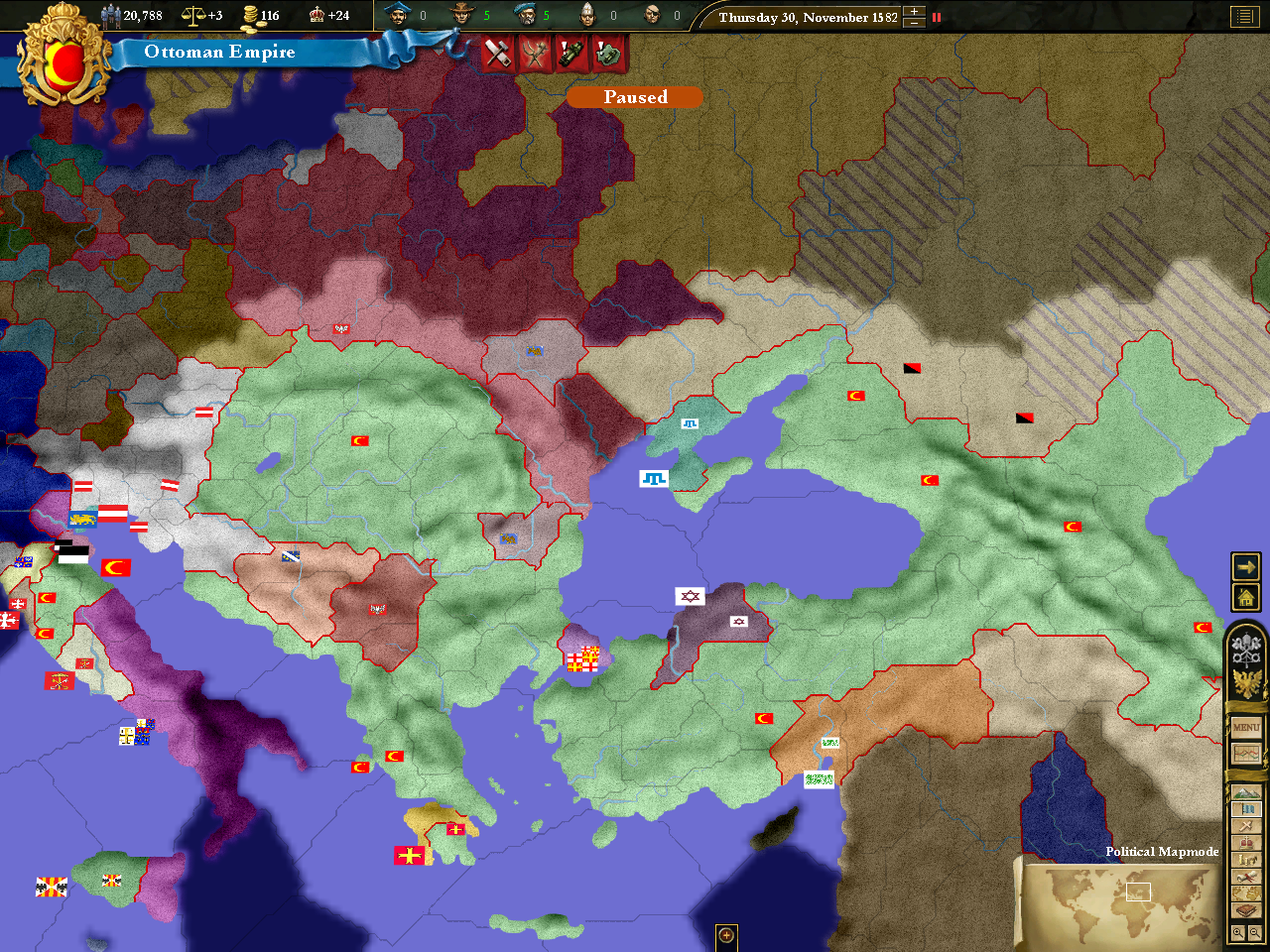
This time I set a trap for the southern Austrian army, with the full intention of destroying it as quickly as possible. In the map above, the large grey province sticking into my glorious Empire is Croatia, and the green province beneath it Dalmatia. The salmon-coloured nations are Bosnia, my vassal, and to their east Serbia. I positioned a large army in Dalmatia, and another in Bosnia, then more in the provinces north, south and east of it. I then scorched the earth in Bosnia, and waited. Austria lays claim to Bosnia as a core, so leapt straight into my trap, sending its 20,000-strong army to get it back. Once they moved into Bosnia I used the same tactic as before, pouring soldiers in from all sides, but now I also sent my men into Croatia to seal the trap. The Austrian army was beaten more effectively this time, and simultaneously suffering attrition from the scorched earth. When it retreated, it fell into the ambush I had set, and was completely annihilated in the valleys of western Croatia. I immediately withdrew my men into my own territory to get resupply, and lined up the same wall of troops around Pecs in central Hungary, to face off against the Northern army. This time my troops had not been so badly mauled, and I rushed up reinforcements, but I still only outnumbered my enemy perhaps 2.5:1. Luckily those new Austrian troops, plus a slightly better land morale, made the difference, and I won at Pecs – though I think I lost 60% of my men trying. I couldn’t press my advantage but had to rush in more troops from far afield – again, the Italian troops who were on anti-partisan duty in the north of Italy had to be shipped in. This is a dangerous tactic, since even if Naples capture all of Italy they cannot force me to surrender, but if Italian partisans hold a portion of a historical state for long enough they can declare independence. I also, of course, left my northern borders undefended against Naples, but Napolitan forces were much reduced and I could be confident that they would not be a threat. With this new force brought in, and also moving up my southern Greek anti-partisan forces, I was able to quickly return to the offensive, and spent a few months chasing that army around western Hungary until, finally, I cleaned it up.
This time I took the remaining states bordering France, and – most importantly – Tirol, which has a large gold supply. I also forced further concessions from Naples. Now Austria was reduced very much in size, and had lost all its manufactories and universities, as well as its trade centre and gold resources (all located in Tirol).
How to skin an Austrian dog: 3, gently draw out the flesh intact, and throw the remains over your right shoulder
War 3: The Cake-walk
After the second war there followed another couple of years of pushing down revolts and rebuilding armies, but then I noticed that Austria had somehow become embroiled in a war with several neighbouring states and the Netherlands. Not wanting to lose the best chances, I declared another war – this time on Ferrara, which had foolishly reneged on its alliance with France and stood unprotected right there by my other northern Italian states – and led a rapid invasion party. This time Austria capitulated quickly, and gave up all its provinces except the capital, Wien. Wien itself capitulated after a further short war, and I was gracious enough to annex them into my empire. Austria thus no longer existed, and it only took 40 years including all the preparation and recuperation. I also seized all of Northern Italy, a province next to Lithuania, and a couple of small German states (like Salzburg) that had to suffer necessary collateral damage as part of my war. At the end of this war, as the map shows, I have captured all of Austria, Salzberg, a province south of Riga, most of Bohemia, Thuringen, and have nearly stomped Hesse. I also now have all the northern Italian university cities except Liguria and Venezia, most of southern Italy, and have lost nothing. The only problem is a single province that the Dutch took from Austria as a peace settlement before I could win the war. Notice the large number of small city-states and one province principalities that got absorbed into my empire during this titanic war – I’m sure they’ll thank me 100 years from now …
A few lessons about fighting technologically superior forces
Fighting significantly stronger forces can be devastating, even if they are numerically much weaker than your own – just as I experienced when I slapped the Golden Horde all the way back into Asia. It’s particularly tough if your war lasts more than a few months, since you will inevitably draw down on the forces that are responsible for maintaining civil order. So here are some tips:
Lure them into war by attacking weak allies, so they are isolated from alliances
Don’t underestimate even small allies – a two province German state fielding an army of 10,000 highly trained infantry will be enough to turn the battle in their favour
Get yourself an ally, even a terrible one. They can do siege work while you do the hard work of smashing the enemy, and although siege work is often seen as something to do after you destroy enemy armies, it is crucial for keeping a lid on reinforcements if you are fighting a war of attrition. If your enemy has money and manpower and you leave his provinces unguarded, expect him to raise another 15,000 man army in a couple of months – just after you lost 30,000 or 40,000 men
Fight him on your land, not his, so you get resupply bonuses and he doesn’t. If you can use the lure tactic (I am terrible at this) then use it to draw your enemy far away from resupply
Pay attention to tiny things: the date you arrive in a province makes a huge difference to resupply and morale (always arrive after the last day of the month); attrition rates in a large army can be equivalent to losing a whole division; when your army tradition is up, hire better generals and take the time to load them onto your biggest armies.
Be very careful to ensure all your armies converge at once – even a day of difference can be a disaster. These Austrian juggernauts tear through small armies like a threshing machine, and if your grand army of 80,000 arrives 20,000 apiece staggered a few days apart, you’ll lose the battle and 60,000 men
Hire advisors who can keep revolt risk down, if you can, because you don’t want to lose a core province permanently to some nationalist bigots while you were chasing the bigger prize
Once you own a province from your powerful western enemy, rapidly generate their best troops from that province – they will be far better than yours and can form a bulwark in the next battles, and you will lose access to these units after 50 years, so you want to generate them during the period that the provinces are not core, and spread them through all your armies
Save before peace agreements and check which land you want very carefully – take the provinces of highest value to your enemy first. You may not be able to find out the best approach (e.g. where universities and manufactories are) without signing a peace treaty and checking, so be willing to reload and try again
Keep an eye on Great Britain and Castille – as your reputation tanks from multiple small wars you may need to spend a lot of money keeping them on good terms with you
Keep an eye on your manpower – if it begins to get really low you will need to bring reinforcements from anti-partisan duty, or else you won’t be able to field sufficiently sized armies
Preparation! Go to war with a full manpower complement and your army already built (it may take two years to get to this point) so that you can guarantee resupply and the ability to build another 30,000 man army within two months – your casualties are going to be horrific
Remember you’re fighting a war of attrition and your soldiers are just peasants. Be ready to throw them away – digital men love to die for a cause
Save often, because even the smallest mistake is going to lose you 70,000 men in a month
Avoid war taxes and try to fight on savings. War exhaustion really soars up when you are fighting a war of attrition, and you don’t want to load taxes on top of that
Design your strategy so that you capture a province neighbouring France early – the neighbour bonuses from France are staggering
Now that I’m used to this strategy I’m much more confident about taking on technologically superior opponents. I have the men, they have the guns, but I can do it if I’m careful and methodical in my planning.
A brief note on neighbour bonuses
I was really shocked to notice after I captured some provinces bordering France that the neighbour bonuses on research had shot up to 30 or 40%. Now I have 6 universities and neighbour bonus from France for a total government research bonus of 60%, equivalent to an increase of 60 ducats a month in research – I get research outcomes in all my research fields of up to 40%, equivalent to 200 ducats a month in income just from neighbouring France. This has been particularly effective in my Naval research, which had been lagging. So get this early in your strategy.
If you’re playing the Ottoman empire this can be done early by grabbing Liguria (of the Kingdom of Genoa) before France gets it. This option arrives early when you get the mission to take the Crimea, which Genoa holds – with a good navy you can grab Liguria after two wars, and they aren’t actually militarily so tough, nor do they have good allies. I didn’t do this but as I understand it they have a university and maybe a manufactory. They become a neighbour of France 100 years before you can complete the capture of North Italy, and they also have a centre of trade (5 ducats of income a month from harbour fees).
I’m also wondering if this tactic could be an effective way of making yourself a huge power in Asia. Take a small Asian country and send a force early on to take a piece of land adjacent to e.g. the Ottomans. Then use this neighbour bonus to get a huge research bonus over all your Asian neighbours. Then use this land as a stepping stone to grab a single state adjoining France (anyone would do, North Italian is best) and your neighbour bonus will be huge. Then you can dominate Asia. I would say that for the Ottomans or any Islamic state, having a province adjoining one of the major western Europeans is worth expending a lot of blood and treasure on. In fact now in my game Syria adjoins the British province of Alexandria, and is developing its land and naval forces faster than e.g. Persia or the Golden Horde (who adjoin Muscowy). These neighbour bonuses now have me stellar distances ahead of my Islamic brother states – I think the Golden Horde are still stuck on Land 16 or 17, while I’m on 23. France is on 27, so I’m catching up.
I think these tactics are key to catching up and competing with the western “lucky” countries. When I started playing the Ottomans I didn’t know about the crushing disadvantage of being Islamic (slower research, inferior units) but if you use the neighbour bonuses and careful strategy, these disadvantages can be turned into challenges rather than game breakers. Dragging myself up through Austria to threaten the entire Prussian north has been a really enjoyable part of the game, and it certainly has been a challenge! But now I’m beginning to feel I’ve turned a corner, and my empire is nearly ready to take on the majors …
—
fn1: You can’t have more than a certain number of units in any one province without suffering serious attrition, and I couldn’t spare any incidental loss of men, so I had to fan my men out until the key moment.
fn2: 41 of my ships to 18 of theirs, and I sunk 6 of theirs and barely won… another example of the devastating effect of huge tech differences. Never split your fleet if you are in a war against a western power.
[This being the victory speech of Padisha Mehmet II, made at the Gates of Vienna in May, 1628]
Oh my Brothers in Arms, peace be upon you that are righteous in the path of the One True Faith! [cheers] [raises arms for sudden silence] I see you now as we all have become in these 40 years of continuous war. We are all wearied, brothers, by this great war that was brought upon us, and by the things that we have been forced to do in the service of Allah, the Source of Peace. I know many of you thought this day would never come. You have marched the mud and snows of this bitter land for so long, some of you have forgotten the feeling of sun on your back, or the sound of the sea. I know you thought you would never see your Mother again, or pray on a mat that was not frayed and worn and splattered with the blood of the infidel.
Oh my Brothers in Arms, peace be upon you now that have won a great victory for the One True Faith! [cheers] Look behind me at these gates, my brothers! [cheers] [turns to face the shattered walls of Vienna] Behind these ruined gates the people of Austria cower in advance of our measured tread. They are not just weary in body, as are you my brothers: no! They are ashamed, my brothers, as are all the infidels! For they waged war against us in the name of a false belief. They thought to crush us, but their efforts broke against the rock of our faith! [cheers] Now do they not know that God is Great, and there is no God but God?! [cheers] [raises arms for sudden silence]
Oh my Brothers in Arms, is this not right and good? For our Prophet, may peace be upon him, did he not warn us of this day? Did he not say,
So when the sacred months have passed away, then slay the idolaters wherever you find them, and take them captives and besiege them and lie in wait for them in every ambush, then if they repent and keep up prayer and pay the poor-rate, leave their way free to them; surely Allah is Forgiving, Merciful.
Have we not done as he bid in all things, my brothers? We were unjustly attacked by the pale wretches of Christendom, and did we not defend ourselves? [cheers] Did we not rebuke them justly for turning their greedy, godless gaze to lands that are and always have been ours? [cheers] Did we not punish them justly for making war against the children and women of the Empire of Peace?! [cheers] And do they not now repent!!? [cheers]
[waits for the crowd to fall silent – it is a long wait]
Oh my Brothers in Arms, let us now be frank with each other. I know that many of our people questioned my father’s judgment when he first declared war on the Austrian dogs all those years ago. No! Do not protest! Are we not a free people, that our fathers can voice their opinions and their fears without trepidation or restraint?! And are our fathers not wise? Are we not an Empire of Peace? Well then, behind these gates the greatest threat to that peace schemed our end, and now that threat is done! There are great powers in Europe, but we have proven ourselves equal to the most ferocious of them, and now it cowers before us like a terrified dog. We are free to do as we like, and all of the unbelievers in Europe shake with the realization that the people of the One True Faith will not bow down to them, but will fight to defend that which is ours. And let us not doubt this: Europe is rich, rich from conquering other lands and stealing their wealth. Now we have taken those riches for ourselves, riches such as I know many of you could not have imagined these unbelievers would hold. Now we have the gold of the great mountains, we have rich fleets and salt mines and we possess all the industry of this land. Where once that gold bought arms to kill believers, now it will buy bread! [cheers] Where those fleets harried merchants trying to sell the fruits of your hard labours, now they will carry oyur products to trade with the world. Where that industry built cannon to break our cities, now it will make ploughs for our fields. Where that salt was horded for fat, rich Austrians, now it will be shared with shepherds and herders across our Empire! For we have brought peace to Europe, and now Europe will begin to join our Empire of Peace!!! [cheers]
[waits for the crowd to fall silent – it is a long wait]
Oh my Brothers in Arms, let us now think of peace and unity. Before me I see gathered faces from all of our vast Empire of Peace. There, a doughty Georgian sapper – over here, yes here! [points] I see a squad of archers from the plains of Dagestan! You have come far, have you not?! There, a Hussar from Vilnius, still weary from carrying his lance so far and fighting so long! And here before me a Turkish man, whose family has held faith with our empire since the Turks first discovered the One True Faith. And all of you united under our crescent banner! Behind me, cowering behind these gates, a new people wait in fear of you. Would you have those people unwelcome in our empire? Did we not welcome the Tartars, the Hussars, the Hungarians who for so long demanded their liberation from Bohemian oppression? Then let us also welcome these pale-skinned infidels! Show them peace and treat them according to the teachings of our Prophet. Soon those gates will be broken down, and I will enter the city to take possession of Austria in the name of Allah, the Victorious. When you enter the city with me, remember our Prophet’s final sermon, and his injunction as to how to behave well towards unbelievers. For did he not say
All mankind is from Adam and Eve, an Arab has no superiority over a non-Arab nor a non-Arab has any superiority over an Arab; also a white has no superiority over black nor a black has any superiority over white except by piety and good action.
We know that our enemies in Europe do not believe this, or any of the words of the Prophet (may peace be upon him). Let us show them that we are better than them, that we are moral where they sin; we are peaceful where they make war; we are generous where they are greedy; and we are just where they are cruel! Be as good and peaceful muslims when we enter this city, and show no anger or resentment towards these people who made war on us. For we have subdued them, and have no further need of anger – for we are victorious.
Oh my Brothers in Arms, let us throw open the gates of Vienna, and make our triumphant entry into Europe!!!
[long cheers; the Padisha holds his arms aloft for some time, then climbs atop a white horse, and rides towards the gates. Explosions sound from the walls, and the gates fall inward in a cloud of smoke and flame. To the sound of cheers and the thunder of many cannon, Padisha Mehmet II enters the city of Vienna, trailed by whisps of smoke from the shattering of the great gates. He takes Vienna, and our Empire takes history!]
When we last left our heroes, they had just captured a large galley, killed its captain in cold blood and won a Letter of Marque from the government of Five Fingers. Now authorized to conduct piracy against the ships of other nations, our group of characters were able to set in motion plans for a life of officially-sanctioned larceny and violent crime.
Nonetheless, our PCs were not happy about how events had turned out in capturing the Urcaen’s Call. Carmichael the Warcaster’s decision to kill the captain in cold blood – slitting his throat in front of his entire captive crew – left the PCs in a significant bind. Captain Mayhorn’s family and patrons were almost certain to seek vengeance for his death, and practically the best way to protect themselves from such reprisals would be to kill all the crew and dump them at sea, or maroon them and leave them to cannibalism and death; but none of the group wished to stoop to such barbarity. Carmichael’s arbitrary action also encouraged an atmosphere of lawlessness amongst the surviving crew of El Pollo Diablo, and would make them much more difficult to control in battle. Since they could not bring themselves to commit slaughter and rule by tyranny, the group decided to make an example of Carmichael through a public whipping and a speech by the Captain, and then dropped their captives at a town far from Five Fingers, drunk and with enough money to keep them drunk for months. They hoped through this tactic that the crew’s information would take a long time to reach Five Fingers, would come accompanied by stories of their drunken excesses, would likely not be believed or accurate in its descriptions of the group, and would probably also be distorted by passing second hand through many tellers.
Nonetheless, Carmichael’s actions had put them at risk, and they decided it might be wise to get out of town for a while. After recruiting new crew – including mechanics and other specialists for their new galley – the PCs took a job for the rich young daughter of a local crime boss, one Katrina Craslovini. She was mounting an archaeological expedition to the Scharde Islands in search of some kind of mythical building (or its ruins) and needed a ship and bodyguards to go with her. This presenting a perfect opportunity to get out of town, the PCs jumped at the chance (and the excellent remuneration on offer), and agreed to go with her. After a short but thankfully non-violent conversation with her father, who tried to dissuade them from travelling, they set off for the Scharde Islands.
They managed to convince Katrina to allow them a few personal stops of their own on the journey to the Scharde Islands, one of which was to be a visit to Carlass’s extinct tribe, therein to worship at the runestones of her tribe. The first stop, however, was to be at a small and irrelevant town south of Five Fingers, where Sharajin wished to investigate the trail of a man she was pursuing. Sharajin is a monk of the Menoth church, likely some kind of Inquisitor, and probably an extremely nasty person when left in a darkened room well-stocked with sharpened pieces of metal and overly open-minded fellow citizens. So it is likely that the group put into this small bay in search of a man who had perhaps simply had the temerity to claim the sun was hotter than the fires of Menoth, or some such foolishness. Nonetheless, Sharajin was one of us, and so as a team we went to that small and sun-baked town in quest of a free-thinker, that we might hand him over to Sharajin’s tender ministrations.
Or so we thought …
Carlass stood at the helm with Hrif the Younger, enjoying the sea breeze, as they put into the small bay where the town lay, lazy and quiet in the sun-drenched morning. Carlass, proud chronicler of a hunter-gathering culture, grunted in disgust at the patchwork of fields that stretched out into the hills beyond the town like a haphazard chessboard of yellows and greens. Smoke rose from town chimneys, occasional farmers and townsfolk stopped in their labours to stare at the unfurled sails of El Pollo Diablo, and somewhere on the road near the town an ancient labour-jack glinted in the sunlight as it clacked along the furrows of a new-ploughed field.
Once the ship had put into the port, the PCs disembarked. They had decided to take a day’s shore leave, so the crew were soon scampering off to restaurants and brothels on the seafront. They left their crew behind and visited the local notables – that is, the local Priest and Nobleman – and inquired as to the man Sharajin sought. Had they seen a scientist fleeing heresy, a unionist covertly escaping torture for wanting to better the lot of salt miners, some foolish woman who had thought to protest her husband’s beatings?
No, they hadn’t, but a man had been seen heading out of town, and it was possible that he was in the ruins beyond the town. As the sun rose to its zenith and the local farmers broke off their harrowing and scrannetting to rest in the shade of their hedgerows, our little group of heroes set off up the road into the hills beyond town, to find Sharajin’s target. They had been told he was meeting with an old woman of ill repute who was perhaps connected with some religious cult laired in the ruins. Perfect! Sharajin’s eyes lit up with that cold Mennite malice at the thought of a whole religious cult to extinguish, and everyone (except Hrif the Younger and Captain Breaker) had to speed their step to keep up with her.
There was some trouble on the way out of town as the townsfolk made the mistake of thinking that Hrif the Younger had come to kill them all, but he managed to smooth out their concerns.
They found what they sought soon enough – an old burial mound, door newly-affixed, that was guarded by two local men who looked a little like militia. Alyvia approached to try and talk to them, but they opened fire with their rifles immediately, and so the party were forced to kill them. They then entered the burial mound, and soon found what they sought. An inner room had been converted into some kind of workshop, and a group of mechanics were working rapidly on a war-jack, under the watchful eye of a middle-aged woman of ferocious demeanour. The war-jack was obviously built to fit a Mennoth design, and the woman was exhorting her labourers to build it faster. In the corner of the room was a vat of some kind of filthy liquid that was being poured slowly and steadily into a fast-running stream. That liquid was clearly not intended to do good, and the stream obviously ran out of this burial chamber to somewhere downhill…
Captain Breaker takes the fore
The PCs leapt into the attack, but discovered themselves suddenly facing off with a group of zombies that the woman managed to conjure forth. She was a necromancer, most vile of heretics! A short and nasty battle followed, in which the woman’s magic nearly felled Captain Breaker, but in the end neither nor her zombies were much of a match for the group. As the battle unfolded, Carlass stopped the poison flowing into the stream, and was able to identify it – swampfoot fever, the same disease whose cure had been stolen from the Golden Crucible and carried north on Captain Mayhorn’s ship just a few weeks earlier.
What a remarkable coincidence …
In the room the PCs found a set of plans for Mennoth war-jacks, and now they learnt who it was that Sharajin was chasing: a spy who had stolen plans for Mennoth war-jacks, and aimed to sell them to the highest bidder. He was gone, and had obviously made his profit, but now Sharajin had possession of the plans. The necromancer of course had to die, and told them nothing useful except that the poison was for the town water supply – she would not say why or who she was working for, but no doubt she was a member of one of the standard cults that venerate the sick and the dead. They killed her.
The PCs then returned to town, bringing with them the parts and plans for the warjacks, and the warjack itself they reconfigured as a labour-jack and donated to the townsfolk. They then returned to their boat … and encountered a strange epilogue.
This nameless little town was officially in the territory of the kingdom of Cygnar, and as they returned to the bay the PCs saw a sloop of the Cygnar navy at rest in the bay. On the beach, Katrina and the crew they had left on the ship were being held at gunpoint by Cygnaran Marines. Why? Captain Breaker approached, leaving the PCs and their war-jack at a suitably menacing distance, and negotiated with the Marines. It appeared that they simply suspect the group of being pirates, and once they had seen Breaker’s Letter of Marque and confirmed his mission was to the Scharde Islands they let Katrina and the other crew free. However, as the captain prepared to return to his sloop he stopped and asked the Captain,
Have you by any chance seen or heard anything of a ship by the name of Urcaen’s Call?
Feigning innocence and appearing as concerned as one mariner should for the fate of another, Breaker declared he had not, nor had he heard of such a vessel, but why were the navy interested? Should he be concerned about pirates?
The captain’s response sent a chill down everyone’s spine:
It’s nothing. We were due to rendezvous near here just a week since, and have heard nothing of her. Thanks for your concern.
And off the captain went, returning to his ship.
The PCs had ambushed the Urcaen’s Call as it headed towards these waters from Khador, and it had been carrying a large quantity of treatment for the very disease they had just seen being poured into the town’s drinking water supply. Could it be that the Cygnaran navy captain had intended to appear as a hero to this town, arriving just in time to cure them of their disease? If so, then he must have a connection with the necromancer they had just killed, or to her employers. And if so, then Captain Mayhorn had surely been deeply involved in whatever plot this was, and perhaps his death had not been so ill-omened. Furthermore, was it just this one Cygnaran captain, or was the Cygnaran rulership involved in poisoning its own people … and why?
It appeared that in ambushing the Urcaen’s Call the PCs had interfered with a devious plot connected with both the Cygnaran navy, a Mennite traitor and some powerful necromantic group. Which must also mean that the stevedore’s union that hired them was opposed to this sinister scheme for its own reasons. By taking one simple job, the PCs may have embroiled themselves in evil designs connecting sinister organizations and the governments of at least two countries…
Perhaps, after all, the safest bet would be an extended tour of the Scharde Islands …
—
Picture credit: again, these pictures are by Captain Breaker’s player.
There is no worse calamity for knowledge and its people than when outsiders intrude
Everyone knows that the people of Christendom are lazy and morally weak. What else is to be expected of people who have been led so far from the path of righteousness as to believe Jesus is the son of Allah, the One and Only, who begets not nor is begotten? These people show themselves in all things to be misguided and confused; to eschew work where leisure could suffice; to revile hygiene where baser instincts can take hold; and to turn away from all enlightened thought to superstition and idolatry. Yet, it cannot be said that they are ignorant; for in Northern Italy and distant France lie almost all of the greatest institutions of learning in the modern world. How can it be that such idle and debased people – so weak of thought and ideals that even their skin is pale – could be in possession of all the greatest institutions of learning in the known world?
Of course they did not build that; they inherited this legacy of great thought from their predecessors in the Islamic world, and then they debased it. Their learning comes from the ancient Greeks through those most barbarous of idolaters, the Romans; and from the Arabs did they learn all they know of mathematics and science. Yet in the long dark era of our subjection and chaos, we allowed this learning to slip away, and a golden age of knowledge tarnished irrevocably, so that all that is great about modern science and philosophy is held in trust by the faithless sinners of western Europe.
Have we not sinned as a people, to allow this knowledge to pass from us into the hands of infidels? Did not Ibn Taymiyyah say that the people of the One True Faith should
Seek (beneficial) knowledge,
because seeking it for the sake of Allah is a worship.
And knowing it makes you more God-fearing;
and searching for it is jihad,
teaching it to those who do not know is charity,
reviewing and learning it more is like tasbeeh.
Through knowledge Allah will be known and worshiped
Sadly we have failed to respect this Islamic ideal for many years, and in the midst of our internecine strife we have allowed the unbeliever to take hold of all beneficial knowledge, and to keep it from us. Does our worship of Allah the Most Merciful not suffer because of this lapse in our vigilance over jihad?
However, those times of internecine strife have been replaced with a time of prosperity and glory, under the great Mehumet I, and now we are able to look to the west, to those nations near us that hold so much of the lost knowledge that is our rightful legacy; and we are able now to reach out, and to take that knowledge back. Of course, we cannot take knowledge from the minds of men, even of infidels; nor can we exert control over how new knowledge is found in the hearts and minds of men (and does not Allah decide in His infinite power, as the Great Teacher, what all men will know and when they will know it?) But we can control the physical spaces in which knowledge is gathered, taught, and protected for future generations. We cannot reclaim the mind of the unbeliever, but we can strike out to take physical possession of the places that teach that mind, that form it; and in so doing we can establish an Islamic Enlightenment, that ensures all knowledge is right and proper, and attendant to its legacy of Islamic principles.
Of course, to do this we must invade and subjugate Northern Italy. But such are the trials of jihad.
Huseyn II reigned for 16 years after he conquered Hungary, and during this time he made some more small gains, taking islands in the Aegean sea that had long been home to pirates and crusaders. Rhodes, Naxos, Crete and Corfu fell to our glorious soldiers, and in the twilight of his years Huseyn II’s scholar and archivist was able to take ship from the most southern edge of the Aegean sea all the way to the tip of Croatia without ever losing sight of the Empire that Huseyn II had built. However, this was not enough for Huseyn II, who had glorious visions of reclaiming not just the physical domain of Islam, but also its cultural legacy. For this reason late in his reign he declared war on the newly-founded state of Naples, which incorporated the city-states of Firenze, Romagna and Siena. Though Naples had military technology far in advance of our own, and was protected by powerful allies, through Huseyn II’s cunning diplomacy we were able to fashion a war in which Naples was isolated from its powerful friends, and through bravery and force of numbers we subdued the entire Italian peninsula in a brutal two year war. Though our brave soldiers faced warfare against modern cannon and forts, in mountains and forests unfamiliar to them, as ever the Christians wilted before the heat of our righteous fury, and the university cities of Firenze, Romagna and Siena were taken. Thus, in the year 1560, did the Islamic Enlightenment begin …
In his wisdom, Huseyn II recognized that to rule all these lands would be impossible, so he opted to carve off only the Northern states, and to vassalize Sicily and the Papal State; he then cast the lesser pickings of Southern Italy back to the Napolitan dogs. All praise should be given to Huseyn II for his tolerance: here he stood, at the doors to the Vatican itself, in possession of the very centre of the unbeliever’s faith, but recognizing the value of art and history for itself, he chose not to raze the city and put all its infidels to the sword, as all accepted to be his right; instead he gave the city its freedom, and allowed the curia to remain as a symbol of the lower status of Christianity. Perhaps when intelligent Catholics look upon their vanquished city, they will reflect on who is the One True God. If they do not, perhaps in future they will be chastised again by our glorious armies. For does our Holy Book not say,
If they desist not from their word (of blasphemy), verily a grievous chastisement shall befall the blasphemers among them.
And are not our emperors just in offering this chastisement?
Before his death in 1564 Huseyn II implemented imperial rule across this whole vast land, but sadly his successor Seyfetim I achieved nothing with the fruits of Huseyn’s work or the new-found enlightenment, and died leaving only bastards. After a brief struggle amongst them, Mehmet I cousin of Huseyn II took the throne, and he rules to this day in glory from the centre of our Empire. In his wisdom Mehmet I realized that it is not enough to take possession of the great centres of learning in Christendom, and thus to restore the legacy of Islamic thought to the Empires of Islam; like a wise and learned father, the Ottoman Empire must also chastise those of its more junior and less educated Muslim brethren, and bring the true fruits of Islamic thought to them. Nowhere was this more the case than with the Golden Horde, that great seething sea of barbarity spreading east of our holy land, which was barely Islamic except in name, and ruled by degenerate horse-loving wretches from beyond the great deserts. This Horde was a constant problem on our borders, and served to destabilize all it was in contact with. What the folk of the Horde needed was discipline and education, in equal measure. And who else should offer such, but a loving and firm-handed father?
Thus it was that in the early years of his reign Mehmet I began war upon the Golden Horde. In this war the wisdom of Huseyn II’s belief in the power of education was made manifest. Our soldiers and our culture were so far in advance of the Horde that even our smallest army had but to stride onto the battlefield, and countless throngs of our enemies would be banished. In but two years of warfare a handful of divisions of our mighty army spread out across the Horde, taking its lands in our grip from Dagestan south of our Empire all the way to India. Behind us we left a trail of vanquished armies and unsettled local warlords; as the Horde’s client system fell apart under the pressure of our armies, and the subject peoples saw the vulnerability of their former masters, they rose up against the Khanate. By the time our armies had rampaged across these vast distances to India the land was aflame with rebellion. We retreated again, choosing instead to take only the lands closest to our own; and at the end of this huge crusade, the peoples of Dagestan, Qarabagh, Azow and Astrakhan had been brought into the loving embrace of the Ottomans. Closer to our own shores, those foolish nations that had previously allied with the Timurids, then turned to the Horde for protection, were suitably chastised, their lands taken and their leaders executed; the rump of the kingdoms of Crimea and Candar was left an empty shell, vassal to our will; but the rest of their territories were absorbed into ours. Now our grip on the Black Sea was complete but for those ports held by Poland, and the nearest of our Islamic neighbours who had fallen to the degeneracy of the Horde were back within our grasp. We also possessed the great trading posts of Astrakhan, and were within striking distance of the gold mines of Samara.
Of course I joined this crusade across the steppes of the Horde. From my vantage point on horseback, as I stood outside my Yurt staring up at the vast Eastern sky, or when we stood in the ransacked rooms of the Khans’ shabby castles, smelling the smoke and hearing the screams of dying prisoners, it became clear to me that the Ottoman Empire offers all of the Islamic world a better, more enlightened way to live; those that do not take it must one day be forced into it for their own good. It was also clear, as I looked into the eyes of freed slaves, or witnessed the violence-charged resentment of ordinary citizens of the Horde, or saw the explosive violence meted out to vanquished armies by the peasants they had previously oppressed, that the Horde was collapsing. Barely an empire any longer, it was held together by the twinned tyrannies of low men and huge distances, and was an anachronism in the modern era. To its north Muscowy grew in confidence; to its East, the Ming empire; to its south a brace of new empires jostling for power. The Golden Horde was going to collapse under internal division, and then be torn apart by these powers; and at some point we, the Ottomans, would have to step in to assure peace and to prevent the worst excesses that we saw in the end times of the Timurids, and were then powerless to stop.
But for now, we can do no more. Exhausted after two years of campaigning on those vast and open spaces, I returned to our capital to discover talk of a new and greater threat than any we had faced before: the Holy Roman Empire was looking eastward, to us; and the head of that greedy and evil Empire was none other than the King of Austria, our closest neighbour. Rumours grew that Austria hoped to retake Hungary from us and forge a new, larger Austro-Hungarian kingdom that would no doubt spell disaster for all Europe. It was our obligation to ourselves and also to all of Christendom to stifle that ambition. In the Autumn of 1582, war with eastern Europe’s greatest power loomed …
What shall we do with the drunken prisoner, what shall we do …
My current role-playing group hold minor adventures away from gaming sessions using Facebook. After our first Iron Kingdoms session ended with the war-caster killing captain Mayhorn in cold blood, one of the players opened a whole new chat session in Facebook to discuss the implications. This led to a long debate, mostly in character, about the implications of slaughtering this upstanding man and what to do about it. After much debate, we finally decided that the PC in question would be whipped 40 times – 10 times by each other member of the group – in front of all our crew, to ensure that everyone knew that we only kill people in battle, and only the people the captain decides to kill.
One of the great things about these (often impromptu) Facebook sessions is that they give all the players a chance to craft what their PCs say, rather than just blurting it out. It turns out that Captain Breaker’s player is excellent at writing a pirate, and did a great job throughout the downtime of producing piratical theatre. Here, then, is his final speech in front of the gathered crew:
Men and women of the seas!! Stamp yer feet and cry to the skies for today you have all proven yourselves as deserving sea wolves!! It is because of your bravery and strength that we have triumphed against an enemy twice our size and might.
Sea Dogs and scum we might all be, but no man here can deny that we have left our bite in the arse of those that believe themselves better than us! Remember the dead me hearties! They reach to us from Urcaen, their eyes demand that we continue to amass riches enough to slake their thirst, so that on the day of our judgement we shall have hands of gold to share with them in the afterlife.
Aye, but there is reason to mourn on this day as well, for our victory is not without stain. Mourn?! you say, aye says your captain, for today an act of vile thuggery has robbed us of both further glory and respect as sailors. I speak of the murder in cold blood of former Captain Mayhorn. Officer Carmichael!!! STEP FORWARD!
I accuse you of murdering Captain Mayhorn right after he had given up arms and begged for quarter. An act that not only is dishonorable, but more importantly robs this company of possible ransom money. Know man, that the actions of one man could brand your captain and this crew as pirates if it is not duly punished!! This act of impiety breaks the rules of conduct of the sea and carries the penalty of death by hanging. Carmichael! Do you deny these charges?!! Explain yourself in front of all and God!
There followed an extended section where we all indicated how our characters responded, and how Carmichael bore it all. I think most of us would have been too shy to work through all this stuff in so much detail and dramatic style in person, so it was a really refreshing and interesting way to run group interaction.
This was also the first time I’ve been a member of a group that actually took a cold-blooded execution seriously. We were generally concerned about both the fact that it was done at all, and its implications for our future as Privateers. And without the GM having to enforce any penalties in-game for the act!
This isn’t the only good thing about running downtimes by Facebook – I’ll try and say more about that in the new year!—
picture credit: Captain Breaker’s player was responsible for the picture of Breaker (Left) and Hrif the Younger (right) discussing what to do with a prisoner.
The Ottoman Empire in the reign of sultan Huseyn 2
Our Sultan could not have known that those first few strides up the blood-slicked steps of his liege’s throne were the steps that would take our Ottoman Empire into history. Some might argue that he had wit and vision to see the future, but there is nothing in the family life or writings of Sultan Bayezid to make us think his vision was anything but that of the moment. He was a man of small visions and simple goals, I think, and he saw nothing more than a chance to head off brutal events that would lead to the destruction of our unique culture. So he took the moment, and the knife, and before anyone could stop him he made a future for us all. Now I am charged with writing the account of those heady years, when our Sultans turned our fate around from slavery and subjection to conquest and greatness.
Our first Sultan, Bayezid I, has by now faded into history – he ascended the throne on the first day of the new year of 1389, and though our Empire has learnt to preserve its records better than any of its neighbours, still it cannot be said that much was written of him or his talents. Though our storytellers sing his praises during our many festivals, I think he was perhaps a man of few great traits – a man unsuited to leadership, but blessed with a sense of good timing and incredible bravery. It was only by the grace of those two instincts that he saved us from ruin, for when he ascended the throne we were beset by troubles.
In 1389 our Empire was yet a fragile and nascent thing, stretching from the mountains of Georgia in the east to the edge of Bosnia and Serbia in the west. We were as a minnow in a muddy river near the end of summer, flitting between great and predatory pikes: to our north and east lay the vast and fathomless expanse of land held by the Golden Horde, and to the southeast was the Timurid empire, a dynasty said to have been built on a foundation of numberless corpses. Our sultan Bayezid’s predecessor was ignorant and vain, and as well as squandering the great wealth of our lush lands, he had embroiled us in a war with both the Timurid empire and our two nearest Muslim neighbours, Kandar and Dulkadir. Lest something were done, all of the Ottoman lands east of Thrace[1] would have been divided up between the carnivorous Timurids and their jackal allies.
So it was that Bayezid slew our aging and vainglorious ruler, and ascended the blood-slicked steps to the throne, from there to guide our empire out of those dark times and into the bright light of eternal rule. Standing now at the window of my study in modern Dalmatia, looking over the gentle waves of the Aegean sea and listening to the call to prayer from a thousand sun-washed minarets in this great and peaceful city, I like to imagine that Bayezid’s throne was a beautiful monument to his glory, set in a great marble-pillared room, gleaming bands of sunlight from lead-light windows transforming the whole into a glowing space just one step from the ineffable heaven to which we all must one day return; but I know more likely it was a small and squalid chamber, the floor covered in dirty rushes and the throne little better than an animal-hide coated stool, perhaps set two steps up on a rough stone platform. Or perhaps the throne was behind a screen, to protect the sultan from his many enemies. Such were the times, and such were the men who risked our entire culture with their dissolute antics in the palace of our rulers.
So it was that Bayezid I began his great works. First, noticing that the Timurid empire was always warring with itself, and realizing that the Ottoman Empire was in no position to defeat such a voracious and barbaric culture, our Sultan by cunning diplomacy convinced them to accept a temporary peace, that they might focus on their own troubles. By the grace of Allah the Granter of Security, the Timurids miraculously relented in their threats of war, and called their puppet nations to heel. In the following 15 years until his death, Bayezid used this time to restore peace and stability to the core of our empire: from Serbia and Bosnia on the edge of Europe to the edge of Georgia in Asia, he restored dignity and nobility to our land. During this time trade, art and culture flourished, and the government grew in strength and sophistication. But Bayezid I knew that trouble lay in our future, and that the colonial powers of Europe and Asia could not long resist the temptation to pluck the ripe fruit of the Ottoman Empire. Such is the fate that awaits a nation straddling two great cultures, and realizing this Bayezid focused his preparations in peacetime for the coming war. He focused on building the size of our army, and developing the nation to support it as one in times of war; and near the end of his reign he annexed the Dalmatian coast, giving our glorious troops a chance to test their arms against European armies and eliminating the threat from the many upstart city-states along that beautiful stretch of sea. During this time too, all of the region once known as Bulgaria embraced the teachings of the Prophet (may peace be upon him), and turned to the one true faith.
Sadly, Bayezid I did not live to see the full fruit of his dreams, and he was replaced in 1404 by Musa I. Musa was a war-like and active leader, and for 9 years of his 29 year reign our empire was at war. First the armies of the Ottomans looked east, to secure our eastern borders against the Golden Horde, and in a brief but bloody two year war were able to capture the whole of Georgia and much of the Crimea. With the modern-day port of Kaffa in our grasp, Crimea our vassal and Georgia conquered, Musa I gained near-complete control of the Black Sea, with only Poland and the rump of the Byzantine Empire sharing access. Our glorious armies also conquered Trebizond, putting the coup-de-grace on the last province of a once-great empire, and then turned west, to conquer most of Greece as far as Athens. This was a time of war but also of peaceful expansion, with our kingdom learning much about foreign nations, and sending ambassadors and traders as far afield as distant Paris and remote Novgorod.
Musa I died peacefully in 1433, and was replaced by Abdullah I, who ruled only for 7 years that were spent consolidating the Ottoman culture in Georgia and Greece. He died young, and a regency council ruled in the place of his successor, Suleyman I. Under a regency council little can be done abroad or at war, and the 5 years of the regency council as well as the 8 year reign of Suleyman I were times of little note; during this period our Empire did not grow, though it flourished, and Suleyman I – though he styled himself “the Magnificent” – was in truth too much a drunkard and a layabout to enact great plans of state. However, despite being raised by a wine-soaked fool, Jem I succeeded Suleyman in 1453 to achieve great things. In three years of brutal battle while still a young man, Jem I managed to conquer all of Eastern Hungary and parts of Wallachia, reducing the once-proud kingdom of Wallachia to a humble vassal and extending our empire so that finally the tide of the one true faith washed up against Europe. All of christendom looked on in shock as the One True Faith spread its influence as far as borders of Hungary and Poland.
Jem I’s vision of uniting Hungary, Bulgaria, Transylvania, and all the Slavic states with Ottoman under the banner of the One True Faith was not completed before he died, though, and internal unrest prevented his successor Huseyn I from continuing this mission; for 25 years the Ottoman Empire lived at peace with its neighbours under his reign. By now the Timurid Empire, which 100 years ago we so feared, had collapsed under the weight of greed and corruption that its leaders were so famed for, and its last provinces sat on our borders warring only with themselves. Those nations that this degenerate gang of barbarians once held on such a tight leash had now fled to new owners, as the lowly gutter dogs that they are, and where once we were threatened by vassals of Timurid we were now flanked by the Golden Horde’s two chained lions, Candar and Dulkadir. Nonetheless, Huseyn I skilfully built relations with the Golden Horde, somehow finding common ground with their filthy, fur-clad leaders, and our Empire bided its time as we waited for an empire built on greed and bloodlust to begin consuming itself. While we waited, though, that last principality of the Timurids gave up its fight with itself; its leaders came on their knees to us and begged to be allowed to join the Ottoman Empire, that they might share in its grace and peace. Truly, God is Great.
After Huseyn’s death in 1509 our current glorious emperor, Huseyn II, ascended the throne. His plans of completing the conquest of Hungary were delayed, however, by the western powers. In 1510 the distant kingdom of Castille noticed our expansion – perhaps word of the beauty and munificence of our Imperial lands reached the Castillian King in his dismal narrow-windowed castle, sparking his jealousy – and a warning was issued. Our people barely new of these great and distant powers of France, Castille and Britain, and we thought our affairs and theirs completely disconnected, but this was to prove far from the case. Because the people of christendom follow a religion based on idolatry and cannibalism, they must always be jealous and frightened in the face of the Prophet (may peace be upon him); though we had no conflicting interests and our Caliphate has only ever sought peace, the infidels of Castille sought to chastise us from their distant cities. For seven years they sent ships full of pale-skinned minions to harry our shipping lanes and blockade our ports, and in one dismal year they even landed their sweaty and ill-prepared troops on the western shores of our Greek conquests. But here, too, we showed them the teachings of the One True Faith: our fleets sank and destroyed their fleets, and when they had the temerity to land men on our hallowed shores we defeated them, drove them back into the sea, and tossed the survivors from the cliffs of Montenegro. After 7 years a mealy-mouthed, pale-skinned wretch came to us begging peace, and though in truth our glorious armies were preparing to launch an invasion of Castille, Huseyn II showed his famous mercy, and brokered a peace that until this day has been unsullied.
With this peace, Huseyn II gained the chance to focus on his grand plan, and within just the last few years it has been completed: after war with Austria, Bohemia and Hungary our glorious empire has captured the remains of Hungary and all of the outlying territories of Bohemia. Behold the map! Our Empire is now so vast that as an ambassador in Georgia sits down to dine on dates and flat bread with one of the Khans of the Horde, here on the Dalmatian coast an artist will be just setting up his easel to paint a picture of court ladies taking a light lunch of olives and pastries; or North in the Mountains of Carpathia a shepherd might be settling down to a morning break of nuts and dried mutton. Truly, our Empire has grown beyond the dreams of humble Bayezid as he grabbed the reins of power, intent only on guiding us out of the darkness. Now, we have become the Empire of the Sun, its territories so far-flung that they hold the whole of a day in their grip. And even now, as I sit here in my study contemplating this great sweep of history, I hear our ruler looks in the same direction as me, across this tranquil Aegean sea to the coast of Northern Italy, whose universities and libraries hold the secrets of a thousand years of learning. Were our Janissaries to take those hallowed halls, then surely an Islamic Reformation could begin, in which the whole world looked to the crescent sun of the Ottomans for knowledge, as well as the wisdom of the One True Faith. Is this the future of the Ottomans, to teach Europe of Asia, and Asia of Europe … and all of them to learn the One True Faith, that is greater than all that has come before it in all of time …?
Yes, I think this is our future … let us see where it will take us …
I just got a nice new macbook, solid state drive and quad core (I guess), a very pretty screen and much lighter than my last one. It’s really fast! But it has had a huge problem since I got it – the wi-fi is hell slow. My 12Mbps connection dropped to 0.6 Mbps when I used my new macbook on it, and I could confirm this was the macbook’s problem: I used the old one at the same time and it didn’t slow down (the old one does not have a Mavericks update).
I guess it could be a hardware problem, but I searched on a lot of forums and found that lots of people have the same problem, and a related problem of wi-fi dropping out every couple of minutes, and it’s definitely Mavericks: many people have reported this problem after updating. It appears that this problem has been around for 3-5 months and hasn’t been fixed.
Well, this morning I stumbled by accident on a solution on my macbook: turn off the bluetooth wireless mouse. This happened because I was comparing wireless speeds on my old and new macbook, and my wireless mouse and keyboard were attached to my old one. My new one was running at 12Mbps downloads so I decided to switch off the old one and use only the new one. I duly disconnected the wireless mouse and keyboard from the old one and connected them to the new one, and suddenly it was running slowly. So then I did tests, and identified that the new laptop works fine with neither mouse nor keyboard attached; that it works fine with just keyboard; and that the speed drops to 5% of previous levels with the mouse attached.
So, if you are having this problem, try this first: disconnect your bluetooth mouse. If that doesn’t work, try disconnecting all devices. If that doesn’t work, then I guess there must be more than one cause for this problem. But for me at least it is specifically the fault of my bluetooth mouse and nothing else. Now my new computer works like a dream, and I’m enjoying the speediest computer experience ever. Solid state drives for the win!
… In fact I am one! The Collins dictionary has deemed “Geek” to be word of the year. Now I just have to sit back and wait for the cocaine and dancing girls …