Nature has just published an assessment of the location and accessibility of all the world’s known carbon fuel reserves (coal, oil and gas), and its conclusion is striking: 80% of coal, 50% of oil and 33% of gas need to be classified as unburnable if the earth is to remain within the 2C “guard rail” of global warming identified by the IPCC and major governments. The Guardian has some nice graphics summarizing the implications, which are dire: 90% of Australian coal and 85% of Canadian oil needs to stay in the ground, for example. These country-specific estimates are based on the assumption that the cheapest material will be extracted first, and uses information on the specific carbon cost of each source. For example the Nature press release states that:
Canada holds the world’s single largest share of unburnable oil because most of that reserve comes in the form of tar sands, a mix of bitumen and sand that requires burning natural gas to transform it into usable petroleum products
and explains that this extra carbon cost makes the tar sands essentially inaccessible. Meanwhile, at the Conversation, John Quiggin has written an article suggesting that carbon capture and sequestration (CCS) is a non-starter, indicating that we can’t rely on sequestration to take out the excess carbon we are producing. Which means that the only option for dealing with this carbon becomes a blacklist, with severe implications for the future of the fossil fuel industry: and if 80% of the stuff needs to stay in the ground then that means fossil fuel companies have to essentially write off 80% of their balance sheet. There is no solution to this stranded asset problem that will see our planet remain a livable place, but no government and not many economists are taking this seriously.
So what can be done to solve this apparently unsolvable problem? A lot of economists attempting to tackle the policy response to global warming seem to think that a carbon tax or a carbon price is the most efficient way to reduce carbon use, but they don’t usually take into account this budgeting problem: they talk about reducing flux, but not about the hard ceiling of the carbon budget. At best, advocates of a carbon price seem to think that the price alone will spur creativity and new investment that will lead to a solution to the budget problem, but when challenged (as I have done repeatedly at for example John Quiggin’s blog) the only answer they seem to have is some vague promise of future technological improvements, or tree planting. As I have observed previously on this blog, even an extremely high and strict carbon tax will likely be insufficient to force even the rapid reductions in carbon consumption we need now, let alone to force developed nations to zero carbon. It is increasingly obvious that a carbon tax is a minimum response to the challenge of global warming, and that on top of that specific policy and legislative interventions are needed to rapidly decarbonize those elements of the economy that can be. If 80% of the world’s coal needs to remain unburned, then we need to be reserving that coal for long-term use in an industry that cannot operate without it: steel-making. Given it is essential for steel production, coal should not be used for anything else. Similarly, oil should be reserved for jet travel and any maritime uses where it cannot be exchanged for something else. Using it for heating or private transport is an incredibly wasteful use of a resource which is far more valuable than its available reserves suggest. Even under an aggressive and probably fascistic level of tree planting, we won’t be able to get to a world of negative carbon emission for a very long time, and until we do reach that state we need to recognize that the only carbon we should be emitting should be from industries that absolutely cannot be switched.
We also need to recognize that the continued prospecting for new coal, oil and gas is madness. There is no social value to be had from this prospecting. $670 billion a year is spent on prospecting for material that can never be used, contributing to a growing carbon bubble that could have serious economic consequences. That money should be spent on developing new zero carbon industrial and energy production processes, and given the efforts that the resource companies have made to get us into this mess, it hardly seems a big deal to me if they were forced to spend their prospecting money for the social good. But in any case one thing should definitely be done immediately: all new prospecting should be banned. It’s not just a waste of money, it’s counterproductive: the more reserves there are, the greater the future environmental risk and the harder it is to downsize this industry.
As I have said often on this blog, it’s time the world got serious about climate change. This means more than just minor tax changes with a vague promise of innovation in the future; it means a concrete set of policy proposals for the elimination of carbon emission from our economy, with a concrete goal for every sector of industrial and social life. Sectors that can’t go zero carbon need to be identified and strategies put in place to first minimize and ultimately offset those sectors’ emissions, and coal and oil resources need to be prioritized for only those sectors. If we start now and implement policies rapidly across many countries, we can probably do this with minimal economic disruption, but if we don’t start soon and act aggressively, the future is going to be very dark: we will enter a world of extremely fascist and restrictive responses to growing environmental problems, coupled probably with potentially catastrophic and untested geoengineering.
Tonight I was having dinner at kushi no kura in Shinjuku with a friend, and we noticed the mysterious oddity of shinshu salmon on the menu. For those of you unfamiliar with the vagaries of Japanese food culture [1], shinshu is an area of inland Japan roughly encompassing the Prefecture of Nagano, and its snowy mountains. I have previously visited Matsumoto in the shinshu region, and reported on the Kaichi school, an interesting museum about Japanese education, but I don’t have any particular sense of what does or does not constitute food from the region, but I naturally assumed it would be sansai, vegetables from the mountains.
So my friend and I were a little confused by shinshu salmon. How can a mountainous inland region have salmon? That doesn’t make any sense! Looking around the restaurant we saw a poster for chicken from the area, and for the salmon, with a picture of … a salmon. Are they laying claim to fish that swim to shinshu from the sea? And surely they can’t do that in January, those salmon rock up in July or something. What’s going on?
Naturally I googled it, and discovered that shinshu salmon has its own webpage (in Japanese) and is basically a genetically engineered food. It is bred from rainbow trout and brown trout, which when combined produce a sterile offspring called shinshu salmon that is apparently great in a ceasar salad (you may doubt; I know enough about how good Japanese chefs are to recognize the genius of this idea). This fish has been around for 10 years or so, and is a kind of famous food of the shinshu area. It has its own FAQ, which features a young woman asking a much older scientist questions about his invention (Frankenstein would have gotten the same treatment if he’d been invented by a Japanese dude). The second question – which the woman, who is wearing an apron to indicate she is a serious housewife, asks while reading a very serious book – is “since it’s artificial life does it risk damage to the natural environment?” to which of course the answer is no since it’s sterile. What could possibly go wrong?!
This is an example of how Japanese people have a very different attitude towards science to westerners. They’re concerned about the environment, much more so I think than westerners, so they check in on that, but they just aren’t able to get mystical about scientific risk, and they really aren’t concerned about GMOs. What restaurant in the west would broadcast that it has genetically modified meat on the menu? It’s the kind of thing that you need to slip by your customers in the west whereas in Japan it’s a selling point. Japanese people are in general very concerned about global warming, the health of bees, pollution and recycling, rubbish rules here are very strict, and things that might affect the environment are taken very seriously – but there is no magical thinking about genetics. OH! Someone designed a new fish! Let’s eat it! It’s as if, if someone could convince a kangaroo to fuck a whale, there’d be a restaurant in Tokyo selling Kangawhale[1] (deliciously cooked no doubt). I think this also explains Japanese peoples’ much more sanguine approach to nuclear power; they’re more comfortable with scientific assessments of risk than westerners are.
This isn’t to say there aren’t anti-GMO folks in Japan, there are (I live in a suburb that is probably over-represented in this regard), but I think it doesn’t have the same salience as it does in the west. Which is interesting, because Japan has a very protected rice industry and despite this openness to science it’s my guess that Japanese people are much less likely to eat GMO rice than are the rest of the world[2], due to the protected nature of the Japanese industry. This is pure surmise, however.
I am not opposed to GMO per se, though I have previously posted about how I think GMOs are over-rated as a solution to world hunger or specific nutritional deficiencies, and I think GMO’s boosters tend to ignore practical issues that dilute the importance of GMOs in the world food system; I also don’t believe for a moment that GMOs will solve “world hunger”, and I find the silence of GMO’s supporters on this issue very disturbing. I think shinshu salmon is an example of this issue in practice: it’s not solving any food security or health issues, it’s just some dudes in Nagano decided to create a new industry to take advantage of Japan’s hunger for “local” foods[3]. This is what I think happens with a lot of GMOs, that some biotech company decides it has an interest in a new product purely for profit, and when it runs up against seemingly nonsensical local opposition it post-dates some broader justification for the food based on food security or something. But basically there is no difference between roundup ready corn and shinshu salmon: it’s food designed for profit. The difference is that whoever designed shinshu salmon had the good taste to advertise it as a luxury food product, rather than pretending they’re solving world hunger. And in Japan no one cares, because a cartoon science dude says it’s okay.
If only things could be so simple in the west …
—
fn1: There is a huge whale restaurant in Shibuya actually, it has a big sign out front warning foreigners in English that it sells whale; recently I passed it and saw through the window a group of white foreigners eating whale. When I was in Iceland I noticed all the whale restaurants have English signs saying they serve whale. English-speakers may make a big fuss about non-English speakers eating whale, but they’re more than happy to tuck in when they’re overseas. Racist do-gooding? You be the judge.
fn2: This is obviously a somewhat false distinction, since all rice is hugely genetically modified; but I assume that my readers understand “GMO” applies to sudden, rapid, laboratory-induced genetic advances, as opposed to those achieved slowly through crop breeding, and we all understand that this is simultaneously an arbitrary but important difference.
fn3: Japan’s “local” foods are an interesting issue. Generally Japanese people seem to assume that every town has its own specialty and that this specialty is built on ancient tradition, but it’s my suspicion that these “specialties” were invented to take advantage of the post-war tourism boom that saw Japanese travelling internally back in the 1970s when getting a passport was really tough. It’s a modern, completely invented tradition, built on some kind of previously-existing and real notion of regional difference in food cultures. Originally there were a few broad, regional food cultures but in the cut throat tourist market of the 1970s every town started making its own specialty. My suspicion is that economic necessity drove the creation of “traditional” food cultures to attract tourism.
—
fn1: you losers! You are missing out on one of the world’s great cuisines!
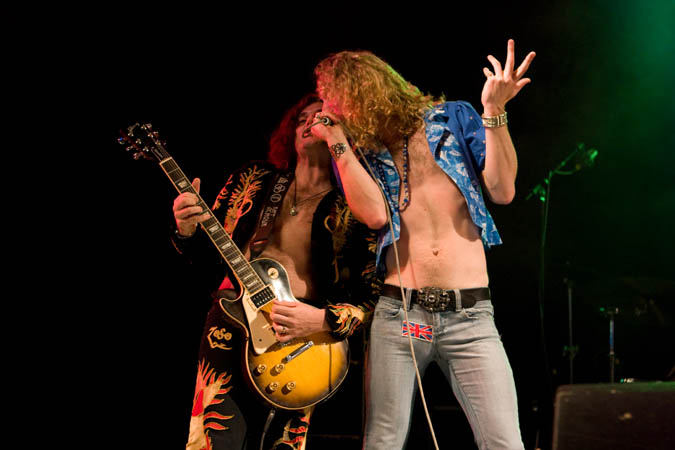
Tonight I watched live videos of Led Zeppelin at their peak, and the official video for Deep Purple’s Child in Time. It’s interesting to watch Robert Plant’s stage persona because it is simultaneously powerfully masculine and sexual, but also coquettishly feminine and camp. For those of us who grew up after the ’70s it’s hard I think to understand how deeply transgressive metal presentations of masculinity were, though the Deep Purple video gives some hint as to the shocked response of ordinary society at the time. The men in these early bands were constructing a new vision for themselves and men generally, and a new ideal of a social order, one which I think in retrospect needs to be seen as much more than just spandex-and-weed nihilism, but as a real (and largely unconscious) attempt to drag the sexual, religious and political radicalism of the English enlightenment into the modern world. I think the only band who actually realized and understood this visionary ideal were Iron Maiden, who are the conscious and willful inheritors of William Blake, but I think the other bands of that era – primarily the British masters, but in their footsteps the American and European legends – were setting about the same project, though sometimes doing it more from a classically romantic rather than strictly enlightenment vision. In amongst the drugs, the sex and the trashed hotel rooms it’s easy to lose sight of the fundamental vision that these men were trying to put forward to the world, a vision of peace, personal religious mysticism and sexual freedom that the world was not ready for, just as it was not ready for and ultimately failed to realize these exact same goals when they were put forward 200 years earlier by Blake and his contemporaries.
I have read that the English Enlightenment is often overlooked by scholars, and that many people don’t even realize there was a separate enlightenment happening in England, but that it had some of the most radical and visionary ideals of any of the enlightenment thinkers. Certainly William Blake was a powerful spokesperson for sexual liberty and political and religious freedom, and it was through the ideals of people like Blake and Wollstonecraft that the Romantics got their chance to rewrite the cultural landscape. I’ve said before on this blog that I think heavy metal is a part of Britain’s mainstream cultural tradition, but in this post I want to go further and say that metal was not just grounded in and drawing upon British cultural history, but was a direct continuation – through Victorian figures like Swinburne – of the radical ideas of the English enlightenment. This is why we find Bruce Dickinson singing Jerusalem at Canterbury Cathedral, and Led Zeppelin’s Stairway to Heaven rich with lyrics referencing the faerie and pagan dreams of Chaucer, Blake and Keats. It’s no coincidence that these men were also challenging masculine ideals of the time, wearing their hair long and singing and acting like women, because the redefinition of sexual liberty and sexual roles was an important part of the English enlightenment. I think it’s also no coincidence that the foremost bands, like Deep Purple and Metallica, lent themselves so easily to classical music, because they were themselves drawing on a musical tradition grounded in opium highs and romanticism that they could be easily adapted back to, and have shown themselves very amenable to.
Amongst all the modern strands of music, I think heavy metal is simultaneously the most conservative, because it fails to stray outside of the parameters set down by the classical musicians of 200 years ago, though it may sound radically different to them. It also confines itself to noble themes and the grandiose and political, studiously avoiding the personal and local themes of folk, hip hop, rock and pop; while they focus on talking about themselves and their relationships metal insists on regurgitating the age-old constants of religion, death and war. But it simultaneously describes new modes of sexual liberty, presents masculinity in a new and very camp style, sneers at the madness of modern politics and does the whole thing while hurtling through a classic opium-induced haze. Rather than being seen as the decline and fall of modern civilization, I think metal needs to be seen as the periodic revitalization and restoration of enlightenment values, a powerful and radical push back against the stultifying sameness of modernity and the growing conservatism of post-war art. Metal is also a sign that the enlightenment was not a phase the west went through, but is a constant spirit of restoration and reinvigoration that has been running through western culture for the last 500 years. And what better flag bearer for that spirit of restless change than Iron Maiden, Megadeth and Slayer??
I’ve recently been building a fairly complex series of Bayesian spatial regression models in BUGS, and thought I’d share some tips based on hard won experience with the models. The various BUGS packages have the most cryptic and incoherent error messages of any stats software I have ever worked with, and although various Bayesian boosters claim that their modeling approach is intuitive, in my opinion it is the exact opposite of intuitive, and it is extremely hard to configure data for use in the packages. Furthermore, online help is hard to find – google an error message and you will find multiple websites with people asking questions that have never been answered, which is rare in the modern world. I take this as a sign that most people don’t understand the error message, and indeed the BUGS manual includes a list of errors with “possible interpretations” that reads more like the I Ching than a software guide. But Confucius say Enlightenment is not to be found in Black Box Pascal, so here is my experience of BUGS.
The models I’m running are complex, with nested conditional autoregressive structures and the higher level having more than 1000 areas with complex neighbour relationships, and millions of observations. I originally ran them on a completely hideous Hewlett Packard laptop, with 4 cores and 8Gb of RAM. I subsequently upgraded to a Dell Workstation (joy in comparison to HP’s clunky root-kitted horror) with 8 cores and 16Gb of RAM; I’m not sure that hardware is the main barrier to performance here though …
The HP machine had a secret administrator account (arseholes!) so I couldn’t install winBUGS[1], so I started off running OpenBUGS called through R’s R2OpenBUGS package running in RStudio. I use R to set up the data and initial values, because I can’t think of any other way to load millions of observations into a text file without going stir crazy. But when I call OpenBUGS it just hangs … no error messages or any other kind of indication of what is going on. I also can’t tell if it is happening at the data loading or compiling or inits stage.
Some digging around online and I found an old post by Andrew Gelman, observing that BUGS does not work well with “large datasets, multivariate structures, and regression coefficients.”
i.e. pretty much every statistical problem worth doing. Gelman also notes that “efficiently-programmed models can get really long, ugly, and bug-prone,” which seems like a contradiction in terms.
Anyway, noting that my data was large, with multivariate structures and regression coefficients, I thought maybe I should tone it down a bit so I tried using a higher level of spatial heirarchy, which reduces the adjacency matrix by an order of magnitude. Still no dice. It was at this point that I upgraded to the bigger computer.
On the bigger computer the smaller model actually worked! But it didn’t work in the sense that anything meaningful came out of it … It worked in the sense that it reported a completely incomprehensible bug, something like a node having an invalid value. I tried multiple different values and nothing worked, but somewhere on the internet I found someone hinting that you should try running BUGS directly rather than calling through R, so I tried this … having created the data in R, I killed OpenBUGS then opened the OpenBUGS interface directly and input the model, then the data, using the text files created by R[2].
When I did this I could step through the process – model was syntatically correct, then model failed to compile! Given that loading inits comes after compilation, an error telling me that I had the wrong initial value seems a bit misleading… in fact I had an “index out of range” error, and when I investigated I found I had made a mistake preparing one part of the data. So where the actual error was “the model can’t compile because you have provided the wrong data,” when called through R the problem was “you have the wrong initial values” (even though I haven’t actually loaded initial values yet).
WTF?! But let’s step back and look at this process for a moment, because it is seven shades of wrong. When you run R2OpenBUGS in R, it first turns the data and inits into a form that OpenBUGS can read; then it dumps these into a directory; then it opens OpenBUGS and gets OpenBUGS to access those files in a stepwise process – at least, that’s what I see R doing. If I decide to do the model directly in the OpenBUGS graphical interface, then what I do is I get R to make the data, then I use the task manager to kill OpenBUGS, then I call OpenBUGS directly, and get OpenBUGS to access the files R made in a stepwise process. i.e. I do exactly the same thing that R does, but I get completely different error messages.
There are various places on the internet where you might stumble on this advice, but I want to stress it: you get different error messages in OpenBUGS run natively than you do in OpenBUGS called through R. Those error messages are so different that you will get a completely different idea of what is wrong with your program.
Anyway, I fixed the index but then I ran into problems after I tried to load my initial values. Nothing seemed to work, and the errors were really cryptic. “Invalid initial value” is not very useful. But further digging on the internet showed me that OpenBUGS and WinBUGS have different approaches to initial values, and winBUGS is not as strict about the values that it accepts. Hmmm … so I installed winBUGS, and reran the model… and it worked! OpenBUGS apparently has some kind of condition on certain variables that they must sum to 0, while winBUGS doesn’t check that condition. A free tip for beginners: setting your initial values so they sum to 0 doesn’t help, but running the same model, unchanged, in winBUGS, works.
So either OpenBUGS is too strict, or winBUGS lets through a whole bunch of dodgy stuff. I am inclined to believe the former, because initial values shouldn’t be a major obstacle to a good model, but as others[3] have observed, BUGS is programmed in a completely opaque system so no one knows what it is doing.
So, multiple misleading errors, and a complex weirdness about calling external software through R, and I have a functioning model. Today I expanded that model back to the original order of magnitude of small areas, and it also worked, though there was an interesting weirdness here. When I tried to compile the model it took about three hours, and produced a Trap. But the weird thing is the Trap contained no warnings about BUGS at all, they were all warnings about windows (something called Windows.AddInteger or similar), and after I killed the Trap my model updated fine. So I think the compile problems I previously experienced may have had something to do with memory problems in Windows (I had no problems with badly designed adjacency matrices in the larger model), but OpenBUGS just doesn’t tell you what’s going on, so you have no idea …
I should also add, for intrepid readers who have got this far, that this dude provides an excellent catalogue of OpenBUGS errors with his plain English explanations of what they actually meant. He’s like this mystical interpreter of the I Ching for Bayesian spatial regressives. Also I want to add that I think the CAR spatial correlation model is super dodgy. I found this article (pdf) by Melanie Wall from the Journal of Statistical Planning and Inference (what a read!) that shows that the way we construct the spatial adjacency matrix is the primary determinant of the correlation structure, and that the correlation structure determined by this adjacency matrix is nothing like what we think we are getting. Today on my whiteboard and with the help of R I imagined a simple industrial process where each stage in the process is correlated with the one before and after it, and I showed very easily based on Wall’s work that the adjacency matrix required to describe this process is completely different to the one that you would naively set up under the framework described for CAR modeling. So I think most of the “spatial correlation” structures described using CAR models have no relationship to what the programmer thinks they’re entering into the model. But I have no proof of this, so I guess like everyone else I’ll just press on, using the adjacency matrix I think works …
So there you have it. Next time you see an opinion formed on the basis of a spatial regression model built in BUGS, remember the problems I had getting to the output, and ask yourself – do you trust that model? Really?
—
fn1: Well, I could copy winBUGS into the program files folder but I couldn’t patch it or install the immortality key, which, wtf? When I bought Time Series Modelling and Forecasting by Brockwell and Davis, ITSM came as a free disk with the book. When I buy the BUGS book I get to install software that comes with a big message telling me to get stuffed, and years later they finally provide a key that enables you to use it for free …
fn2: If you aren’t aware of how this works, basically when you call OpenBUGS in R, providing data from inside R, R first dumps the data into text files in the directory of your choosing, then OpenBUGS opens those files. So if you aren’t comfortable preparing data for BUGS yourself, use the list and structure commands in R, then kill OpenBUGS and go to OpenBUGS directly … the text files will remain in the directory you chose.
fn3: Barry Rowlingson does a pretty good job of showing how interesting and useful spatial analysis can be: see e.g. his post on mapping the Zaatari refugee camp in Syria.
Standard economic orthodoxy seems to be that deflation is a terrible thing that all economies should avoid. Most central banks now seem to have an inflation target that is greater than 0%, and move their interest rates to try and keep inflation inside this target; inflation numbers are eagerly anticipated economic indicators, with anything below 2% or so greeted with horror; and one of the core goals of Abenomics is getting Japan out of its deflationary situation. Indeed, one of the central criticisms of Japan’s economy is that it has long been deflationary, which is supposed to be terrible.
Recently Paul Campos at Lawyers, Guns and Money observed in a somewhat surprised tone that deflation has been the norm for a large part of American history, and before world war 2 inflation often only accompanied major economic shocks and war. He writes:
(1) Overall prices in the American economy were about the same at the beginning of FDR’s presidency as they had been at the end of George Washington’s second term.
(2) Prices were nearly 25% lower in 1900 than they were in 1800 — that is, on net the 19th century was deflationary.
(3) Prior to the middle of the 20th century, significant inflation, rather than being seen as a normal thing, was very closely associated with, and clearly caused by, war. Indeed, prices would have been very strongly deflationary over a 200-year period if not for bouts of severe inflation during the Revolutionary War, the Civil War, and World War I.
(4) If we consider American economic history from colonial times to the present, the last 75 years have been an almost freakish exception to the normal course of events, in which prices are as apt to fall as they are to rise.
The tone of his blog post is mild surprise, and it includes a request for a recommendation for a cultural history of inflation. He notes that until recently American economists could compare average prices in nominal terms over very long periods, because prices would be relatively similar even over 200 year periods, though in the short term they might not be stable. His observations about the history of inflation in America surprised me as well.
It’s obviously difficult to compare economies across 100 years, and the economic fundamentals of expansionary, colonialist America with a gold standard currency were obviously very different to modern America or Japan, but it should be obvious I hope that for large periods of time during these deflationary eras the US economy was both growing, something of a miracle around the world, and also generally working to enrich and improve the lives of its residents. So what is going on with this deflation thing? Why is it so terrible?
This question bugs me a lot because I live in Japan, and for a country that is supposedly suffering under deflation it seems to be doing pretty well. It’s difficult to say people aren’t consuming, for starters, and indeed the same newspapers that will decry the dampening effect of deflation on the Japanese economy will also carry stories stereotyping Japanese as brand-obssessed hyper consumers. I certainly don’t notice a lack of consumer effort in this country, and in just the last year in my suburb three new department stores have been built. Economists often tell you that the problem with deflation is that it discourages people from buying things today because they know they will be cheaper tomorrow. If that is the case then in Japan it is probably working as a very useful dampener on economic activity – if Japanese people consumed any more than they do, everyone in Japan would have to work without sleep just to deliver the goods. It certainly doesn’t appear to be stopping people from consuming, and furthermore life in Japan is excellent, the standard of living is high and it is a peaceful, functioning society with excellent quality consumer goods and (comparatively) low rents … So why are economists so worried about deflation, and why do they constantly criticize Japan for its deflationary situation?
My theory is that deflation is viewed by most mainstream economists (and especially economic commentators) through the same narrow, biased lens as inflation and printing money. There are several aspects of Japan’s deflationary economy that most economic commentators completely ignore, because they would mean taking into account the whole nature of the economy and the behavior of individuals and institutions in it, rather than reciting a simple mantra. These aspects are:
Japan’s population is aging and older people consume less goods from many sectors, so reduction in consumption is to be expected as part of population realignment
Japan has a long history of infrastructure growth and investment, and still does, and as population growth stalls this historical infrastructure has to do less and less work, so maybe prices don’t have to rise
When you can’t compete on lower prices because everyone expects prices to fall anyway, you have to compete on quality, which is why Japanese services are such high quality
For a long period of time Japanese companies have been avoiding raising prices by giving more work to the same number of people, making their workers work longer hours without hiring new people, and I think this is an inevitable aspect of an economy with very low unemployment
The bubble saw prices rise way too high, and a long period of deflation has been necessary to reset these prices to a more reasonable international standard, so here deflation is at least partly a correction to a historically stupid mistake
None of these things (except the overwork thing) are necessarily bad, and fixing the overwork problem would require that Japanese institutions find a way to employ the last 3-5% of the population who aren’t working but want to work, or employ more women, and there are lots of reasons why this can’t happen. You would think that with Japan’s labour economy bumping up against structural unemployment limits, prices would rise under labour constraints, but I think this is balanced by the aging of the population and reduction in consumption in many areas of social life, plus automation, and it all just ends up balancing out.
It is sometimes said that inflation is the friend of the poor and the working class, because in chewing away at the value of money it prevents the rich from getting richer. I think this is very far from a universal truth, because whether inflation works in this way depends on what prices are inflating and why, and what the balance of interest rates and inflation are. If interest rates have to be raised to keep inflation in check, there may be long periods of time when prices are growing as fast as wages but interest (and therefore accumulated wealth) is growing faster. Or the opposite may occur. The same applies with deflation – it’s the friend of the working class if it arises because access to infrastructure and land is falling in value (which may have happened for long periods of time in US history as it opened the interior), but the enemy of the working class if it is arising because of economic collapse that leads to labour instability and loss of work. Looking at the history of the USA as presented at Lawyers, Guns and Money it appears that inflation was the enemy of the working class before world war 2, when it was associated with instability and job losses; perhaps deflation was largely irrelevant to them.
What is the real story now? Is deflation to be universally feared, or is it just one more partial indicator of the quality of the total economy?
Update: Subsequently to writing this post I discovered a chart of historical inflation at Eli Rabett’s, which shows the step change in 1950, with his opinion about what this means for discount rates and future costs of climate change.
One of the English loan-words that Japanese people misuse slightly in a really cute way is gorgeous (ゴージャス). In Japanese gorgeous refers not to something really nice, but to something that is overdone or just a bit too much – not necessarily unappealing or unattractive, but just a bit too much. I’ve heard the word applied to appearance, food and even writing (e.g. scientific writing should not be gorgeous). It’s often associated with the stylistic choices of young women of a certain social class, and also with hostesses. It’s not necessarily a marker of class or taste, and not deployed in a particularly judgmental way, but it suggests a certain immaturity or inelegance in taste, something that’s acceptable in young women but not for example something one would respect in an adult[1].
The Hobbit: Battle of Five Armies is the cinematic showcase for this word. It’s too long, the battle scenes especially are unnecessarily embellished, and the heroism is over the top and over-frequent. Almost every moment of it is also great fun. These battle scenes are the kind of battles where you can imagine seven impossible maneouvres before breakfast, where enormous and terrifying trolls are killed with a single knife stroke, and where a war pig can be more terrifying than a giant. There are even sand worms! As battles go it’s a tour de force, the entire movie is basically one long series of battles, with maybe two brief pauses to discuss the importance of family and tasteless jewellery. The centerpiece battles – between the Uruk Hai and the dwarven heroes – are masterfully done and very enjoyable, but they’re so over the top as to be ridiculous. They’re also good examples of exactly what gorgeous means: for example, Legolas’s prancing up the collapsing tower is precisely how I imagine an elf to be able to move against the laws of nature, it’s the right thing to be in this kind of movie, but it is dropped into the middle of such a long-running series of epic-level feats that instead of being stunning and impressive, it’s just another blister of impossibilities on the back of your retina.
In this regard the movie can be contrasted very effectively with other works from the same series. The final battle between the fellowship and the Uruk Hai in The Fellowship of the Ring, for example, is a masterclass in how to turn a classic role-playing battle into believable cinema. It depicts a group of high-level characters at the peak of their power pulling themselves out of what is basically a lethal ambush by overwhelming numbers, with minimal losses. They do things we know are physically impossible, but they aren’t so far from impossible that we are lifted out of the feeling of the battle by them, and they aren’t so fast-flowing that they become overwhelming in their fantasticality. That battle is heroic fantasy at its finest, patently unrealistic but completely believable in the context of the world, and really engaging. The battles in the Battle of Five Armies are so full of over-the-top heroics and impossibilities that they become less an exercise in story-telling and heroic fantasy and more of an exercise in braggadocio by everyone involved. Yes, I want to see my fantasy heroes do impossible things; I want to see victories against overwhelming odds; I want to know that these people are not normal, not like me, doing things I can’t do. I don’t want this experience to be transformed into marveling at the ingenuity of the movie’s creator’s rather than its characters.
Just as a young hostess’s style can be so gorgeous that it becomes a self-evident performance of beauty rather than beauty itself, so this movie has turned heroic fantasy into a performance of itself, rather than a performance for its fans.
And don’t get me mistaken, I am a fan. The Hobbit is not a particularly interesting or enjoyable book, and Peter Jackson had pretty thin gruel to work with in making this part of the epic; he also had to please a group of tantrum-prone true-believers with an immature and shallow approach to the work. Given how dark and grim the later Lord of the Rings movies turned, he also had to find a way to leaven the silly boys-own-adventure style of the main plot with some kind of nod to the growing shadows. By choosing to work in the unwritten parts of the original story – Gandalf’s exploration of Mirkwood and the battle with the necromancer, for example – I think he has made the story more engrossing and enjoyable. He has also managed to present us with a breathtaking and splendid vision of Middle Earth, carved out of New Zealand, that has been more or less consistent across six diverse movies, and has stuck very closely to the aesthetic vision of Tolkien’s main visual interpreters. He managed to lift the dwarves from their shallow representation in the book and Snow White-style triviality in popular culture into serious, adult figures without falling on the cheap Jewish or Scottish stereotypes that often get attached to them, and for this all Tolkien fans should be eternally grateful. The dwarves are excellent, and as dwarves should be – dour, hard working, tough, narrow-minded and loyal. They look like adults and adventurers, and unlike Gimli (or Dwain in this movie) they don’t get turned into comedy sideshows. The Hobbit would have been an utter disaster if it had been made by someone trying to be loyal to the original book and the needs of the fans, it would have been a single stupid movie involving 12 characterless technicolor idiots and a dude in a pointy hat, cocking up everything they do.
Furthermore, The Hobbit is a rare example of a movie that manages to make a dragon a central part of it without cocking it up monumentally, which every other movie except Dragonslayer and Reign of Fire has managed to do. Smaug is an evil, cunning, wily and deeply sinister monster of terrifying power, and as soon as he is let loose on Dale you can see why armies of dwarves would fall before one of these things. His supreme arrogance, coupled with his incredible power and complete disregard for mortals and their feeble efforts, is a joy to behold. This is how a dragon should be! But even here we see Jackson falling for the gorgeous: the simple tale of Smaug’s death gets padded out with an unnecessary piece of sentimentality and impossibility, and a spot of slightly out of place (but nonetheless enjoyable) humour. Nothing in this movie just jumps, or just climbs, or just dies. Not even Smaug.
Still, I didn’t sign up for the last instalment in this epic so I could see a handful of orcs get their arses kicked by some woodland sprites and a few technicolor stereotypes in a backwoods scrap. I signed up for a monumental battle between the noble forces of good and the deepest evil ever conceived, and that’s what I got – in spades. The Orc leaders and Uruk Hai champions were awesome, the dwarven and elven battle scenes were spectacular, the troll stormtroopers impressive and exciting (though like every other stormtrooper, remarkably easy to kill …), the desperation of the human defenders grim and hopeless. This is a two-plus hour rollercoaster of well-deserved death and slaughter, and though you will at times find yourself thinking “what were they thinking?” and marvelling more at the movie-makers’ ingenuity than the actual traits of the people on the screen, you’ll still love every minute of it.
But it is too gorgeous.
—
fn1: Remembering that in modern Japan the word “adult” is increasingly coming to mean a person over 30, and there is even a growing fashion trend for otona (大人) that is specifically aimed at offering classy but still pretty and sexy clothes to women aged in their 30s and 40s. This style is largely the opposite of gorgeous.
This is an account of our first, short adventure, playing the Malifaux RPG Through the Breach. Malifaux is a Victorian steampunk-horror setting in which the world as we know it is linked to another, sinister world called Malifaux by a phenomenon called the Breach. The Malifaux side of the Breach is full of magic powered by artifacts called Soulstones, and the mundane side of the Breach mines these soulstones to power magic on the mundane side of the Breach. Our characters traveled through the Breach in response to an advert seeking adventurers …
The PCs are my character, Penitent Benny, and two others:
Lucien Buchmeister, a bookish chap from Prussia who carries a couple of pistols and has secret magic powers (magic is monitored in the world of Malifaux)
Damien, a Frenchie woman with a scarred face and a very cold demeanour, who whispers to her carbine, which she calls Mon cheri …
What could possibly go wrong?
The three PCs met for the first time outside the double doors of the main station at the Breach. It was a typical hot, dusty day in Malifaux, though to the characters the soul-sapping heat and dryness were yet a novelty. They stood facing a hectic loading yard, full of horse-drawn carriages, porters, rough-looking steam-yarders of every physical description, hue and creed. A gang of Sikhs gently lifting a crate of carefully balanced vases, sweat streaming down their dark bearded faces, turbans gleaming like jewels against the dust and faded ochre of the yard; a squad of Condottieri, resplendent in blue and red silks and brocades, heavily armed and sweating like pigs; a group of Japanese pearling women, famously crossing the Breach to find soulstones in flooded mines, weaving through the yard in colorful yukata, fans waving and tittering in the heat; in amongst them all the swarming throng of leather-chapped steam-yarders, carrying, cursing, fighting, spitting and yawning, surrounded by the stench of horses and tendrils of dust and smoke.
The characters converged amongst this clouded, crowded chaos on the diminutive form of one Mr. Tyler, Esq., standing next to a large carriage atop which sat an enormous, coal-dark black man, a veritable mountain of ebony flesh carrying a blunderbuss the size of a London Omnibus. This black man was holding a signboard in one hand that read “Messrs Damien, Lucien and Benny”, and looking about him with a wary, bored gaze. Beneath him, in the shadow of the carriage, Mr. Tyler stood gleaming pale white in a white linen suit, blazing brilliant white even in the shadows. Diminutive and wiry-looking, he spat out a gobbet of chewing tobacco as the characters approached and strode forward to greet them, hand outstretched. “Mr. Tyler, dogsbody to Dr. Samuel Jacobs. Welcome to Malifaux,” he greeted each of them in turn, looking a little surprised to discover that Damien was a woman, and gesturing them to the carriage. “It’s straight to Dr. Samuels, I’m afraid, for your interview with your new employer, and then to your lodgings. If you don’t mind?”
The journey to Dr. Jacobs’ place was short, and during the ride Mr. Tyler maintained a constant patois of explanations and descriptions of the city of Malifaux, with no questions asked about the characters’ journey or origins. They soon reached Dr. Jacobs’ mansion, a classic Colonial mansion with large gardens and a pristine, low white wall, and the carriage swept through an open gate and perfectly manicured gardens to a wide gravel yard before the grand entrance. Mr. Tyler led them inside, and they soon found themselves standing in a classic academic study: cluttered with books and oddities, stuffy with the smell of old papers and dead things, and dominated at one end by a huge desk. Behind this ostentatious arrangement of marble and leather sat a frail, worn-looking old man who introduced himself as Dr. Samuel Jacobs, shaking each of their hands without standing, and explained the rules of their engagement to work for him:
Free lodgings with the indomitable Mrs. McCranning
15 scrip a week [<-this is a quite fantastic quantity of money]
Extremely dangerous work at Dr. Samuels’ whim, on demand
With that he told them the nature of their first job. He had recently lost his fob watch, which had considerable value to him since it was given to him by his deceased wife, and he needed them to find it. Though the task might seem trivial, his experience of Malifaux was that such minor misdemeanours as a stolen watch could explode into catastrophe if not addressed, and he needed that watch. The PCs were to find it, and they could start by visiting a Guild investigator by the name of Travis Cain, who rumour has it had been investigating petty theft in the slums.
With that simple explanation the PCs were dismissed, and left the house to ride to their lodgings. Mrs. McCranning’s was a huge Georgian building in downtown Malifaux, not so close to the quarantine quarter or the slums as to be damnable, but not far enough to be comfortable, occupied primarily by travelling labourers. Mrs. McCranning was a classic Irish landlady, hard as nails and shrewd as a goblin. Fortunately she found a soft spot for Penitent Benny, and was willing to secure them a late dinner and baths before they retired. They spent the night in adjoining rooms, Damien chattering to her rifle, Lucien to his books, and Benny screaming his nightmares to the rafters. A group of valiant adventurers ready for any task.
The next morning, after a robust breakfast, the PCs visited Mr. Cain at the Guild HQ, to ask him for advice. This man, snoring in the corner with a bottle of whiskey on his desk, was of little help; he demanded one of their scrip before he would help, and then told them the names of a few families he had investigated in the slums. They paid up and trundled off to visit the slums.
Unfortunately in the slums a local gang lord, the red something-or-other, had them followed, and thinking their pursuers part of the problem they ambushed them in an alley. One they killed and the other two they injured, and in the talk that followed discovered they had simply killed a couple of local gang members keeping an eye on them. These gang members were aware of the stolen local items, and as a sop to avoid getting into trouble with their leader the PCs offered to share any information with the red something-or-other before reporting it to the Guild. With that they continued their search.
They soon found their first target, a family whose two children who had lost their stuffed toys and were now slowly dying of some kind of withering illness. The PCs very quickly realized what was going on here when they heard the mother thought she had seen something near one of the children during the night. They set up a watch.
They were soon rewarded. During the night two small creatures stole into the room where the children slept and sat on their chests. They touched the childrens’ heads, and a strange glow began to form, obviously stealing the childrens’ life force. However, at the same time a strange magic fell over the whole area, causing everyone except Lucien to fall asleep. Lucien managed to wake Penitent Benny, and then ran outside to wake Damien. Penitent Benny acted, moving against the creatures. In the glow of their soul-stealing magic he realized they were some kind of puppet, made out of an agglomeration of household objects. Each of them included a single piece of a child’s teddy bear, as if they were some kind of fetish made of ordinary people’s belongings – including these childrens’! Whatever their origin, Benny didn’t like them, and threw his bowie knives at the puppets. He killed one and pinned the other one to the wall.
Meanwhile Lucien had failed to wake Damien, but upon emerging into the street (where Damien was keeping guard) saw a strange magical woman who terrified him so much that he was forced to run away in fear. Once out of sight around the block he was ambushed by another, nastier puppet, and got caught in a battle that lasted some time before he could kill it. Meanwhile Benny woke Damien and they killed the woman in the street. By the time they had dealt with her Lucien returned from his victory over the puppet (what a hero!) and they all returned to the bedroom, where the puppet remained pinned to the wall. Penitent Benny tied a piece of string and a tin can to it, and they let it go. It immediately scarpered, heading off into the city, so they followed.
The little scoundrel scampered over rooftops and alleyways, moving fast but without concern for stealth through the empty early morning streets until it arrived at the wall separating the slums from the Quarantine Zone. Here it started digging a tunnel under the wall. The PCs climbed the wall, though doing so is highly illegal and probably quite dangerous, and waited calmly on the other side for the puppet to finish digging. They then followed it some more, into the Quarantine Zone. After perhaps another ten minutes of running, it scampered into what was quite obviously an ancient tomb.
They followed.
Inside they descended some ancient stairs into a narrow tunnel, lined with chambers. In each chamber was a huge pot, filled with random household items. At the farthest end of the tunnel, the chambers were empty of pots… Soon the tunnel ended, opening into a large room dimly lit with candles. The PCs stopped and Penitent Benny crept ahead to look.
In the room he saw a huge old tomb, on which danced two man-sized puppets, communicating silently with their little tiny puppet. The floor was covered in discarded household items, and two huge pots full of items sat near the throne. There was a sense of malice and despair about the room, and as Benny watched the puppets took one of the pots and did … something to it. A dark, sinister mist emerged from the pot and poured into tomb, within which something … huge and sinister … slowly stirred. Then the puppets cast the pot onto the floor where it broke, its ordinary household contents crashing in amongst the sea of other contents. The two big puppets then looked at the tiny one, and it fled back the way it had come, obviously already setting out to find a new victim …
They attacked. With surprise the battle did not last long, and soon the two big puppets were soon dead. They explored the room briefly but there was nothing else there but the tomb. Being new to Malifaux, they soon decided the best course of action would be to open the tomb, and between the three of them managed to pry off one of the stone slabs covering it. Why was the slab so heavy? It were as if whoever made the tomb didn’t want it opened…
As the slab tumbled off the tomb, they all heard a roar of anger, and a dark, malevolent force began to emerge from the tomb – a kind of huge, shadowy version of the puppets they had killed. It oozed out of the tomb at first like a thick goo, but soon began to congeal in the middle of the room, gathering together the household belongings as it formed like a kind of huge, shadowy tatt-magnet. As it grew they saw Dr. Jacobs’ fob watch in amongst all the tatt, slowly being drawn towards the shadow. The grabbed it and, realizing their mistake, ran for the exit, followed by the booming laughter of the growing shadow. They burst outside just in time, running helter skelter for the Quarantine Wall, as behind them a vast shadow blocked out the evening sun, crawling with invincible and patient malevolence slowly down the alleys and byways of the Quarantine Zone. What had they released?
They tumbled over the wall into the slums, and already they could see movement about, as people felt the thing coming before they could even see it. They ran straight to the crime boss, the red something-or-other, and told his minions to get everything he had out on the street now. They didn’t wait around to die though, and ran on, towards Downtown. By the time they got to Downtown word had reached someone somewhere that a Big Thing was arisen, and they saw many Neverborn hunters from the Guild rushing down to the slums. They even saw Travis Cain, though they didn’t bother to offer him any useful information. Instead, they ran.
Their adventure ended there. The townsfolk hid and for the whole night battle raged through the slums, as the red gangs and the Guild fought the beast. By morning many of the red gang were dead and their leader was a hero, the black shadow beast defeated. The PCs were able to quietly hand over the watch to Dr. Jacobs and retrieve the reward, and no one – not even Dr. Jacobs, though no doubt he suspected – was aware that Malifaux’s near destruction was the fault of a group of young idiots opening the wrong grave.
The next day they received 15 scrip. So who really cares?
[Editor’s note: this is a guest post giving an account of another downtime, played by Bart, who is responsible for our hacker, Ghost.]
After loading in the loot from their latest gig, the hacker Ghost and kid mechanic Tail have separated from their companions to bring the stuff to their hideout quickly and are preparing to launch a whaler they found at the bottom of the facility, to get away from the reinforcements coming from above, which their friends are currently keeping occupied.
The bulky machine actually resembles a whale. The tail ends in two rotors, and the sides of the machine contain two hover engines that seem to double as rotors. The cockpit gives a distinct vibe of the head of a killer whale. Whalers are a type of semi-hover crafts that were really common in New Horizon before the Crash. They are really slow and hard to manoeuvre in the air and can’t fly very high, but they are supposed to be airtight and capable of operating underwater. Goldfish hunters sometime use them to seek out the big mutant fish schools underwater and report their current location to others who will swim down with tougher vehicles.
The whaler sits next to a shaft that goes down into New Horizon as far as the eye can see. A walkway spirals around the shaft, but even that eventually vanishes into the distance.
Tail finishes working on the Whaler and closes everything up. He watches as the kids are being dragged in and placed inside the whaler. He looks at them confused, as he tries to talk them. Then a bit annoyed when they dont answer. Then he just ignores them. After everything is loaded, Tail goes in and starts the Whaler, warming it for take-off. The thing coughs to live, its thrusters taking a few tries to come alive. “We good!” You hear Tails voice from the cockpit. The machine takes quite a while to take to the air. The weight of the loot is being hard on the ship, so Ghost slowly lowers her down into the rabbit hole. He can hear the sounds of shots being fired coming from upstairs, and he hopes the rest of the team is alright.
Tail seems to be very excited about the ship. He is monkeying around, pressing and tinkering around with stuff and generally making sure the ship stays up.
They start their slow descent down the shaft, seeing an infinite number of tunnels cross it as they slowly drop down and down. After 10 minutes of steady descent, there is still nothing on the radar that gives any indication of the shaft ending anytime soon.
It feels like a kind of time travel to them, staring out of the windows. At the upper levels, they see recent buildings and abandoned cars from the age of the crash, then as they go further down, they see less damaged but much older buildings. After a while they notice a change in the whole layout, and Ghost figures they must’ve crossed into the docks. The only light remaining here is some scattered remnants of machinery and city that are still powered by a quirk of fate, and the light of the whaler’s powerful spotlights.
The shaft widens and in the distance they hear the husks of old machinery. Probably factories, utility docks and the huge -now abandoned- railways that Titan Corp used to move its massive trains around the belly of New Horizon. It is terribly quiet, and still the radar detect no movement except debris that from time to time falls from the upper levels, probably disturbed by the little life that remains down here, but possibly just because the structure is old enough to get instable. Those drops are followed by little tremors as if a huge metallic beast is snoring down here.
Ghost slowly steers the whaler further down, weaving around and between machinery and vents as necessary. “I wonder how far down this goes…” He says while glancing up.
“What was originally up there that required access to this… pit?” he wonders aloud.
As they drop down further, he soaks in the silence, and unconsciously sends out a ping through the husk to see if a part of it is actually alive down here. Somewhat to his surprise, there are actually some scattered responses.
“Kinda looks like the big shafts in between districts no? Weird that it is in the middle of everything!” says Tails from the back of the whaler.
Ghost can’t do anything but nod, “Indeed”, he’s obviously impressed by the fact that this shaft is here, in the middle of the city. They keep going down.
“Are we ever going to get anywhere?!” says Tail, getting frustrated with the ceaseless monotony of the descent.
Ghost shakes his head, and wonders about that himself as he stares through the window, trying carefully to avoid any objects in the way. A few beads of sweat form on his face from the ceaseless concentration.
When the amount of debris decreases a bit, Ghost slows the descent and tries to connect to the net to download anything that would remotely resemble a map of this place. Something tells him the infrastructure to connect to the husk will only get worse as they continue their journey. He suddenly regrets not moving the ERHAS (Extreme Range Husk Aligned Scanner) they had in their normal transport over to the whaler. He downloads as much information as he can while they journey down the rabbit hole.
After 40 minutes of slowly making their way down, the scenery changes again. “Wooow” Tails exclaims, as they leave what was probably the Docks and enter the Pit. There is no technology or docks anymore, just massive structures of concrete, and darkness. All light is gone, and the only light remaining is what the whaler’s beams give off, but that play of light creates an awesome spectacle. Everything is wet and slimy, reflecting the light. They suddenly make out what have to be the corpses of REALLY old buildings hidden in the darkness. They must be hundreds of years old by the looks of their husks and lack of the usual steel. Ghost lets out a low whistle in appreciation. He looks a tail “These buildings really are ridiculously old. Have you ever seen something like this before?”
Tail just shakes his head, staring outside.
It takes them about 20 minutes longer before they eventually reach the bottom. The whaler sets down on a concrete base, amidst the rubble. There are odd concrete pathways with dotted white lines, and at some places in the rubble there even seems to be some rotted wood. The diameter of the tunnel at this point is still over 50 meters, but even with their spotlights they can only see about 10 meters into the distance. Dozens of tunnels and paths are going everywhere. Some should lead to the waterline, but they are not sure. Ghost tries to compile all the maps he got on the journey down into something intelligible. He was expecting the concrete floor, the maps show that there used to be a “deck” here, or what people from decades ago thought of as a deck in their simple minds.
The maps show a vast and complicated network of old streets that could make anyone lose it, after showing the map to Tail they figure their best chance is to try and find a way further down, to sea level. That way they’ll have to deal with less structures getting in the way. Only debris and the massive columns that support the district, for which it should be easy to figure out where they are. After that it is pretty much simply sailing northwards. It takes a few tries to find the correct tunnel. Many of the routes on the map have been blocked by fallen debris piles, or things were built in the spaces where shafts used to be. In other cases, the maps are just plain wrong.
Half an hour later they find something, the place used to be a kind of dock, were ships that only travelled in the water used to stop (they have difficulty imagining that, and spend a few minutes trying to figure out how that would’ve worked). The surface here is inclined and broken, a big depression, and further ahead, only slightly illuminated, but visible because it reflects the light from the spotlights, they see it: water.
Ghost does a double check on the lights, before manoeuvring the vehicle forward to the waterline. They can now clearly see the water and all the rubble it contains. The water seems to fill some kind of huge channel about 100 meters wide that runs out through what looks to be an equally huge tunnel. It’s impossible to see how deep the water is, but it certainly seems deep enough to hold the whaler.
Ghost looks at Tail “Do I do anything special here? I have plenty of experience with AV’s, but not with AV’s underwater.”
“Aaah.. “ tails hesitates looking at the dashboard and pressing some buttons.
Ghost just looks on for a while, looking kind of sceptical. Tail seems to be pressing buttons at random, but suddenly the Whaler twitches, and locks come down over the places that were previously open and the air seems to change a bit, a slight hissing is heard from somewhere back in the cargo hold.
A red sign on top of the dashboard suddenly flashes on: “AIRTIGHT”
“We good tank man!” Tails happily exclaims, completely oblivious to the doubtful stare Ghost gives him.
Eventually he shrugs though and positions the whaler above the water.
“Well, let’s do this then” he says as if commanding himself, and he slowly lowers the vehicle into the water. When it seems about completely underwater, Ghost stops the whaler and stands up to take a walk around the inside of the thing. After satisfying himself that water is not pouring into their transport somewhere, he returns to the cockpit and starts moving again. The Whaler slowly glides into the water, reaching the bottom and finding that it is slightly inclined they follow it downwards. They can feel the resistance of the water, as soon as the machine is submerged the thrusters falter for a bit and seem to switch into underwater mode. Making a sound not unlike some of the huge fans running up on the higher levels of New Horizon. As they go down, the hull moans a bit, which freaks them out, but it otherwise seems to hold fine.
Ghost slowly releases the breath he had been holding “Apparently she works fine.” He briefly wonders how the others are doing, then realizes that there is no possible way to know and travels onwards.
He sends out a ping again to the husk surrounding him, but if the husk even exists here it remains as silent as the grave.
The whaler moves slightly faster underwater, but the going is slow because they have difficulty keeping their bearings and have to watch out for obstacles in the dark muddy waters. They see all kinds of strange fish swimming about. After some travel they see lights ahead, as they get closer they notice it’s a school of fish that have small luminescent bodies that quickly flash their bodies when the whaler comes close and rapidly shoot away, the school moves in crazy patterns, which are quite confusing but also very pretty with the greenish blue background.
Their lights turn off suddenly and they disperse, after a few moments, the school come back to life a few meters away in a more relaxed state and they slowly swim away.
Ghost keeps going steadily northwards, based on the maps, they should now be nearing the border between D68 and D73.
As they get closer to the border they see another school of the glow fishes, this time they are swimming forward ahead of the whaler, swinging smoothly from left to right. For a moment Ghost entertains the idea that the fishes are guiding them. It’s quite entrancing and Tail is all smiles.
“Oooh!!!” Tail says grinning wide. The radar beeps and when Ghost checks it, he sees movement up ahead. It is something very confusing, the radar is detecting hundreds of ships slowly moving in on them up ahead.
“Umm…” Ghost stares at the radar feeling suddenly uncomfortable in this metal hulk surrounded by millions of gallons of water. He drops the whaler down to the bottom of the tunnel, setting it down on the base of it, sinking away slightly in some kind of muck. He kills all the lights and the engine, then stares through the window with Tail, in the direction the ships were coming from, to see what the hell that can possibly be.
His hand is hovering over the ignite button, and shaking.
It is too dark to see much outside, the only light being the dim bluish light coming from the glow-fishes. Without radar they can’t tell how close the “ships” are, but Ghost thinks he had a good idea of how far they were. It shouldn’t be too long. The glow fish are swaying left and right and suddenly they see something strange. At first it seems like a shadowy mass is moving towards their general area, big dark shapes moving over and through the glow-fishes, casting shadows and leaving them in more darkness.
Then they see sparkles of gold and orange all around, as the bluish light reflects off the skin of hundreds upon hundreds of goldfishes the size of a man. Some dance around the glow-fishes, but the glow-fish seem to not panic at all unless the goldfish get very close. Then they hear a bump, and the whaler shudders a bit. There is yet another bump followed by the hull whining, as if some pressure is being applied on it. They can’t see anything around, the light from the glow-fish seems to be dimming more and more.
Tail is seemingly oblivious to the whining, staring at the spectacle with a huge grin on his face “Wooooow!”
Ghost himself is impressed for a moment, staring at the huge school of goldfishes, but the hull creaking snaps him back to reality. He anxiously listens to the sound, trying to pinpoint where it comes from. More thumps and shudders come. Suddenly there is a very hard and very loud succession of thumps, and the whaler shudders, whining loudly and inclining a bit. Tails loses his footing and falls to the ground with an “Ouch!!! The hell!?”
Ghost manages to keep his seat, but stares around at the back of the whaler with wide eyes. He’s had quite enough of the fishes and frantically smashes the ignition switches. Turning everything on again with the speed of the devil. When he flips on the light, three huge goldfish heads are looking right into the cockpit. They seem shocked by the light at first, but then it seems to turn their mood and they start bashing the lamps, knocking a few off.
As Ghost starts up the engines, the entire whaler is swarmed by goldfish, pushing and bashing against it with their huge bodies. The ones near the window open their mouths, and it becomes apparent that these goldfish, besides being oversized, have also grown wicked shark-like teeth. It is clear they’re trying to eat the whaler, but they have trouble with the glass and metal it is made off. A person would be instantly ripped apart.
The whaler slowly manages to plow through the fishes. Just when it seems they might get away, a heap of goldfish crashes into the side, spinning the whaler wildly to the side. The whaler hits a column with a crunch, and they are stunned for a moment. Tail is launched to the side and he hits the wall with a scream. Another hit, this time from behind pushes the whaler forward.
Ghost is slammed forward and feels the security straps of the seat burning against his skin. Tail was ready this time, holding on to the wall, and doesn’t gets thrown around. Fortunately the hit actually gave the whaler a push and they are propelled forward out of the mass of fish, the thrusters kick in and the whaler quickly accelerates.
Ghost slams the gas paying little attention to correct direction, and just launches the whaler forward through the tunnel, trying, with his limited vision, to find the part of it that has the least obstacles.
He has been cursing like a sir ever since their first lurch. He frantically calls back to Tail “Please check if we have any leaks!”
They can’t see behind them, but they need no sixth sense to know that the fish are on their tail. Tail stands up and starts frantically running around, struggling and cursing all the while. The whaler has a whole range of leaks, and the water is pouring in. An siren is ringing somewhere in the cockpit, and the “AIRTIGHT” sign in the cockpit is flashing rapidly.
Ghost keeps the pedal floored, though the machine is already at it’s limit.
“I just knew something had to go wrong.” he spews off another stream of curses, and yells back at Tail “I hope you can fix it as we go, since we’re NOT going to stop!”
The whaler shoots through the tunnel, occasionally bumped in the back by a fish that apparently managed to catch up. Small pieces of debris rattle against the cockpit as Ghost doesn’t bother to evade them, and instead focuses on the straightest line forward. The fish are incredibly aggressive and won’t let go.
Up ahead the roof of the tunnel suddenly breaks open in a wide area, light shining down into the water from above. Ghost doesn’t need to see that twice to know that it’s an opening away from the fishes, and swerves the craft directly towards it. Scraping by what looks to be the ruins of an old building with an eerie screeching sound, but he is past caring, he’s seen the way out. The moment the ship is below the opening, Ghost pitches the ship straight upwards, making the most of their forward and sideward AV engines, and launches straight up out of the water. The hull screeches in protest. He hears a loud metallic sound from the back. “CAO!!!” curses Tail in mandarin as he is launched backwards, hitting the back wall with a loud thump. Oddly, no more curses follow.
Water is leaking in everywhere now, and it’s all pooling towards the back due to the orientation and speed of the ship. The ship is slowly pulling upwards, but the rising water levels and the loot strapped into it pull down on it. It rises slower and slower. The light is growing strong and stronger, but they are not there yet. Ghost is frantically looking around the dashboard for any button containing “Life saving turbo” or anything of the kind. A few seconds later the whaler jerks out of the water, the thrusters jerking and sputtering, giving them a brief moment of weightlessness, then changing into AV mode. A small shockwave pushes the water away, as the whaler throws out more energy than usual to lift itself out of the water. At the same time goldfishes come to the surface as well, bumping into the back of the whaler, and jumping out of the water with their massive bodies trying to reach the whaler, but liberated from the water it bursts upwards and is out of the fishes range.
Ghost looks down at the fish and they’re all up there on the surface, looking straight at the whaler and snapping their jaws violently, as if they can still reach it if they just try hard enough. The whaler has automatically activated a pump and water is gushing off the sides as it slowly rises. As the ship comes up, five other ships are coming down the shaft that the whaler just burst into. One of them is the same type of whaler, three look like the sort stormtroopers use in Star Wars, with bulky open sides and big harpoons mounted on a turret on the deck. The last one is like a garbage AV, big and long, with a cargo area on the back that’s open on the top.
Someone is hailing the ship on comms. “Wow, wow, wow, freeze it choomba! Put her in hover and don’t move, or we drop you!”
Ghost is a bit surprised by the ships, but at least they’re not trying to bite his whaler to pieces. Considering he was planning to hover there anyway, he finishes that manoeuvre, and hails them on the intercom.
“Don’t worry, as long as you don’t force me back into the water, everything is all fine with me!”
He’s still enormously panicked. He quickly puts the intercom on speaker, and unbuckles himself, then runs down to the back, where Tail still is.
“Aiight choombs! Keep her like that steady and we will have no problems…” Comes over the speaker. But Ghost is not paying attention, he sees Tail is badly hurt. One of the equipment crates fell on him and crushed his cyberarm, which isn’t too much of a problem, but it’s must’ve also smashed the rest of his body, he has bruises everywhere and is out cold.
Ghost pulls the crate off Tail, then brings him forward to the cockpit. Having no medical knowledge makes it difficult to figure out how to help him, but he thinks he’s heard that you shouldn’t move people bashed around too much. He quietly tells Tail “Sorry man… but I guess this is still better than drowning or eaten by fishes.”
He sees 2 of the harpooners and the whaler pitch towards the mass of goldfish. The whaler opens up her belly and a heap of what looks like rotten meat, fish and various body parts falls into the water. The fishes go berserk, piling upon each other to get to the bait. He see the two harpooners work in unison to spear a fish at the same time and pull on it, lifting up from the surface of the water and pulling in different directions. The fish struggles for a long while, much longer than an ordinary fish would have, as he is carried upwards into the carrier.
“What in Exalta’s bolts are you doing down there choombs? Whose team are ya on? Don’t try anything funny, tell us where your support is and we can negotiate your release. Fucking amateurs, are you seriously trying to poach the gold triad’s turf?!”
Ghost turns to the intercom again “Sorry guys, I have no experience with whaling whatsoever. I just needed to get away fast, and this was the closest vehicle and route. I just didn’t count on the fucking fish.”
He takes another look down at the water, where the fish are still milling about frantically, even though one of their number was just taken.
“Nobody would anticipate anything that was named ‘goldfish’ could be this fucked up huge or dangerous!”
He hears laughter on the channel, there’s are comms from other ships coming in now.
“HAH! He for reals? You hear that Ape, this guy just went into the wet pit blind and clueless!”
“…Ffuuuuuck… choomba ya lucky you aint goldfish food.”
“Haha! Crazy ass choomba, oi we got the motherload of schools here thanks to him tho.”
“Ya man, pulled them right up from the deep.”
Tail is woozy, hurt and coughing up water, having been flooded by all the water in the ship when pinned to the back wall, but he seems to be breathing, albeit with effort.
Ghost sees the gold triads keep on fishing the goldfishes out of the water and loading them on the cargo AV. They take a good while. Once the whaler, having dropped all of its bait, is done, it hails him on the coms again. “Oi choombs, land your whaler on that ledge over there. It’ll hold us both no problem, let’s sit it out, shi? We wait nice and easy for the harpooners to finish the job, that way we check your tale has no spin to it, shi? If it happens you do have a team waiting for this haul hiding somewhere. Well then… then we stop being pretty with each other, ne?”
Ghost replies slightly less anxiously now, having confirmed that Tail is alive and they are apparently not going to shoot him out of the air.
“Landing it anywhere more fixed than this will be good. I need to look after my friend here for a bit. He got hurt while escaping the fish.”
He steers the whaler over to the ledge, then sets it down quickly.
“You do not happen to have anyone there with medical experience, right?”
Once he sets down, he puts on his helmet, and opens the door of the whaler, stepping out in full armour.
The unknown whaler drops down next to theirs, and 4 guys come out of it, all of them wear cybernetics similar to Tail’s, patch made out of junk and looking like they can hardly hold long. All of them seem to be Cantonese, with the clear scale-like skin of the goldfish people. They all have long rifles on their back, and also wear a pistol on their hips with a machete on the other side. The machete’s hilts are covered in gold scales, and there are a few ribbons of different colours hanging from them. They jump out laughing and chatting with each other, then they notice Ghost and they stop in their tracks.
He see all of them get nervous, putting their hands on the hilts of their pistols. The one in front raises his arms to the level of his chest in a peaceful matter. “Oi oi topsider, no need for violence, ne? We all friends here.”
Ghost is slightly embarrassed, by this display, seeing them get out careless like that, but still doesn’t feel entirely comfortable, though he wants to trust these people. He takes off his helmet slowly, in the hope that it will show goodwill. In a way he’s baffled by their response, as the only thing he’s still carrying is his pistol, but he supposes the armour looks somewhat intimidating.
“Sorry guys, no clue what to expect here. The fish didn’t exactly help.”
The guys relax a bit, but still stay on watch as well. The leader is smiling though.
“No prob choombs, what’s the news with your buddy there? He got hurt? We can check him out fine yeah? We used to people losing limbs in our line of work.”
Ghost eyes their cyberlimbs. “I think this one’ll be right up your alley.”
He turns back to the whaler, and cautiously lifts Tail out, then walks out to roughly somewhere between their vessels before putting Tail on the ground. He’s biting his lip.
“It looks rather bad. His arm is probably fine, it was cybernetic anyway, but he got thrown around a lot, and probably half drowned.”
One of the guys walks forward and kneels in front of Tail
“Ah man poor fella!”
He looks up at Ghost, his eyes are big and angry.
“Man… you really have to buckle up when handling a whaler choombs! Guy could’ve been killed, easily.”
Ghost looks at the proceedings guiltily, seeing the man checking for signs and applying some sort of paste to his wounds.
“Exalta above…” exclaims the man.
Ghost looks down, very much aware that that is probably nothing but the truth. He remains silent while the guy works on Tail. The leader of the men whistles and waves at the harpooners that woosh around above the water, doing their job with gusto. Once in a while you hear a cheer coming from the harpooners as they swing real close to where you are.
“Don’t listen to Doc here choombs, he is hard on anyone. Things happen, shi? Karma. Kid’s alive and that’s all that matters.”
The Doc looks up at the leader with the same angry eyes and goes back to fixing Tail.
The leader shrugs and says to Ghost “Let’s sit it out for real.” He motions to the other two who go into the whaler, then come back with a folding table and chairs, they also bring a few plastic boxes and set them down on the platform. After setting up the table, they sit and open the boxes, picking out glass bottles with some transparent liquid inside. They start drinking it, trying to chill, but you notice their hands are close to the pistols still. The leader waves at you to sit.
“C’mon choombs, take a seat. Name’s Ape man, what they call you?”
Ghost is impressed by the preparations they have made, bringing a table out here to drink while ostensibly working.
“Whoa, you come well prepared. Been doing this for a while ne?”
Ghost comes over to the table and sits down, slightly more relaxed by the apparent care with which they handle Tail, and occasionally he looks back at Tail and the doc. He looks at the liquid doubtfully.
“What’s that you’re drinking? Anyway, the name’s Ghost.” He lets out a short, forced laugh. “I guess it may seem more appropriate after coming out of that pit.”
The leader looks at him with a twinkle in his eyes
“Hah! definitly man, white faced and all!” He laughs. “Ghost. Yeah that fits well. Yeah Ghost, we do this all the fucking time. We hunt for the hood every day, people on the docks get almost no food. Gold meat is slimy and tasteless, makes you all scaly like after a few years, but it won’t killa, and it keeps ya fed.”
“In regards to the drink, that, my friend is Musk. Soy like grass grows wild around the pit. We ferment it for fun times. Hard as it gets, but it definitely helps you live through the bad times. Here, have some.”
He picks up a bottle and holds it out to Ghost Ghost takes the bottle, sniffs at it, looks at the other guys drinking it, shrugs, and takes a sip.
“God knows I need it…”
He looks at the harpoon-boats flying around the fishes.
“How do you normally get these to come here? Dump the food and wait until they come?”
The Musk is ridiculously strong and it has not much flavour. It burns down his throat but the warm sensation feels nice. Considering he is soaked and cold it is a pleasant sensation.
“Ah… that, or if it’s no enough to call them we send a whaler or two in. We keep very close look at the radars when we do. They are attracted to light, so we have glowing bait as well. The glowfish are another good sign of them, fuckers keep a sort of… what’s it called? Sinthetic relationship or something like that. Point is, glowfish attract big prey towards the goldies, and then eat the remains. Goldies are very ravenous, they tear and take chunks off their pray rather than swallow hole. Man it’s scary as fuck. A goldie comes in takes a chunk off ye, then the glowfish come and bite at your wounds. Have seen it way more than I’d like to.”
Suddenly the A-team tune plays, and the leader of the whalers sits there baffled, until Ghost picks up his phone. He stares at it for a moment wondering how he can have connection down here, but eventually reads the message from Coyote telling him to leave the equipment at Ragu.
After about 30 minutes the harpooners finish loading all the fish the cargo ship can carry and you see Ape and the rest get ready to leave. They pick up their stuffs and load it into the whaler. The doc finishes with Tail. He tells Ghost the cyberarm will need lots of repair, but that Tail will be okay as long as he rests for a day or two. Ape extends his cyberarm to Ghost.
“Well Ghost, looks like we won’t have to throw you down to the goldies after all. Been a pleasure to meetcha. Thanks for the easy haul my friend. We can all call ourselves lucky today and get back home early. Way back to topside ain’t hard from here. Or just follow us to the Docks.”
Ghost grips his hand. “Thanks! For a moment there I thought we’d run into worse trouble than the fish.”
He carries Tail back to the whaler, putting him in the co-pilot seat, and this time straps him in quite securely.
“I’ll be following you to the docks. If you ever need some help with something related to the net. Give me a call. I owe you one.”
Ape laughs.
“We don’t get much net here white devil, but sure, I’ll hold you down for that one.” He grins. “Aiight, keep her close, we’ll get there before you know it.”
He hops into his whaler and it takes to the air. Followed by his squad of other crafts.
Ghost sighs, staring after them as they fly up, and gets in the whaler to follow them. Another adventure complete, but what awaits them next? After all, it can only get worse…
For you must dredge the waters till the Just give up the Dead …
The sands of waters will make you clean
And you will hear the whispers beyond
I recently started playing in a short Malifaux campaign, with my regular group, that is intended to be a light-hearted relief from the dark and intense worlds we usually play in. You know you’re up to your neck in sinister gaming when Malifaux is light-hearted relief. The Malifaux RPG, Through the Breach, is an interesting and entertaining port of the Malifaux miniatures battle game to role-playing, and so far it has been a lot of fun. I am playing a character called Penitent Benny.
Were you seeking absolution?
Penitent Benny was born in prison to a convict family, and has lived his whole life in prison, on the mundane side of the Breach. He was born before the Breach was opened, and in the world of his youth he was legally entitled to amnesty and freedom when he reached the age of 21. His whole teenage life in prison was lived in breathless anticipation of release at 21 into a world he had only ever heard about through rumour and prison gossip, but at 20 his one hope was snatched away from him: the Breach reopened, and the Guild discovered a sudden need for convicts to mine for soulstones in the new world. Benny’s release was cancelled and all children born into prison were doomed to stay in prison until they were fetched for labour beyond the Breach. Benny’s hopes for freedom destroyed, he was forced into the world of the adult prisons, and spent the next 10 years in the most brutal depths of the system, awaiting transportation.
With the reopening of the Breach many things changed in the world, and new religious movements formed. One of these, the Penitents of the Breach, saw the opening of the Breach as a consequence of humanity’s moral failings, and the use of soulstones as an abomination. They traveled the world scourging themselves to try and close the Breach through penitence, taking the whole world’s sins onto their own backs; and they also raided prisons and freed prisoners, in hopes of destroying the means of producing soulstones. Those prisoners they freed were killed or forcibly converted, and one day Benny found himself liberated to face this choice. Like most of his fellow prisoners he chose penitence, and for the next five years he too traveled the world, scourging himself, raiding prisons and “liberating” their inmates. But as time passed he found himself drawn to the Breach – his faith in penitence wavered, and in place of hatred he found a strange yearning for the mystical Breach. Eventually he left his Penitent sect, and traveled across the world to the Breach, looking for work on the other side. It is at the end of this journey, passing through the Breach, that Benny’s adventures began. Stepping onto the platform at Malifaux station, he felt himself a man reborn – purged of all the sins of his old world, scourged and free in the world whose existence had robbed him of his youth, and which had loomed threateningly over the last 15 years of his life. Repenant and scourged, Penitent Benny stood ready to face this new world and make himself anew.
Penitent Benny is a tall, powerful man in his late thirties, completely incapable of hiding his past. He dresses in leather chaps and wears only a harness over his torso, leaving most of his upper body bare to the elements. He is covered in prison tattoos, already fading, but over these tattoos are another layer of penitent tattoos, carved in complex lines in sepia and black. These tattoos are complex patterns of masks, tomes, crows and rams. His back is covered in a huge tattoo of a two-headed ram, carved in exquisite detail by one of the master tattooists of the Penitents and overlaid with subtle patterns of masks and crows. His back ripples with old scars, the visible and permanent marks of his many years of scourging, and the rest of his body bears the scars of years of hard prison life. His face is plain and scarred, topped by a mohican of red and a shaved skull decorated with subtle sepia tattoos. His prison number is tattooed on his arm and behind his ear, and past owner’s names on his inner thighs. Penitent Benny wants for nothing because he needs nothing, and has never known riches. He travels light, carrying only two bowie knives strapped to his harness, and a long and vicious spear that has a ring of rat’s heads hanging from coloured threads near the blade.
Despite his ferocious and outlandish appearance, Penitent Benny is blessed with a modicum of charm, rough and blunt though he might be. He speaks in the portentous semi-poetic absolutes of the fervent believer, and has the confidence of a man who cannot fall further, but will not bend or buckle. This gives him powers of leadership in moments of strife and conflict, though he is not the kind of man one would send to haggle over the price of beans, nor would one entrust one’s daughter to him. However, in a land of struggle and death, people naturally look to a man of Penitent Benny’s character and appearance for inspiration and leadership, and in his own rough and uneducated way he can sometimes provide it.
Penitent Benny’s class is Criminal, and he focuses on stealth and melee combat. His primary expertise skills are in medicine and wilderness skills such as tracking, so his character vision doesn’t quite match his pursuit, but this is of little matter at this stage in our campaign. Benny’s Resilience and Tenacity are terrible, indicative of his inability to remain penitent or to avoid the lure of the Breach. He survives primarily on his Cunning and his Might, and although he isn’t stupid he doesn’t really care to think things through so much. Penitent Benny likes to fight and to make strong declarations. Subtlety is for prison administrators and accountants, both of whom are best found at the bitter end of Penitent Benny’s well-used spear.
Penitent Benny is an ideal man to carve out a new world in the wilderness of the land beyond the Breach. He does not look back, and has nothing to lose, and what he lacks in bravery or toughness he makes up for in brashness and aggression. An ideal ally to have in front of you, but no one to rely on when the chips are down, because he has never known anything in life except thinking about himself and staying alive from day to day. Unfortunately for our little group of outlaws, he is the only one with any charm or leadership ability. To what ugly scourging will Benny attempt to lead his little band of misfits …?
Sometime ago I wrote some posts about a campaign idea set in the world of Stephen Baxter’s Flood, where sea levels had risen to cover the entire earth and what little remained of the human population had been forced to make its life on the open ocean. I envisaged raft cities and OTEC remnants, and tried to bend the physics of the world to imagine some way that it might be possible for humanity to survive in such an unforgiving environment. Early next year I plan to run a one-shot adventure set in this world, using the Cyberpunk rules, and set in a region of the post-diluvian world that I will call the Gyre.
I have decided that this will be a gentler version of the Flood: sea levels have only risen by about 6000m, so there is a small swathe of land in one part of the Himalayan plateau that is still above the water, as well as a handful of mountain peaks in the Andes. The areas around these peaks are the new continental shelves, narrow zones of teeming ocean life, and other mountain ranges, such as the Alps and the Rockies, though completely submerged, are perhaps close enough to the surface to support an ecology of sorts, and maybe even to allow undersea arcologies to exist, though life in them would likely not be pleasant. Unfortunately in this version of the Flood the remaining tiny landmasses are or have been warzones, heavily damaged in battles for possession during the final years of the flooding, so although they are rich in land in the new world, the residents of these little archipelagoes live in a constant state of conflict, and are not capable of leading humanity forward to a new world. Life on the open seas still holds some allure to those who wish to escape war and death, but it comes with its own risks – of starvation, thirst and storm. By a freak of fluid dynamics and history, the Gyre is an example of a uniquely fortunate open ocean community, and it is here that I will set the adventure, perhaps 100 years after all of human civilization drowned.
What and where is the Gyre?
The gyre is a huge fluid dynamic phenomenon, which has carved out an area of relatively placid and protected seas in the centre of what was once the Tibetan plateau. After the Flood the oceans are unconstrained by land masses, and huge and powerful currents sweep across the planet, bringing with them powerful storms and huge waves that make life on the open seas difficult and terrifying, but there are spots where strange local phenomena serve to create calmer, relatively storm free environments. The Gyre is a community of floating remnants built in one such region. Powerful currents flow from west to east above the tropics, but when they reach the Himalayan landmass they separate, and the currents passing the north side of the mountains slow down and curve, like the low pressure eddies above an aircraft wing. Curling off the spur of the mountains, they hit the relatively shallow and even expanse of the Tibetan plateau, forming an arc of swirling chaos around the plateau. A weaker version of the same phenomenon on the northern edge of the plateau completes the circle, and in the centre of this tear-drop shaped border of constantly stormy water is a broad expanse of relative calm, perhaps a couple of hundred kilometres across and maybe 500 kms from the warring states of the Himalayan Archipelago. Protected by this storm zone from both war and unstable waters, the Gyre has formed into its own small autonomous community. While its stability arises from the protective storm zone, its wealth and relative modernity derive from another fluke of fate: huge flood-survival facilities that were build in Europe and Central Asia, but drifted on the currents into the Gyre where, stranded, they slowly formed their own covenant. The centre piece is the towering arcology of plastic and steel called The Arc, but there are several others that became stranded in the Gyre and give it its unique prosperity. The Gyre is a kingdom of constantly floating, slowly rotating parts, a constellation of abandoned facilities from the Drowning Time: a floating archipelago of remnants.
Facilities of the Gyre
The facilities of the Gyre float in a constantly evolving and reorienting constellation, always spinning around some unknown central axis in slow but chaotic patterns, and forever trapped within the teardrop boundaries of the storm zone. At their centre is the Arc, to which all residents direct all their efforts, but in reality few people live there or even ever visit. Each facility is unique in its culture and origins, and functions as a kind of independent city within the complex of the Gyre.
The Arc
The most prominent of the remnants is the Arc, a massive floating arcology that was thrown together in desperation by the combined industry of France, Germany and Britain as they realized the Drowning was not going to end. Being low countries they were the first to have to abandon the land, and the least prepared, so their solution was low-tech at first and enhanced later. They bound together six oil rigs in a rough hexagon, the edges of the hexagon formed from abandoned oil rigs, and joined the whole thing together with anything that would float. The walls were initially an amalgam of wood, tires, shipping containers, anything that would float. Near the end someone developed a technology to extrude plastic from sea water and a kind of algae, and all of the industrial power of three nations was devoted to covering the whole structure in extruded plastic. By the time the waters finally took the last of the cities of France and Germany the Arc had been built into a kilometre deep monstrosity of plastic, wood and steel, designed so that much of its depth would be underwater, but enough above water to protect the centre of the space from even the most ferocious storms. Beneath the surface they built wave-powered generators, and on the sides they installed solar panels; inside the structure they dumped hundreds of tons of soil, and planted trees and grass. An army of workers slaved night and day to complete it before the waves took it, but at the end there was a revolution, when those workers realized they weren’t going to be allowed to live on the object of their toil. The thing eventually took float half finished, and fighting in and around it lasted for years. It drifted across the new flood plains of Europe, often running aground and then freed as the waters rose, coming into conflict with every new nation that took to the sea as the waters rose. But it also drifted east, and in the chaos of the final years of the Drowning it was lost to history, eventually reappearing with its lucky surviving residents in the Gyre.
The Arc is an ecosystem all of its own. It has trees and grass above ground, and great plastic and steel strakes protruding from its keel host reefs teeming with fish. The outer walls of the rigs on its corners, pock marked with holes and breaches, are home to thousands of screaming sea birds; their guano keeps the fields within fertilized and provides chemicals for explosives. Near the water line it hosts fields of barnacles, which are harvested for silicates; the corals of its reefs too are recycled for their essential nutrients. The wave generators provide enough power for essential function, and it hosts an array of batteries that can be used to power the many ships that dock with it and feed it. Those generators also maintain a last, barely-functional plastics lab, that continues to extrude plastics from sea water and algae, though in decreasingly small amounts. The Arc also hosts a seed bank and a huge repository of the scientific and historical knowledge of the world before the Drowning, though much was damaged or lost in the battles for possession of its riches. During its drift East the Arc has gathered a wide range of folk from across the old world, so that amongst its few thousand residents can be found perhaps a hundred languages, not all spoken easily, and it has slowly built its own language that is a mixture of all of them. The Arc has never been sunk or even seriously damaged by storm or tempest, but it is too big to move under its own power, and its residents are lucky that it found the Gyre; without power it might eventually have drifted into colder waters, and everyone frozen there. Instead it floats at the centre of the Gyre, moving perhaps only a few hundred metres a year and mostly in a circle. It is the centre of it all.
The Towers
No one knows why the Towers were built. Some contend out of hubris, that the peoples of Europe wanted to preserve their most poignant architecture, thinking that even if it drifted untended on empty seas for an eternity at least some part of their noble past would be preserved; others think that the Towers were simply a desperate gift to the newly stateless residents of whichever place they were built, a kind of offering to the world of the Drowning. Labourers and great machines toiled day and night to throw together a bizarre agglomeration of ships, rafts and crates – all the old oil-powered vessels that would be useless once the last oil rig was torn from its fields and left to drift. Once they had crushed and bound together a large enough base of old shipping, the engineers of old hoisted on top some great tower, for no one knows what purpose, though some guess; the whole was then set adrift. Most likely it was intended to be a permanent floating source of steel and glass, and indeed legend holds that one of the towers held in its base a huge store of wood and coal, and another of chemicals. Two of the towers are telecommunications towers, one rumoured to have once been emblazoned with the flag of a lost state and both possibly purpose built; the last is the Eiffel tower, listing slightly to one side and partly submerged in the base of ships and rigs that hold it.
Though no one knows why the towers were built, everyone understands their current use: birds and binoculars. Each of the towers has a microwave relay station at the top, a mirror for laser ranging, and a small communications room. The towers themselves swarm with birds, and provide the Gyre with three breeding colonies for one of its main sources of food and fibre. The ships at the base are covered in guano and now also bound together by accretions of seaweed, coral, rust and salt. Some of the ships are partially broken in order to fit them together well, and the whole structure is unstable, constantly battered by waves, and full of unsafe structures. The Towers are not for living on, but for harvesting; one of them (named “the Russian” after its fading flag) even holds a breeding colony of oysters, and the eels from beneath the Eiffel are considered a delicacy. Rumour has it that the O2 Tower has not been fully looted even after a hundred years, and deep in the bowels of its complex superstructure one can find treasures still, if one is brave enough to look.
The Towers are the least stable of the remnants, and float rapidly around the perimeter of the Gyre orbiting the Arc at a great distance perhaps once every decade. Occasionally people will live on them temporarily, but mostly people visit them to harvest shellfish and guano, and occasionally steel, though steel is taken only with the permission of the Arc, and in carefully controlled quantities. A small squad of guards lives on each Tower, and anyone caught harvesting anything without a permit is killed without mercy. Some hulks are too precious to leave to scavengers.
The OTEC
The OTEC was built by the Chinese when they realized their world was going to be lost, and is the only remnant that started its life on the Tibetan plateau. The shallow seas of the plateau have a steeper temperature gradient than the rest of the world ocean, and the OTEC was built to harness that heat gradient for power. This power is used to provide energy to a state-of-the-art facility designed house the elite of China’s military and political establishment after the drowning. The cold water from the depths that rises through its systems is used in aquaculture, and also separated into hydrogen and oxygen for fuel. The OTEC is huge, the size of the largest oil rig at its centre and even bigger beneath the surface in order to ensure its stability. It was designed to be serviced by several small submarines and ships, and the Chinese built it to last: 100 years after the Drowning it is not a pretty sight but it is still seaworthy and robust, if a little drafty.
Unfortunately for the Chinese their plan did not come to fruition. Starvation, thirst and disease took their toll on the residents, and the difficulties of life on the open seas led to rebellion and chaos. The wars for control of the Himalayan archipelago sucked in what little was left of the Chinese navy, and those who could escaped to what then seemed like the greener shores of the Himalayan archipelago, never to return as the war for land drained their blood and treasure. The OTEC was forgotten, its skeleton crew left to try as best they could to keep it functioning and to feed themselves, until one day outriggers from the Arc arrived and, realizing what they had found, made the Chinese technicians an offer they could not refuse. Now the OTEC powers laboratories and spends a large portion of its energy on charging power cells and filling hydrogen tanks for gas power. It also fuels light industry, and in amongst its sprawling substructure are an array of facilities for electrolysing seawater into metals. Scientists in the OTEC attempt to find new technologies for living on the ocean, and also run a computer facility that serves an essential purpose in the Drowned World: keeping track of the world’s slowly falling satellites.
The OTEC is a deep and heavy structure, and barely moves in its place. Some of its prodigious power generation is spent on huge undersea motors to hold it in place over the most promising stretches of water. Still it moves, slowly, and it is the policy of the Arc that it should move into the Gyre not towards the edge of the Gyre where the waters are more mixed and the risk of losing it greater. The OTEC is that little spark of civilization that keeps the people of the Gyre from falling back into barbarism, and also that keeps them independent of any other powers that might rise up in the distant Himalayas, and start looking to the floating world for new conquests …
The Hulks
If the OTEC is the Gyre’s last remnant of civilization, the Hulks are its vanguard of barbarism. The Hulks are a collection of old ships that have entered the Gyre through its currents – ghost ships adrift on the oceans – or whose crew surrendered them to the Gyre in hopes of admission to a better world. These Hulks were lashed together, interspersed with rafts and flotsam, and turned into living space for the ordinary workers of the Gyre. It is on the Hulks that all the grinding soul-crushing labour of the Gyre is performed. Here are the low-grade chemical factories producing fertilizer and explosives; the net repairers and weavers who constantly repair the crucial daily materials of life on the sea; the fishermen and labourers who keep the people of the Hulks fed and rebuild the homes that the sea constantly damages.
The Hulks are always swarming with activity. No one rests, because this sprawling complex of interlocked rafts and ships is at constant risk from the sea, and the bonds that lock them all together in a great carpet of teeming humanity need constant repair. Children swarm over chains, cables, ropes and anchors, making sure they are fast, rubbing off rust, checking pieces that need reweaving or resealing, reapplying rust-repellent materials and testing for weakness. On the bigger ships, chemical factories churn out compounds and pump waste into the sea; recyclers move from house to house and business to business, picking over every tiny object of rubbish to remake and reuse. What is lost to the sea is lost forever, and even the smallest thing may prove to be a precious treasure during hard times, so no one in the Hulks rests when they could be repairing, recycling or gathering.
Life is cheap in the Hulks. It is a world of power, crime and abuse. The only way out is down, or into “service,” working on the Arc or the OTEC. Even becoming an adventurer is almost impossible on the Hulks, since to be a real adventurer requires that most precious of commodities – a ship – and for all its wealth the Gyre does not have the capacity to make spare ships. In the Hulks, only the fishermen have ships – and only the bravest of folk ride in those. So for most people there is no way off the Hulks, just a life of squalor and hard scrabble. But to the Rafters, the Delvers and many of the Himalayans, such a life holds riches beyond imagination …
The Booms
The booms are a complex of nets floating in the edge of the Gyre, near the swirling currents of the storm zone. These currents draw flotsam from far away outside the Gyre, but they also dredge up material from the plateau 1000 metres below, and sometimes this includes that most precious of commodities, soil, or even large pieces of plastic washed free of some ancient town or encampment. Sometimes these wash into the Booms, where they are trapped and gathered by the little colony of workers who always live here. They gather driftwood – especially driftwood – plastic, soil, little scraps of rubbish that might have fallen from a colony 1000 kilometres away, and many small fish, and carefully collect them together. The fish are separated into flesh and bone, the bone to be used in weaving and surgical instruments, the flesh dried and shipped to the Hulks for cheap sustenance. Sometimes a rare treasure falls into the nets – a bottle or a piece of flotsam containing metal, or driftwood, or some large sea animal with valuable bone – and the ever-vigilant workers will quickly claim it.
Work at the Booms is hard. They must be constantly watched for something valuable that might be quickly lost, and they are also constantly in need of repair and cleaning. The nets are an irreplaceable treasure, many kilometres of net of different sizes and weights that have been shepherded through 100 years of use, and they are constantly in need of repair and care. The people who work them are like a spider in its web, always checking for breaks, fixing damage, and quick to make a judgment about whether a prize snared is more danger to the nets than it is worth. The Booms are privileged work for residents of the Hulks, but they are also hard work, and dangerous. But life in the Hulks is hard, and the Booms offer promise of wealth delivered by the sea, so many come to work here, and work hard for the chance at something special. Work and risk are the essence of life in the Gyre.
Life in the Gyre
Life in the Gyre is about what is needed and what should be done. Of course in their personal lives people act according to morality, love and the concerns of daily affection, but on a political level the Gyre is ruled by expediency and efficiency. The world ocean does not care about morality, and all of humanity is powerless before the ocean’s force. Living on the ocean means acceding to its whims, and finding ways to live with its power, and the first lesson that this new and harsh world teaches humanity is that society must be organized according to what is needed, and not what is right. The single biggest demand in the Gyre is work – there is always more work to be done – and society is built around the mobilization of labour. No one is allowed to be lazy, and no one is allowed to be unemployed. There is no retirement, and to a large extent no education. The entire society is built on a system of centrally planned and organized labour, and skills are learnt through apprenticeships rather than schooling. Every year the scientists of the labs travel through the stations of the Gyre, seeking out talented individuals to join them for training. So too do the stormguards, the functionaries of the Arc, the fisher guilds … anyone who is not picked up by these elite societies is left to work as manual labour, working long and exhausting days in service to the Arc, a kind of serf in a post-apocalyptic feudal ocean. Nor is there room for rebellion or resistance, which is punished viciously and quickly by the stormguards – though in reality there is little desire for resistance, because no one who floats on the vast and cruel ocean can imagine a better world where freedom and self-expression matter. There is work, or death.
People in the Gyre are small, because food is scarce. But although food is scarce there is no starvation, and the people of the Gyre enjoy a diverse diet. They eat seabirds, guinea pigs, rats and fish; occasionally they are able to hunt or, more likely, scavenge whale meat. Although their diet is primarily protein, they also eat plantains and potatoes, grown on the arc but also in small amounts on the Hulks. Mushrooms are plentiful, and they have a wide range of vegetables that are grown wherever there is space. Seaweed is, of course, ubiquitous, as are shellfish grown on the outskirts of the remnants, and squid. Vine fruit such as passion fruit, grapes and gooseberries are to be found growing on every structure, and in certain seasons the Hulks blaze with the flowers of these omnipresent vines. Stunted lemons and pineapples grow on the outer slopes of the Arc, and everyone grows tomatoes. Occasionally a trader from the Himalayan war zone passes, selling rice or buckwheat, and those who can afford it bloat themselves on this exotic food; there are a few sheep on the Arc, mostly used to grow wool, and on special occasions it is possible to eat strong cheese. There is a large stock of wines and spirits from before the Drowning on the Arc, and the leaders of the Gyre will open these once a year to celebrate their continuing survival; everyone else drinks cheap alcohol made from waste plant material. There are many rituals around food, eating and community, and festivals in every season and every month. The people of the Gyre are bound together by their shared experience of the Ocean’s bounty; they do not starve, and though life is tough they are confident of tomorrow’s meal.
The Gyre’s rulers are not selected by any known rule. There is no system of government in the Gyre; a few people run the system, and these people are chosen by those already running the system. The people who rise to rule are ruthlessly selected for talent, because there is no space in the Gyre to appoint idiots or psychos to positions of power, and the ruling clique must choose their successors very carefully. Tradition has it that the ruling clique should always include a representative from the fisher’s guild, someone from the Hulks, someone from the OTEC, and a member of the stormguard; beyond this the clique’s size depends on circumstance and expedience. They rule with the consent of the governed, and a healthy dose of stormguard violence; no one expects justice, only expedience. What choice does anyone have?
This is the world of the Gyre, one of the best places to live after the Drowning. It is a world without space for complaint, dissent or resistance, a world of work and endurance. It is also a world of sunshine and freedom, a relatively stable society living on the great, free and liberated world of the open ocean. Life is clean, pure and intense, free of war and starvation and hopeful of a future, so very different to the violence of the Himalayas or the slow, sad madness of the Delvers; and much, much richer than the bare-naked subsistence life of the rafters. Slowly the people of the Gyre recover from the Drowning and hope to build a society that can grow and be more stable; perhaps one day a real human society can rebuild in this strange storm-wracked post-apocalyptic world. If it does, there is a good chance it will arise from the Gyre – or look to the little constellation of remnants as its main rival …
Update: Commenter Paul has suggested these two extra remnants to make the Gyre more likely to survive, and to add to the sense of lost past and pressing survival needs. See the comments for elaboration on the justification.
The Earthen Geyser: Near the western edge of the Gyre the constant motion of the tides picks up matter from far below and returns the forgotten earth to those high above it. The Earthen Geyser is an area of light brown water under a kilometer across rich in actual soil washed within human reach by an up-swelling current. The actual location varies constantly as the current moves, but is always located too close to the storm zone for a sane sailor’s comfort. The Harvesters dare lowering makeshift containers into the choppy waters from some of the sturdiest boats controlled by the Arc. They track the Geyser and dart in when the storm fronts retreat or the current drifts into the safe zone. These advances are matched with desperate retreats with the wind at their back when the clear period comes to its inevitable abrupt end.
Only the precious materials retrieved from the endless dance with doom justifies such risk taking. The silty water retrieved is taken to the Pans, sheets of thick plastics stretched out under the sun, and poured out there for evaporation to leave their reward. This effort provides the single largest source of new material into the community, replacing that lost to the wind or vagaries of chance. It is also critical to enabling the growth of the forest.
The Forest: Actually a series of small artificial islands created after the Drowning, these tree laden refuges are held in nigh-religious veneration by the inhabitants of the Hulks. The most recent structures are built from wood and each is filled precious soil and fertilizer extracted from human and seabird waste. In this soil grows some of the largest non-aquatic plants still alive in the world – swift growing pines and even a single raft with rot-resistant dense woods that won’t be usable for another century. The tress are carefully tended by caretakers who possess one of the most desired roles in the Gyre. Once grown to an acceptable size the tree is dug out and cut and carved to a dedicated use identified while the tree was still a sapling.
The Forests are never visited by most residents of the Gyre and drift far beyond the sight of almost all. Despite that, everyone is aware of their presence. 2 new wooden ships have been launched in the last 5 years and all know that for their community to survive the wood must grow.