• It’s been a long time (maybe 7 years) since I did any role-playing in a world of my own creation, with its own maps and such like. I really enjoy making the maps – the last map I made involved a light table I scavenged from somewhere, a contour map and an attempt at redrawing the map of Europe to account for catastrophic global warming – but I no longer have the energy for it, and my maps are in any case inevitably really crap. That global warming map – my God! – it involved photocopying sections of an atlas and doing careful calculations so different parts of the atlas were all mapped to the same scale, then all stuck together, and then flooded, and then painted with water colours. That’s crazy, right? And of course I lost the lot at some point when I moved house, and there is no scanner big enough to scan it all so I have no digital version.

    I also when I was younger bought myself that Campaign Cartographer package and tried to use it, but it’s fiendishly complicated and you can spend hours on a single 4 room dungeon, only to discover that adventure time has come again, and the you haven’t had time to populate the map. Plus of course, the players never appreciate it. So what’s the point!?

    A mysterious place of unknown provenance
    A mysterious place of unknown provenance

    Now I do most of my adventures in pre-existing worlds (i.e. Middle Earth) or in Europe/America, where I can just use pre-existing maps. I don’t make my own, I just scavenge others. I particularly like using historical maps and pre-existing maps of places and buildings. As an example of the sorts of silliness I get up to with maps – here is one I found in Japan. I found it on a sign, and the map is actually a photo. But what is it a map of…?

  • A formidable obstacle to peace on the Continent...
    A formidable obstacle to peace on the Continent…

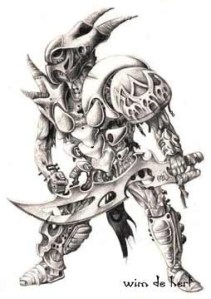
    The crowning achievement of the pre-Victorian era, the Myrmidon first appeared in Europe in the mid- to late 18th Century. The Myrmidon is a construct of demon-hardened ceramics, artificially living flesh and bone, and superhard steel. Endowed with the spirit of a simple Demon and bound to specific magical and religious commands, the Myrmidon is capable of following simple orders delivered by a priest, infernalist or conjuror. The Demon measures about 7’ in height and has strength greater than any human; it is also very fast, and the Demon learns to fight just as a normal human would. Inexperienced Myrmidons fight as well as an untrained militiaman, but as the Demons become older and more experienced they improve their skills just as does a normal warrior, though more slowly due to their extremely limited intellect. Myrmidons are always accompanied by a priest or infernal engineer and are designed to fall apart when administered a command from a remote location, preventing their capture or the revelation of their deeper secrets. They heal minor damage if inside a church, though major repairs require experienced technicians. They can follow simple sets of commands, and can be given a “framework” within which to operate, with the framework following a basic template such as skirmisher, warrior or berserker.

    Myrmidons are heavily armoured and highly resistant to infernal energy. Magical energy and physical attacks do no more damage than usual, though it takes a formidable mortal to penetrate their magically enhanced shell, and their huge physical structure takes considerable damage to wear down. Most Myrmidons also have at least some basic combat feats, and most are also designed to incorporate an infernal rifle or pistol of some sort. Some of the more intelligent constructs may also contain a confustor or impulsion field rod, and as their design becomes more sophisticated they also develop powers of flight, teleportation or leaping. By the mid-19th century, they became the most feared soldier on the battlefield, proof against all but the most hardened of soldiers.

  • So, the English press is afire at present with the decision of British “workers”[1] to protest supposed off-shoring of their work to Italian workers. There really is no reason for me to care about this except that I am British but I feel like a foreign worker, because I’m really Australian[2]. So today I am going to rant in a completely off-topic way about the stupidity of the British response to this “problem”.

    First, the problem: A French oil company building a new refinery in Northern England has tendered out a short-term construction contract, and an Italian company beat 5 British companies to the job. This Italian company is going to import 400 workers from Italy, who will live in Barges in the nearby port and work on the site. It’s a new contract, so no existing jobs will be lost, but there are lots of unemployed people in Grimsby who could supposedly do the job. So the local workers have downed tools in protest at the lost employment chances for their unemployed neighbours, and other workers in other cities are “spontaneously” going on strike in protest. There is lots of talk of “cheap labour” and a so-called “race to the bottom” (the bottom being, apparently, Italy – not Grimsby) and general left-wing pride at the unions taking on transnational capitalism.

    Only, it turns out  (if you read the Humber business news) that the Italian workers are being paid British rates. And if you read that Cruddas article about “cheap labour”, you’ll note that he simultaneously claims that the British workforce is unprotected and exploited, while simultaneously accusing the Italians of undercutting the “most unprotected workers in Europe”. Now usually, when I read two contradictory opinions in the same sentence, it’s in a right-wing piece – am I sensing racism here? In Australia we have a term for this kind of subtle message, we call it a “dog whistle”[3]. I always thought that “cheap labour” was a rallying cry of left-wing internationalists, but it would appear that in the left-wing British press (for that is what the Guardian is, and Cruddas is supposedly a Labour politician) it seems to be a rallying cry of racism, carefully coded so that it can sound reasonably whilst riling up the troops. That, my friends, is dog whistle politics.

    So why is it racist to protest Italian workers being shipped in barges to do a job in England? Shouldn’t British workers do that? Well, perhaps. But it’s a 4 month contract, and hiring 400 locals could take a bit of time. And – count them – 5 British companies tendered for this contract with staff being paid at the same rates and couldn’t win it. So an Italian company which has to ship its workers over here, pay them British rates and pay for their accomodation and food won the contract  over 5 British companies with no such expenses. Could it be the British companies were being greedy? Or couldn’t guarantee completion of the contract? Or that there was no British company set up to win short-term construction contracts? Maybe they were busy doing building contracts down south? Sounds like poor British business management, or greed to me. Sound familiar? Poor British management and greed has been in the news a bit lately, something about a “credit crunch”.

    And what does this mean for me, a foreign worker in this country because no-one could find a British person capable of doing my job? Does it make me feel welcome? I think of those Italians on their barges and I wonder if some lunatic BNP[4] member might decide to sink one. I think of the Polish people who are doing all the catering work at my company because no white British person will do a job like that… do they feel welcome here and respected when they leave their poorly paid jobs and see this in the news? While outside the British lumpen proletariat, all those unemployed Brits who’d rather pull a welfare cheque than serve coffee, wander around stabbing each other and swearing.

    And if we’re to get into the business of recalling foreign workers who are doing jobs that locals could be doing, does that mean that British expats in Tokyo, Dubai and New York should go home? All those British backpackers who spent a year living off their trust fund in Australia, earning sub-award[5] rates tax-free to steal Aussie jobs, should also  go home? It’s a can of worms.

    But the fundamental problem here is that British companies are incompetent, the British are unskilled and undereducated, and they can’t do their jobs let alone compete. But here we see the British solution at its best: blame the foreigners!

    [1] One day I will prepare another off-topic post on all the ways in which the British worker’s incompetence and slovenliness has made my life here hell…

    [2] For anyone who is confused by this I have the magic words “commonwealth”.

    [3] I have no idea if this is an international term,  but I won’t have foreigners stealing my work.

    [4] British National Party, for my American/Canadian readers – it’s a funny British thing, it rhymes with “National Socialist Party”

    [5] An “award” is an industrial agreement setting out what employees should earn.

  • Colonel George Washington, 5th August 1754

    Attended Madame C’s Firefly party last night. Better than last year, more pretty dancing girls (one Chinese with a cloud of fireflies particularly feisty in the back of the library, damn her for saying no but she learnt the hard way that no-one can!). Guests were worse though, one supposes that the greater the effort on a soiree the more of the public one needs to invite, and one could hardly avoid inviting a few of the heroes of the French-Indian war, but bringing Frenchy? And those damned natives? It may not be proven, but everyone knows Magua murdered Colonel Munro in cold blood, ate his heart by all accounts, and damn my breeches if I can tell how exactly Madame C expected Francois Frenchy to get along with that bloody native Tacharison, who slaughtered Jumonville right in front of me (not that I told him to stop, heh!). A weird mix by all accounts, and there was that brazen slut Cora Munro fawning over her father’s murderer! I swear she had a hand in it the ungrateful tart. Bit of a shame I could never get my fingers in her, but now that her Daddy’s shamefully put aside maybe I can give it a go… Magua will have done the white man one favour at least… maybe a bit of  attention from a white gentleman will prevent her going native like her retarded sister did…

    Of course, it was interesting to meet the “heroes” of the French and Indian War. Bunch of ignorant foreigners, we thought they might have some value for colonial interests but it seems they can’t even summon enough racial pride to support any white man, let alone to throw in their lot with the Americans whose rightful country they’re in. I tell you, it sticks in my craw that some Irish Priest can have the balls to call me a coward when all 5 of those pimped up heroes were hiding behind native skirts for every battle. Though I suppose they did go into Huron territory, which is more than you would catch me doing! It took all the balls I had to encourage Braddock to ambush the French at Monongahela, even though they were running away, and that didn’t exactly go as planned now did it? Frenchy couldn’t be bothered chasing retreating Americans, and we had to sign that damned peace deal after all. But there’s a lesson in that isn’t there? Never hatch a plan which relies on others to do your own dirty work.

    Still, I thought those heroes might have some use, even if it was only temporary. It looks like they’re pretty soft on the natives though, so any use we put them to would be pretty limited, and I reckon half of them still have loyalty to the old White Father. Best keep an eye on their contacts, in case they become trouble, but we definitely won’t be relying on them for anything else. Friends with two different native “nations”, and proud of it! A disgrace…

    Anyway, we’ll see what comes of it all… maybe there are other ways we can use Frenchy to our advantage than just by accident!

    Miss Cora Munro, 5th August

    Dear Diary, it would appear I have the singular distinction of being able to report on a most diverting evening at Madame C’s Firefly party, the first I’ve been invited to in the New World and surely one of the most illuminating events I’ve attended in years (oh dear, do pardon the pun won’t you my dear diary?) Of course I had the chance to meet that fascinating brute Magua, who tells me my dear sister has hunted her first deer and eaten it’s heart (I do hope that when he says deer it is not a euphemism for anything else!) I do declare this to be positively disgusting, but my sister has always been a tad strange, so it’s best I suppose that she is doing something she likes, and it’s not as if she hadn’t first hand experience after seeing what happened to Daddy (Satan take him), but really… I shall have words with her about a Lady’s Decency when next I visit her. No word on children, so I don’t know yet if she’s come around to his ways, lord knows I would in a flash… oh don’t blush dear Diary, there’s far worse in your earlier pages and you aren’t telling anyone, now are you?

    Of course I also met those dear stuck up Frenchies, they had nothing much to say except trying to slobber on my hand, of course, but infinitely more charming than the colonials. I really don’t like the way that Colonel Washington looks at me… he may be a battle mage and a hero, but that doesn’t give him the right to look at me like that. And by the way dear Diary, how does one get to be a hero by merely retreating? I could do that! I would never say it, of course, but I was mighty entertained to see the English Heroes burt it out like the quaintly uncultured chaps they are. That Irish Priest is rather dishy, I must say if I were to have a chance to see under his habit I would rather like to take it, but I suppose it shan’t be happening. So mysterious with the collar and the coat! And even the Torturer is so much more charming than oily George Washington, the fast-footed hero of monongahela. Anyway, it’s nice as well to see that they interacted with the Natives as if they were men (and Kings!) instead of fools… maybe there is some good yet in the White man…

    Anyway, dear Diary, I suppose I should speak a little of my garden. There was [ Several pages of botanical science follow]

    Magua, 5th August

    Hmmm. Interesting. The prophet suggests the White Heroes may have a use. The Colonel has only one use, but the White Heroes showed his skin too thin to be used in even the smallest war drum. Fools, these Americans. Dangerous arrogant fools.

  • So between October and April England disappears into a murky world of fog and chilly, dark afternoons. What does one do during that time? I have been reading, my role-playing group switched to an old favourite, and I watched a few things. Here are the things I have been reading and doing recently:

    Rolemaster in middle Earth: My role-playing group did a 5 or 6 session short campaign in good old-fashioned Rolemaster (Classic, to be precise), set in Mordor at 10th level. It was fun but with 8 players and high levels, it got a bit tedious at times. I’m not sure if my players liked my vision of Mordor either – 10km deep canyons and cities of Undead didn’t seem to appeal. Well, can’t be helped… but in fact Rolemaster was a lot less fun than I remember and I won’t be DMing it again. I originally intended to write the results here but I couldn’t be bothered in the end. ennui, much?

    A concise Chinese-English dictionary for lovers: recommended by a friend, this book is by a Chinese author, and tells the story of a Chinese girl who comes to London to learn English and, ah, doesn’t quite fit in. She meets a 40-something ex-anarchist and they start a quite fucked-up relationship. I’m sure this book is autobiographical. It also contains some beautiful observations about the horribleness of London. There’s a passage where the Chinese girl compares British weather reports with reports from a war, and it’s so true. It’s a sad book but a really interesting description of cross-cultural confusion. Strongly recommended!

    Emma: also happens to be the name of my partner, but in this instance is the manga tale of a Maid in Victorian England. I think it’s by the author who wrote “Mermaid Forest” but I’m not sure. I’ve been struggling through the Japanese version (i.e. the original) of book 1. You can get the whole thing online in English, but I think I’ll stick to misunderstanding the Japanese. 4 months= nearly finished.

    Dexter: Just finished season 3. I love Dexter!

    Neverwinter Nights 2: I have returned to this, and spend maybe two or 3 hours a week saving the world. It’s not going too well, but at least I’m back into it. It is still too easy though… and I have discovered that when NPCs die they don’t die, they just lie down until the fight is over. This is all the encouragement I need for sloppy, drunken adventuring…

  • So, a two month absence… the truth is that London life has been wearing me down recently, and I haven’t had any interest in anything actually worthwhile. Then christmas came, and like every other person in London I got sick, repeatedly. Plus, of course, when one is in a new town one needs to get out and about and socialise … so blogging, though not role-playing, suffered a little. I’m back to life this year though, exercising again and trying to work a little better and also paying attention more to the international role-playing world I was neglecting. Hopefully now I can find some things to say…

  • Once again we find the characters standing amongst their dead foes, splattered in blood and shrouded in darkness. This time however, the blood is mostly their own, and the situation dire. Father Cantrus was forced immediately to invoke his sternest healing disciplines, and with the help of the Angels on High soon restored the party to their full powers; however, it had been a close shave and, shaken by the ferocity of the defence of this tiny tower, the characters set about exploring cautiously.

    Within the compound they found rooms full of minor trinkets and treasures, and obvious evidence of many experimental areas that had been hastily converted into soldiers’ quarters. All the soldiers now being dead, the characters’ goal was almost achieved. All that remained was to investigate the sealed Northern section of the building, under the cliffs, and the locked south-western section. Their one captive soldier told them that three wizards were holed up in the south-western section; and it was these wizards who had created the beasts they called “Remade”, whose snufflings and howling moans could be heard through the door to the North…

    deciding upon discretion over valour, Russell Ganymede stepped outside and used his mysterious Infernal Vision to gaze through the walls of the building, viewing every room where their next adversaries might hide. He found 2 strange creatures prowling the rooms in the north wing – one a disturbing amalgam of steam engine and  man, the other a horrific bastard creation forced together from the bodies of a man and a gorilla. Clearly the wizards to the south west had been experimenting with, and advancing the technology of, chimaera creation in a fashion previously forbidden to all Decent Men. Vengeance (and information!) must be obtained!

    Having so decided, the characters invaded the South-western wing. First opening the door, they sent in a Monster to attack the mages therein; while the mages were distracted, Dave Black and Lord Merton St. Hillier intruded under the cover of stealth. Unfortunately, a mage at the end of the hall armed with a Confustor Field Rod quickly stunned the beast, and used his telekinetic powers to slam and lock the door. The door being trapped and locked, no-one could rush to the aid of the unfortunate assassins. There followed several minutes of desperate combat as the two assassins, separated and beleaguered, attempted to overcome their adversaries while the remainder of the group ran around outside, seeking and finally finding a window through which to gain egress. Vicious battle followed, fought with fireballs, walls of stone, disabling and petrifaction spells; but ultimately the characters prevailed and fortunately no-one was seriously harmed, though at times the battle came close.

    Having killed 2 and captured 1, the characters interrogated him to learn the truth of the experiments conducted at the Lighthouse. Named Chateau Caprice, the lighthouse had been previously a research institute for the French Secret Service until the war preparations, when it was converted to a garrison and used to store the Mohican totem pole. The Remade already created were to be used as guards for that item, their lives meaningless and held in thrall to those who had presided over their hideous creation. The only thing any Gentleman could hope to do for these poor wretches was to provide them with quick and Christian mercy.

    Having established the presence of only 2, the characters decided to lead them out through the main door, trapping the door with explosives from the cannon, and cut them down from a distance after their initial surprise. While this battle happened the Mohicans would run through a breach in the wall to obtain the totem pole.

    This plan worked well, except for two small flaws. The first of these was that the explosive trap barely harmed either of the Remade, who advanced upon the characters under a withering hail of fire, apparently unharmed by mere bullets. The second flaw was the presence of two hidden remade – one a disgusting spider/octopus/human recombination, the other a metal-skinned monster-man with blades for arms. These Remade attacked the Iroquois, thus risking defeat for our heroes when within sight of their goal. Fortunately Lord Merton St Helier and Anna la Brousse were able to infiltrate the room while the battle with the Heavy Remade raged outside, and quickly slew these lighter, faster remade while David Cantrus saved the life of the only fallen Iroquois.

    Outside the battle raged, but the Remade were no match for the formidable strengths of our heroes, who after some close calls managed to deliver unto these mishapen beasts the mercy for which they longed. Thus conquering Chateau Caprice, the characters looted it of all its knowledge and belongings, so that the secret of Remaking could be taken to England. In future, of course, this secret would be used as a form of punishment, to keep under control those lower orders whose constant labours make England great, but whose constant dissatisfaction with their brutal lot threatens always to boil forth into revolution. That, however, is a tale to be told another day… as its unfortunate and revolutionary conclusion…

    The characters returned triumphant to their ship with the totem pole. Sending the Dervish back towards Quebec in his decoy ship, they sailed at full speed for New England, and civilisation … far from the horrors of grotesque French immorality, thereupon to save New England evermore from French aggression. Though whether it shall remain ever a colony of glorious England remains a story to be told…

  • Sadly it has a voiceover which makes it annoying to open, but this website has an interesting article discussing the first computer programmers of the modern age – all of whom were women.

    I have read before about the “calculators”, women who worked in Universities doing the practical work of solving equations by hand for academic, research or engineering tasks. This website shows how these women became the first programmers. Some of them went on to have significant roles in the development of modern programming, including the concepts and methods underlying it. It’s fascinating that the whole field is now much more male-dominated than it was then … though of course, not surprising.

  • I envisage  magic working very simply:

    • many characters can learn magic, either as a central skill or as dabblers
    • characters learn spells individually, almost like feats
    • all characters who use magic have a certain number of fatigue slots, equal to their concentration skill
    • all spells have a DC to cast
    • all spells are cast using either Spellcraft (for primary users of magic) or one of the save skills (Presence or Will) for minor users of magic
    • failure to make the DC means the spell works but the caster suffers fatigue; success means no fatigue
    • the difficulty to resist a spell is determined by the spell-caster’s skill roll in a challenged skill check
    This retains the essential character of AD&D spells (they always work) but builds in the essential skill-based system of resolving saving throws which I want to base the system around. It incorporates the cost of casting into the one roll as well.
    The two problems I have with this system are:
    • Defining  DCs: spells are really diverse with diverse effects, so it’s difficult to define DCs for  all of them. The simplest method is simply to set a level on the spell and make the difficulty from a formula based on the DC. I had been working on a set of rules (based on duration, range, maximum damage and type of effect) but this has not been very easy to generalise – for example, healing is a permanent effect, so any duration-type modifier has to increase the DC of a simple healing spell, in order that it be generalisable across other types of spell (such as fireballs)
    • Spell failure: to be properly consistent with a skill-based resolution system, spells should be able to fail like any other skill. The skill being used here is the skill of channelling some kind of essence or force into a physical effect. Obviously this is kind of challenging! So one should be able to fail.
    I had earlier written that I don’t want to have a skill system which has categories of partial failure and partial success, but this seems like the perfect opportunity to introduce notions of partial failure and complete failure: complete success occurs if you beat the DC, partial failure if you just miss the DC, and complete failure if you really miss the DC. Partial failure can indicate the spell works but the PC suffers fatigue, while complete failure indicates fatigue and the spell doesn’t work.
    So here is the simple method for determining how spells work:
    • level-based DCs
    • partial failure occurs if one misses the DC but beats a lower target (DC-level, for example)
    The AD&D 3.5 system gives a clear way of setting out levels, so it should be easy to judge the level of any spell. This system only becomes challenging if one does away with spells and makes all magic skill-based (my ultimate goal), because then the DM has to make judgements about the level of an effect on the fly.
    We’ll cross that bridge when we’ve burnt it…
  • The last 4 sessions of Compromise and Conceit have been conducted using the basics of the system I have been developing, with the main properties of this system being:

    •  All actions are skill-based, with no difference between saving throws, skill checks, magic use and combat
    • All results are determined by a difference between the result of the roll and the target of the roll, and the maximum effect an action can have represents its power
    • hit points and available spells are determined by skills rather than by dice rolls
    • all actions are resolved using 2d10
    The 4 sessions to date have given a chance to assess this system in practice, and I think it works. There are a few small flaws, but the main good points appear to be:
    • It is fast: we can run the introduction to the adventure, setting out, travel, a single large combat and a brief denouement in 3-3.5 hours, which I think is good
    • It is simple: there is only ever one die roll to determine the success of any action, and the mechanics of resolution being always the same means that I can assess the outcome of actions quite rapidly
    • The two properties of skill-based magic and wounds affecting combat/magic mean that the system does capture a feeling of desperation as people tire or get wounded, and magic is a powerful and frightening phenomenon
    So far we have had 4 battles: 1 teaser with a witch and some zombies, one small conflict (inside a larger battle) with a couple of experienced soldiers and their minions; one ambush by a wizard/assassin and her minions; and one big pitched battle. All have been resolved rapidly, and although the first and third weren’t very challenging, the fourth was a very close call with the characters only being saved at the end by their Iroquois allies. That last battle was between the 5 characters (all 4th level) and 15 soldiers (1st level) and three leaders (all about 3rd level). The characters used some magic items, quite a bit of their more basic magic, and their stealth skills, and came out of it heavily fatigued and badly wounded. 
    The main faults I have found so far are:
    • The difficulty classes for spells are a bit arbitrary and need to be tightened up. I think an absolute judgement on level and a level-based difficulty assignment may be a good idea
    • I am working with a system of DCs for spells in which failing to meet the DC on a skill check means that the spell still works but the character takes a fatigue. This makes magic perhaps a little too powerful. I am considering setting a lower DC for partial failure (which could also apply to other skills) equal to the DC minus the character’s level. So for example, if the DC is 15, partial failure occurs for a 4th level character on rolls of 11-15. This will make magic viable but will make people think twice about using their most difficult spells frequently.
    All in all, if I can tighten up the magic system I think this system  will work well!