• Once again we find the characters standing amongst their dead foes, splattered in blood and shrouded in darkness. This time however, the blood is mostly their own, and the situation dire. Father Cantrus was forced immediately to invoke his sternest healing disciplines, and with the help of the Angels on High soon restored the party to their full powers; however, it had been a close shave and, shaken by the ferocity of the defence of this tiny tower, the characters set about exploring cautiously.

    Within the compound they found rooms full of minor trinkets and treasures, and obvious evidence of many experimental areas that had been hastily converted into soldiers’ quarters. All the soldiers now being dead, the characters’ goal was almost achieved. All that remained was to investigate the sealed Northern section of the building, under the cliffs, and the locked south-western section. Their one captive soldier told them that three wizards were holed up in the south-western section; and it was these wizards who had created the beasts they called “Remade”, whose snufflings and howling moans could be heard through the door to the North…

    deciding upon discretion over valour, Russell Ganymede stepped outside and used his mysterious Infernal Vision to gaze through the walls of the building, viewing every room where their next adversaries might hide. He found 2 strange creatures prowling the rooms in the north wing – one a disturbing amalgam of steam engine and  man, the other a horrific bastard creation forced together from the bodies of a man and a gorilla. Clearly the wizards to the south west had been experimenting with, and advancing the technology of, chimaera creation in a fashion previously forbidden to all Decent Men. Vengeance (and information!) must be obtained!

    Having so decided, the characters invaded the South-western wing. First opening the door, they sent in a Monster to attack the mages therein; while the mages were distracted, Dave Black and Lord Merton St. Hillier intruded under the cover of stealth. Unfortunately, a mage at the end of the hall armed with a Confustor Field Rod quickly stunned the beast, and used his telekinetic powers to slam and lock the door. The door being trapped and locked, no-one could rush to the aid of the unfortunate assassins. There followed several minutes of desperate combat as the two assassins, separated and beleaguered, attempted to overcome their adversaries while the remainder of the group ran around outside, seeking and finally finding a window through which to gain egress. Vicious battle followed, fought with fireballs, walls of stone, disabling and petrifaction spells; but ultimately the characters prevailed and fortunately no-one was seriously harmed, though at times the battle came close.

    Having killed 2 and captured 1, the characters interrogated him to learn the truth of the experiments conducted at the Lighthouse. Named Chateau Caprice, the lighthouse had been previously a research institute for the French Secret Service until the war preparations, when it was converted to a garrison and used to store the Mohican totem pole. The Remade already created were to be used as guards for that item, their lives meaningless and held in thrall to those who had presided over their hideous creation. The only thing any Gentleman could hope to do for these poor wretches was to provide them with quick and Christian mercy.

    Having established the presence of only 2, the characters decided to lead them out through the main door, trapping the door with explosives from the cannon, and cut them down from a distance after their initial surprise. While this battle happened the Mohicans would run through a breach in the wall to obtain the totem pole.

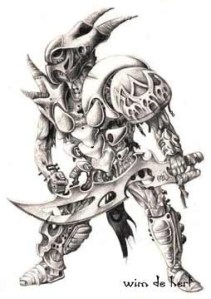
    This plan worked well, except for two small flaws. The first of these was that the explosive trap barely harmed either of the Remade, who advanced upon the characters under a withering hail of fire, apparently unharmed by mere bullets. The second flaw was the presence of two hidden remade – one a disgusting spider/octopus/human recombination, the other a metal-skinned monster-man with blades for arms. These Remade attacked the Iroquois, thus risking defeat for our heroes when within sight of their goal. Fortunately Lord Merton St Helier and Anna la Brousse were able to infiltrate the room while the battle with the Heavy Remade raged outside, and quickly slew these lighter, faster remade while David Cantrus saved the life of the only fallen Iroquois.

    Outside the battle raged, but the Remade were no match for the formidable strengths of our heroes, who after some close calls managed to deliver unto these mishapen beasts the mercy for which they longed. Thus conquering Chateau Caprice, the characters looted it of all its knowledge and belongings, so that the secret of Remaking could be taken to England. In future, of course, this secret would be used as a form of punishment, to keep under control those lower orders whose constant labours make England great, but whose constant dissatisfaction with their brutal lot threatens always to boil forth into revolution. That, however, is a tale to be told another day… as its unfortunate and revolutionary conclusion…

    The characters returned triumphant to their ship with the totem pole. Sending the Dervish back towards Quebec in his decoy ship, they sailed at full speed for New England, and civilisation … far from the horrors of grotesque French immorality, thereupon to save New England evermore from French aggression. Though whether it shall remain ever a colony of glorious England remains a story to be told…

  • Sadly it has a voiceover which makes it annoying to open, but this website has an interesting article discussing the first computer programmers of the modern age – all of whom were women.

    I have read before about the “calculators”, women who worked in Universities doing the practical work of solving equations by hand for academic, research or engineering tasks. This website shows how these women became the first programmers. Some of them went on to have significant roles in the development of modern programming, including the concepts and methods underlying it. It’s fascinating that the whole field is now much more male-dominated than it was then … though of course, not surprising.

  • I envisage  magic working very simply:

    • many characters can learn magic, either as a central skill or as dabblers
    • characters learn spells individually, almost like feats
    • all characters who use magic have a certain number of fatigue slots, equal to their concentration skill
    • all spells have a DC to cast
    • all spells are cast using either Spellcraft (for primary users of magic) or one of the save skills (Presence or Will) for minor users of magic
    • failure to make the DC means the spell works but the caster suffers fatigue; success means no fatigue
    • the difficulty to resist a spell is determined by the spell-caster’s skill roll in a challenged skill check
    This retains the essential character of AD&D spells (they always work) but builds in the essential skill-based system of resolving saving throws which I want to base the system around. It incorporates the cost of casting into the one roll as well.
    The two problems I have with this system are:
    • Defining  DCs: spells are really diverse with diverse effects, so it’s difficult to define DCs for  all of them. The simplest method is simply to set a level on the spell and make the difficulty from a formula based on the DC. I had been working on a set of rules (based on duration, range, maximum damage and type of effect) but this has not been very easy to generalise – for example, healing is a permanent effect, so any duration-type modifier has to increase the DC of a simple healing spell, in order that it be generalisable across other types of spell (such as fireballs)
    • Spell failure: to be properly consistent with a skill-based resolution system, spells should be able to fail like any other skill. The skill being used here is the skill of channelling some kind of essence or force into a physical effect. Obviously this is kind of challenging! So one should be able to fail.
    I had earlier written that I don’t want to have a skill system which has categories of partial failure and partial success, but this seems like the perfect opportunity to introduce notions of partial failure and complete failure: complete success occurs if you beat the DC, partial failure if you just miss the DC, and complete failure if you really miss the DC. Partial failure can indicate the spell works but the PC suffers fatigue, while complete failure indicates fatigue and the spell doesn’t work.
    So here is the simple method for determining how spells work:
    • level-based DCs
    • partial failure occurs if one misses the DC but beats a lower target (DC-level, for example)
    The AD&D 3.5 system gives a clear way of setting out levels, so it should be easy to judge the level of any spell. This system only becomes challenging if one does away with spells and makes all magic skill-based (my ultimate goal), because then the DM has to make judgements about the level of an effect on the fly.
    We’ll cross that bridge when we’ve burnt it…
  • The last 4 sessions of Compromise and Conceit have been conducted using the basics of the system I have been developing, with the main properties of this system being:

    •  All actions are skill-based, with no difference between saving throws, skill checks, magic use and combat
    • All results are determined by a difference between the result of the roll and the target of the roll, and the maximum effect an action can have represents its power
    • hit points and available spells are determined by skills rather than by dice rolls
    • all actions are resolved using 2d10
    The 4 sessions to date have given a chance to assess this system in practice, and I think it works. There are a few small flaws, but the main good points appear to be:
    • It is fast: we can run the introduction to the adventure, setting out, travel, a single large combat and a brief denouement in 3-3.5 hours, which I think is good
    • It is simple: there is only ever one die roll to determine the success of any action, and the mechanics of resolution being always the same means that I can assess the outcome of actions quite rapidly
    • The two properties of skill-based magic and wounds affecting combat/magic mean that the system does capture a feeling of desperation as people tire or get wounded, and magic is a powerful and frightening phenomenon
    So far we have had 4 battles: 1 teaser with a witch and some zombies, one small conflict (inside a larger battle) with a couple of experienced soldiers and their minions; one ambush by a wizard/assassin and her minions; and one big pitched battle. All have been resolved rapidly, and although the first and third weren’t very challenging, the fourth was a very close call with the characters only being saved at the end by their Iroquois allies. That last battle was between the 5 characters (all 4th level) and 15 soldiers (1st level) and three leaders (all about 3rd level). The characters used some magic items, quite a bit of their more basic magic, and their stealth skills, and came out of it heavily fatigued and badly wounded. 
    The main faults I have found so far are:
    • The difficulty classes for spells are a bit arbitrary and need to be tightened up. I think an absolute judgement on level and a level-based difficulty assignment may be a good idea
    • I am working with a system of DCs for spells in which failing to meet the DC on a skill check means that the spell still works but the character takes a fatigue. This makes magic perhaps a little too powerful. I am considering setting a lower DC for partial failure (which could also apply to other skills) equal to the DC minus the character’s level. So for example, if the DC is 15, partial failure occurs for a 4th level character on rolls of 11-15. This will make magic viable but will make people think twice about using their most difficult spells frequently.
    All in all, if I can tighten up the magic system I think this system  will work well!
  • For the first time in a month, we join our heroes with their hands free of blood, in the New French town of Quebec. Having discovered by foul means the evil plans of the French to destroy the Mohican tribes, our heroes were summarily dispatched by ship from Fort Stanwix to Albany, and thence around the coast to the kingdom of their enemy in New France. Their mission is simple: to break into the castle where the Mohican’s totem pole is stored, and to steal it back. Once stolen, they are to march overland with it to the Mohican lands, and present it as a wedding gift to the Mohican people.

    With them to Quebec came the Iroquois priestess, “She comes with Shadows” and her 4 bodyguards. These are the only 5 people who can touch the totem pole, and so they are essential to return it. The characters’ charge was to keep these 5 alive at all costs, and return with them and the pole to Mohican lands. 

    Having been given not even an hours’ rest, and with winter closing in, the characters found themselves put aboard ship and rushed off to Quebec. Without even taking a night to orient themselves on their arrival, our heroes surveyed the lay of the land. Their target was a small, converted lighthouse called La Malbaie, on the Northern side of the Bay of St. Lawrence. It could be reached by sea or overland, but the overland journey promised another 5 days of walking through the freezing cold. Instead, and sensing much danger, the characters arranged a different approach. They hired a pair of ships, one to take them to La Malbaie and one to act as a decoy from La Malbaie heading back towards Quebec. The Dervish, Umit, would take this latter ship and serve to distract any French pursuit by taking a different ship from Quebec to New York. On the second ship, the characters would lay to at night just offshore from la Malbaie, and find a way into the converted lighthouse. 

    Having made these arrangements, our heroes set out in the Dutch ship Set Your Confustors to Stun, sailing for 8 hours up the sound until, in the last glow of twilight, they heaved to offshore from la Malbaie lighthouse. From here they could see the hills of New France as silhouettes against the fading twilight. Light flurries of snow fell from a steel-grey ceiling of low clouds, scudding along the water surface and swirling about the boat in a stiff, freezing breeze that blew down from the open waters to their East. The last light reflected on the iron-black sand of a small beach, which stretched into darkness penetrated only by the distant lights of the lower windows of la Malbaie’s ground floor. Behind the boat, distant lights of the evening’s river traffic inched by in the darkness, or bobbed on the water where they were moored for the night. 

    The characters decided to eschew the frontal assault and instead move through the hills and take a small coastal path to the lighthouse. Two boats were dropped, and they rowed to the shore some distance from the lighthouse. From there it was a 1 hour walk through the freezing darkness, their path lit only by a tiny hooded lantern, before they arrived at the end of the path. Here a culvert cut into the hills, dropping through impenetrable darkness to the beach, from whence they could hear a faint lapping of surf. Trying to move carefully, they descended the culvert, their path lit only by a faint light of infernal essence, Russell Ganymede to the fore.

    As they neared the bottom of the culvert, however, Russell’s light and the rousing alarm of his clumsy passage alerted those below to his presence. Two guards opened fire with long rifles, fortunately missing any in the party and forcing them to scatter for cover. Anna laBrousse yelled at  them to cease and drop their weapons, her voice taking such a tone of command that in fact one of the soldiers did just that, and began remonstrating with his colleague to do the same. Russell opened fire on the other, while Dave Black and Lord Merton crept along the gully to do their dirty work. Unfortunately the remaining soldier was blowing a whistle, and by the time the party could get to the base of the culvert and finish off the two soldiers the alarm had been raised. 

    From the culvert the beach stretched for 50m to a low line of dunes, which formed a kind of low plateau on which, 50 metres further along, the lighthouse was built. The lighthouse was dimly visible in the glow of its own lights as a kind of horseshoe-shaped building with a low tower at the side furthest from the characters. The opening of the horseshoe was a narrow, 5m wide open gate facing the characters, with two lighted windows on its right side and a dark, windowless wall on its left. From our heroes’ vantage point the cliffs loomed over the lighthouse on their left, and to their right the beach sloped down to the shore, where the surf whispered in the darkness.

    Fearing themselves exposed, the characters set off immediately for the lighthouse, but had barely moved 10 metres before they heard the distant boom of two cannon firing. Moments later infernal shot landed just metres ahead of them, exploding in puffs of faded purple light and a rain of harmless shrapnel. Realising now that battle was on, the characters turned their determined walk into a sprint, and reached the cover of the dunes just as the guards at the lighthouse began firing their rifles. From the flash and retort, it was clear that there were 4 guards hidden in the cover of the entryway, firing from cover at the distant dunes. These hopeful shots had little chance of hitting the characters, but now they found themselves in battle in earnest.

    Anna laBrousse had summoned a monster, composed of sand and shadow, to kill the guards at the  culvert, and this she sent ahead to attack the guards at the gateway. Dave Black the Torturer and Lord Merton, thinking themselves unseen, continued their slow and stealthy advance. Father David Cantrus and Anna, seeing little else they could do, went over the top of the dune and ran towards the gateway, while Russell Ganymede fired into its cloaking darkness. As David and Anna ran across the open ground, two more shells landed, one exploding amongst them in a plume of sand, shrapnel and purple infernal energy, knocking them both to the ground and injuring Anna laBrousse badly. David Cantrus took the time to heal her with a prayer, but the pair of them found themselves briefly given respite, for the riflemen at the gate had seen David Black, and opened fire on him in concert. One hit but did no serious damage, and Lord Merton opened fire in return, hitting one. Now battle was joined for real. David Cantrus charged in to the attack, as did David Black and Lord Merton, while Anna laBrousse hid against the cover of the wall. Russell summoned a Demon to aid the characters, causing it to appear amongst the soldiers at the gate as a wrathful, spindle-legged figure of shadow and fog. They killed the 4 guards at the gate quickly, but inside the gate found a small compound, in which the remainder of the lighthouse’s guards were clustered. Five guards had clustered together to form a line, and 4 more were running towards the front of that line from two small cannon which they had been operating; and from a door at the rear of the courtyard came two more, a big man in breastplate and the soldiers’ leader, a captain to judge by his insignia.

    David Cantrus, seeing death in the eyes of the men of the line, stepped to the fore and revealed unto them the spirit of the lord, striking 6 of them dumb with awe. Anna laBrousse cast paralysis on another. One remained standing, and one who had been tardy to run forward was unaffected by the spell, while the others fell to their knees in amazement at the glory of the Spirit revealed. Lord Merton, seeing his chance, shot dead 2 of these humbled men immediately, and the group’s summoned beasts surged in to kill another one each. Dave Black moved up to one other and killed him so horribly – with such a combination of eye-gouging and choking – that those watching could not help but be so sickened that they were weakened with terror.

    Now the tide turned, so that only 2 soldiers and their leaders remained standing. Unfortunately, they had failed to see the lighthouse scout, who crept up behind Dave Black and dealt him a vicious blow to the kidneys. Black, frightened and badly injured, immediately rendered himself invisible and ducked out of the battle. Russell Ganymede charged forward to attack the breastplate-wearing sergeant, but fell over in his haste and was stabbed viciously by his more competent opponent. Lord Merton fired at the Captain, hitting him, and behind them their conjured demons did more of their evil work, killing more of the paralysed soldiers. But now the battle had turned desperate, with Ganymede humbled by the sergeant and the captain surging forward to attack Anna laBrousse’s demon. 

    Dave Black emerged from the shadows to ambush the man who had ambushed him, and Ganymede regained his feet to attack the sergeant. Lord Merton fired into battle, helping to break down the sergeant, who soon fell under the ferocity of their combined attack. However, by now everyone was severely injured – Russell Ganymede at the very edge of his strength, Dave Black stabbed with the Corporal’s rapier so many times that he could no longer move, and Father Cantrus and Anna laBrousse both badly hurt. However, with only the Captain and one soldier still standing, the battle turned in the characters’ favour when the Iroquois appeared from the shadows to cut the Captain down. The remaining soldier fled into the castle, and silence descended upon the battlefield. 

    The characters had noticed that the courtyard had windows overlooking it from one side, so now they opted to dash to cover. Staggering after the remaining soldier, they caught him in the entry chamber to the building.  He offered no resistance to them, and under Dave Black’s tender ministrations he confirmed their suspicions – that they had slaughtered all the soldiers in the building. However, he also told them two other disturbing facts:

    • There remained 3 wizards in the building, who used to work here before the lighthouse was converted into a military base, and who might prove dangerous though they were generally weak and not fond of fighting; and
    • The totem pole had been put in the North wing of the building, under the cliffs. This wing also housed “The Remade”, whose moans and hissings could be heard through the door, and who the soldier had never seen. The Remade are fed once a day with coal and raw flesh…
    Thus does our adventure come to a close, with David Cantrus moving amongst the exhausted and huddled ranks of our heroes, healing them of their wounds, while the injured soldier whimpers in the corner and the wizards and Remade of la Malbaie plan their next move…
  • Once again we join our heroes bathed up to their elbows in blood, this time standing at the edge of Lake Oneiga amongst the bodies of a thousand slaughtered Frenchmen. Around them their Iroquois allies move quietly about their business, butchering the wounded and nearly-dead remnants of the French force, while on the hill overlooking the battlefield the signal fire burns slowly to ash, the charred corpse of the Iroquois spy sinking slowly into the embers.

    The characters were presented with the single battered survivor, Lt Colonel Jacques Fouroux, and told that this poor unfortunate would be ransomed to the British, or burnt alive. They searched the body of the French rogue and spy, Misericorde and, having taken what little of value he possessed, handed the French colours over to the Iroquois tribe and left the area for Fort Stanwix.

    At Fort Stanwix they were greeted as heroes, feted about the complex, and given Officers’ accomodation in which to wait for Governor deLauncey, who arrived on an exhausted mount after a few days to deliver the characters their reward, and to apprise them of the consequences of their actions:

    • 1000 French soldiers were captured in the lowlands between Fort Stanwix and Fort Oswego, though the cloaked ships which delivered them managed to escape
    • Several spies at Fort Niagara were captured and executed, preventing a surprise attack and general incursion from beyond Niagara Falls
    • The Iroquois have been offered full aid against the French, the Covenant Chain restored, and the Western borders of the Iroquois lands bolstered against French incursion
    • French military activity on the edge of Pennsylvania has come to a temporary halt as French forces are relocated to the Northeast to bolster the newly weakened French force there
    The French plan has in the space of one night degenerated from a bold master plan of treacherous genius to a massive defeat. Manoeuvring forces to protect their now-exposed frontline will take at least 6 weeks, by which time winter will have set in properly, delaying any serious French incursion into British lands until Spring. This gives the British time to prepare themselves for the inevitable border war.
    Unfortunately, there are insufficient soldiers in the territory to defend it against a serious French incursion without further good luck, and the French undoubtedly know this. Their most likely attack plan will be to move in force directly from the North, bringing their Huron allies through  Mohican lands to lay siege to Albany. The British, having insufficient forces to prevent an assault from the West and the North, will be forced to choose between losing Pennsylvania and Ohio or New York. Their only hope is the Mohican tribes which lie between Albany and New France; but these Mohican tribes present a significant problem.
    The Mohican lost a major battle with the French and Huron some 5 years ago, and in the settlement that followed signed a treaty of non-aggression and disarmament. Since then they have been set upon ferociously by the Delaware and, in observing the exact terms of their treaty, have been decimated. Another winter of such conflict will render them too weak to present any threat to the Huron, even if they were willing to break their original agreement. There is also some suspicion that the Delaware have been receiving aid in arms from the French, enabling them to overpower the Mohican; or that perhaps there is a secret clause in the Mohican treaty which weakens them more than the British have been led to believe.
    This is a dire situation for both the Mohican and the British. Fortunately, a solution presents itself. An Iroquois princess is being sent to marry a  Mohican chief, securing an alliance between the Mohican and the Iroquois. This will undoubtedly cause the Delaware to cease their attacks, since they will be afraid of stoking war against both the Iroquois and their British allies. The characters are required to escort this Princess to the Mohican tribes, protecting her against French and Huron aggression, in order to ensure that the alliance of Iroquois and Mohican can be completed.
    Once they reach the Mohican lands, the characters are to find out why the Mohican are so fatally weakened; is it enchantment, a secret clause in the treaty? Are the Delaware being given secret French aid? If the characters find a conspiracy by the French to arm the Delaware, they are to kill any traders involved, and destroy Delaware arms. Further, any other perfidy or treachery – be it English, Iroquois or French – which might be causing the Mohican to be weakened or disadvantaged, is to be dealt with in any way necessary.
    However, the characters are to avoid sparking a border war before winter, so they must be discreet.
    Easy! The characters agreed, and set off the following day in the company of 4 Iroquois braves, 4 Mohicans, the Princess “She comes with shadows” and their hastily hired interpeter and guide, an Iroquois named  “Speaks with Three Tongues”. Their journey would take a little more than 2 weeks, leading them through Fort William Henry and East of Lake Ticonderoga deep into the Iroquois forest.
    Within 3 days, of course,  disaster had struck. They were ambushed near midday by a force of 10 French soldiers, who lay in wait by the roadside. Fortunately our heroes saw them first and unleashed the full force of their magic upon them, paralysing or putting to sleep 6 of them before the fight began. The remaining 4 fired upon the Princess, knocking her off her horse and nearly killing her, before they were overwhelmed by the Braves. Father Cantrus ran to aid the Princess while the characters checked for other dangers, and found themselves facing a sneaking, spying Frenchwoman, who attempted to cast a powerful destructive spell on the King’s Torturer before Anna laBrousse was able to react. Anna cast Grendel’s Demise, tearing off the Frenchwoman’s arm, and livid with rage the King’s Torturer used the dismembered limb to choke her assistant to death before her very eyes. This, and the Torturer’s unique ability to extract confessions, quickly caused this woman to reveal everything she knew…
    This woman was la Belle dame sans Merci, a spy famous throughout North America for her ruthlessness and efficiency, as well as her secrecy. She had been charged with abducting the princess, or killing her. Had she succeeded in abducting the Princess she would have taken her downstream along the Mohawk river, using a boat moored nearby on that same river. After a day’s travel her plan had been to land on the far banks of the Mohawk, from where a force of 10 more French soldiers would lay a decoy trail, with the assistance of a camp follower who would pretend to be the princess. La Belle Dame would then drift further downriver, alighting north of Albany and heading in disguise into the North, dragging the Princess with her to her masters in the French army. This woman would then be used as a bargaining piece in the game of politics, to force the Iroquois to break the Covenant chain. 
    Having stopped all of this, and with la Belle Dame cowering at his mercy, David Black asked her another question: how had the French weakened the Mohican? She answered truthfully immediately: she, personally, had stolen the Mohicans’ totem pole. The characters, flabbergasted, wanted to know how she could even touch such a holy relic, let alone carry it. The carrying was easy, she said – she has a power for such things. And the touching? An offhand comment she remembered years ago – that Indian magic has no power over a woman when she is menstruating. la Belle Dame had tried it, and found the rumour true. One night she slipped into the camp and simply walked off with the pole, and thus did the Mohicans’ gods leave them…
    The characters now hatched a new plan to throw the French off their path. Anna laBrousse, disguised as la Belle Dame, floated downriver with the Princess in the boat, with Lord Merton and David Black disguised as French guards. At the appointed meeting spot she tricked the French soldiers into leaving on their pre-planned path, as if the plan were working; thus did the characters trick the French into thinking the Princess captured. While Anna, Merton and David Black did this, Father Cantrus and Russell Ganymede escorted la Belle Dame back to Fort Stanwix, to be handed over to the British and properly questioned.
    The characters rejoined after 5 days at Fort Stanwix, having successfully outwitted the French again, and with only one task remaining – to smuggle the Princess past that most frightful of Indian tribes, the Huron, and deliver her safely unto her waiting husband.
  • A whole bunch of RPG bloggers have recently pointed to this post which compares the obsession with game mechanics in RPGs with the obsession on certain mechanical details in pornography (hereafter referred to as pr0n to escape the spammers). 

    I think they are getting way too hung up on the pr0n=D&D thing. The argument is clever, and I like it, but it simply consists of observing that the mechanics of a product can overwhelm the underlying purpose during the drive to market the product. Pr0n is just the most obvious representation of this phenomenon, which I think it’s reasonable to say occurs in many areas of commerce etc. But I think its too simplistic, and over-simplifies the dynamics of modern pr0n and RPGs.

    The most obvious way in which this can be seen is the article’s claims about splatbooks. They just don’t serve the role Wax Banks claims. The article ignores the importance players put on the imprimatur of game authors over products, i.e. we buy expansion packs because we trust our game company to develop the ideas which interest us in such a way that they work within the game rules. Good expansion packs are the very opposite of the “splat” which Wax Banks claims. Anyone who has tried designing their own character classes or systems should know that doing so in a balanced way is extremely difficult, and because game designers are often better than us at this we prefer to buy their version than use our own. An obvious example of this is the classic fantasy character of the warrior mage – there is no starting class of this form in AD&D, so if one wants to have such a class one needs to design it oneself or buy a book containing such a design. Chances are, the game designers’ version will be better than your own. Anyone who doubts this need only look at the example of the monk, a triumph of balance in designing a character which threatens to be either really weak or way too powerful.

    On this kind of evidence, I would contend that the drive in modern games is not towards mechanics for the sake of it, but towards the use of mechanics to balance simulationism and playability in a game which appeals to people who want to imagine fantasy worlds. Mechanics are important for this, just like body parts and methods are important in good sex. And just as pr0n-o-graphic styles and emphasis change over time – as fashion changes, as relations between the sexes change, and as our relationship with ourselves changes – so role-playing styles change under the influence of the customers, the parallel geek worlds of computers and fandom, the literary and cinematic worlds which influence us. AD&D 3.5 may be much more mechanical than AD&D 2, but it’s better, it gives a better balance of high fantasy and realism, and the characters are more interesting and better balanced. The AD&D 3.5 ranger is a lot of fun, because of rather than despite the rules.

    Similarly modern developments in pr0n don’t necessarily always represent the victory of mechanics over feeling. There is not “always a money shot”, which is in fact a reasonably modern innovation in pr0n. Modern mechanics in that film genre at least partially represent the increasing diversity and vibrancy of modern human sex lives, and may actually continue to reflect the fantasies and desires of ordinary people. It’s not as if the study of this genre is exactly unbiassed enough to provide clear answers as to what the viewer “wants”, which makes comparisons with it pretty dangerous unless, like Wax Banks, you’ve watched an awful lot of it. Who is to say that the money shot or gonzo stuff represents a focus on mechanics over fantasy, rather than the predominance of a particular fantasy among the viewers? Maybe the modern focus on mechanics serves to aid the viewers’ fantasies, rather than to overwhelm them in grotty detail? If 80s pr0n is like AD&D 2, then maybe pr0n 3.5 just represents a better way of showing people what they want?

    (Interestingly, I tend to think that modern internet pr0n is much nastier and more sexist than earlier stuff, and particularly the predominance of really humiliating nastiness in American internet pr0n is quite disturbing. I recommend anyone who wants to investigate this compare any of the major purveyors of internet stuff from America and Japan. The Japanese stuff – famously sexist – strikes me as much more gentle, and much less degrading (in general) than the American stuff. Wax Banks had some things to say about the American national character and the focus on mechanics which are interesting in light of this comparison)

    (But, it’s dangerous to compare internet pr0n with anything. Nobody pays for that stuff (what a shocking idea!). And as with all things, if you want to get your kicks for free you have to compromise, and the compromise with American internet pr0n seems to be that you have to suffer through the misogyny to get your excitement. bitTorrent notwithstanding, one usually pays for role-playing books, so one tends to have some consumer power as regards what goes into them…)

    (And in closing, can I just say that Wax Banks’ blog is excellent!)

  • I am currently reading <i>I am a cat</i> by Soseki Natsume, who is apparently a much-loved author from Meiji era Japan. The book is set in Japan in 1905 during the Russo-Japanese war, and is told entirely from the point of view of an apparently omniscient cat, who is nameless. The cat lives with a dyspeptic, penny-pinching English Teacher and his unfortunate wife, and comments on the trivial comings and goings of their daily life in a highly critical, extremely sarcastic and scathing tone. 

    The central conceit of the book appears to be that the cat is himself a complete wanker, in exactly the way one would expect of a cat. The author manages to maintain this perspective with singular devotion and skill through many pages of sneering commentary on the very ordinary people with whom the cat lives. The book alternates between sublime descriptive passages (as when the nameless cat foolishly attempts to catch rats), hilarious interactions between the humans, slapstick, and scornful monologues on the nature of humans – usually all at once. Yet despite the constant criticism, the tone of the book is light-hearted and cheerful. It is mostly a delight to read – cutting presentation of the foibles of everyday people was never so sugar-coated. 

    Plus it makes me think of my own cat, who is probably engaging in just such a feline monologue right now, in the home of my partner’s parents in far away Australia (where, no doubt, it is warmer than London!)

  • I have complained previously about the injection of banal meat-world activities into computer games which occurs in MMORPGs, particularly the need to “work” to make money and items. I play computer games to escape from my ordinary reality, not to go to work after I have finished work, so the importance of “grinding” and trading in games like World of Warcraft gives me the shits (a little). Obviously it’s good from a technical point of view that the designers have set up whole functioning economies, and it’s good that you can make and buy specialist stuff. I also accept that trade in one’s creative efforts is a fundamental part of human interaction, and that is largely what MMORPGs are all about. But it also seems like a kind of seedy under-achievement, that the best these teams of super-creative designers could come up with was real life.

    So it doesn’t come as a surprise to me that another of the real world’s great mundanities – sexism – has crept into these games. via Terra Nova, I discovered this claim that Age of Conan has penalised the combat ability of female characters (“by accident” of course). Discussion of this sexism at Terra Nova, incidentally, has been strangely muted, with a wierd example of men giving birth as some kind of counter-factual. The topic reminded me of an experience my good friend Ms. B (in Amsterdam) had while playing WoW. Her Warlock went on a quest to gain a new and powerful demon pet, and came back with this stupid succubus in high heels and a bikini. Ms. B’s reaction to this creature was quite visceral – she almost physically shuddered every time it cracked its whip and snickered. If a game could sexually harass a female player without actually pinching her arse, this is the way a game would do it. Sure, we know most players of these games are probably men but that doesn’t mean we have to reproduce the boys’ club rules quite so explicitly, do we? 

    In real role-playing, of course, this stuff doesn’t happen so much. Sure the artwork in the games is universally pretty seedy, but generally (Tunnels and Trolls perhaps being a notable exception) there is no representation of inequality in the game rules, which in fact go out of their way to state that there is no barrier to women playing any role. In all my years of playing I have only ever seen one or two instances where the players try to recreate sexist ideas within the game, even though pulp and high fantasy are essentially very sexist milieux. And to the best of my knowledge I’ve never seen any sexual harassment of players, or attempts at belittling sexualisation. 

    It’s another one of the great achievements of MMORPGs, I suppose, that they have created this kind of rush to the bottom, as if the only way the designers could envisage an online community is if it reproduces the basic structures of our real lives. I suppose it’s inevitable, but as always I would have hoped for better.

    (Terra Nova also has an interesting discussion of whether or not the MMORPG EVE is going to be affected by the credit crunch currently enveloping its real-world company, which is Icelandic).

  • We rejoin our brave heroes on the first floor of the only tavern in Schuyler, soaked to their elbows in the blood of their villainous foes, 6 Frenchies who had (until their rapid and brutal demise) cloaked themselves in the disguise of good English Soldiers. Oh, how the good people of that fair green land would tremble to see the honour of their finest young men so besmirched by French interlopers!

    But these 6 would sully no more reputations, for they had been gutted horribly in their sleep by our fine adventurers, who now began planning the defeat of the army from whence these vile Frenchmen had come. First they gathered up the soldiers’ swords and coats, dumped the bodies, and set off for the nearby Iroquois village which they had so narrowly saved from a fate worse than death.

    The journey took perhaps an hour at a brisk pace, and involved mostly walking along a narrow goat trail heavily encompassed by the silent, dripping forest. Constantly troubled by a feeling of being watched, our heroes nonetheless maintained their bold poise, and emerged after an  hour and a bit into a large clearing in the forest. The North end of the clearing was topped by a low hill, beyond which lay the waters of the lake in which the French army lay hidden. Between them and that hill lay the Iroquois village, consisting of rough tents pitched around a long, low building made of solid logs and thatch. Between the characters and the tent stood some hundred or so Indians, a huge crowd composed of every brave the village had, silently waiting for them.

    The characters emerged with their agreed spokesman, the inconstant sybarite Lord Merton, to their fore. In his left hand he carried the coat of a slaughtered soldier, while in his right he brandished the coup belt earlier given to the group as a gift by Iroquois tribesmen. Seeing him the braves began whooping and yelling, brandishing axes and knives; but seeing the coup belt and his respectful greeting, they parted sufficiently to open a narrow pathway through the crowd. At the end of this pathway stood their warchief, a tall and proud brave wearing a coup belt that carried the emblems of many dead.

    Troubled but firm in their resolve to aid the Crown, our heroes marched forward into the breach. As they passed amongst the savage throng, many an Indian warrior would step forward, thrusting out his breast and yelling his challenge; but a mere eyeballing of the brute, and a strong back, were enough to forestall further threat. So doing, the characters emerged at the far side of the crowd, standing now face to face with the warchief, his entire clan arrayed about them in native splendour.

    Lord Merton had noticed a particular slimy, sly looking Indian, much unloved by his fellows, following their passage attentively through the crowd. Was this perhaps the spy who had aimed to aid the French? But how could one so lowly in the regard of his tribe convince them all to drink alcohol and light fires? Surely he was not the one… but now Lord Merton watched wide-eyed as this inconsequential chap emerged cautiously from the crowd and walked over to his warchief to whisper in his ear. After a moment the weedy fellow turned and returned to the crowd, soon disappearing from sight. Fearing the worst, Merton cast his spell of hindsight to try and identify this spy’s earlier movements and discovered that, sure enough, this was the Indian who had followed them here, giving them such chills in the dark of the forest…

    Lord Merton greeted the warchief respectfully, reminding him of the antecedent bravery which the coup belt represented, and of the strong relations between their nations until this juncture. He gave brief warning of the war to come, and begged leave to ask the assistance of the tribe. The warchief merely grunted, and gesturing to some of his fellows, turned away. These other braves ran to the large wooden hall and disappeared inside, and a hush fell over the crowd.

    This was too much risk for Russell Ganymede, who invoked his demonic sight so as to look inside the hall. By means of his Infernal scrying he was able to see three ancient, wizened men inside. The hall was wreathed in smoke, penetrated only by the ruddy glow of a few dying fires. Coughing and spluttering, a small gang of braves picked up the platform on which the three wizened men sat, and carried it slowly into the light.

    Once the three old men had been set down before the characters, they explained the situation, turning to Mr. duPlessis to prove their point. Having outlined the evil plans of the French, they requested the tribe’s aid – in lighting the signal fire, and ambushing the French army after it had landed. The Indian elders were not convinced until one of their number had laboriously climbed the hill at the rear of the village. There, overlooking the lake, he summoned a gentle rain, and in the pattern of this shower could be seen the 30 French boats, cloaked against prying eyes but not against the trickery of Indian magic. Turning to the other elders, he nodded assent, and the tribe immediately set about preparing the ambush.

    While the preparations continued the characters noticed that the warchief refused to talk to them, and wondering at the earlier behaviour of the warchief’s slimy comrade, asked after him until they came to his tent, which was pitched as close to the latrines as a man of his dubious physiognomy ought to be. When they arrived this Indian scout was just sidling off into the forest, carrying a small bag. Lord Merton went invisible and followed him, leaving a trail for Russell Ganymede to follow. They pursued the Iroquois to the edge of the forest overlooking the lake, where they found him attempting to signal the French with a helioscope. They attacked, grabbed him and the helioscope, and bundled him back to the camp.

    Upon discovering this treachery the Indians were incensed, and immediately they tied the unfortunate spy to a stake and erected it above the growing woodpile of the signal fire. He began blubbering and wailing, and desperately tried to bargain for his life, but the elders would not listen. During his pathetic begging pleas, he revealed the following information:

    • He was recruited by a spy called Misericorde who deals with natives of three nations (Iroquois, Delaware, Susquehanna)
    • There is a spy amongst the Iroquois near Niagara who may be recruiting Iroquois bandits to infiltrate fort Niagara itself
    • The French invasion fleet is using riverboats with little space for cannon. No cannon will be offloaded at the disembarkation point, the French aiming to use instead the cannon from the capture of Fort Stanwix in their ongoing campaign
    • 10 of the ships on the lake will be departing to land troops inland of Fort Oswego once the signal fire is seen, so as to prevent any retreat from one fort to the other.

    Having revealed these things, the spy was left on the stake, with a small group of Iroquois women sharpening their knives nearby, just in case he should be allowed down.

    So the scene was set, and everyone drifted down to the forest as the signal fire was lit. Against the backdrop of its glowing fury – and the dying screams of the captured traitor – the characters and their new allies took up positions on the edge of the forest, facing a 100m stretch of open ground to the water. In all there were 100 braves. Their elders had set about summoning the spirits of the forest, in the form of great, shadow-enshrouded treemen, who stood sentinel near the edge of the forest. All  went silent as the river ships approached and disgorged a cloud of longboats. As the longboats approached the shore, still visible in the last light of dusk, it was clear that the Iroquois were horribly outnumbered, perhaps 12 to 1. How could they prevail?

    The French landed and gathered with admirable silence on the shore, as yet unprepared for battle. After the majority of the  Frenchies had settled onto land, and were lounging or standing about waiting for orders, a single brave burst from the trees. He ran screaming down to the shore, brandishing his axe and wailing fit to wake the dead. A French soldier raised his rifle to shoot the brave down but his sergeant, thinking the brave friendly, ordered the gun lowered. Moments later this lone Iroquois crashed into the mass of huddled troops, smashing the first couple with his axe and hurtling into the interior of the squad. By the time they had reacted enough to cut him down, he had killed 3 or 4 and injured as many more.

    A deathly silence then fell over the scene as all French eyes turned outward to the darkness of the waiting forest. And then, as one, screaming and yelling their barbaric warcries, the Iroquois burst from the shadows of the Forest and charged forward, the great dark forms of their forest spirits running alongside them (and the characters just a little way behind). They hit the unprepared French in a wall of death, hacking and gouging and slaying as they came. The first lines of French, hastily formed with neither powder ready nor bayonets fixed, fell like the wheat before the scythe, and as the Iroquois penetrated the main force of French they hacked about them with gleeful abandon. Here and there an Indian stopped in his tracks to gut one of the fallen where he lay, tearing out his heart or other vitals and holding it up to his fellows in tribute before returning to the slaughter. To the rear, French soldiers began assembling in lines and loading their weapons, but to the fore all was red rage and rivers of blood.

    The characters saw now their main goal, for at the rear of the battle stood a Lt. Colonel, his colour sergeant, and the French flag. A potent magic item, the colours grant benefit to the allies of whomsoever hold them, and their possession can turn the tide of battle. Seeing their chance, the characters went to action. David Cantrus summoned the Angel of Death and sent it to slay a Sergeant Major who was attempting to direct fire; Lord Merton assumed his invisible form and slipped through the battle to the distant colours, while his batman fired upon the Lt. Colonel’s signalman, who was attempting to send warning to the retreating ships with a helioscope. Umit the Dervish set about healing fallen Indians, moving slowly forward to remain in range of battle. 

    As the Indians marched forward, Lord Merton siezed the colours from the colour sergeant. Russell Ganymede fired on the sergeant, dislodging his grip, and Lord Merton resumed his invisible state. Unfortunately for Merton, a shadowy figure emerged from nowhere and, seeing through his magic, attempted to stab him from the rear. It missed but, guessing it must be Misericorde the assassin, Merton attempted to flee. Seeing the colours retreating, the Lt Colonel, his colour sergeant and 5 soldiers pursued the bobbing flag. Russell Ganymede finished off the Lt Colonel with another blast from his infernal rifle, but Misericorde let out a supernatural screech which staggered Merton and slowed his flight. Still invisible, he staggered about, unable to fight. Misericorde then cast a spell to surround himself with mulitple mirror images. David Cantrus lost concentation on his Angel of Death, dispelling it, and instead cast his spell Suffer Not a Witch, whose righteousness stripped away Misericorde’s protections. Umit the Dervish streaked forward into the battle and, in a sudden whirling attack, injured 3 of the soldiers. Russell summoned a Demon, which came in the form of a shadowy Indian brave, and battle was joined in earnest.

    Meanwhile the Iroquois charged down the last lines of French soldiers, who had formed three ranks and were ready with massed gunfire. Panicking, all three lines of soldiers – some  300 men – opened fire on the thinly spread Iroquois, but remarkably barely a brave fell. Then they hit the line of soldiers, and the last pitched battle of the engagement began. Against the backdrop of the screams of the wounded and the dying, and the triumphant whooping of  Iroquois warriors, the characters pressed their attack against the Lt. Colonel and his men. Eventually seeing that the battle was up, Misericorde fled to a small boat, leaving the Lt. Colonel and his men to die. He screamed for some nearby fleeing soldiers to help, and together they pushed the boat into the water. The Lt. Colonel made his last stand on the beach, where his men were quickly cut down by a horde of savages, who left him alive on the request of Lord Merton. Besides  the Lt Colonel, the only soldiers still alive were the 5 who had taken to the boat with Misericorde.

    Seeing their spy escaping, David Cantrus summoned  a storm of ice and snow over the boat. Huge chunks of hail fell on it, scuttling it and slowing its progress sufficiently for the braves to take to the water and catch up with it. They turned it  over and slaughtered the soldiers as they fell in the water. Again Merton called for them to preserve the life of the spy, but they heeded him not; in their frenzy they butchered him in the water like a stranded Manatee.

    So did 1200 men of the French frontier forces fall to a vastly inferior barbarian army. Some might say that in this battle lies a lesson for those who lay claim to the superiority of Infernal technology and modern military planning; but most would merely point out that, as some Oriental strategists have long advised, the key to every success is surprise, and planning.

    And on this single event’s outcome rests the fate of the French incursion into the territory of the British Crown. Perhaps this single action will stall the war to come – or have the characters’ actions inflamed a border skirmish into total war?