• I predict this swan will never fly

    I have noticed recently a tiny debate going on between two blogs concerning whether or not it is sensible to assign the class of people called peasants a different distribution of ability scores to the class of people called lords. The distinction in question – 2d6 for peasants, 3d6 for lords – seems roughly fine to me in the renaissance setting in which it’s proposed, though I prefer 2d6 for peasants with a further roll of 2d4-2 if the first roll is a 12, since this gives a small probability of numbers greater than 12. I agree with this method because being a peasant is the single biggest determinant of every aspect of your life, malnutrition and lack of even basic education being a significant impediment to the development of even normal stature and mental function, let alone decent wisdom or strength scores. My Eternal Antagonist over at Monsters and Manuals disagrees, because (it would appear) he objects to the epistemic arrogance of claiming one can model class effects, and it’s an inductive fallacy to propose that just because most peasants have 2d6 stats, the next peasant one meets will have 2d6 stats.

    I’m not going to address either of these arguments directly, because it’s impolite – I’m arguing with Noisms at his own blog and I’ve got nothing to say at Alexis’s. What I thought I’d do instead is briefly give my opinion of the Black Swan thesis, which Noisms references in his objection to the model. Taleb, you see, who wrote The Black Swan, is opposed to modelling.

    I haven’t read this book, but I’m vaguely interested in the philosophy of science and I had heard that Taleb was not overly respectful of global warming theory, so I picked it up at a friend’s house and read the first chapter, and I was struck by the complete failure of the fundamental analogy, that of the black swan. Taleb argues that black swans, when they were discovered in Australia in the 18th century, were a freak unexpected event that biological theories of that time had not predicted, and which were worked into the theory in hindsight. These have come to represent in his theory the unpredictability of nature, and the inherent dangers of modelling anything.

    Except, the problem with this is that in 1790 the biologists were working from the wrong theory. They didn’t have anything like a theory of evolution, which came later after Darwin visited Australia. Evolution, I have read, gives biologists the power to predict new animals, and in fact even to predict where they might be found or how they might behave, and had the theory been developed at that time the black swan wouldn’t have constituted much of a surprise at all, let alone a “significant random event.” While it’s trivially true that the black swan might have appeared like a significant random event at the time, what is more important is the fact that the scientists of that time were working with an imperfect theory, that had no predictive power. Taleb’s whole book about random events screwing predictive models is based on an analogy to a situation in which a (possibly) predictable event was not predicted by a theory that lacked any predictive power. It’s essentially a book whose thesis could be rewritten “Don’t make predictions from the wrong model.” Also, I would add, it’s disingenuous to claim that the swans were worked into the theory with the benefit of hindsight – Australian flora and fauna were essential data in the construction of a revolutionary new theory, evolution, which had greater predictive power. This is not the same as justifying their existence in hindsight.

    There is also something a bit strange in a book which purports to claim that financial models are doomed to fail to predict significant random events (black swans) by an author who claims to have predicted the Global Financial Crisis (GFC), which he simultaneously claims is the key black swan of our time. Figure that out. He isn’t the only one to have predicted this black swan, either – I did in 2004, and lots of economists and financial people did, starting around 2004. Of course, the claim that modelling can’t handle unpredictable events is prima facie true, but vacuously so. For example, global warming theory can’t predict rapid global cooling if in 2020 a ginormous meteor hits the earth, because random events like that can’t be factored into anyone’s theory. But a meteor strike in 2020 doesn’t invalidate global warming models or the theory, and to say so is to deliberately ignore the underlying assumptions of the modelling process.

    It’s actually quite hard to find on the internet criticism of Taleb’s theories, though I found one article here, also by someone who has not read The Black Swan, but who is primarily riffing off of a very shoddy-sounding Financial Times opinion piece by Taleb. This blog appears to be by a quantitative analyst, so is undoubtedly biased about Taleb’s criticisms of quantitative analysts, but makes some interesting points, particularly about the business consequences of Taleb’s theories, and the silliness of some of Taleb’s claims about the actual models that are used in finance.

    I would also add that the finance world isn’t the best place to look for examples of sound modelling. It isn’t subject to any of the checks and balances of science, doesn’t have the historical lessons of science, and a lot of its methodology and results (beyond “making money”) are not made publicly available for us to check. Also, the “making money” part appears to be driven by human interpretation of the models the analysts provide, and not necessarily by the models directly. But Locklin makes the point here, I think nicely, that Taleb has made a big claim that normally distributed data is insufficient for finance modelling; but modern finance modelling doesn’t use the assumption of normality very much. Locklin claims that for this very reason he, like me, had to become a “small-time expert in kernel regression.” Kernel regression modelling has many flaws, but an assumption of normality ain’t one of them. Locklin’s rather malicious claim is that Taleb makes money and fame by telling people who know nothing about finance about something very obvious to the modellers (non-normality), while simultaneously making them think the modellers don’t realise this.

    You see the same tactics in global warming denialism all the time, and hordes of armchair scientists eager to claim that they’ve seen the obvious thing (“climate isn’t weather!”) that a generation of climatologists have missed. It may make for entertaining reading, but it’s neither enlightening nor correct.

    Further, Taleb is an inheritor of Popper, although Locklin claims he is an inheritor of Feyerabend and therefore an “intellectual nihilist,” an accusation I think is valid regardless of his intellectual inheritance. It’s very easy to claim that all models don’t work because of unexpected events; but a lot harder to square this “philosophy” against the continuing excellent success of, for example, life tables in the insurance industry, or models of global warming. And, a claim that all models will be destroyed by a black swan event is, contra Popper, unfalsifiable. If the event comes and doesn’t destroy the model, you claim it wasn’t really a black swan; if no black swan ever comes in our lifetime due its low probability, you never get to test the model against a black swan. I don’t think Popper would like this. Also, Taleb’s explanation for the causes of the GFC – interconnected markets sharing bad models that didn’t expect the housing meltdown – conveniently deflects blame from the agencies and institutions that were actually responsible for the crash[1], while simultaneously failing to explain the fact that the black swan event (the housing meltdown) was being predicted in very many models for years beforehand. Not only is his model built on a false analogy, but its fundamental test doesn’t have all the characteristics of a black swan anyway.

    I suppose the consequence of this intellectual nihilism is what bothers me, the idea that people who don’t do science will reject perfectly good models of important stuff on the basis that you can’t ascribe theories to observed facts. It’s for this reason that we have the unedifying spectacle of Sir Noisms, who hails from the most class-stratified society in the developed world, trying to argue that it’s impossible to model differences between peasants and lords because life is just too complex. The sad finding of 100 years of research on poverty in the UK is that no, life really is that simple[2].

    fn1: To be fair, Taleb does provide a reasonable set of rules to avoid a subsequent GFC, but they’re so clearly common-sense based that his “theory” is hardly necessary to justify them.

    fn2: Yes, I’m aware I’m being facetious here, ecological fallacy etc. etc. blah blah

    Note: the picture is from this site about the 303rd bomber group in world war 2, and the fate of the Black Swan. Models of aircrew survival in world war 2 very much allow us to expect the kind of events described on this page…

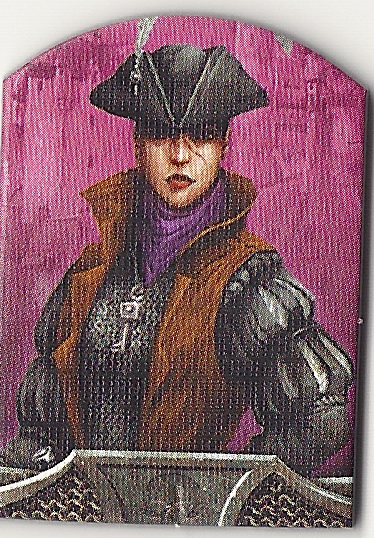
  • この投稿で、小さい戦闘例を表す。私が作った例キャラクター、「Mad Maxine」というロードウァードン(roadwarden)たいゴー種類のビーストマン。この種類は中級だと思う。じゃ。。。

    Mad Maxine:

    狂気みたいなMad Maxine,初めまして

    (今日新しいスキャンを使ってみるからちょっと下手なスキャンです。すみません、私にとしては絵術は無理だよ)。

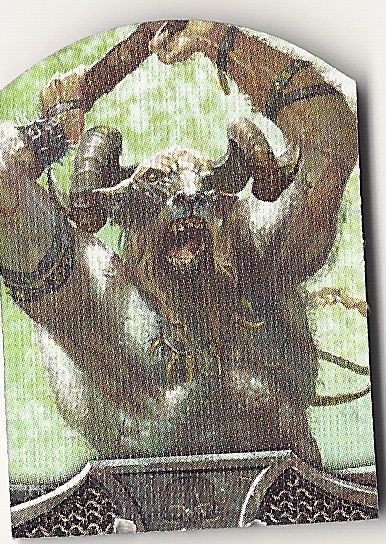
    次は、あのビーストマン:

    ごーーー

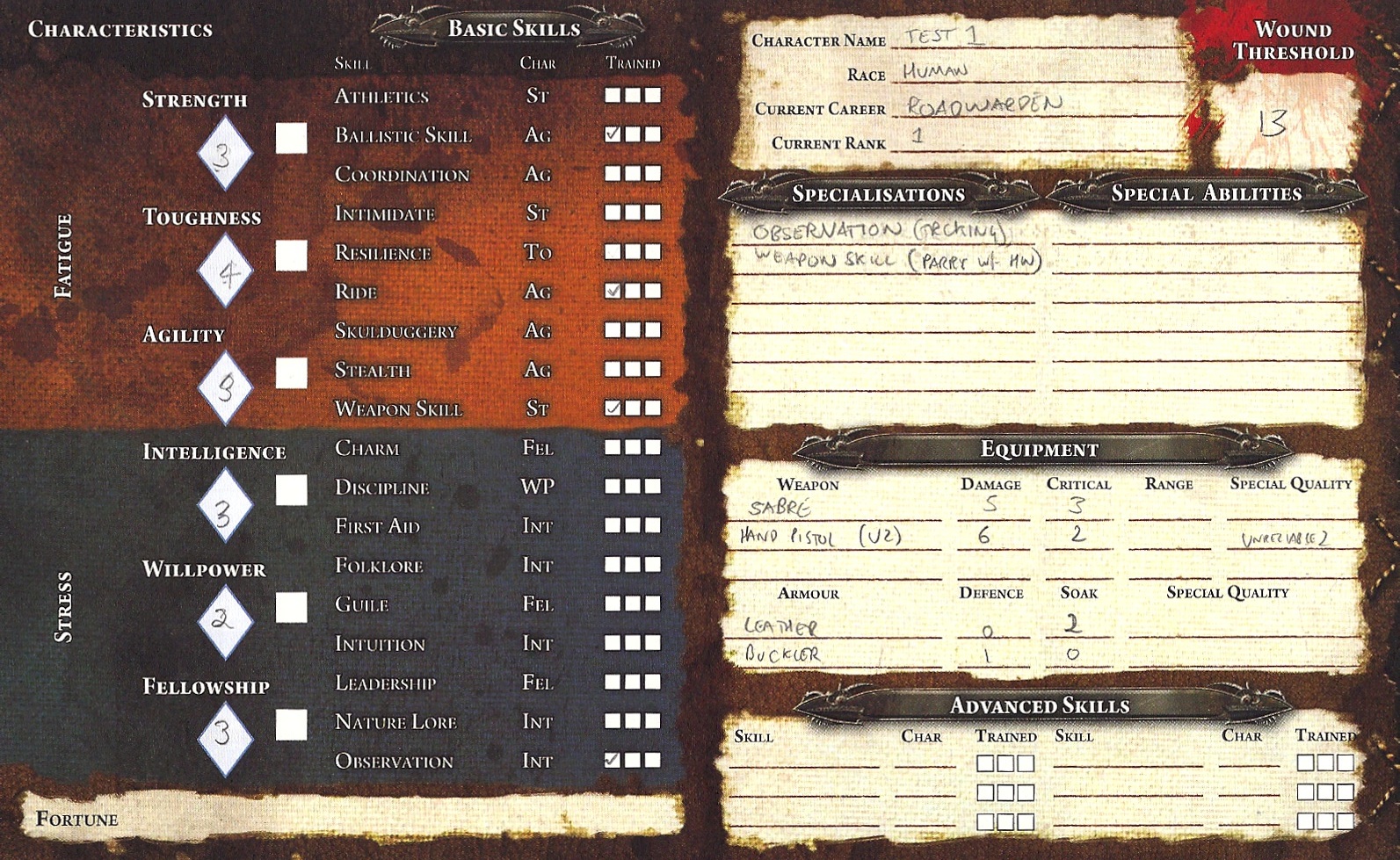
    危なそうね。Mad Maxineさんのキャラクターシートはこれです(クリックすると大化):

    それでは、戦おう!!

    大切のは:

    • strength(筋力)は3
    • agility (敏捷力)は3
    • toughness(耐久力)は4
    • weapon skill (攻撃力)は熟練だし、それにもparry(受け流し?)習熟もある。
    • ballistic skill (射撃力)は熟練です
    • wound threshold(傷度?)は13

    彼女も盾を持つ。

    では、始めよう。お互いはちょっと離れて会って、ゴー君は何も持っていないし、Mad Maxineさんは拳銃と盾を持っていると仮定しよう。

    らうんど1

    最初はイニシャチブ。これは、敏捷力の数の属性サイコロできめられた。Mad Maxineさんの敏捷力は3;ゴー君の敏捷力は4。だからMad Maxineは3個の属性サイコロをふって、ゴー君は4個。

    Mad Maxineさんのサイコロは:

    やった?

    ハマー(金槌)を2個、天使を1個。イニシャチブを判定する時に、天使は意味がない。各ハマーは成功を一つから、Mad Maxineさんは成功2つできた。彼女のイニシャチブ値は2になる。

    ゴー君は4個サイコロをふって、ハマー1つ、天使1つを得るから彼のイニシャチブ値は1になる。

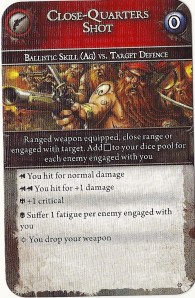
    だからMad Maxineさんは最初に行動する。各ラウンド、皆さんは移動1つ、アクション1つができる。反応アクション(例えば、受け流し)は自由に使える。姿勢を変えるのは移動です。Mad Maxine はとりあえず姿勢を中立から暴走1まで変更して、そして「Close Quarters Shot」(近距離射撃)というアクションを使う。このアクションのカードは:

    死にたいの?死にたいの????シニタイの!!!???

    「Suffer 1 (black square) for each enemy engaged with you」という意味は、白兵攻撃中の相手がいたら、相手ごとに1個の不吉サイコロを得る。今の頃、Mad Maxineさんはまだ白兵相手がないから、気にしない。彼女は、射撃ロールをする。射撃攻撃は敏捷力に依存する。彼女の敏捷力は3だから、属性サイコロ3個をダイスプールにいれるはずだけど、姿勢は暴走1だから、属性サイコロ1個の代わりに赤い姿勢サイコロをいれる。そして、彼女は射撃技能熟練1レベルがあるから、熟練サイコロ1個を加える。そして、彼女は人間だから、特技はセッションごと一回吉サイコロ2個が何判定でも加える。今使ってみようかなとおもうから、その吉サイコロ2個も加える。

    そして、射撃攻撃の難易は「easy」(簡単)だから、挑戦サイコロを1個加えて。それにも、ゴー君の防御値は1点だから、不吉1個を加える。

    だから、合計は:属性サイコロ2個、赤姿勢サイコロ1個、熟練サイコロ1個、吉サイコロ2個、挑戦サイコロ1個、不吉サイコロ1個。

    大変だね。Mad Maxine さんのロールは:

    成功!

    基本ロールの結果は写真の真ん中にある。熟練サイコロ(黄色d6)の結果は「小さいプラスを持つハマー」。この結果の意味は、あの種類のサイコロをもう1個ふる。。。次の熟練サイコロは左上の黄色d6。結果は天使。挑戦サイコロの結果は2つの刀イメージです。この結果の意味は、失敗2つです。赤姿勢の結果はハマー2つ。これは成功を2つを表す。そして属性サイコロ、熟練サイコロもハマーを表す。それは、成功4つ、失敗2つ、吉1つ。失敗2つは成功2つをキャンセルから、合計は:成功を2つ、吉を一つです。

    Close Quarters Shotのカードを見ると、ハマー2つの線に「You hit for +1 Damage」が書いてある。その下には、吉1つの線に「+1 critical」が書いてある。結果は、+1ダメージ、傷1つはクリティカルになる。拳銃のダメージは6たす敏捷力から、傷の合計は6+3+1=10。そして、ゴー君の鎧と耐久力を引いたあとで、5になる。ゴー君は5傷をえて、1つはクリティカルになる。クリティカルカードを確率的に引くとこれが見える:

    ゴー君は小泉様が好きになった

    「aggravated wound」っていうのは、小さい傷はもっと悪くなった意味です。「Your stance is considered one step closer to neutral」っていうのは、姿勢は中立まで1レベルを化投げないといけない。コー君は普通に暴走1から、今から、中立として戦闘しないといけない。いい!

    Mad Maxineのアクションカードを見ると、右の上には「0」が書いてある。この「0」の意味は、Close Quarters Shotのリチャージ期間は0ラウンドです。次のラウンドにまた使える。

    そしてゴー君は攻撃する。彼は特別な攻撃がある:Fearsome Chargeという攻撃。日本語で「威圧突撃」かもしれない。これを使おう!

    このアクションは筋力で解決された。コー君の筋力は5です。姿勢は中立だから、姿勢サイコロにかわらない。そしてかれは運点2つを使う。

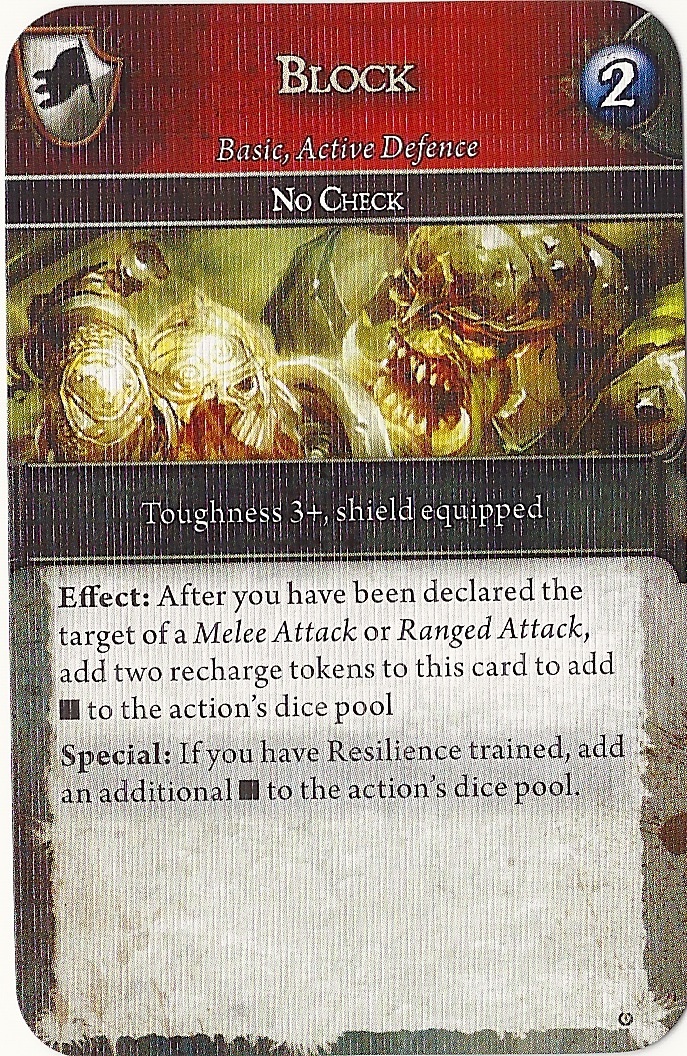
    攻撃の難易が「easy」だから挑戦サイコロを1個加える。そして、Mad MaxineはBlockを使う:

    わあああ!盾を示そう!

    右上には「2」が書いてある:リチャージは2ラウンドです。基本的にこのカードは不吉1個をダイスプールに加える。「Resilience」という技能があったら、もう1個加えられるが、Mad Maxineは回復力がない。

    だから、不吉1個を加えよう。そしても、Mad Maxineさんの防御値は1点だから、不吉サイコロもう1個を加える。ダイスプールの合計は:属性サイコロ5個;吉2個;挑戦1個;不吉2個。振ろう!

    結果(写真見せない):

    ハマー2つ(成功+2)

    刀2つ(失敗−2)

    天使1つ(吉+1)

    頭骨1つ(不吉−1)

    合計:成功なし、吉+0!ミス!ホッとするMad Maxineさん。

    それで、ラウンドが終わった。次のラウンドの前に、アクションカードのリチャージ期間を1引く。そしてラウンド2。

    らうんど2

    Mad Maxineは最初に行動する。彼女の一番得意防御は受け流しだから、拳銃を刀に変更したい。でも、拳銃を片付けるのは移動を1つかかるから、彼女は普通に1ラウンドで拳銃を片付けて、刀を出すことができない。でも、大切だから、倦怠1つを得ると移動もう1つができるから、そうしようと決める。これから、彼女は倦怠点1つを持っているが、刀も持っている。

    では、白兵攻撃しよう。

    kill!
    kill! kill! kill!

    このアクションは筋力を使う。だからダイスプールは、基本的に:属性サイコロ2個、赤姿勢サイコロ1個、熟練サイコロ1個、挑戦サイコロ1個、不吉サイコロ1つ。ゴー君は回避アクションができるけど、Mad Maxineは怖そうではないから、使わない。彼の防御値は1だから、不吉サイコロ1個を加える。それで、振ろう。結果は:ハマー1つ、刀3つ、天使1つ。ミスである。

    そしてゴー君は自分の普通白兵攻撃を使う。これも、筋力で解決するが、Mad Maxineさんは受け流しを使う:

    Parry is a Girl's Best Friend!

    彼女は不吉を1個加えられる。その上に、もし攻撃技能熟練があったら、も1個加えられる。そして、受け流し習熟もあるから、もう1個を加える。盾を持っているから、基本の防御は1だから、それも不吉1個を加える。

    ダイスプール合計は:属性5個、挑戦1個、不吉4個。ふろう!結果は:ハマー3つ、混沌1つ、天使2つ、頭骨1つ。合計:成功3つ、吉1つ、混沌1つ。ゴー君の普通の攻撃なら、結果は:

    • 成功2つできたから、あたり!ダメージ+2、クリティカル1つもある
    • 混沌だから、ゴー君も傷1つを得る!

    ゴー君のダメージは11、Mad Maxineの耐久力と鎧で5を引くから、彼女は傷6、クリティカル1つを得る。クリティカルの結果はMinor Trauma(怯えみたい)。多分関係がない。

    この通りで戦闘が続く。Mad Maxine は、2ラウンドくらいに死ぬと思う。

    基本的に、これはWarhammer 3の戦闘。複雑そうだけど、たくさん色な行動ができるから面白そう。それにも、サイコロの種類が多いし、アクションの結果も多いから、おもしろそう。

    やろう!

  • The owner of my FLGS gave me a copy of Warhammer 3 (yes, in Steamy Beppu, the FLGS really is Friendly) to read so I can run a game in Japanese, so recently I’ve been reading it and doing some trial fights[1]. I don’t get to run a game until late June, but I think I can safely say from what I’ve seen so far that I really like. There are some pictures of the mechanics of the system here, but I’m going to give a full overview of the mechanics I’ve read so far in this post. By way of background information, it appears that the system has been licensed out to Fantasy Flight Games, but they have retained some of the basic flavour of the old game, so even though the mechanic is completely different, the rulebooks and some aspects of the skeleton of the character system are similar. Wounds, for example, are a roughly similar number to 2nd edition, toughness still acts as a soak to damage, you still use an ability score to determine skill use, and there are still 3 boxes next to each skill for training. The character classes and races are roughly similar, though they got rid of the Camp Follower, and ditched halflings (yay!) They retained racially specific classes like the Envoy, and magic has been beefed up a bit. They also retain the Warhammer worldview, so the maps are the same and they have quotes from famous figures in the world which retain the sense of ironic low-fantasy darkness from the original. The Tome of Mysteries, for example, has a section on magical theory penned by a wizard, which makes it clear that the wizard thinks that magicians, priests and demons all draw their power from the same source, while strenuously denying any such heresy. This is the sort of thing I like about Warhammer.

    But it appears that the 3rd edition system actually reflects the underlying dubiousness of the world, and its deadliness, in a way that 2nd edition never did. So, here is my review of the system.

    Bye bye shorty

    There are no Halflings in the new version.

    The dice and the standard mechanic

    Warhammer 3rd edition uses dice pools, but it ditches standard dice, and instead introduces several new types of outcome, and scatters them at different rates across different dice. The dice are:

    • Attribute dice, which are blue d8s, you roll one of these for every point you have in an attribute, and they form the basis of skill checks. So if you have Strength 4, you roll 4 attribute dice for any skill based on strength. These are good dice.
    • Expertise dice, which are yellow d6s. You add one of these to your dice pool for every level of training you have in a skill. These are good dice.
    • Challenge dice, purple d8s. You add one of these for every level of difficulty of the skill check. These are bad dice.
    • Stance dice, red or green d10s, which represent the effect of being in a conservative or reckless stance (see below). You exchange attribute dice for these, so if you are two steps into a conservative stance you switch two blue d8s for 2 green d10s. These dice are better than attribute dice, but they carry a risk: conservative dice minimise the risk of bad outcomes but increase the risk of delay, while reckless dice increase the risk of bad outcomes as well as good ones
    • Fortune dice, white d6s, which you add to the roll using fortune points. Specialisation in a skill, or helpful environmental effects, also add these dice to a roll
    • Misfortune dice, black d6s, which are added to the roll when it is opposed by an opponent’s action (e.g. a parry) or the environment, or if your opponent uses fortune to oppose your roll.

    Each die can have several outcomes:

    • success (represented by a hammer)
    • Challenge (crossed swords)
    • Bane (skull)
    • Boon (angel wings)
    • nothing (blank face)
    • chaos (a chaos star)
    • Sigmar’s comet (a comet)

    Your roll is successful if you get more successes symbols than challenges. Boons also have good results (e.g. criticals), and banes can have bad ones (e.g. suffering a wound from your enemy). Banes and boons can cancel. Chaos and Sigmar’s comet are particularly bad or good outcomes. So if , for example, you roll 4 hammers, 3 crosses swords, 3 angel wings and a skull, your end result is 1 success and 2 boons, which in a standard combat attack would be normal damage and a critical.

    Probabilistic analysis of this is going to suck.

    Actions and talents

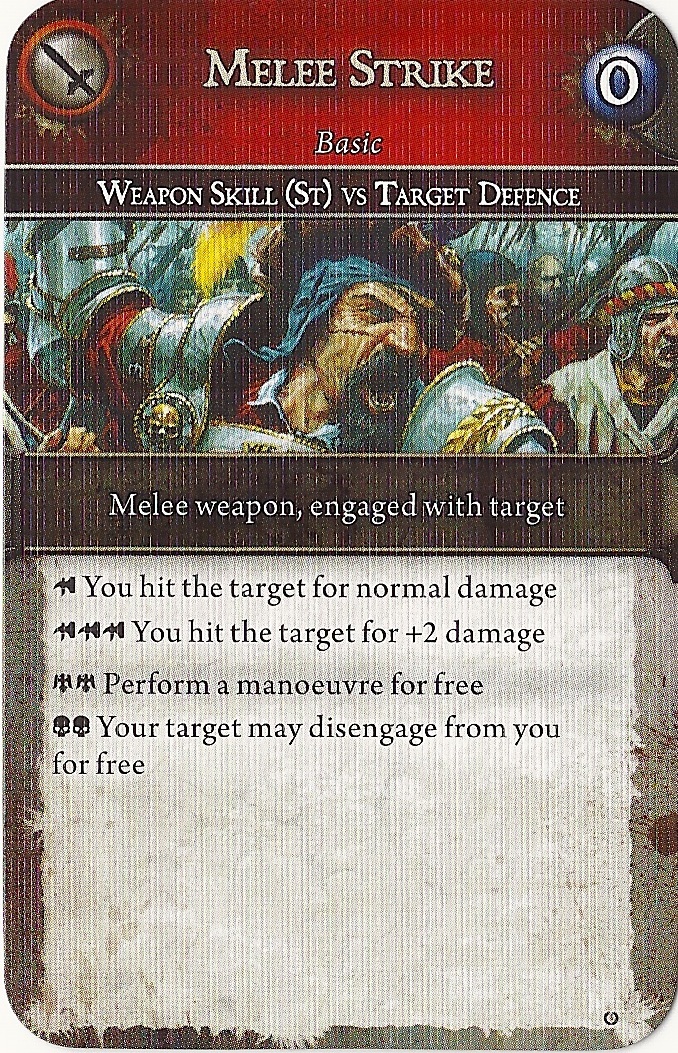
    Every character class gets to choose certain actions, written on cards, and talents. Talents can be used once per session to get some benefit; actions have a recharge rate (in rounds) ranging between 0 and 5, and each action card has two sides, one green (for an action in conservative stance) and one red (for an action taken under a reckless stance). Each card lists the benefits of success, various levels of benefit associated with different numbers of boons, and bad outcomes for banes, chaos, etc. Each character has a set of basic actions (block, melee strike, manoeuvre) but then additional actions they can choose to use. When you use an action with a recharge time, you put cute skull-shaped counters on it and remove one at the end of each round. In my trial combat I used block (with a shield), that has a two round recharge, but then I used the sword and board attack, which has a 3 round recharge, but if you get a few boons in your roll it completely refreshes your block action. This is the mechanic of actions, and it strikes me that it’s quite an effective way of keeping track of round-to-round effects. It’s also a good way of keeping your powers managed, and giving them multiple outcomes depending on the stance you’re in. I like this.

    Stances

    Your character starts the game in a neutral stance but can choose to move into a conservative or reckless stance. Different classes have different stance tracks – my trial PC, a roadwarden, can go two steps in either direction, but other characters have different approaches. Some actions work better in one stance than another, and you can check which is better by looking at your cards. According to the book, for example, the accurate shot action is better in a conservative than a reckless stance. I like this too, it gives players diversity in handling situations, and gives the GM a context in which to set action descriptions. The game also provides some counters that you assemble to form a “stance tracker” which you use to keep track of where your stance is at. I like the mechanical aids in this game, they are really actually useful.

    The Progress Track

    This is another game aid, constructed by the GM out of cardboard pieces, which shows the progress of a challenge, skill check, scenario or series of events. Counters are set on the track, representing the party and the opponents, and the GM moves them according to time increments and/or skill checks. Whoever gets to the end of the progress track first wins the challenge, so for example if the track represents a pursuit, PCs and NPCs move along the track according to challenged skill checks, and if the NPC gets to the end of the progress track first he/she has escaped.

    I’m not sure if this will be easy to use in practical gaming, but I can see the purpose of the idea and the possible benefits. I shall report back on it when I have tried it.

    Magic and monsters

    I haven’t tried magic yet but the main aspects of it that I can see are:

    • It’s more powerful than in 2nd edition
    • It retains the edge of risk and miscasting
    • If anything it’s rendered more risky by the role of fatigue, stress and insanity
    • It seems to have a strong feeling that suits the warhammer world

    Stress, fatigue and insanity

    The game has an excellent and very powerful mechanism for fatigue. For example, my trial PC had an excellent action called execution shot which enables the PC to use a close-quarters missile shot and a melee attack in the same round, if she is carrying a pistol and a sword at the same time. But when combat started she had shield and pistol, so she wanted to swap out the shield and draw the pistol. Doing so requires two manoeuvres, and in order to do this and move into a reckless stance[2], she had to make 2 more manoeuvres than she was eligible for. So she spent two fatigues and gained two extra manoeuvres, problem solved… until some action failed and she incurred 2 more fatigues. As soon as your fatigue score exceeds  a physical ability, you incur a penalty of one misfortune die on all rolls – which increases the risk of subsequent fatigues. Then she copped a critical that caused another fatigue, and now her chances of doing anything successfully are very low. In subsequent fights, I made sure to be careful with these fatigue accumulations, because they get prohibitive fast. The same mechanism exists for stress, which is applied to mental abilities. If your stress exceeds twice your willpower, you risk insanity, which is initially temporary but can become permanent. I think magic use carries a high risk of insanity and stress, and there are even character classes (like the Witch Hunter) which you cannot take until you have incurred a permanent insanity.

    Deadliness

    Based on trial combats so far, against orcs and various levels of beastman, this game is deadly, at least for first level characters. The battles proceed rapidly to a dismal end, and vicious stuff happens quite fast. You can incur fatigues, criticals, and significant penalties on your next action very quickly, and then it’s all downhill. Whether this continues at higher levels I’m not sure, but I’ll be keeping an eye on it.

    Drawbacks

    The most obvious drawback is that the talent cards, action cards and special dice mean you have to buy the company’s product, and the initial product only provides enough stuff for 3 players, so if you have 5 players you have to buy an expansion pack containing more of these key ingredients. The game is expensive (about 10000 Yen), but I don’t think this is the end of the world, because it’s assumed that 4 people will be sharing the one box, which at 2500 Yen each isn’t the end of the world. However, if you run out of counters or action cards it sucks a bit. I also suspect that at higher levels and in hard combats the dice pool will be very complext to read, but after a few battles I was able to understand the dice pool quite quickly, so it’s maybe not the end of the world. Physically laying out your characters is also a bit of a pain, but on the upside they have designed it well to enable you to access all your information easily. I think the method of handling second careers could be a bit of a pain, though.

    Presentation

    The books look nice and all the associated material (cards, dice, counters, cardboard figures) are great. The editing of the game is a bit shoddy, and the rules are sometimes a bit vague (handling specialisations seems to have been reduced to a single sentence, so I had to do some guessing). However – and I believe, most importantly – the book tries hard to keep the flavour of the previous two versions of the game, with quotes on every few pages and regular reference to the world of Warhammer. The quotes and the sense of dark confusion and chaos have always been a very good aspect of Warhammer, and this game has retained them admirably.

    Conclusion

    It seems good, possibly too complex, and I’m not sure if the mechanic will hold up under the pressure of high-level gaming. I’ll give a further definitive opinion once I’ve run a session – stay tuned!

    fn1: which involves saying to your partner when she comes in, “This isn’t what it looks like! I’m not so sad that I’m role-playing with myself!”

    fn2: If you’re juggling a shield and a dodgy pistol mid-combat, you are by definition in a reckless stance!

  • Looking from the Tower of the Sky over the city of lights…

    Neil Gaiman did this first of course with his excellent Neverwhere, and its imaginative reinterpretations of London Underground station names. London Underground stations are in reality completely unromantic despite their names, and the same applies to Osaka, whose residents don’t think much about the romantic and inventive meanings of the station names all around them – to them, they’re just names. The meanings derive from the Japanese characters (Kanji) of which the names are composed, of course, and on my recent trip to Osaka I was struck by how romantic a role-playing world would sound if its regions and place names were built from English translations of Osaka (or Tokyo) place names. For example:

    • Nanba, Wave of Hardship
    • Shinimamiya, New Palace of Now
    • Shinsaibashi, Bridge of Heartful Worship (thanks Noisms!)
    • Tennoji, Heavenly King’s Temple
    • Kujo, Nine Clauses
    • Tsuruhashi, Crane Bridge

    Fukuoka, in fact, has a street in the drinking and night-life district whose name literally translates as “Disrespecting parents street.” The challenge here is to think of something interesting about the area which justifies its name – is the area called Nine Clauses a town in the juncture of 9 competing kingdoms? Is it a series of 9 standing stones with ineffable powers? What is the New Palace of Now, and does it ever change? Is the Heavenly King a lost God whose temple is falling to ruins, or does the cult of the Heavenly King wish to violently overthrow the parliament and restore the King as a God? If so their temple must be remote, and very well defended.

    It doesn’t take many of these names to construct a world with a romantic feeling (too many would, of course, be very tacky). One could even do it sandbox style, lay down the names to start with and have the players decide what they mean when they arrive at the location. Creating a world based on names, and filling in the adventures later… could be fun!

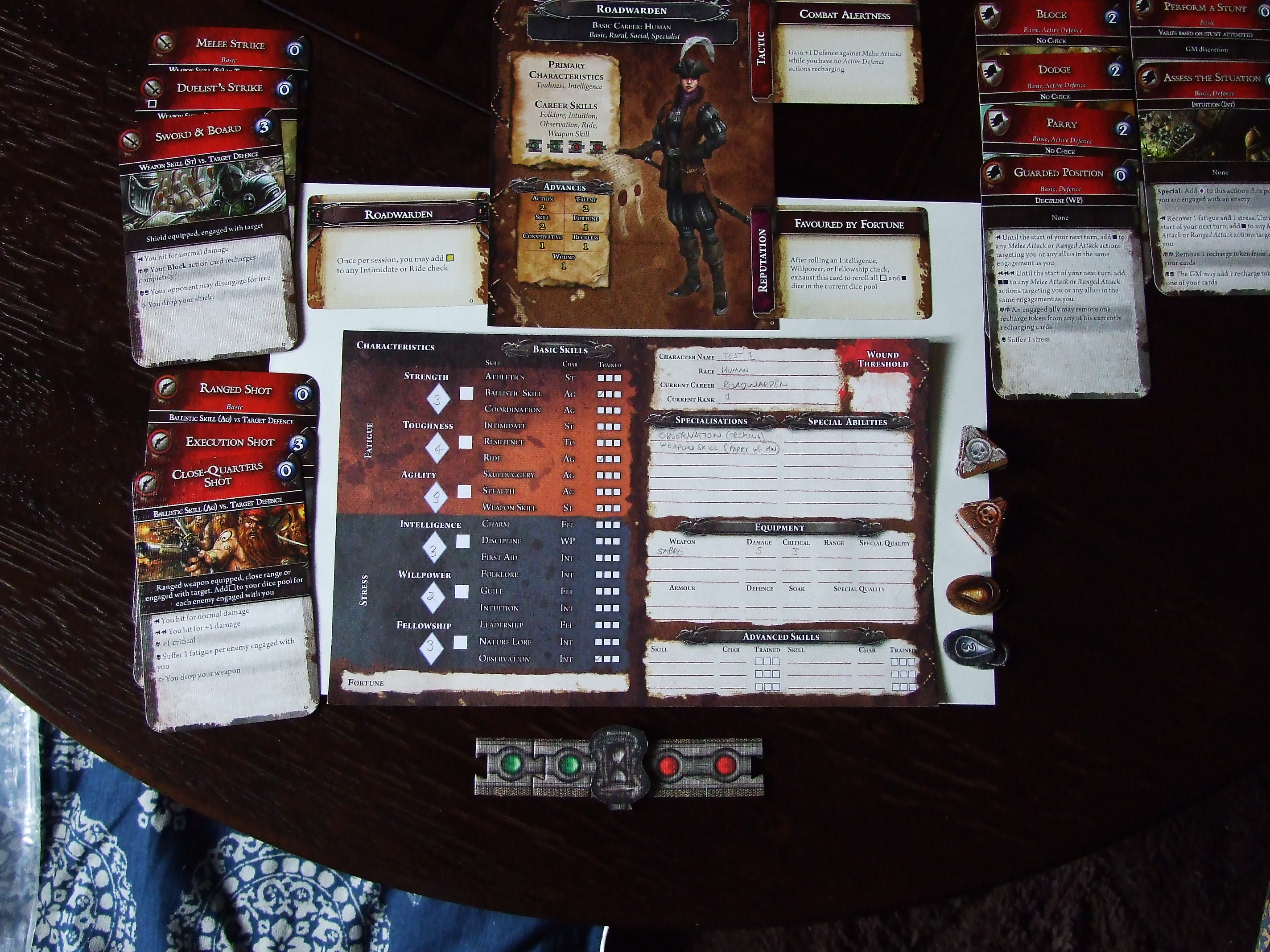
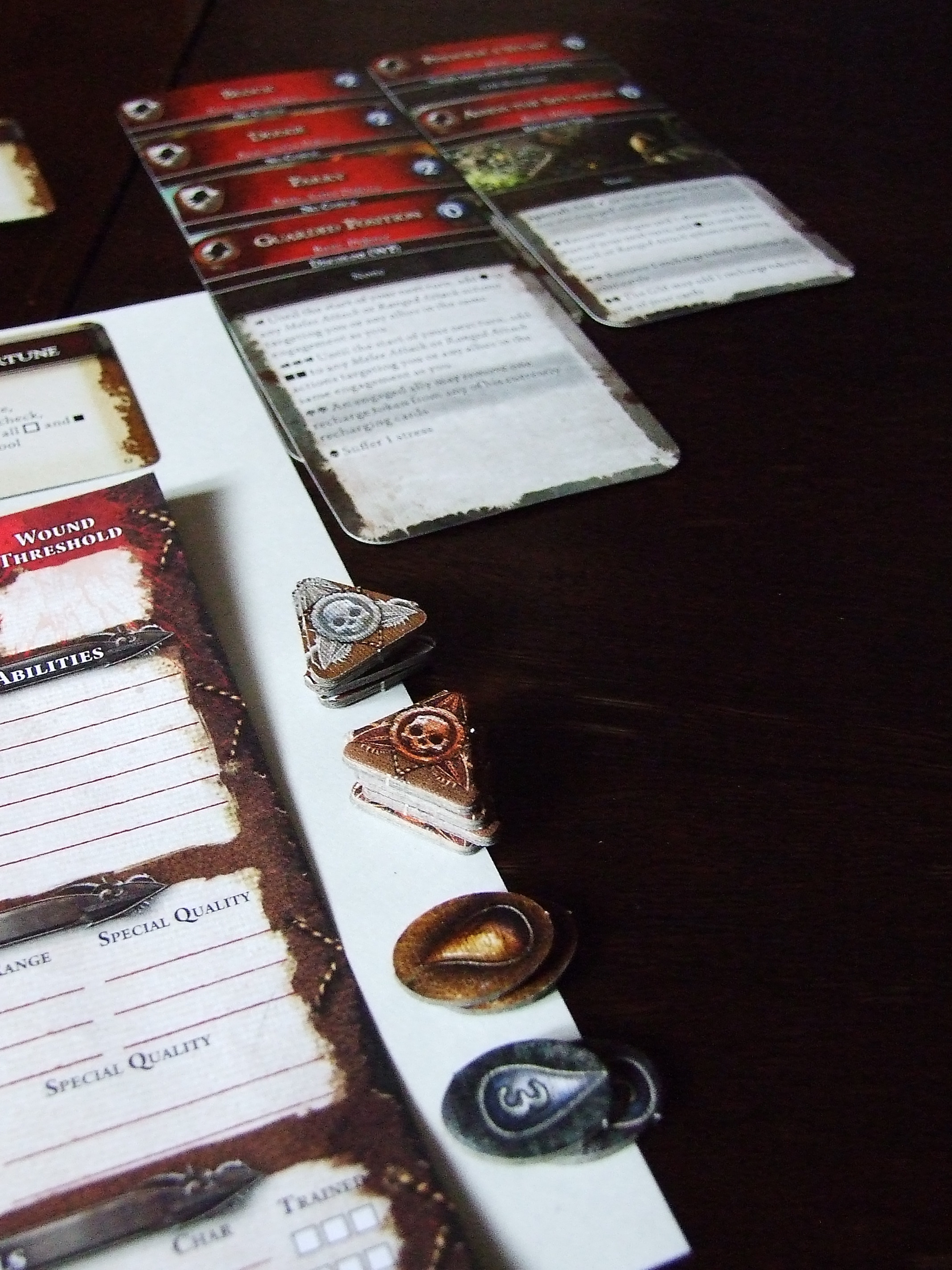
  • Ringtailのお店の店長にWarhammer 3版をもらった。目的は、基本規則を日本語に翻訳して、ゲームを行う。以下は、キャラクター構成の写真(クリックで大化):

    ほんまにTRPG?

    キャラクターは「Roadwarden」です。戦闘を試すために、戦闘ができるキャラクターを作成した。作成は簡単だけど、戦闘規則はちょっと複雑だし、説明は時々あいまいです。もう少し詳しくみたい?

    とりあえず、以下はカウンターです。アクションとか倦怠とかストレスとかケガはこのカウンターで監視(?)された。

    1。。。2。。。3。。。GO!

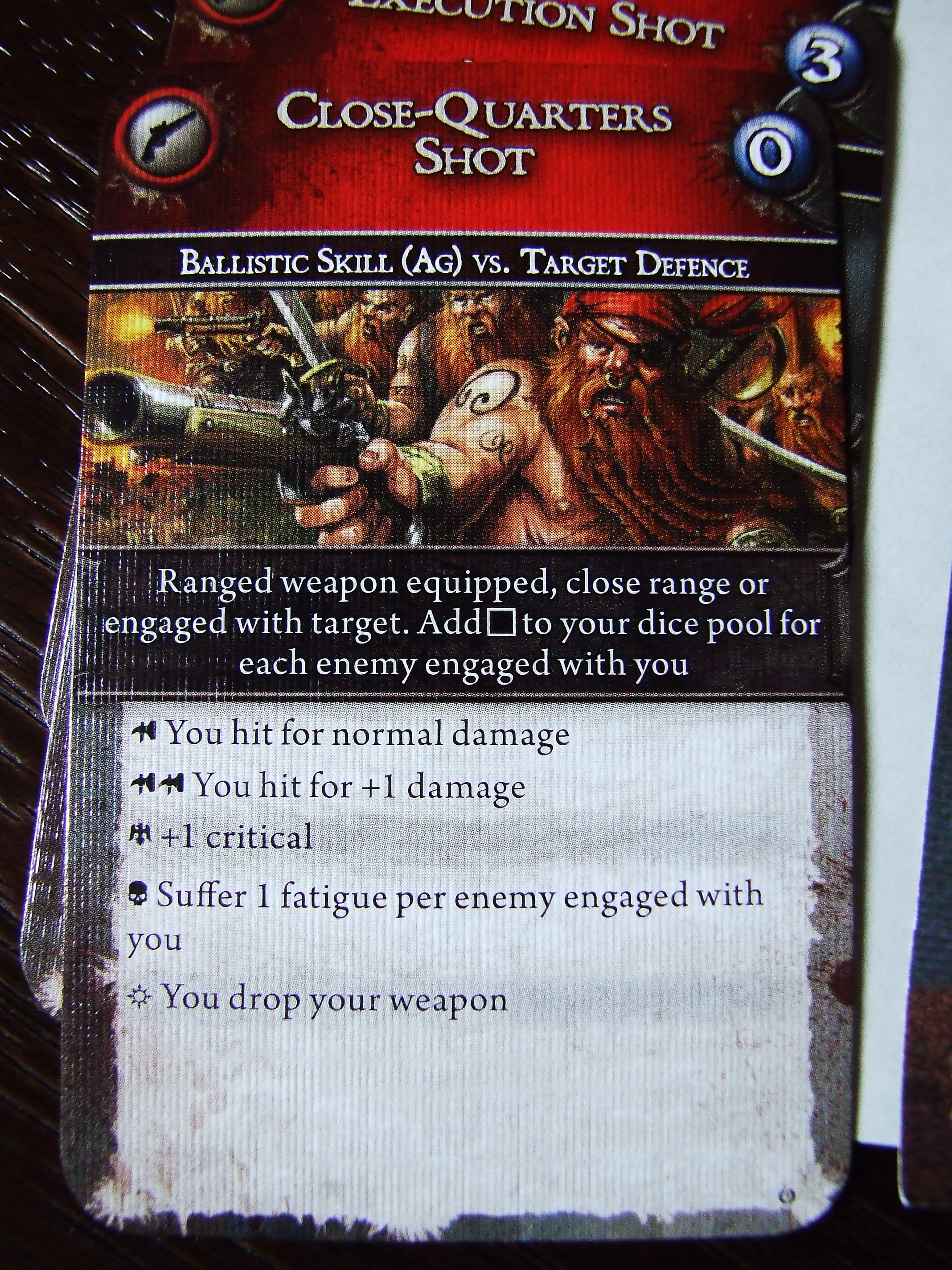
    カウンターの上にはアクションカードです。アクションカードはキャラクターの普通・異常なできる行動の説明をあらわす。皆さんは基本アクションカードを(攻撃や受け流しなど)が集められるが、その上にキャラクター作成の時に1から4枚を決めて加えることもできる。以下はアクションカードの写真:

    やろう!!!

    このアクションは近距離射撃です。カードは行列3つで、いい結果を表す:

    • 普通のダメージで打つ
    • ダメージ+1で打つ
    • その上に特製ダメージも受ける

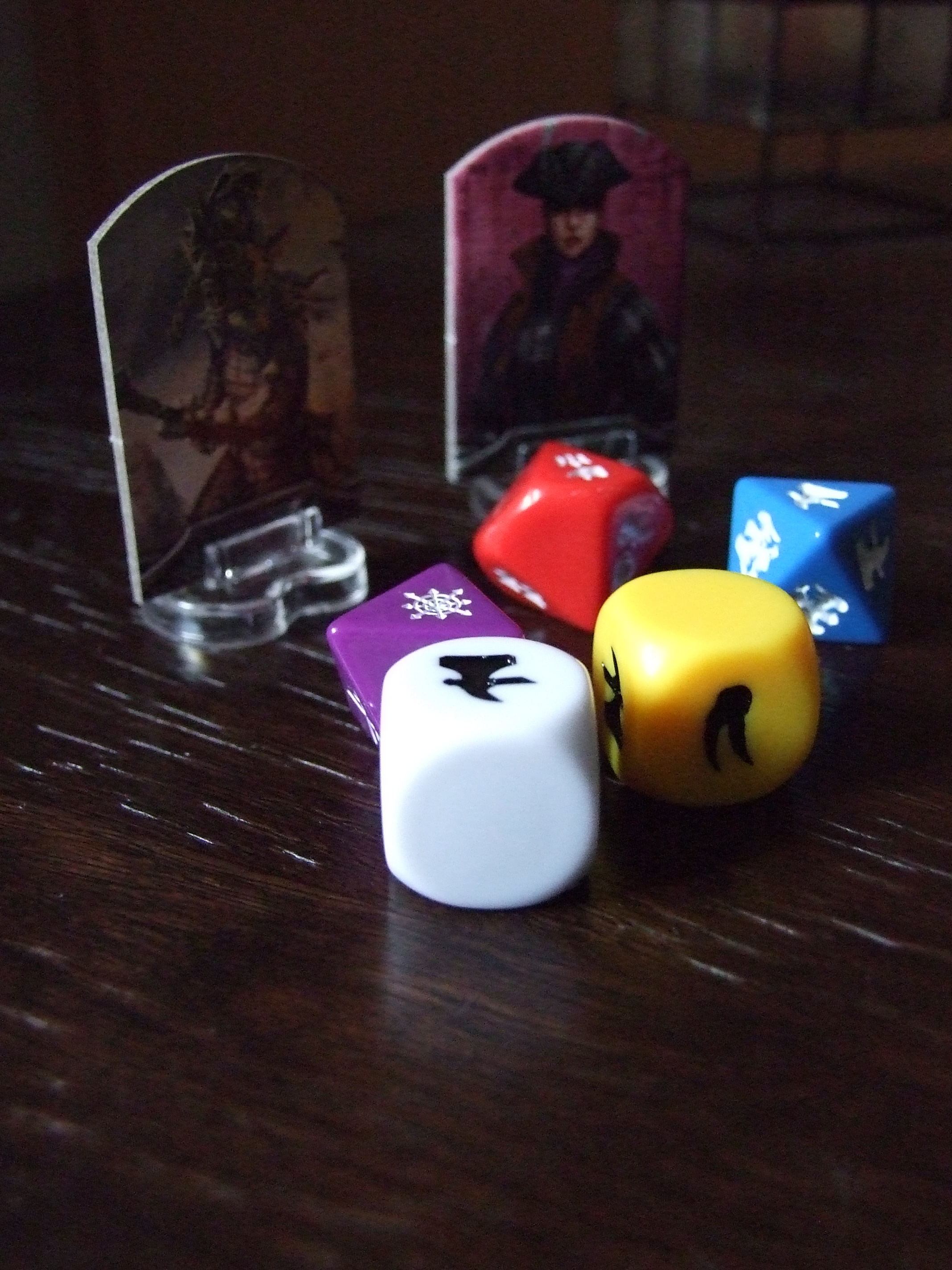
    と1つの悪い結果:武器を落とす。このカードの中に、変な絵文字を気がついた?Warhammer 3は特製サイコロをつかう。以下はサイコロの写真:

    この種類で結論しよう

    サイコロのいろな種類がある。この種類は:

    • 属性サイコロ:青いいろのd8。このサイコロは基本アクション・攻撃の結論ダイスです。アクションはある能力に依存する。適当な能力の値の属性ダイスの数をふる。例えば、近距離射撃のアクションはballistic skill (AG)に依存する。能力はAG(Agility=敏捷)。だから、敏捷力値のダイス数をふる。私の例のキャラクターは敏捷値が3だから、属性サイコロ3をふる。
    • 熟練サイコロ:黄色のd6。もしアクション関連技能は熟練があったら、このダイスをダイスプールに加える。例えば、近距離射撃の関連熟練はBallistic Skill(射撃技能)。私の例のキャラクターはこの技能を1レベルに熟練があるから、熟練ダイス1個をダイスプールに加えられる。熟練最高レベルは3
    • 姿勢サイコロ:赤のd10。キャラクターは2つの姿勢に入れる。姿勢は「暴走」か「保守」です。写真にある姿勢ダイスは暴走ダイス(保守は緑のd10)。姿勢レベルによって、属性ダイスの代わりに姿勢ダイスを使わないといけない。暴走ダイスは、いい結果の確率が高いが、悪い結果のおそれもある。保守ダイスは、悪い結果の恐れが少ないが、いい結はそんなに言い訳じゃなくて、時々アクションの時間を延長するおそれもある。
    • 吉サイコロ:白いのd6。運ポイント使ったら、このダイスがダイスプールにも加えられる。このダイスはいい結果だけが表れる。このダイスの反対は黒いd6の不吉さいころ。悪い状態があったり、相手は受け流しをしたり、相手は運ポイントを使ったりする時に、この悪いサイコロをダイスプールにも加えないといけない
    • 挑戦サイコロ:紫のd8。アクションの難しさを表すダイス。例えば、アクションの難しさが「easy」だったら、このダイス1個をダイスプールに加える。このダイスは悪い結果だけがあらわれる

    基本的に、アクションを結論するように、ダイスプールを全てふって、いい結果と悪い結果を整理する。ダイスの面に表れる結果は:

    • 成功(小さいhammerのイメージ)
    • 失敗(小さい刀で作られたバツのイメージ)
    • 吉(小さい天使のイメージ)
    • 不吉(小さい頭骨のイメージ)
    • 混沌(特別のイメージ)
    • シグマーズコメット(ほうき星のイメージ)

    成功と失敗は反対;吉と不吉は反対;混沌とコメットは特別。もし成功数は失敗数より高かったら、アクションは成功!もし吉は不吉より高かったら、もっといい結果がある。反対も起きるおそれがある。そしても、混沌は特に悪い結果;コメットは特にいい結果。

    その方法でアクションを結論する。

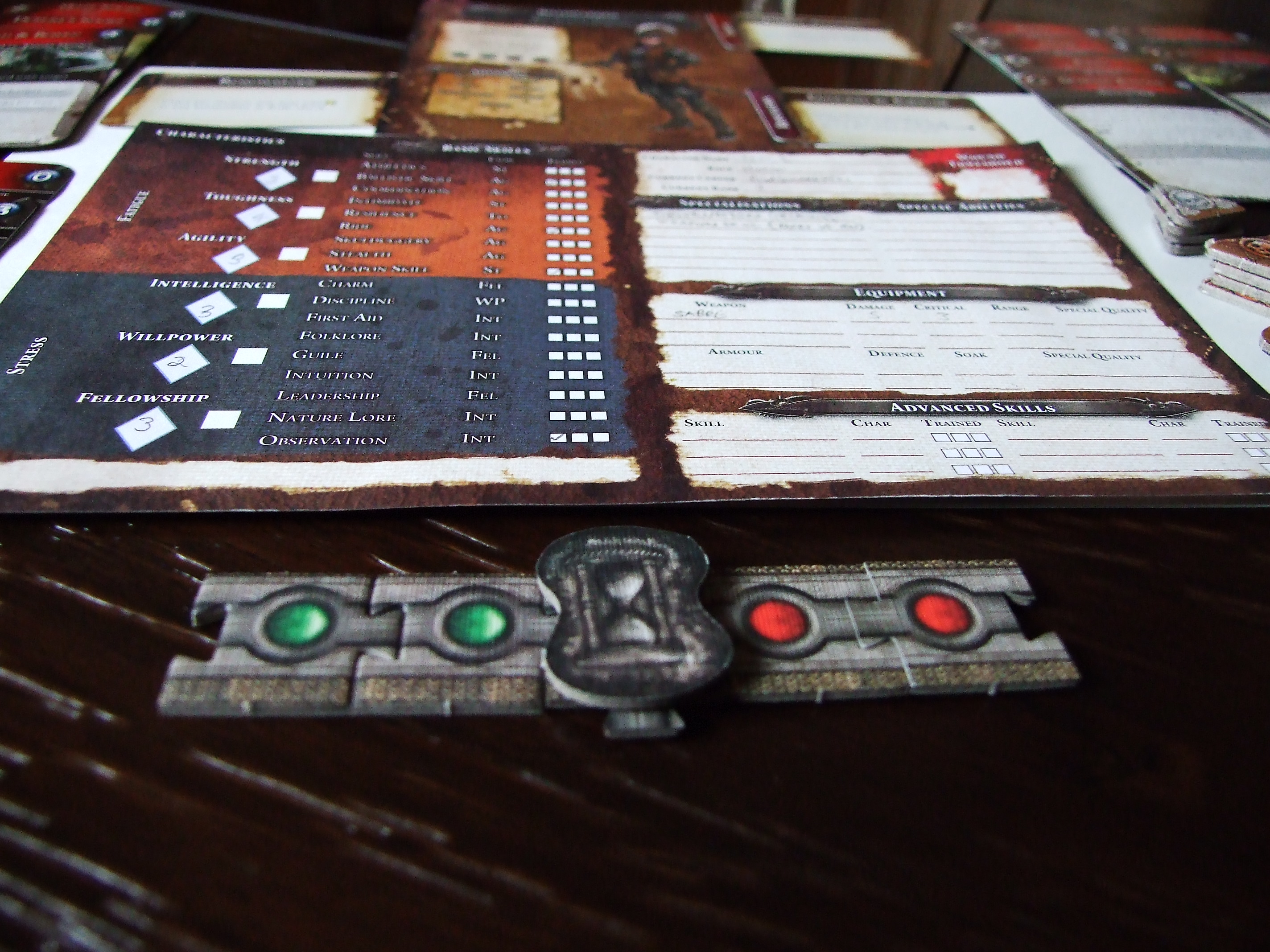
    最後に、姿勢メーターを見よう:

    暴走性に行こう

    キャラクターによって、このメーターが違う。緑線は保守姿勢れべる;赤線は暴走レベル。カウンターは今の姿勢レベルを表す。アクションカードの全ては片面です。赤い面は暴走姿勢の結論結果を表す;緑面は保守姿勢の結論結果を表す。

    複雑ですが面白いです!やりたい!

  • This is the report of the warhammer session I participated in 2 weeks ago, which I haven’t had a chance to report on yet. The group consisted of the GM and 3 players, one of whom didn’t introduce himself[1]. Our characters were:

    • Dwarven Runebearer (played by Ichinose, who was part of my last Pathfinder experience)
    • Human Nightwatchman
    • Human graverobber (me)

    We rolled randomly for our characters, so I also had a choice of playing a fanatic, which I was inclined to do, but it would have been even more of a disaster than graverobber. My graverobber’s main traits were that she was female, with wide, staring eyes and a slightly mad, twitchy manner – as if she has seen things you wouldn’t believe. Seemed suitable.

    The adventure started in Middenheim, where we three found work with a church organisation. The forces of chaos had once again surged down from the North, and many of the Northern towns had been reduced to ashes[2], so there were missions heading north to rescue people, treasures, and the remnants of the non-chaotic civilisations that had been crushed there. The church mission would be straying near a town (name now forgotten) which was famous for its milk tea company, now all sacked of course, and particularly for the family that ran the company – the daughter of which Suzette Crepe, was famously beautiful and kind. All three of us had met Suzette Crepe in the past, the Watchman guarding her when she was on volunteer duties to the South, and me being healed by her during those same volunteer duties after a close shave with some chaotic scenario (perhaps a badly run funeral?)

    So, North we went. We were soon attacked by a mob of Snotlings, which we soon put paid to despite my concerns about the combat system (possibly because they’re piss weak, but also because they weren’t defending themselves properly). Having cracked some chaotic heads, we settled into the mercenary camp in the town. Here our evening reveries were interrupted by an encounter with a filthy waif, who was attempting to steal some of our hard-earned bread. She was caught in the act by the resident mercenary bully, a racketeer who I shall choose to name “Tony,” who began roughing her up a bit and causing trouble. It was at this point that we realised the waif was actually Suzette Crepe, and we were watching the heir to the Milk Tea fortune being roughed up by some Southern German lout.

    This is the point in any cartoon where the scrawny, dodgy girl at the back – you know the one, with the staring eyes and the twitchy expression – suddenly gets dollar signs spinning in her eyes like a crazy pachinko machine. It’s the point where Luke Skywalker says “She’s rich…” and Chewie sighs.

    Some people, as Black Adder said, will fight for glory, love of country, the glistening tear on the cheek of a golden child… but my graverobber will mud wrestle her own grandmother for a stack of cash and a sack of french porn.

    So, of course, we stepped in to intervene. And found ourselves in confrontation with a racketeer (“yurusuya,” or ゆるす屋). Things went badly from here, and my attempts to appear mad and unhinged and not-wise-to-approach didn’t work. Fortunately, just as things were beginning to heat up the head of the church force, a Judicial Champion, waltzed in high-handedly and “resolved” our dispute with the usual diplomatic style of a paladin – dispatching us all to our posts and ignoring the obvious injustice I was suffering.

    We returned to our tent and, seeing the possibilities inherent in our having a rich girl suddenly homeless, orphaned and at our mercy, we did the obvious thing – dispatched the girl with the only female in the vicinity (me) to a bathhouse, where I determined her story. It was the usual tale of woe – family all dead, fortune lost behind enemy lines, goblins, etc. Turns out she didn’t even have any special “teas” which might be useful in, say, combat[3].

    So, having endured her sobstory, back to camp it was, while she melded into whatever shadows people not as skilled as a grave-robber meld into[4]. Unfortunately, on my way back to camp I was accosted by the aforementioned yurusuya (you’ve forgotten this word already, haven’t you dear reader? See how hard this is for me?!) He was just about to grab me and start doing what racketeers do to shifty-eyed graverobbers when, again, along comes the Judicial Champion and recommends the only solution Judicial Champions can recommend – a duel. Knockout style, our 3 PCs versus three NPCs, including said yurusuya. I bet this guy chooses his underwear the same way (if he wears any[5]).

    So, a knockout duel between some kind of Dwarven scrivener, a glorified lantern carrier, and a shifty little minx whose idea of a good time is digging up the bones of your daddy, in the red corner; and in the blue corner 3 trained mercenaries. Fortunately, I now know that probabilistically this was doomed to go on so long that eventually the DM would send in an extra-melee-icular resolution, which was exactly what happened. After 20 or so rounds of faffing, the scrivener finally managed to smash the first mercenary into submission[6]. This mercenary was followed by the next mercenary, who managed, after taking quite a beating, to reduce our scrivener to a bloody pulp (this took another 10 rounds or so), so then battle moved on to the watchman vs. the mercenary. Watchman soon stomped mercenary (a critical was rolled) and the final member of the mercenary duelling team, our friendly neighbourhood racketeer, entered the battle. What followed was an interminable series of rolls, and many announcements of “attari” and “hazureta” (hit! miss!) before finally the racketeer beat our loyal watchman to the pulp he deserves to be[7]. This left little me, all wild eyes and sparrow-like twitchiness, up against The Big Man, who was badly wounded but, you know, kind of … big! So battle commenced, and it just so happens that my character, even though not very big and a bit scatty, has a rather high toughness – so she could take that one extra wound before going down. So there she stood, swaying, on exactly 0 hit points,  obviously looking way tougher than anyone had given her credit for (and having previously done a bit of intimidation with the twitching-eye thing, and a rare successful social check), with the racketeer on exactly 2 hps and leering at her after a quite long fight, when in burst one of his hangers-on to beg us to desist (out of fear for the racketeers life!), only this is illegal, so the Judicial Champion stepped in and declared … us… the winners!!!

    So do most Warhammer fights end, methinks…

    So! Victory was ours! (Did you doubt me, dear reader?) So we took Suzette aside and discovered that she knew of a country house where perhaps her dad’s treasure was buried. At this point we discovered that amongst the entertainers following the camp was a clown who was a friend of Suzettes. So between them they instructed us on how to find this country house, and off we went.

    Of course the country house was empty, and occupied instead by beastmen. So I crept up and spread some oil around the house, to burn it down, but they smelled my oil (stupid beastmen!) and most of them ran away (some of them got caught in the conflagration). We followed them to their cave, where we ambushed the leader and made short work of him. Inside the cave we found they had dragged off the treasure from the country house, which included a large case containing… a golden gun. And it was at this point that the clown and Suzette revealed they didn’t trust us, and were scared we would kill them and take the treasure. Suzette Crepe, being too good to be true, suggested we sell the gun and use the money to help resettle refugees from our old town. I twitched my eyes and suggested we should split the money and she could do what she wanted with her share. The Dwarven runebearer agreed, but our friendly watchman took an awful long time deciding what to do with his opinion. Finally, he weighed in on the side of divvying up the loot. We rolled social skills and ended up with … 100gps each, not the 300 we deserved. Still, better than poke in the eye with a golden gun… or not!

    And so around us the war with chaos raged, while we scuttled back to Middenheim with our ill-gotten gains, to spend them on whatever second-rate goods the residents of a warhammer adventure purchase for fun. And I scuttled off to dinner with a sensei from the University, so missed the post-game review… zannen da ne!

    fn1: There’s a whole strange phenomenon here. In Japanese “circles,” or hobby groups, by dint of being part of the group one doesn’t need to introduce oneself or have a proper name – names are almost irrelevant to native Japanese speakers, since they don’t need to use subject or object in constructing a sentence, and amongst your circle you are obviously part of a group, so don’t need to be named in many instances anyway; and when you are, a nickname will suffice.

    fn2: It’s cute, the rulebooks contain a table for this war, with a list of cities and their populations, many simply recorded as “0”. Warhammer is British … any chance it was influenced by WW2 and the Cold War, just slightly?

    fn3: This will be relevant later

    fn4: It doesn’t bear thinking about, does it?

    fn5: And assuming he ever changes it, which… he is a Paladin…

    fn6: I’m really not sure what a runebearer does, but it fills me with fear of the kinds of disputes they have in Dwarven academia

    fn7: I’m pretty sure that the first fight, between rune-bearer and mercenary, would have lasted even longer, but the player in question kept switching his tens and units dice around when it suited him.

  • This post describes the probabilistic structure of the feint in 2nd edition Warhammer, and its effects in combat, and concludes that it is a highly risky manoeuvre not worth using in any situation. The feint increases the opponent’s attack benefit more than the user’s in all cases, with the penalty for its use increasing with the increasing weapon skill of the user. This post will also show some more remarkable facts about the structure of probabilities in Warhammer 2, particularly the effect of the rules on attack probabilities for evenly-matched antagonists with very high or very low ability scores.

    Introduction

    The feint is a risky manoeuvre in Warhammer 2nd edition, which enables the user to disable the target’s parry/dodge ability, rendering them easier to strike. It is risky because it uses a half action, requiring the user to give up their own defensive parry/dodge ability in order to make the manoeuvre. Because the parry ability relies on weapon skill, it seems reasonable to assume that the manoeuvre should provide most benefit when the target’s weapon skill is higher than the user’s, since in this case the user’s parry ability will be of lower utility to them than the target’s parry ability is to the target. It is not clear that a straight trade – dropping one’s own parry for the chance to remove an opponent’s – is practically a very sensible suggestion. Here we test this.

    Method

    To test the effect of the feint ability we consider two fighters, one with weapon skill p, the other with weapons skill q, and, for simplicity, both having equal toughness t. We then calculate the probability of doing damage on a standard attack, and the probability of doing damage for a feint. We also calculate the odds ratio of a hit for the user vs. the target, i.e. the odds that the user hits with a feint divided by the odds that their target subsequently hits them. For the feint to be a useful manoeuvre, the odds ratio needs to be greater than one (indicating that the feint has increased the user’s hit chance more than dropping the parry has increased the target’s hit chance). All values of p,q and t are here represented as values between 0 and 1, to represent their probabilistic nature – on the character sheet they are of course expressed between 0 and 100.

    The probability of succesfully doing damage with a feint is the probability that the feint succeeds and the subsequent attack succeeds OR the feint fails but the attack succeeds anyway. This can be expressed as

    p*p*(1-q)*(1-t)+p*(1-p)*(1-q)*(1-t)+p*p*q*(1-q)*(1-t)

    which is the probability that a standard attack hits plus p*p*q*(1-q)*(1-t). This in turn can be expressed as (1+pq) times the probability that a standard attack hits. The feint increases the chance of a successful attack hitting by a factor of pq. In practice this is a very small amount, and is maximized when both the attack and defense values are high. However, as we shall see, the normal chance of success is smallest when the attack probabilities are highest, and this is the point in time when dropping one’s own parry is most dangerous.

    Tables of probabilities were calculated in Microsoft Excel for attack probability p ranging from 0.3 to 0.9, target attack probability q ranging from 0.1 to 0.9, and three values of toughness of 0.3, 0.5 and 0.75. Odds ratios (OR) were calculated as follows:

    Odds(Feint user hits) = P(Feint User hits)/P(Feint User misses)

    Odds(Target hits)=P(Target hits)/P(Target misses)

    Odds Ratio =Odds(Feint user hits) / Odds(Target hits)

    with an OR greater than 1 indicating that the feint has increased the success probability for the feint user to a greater extent than dropping the parry has benefited the target (and vice versa for an odds ratio less than 1).

    For the remainder of this post, the word “hit” should be taken to mean a blow that penetrates all defenses (parry and damage reduction) to do actual damage.

    Results

    First we present the curve of successful hit probabilities without using feint for two cases: the attacker has a weapon skill of 0.3, against all target weapon skills between 0.1 and 0.9; and the case of equal weapon skills for attacker and target for every value between 0.3 and 0.9. In both cases, toughness is assumed to be 0.3. These two curves are shown in Figure 1 (click on the figure to enlarge).

    Figure 1: Probability of attack success for two cases, no feint

    It is clear from Figure 1 that fights between characters with very low or very high weapon skill will last for a very long time. Previous analysis showed that a total attack success probability of 16% is associated with a 50% survival of 17 rounds; with attack success less than half this, we can expect a battle between two antagonists with WS 0.9 to last considerably longer, perhaps as long as 30 or 40 rounds, in 50% of cases.

    Next we compare these curves separately for attacks with and without a feint. Figure 2 shows the probability of success with and without feint for a character with WS 0.3, against a range of weapon skills from 0.1 to 0.9 (click to enlarge).

    Figure 2: Probability of attack success with and without feinting, wS=0.3

    Clearly the benefits of feint for this character are marginal and not equal across targets, with the largest benefit lying at roughly the middle of the range of target Weapon Skills. In Figure 3 we show the probability of successful attack with and without feint for antagonists with equal weapon skill ranging from 0.3 to 0.9 (again, click to enlarge).

    Figure 3: Probability of successful attack with and without feint, equal WS

    This chart clearly shows that the benefits of a feint technique are greatest for Weapon Skills around 0.5, when both antagnoists have similar values of WS. However, this is not the complete story, since in all cases the attacker is giving up a parry move, thus lowering their own defenses. To consider the full effect of the feint an estimate is required of the relative benefits to attacker and defender. We represent these benefits as the odds ratio of a successful attack, that is, the odds that the attacker is successful divided by the odds that the defender is successful. Ideally, applying the feint should lead to an increased odds ratio relative to an attack without the feat, in some circumstances. Note that an odds ratio of 1 indicates equal chance of attack success for both attacker and target, and should occur in the case of two antagonists with equal WS and toughness attacking each other without a feint. To illustrate this, we first present the odds ratio curves for two situations – an attacker with WS 0.3, against a range of target WS from 0.1 to 0.9; and an attacker with WS 0.4 against a similar range. This is shown in Figure 4 (click to enlarge).

    Figure 4: Odds of successful attack without feint, two common WS

    A grid line has been placed in this chart at an OR of 1 to show that the equal success chance lies at the point where the WS are equal. Note that a WS of 40 significantly improves the odds of a successful attack compared to the target when the target has a lower WS, but makes little difference against large weapon skill values.

    Finally, figure 5 plots the odds ratio of success without feint against the odds ratio with feint for a weapon skill of 0.3 (click to enlarge).

    Figure 5: Odds of success with and without feint, WS=0.3

    Using a feint reduces the success rate relative to a non-feinting enemy for all values of the enemy’s Weapon Skill. In the case of a WS of 30, the reduction in relative success is about 30-40% across all values of target WS; however, for an attacker with a WS of 90, the reduction is about 90% across all weapon skills. For example, against a WS of 0.1, an attacker with a WS of 0.9 would have an odds ratio of 185 without feint; this drops to 21 with feint.

    Conclusion

    Although superficially an appealing mechanism, the feint technique leads to a significant loss of relative success in combat against an opponent not using the feint skill. This loss of success occurs regardless of the target’s Weapon Skill, and increases with the increasing weapon skill of the attacker, so that the penalty for using the feint technique increases as the combat skill of the users increases. This penalty at high attack values is extremely large, but even at standard WS values (of about 30) the penalty is significant, representing an approximately 30% reduction in effectiveness relative to the opponent.

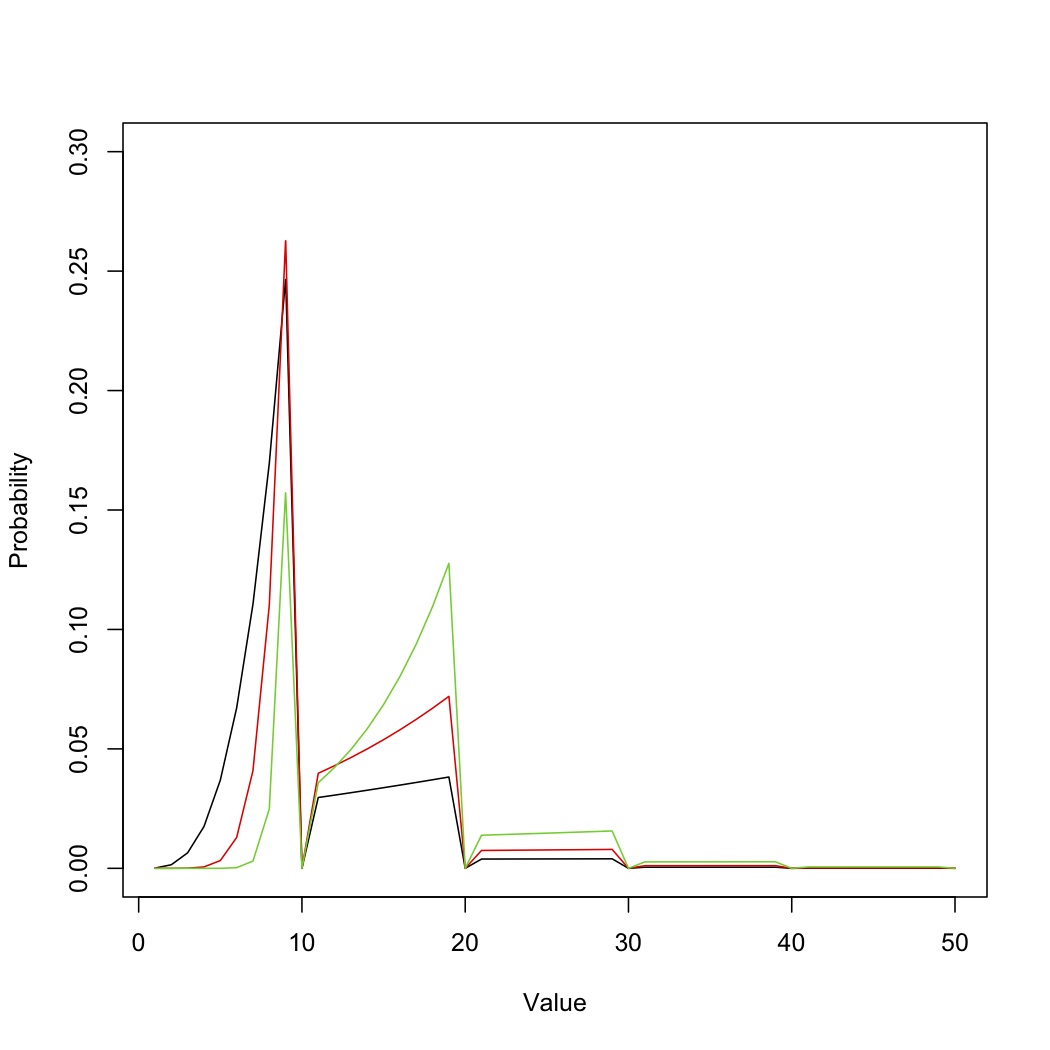
    An additional conclusion of this post is that the probability of success in a single combat round for equally matched antagonists is not consistent across all weapon skills, with the antagonists most likely to hit each other being in the middle of the weapon skill range (about 50), while those with much higher or lower weapon skills are doomed to very, very long combats regardless of the attack techniques they use.

  • Reader’s note: this is another account of the second session of our Pathfinder adventure by one of the players, Kuma-san. A guest-post, as it were.

    特別なノート:以下の投稿はくまさんというプレイヤーに書かれたpathfinderの冒険の2回目のセッションのレポートです。

    予定は未定とは、よく言ったものでして。
    帰宅した時間が時間(午前三時)だっただけに、昼頃まで眠っていたワタクシ。それからもそもそ起き出して、不要な本を処分するその足で髪の毛を 切りに行こうと思っていたら。
    急に鳴り出す、ワタクシの携帯。
    何事やあらんと出てみれば、祖母からの急用で再び大分へ送迎することになったわけでして………これは已む無しと、髪の毛の処理は翌日に回して、 祖母の急用と本の売却を行うのみに留まった日中でした。

    で。

    TRPGの景色

    こんな塩梅に日がとっぷりと暮れた頃に、馬宅を訪れるワタクシたち一行。
    いつぞや、ゲームのお店リングテイルさんで行ったTRPGの第二回目を行うべく、今度は馬と相方の両儀さんのご好意で、自宅を開放して楽しませ ていただくことになったわけでして。
    なので俄然張り切るのは、馬。

    さてTRPG「Pathfinder」の様子は、こんな感じかな。

    ———蒸気の谷での激戦を制して、再び歩みを進めるPCたち。
    やがてあれほど分厚かった蒸気はウソのように晴れたものの、目の前に見えてきたのは大きな幅を有する川であり、対岸には幌馬車を中心としたノー ムたちのキャラバンが野営地を張っていた。
    渡れる浅瀬は一箇所のみ。
    ただし幌馬車には、前回猛威を振るった『蒸気式の石弾散弾銃』を更に大型にした、ほとんど大砲のようなものが控えていることを知る。

    キャンプで、ノーム達の結論

    この大砲を前に、力押しは自殺行為だと色々な作戦を練るが、結果、浅瀬を夜陰に紛れて通過した後で、大きく二手に分かれて陽動組と突入組に分かれての野 営地襲撃ということに。
    そして始まる、大激戦。
    人数でいうならPCの倍は居るノームたちだったが、バードとクレリックが壁となって引き付けている間に、問答無用の火力を誇るレンジャーの弓矢 がノームたちをばたばたと射倒し、ソーサラーの呪文《グリース》で無力化されていく。
    一方のバーサーカーは、とにかく当たらない攻撃に巨大扇風機と呼ばれながらも、めげずに殴り続けて50点近いダメージを叩き出す。

    レンジャーの得意なお菓子はコアラだよ

    最終的に、ノーム・リーダーによって戦闘は停止させられる。
    そして語り出すノーム・リーダー。なんでも十年前まであの温泉施設のオーナーは彼であり、現オーナーとのギャンブルに敗れて手放す羽目になった のだとか。
    それから十年、必死に買い戻すための資金を蓄えたものの、まだ僅かに足りない。
    そこで温泉施設の価値を高価にしている、温泉妖精を盗み出すことで資産価値を暴落させて、それから買い戻そうとノーム・リーダーは企んだのだ。

    が。

    現オーナーは温泉施設をギャンブルの質草として乗っ取った直後に、温泉妖精を高値で売り捌いていたのだった。
    その代わりに、温泉妖精が入っていたと思しき「妖精封じの大鍋」を如何にもそれっぽく隠し部屋に配置し、鰯の頭も信心から〜の例えの通りに、効 能素晴しい温泉施設として客を集めていたのだった。

    ところが今回の一件で、温泉妖精不在の件が暴露されたことで、これ以上の収益は見込めないと判断した現オーナーは何処かに逐電。
    ノーム・リーダーにしても温泉妖精の欠けた温泉施設を取り戻したところで、大きな価値にならないと肩を落として何処かに去っていった。結果、 オーナー不在となった温泉施設の建物や権利証は、PCたちの手に帰することになったのであったとさ。

    ———とまあ、こんな感じの流れでした。
    最後の報酬が温泉付きの、土地建物丸ごとどーん! というのは予想外だったけれど、それに面食らっている私達を見て、きょとんとしている faustusnotesが妙に印象的でしたね。
    ともあれ、楽しいひと時でありました。

  • A week ago, at the monthly konkon Convention in Oita, Japan, organised by the Evil Spirit club, I joined a Warhammer 2nd Edition game. This post is a brief report of the game and some additional comments about the convention, gaming in Japanese, etc.

    I have reported on the convention procedure before, and this time was little different. This time the game was held in a single very large room, again with tatami mats and everyone sitting on the floor, and there was a total of about 20 attendees. One chap was wearing a chain mail shirt, and some people had brought anime figures or soft toy mascots to position at their table. There were 5 games, 2 western (Pathfinder and Warhammer 2nd Edition) and 3 Japanese (I didn’t catch their names). I had to leave immediately after the game so didn’t get to do  a post-game rundown with the GM or do any post-convention dining or karaoke. However, I was exhausted, so probably by then my Japanese wasn’t up to the task.

    I chose Warhammer on the somewhat foolish expectation that I could enjoy it as much as Pathfinder, and that it would help me diversify my gaming vocabulary and experience. I’ve previously expressed some dissatisfaction with Warhammer 2nd Edition, but was willing to believe this was largely the fault of the GM, but I think actually it’s true that the problem is at least partly the rule system, which at low levels is about consistently failing, and long-drawn-out battles to nowhere. I don’t see how anyone can think this is fun.

    Playing Warhammer in Japanese is much harder than Pathfinder, however, so there were some non-system-related reasons why this session was a lot harder to play than Pathfinder. Particularly, Warhammer has an official Japanese translation, which means that a lot of the words that have been transliterated in the Pathfinder version have their own Japanese forms in Warhammer. Anyone who is familiar with the Warhammer character classes will be aware that names like “Bone-picker,” “Camp Follower” and “Judicial Champion” are not readily accessible to foreign-language learners, and in fact I have a friend living in Oita who studied Japanese at University, is married with children and is to all intents and purposes fluent in Japanese, but for whom the words I was exposed to were completely new. This makes the game a lot harder to follow in play than Pathfinder – at one point I was rescued from a racketeer by a Judicial Champion, which doesn’t make much sense if you aren’t very familiar with a language.

    Also I didn’t know the rules backwards, so I had to have them explained to me without proper reference points, which makes the accurate comprehension of language more important. I got this pretty well, but it does make the game a lot harder to play smoothly. Fortunately Warhammer characters don’t have many special abilities, and the skills overlap with Pathfinder skills, so that aspect of the game went pretty smoothly.

    The main language problem I faced, however, was that Warhammer seems to be played in Japanese with a very similar feeling to my experience of it in English. There is a lot less combat, and a lot more talking and assessing situations and finding the best solution to problems, than there is in Pathfinder. This is because the PCs are so godawfully terrible at everything that resolving any situation by the use of skills or combat is pointless. It revolves more around old-fashioned “role-playing” (the players present a viable story for what they’re going to do, and the GM pretends that a different story would have resulted in failure, while rewarding the one they chose), and this kind of role-playing naturally leads to long descriptions and explanations from everyone involved. The GM had scripts prepared to describe various situations, and there was a lot of negotiation. The final scene – where we uncovered the golden gun and had to negotiate about its disposal with the woman who helped us find it – was 10 long minutes of this kind of discussion, with a hastily-cobbled-together resolution mechanism by the GM which he had to explain to us. This kind of thing is naturally very hard to grapple in a foreign language. As ever, however, everyone was patient with my limited Japanese and willing to explain things simply, so I understood the majority of what happened, if not its nuance. The GM’s scripts used quite technical and abstract Japanese, like having a combination fantasy novel/rules description read to you at very high speed, with occasional excursions into the slang or regional dialects of the main protagonists, and this is extremely difficult to follow.

    I was very interested by the way that the Warhammer system encourages in Japanese exactly the same play style as it does in English. The GM presents quite low-powered, low-fantasy situations which the players attempt to resolve through negotiation or some sort of lateral thinking, rather than through applying their characters’ abilities, and the successful resolution of tasks depends a lot on their knowledge of the world and accurate interpretation of the the GM’s explanations. It discourages any kind of craziness or attempts at doing unusual stuff, because any stuff you do naturally fails if it falls back on a skill check, and can’t be resolved without GM fiat otherwise. And every situation the GM throws at you, because it naturally ends with your failure, inevitably leads to the GM resolving it through some NPC interaction – i.e. GM fiat. So, our first encounter with the “Milk Tea Princess,” in which we try to help her, attracts the ire of the head bully in the mercenary team. Our attempts to negotiate a way out of the situation are rapidly heading into a painful end – we’re obviously not able to intimidate him, we obviously can’t fight him with his followers around, and there’s no reasonable outcome of the situation which won’t end with us being beaten up and the “Milk Tea Princess” sorely treated; so in waltzes a Judicial Champion to send everyone to bed. Similarly the duel with this same racketeer, which appeared to be carefully poised, fell apart near the end and was resolved through another GM Fiat (a follower of the racketeer’s fouling the duel so we won). I don’t think this was bad GMing either – it’s just really hard for a GM to set up a game where the players can make any progress, when everything they do is doomed to failure. How do you progress a story when the protagonists themselves are the main obstacle to progress? This happened in my previous Warhammer game, and I thought it was bad GMing, but last week’s GM was clearly quite good, and it still happened. It’s a flaw of the system.

    So once again, my experience of playing in Japanese was very similar to playing in English, to the extent that even the different feeling of two systems I’ve played in English – D&D and Warhammer – was preserved across the language and cultural gap. I think that’s a very interesting observation on the universality of system and its impact on player choices. Also, the GM used a style I’m familiar with in the West – scripts to set out the scene, and extensive use of voice and characterisation to make the characters come to life. I’m beginning to think that there is a limited range of GM styles, and they’re language-independent. It’ll be interesting to see how if these similarities disappear when (if) I start playing Japanese-developed games.

    The adventure itself was quite interesting, and I’ll give a separate report on the story later in the week. It’s been holidays here, I have German friends staying, and blogging time has been a little limited, so this comes out a little late.

  • Friday night last week was the culmination of my brief Pathfinder game, in which the PCs venture further down the valley, beat up some gnomes, and discover that yes, even in the idyllic Steam Mountains treachery abounds. This week’s session was played not at the ringtail store, as it was last time, but at the family business of one of the players, Era san, who has an 8 month old baby called Mizuho. This family business is on the main road in our steamy town, and is a tax business sprawled across 3 floors of a large building facing the sea. The ground floor (first, as they say rather sensibly over here) was all car park; the second floor the business; and the third floor was a small apartment and bbq area, which seems to double as Era san’s home but is used for entertaining. It has a spare room with an automated mah jong machine in it (complete with little ash-tray holders sticking out from each corner), a draught beer machine, a kitchen, a huge cooler, and a fine view of Beppu Tower and the sea. In summer, it was suggested, we should play some games on the balcony. Era san cooked food for us all, depicted below.

    Somewhere in this are two dita-milk cocktails

    The food consisted of hot dogs, fried chicken, fruit salad, stir fried noodles, fried chicken wings, and some sausage salad (!). There is also the ubiquitous 2 litre bottle of oolong tea, and a couple of other fancy drinks. I was plied with beer all night, which is much more like my western role-playing experiences. Era san drank non-alcoholic beer (she is still breast feeding) and kept saying “It’s beer! Really it is!” Furudera san seemed to have left her endless supply of food at home but did drink two dita-milk cocktails; apparently she’s a strong drinker. No-one else could drink due to driving or poor drinking skills, and Era san’s husband drifted in and out with the baby, who was very well-behaved and very shy. My contribution to the food was a bag of crisps and a packet of Koala March biscuits[1] (it seemed fitting), pictured in action here:

    Drop-bear does 3d6 damage, then drops as a free action…

    It took us a while to get started due to dithering, delays, food and chatter, but eventually we started, and we didn’t finish until nearly 1am. This was because the only battle just kept going on and on and on. Pathfinder battles take a long time! I’ve done some comparisons and been thinking about this, and I’ll be getting back to this in more detail later, but I think some of the game mechanics we commonly use are designed to get boring in battle. I think Kuma-san certainly thought so – he started playing with the baby while he waited for the battle to finish. I wanted to join him, actually, and the same thing happened on Sunday at my warhammer game actually – battle stopped early by DM fiat due to lack of interest in continuation by all involved. This is not a stunning recommendation for a rule system.

    Everything else went along much the same lines as before. Players now used to being expected to give descriptions and make decisions about how things played out, they were much quicker to do this. One doozy was Myuta the ranger shooting a gnome through the neck, and pinning him to the music box so that he stopped it playing. This session involved some planning for a big assault, and here, folks, is my conclusion about that:

    MY PLAYERS DID NOT DITHER!

    I’m a little stunned by this. Players who don’t dither?! Who would have thought. Decisions were made, a cunning plan tried, and then another plan come up with in short order and enacted. Sadly, Myuta cocked the plan up by fumbling his stealth check (and setting off the music box). Also, although the players don’t dither in planning, some of them dithered in execution, spending a lot of time wondering what spell to cast while the battle raged. I move this stuff on pretty quickly though, with the time-honoured GM five-count. Dithering in action is vastly superior to dithering in anticipation.

    All-in-all a successful game, with demands to continue; but we may be moving on to Warhammer 3rd edition first. We shall see…

    fn1: This website has a blog by the Koalas from the box. I strongly recommend this site.