a computer-generated, manga-esque promotional image designed and maintained by a team of priapic teenagers working shifts in a dingy, fetid bedroom in Stoke littered with copies of White Dwarf magazine and a job lot of Triple Velvet.
These being paintings of airships and early aircraft at war, particularly world war 1, which can be found here. I was stumbling about the internet this sunday evening and discovered this site via this chap, a military historian with a focus on aerial warfare. I’m one of those rubes who has no skills in historical analysis but a strong interest, so I’m easily taken in by the next history book I read, but it seems like this site has some interesting historical theorizing going on.
I was struck immediately by the romantic steampunk elements of the images on display there. They map immediately to Stephen Hunt’s books, which are set in a fantastical Britain, never named but clearly portrayed as such. There’s a definite element of romance to those giant ships of the air… and even though any image you see of war in the sky is actually horrific and coldly terrifying, somehow those early aviators manage to retain a sense of casual adventure, the essence of romantic steampunk role-playing.
Because there isn’t a great deal of easy work in steamy Beppu, I’ve taken up some freelance editing work while I wait on certain work opportunities to develop over the next few months. This editing work involves editing about 100 very short (200 word or so) articles by adult Japanese students of English, written casually on topics drawn from daily life. This is a bit like doing a kind of vox populi of ordinary Japanese life – how often does a person get to read the opinions of 100 normal people every month in their own country, let alone in another? The articles cover a wide range of topics, from political topics (including whaling, environmental issues, the declining population) to what someone had for lunch yesterday. But there are some interesting trends and ideas in the articles, which have surprised me.
Japanese seasonal writing transcends the mother tongue
Even a passing familiarity with Japanese literary and cultural traditions is enough to acquaint the foreigner with the idea that Japanese people have a strong sense of the importance of the seasons and the cycles through which they move. Furthermore, this sense is an important aesthetic motif in writing, art and philosophy. I was slightly surprised to discover that not only does this sense extend into everyday writing by everyday Japanese, but it extends into their writing in a second language, no matter how amateur their writing skill. Some writers will speak self-consciously of the importance of the seasons, but much more common are essays about a seasonal topic or activity, with no self-referential cultural knowledge. They simply report on or revel in the seasonal activities they love. These topics come in waves, so in April I received a bunch of essays about hanami (cherry-blossom viewing); in late April, articles about the beauty of walking through falling blossoms; early May, articles about children’s day and koinobori (carp streamers) in the wind; in late May, now, I am receiving a huge pile of articles about children’s sports days, which occur in the end of May. In the middle, there were a series of articles about what people did in their week-long Golden Week holidays, often about their experience of “nature.”
The tradition of writing about nature is language-invariant
A lot of the articles, regardless of the season, involve descriptions of the natural world and trips into it. This doesn’t surprise me in a nation that is essentially Shinto (though of course, the Japanese will tell you they’re not religious, possibly while they’re taking you to a shrine, where they will, of course, pray). It’s interesting the extent to which it enters their writing in a second language, and the extent to which even with limited language skills the writers are able to convey a sense of love of nature built around mountains and seasonal changes, and imbued with a feeling of mystery.
Miyazaki’s characters are real
Another noteworthy point is that Miyazaki Hayao‘s anime are so imbued in the national consciousness that they don’t need introduction. If someone visits the house on which My Neighbour Totoro was based, they don’t need to preface their activity with this information; they just say, “I visited Satsuki and Mei’s house.” It’s almost as if Mei-chan is every Japanese person’s neighbour.
Heian-era ideas never change
Some of the topics seem to emerge straight from a lost Japanese era, and are striking for their eternal Japaneseness. These articles read like a vox populi conducted in the Heian era, or taken from the Tale of Genji. For example:
I have received several articles about haiku-gathering trips, in which groups of Japanese people go to an area of nature during a period of seasonal change, wander about for a few hours, take some time to write a few haiku, then gather in a restaurant or tea house and compare haiku. One was even assigned a grade. This is a level of formality about the interaction of Japanese language and nature which, in addition to being largely unheard of in the West, is a direct tradition inherited from prior eras
I have received some articles about manners which read like a Heian court epic, particularly articles about the disputes between a woman and her daughter over wedding plans, or about the behaviour of “ladies” in a workplace towards the men, and how it is simultaneously elegant and deceptive
Many articles will invoke timeless images of Japanese life, in passing, which immediately attach an image of historical continuity to the work – images like the koinobori, or being able to see Fuji from your backyard, mentioning falling sakura in connection with an activity unrelated to the season, and so on.
Sometimes, the essay has a cunning, sonnet-like trick in which the essay builds through a gentle and wistful tone, but in the last sentence or paragraph suddenly changes direction completely to deliver a hard, vicious or cruel conclusion about the personality of the author or one of their interlocutors. I’m convinced this is a trick of a historical form of Japanese writing, though I don’t know which kind
Japanese wistfulness is independent of writing skill
A lot of the writing I receive has a wistful and elusive tone that one might associate with a more professionally-done style of Japanese writing, or with historical writing. It’s interesting that even people with quite low-level English skills manage to capture the slight sense of vagueness that enters normal Japanese conversation, along with the passive acceptance of other peoples’ traits, and the roundabout way of presenting strongly-held opinions or uncomfortable facts. I would have thought that representing national character by nuance in a story is a trait of a skilled writer, but it turns out that this seems to occur even where the English level is quite low. The style seems to mostly survive editing, though sometimes I feel like I have to bend the rules of English to preserve a style that is obviously of the author’s own making, even if not deliberately done.
About the picture: taken from the story “Yuki Watari” (Crossing the snow) by Miyazawa Kenji, illustrations by Katao Ryo, which I bought for my partner’s birthday.
We saw in my previous post how a simple character is made in the Double Cross role-playing game. I have subsequently skipped across the more complex character generation rules straight to the bit about how the characters operate in practice, i.e. how tasks are resolved. This is basically divided into two parts, the standard skill resolution system and combat. It’s also very strange, because it uses a mechanism I’ve never seen before.
The basic resolution mechanism
The basic resolution mechanism is the use of a pool of d10s to calculate a value, which is compared against a difficulty to determine success. However, instead of simply counting successes on dice (as in Exalted) or summing all the dice (which would, I contend, be madness), Double Cross 3 uses an insane hybrid. Under this system, you roll all the dice and take the maximum value that occurs on the dice. This would give you a value between 1 and 10 (which for large dice pools will almost always be 10!), except that Double Cross 3 has a critical system, in which any die that rolled up a 10 is rerolled, and the maximum of this new pool of dice is then added to the previous maximum (10). This continues until all subsequent sets of 10s have been exhausted. We’ll consider an example of this shortly.
Rolls of 10 are considered a critical, but it’s possible through syndrome effects to reduce the number required for a critical from 10 to, say, 8 or 6. In this case any die that hits or goes above the critical number is rerolled, and added on to the maximum from the previous roll. It’s not clear from the rolls whether this maximum is the new critical effect limit, or the maximum on all the dice. If the latter, things get very fiddly. There is an example in the book of someone rolling 16 ten-sided dice against a critical target of 8, for a total of 33.
The difficulty classes are given as:
Easy: 3 – 5
Normal: 6 – 9 (success to be expected in most cases)
Difficult: 10 – 13
Really Hard: 14+
However, challenged skill checks go directly off the competing skills, so if you have a PC using stealth against an NPC it will be a direct application of their body against the target’s sense, with the higher roll winning.
Example
It’s a little fiddly, so let’s consider an example. Yumiko has a sense of 9, and 4 levels in missile combat, so when she attacks with a gun she rolls 9 10-sided dice, and adds the 4 for her missile combat skill at the end. Let’s consider such an attack. Her fine specks gives her an extra (level*2) dice, or 2, in this case, for a total of 11. I don’t have enough dice for that sort of stuff, but let’s give it a go. She rolls and gets… 1,2,2,2,5,6,7,8,9,10,10.
That’s pretty poor. So we roll the two 10s, to get… 4 and 5. So adding the maximum of the previous round (10) to this round (5) and her skill of 4 gives us a total of 19.
Yumiko’s body is 1, with 1 level of dodge skill. So if she wants to avoid getting hit she needs to roll above 19 on that 1 die… let’s try it. She rolls and gets… 10! Rolling again gives us… 4, for a total of 14, +1 for dodge gives 15.
So Yumiko hit herself. Damage is then resolved as the total success roll divided by 10, plus 1, plus any effects due to syndromes. So in this case it would be 19/10, plus 1, or 3 dice, plus any weapon/syndrome effects. After this Yumiko gets to take off effects of armour, and the remains are hit points of damage. I haven’t yet found the rules on rounding down damage. I presume the same effects apply in other situations where damage can be applied.
That seems quite potent; with 3 dice one can easily struggle above 15 damage, and our little schoolgirl only has 23 hit points.
Some notes on this mechanic
This mechanic is fundamentally a pretty tricky one, combining as it does the counting aspects of a system like Exalted and the adding of systems like D20, along with division at the end. It also includes a system of challenged dice rolls, which I’ve been suspicious about since I tried playing Talislanta (I think it was Talislanta). Challenged dice rolls are also a property of warhammer 2, which takes a long time to chug through skill resolution. This system could take an awfully long time if one has low critical thresholds and high dice pools – Yumiko is first level and already up to 11 dice!
Probabilistically, this die-rolling mechanism is evil. It involves taking a sum over maximums of chains of multinomial distributions where one parameter in each link of the chain (the number of trials) is conditionally distributed according to the results of the previous step in the chain. Compare this to the standard Exalted mechanism, which is simply a sum of multinomial distributions where each multinomial distribution has 3 outcome values (0,1 or 2) with relatively fixed probabilities (0.6, 0.3 and 0.1 respectively) and the number of trials is fixed (by the dice pool). Simple!
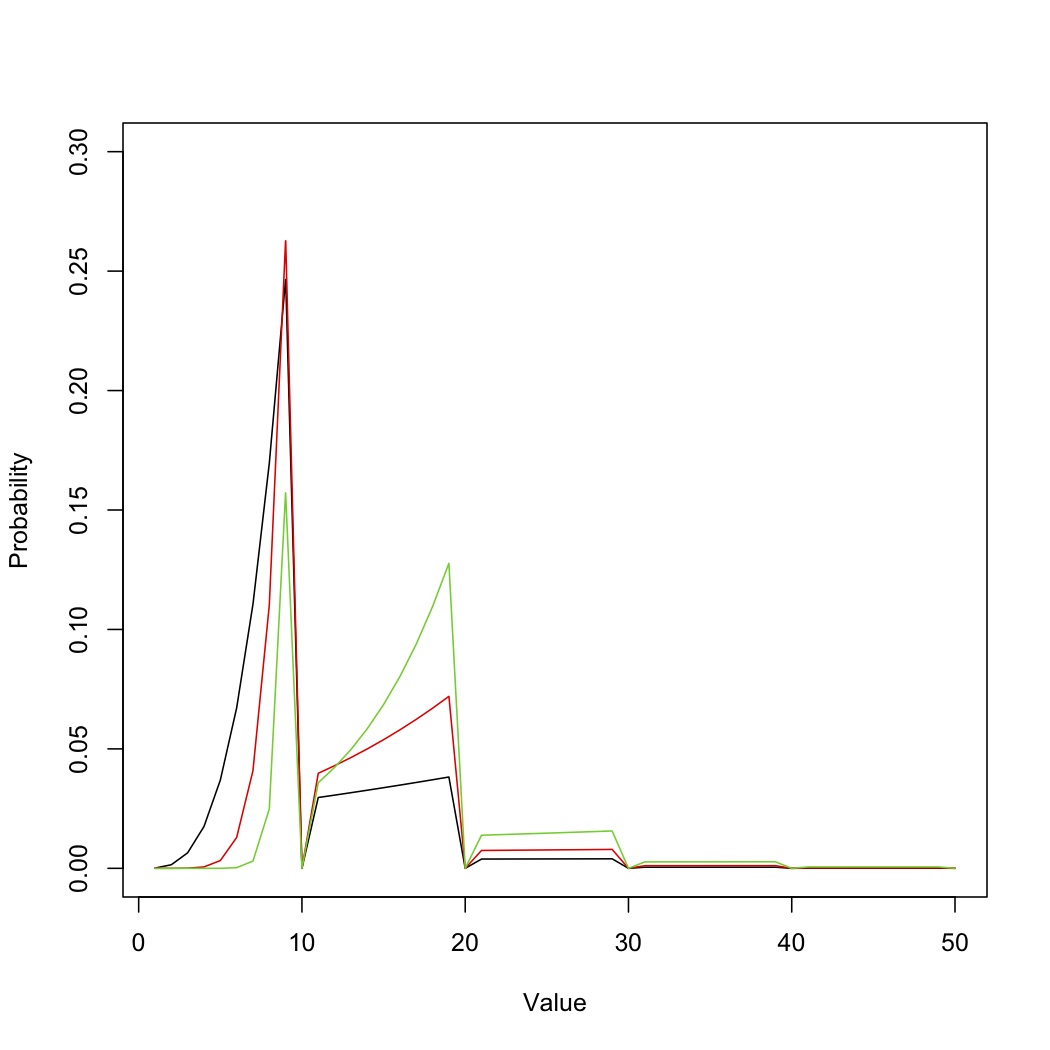
So, over a period of some days, I have calculated the probability distribution for the skill system, which can be done using transition matrices[1]. I ran some calculations in the stats package R, and the probability distributions are shown in the figure below for three sizes of dice pool: 4 dice (black), 8 dice (red) and 16 dice (green). I also ran some simulations (not shown) which roughly reproduce these probability distributions, so I think they’re correct[2,3].
Three Double Cross probability distributions
So with 4 or 8 dice there is a 25% chance of getting a 9, and in all dice pools of size up to 16, 9 is the most likely value. This kind of surprised me, but obviously it has to be true. Actually 10 is the most likely value, but it gets redistributed immediately across the remaining (infinity – 10) values. Considering just the first 9 values, in a die pool of size 16 as soon as you roll a 9 all other values become irrelevant; whereas if you roll a 2, any of the remaining 15 dice could be larger. So, on any die pool larger than 1, 9 is the most likely value when you’re taking maxima. The Double Cross authors seem to have recognised this by setting the difficult skill checks to above 10; on a roll of 4 dice there’s only a 35% chance you’ll get above 10. Of course, starting with 11 dice the probability is 69%, so really it’s not so hard for Yumiko to do hard things with her sense (i.e. her guns).
This is the weirdest skill resolution mechanism I’ve ever seen. It’s going to be fun just for its sheer kookiness, but I suspect it breaks down fast. As soon as I get a chance to play this, I’ll let you know…
—
fn1: We can represent the process of calculating the total as a series of steps, with the full dice pool rolled at step 0. For a dice pool of size k, we can define a matrix P, whose ij-th entry gives the probability of going from i dice in a step to j dice in the following step; a starting state vector s, which is a vector of length k whose j-th entry represents the probability of j 10s occurring in the first roll; and a final probability matrix Q of size kx9 representing the probability of any number less than 10 occurring at a given size of dice pool up to and including k. The number of steps required to reach a given value x can be calculated as the quotient of l=x/10. Denote this number of steps as j. Then the value x can be written as x=l*10+r. For step 0 we calculate the probability of 1 to 9 directly in order to construct the first row of Q. For all step sizes greater than 0, we calculate the probability vector of all values occurring at step l as t(s)P^(l-1)Q, where here the t() represents the transpose (I can’t write maths here easily). The probability of the value x is simply the r-th entry of this vector[2].
fn2: You probably think I have too much time, and right now I *really* don’t, but I haven’t done any decent stats in 6 months and this kind of stuff is fun for a weirdo like me.
fn3: Actually I think there’s a tiny error in these values, because the sum over 40 or 50 values doesn’t come to less than 1 in all cases, which it must do. But they’re close enough, and I can’t find what the error could be, so stuff it. I think there is a very small error in my calculation of the probability of maximum values, or I have to include some modification for the probability of stopping at step l, but I can’t quite see how to do it.
I went on a YouTube wander tonight, starting at Rupesh Cartel and ending up at Jethro Tull, who’ve been around since the 70s. I noted that in their earlier days Jethro Tull sang about very mediaeval stuff, along with the small concerns of ordinary life one might expect to associate with a peasant’s view (think Thick as a Brick and Heavy Horses here), but by the early 90s they were singing about agricultural society and the larger issues of a complex and interconnected social structure (think here Farm on the Freeway) before advancing further to the concerns of the military-industrial complex (in Broadsword) in the mid-90s. Of course, the tone of Broadsword is very much mythical/legendary, but the content – voluntary preparation for war and glory – is a much more modern (Victorian?) phenomenon. The peasant from whose view they sing in the early days would see war very much as a catastrophe that he/she has to be involved in, not as a source of mythical glory.
Is there any phenomenon in human society that Heavy Metal hasn’t covered[1]?
—
fn1: If you aren’t sure yet, I watched a clip from The Man of la Mancha, a 70s movie starring Peter O’Toole and Sophia Loren, based loosely around Don Quixote. I was brought to it by the Australian prog metal band Vanishing Point, who sample it. It’s all covered, I tell you.
I promised I would read through this game and give a full report, and by now I’ve read far enough through to make an attempt at character creation. There are two methods of character creation, Quickstart and Construction. The former is done by choosing a sample character and then developing a life-path for it; the latter is a full creation process. I haven’t read the latter, so I’m going to try the former today.
Quickstart creation essentially uses all the statistics from the sample character, and the only creation part the player engages in is the social history of the character. I think this reflects the importance of the social setting in this game, and the role played by a character’s social supports (their Lois). Also, characters have a cover, which is chosen for you in the sample characters.
Basic characteristics
There are 4 basic ability scores, and under each ability score a couple of skills which are affected by it. The ability score is, I think, determined by your choice of syndrome (I haven’t got that far in the book to be sure), while the starting skill values are determined by your cover (so a high school student has different skills to a company man). The ability scores and skills are:
Body, which is strength and constitution, and covers three skills: melee, dodge and ride/drive.
Sense, which is a kind of intelligence score, and covers the three skills of ranged combat, knowledge and art (which has various sub-specialties)
Spirit, which is a kind of willpower score, and covers the three skills of Renegade Control (used for powers), will (important for resisting triggering your impulse), and knowledge (which has sub-categories)
Social, which governs diplomacy, requisition (for preparing items, which I think might be special objects in this game), and information (about research and gathering information)
Again, these skills indicate a strong social element to the game, and a simple framework (I haven’t got to task resolution yet!)
Other character creation elements
Having chosen your sample character, you need to determine the following elements of your life path:
Your origin, the environment in which you were born and raised
Your experience, which can be chosen from four background tables: High School, Company Life, Underclass, or UGN (the company that our heroes work for)
Encounter: determines a person you met in your life who is very important to you
Awakening: How you discovered your Renegade talent
Impulse: an emotion which, when triggered, threatens to evoke overwhelming emotions which carry a particularly high risk of overwhelming your control of your powers, and causing you to lose your humanity and become a germ
The first 3 sections of this process each give rise to a Lois, a person with whom you have a particularly close bond. One of these will be an NPC. For each Lois you need to determine a negative and positive trait in your relationship, and turn it into a narrative for your relationship with this person.
All these decisions are made by “ROC,” Roll or Choice, so you can create your character completely randomly by rolling on d100 tables, or you can choose everything. Since choosing everything involves decoding lots of entries in lots of tables, our example character is going to be done randomly. Shall we try?
Sample Character: “Sparkling Twin Bullets”
We’re generating a Japanese role-playing character here, so one thing is fixed: they’re going to be a high school student. Any of the sample characters can be, of course, but there is one that comes with a pre-packaged High School student picture (click to enlarge):
Odd-coloured shoes: the hazards of school-girl life
The text at the bottom left of the picture says
UGN Children. Awakened as Overed in infancy, these children are raised by the UGN agency. You are one of these
Your earliest memories are only of study in order to control your power. You realised that you are not normal, and you have a duty to fulfill.
It’s not the case that you don’t yearn for ordinary life. It’s not the case that you don’t imagine a world at peace.
But, for now you are using your power to protect others. In this there is meaning, you believe.
This is the path you learned to follow…
The big text at the top left says “Duty! Roger! Finish this quickly!” and the part at the right is this schoolgirl’s character image (the “Sparkling twin bullets”) writing.
The UGN children story is not essential to the sample character, so we can change her, but let’s not. We’ll give her a UGN background and assume that she’s still in high school, because the stat block for her character sheet says that’s her cover; but the rule book says that UGN Children have to select their experience life path element from the UGN table.
We’ll call our girl Yumiko, in honour of my friend who has been recently helping me with my Japanese study. In Japanese characters, Yumiko means “Free Beautiful Child” (由美子)
Basic statistics
Syndrome: Yumiko is a tri-breed, so she has 3 syndromes, which are Angel Halo (manipulating light), Morpheus (creating and manipulating matter), and Hanuman (changing the nervous system to increase speed or reflex).
Basic stats
As might be expected of someone with this focus, Yumiko’s stats and skills are:
Body 1, 1 level of skill in Dodge
Sense 9, 4 levels in missile attack
Spirit 1, 1 level of skill in Renegade Control
Social 3, 3 levels of skill in requisition and 1 level of skill in Information (UGN)
She has 23 hit points.
Effects
Effects are the powers her mutations give her. In addition to the standard (concentrate), she gets the following:
Fine specks: increases her ranged attack by improving her precision (this is an Angel Halo perception effect)
Hundred Guns: in exchange for some raw material, this creates a ranged attack weapon, the form of which is up to the player (this is a Morpheus matter creation effect)
Penetrate: Enhances a gun so that it penetrates armour better (this is a Morpheus matter modification effect)
March Weapon: Gives the power of using two weapons at once, either ranged or close combat (this is a Hanuman sensory modification)
Those are some serious powers with guns! Yumiko is a deadly schoolgirl!
Connections
Yumiko has a connection to an executive in UGN (however would a schoolgirl do that??!!), which gives her a bonus on her Information (UGN) checks.
Life path
So, using random rolls, let’s go through Yumiko’s life path.
Origin
Inheritance of power: Born the heir of a family that values its genealogy, Yumiko has always carried an inheritance. The Lois for this origin is a teacher. (I rolled 27)
Experience
Dirty job: As a UGN Overed, Yumiko had an experience on the battlefield that she doesn’t want to think about a second time. The Lois for this experience is a fellow soldier. (I rolled 87).
Encounter
Herself: Yumiko has minded her own business and had few encounters with others. Her main connection in UGN is Artemis (Shikishima Ayame), a UGN illegal with great powers who tends to look after isolated members of the organisation. (I don’t know yet what a UGN illegal is, and I rolled a 2).
Awakening
Ambition: Yumiko is driven by a single eternal goal, and will bravely consider any sacrifice to achieve it. She only has one dream, which is for everyone to admire her, and to be able to overcome any enemy. When she achieves this goal, she is uplifted. (I rolled 4 on a d10 on this table, and it gives a corrosion probability of 17%, near the high end)
Impulse
Hunger: In her heart, there is an empty hole. Nothing she consumes can fill it, but it has to be filled. So, by any means… (This flaw gives a corrosion probability of 14%, the lowest)
Lois
This gives us three Lois‘s, characters with whom Yumiko has a close relationship she cannot neglect. One of these is the NPC, Artemis. The others are a childhood teacher, and a fellow soldier. For one of these, Yumiko needs to establish a positive and negative emotion, which conflict in the same relationship. I choose to make these for the comrade-at-arms, and off we go…
Positive:charity! This person is a figure like a junior member of her team who always strives at hard tasks, a sick sister, etc. who Yumiko cherishes (I rolled a 21).
Negative: threat! This person has the power of a formidable rival, and may be someone Yumiko is afraid of losing to (I rolled a 10).
These two elements need to be worked into the same relationship, so I think we can see what is happening here.
Let’s put it all together, then…
Yumiko’s full story
Born into a wealthy family from whom she stood to inherit a great deal, Yumiko manifested her Overed powers early, and was taken in by UGN. Her family were a typical loveless aristocratic family, and during her powers’ awakening she was cared for by an elderly teacher whom she still respects very much (this is Lois 1, the teacher). Taken in by UGN, she was assigned a cover as a school girl in this teacher’s school, and mentored by the teacher while she learnt to control her powers and fit into society. At an early age she was thrust into a terrible task, of the “burn this school down to save it” sort, and in this horrific battle she endured much grief and many battle scars that she dare not think over again. There was only one survivor from this battle, a junior soldier who Yumiko protected to the end out of a sense of duty, and she carried him bloodied and battered from the ruins of the school. He recovered, and to this day they have maintained their original relationship, as if she were his senior and more respected figure; but in fact his powers have grown fast and there is increasing tension between them as he chafes within the bonds of her charity (this is Lois 2).
And the bonds of her charity can be great indeed, for she has few friends or associates and has always been lonely, from the time of her loveless early childhood right through her training at UGN. She has always withdrawn, and focussed sullenly on the development and control of her powers. Some say that she feels rejected and spurned by her family, cast aside in the unloving embrace of UGN, and that she has a deep, dark desire to be accepted which also drives her ambitions and her stern sense of duty, both to UGN and to her junior colleague. This complex attracted the attention of Artemis, herself a loner, who recognised the risk that ambition thwarted, duty spurned, or acceptance withheld could trigger a great shock for Yumiko, and drive her to dark deeds.
Also, Yumiko is a very good shot, and has a fine selection of schoolgirl outfits, many with matching shoes.
Many years ago I ran a campaign I referred to as “The Apocalypse Campaign,” set in a post-apocalyptic Europe in which the sea level had risen. This was back when A4 drawing tablets for a computer were hideously expensive, and scanners were expensive too. So to make my higher sea-level Britain, I photocopied pages from an atlas (A4 size), did some careful calculations of enlargement scales to get all the different-scaled maps up to the same A3 size, then carefully joined them together, traced them out onto a new, single huge piece of paper on a light table I found in an abandoned garage next to my house[1] (even light tables were quite expensive, I recall!) and then painted over the lines.
So I spent, obviously, a lot of time on this, and I came up with a quite fascinating piece of work in which England was broken into several significant islands drawn on a crappy map coloured by one of the worst artists the world has ever known (me). I had to flood the world by quite a bit – maybe 50m I think – to reproduce the effect I wanted, which was the beautiful world map from the White Bird of Kinship novels[5], and this took some work, and I think I used a bit of GM’s license in there too (it’s not like anyone was going to check, this was before the internet could host massive maps, so no silly nerd was going to come along and complain I had my contours wrong).
Today I discovered that this site, using google maps, can produce the whole effect in a few seconds. Not only that, it can give street-level detail of anywhere in the world, hardly a comfort if you live in Bangladesh or Amsterdam; but it did enable me to check the location of my own flat, and determine that with a 5m sea level rise I’ll be on water-front property! Any more, and I’ll be going uphill in a hurry.
Perfect material for post-environmental-apocalypse gaming, if only it showed values more extreme than 14m. Who cares about that? (Besides a couple of 100 million South Asians, and the entire Pacific Island diaspora).
—
fn1: an interesting story that. I went digging through that garage with my flatmate, who had written some excellent art theory articles about Bladerunner[2], and we discovered a box full of old documents. Sorting through this box, we discovered a bunch of jewish religious material and some schoolbooks from world war 2. We contacted the owner of the garage to tell them what we had found, and it turned out that the owner was my boss, and the school book pictures were some material from her own childhood that she had lost. I think her parents had been refugees from Germany, though I don’t recall that clearly. Anyway, we kept the light table.
fn2: The gist of them was, 1) that Roy Batty plays a role very similar to that of the Gnostic Redeemer, come to Earth to destroy his maker and to tell the people that the Earth is a trick created by Satan (or some such), and 2) that photo that Decker examines on his super-crash-hot computer[3] is a close simulacrum of some painting by a dutch master, which famously has the picture of the painter in the mirror; but in the Bladerunner version, there is nothing in the mirror, and the investigation of the photo is physically impossible. This serves to cause the reader to question their own humanity, whereas in the original painting the figure of the painter in the mirror is meant to restore your sense of self as a viewer, and remind you of the presence of a human creator. Or something[4]
fn3: I watched Bladerunner again 2 nights ago, and it’s interesting how in some ways the vision of future technology is really basic, such as the TV on which the photo is examined, but in other ways really advanced, such as when Decker directs a computer to do things with commands like “no wait! back up!”
fn4: They were actually really good, but after 15 years the details are a bit blurry.
I have noticed recently a tiny debate going on between two blogs concerning whether or not it is sensible to assign the class of people called peasants a different distribution of ability scores to the class of people called lords. The distinction in question – 2d6 for peasants, 3d6 for lords – seems roughly fine to me in the renaissance setting in which it’s proposed, though I prefer 2d6 for peasants with a further roll of 2d4-2 if the first roll is a 12, since this gives a small probability of numbers greater than 12. I agree with this method because being a peasant is the single biggest determinant of every aspect of your life, malnutrition and lack of even basic education being a significant impediment to the development of even normal stature and mental function, let alone decent wisdom or strength scores. My Eternal Antagonist over at Monsters and Manuals disagrees, because (it would appear) he objects to the epistemic arrogance of claiming one can model class effects, and it’s an inductive fallacy to propose that just because most peasants have 2d6 stats, the next peasant one meets will have 2d6 stats.
I’m not going to address either of these arguments directly, because it’s impolite – I’m arguing with Noisms at his own blog and I’ve got nothing to say at Alexis’s. What I thought I’d do instead is briefly give my opinion of the Black Swan thesis, which Noisms references in his objection to the model. Taleb, you see, who wrote The Black Swan, is opposed to modelling.
I haven’t read this book, but I’m vaguely interested in the philosophy of science and I had heard that Taleb was not overly respectful of global warming theory, so I picked it up at a friend’s house and read the first chapter, and I was struck by the complete failure of the fundamental analogy, that of the black swan. Taleb argues that black swans, when they were discovered in Australia in the 18th century, were a freak unexpected event that biological theories of that time had not predicted, and which were worked into the theory in hindsight. These have come to represent in his theory the unpredictability of nature, and the inherent dangers of modelling anything.
Except, the problem with this is that in 1790 the biologists were working from the wrong theory. They didn’t have anything like a theory of evolution, which came later after Darwin visited Australia. Evolution, I have read, gives biologists the power to predict new animals, and in fact even to predict where they might be found or how they might behave, and had the theory been developed at that time the black swan wouldn’t have constituted much of a surprise at all, let alone a “significant random event.” While it’s trivially true that the black swan might have appeared like a significant random event at the time, what is more important is the fact that the scientists of that time were working with an imperfect theory, that had no predictive power. Taleb’s whole book about random events screwing predictive models is based on an analogy to a situation in which a (possibly) predictable event was not predicted by a theory that lacked any predictive power. It’s essentially a book whose thesis could be rewritten “Don’t make predictions from the wrong model.” Also, I would add, it’s disingenuous to claim that the swans were worked into the theory with the benefit of hindsight – Australian flora and fauna were essential data in the construction of a revolutionary new theory, evolution, which had greater predictive power. This is not the same as justifying their existence in hindsight.
There is also something a bit strange in a book which purports to claim that financial models are doomed to fail to predict significant random events (black swans) by an author who claims to have predicted the Global Financial Crisis (GFC), which he simultaneously claims is the key black swan of our time. Figure that out. He isn’t the only one to have predicted this black swan, either – I did in 2004, and lots of economists and financial people did, starting around 2004. Of course, the claim that modelling can’t handle unpredictable events is prima facie true, but vacuously so. For example, global warming theory can’t predict rapid global cooling if in 2020 a ginormous meteor hits the earth, because random events like that can’t be factored into anyone’s theory. But a meteor strike in 2020 doesn’t invalidate global warming models or the theory, and to say so is to deliberately ignore the underlying assumptions of the modelling process.
It’s actually quite hard to find on the internet criticism of Taleb’s theories, though I found one article here, also by someone who has not read The Black Swan, but who is primarily riffing off of a very shoddy-sounding Financial Times opinion piece by Taleb. This blog appears to be by a quantitative analyst, so is undoubtedly biased about Taleb’s criticisms of quantitative analysts, but makes some interesting points, particularly about the business consequences of Taleb’s theories, and the silliness of some of Taleb’s claims about the actual models that are used in finance.
I would also add that the finance world isn’t the best place to look for examples of sound modelling. It isn’t subject to any of the checks and balances of science, doesn’t have the historical lessons of science, and a lot of its methodology and results (beyond “making money”) are not made publicly available for us to check. Also, the “making money” part appears to be driven by human interpretation of the models the analysts provide, and not necessarily by the models directly. But Locklin makes the point here, I think nicely, that Taleb has made a big claim that normally distributed data is insufficient for finance modelling; but modern finance modelling doesn’t use the assumption of normality very much. Locklin claims that for this very reason he, like me, had to become a “small-time expert in kernel regression.” Kernel regression modelling has many flaws, but an assumption of normality ain’t one of them. Locklin’s rather malicious claim is that Taleb makes money and fame by telling people who know nothing about finance about something very obvious to the modellers (non-normality), while simultaneously making them think the modellers don’t realise this.
You see the same tactics in global warming denialism all the time, and hordes of armchair scientists eager to claim that they’ve seen the obvious thing (“climate isn’t weather!”) that a generation of climatologists have missed. It may make for entertaining reading, but it’s neither enlightening nor correct.
Further, Taleb is an inheritor of Popper, although Locklin claims he is an inheritor of Feyerabend and therefore an “intellectual nihilist,” an accusation I think is valid regardless of his intellectual inheritance. It’s very easy to claim that all models don’t work because of unexpected events; but a lot harder to square this “philosophy” against the continuing excellent success of, for example, life tables in the insurance industry, or models of global warming. And, a claim that all models will be destroyed by a black swan event is, contra Popper, unfalsifiable. If the event comes and doesn’t destroy the model, you claim it wasn’t really a black swan; if no black swan ever comes in our lifetime due its low probability, you never get to test the model against a black swan. I don’t think Popper would like this. Also, Taleb’s explanation for the causes of the GFC – interconnected markets sharing bad models that didn’t expect the housing meltdown – conveniently deflects blame from the agencies and institutions that were actually responsible for the crash[1], while simultaneously failing to explain the fact that the black swan event (the housing meltdown) was being predicted in very many models for years beforehand. Not only is his model built on a false analogy, but its fundamental test doesn’t have all the characteristics of a black swan anyway.
I suppose the consequence of this intellectual nihilism is what bothers me, the idea that people who don’t do science will reject perfectly good models of important stuff on the basis that you can’t ascribe theories to observed facts. It’s for this reason that we have the unedifying spectacle of Sir Noisms, who hails from the most class-stratified society in the developed world, trying to argue that it’s impossible to model differences between peasants and lords because life is just too complex. The sad finding of 100 years of research on poverty in the UK is that no, life really is that simple[2].
—
fn1: To be fair, Taleb does provide a reasonable set of rules to avoid a subsequent GFC, but they’re so clearly common-sense based that his “theory” is hardly necessary to justify them.
fn2: Yes, I’m aware I’m being facetious here, ecological fallacy etc. etc. blah blah
Note: the picture is from this site about the 303rd bomber group in world war 2, and the fate of the Black Swan. Models of aircrew survival in world war 2 very much allow us to expect the kind of events described on this page…
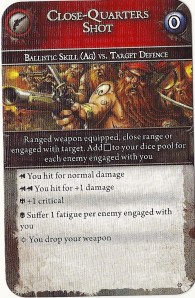
「Suffer 1 (black square) for each enemy engaged with you」という意味は、白兵攻撃中の相手がいたら、相手ごとに1個の不吉サイコロを得る。今の頃、Mad Maxineさんはまだ白兵相手がないから、気にしない。彼女は、射撃ロールをする。射撃攻撃は敏捷力に依存する。彼女の敏捷力は3だから、属性サイコロ3個をダイスプールにいれるはずだけど、姿勢は暴走1だから、属性サイコロ1個の代わりに赤い姿勢サイコロをいれる。そして、彼女は射撃技能熟練1レベルがあるから、熟練サイコロ1個を加える。そして、彼女は人間だから、特技はセッションごと一回吉サイコロ2個が何判定でも加える。今使ってみようかなとおもうから、その吉サイコロ2個も加える。
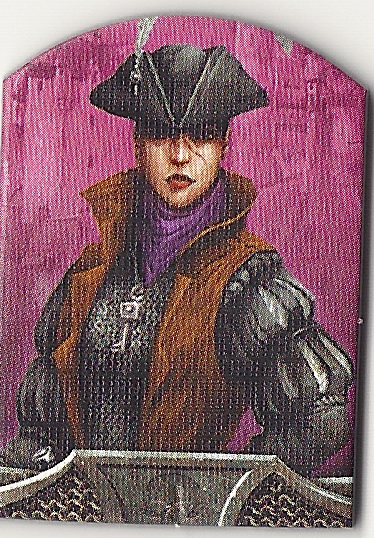
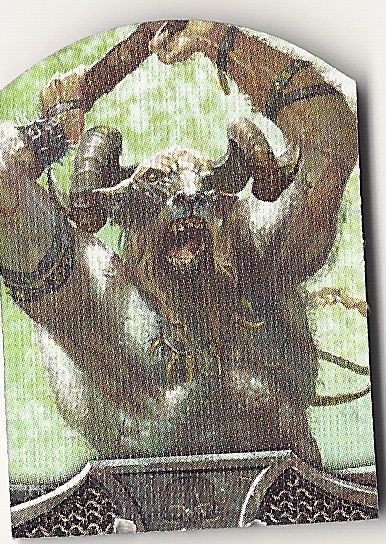
Close Quarters Shotのカードを見ると、ハマー2つの線に「You hit for +1 Damage」が書いてある。その下には、吉1つの線に「+1 critical」が書いてある。結果は、+1ダメージ、傷1つはクリティカルになる。拳銃のダメージは6たす敏捷力から、傷の合計は6+3+1=10。そして、ゴー君の鎧と耐久力を引いたあとで、5になる。ゴー君は5傷をえて、1つはクリティカルになる。クリティカルカードを確率的に引くとこれが見える:
ゴー君は小泉様が好きになった
「aggravated wound」っていうのは、小さい傷はもっと悪くなった意味です。「Your stance is considered one step closer to neutral」っていうのは、姿勢は中立まで1レベルを化投げないといけない。コー君は普通に暴走1から、今から、中立として戦闘しないといけない。いい!
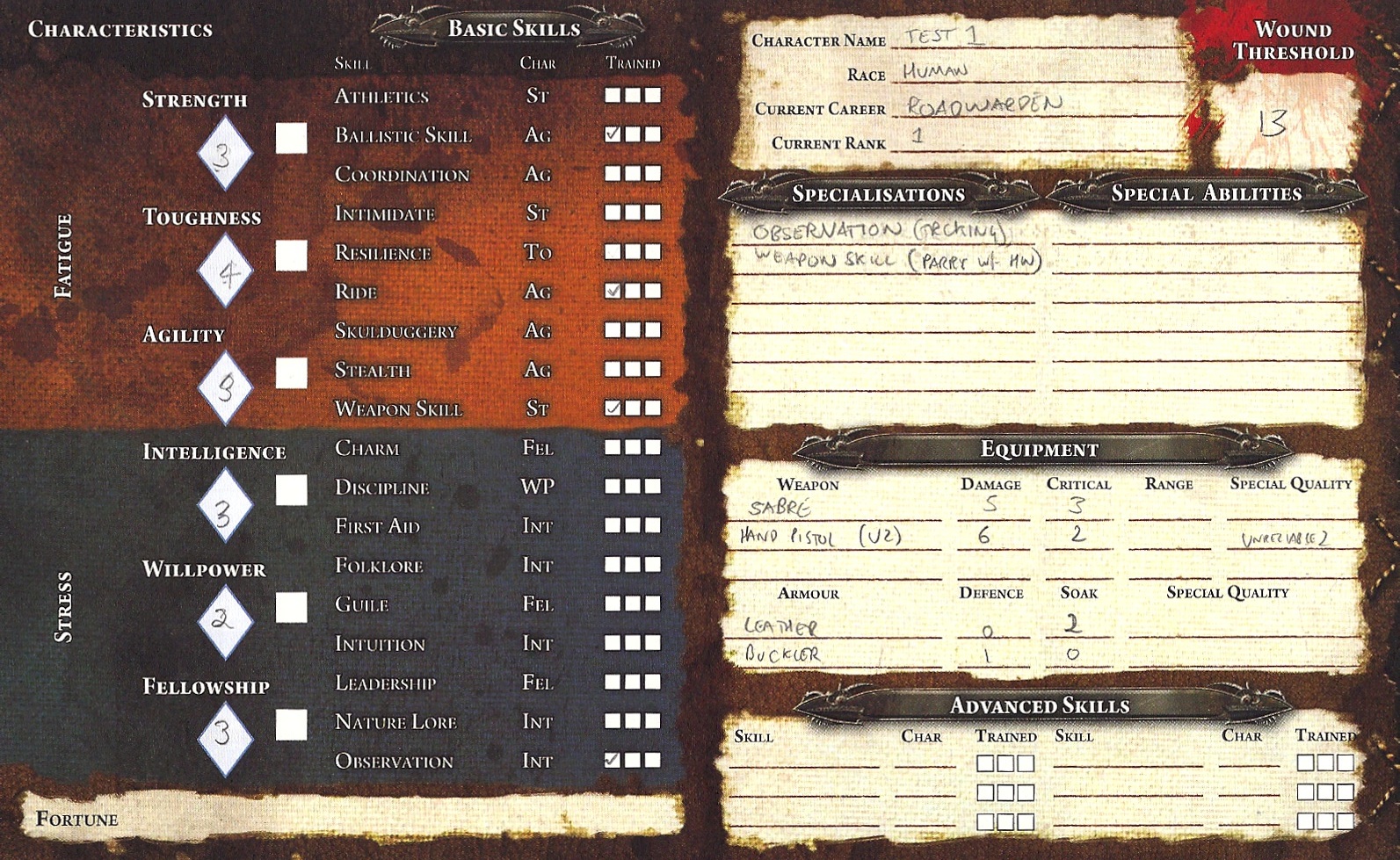
The owner of my FLGS gave me a copy of Warhammer 3 (yes, in Steamy Beppu, the FLGS really is Friendly) to read so I can run a game in Japanese, so recently I’ve been reading it and doing some trial fights[1]. I don’t get to run a game until late June, but I think I can safely say from what I’ve seen so far that I really like. There are some pictures of the mechanics of the system here, but I’m going to give a full overview of the mechanics I’ve read so far in this post. By way of background information, it appears that the system has been licensed out to Fantasy Flight Games, but they have retained some of the basic flavour of the old game, so even though the mechanic is completely different, the rulebooks and some aspects of the skeleton of the character system are similar. Wounds, for example, are a roughly similar number to 2nd edition, toughness still acts as a soak to damage, you still use an ability score to determine skill use, and there are still 3 boxes next to each skill for training. The character classes and races are roughly similar, though they got rid of the Camp Follower, and ditched halflings (yay!) They retained racially specific classes like the Envoy, and magic has been beefed up a bit. They also retain the Warhammer worldview, so the maps are the same and they have quotes from famous figures in the world which retain the sense of ironic low-fantasy darkness from the original. The Tome of Mysteries, for example, has a section on magical theory penned by a wizard, which makes it clear that the wizard thinks that magicians, priests and demons all draw their power from the same source, while strenuously denying any such heresy. This is the sort of thing I like about Warhammer.
But it appears that the 3rd edition system actually reflects the underlying dubiousness of the world, and its deadliness, in a way that 2nd edition never did. So, here is my review of the system.
Bye bye shorty
There are no Halflings in the new version.
The dice and the standard mechanic
Warhammer 3rd edition uses dice pools, but it ditches standard dice, and instead introduces several new types of outcome, and scatters them at different rates across different dice. The dice are:
Attribute dice, which are blue d8s, you roll one of these for every point you have in an attribute, and they form the basis of skill checks. So if you have Strength 4, you roll 4 attribute dice for any skill based on strength. These are good dice.
Expertise dice, which are yellow d6s. You add one of these to your dice pool for every level of training you have in a skill. These are good dice.
Challenge dice, purple d8s. You add one of these for every level of difficulty of the skill check. These are bad dice.
Stance dice, red or green d10s, which represent the effect of being in a conservative or reckless stance (see below). You exchange attribute dice for these, so if you are two steps into a conservative stance you switch two blue d8s for 2 green d10s. These dice are better than attribute dice, but they carry a risk: conservative dice minimise the risk of bad outcomes but increase the risk of delay, while reckless dice increase the risk of bad outcomes as well as good ones
Fortune dice, white d6s, which you add to the roll using fortune points. Specialisation in a skill, or helpful environmental effects, also add these dice to a roll
Misfortune dice, black d6s, which are added to the roll when it is opposed by an opponent’s action (e.g. a parry) or the environment, or if your opponent uses fortune to oppose your roll.
Each die can have several outcomes:
success (represented by a hammer)
Challenge (crossed swords)
Bane (skull)
Boon (angel wings)
nothing (blank face)
chaos (a chaos star)
Sigmar’s comet (a comet)
Your roll is successful if you get more successes symbols than challenges. Boons also have good results (e.g. criticals), and banes can have bad ones (e.g. suffering a wound from your enemy). Banes and boons can cancel. Chaos and Sigmar’s comet are particularly bad or good outcomes. So if , for example, you roll 4 hammers, 3 crosses swords, 3 angel wings and a skull, your end result is 1 success and 2 boons, which in a standard combat attack would be normal damage and a critical.
Probabilistic analysis of this is going to suck.
Actions and talents
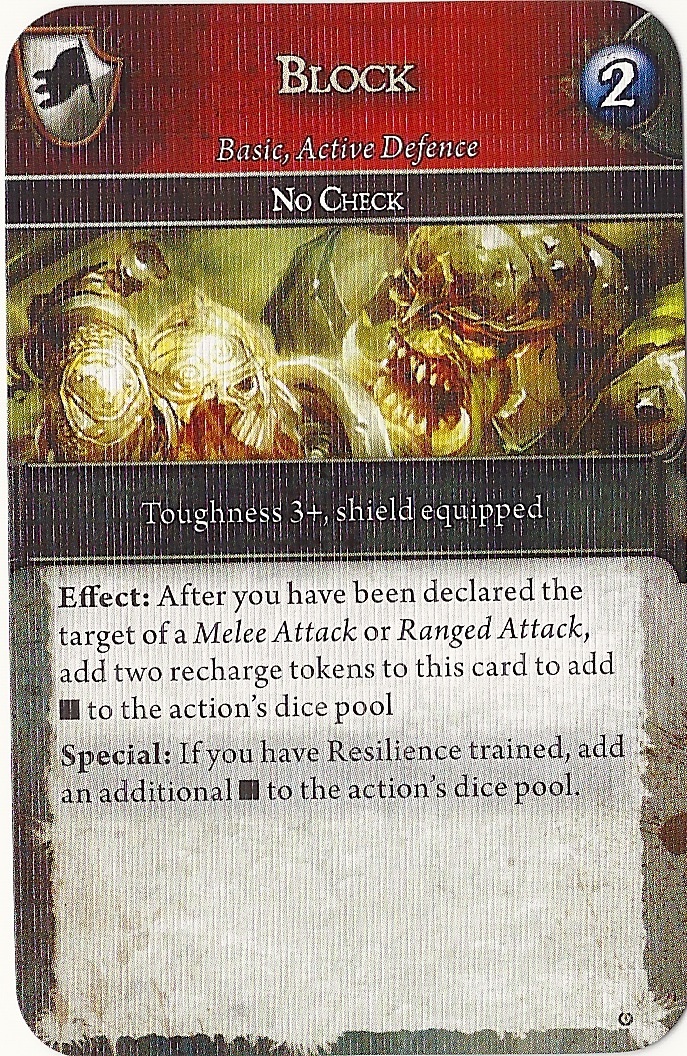
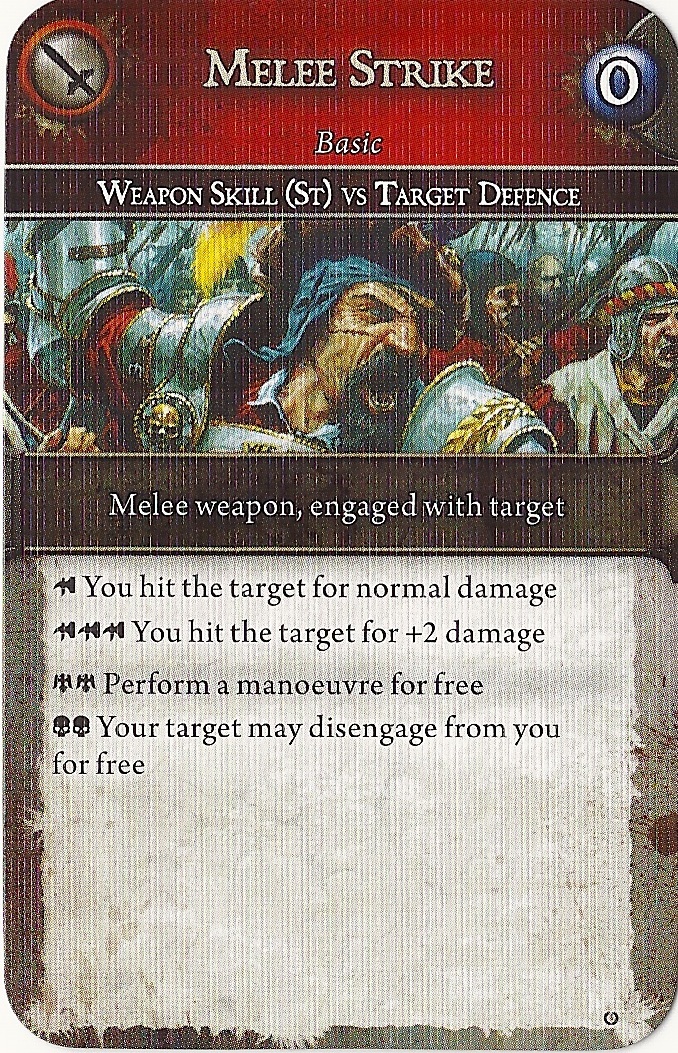
Every character class gets to choose certain actions, written on cards, and talents. Talents can be used once per session to get some benefit; actions have a recharge rate (in rounds) ranging between 0 and 5, and each action card has two sides, one green (for an action in conservative stance) and one red (for an action taken under a reckless stance). Each card lists the benefits of success, various levels of benefit associated with different numbers of boons, and bad outcomes for banes, chaos, etc. Each character has a set of basic actions (block, melee strike, manoeuvre) but then additional actions they can choose to use. When you use an action with a recharge time, you put cute skull-shaped counters on it and remove one at the end of each round. In my trial combat I used block (with a shield), that has a two round recharge, but then I used the sword and board attack, which has a 3 round recharge, but if you get a few boons in your roll it completely refreshes your block action. This is the mechanic of actions, and it strikes me that it’s quite an effective way of keeping track of round-to-round effects. It’s also a good way of keeping your powers managed, and giving them multiple outcomes depending on the stance you’re in. I like this.
Stances
Your character starts the game in a neutral stance but can choose to move into a conservative or reckless stance. Different classes have different stance tracks – my trial PC, a roadwarden, can go two steps in either direction, but other characters have different approaches. Some actions work better in one stance than another, and you can check which is better by looking at your cards. According to the book, for example, the accurate shot action is better in a conservative than a reckless stance. I like this too, it gives players diversity in handling situations, and gives the GM a context in which to set action descriptions. The game also provides some counters that you assemble to form a “stance tracker” which you use to keep track of where your stance is at. I like the mechanical aids in this game, they are really actually useful.
The Progress Track
This is another game aid, constructed by the GM out of cardboard pieces, which shows the progress of a challenge, skill check, scenario or series of events. Counters are set on the track, representing the party and the opponents, and the GM moves them according to time increments and/or skill checks. Whoever gets to the end of the progress track first wins the challenge, so for example if the track represents a pursuit, PCs and NPCs move along the track according to challenged skill checks, and if the NPC gets to the end of the progress track first he/she has escaped.
I’m not sure if this will be easy to use in practical gaming, but I can see the purpose of the idea and the possible benefits. I shall report back on it when I have tried it.
Magic and monsters
I haven’t tried magic yet but the main aspects of it that I can see are:
It’s more powerful than in 2nd edition
It retains the edge of risk and miscasting
If anything it’s rendered more risky by the role of fatigue, stress and insanity
It seems to have a strong feeling that suits the warhammer world
Stress, fatigue and insanity
The game has an excellent and very powerful mechanism for fatigue. For example, my trial PC had an excellent action called execution shot which enables the PC to use a close-quarters missile shot and a melee attack in the same round, if she is carrying a pistol and a sword at the same time. But when combat started she had shield and pistol, so she wanted to swap out the shield and draw the pistol. Doing so requires two manoeuvres, and in order to do this and move into a reckless stance[2], she had to make 2 more manoeuvres than she was eligible for. So she spent two fatigues and gained two extra manoeuvres, problem solved… until some action failed and she incurred 2 more fatigues. As soon as your fatigue score exceeds a physical ability, you incur a penalty of one misfortune die on all rolls – which increases the risk of subsequent fatigues. Then she copped a critical that caused another fatigue, and now her chances of doing anything successfully are very low. In subsequent fights, I made sure to be careful with these fatigue accumulations, because they get prohibitive fast. The same mechanism exists for stress, which is applied to mental abilities. If your stress exceeds twice your willpower, you risk insanity, which is initially temporary but can become permanent. I think magic use carries a high risk of insanity and stress, and there are even character classes (like the Witch Hunter) which you cannot take until you have incurred a permanent insanity.
Deadliness
Based on trial combats so far, against orcs and various levels of beastman, this game is deadly, at least for first level characters. The battles proceed rapidly to a dismal end, and vicious stuff happens quite fast. You can incur fatigues, criticals, and significant penalties on your next action very quickly, and then it’s all downhill. Whether this continues at higher levels I’m not sure, but I’ll be keeping an eye on it.
Drawbacks
The most obvious drawback is that the talent cards, action cards and special dice mean you have to buy the company’s product, and the initial product only provides enough stuff for 3 players, so if you have 5 players you have to buy an expansion pack containing more of these key ingredients. The game is expensive (about 10000 Yen), but I don’t think this is the end of the world, because it’s assumed that 4 people will be sharing the one box, which at 2500 Yen each isn’t the end of the world. However, if you run out of counters or action cards it sucks a bit. I also suspect that at higher levels and in hard combats the dice pool will be very complext to read, but after a few battles I was able to understand the dice pool quite quickly, so it’s maybe not the end of the world. Physically laying out your characters is also a bit of a pain, but on the upside they have designed it well to enable you to access all your information easily. I think the method of handling second careers could be a bit of a pain, though.
Presentation
The books look nice and all the associated material (cards, dice, counters, cardboard figures) are great. The editing of the game is a bit shoddy, and the rules are sometimes a bit vague (handling specialisations seems to have been reduced to a single sentence, so I had to do some guessing). However – and I believe, most importantly – the book tries hard to keep the flavour of the previous two versions of the game, with quotes on every few pages and regular reference to the world of Warhammer. The quotes and the sense of dark confusion and chaos have always been a very good aspect of Warhammer, and this game has retained them admirably.
Conclusion
It seems good, possibly too complex, and I’m not sure if the mechanic will hold up under the pressure of high-level gaming. I’ll give a further definitive opinion once I’ve run a session – stay tuned!
—
fn1: which involves saying to your partner when she comes in, “This isn’t what it looks like! I’m not so sad that I’m role-playing with myself!”
fn2: If you’re juggling a shield and a dodgy pistol mid-combat, you are by definition in a reckless stance!







 Compromise and Conceit
