This is a completely off-topic post, but I thought it covers an interesting topic in one of those areas that it benefits everyone to know something about. Last night I found myself accidentally at diner with the director of the Land and Water Division of the Food and Agriculture Organization (FAO). His particular interest at the moment is Globally Important Agricultural Heritage Systems, that is systems of farming developed in a particular location over a long period of time that have adapted uniquely to their environment, and represent a long investment of local knowledge and experience in the local farming system. Japan has its own unique agricultural heritage, the Satoyama, which is why he is here (I think). There’s even a David Attenborough-narrated documentary about them (so they must be important!) I’ve previously written in another location about the challenge that Japan faces in the modern era of protecting food security and simultaneously preserving their agricultural landscape, as well as the generational conflict that the burden of preserving Satoyama is sure to create, and it’s interesting to see the UN taking an interest in it as well. Anyone who has visited rural Japan (and I have to recommend rural Japan for anyone who wants to come here – it’s truly a beautiful and calming part of the world) will know that Satoyama are an essential part of the landscape here, and a Japan without them would be a strange sight indeed… but times and places change, and if Japan is to increase its food supply from its current woeful state then maybe the Japanese will have to start thinking about a move to industrialized rice farming. Which, the Australians can assure you, is an environmental disaster.
Returning to the topic of Globally Important Agricultural Heritage Systems, however, the list in the FAO website provides some stunning and fascinating environments which surely make an interesting setting for any role-playing campaign. There are the high-altitude Andean terraced farms, the Chinese rice-paddies swarming with fish that play the role of both fertilizers and food, and the lemon gardens of Amalfi that have been such an inspiration to both Porco Rosso and the eastern suburbs of the town where I did my undergraduate degree… these places are all excellent locations for an adventure, and the unique nature of their environment and their farming heritage makes for a unique culture and built environment that you can transfer, wholesale, into your campaign, with perhaps a bit of fantastic flavour, to make a genuinely different setting. Maybe those lemon farms could be transferred to mushroom plots on steep cliff-faces staring into the outer darkness of a Dwarven settlement; maybe your PCs will stumble on a high and mountainous kingdom, where slaves toil on multiply-terraced mountainsides to provide a powerful narcotic to their elven masters; or maybe the fish that grow in those paddocks have some healing property that keeps the rice-farmers eternally young despite their back-breaking labour… there’s much to be drawn from unique cultures in the real world, and the FAO conveniently provides us with a list…
Last Wednesday was the second session of the urban semi-sandbox campaign I am running in warhammer 3rd edition. It was held, as usual, in the upstairs gaming room of the local gaming store, Ringtail, which is currently in the midst of being refurbished to look more like a mediaeval tavern.
I had expected this session to run as a complex series of investigations, but my players proved very swift, and got to the heart of matters pretty quickly, and got quite a bit done in a short session. Today’s session started a little late because the Ringtail shop owner wanted to discuss a new game, Mallifaux, that he wants me to translate so we can play it together. One of our players, Mr. K, was running late so he was replaced by a nameless schoolboy who happened to be in the shop and is friends with the owner. For the first two hours or so while we waited for Mr. K to come, this chap watched; but when Mr. K confirmed it was too late for him to come, the schoolboy took over Heinze, the soldier. As we’ll see, the soldier is a really important character to have around…
Visiting the Temple of Sigmar
The PCs remembered that they are carrying a rather nasty Chaos artifact, the Unseeing Eye, that they can’t destroy, so they took it immediately to the Temple of Sigmar to entrust to the High Priest. The Temple itself is unusually large for a town of the size of Ubersreik, which fact the PCs put down to the fortress-like nature of the town, and inside they received a calming aura that, had they been actually stressed (rather than just wounded) would have been very helpful. The High Priest, a middle-aged woman with gentle eyes, took them into a side room where 4 rather scary-looking soldiers of Sigmar and two initiates stood guard while she inspected the picture. She told the PCs that a comet will appear in the sky in a month, and at that time she will be well able to destroy the artifact, and asked them if they would entrust it to her. The movement of the soldiers behind them suggested that at this point they had a choice to request its return, but that they wouldn’t be leaving the room alive with their prize. Fortunately for all concerned, they had no desire to keep it and handed it over without a hint of regret. No-one in the world of warhammer doubts the church of Sigmar’s willingness to commit cold-blooded murder in its sanctuaries to preserve the world from chaos, but in this case it was far from necessary.
In exchange for the picture the High Priestess revealed some history to the characters:
The Cult of the Unseeing Eye was driven out of Altdorf by a large assembly of soldiers and priests of Sigmar some years ago, but we never captured its leader or its most sacred paraphernalia. We never even really learnt how organized it was or what its purpose was. They must have fled to the forests where you found them, and in such a weakened state were ripe for infiltration and destruction. This picture is undoubtedly at the core of their religious enterprise, and without it and the enterprising servant of Chaos who set up that outpost, they are surely done for.
In exchange for the picture she gave each character a letter granting them a single free visit to the Shrine of Shallya (for healing), and a magic item called “Sigmar’s Promise,” a necklace of a platinum hammer that can be worn by any initiate of any religious church, and which grants the initiate +1 Willpower for the purposes of calculating their equilibrium state of favour while worn. Obviously Suzette took this item.
The characters then immediately set about their main purpose in Ubersreik – they went to the Temple of Shallya for some free healing.
Finding the “Wife of the Remains”
That evening the PCs started trying to locate the relatives of the dead man they found on the road to Ubersreik. They had a locket with a picture of a woman in it, and a game token with “The Sad Shield” written on one side. They soon discovered that the Sad Shield is a pub in the Labourer’s section of town, so they took the token and the locket and headed across the river to the labourer’s section. This section, on the poorer south side of the river, is a mixture of factories and workshops, interspersed with cheap houses and occasional slum areas. It is not the cheapest part of town to live – that sad distinction belongs to the Southbank Slums – but it is still quite poor, and on many street corners were suspicious looking men, loitering and spitting.
In the pub they soon found out what they needed to know, though not cheaply. The man was called Manegold Stolzer, a Ratcatcher, and he lived with his wife and child in the Northern River Quarter. The PCs didn’t learn this cheaply though – the tavern keeper was unforthcoming and they had to spend a lot of money on alcohol for the Ratcatcher he directed them to before they learnt what they needed to know. Having determined this they went home, and the next night they went to the Northern River Quarter to visit the wife.
Rumour: At this tavern they also heard a rumour that a long forgotten wizard’s tomb has been discovered outside of town, with rough directions on how to find it.
Visiting the bereaved
Things immediately struck them as suspicious as soon as they got to the Quarter. The Northern River Quarter is a suburban area on the north side of the river, populated with a mixture of classic Germanic courtyard-style apartments, English-style terraces, and stereotypical fantasy-world garden houses. These were clean, well-established and quiet, in a civilised, upmarket suburb.
What was a Ratcatcher doing living here? In every other town of the Empire, Ratcatchers live in rough shacks near the sewage outlets. They don’t live in quaint, trimmed-hedge garden houses in the most expensive non-noble part of town.
So, by the time they reached Mrs. Stolzer’s little house they were very suspicious. After they had informed her of her loss, and she had cried a little, she offered them a ring as payment for their work – they declined but she pointed out to them that they had ensured his soul’s rest by burying him like a civilized man.
This was also suspicious. Mrs. Stolzer, just-widowed, was offering them a platinum ring[1] as payment for something as abstract as a soul’s rest, when she was looking at a future of potential destitution.
What manner of Ratcatcher was she married to?
Sadly they didn’t get to find out because Suzette the Initiate asked a few too many probing questions, causing Mrs. Stolzer to get angry and take back the offer of the ring.
Spying on the bereaved
Naturally, they took the next best option to direct investigation, and stationed the elf on watch at Mrs. Stolzer’s window to find out who she really was. Sure enough, within a few hours of their departure, three men turned up at her door. She let them in, and the following conversation ensued:
Men: Mrs. Stolzer, we’ve just heard of your loss and we’ve come to give our condolences. Manegold was a good man and a fine colleague, and we all hurt for his departure
Mrs. Stolzer: Thank you, thank you. I am very saddened by his loss
Men: And we are aware that now you think your future must be very grim. So we have been sent by The Organization to give you this bereavement money in thanks for his work and effort [sound of much money clinking, some crying]
Mrs. Stolzer: Thank you, thank you. I appreciate the efforts that The Organization has made to look after us through these years of his service. I am told that he died in the forests outside of town – is it possible for you to tell me what he was doing out there?
Men: As ever, Mrs. Stolzer, we are unable to tell you anything about his work, even at this sad time. Suffice it to say that what he was doing was dangerous and important to us, and he lost his life in service to The Organization. We offer him our respect and thanks.
Mrs. Stolzer: Thank you, then, and I’m sorry for asking
Men: It’s perfectly okay Mrs. Stolzer, we understand that you wish to know more about your husband’s sad death. What did the adventurers who came here tell you? Please tell us everything they knew
Mrs. Stolzer: Only that they found him being disposed of by orcs, and buried him like a man deserves.
Men: Ah, so then. Mrs. Stolzer, we trust that you told them nothing of The Organization, and it pains us to have this conversation at the time of your new grief, but our seniors direct us to it. We must remind you that, just as you were sworn to secrecy about your husband’s involvement with us during his life, now even after his sad death you are bound to secrecy about his membership of The Organization, about its existence and about anything you have noticed of it during your life with Manegold. We have been asked to remind you that your responsibilities to us do not end with your husband’s tragic passing, even though our connection does, and it hurts me to say this but I must remind you that any breach of our secret is punished swiftly, cruelly and fatally. From now there is no further reason for you to have any entanglement with The Organization, and we will have no more such visits, but we must remind you that your responsibility to maintain our secret carries with you to your grave. I’m sorry to have to burden you with threats and dire warnings at this time, but it is our way, but I must ask you to forget that we ever existed in your life, or that your husband was anything but an ordinary Ratcatcher.
Mrs. Stolzer: I understand the need for this warning, and I don’t begrudge you your cold words at this time. I can only thank you for your assistance, and I hope that I will respect your secrets forever.
Men: Then we will take our leave of you, Mrs. Stolzer, and again offer our condolences on your loss and our hopes that this small offering will see you well into your dotage. We’re ever your servants
And with this they took their leave…
The PCs were naturally very interested to hear about this “Organization,” so decided to go back to the Sad Shield and see if they could rustle up a Ratcatcher to answer some questions.
The Rat’s Tail
The elf tailed the PCs back to the pub, and outside the pub he noticed someone else tailing them. A short and nasty scuffle later they had him under control, and dragged him out of sight for a bit of a beating and some intimidation. They soon discovered he, too had exactly the same rat tattoo as the body they found in the woods, but he refused to speak of any organization, and when pressed claimed he was just an ordinary ratcatcher. They dragged him to the Labourer’s Quarter, sought out a suitably dodgy rooming house, and locked him in a room obviously well-used for similar purposes by various criminals, before heading back to town. They then went back into the Sad Shield, and located two more ratcatchers with the intention of offering a hostage-for-information swap. Unfortunately these two tried to flee, so another short fight followed. For some of this fight the Soldier was on guard at the door, and things were looking unlikely to resolve themselves until he came charging inside and flattened one of the ratcatchers. They allowed the other to flee, and the elf followed him under cover of stealth.
The night ended here, with the PCs in possession of two hostages from “The Organization,” and the elf watching the doorway of one of “The Organization”‘s safehouses. Next time: finding out what this organization of ratcatchers is. The players aren’t yet convinced that it is even a bad group, though it certainly has been behaving in a shadowy way.
Conclusion
Again despite a bit of faffing and a late start things went smoothly and a lot was covered. As usual I dropped any role-playing of shopping etc (I find this sooo boring). This was the only chance the PCs will get for healing – in fact, they don’t have enough money for much healing from now on, so they’re going to be slowly getting in trouble. They discovered a lot more than I expected, largely through quick decision-making, but there’s still much for them to do.
I invented a new rule for this session, enabling the PCs to do submission damage at increased difficulty, to avoid the situation they were in last time where they had to knock someone out with lethal damage and then heal them in order to talk to them. This isn’t a good way to do things in town! So now they can club people into submission before they talk to them. I also made up some grappling rules on the fly, which everyone seemed satisfied with. I need to investigate that a little…
Rules notes and comparisons
Finally, I should add that many decisions made in this adventure would have been impossible in Warhammer 2nd Edition, because the PCs would have had such low chances of success that they wouldn’t have done them. Particularly, anything involving stealth or information gathering is impossible for first level PCs in 2nd edition, even for a thief character. Hiding under Mrs. Stolzer’s window, following the tail, would have been impossible. Also, the battle in the inn – between two relatively weak ratcatchers and 3 PCs who are also weak in melee and penalized for submission damage – would have lasted about 2 hours of real time (I’ve experienced this phenomenon before). In 3rd edition this was the slowest and most frustrating battle we have had yet, and couldn’t have lasted more than half an hour. It probably would have stretched for an hour without the Soldier’s intervention, whereas in warhammer 2 it probably would have taken an hour with the soldier’s help. This sort of thing was really frustrating in 2nd edition and makes a big difference to how enjoyable the game is. I want my players to make decisions about what they will do within their core competencies on the fairly safe knowledge that they can succeed if they plan well and are better than their opponents. It doesn’t work that way in 2nd edition!
I think some of the spells in 3rd edition are a bit strange. The spell Shooting Star, for example, is completely useless compared to Magic Dart. Shooting star is higher level than Magic Dart, so it’s a bit weird. I removed Shooting Star from the Wizard’s list and offered him a choice of a new spell or an increase in attribute by one point (this spell was chosen at character creation) and he chose to increase willpower, which was a wise decision for the battle.
Also, I screwed up the progress tracker a bit today, so I need to review that rule a little and think about how to handle it. Otherwise, things are going more smoothly
—
fn1: In fact, Schultz cocked up his appraisal check – he got successes, but also a chaos star. This was sufficient for him to identify that the ring was worth more than a standard ratcatcher’s wife should own, but also put a bit of confusion into the mix. The ring is really silver, not platinum, and worth 10% of what Heinze believed it to be worth.
I mentioned previously that I think I have stumbled upon a Japanese Grognard, who I shall call Mr. 123, and it occurred to me recently that I could try and ask him some questions about his attitude towards gaming, his opinion of old school, etc. I’ve noticed that the people I play with here, though generally willing to try new games, are completely uninterested in D&D 4e, though some have made a major divergence into Pathfinder. Mr. 123 recently ran a game using the D&D Rules Cyclopedia, and is a big fan of Warhammer 2nd Edition (which is pretty old school, I think). So he probably has opinions on games and gaming connected with the period of the games. He’s playing WFRP 3rd edition with me, but this could just be because he’s willing to tolerate new rules in order to play Warhammer rather than GM it.
If I give Mr. 123 an interview, the basic questions I would ask would be:
The usual demographics
His gaming history
What sort of games he likes and dislikes
Whether he prefers games from a particular generation and, if so, whether this applies to Japanese as well as Western games
If he knows anything about the OSR, and if there is an equivalent thing in Japanese games
But I would like to find out if any OSR gamers reading this might be interested in asking additional questions, and if so what sorts of stuff they would like to know. Please let me know in comments!
In a related note, there is usually a Pathfinder adventure at my local monthly gaming convention, run by a Mr. S. This local gaming convention has been running for 25 years, and the most recent event was the 60th meeting (in earlier years it was much less regular than now). I discovered recently that Mr. S has been running this convention continuously for the last 25 years! Beppu has a population of 123000, so I think this is a pretty good achievement – let alone that it’s run by just one person. I wonder if Mr. S is also a grognard, despite his Pathfinder-y-ness? And I wonder if a survey of the local convention gamers might be a good idea…?
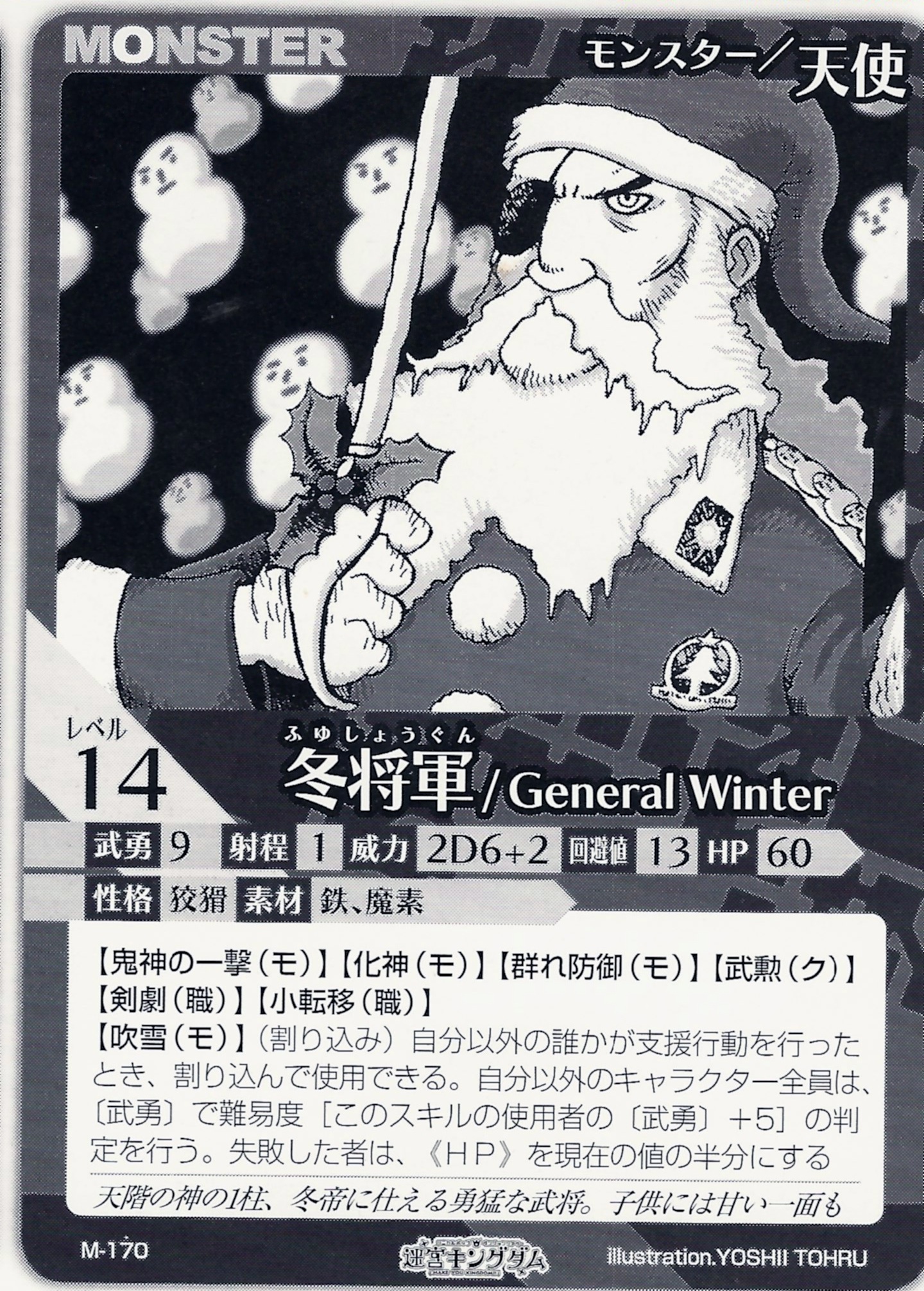
Having presented a random table and monster from the game Make You Kingdom, here are a few more monsters from the game. I have to return the book tomorrow, so there’ll be no more posts about it until I buy my own. Here is a translation of the monster in the main picture, General Winter.
General Winter (level 14 Angelic Monster)
Bravery:9
Range: 1
Damage: 2d6+2
Resistance: 13
HPs: 60
Character: Sly
Common Monster skills: Fist of the Fierce God, Divine Transformation, Swarm Defence, Feat of Arms, Sword Play, Minor Transformation
Storm of Snow: When someone other than General Winter uses a support action, he can interrupt them using this manoeuvre. Everyone but General Winter must make a Bravery check with a difficulty equal to the General’s Bravery +5. Those who fail immediately have their hit points halved.
Text (“flavour”): A valorous commander who serves the Winter Sovereign on the steps to heaven. He also has a side that is kind to children.
(I don’t know what the “common monster skills” are because they aren’t in my book, but they seem pretty scary).
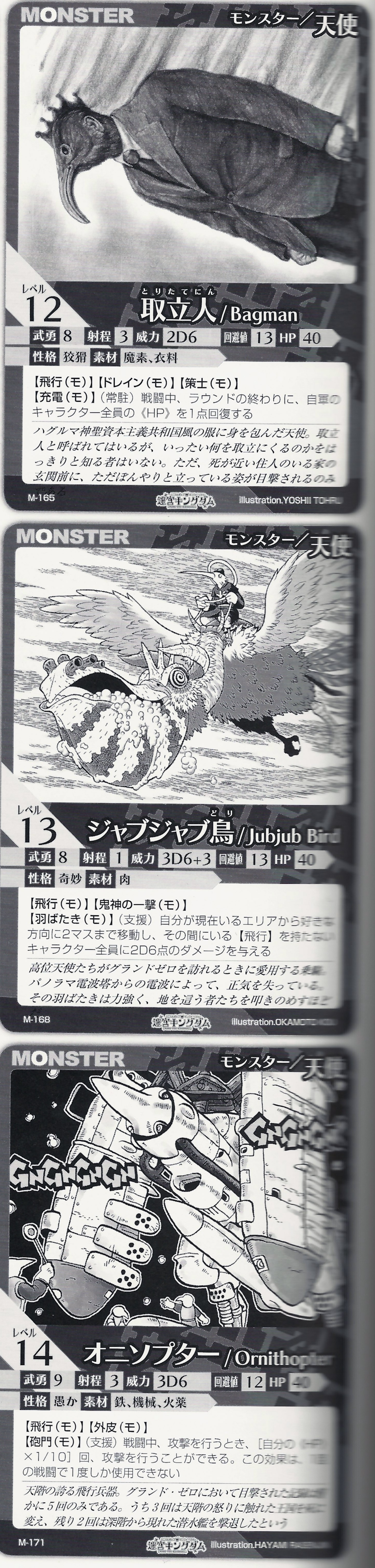
Below are three other monsters that I scanned in as random trash during the process of scanning in General Winter, and figured I should upload. No translations are provided, but they’re all from the “Angels” family of monsters.
Woe to you oh earth and sea, for the devil sends the beast with wrath
About a month ago, our little foundling Arashi chan finally recovered from his severe car-related injuries, and I present to the world this picture as proof that his recovery has been spiritual as well as physical. He’s not so little anymore, and definitely not so immobile…
Many people in the RPG world think what I’m about to say is heresy, but I actually think that board games and computer games have some interesting ideas to teach RPG makers and players, and a lot of them are based on making available new and specialized content – that is, objects and purcahsable add-ons – that can provide additional opportunities for role-playing, or tools to help the GM and the players manage the game. A lot of these ideas are common in Japanese RPGs, and some of these tools when combined enable the game to improve the number of rules options available, and to have incidental rules – like fatigue, encumbrance and the like – that people typically hate to use because they’re fiddly to manage.
As an example I give Warhammer FRP 3rd ed, which I’m using now. It has 5 ideas which, used together, enable both improved role-playing opportunities to emerge from dice rolls, and give better management of in-game actions, which in turn allows Warhammer 3rd ed to use a wider range of resource types for players. They are:
Special dice: these enable actions to be resolved on two dimensions, with one dimension the standard success/fail and the other a good luck/bad luck dimension that is largely used to add role-playing hooks and interesting side effects to actions. These two dimensions offer the opportunity to succeed but have a bad or annoying side-effect, and to fail but have some minor quirk of luck. They also enable success in one action to affect another. For example, good fortune on a successful Sword and Board action enables a fighter to reuse their Block defense. Such a dimension in, for example, D&D might mean that a Cleric rolling good luck on a Bless spell might regain one of their daily Turn Undead uses. In D&D 4th edition, good luck on an at-will power could lead to a recharge of an encounter power; or success on an encounter power might recharge another encounter power, or add to the tally of available healing surges. Of course, all of these extra effects in combat can be hard to keep track of, except for the additional use of Action Cards…
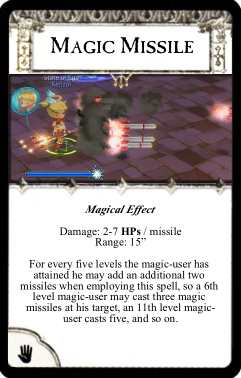
Action cards: which enable you to pull all your main effects out of a book and put on the table for easy reference, so players do not have to constantly reference the books. This would be useful in D&D for wizards and clerics but even putting a character’s to-hit table on a card would make that action resolution very quick. I’ve given the rather trivial example of Magic Missile here (the text is from Greyhawk via Grognardia). Obviously Magic Missile is trivial, but it seems uncontroversial to me that having things like hit tables and turn undead rules on easily-accessible, attractive cards is really useful, especially in a game like D&D where lots of rules (e.g. surprise, finding secret doors) that are used a lot may differ by race, class or situation. The downside of attractively-made cards is that they add to the cost of a product in art and production[1], so they’re hardly justifiable in and of themselves[2], but in WFRP 3 they are justified by a useful mechanical tool, cooldown, which is only possible as a mechanical technique due to the combination of Action Cards with Recharge Tokens.
Recharge tokens: this enables actions to be limited in terms of available power (for spells) but also time to reuse, i.e. cool-down, which is something I think 4e D&D wanted to use but couldn’t get working because they weren’t thinking board-game-y enough. In WFRP3 each Action has a recharge time written on the top right corner of the card, and you track recharge by putting recharge tokens on this spot, then removing one at the end of each round. These tokens can also track other sorts of recharge. For example the Morr’s Touch spell is discharged after a certain number of hits, which are tracked using tokens in the recharge section of the card. If an Initiate of Morr gets a lot of luck on another spell roll they may be able to add recharge tokens to this card, adding to the number of hits they can deliver. But they don’t need to track these on paper using a pencil and crossing it out, because the tokens are right there. These tokens also track fatigue and stress, which can be accrued for any action and are an important consideration in the development of insanity. They are also used for tracking the duration of conditions. When I first read about this method I thought it would not be an improvement on just writing numbers on a sheet but it really actually is, both because you don’t have to keep track of actual numbers (you just move tokens around) and because it’s trivial to keep track of 6 or 8 recharge processes at once when they’re combined with cards, while keeping track of recharge next to multiple effects written on a paper is messy and easily confused. The upshot of this is that the WFRP system enables continual use of magic, but through the combined management of power points and recharge. Power points can be redrawn after use, but this takes a round, and spells may take several rounds to cool down. This means that Wizards and Priests always have their spells available to use but can’t use them at will. I think this is the approach Wizards of the Coast wanted with D&D 4e, but without cards and tokens a truly flexible cooldown system is impossible, so they went for the more basic form represented by at-will/encounter/daily powers. I think cooldown is a natural idea for both spells and non-magical actions, and keeps the game fun for everyone because they always have the actions they want, but usable at a frequency that is balanced by the system. I don’t think recharge has much use in pre-4th edition D&D, but I’m sure there are other uses for tokens – for example, after casting bless you put a number of tokens equal to its duration on the card, and remove one per round. This frees up the GM from a lot of management issues.
Progress Tracker: a really simple idea for keeping track of contests between PCs and enemies that span long periods. e.g. chases, building armies before a deadline, etc.This is system-independent but really useful. For example, suppose that the adventure requires that the PCs find the location of a secret cult before the cult sacrifices the Mayor’s daughter. The GM can decide how much leeway to give the PCs and then constructs a progress tracker with a number of spaces corresponding to this leeway. Halfway along is an event space. Every time the PCs make a mistake (raid the wrong building, or screw up a negotiation with a potential informer) a token is moved one space along the progress tracker. When it reaches the halfway-point event space the cult become aware of the PC’s investigation and send assassins against them; if the progress tracker reaches the end before the PCs have found the Cult HQ, the girl gets sacrificed and the PCs have failed. This gives the GM a method for relating failure in the investigation to the outcome, and a way to construct limits on how many mistakes the PCs can make. I think this is a really useful tool for managing competitive tasks of this sort, and can offer really interesting plot triggers. In a longer adventure event spaces could be scattered through a progress tracker to indicate incidental events (unrelated to the adventure) or just spots for the GM to roll up rumours/weather/adventure hooks (this is how the progress meter was used in the Scenario Craft adventure I played). This is system-independent and again, although it doesn’t need a purchasable product, a solid cardboard progress meter with a style that suits the game is nice to use. The Scenario Craft adventure had a double-page spread in the book that could be photocopied and contained the progress meter and all the associated random charts, for easy reference.
Party character sheet: used to build up tension between party members. The tension meter increases with every failure, and at some point triggers a negative effect that depends on the type of party the players have chosen to play. There is also a pool for storing fortune points, which are added to whenever the party gets a success, and then distributed amongst the party whenever the number of points equals the number of PCs. I think fortune points are a system-independent idea as well, being basically a house-rule to enable players to get out of trouble. The party character sheet also has a special skill for the group, and two slots for a talent that anyone in the group can activate. In D&D3.5, there could be a special set of feats that go on this character sheet and that players can choose to purchase for their PC in place of normal feats. This would be particularly suitable for bard, rogue and other support characters (or could even be used to make bards desirable as party members!) My current party are playing “Brash Young Fools,” so when their tension reaches 4 points the party have an argument and everyone’s stress increases by one. The “Hired Thugs” party take a wound at that point, indicating that the increasing tension of continual failure has led to recriminations that actually came to blows. In this group, continual failure can be deadly. Again, this sheet benefits from the use of tokens, and is also at its most basic completely system-netural.
These ideas are all things you can make yourself and import into OD&D, but most of them are ideas from computer games or board games. Most of them enhance options for role-playing. The current version of WFRP was made by Fantasy Flight Games, who are a board- and card-game company too, and I think they’ve incorporated the lessons of those other genres into their work. In this blog, board games are credited with improving the rules of modern wargames, again through the incorporation of ideas from outside the world of wargaming itself.
I think RPG players and makers have an objection to “additional content” that is often quite visceral and reflexive, and has a lot to do with the way in the past companies like TSR and Wizards of the Coast have tried to sell all sorts of useless crap via splat books. But this stuff often didn’t improve or change our play at all, just gave us ever-increasing numbers of meaningless choices. Iron Crown Enterprises (ICE) did this with Rolemaster – I had maybe 3 companions, but the only useful one was the first (with the addition of the Nightblade character and a few new open spell lists); the rest were useless fluff. Of course, ICE and TSR produced some very nice world settings, but along with these useful additions came a bunch of useless stuff (especially from Wizards of the Coast) like Fighter Handbooks and The Complete Left-handed Basket Weaver, etc. However, in amongst this useless pile of accrued crap is a simple truth – sometimes the stuff that gets added on is really useful and enhances the game, regardless of its financial advantages to the original company. Even though the additional content in WFRP3 presents Fantasy Flight Games with an excellent vehicle to sell more stuff, this is neither a new phenomenon, nor something unique to card games, nor a cynical money-pushing decision on their part. The material added to WFRP makes for a genuine interesting improvement to both that particular game and to the practice of role-playing generally, and I think it’s a sign that there is a lot of gaming practice outside of RPGs that we could stand to learn from – including (shock horror!) in computer games.
—
fn1: Don’t I know it! I’m currently translating all the Warhammer 3 cards to Japanese and printing them and it takes a huge amount of time and effort.
fn2: A lot of Japanese games seem to present actions/effects in card form in the book but don’t present the cards themselves. I think it’s assumed the players will make their own cards with a photocopier, or maybe in some cases they’re sold separately.
This post was inspired by a discussion at Sarah DarkMagic’s blog about how to justify daily powers for fighters. I’ve read a few spots where people say they find daily powers for fighters hard to comprehend – how come you can only do your power strike once per day?
I put an explanation on the referenced post which I think gives a mechanism for handling this. The specific situation described in a comment is one of Indiana Jones as PC, with firing his gun as a daily power that does a lot of damage (maybe it’s a save-or-die effect). Here’s my suggestion:
How about… his gun jammed?
There’s a challenge you can set the player – if he or she needs to use a daily power a second time in a day and can’t, try and find an explanation.
Why doesn’t the fighter use his whirlwind attack of blah a second time? Maybe it makes him dizzy and he doesn’t want to risk it; maybe he missed the chance this time in the flurry of battle; maybe the day’s efforts had worn him down and he didn’t have the strength; maybe he thought the opponents were moving too fast and didn’t want to risk turning his back on them.
Just because the mechanic says it’s once a day, doesn’t mean that the role-play aspect of the battle requires that to be the explicit, stated reason.
e.g. Jack is pinned down under the beast, and yells to his gnome companion “shoot it!!!” His gnome companion doesn’t reply “sorry, can’t use my gun ’till tomorrow” and leave him to die. Rather, his companion does what you see in movies all the time and flies into a rage, charging forward to beat the beast; or the gun jams; or he realizes he left his ammunition back on the horses; or the gun is empty, and in a moment of snap judgment the gnome decides to rush forward rather than risk the reload time; or the gnome saw a vulnerable spot he thought he could get a knife through more effectively than trying to shoot through the beast’s carapace.
In essence I don’t think the powers daily-ness needs to be made explicit – treat it as a mechanical game balance rule and find an in-world, role-playing reason for the effect. This will make battles take different tones as you try to explain your fighter’s fighting style.
The same approach probably applies to cool-downs, and even I suppose to Vancian magic, though in the case of magic I think there are obvious excuses for any mechanic you choose to think of (“it’s magic!”)
Continuing my series of posts on the Japanese RPG Make You Kingdom, here I present a single table from the random Kingdom generation section. In this section you choose how many rooms your Kingdom will have (1 to 9), then you generate each room randomly. To do this, you first roll a d6 to see what sort of room it is (human creation, natural form, underground, etc). Once you have chosen the form, there is a table of random rooms from which to select each room. All 6 tables use the same random selection method: D66. That is, you roll 2 six-sided dice, taking the lowest as “tens” and the highest as “units,” like d100 – except you don’t designate one die to be a “ten.” Instead, the lower roll is always a “ten” and the higher always a “unit.” For example a roll of 1 and 4 is 14, regardless of which die rolled the 1. This gives you 21 options.
The table below is an attempt at translating the results for the “Heavenly” style of room, which you obtain with a roll of 5 on the original D6 to determine room type.
11
A room with falling rain
23
Atop a cloud, which somehow you are able to walk over
36
A colossal exhaust vent making a huge roaring sound
12
A cavern riddled with wholes like a swiss cheese
24
A hollow veiled in mist
44
A room in which lightning strikes every now and then
13
Many floating gardens layered atop one another
25
A room in which you drift, weightless
45
A room of gently falling feathers
14
White laundry strung out in endless lines
26
A room in which snow falls and gathers
46
A cavity with many walls on which have been painted pictures of a clear blue sky
15
Beanstalks growing to the heavens
33
A cloister floating in mid-air, in which space and time are distorted
55
A room on one wall of which is a mirror
16
A colossal shaft in which hangs a rope ladder or a chain
34
A corridor in which a monster-repelling windmill spins, making a strange sound
56
A cavern in which the aurora wavers and flares
22
A room through which a strong wind blows
35
A cavern, through the roof of which a ruin or relic can be seen
66
A room in which the direction of gravity is disjointed or strange
With only 21 choices, in one campaign you can only make 2 or 3 wind-themed kingdoms before you run out of rooms (unless you make up your own), but even if you mix in a few rooms from a different table (e.g. roll 6, the spirit world) you’ll get an interesting and weird dungeon to play in.
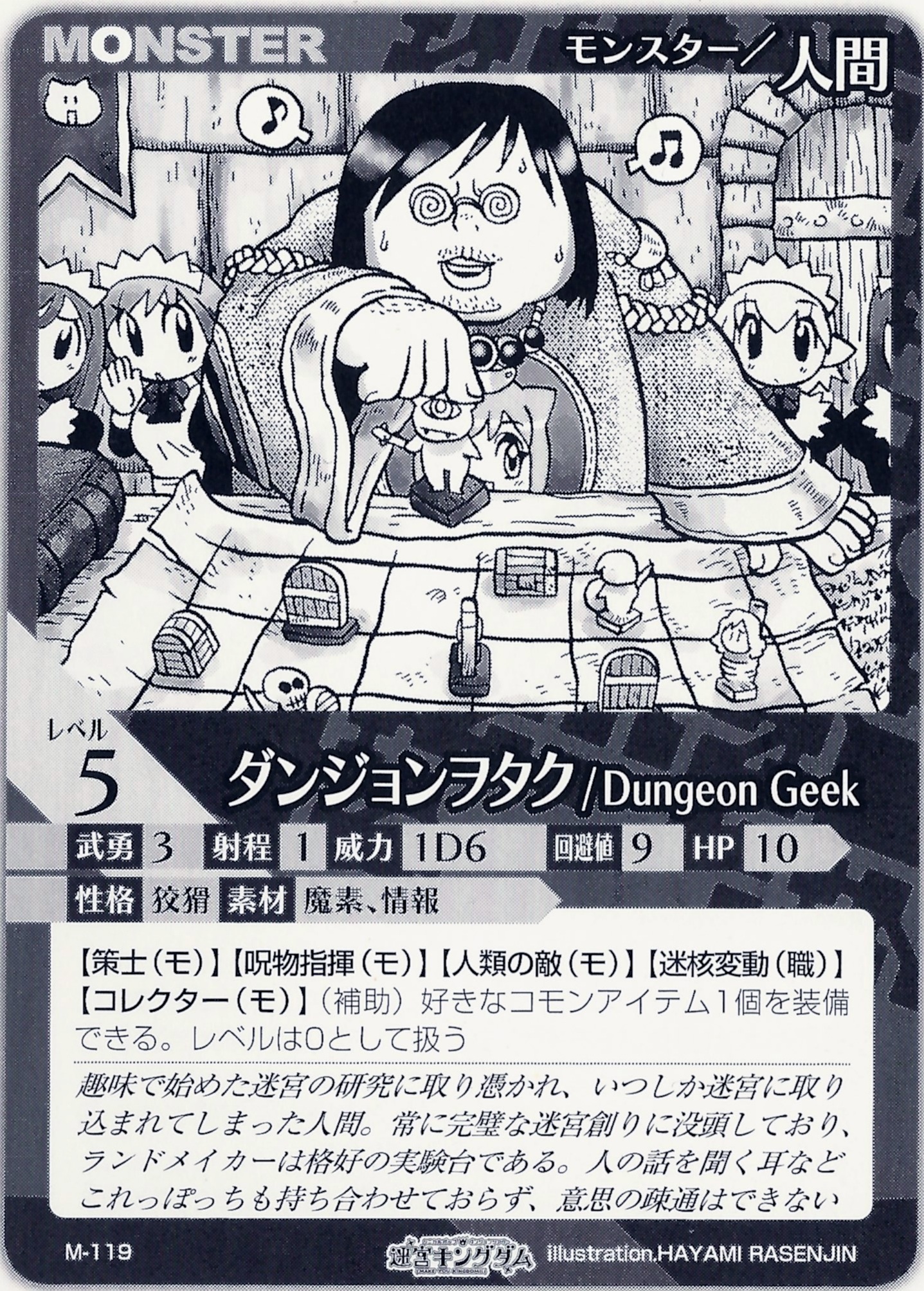
The picture is a human monster, called a Dungeon Geek (“Dungeon wo taku”). I think the name is actually a play on words, because the correct way to write “geek” in Japanese is “otaku,”(オタク) not “wotaku,”(ヲタク) but the verb “taku” means to burn, so “Dungeon wo taku” could mean “burn the dungeon.” There are a few puns in the monster section playing on either Japanese kanji jokes, or English translation jokes (like the “living room” which is literally a room that lives). The Dungeon Geek is a level 5 monster with an attack range of 1 (missile fire), 1d6 damage, 10 hit points and a resistance of 9. His abilities are:
Schemer: Enemy tactical checks are made 3 points harder when opposing this chap (I’m not sure what a tactical check is, as I don’t have the basic rule book)
Enhance Animated Objects: He can increase the resistance and damage of nearby animated objects
Public Enemy: This skill’s rule beats all others. This monster cannot be converted into someone else’s follower. Also, this monster’s skills cannot be acquired by a PC (I presume there is a mechanism by which PCs can steal monster skills).
Dungeon Tectonics (I think, this skill is not listed in the book I have): The Dungeon Geek can lay traps for enemies
Collector: The Dungeon Geek can equip a single common item of his choice, using it as if it were level 0
The text in italics at the bottom is “flavour” (フレーバー) and says
This is a human who became obssessed with the first dungeons, and was drawn into them unawares. Always losing himself in the quest to make the perfect dungeon, Dungeoneers are his perfect test bench. Being completely heedless of human conversation, he is incapable of communicating his purpose.
A very suitable monster for our little corner of the universe…
[All translations should be taken with the usual note of caution]
Comments on my last post have become bogged down in a debate that makes it hard to think clearly about the things I’ve been discussing in this series of posts about Tolkien and racism. Specifically, I think we’ve drifted off the main thread of the arguments, and become distracted from the issue of racial essentialism in Tolkien by a nasty debate about whether Tolkien’s work was fascist. So this post is an attempt to regather my thoughts (I find the cut-and-thrust of internet debate can cause me to drift off of the main thread of a thought).
I think my interlocutors have become a bit bogged down in defending Tolkien against a misinterpretation of scientific racism, which gives it a stronger set of conditions than it actually and historically carries, so I’m going to try and clarify that. In this post I will remind my readers of the way scientific racism works, and discuss the additional properties of Nazi racism. I’m also going to try and set out a method by which an author can unintentionally make a Nazi racial model for their work through combining two quite separate narrative ideals, and I’m also going to try and set out an alternative plot for Lord of the Rings that would be almost exactly the same as the original but substantially less concerned with the inherent moral differences of races, in an attempt to show how a very similar text could be less vulnerable to scientific-racist interpretation.
Scientific racism and racial essentialism
The fundamental property of a theory of scientific racism or racial essentialism is that it ascribes moral properties to a race, and assumes they’re racially inherited. This is different to, say, racism, which ascribes moral properties to a race but assumes they’re not genetic; or scientific analysis of cultures, which assigns certain properties to a culture and assumes that you have to grow up in the culture to get them; and connects this to a race only inasmuch as a race is connected to the culture.
When scientific racism assigns a moral property to a race, that assignation isn’t absolute or invariant – it’s an average level around which the race is generally assumed to deviate, and in most models it’s not absolute. As we’ll see, the exception to this is Nazism which (pretty much) assigns immutable, eternal and unvarying evil motives to a single race (Jews). So in general a scientific racist theory will make statements like
[Race A] is less moral than [race B]
[Race A] is inclined to savagery and barbarism [with the implicit contrast to race B]
[Race A] cannot rise above their base instincts, and will never aspire to the higher art or culture of [race B]
These statements tend to allow for diversity within the framework, and specifically they allow members of race B to be degenerate. In fact, the concepts of degeneracy applied to [race A] tend to be grounded in discussion of the “worst types” of [race B], and historically they’ve often been taken from descriptions of the poor and working class members of the society of [race B]. Saying [race B] is better than [race A] is not a statement that is everywhere and absolutely true; it’s sometimes (or often) the case that members of [race B] behave like [race A] or can be corrupted to so behave – this is the essence of the fear-mongering and salacious marijuana scare books of the 50s, for example.
Further, it’s important to note that a lot of scientific racism is based on an underlying fear of [race A], and especially of [race B] becoming like [race A]. For such a fear to be viable, there has to be some real life risk that [race B] will occasionally (or frequently) behave like [race A]. This is especially evident in racial essentialist arguments against cultural mixing. The fear isn’t just that the races will interbreed, but that the mere presence of large numbers of [race A] doing bad things will cause [race B] to do more of them.
As a concrete example, consider some more modern racial essentialist theories based in pop pscyhology. Under these theories black people have “poor impulse control.” This means that, for example, young black girls can’t resist the urge to have sex, and get pregnant as teenagers. This theory doesn’t preclude white teenage pregnancies, because it allows for the existence of white girls with poor impulse control (usually it sees these girls as poor or working class, often living in neighbourhoods with lots of black people). But it is used as an explanation for high black teenage pregnancy rates (and is often followed up with an argument that special funding for programs to reduce teen pregnancy in black communities are a waste of money because the problem is “biological”). This racial essentialist theory will be stated as “blacks have poor impulse control” but it doesn’t actually exclude poor impulse control in whites.
Nazism’s special additions
Nazism is unique among these theories for adding a narrative of purposeful evil and corruption to the racial model. Jews are seen as not just immoral but always and everywhere evil, as represented in the essay The Eternal Jew. This evil is racially inherited, so immutable, and the deviousness and evil of the race is seen as such that mere exclusion is insufficient – extermination is the only solution. This model does not, however, preclude the possibility of evil in the “superior” races of whites. It presents a heirarchy of corruption, in which Jews are, for example, much better able to manipulate blacks than whites, and Germans and British are much more resilient to manipulation than, say, slavs or (sub-human) Russians. In fact, this racial theory was adapted quite neatly to explain the importance of Jews in American life, and a theory of cultural isolation and racial and cultural mixing was used to explain the “special vulnerability” of Americans to Jewish manipulation.
Nazi racial theory doesn’t assume that all white people are pure though; in fact, it allowed for the possibility of genetic flaws in whites, and had eugenic programs to manage them; and it had a criminal justice policy which, though racially-oriented, also assumed that white people could do bad things. The key point here is “could.” The Nazi view of race was that white people could do good or evil according to their free will (though they were always looking for genetically eradicable causes of propensity to do certain things); but Jews could only do evil. This kind of model is essential to explaining the presence of gay Aryans, and of Aryans who voted against their racial interests (i.e. voted Social Democrat).
Nazism also has a narrative of corruption, with the Jew whispering in the ear of the white man to corrupt him from good. Such a narrative doesn’t preclude people choosing to do evil acts by themselves, but the big movements of the time were all seen in the light of Jewish corruption: Bolshevism was Russians being corrupted by the international Jewish plot of Marxism; British views of Germans were the fault of the Jewish media; and Germany’s defeat in world war 1 was the fault of Jews corrupting Germans at home through fear and hunger.
Tolkien and racial essentialism
Tolkien’s work fits perfectly into a racial essentialist model, presenting tiers of morality in the races. Elves, Dwarves, Halflings and humans have the power to do good or evil by their own free will; Orcs and Southrons do not, with Orcs being always and everywhere evil and Southrons somewhere in between. Amongst humans, levels of goodness are genetic, with the Rohirrim and Gondorians at the top, then the men they interbred with, and then the Dunlendings, and then Southrons etc. (all the servants of Sauron). These traits are clearly presented as racially inherited – even halflings’ resistance to the siren song of power is racial.
Note here that “level of goodness” is defined as a propensity to do good; a race doesn’t have to be presented as everywhere and always good in order to fit a racial essentialist model. It simply has to be more moral than other races.
Tolkien’s model has the further unfortunate property of mapping these genetically-inherited racial differences to a geographical and morphological scheme that fits our real world, making the races very easily interpreted in real-life terms.
Tolkien and Nazi racial theory
In addition to presenting a race as immutably evil, just as Nazis do, Tolkien’s work includes an additional narrative of corruption, which brings it closer to Nazi racial theory. The evil races are corrupted by a pair of evil Gods, and the most evil movements in human and elvish history are related to corruption and deception by these evil Gods. From a Nazi racial theory perspective, this is Morgoth as Marx and Sauron as Lenin. They deceive and corrupt other races to following an evil creed, but unlike the real-world versions, they don’t rely on races being created inferior; they corrupt them with their magic so that those races become their permanent servants. The inclusion of this additional magical element to a fantasy text doesn’t rescue the racial theory from the interpretation it deserves; and the use of supernatural figures to do the corrupting, rather than representatives of the evil races, is simply a device of the genre. These points don’t fundamentally change the narrative, which is one of corruption of basically good peoples by the representatives of an evil race. In this case the representatives are magical, not political activists; but the effect is the same. The single difference is that these representatives pre-date the races they control, and created the (genetically-inherited) corruption in those races, rather than arising from it. This is not a hugely important element of the narrative structure of the Nazi racial theory represented in the text, though it suggests a way in which a Nazi racial theory can be constructed by accident.
Creating and recreating racial stories
In this section we will consider narrative structure and intent, but by inferring possible intents we shouldn’t assume that we’re commenting on the author’s actual intent or character. It’s generally assumed, I think, that because Tolkien put a great deal of thought and work into his world then any representation of racial essentialism must also have been intended. I don’t think this is necessarily the case. All Tolkien had to do to put a racial essentialist context in his books was to a) want to put non-human races in and b) recreate the social and cultural theories of his time uncritically. Having spent years developing the languages, geography and histories of his world, it’s entirely possible that he didn’t put any specific effort into thinking about the underlying racial cosmology; he just assembled it unthinkingly from the standard model of his day. Just as today many sci-fi authors unthinkingly write the democratic and liberal structure of their own culture into their novels, so he may have reproduced the racial theory of his time.
I think this seems hard to believe to some people because of the detail of his effort, but I’ve been reflecting on gender and fantasy recently and I don’t think it’s so unusual. Ursula le Guin put a great deal of thought into the race of her protagonist in A Wizard of Earthsea, she outlined the geography of the world and the peoples therein, and she is generally respected for creating a detailed and internally consistent magic system that formed the core of the narrative of the stories; but when she sat down to write the book she unthinkingly reproduced the gender conventions of the genre even though she’s a feminist. By contrast, Tolkien seems to have been a bit of a radical in women’s issues and I think this shows in the text – I think he consciously chose to eschew the gender politics of the genre he was writing in (which at that time was not fantasy). In order to eschew the conventions of a genre or a social order, you have to make a decision. Reproducing them merely means writing within the genre without effort. If le Guin could do this with one of her central political ideals (feminism) I don’t see any reason to believe that Tolkien wouldn’t have done it with a political ideology that may or may not have been his central concern (I don’t think it was). The result is a powerfully racially essentialist narrative.
Unfortunately for Tolkien, he also put in a narrative of corruption and downfall, probably based on his Catholic principles (though again he may not have thought about this). I think it’s very easy to write two separate themes – one of corruption, and one of racial essentialism – in a text and produce by accident a Nazi racial theory. That’s pretty much what the Nazis did – they combined pre-existing religious ideas about corruption and downfall with a particularly strong racial theory of evil, and the result was an exterminationist racial theory. They did this deliberately, but I think you could do it by accident and get a quite similar politics. If you unthinkingly reproduce racial theories of the interwar era and consciously put in a narrative of corruption, you’ll probably get Nazi theory.
Another way of looking at this is to consider a modern version. Suppose you write a fantasy book in which one race – from amongst whom you select the protagonists – go to war to save another race from an evil magical ruler who has enslaved them. Now, without thinking about it at all, simply make the society the good guys come from be a democratic liberal society – that’s what you know and politics isn’t your central concern, so you just write it that way. Then, because you’re really concerned with censorship, or because you want to make the evil magical ruler an allegory for the Wizard of Oz, or because you want to make a feminist comment on beauty culture, or for some other similar reason, suppose that you write into your story that the evil magical ruler has banned all images of himself. Without meaning to, you’ve produced a fantasy text which is a perfect image of modern liberal interventionism, with the bad guy a model of the Prophet. It’s US vs. Iraq all over. Having done this, I don’t think you can complain if your novel is trumpeted by the Hitchens and Abramovitch’s of the world as the next Orwell.
An alternative racially neutral text
Now I’m going to present a slight modification of the original story which would make it less racially essentialist, though I don’t claim this version would be better – I’m doing this just as an example. First, suppose that Tolkien had written the Orcs as humans, whose savagery was caused by a curse invoked on them by Sauron. This curse is tied up in the one ring, which has been lost. The one ring maintains all its other properties, too. So long as this ring exists, any descendant of the original nation cursed by Sauron is reduced to barbaric savagery – i.e. behaves like an Orc, but is human in form. The books proceed in exactly the same way, except that at the end when the ring is destroyed it undoes the curse, and the cursed humans resume normal human traits. This provides an explanation for the sudden victory at the Black Gate, it allows us to understand what happens at the end of the story, just as does the original, but it removes the genetically inherited trait from the Orcs. Even if the enslaved humans at the end of the story remain evil, their children will have free will. In such a story the inherited evil is a transient curse, rather than a genetic property. I think this version probably still is open to criticism, but it’s also much more defensible because an inter-generational curse that can be lifted by killing the magical source is (within the genre) completely different to an inherent trait that is genetically transferred and renders a race of “mongoloid” people evil by birth.
A final note on racial theory and free will
It’s important to understand that in all of its incarnations racial theory isn’t just a piece of pointless propaganda or a catechism to be invoked in foxholes. It’s a model of how society does and/or should work, and as such it has to take account of the real properties of the people it describes. This is why the Nazis had to write a special pamphlet explaining why the Japanese are superior to other Asians, and this is why racial theories in all their hideous variety have to accept that the “good” races aren’t purely good. This is usually done by ascribing to the “good” races more control over their baser instincts, and the free will to choose between evil and good, between delayed impulses and immediate drive, and between their personal desires and their racial survival. But such free will has to include the possibility of being a traitor to one’s race; being an impulsive criminal; or being evil. All racial theory arguments – even in their purest form under the Nazis – rely on acceptance of variation between individuals within a race, and build a structure based on averages and tendencies. The singular exception to this is the representation by the Nazis of Jews as especially and unavoidably evil; and this is a trait that the Nazis’ imaginary Jew shares with Tolkien’s imaginary Orcs. If the parallel stopped there then it would be meaningless, but the additional tale of corruption in the novel, and the geographical and morphological similarities to Europe, make it ideal Nazi propaganda, which is what we see in action today.
Conclusion
One doesn’t have to accept the similarity between Tolkien’s model and modern Nazi theory to accept that the races in the Lord of the Rings are based on a racially essentialist model. It’s important to note that Nazi racial theory gives no explanation for the genesis of Jewish evil (or black/slavic/Russian inferiority) – there is neither a natural selection nor a religious depiction of this. This means that the order of corruption in the Lord of the Rings – Morgoth corrupts the orcs, rather than being a political leader of that corrupted race – is not an important determinant of whether this book’s racial model is essentially Nazi. There is only one racial model in history which assigns one race to be pure evil, on a genetic basis, and sets them against a race capable of moral judgment and attainment of superior moral qualities. That model is Nazism, and Nazi racial theory has a lot in common with the racial theory of the Lord of the Rings.
This commonality, however, should not distract from the broader, and more insidious problem of scientific racism. Racial essentialism survived the Nazis, and has been reborn multiple times – most recently in the contentious IQ debates in the US. Tolkien’s works accept racial essentialism in full, and make it an essential part of the story; and there is nothing in the novels that contests this.
This is the session report for yesterday’s Make You Kingdom adventure. Because we covered a lot of ground and my notes were being taken hurriedly, this report needs to be quite light on details – probably a good thing, since I didn’t understand what was going on about 50% of the time.
The PCs and the Kingdom
There were 4 players, who as usual didn’t introduce themselves – in fact one player referred to another player as “Honourable Older Sister” throughout the session, because he didn’t know her name. We played the following characters:
The King, previous job “Doctor”
A servant, previous job “Eunuch.”
An Oracle, previous job “Sex worker” (Or something similar – performer of dubious origins, perhaps?)
A Ninja, previous job “Hunter,” played by me and named (by random roll) “uwasa wo sureba Oboe,” which in English would be something like “The Oboe of which everyone speaks”
I decided that my ninja was of unspecified gender, being so heavily wrapped in black that only his/her eyes show, and wrapped in a great black cloak (part of my equipment). My ninja starts with Quest 5, Wit 2, Bravery 2 and charm 1. This means he/she has 7 followers, who I decided (in keeping with the ninja theme) are all members of the same Visual Kei band. My Ninja had two skills:
Hunting, by which he/she can gather food with a good skill check
Disruption, by which he/she can expend a wish and prevent 1d6 of damage to a fellow PC
My ninja had the following equipment, all rolled up on random tables:
A fragment of a star
A used magic item
A cloak
Some shuriken (throwing stars)
A warhammer
A full course meal
No character can have more than 6 items. No one carries mundane items. I’m not sure what these items did, and I didn’t get a chance to use any except the shuriken, hammer and meal.
To give an idea of the dangers of combat, my Ninja had 14 hps. My ninja’s shuriken do d6-1 damage. To hit my ninja an opponent needs to roll over 12 on 2d6+bravery, and usually a monster’s bravery is roughly equal to their level. We were all level 2.
Our Kingdom was called “Eastern Champion Land” (also randomly rolled). Within it we had a Palace, Temple, School and Hospital, all randomly rolled.We also rolled up its location in a larger labyrinth section (like a Gormenghastian Traveller sector map!).
The Adventure Starts: The Kingdom Phase
A spy came to our kingdom and told us that nearby was a kingdom called “The Forest of Harvests” that was having a little trouble and was also the holder of a rare magic item. We decided to explore this kingdom, so first of all my ninja used his/her Exploration skill to map out the kingdom. I rolled so well on this process that I learnt the number of traps and monsters in every room, and the layout of the whole kingdom, as well as the type of monsters in one room. With this knowledge our job was made considerably easier. While I was doing this two of the PCs decided to go for a wander around our own kingdom; this is handled by rolling on special “roaming” encounter tables and can only occur during the “kingdom phase,” which happens when you’re in your kingdom. One player found some kind of magic berry or something and gained a permanent increase in hit points (+5!), while the other found us all some money. You can make these rolls any time you are in the kingdom phase, but you can only ever get each result once, and there are some risky outcomes (I think). It’s an example of your kingdom giving you benefits, basically.
Once these things were out of the way we set off. On the way one player rolled a random encounter, which we managed to avoid by making successful bravery checks, and then we arrived at our destination, The “Forest of Harvests” Kingdom.
Room 1: The Entry
There is usually only one way in or out of a kingdom, and the way in is always the first room you enter. The Forest of Harvests’ entryway contained some rolling hills and a road rolling between them, which happened to be blocked by a giant tree. This tree happily moved out of our way after some negotiation (I’m not sure what was said; my hangover was still going pretty badly at this stage)[1], and we proceeded without further trouble into room 2.
Room 2: The Road of Meals
In this room we were attacked by a pair of Ogrekin, who we killed quite quickly. We then explored the room, finding a road running through the middle and a field of mushrooms. Some investigation revealed that the yellow mushrooms healed damage, the red ones exploded on impact, and the blue ones were poisonous to touch. We couldn’t take the red ones with us because they were a little unstable. We travelled to the next room.
Room 3: Fisherman’s Lake
On the road to room 3 we discovered a Black Spot trap, which I disarmed. A Black Spot trap causes any who fail a Quest DC 9 test to be trapped in the black spot. Every quarter they have to make another test to escape it, and everyone else has to wait. This wastes time, but also food; every 4 quarters everyone has to eat one meal. Fortunately we didn’t trigger it, and ended up in the third room, which contained a massive lake. This lake was populated by Kappa, with whom we chatted. They revealed that they catch fish and trade them with a princess called Princess Mira, and told us about the dangers on the road to her room. We thanked them and did a spot of fishing: the Oracle hauled up a rare and splendid “Dungeon Maguro,” which can be used as trade with Princess Mira (or anyone else!) and a rare item (I was writing this so I don’t know what item came out of the tables).
Room 4: The Forest of Relaxation
This room wasn’t very relaxing at all, being gloomy and filled with Giant Squirms, a Chowhound and a Minotaur. We killed all of them. The Chowhound had a special attack called “Warm and Snug” which reduces everyone’s Resistance, making them easier to hit, but we dealt with it. There was nothing else in this room, so we proceeded to the room of the Princess.
Room 5: Mira’s Forest
Here we met Princess Mira, in a room with huge trees and lots of harmless flying monsters. Princess Mira spoke to us when we gave her the Dungeon Maguro, and revealed that the Kingdom was in trouble due to something happening at the “Small Shrine.” We offered to help, and set off to the next room.
Room 6: The Forest of Confusion
In this room we were attacked by 5 Scum and 2 Bad Company. Someone also set up a trap in the battle zone, which was a problem because this trap did 2d6 damage to anyone who triggered it, and was between us and the enemy. Only two of our members had missile weapons, and the Bad Company are pretty solid ranged fighters. However, our Servant had a special skill, “Dungeon Tectonics,” which enabled him to set traps in battlezones from a distance (it’s a type of magic). He used his Dungeon Tectonics skill to set traps, which killed the Bad Company and half the Scum; I then took out the rest with Shuriken. From their bodies we looted a rare magical Business Card that gives a bonus on diplomacy; this we gave to the Oracle. Every ex-prostitute Oracle should have a magic business card.
Every room has a Camp Phase, if you choose, in which you rest or explore. I chose to risk a “Rest Event” and rolled on the Investigation Table; it turns out that during the rest period I explored the room and stumbled on a Rust Samurai’s grave, and from this I looted a few pieces of iron, which I gave to the Oracle to use in her magic item construction powers.
Room 7: The Forest of Nightmare
This room was not actually a forest, but had lots of small buildings and contained some Dwarves. We talked to them and they told us that the next room – the Small Shrine – was occupied by 3 “Hurry Foxes” that could be very bad news. They gave us a bitter potion that we had to make Bravery checks to keep down, and with this we regained a few hit points. We rested here and moved on to the Small Shrine room.
Room 8: The Small Shrine
In the Small Shrine we were met by the 3 Hurry Foxes, who were called Umi, Soru and Chan. They refused to help us unless we answered 3 riddles, which were
Riddle 1
Consider the following equations. What is the answer to the 4th?
Bx4=1
Ox3=C
Sx3=O
Dx1=?
This is a baseball reference, and one of our players got it. 4 bases = 1 run, 3 outs=change sides, 3 strikes = Out, so 1 Deadball=Take 1. Thus the answer is “1”.
Riddle 2
In every survey ever done, which planet in the solar system is the most popular with firefighters? Is it Venus, Saturn, Earth or Mercury?
The answer was Earth. The reason: the emergency number for firefighters in Japan is 119, ichi-ichi-kyuu, which sounds very much like ichi-chikyuu, which means “1 Earth.” One of our players got this. I was flabbergasted.
Riddle 3
This involved completing a sequence of kanji I couldn’t read. The players got this in moments (Japanese love kanji quizzes).
With these three correct answers the Foxes told us of a secret road to an 8th room, where a Mushroom Dragon and its followers had set up and were terrorizing the Kingdom. So, off we went… but first a rest… I rolled on the Exploration rest table, and found a secret path to any room of my choice; we set this secret path to shorten our exit route. Then, onto the next room…
Room 8: The Mushroom Dragon
This room was gloomy and foggy, and occupied by a Mushroom Dragon, some Primal Ogrekin, some Ogrekin, an Ogrekin Shaman and a Minotaur. Battle was joined.
This battle was nasty. The Dragon’s breath caused poison damage (1 HP every round) and the Ogre Shaman kept summoning Ogrekin between us and the Dragon. Because the rules don’t allow us to move through occupied spaces of the battlezone, this stopped us from neutralizing the dragon. At one point the King was trapped in the Dragon’s zone, with a wall of Ogrekin summoned between us and him. I had to use all my wishes deflecting damage with my disruption skill, and I also sacrificed 4 of my band members to improve an attack roll; in the spirit of things I made a random table of band members and determined that the sacrificed members were the singer, both guitarists, and the Strange Male Dancer. The battle finally came extremely close to a TPK. The King was on 4 HPs, the Servant on 1 and the Oracle on 2, and me on 10; but Oracle and Servant were both poisoned, so one would die next round regardless of his actions, and the Oracle the round after. The Dragon was a 2d6-damage monstrosity, so likely to kill the King, and the King was our only way of winning initiative – and to do this he had to sacrifice an elite follower every round. Only the King and I were close enough to the Dragon to hit it. If I missed the Dragon its HPs would be too high for the King to kill it, and then it would kill him; if he missed it then it would probably kill him next round anyway, and even if it didn’t the Servant would be dead. For me to hit it I had to roll over 11 on 2d6. At this point the Oracle chose to expend her “loyalty points” on me, doing a kind of mad prayer to give me all the support she could. This effect can be used once a session, and gave me a +2 to my bravery. With this I hit, doing 3 damage; the King then managed to hit, and killed the Dragon. Had he missed, it would almost certainly have been a TPK, and had I missed he probably couldn’t have killed it even with a successful hit.
When the dragon died the gloom of the forest dispersed, revealing a beautiful and happy forest full of fruits that healed our injuries. The dragon was carrying a special rare item that could grant much money on a successful Wits check, which the King failed.
Returning to our Kingdom
The return journey has its own special random table, and rolling on this we got lost for a few quarters (no big deal), and I fell in love with the Oracle. We avoided random encounters on the way home, and when we got back to our own Kingdom we each rolled on a special encounter table for the response of our citizens, who thought I was a hero and granted me an extra follower, and then finally we rolled on a table for our party’s return to the Kingdom; this granted us extra followers. We then used our money to purchase a new building – a Harem. Finally the King rolled a wits check and recovered my band members for me.
Once the game was up there was one final, cute mechanic. Everyone had to close their eyes and, on the count of 10, point to the person they thought was the most effective player. This person gets a single “MVP point.” That person was me!
Conclusion
Including character and Kingdom creation, and an hour for lunch, we got through all those rooms, combats, talks and events in 7 hours. I think that’s an excellent amount of progress, and we had a lot of fun while we did it. This is an excellent system for megadungeon madness, and I think with a bit of GM input it could lead to some really excellent and hilarious dungeon settings. For example, there is a monster called a Red Giant that is essentially some kind of construct of Communism. This could be the final boss for a level 1 adventure, in a kingdom full of enslaved and crazy humanoid and magical creatures with a communist theme. Alternatively, the level 5 Dungeon Geek monster could lead to a kingdom modelled on a D&D dungeon and stocked with suitable monsters. For the times when the GM is not feeling imaginative there are a wide range of random dungeon tables by which a whole Kingdom can be stocked for play.
The game also has an excellent campaign mode, with the Kingdom phase between adventures enabling players to grow their kingdom as well as their characters, and relations between the PCs growing dynamically at every rest point. The final results of a campaign run this way would, I think, be truly hilarious. I think I might invest in this game and try it out on some people to see how a campaign runs – or try and force the GM from the convention (who plays the Soldier in my WFRP campaign, coincidentally) to run such a campaign outside of the convention. This probably won’t happen though, since he’s running Sword World campaign too (which I may be joining).
—
fn1: An interesting fact about the players in the convention that I really should dwell more on is that they are really kind and friendly, and if I had stopped at this point and asked for a simple explanation of the negotiation, they would happily have done so, and continued to do so through the whole game; in fact at later points “Honourable Older Sister” did this, as did the GM. I don’t think I’ve ever had a bad encounter at this convention, which differs remarkably from the pub-based experiences I had in London; furthermore, I’m very confident that a British or Australian group would be nowhere near as supportive of someone with my level of language skills. The players were even interested in my reading method, since I had to translate things as I went and this is a fiendishly slow task. They’re genuinely helpful and warm-hearted.