Recently the Guardian had a news report about a prize budgerigar breeder whose birds were killed or nicked in an act of industrial (sport? Hobby?) sabotage, and now they have a follow-up (with pictures!) of a budgie fanciers show in the UK.
This semester I’m teaching a course on Global Crime and Public Health as a special lecture series (in fact I should be preparing material now instead of posting here). This course represents a culmination of 15 years’ research experience in the service of a general model of what constitutes a “good” response to the public health threat of movements in global crime. The key public health threat in the West is, of course, HIV spread by injecting drug use and/or sex work[1]. Both HIV and sex work have an international criminal connection, since the former is fed by international crime syndicates and international criminal connections drive the movement of women from high-HIV areas in Asia to low HIV areas in Oceania, to work in unregulated sweat shop-style brothels. The movement of these drug- and sex-work markets in Australia is also tied into its multicultural history and movement towards open markets and trade, so there’s a lot to take in, but basically it’s about HIV.
A lot of people – including quite a few in positions to know better – seem to think that HIV is no big deal, perhaps through their having looked at it through the prism of the developed world’s good luck, but in my wandering through this topic at the University I have had to review both the history, recent epidemiology and effects of HIV. It’s certainly the case that, had the developed world had the singular bad luck that Africa had, or reacted more slowly, our lives here in the pampered Western world would be very different. I wonder if our luck in dodging this bullet might be partly responsible for the growth of zombie/disease movies in the last 10 years, and while I was wondering at that it occurred to me that a slightly different set of historical circumstances could create an alternate history earth with a lot of cyberpunk elements, that could be an interesting setting for a gritty near-future cyberpunk campaign. To understand it, we should take a look at a brief potted history of HIV, and its effects.
The history of HIV
The first known death due to AIDS was a Norwegian sailor and his family, who died of AIDS in about 1972[2]. He almost certainly got his HIV while travelling through Africa, where it is believed to have appeared during the 50s at least, and from where it spread to Haiti in the 60s. It is then believed to have circulated through America, but it appears to have been confined to gay men at first in America. Unfortunately for the Africans, AIDS appeared simultaneously in 3 separate, geographically distinct locations in heterosexual populations in the early 80s, and it’s possible it was already endemic in those areas by that time.
In the USA, UK and Asia, however, it was not endemic – having come to those countries from other countries – and it did not appear first in the heterosexual community. The huge benefit of this is that it could be contained, because of the good luck of its originating in a separate community with different behaviours and a strong community identity. This combination meant that it wouldn’t spread fast outside of the group, and health behaviour messages were easily communicated within the group.
On the other hand, in Africa it appeared in the most diverse community possible – heterosexuals – and because of its incubation period (10 years) and the fact that it was native to the region, it was already endemic by the time it was identified. It’s very hard to control a disease that is already widespread in a group with a very vague shared identity, if the only form of prevention is behavioural change.
The Effects of HIV in Africa
HIV in the west is a scary disease that affects a small portion of the community. Strong public health systems can handle scary diseases in minority communities very easily. However, in Africa the disease has spread amongst heterosexual populations very quickly, and is now at epidemic level within nations. Prevalence of HIV in Swaziland is 26%, and in Lesotho 24%; even in countries with a model response, like Uganda, the prevalence is around 5-6%.
HIV exacts a cruel toll on its victims, both in terms of their horrible suffering as they die, and the effects on their family and friends. In Africa the disease’s high prevalence has also had economic effects, especially:
Reduced food production, as labourers either die or leave the land to care for relatives
Poverty, as people drop out of work to care for relatives
Reduced school enrolments, as children are withdrawn from school to support families whose main earners are sick or dead
In a lot of countries in Africa, HIV is expected to lead to long-term entrenched poverty, loss of food production, and loss of economic growth because businesses cannot find suitable labour. Recently Lesotho petitioned South Africa to be absorbed into the South African nation, because Lesotho itself is facing economic and social collapse specifically because of the HIV epidemic.
Alternate HIV History
Suppose, then, that the disease had developed in the USA rather than Africa, and appeared spontaneously in three areas in the heterosexual community, rather than the gay community. Suppose further that it was already endemic in these areas. Even if all three areas were rural, it’s hard to believe that the US could have done better than Uganda, and given the amount of travel in the US compared to Africa in the 70s and 80s, the sexual looseness of the time and the presence of the pill, it’s pretty easy to imagine the disease getting out of control. It would spread rapidly to the UK and Australia through travel, but not so rapidly to virgin Africa, since there wasn’t so much contact between the two at the time. By the time it was identified and isolated (and maybe first it was called “Heterosexual Related Immune Deficiency”?) the Africans would have been in a position to ban travel from the US, and gain a few years’ grace to teach Africans about safe sex. i.e. the situation that the West experienced, in reverse. It’s possible to imagine, too, that the economic costs could have been larger in the US than in Africa. Much of the economic cost of HIV in the early years in Africa was handled on the cheap, by letting people die or giving very basic palliative care, while in the US it would be all-hands-to-the-pump in what was then still a quite well-run system.
The difference, of course, is that the US and Europe were the key drivers of economic growth in the 80s and 90s, and if they suddenly collapsed in on themselves due to HIV, the world would have gone along a very different trajectory. Asia – or at least those countries untouched by HIV – would have been the key drivers of economic growth in the 90s, and those countries of course would be the nations isolated from US involvement, or relatively untouched – China, Vietnam, Korea and maybe Japan. Japan, if untouched, would have continued the development aid to the region which enabled most of Asia to grow during that time, and we would be looking at a world where the West was collapsing in on itself while Asia grew, and Africa went on its own, possibly quite isolated trajectory to growth. How would African growth be affected by a collapse in the West? Would trade with Asia be a less protected and more open affair, so Africa could grow out of its problems? Without Australian and Canadian wheat, would Africa become a major food supplier and thus grow in a way it didn’t in the real world?
The world that would come from this strikes me a lot like the world of Appleseed, where a few isolated Asian countries have achieved great wealth and security while Europe and the US struggle and collapse in on themselves. However, the cause wouldn’t be some kind of global war, but a global disease catastrophe that changed the economic development model of the last 30 years.
Some HIV-driven cyberpunk scenarios
A world where nuclear-armed, militarily sophisticated states collapse in on themselves under the burden of epidemic disease is a scary one indeed, and suggests a variety of interesting scenarios for adventuring:
The Isolated Survivor: Perhaps a couple of countries acted early to isolate themselves, and while the rest of the world (or the rest of the world that we’re interested in) struggles and dies, they soldier on. Such a society might be a lot like the world of Children of Men, grotty and nasty but trying to cling on to its past social structures while it slowly and inevitably decays into a post-apocalyptic mess. Adventuring in such a state would be something between cyberpunk and post-apocalypse, as the scenes in the refugee camp in Children of Men show. There would be many factional sides to take, and very little to be gained from being self-interested except power.
Dictatorship and War: With economies failing and populations in unrest, an obvious way for Western governments to reassert their authority, regain popularity, and regain resources, is to launch foreign wars, either for material gain or for the simple distracting power of a good, cleansing war. War overseas is a good excuse for dictatorship at home – as is a state of permanent disease – and the PCs could find themselves suddenly on the wrong (or the right) end of a fascist, communist, or even religious dictatorship. Dictatorships in a society slowly falling apart from the inside are an excellent dystopian cyberpunk setting, with the PCs able to position themselves as freedom fighters, spies, death squads, innocent victims of a plot, etc.
Homesteading and survivalism: With no cure in sight, and large parts of the populace infected, maybe the wealthy, the brave, or the stupid would try to set up their own kingdoms or survivalist enterprises. The best ones are always at sea, but there could be other places too – the arctic, the deep mountains, enclaves inside fast-collapsing cities. The PCs could be hired on as guards, or could be members of the original community who find themselves caught in a plot – or sent on a mission.
The Cure: Maybe someone finds a cure for the disease, and the PCs stumble on it or are enlisted to protect it. What do they do if they find that a local power-broker/government/corporation wants to keep it secret to use as a political tool, to assure world domination, etc? Do they go along with the plan for a slice of the goodies, steal the cure, or reveal the truth to the world? What if the cure is a bio-weapon that instantly kills the infected? Would the PCs disseminate it for the greater good, destroy the last sample, fight to prevent its use?
The Truth: Suppose that in fact HIV were not a natural disease at all, but one of the conspiracy theories about its origin proved to be more than true, and it was in fact a bioweapon gone wrong. A campaign leading up to this revelation could change the world – especially if a government of an uninfected country had secretly released it, and was sitting on the cure.
Drug dealing: In an America with a properly cyberpunk economic system, crumbling infrastructure and declining wealth, very few people would be able to afford anti-retroviral drugs, which would become a new kind of treasure. The PCs could be dealers in ART, or even Robin Hood style liberators of stashes of the drugs, constantly running from criminal rivals and the law. Or they could be dispatched by the government or a corporation to break up such a group.
My favourite is the first or second, or a combination of the two, though elements of any of the rest could be thrown in for effect. HIV-related collapse has the advantage of not being as catastrophic as modern disease/zombie movies, so it creates a crumbling cyberpunk society as opposed to a post-apocalyptic one, but it gives an opportunity to create a future with an economic order that has been changed in a semi-plausible way, and a reason for the moribund state of western nations. It also gives a plausible background against which genuinely fascist or radical, but powerful religious movements could be resurgent, and the slow development of the virus gives a long time frame for corporations and governments to work their schemes, rather than the kind of disaster-management scenarios we often see in zombie/outbreak-type movies.
Beyond HIV
Of course, invented diseases could be more tailored to the scenario than HIV. A disease that causes madness, so that the victim never recovers and never dies, and is a constant burden on society, could create an even more disturbing future. Maybe the mad are easily contained, but in some places there are just too many… Diseases with catatonic or similar semi-stuporific states would create a challenge of an interesting sort, as do diseases that lower fertility or prematurely age the population. All that’s really needed is a disease that appears suddenly after a long latency, so it is insidious; that is highly contagious; and that creates a huge, irresolvable social burden out of its victims, sufficient to create the conditions of economic decay and apocalypse that would characterise the campaign world, because the purpose of the disease is not to create physical enemies of its victims, like zombies; but to create the context for a debilitated society, suspicious of its own members and falling from its previous greatness due to disease and rapid economic decay. Under these conditions one can create the backdrop for a game of gritty urban cyberpunk semi-apocalypse, which I think could be an interesting setting for some unpleasant and challenging adventures.
—
fn1: Though it’s of course not the only such problem. I’ve been thinking of setting my students an assignment based on the problems that the Italians are having with rubbish disposal and the mafia, but I suspect that there isn’t much published on this. Contraband olive oil created significant public health disasters in Spain under Franco, and there is now of course the potential health consequences of smuggling animals and plants. But I think these don’t compare to the real, identifiable effects of heroin importation to countries like Australia and Kyrgizstan.
fn2: Doesn’t even bother checking the lecture he gave last week for the exact date…
Trying to find the famous Grim Reaper HIV/AIDS advert from Australia in the 1980s, I stumbled upon this miracle of rhetorical power. I think it’s safe to say that this is the pithiest example of the craziness of AIDS-denialism that there is to be found on the internet. Could you be more offensive and more ignorant in a shorter space of time?
This is a completely off-topic post, but I thought it covers an interesting topic in one of those areas that it benefits everyone to know something about. Last night I found myself accidentally at diner with the director of the Land and Water Division of the Food and Agriculture Organization (FAO). His particular interest at the moment is Globally Important Agricultural Heritage Systems, that is systems of farming developed in a particular location over a long period of time that have adapted uniquely to their environment, and represent a long investment of local knowledge and experience in the local farming system. Japan has its own unique agricultural heritage, the Satoyama, which is why he is here (I think). There’s even a David Attenborough-narrated documentary about them (so they must be important!) I’ve previously written in another location about the challenge that Japan faces in the modern era of protecting food security and simultaneously preserving their agricultural landscape, as well as the generational conflict that the burden of preserving Satoyama is sure to create, and it’s interesting to see the UN taking an interest in it as well. Anyone who has visited rural Japan (and I have to recommend rural Japan for anyone who wants to come here – it’s truly a beautiful and calming part of the world) will know that Satoyama are an essential part of the landscape here, and a Japan without them would be a strange sight indeed… but times and places change, and if Japan is to increase its food supply from its current woeful state then maybe the Japanese will have to start thinking about a move to industrialized rice farming. Which, the Australians can assure you, is an environmental disaster.
Returning to the topic of Globally Important Agricultural Heritage Systems, however, the list in the FAO website provides some stunning and fascinating environments which surely make an interesting setting for any role-playing campaign. There are the high-altitude Andean terraced farms, the Chinese rice-paddies swarming with fish that play the role of both fertilizers and food, and the lemon gardens of Amalfi that have been such an inspiration to both Porco Rosso and the eastern suburbs of the town where I did my undergraduate degree… these places are all excellent locations for an adventure, and the unique nature of their environment and their farming heritage makes for a unique culture and built environment that you can transfer, wholesale, into your campaign, with perhaps a bit of fantastic flavour, to make a genuinely different setting. Maybe those lemon farms could be transferred to mushroom plots on steep cliff-faces staring into the outer darkness of a Dwarven settlement; maybe your PCs will stumble on a high and mountainous kingdom, where slaves toil on multiply-terraced mountainsides to provide a powerful narcotic to their elven masters; or maybe the fish that grow in those paddocks have some healing property that keeps the rice-farmers eternally young despite their back-breaking labour… there’s much to be drawn from unique cultures in the real world, and the FAO conveniently provides us with a list…
Last Wednesday was the second session of the urban semi-sandbox campaign I am running in warhammer 3rd edition. It was held, as usual, in the upstairs gaming room of the local gaming store, Ringtail, which is currently in the midst of being refurbished to look more like a mediaeval tavern.
I had expected this session to run as a complex series of investigations, but my players proved very swift, and got to the heart of matters pretty quickly, and got quite a bit done in a short session. Today’s session started a little late because the Ringtail shop owner wanted to discuss a new game, Mallifaux, that he wants me to translate so we can play it together. One of our players, Mr. K, was running late so he was replaced by a nameless schoolboy who happened to be in the shop and is friends with the owner. For the first two hours or so while we waited for Mr. K to come, this chap watched; but when Mr. K confirmed it was too late for him to come, the schoolboy took over Heinze, the soldier. As we’ll see, the soldier is a really important character to have around…
Visiting the Temple of Sigmar
The PCs remembered that they are carrying a rather nasty Chaos artifact, the Unseeing Eye, that they can’t destroy, so they took it immediately to the Temple of Sigmar to entrust to the High Priest. The Temple itself is unusually large for a town of the size of Ubersreik, which fact the PCs put down to the fortress-like nature of the town, and inside they received a calming aura that, had they been actually stressed (rather than just wounded) would have been very helpful. The High Priest, a middle-aged woman with gentle eyes, took them into a side room where 4 rather scary-looking soldiers of Sigmar and two initiates stood guard while she inspected the picture. She told the PCs that a comet will appear in the sky in a month, and at that time she will be well able to destroy the artifact, and asked them if they would entrust it to her. The movement of the soldiers behind them suggested that at this point they had a choice to request its return, but that they wouldn’t be leaving the room alive with their prize. Fortunately for all concerned, they had no desire to keep it and handed it over without a hint of regret. No-one in the world of warhammer doubts the church of Sigmar’s willingness to commit cold-blooded murder in its sanctuaries to preserve the world from chaos, but in this case it was far from necessary.
In exchange for the picture the High Priestess revealed some history to the characters:
The Cult of the Unseeing Eye was driven out of Altdorf by a large assembly of soldiers and priests of Sigmar some years ago, but we never captured its leader or its most sacred paraphernalia. We never even really learnt how organized it was or what its purpose was. They must have fled to the forests where you found them, and in such a weakened state were ripe for infiltration and destruction. This picture is undoubtedly at the core of their religious enterprise, and without it and the enterprising servant of Chaos who set up that outpost, they are surely done for.
In exchange for the picture she gave each character a letter granting them a single free visit to the Shrine of Shallya (for healing), and a magic item called “Sigmar’s Promise,” a necklace of a platinum hammer that can be worn by any initiate of any religious church, and which grants the initiate +1 Willpower for the purposes of calculating their equilibrium state of favour while worn. Obviously Suzette took this item.
The characters then immediately set about their main purpose in Ubersreik – they went to the Temple of Shallya for some free healing.
Finding the “Wife of the Remains”
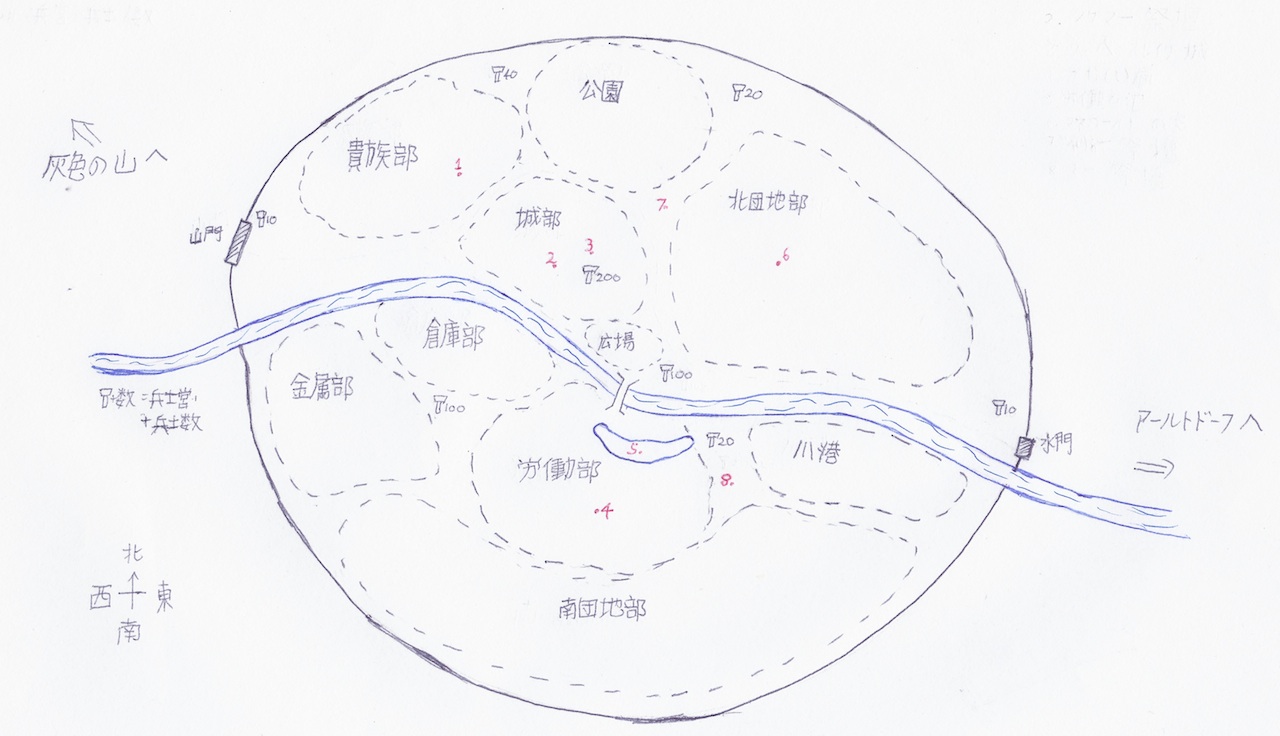
That evening the PCs started trying to locate the relatives of the dead man they found on the road to Ubersreik. They had a locket with a picture of a woman in it, and a game token with “The Sad Shield” written on one side. They soon discovered that the Sad Shield is a pub in the Labourer’s section of town, so they took the token and the locket and headed across the river to the labourer’s section. This section, on the poorer south side of the river, is a mixture of factories and workshops, interspersed with cheap houses and occasional slum areas. It is not the cheapest part of town to live – that sad distinction belongs to the Southbank Slums – but it is still quite poor, and on many street corners were suspicious looking men, loitering and spitting.
In the pub they soon found out what they needed to know, though not cheaply. The man was called Manegold Stolzer, a Ratcatcher, and he lived with his wife and child in the Northern River Quarter. The PCs didn’t learn this cheaply though – the tavern keeper was unforthcoming and they had to spend a lot of money on alcohol for the Ratcatcher he directed them to before they learnt what they needed to know. Having determined this they went home, and the next night they went to the Northern River Quarter to visit the wife.
Rumour: At this tavern they also heard a rumour that a long forgotten wizard’s tomb has been discovered outside of town, with rough directions on how to find it.
Visiting the bereaved
Things immediately struck them as suspicious as soon as they got to the Quarter. The Northern River Quarter is a suburban area on the north side of the river, populated with a mixture of classic Germanic courtyard-style apartments, English-style terraces, and stereotypical fantasy-world garden houses. These were clean, well-established and quiet, in a civilised, upmarket suburb.
What was a Ratcatcher doing living here? In every other town of the Empire, Ratcatchers live in rough shacks near the sewage outlets. They don’t live in quaint, trimmed-hedge garden houses in the most expensive non-noble part of town.
So, by the time they reached Mrs. Stolzer’s little house they were very suspicious. After they had informed her of her loss, and she had cried a little, she offered them a ring as payment for their work – they declined but she pointed out to them that they had ensured his soul’s rest by burying him like a civilized man.
This was also suspicious. Mrs. Stolzer, just-widowed, was offering them a platinum ring[1] as payment for something as abstract as a soul’s rest, when she was looking at a future of potential destitution.
What manner of Ratcatcher was she married to?
Sadly they didn’t get to find out because Suzette the Initiate asked a few too many probing questions, causing Mrs. Stolzer to get angry and take back the offer of the ring.
Spying on the bereaved
Naturally, they took the next best option to direct investigation, and stationed the elf on watch at Mrs. Stolzer’s window to find out who she really was. Sure enough, within a few hours of their departure, three men turned up at her door. She let them in, and the following conversation ensued:
Men: Mrs. Stolzer, we’ve just heard of your loss and we’ve come to give our condolences. Manegold was a good man and a fine colleague, and we all hurt for his departure
Mrs. Stolzer: Thank you, thank you. I am very saddened by his loss
Men: And we are aware that now you think your future must be very grim. So we have been sent by The Organization to give you this bereavement money in thanks for his work and effort [sound of much money clinking, some crying]
Mrs. Stolzer: Thank you, thank you. I appreciate the efforts that The Organization has made to look after us through these years of his service. I am told that he died in the forests outside of town – is it possible for you to tell me what he was doing out there?
Men: As ever, Mrs. Stolzer, we are unable to tell you anything about his work, even at this sad time. Suffice it to say that what he was doing was dangerous and important to us, and he lost his life in service to The Organization. We offer him our respect and thanks.
Mrs. Stolzer: Thank you, then, and I’m sorry for asking
Men: It’s perfectly okay Mrs. Stolzer, we understand that you wish to know more about your husband’s sad death. What did the adventurers who came here tell you? Please tell us everything they knew
Mrs. Stolzer: Only that they found him being disposed of by orcs, and buried him like a man deserves.
Men: Ah, so then. Mrs. Stolzer, we trust that you told them nothing of The Organization, and it pains us to have this conversation at the time of your new grief, but our seniors direct us to it. We must remind you that, just as you were sworn to secrecy about your husband’s involvement with us during his life, now even after his sad death you are bound to secrecy about his membership of The Organization, about its existence and about anything you have noticed of it during your life with Manegold. We have been asked to remind you that your responsibilities to us do not end with your husband’s tragic passing, even though our connection does, and it hurts me to say this but I must remind you that any breach of our secret is punished swiftly, cruelly and fatally. From now there is no further reason for you to have any entanglement with The Organization, and we will have no more such visits, but we must remind you that your responsibility to maintain our secret carries with you to your grave. I’m sorry to have to burden you with threats and dire warnings at this time, but it is our way, but I must ask you to forget that we ever existed in your life, or that your husband was anything but an ordinary Ratcatcher.
Mrs. Stolzer: I understand the need for this warning, and I don’t begrudge you your cold words at this time. I can only thank you for your assistance, and I hope that I will respect your secrets forever.
Men: Then we will take our leave of you, Mrs. Stolzer, and again offer our condolences on your loss and our hopes that this small offering will see you well into your dotage. We’re ever your servants
And with this they took their leave…
The PCs were naturally very interested to hear about this “Organization,” so decided to go back to the Sad Shield and see if they could rustle up a Ratcatcher to answer some questions.
The Rat’s Tail
The elf tailed the PCs back to the pub, and outside the pub he noticed someone else tailing them. A short and nasty scuffle later they had him under control, and dragged him out of sight for a bit of a beating and some intimidation. They soon discovered he, too had exactly the same rat tattoo as the body they found in the woods, but he refused to speak of any organization, and when pressed claimed he was just an ordinary ratcatcher. They dragged him to the Labourer’s Quarter, sought out a suitably dodgy rooming house, and locked him in a room obviously well-used for similar purposes by various criminals, before heading back to town. They then went back into the Sad Shield, and located two more ratcatchers with the intention of offering a hostage-for-information swap. Unfortunately these two tried to flee, so another short fight followed. For some of this fight the Soldier was on guard at the door, and things were looking unlikely to resolve themselves until he came charging inside and flattened one of the ratcatchers. They allowed the other to flee, and the elf followed him under cover of stealth.
The night ended here, with the PCs in possession of two hostages from “The Organization,” and the elf watching the doorway of one of “The Organization”‘s safehouses. Next time: finding out what this organization of ratcatchers is. The players aren’t yet convinced that it is even a bad group, though it certainly has been behaving in a shadowy way.
Conclusion
Again despite a bit of faffing and a late start things went smoothly and a lot was covered. As usual I dropped any role-playing of shopping etc (I find this sooo boring). This was the only chance the PCs will get for healing – in fact, they don’t have enough money for much healing from now on, so they’re going to be slowly getting in trouble. They discovered a lot more than I expected, largely through quick decision-making, but there’s still much for them to do.
I invented a new rule for this session, enabling the PCs to do submission damage at increased difficulty, to avoid the situation they were in last time where they had to knock someone out with lethal damage and then heal them in order to talk to them. This isn’t a good way to do things in town! So now they can club people into submission before they talk to them. I also made up some grappling rules on the fly, which everyone seemed satisfied with. I need to investigate that a little…
Rules notes and comparisons
Finally, I should add that many decisions made in this adventure would have been impossible in Warhammer 2nd Edition, because the PCs would have had such low chances of success that they wouldn’t have done them. Particularly, anything involving stealth or information gathering is impossible for first level PCs in 2nd edition, even for a thief character. Hiding under Mrs. Stolzer’s window, following the tail, would have been impossible. Also, the battle in the inn – between two relatively weak ratcatchers and 3 PCs who are also weak in melee and penalized for submission damage – would have lasted about 2 hours of real time (I’ve experienced this phenomenon before). In 3rd edition this was the slowest and most frustrating battle we have had yet, and couldn’t have lasted more than half an hour. It probably would have stretched for an hour without the Soldier’s intervention, whereas in warhammer 2 it probably would have taken an hour with the soldier’s help. This sort of thing was really frustrating in 2nd edition and makes a big difference to how enjoyable the game is. I want my players to make decisions about what they will do within their core competencies on the fairly safe knowledge that they can succeed if they plan well and are better than their opponents. It doesn’t work that way in 2nd edition!
I think some of the spells in 3rd edition are a bit strange. The spell Shooting Star, for example, is completely useless compared to Magic Dart. Shooting star is higher level than Magic Dart, so it’s a bit weird. I removed Shooting Star from the Wizard’s list and offered him a choice of a new spell or an increase in attribute by one point (this spell was chosen at character creation) and he chose to increase willpower, which was a wise decision for the battle.
Also, I screwed up the progress tracker a bit today, so I need to review that rule a little and think about how to handle it. Otherwise, things are going more smoothly
—
fn1: In fact, Schultz cocked up his appraisal check – he got successes, but also a chaos star. This was sufficient for him to identify that the ring was worth more than a standard ratcatcher’s wife should own, but also put a bit of confusion into the mix. The ring is really silver, not platinum, and worth 10% of what Heinze believed it to be worth.
I mentioned previously that I think I have stumbled upon a Japanese Grognard, who I shall call Mr. 123, and it occurred to me recently that I could try and ask him some questions about his attitude towards gaming, his opinion of old school, etc. I’ve noticed that the people I play with here, though generally willing to try new games, are completely uninterested in D&D 4e, though some have made a major divergence into Pathfinder. Mr. 123 recently ran a game using the D&D Rules Cyclopedia, and is a big fan of Warhammer 2nd Edition (which is pretty old school, I think). So he probably has opinions on games and gaming connected with the period of the games. He’s playing WFRP 3rd edition with me, but this could just be because he’s willing to tolerate new rules in order to play Warhammer rather than GM it.
If I give Mr. 123 an interview, the basic questions I would ask would be:
The usual demographics
His gaming history
What sort of games he likes and dislikes
Whether he prefers games from a particular generation and, if so, whether this applies to Japanese as well as Western games
If he knows anything about the OSR, and if there is an equivalent thing in Japanese games
But I would like to find out if any OSR gamers reading this might be interested in asking additional questions, and if so what sorts of stuff they would like to know. Please let me know in comments!
In a related note, there is usually a Pathfinder adventure at my local monthly gaming convention, run by a Mr. S. This local gaming convention has been running for 25 years, and the most recent event was the 60th meeting (in earlier years it was much less regular than now). I discovered recently that Mr. S has been running this convention continuously for the last 25 years! Beppu has a population of 123000, so I think this is a pretty good achievement – let alone that it’s run by just one person. I wonder if Mr. S is also a grognard, despite his Pathfinder-y-ness? And I wonder if a survey of the local convention gamers might be a good idea…?
Having presented a random table and monster from the game Make You Kingdom, here are a few more monsters from the game. I have to return the book tomorrow, so there’ll be no more posts about it until I buy my own. Here is a translation of the monster in the main picture, General Winter.
General Winter (level 14 Angelic Monster)
Bravery:9
Range: 1
Damage: 2d6+2
Resistance: 13
HPs: 60
Character: Sly
Common Monster skills: Fist of the Fierce God, Divine Transformation, Swarm Defence, Feat of Arms, Sword Play, Minor Transformation
Storm of Snow: When someone other than General Winter uses a support action, he can interrupt them using this manoeuvre. Everyone but General Winter must make a Bravery check with a difficulty equal to the General’s Bravery +5. Those who fail immediately have their hit points halved.
Text (“flavour”): A valorous commander who serves the Winter Sovereign on the steps to heaven. He also has a side that is kind to children.
(I don’t know what the “common monster skills” are because they aren’t in my book, but they seem pretty scary).
Below are three other monsters that I scanned in as random trash during the process of scanning in General Winter, and figured I should upload. No translations are provided, but they’re all from the “Angels” family of monsters.
Woe to you oh earth and sea, for the devil sends the beast with wrath
About a month ago, our little foundling Arashi chan finally recovered from his severe car-related injuries, and I present to the world this picture as proof that his recovery has been spiritual as well as physical. He’s not so little anymore, and definitely not so immobile…
Many people in the RPG world think what I’m about to say is heresy, but I actually think that board games and computer games have some interesting ideas to teach RPG makers and players, and a lot of them are based on making available new and specialized content – that is, objects and purcahsable add-ons – that can provide additional opportunities for role-playing, or tools to help the GM and the players manage the game. A lot of these ideas are common in Japanese RPGs, and some of these tools when combined enable the game to improve the number of rules options available, and to have incidental rules – like fatigue, encumbrance and the like – that people typically hate to use because they’re fiddly to manage.
As an example I give Warhammer FRP 3rd ed, which I’m using now. It has 5 ideas which, used together, enable both improved role-playing opportunities to emerge from dice rolls, and give better management of in-game actions, which in turn allows Warhammer 3rd ed to use a wider range of resource types for players. They are:
Special dice: these enable actions to be resolved on two dimensions, with one dimension the standard success/fail and the other a good luck/bad luck dimension that is largely used to add role-playing hooks and interesting side effects to actions. These two dimensions offer the opportunity to succeed but have a bad or annoying side-effect, and to fail but have some minor quirk of luck. They also enable success in one action to affect another. For example, good fortune on a successful Sword and Board action enables a fighter to reuse their Block defense. Such a dimension in, for example, D&D might mean that a Cleric rolling good luck on a Bless spell might regain one of their daily Turn Undead uses. In D&D 4th edition, good luck on an at-will power could lead to a recharge of an encounter power; or success on an encounter power might recharge another encounter power, or add to the tally of available healing surges. Of course, all of these extra effects in combat can be hard to keep track of, except for the additional use of Action Cards…
Action cards: which enable you to pull all your main effects out of a book and put on the table for easy reference, so players do not have to constantly reference the books. This would be useful in D&D for wizards and clerics but even putting a character’s to-hit table on a card would make that action resolution very quick. I’ve given the rather trivial example of Magic Missile here (the text is from Greyhawk via Grognardia). Obviously Magic Missile is trivial, but it seems uncontroversial to me that having things like hit tables and turn undead rules on easily-accessible, attractive cards is really useful, especially in a game like D&D where lots of rules (e.g. surprise, finding secret doors) that are used a lot may differ by race, class or situation. The downside of attractively-made cards is that they add to the cost of a product in art and production[1], so they’re hardly justifiable in and of themselves[2], but in WFRP 3 they are justified by a useful mechanical tool, cooldown, which is only possible as a mechanical technique due to the combination of Action Cards with Recharge Tokens.
Recharge tokens: this enables actions to be limited in terms of available power (for spells) but also time to reuse, i.e. cool-down, which is something I think 4e D&D wanted to use but couldn’t get working because they weren’t thinking board-game-y enough. In WFRP3 each Action has a recharge time written on the top right corner of the card, and you track recharge by putting recharge tokens on this spot, then removing one at the end of each round. These tokens can also track other sorts of recharge. For example the Morr’s Touch spell is discharged after a certain number of hits, which are tracked using tokens in the recharge section of the card. If an Initiate of Morr gets a lot of luck on another spell roll they may be able to add recharge tokens to this card, adding to the number of hits they can deliver. But they don’t need to track these on paper using a pencil and crossing it out, because the tokens are right there. These tokens also track fatigue and stress, which can be accrued for any action and are an important consideration in the development of insanity. They are also used for tracking the duration of conditions. When I first read about this method I thought it would not be an improvement on just writing numbers on a sheet but it really actually is, both because you don’t have to keep track of actual numbers (you just move tokens around) and because it’s trivial to keep track of 6 or 8 recharge processes at once when they’re combined with cards, while keeping track of recharge next to multiple effects written on a paper is messy and easily confused. The upshot of this is that the WFRP system enables continual use of magic, but through the combined management of power points and recharge. Power points can be redrawn after use, but this takes a round, and spells may take several rounds to cool down. This means that Wizards and Priests always have their spells available to use but can’t use them at will. I think this is the approach Wizards of the Coast wanted with D&D 4e, but without cards and tokens a truly flexible cooldown system is impossible, so they went for the more basic form represented by at-will/encounter/daily powers. I think cooldown is a natural idea for both spells and non-magical actions, and keeps the game fun for everyone because they always have the actions they want, but usable at a frequency that is balanced by the system. I don’t think recharge has much use in pre-4th edition D&D, but I’m sure there are other uses for tokens – for example, after casting bless you put a number of tokens equal to its duration on the card, and remove one per round. This frees up the GM from a lot of management issues.
Progress Tracker: a really simple idea for keeping track of contests between PCs and enemies that span long periods. e.g. chases, building armies before a deadline, etc.This is system-independent but really useful. For example, suppose that the adventure requires that the PCs find the location of a secret cult before the cult sacrifices the Mayor’s daughter. The GM can decide how much leeway to give the PCs and then constructs a progress tracker with a number of spaces corresponding to this leeway. Halfway along is an event space. Every time the PCs make a mistake (raid the wrong building, or screw up a negotiation with a potential informer) a token is moved one space along the progress tracker. When it reaches the halfway-point event space the cult become aware of the PC’s investigation and send assassins against them; if the progress tracker reaches the end before the PCs have found the Cult HQ, the girl gets sacrificed and the PCs have failed. This gives the GM a method for relating failure in the investigation to the outcome, and a way to construct limits on how many mistakes the PCs can make. I think this is a really useful tool for managing competitive tasks of this sort, and can offer really interesting plot triggers. In a longer adventure event spaces could be scattered through a progress tracker to indicate incidental events (unrelated to the adventure) or just spots for the GM to roll up rumours/weather/adventure hooks (this is how the progress meter was used in the Scenario Craft adventure I played). This is system-independent and again, although it doesn’t need a purchasable product, a solid cardboard progress meter with a style that suits the game is nice to use. The Scenario Craft adventure had a double-page spread in the book that could be photocopied and contained the progress meter and all the associated random charts, for easy reference.
Party character sheet: used to build up tension between party members. The tension meter increases with every failure, and at some point triggers a negative effect that depends on the type of party the players have chosen to play. There is also a pool for storing fortune points, which are added to whenever the party gets a success, and then distributed amongst the party whenever the number of points equals the number of PCs. I think fortune points are a system-independent idea as well, being basically a house-rule to enable players to get out of trouble. The party character sheet also has a special skill for the group, and two slots for a talent that anyone in the group can activate. In D&D3.5, there could be a special set of feats that go on this character sheet and that players can choose to purchase for their PC in place of normal feats. This would be particularly suitable for bard, rogue and other support characters (or could even be used to make bards desirable as party members!) My current party are playing “Brash Young Fools,” so when their tension reaches 4 points the party have an argument and everyone’s stress increases by one. The “Hired Thugs” party take a wound at that point, indicating that the increasing tension of continual failure has led to recriminations that actually came to blows. In this group, continual failure can be deadly. Again, this sheet benefits from the use of tokens, and is also at its most basic completely system-netural.
These ideas are all things you can make yourself and import into OD&D, but most of them are ideas from computer games or board games. Most of them enhance options for role-playing. The current version of WFRP was made by Fantasy Flight Games, who are a board- and card-game company too, and I think they’ve incorporated the lessons of those other genres into their work. In this blog, board games are credited with improving the rules of modern wargames, again through the incorporation of ideas from outside the world of wargaming itself.
I think RPG players and makers have an objection to “additional content” that is often quite visceral and reflexive, and has a lot to do with the way in the past companies like TSR and Wizards of the Coast have tried to sell all sorts of useless crap via splat books. But this stuff often didn’t improve or change our play at all, just gave us ever-increasing numbers of meaningless choices. Iron Crown Enterprises (ICE) did this with Rolemaster – I had maybe 3 companions, but the only useful one was the first (with the addition of the Nightblade character and a few new open spell lists); the rest were useless fluff. Of course, ICE and TSR produced some very nice world settings, but along with these useful additions came a bunch of useless stuff (especially from Wizards of the Coast) like Fighter Handbooks and The Complete Left-handed Basket Weaver, etc. However, in amongst this useless pile of accrued crap is a simple truth – sometimes the stuff that gets added on is really useful and enhances the game, regardless of its financial advantages to the original company. Even though the additional content in WFRP3 presents Fantasy Flight Games with an excellent vehicle to sell more stuff, this is neither a new phenomenon, nor something unique to card games, nor a cynical money-pushing decision on their part. The material added to WFRP makes for a genuine interesting improvement to both that particular game and to the practice of role-playing generally, and I think it’s a sign that there is a lot of gaming practice outside of RPGs that we could stand to learn from – including (shock horror!) in computer games.
—
fn1: Don’t I know it! I’m currently translating all the Warhammer 3 cards to Japanese and printing them and it takes a huge amount of time and effort.
fn2: A lot of Japanese games seem to present actions/effects in card form in the book but don’t present the cards themselves. I think it’s assumed the players will make their own cards with a photocopier, or maybe in some cases they’re sold separately.