• This is a technical post, to help people who like me have been struggling with MS Word and Japanese text.

    I’ve decided to switch to doing preparation for my warhammer 3 campaign in Japanese, just so I get used to the language a little more. But I want to put furigana over the words I am not familiar with, so I don’t have to look at separate tables of vocabulary while I’m gaming (warhammer vocabulary is really really weird). Unfortunately, furigana don’t have an automatic menu option in MS Word for Mac OS X the way they do for MS Word in Windows. I did a search on how to get furigana to work on a mac, and found this advice:

    • Install a software package called the MS Office Language Register on your Apple
    • Drag the MS Word application onto the language register icon in the applications folder
    • Choose your language
    • You can then access the furigana using the Format->Phonetic Guide option (see below)

    The language register program is on your MS Office disk in the “Additional Tools” folder.

    I tried this and my MS Word slowed down to a crawl, which on a computer like the one I’m using is a thoroughly unacceptable phenomenon. I tried uninstalling the language register but this didn’t help. So, what to do?

    I’m sure other people have this problem (that Word is slow after installing the language register), and if you do then the reason is probably the same as mine:

    • The Language Register is already installed when you do a full install of MS Office
    • When I read on the internet “install the language register” I naturally did so by dragging and dropping it into my applications folder
    • It actually needs to be in /Applications/MS Office/Additional Tools
    • If you install it in the applications folder you’ll have two versions of the software, and your computer will die horribly, in the arse (as they say)

    So, my guess is that for most people out there the best way to get furigana on word in mac os is:

    • Check in the /Applications/MS Office/Additional Tools folder for the language reference software
    • If it’s not there, drag and drop it there from the install disc
    • Once it’s there, drag the MS Word application onto it
    • Choose the language you want to use
    • Bob’s your uncle, MS Word will have the power to apply furigana without any pain or slowness at all

    Note that when you do this, some of the menus in word (e.g. print) turn Japanese, so you need to have some familiarity with Japanese computer menus (or know the layout of the menus in your sleep) to survive this bit.

    Applying furigana

    Applying furigana is a little more tricky than in windows. You need to do the following:

    • Highlight the word of interest
    • Select the Format->Phonetic Guide option
    • In the text box at the top, type in the hiragana
    • Click apply (or apply to all)

    Note you need to type the hiragana yourself, not like in word.

    Note there is an “apply to all” option, that you can use to have the furigana through the whole document; you will need to do this once the words are all written (I think).

    To remove hiragana you need to do the same thing, but select “remove”. I think this applies to all words in the document instantly.

    So it’s a bit trickier than Windows but not hard.

    A note on rikaichan

    Get it. It will change your life. You can save word documents you don’t understand into html and then open them in firefox, and your life will never be the same. Plus you can read newspapers without having to learn 3500 kanji, which makes it a lot easier to practice reading.

  • Introduction

    This is a bit of a weird diversion from normal programming, but I thought I’d give it a go. On the weekend it was the final of the Australian Rules Football League, the AFL, and – rather remarkably for the game – it ended in a draw. Those of you who know anything about scoring in AFL will guess that this is pretty unlikely, especially in a grand final. So a blog I regularly read, Larvatus Prodeo, have a post up pondering the possibility that we live in an era of close grand finals. I offered to attack this problem with my (apparently somewhat rusty) time series analysis “skills”, and this post is an attempt to present the results.

    Method

    Winning and losing scores since 1950 were provided by the author of the post at Larvatus Prodeo (I rather suspect he’s been writing them by hand on the day of the final since 1950, but let’s assume they’re accurate because no AFL fan would get something as important as this wrong). Visual inspection was used to investigate the possibility of a narrowing of winning and losing scores. The margin of victory was divided by the winning score to give a measure of the proportionate margin (referred to as such from now on) and ARIMA time series analysis used to estimate the seasonal patterns (if any) in the proportionate margin. A linear model was then fitted to the proportionate margin by year, and serial dependence in the residuals estimated using another ARIMA model. Where serial dependence was evident, a second linear model was fitted using generalized least squares adjusted for the identified serial dependence, and the resulting estimates of the straight line fit were presented.

    It was my original intention to fit these models using Stata 11 but my version of Stata seems to be broken so I used R. Unfortunately, R’s time series analysis software is … dubious. And I’m all at sea doing time series analysis outside of SAS, so you should take this with a grain of salt[1].

    Results

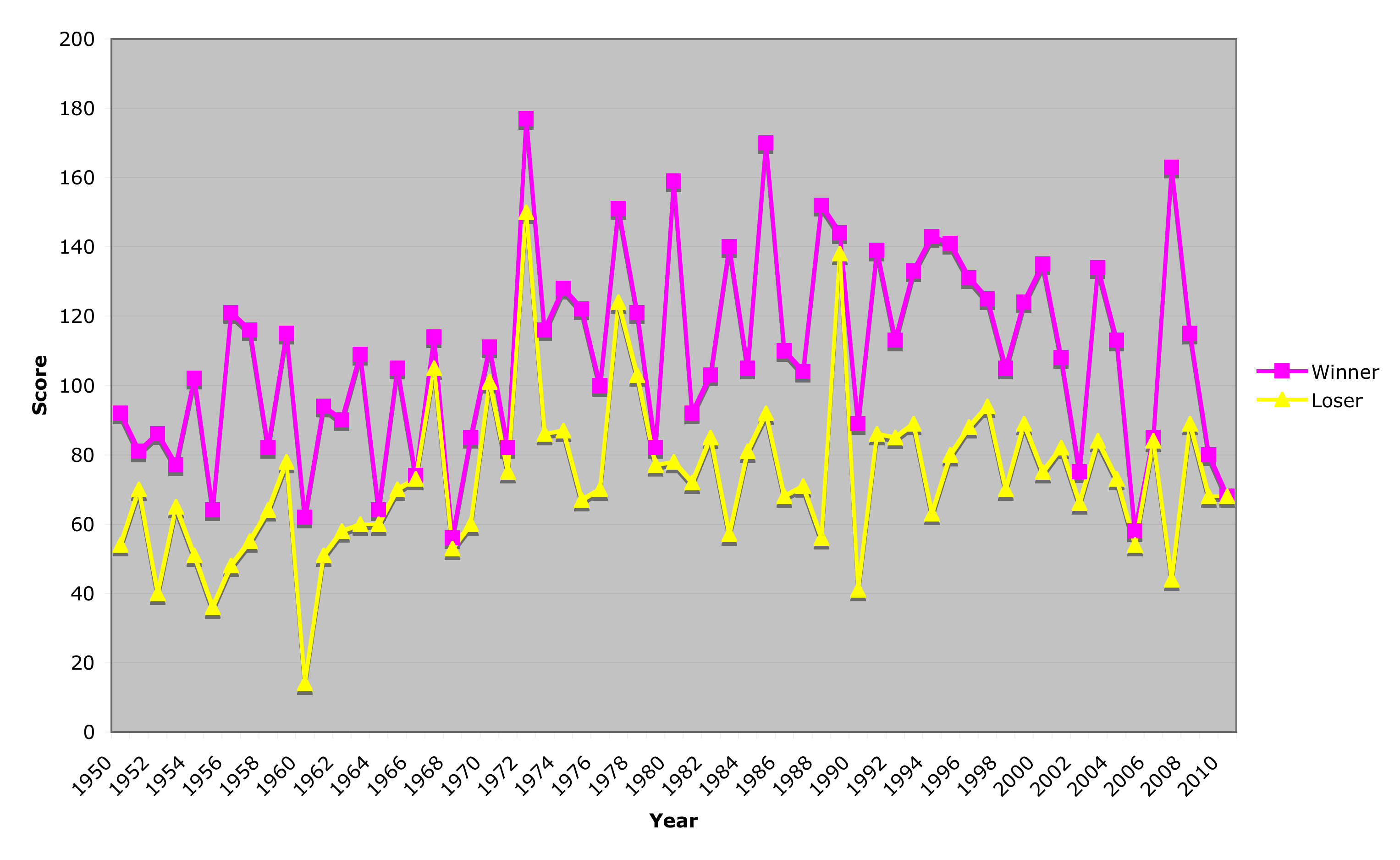
    Figure 1 shows the winning and losing scores in the grand final for the last 60 years. There appears to be a narrowing of scores before the 1980s and another narrowing the previous 10 years, though the results shown in this chart are hardly conclusive. There’s also a hint of a jump in scores at about 1980, which actually shows up very clearly in the differenced time series plot of loser scores but not of winners.

    Figure 1: Scores of winners and losers in the grand final of The Only Real Footy

    A plot of winner’s scores against loser’s scores suggests a strong relationship between the two, but this is not unexpected given that both teams are trying to win, so is not presented here.

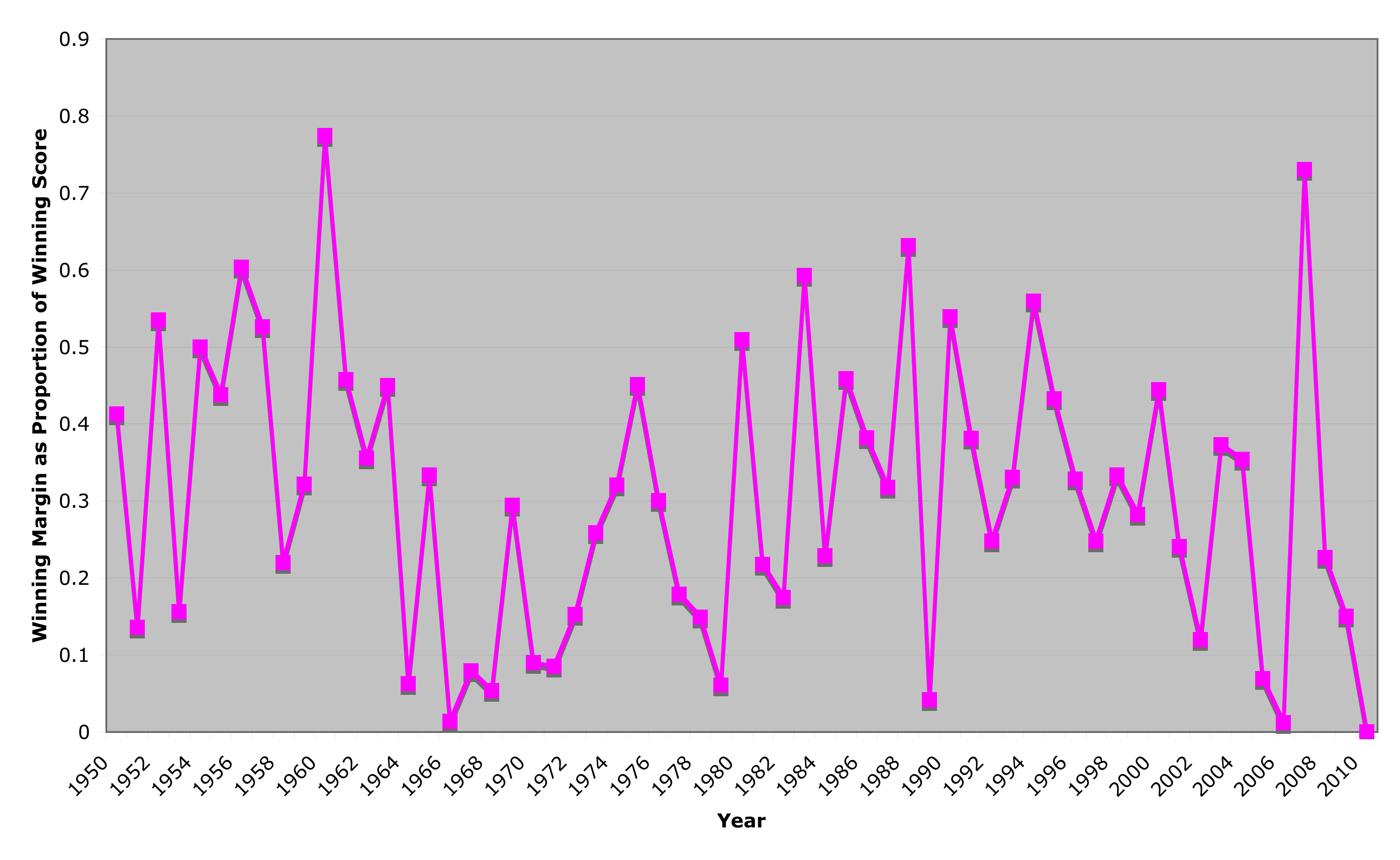
    Figure 2 shows the proportionate margin by year. There appears to be a periodic relationship in this margin, but in fact analysis of this period does not suggest it is very significant[3].

    Figure 2: Margin by which 22 men become Gods for a year, as a proportion of their total score

    Analysis of autocorrelation and partial autocorrelation functions (not shown) suggests that the serial dependence in this model is AR(2), that is the margin of victory in any given year is related negatively to the margin of victories in the previous two years, and very strongly to the previous year. This is to be expected – teams learn from a very large margin of victory in the prior year, and adapt to fit new tactics, significantly reducing the margin the following year. Fitting a linear model, with year as the only predictive term, we find that there is no serial dependence in the residuals of the model, but that year is not statistically significant (p=0.151). This means we don’t need to fit a generalized least squares model, though doing so with an autoregressive (2) term makes no difference. On visual inspection the residuals do seem to be uncorrelated, suggesting a model with no serial dependence. The linear model only explains 0.1% of variance, suggesting a lack of predictivity for simple models of AFL scores.

    Conclusion

    There is no evidence of a strong pattern, either periodic or linear, in margins of victory in AFL grand finals. There is some evidence that the margin of victory in a given year depends on what happened in the previous two years, and tends to regress towards the mean, suggesting that teams learn from previous blow-outs. There is otherwise no evidence of any time dependence in this data.

    Note that there are two important additional caveats: one, that estimates of significance in ARIMA models in R are thought to be wrong[4]; and two, that there is an additional source of serial dependence in this data, in that some of the grand final scores are for the same team in multiple years. Obviously the blow-outs in figure 1 correspond to the years when Port Adelaide won the grand final, or when the Crows lost. A more sophisticated analysis of AFL scores would use all scores for the year, adjusting for serial dependence by team and game, and using a version of Stata that works rather than R.

    Finally, I think that the AFL maintains a draft system and a salary cap. This would be consistent with the findings[5] presented here.

    fn1: I think it would be great if all research papers presented their caveats in this style. But I’ve had 3 beers, and that is not the usual condition under which research papers are written[2]

    fn2: He assumes, bravely

    fn3: possibly because I’m pretty crap at fitting periodic models, and after 3 beers really not even very good at working out how many radians to divide 40 years into, or what should be on the top or bottom line of the sine function. But I think I got it right.

    fn4: I read this in a journal article when I was actually doing something important, but I can’t be bothered finding it now

    fn5: May I use this term loosely?

  • This is a speculative post, since what I’m suggesting would require a lot of effort and probably be a huge waste of time. My experience so far (in 3 or 4 sessions) of Warhammer 3 suggests that the system is something I really like, and I’m interested in whether it could be converted to use in non-warhammer settings. The rules themselves are very simple and easy to understand; but there are huge elements of it that make it very specific to the setting, but these elements are kind of modular and can probably be used to make the flavour of a new setting quite easily. So I’m wondering if I could convert the system to suit my Compromise and Conceit campaign world (or any other!)

    Why I like warhammer 3

    There are several aspects of the warhammer 3 system that I really like. The dice and skill resolution system contain a lot of role-playing hooks that enable a GM to very easily create interesting outcomes for actions, including success-with-cost, failure-but-some-minor-benefit, extreme success and failure, and unusual outcomes. The combat system is fast and deadly, and the rules for Actions give non-magic users a lot of options for things to do, as well as applying costs to non-magical manoeuvres. The system for handling fatigue/stress and other side-effects of actions is quite straightforward, and the easy way that cool-down effects are worked into the system is very clever. I also like the method for having continuous access to spells – no 1-a-day magic-users here – but limiting the frequency of use by the simultaneous mechanism of rechargable power points and rechargable actions. None of this would be possible without the simple counter-based tracking systems, of course.

    I think all of this is very innovative, and very suitable to the style of game that I like to run, which is roughly like this:

    • combat is realistic and deadly, but handled quickly and simply
    • death spirals make multiple combats risky
    • magic is powerful and almost unlimited, but magic-users don’t have many spells
    • i.e. essentially fighters’ or thieves’ actions, and magic-users spells, are broadly similar in number
    • spell-use and other special actions are limited by a cost
    • skill use applies to non-combat, non-mechanical actions and can be stunted to get benefits from role-playing or good planning
    • partial success is possible in skill use, and simple to manage
    • PCs are slightly more heroic than the average person, and become quite powerful with time, but are always vulnerable

    Rolemaster had almost all of these components, but was hideous to run. The simple mechanisms of the Warhammer 3 system seem to balance the kind of details this type of system requires with the kind of playability that stops a single action from taking forever.

    Basic adaptation of the Warhammer 3 system

    Basically, to adapt the Warhammer 3 system to a new setting, you need to change the careers (and associated advancement system), and the actions and talents. I don’t think it would be necessary to change the skills even if you were switching to a completely different setting (such as cyberpunk or space opera) though a wider range of advanced skills might be necessary. So the key thing is the careers, actions and talents. Of course you would also need to adjust equipment.

    Changing the careers and advancement system

    In the current warhammer 3 setting, there are a (fairly) large number of careers, and PCs are expected to progress through several over a long adventuring career. Essentially you pick up a number of advances – like experience points – that you spend on acquiring new actions, improving ability scores, or gaining skill slots over one career. Once you’ve spent about 15 (I don’t know the exact number) you can advance to a new career, retaining (most) of what you collected in the old career. You can’t advance an ability score past 6, and typically when you’re in one career you can only pick up 3 new actions; and in one career you can only train any one skill once.

    The obvious way to make a more heroic and classically fantasy-centred game is to reduce the number of basic careers, and increase the length you can be in them. By requiring, say, 30 advances rather than 15, and allowing PCs to increase ability scores up to, say, 8, (or, say, 5 for non-career scores) you would basically turn a career into a longer-lived, more heroic style of “character class.” You could then allow PCs to progress to a set of prestige classes with new and better abilities. So, I would probably consider restricting the initial careers to Fighter, Specialist, Wizard or Cleric. Then subsequent advanced careers might be things like Paladin, Guildmaster, Archmage, High Priest, Necromancer, etc. I would probably also produce a dabbler-type basic career which allows a mixture of thieving or fighting and magic, but with more restricted access to spells (only level 1, for instance).

    Allowing ability scores to advance to 8 is particularly important for magic-using PCs, since it enables them to cast more spells before they have to draw more power, and reduces the risk of stress from carrying power above their usual limits. Because skill checks depend on abilities it also gives fighters solid combat powers to take on the types of monsters you don’t see in a standard warhammer campaign.

    Changing actions and talents

    I already have a set of spells for Compromise and Conceit, some of which I tried to represent as actions for a D&D-style game. It wouldn’t be difficult to rewrite these (and some new, demonically-influenced talents) as actions for warhammer 3. Most of the combat actions could stay as they are. There would be a new set of Infernal-style actions which would be semi-spell-like and available for all characters, wizard or not, but quite basic. There might also be some interesting technology-related ones, particularly to do with building stuff; for example a “grenade” action which requires that you previously spent some time in a lab creating grenades using your advanced tech skills.

    Basically, however, the system would retain a bunch of core actions, and only the spells and infernal talents/actions would change.

    The downside

    The challenge of doing this is that it would be a huge amount of work, and a lot of the results would probably be unbalanced. The warhammer setting as it stands is almost translatable to Compromise and Conceit without much change, so it might not even be worth the effort. I’m also not sure if the warhammer system breaks at higher power levels or not. But it could be worth finding out…

  • While I was travelling my blog attracted the attention of a Danish Fascist group, the Danish National Front, for its posts on Tolkien and fascism. A post went up on their message board indicating that the Tolkien books are recommended reading for fascists and giving my post on Tolkien’s racial theories as an explanation of why. I’m not, of course, going to give a link to the message board, since I don’t want to give them traffic (from my thousands of readers, ha!) and neither do I want to draw their attention (more than I have). The post about my blog only has two replies but one of the replies, translated in google translate, gives an excellent insight into how fascists and nazis think about Tolkien. Here it is, post-google:

    There is no doubt that Tolkien’s books based on a Germanic mythology, even his linguistic inventions are rooted in language studies.

    In contrast, Harry Potter pure fiction mixed with Marxist ideology of equality. I would never let my children read Harry Potter, but even read Tolkien’s books aloud to them – there is a readily available version of them as suitable for children and adolescents.

    The post above this one also claims CS Lewis for the fascists, because

    CS Lewis, author of the Narnia series, was surely also a racist or at least accused of it (especially for being anti-Muslim and producing Middle Eastern people as bad guys, etc). May I look at a time.

    These two comments also give support to some of my claims about the conservative appeal of high fantasy.Note as well that this stuff transcends any individual national interpretation of Tolkien – now I’ve found it in the UK, Italy, America and Denmark. All strands of fascist thought in the Western world seem to have a strong appreciation of Tolkien’s racial and hierarchical themes, and see them as excellent propaganda material to expose their children to. They also don’t seem to have any concerns about the putative multiculturalism of the Fellowship, presumably because they see all the races of the West as representative of “white” men, and don’t care about the (huge) differences between dwarves, elves, halflings and men. The fact that there are no black men or “mongoloids” (Tolkien’s term) is more relevant to them than the fact that elves and dwarves are so racially different that they can’t even inter-breed[1].

    This last point perhaps also is relevant in defense against the claim that the colours of the antagonists in Lord of the Rings are not symbolic of anything. Fascists take the whiteness of dwarves and elves as symbolically more important than the fact of their racial difference. This is a pathological level of focus on the real world notion of race, since their perception of skin colour transcends the very real, “scientific” differences described in the book. But they are largely only able to do this in the works of people like Tolkien and Lewis. I think that this ability to transcend the actual racial codification in the books, and to map onto it their own models, is made possible by the reassuring conservative environment of the books, and the germanic mythology underlying them. These books contain a lot of coda that reassure fascists that they are reading the “right” type of conservatism, and thus able to draw the “right” conclusions about the racial messages in the book.

    I’ve read a lot of apologies for Tolkien’s worldview in my various posts about the racial theories inherent in them, but I think the way fascists view him and his work is a pretty clear sign that his politics is not worth rehabilitating. It’s possible to read Tolkien critically without losing enjoyment of the books, and it’s possible to play the fantasy RPGs that inherit his conservatism and racism with the same critical eye, without losing enjoyment of them (or indeed, enjoying those unrealistic aspects of their racial theory that make them so different to the real world). What it’s not possible to do, as far as I can tell, is read Tolkien while somehow claiming he is presenting a world devoid of racial theory, or even (as some seem to want) a world that is at least neutral with respect to modern standards of racial equality and racial determinism. This view of the books is only possible through sleight of hand (e.g. pretending the Fellowship is a multicultural symbol) or outright deception (e.g. claiming, as regularly happens, that the Southrons weren’t meant to be black). Fundamentally, it’s a text on scientific racism, and needs to be read as such.

    Which doesn’t change the fact that it’s a great book. It just means that it’s a product of its times and, seen in a certain light, a work of virulent conservatism and racism. But so what? It’s still a fun read.

    fn1: as far as we know…

  • So tomorrow I will depart from the Northern Bay by bus to the Station of Wide Acclaim, from whence I shall take a bullet train to Double Mountain. There I change to the express over the mountains to the town I used to live, Pine Bay. I’ll spend three days there with my New Zealand friends Drs. P and B, and once I’ve exhausted their beer stocks I will take the same route back along the sunshine coast to the city of Double Blessings. I’ll spend a night with a friend there, and then return by bus to the Bay of Rice Cakes.

    I think Drs. P & B have recently installed broadband (Pine Bay is a little behind in internet, if not coffee and other imported delicacies; or P &B are), so I may be able to check my email but I definitely won’t be posting here.

  • This is one of a series I aim to run describing the old, successful campaigns I have run in the past. I think this was the second campaign I ever ran with a determined plot, to fruition, over a year or so in about 1998. My players were all friends rather than devoted nerds, though two were ex-players enticed back to the fold by me. The campaign setting was determinedly high fantasy, and it was the first and only campaign I ever ran in high level Rolemaster, starting at about 9th and ending at about 15th level. None of my players had done RM before and I had a very definite plan for this campaign, so I gave them their characters. In many ways this was the most railroad-y campaign I have ever played, and probably the most railroad-y anyone will ever play.

    The setting

    The setting was the borderlands between two huge Empires, the Northern Empire being a roughly Western European-style mediaeval Empire, and the Southern being an Oriental combined Chinese/Japanese Empire. To the West was an African/Islamic-style desert kingdom, separated from the Northern lands by a Mountain range occupied by elves. In between the Northern and Southern kingdoms were a series of small independent city states and countries, with the two most relevant to this story being the Kingdom of the Lakes, a little feudal kingdom carved out of nothing by a retired adventurer (and his big-cat riding soldiers), and the key city of the campaign, Innsfelle, a massive city-state resting between the Northern Empire and the Kingdom of the Lakes, heavily fortified and buttressed to the South by the Mountain range separating the North from the Kingdom of the Lakes. Innsfelle, famously impregnable and never having been defeated in war, famously independent, and in possession of a few small outlier towns scattered through hills, forests and farmlands; a city-state that is essentially part of the Northern Empire culturally, but ferociously politically and militarily independent.

    The characters

    The characters I handed out for the players to take on were very carefully designed to work together, and partly based on some PCs I and my friends played in 1995 in a previous campaign:

    • Kusumi, a Japanese-style Fighter, essentially a soldier, from common stock (not a Samurai) who is a crucial component of this campaign. He was a key part of the Southern Empire’s armies but joined a rebellion against the Empire, and rose up through the ranks of the rebellion; but at the last the leaders of the rebellion screwed him over (see below) so he took over a large chunk of the army and led it North. He has a single, historical adventuring experience with two of the other PCs. RM class: Fighter.
    • Amber, an Elven enchantress, who adventured briefly with Kusumi, helping him to crush a smuggling ring when he was in charge of security for a Southern Lord. Amber is cast out from her own community, having rejected an arranged wedding and fled her homeland to take up a life of adventuring. RM Class: Enchantress (Companion 1 I think?)
    • Cwael, a half-black (Western kingdom), half-elven assassin-hunter who has adventured for a very long time with Amber, and essentially thinks of himself as her bodyguard. RM Class: Nightblade (Companion 1: this is my favourite RM Class)
    • Eldar 1: I forget the PC’s actual name now, but he was basically a dark elf Rogue, and Amber’s lover. In this campaign the dark elf are called Eldar and are not evil black-skinned elves from underground; they are elves who were cast out of the Elven kingdoms many millenia ago and live as nomadic mercenaries, selling their martial skills to the highest bidder. Eldar 1 is a rogue but also the leader of a small warband of about 50 eldar (half of whom are combatant). The group has this warband at its disposal. Eldar are reviled by all civilised races, like gypsies, and live in caravans like gypsies; they are also the most vicious mercenaries the world knows, and of course capable of all the non-wartime adventurer-style nastiness that you can imagine a warband of dark elf mercenaries getting up to. RM Class: Rogue.
    • Asian 2: I can’t remember this PC’s name either, but he was a Southern Battle Mage, essentially a wizard trained in blowing shit up while soldiers run rampant around him. He and Kusumi fought extensively together in the Southern rebellion, and famously won the battle of the Oni Peaks before the rebellion (they had a magic bell). They rebelled together against the rebellion’s leaders and led their soldiers north. RM Class: Magician.

    All the PCs started at 9th level. 9th level RM characters are a lot of fun.

    The Adventure: background and purpose

    The story opens with the area around Innsfelle in a state of war. Kusumi and Asian 2 were in a rebellion of young Lords in the Southern Empire, which went horribly wrong. The young Lords, finding themselves losing and being trapped in an increasingly small area, had barricaded their army in a mountain fastness and determined to commit suicide and take their whole army with them. Kusumi and Asian 2, discovering this, slaughtered the Southern Lords and fled North with their army. Reaching Innsfelle, they decided this seemed a perfectly good city, and thought they’d take it over. Thus, they laid siege to it and started capturing the outlying towns. Nice guys all round. However, they have until the end of Autumn to complete the job; it is expected that by the end of Autumn the Northern Queen will have finished putting down a rebellion to the East, and her crack force of rebellion-putter-downerers, the “Queen’s Men” will come to Innsfelle to sort stuff out. But Innsfelle, Kusumi and Asian 2 have discovered upon arrival, is impregnable…

    … At which point the campaign starts, with Kusumi and Asian 2 stumbling upon their old allies Cwael and Amber in a battlefield full of dead Innsfelle soldiers. The Eldar warband controlled by Eldar 1 have ambushed and destroyed the soldiers, and Kusumi and Asian 2 been invited to the aftermath. Here Cwael and Amber reveal that they have a letter from the Mayor of Innsfelle, sent to an important General, which makes it pretty clear that the Mayor is using the war to enrich himself. He has set up a nest of “bandits” – actually soldiers in the mountains and they raid supply trains of the Mayor’s own army, then sell the items they steal, and return the tax money they loot to the Mayor. The Mayor is so confident in Innsfelle’s impregnability – and the Autumn arrival of the Queen’s Men – that he is willing to undermine his own war effort for short term wealth.

    The characters realise that, if they can get more concrete proof of the Mayor’s perfidy, and subsequently capture Innsfelle, then they may be able to convince the Queen to grant them suzerainty over the city, since the exisitng mayor is a Right Proper Bastard. In order to do this they need to:

    • Prove the Mayor’s perfidy as extensively as possible
    • Find a way into the city
    • Make contact with the Queen

    And thus the campaign unfolds, with the PCs having 3 months to capture a city.

    Bsaic conditions of the campaign

    The first thing to note about this little railroad is that none of the PCs can die. They are all essential to the plot (except maybe Eldar 1). Everyone knew this, but there were some famous moments in this campaign where everyone was in abject terror for their lives, despite the fact that they knew they had to be kept alive for the plot. It was through this process that I discovered that, with good storytelling, the proper choice of scenes and enemies, and the correct atmosphere, you can suspend or break every one of the supposed precepts of good adventure-setting, and particularly the notion of rewards and incentives is completely irrelevant if you’re running a fun campaign that everyone gets into in detail. There were no experience points in this campaign – I handed out levels at regular intervals – and no threat of death. Yet all my players acted on the assumption that all their actions were potentially deadly, and were the most cautious and inventive players you can imagine. I think this is because, more than any other campaign I have ever run, this campaign had a distinct and definite notion of “winning.” If Innsfelle fell into their possession at the end of the campaign, they had won – and beaten me – and if it didn’t, they had lost even though they lived.

    Plus I set up a damn scary setting. During the campaign they discovered that actually the raids on the caravans by the mayor were cover for a search he was undertaking for a certain magic item, that would be used in a ritual on a hidden temple beneath Innsfelle. This ritual would free a Demon chained beneath the city millenia ago, and ultimately this campaign ended with the characters discovering the history and location of this demon, and banning it permanently. The quest for this demon and the truth behind it involved some exploration of frightening underground settings, interviews with dragons, and a variety of other scary encounters that kept the whole campaign in a continual atmosphere of creepy doom.

    This is also the only campaign I’ve run where the PCs had extensive resources to call on from the start. They were mates with the leader of the Kingdom of the Lakes, and Amber was mates with a dragon, plus they had that Eldar warband, not to mention Kusumi’s entire army, at their disposal. Though all the adventures occurred on the level of the party, the campaign itself spanned a country-level war, with corresponding forces and resources in play. This gave the players a lot of flexibility in how to deal with particular problems.

    The Eldar

    During the campaign the PCs uncovered the mystery of why the Eldar were cast out from the Elven nation – essentially they refused to commit a terrible act as part of a war between elves and humans, and were exiled. This terrible act was related to the Demon locked under the city, and at one point the characters had to visit the ancient underground city in which the original Eldar were slaughtered by their elven compatriots for refusing to cooperate – the modern Eldar being the remnants of this slaughter. I can’t remember clearly now, but I think it was a type of Masada, in which the elves were surrounded and outnumbered, so decided to kill themselves and all the non-combatant elves in the city; but the Eldar objected and fled, fighting their way out of a secret entrance and sealing it behind themselves to avoid pursuit. Eldar 1 learnt all this history during the progress of the campaign.

    Enlightenment man and Innsfelle

    The PCs clearly constituted a group of outcasts, exiled from both their own lands and the city they aimed to capture, and in some case bound to a history of exile and revulsion. As the campaign developed this became an important theme, with all the PCs looking on their eventual capture of Innsfelle as an opportunity to establish a new kingdom of exiles in the gap between the Northern and Southern Kingdoms, and to establish a new polity based on the laws and histories of these exiles. As the game developed this became a kind of multicultural dream, with the PCs increasingly in a type of Hamlet role, as misunderstood thinkers standing on the edge of the Enlightenment, returned to a more brutal feudal world and hoping to change it to a new and brighter outlook. The players became quite driven by this quest by the end and, being in charge of armies and strategic decisions, were willing to make some quite hard decisions to get there.

    Role-playing weekends

    We also pioneered the “role-playing weekend” during this campaign. Two of the players moved in together in the Blue Mountains, and we went to their house twice to do all-weekend-long extravaganzas. In fact, the final concluding session of this campaign occurred as part of a weekend-long session. We would cook, drink and do other things as part of these weekends, but the main part was the 8-10 hour sessions we would do each day of the weekend. This type of immersion really helped to maintain the intense and broody mood of this campaign.

    Resolution

    In the end all the threads of the story – the Eldar history, the site of their original exile, the bound Demon, the treacherous mayor, the negotiations with the distant Queen, and Amber’s dragon ally – all came together to a cracker of a conclusion. Unfortunately, however, the players screwed up (I can’t remember how, now) and although they captured the city and were granted it in perpetuum by the Queen, they also accidentally unleashed the bound demon. The plan was to have a sequel campaign – a high-level RM campaign! – in which the PCs hunted down the demon. Unfortunately, 3 players had to move away and the sequel never happened. But the first part was an awesome campaign with a dark, frightening mood, a complex story enacted on many levels, and a group of interesting and well-developed PCs who became only more interesting over the course of the game. I consider this campaign to be the one in which I realised that role-playing can be about soooo much more than killing things and stealing their stuff (even though that was, writ large, the exact topic of this whole campaign!) It really provided me with an opportunity to run an absorbing, fascinating and complex story that was so much more than just another anodyne fantasy arc.

  • In the Grauniad today, an excellent article about the disappearing aquatic nomads of the Coral Triangle, the Bajau, complete with cool picture of boy with pet shark. Apparently these people live almost their entire lives on boats, like tropical gypsies, trading sea products for rice and kerosene. Some of them still don’t even have motors for their boats. They dive to depths of 30m hunting for food, and to make it easier a lot of the Bajau burst their own eardrums in childhood. At the bottom of the article is a link to the website of the photographer, James Morgan, who visited them to take the photos, where you can find more photos of the same people (as well as some excellent material on Mongolian Eagle Hunters, amongst other things).

    Of course, I was immediately reminded of <i>The Scar</i>, by China Mieville, and the inherent romance of a race of aquatic nomads. Looking at scenes like those at James Morgan’s website, I’m immediately taken in my imagination to the places they depict, where I imagine adventures and mayhem in different, fascinating alien cultures. Many of the cultural settings in his website would be perfect campaign milieux, or great places for a group of adventurers to drop by at for a brief adventure. Those Bajau are close to a perfect model for sea elves, and the photo from the Eagle Hunter’s front door has me immediately thinking of dragon hunting… as does anything in Bhutan.

    It’s easy to forget the amount of creative impetus the ordinary everyday world offers us, and I don’t think I can say enough how much inspiration and campaign material I get from the ordinary world, even the modern day world that we so readily imagine has had all the wonder sucked out of it. It certainly hasn’t!

  • In a recent skype conversation, one of my players from London accused my GMing style of being “very sandbox,” and even went so far as to imply that there is little difference between me and the OSR. This has me a little confused as to what sandboxing is, since I don’t do any of the following:

    • Random terrain generation
    • Random monster encounters
    • Random adventure generation
    • Morale checks, or any kind of non-deliberative decisions about monster behaviour

    and, as far as I know, most of my campaigns have a strong plot element (though I tend to allow the players to decide what direction to go, including which side to pick).

    So I’m wondering – if I don’t do any of these things, and I like “story,” is it possible to be a sandbox-GM? Jesus, these days I don’t really even make maps.

  • Here are a couple of examples of “actions” based on the skill-based d20 system I developed a while ago, combined with the Actions framework discussed yesterday. One is a spell, one a “supernatural ability” and one a “mundane” (and hideous) special ability. The Cost line in each description gives the attribute against which damage is done if the action fails. The cost is always 1 wound. In my conception of magic, arcane magic incurs a physical cost (it is exhausting) while divine magic incurs a mental cost (it drives you a little bit.. irrational and loopy). So failed arcane spells incur a wound against strength, while failed divine spells incur a wound against intelligence. In this system, a critical is achieved by a roll of a 20, at which point 2d10 are re-rolled and added to the previous roll to get a new total. On rolling a critical, all maximum effects (damage, rounds of duration of effect, etc.) are increased by some amount.

    Grendel’s Demise

    Type: Spell

    Level: 7

    Cost: Strength

    Conditions: Must have one hand free and be unencumbered, not wearing metal armour. Target must be within sight, and have at least one arm or other limb.

    Skill check: Intelligence (Offense) vs. Target Strength (Defense)

    Critical: Yes (Double)

    Effect: This spell attempts to tear off the target’s arm. It does maximum damage 7, and the target is stunned for one round plus one round per point of success (maximum 7, double on a critical). The target is also bleeding (1 wound/rd) until healing is administered. The target loses all use of one arm, either temporarily (due to massive injury) or permanently (due to amputation) at the GM’s discretion.

    Hideous death

    Type: attack, reaction

    Level: 1

    Cost: Charisma

    Conditions: Attacker must be visible to the targets of the action, who must be allies of the target. Target must have been reduced to 0 hps in this round, by the PC or one of his/her allies.

    Skill check: Charisma (Offense) vs. Charisma (Defense)

    Effect: The character turns an opponent’s death into a lurid display of horror and gore. Any ally of the dying enemy who witnesses his/her/its death is shaken for 1 rd plus 1 rd/point of success. The target experiences a -2 penalty on all actions and will attempt to avoid combat with the character if possible. If the target is already shaken due to witnessing a hideous death in this engagement by this character, they move from shaken to terrified, and will immediately attempt to flee the battle.

    If this action is being used on an enemy the character did not kill, apply a -2 penalty to the skill check.

    The GM may choose to allow the player to describe the type of hideous death for an attempt at a bonus on the skill check. This is strongly advised! Note that failure to successfully terrify the target merely makes the PC look like a bloodthirsty maniac (charisma damage).

    Infernal Essence

    Type: Ability

    Level: 1

    Cost: None

    Skill check: Wisdom (Use) vs. DC 20

    Effect: The PC conjures an infernal essence to enhance their weapon or armour, giving a +1 to maximum damage or damage reduction for 1 min + 1 min/pt of success (maximum=character level). This is an infernal effect, so can be dispelled by demon-binding or abjuration effects, but not by magic-dispelling effects. It is usually visible as a faint glow and/or feeling of discomfort or unpleasantness surrounding the PC.

    Higher-level versions of this effect are possible, and give an effect equal to the level of the action.

  • A while back I introduced a simple skill-based d20 system, with 12 skills and 24 “disciplines” all connected to 6 attributes. If you have training in a discipline connected to an attribute, you use the primary skill based on that attribute; otherwise you use the secondary skill. On a first pass, primary skills increase at 2 ranks per character level and secondary skills at 1. There are some additional points to scatter through the skills to make for a little diversity (beyond that obtained from discipline selection) and some discussion still to be had about how fast skills accrue and what they start at. The four disciplines are offense, defense, use, and state. The last indicates the amount of damage you can sustain on a given attribute; the use discipline indicates proficiency in applying that attribute to all ordinary tasks, and the first two should be obvious. As a PC accrues damage against an attribute, that damage applies a penalty to that attribute and all those below it on an ordered list.

    Under this system “hit points” are handled by the Constitution (State) discipline; if you have trained in this discipline you have your primary constitution skill bonus as your wound level; otherwise your secondary skill. There are various types of attack for each physical attribute; Charisma (Offense) indicates intimidation, and the remaining two mental skills’ offense disciplines are for use with magic.

    As ever with this reconfigured D&D system (and the earlier versions I have introduced here), the issue comes with handling magic and combat. Having played a little warhammer 3 now, and also some Double Cross 3, I am really enamoured of the concept of actions (effects in Double Cross 3). They seem to fit very well with this revised version of the d20 system, and I think they can amalgamate unusual combat moves and magic into one system. This post is intended as a brief outline of how.

    A skill check is a basic game mechanic to determine if something a PC does is successful. Out of combat or any challenge against another NPC/PC, skill checks are resolved according to the basic skill vs. Difficulty Class (DC) rule. However, in combat a PC’s actions are restricted to the range of available Actions he or she has learnt. An Action is an activity challenged against another PC or NPC, or performed in combat, with an outcome positively affecting the PC or their ally, or negatively affecting a foe. It is characterised by an effect and a cost (which may be 0), with the cost typically measured as damage against an attribute. Every discipline has associated with it a basic action that has 0 cost and can be enacted every round. PCs can typically use one offense or use action in a round. Defense actions are typically passive, and determined by the attacking PC/NPC, but there may be active actions the PC can also use.

    Spells are simply Actions based on the offense or use discipline associated with the Intelligence or Wisdom (or maybe Charisma) attribute. They are enacted as actions in the combat round, carry a potential cost (if the caster fails their skill check) and have an effect which may include damage, and various status effects. This makes them no different to physical actions. However, because the cost of physical actions also affects mental attributes, non-magical physical effects will have a slightly lower level or cost for the same effect. But some effects will be rarer with physical (non-spell) actions, and combinations of effects almost impossible.

    In my next post I’ll give a few examples of spells from my Compromise and Conceit game, converted into actions for this system.

    A final note

    I think this is largely irrelevant because actually Warhammer 3 seems ideally suited to Compromise and Conceit. So I may try converting a few of the same spells into Warhammer 3 Action Cards to see how they work.