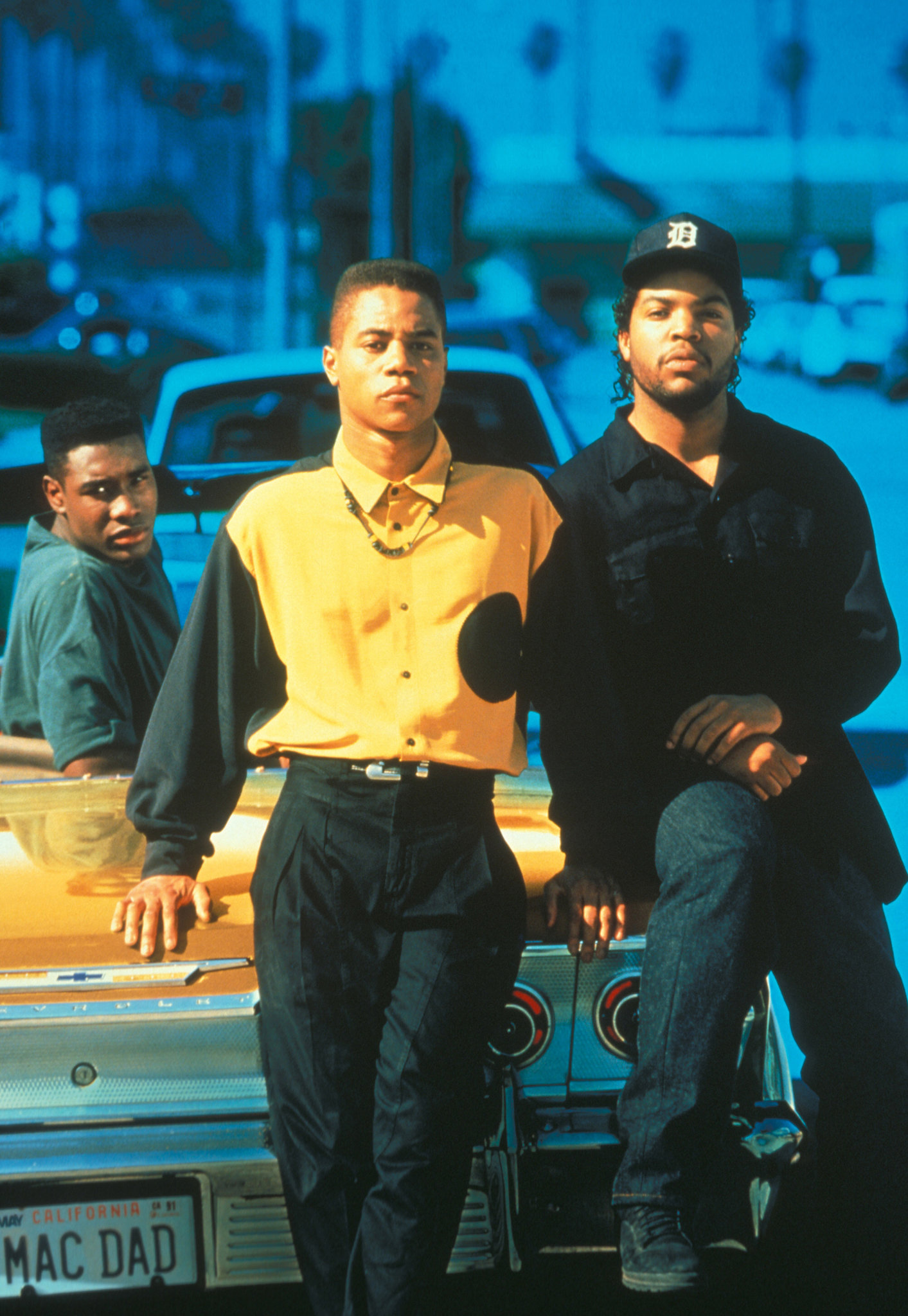
This week I watched the new War of The Worlds so you don’t have to. The sacrifices I make for my reader(s)! I watched it because a) I was interested in whether it actually deserved the 0% rating it has received on Rotten Tomatoes and b) I am interested in all the variants of this famous story that are produced, from the weird time traveling robot dog one to the Tom Cruise one to the original.
This version does some interesting new things with the basic concept, which are worthy additions. In particular the aliens are attacking earth for our data, not for our physical resources, and have weird little ant robots that can crawl into any space to suck data from hard drives and usb sticks. This leads to some poignant scenes in which the main character Will’s dead wife’s Facebook memorial page is progressively deleted, and the last message she sent him (a five second “put the dog out” reminder) corrupts and disappears as he plays it. The movie is also almost entirely shown from the perspective of Will’s computer: we see him making phone calls, using various apps to access remote cameras, and surfing the web and youtube to look for information. The only time we break this view is to see him in action through the perspective of a delivery drone. This is a difficult perspective to do well, and I think this movie actually pulls it off. So, it adds something to the genre.
Did this movie deserve 0%?
When I watched the movie it had a 0% rating on Rotten Tomatoes, which has now risen to 4%, and I don’t think, frankly, it deserves this. It has a coherent plot, an interesting visual perspective, it quickly and effectively develops the main characters who are, in general, sympathetic, and it does not insult the viewer’s intelligence or their morality. The acting isn’t great and it has some timing problems, and some of the story developments are preposterous and not really sustainable, but it isn’t terrible. It certainly does not treat the viewer with the complete contempt shown by the new Star Wars movies, it doesn’t have the weird Vaudeville turn of some other recent movies, and it doesn’t fundamentally let down either its genre, the canon from which it is drawn, or the basic internal premises it establishes for itself. In fact the final process to defeat the aliens, in which the family members have to pool their separate skills to develop a combined computer/physical virus to simultaneously attack the aliens’s cybernetic physical and data forms, is consistent with the original story being updated to the information age, and nicely foreshadowed by a text message in which Will’s daughters Lancet paper is shown. If this movie deserves 4% then the new Star Wars movies should be somewhere down around -50%.
I wonder to what extent the bad reviews are simply a racist response to the fact that this movie has a mixed-race cast in which the three most important characters are black. But my primary interest here is not to review the movie, but to explore some of the implications of the main character’s job as an NSA spook, and the fact that he is played by Ice Cube.
Will Radford and the Actually Evil NSA
The main character in this story is Will Radford, played by Ice Cube from NWA. Will is a low-level agent in the NSA, whose job involves sitting in an office accessing various apps to spy on members of the population to check for “threats”, as well as ghosting agents in actual raids. The tools at his disposal are a genuinely excellent depiction of an electronic surveillance organization in a cyberpunk dystopia: he can basically block select a section of a map in his app and reveal all the accessible cameras in the area. He can then right-click on any one of those cameras, vehicles or NSA “assets”[1] to bring up a context menu of tools available to him, which includes being able to instantly access the camera and view the street through it. Furthermore, once he has streetview he gets little floating pop-ups over every person in the view giving their name, major information and threat assessment, and if he clicks on them he can monitor their spending habits. He does this in the beginning of the movie to track his daughter on her way to work, determines that she bought a muffin, and then calls her to body shame her for eating the muffin. Top parenting, Ice Cube!
This isn’t the limit of his powers though! He can access reaper drones to use their weapons, and can also hack cars, so that at one point he hacks a Tesla, drives it to his injured daughter, and programs it to drive her to an emergency center (as well as turning on the aircon). He can also generate all-purpose security keys for any device or program, which he uses to hack his daughter’s laptop so he can monitor her conversation with her (white) boyfriend and to break into a Zoom call. It’s actually a really good depiction of the security state at work, the one we conspiracize about, and better still it’s essential to the framework of the story – the aliens are attacking earth for its data, and a large part of the reason they have recognized the abundance of data is the amount that is being used by the security services.
You see, the kicker here is that the NSA is running a top secret extra layer of surveillance called Goliath that collects orders of magnitude more data than Will has access to, and that will ultimately enable computers and AI to be used to predict terrorism and crime (and possibly bad thoughts). This system is so secret that Will didn’t know about it, and is shocked when he learns about it. His kids make jokes about him spying on everyone – which he literally, physically is! – and complain about how his job is a bit dodgy, and he’s aware that he’s spying on everyone, but halfway through the movie we learn that there is a further layer of NSA tech that is beyond the pale. We learn this when Will is busy using his technological and surveillance powers to try and save the earth from an attack by super-powered aliens, so the message is very clear: the surveillance Will was doing is good and right, but the new program, Goliath, is going too far, it’s evil, and it has had extra-galactic consequences.
Essentially the movie sets up a clear moral boundary between having a guy like Will sitting in his office spying on literally everyone on earth to the extent that he is able to see when and where they bought their breakfast, how they paid and what they bought, which is directly shown as good and right; and some nebulous additional level of surveillance that would be immoral, bad, and dangerous. And we are shown all this through the perspective of the hero of the story, the guy who was doing the government surveillance that is good, and who is played by Ice Cube, a famous anti-government rapper.
Where have the black cultural resistance ended up?
That’s right, the man whose first solo album was entitled Amerikkka’s Most Wanted, and who sung about institutional racism in the police force, played the NSA spy whose digital intrusions into the lives of ordinary Americans were clearly portrayed as good and necessary. This seems like a far cry from the original political purpose that he was singing for in the late 1980s and early 1990s, doesn’t it? But surely he’s alone in this fall from grace?
Ice T, infamous for the (excellent!) song Cop Killer on the (excellent!) Body Count debut album, has played a policeman in Law and Order: Special Victims Unit for about two decades. Snoop Dogg was one of the Olympic ambassadors for the 2024 US Olympic team (and apparently very good at it), while 50 Cent attempted to become an investor (even investigating a metals business in South Africa, the most colonial of colonial adventures) before declaring bankruptcy. Tupac is dead, with rumours connecting his shooting to P Diddy, who is being investigated for what appears to be a decades-long rape and sexual assault factory he was running.
It certainly looks, on the surface, as if one of the biggest movements of black cultural resistance in the USA in the 1990s, the entire rap/Gangsta Rap world, has collapsed into a cultural movement dedicated to churning out propaganda in support of the central planks of American imperialism, and profiting from it where possible.
It’s worth noting that not everyone accepted these rappers as a form of cultural resistance. Black feminists criticized the language they used to describe women, which was quite new, and other rappers were concerned about the nihilism and destructiveness of the movement. Gil Scott Heron identified this most clearly with his 1994 song Message to the Messengers, which questioned the value of their songs about crime and misogyny, with lines like this:
You can’t talk respect of every other song or just every other day
What I’m speakin’ on now is the raps about the women folks
On one song she’s your African Queen on the next one she’s a joke
And you ain’t said no words that I haven’t heard, but that ain’t no compliment
It only insults eight people out of ten and questions your intelligence
Gil Scott Heron wrote that song carefully, to question the content of the lyrics of Gangsta Rap without questioning the motives of the singers themselves, and included this chorus to make this point:
And if they look at you like they think you insane
Or they call you scarecrow thinkin’ you ain’t got no brain
Or start tellin’ folks that you suddenly gone lame
Or that white folks have finally co-opted your game
Or you really don’t know…They said that about me a long time ago
It’s nice of him to be so considerate of the motivations of this political movement, given where they ended up. After all, Gil Scott Heron wrote the famous song Whitey on the Moon, but he never cos-played an astronaut for TV. What does it say about the next generation of rappers that they ended up cos-playing their class enemies on TV?
Settlers and the co-option of resistance in America
I am currently reading Settlers, the 1983 radical history of America that argues the US working class are a labour aristocracy, with whom it is impossible for the global proletariat to find common cause. The book’s argument could probably be boiled down simply to “My argument is not with the government of America, but with its people.” It describes the economic development of America (which it writes always with a k, as in Amerika) from its “discovery” to the civil rights era, with the fundamental conceptual framework being that at every step of its development the “Euro-Amerikan settlers” destroyed non-white cultural and economic systems, stole their land and the fruits of their labour, and either killed them or drove them out. For example, consider this description of activities in the south-west of the USA after world war 2:
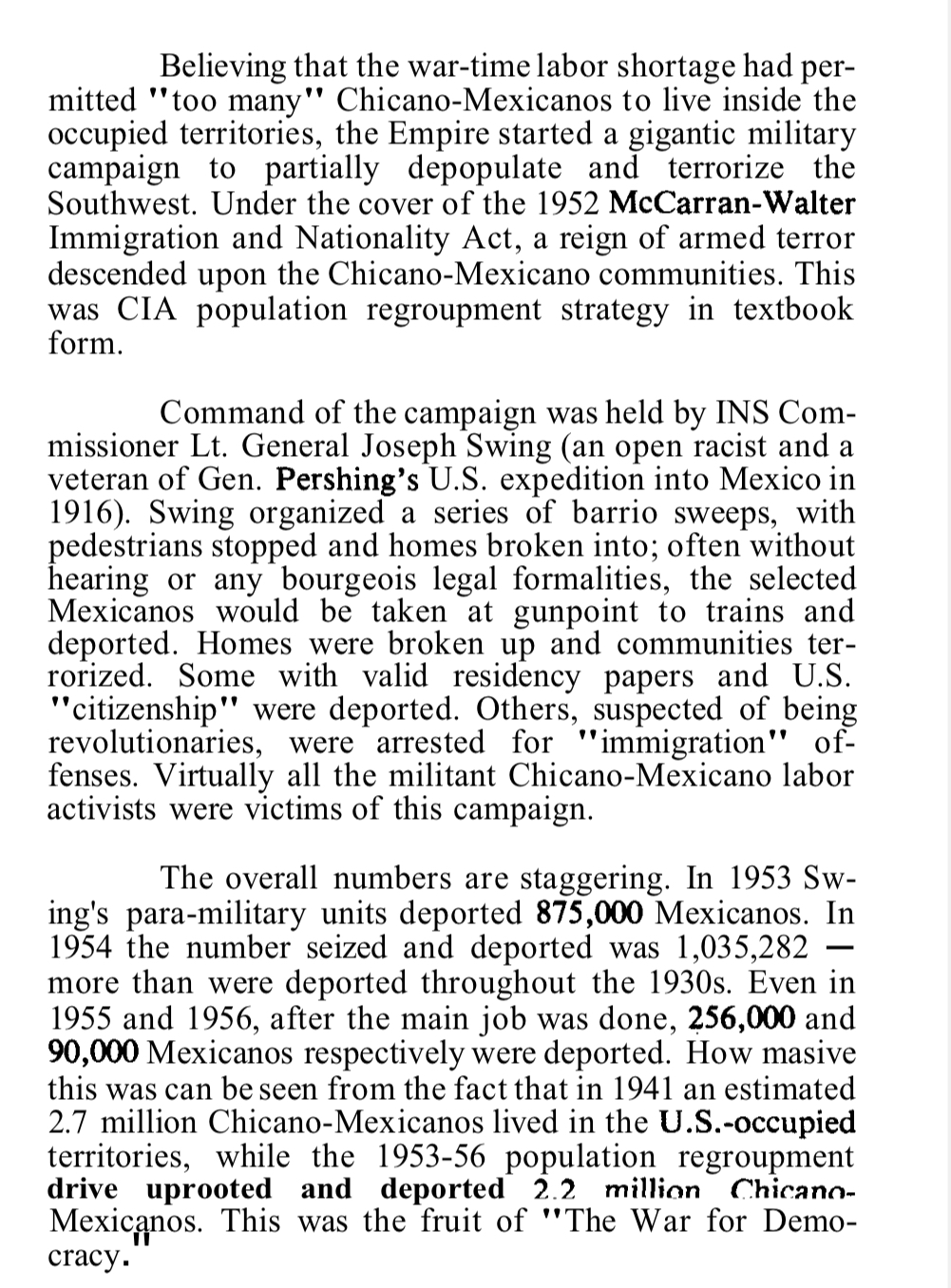
Sound like a program that’s being fired up again?
At every step in this process the author, Sakai, argues that the goal of the “Euro-Amerikan settlers” was to expropriate non-white wealth and labour and steal their land. However, the book describes specific periods of time when the settler state realizes that the black proletariat, in particular, is too numerous and too powerful to destroy, and in those periods it employs various strategies to co-opt the leadership of the black proletariat, offering them incentives and inducements in exchange for their efforts to defang resistance to the settler state. The canonical example of this provided in the book is the co-option of black labour activists in the immediate lead-up to and during the second world war, when black workers were deemed essential to industrial growth during the war and too numerous to destroy, but at the same time the black proletariat had built their own system of unions and radical organizations, and were simultaneously embracing black nationalism and communism. Sakai gives the example of Garvey-ism, a black nationalist movement embodied in the form of the United Negro Improvement Association (UNIA), which was radical and later said to have inspired people such as Kwame Nkrumah and Ho Chi Minh. Malcolm X’s father was assassinated by the KKK because he worked for this organization, and the US government cracked down on it mercilessly. At the same time, however, they built up an alternative activist, A. Philip Randolph, who worked alongside other bourgeois organizations to oppose the UNIA and try to lead the black working class to an accommodationist, integrationist compromise with the settler state. In exchange for steering the black community away from nationalism and communism he and other leaders from these organizations managed to secure some concessions from the settler state, became leaders within their community, and the New Deal was partially extended to black communities. By the end of world war 2 black men were integrated into the army and the industrial base of the military-industrial complex and had become junior, unequal partners in the post-war imperial program of the USA.
After the war, however, when everything returned to normal, the settler state began pushing non-white people out of industry, which was again returned to the Euro-Amerikan settlers, and a new wave of terror was unleashed on black people in the south. This led in turn to the civil rights movement of the 1960s, and after that the rise of black cultural resistance in the form of activists, rappers and writers like Angela Davis, Gil Scott Heron and James Baldwin[2]. The settlement brokered by those co-opted labour leaders before and during the war had been partial and incomplete, and the post-war, post-New Deal settler state retrenched much of it, leading to the disruption and violence in the inner cities of the 1980s.
Sakai wrote Settlers in 1983, before the rise of gangsta rap, but I think we can see some parallels in the growth of that movement, what it advocated for, and how it ended up. The focus on nihilistic criminality and money, the individualism and competitiveness, represented a distinct break from the community-focused discipline of earlier activists, a solution to the problems of the inner city based on personal salvation rather than group solidarity. It’s no surprise that one of the major producers of the movement, P Diddy, was eventually revealed to have been running a record studio where sexual assault and playing favours was a key part of the business model. It’s also no surprise that drugs, sex and money replaced politics and love as the main themes of the music. Cop Killer replaces anger against the system with individualistic rage and violence, a loner driving around the city killing single police officers rather than an uprising against the police force as a whole; it is more lascivious, more inviting, but also ultimately futile and self-destructive. As a political program, this kind of stuff led nowhere.
So it makes me wonder, now that we see where that movement ended up, whether the post-Rodney King cultural resistance among black Americans was actually effectively a co-option of struggle[3], a promise of lucrative rewards to a small number of gangsta rappers in exchange for leading a movement of desperate young men down a blind alley. And once that anger has fizzled out, lost its direction, the deportations and political violence start up again – as we have seen, in the wake of BLM – while the people who led the movement astray get their sinecures on TV, doing copaganda and nationalist propaganda for the settler state.
This new War of the Worlds movie showcases this perfectly, with one of the main characters from Boyz in the Hood, the man Straight Outta Compton, working for the government to spy on his own people, and saving everyone from an alien threat on TV at the same time as the real-world government his character works for gears up a new program of state violence, concentration camps and deportations the like of which we haven’t seen in almost 100 years. I think it’s pretty likely that this new wave of state violence won’t spare the young black men of modern America, and right now real versions of Ice Cube’s character – who almost certainly aren’t black – are firing up their apps to start spying on the very people Ice Cube once claimed to represent.
fn1: I really hate this term
fn2: It’s worth comparing the intellectual, gender, and sexual diversity of that movement with the uniformly hetero and cis nature of gangsta rap. Baldwin was gay, and the movement was much more internationalist, inclusive and politically aware than gangsta rap. This may reflect the reactionary politics of the 1980s in which gangsta rap forrmed, but it is also indicative of an organic mass movement embedded in an enlightened proletariat, rather than a curated movement drawn from a suitable pool of nihilistic and destructive talent
fn3: I don’t want to get too conspiratorial here; co-option doesn’t necessarily mean that someone in the government identified this strategy directly and reached out individually to these people to groom them. Cultural movements arise from the political circumstances of their time, and the ruling class selects from many bubbling movements those which are useful to it. But at the same time we know that the CIA directly funded authors associated with anti-government movements, and the state worked alongside supposed radicals like Orwell. We’ve all seen the suspicions surrounding people like Epstein, and the awful behavior of the spycops in the UK. It’s possible that a nihilistic and destructive resistance movement emerged organically from the reactionary economic and political climate of the 1980s; it’s also possible that a few gold weights were placed on the scales, to ensure certain movements rose out of balance. Who knows, maybe the CIA are paying me to write this!


Leave a Reply