• India, Indonesia, Burma, Bhutan and Nepal have all been freed from British, Dutch and French colonial tyranny, and in payment for generations of their crimes, the Dutch nation no longer exists. From Saigon to the eastern border of Persia stretches a single, uninterrupted coastline from which the myriad peoples of Asia can look out at a sea free, for the first time in 200 years, of the navies of their hated colonial oppressors. In the place of old tyrannies, a new and enlightened rulership has asserted its right to guide the peoples of Asia into the future; the clouds of imperial oppression have been blown away in just a year of war’s tempest, to allow the glorious light of Japan’s Rising Sun to shine over the whole region. Soon the last remnants of colonial oppression in Asia – Australia’s territories in Papua, and Sri Lanka – will fall and a Greater Asian Prosperity Sphere will be in place. After that, American meddling in Asia through its puppet nation – the Philipines – and its dubious activities in China will have to be dealt with. It pains me as the leader of this great military endeavour to have been forced to wait so long to deal with the American menace, but my first and greatest concern has always been to free the people of Asia from the direct tyranny of colonialism. Next, America’s “modern Imperialism” will be shown for the anachronism it is, and Asia will be truly free. Even Australians will welcome my enlightened rule.

    Last night was my last chance before the Golden Week national holiday to indulge in a good round of anti-colonialist imperialism via Hearts of Iron 2. I tried two brief attempts to start war with Holland last week, but one crashed and then the other – oh how hideous – went disastrously wrong after Nationalist China declared war on me. So this time I set about spending money on the Chinese before I commenced my war. Make no mistake, the Chinese are the albatross around Asia’s neck, holding it back from its proper advancement and refusing to cooperate with that which is best for the region, but dealing with them is tricky, and I hope to convince them to change their ways peacefully rather than through war. It’s hard to believe from the way they side with foreign powers, impede my righteous military efforts, and refuse to recognize the benefits of Japan’s plans for Asia, that once they were the cradle of civilization in this region! So, currently I’m buying them off and getting them to look the other way while I stomp my way across Asia. I haven’t had a full-blown naval battle with Britain yet, but I’ve encountered their Indian fleet a few times and now it’s a lot smaller than it was. I think they ran into a bit of trouble early in the piece, when they tried to sneak 13 transports into Singapore (right at the beginning of the war), but I sank the lot. No one tries to sneak empty transports into Singapore. Wikipedia tells me that a division consists of about 10,000 men; I think I drowned 13 divisions of British and Australian soldiers in the first week of the war, that is 130,000 men. I think this slowed down British attempts to stop my relentless march across Asia, and so did my subsequent use of marines to outflank the entire Burmese army at Chittagong. Another 100-150,000 soldiers mopped up there, and then the remainder of India was trivial. What to do with all these soldiers? I note there isn’t a lot of transport infrastructure in India, maybe I’ll build some railways…

    I also discovered that the Dutch had their capital in the Dutch East Indies. Why was this, I wondered, and checking found that Germany has conquered all of Western Europe except Republican Spain[1], so the Dutch had to flee to their colonial territory. Every province in Indonesia that I conquered, that little red capital dot would move one province over. So, after a campaign that lasted just a few months, I landed some marines in Hollandia (in West Papua) and captured the last meaningful territory in the Dutch East Indies. I then annexed Holland, my first conquest of a European power. Annexing Holland earned me a massive stockpile of every resource, but especially of money – I now have 30 times more money than I had a year earlier. I’m spending this liberally to keep the Soviets and Chinese off my back.

    With India captured I am now able to put one of my fleets into the Red Sea and destroy any British ships attempting to escape – or return – via the Suez canal. I think they might be tied up fighting the Germans in the atlantic anyway, but attempts to retake India are going to be extremely difficult at present, because they need to come via South Africa or they run into a fleet of 6 Advanced Carriers, 4 Advanced Battleships, 4 Advanced Battle Cruisers, about 6 Light Cruisers, and 10 advanced Destroyers. This is a larger and more modern fleet than the Japanese were ever able to field in the real war, it’s significantly more advanced than anything the British have, and it’s just a third of my total naval power. It’s also soon to become just a quarter of my naval power – I have another whole fleet – 4 battleships, 6 carriers, 6 escort carriers, 4 battle cruisers and 10 Destroyers – half complete, and will be deploying that in the next few months to patrol the Indian Ocean. This will free up my larger fleet to destroy the Australian navy, and whatever British remnant is lurking down there, and to capture Australia. With Australia out of the way there will be no way the British can return to their colonial possessions without coming through the Suez canal. I still also have to take Sri Lanka, which is a holdout base for the British at the moment – this won’t be hard, though I’ve noticed that capturing a port city by sea is tricky, because once you land troops the enemy fleet has to flee, and the first thing they do when they flee is meet your transport flotilla. This has happened to me twice so far:

    • First time, the entire Dutch fleet, escaping the capture of Batavia, ran into my transport fleet, which was just leaving the area after the assault. The Dutch fleet consisted of 4 capital ships and about 8 destroyers. My fleet: 6 transports, 2 interwar-era destroyers, a light cruiser and a battleship. The Dutch fleet lost everything but 2 destroyers and a capital ship. This should give some sense of how much tougher the Japanese navy is than those of most other developed nations
    • Second time, the British Indian fleet, when escaping Calcutta, ran across my transports, again just leaving after a successful landing. This pitted the same transport fleet against a fleet of 20 or so interwar-era ships, including four or five battleships. For the loss of 4 transports and a destroyer, I managed to take out a British light cruiser and a destroyer, and escape to Rangoon.

    That same British fleet, fleeing the area, ran into my main battle fleet and got eviscerated. After the fall of Karachi they did another runner, and got caught at the mouth of the Red Sea. All that remains of them now are a battleship and a few light cruisers, limping home in disgrace. There have been no other significant naval battles, except some skirmishes with Australia (inevitably disastrous for them). Actually, so far I have only lost any land engagements twice, once in Rangoon before I had a proper force in place and once in the Spice Mountains near Kerala. The Spice Mountains are the only time a small force has managed to hold me off – and of course, they were Australians! Bloody ANZACS…

    Which brings me to my plans for the immediate future. It’s mid-1944 and after one year of war the only places remaining to be captured in the region are Australia, New Zealand and Sri Lanka. I have to take Sri Lanka soon so I can remove British naval power in the Indian Ocean, and I will simultaneously also deal with Australia, which I suspect currently holds a large expeditionary force. Australia is a bad place to take, it’s big and worthless. But I have a workaround. I have 4 or 5 brigades of Ballistic Missiles, with a range of 2400 km, currently based in Taiwan, Hanoi and Batavia. The Batavia missiles reach Western Australia. So, I’m going to capture Sydney, Canberra and Melbourne – the main industrial centres of Australia – and possibly Brisbane simultaneously and then wait to see where the Australians move their capital to. Then, I’m going to hit their capital with a significant ballistic missile attack, reducing them to almost no industry. Once this is done I’ll offer them a surrender they can’t resist, and move on to New Zealand. This ballistic missile option, incidentally, is my main deterrent against China. I’ve been building land fortifications in the North of China (Beijing, which I hold) and the border with Indochina, and I now have a force of ballistic missiles sufficient to wipe out industry in Chongqing, Guangzhou, Nanjing and Shanghai simultaneously. If China declares war on me I can eliminate half of their industrial base on the first day, and tie them down trying to storm my maginot line while I land marines on the coast.

    Marines! They’re the gift that just keeps on giving!

    The ballistic missile option is also the main means by which I aim to reduce the British, as well. I am currently nearly finished researching Intercontinental Ballistic Missiles and nuclear waste bombs, which I expect to have working by mid-1944. With this combination, I will nuke London. I have read that not only does this cause massive infrastructure damage but it adds a large amount to your “warscore” (by which you force people to surrender) and increases dissent in the targeted territory. Once I’ve done this, I’m hoping that Britain will surrender and allow me to annex them. This has two immediate consequences – it gives me control of the Suez canal, and frees Germany up to invade Russia. That frees me to concentrate on the USA, which is going to be a challenge. My spies tell me the USA has 22 battleships and 15 carriers, so they have a navy almost as powerful as mine. They’re currently researching Heavy Advanced Carriers, so their carrier force is not as advanced as mine (I’m currently deploying the first of this design), but it’s big and they have almost limitless resources to make more. Of course, by then I’ll have nukes and ICBMs, so it’s possible that the whole issue of naval warfare will become irrelevant. But I want to defeat the US at sea and deploy nukes later, when the land war starts. Also I don’t know how long it takes to make a nuclear bomb once the designs are in, so I may need to rely on conventional war for a year. Anyway, at this stage it looks likely that the entire Pacific will be mine by 1945, with my empire stretching from Korea in the North to New Zealand in the South, and from Papua New Guinea in the East to the border of Persia in the West. If my nuclear plan works, I will also have possession of large parts of the middle east, Africa and the UK. Truly, a global order will emerge and we can hail the beginning of the Asian century!

    fn1: a couple of iterations of this game have passed me by recently, and in every one of them Republican Spain trounces Nationalist Spain. I think this is because the Germans don’t try to help Nationalist Spain. It could even indicate British help – I think they’re part of the alliance against me!

  • Discussion of whether Jesus was a Vampire has taken an inevitable turn towards discussion of the Big J’s phylactery, the piss-christ. Now, I’m not a big fan of the piss-christ, I haven’t seen it in person but it doesn’t seem like good art and it doesn’t seem like a good contribution to the debate about christianity. I’m also sympathetic to the view put in comments that modern christianity has been defanged, and it’s no longer particularly brave or radical to take the piss out of it (haha). What I’m not so sympathetic to is the view that the modern art scene has an unacceptable anti-christian bias, or that the current crop of artists should be focussing on a wider debate about all the different religions. This is because:

    • The main thrust of modern conservative debate about identity in the English-speaking world claims that we are a “christian” society with a “judaeo-christian” heritage. See, e.g. this repulsive tweet – by a christian – on Anzac Day. You can’t claim that we’re a christian society and then complain that people who want to criticize their own society’s morals and social structures lay into christianity.
    • Most of the modern crop of artists didn’t come of age in the post-9/11 world, and the context they grew up in was a vigorous and sometimes violent fight against a christian movement not yet in full retreat. In the era they grew up in, Islam and Hinduism were non-events, non-issues, they probably neither learnt about nor knew about them. It’s rich to expect them to change their angst in late adulthood because a few western leaders decided to start a war with a previously largely irrelevant religion

    I’m not going to talk about the first problem (reaction against claims of judaeo-christianity) here, but I do want to talk about the context of the artists’ upbringing, because a) it relates to role-playing and b) Paul in comments has suggested that the reaction to the Satanic Verses is indicative that actually Islam was a big issue in the 80s (the fatwah against Rushdie occurred in 1989). I don’t think this is true – I remember when the fatwah was issued, and it came as a complete shock to Westerners – and I want to do a quick scout through the main pop cultural movements I’m familiar with from the 70s and 80s, to give a highly biassed account of how completely irrelevant Islam was in the development of the sensitivities of the current crop of “elder” artists.

    And Serrano is an elder. The piss-christ was made in 1987, suggesting that he “matured” (in physical years, if not in artistic merit or sense) before 1987. In fact he’s in his 60s now. So is it reasonable to suppose that he should give a drop of piss about Islam or Hinduism? He was raised in New York by a strict catholic family, so it seems like popular culture in the 70s and 80s is more relevant to his development and his perspective on art than, say, Osama bin Laden.

    New York, Islam and the Debates of the 80s.

    So what was going on in New York in the 70s and 80s? I don’t think we can say that Islam was a big issue in the melting pot of 70s and 80s America; this site suggests that today in NY there are 160,000 arab Americans, who came in two waves, the first of which was in 1925 and was largely Christian. This is not exactly a big population for New York, and a lot of them aren’t even Muslim (and probably the descendants of the 1920s migrants don’t even think of themselves as Arab-Americans, after 3 generations). The second wave of migrants in the 1960s may have raised some issues about settlement, integration etc. but this needs to be seen in context – 1 million Vietnamese moved to the USA in a few years after 1975, and Chinese migration was an ongoing process in the US. The debates in the western world about migration in the 1970s and 1980s focussed on Asians, not Muslims, and really the issue of “Islamification” only came up in the 1990s, after the collapse of Israel’s war in Lebanon and the camp David peace accords, the second intifada, etc. – i.e. in response to the growing presence of Islam in western news reports, and corresponding waves of refugees fleeing those countries.

    If you look at some of the pop cultural stuff specific to New York or the Eastern seaboard from the 70s and 80s – things like the work of Brett Easton Ellis, movies like Heathers and the other teen-movie stuff of the time, Wall Street etc, they’re much more concerned with debates about in- and out-groups in New York, as reflected in class and some regional or christian-specific categories (like WASPs vs. nerds, or simliar) than they are about Islam. I remember watching 21 Jump Street and Cagney And Lacey, and episodes about migrants and discrimination were rare, and primarily focussed on Asians. 21 Jump Street had a few episodes about e.g. abortion, HIV/AIDS, etc. but the background of political trouble to these was always christian. As an outsider looking at NY, I don’t see much evidence that Serrano would have been growing up in an environment where other religions were much of a significant factor.

    The key issue in the west in the 70s and 80s was the uneasy relationship between christianity and civil society as envisaged in a modern liberal democratic state. There was a low-key conflict going on between popular culture and christian sensibility, that occasionally exploded in controversy, and this conflict provided fertile soil for the imagination of budding artists. I don’t know much about art, but there were some pop-cultural movements at that time that I understood, so let’s look at them.

    Thrash Metal and the Christian Revival

    The shock-troops in this conflict with christianity in the 70s and 80s were undoubtedly heavy metal, who took up where punk’s guerilla warriors left off at the end of the 70s, and mobilized an army of disaffected young men against the religious imagery of the time. This wasn’t equivocal, either – heavy metal hated christianity and christianity hated metal. Islam and Hinduism didn’t figure in this, and in fact it took the generals in this movement – Metallica – 10 years to finally write a song about a religion other than Christianity. When they did, it was a hate-filled screed about alternative religions, telling the very personal story of James Hetfield’s own family life. No interest in the large international religions at all. But before then, Metallica wrote songs like Leper Messiah and Creeping Death that were highly critical of christianity; Slayer were using and abusing christian imagery as much as they could, Testament wrote whole albums about the hypocrisy of christianity (albums like The New Order) and the more skatey/speedy metal bands like Suicidal Tendencies were laying in with criticisms of religion as a prop or crutch, and direct criticism of the new wave of televangelists (with songs like Send Me Your Money). Tellingly, the christian response at the time wasn’t to accuse them of bias and Islam-loving. No one demanded that Metallica write Leper Prophet, or that Slayer’s Expendable Youth be rewritten to include lines about muslim martyrdom. No, instead, they accused these bands of being satanists and wanting children to go to hell. Other religions didn’t enter into this debate at all, and in fact to the best of my knowledge the only song written in that time about islamic countries was Iron Maiden’s Powerslave – which was about the Pharaohs.

    The christian response to this was organized and serious. They first tried for censorship, introducing the PMRC (a censorship committee beautifully attacked by Megadeth’s Hook In Mouth), they invented the concept of back-masking and made videos about how AC/DC were satanists who believed they were channelling their dead singer through their new singer; they did speaking tours and later Tipper Gore introduced those abominable censorship stickers called “Tipper Stickers.” At no point did the issue of bias come into it, because religious groups in America in the 70s and 80s hadn’t registered Islam, it was irrelevant. They directly accused their enemies of attacking christianity within a christian framework, i.e. of being satanists. The relative sophistication of the “why don’t you criticize Hindus too” victimization complex is very new.

    So, Serrano grew up in an environment where all of the extant good music (i.e. heavy metal) was at war with christianity, and neither side was talking about other religions at all. This isn’t reflected in just the good music either…

    Pop Music, Blasphemy and Smut

    Madonna exploded onto the pop scene in the early 80s with a huge sexual energy and a lot of catholic angst, and was immediately targeted by religious campaigners. She wasn’t targeted by Muslims or Hindus, but by Christians – and they fed off each other for years. This came to a head with the highly emotionally charged Like A Prayer, where she has sex with a child Jesus[1], but she had already managed to offend with Papa Don’t Preach and, well, pretty much everything else she ever did. Compare the lyrics and imagery of songs like hers with those of Lady Gaga, and you can see that it’s a lot harder to offend anyone now than it was in the early 80s. Madonna used blatant christian imagery in her work, and got a lot of flak for it; but christian imagery wasn’t just used negatively in the 80s  – it was heavily present in the work of bands like U2, Terence Trent d’Arby, the New Romantic movement, The Cure, etc. Through the entire opus of New Romantic work (and there is a lot!) you’ll be hard pressed to find any reference to any religion except Christianity and maybe a touch of Buddhism. Sure, the Cure sing about killing an Arab, but they’re quoting Camus; the Bangles Walk Like an Egyptian but they don’t talk like one, and again when speaking of a North African country they explicitly skip the 800 years or so of Islamic history and go straight to the Pharoahs. Nik Kershaw mentions “a lone man of Aaron” in The Riddle, but that’s pretty much the only reference to Judaism in 10 long years of make-up, military jackets and spikey hair. Meanwhile the christian imagery comes thick and fast, and again much of it positive as well as negative. Particularly Gospel Singers, crosses, kneeling in prayer, churches as symbols of mystery, decay or (generalized) faith. You won’t find a mosque or a Hindu temple as an image of any of these things, though they may be visible in the odd place here and there as a homage to exoticism or the Orient.

    So where do we think we can find the most obvious evidence of “alternative” religions being presented? Perhaps in a musical movement symbolized by the Ankh, a distinctly non-christian symbol…?

    Goth, Punk and the Wyccan Impulse

    Goth music draws heavily on the twin themes of religion and death, and was at its peak during the mid-80s under the guiding influence of bands like Sisters of Mercy, Christian Death[2], Bauhaus and the like. Christian Death spent most of their lives ranting against christianity exclusively, in strong and uncompromising terms; but the other bands in this genre were much more eclectic in their tastes. The Sisters of Mercy are a good example, using a lot of christian imagery but also drawing on the magical (in songs like Floodland) and expropriating middle eastern musical forms, particularly that amazing wailing woman in Temple of Love. But when they took this music, they took it in purely aesthetic terms – the political and religious context was stripped out. It’s as if the cultural background was irrelevant to the Western world, so strange and mysterious that it could not influence thinking beyond the aesthetic. And indeed, when we see groups like Inkubus Sukkubus or Garden of Delight searching for mystical inspiration, do we see them drawing on the extant religions of their day, which they could easily turn to for inspiration were those religions omnipresent in their cultural life? No, Inkubus Sukkubus turn to Wycca and varied notions of pre-Christian witchcraft; Garden of Delight construct a strange personal religion based on the ancient Sumerian angels and Cthulhu. Sure, Garden of Delight have a song called Sharia but the lyrics are completely unrelated to Islam. They have a lot more songs about fallen Sumerian angels than they do about any extant religion.

    The efforts of Goths and punks to revitalize Witchcraft, Paganism and Wycca are particularly illustrative in this light. In the late 80s and early 90s there was an interesting blend of hardcore punk that attempted to sing about paganism, and which drew on pagan ideals and mythology; at this same time witchcraft and paganism were beginning to be accepted as a religious theme or ideal for people seeking a new type of religious outlet, and I think even were accepted as one of the religions the US Army allows one to worship (by the end of the 90s). However, in reconstructing these religions the people involved were heavily influenced by a christian context, and thought only of investigating the paganism destroyed by christianity. Had they known anything more about the wider religious setting of the modern era, they could have taken a quick trip to Japan and explored a currently existing pagan religion practiced by 120 million people. They didn’t though, because the context for religious thought in the West is so heavily dominated by christianity that the concept of an animist religion that never came into conflict with christianity doesn’t exist to most of us; the idea of animism living in harmony with modern society is anathema to our concept of religious progress because we see religious progress through the prism of christian conquest. Where non-christian religions entered the popular mind in the 80s they did so only in as much as they were perceived to have a relationship to christianity, or stripped of all context down ot the purely aesthetic.

    Context-free Islam in Cinema

    Islam was barely relevant in cinema in the 70s and 80s, but where it was shown in movies it tended to be presented as the backdrop for western stories, its own history and culture irrelevant. So we see at the beginning of The Exorcist that the original source of the demon is dug up in Iraq, but the demon itself is christian and Iraq is just an empty backdrop, a series of bazaars and the call to prayer as culture-free exoticism to define the origin of the demon as the middle east; islam is here only as historical fact. In the first Indiana Jones the Holy Land serves only as the colonial setting for the conflict of western powers – neither Judaism nor Islam have anything to say about the expropriation of an object that is sacred to both of them, and all the non-white characters are incidental (or mercenaries to be shot). It’s the same old adventure in a different setting. In A Passage to India we have a love story in a colonial setting, but that’s all it is; even the Zulu movies give barely a moment’s time to elucidating the religious and cultural details of the enemy, which is jsut a black African mass. It’s as if there is not even an awareness of the possibility of other religions, or they’re discounted immediately as irrelevant to the Western story.

    And this is the key here – irrelevance. It’s not that people wish to deny the existence of other religions in the world, they just don’t figure into the Western cultural context. Religious representation in the West in the 70s and 80s occurred entirely within the Christian framework.

    Role-playing and Christian Censorship

    This is also clear in the christian response to fantasy RPGs, which was to accuse them of satanism or idolatry, and to campaign for censoring them. This campaign had partial successes, resulting in schools banning gaming clubs and even a 60 minutes “documentary” on how dangerous these games are. But again, the christian response to these games was not in terms of the risk of allowing other religions into schools, or of the game being disrespectful to religions generally – the only concern was about christianity and satanism. And the games themselves were largely bereft of non-christian religious influences when they started – the Cleric character’s spells are clearly inspired by images of the Priests and holy men of the western religious canon, and about the only non-western monsters are the Rakshasa and the Djinn. Even the conception of Hell is heavily inspired by Milton, Dante etc., rather than drawing on those of other religions (such as the Bhagavad Gita). Campaigns set in middle eastern or Asian settings came much later as “alternative worlds,” and the two key settings right up until 3rd edition were Greyhawk and Forgotten Realms – pantheistic but clearly European and feudal. Warhammer was explicitly christian-themed. The main departure of role-playing from the common themes of religious context we see in other cultural works of this time is its adoption of pantheism. But this pantheism doesn’t change the backdrop from its European feudal setting, and it only provides colour to a character class obviously based around western, christian notions of what a cleric can do. And you won’t find many islamic or hindu objections to RPGs in the western world – when a generation of young nerds grew up in the 80s, they knew that they only had one religious enemy, and it was christianity.

    The Politics of the 70s and 80s

    Anyone who was growing up or a young adult in the 70s and 80s will remember that the social politics was enormously conservative and heavily influenced by christian ideals; much of the pop cultural struggle in the 80s was to push christianity out of our private lives. In the 70s and 80s christian minsters and evangelists preached their bigotry loud and clear, and attempted to enforce it in ordinary life as much as they could. Homosexuality was still illegal in some places, and violence against gays was both accepted and normal (I even had a GM in the early 90s tell me casually about his younger days “poofter-bashing” on Oxford Street). HIV/AIDS was just entering consciousness and widely decried as a gay disease; discrimination against gays in employment and housing was both legal and common, and attempts to end this discrimination met organized and vociferous resistance from the church. Depending on where you were domestic violence and/or rape in marriage were considered acceptable, and it was generally not considered possible to rape a prostitute – this was theft, not rape. Censorship – in the sense of book burning – was advocated by all major christian groups, and attempts to decriminalize prostitution or drug use were met with extremely vocal christian objections. The police were free to beat, rape and torture members of the underclass, and in the 70s in Australia, the US and the UK political activists were still murdered by their opponents, or the police. In America Irish catholics were raising funds for Irish catholic terrorism in the UK, and christian extremist survivalist groups were establishing arms caches in advance of the coming race war. The doctrine of “blood in the face” and white supremacism were intimately connected with religion in a way that they aren’t now – it was inconceivable that a member of the far right could be openly gay in 70s and 80s Europe, but now their leaders are, and even atheism and vegetarianism are tolerated amongst their ranks – this was impossible in the 80s because fascists were universally christian. The catholic church openly supported, or later tacitly condoned, fascism, torture and mass murder in latin America and the Phillipines. Abortion was still illegal and extremely hard to get in many countries – in Ireland even into the mid 90s children who had been raped were prevented from leaving the country to get abortions by mobs of christians. Even women’s shelters and domestic violence programs were opposed by christians on christian grounds. The numerous victims of child abuse in the church were still either too scared to come forward, or their cases were failing, or their lives were destroyed when they did; and the catholic church was still openly involved in destroying evidence, hiding crimes and moving accused priests to other states and countries.

    This was all unique to christianity in the west, though no doubt in Hindu countries there were hindu scandals, and in muslim countries muslim scandals (e.g. Anwar Ibrahim in Malaysia). But the central angst of the western world and of artists, musicians and large slabs of what was to become “Generation X,” the central threat to the freer, more open way of life we could see coming was the christian right. Islam wasn’t complaining about Roe vs. Wade; Hindus weren’t objecting to Slayer; Buddhists weren’t trying to ban AD&D or stop the sale of morning after pills to raped teenagers. You didn’t see Shintoists protesting in front of abortion clinics or African animists rampaging through Soho smashing gay bars. They may have been doing that in Egypt, India and Japan; but we didn’t even know what was going on there, or even really care much what religions were practiced where, because we were told every day in no uncertain terms that we lived in the christian west, and that game we liked was an offence to christian values; those people coming here from Africa would dilute christian English blood; those women gyrating on the stage were offending christian values of chastity and modesty.

    Conclusion (at last)

    By the time the Satanic Verses came out and Islamic engagement with western art exploded centre stage, Serrano was 39 years old and had been making art for 6 years. He was raised a catholic in New York during a period of history when non-christian religions were not a big part of either our cultural sensitivities or our cultural fears – and particularly when Islam and Hinduism were simply considered to be colourful parts of the backdrop of our colonial history. At the time he was creating his work there was an intense cultural conflict playing out, especially in America, between christianity and secular culture, and this conflict probably played a defining role in the development of the artistic sensibilities of Serrano and his peers. It’s highly unlikely that he would have even thought about Islam in his attempts to explore “the relationship between beautiful imagery and vulgar materials.” Somewhat perversely for the christian advocates of the “Judaeo-christian society” they claim is the status quo for the English-speaking west, until they allow other religions to share an equal part of that status quo, both in practice and in rhetoric, it’s unlikely that artists like Serrano will ever spare much thought to making art that criticizes those other religions. This isn’t a sign of the shallow obssession of people like Serrano with attacking a weakened and fading christianity – it is, instead, a sign of the way christians have been able to reserve a special place for their own religion in the ostensibly secular west, whose cultural underpinnings they jealously claim as their own. Until they give up the one, they can’t expect to see much of a reduction in the frequency or intensity of the other – which, on a charitable reading of its value as art, might explain why the piss christ remains a popular artwork 20 years after its creation.

    fn1: Thus ticking all the boxes!

    fn2: Need I say more?

  • So, my previous efforts to revoke the Meiji Restoration through militarism floundered in late 1943, when the Russians joined the party. Damned Soviets. By this time I had captured Nationalist China (and all other forms of China, actually) and all of the Dutch East Indies, and had triggered the Pearl Harbour Event, bringing me into war with the USA and Britain. Things were going quite well, with decisive naval victories happening regularly, all of Indonesia (and its resources!) in my possession and Singapore and Burma next to go. Unfortunately, my belligerence score was up in the stratosphere, no one would trade with me and all my neighbours were a little wary, to say the least. The effort of production to maintain reinforcements and a good supply of soldiers for China had chewed up a lot of industrial capacity for 2 or 3 years, so my navy and airforce were a tad underdeveloped and I didn’t have enough money to throw away on buying off the Russians. Invading Nationalist China hadn’t provided the benefits I thought – once you annex a country you only get 40% or less of its industrial capacity (IC) and resources, and China was basically a barren wasteland so I had only gained about 20% industrial capacity (at most), though my resource stockpiles were much bigger than I needed due to seizing China’s. However, to maintain the occupation of these suppliers, I had to expend large amounts of industrial capacity on garrisons to place around the country (to suppress partisan activity). The partisan activity was significantly hampering my supply efficiency, and I had to maintain at least 3 sizable military forces to deal with partisan flare-ups (which garrisons can’t handle). I had also opened up a huge front with both Russia (all the way from Xinjiang to the Sea of Japan) and the UK (Burma). Spending all that productive capacity on the war effort meant I also had no money to arrange alliances, so I had no land border with British-occupied Burma or Singapore, and no trading partners willing to do profitable deals with me.

    And then the Russians attacked, through the area around Vladivostok and Xinjiang simultaneously, while the British invaded through Burma. I found myself fighting a war on three fronts, all badly supplied across the mass of partisan-infested China, while attempting to beat down the USA and Britain in the area around the Phillipines so I could get access to its oil and supplies. This was all too much for my feeble powers, so I threw in the towel.

    So now I’m trying a different approach, more culturally appropriate, of building Japan’s industry and resources through trade, completely ignoring China as a military target, and focussing on simultaneous strikes against resource-rich states (i.e. the Dutch East Indies and Singapore) simultaneously while fighting the USA. I have also decided to avoid the Pearl Harbour trigger, because it’s not a good idea to pull it. As I write this, it’s March 1943, 1.5 years after the original start of hostilities against America, and I’m about to turn nasty using my new trade-focussed buildup strategy.

    The Devious Asian Gangster Approach

    This new approach basically involved spending the 5 years to 1941 (the original deadline for war with America) building up my industrial capacity and resources. Increasing your IC by 1 point costs 5 points of IC and takes 1 year; but you can do serial runs, which take about 4.5 years to produce 5 points of IC, so if you use all your IC in 1936 to do this, you can set up about 5 chains of 5 points of IC. Each year you then get 5 points added on to your IC (as the first factories are complete); you can use these 5 points to set up another 4 point chain; then in the second year you get 9 points, so you set up another 2 3 point chains; and so on. Following this cascading effect, we get the following results:

    • The original state of Japan in 1941 when it attacked America, as estimated by the scenario in the original Hearts of Iron 2 install: 126 points of base IC
    • Me in 1943, after a long and vicious campaign against Nationalist China that turned the Yellow River red with precious Japanese blood: 135 points of base IC
    • Me in 1943, after a 5 year build up period and the capture of Peking (my only military adventure): 151 points of base IC

    However, under the third strategy, I got the extra 15 base points of IC by 1941, and spent them on a carrier fleet and massive Destroyer expansion program, so that now my fleet is very high quality, and capable of defending the home islands while projecting power in 4 different regions, and possibly also guarding my colonial possessions. It’s also due to get even bigger in 1-2 years, so that any small setbacks will be repaired by 1945. Japan lost the Battle of Midway with 4 carriers and 2 battleships, most of both types of ship being from the interwar period. I intend to fight the battle of midway with at least 3 modern carriers, possibly as many as 8, and a fleet composed entirely of 1941-vintage ships. Because the USA is not expecting war, under the original game settings it doesn’t start building its fleet up until after the Pearl Harbour event; but still, even before this in 1943 under my current plan we estimate they have 15 carriers and 15 battleships, but I expect most of these are older models.

    A comparison of my current navy with the Imperial Japanese Navy when it attacked Pearl Harbour is shown in Table 1. The proportions presented in brackets are the percentage of the total fleet that are “advanced” models, that is built after 1940.

    Table 1: The Forces of Good under Two Development Models

    Ship Type Devious Asian Gangster Land War in Asia
    Carriers 16 (60%) 12 (50%)
    Battleships 10 (40%) 10 (0%)
    Battlecruisers 4 (0%) 0
    Heavy Cruisers 14 (0%) 18 (11%)
    Light Cruisers 21 (25%) 20 (25%)
    Destroyers 188 (>40%) 108 (approx. 10%)
    Submarines 90 (approx. 20%) 68 (approx. 0%)

    As can be seen clearly from Table 1, my plan is to focus on destroyers and carriers in the first round of conflict. Japanese Carrier technology and fighting techniques were universally accepted as superior to those of the allies, and their Destroyer technology also supposedly superior, so a focus on these two ship types at first seemed sensible. In addition to what is listed there, I have a major naval expansion program in train:

    • 6 new carriers (more advanced than the current 16)
    • 2 new battleships
    • 4 heavy cruisers (1941 model)

    Additionally, my 10 most advanced current carriers are 1943 variants (not 1941) and I have researched light carriers to the 1941 level; I aim to start building a long train of these shortly. By 1945 I should have a fleet of the most advanced carriers in the world that rivals the entire US carrier fleet in size, and the most powerful destroyer fleet the world has ever seen. I’ve avoided going down the path of the super heavy battleship (the Yamatos and similar) because although they look like death on waves, and are clearly very cool, they take ages to build and are a technological dead end (in-game); there is no option for a nuclear-powered Yamato (though maybe in Hearts of Iron 3 they will have the possibility of a space-faring variant). My general goal is to have nuclear submarine and carrier technology by 1945, so I can extend my range.

    The Basic Strategy

    In the 5 year buildup period I’ve also established rocket technology and nuclear power; I have access to strategic rockets (V2s) which I aim to build a nest of for installation on Taiwan; if the Nationalist Chinese take issue with my newfound belligerence I’m going to waste Guangzhou. The next stage from these rockets is the ballistic missile, which I aim to stick nuclear weapons onto. I need to start developing strategic bombers for this purpose soon. I think nuclear weapons are essential in this game because of a big bug in the computer – it just refuses to surrender, even on quite good terms, but apparently the use of nukes adds considerably to your favour in the balance sheet. I suspect I won’t be able to make a puppet of the USA without nuking it, and I don’t want to fight a land war across all the USA in order to annex it. I don’t have forever. Ditto Nationalist China.

    I think the key to victory is to not trigger the Pearl Harbour Event. This event gives initial advantages to the Japanese navy, but also leads to a massive reorientation of the US war effort (including an increase in IC, I think) towards its navy – within about a year they are swamping Japan with carriers. Pearl Harbour was probably a huge strategic error in real life, and probably also in the game. But if the computer goes on its own merry way, it will produce a much smaller, more realistic fleet, and I will have a chance of defeating the USA.

    So, this is the plan for the immediate future of the world. If I avoid triggering the Pearl Harbour Event, I can hopefully annihilate the entire US and UK navies within 6 months, and have a good year and a half in which to stomp my way over the Pacific before the US recovers. The plan then is to occupy their Pacific population centres, cutting off their industrial capacity and preventing them from fielding their fleet against me, and then nuke New York.

    How could such an optimistic battle plan possibly fail?

  • Australia’s Prime Minister, Julia Gillard, is touring tsunami-affected parts of Japan today, and discussing deepening military ties with a country that just 70 years ago we were at war with. This is testimony to both the power of Australians and Japanese to overcome prejudice, and the huge changes that have occurred in Japan since the tragic end of that terrible war. These changes are particularly notable because, like Germany, Japan entered World War 2 only after the country had been overtaken by, essentially, a military dictatorship – but I think it’s safe to say that Japan’s pre-dictatorship democracy was more fragile than Germany’s. Julia Gillard’s tightening of Australian-Japanese ties, and her discussion of the role of China in the region, reminded me of two theories I’ve been harbouring in my breast for years about Japanese and Chinese history, so I thought I’d lay them out here and see if anyone has anything to say about them. I have no skills in historical analysis, so I think it’s reasonable to say that they’re likely bullshit, and probably not even factually correct. If so, please correct me. First Japan, then my (much more speculative) views on China.

    World War 2 as a Revocation of Meiji

    I use the phrase “World War 2” to appeal to a western reader’s view of the war, but Japan’s involvement in world war 2 was only a very brief and tragic part of a much larger military engagement, which gets called various things here, such as “The Fifteen Years War” and the “Great Pacific War.” This started around about 1932, I think, when Japan started causing trouble in Korea and China, and began to assign itself the right to have “colonies” in Asia. A large part of this attitude was driven by a newfound chauvinism and a view that Japan had entered the tier of developed nation great powers, and I think such views were common at the time. The Germans were also complaining that they were the only European “power” without colonies, and I think Italy was trying to establish Imperial possessions in North Africa. It’s worth bearing in mind too that democracy in the 20s and 30s had much less legitimacy than it does now – many countries in the 30s had only had universal suffrage for 10 or 20 years, and for much of its history to date democracy had been a means by which the ruling classes debated amongst themselves as to how to dispose of the fruits of the labours of their non-voting classes. Now, of course, democracy has a 100-or-so year history of genuinely universal suffrage, and it’s been more than 100 years since the vote was extended to working-class men. So it’s easy to see that in the 20s and 30s colonialism and anti-democratic ideals could have mainstream appeal.

    Japan had newfound military and international political confidence in 1905, after they trounced the Russians, and by the 1930s the western powers were starting to get worried, and forced Japan to sign up to a treaty limiting their naval tonnage, as well as rejecting a racial equality motion at the League of Nations. I have read people in Australia pointing out that the mismanagement of Japan’s military and economic growth is a good example of exactly how the west should not deal with China – responding to a new economic and military power by trying to cut off their legitimate political interests and military development is likely to exacerbate the risks of conflict; and in the 1920s colonial possessions were seen as a legitimate interest. It’s also worth remembering that before world war 2 Japan was a major industrial power as well – anyone in doubt of this should visit the Kawasaki museum in Yokohama, to witness the vast array of heavy manufacturing that was being exported from Japan in the 20s.

    Along with this growing military confidence and colonialism, Japan was also going through a series of significant cultural developments that have been very well described by Basil Chamberlain, who maintains that Bushido was a fictional concept invented by the turn of the century Japanese military establishment, and points out that Shintoism’s place in national politics was changed to support the development of an intense nationalism in Japan. But this nationalism was heavily slanted towards militarism, and steeped in imagery of the power of the emperor and the importance of political ideals from before the Meiji restoration. In fact, I think that the Great Pacific War represents the terrible culmination of a long project by the military class in Japan to unwind the Meiji restoration and end the separation of the state and the military.

    While western nations have struggled to separate church and state, Japan has historically had a huge problem with the non-separation of the military and the state. This problem came to a head in the 19th century after the Americans forced the Japanese to end their period of isolation. In the ensuing political and cultural struggles, civil society reacted against the historically overbearing role of the military – represented through the excessive power of the Shoguns in political life. By 1867 the emperor had become so weak and the Shogunate so powerful that the military were essentially the dominating force in domestic politics. The Meiji restoration undid this dictatorship, and included a civil war that the shoguns lost convincingly to a civilian army, a military defeat that I think they and their descendants never got over. After Meiji came a series of democratization reforms, most of them adopted along German models, and culminating in the early 20th century with universal suffrage (I think!) and the adoption of a kind of liberal democratic modern world.

    However, from the 1920s on the military used flaws in the constitutional process, and their historical position near the levers of power, to regain control over the government piece by piece. I have even read that by 1942 they had so far pushed the Emperor out of power that he never learnt of the defeat of the carrier forces at the battle of Midway, and only learnt of it in the dying days of the war. By the mid-30s the military had complete control over who would sit in the cabinet, and could control the selection of the government; they were also engineering “incidents” (such as the Marco Polo bridge incident) in China to bring forward plans and excuses for war and colonization. As is often the case, every step down the path to war reduced the power of civil society and caused Japanese political life to become more closed and thus more amenable to militarism. By the time of Pearl Harbour the Japanese military was basically running the country through a puppet cabinet, with Emperor Hirohito as basically a figurehead (though, I suspect, a willing one).

    i.e. they had restored the Shogunate, and returned Japan to its “natural” position as a society ruled by enlightened military leaders through puppet governments. They achieved this through a 20 or 30 year process of interference in political life, and before that by careful development of cultural ideals (of Bushido, and of the righteousness of Shintoism) that served their goals. Compare this to the military dictatorships in Europe at that time, which generally came about after short political struggles in civil society, during which the thugs of the far right intimidated the unionized left, and then at some key point the civilian leadership invited the military to help them through emergency rule. Hitler’s ascension, for example, was almost entirely conducted through the political sphere, and in fact he had to develop a parallel military to serve his aims (which he then disbanded, brutally, once he had the real military on side). I think that the Japanese slide into dictatorship was a very different animal, conducted subtly as a process of revocation of Meiji.

    This isn’t to say that the military knew they were doing this – they may just have been seizing power by the means they thought best suited their culture, but that means inevitably ends up resembling a return to the pre-modern era, and could only be facilitated through a continual slide into war. Given that the USA was hell bent on stymying Japanese expansion in Asia, and the military’s plans for domestic power required foreign intervention, a collision was inevitable. I think America and the UK could have avoided this collision had they been better acquainted with Japan, but by 1935 Japan was still largely a mystery in the West – in 1905 when he wrote his essay, Chamberlain notes that there is only one history of Japan published in English, and the first real interpreters of Japan for a foreign non-academic audience only started writing in the late 19th and early 20th century. So it’s reasonable to say that the west – and especially the English-speaking west – were struggling to understand Japanese political goals in the inter-war era.

    So, just as the war in Europe put an end to military dictatorship as a respected form of political power in Western Europe (but sadly, gave proletarian dictatorship a big boost), so it was only the complete destruction of the Japanese army that ended its long-held desires to return to a Meiji-era position of prominence in Japanese cultural life. It took a war of unprecedented scale and horror to finally guarantee Japan a pathway to peaceful democracy, and even then the post-war disputes were quite vigorous and violent. It could even be argued, I think, that there is another kind of revocation of Meiji going on in modern Japan, with the military’s role replaced by the big corporations, who sometimes appear to control the government in much the same way as the military once did. Maybe this is a model of democracy that the Japanese can’t escape, and the continuity is still there even now.

    Communist China as a Continuation of Empire

    So now we move on to the issue of communist China. I visited China for a month in 2002, and I was struck by some of the parallels between the modern communist government and the Empire that it replaced. Three particular parallels surprised me: the reconstruction of the great wall, the judgment of heaven, and the role of mandarins.

    The Reconstruction of the Great Wall: Throughout history, when a new Emperor seized the reins of power in China his first task would be to reconstruct the Great Wall, as a kind of nation-building project and example of his power and authority. When I went to China in 2002, the government was engaged in a massive rebuilding project to restore the Great Wall and make it better available as a tourist attraction. The Wall isn’t only a tourist attraction though, it’s also a symbol of China’s continuity as a nation, and its resistance to foreign occupation. No surprise then that the communist government saw the same value in restoring it that previous Emperors did, even if the public face of it is for tourism rather than war.

    The Judgment of Heaven: Something that is often overlooked in criticism of Mao’s Great Leap Forward is that China has always suffered from periodic famine, and its peasants suffered terribly from the policies of successive Imperial governments. This phenomenon was so pronounced that it even had a religious and political explanation – if famine or drought struck the land the Emperor was assumed to be out of favour with heaven, and had to go to a special part of the Summer Palace near Beijing to sacrifice some bulls in a special ritual to restore favour. Too long out of favour, and the Emperor would fall. When I was in China my guide, an Australian chap who spoke good Chinese and had spent years there, told me that the Chinese government is absolutely terrified of famine, and does everything it can to ensure there will never be a threat of starvation in China. In fact, for all the cruelties of its early years, the communist government deserves credit for being perhaps the first government ever in the history of China to end famine. There has been no famine in China since the Great Leap Forward, which is possibly the longest period in history that this has happened (don’t quote me on this!) The communist government values this judgment of heaven, and strives to maintain its good graces through a wide range of political and economic tactics… I think the 10 years since my visit have shown that they will go to great lengths to ensure an ordered transition to market mechanisms, guaranteed employment, etc.

    The Role of the Mandarins: Imperial China was ruled by a tiny clique of public servants, who worked in a very ordered and structured system. One entered the service through passing tests, and there were strict levels and heirarchies, through which one ascended by carefully prescribed mechanisms. i.e. the Imperial court was pretty much exactly like the communist party that rules China now.

    So, they had a huge revolution, 20 years of turmoil, and … nothing has changed. Except that the current government enjoys the favour of Heaven… Whether this government will last as long as some Imperial dynasties we will never know, but I’m willing to bet now that whatever replaces communism in China will show the same general principles.

    It’s interesting that huge changes – reformation, revolution, turmoil, world-consuming war, famine, civil war, strife – can befall a country like Japan or China, but through it all they can maintain this strange coherency of political structures, even if on the surface they seem to have changed completely, or even been put in place in reaction against the previous processes. An interesting form of continuity…

  • Definitely a Celtic fan…

    From amongst the classical typology, of course. In life Jesus was clearly a powerful cleric, capable at the very least of Create Food and Water, Dismissal, and Water Walk, as well as the various Cure and Remove Curse spells. We see no evidence of his having used the reverse forms of these spells – except perhaps in throwing the money lenders from the temple, which may have been simply mundane combat – but he must clearly have been an evil cleric, because he came back from the dead under his own magical powers, and the various guidebooks make it clear that this is something only ever done by evil clerics. He also appears to have come back in a form possessed of its previous memories and with a strong will, which rules out the possibility that he was just a restless spirit (reasonable to wonder, given the nature of his death). At the very least he was possessed of a vengeful will, but more likely he planned his return from the dead in some way.

    So considering this, he must have been either a Wight, Vampire or Lich. But I’m pretty confident from the descriptions of his actions after his reanimation that he ventured out during the day, which rules out Vampirism. I’m not clear on whether Wights have a problem with sunlight, and the only extant description of a Wight – from Tolkien’s work, which addresses a time that I think predates christianity – isn’t clear on the matter as far as I can remember. But anyway, Wights don’t usually retain magical powers, and also we have no evidence that Undead Jesus could do level drains, and he did seem to at least retain possession of the Geas spell[1]. So, I’m thinking he must have been a lich.

    This is bad news for the world, but it does explain how christendom spread so quickly after his reanimation. It might also explain some of the subsequent troubles between Islam, Judaism and Christianity. Clearly the elder figures of Judaism in that time were wizards of various kinds, and probably wanted rid of this troublesome lich; while I don’t think it’s a stretch to presume that Islam’s founder was some form of Arabian paladin (as well as a social reformer), so he would also have had problems with liches. Though his disputes with the elder figures of Judaism suggests he may have had a problem with magic-users too, so maybe he was a form of Barbarian[2].

    So perhaps the great historical movements of the early christian era need to be viewed in terms of questing adventurers in classic classes, rather than this silly stuff about social-cultural movements etc. You heard it here first.

    Now, the obvious result of this lich operating behind the veil of chrstianity is his influence on the popes. As time passed he would surely have crumbled to demi-lich status, and been interred somewhere in the vatican, from where he would control the various popes in a vice-like grip. Maybe even Avignon’s anti-pope represented a genuine clerical reaction against him? The problem of course with killing a lich is to find its phylactery, which I think many would construe as being the Turin shroud; but we’ve seen this is a fake, so what else could it be? My suspicion is that Jesus is a cunning old lich, and has disguised his phylactery in the form of the piss-christ. He knows that the greatest enemies of christendom are the liberal-arts media, so of course he has disguised his phylactery in a form that they will defend to the death.

    Truly, 2000 year old Undead minds are devious.

    Note that this theory isn’t without its detractors. Some experts believe that the Pope is a devil, possibly even Satan himself, exerting his will on earth through the powerful focal point of Scottish soccer. Despite the obvious improvements that the campaign against the Pope’s influence have brought to the Scottish game, I don’t think there is any evidence to support claims that Jesus, the Pope or any of the other elders of any of the main churches of Europe or the Middle East are Infernal Outsiders. Though I grant you the possibility that Tony Blair is.

    In any case, the best solution is clearly to take off and nuke the entire site (the Vatican, and Scotland) from orbit. It’s the only way to be sure…

    fn1: Or is it Quest? I always confuse which one is a clerical spell. But maybe Jesus was a cleric/magic-user. He seems to have had access to a lot of enchantment-type magic that is more traditionally seen amongst wizards…

    fn2: I think the Barbarian character class is an interestingly misnamed one, because the word in western history implies a savage or wilderness-oriented figure, but the character class actually allows a much broader range of characters than this. For example, the bedouin or the tribesmen of Afghanistan during the era of the crusades could probably be construed as “barbarians” under the character class system, but I think they actually had quite a sophisticated written culture, and at least in Afghanistan they had cities, armies, orchards, etc. … see Flashman for descriptions of the palaces and cultural practices of Afghanistan in, e.g. the 19th century for an example of “enlightened” “barbarians”.

  • Today is the first day of my statistics classes, so it seemed appropriate to engage in a statistically-themed deception. The classes are for graduate students, and consist of twelve, three hour long lessons, with the last hour or so intended to be practical. Unfortunately, Tokyo University doesn’t have a shared computer room (at least not in my faculty) so we have to use a normal lecture theatre, and all the students have to bring their own computers. This has been troubling me for some time, because it’s really obvious that someone is going to trip over and die when there are 22 cables lying around. Now, you may laugh at my occupational health and safety instincts, but anyone who has ever seen someone trip over at work due to a cable and lose their front teeth, as I have, is aware that not all OH&S concerns constitute meddling madness. As if it’s not enough that I have to learn the correct procedure for handling serious earthquakes during class time, I may have to revisit basic first aid.

    So, I was having lunch with a colleague today – let’s call him “Dr. Liverpool” –  and he asked me if I was going to use computers in my class. I started complaining about the lack of a proper computer-equipped facility, and he said to me, “so how are you going to do the practical work – hand calculations?”

    The chance was too good to be true, and I took it. “No,” I said, “We’ll be using abacuses[1].” I expected him to see through this straightaway, but he didn’t, so I gave him a few more chances. First I embellished my lie by telling him about the OH&S concerns – I even claimed a student had tripped over last year, in opposition to his objections that last year everyone was doing it – but then to make my lie more obvious, I told him that not only had I spent all of last week teaching myself how to use an abacus[2], but many of my students had been going to “soroban school” (soroban is Japanese for abacus) to prepare for my class. Now, soroban schools exist, but they are mainly for primary school students (and weirdos). I even told him this, to try and evoke the image of my students learning soroban with 10 year olds, but he still couldn’t see the wood for the trees.

    Then we had a long conversation about lack of communication between the departments who wanted the course to be run, and how you can do anything on an abacus. Finally I disabused him of the notion, rather than leave him thinking that the Tokyo University Medical School graduate stats course was being conducted on abacusciscci.

    So, shall we grade my work? If you were the Professor of Cunning at Oxford University and I were your student, how would you rate me?

    Degree of Difficulty: This was an academic I was talking to, an educated man skilled in seeing through the fog of misinformation to find the truth at the heart of any problem, no matter how complex. A grown man, to boot, who has traveled the world. Furthermore, a man who does statistical analysis in his own research. So, you’d think that fooling him would be a little challenging. Especially on something as basic as modern teaching procedure. So I rate this a 5 [depending on your view of academics, you might want to rate it a 1, or less, of course…]

    Degree of Preposterousness: Anyone who doubts this task is preposterous should go away and try to do a generalized linear model on anything that isn’t an advanced computer. In the days of yore, the original statisticians had whole teams of young women (called “calculators”) whose job was to do the calculations required for basic multiple analysis of variance. The idea of constructing anything beyond a mean on an abacus is madness. So I give this a 4.5.

    Degree of Success: Pretty close to perfect, so I give it a 4. I relented at the last though, and revealed the truth.

    Overall rating: 21.25

    fn1: is the plural of abacus abacuds? abaci? abacudipods?

    fn2: This is a blatant lie too – abacudipods are hard to learn by oneself.

  • This is not happening to you or me

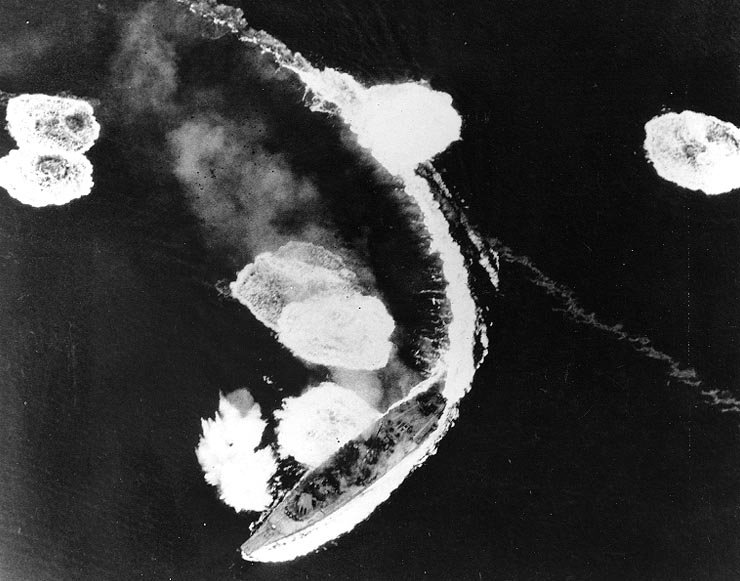
    They go together really, don’t they? All this Hearts of Iron 2 slaughter has led me to that most honourable of late night activities, the Wikipedia Wander, and in this case I find myself trawling through the combat histories of the battleships I’m building. The Japanese involvement in world war 2 is famous primarily for its naval component, and there is something about naval conflict that is inestimably cruel and heartless. There is no tale of naval combat where someone rushes out of the trees and drags you back to your fellows; instead there is the tale of floating in the sea for hours waiting for a rescue that may never come; there is exposure or the horrible death by oil-fire or drowning. The iconic pictures of the naval engagements of world war 2 (in this post we see the famous Yamato, desperately manoeuvring to avoid her inevitable end) depict a loneliness and desperation in every way as cruel and inescapable as the scenes from the battle of Britain, in which the person in control of the camera relentlessly destroys their target plane, watching it shred into a thousand pieces far above the ground, its pilot doomed. But in the naval case it is not a single man who dies, but a whole village worth of people, sometimes trapped far out on the open ocean with nowhere to go but down. Or they are the Special Attack Squadron (kamikaze) of historical fame, whose fate is so coolly described in the histories of the war but so hotly contested, to such pointless end, at the time.

    Of course, as nerds interested in wargames and role-playing games in the early 21st century, far removed from the military troubles of previous generations (at least, if we’re not Americans) we can afford to joke about and amuse ourselves with games set in this time and place, as I’m doing now with Hearts of Iron 2. We can “appreciate” the “realism” of the fantasy stories we read (such as those of Bernard Cornwell) which draw on these or other histories. But I think it’s good occasionally to reflect on how ultimately these tales that we enjoy playing in are built on something that is fundamentally completely and utterly wrong, usually of no value to those who instigate it, and completely destructive for the international order it intrudes upon. This is as true now for the “small” wars of Iraq (a million dead), Afghanistan (no one’s counting) or Libya, as it was of the unfathomable catastrophe that was world war 2. Rest assured I have every intention of nuking America (preferably Seattle, after they develop “advanced computers,” so I can pride myself on killing Bill Gates), but let’s not make any bones about it – these games we play are reflecting on a time whose repetition needs to be avoided at all costs.

  • They used to belong to the Dutch, but at some point all empires must fall (except mine). Perhaps they should be renamed to the “Japanese South Ryukyus,” but I’m saving that name for the Phillipines (which, sadly, will involve killing a lot of Americans, which is why I’m enhancing my fleet). I’ve found an excellent series of posts by some chap (I suspect an Australian) who successfully took over the world as Japan; I’m thinking of asking him how he managed to get such a huge industrial capacity by 1941, since I was lied to and have nowhere near as much benefit from China as I was expecting. The result of this is that I need a few provinces with oil, and who better to take it from than the perfidious Dutch? Tall, waffle-ated bigots the lot of them. Even their fascists are gay. They don’t deserve colonial possessions. Especially colonial possessions that offer excellent views of Australia, a launching point for rapid assaults on both French Indochina and the Phillipines, and a lot of oil and rare materials.

    It’s not like the Dutch have anything to fear, anyway; Germany is about to be annexed by the Soviet Union and no amount of colonial resource flows is going to save Holland from the red tide that’s about to roll over them. Maybe I’ll offer the survivors a squalid village in Lombok where they can swelter and labour under the whip of their Sumatran overlords.

    The Netherlands will fall fast, basically as fast as I’m willing to do amphibious assaults, and they are fairly resource rich. After that, unless I turn on Siam (who seem to be allied with too many people) my next step is America. In September 1943 the Pearl Harbour event will be triggered, but I’m expecting that before then the USA will go to war with the USSR, in which case I will avoid the Pearl Harbour event and build up my fleet for another year before I do anything; I suspect that the Pearl Harbour event triggers a massive frenzy of carrier construction by the US, which they won’t do if I just quietly invade their western seaboard after I destroy their Pacific fleet. I need them to be deeply embroiled in an unwinnable war with the Russians for this to be achievable, though.

    Last time I fought America I managed to capture chunks of the Western seaboard (California, etc.) but ran out of manpower. This time I have invested early in manpower improvements; I just need to ensure my fleet survives to protect my transports. Then I need to get nukes early, but I’ve delayed building my powerplant for a year while I try to build up a decent industrial capacity, a tactic that hasn’t really worked because Chinese partisans are stopping me at every turn. So… to the Netherlands…

  • It’s 1943, and in honour of the Japanese recovery from the Great Hanshin Earthquake I have installed my first nuclear reactor at Fukushima. We are, of course, talking Hearts of Iron 2 here. I’ve captured China and established the Empire of the Sun God (better names accepted) and I’ve also installed a rocket research facility in Niigata, and managed to gain access to the ICBM technology option. My plan, obviously, is to beat the USA to nukes. I figure that if the USA develops “electronic computer technology” and I develop a nuclear capable ICBM, then nuke Seattle, I can interpret that act as nuking Microsoft.

    Which would be a good thing.

    In 1943 I’m struggling to produce enough supplies and raw materials, and my oil stocks are dwindling – this despite owning all of China – so I’ve decided the only rational option is to invade the Netherlands. They’re colonialists, so it’s cool. Only bad people will die. Bad dutch people, even. What have they ever done for you? Sadly I’ll never be able to annex the Netherlands, because I don’t have transports with that kind of range, but I can capture Indonesia and West Papua. In the real world I would liberate them both, but in the game I can’t do that, but capturing the territory gives me access to their oil, plus a jumping off point for Australia, and a possible redeployment point for my V2 missiles (which are worthless; which is why I only made 1). I’m not sure if it’s worth bothering with the Phillipines, but I probably will.

    The big problem arose on 21st September 1943, when the computer offered me the option of a surprise attack on Pearl Harbour. This gives me the benefit of a short term advantage in naval conflict, but in the long term leads the US to gear up for war. I would have decided against this option, and gone for war against the Netherlands only in the short term, but alternate history has turned in my favour. In this instance of Hearts of Iron 2, the USSR invaded Germany in 1940 (which justifies Germany’s real-life decision in 1942, clearly). They annexed Germany in 1943, which is further proof that you shouldn’t rouse that particular bear. France declared war on the USSR a few weeks later and their allies followed, so currently the USA, UK and France (my key enemies) are embroiled in a war with the USSR. This means that I have a good 3 years before the USA can turn its sights entirely on me, and if the lessons of history are any guide, France is completely and utterly doomed. With the collapse of France on the continent I can capture their territories in Asia – I wonder what happens then? Anyway, this should neutralize the USA’s traditional industrial and supply advantage, and if I join a military alliance with the USSR I’m guaranteed to win the game. Alternatively, if I quietly develop nukes and ICBMs, I can destroy the USA’s infrastructure and take them from the flank while they’re embroiled in a continental war of stupendous proportions.

    Unfortunately, my naval forces have proven weak and this is a big problem against the USA, who are right now building about 15 aircraft carriers with the express purpose of destroying my navy. But they have some tough decisions to make with Russia about to stomp France, so maybe they’ll change direction and leave me to capture the Phillipines, Indonesia and PNG. Then I’m going to have sufficient oil and troops to do the dirty and capture England and Vietnam…

    Interesting times in WW2. Stay tuned for the tale of Japan’s development of nuclear weapons…

  • I can’t find much information online about how to win Hearts of Iron as Japan, so I thought I’d try it again for myself. I played once before, and got all the way to 1944 before it all collapsed in a heap. The reason that time was that I failed to plan certain things properly from the beginning, and didn’t understand the territorial conquest system properly, so I ended up in an industrial- and manpower contest with the USA. That’s not an easy contest to win.

    So, last week I loaded up Hearts of Iron 2, and decided to try again. For those unaware of this fine game, it’s a strategy war game that pits all the major nations from world war 2 against each other, starting in 1936 and running until 1953. It’s an enormously detailed system, in which the player has to choose policy settings, research technology, do trade deals, plan intelligence operations, build and plan units and even take control of supply convoys and unit leaders. The player can choose the level of control, but managing all the details requires a specially compartmentalized brain. I play with some settings – particularly convoy management and choice of unit leader – mostly automated, and tend not to fiddle with the policy settings or government ministers (much). I mainly focus on balancing industrial capacity and research, trade, and building new units. Combat alone in this game takes most of my attention, since you can’t beat another nation – even a weak one – without careful attention to supply lines, who is supporting who, and where your armies should go next. Basically, if you want to destroy your enemy you need to encircle chunks of their army, destroy them, bite off another chunk, and so on.

    So, this time around I wanted to play Japan as a kind of benevolent Asian power, possibly even aiming to ally with the comintern against the Nazis, but things sadly didn’t go quite according to plan. It’s very clear that the liberal democracies of the inter-war years are a fickle and untrustworthy bunch, heavily involved in colonialism, and in fact the region around Japan is infested with British, Dutch, Portuguese and US colonies or puppet kingdoms. Through the 20s and 30s, of course, we know that the colonial powers – especially Britain and the US – were increasingly infringing on Japan’s rights, and had aggressive plans for the region. For example, if you look at the map in 1936, you can see the French possessions stretching right up to the southern Chinese border. Is this the behaviour of responsible citizens?

    So, both to protect Japan from colonialism and to ensure the continued peaceful growth of the region I felt that Japan could play a leading role establishing a kind of Asian alliance, that might stave off the western powers. I could see a kind of zone of free commerce and peace in the region, a co-prosperity sphere if you will, and hoped that this would be sufficient to protect both my own nation and the region under my benevolent guidance. Unfortunately at every turn the Chinese stymied my plans, sending spies to my nation and attempting to turn world opinion against me – I think they even saw the presence of a few militia units in Manchukuo as provocative, rather than simply in the interests of my ally’s internal security, and the Chinese began arming up. But they were also playing cosy with the USA, and I could see that in the long-term the conflict would undoubtedly end badly for Japan (and by extension the region) unless I could increase Japan’s industrial capacity, and secure a greater range of supplies.

    Given the instability on its borders, and the threat of incursion from the south by an aggressive communist insurrection within China, I figured the best way to make everyone in the region safer was to send a security stabilization force into Shanxi, a kingdom between my colonial possession my ally Manchukuo and Nationalist China. This force wasn’t even mainly Japanese, being at least 50% divisions from Manchukuo. Unfortunately the Chinese misread this as a sign of colonial intentions, and reacted by annexing Shanxi, invading the Guangxi Clique on their Southern border[1], and declaring war on me!  Fortunately I had a rapid reaction naval force in Dalian, and I responded to this act of naked aggression by landing it in Shanghai and fighting Northwest towards Shanxi.

    This pincer movement weakened the Chinese in my region, but I subsequently discovered that their weakness was partially due to overreach – they had also declared war on and invaded Yunnan to the Southwest, and Sinkiang to the West. So, my suspicions were proven correct all along – they planned to expand their own territory, obviously counter to any plans for peace and prosperity in Asia. They also seemed to have become embroiled in a war with France, which seems a bit stupid, but also confirmed my suspicions that the colonial powers had designs on the two unconquered great powers of Asia. The only solution to Chinese aggression was to overthrow their illegitimate leadership, and the only language that liberal democracies understand is force, so I had no choice but to prosecute a war against China to the fullest extent of my powers. So, I adopted a policy of rapid amphibious strikes on the Chinese coast, with the incursion forces pushing inland to encircle Chinese resistance and mop it up, and simultaneously pushing Northwest to meet my forces as they descended from Shanxi. In the first year, large numbers of Chinese divisions were cut off and destroyed this way. Of course, I’m a benevolent power, so the survivors are treated well, and are being held in facilities where they are educated daily in the benefits of a greater Asian unity under my leadership.

    Throughout this process, the Americans have been trying to destabilize me, and the Germans have been subject to considerable international pressure, even being forced to annex certain territories to their immediate East, such as Czechoslovakia, in order to ensure their security. This proved remarkably foresightful, as the USSR declared war on the Germans in 1940. I haven’t joined a full alliance with the Germans yet, but I had a hard and protracted fight against Communist China, and I can see how the Germans must be scared of the Soviet Union, so again I need to consolidate my hold on fractious China before the situation in Europe stabilizes.

    Currently, however, the war has become somewhat bogged down. I have established a huge pincer on the southern and northern sides of China, with forces stretching as far as the border of Mongolia to the north, and as far as the southern foothills of Sichuan to the South, where Chengdu is in sight. In the middle stand some 30 or 40 divisions of Chinese troops, who have put up bitter resistance against my forces. There is a river that flows between the old Communist China and Xi’an, and the battle has reached something of a stalemate there, with the Chinese defending the ancient capital of Xi’an ferociously. I think I have finally established a foothold on the southern side of that river, though, and captured Xi’an. The battles to cross the river have been huge, spanning multiple provinces and involving tens of divisions on both sides, only to end every time in a bloody stalemate. To the south the battle proceeds valley-by-valley through the mountainous regions near Chengdu, and in the hills to the East of the mountains has been slowed by dogged resistance. However, I am confident now that I have strangled much of China’s access to resources and industry, so that they no longer have sufficient capacity to reinforce their soldiers and supply their civilian populace; and the tide of battle appears to have turned recently after I developed the technology for modern infantry, and upgraded my battlefield divisions. I am also pressing a new unit of modern motorized infantry into the fray, and think I can complete a massive pincer movement cutting off some 20 or so Chinese divisions within a few months. From there only mopping-up operations will remain, and I can annex the entire territory.

    This is necessary, because it is now mid-1941 and the tide of history suggests that within a year or two I will be at war against the most vigorous and acquisitive power, the USA. They may not have many colonial possessions now, but their intent towards the Pacific is clear. I need to be able to shift my industry – and the newly captured industry of China – to the production of coastal fortifications, radar stations, and aircraft carriers for the long war to come. Plus, I have a nuclear reactor and a rocket research facility to build, and as yet my armoured divisions are very backward and in need of upgrades. I am confident though that if I can capture China I will be well-placed to turn its industrial capacity to the task of conquering America.

    This game has one cheat that I really hate, that makes things a lot harder and which I think doesn’t reflect historical realities. Basically, you can’t gain access to a nation’s industrial capacity until you annex the nation, which means capturing all its key regions (which have “victory points”). So, when you get close to capturing one of China’s puppet nations (e.g. Shanxi, which would have increased my industrial capacity by 15% or more), the computer annexes that nation. This eliminates the nation from the diplomacy board, and prevents you from annexing it. You then have to conquer all of China before you can free up the industrial capacity of those regions that were in the puppet nation. I don’t think this is a realistic model of conquest, but the computer’s use of this trick has denied me access to the industrial capacity of two whole nations for about 3 years (I captured all the regions of Shanxi and the Guangxi Clique in about 1938). So, although I’m going to try a legitimate victory, if the battle drags out in China’s huge western provinces I’m going to use a reverse trick. Every time you load a saved game you can start as China instead of Japan. So I’m going to load a saved game as China, and then make a peace offer to Japan on ludicrous terms that reduce China to only a handful of useless provinces. Then, I will save, quit, enter that game as Japan, and annex the regions I have been ceded by China. I can then invade the remnants of China and take my time about it, having siezed the key industrial capacity ahead of the looming war with the US.

    Last time I lost this game due to a sudden collapse of manpower, and the inability to out-produce the US. Part of the reason for this was that I failed to adequately capture all of China (in fact, I don’t think I even tried), and so spent a lot of time and industrial capacity without gaining any long term benefit. This time I shan’t be so foolish. Once I have captured China I will commence my nuclear power program (in 1941!), build a super-fleet of carriers, and aim to have troops on the US mainland within 3 months of going to war – this is the only way to prevent its productive capacity from completely swamping me.

    Perhaps then we can begin to consider a co-prosperity globe, rather than merely a region…

    fn1: Which, fair enough. No nation with the word “clique” in its name can mean well, can it?