The Australian census is due soon. In 2001, 0.37% of the population wrote “Jedi” as their religion. Will Yoda triumph this time around?
Compromise and Conceit
Infernal adventuring…
-
I really like the Pirates franchise: it’s got pirates (sometimes undead), swashbuckling, ships ‘o the line, monsters, magic, necromancy and demonology, back-stabbing, swindling and mincing ponces getting out of trouble by the skin of their teeth. It also has Johnny Depp and Geoffrey Rush playing parts they seem to really love, which is a joy to watch. This one has the addition of Dan McShane from Deadwood as Blackbeard, and a host of evil mermaids. It’s also dialled back on the double-crossing and plot twists from part 3, which is good – colour me old-fashioned, but I like my action movies to be sparing on plot and heavy with good dialogue and action. On Stranger Tides delivers this with its old passion, giving us a healthy run of piratical interchanges, some entertaining fight scenes, some excellent swash-buckling escapes, and the usual sinister context of black magic and evil.
The basic outline of the plot is very simple: the Spanish, the British and Blackbeard the Pirate are all making an attempt to get to the Fountain of Eternal Youth, and Captain Jack Sparrow has been caught up in it all, along with Barbossa. Everyone has their own very distinct agenda and purpose for the fountain, which we aren’t going to discover until the final confrontation; all the way through we’re kept guessing at people’s motivations, without the thankless task of trying to keep track of the threads of all their betrayals and swindles. To get what they want from the Fountain they need to get some components for a ritual, so the middle part of the movie is all about the contest for the parts, a contest that is at times more than a little deadly and at other times surpassing cruel; the last quarter or so is where all the disparate plots come together and we find out what everyone’s really up to. It’s about 2 hours long but with a better pace than parts 2 or 3; you get a few breathers in the middle, which I think helps to contribute to the sense of a less needlessly complex plot.
We don’t learn much more about Sparrow (though we get some tales from his past); we do get to find out a lot more about Barbossa, a character I really like, and we get to see a very nice vision of the Fountain of Youth. We also get a nice helping of new magic, mainly that under Barbossa’s command, and get to enjoy Sparrow in a new setting (London, as far as I could tell). Overall it’s a nice addition to the series, and makes me think there’s life in this old seadog yet. I reckon it’s good for another one or two instalments before it dies in the arse; I recommend checking in on this one because, in my opinion, it’s a slight improvement on the previous two, and it is fun in and of itself.
And I wonder – would it make a fine role-playing setting? I think it would!
-
The Guardian has a very cute article about reading Lord of the Rings in Lagos, at age 13, by Claire Armistead. Trapped for 6 months in the sweltering Nigerian capital, her mother set her the book to read to keep her out of trouble, and she has since always associated Tolkien’s world with the mangrove swamps and rivers of Africa. She describes imagining Ents as Baobab trees and Nazgul as vultures, and sees spies of Sauron in the crabs in the mangrove swamps. It’s a testimony to the power of personal experience to shape the way we imagine someone else’s worlds, and also shows how important context (cultural and physical!) is to interpreting any text.
And, of course, it’s a strong testament to the power of Tolkien’s world-building, that it holds its magic even in the minds of children reading it in a completely different place and time.
-
Because one day, I aim to sue for injuries incurred having sex at work as well!
-

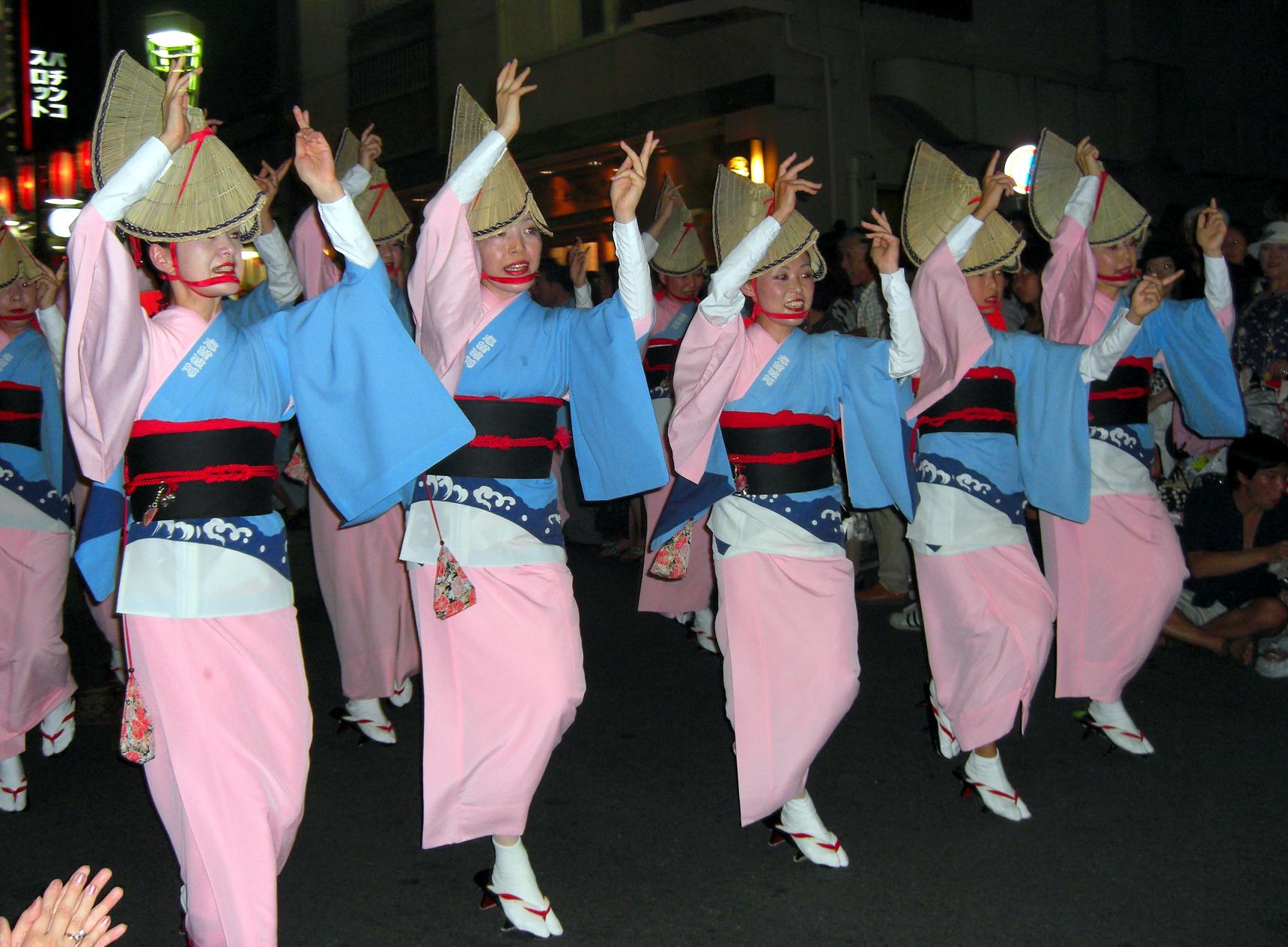
Whatever happens next won't be as pretty as they are On Friday night I attended the Kagurazaka Festival in Idabashi, Tokyo. In this famous festival, groups of performers dance their way around a course through the streets of a famous part of old Tokyo; the most significant part occurs on the famous “Kagura Slope” to a backdrop of drumming and Japanese pipes. The procession alternates between groups of men carrying lanterns, and groups of women in the outfits shown above, whose dance primarily consists of movement of their hands and a strange, shuffling walk on the tips of their geta shoes – an extraordinarily difficult dance to maintain for two hours, especially given the oppressive heat of this season. The crowd of onlookers is drunk down to the last tottering young lady, and the dancers are carnivalesque, leaping on members of the crowd in a group or giving lewd and suggestive movements to admirers in the crowd. At times the women draw up into a phalanx such as the one pictured, and the men dance around them; or the women themselves suddenly surge forward to wave their hands at the crowd. The rhythm and style of the dance can be viewed here, and some interesting pictures here. As ever with Japanese drumming, the full force of the drums are not captured in amateur film. A slightly more professional depiction of the same dance from the seventies can be viewed at the 10’05” mark of the movie Sans Soleil, which is viewable here. Notice how in the first video the dancing girls bunch together into a tight phalanx of kimono, pointed hats and arcane hand movements.
Seeing this, I asked my friend Sergeant M (who used to role-play with me) how he thought a group of my players would react if, in the midst of a battle-scene, the serried ranks of their enemies parted to reveal a group of these women, moving slowly forward on their tip toes, arms moving in strange patterns, seemingly completely unarmoured or unprotected in any way, perhaps followed by a group of drummers, whose rhythms had preceded the girls onto the battlefield. Packed into a tight phalanx, staring at the characters and apparently in the midst of some powerful invocation, what exactly would my players think? The sergeant broadly agreed with me that, given the general lack of trust that my players have for me as a GM, their general expectation that nasty and infernal things are going to happen, and the ongoing fear my players usually have that more is going on than quite meets the eye, they would greet the arrival of a phalanx of dancing girls like this with extreme trepidation.
From this I imagined this monster, consisting of a group of these fiendish young ladies, their magical power enhanced by the tight group membership, the mysterious combination of hand movements, the ritual garments and the music. Perhaps sometimes they are led by a wild-eyed man in festival clothes, carrying a pole-arm decorated with a lantern, and followed by a small band of musicians. They fight exclusively with magic, but so tightly coordinated and close-knit is their unit that killing any one of them makes no difference to their morale or powers. To win a battle against the Kagura Dancing Maidens, you need to kill all of them before they can complete their invocation. Of course, with dancing lantern-man fighters surrounding them, and a shield of protection drawn by their musicians and their own magical powers, killing even one of them is not easy. And woe betide the hapless group of adventurers who experience the full brunt of their completed invocation … or the army that faces a full dance troupe adequately protected.
Perhaps also they have powers of magical fascination, their weaker-willed opponents brought to a halt by the sight of those strange, dancing hands; maybe they are accompanied by the spirits of the forest and the servants of the gods they serve; and perhaps they are equipped with a range of powerful protective items (the straw hats, the pouches hanging from their obi, the obi itself…) The beleaguered adventuring group needs to find their weakness and exploit it ruthlessly – perhaps they are vulnerable to a particularly charming man, or wither in intense heat, or cannot run faster than their strange tip-toed walk allows them; maybe their entire power depends on the drummers who follow them. Or maybe they are just a very powerful, arcane opponent, that only the most powerful of adventurers can defeat…
The mystery of the ritual and the massed women gives this opponent lots of power to unsettle players and confuse them, particularly the first time they encounter it. Played well in the right setting, I think it could provide a disturbing and exciting encounter.
-
In amongst the horror and carnage and corruption that is modern Western Europe, the Guardian has a quaint report on the table soccer game of Subbuteo, which apparently is still going strong and has its own fanatical retro-games following. The world final concludes tonight in Palermo, Sicily, and the report includes reminiscences on the popularity of the game in the 80s and early 90s. Just like D&D, its popularity was driven by its huge popularity amongst primary-school boys. I remember playing in a league at my school (and not coming in the bottom), and arguments with friends at home – I hadn’t thought of this for years, until I read this report.
Note also the photo of the humble abode of a 70s football club manager. You wouldn’t see anything like that now!
-
On the same day it considers banning facebook for children, the Australian Federal Government has agreed a deal to implement an “R18+” category for computer games. This category brings computer games into line with videos, and has long been sought by the game industry – the alternative method used by the censorship board in Australia has been to refuse very violent games a rating (as happened with, I think, Grand Theft Auto) or to get the company to reduce their content to M15+ level. The game industry has long seen this as a commercial problem, since it introduces considerable uncertainty into Australian business models.
Australia doesn’t have a censorship policy that’s particularly friendly to “creative” industries, in my opinion – the government can be quite ferocious in its censorship if it sees community concern (or a chance at votes) connected to an issue, and particularly where children are involved the censorship rules can be ridiculous. The most famous example of this is the Bill Henson furore. The sometimes political nature of government actions can be seen in the way this deal is reported: the federal government has stitched up a deal with all the states except New South Wales (NSW), which has a long-standing fringe-right religious party and movement that has strong views on censorship, and which the (quite new) Liberal party[1] probably wants to court support from. Also, the NSW state Liberal party has a bit of a history of extreme-right christian shenanigans, and probably doesn’t want to upset that particular apple cart. In any case, the deal is going ahead without the agreement of the country’s most populous[3] state, which may lead to the ludicrous situation in which R18+ games can be bought in any part of Australia except … Sydney! Brilliant.
Still, it’s an advance on the current situation, where game companies have to second guess the whims of the censorship board because there is no category beyond M15+ that they can put their games into. This isn’t to say they won’t still be denied a rating (this has happened to a few movies in history, and famously a pair of movie critics were almost gaoled for playing one of those movies, I seem to recall). But It’s a lot easier to release a game in Australia that was designed for an overseas market if you have an R18+ category than if you don’t. Hopefully this will lead to more diversity of computer games – and more violence!
Incidentally, I should add that I’m not opposed at all to this type of censorship system, though I don’t like the part where some movies are refused a rating – there should be a new category of “Don’t watch this” for such movies, and people view them at own risk. But censorship-as-labeling seems a fundamentally sensible idea and, Metal Militias’ historical rage against Tipper-stickers aside, I think it helps rather than harms the ability of the community to judge what it wants to watch and indeed, gives some ability to identify what our own standards are. There is, of course, a bigger debate on free speech between Australians (or antipodeans generally) and Brits on the one side (who generally seem to see all “freedoms” as contingent to some extent) and Americans on the other (who seem to have elevated “freedom” to the level of a false Idol). I of course find the antipodean approach best, but I think that sometimes Australian governments of all political stripes can be too conservative and restrictive when it comes to free speech, and could do with a few drops of American medicine. So this is a good step forward, in my view.
—
fn1: As Australians never tire of observing, our “conservative” party is called the “Liberal Party,” because we’re in the Southern Hemisphere and we’re backwards[2]
fn2: Which isn’t to say there isn’t some value to this nomenclature; a great many US “liberals” would probably be considered too conservative for the Australian Liberal Party.
fn3: And possibly most politically corrupt, to boot[4]
fn4: Though I’ve never lived in Queensland, so I could be wrong about this.
-
The French soldiers at the Battle of Agincourt were so exhausted by the time that they entered battle that they could barely have fought, according to new research reported in the Guardian. A professor of biomechanics asked staff from the Royal Armouries Museum to walk and run in replica armour from the 15th century, based on a variety of designs, and took measurements of oxygen use, which enables estimates of energy consumption. The Guardian website has a video of how they did it.
Apparently running in a typical suit of armour uses 2 times as much energy as running in normal clothes, because the armour weighs up to 30kg; but worse than that, running in a backpack carrying 30kg of weight uses only 1.7 times as much energy. This is because the armour distributes some of that 30kg onto the limbs, which move more than the back during ordinary movement. Additionally, armour constricts breathing. The news report also points out that in Agincourt the French had to slog through mud, which would further add to their energy load. Interestingly, armour is comparatively more efficient when running (1.9 times the energy load) than walking (2.3 times).
I’ve always been suspicious of mediaeval re-enactors oft-repeated claims that plate armour is easy to move in and not that exhausting. I suspect this comes from their limited experience of battle. I’m guessing that most mediaeval re-enactment battles cut straight to the chase, and ignore the lived experience of 15th century soldiers. Most battles probably consisted of many hours of standing and walking, and obviously we don’t do things like mediaeval re-enactment in order to reproduce the tedium of ancient warfare (or the cholera and dysentery, for that matter). So if you cut out the long, arduous process of getting to and from the battle, waiting fororders, etc. the armour probably doesn’t seem so bad. But if you think about moving around for hours in it, and the battle itself just a short part in the middle, you can see that the energy expense of just walking would be a terrific burden on the use of armour. When we think about adventurers in caves and dungeons, slogging around for hours in their full plate, it makes sense that it should put an inordinate penalty on their combat actions to represent this. Warhammer 3 reproduces this nicely with punitive encumbrance rules that quickly punish characters with fatigue penalties; I don’t think D&D was ever so good at this (largely because no one ever bothered with the encumbrance rules, I guess). Of course Rolemaster does it with complex movement manoeuvre penalties, which would be really good if they were combined with fatigue (which I don’t recall RM using).
I think the Guardian has probably over-egged the pudding on this one though, so here’s a few additional thoughts:
- The study subjects weren’t fit: Some workers at the Royal Armouries are probably re-enactment types[1], and might be used to armour, but at a guess most of them weren’t that fit or trained for running in armour. My guess is that, just as longbowmen trained to use the bow, mediaeval soldiers trained for their armour, though this guess could itself be over-optimistic (“training” is actually a pretty modern concept). So it could be that the relative burden of armour compared to no armour is reduced in mediaeval soldiers compared to modern archivists, since fitness training tends to adapt the body to specific activities
- The study subjects were modern: and thus almost certainly physically healthier than a mediaeval soldier, with better diet and less childhood illnesses to reduce fitness. However, they were likely also bigger, and bigger people (I think) use energy less efficiently. But one should never underestimate the importance of good modern diet, housing and healthcare (as well as childhood fitness training at school) in improving the fitness of modern people over their ancestors. So it could be that armour was even more exhausting for the mediaeval knight
- Study bias due to armour type: Wikipedia tells me that actually most soldiers didn’t use the type of armour depicted in the video on the Guardian site, and were more likely to wear weaker wrought iron or composite armour types, that are probably also easier to move in (though wrought iron full plate could be awful, I would guess!) It also tells us that the elite knights in the vanguard at Agincourt[2] were relatively unharmed by the longbows. Still, they would then have to engage in melee combat against lightly-armoured and mobile foes while exhausted. So the best tactic for these guys would be to ensure they were surrounded by less heavily-armoured allies while they regained their breath; unfortunately, the longbowmen would have reduced the numbers of those less armoured mooks quite hideously (the stats and description of the bows at that wikipedia entry suggest that for the lighter-armoured French soldiers Agincourt would have been truly terrifying). In any case, the army fielded at Agincourt would not have looked much like the army being tested in the linked study
- The longbow was actually not that effective: Wikipedia also tells us that, although they had a few successful battles, the French quickly got the measure of the longbowman as a weapon of war, and in some battles either defeated them or routed them. This is probably because tactics based on the longbow depend on this phenomenon of exhaustion – you thin out the lightly-armoured troops in the charge, and by the time the knights reach you they’re too buggered to fight. But I guess this depends on either a numerically superior force or having very good positioning to force a long charge (as happened at Agincourt, with mud). This goes to show that tactics are ultimately more important than most single weapons or devices. Also, I guess that although the longbowman appears, superficially, as an appealing strategic investment (lightly armoured, so cheap to equip, and manpower was something every mediaeval country had an excess of), he was probably actually a type of elite professional troop that was highly expensive to develop (15 years on that bow!), and you only need to beat them in battle once or twice to have essentially destroyed a once-in-a-generation investment. So maybe as a military tactic the longbow was as much of a dead end as the knight. The pikeman, on the other hand…
It’s nice to see science attempting to answer some of these questions about how the ancient world waged war or achieved some of its more impressive peace-time achievements (like the science of longitude, cathedrals, etc.) Some of what we think of now as quite barbaric or backward practices, or don’t esteem because they’re trivial in the modern world (like church-building) actually required prodigious talent and willpower (like any kind of mediaeval warfare) or skill, and it’s good to appreciate that.
—
fn1: If you’re from the Museum and you’re reading this, please don’t sue me for this slur
fn2: Ah, the days when the people who chose to go to war actually had to lead the charge! I bet if that were expected of your average modern politician, we would have much much lower “defence” budgets that were actually for defence.
-
The Nameless One has spoken, this time through a team of oracles at the German sea-life aquarium, and the cephalopod cabal predicted a win by Japan in the Women’s Soccer World Cup. The closeness of the decision within the tentacled tribunal led some to question whether the final match might be a closely-fought event, and indeed it was; but in the end Nadeshico Japan won! Ganbare Nippon! I wanted to watch this final match but sadly it was only available on pay TV, so I missed it. But I’m happy that Japan won a well-deserved victory after beating some tough teams (Germany and Sweden!) to get there.
Incidentally, Nadeshico in Japanese is a name taken to refer to a classical Japanese vision of feminity. To say someone is “a Nadeshico” is to compliment their feminity as both beautiful and traditional. I think this is an excellent name for a women’s national soccer team. Well done Nadeshico!
 Compromise and Conceit