• This is a cute variant on chess that I bought in Japan as a souvenir for a friend. I wasn’t expecting it to be anything but a cute example of Japanese children’s game design, but it actually proved really interesting. The game layout and images of the pieces can be seen here: it’s obviously just a cute little chess game. The rules are similar to chess but with simpler moves and an additional way of winning. The board is a 3×4 matrix, with sky at the top and forest at the bottom. These regions constitute the players’ “areas”, which are similar to the back row of a chess board.

    The pieces
    Each side has only four pieces:

  • The lion, essentially the king in chess, that can move one square in any direction, making it as powerful as the queen on this board.
  • The Elephant, essentially a bishop, that can move one square diagonally
  • The Giraffe, essentially a rook, that can move one square horizontally or vertically
  • The Chick, essentially a pawn, that starts in the middle of the second row and can move forward one space. If it reaches the enemy area the chick becomes a chicken (which in play my friend called a “magic chicken” ) that can move sideways or forward diagonally, and backwards one step
  • The objective
    Winning is possible by catching your opponent’s lion or by advancing your lion into your opponent’s area. Catching the lion is called “catch” and winning by advance is a “try.”

    Replacable pieces
    The main change from the standard rules of chess is the ability to return captured pieces to the board. After you catch your enemy’s piece you put it next to your side of the board and can then place it on the board instead of moving an existing piece. You have to place them in the order you caught them, and you can put them in any empty square. It wasn’t clear from the explanation but the rules stated that the chick has to advance into the opponent’s area to become magical, so we figured that means you can’t enchant a chick by placing it in your opponent’s area.

    Differences from chess
    Replacable pieces on a board this size makes for an interesting variation on chess. You can see from the diagram that the chicks start off facing each other and able to take each other. This is of no benefit to the person who starts because both players end up with a chick in hand, but one player has his lion in the middle of the board. The lion is strong, not weak, so this is a good position to start.

    This is the other main difference from standard chess. Because no piece can take from range the lion is the strongest piece on the board, and moving it out early is good. Also, the ability to win by a try makes aggressive use of the lion a good tactic. In fact, over 10 or 12 games I got the impression that this game encourages aggressive play.

    Another difference from chess is the use of diversionary tactics, especially using captured pieces. For example, if you threaten the king with a newly-placed elephant from one side of the board, the king will have to take it. This gives your king a free run up the board on the other side. I don’t think these tactics are used as much in standard chess.

    Three special rules
    This game is a training game for child chess players (the website is on the women’s chess society homepage), and as such intended to introduce children to chess culture. So it introduces three special rules for all players:

  • Always say “please be good to me” (yoroshiku onegaishimasu) before you play and “thank you” at the end
  • Never let anyone help you: play under your own effort
  • Never say “again”: in mistakes are the foundation of learning, so try to accept your errors and play without taking moves back
  • Each game takes only 5 to 10 minutes, so it’s a pretty quick learning curve compared to chess and it’s cute and fun to play. I recommend giving it a go. It also has me wondering what other variations on chess might be possible. For example, if you doubled or tripled the board size could you play chess like a modern war-game, with great sprawling battles, and wargame-style tactics? I’ve not really seen variations of chess based on changing the board size and distribution of pieces, but it appears to offer opportunities to use the basic rules of chess to play a very different style of game. An interesting idea…

  • I am watching England being slowly ground into humiliation by an astounding Argentinian team On the second day of the biggest contest of the world’s most important sport. It’s a war of attrition out there but the Argentinians are proving once again that the future of sport lies in the southern hemisphere. Sadly I am neither in the south nor the east for the first two weeks of this titanic struggle: I am in scungy, embittered London for a (great!) course on mathematical modeling of disease[1]. This means I have to watch the games in the morning and will miss most, but I can at least enjoy this weekend’s.

    I love watching rugby. It’s the perfect synthesis of physical contest, teamwork, bravery and skill, and it happens at a pace and intensity that other contact ball sports lack. I love also the special tactics that derive from the specialization of the players when they are forced to mix it up in a chaotic melee. It also lacks the posturing and false machismo of soccer, and the nationalism of rugby doesn’t come with the nasty violence or racism of that sport. It’s culturally a million miles away from the other British code… It’s the best side of sport.

    In today’s other game in a remarkable upset, Japan stood up to France right up to the last 10 minutes, even looking like they might win at one point, until their fitness gave out and les bleus marched home. Fans all around the world were hoping for a miracle there, but it didn’t come. However, I have hopes that this time around they will be able to get some victories. In 2007 they got their first ever points in a cup; this time they can hope for victories.

    And of course I am hoping for a NZ victory, but they are famous for choking at the last. Can they do it in their home country in 2011? And if they can’t should Australia annex them?


    fn1: one of my fellow students is the Australian Nobel laureate Barry Marshall, who identified the cause of stomach ulcers[2]

    Fn2: and thus proved that the future of science is also in the southern hemisphere

  • This is another Stephen Hunt novel, set in the same world and with the same characters as the previous two I have read, The Court of the Air and The Kingdom Beyond the Waves. While the last two were definitely steampunk-fantasy, this one has crossed the line to science-fantasy, with a heavy dose of space opera and time travel to leaven the mix. I really like the world Hunt has created, and I think it provides interesting insights into the kind of post-scarcity fantasy that has been under discussion here recently. The world of these books includes clockwork-run computers and steam “transaction engines,” as well as sentient “steam men” who are basically steam-driven robots; this is a kind of steam-driven cyberpunk, with a heavy element of magic hanging it altogether. It also has a basis in real world politics, with the kingdom of Jackals clearly modeled on an atheist, post-revolutionary Victorian steampunk Britain; while Quatershift is clearly post-revolutionary France, where the revolution turned horribly communist but revolutionary Britain remained free-market capitalist. These models for a fantasy world based in an alternative-history earth with different geography and multiple races, as well as druidic magic, are really fun to wander through. The world of these tales has a high amount of magic that is put heavily to use in the service of the state: law and justice, war, public transport and scientific research are heavily driven by a combination of magic, old-fashioned science, steam technology and mysterious semi-magical materials science. The world is identifiably Victorian but also wealthy and capable of stupendous feats of technology and human achievement.

    In this novel, the kingdom of Jackals is threatened by a powerful force using very high technology to an extremely destructive end. Although the technology resembles space opera-level power (space and time travel, nuclear power and weapons, and beam weapons and modern aerial machinery) much of its impetus is derived from harnessing the magic of the land. As a consequence it is understandable by and – more particularly – vulnerable to the ancient magical powers of the druids and fey creatures who live in Jackals. The heroes of previous stories have access to these powers and use them to combat the invasion, but they are clearly outclassed and need to use all their wits and power to face their foe.

    Just as in previous books, the narrative is fast-paced and exciting, and some of the characters very enjoyable – I particularly became fond of Commodore Black in this story – and the plot is fairly robust, requiring leaps of faith and imagination but not particularly unbelievable or inconsistent. We learn more about the history of Jackals and Quatershift, as well as their present cultures and the magic and cosmology of the world. We also get a glimpse of what people without a proper knowledge of science can achieve if they have magic and an ingenious turn of mind.

    Also like the previous stories, this one involves a certain element of deus ex machina that can be occasionally frustrating. It leads to main characters gettnig sudden mighty powers out of nowhere to rescue them from mounting adversary, and also causes the plot to hang on sudden leaps of intuition or new-found abilities that sometimes stretch credibility. But the story is pacey and you want to know both the secrets of the enemy and how they’re going to solve the problems facing them, so it’s not a deal-killer; but it is frustrating at times that the story can only proceed through main characters gaining the grace of ancient powers.

    Despite these small complaints, it’s a fun book and the world it’s set in is an interesting and enjoyable addition to the fantasy genre. Also, revisiting the characters of Molly, Oliver, Coppertracks and Commodore Black is fun, as is the rumbunctious and chaotic politics of Jackals. Stephen Hunt’s writing is fast-paced and fun, and his books more than hold my interest. Read this novel if you want to see Steampunk taken in interesting and challenging new directions.

  • We continue our series on Tim Power’s War Without Mercy with a discussion of the role of social scientists in the construction of propaganda. We have already seen that Japan’s social scientists were working on the question of how to construct a new social order for the pacific under a Japanese empire, but their role by no means ended there, and nor was this kind of distasteful theorizing limited to Japanese scholars. In fact the work we saw in our previous post was largely conducted in secret,and served less to construct propaganda as it drew on existing racial ideology to develop practical plans. And in this we see the nub of a fascinating problem. By the time Japan had spent 10 or more years at war in the Pacific her propaganda had become so entrenched that the social scientists’ work had itself been infected by the kind of foolish ideologies that so much effort had previously been put into convincing the population to believe.

    The same can be observed of allied war planers before the war. Based on the theories of racial and social scientists, Britain’s military planners really believed that Japanese would make bad pilots and couldn’t win aerial warfare – they had been told by their scientists that the way Japanese women carry their infants affects their inner ear and makes them unsuited for aerial manoeuvres. Also they believed the Japanese to be short-sighted and timid, and had been told that their lack of initiative would make them predictable and uncreative war planners. Even at Iwo Jima, when the Japanese defence used coordinated heavy artillery, they decided the Japanese must have German support; they assumed this after initial victories in the Pacific as well, because their racial theories didn’t allow non-white races to win.

    These fallacies in the support of propaganda were not accidental, either. Sometimes considerable effort would be put into research and justifications for certain political views. Social scientists played a key role here, presenting both academic and popularized descriptions of Japanese culture that supported the views being presented by government propagandists. Extensive effort was put into proving that the Japanese as a race were trapped in a childlike mental state, with the preferred theory appearing to be that Japanese toilet training techniques were so horrific that they arrested the development of the Japanese psyche, rendering them also vicious-tempered and subservient to authority figures. That’s right, a whole race’s psychology traced to it’s choice of toilet paper, and entire theories of wartime conduct developed on this basis.

    I don’t think it’s a coincidence that a whole bunch of social scientists spent a large amount of time working on a complex set of theories that ultimately ended up agreeing very closely with the base propaganda of the US government and Leatherneck magazine, any more than that a previous generation of scientists labored to prove that blacks were inferior to whites; or archaeologists managed to prove that the white race settled India. It’s a salient lesson to all of us – especially those of us in or near academia – that the much-vaunted intellectual freedom and independence of academia always ends up telling us what we want to hear. This shouldn’t seem so surprising, given human nature and the way society works, but the history of academia’s service to unpleasant ideas should stop us being too self congratulatory about how free-thinking we really are in our ivory towers. My own field of statistics prides itself, I think, on being quite independent and free-thinking[1], but it’s worth remembering the somewhat unpleasant eugenics of Fisher, and the role of demographers and population planners in the Nazi occupation of eastern Europe – all very good examples of academics supporting the status quo when, in retrospect, the status quo was obviously wrong and in many ways evil.

    Maybe things have improved since world war 2, but maybe also they have just become more sophisticated, or the stakes have been lowered. We’ve seen plenty of social science in support of foreign intervention (e.g. The domino effect) and dictatorship (some of our more morally bankrupt economists on Chile, and a wide smattering of pre-70s leftists on Eastern Europe), and the history of population planning hasn’t been free of controversy in the post-war era. So it’s worth remembering that quite often scientists are working as hard to reflect perceived wisdom as they are to uncover genuinely new ideas. Where the propaganda is needed the academics seem to be able to find a basis for it; and where it has already taken hold they are as likely to perpetuate it (or just lend it a little nuanced sophistication) as they are to challenge it. And you certainly can’t rely on us to bear the load of intellectual honesty when the stakes are high. So next time a scientist tells you they have stunning proof of a commonly-held prejudice, you should probably just smile and back away politely. Who knows where their work will end – it could be a population planning document whose contents have long since passed into preposterous fantasy; or it could be a firestorm in Tokyo. But like as not, their work isn’t going to get you to any profound truths – or at least, that is the lesson we can learn from the involvement of academics in the development of the theory underlying propaganda and race hate in world war 2.

    fn1: though maybe this field is better characterized as a bunch of ratbag leftists, at least in my experience

  • Continuing to flog the dead horse of post-scarcity fantasy, I thought I’d bring my day job to bear on the task, and test the cost-effectiveness of a cleric-based public health measure to reduce infant mortality in a developing (medieval) nation.

    Introduction

    Infant mortality was a significant public health problem in the medieval era, and in the absence of explicit evidence to the contrary it is reasonable to assume that it is also a significant cause of morbidity and mortality in medieval fantasy settings. Reduction of infant mortality leads to increased wealth as families devote resources to tasks other than childbirth, and also to reduced family sizes, a significant element of economic growth in most developing nations. Furthermore, control over fertility is considered a significant element of women’s emancipation, and reduced infant mortality reduces family size.

    As a public health task the reduction of infant mortality is not particularly challenging, but ultimately relies on access to advanced medical care for the small minority of mothers for whom drastic complications arise. Such medical care is not available in many developing nations, but in medieval fantasy settings it is easily provided by divine spell-casters, through the wide range of magical healing technology available. Until recently, it was believed that this technology was too rare and expensive to be used for non-adventuring tasks. In this report we investigate the cost-effectiveness of devoting divine magic to averting infant mortality, under two different intervention models, and show that even under the extremely inequitable economic conditions of a classic medieval fantasy setting, this intervention is cheap, cost-effective, and likely to lead to significant economic gains at very low cost.

    Methods

    A simple decision model was developed for a medieval fantasy setting under the assumption that its mortality profile was approximately similar to that of Afghanistan. The model was tested for a small community of 2000, but consideration given to its extension beyond this small community. Two intervention models were tested:

    • The Clerical Attendance model: in which clerics attend every birth at the point where complications ensue, and use either of the cure light wounds, cure moderate wounds, and Remove Disease spells to intervene and prevent infant mortality
    • The Potion Distribution model: Because medieval fantasy settings have very poor transport networks, an alternative model based on distributing potions to skilled birth-attendants was considered

    Both models were compared to a control model in which skilled birth-attendants were the only healthcare available to the population. Under the Clerical Attendance Model, it is assumed that these women can call a cleric when a woman begins to experience difficulties in labour, and relative risks of infant mortality were assumed on the basis that clerical intervention would improve childbirth outcomes but would sometimes come too late. Under the Potion Distribution Model, the skilled attendant would apply the potion when it was judged necessary, eliminating the need for a cleric to be present and significantly improving outcomes.

    The population of the medieval fantasy setting was assumed to have a demographic profile approximately equivalent to modern day Afghanistan:

    • High birth rate: 37.5 per 1000
    • High infant mortality: 134 per 1000 live births

    Population was assumed to be 30 million where overall population figures were required. For a hamlet of 2000 people, this leads to the following outcomes:

    • 75 births
    • 10.0275 infant deaths

    Infant mortality was modeled on the assumption that women fall into 3 risk categories, with different probabilities of complications in each category. Where complications occur they were assumed to always lead to mortality under the control case (skilled birth attendant only). The ratio of risk groups was:

    • Low risk: 50 births, risk of complications 1.75 %
    • Medium risk: 22 births, risk of complications 30%
    • High Risk: 3 births, risk of complications 85%

    This produces 10.025 deaths from 75 births, so is closely similar to the expected number of deaths. The interventions were expected to experience similar rates of complications (used for calculating costs) but reduced death rates. For the Clerical Attendance model, relative risks of death were:

    • Low risk: 0 risk of complications (RR=0)
    • Medium risk: 0.33
    • High risk: 0.25

    That is, medium risk women had 1/3 the chance of dying of complications under this intervention, and high risk women 1/4 the risk.

    For the Potion Distribution model, deaths in all 3 groups were assumed to be eliminated completely.

    Costs for the both models were calculated on the assumption that when complications occurred the following spells were necessary:

    • Low risk: Cure Light Wounds
    • Medium Risk: Cure Moderate Wounds
    • High Risk: Cure Light Wounds, Cure Moderate Wounds, Remove Disease

    Spells were cast at a cost of 50gp per level; potions were generated at the costs given in the Dungeon Master’s Guide.

    Clerical load was also calculated for the Clerical Attendance model; that is, the number of clerics per 1000 required to support this model on the assumption that a cleric works no more than 200 days a year and sees one case per day.

    Quality-adjusted life years (QALYs) saved were calculated assuming life expectancy in the medieval fantasy world was equal to that of Afghanistan (44 years) and outcomes expressed as incremental cost effectiveness ratios (ICERs), that is, the additional cost per QALY. Costs were in gold pieces, on the assumption that a basic medieval fantasy job (Maid) earns 36 gps per year (see Table 4-1, DMG). The wages of the skilled birth attendant were assumed to be 100Gps per year, i.e. approximately 3 x that of a maid in the era.

    Sensitivity analysis was not conducted, because this is a blog.

    Result

    In one year, the 2000-population hamlet could expect to experience 10.025 deaths. Under the two interventions, expected deaths are as follows:

    • Clerical Attendance model: 2.8
    • Potion Distribution Model: 0

    That is, at least 7.5 lives were saved per 2000 population. QALYs for the base case and interventions are:

    • Birth Attendant Only: 2878.4
    • Clerical Attendance: 3198.5
    • Potion Distribution: 3322.5

    And costs were:

    • Birth Attendant Only: 100 Gps
    • Clerical Attendance: 1978.8 Gps
    • Potion Distribution: 4828.75 Gps

    Giving ICERs for the two interventions of:

    • Clerical Attendance: 6.2 Gps / QALY
    • Potion Distribution: 10.9 Gps/ QALY

    Both ICERs are significantly less than the annual income of the person saved (36 Gps). The cost per birth was:

    • Clerical Attendance: 26.4
    • Potion Distribution: 64.4

    Thus, childbirth could be managed with improved safety at less than the cost of a cure light wounds spell, or less than a year’s wages for a lower-class job in this world; childbirth could be rendered completely safe for less than the cost of 2 such spells. The total income for this community in one year is at least 72,000 GPs, so even the more expensive program could be paid for through a tax of no more than 10%.  Under such a tax system the cleric offering the services would be expected to pay at least 400 Gps tax, and this income could be easily diverted into a partial subsidization scheme for the poorest members of the community.

    Note also that under the Potion Distribution model all child deaths are averted. Given that this would probably lead to a reduction in parity of, on average, 3 children per woman, this would lead to an increase in productivity of probably 2.25 years per woman, which gives an income of slightly more than the cost of the scheme under a free market model.

    Clerical Load

    With approximately 10 complications per 75 births, i.e. 10 complications per 2000 population, we expect that there would be 400 complications per 80000 individuals. A single 7th level Cleric could cover these 400 complications, so we expect not to need more than 1 such cleric per 80000. Under the Potion Distribution model, we need only 2.55 complications in the high risk group per 2000, or 200 complications per 157000 individuals. So we would need a single 7th level cleric per 157000 individuals, making one Remove Disease per day. This cleric would lose 6000 xp per year, so would need to adventure for the remainder of the year; or, for a more reasonable human resources regime, we could allow 1 7th level cleric per 80000 individuals on the assumption that one was adventuring at any time. To allow for death during adventuring, we should assume one cleric per 55,000 individuals. In a population the size of Afghanistan, we would require 545 clerics of this level or higher.

    Reduction in Service Load

    Given that reduced infant mortality leads to reduced birth rates and lower levels of parity, we would expect a rapid reduction in the number of births per year, and a concomitant reduction in costs and clerical load. Over the long term, we should expect the total cost under both schemes to drop rapidly.

    Conclusion

    Both schemes proposed here are highly cost-effective, being less than the income gained from the lives saved over their entire life course. Divine intervention to reduce infant mortality is an extremely effective public health intervention that simultaneously reduces personal suffering, death rates, and poverty and has significant demographic and economic effects. It can be paid for easily through a low rate of taxation and the cost reduces over time. In every sense, it is a model public health intervention. Policy-makers, hereditary kings and infernal dictators are advised to adopt this policy as soon as practicable in order to guarantee that they are Universally Loved. Churches of healing that are not already doing this gratis should hang their heads in shame. Paladins everywhere should hang their heads in shame anyway. Fantasy authors should ask themselves if they considered this cost-effectiveness analysis before they wrote their bubblegum-world stories, or if they were just being lazy.

    It’s worth considering the extent of poverty in the lower classes of these worlds. A Cure Light Wounds spell costs 50gps, but the average maid earns 36 gps. Being a maid in the medieval era is not exactly the lowest class of job one can expect; it’s not tanning, bone-picking or any of the other taboo jobs, and many women aspire to this sort of work. What Paladin isn’t shagging his maid[1]? What maid isn’t lovin’ it[2]? The WHO defines “catastrophic health expense” as any health care event that costs more than 40% of your annual household consumption. Assuming no savings, cure light wounds costs a maid 140% of her annual consumption. Compare and contrast: in modern Japan a trip to hospital for a broken arm will cost me a maximum of 210,000 Yen without insurance, and if I work full time at Lawson (a pretty low-paid job) I earn 1400000 yen a year. Lower-class people in D&D are poor. But through clerics working together in an organized system, they can eliminate one of the most tragic and significant health problems facing our “advanced” world, at less than (or at least, little more than) the cost of a year’s wages for a reasonably low-class member of society. Even when these clerics are extremely rare, they can still do it. This should serve as a strong hint at the fact that even with scarce sources of magic, medieval fantasy settings should become rich very fast.

    fn1: What do you mean “none of them”? Are you suggesting paladins are gay? That’s … blasphemy!

    fn2: I’ve read George RR Martin[3], you can’t fool me

    fn3: Actually I haven’t, but I’ve watched the TV series

  • Following my previous post on post-scarcity fantasy, what would scientific inquiry look like in a world where economic and social relations are dominated by magic? As we saw in the previous post, even if only a small number of people have magical power, and only a small number of them have more than a little, we can solve significant social welfare problems without actually understanding anything about the way the world works. We can fly without understanding gravity or aerodynamics; we can cure disease without understanding biology or genetics, and we can prevent disease through the brute force of secondary prevention (treating a disease so fast that it doesn’t get time to spread); we can inquire into guilt or innocence without establishing a proper system of policing or law enforcement. Whole areas of scientific and social inquiry become a waste of time, because we already have the solution – and a lot of modern scientific and social knowledge developed from the quest for solutions in an uncertain world.

    So what kind of scientific inquiry would happen in a world short-circuited in this way? I think that a lot of questions would still be explored, but in very different ways, and perhaps through a different epistemology (? I’m going to use this term from now on without being 100% sure I am using it right ?) of knowledge. Most magical systems give us a variety of detection spells, and also the ability to commune with higher beings or outsiders, often gaining only elusive answers and not necessarily getting the full picture. In fact, much of the knowledge one gains from magic is, contra its image of mystical depth, completely superficial. Spirits and demi-gods give vague, elusive answers; detection magic will tell us that a person is diseased, but won’t tell us anything about what a disease is, what it is caused by, or where it fits into the world as we know it. Let’s consider how inquiry might proceed under such a worldview. I will use examples I know from the world of public health, but you could easily consider others. I’ll give three examples – two medically interesting, one socially revolutionary – and then discuss the underlying epistemology.

    The First AIDS Case

    Consider the first identified AIDS case in the USA, about 1983. This was a symptomatic case, so the person had probably had HIV for about 10 years; there were undoubtedly others in the community who were still asymptomatic, and spreading the disease by an as-yet-undiscovered method. After a couple more cases had been identified the Centres for Disease Control did some investigating and found out all the cases were likely gay men. They didn’t know how it was transmitted, but assumed it was a disease and therefore transmission was probably preventable, though its possible relationship to gay lifestyle meant they wondered also if it might be the result of some other non-biological cause (prime candidate: amyl nitrate). After a short period of investigation they guessed it was probably sexually transmitted, and suggested some basic public health measures; there was debate about closing gay saunas. It took 4 years of intense work before someone in France (I think) identified the HIV virus, and I think about the same time they developed an antibody test. Roughly during this time they also developed a taxonomy of AIDS, so that they could identify symptomatic HIV and AIDS, understand the course of the disease, and make prognoses. All the identified symptoms were actually symptoms of other, opportunistic infections, so they introduced a system of checks to identify whether someone likely had AIDS – this kind of thing is essential for passive case-finding to play a role in monitoring the spread of HIV. It takes 3 months for the antibody test to work due to the seroconversion window period, and it’s not 100% accurate (though very close). After another 4 years the first anti-retrovirals were introduced, and treatment improved. Now, 30 years after the first cases were identified, people with HIV can expect to live a basically normal life, though there is not yet a cure.

    Compare this with what would happen with a first case in Faustusville. The patient would present with unusual symptoms, so the cleric’s first question would be – is this a disease or a curse? This is answered in one round, using a spell. Then the cleric, noting that the symptoms are new, would cast Remove Disease and send the patient home. A few months later another patient would turn up with another set of symptoms that were iconic opportunistic infections, and the same process would be followed. The symptoms for the second patient might be different to the first; the cleric doesn’t care one whit. It’s a disease, with symptoms. Not only would the cleric not know that the diseases were caused by the same underlying process, but this information would be irrelevant. In the case of a disease like HIV, even the transmission method would be irrelevant.

    The First Black Death Cases

    By contrast, the black death would be scary. Multiple cases would present in a very short period, suffering extreme discomfort. The disease would probably spread before the cleric had treated all the initial cases (due to incubation periods, and the role of fleas). So it would be in the township’s interests to identify how it is spreading – even though no one understands disease, hygiene or biology at all. So investigation would be necessary. This could be done, quite simply, with a commune spell, which would potentially give the cleric all the (superficial) information they need to prevent it. Suppose the cleric notices that people in the same household tend to get the disease first. Then he or she invokes the commune spell – which gives only yes or no answers – and off we go:

    Cleric: Is this new disease more likely to be spread within a household?

    God: Yes

    Cleric: Is it spread directly by contact between individuals within the household?

    God: No

    Cleric: Is there some other vector of transmission operating within the household?

    God: Yes

    So we’ve established that it’s an environmental problem, not a direct human-to-human transmission problem. Now we can make an exhaustive list of things in the victim’s homes, and just keep asking questions (with commune spells) until we get a reasonable list of culprits. We can also ask additional questions like “can we solve the problem by reducing overcrowding?” Note that this kind of question-and-answer system would be very effective in the prevention of malaria, dysentery – a whole range of basic infectious diseases – but without knowing anything about the disease itself. And as time goes on, clerics will start to produce a set of questions that are useful, such as the vector question. Consider:

    Cleric: Does this disease have a transmission vector?

    God: Yes

    Cleric: Is it human?

    God: No

    Cleric: An insect?

    God: Yes

    There you go, you’ve just found the first step in preventing malaria.

    Changing Society with Three Questions

    Consider now this exchange between the cleric and a god.

    Cleric: I have noticed that women sometimes get a minor disease after sex, that can be very painful. Is this a punishment for their immorality?

    God: No

    Cleric: Is it caused by any malignant spirit of any kind?

    God: No

    Cleric: So, it is simply a disease that is transmitted through sexual activity?

    God: Yes

    With this set of questions the cleric has established that there is no link between the suffering we experience as mortals and our morality. Pursuing this with a few other issues (such as cancer, stillbirths, etc.) will soon serve to establish that there is no moral dimension to illness. The last 200 years of the development of medicine have been heavily coloured by this debate – particularly about sexually transmitted infection and sex work – but in our medieval world, without knowing anything about the disease itself, its process of transmission or the biology of sex, our superstitious cleric has answered this question – direct from God.

    How this Affects Knowledge

    This kind of question-answer process of inquiry will obviously affect both our understanding of the universe around us, and the way that we construct scientific inquiry. Faith is a very different phenomenon when you not only know that your god exists, but you speak to that God and ask direct questions about the morality of your universe. God may have set you some strictures about sex; but then you ask god and it tells you that sexually transmitted infections have no relationship to breaches of moral codes. Bye bye stigma and shame! Furthermore, other key moral questions can be answered definitively: “Are women inferior to men?” “Are black people smarter than white people?” These inquiries shine a light into our morality in a way that modern science just cannot.

    Yet at the same time, we don’t know anything about what’s really going on. Our inquiries are superficial, and only as good as our hunches. Our investigative process does not consist of positing hypotheses based on theory, then testing them through experiment. Rather, we build hunches based on observation and test by asking God. We build knowledge through sentence cascades: by considering what we will ask God if he says no to our first question, and what we will ask if she says yes. Then we go away and compare the knowledge with what we see happening, and build some more question-chains, and come back and ask more.

    With this kind of system of inquiry, we can learn that birds don’t fly by magic and that it’s impossible for humans to build a non-magical wing that enables them to copy the process. But we can’t understand the actual process of flight. To do such a thing we would have to release a flock of pigeons and cast Time Stop, then walk amongst them, observing their wings. Or perhaps with an ingenious process of illusions we could film them and replay the illusions slowly. We could posit the existence of an aether, and God could tell us we are wrong. But we could never find out the speed of light, because to do so would require that we develop a process of experimentation that is alien to the way we gather knowledge.Over time – and especially if clerical power became more widespread, and more influential – it would become increasingly difficult to think of other ways of inquiring into a problem, just as most westerners now find it hard to believe knowledge that isn’t obtained through scientific inquiry.

    Also, the knowledge we did gather would be highly concentrated amongst those in the immediate orbit of the clerics. Class and caste differences might disappear from our society, but power structures based on knowledge and magical possession would become very strong. And of course, the clerics could lie, and we would need to obey what they told us, because it comes directly from God, mediated by no book or historical debate. If the clerics commune with God and tell the Lord of Faustusville that a strict caste system is essential for the good of society, then a strict caste system we must have – who goes against God? This knowledge is not only absolute but almost completely unobtainable for those not in the proper caste. But would the clerics feel comfortable lying about what God told them, knowing God was real? And what if Lord Faustus insisted that all commune spells be cast from within multiple Zone of Truth spells? In fact, it seems likely to me that social development based on this type of inquiry would bifurcate early on into two very different paths: one based on complete truth and adherence to moral codes based on understanding the world as it is really known through direct inquiry; or a social path in which a clique of evil, treacherous clerics use their knowledge of the universe to further their own power while lying ruthlessly about God’s teachings to the masses, in order to hold them in a society that the clerics desire. In the former society there would be no discrimination based on imperfect knowledge, no social structures based on false assumptions, and no moral codes that were unnecessary. It would be a strange place indeed. The latter society would become increasingly authoritarian as the clerics controlled access to the truth ever more tightly, and would have a fatalistic view of the future and of social order that would be truly terrifying. You can’t rise above your station because God says so; you can’t commit crime because they will catch you; you can’t leave because they won’t let you; you can’t rebel because everyone genuinely believes that it is the correct natural order of things; you can’t prove otherwise because no one will ever believe you. It’s the worst excesses of the dark history of our own churches, held together by the worst abuse of supernatural power – and everyone believes it is right.

    So, even as we were solving social and welfare problems, we would be creating a society with no potential to learn or develop new ideas, filled only with superficial and disconnected knowledge. Like the world we would inhabit tomorrow if all scientists died and all books burnt so only the internet remained, and we had to relearn how the world works from wikipedia, accessed through a single computer terminal by a clique of 5 people.

    What a terrifying thought!

  • It’s often bugged me that fantasy writers don’t take advantage of the cosmology of their worlds to examine how social, political and economic relations would change in a magically-imbued world. It’s not as if this is without precedent: sci-fi writers do it all the time, but for some reason fantasy writers can’t move past a grotty mediaeval slum, modeled on (usually) the social relations of 15th century Europe – a very poor period of our history that surely would have been completely different if the people there had access to magic. Iain M. Banks has managed to envisage a galaxy with no limits, due to what he calls post-scarcity economics; this is based on the availability of technology that essentially frees humanity from the constraints of limited energy, and the ability to travel very very fast. This kind of technology is available in fantasy worlds too: magic fundamentally breaks the law of conservation of energy, which means that, in theory, the achievements of fantasy societies are only limited by their imagination. How would a society with unlimited energy function? How would class, race and gender relations change in a world where, for example, no one gets the clap and women never die in childbirth? What happens to feudal relations in a society where plants grow magically, and no one ever needs to go hungry? Why don’t fantasy writers try to explore this concept?

    I thought I’d take a look at how this works through access to the fantasy role-playing canon. Using the D&D 3rd edition DMG and Players Handbook, let’s consider how we could construct the social relations of a small fantasy town.We’ll take a development focus, just as if it were a poor developing nation in the modern world, so our key interest is to increase wealth by:

    • Reducing child and maternal mortality
    • Improving agricultural production
    • Infrastructure development
    • Access to universal healthcare

    These roughly mean we’re covering most of the millenium development goals. In the real world, the MDGs haven’t been met, even with all the developed world throwing our aid resources at them; those MDGs that have been met have largely been due to development in China. Some countries are held back by HIV/AIDS, others by war or under-development. Let’s see what happens if a single mediaeval town got to open the D&D Player’s Handbook and make it real.

    The Demographics of Faustville

    Faustusville is a town of 10,000 people, ruled by a benevolent, enormously intelligent and stunningly good looking dictator called Lord Faustus, who has a harem of 20 incredibly good-looking women, is revered by his people, and has written a book of sayings, The Little Green Book of Faust, that all his people love to hear readings from at their (completely voluntary) 4 hour Sunday community meetings. Everyone loves him, and it is his plan to keep it that way through an extensive development program. By improving the health and wealth of his people he aims to:

    • Make them richer (so that he can collect more taxes)
    • Make them tougher (so that no one overruns his community)
    • Make them love him even more (if this is possible)

    From the D&D Dungeon Master’s Guide we can estimate the total number of magic-users in this community (see Appendix 1): it’s a surprisingly large number. In fact, there are a total of 118 people capable of divine magic, 128 capable of arcane magic, and 4 semi-magic users (i.e. rangers and paladins). This is without including adepts and bards (the movies in this town will be great!) Fully 2.6% of the community are magically capable, which is not so extreme really. There are only 56 Clerics, which is probably enough to maintain two churches.

    Of the remaining people, let’s assume the following:

    • Birth rates: birth rates in this town will not be those of a developing nation like Afghanistan, due to the primary intervention I’m going to propose, so I’m modelling them on a country like Chile: about 14.3/1000, or 143 people per year
    • The black death: this is the worst disease that can possibly strike the community, and I calculate the death rate for this (from Wikipedia) to be about 1 in 9. That’s right, wikipedia tells me that in 1348 -1350 (two years!) the black death killed 100 million people out of a global population of 450 million – which is about 50 million per year, giving an incidence rate of 1/9 per year.
    • HIV/AIDS: if there were to be an HIV/AIDS epidemic in Faustusville, it would strike hard (no condoms – though actually you could probably create them using certain spells). Let’s assume that, like their leader, Faustusites are a bunch of libertines. HIV incidence rates in, for example, Uganda are probably about 0.48 per 100 person years (they had 120,000 new infections last year in a population of 37 million; if you assume 25 million sexually active, this gives you about 0.48 per 100py). Let’s triple this and get 1.2 per 100 person years. Uganda is not the worst-affected country in Africa, but it has a high prevalence and countries with twice its incidence are probably those that are suffering economic consequences from HIV; this is the sort of disease that, if you could magically cure it, you would be well-served in so doing.

    So, in this context, what can our noble Lord Faustus do?

    Development Through Magic

    Clerics and Infant Mortality

    The first development goal Lord Faustus prioritizes is infant and maternal mortality. Infant and maternal mortality are linked, and high infant mortality is a key driver of high rates of childbirth. High childbirth rates lead to high poverty. To improve productivity in society and reduce population growth, we need to attack infant mortality. In the real world this involves a complex system of vaccinations, childbirth centres and ante-natal care. In Faustusville, it involves clerics. The primary cause of infant mortality is injury during childbirth,preventable disease and diarrhea, all of which are preventable (except some of the injuries). How can my clerics fix this?

    • Cure Light Wounds: My clerics can heal a maximum of 125d8+99 hps per day[1]. No one in my town will die in childbirth due to any of the common physical sequelae
    • Cure Disease: My clerics and druids can cure a maximum of 27 diseases per day. No one will get gangrene through industrial accidents, poor birth conditions, or in fact any other possible cause. Septicaemia will never happen after childbirth.
    • Create Water: My clerics and druids can create at least 125,000 litres of pure water per day with a mere cantrip, which is enough for a city of 4x the size of Faustusville. No child will ever die of diarrhea in Faustusville

    With 143 births per year we’re seeing one every 2.5 days, roughly. I have 10 divine spell casters capable of casting Remove Disease, which means I should be able to have at least one of these clerics on hand at every birth. If the lower level ones can’t handle it, the higher-level ones have Heal. Any trauma that might have long-term effects can be fixed through Restoration spells. My clerics can cast 2 Raise Dead spells per day. There is no reason to expect that anyone should ever die in childbirth.

    Note also that Druids can create Goodberries days before birth; women giving birth can take these in the first instance and call clerics later if they continue to experience difficulties. And no one will die from caesarian section: not only can we make holy blades with extremely good surgical properties, but we can heal everyone involved immediately afterwards, and bring the dead back to life if we stuff up. In fact, in the worst case we could just kill the mother, cut out the baby, and bring the mother back to life; done quickly, this could even be more humane (and I have clerics who can kill the mother with a word).

    Clerics and Disease

    I also have some Paladins. In total, my divine spell-casters can cure 192 diseases per week. This means that they can prevent an outbreak of black death in its first week, and the town is completely capable of dealing with black death, Spanish ‘flu, a full-blown HIV outbreak and ebola all in the same week. It’s also trivial to stock up on remove disease potions; one potion costs 30 xp and 375 gps, and the clerics can make them every day. 375gps is a lot of money, but a wand of Continual Flame will fetch 2000gps, and my wizards can make 16 a month without losing a level – the trade options are huge. This means that in a year we can stock up on enough Remove Disease potions to handle a major outbreak of any single disease. In fact, there is no reason that anyone should ever die in Faustusville except through old age or war. Disease and accidental death are things of the past. Even industrial deaths of the worst kind are completely irrelevant -we have Heal, Raise Dead and Restoration spells, so even heavy industry is largely rendered completely safe.

    Nothing Ever Breaks in Faustusville

    Mending is a 0 level spell. My Clerics, Druids and Wizards can all use it, and this means they can easily repair up to 300 or so broken minor objects every day. So if someone has invested a lot of money in a saddle, some good shoes, a large amphora for the storage of oil, whatever – it will last forever, essentially.

    Agricultural production, trade and consumption

    We have up to 13 Plant Growth spells per day, and my clerics can feed at least 117 people per day just through magic. They can create enough pure water for the whole town, with a lot to spare for storage, baths, whatever. This means that agricultural production in this town will vastly exceed consumption, and Faustusites can trade a huge agricultural surplus with neighbouring towns. We’re probably all very fat. There is no scarcity in winter, because we can preserve food and clerics can create food. In the depths of winter, if every cleric focused all their spells on this one create food and water spell, we could probably feed the whole town. No one will ever starve in Faustusville. No drought will ever reduce agricultural production (we can create rain with the Create Water spell). We can pollute the river with all our effluent, and clerics will just purify it.

    Electrification

    The clerics in Faustusville are capable of casting Control Water spells that will drive a total of 68600 cubic feet of water into a dam. A 1.6kW hydro-electric dam requires 17200 cubic feet of water flowing from 20′ above the location of the plant, so if we lived near the sea the clerics could produce about 6kW of electricity a day (at least) through this spell; they can add small amounts using the Create Water spell. Furthermore, wizards and clerics can both cast Continual Flame; in about 3 months we could have installed lighting in every house, shop and factory in Faustusville, which never runs out and has significant effects:

    • never have to make or buy candles
    • factory and shop working hours are extended in winter
    • reduced risk of fires

    The latter is particularly important; fire was a deadly risk in mediaeval times, and could destroy huge sections of a city at massive cost. Though obviously, Faustusville doesn’t need a fire brigade. We just have a wizard with the Quench Flame spell. But if that doesn’t work, we’ve got huge amounts of spare water…

    Magic And Justice

    Mediaeval society was capricious and superstitious, with strange methods for determining the truth about crimes and criminals. Not so Faustusville. No one is ever wrongly convicted in Faustusville, and very few crimes go unpunished. This is because we have a wide range of judicial methods at our disposal. Besides the obvious investigative tools – True Seeing, Detect Evil, etc. – we have an excellent selection of interrogation tools:

    • Detect Thoughts: Second level! I just need to ask a few questions and my wizard scans surface thoughts. My wizard can be invisible while I do this; we can disguise it as a bar conversation using an Alter Self spell. I have a total of 24 wizards capable of this level of sophistication, so investigations will be over pretty quickly. But I don’t convict someone on the back of this alone, oh no
    • Zone Of Truth: Another 2nd level spell. Once we’re suspicious that you’re either a suspect or know something about the suspect, we call you in and slap on the Zone of Truth. You don’t even need to know it’s there – you walk into it and bang! you’re answering my questions honestly. Not only does this mean you can’t hide your own crimes; it means you can’t intimidate witnesses, and you can’t get your family and friends to cover for you. And note: rape is non-existent in my society, because every woman knows that she can make an allegation and the truth will always be discovered. There’s no he-said-she-said in my world, and no false allegations. The only way you can protect yourself is to bribe the wizard who interrogates you; but this is trivial to prevent, because I can roll a die and select another wizard to interrogate the wizard who interrogated you. Which means that no wizard will ever be able to be corrupt. In fact I have enough spells to randomly interrogate every wizard every week as to whether they have been corrupt in the last week – and to randomly interrogate every official functionary every year. I also have Detect Lies spells to back me up. How’s that for “enhanced governance”?
    • Commune: If there’s any doubt, I can just ask the gods themselves whether a particular person is guilty.
    • Sending: Also note that you can’t run, and you can’t hide. I can send a message to every neighbouring town days before you get there, if you decide to run; and my more powerful wizards can fly or teleport there ahead of you if they know where you’re going. And once I get there I will always find you with my Locate Creature spells. There is no escaping justice in Faustusville, and the right of appeal is absolute: a cleric just asks the Gods, in a Zone of Truth.

    And if that fails, I have Power Word, Pain.

    This is almost infinitely better than our current justice system. Even the death penalty is pretty simple – I have Slay Living, Cloudkill and Inflict Critical Wounds. You will die when I tell you to, painlessly, and I will destroy the body. Plus, I will resurrect the person you killed, heal any negative emotional effects on the person you injured and/or raped, and if necessary make them forget the whole experience so they don’t have to relive it. And I can use charm person on your friends and family so they don’t resent the act afterwards.

    What’s the point of crime in such a world?

    Infrastructure Development

    Modern society is made much better through paved roads and sewage systems. This is all pretty trivial in Faustusville. We have Shape Stone to make it easy to set up particular structures; paved roads are trivial – we dump rock on them, cast Rock to Mud, smooth it out, and then cast Mud to Rock. We can soften stone to make it easy to work with, then harden stone to make a structure. Paved roads with drainage ditches, sewage systems built through simple magical procedures, and magical methods to purify water and produce water where there isn’t enough, in a society with street lights and house lighting that never go out. We can make dams for water, and we can move water upstream as well as down, so our water wheels and mills never fail to function. If we want, we can build esoteric towers and crazy structures through the work of the Druids of the town. No one needs to live in a hovel, and we will never have a shortage of firewood for heating because we don’t need it for anything else and anyway, we can just grow more with our Plant Growth spells.

    Education

    This is the best part of the whole deal. There are two wizards capable of casting Permanency, so the spell can be cast twice a day. It costs 500 xp to make Comprehend Languages permanent, so we can basically cast it on every 2nd child, and then every year the wizards will have to go adventuring to maintain their current level. With a bit of research, this effect could be extended to intelligence, so we could cast permanency on a Fox’s Cunning spell, for every 2nd or 3rd child born. Note that this is a bootstrapping process. We start with our existing mages researching this spell, and casting it as much as they’re able (with permanency) on the next generation. As this generation gets older, they select the best and train them to be wizards. The number of children capable of becoming wizards increases, so we get more in the next generation, and so on. Eventually, we have enough wizards to cast Fox’s Cunning on every child; our population is 4 points of intelligence smarter! Which also means it’s better able to cast other spells, so in time will become wiser, tougher, etc. Ultimately, over maybe 4 generations, we’ll find that people of Faustusville roll 3d6+4 in order for their stats –  race of essentially super heroes, who never die before their old age, can speak every language, never get sick, never experience disability or madness, and live in a crime-free society.

    Conclusion

    The D&D magic system is, as magic systems go, pretty limiting, but I think I’ve shown that even under this system groups of wizards and/or clerics acting together can achieve almost anything. As an individual cleric you may not be able to go more than 3 or 4 rooms deep into the dungeon; in concert with 50 others you can build any building, solve any crime, and prevent any epidemic. In short, you can build a post-scarcity economy. And this is not the limit; the DMG tells us that cities of larger than 12000 people have an even larger number of higher-level magicians, and commensurately more lower level ones. The world where these wizards, druids and clerics live will indeed be a post-scarcity paradise. Of course, as our society becomes richer magical technology becomes more common (as it is easier to build and trade). Ultimately I imagine every family will have a few magical trinkets to hand down to their children – +1 charisma, or +1 strength, maybe a ring of resistance +2, ultimately ioun stones and magical mounts and all sorts of other things. And although it might take longer, even societies with a much smaller number of magically capable people will do the same thing, ultimately. I’ve constructed this post-scarcity economy in  a society where only 2.6% of the whole population are magically capable, and the vast majority of them are 1st or 2nd level. But even then, it’s clear that no serious problem will ever afflict anyone in this society. Even without experiencing an industrial revolution, it will attain a state where crime is always caught, no one ever dies except by old age, and everyone lives in a good house in a clean and beautiful place. Gender relations can be revolutionized, class relations become irrelevant, and injustice disappears.

    But for some reason almost all fantasy literature ignores this kind of concept. The stories remain bogged down in a filthy, primitve, ignorant feudal world, where life is hard, racism and sexism is rife, and injustice is the order of the day. Does it seem reasonable that this is even possible in a world where the basic principles of our mediaeval history don’t apply? And what does this tell us about the imaginary space that the fantasy genre occupies?

    Appendix 1: Magical Complement of Faustusville

    cleric
    1 x lvl 12
    1 x lvl 7
    2 x lvl 6
    2 x lvl 4
    4 x lvl 3
    12 x lvl 2
    24 x lvl 1
    Total: 46
    Druid
    1 x lvl 9
    1 x lvl 12
    2 x lvl 6
    2 x lvl 5
    8 x lvl 3
    16 x lvl 2
    32 x lvl 1
    Total:62
    Paladin
    1 x lvl 9
    1 x lvl 8
    2 x lvl 5
    2 x lvl 4
    4 x lvl 3
    12 x lvl 2
    24 x lvl 1

    Ranger
    1 x lvl 8
    1 x lvl 7
    4 x lvl 4
    8 x lvl 2
    16 x lvl 1

    Sorcerer
    1 x lvl 8
    1 x lvl 10
    2 x lvl 5
    2 x lvl 4
    4 x lvl 3
    12 x lvl 2
    24 x lvl 1

    Wizard
    1 x lvl 10
    1 x lvl 9
    4 x lvl 5
    8 x lvl 3
    16 x lvl 2
    32 x lvl 1

    fn1: Yes, I calculated this and other spell-level figures. I did this on the assumption that all my clerics had no wisdom bonuses to spells. If they do have wisdom bonuses, their usefulness increases significantly. Same applies for the wizards (and did I mention the movies the bards can make?)

  • Japan's light puts all in their place...Continuing my series on War Without Mercy, Professor Dower’s analysis of race propaganda and its role in World War 2, we get to the last main section, on Japanese racist propaganda. This is a very different section to that on US propaganda, because the Japanese approached the problem of how to portray their enemies very differently to the Americans, and had a very different historical perspective on the bad guy. The section also includes a dissection of a fascinating piece of wartime Japanese research, a massive document setting out a vision for Asia and ultimately the world if Japan won the war. This document was written by an obscure section of the Ministry of Health and Welfare, was almost 4000 pages long, and was only discovered in 1981. It essentially sets out the racial policy of the future East Asian Co-prosperity Sphere, so gives a meticulous insight into not only how the wartime authorities viewed race, but how they intended to enact their race policy in the future.

    Dower portrays the Japanese as having their own race trap, deriving from their admiration of America and Britain during the Meiji era, and the fact that many of their achievements in the 50 years since the restoration were based on western industry, technology and ideas. So they couldn’t dismiss the source of these ideas as necessarily inherently inferior, and instead had to find an ideology which would enable them to strip the best out of the western way of life, while making it somehow appear undesirable. They did this through the application of ancient folklore and imagery that had a strong social acceptance in Japan: establishment of the Emperor as direct descendant of god; exaltation of the concept of purity, and its links to race, emperor and war (and death); and depiction of the enemy as demons and outsiders.

    The Emperor

    I don’t want to talk about this in too much detail, because it’s not the focus of the book and the Emperor remains a much-revered part of Japanese life; a lot of western interpretations of the Emperor’s role in world war 2 are wont to cast the institution as eternally bad, when it’s more a case of the position being forced into service to a militarized state. I have mentioned before that Basil Chamberlain identified the exaltation of Emperor to religion, and the uses this religion was going to be put to, in a famous essay in 1905, and Power’s book reiterates this point. To quote Chamberlain:

    Mikado-worship and Japan-worship—for that is the new Japanese religion—is, of course, no spontaneously generated phenomenon. Every manufacture presupposes a material out of which it is made, every present a past on which it rests. But the twentieth-century Japanese religion of loyalty and patriotism is quite new, for in it pre-existing ideas have been sifted, altered, freshly compounded, turned to new uses, and have found a new centre of gravity. Not only is it new, it is not yet completed; it is still in process of being consciously or semi-consciously put together by the official class, in order to serve the interests of that class, and, incidentally, the interests of the nation at large.

    The purpose, of course, and “the interests of the nation at large” was war, military dictatorship, and the subjugation of the individual to the state. Indeed, in some ways Japanese racist propaganda served not so much to make the Japanese hate the enemy, as to bind them together against the enemy. As Chamberlain put it, in his foresightful essay:

    On the one hand, it must make good to the outer world the new claim that Japan differs in no essential way from the nations of the West, unless, indeed, it be by way of superiority. On the other hand, it has to manage restive steeds at home, where ancestral ideas and habits clash with new dangers arising from an alien material civilisation hastily absorbed.

    Professor Power observes too that Japanese wartime propaganda didn’t aim to make the Americans look lesser so much as it aimed to make the Japanese look better. And it did this through the Emperor and the notion of the Japanese as unique, of divine descent, and pure. These concepts were all embodied in the emperor, and the propaganda had it that they could be preserved through filial service to the emperor; indeed, the entire vision for the future was of the Emperor as father of the nation, and by extension as the guiding hand over all the races of the world, set into their proper place according to a theory of racial superiority that had Japanese as the only “pure” blooded people on earth, pre-destined to lead all the others.

    Purity

    Purity is an important and enduring concept in Shintoism, and was reconceived in political and nationalist terms by Japan’s propagandists. Foreign social ideas – especially those of individualism, freedom, and the self – were portrayed as impurities in the Japanese body politic, and Japan’s citizens encouraged to purge themselves of such filth. War, of course, would be the purifying fire into which this slag would be melted down. One powerful image in Power’s book shows a woman brushing the dandruff out of her hair, and the dandruff as it falls turns into American and British political ideals – selfishness, liberalism, etc.

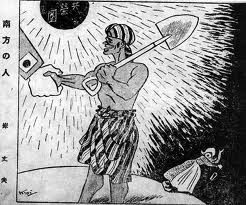
    Japanese racial theory also had Japan as the only “pure” race, untouched by significant immigration or miscegenation and thus retaining a unique set of characteristics. Maybe such an ideal doesn’t have to be prima facie racist, but the pretty clear understanding in racial theory in Japan was that this purity of heritage (which was almost certainly fictitious anyway) made them superior, and the picture in this post shows pretty clearly how they viewed the “impure” south East Asian races – as dark-skinned labourers beneath the light of Japan’s sun. And the report from the Ministry of Health and Welfare makes this goal clear, in the section entitled An Investigation of Global Policy with the Yamato Race as Nucleus. The Japanese, pure through divine right and selective isolation, were best placed to “lead” the other races of Asia into the future, and the other races would have their future direction and role decided according to a racist doctrine based on foolish 1940s conceptions of what each race was good at. Largely, they were to be consigned to the role of labourers and suppliers of resources to the advanced Japanese economy.

    There’s nothing of exterminationism in this propaganda, but a lot of material that skirts close to advocating slavery and colonialism. It doesn’t really differ from the views of many colonialists in Europe at that time, I suppose – I’ve even heard defenses of slavery on the “it’s for their own good” line – but this is the nature of the grubby racial politics of the west in the interwar era. A newcomer to the global scene could make up a fanciful political theory based on a silly superstition and a fabricated history, and elaborate a systematic process of enslavement and exploitation for half a hemisphere, and in their defense they would be able to say “it’s no different to what everyone else is doing!” And in fact a lot of Japanese propaganda presented the “purifying” light of the Japanese sun either driving out the colonialist westerners, or revealing their true form as demons, necromancers and evil interlopers.

    Demons and Strangers

    This brings us to the third and most prevalent part of Japanese propaganda, the representation of Americans, British and Dutch as demons and outsiders. Power describes the role these creatures play in Japanese folklore as two-sided: they can be forces for evil, or they can be helpful. This makes them the perfect double-sided image for the western powers, whose technology the Japanese imported (and in many cases improved), but whose ideals they wanted to cast out, along with their physical presence in Asia. In propaganda aimed at their Asian colonies they could portray the west as colonialist and outdated powers being driven out; but to their own people they portrayed them as demons with two faces, presenting a human or pure image to Japan while hiding an evil face. They could also present them as outsiders, a powerful concept in Japanese that can be both liberating and terrifying. Thus they can (literally) demonize their enemy without reverting to any of the forms of scientific racism that infected western depictions other nations, while at the same time excusing their enemies’ former teaching role. In some ways this image hasn’t changed – the ideas outsiders bring to Japan are often seen as simultaneously threatening and empowering, and Japanese people’s fascination with foreigners is often mixed with fear and trepidation. After the war ended, Power observes that this propaganda proved remarkably malleable – the demons and outsiders just changed their face, and went from being the terrible demonic other to the helpful, inspiring, slightly strange other – just as American propaganda turned the Japanese from petulant children who couldn’t be reasoned with to a young democracy in need of tutelage and guidance.

    This demonization of the other also shows that you don’t need to construct directly exterminationist, vile racist propaganda to convince a people to fight bitterly to the very end. A complex synergism of religious imagery, faux history and carefully-adapted folklore ideals will do the job just fine, if you tune it correctly. In fact, I think this has many elements in common with a lot of the propaganda we see in support of the global war on terror. The better stuff (I am referring here to that which our more reasonable supporters of the war give us, not the loony American right) doesn’t tell us that muslims are animals who need to be put down; the village doesn’t have to be destroyed to be saved. Rather, we are presented with a (mythical) ideal of western liberal democracy as pure and perfect, built up through long trial and testing, yet fragile and vulnerable to the influence and impact of the other. If we attack them and overcome them in the correct way we can guide them to a society like ours, and lead them forward to a better tomorrow – which is what we’re trying to do in Iraq and Afghanistan now, and failing at in both cases (probably). On the way, of course, just as the Japanese did, we reveal ourselves to not be the pure and ideal society we pretend – Abu Ghraib, Guantanamo Bay, and regular wedding party slaughters in Afghanistan prove that our society is not quite what we say it is – but our propagandists overlook these small inconsistencies and the faux history (divorced of the native genocide, colonialism and extermination that made our societies rich in the first place) in order to present the greater myth. And, just as at some times and some places in Japan’s 15 year war in the Pacific, these images really did seem to present a better future, so too the simple story of liberal democracy shining a light into the darkness can present the same hope for a better world. But the Japanese experience perhaps shows us that better worlds aren’t made through war, or if they are it probably isn’t worth the suffering, and certainly isn’t the only way.

    The Japanese propaganda of the war liked to present them as purer than Americans, driven by greater ideals and united by stronger bonds, and also depicted the Japanese as liberators casting colonialism out of the Pacific. Power points out that they really did serve this role in some ways, showing the people of the Pacific that the colonial powers weren’t invincible and that sufficiently energized Asians could turn the colonialists’ own tools and technology against them. At the same time their scorn for the moral inferiority of Americans led the Japanese to completely misunderstand America’s willingness to fight – just as American propaganda overestimated Japanese obstinacy in the last year of the war. Both sides’ propaganda may have worked against Japan, leading to a situation of frenzied violence where both sides refused to believe what the other side really wanted. But there’s a lesson in this that is particularly compelling – the propagandist really does believe their own work. Propaganda goals are set on high, and propagandists listen to a lot of material being written in their own and other countries about the enemy – they don’t form their opinions in a vacuum. In the pre-war era, and during the war, this material was facile, shallow and wrong, but it was incorporated into the propaganda and really seems to have been believed by the planners and policy-makers of the era. American and British military planners really did believe that Japanese pilots were inferior due to Japanese child-rearing practices; Japanese war planners really did believe that the Americans would give up after 6 months because they were morally weak and lazy. For my next post on this book, I’ll look at how propaganda serves to reinforce rather than reflect prevailing views, and can be a negative form of information in a war. Certainly in world war 2, it appears to have served the role of reinforcing a vicious spiral that was circling in towards genocide, and although fortunately for the Japanese cooler heads prevailed, the experience of that war shows that propaganda of this kind isn’t just a tool of war, but can become a driving force and, at its worst, a self-fulfilling prophecy. What does this tell us about the decision-making that led to the fire-bombing of Japanese cities and ultimately the use of nuclear weapons? What would the Japanese have done with nuclear weapons if they had them, given their use of images of purification through fire and death? This is also something I want to explore in a future post about this book.


  • Manifest Destiny

    Returning to Hearts of Iron 2 after a long hiatus, I finally struck the motherlode and annexed the USA after months of trans-atlantic hide-and-seek. The forces of imperialism and racism refused to surrender, showing much more bravery and persistence than my top social researchers had credited them with, and after I captured all of mainland USA they moved their capital to their offshore imperial holdings: first some godforsaken place on the Atlantic coast of latin America, which of course I liberated; then Greenland, which is easy to invade because there is nowhere for US soldiers to hide; then their colonial possessions in Iceland. Getting to Iceland required that I declare war on Portugal and capture the Azores, sinking the Portuguese Atlantic fleet in the process. This was unfortunate, but ultimately my continental European campaign will be made easier by the availability of a second front – I am after all at war with Republican Spain, and a second leaping-off point for the invasion of Britain will be handy.

    Once I had overrun Iceland the USA continued its flight, like Gaddafi or Hussein; they moved their capital step by step across the Aleutians and the Manchukuo 8th Division followed them, in concert with one of my more hardened units of marines; after the Aleutians had been entirely occupied they disappeared for a month or two, but I finally discovered them cowering on a slip of land in the Pacific called Tinian Island – right under my nose, in fact, because the neighbouring islands were garrisoned by my home guard. So, in went Manchukuo’s famous 8th, once again, and the final battle was joined. This was a battle of bureaucrats as much as anything else, because the US lacked soldiers, industry or equipment, and was hiding in what was essentially a coral atoll. The president himself, his family and the few retainers and functionaries of the surviving government of the USA were all that remained and, I’m sad to say, they fought to the last family member. Or so the grizzled veterans of the Manchukuo 8th told me. Only the most barbaric of peoples would force even primary-school aged children to fight! Such a shame they all had to die … though I hear there was rejoicing on the streets of America (or what’s left of them, in most cases) after 6 years of war were finally brought to an end.

    So now I find myself facing off against China, who declared war on me 2 years ago and in the first heady stages of that war managed to seize huge amounts of territory from me – all of India, Burma, Nepal and Tibet, in fact. I hold them in a line from the border of Burma through Guangzhou and up to Qingdao, and also the northern areas around Beijing, but it’s been a desperate slog for both sides, as huge numbers of my soldiers have been tied up in the USA and getting them back can take months of reorganization. I’ve now started landing forces around Qingdao and western Thailand ready for the big counter-attack: my aim is to cut off huge chunks of the Chinese army at Tianjin in the North and Sittang in the south, and then destroy them, before pushing into the inland from Beijing and Guilin and working an encirclement the size of a continent.

    In many ways China have been harder than the US, because they US focused its industry on naval and airforce units, and when I finally landed on the mainland they had very little infantry for me to roll up – in fact a good 3-6 month period of the war on the west coast was taken up with defeating a large Canadian land army. But the Chinese have an enormous land army, that is fielded in great clots of men – 100,000 here, 200,000 there, maybe a million in total camped around Beijing and Tianjin and constantly trying to break through that poor beleaguered city. Every victory is followed by a defeat, and battlezones like the plains south of Beijing or the karst landscapes of Guilin have seen our armies crossing and re-crossing the killing zones for months. The nature of the Chinese campaign, with so many soldiers, makes it very hard to conduct encirclement operations, because they have so many soldiers that they have an excellent defense in depth. I have to wait for them to push a salient towards the sea, then snap it off in counter-attacks that are costly in time and men. So far I think I’ve captured about 100,000 men (10-12 divisions) at the loss of 20,000 of mine, and I have the enemy teetering on the brink of collapse. I regularly devastate their industrial centres, and their capital is a smoking, radioactive hole – Chengdu and Chongqing have both been nuked, and thrice hit with conventional missile attacks, as have many of their industrial centres. I’ve captured Nanjing, Guangzhou and some of the mountain approaches to the South, and hope soon to overrun Guilin. I know that they’re unable to maintain reinforcements for their army, feed their populace and keep dissent under control without abandoning all other industrial tasks. I think soon they will lose the ability even to control dissent and reinforce their troops.

    In anticipation of this, I’m now reorganizing my naval forces to start starving the British, with a naval blockade of Britain itself and a submarine force set to prowl the Caribbean. China is going to take another year to beat, and I’m going to need to leave a huge force there in readiness for any aggression by the Soviets, but I think in a year’s time I’ll be in a position to start attacking Western Europe. I hold the Azores and Iceland, so a simultaneous attack on Portugal and the UK is a distinct possibility. But first I’m going to clean up the UK’s Caribbean territories, to ensure there is no way they can stage counter-attacks on the US.

    The big problem I’m having with this game is that the computer never surrenders. Even when I have reduced it to a rump of two provinces, with no military or industry, it still refuses to surrender. This drives me crazy, because it means I waste months trying to find and capture every single territory the enemy possesses, even coral atolls like Tinian. I even once tried starting the game from a saved game as my enemy, and suing for peace with myself, but the computer wouldn’t accept my generous offer. This makes the endgame of every war unrealistic and is going to be a particular pain in the arse with Britain – conquering Africa is sooooo tedious.

    Other than that, though, I’m having  a great time. The main question I have to put to my readers: what shall I call America? It’s clearly no longer the USA, so what should I call it?

  •  

    The characters were wooden, the setting not credible


    What beast do they seek? What monstrosity this way came…?