• I have always found it impossible to play magical cyberpunk outside of Shadowrun; I can’t imagine adapting the Shadowrun system to play, say, space opera or high fantasy. Similarly, I can’t imagine playing high fantasy with Traveller rules, or cyberpunk with D&D. Something about these classic games prevents them from being used outside of their genre remit, which is why I don’t naturally turn to D&D Modern, though no doubt it’s perfectly capable of the task. This is probably partly because they’re the games I grew up with, and back in that more innocent age I adhered to the setting constraints they gave me and then when I grew up I couldn’t escape them; but I don’t think I’m alone in this feeling, and I think there’s a more fundamental artistic achievement here than merely capturing the attention of a 13 year old boy when he was vulnerable. Even now I can remember what it was like to open the AD&D Player’s Handbook (I think first edition, with the badly-drawn wizard on the front), and smell the very special smell of the paper, and see that densely written text; read Gygax’s strange (and in many ways wrong) prose, and appreciate the spells and monsters and actions described therein. There’s something very specific and powerful about the way that game is presented, like it contains its own lexicon and cosmology, right there in those 200-odd pages. The style of the game determines what you can do with it, and the presentation of AD&D, along with its gaming style, is so particular that you can’t just strip out the spells and monsters and use the system to run a space opera. I’d wager no one ever has, or if they have, they’ve slowly regressed.

    I was reminded of this today by this excellent review of The Name of the Wind and The Children of Hurin, which compares the modern style of one genre novel (The Name of the Wind by Richard Rothfuss) with another, more suited to its task (The Children of Hurin, by Tolkien). The reviewer says about style:

    style—the language and form of the novel—is seen as an unimportant adjunct to the “story.” It is not. A bourgeois discursive style constructs a bourgeois world. If it is used to describe a medieval world it necessarily mismatches what it describes, creating a milieu that is only an anachronism, a theme park, or a WoW gaming environment rather than an actual place. This degrades the ability of the book properly to evoke its fictional setting, and therefore denies the book the higher heroic possibilities of its imaginative premise.

    I think this applies to RPGs as well. Creating style in RPGs isn’t just about the book (though the AD&D 1st edition is a great example of how this is done) but about how the gaming environment is constructed. Fiddly dice and tabletop mapping (AD&D); fiddly cards and tokens (WFRP3); miniatures and maps (D&D 3rd); starmaps and starships and sparse use of props (Traveller) – these are tools to create an environment that invokes a style. In some games this style is very carefully evocative of the nature of the game, and in others it is sterile (Aria) or actually versatile (Rolemaster/Spacemaster/MERP/Cyberspace). But without creating this specific environment – in the rules, in the aesthetic of the book, in the gaming environment, and in the nature of challenges and dramatic process – the game will fail to impress. Maybe this is why generic systems tend to be less successful than genre systems, and maybe also why some setting-specific games fail (because they don’t match their style to their setting).

    The reviewer gives an example of this with Tolkien, contrasting the modern 20th century style of Rothfuss with Tolkien’s genre-specific style:

    It’s a book by a man who knew intimately not only the facts and paraphernalia but the mindset, values, and inner life of his relevant historical period—more Dark Age than medieval, this time, but assuredly not modern. The most obvious, although certainly not the only, level on which this registers is that of the style, which actually does approach the classic elevation that Wollheim wrongly identifies in Rothfuss. The Children of Húrin‘s syntax is compact, declarative and unafraid of inversion (“Great was the triumph of Morgoth”). Its vocabulary is almost entirely purged of words not derived from Old English sources: so much so that the occasional Anglo-French term—for instance, the phrase “Petty-dwarf” with its petit-derived qualifier—jars a little. More, it is a prose written with a careful ear for the rhythms of English; a prose with a very satisfying balance of iambic and trochaic pulses, sparingly leavened with unstressed polysyllables (it reads well aloud)

    This shows well the numerous tools that a writer can use to invoke effect, beyond just plot and ideas.The task of RPGs isn’t just to provide a distracting few hours of your life (as the reviewer so dismissively characterizes Rothfuss) but to provide a means of escape to another world. You don’t get this by slinging together a skill resolution system and a character sheet. You need a style for your game, a bridge between the imagination of the players and the mechanism by which they play it out interactively. Is this more difficult than constructing a good genre novel? I’m not sure, but I’m fairly confident it’s less financially rewarding. In any case, there’s a lot to be said for the stylistic achievements of the early gaming world, even if the systems themselves were crap and we eventually moved on to better ones. And I think the linked review gives some powerful examples of why these early games held our attention despite their flaws, through the comparison of two fantasy novels.

    Incidentally, this review is also an excellent and powerful defense of Tolkien.

  • What's the Chinese for "fail"?

    Sliding Void is the first in a series of hard SF novels by Stephen Hunt, author of a series of steampunk novels that I really enjoyed: The Court of the Air, The Kingdom Beyond the Waves, and The Rise of the Iron Moon. Hunt’s interest in space opera and SF was fairly clear in The Rise of the Iron Moon, so it’s no surprise to learn that he also writes hard SF, and although it’s also weird to read him in a completely new genre, the book was enjoyable and interesting – though not without its flaws.

    The basic setting is a universe some thousands of years in the future, with the usual necessities of hard SF: hyperspace has been invented but travel is slow, there are many settled planets and terraforming and expansion is ongoing, the settled universe is divided into the core and the periphery, and the core is ruled by a shifty and sinister organization (in this case called “the Triple Alliance”) that maintains order at the expense of freedom and corruption. Of course, one can stay a step ahead of the alliance by working on the fringes of space, but not everything one does out here on the edge is entirely legal, etc. The outline of the setting probably seems to have a lot in common with Serenity/Firefly or Traveller:2300, including the importance of China in space exploration and the settling of planets on national lines (this is a German planet, that is a Chinese, etc). It’s pretty standard.

    The story centres around one Captain Lana Fiveworlds and her oddball crew, who are running a free trader in classic Traveller style, tramp trading on the periphery. They need money in a hurry and get called in by an old contact to whom they owe a favour; he gives them the task of taking on a new crewman to help him escape from his arse-backwards mediaeval ice world, where he was a prince until he got a bit too arrogant and ran a war that got half the world chasing him. Unfortunately, there is something up with this new crewman and things rapidly go pear-shaped. That’s it! We then have to wait for book 2 to start finding out why things went wrong, and what they’re going to do about it.

    This book is quite short and well-told, but interestingly a large part of the story is set in a fantasy world. The crewman is from the planet of Hesperus, a failed colony world that slid into an ice age soon after it was colonized. It’s an interesting story: the colonists were refugees rescued from an interplanetary war by a well-meaning aid agency and packed across the galaxy in cryonic sleep, arriving on their colony with nothing but the resources in their ship and nowhere to return to, their world having been destroyed. Soon after they arrived their new planet, which had looked so promising, fell back into an ice age and the colony fell back into the bronze age, so that when we stumble on it the planet is more like a norse kingdom than a sci-fi setting. I really like this idea, I think it’s quite believable and a terraforming outcome I don’t think I’ve read in a long time (perhaps in Ursula le Guin’s The Word for World is Forest? I can’t recall…) Stephen Hunt does this part particularly well, and the way the rest of the universe treats this planet is a sure sign that we aren’t dealing with a particularly well-meaning Alliance. No Culture here, folks.

    The rest of the story, though brief, is well-written. It’s got occasional hints of “realism” such as has started to creep into modern genre writing – swearing, “gritty” settings and the like – which is particularly jarring when you’re used to Hunt’s other, gentler, steampunkier works. Hunt’s vision of hyperspace is cute – it’s all mathematical and humans can’t handle it, because they get “addicted to the maths” – and means that humans are dependent on the help of an alien crab species who are religious in their mathematics, and believe that entering hyperspace gets them closer to their mysterious mathematical god. The rest of the SF world is fairly standard, though some of the information technology ideas are cute: the characters refer to a wiki to learn about Hesperus, and when their barbarian crewman needs to be oriented to the modern world he is given full-immersion entertainment packages that give him 6 months of real-time experience of someone else’s life in a couple of hours. This means that two days after he’s arrived on ship he has already lived several years of subjective life in the modern world, and is speaking like a mixture of policeman and starship crew. His adjustment is otherwise not handled so well though: his first experience of eating rice just flicks by without any mention of how he feels about this new experience, and there are a few other moments where we really could get a deeper sense of his disorientation in his new world. Having spent half the book establishing his barbarian credentials, we see them all washed away in a chapter, which is a bit weak. Given that the whole thing is quite short, a few more chapters to have him settle in – perhaps including a moment of craziness – would be nice.

    Another thing about this book that really frustrated me and nearly had me give up on it was the massive Orientalism fail in the middle. When we first meet the Chinese engineer, Paopao, he orders Calder (the barbarian) to make his favourite food: Ochatsuke. He has a list of ingredients in his kitchen which includes dashi and jako. Stephen Hunt has carefully researched the recipe for a Japanese traditional food, complete with Japanese names, and had his chinese character act as if this is some Chinese food or spiritual rite of passage: the food labels are all written in Chinese (how do you write jako in Chinese?) and Paopao tells Calder that “A man who steams rice may be trusted with the care of antiproton storage ring.” The implication is that this traditional Japanese food is somehow of cultural significance to this Chinese engineer, who judges his staffs competence on their ability to make it. This is, I think a straight-out orientalism fail: either Hunt doesn’t care about the difference between China and Japan, doesn’t know (despite having careful knowledge of a Japanese food that is quite obscure outside of Japan), or knows nothing about China and figures his readers won’t notice the difference. He obviously couldn’t make the dominant Asian culture in space Japan because that doesn’t fit the current narrative about an ascendant China, but he couldn’t be bothered doing the basic research on China necessary to fit the character to the story. The same applies with the stupid way he writes Paopao’s language: I’ve met enough non-native speakers of English now to know that the way Paopao speaks is not the way it works. On the one hand he says

    Only if you submit to them, Mister Fighting Fourth. Sometimes it beholdens man to remember

    which is perfect lyrical English and very advanced, including careful omission of an article such as non-native speakers often get wrong. But then he says

    Found it inside fortune cookied on station above Kunjing Four

    dropping both the subject (which I think is a Japanese, not a Chinese, problem) and all the articles, and mangling a sentence which anyone who can say the former would surely be able to spout very quickly and easily. Now, I don’t think anyone can get language misuse right (it’s extremely hard) but stuffing this up to this extent, while also mangling the character’s cultural origins, is a pretty big level of fail. It’s disappointing, and sloppy. I understand that with the ascendance of Asia, and the recognition that the 21st century is going to be the Asian century, people want to fit Asia into their inter-galactic hegemonies, and not being Asian are likely going to screw it up somehow. But there’s still a minimum level of research that one could do, in this case as simple as buying a Chinese cookbook and visiting a good restaurant.

    I think we’re going to see a lot more of this kind of sloppiness in the years to come …

    Anyway, aside from the small orientalist unpleasantness, this story is enjoyable and worth giving a go if you like classic hard SF. It’s reasonably well crafted, moves fast, has a smooth and easy narrative style, and has some nice ideas to add to the genre. Stephen Hunt’s writing is sometimes a little jarring, as if he were occasionally slipping into a young adult novel style, and sometimes his genre-bending doesn’t work, but in this case he’s combined a low-tech fantasy world with a hi-tech spacefaring civilization very well. I wouldn’t say it’s ground breaking or stellar in its achievements, and I think Hunt has been more creative in his steampunk work, but I can still recommend it. Read this book if you want to see a small amount of genre-bending in an otherwise classic, easily readable hard SF, but give it a miss if you demand only classic tropes in your SF.

  • How does this work, anyway?

    I recently finished reading Robert Silverberg’s Majipoor Chronicles, second in the Majipoor Series but easily readable in isolation. It is not a single novel but a series of short stories set throughout the history of the eponymous planet; some of these stories are directly connected to the events of the first book in the series, Lord Valentine’s Castle, but I think most are intended simply to offer historical and cultural background to that tale. The settings of the stories are separated by huge distances in space and time but are strung together through a cute conceit: a low-level functionary in the central government has found a way to sneak into a library of memories, and through accessing the library enters the memories of any individual he can choose. So, he calls up random (and sometimes deliberate) people from Majipoor’s past, usually connected with great events in the history of Majipoor, and views the events through their eyes.

    This is an interesting trick, since it sets the flavour of the planet and the culture through the choice of protagonist, which in most cases is a person who is neither famous nor important, just a person connected to some great event. Where the functionary could have stolen access to the memories only of the great and the good, he instead chooses random nobodies: a woman living in the jungle when the alien settlers first began to come to Majipoor; a mid-ranking military officer involved on the fringes of the final battle to eliminate Majipoor’s indigenous people; a shop-keeper who ends up marrying a lord (but not the lord himself); a low-level official who discovers the technology of the King of Dreams (but not the King himself). As the functionary gets bolder in his theft he chooses more powerful and famous people to spy on, but through the first half of the story we are shown the history of Majipoor through the experiences of its basic citizens. This helps to set the tone for a kind of subdued utopian world, which while not free of conflict or strife seems to have largely eliminated murder, other forms of serious crime, war and major civil strife. It’s a world that has been going quietly about its business for thousands of years, and by setting the stories in the frame of the world’s very ordinary residents Silverberg has set this tone very nicely. These stories are also surprisingly free of any form of violence or militarism, though one story involves a murder and one story involves an attempt at genocide. But largely they depict a world at peace with itself, a future society that, though its environment is harsh, has largely moved beyond the problems that beset our own.

    Majipoor itself is a fascinating world: vastly larger than Earth but much less dense, so with similar gravity, flora and fauna, it is recognizable as a classic sci-fi garden planet, though with noticeable differences: it has very few mineral resources and the distances people have to travel are huge, so it is actually quite poor, with many people living close to subsistence level. Furthermore even after thousands of years of settlement it remains mysterious, with huge areas unexplored and unsettled. One story of this potted history is set in the period when the planet first opened its arms to alien settlers, who were deemed necessary just to populate the world enough to make it socially functional. At the same time, even though the planet is vast and fertile, the human settlers come into continuing conflict with the indigenous people who lived there before them, and these indigenous people or the knowledge of what was done to them figure in the background to many of the stories. So in many ways Majipoor is an inter-galactic allegory for the settlement of America or Australia, with all their utopian promise, conflict with the original inhabitants, and opening up of frontiers and then of society to aliens. Also similar to the early histories of those settler nations, Majipoor seems to be cut off from its galactic neighbours, having little significant interchange with them and unable to rely on them for either industry or development. People and things come from the stars, and the cultural background is that of the sophisticated galactic travellers who originally settled Majipoor, as is much of its technology, but at the same time it seems to be separated from those peoples. Some of the technology is mysterious to the locals, or known only to a few, and it’s not clear that the locals are able to aspire to the technological skills of their forefathers. There is no sense of hi-tech or heavy industry in this strange world. Like early Australia, it is characterized very much as a rural utopia, full of freedom but lacking in wealth and too distant from its original society to be able to gain much practical value from its originating culture.

    It’s interesting to see these themes in a sci-fi story, and to see the sensitivity and care with which some of them are explored. Particularly surprising was the importance of the indigenous peoples’ story to the narrative, because I can’t see any evidence that their history is itself relevant to the remainder of the series (though I could be wrong – I haven’t read them yet). Silverberg has written other work about indigenous people, and clearly has an interest in this topic, so perhaps he has deliberately created an allegory to the old American west, but it’s not heavy-handed and the depiction of post-genocide Majipooreans’ view of their history is probably too optimistic compared to the way Australians or Americans view those issues now – perhaps this is another aspect of the utopianism of the novel. In any case, this kind of topic is rare in the genre, and the moral ambiguity of Majipooreans’ views of the issue of indigenous dispossession very close to the way modern Australians (and I guess Americans) view their own history. It’s nice to see this approached so carefully in the genre.

    This book is a nice combination of gentle cultural commentary, careful world building, classical SF-style speculative work, and mild utopianism. It’s also very well written, with a really accessible style and easy descriptions that leave you with a clear image of the setting you’re in without using burdensome prose. It’s also largely free of many of the tropes or language of the genre, which I see as a sign of superior writing style: if you can deliver a SF setting to a reader without using SF jargon, in a smooth and easy prose style, you’re doing well. One complaint I had about the story was the intermissions between chapters in which the low-level functionary describes his feelings about the memory he has just entered – they have too much of the tone of narrative authority, so that I felt the functionary’s perspective was being used to convey to us how Silverberg believes we should feel about the story we just experienced. Also, these intermissions have too much tell and not enough show. But they’re short – not even a page in many cases – and the tone changes as the book progresses. Another complaint I think other readers might have is that the stories are too disconnected, and there’s not enough common theme to warrant presenting them as a novel rather than a straight-out short story collection. In many ways it feels like you’re reading le Guin’s Orsinian Tales (a beautiful, beautiful book!) but that book is presented as short stories, whereas this seems to have been marketed as a novel, and the narrative continuity of the functionary’s role is surely intended to make it read this way, even though there is nothing else to connect the stories except the functionary’s curiosity. This didn’t bother me at all, but I’m sure it would frustrate many readers.

    Overall, however, I found this an engaging, intriguing and really enjoyable book. I recommend it to anyone who is interested in the kind of speculative social ideas that characterize the work of people like Ursula le Guin, Gene Wolfe or Samuel Delany (though it’s much more accessible than Delany). I don’t recommend it to people looking for hard SF, or SF full of conflict and combat. If you like unassuming social critique or practical utopia in your speculative SF, and you’re happy with SF/Fantasy mixed in, then this is definitely a good book for you.

    The picture, incidentally, is by Jim Burns.

  • Extreme Fishing …

    In comments on my review of Mt. Takao as a zombie survival spot, commenter’s Claytonian and Paul raised the complex and controversial issue of Zombies and water. Claytonian even went so far as to raise the radical (but in my opinion very interesting and challenging) notion that zombies might retain some human instincts:

    come to think of it babies can swim so zombies might have the instinct left

    This raises a lot of issues for zombipocalypse survival planning, since there are a lot of benefits to establishing a water barrier. In this post I’ll describe these benefits (essentially rehashing my response in comments) and then look at some of the possible planning problems that arise from consideration of zombies and water barriers.

    The benefit of water barriers

    Water barriers aren’t just good because of their ability to keep out zombies. If the barrier has freshwater, it provides a potentially unlimited source of water and sewage for a small community (only the latter if its seawater). Water barriers offer an uninterrupted view which, while it may be useless against zombies on the sea floor, is very useful for identifying incoming human threats – and these are not to be discounted in the post zombie world. If the water is flowing, it offers the potential for long-term construction of energy systems (water wheels). But perhaps most importantly, a water barrier contains fish, which means that in addition to establishing a buffer zone, a community on an island can use this water barrier as a source of (potentially unlimited) protein, which can be obtained with limited skills and without needing to make a great deal of noise or effort. Furthermore, it’s fairly likely that fish don’t attract zombies, whereas mammals might, so as a protein source fish are a much much safer option than farming. By finding a suitable island within a reasonable distance of a city, it may be possible to establish a sustainable community, with easy access to valuable resources in the city, that is relatively well protected from zombie assault. The biggest problem the survivors are likely to face is then going to be marauding groups of survivors: islands will be in high demand after the zombiepocalypse, and people will kill to take them.

    Can zombies swim?

    Water barriers will be most successful if zombies can’t swim, but the definitive text (World War Z, 2006) suggests that they can walk underwater, and that they will slowly spread out under the sea as they seek human prey. This means that eventually zombies will arrive at your island, and that in the science of that textbook, they will appear randomly and intermittently without warning. This means at the very least you will need to keep a constant watch, though a random process of diffusion suggests that the further your island is from shore the lower the rate at which zombies will arrive. Obviously some system of inshore nets or wires may help in the watch process, but these may require a lot of work and be hazardous to establish. Claytonian’s swimming suggests that Zombies will have a more purposive process of attacking islands, choosing to swim towards them if they sense food but otherwise not swimming – if one assumes that zombies function according to some kind of basic laws of energy conservation, they will presumably prefer the least energy inefficient method of movement when there is no reason to use a more intensive one. Of course, it may be that zombies aren’t governed by such constraints, and that hordes or individuals will occasionally choose to swim and can potentially swim huge distances without effort. This problem can still probably be partially managed on an island, since if it is more than a few hours from shore the action of wind and water will likely disperse hordes sufficiently to render them much less threatening if they stumble on an island.

    So then, an important question arises: can zombies communicate and form hordes underwater, and do they retain the ability to hone on prey when travelling by water?

    Zombie hording patterns

    It seems reasonable to suppose that zombies find movement underwater more difficult than on land -there are special obstacles and the water impedes movement, not to mention the issue of currents – and that they require some kind of sensory function to identify prey. This suggests that even if a horde encounters evidence of humans living in an island within sensory distance of shore (e.g., light on an island 300m out) they won’t necessarily be able to approach it as a horde. Seeing the light, they enter water as a horde but once underwater they are disoriented, blind, no longer able to see the light, and the horde begins to break apart. Walking along the bottom they will soon enter lightless zones, and won’t be able to communicate; presumably then the horde begins to disperse, but furthermore, in those zones they will have no knowledge of where their target is. This suggests that the horde will then behave as a random entity, with zombies heading in all directions. Assuming they entered on a straight line path to the island, some will likely wash up ashore, but their arrival must surely be staggered and incoherent. The only way they can arrive en masse is if they are both attuned to each other through a supernatural force, and attuned to supernatural emissions from quite distant life forms. But there is no evidence from any of the extensive research on zombies that this is the case: they seem to require some sign that a human is there, and can even be fooled by smell (The Walking Dead, 2011) or by convincing acting (Shaun of the Dead, 2oo4) or by various forms of stealth and silence (28 Days Later, 2002).

    This suggests that even if they can walk underwater and cross very large distances under the sea, zombies will not be able to attack an island as a horde with the same ferocity as they can attack a survival spot on land. In remoter areas this may mean it may be possible to run lights and sound at night, with relatively little fear of intrusion, even on an island relatively close (say, 500m) to shore, because even a large horde will be broken up by water and arrive in a staggered and easily destroyed fashion.

    Conclusion

    The obvious benefits of islands as a long-term sustainable community setting, combined with the potential for a water barrier to disrupt zombie horde accretion even when located quite close to land, suggests that islands are ideal survival settings regardless of the particular level of aquatic adaptability of the undead, and that even islands quite close to land – within sight of occupied areas – may be suitable survival settings in a zombiepocalypse. Of course, this doesn’t mean that you will be safe on an island 30m from the shore in Tokyo bay, but it does mean that a reasonably well placed island with no direct land access provides a very strong base to establish a community of survivors in relative safety. The value of islands as a survival location increases significantly if the survivors are fleeing in an area of very dense population (e.g. Tokyo or New York) since even if ultimately the island is overrun, its facility in slowing down hordes will provide survivors a location to regroup and gather supplies before moving on to a more distant island.

    The most significant problem in choosing an island to escape to is likely to be human survivors, who will defend their location ferociously precisely because of these benefits. The best advice is to get there first, and heavily armed.

    Addendum

    If you appreciate my thoughts on zombie survival strategies – and on the movie 28 Weeks Later – then please consider reading my novella Quarantine Breach, freely available at Royal Road.

  • There are few things more entertaining in the world of politics than watching one of Australia’s main political parties airing its dirty laundry in public. This week we get to see this spectacle at its finest, as Australia’s foreign minister, Kevin Rudd, steps down from his position and challenges the Prime Minister (PM), Julia Gillard, for the leadership of the party. If he wins, of course, he will become Prime Minister. He was PM before, until 2010, when Julia Gillard overthrew him in a figurative night of the long knives. On that occasion he did not even take his position to a vote, so weak was his support, but this time around he is going to take it to a vote on Monday at 10am. That’s gripping viewing for those of us who enjoy our politics done dirty and Machiavellian, and this time, in the public eye. And nobody in Australian politics (or, probably, in the democratic world) does politics dirtier or slimier than this mob.

    The vote in question is not a ballot of the people of Australia, or anything so silly. It’s a vote of the the representatives (MPs) who make up Gillard and Rudd’s party, the Australian Labor Party (ALP). For the benefit of my American reader(s), in the Westminster system that your benighted republic so sadly decided to dump, the PM is not elected by the people, but chosen from the parliament. When Australian politicians try to appeal to populism as part of this process – as Rudd is known to have done – they are referred to dismissively as “running a presidential-style campaign.” For people like Rudd and Gillard, the mere act of getting elected is something to sniff at – they are usually installed in safe seats and get an easy run into parliament. The hard work does not lie in convincing ordinary people that they might be good representatives, but in convincing their colleagues that they should be given high office. Usually this means being in parliament as a nobody for years, slowly building up the support of a faction within the ALP, and then climbing through ministries until finally you have the experience, the reputation, and most crucially the numbers to be able to backstab someone and take their job. That’s what we’ll see at its bloodiest best on Monday.

    Usually all of this happens quietly behind closed doors, but for complex reasons that seem to have a lot to do with Rudd’s personality, this time it’s all being done in the open. If you believe the journalist who has done the most work on the matter, Rudd was dumped from PM in 2010 because he was losing control of the government and the policy-making process, alienating his colleagues and slowly destroying the ability of the higher offices to function. But publicly they didn’t want to smear him, so they didn’t mention any of this, although what really went on behind the scenes may have been summarized in this article from just before the coup. Because in Australian politics disunity is death, the plotters kept all the internal troubles quiet and claimed that Gillard toppled him in order to change policy direction. But by undermining the narrative of the government’s policy direction over the previous 3 years, this probably contributed to the ALP’s poor performance in the 2010 election, which saw them lose a lot of seats and forced into minority government with some independents and (shock!) the Greens. In fact it now appears that Rudd was already planning his vengeance, undermining that election campaign with leaks and “backgrounding” journalists. Since that election the media has run constant stories of leadership tension between Gillard and Rudd, who was given the position of Foreign Minister. It now appears tha a lot of that tension was being created by Rudd himself, and in recent days it reached such a peak that something had to be done. This time around, though, it looks like Gillard’s supporters intend to be frank about what happened then, and to poison the well so that nobody is willing to risk Rudd in the leadership position. They have been very publicly and aggressively bad-mouhting him, making sure that his reputation and legacy are in tatters and any election campaign featuring him as leader will be dominated by the opposition quoting his own party members’ poor assessment of his character.

    Nobody does this stuff like the ALP, which is why it’s a joy to watch. Rudd’s knifing in 2010 was a shadowy business of meetings behind closed doors, over almost before we knew it had started. The last time a leadership struggle happened in a sitting ALP government was between the two greatest politicians the Westminster system has thrown up since the war: Hawke vs. Keating (whose colourful contribution to political life can be found here)[1]. But that was a tame affair compared to this, fought as it was on the basis of ability to win elections and policy vision – no one would ever claim that either of those men’s considerable personality flaws rendered them unfit to run a government. This time around, the government rests on a knife-edge of marginal seats in a coalition with free-willed independents and the battle is over personality, so whatever damage is done in this very public battle could well poison the chalice for the winner. They’re flinging so much poo that some of it is going to have to stick.

    The battle is probably decided already, in reality, because it involves lining up the numbers for the caucus vote. ALP politicians don’t vote by conscience (this is explicitly banned when voting in the parliament!), they vote according to the dictates of whatever faction of the ALP they are a member of. The factions in turn are composed roughly along union lines, with different trade unions supporting different factions, and the key to success in the ALP is to get along well with your faction and to be able to negotiate deals between factions. Rudd, famously, eschewed this system in his run for PM, supposedly intending to “reform” the ALP’s systems. Gillard is a great negotiator and apparently has an inclusive style, so it’s likely that she’s been doing what all sensible ALP leaders do: keeping one eye on the opposition leader and the other eye firmly over her shoulder, on her factional “allies.” If the stories about Rudd are true, he will have alienated all the factions and will be left swinging in the breeze when it counts. Unless he has some very, very nasty tricks up his sleeve…

    Many people say that this faction system is a bad idea and an undemocratic disaster, and Rudd was supposed to reform it to reduce its alleged bad properties, but I’m not convinced this is true. The ALP has been around for 100 years and the faction system has operated for at least 50 as far as I know, and in that time it has thrown up a great many highly talented politicians. Hawke, Keating, Whitlam and Chifley were all products of this faction system, as were some of the lesser, but still brilliant, members of the cabinets of yore. Any system that can produce the leadership team of Hawke and Keating, and keep them in office for 13 years, has to be doing something right. Recently the quality of the ALP reps has started to decline and there have been a few famous and regrettable mistakes in leadership (e.g. Mark Latham) but these mistakes and the thinning of talent I think might represent a much deeper problem with the ALP: its membership is declining rapidly, and its dependence on unions and an industrial working class base is no longer as relevant as it used to be, depriving it of the deep pool of talent it once had at its disposal.

    It may or may not be bad for the party, but the faction system makes great theatre. This time around we are not just being shown a glimpse of the ALPs seedy inner nature, but may be offered the chance to look right into the depths of its soul. And I think that’s compelling viewing for anyone with an interest in how nasty politics can be. So grab the popcorn and gather round, kids, because the palace coup is underway …

    fn1: I guess the third greatest is Thatcher, who probably should go at the top of the list for her singular achievements against the run of British expectations about class and gender, but she’s not as funny as Keating, not as educated as Hawke, and anyway she eats babies and her policies were crap in comparison to theirs.

  • Scott Westerfield’s Leviathan is the first in a series of young adult steampunk novels, set in a very close parallel history of Edwardian Europe. They’re light-hearted, fast-paced and fun, and they have some nice new ideas for combining classic steam-tech with biotechnology. The basic setting is Austria and London on the eve of the first world war, with Europe locked into the exact same ludicrous stand-off as actually happened. The Austrian Empire – “clankers” in the common British parlance – bases its technology on steam power and heavy industry, while its main opponents, the British “Darwinists” have followed the old man’s lead into an industrial milieu based on bioengineering. Most of the action in the story revolves around two symbols of these two types of technology: an Austrian walker, very similar in essence to an ST Walker from Star Wars; and the British airship Leviathan, which is essentially a hydrogen blimp bioengineered from a massive whale. The technology on both sides is ludicrous and well beyond what one would imagine were possible in the time period, but it’s classic steam-based SF.

    Each technological setting also comes with a character: the Austrian Alek, bastard teenage son of the Austro-Hungarian empire, who has to flee his home after the assassination of his family; and Deryn Sharp, a poor Scottish girl who has come to London with the crazy idea of disguising herself as a boy and entering the British Royal Air Force. Through a series of improbable accidents she finds herself onboard the Leviathan over Austria at the same time as Alek is fleeing across Europe, and so they end up meeting by chance. They then have to join forces to escape the Austrians chasing Alek, and thus the two of them are introduced into the scheming and plotting of European politics as the great powers plunge headlong into war. The first book ends at the point where we discover what they’ve become embroiled in; presumably we’ll explore more in later books.

    This is a young adult novel, so it has some characteristics that I know many adult readers hate: hastily-sketched characters based on archetypes, simple and fast-flowing narrative style, sometimes awkward explanations of background and setting, and the frustrating phenomenon of children beating adults at their own game. But the fast-paced expositions and quick descriptions are a pleasant change from the bulky, unwieldy style of some modern SF and fantasy, and it’s nice to read a story with background nuance presented quickly and easily. The novel lacks the deep, thoughtful emotional engagement that characterizes the best young adult fiction (like, say, the works of Robert Westall or Maurice Gee) and it doesn’t have any of the coming-of-age intensity of much of the genre. I really like those aspects of good young adult fiction, and so in that sense this book is a little lightweight at times. But who cares? It’s fun, it has a cool giant floating whale armed with flechette bats (which have a cool name but are actually a bit of a stupid idea), and it has an alpine AT-AT chase between. What’s not to like? Also, I’m sensing strong hints of a dragon being involved somewhere in all this, and there’s definitely a kraken. The characters are a little shallow and stereotypical but engaging enough, and although both are a little super-human they are not insufferable prats such as one sometimes stumbles across in young adult fiction.

    If you like steampunk and want to see such a setting leavened with carefully-imagined biotech, in a slightly later era than we usually associate with the genre, then this is a good book to pick up. It’s easy to read, fast-paced, and keeps the new ideas coming along at just the right pace to keep you interested. It also promises more depth – both emotional and political – in subsequent volumes. If you aren’t into young adult fiction, or like your stories slow-paced and thoughtful in the style of a classic fantasy trilogy, then you probably had best leave this one be. Overall, it’s a good effort and I’ll be persisting with the series.

  • Saturday night was boxing’s equivalent of a neckbeard giving a naked reading of Carcosa on Sesame Street. It was the chavtastic moment when the final nail was hammered into the coffin containing heavyweight boxing’s credibility. The first hint of the sport’s rapid decline was evident when Tyson returned from prison to “knock out”  a series of patsies; it looked beyond salvation when that same man turned cannibal; but briefly under the rein of the Klitschkos we could all pretend that it had regained some life. But on Saturday night, surely, the sporting public gave up on the farce that is the “sport” of heavyweight boxing, as two classic representatives of everything that is wrong with modern Britain re-enacted a classic Friday night in Guildford, while the only civilized representatives of the sport looked on in horror and barely-disguised scorn.

    Of course, the brawl was just the sad end of a sorry series of events, any one of which would have seen the end of a man’s career if perpetrated in a less forgiving, more reality-based sport. The scene was the face-off between the 40 year old Vitali Klitschko (46 fights, 44 wins, 40 KOs), “Dr. Ironfist,” from the Ukraine fighting out of Germany; and 28 year old Dereck Chisora (18 fights, 15 wins, 10 KOs), whose win record is lower than Klitschko’s knockout rate. Klitschko is one of a pair – between him and his younger brother Wladimir they own all the titles in heavyweight boxing – and the talent is so thin on the ground that they have to stoop to beating up men like David Haye, the third leg in Saturday night’s sad showdown. Chisora, perhaps hoping to psyche out the un-psychable Ukrainian machine, Chisora engaged in a series of pre-fight antics that would embarrass anyone with any taste: first he slapped Vitali Klitschko at the weigh-in; then, he spat water in Wladimir Klitschko’s face during the pre-fight introductions. In between this, he refused to allow Wladimir to witness his hand-wrapping, which required some sensitive negotiations and led to a delay in the fight. The Klitschko’s response to this behavior was typically level and measured: after the slap, Vitali was heard to say “You’re fucked now Dereck, you really are fucked,” but otherwise didn’t do much (and revealed in the post-fight press conference that he wasn’t able to knock Chisora out because his right hand was injured). The video of the water-spitting incident shows Wladimir (59 fights, 56 wins, 49 KOs) licking his lips and giving a tight little smile, but no other response – this man is his brother’s prize, and there’s a lot of money at stake, so he restrains himself from taking revenge on a man who is so clearly beneath his regard.

    Really, these are not men you want to anger. And it’s a sad indictment of the management of the sport that Chisora even tried: had he engaged in either of those antics before a rugby match, he would certainly not have been allowed to play, and would most likely have been banned for life. The press is talking about 6 months for Chisora, and only because of what happened at the post-fight press conference.

    It was at the post-fight conference that we really saw how much British boxing has lost of the dignity it built up under Bruno, Hollyfield and Lewis. Klitschko’s promoter was asked if he would bother with any more British contenders, given the behavior of Chisora and Wladimir’s previous opponent, David Haye, who famously promised to “hospitalise” Wladimir and taunted him continuously in the weeks leading up to the fight, but then put in a terrible performance on the night, that he blamed on a broken toe. The promoter said he would look elsewhere, but was interrupted by the infamous (now retired) Haye himself, from the back of the conference, demanding a fight with Vitali. The promoter’s response, in perfect English: “You don’t get to fight anyone. Chisora showed his face, you just showed your toe.” Chisora’s promoter then suggested a face-off between Chisora and Haye, with the winner to face “a Klitschko” (like a penitent at the altar of boxing …) Haye’s response: Chisora had already lost 3 fights in a row, so why should Haye bother? Chisora took offence to this and walked up to Haye, demanding that Haye “say it to his face.” And so the schoolboy brawl commenced, and ended with Haye swinging a camera tripod around and nearly braining his own trainer. In the video you can see, while all this is happening, Klitschko standing on the podium like some gentle giant, sneering down at his defeated British opponents as they brawl with each other over their own failings, like spoilt children.

    This is British boxing in the new millenium: being sneered at by civilized, educated boxers from Europe. There is no talent left in Britain that the Klitschkos will deign to face, and even if there were, on reputation alone the British are best left well outside the ring, brawling in car parks where they belong. Britain has always been one of the top two countries for heavyweights, and British heavyweights have carried the sport with a certain dignity and poise, but in just 10 years the division has been dragged into the gutter by its reprehensible promoters and fighters.

    The problem for those of us who enjoy a fighting art mirrors, in many ways, the problems role-playing faced in the 80s through accusations of satanism and addiction. Those of us who enjoy boxing and understand it know that it is a thing of beauty when done properly, but for those looking in from the outside it clearly resembles nothing more than a sanctioned brawl, in which barely-civilized men pound the crap out of each other for excessive amounts of money. We ask them to trust us that this sport is more than mere barbarism, and we point to its elements of discipline, courage and respect – which we like to hope are more than just a silly myth – as evidence that it is worthy of a little more respect than mere brawling. We also want people to think it’s not a particularly dangerous sport – which compared to Rugby it probably isn’t – and we point to the strict adherence to rules of combat as evidence of this. But it’s kind of hard for the general public to believe us when they see the sports peak performers bashing each other with camera tripods and threatening “I’ll fucking shoot him.” It’s the Carcosa problem, in essence, only being played out in front of the cameras on national TV. And it has a spillover effect: as UFC is gaining popularity and professionalism, its more popular cousin, boxing, is making fighting arts look like uncivilized brawling. How is UFC going to make headway then? And how will we be able to, for example, over turn bans on women fighting (often justified on the basis that it’s “uncivilized”) when the men at the top of the art are doing their best to encourage a ban on anyone fighting?

    Some promoters have clung onto another great stereotype of the sport that I think has been used to gain it respect it probably never deserves: the “rescuing urban yoof” myth, that boxing offers working class and poor kids “a way out” and offers youth involved in gangs and crime a way to reform and learn to respect themselves and others. Watching the behavior of Haye and Chisora, and comparing it with PhD-endowed Vitali Klitschko, the conclusion is obvious: education makes men better, boxing makes criminals more dangerous. Society might consider itself well-served in asking: perhaps instead of sanctioning these poor kids’ efforts to beat each other up in the ring, we should ban men like Chisora’s trainer from being allowed to teach poor kids from deprived neighbourhoods any skills that might in any way resemble what we see on display in that video? Because it doesn’t appear to have improved their respect for themselves or others, or their wit: it’s just made them bigger and nastier. Perhaps they might be better off staying away from the boxing gym and doing their homework …?

    With this sad display, boxing joins the long list of activities that Britain invented or codified, but lost out on to the rest of the world through indiscipline, inequality and poor education. Other notable activities that went this way are:

    • Naval warfare (to the Japanese and then the Americans)
    • Cricket (to Australia)
    • Rugby (to the Antipodes, but increasingly, just about anywhere)
    • Soccer (to everywhere else)
    • Statistics (to India, and then the rest of the Commonwealth, and the USA)
    • The English language (to the Commonwealth)
    • Heavy Industry (to Germany, Japan and the USA, and now China)

    I guess so long as they have the Falklands, the British can still lay claim to being the masters of colonialism. It’s important to be good at something, after all! But it’s a long and sad decline that Britain has gone through since the end of the war, and boxing, though hardly likely to be the thing British society will most miss, has now sadly been outsourced to Mexico and the Ukraine. What have the British got left to lose?

  • Big Bang Theory has some amusing and interesting insights into the world of nerds and physicists, and the way it depicts the social standing of nerds in America seems very familiar to an Australian viewer. But like most American shows, when it moves on to talking about relationships and gender relations, it’s a whole new world. Because the show presents an outsider’s view of the social relations of ordinary people, it can be quite brutal in its honesty about what I assume are standard American cultural practices, and when it talks about “dating” and relationships I truly find myself wondering: is America really this crazy? So, this blog post is a plea for my American reader(s) to enlighten me about American “dating” culture: is it really so hard for you guys, and is America really that conservative?

    This isn’t a problem limited to just Big Bang Theory, either. Watching Friends, I’m struck by the pointless dufusness of the men’s behavior, the knee-jerk “I’m not gay”-ism and the puerile sex jokes that speak of writers uncomfortable with their own and others’ sexualities. Then there is the hideous conservatism of Sex and the City, that bills itself as being all about a new generation of liberated women, whose liberation boils down to … giving out blowjobs for nothing as if this were daring (and of course settling down for the older rich guy at the end[1]). There is the strange and juvenile way that Richard Castle loses his train of thought any time Kate Beckett implies that she might once have done something racy. Or the way that the women in Buffy all fall over themselves to prove how they’re not “sluts,” and perfectly attractive women in even vaguely gothy outfits are routinely referred to as “skanks” – and this from a supposed feminist. But the good thing about Big Bang Theory is that it’s not just reproducing social norms: being a story about outsiders who sometimes try to fit in, we see them on both sides of the fence. Sometimes they engage in the standard mating rituals of the American male, and then sometimes – as in the outstanding episode where Leonard and Penny decide to be “just friends” – they take on those standard rituals.

    In that episode, Leonard and Penny go out for a meal as “just friends,” and Leonard takes great pleasure in forcing Penny to pay for everything she consumes, because that’s what friends do. But the clear reason he takes pleasure in this is that, normally, he would be required to pay for everything.

    Is this normal in America? When you go on a date, is the man supposed to pay for everything? I was confused about this, finding it really hard to believe that such a backwards ritual could apply in the modern world, especially in a country so supposedly open-minded and equal as America; and after all, television doesn’t depict life just as it is, but often as the writers would like to imagine life should be, so maybe it’s fake? So I did a bit of online research, and I worry that the show might be telling the truth. This Irish website gives tips to Irish men dating American women, and after “don’t get drunk” the number 2 tip is “pay for everything.” This (admittedly more than a little obnoxious) Guardian opinion piece ponders why American women expect to be shouted everything, even when they earn more than the guy (and blames it on that crappy book The Rules); and this dating advice website corroborates another part of Robert Kelsey’s point about American dating tips – that you shouldn’t “make yourself too available,” which is apparently a delicate American way of saying “don’t have sex when you want to.” I found a website by girls seeking advice about dating French men, too, and the top complaint by the women there seemed to be that their Frenchie doesn’t text them every 10 seconds to tell them how great they are – like maybe he’s got a life, or something[2]. The strong implication I drew from these sites is that American women are high maintenance, requiring men to buy them lots of stuff and constantly tell them how great they are[3]. Also something that a lot of people trying to get by in America seem to notice is that the concept of “dating” is unique to Americans. The dating tips website even talks about this as an identifiable social mode:

    Whether you are new to the dating scene, are reentering the dating scene, or are a serial dater, you can use dating tips and advice

    Well clearly I would need dating tips and advice, since I’ve seen many scenes but I’ve never heard of a “dating” scene. And what is a “serial dater”? Is that maybe someone who just can’t get a root? In Australia, we don’t “enter the dating scene,” we meet people and if we like them and they like us we have sex with them, and at some point we discuss whether maybe we should stop having sex with other people (although often this is just assumed, or just a touch too delicate so we just keep on doing it until we move in together[4]). If someone is meeting a lot of different people of their preferred sex for dinner and drinks, their friends will say “ooh, he’s getting a bit isn’t he?” or “well she’s certainly enjoying her single life” but no one would say “I think Sheila’s dating again…” What a strange concept. Also, if Sheila is meeting lots of different Bruces, one can be fairly certain that most of those Bruces are expecting her to pay half of the bill. She is not, after all, an escort girl, so it’s not like dinner is a business expense. In fact, quite a few Australian women I have known would feel uncomfortable about the implied expectation of having a man pay for your dinner and drinks. How horrible would it be if a woman paid for my dinner and drinks, but I didn’t like her and didn’t want to see her again? I’d feel like a cheap fraud.

    Finally, one night I had a long conversation with my (good-looking, well-adjusted) American (Californian[5]) flatmate about this, and he told me that California girls are really complex, and that trying to become entangled with one is a real pain in the arse: not only do they expect you to pay for everything but the whole “dating” thing is a complex job-interview-like assessment, in which your current and future prospects and all you “have to offer” them is on the table. And you know they’re “dating” various other men – openly! – so that you know you’re competing, kind of bidding for a tender or something. I suppose it fits with the rest of the world’s image of Americans as having kind of commodified themselves, but to me the thought of going out looking for a root as being some kind of investment or marketing strategy is quite horrible.

    So my question to my American reader(s) is: is Big Bang Theory right? Is it true that men have to pay for everything and women mustn’t fuck on the first date? Do you really openly admit to your dating partner – through the very use of the word “dating” – that you’re seeing other people in the same context, and kind of taking applications …? Just how cold and calculating do you think people are in their assessment of their dating “partners” in such a context? And are American women as complex and princess-y as your dramas suggest? I’ve never had the good fortune of “dating” (or anything else!) one of your Amazonian women, so your culture is foreign to me. So please do enlighten me! If I were Leonard dating Penny, and I refused to pay for her ice-cream, would that be a faux pas? And if so, what do you think of these strange rules? And have you considered moving to Australia, where the women are beautiful and fun and simple and sweet and, quite frankly, easy?

    fn1: At least, that is what I’m led to believe happened – I don’t dare watch the show too much for fear my head would explode from the sheer horribleness of the main characters, not to mention the intense pain brought on by the concentration required to pretend that these hideous brides-of-skeletor are actually pretty women who are capable of sexual enjoyment (though admittedly, all their sexual enjoyment seems to come from giving blowjobs and then telling each other about it, so maybe this last part should make sense).

    fn2: spent working hard to pay for the next date, maybe?

    fn3: I think there’s a Monty Python scene about this, involving Death and a salmon mousse.

    fn4: This is a slight exaggeration, but you get my point, I’m sure.

    fn5: Actually, is it possible to be Californian, good-looking, and well-adjusted at the same time? Maybe I missed something!

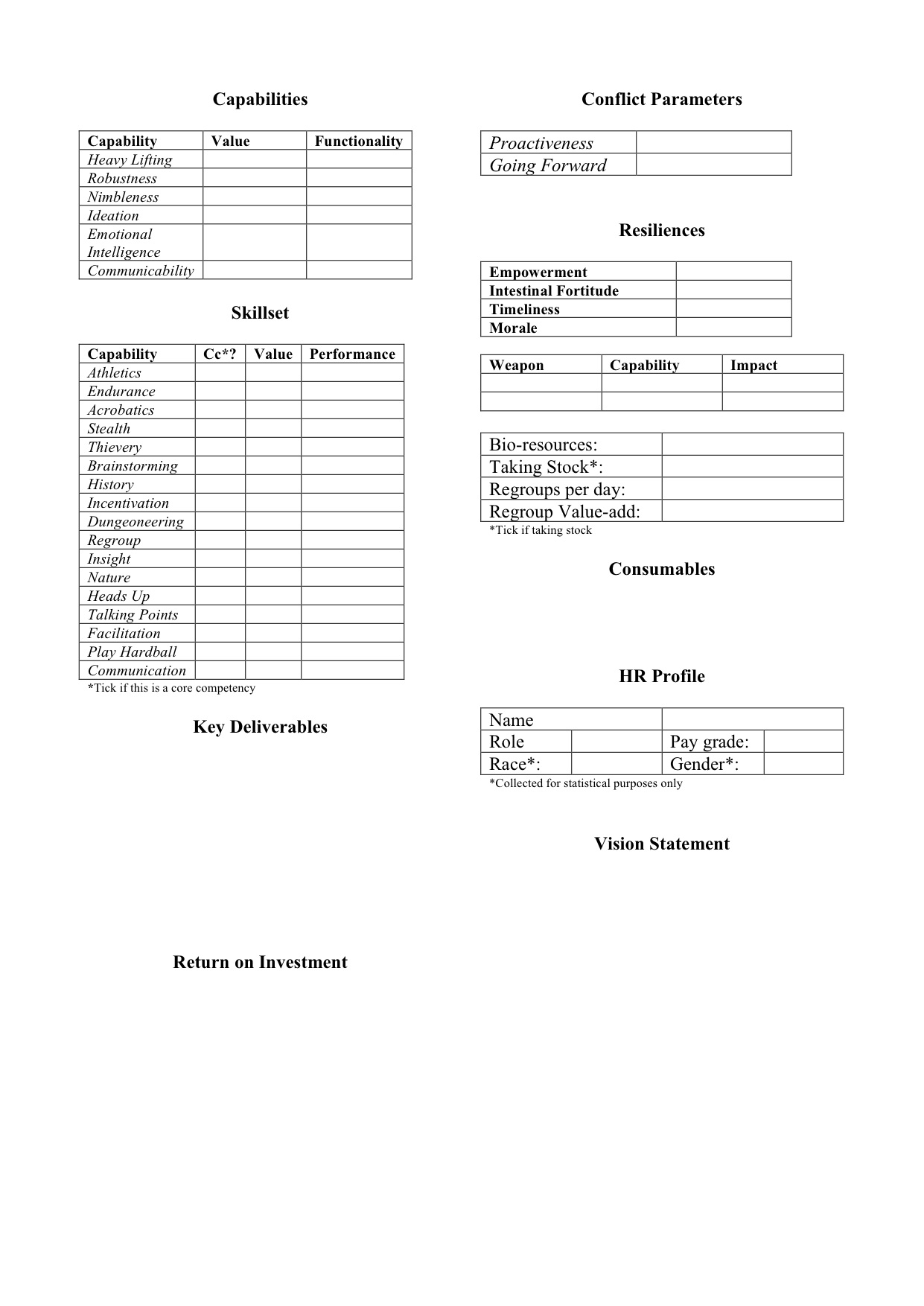
  • A first attempt at how a D&D character sheet might look like if written in business buzzwords:

    Click for a full Horizon-scan

    This character sheet is based on the D&D 4e Essentials character sheet, with the “skillset” separated from the “capabilities.” Follow the flow of that character sheet to see how they all fit in, though it should be obvious to anyone who is singing from the same hymn sheet as me exactly what should be actioned in, for example, the “Key Deliverables” section of the document. If you see a word you recognize, it’s because I can’t think of a suitable buzzword to replace it with. I considered putting in a statement about proper treatment of personal data and please destroy it if it has been emailed to you in error, but we all know that really those statements have no legal force. I think I haven’t used enough hyphens, and some of the nouns lose their full bullshit bingo force if they’re not used as verbs (or should I say, “verbed”).

    Suggestions are welcome, of course: we’ll stir-fry them in the ideas wok. I’m doing a full 360-degree horizon scan on this, so any blue-sky thinking on it is absolutely welcome. Just so we’re sure we’re all on the same page, I should clarify that this is issued under the Open Bullshit License (OBL), just like all product made available through this communication channel. Under the Open Bullshit License, if you envision a strategic fit to any of the ideas pioneered here, you’re welcome to transition them to your own knowledge base. A few questions for us to brainstorm:

    • Is “drill down” sufficient for “dungeoneering”?
    • “Empowerment” isn’t the best option for “Armour class,” but much as you’d like to see the average meeting turn into a melee (that ultimately ends with your boss getting stuck with a guisarme), I can’t think of a buzzword for this
    • “Intestinal fortitude” seems a bit weak. Actually some of the original words (dexterity, fortitude, intiative) are kind of bullshitty in their own right: should they just be kept as-is?
    • Should the whole thing be called a “Service Level Agreement”? I’m not sure…

    Let’s whiteboard any ideas and see if we can come up with a 2.0 version …

  • I’m not a fan of American comedy in general, but Big Bang Theory has really impressed me. I presume no one in my readership is ignorant of the basic idea behind this show, but just in case: it’s about a group of nerds – three physicists and an engineer – who are completely out of touch with ordinary life, and one completely ordinary, normal, un-nerdy girl called Penny. In later seasons two additional extremely nerdy (and very, very funny) women join the group as partners of some of the boys. Two of the characters, Leonard and Sheldon, live together. The rest is classic American situation comedy, except that it’s all filmed from the perspective of the four nerds. There are no dufus macho American men like in Friends or your standard run of crappy sit-coms, clapping each other on the back and putting their feet on the seats: this is the kind of show where the main characters play D&D, or Settlers of Katan, and look on conscious displays of machismo as a kind of vice.

    The humour is simultaneously smutty and sophisticated, which is unusual for American TV, and the characters are excellent. Even Sheldon, who is clearly an arsehole by anyone’s lights, is really funny and endearing, and Howard – who if he were a normal guy would be a horrible person – is quite sweet in his own crazy way. The central character, Leonard, is also the most normal of the group, in that all though he is a nerd’s nerd – nerdier than you or I can ever hope to be, young Jedi – he understands ordinary human interactions sufficiently to be able to pass as a normal human, and his gentle manner means that he regularly manages to pull quite hot women (without ever intending to). The rest of them, however, are lost in la-la land. And this is the central conceit of the show: everything that is normal and coherent is reversed, so that the social relations, interests and even dreams of ordinary people are seen as weird and outre, while the warped social dynamic of nerd-dom is recast as the norm. This show reverses the role of insider and outsider, so that designing an app to solve ODEs is a normal Friday night activity, while going out drinking with your buddies is weird and unenjoyable. Instead of having the nerd or the freak point out the social contradictions and oddities – as happens in, for example, The Breakfast Club – in this show it’s the ordinary Nebraskan woman, Penny, who is constantly confused and challenging the social norms. This reversal in itself offers a lot of entertainment, as we see what would happen if the things we know are weird and unusual were normal, and the things we know everyone expects to be normal were considered a waste of time. It also occasionally offers some quite interesting insights into what is wrong with the standard social order.

    At the same time, however, the main characters are acutely aware of their status in broader society, and we are regularly reminded of their experience of bullying and social exclusion when they were younger. Now, of course, within the world of the university where they work, there is no such problem, and it is Penny – representative of ordinary society – who is cast as the outsider. But when they venture outside of their small group we are reminded of the fragility of their social setting and its fundamental defensiveness. Howard, out on the pull at a club, tells us in one memorable scene that if he waits until 3am all the cool kids will have scored, and he will be guaranteed success with the ugly and desperate social loners who remain – this is his conscious tactic. They occasionally have run-ins with people from their past, and are reminded of how weak they are in other social settings. Sometimes they try to do the right thing in broader society, to defend their rights as nerds or just to be moral, and it always comes back to bite them because they are weak and hated. So they return to their cocoon, aware that they are looked down upon by the rest of society but happy in their safe world. This isn’t really much like adult life as a nerd at all – nerds tend to be much more respected in adult life than they were in childhood, and this part of the show is very much about reliving childhood trauma in an adult setting – but it’s fun and in some ways (especially the parts about women and sex) still true.

    The show does have a few weaknesses. The treatment of Raj, an Indian, I would consider to be racist at times, though also the way that he takes the piss out of the image of India as a poor and backward country is quite funny. The characters never seem to successfully get back at the people who bullied them in their school days, which is frustrating, and the gender relations are typically conservative in that weird American way that mystifies the rest of the world whenever we see it (I’ll have more to say about that in a future post). Also, at times Sheldon is so annoying as to be offensive, and you kind of wish that he would relent a little. But these are minor flaws, considering that this is a show where people quote Star Wars, play Klingon word games, regularly visit the comic shop, and quite frequently have carefully rendered debates about quantum mechanics. The scene where they play D&D is brilliant, and every episode is a gem of good humour. Also, Penny’s dealings with the boys – the way she is affectionate towards them but understands how completely weird they are – is a thing of beauty, sufficient to give all nerds everywhere the hope that they, too, will one day be able to lose their virginity.

    I recommend this show for all nerds everywhere, or for partners of nerds who need to get an insight into their partners worlds without having to face the horror of actually participating in that weird shit. I also promise that if you, a nerd, watch it, you will be reassured of your normality in comparison to the freaks who populate the show. It’s a balm for the soul, if you’re into playing D&D in Elvish but don’t want to think you’re unusual. So if you haven’t already, give it a go…