• I don’t often think about being a “migrant” in Japan, or about racial politics much at all, though I suppose having been here five years and with at least another four years on the cards it’s time I started conceiving of myself as something more than a tourist. It’s not often discussed here amongst the white, English-speaking “expat” crowd, for complex reasons that often don’t reflect well on us, but as Japan changes and accepts more migrants, and as more and more white foreigners live here beyond the mythical three year mark that supposedly is our usual limit, it’s being talked about more and more. This is especially true since last year’s tsunami, when a lot of foreigners fled the country and those of us who stayed behind were offered the perfect opportunity to define ourselves in solidarity with the Japanese, or to think about just how deep the commitment of foreigners to Japan really is – or indeed, how much they expect of us.

    This led to something of an explosion of commentary by the Japan Times‘s resident “voice” on foreigner issues in japan, Debito Arudou, whose claim to fame is that he is an American who took Japanese citizenship. He objects to any form of negative characterization of foreigners in Japan, and even reacts against the patently obvious – that foreigners commit more crime than Japanese, and that we were more inclined to flee the country than were Japanese when the tsunami hit (hence the amusing term flyjin). Since then, Debito has upped the ante a little, and in May he wrote a controversial post at the Japan Times about the daily microaggression that foreigners face in Japan. “Microaggressions” are a kind of tiny little phrase or behavior intended to reinforce status – to make one seem inferior or to put one in one’s place. The phrase works well in describing how women can be made to feel uncomfortable in some spaces, or how black people in American can be reminded of their racial difference. In the case of Japan, these microaggressions supposedly remind foreigners of their “inferior” position here. But if you listen to the list of microaggressions they are really rather pathetic – comments on how well one can use chopsticks, questions about where one is from or how many Japanese women one has had sex with. I don’t understand some of these supposed microaggressions – no one ever asks me how many Japanese women I’ve had sex with, for example. But even the ones I have heard are, in my opinion, not intended to denote any inferiority at all. Many foreigners can’t use chopsticks and many foreigners don’t speak any Japanese at all, or can’t read at all, and it’s not unreasonable for Japanese people to be surprised by those who can. Debito presents their surprise as a kind of ingrained racial superiority, but much of Japanese response to foreigners’ ability at or interest in Japanese things is driven by their amazement that anyone would bother with Japanese culture when they live abroad. They are surprised that anyone in Australia would learn to use chopsticks, thinking that we would just be sensible and use a fork; or that we would try to learn to read when Japanese people will just help us read anyway. In short, they’re a mixture of appreciation and a kind of delicate formalism that Japanese people use to enter into conversations, a formalism that (as has been pointed out to Debito) they use with each other too.

    There is some truth to the greater issue underlying these “microaggressions” – they do serve as reminders that we are guests here and that we are different. Japanese immigration policy hasn’t ever really been founded on the notion that foreigners will stay, and so much of Japanese cultural interaction with foreigners presumes that we are temporary, guests, who should be treated well but assumed to be leaving. This is a source of constant complaint for Debito, who has assumed citizenship here and so naturally would like to be seen as permanent. However, he is (as we would say in Australia) pissing in the wind, because most white foreigners (and let’s make no mistake – he’s not interested in the much greater macroaggressions that Chinese migrants experience!) don’t like to think of themselves as immigrants. Indians and Chinese seem to be willing to see themselves as part of a migration diaspora; whites see themselves as expats, and though they will happily move in amongst each other’s countries, it’s very rare to meet white people in Asia who see themselves as immigrants. Coincidentally the Guardian has a delicate article on this today, by an Indian columnist comparing how British see themselves when they live abroad (as expats) with how they see foreigners in their own country – as immigrants. And this phenomenon is probably nowhere truer than in Japan, where the vast majority of white foreigners are here temporarily as English teachers, either escaping their poor home economies and looking for easy work, or chasing Japanese women. This phenomenon is no doubt common across the region – white foreigners in Asia act like foreigners and they often act very badly with it (Thailand being the best case in point of this). So while Debito is arguing for a greater degree of acceptance of foreigners as permanent members of Japanese society, most foreigners here are on the lamb, or doing smash-and-grab raids for a Japanese woman. Japanese society seems to be infinitely patient with this phenomenon, but it doesn’t encourage them to consider long-term integration, I think, or to see foreigners as anything except oddities.

    In keeping with his interest in migration issues, Debito recently had an article about how the Japanese government is planning a new immigration policy, and rightly points out that they don’t seem to be consulting any foreigners living in Japan about how they feel on the matter. But in this article he raises positively the spectre of “assimilation”:

    Sponsored by the Cabinet, these meetings are considering assimilationist ideas suggested by local governments and ignored for a decade.

    This shows how limited Debito’s thinking on immigration policy is, and how removed his vision for Japanese policy and cultural change is from what he personally is capable of giving back. Does he seriously think that if the Japanese government and society do the hard work on developing a society that accepts foreigners, he will in turn “assimilate”? Assimilation is a strong term, at home in French immigration policy but never adopted by any migrant anywhere in the world. Assimilation is impossible, because it means adopting morals and manners that it’s impossible for one to understand or bend to. For example, it’s unlikely that Debito would be able to write his column in a similar confrontational tone and style in Japanese, and if he were to “assimilate” he would have to adopt a much more consensus-building and conciliatory tone. He obviously hasn’t done that, ergo he hasn’t assimilated. He routinely points out aspects of Japanese culture he doesn’t like and won’t adhere to. This is not assimilation, and in general “assimilation” is not what white westerners do. Wherever we go, we think we can improve the locals and Debito’s constant crusades – from his efforts to force universities to improve employment law for foreigners to his attempts to force brothels to admit non-Japanese – are a classic example of a western way of doing things that isn’t particularly well accepted in Japan. If he – a foreigner who has become a citizen of Japan – won’t do it, why should he think that the rest of us will, and why should he applaud central government policies to encourage this shibboleth? Much better than assimilation is multiculturalism, which allows people to keep their own culture while obeying the laws and codes of the local culture. This is about all that the Japanese can ever expect of us whites, since we’re a proud and fractious bunch, and frankly I think it’s better for Japan that it be this way. To the extent that I have anything to offer this country, Japan is much better off if I don’t become too Japanese – whatever I have to offer the culture will derive from my difference, and there’s little benefit to anyone (me or them) in my submerging my identity under a facade of Japaneseness that will ultimately be shown to be false. Anyone who doubts this about the special case of supposedly unique and pure Japan need only look at the debt their culture already owes to foreign ideas – a good portion of their written culture and one of their two main religions are entirely imported. Even their biggest mistake (world war 2) was heavily influenced by their constant awareness of foreign ideas.

    The same, incidentally, applies to the rest of the world. Australia is much better off asking its migrant populations to retain whatever they like of their own culture, within the laws and codes of Australia, than to demand that they leave the lot at the door and just become Australian. Putting aside how hard it is for us to even say what an “Australian” is, there’s little benefit to us from people doing this. You don’t learn new ideas by asking people to hide their own way of thinking. Australia doesn’t make any such crude demands of its new citizens, and this openness to change and diversity is in my opinion one of Australia’s great strengths. It’s a very different attitude to Britain, for example, where there is a much stronger element of guest worker mentality on the part of both the British and their migrant workers (though to be fair the European situation complicates things there). I think that Japan will naturally end up with a multicultural immigration policy, because it suits their historic attitude towards foreign ideas, but they certainly don’t need people with as shallow a view of migration politics as Debito encouraging them to think about assimilationism, or demanding that we ignore any of the realities of foreign life in Japan that need to be accounted for in managing increased migration. The lesson of Britain in the past 15 years, and also of France, is that ignoring the problems that migration brings with it – both the imagined problems of the racist tory working class, and the real problems of infrastructure, crime and poverty – just leads to a powerful backlash against the most vulnerable. It’s much better to confront them openly and deal with them honestly, which Debito is obviously not interested in doing. This makes him, in many ways, just like the classic swarthy muslim firebrand that every Daily Telegraph reader is scared of, standing on his pulpit and ranting against the racism of white society while refusing to accept that anything is going wrong in his own community. This is not how one builds constructive dialogue and it’s an approach to immigration politics that Australia and Japan have up until now largely skipped. Keeping it that way would be good.

    Finally, I can’t resist but pile on to the obvious problem with Debito’s account of microaggression, and the implicit lack of solidarity between white and non-white foreigners in Japan that it contains. These aggressions really are micro, and many of them don’t apply to those who suffer the worst discrimination in Japan. Does Debito think that Chinese people regularly get complimented on their chopstick skills? No, they don’t. Instead, they get denied housing and treated like potential criminals by a sizable minority of Japanese they meet. They experience discrimination in employment and bad things get said about them quite openly by the minority of Japanese people who don’t like them. They are the cipher for illegal immigration and poor international relations that are almost certainly – you can be sure of it – not the fault of the average Chinese person working in Japan. They are also expected – because they’re east Asian – to learn the language quickly and not rock the boat. They don’t get the same leeway on polite language and Japanese-style interaction as do white foreigners, or foreigners from South East Asia. There is a definite hierarchy of foreigners in Japan and we whites are at the top – which makes it all the sadder when I read a response to Debito by someone bemoaning the microaggression of having people constantly say “you’re so handsome.” You poor dear! Not only does that not happen to your average dweeby foreign resident when they return to their own country, not only are they punching way above their weight in the women they pull because of it, but do they seriously think that the average Pakistani migrant in Britain experiences the same type of microaggression from white British women? Or that black men in America are just being beaten down by this constant racist attention of being seen as sooo good looking? No, it’s probably not happening to anyone except the privileged white resident in Japan. And don’t think for a moment that foreigners here aren’t happy to trade on their foreignness when it gets them free meals, attention from cute girls, or special consideration in service. I’ve never seen a foreigner in Matsue refuse to accept the discount foreigners get on entrance tickets to museums there. I don’t remember any foreigners in my previous town protesting against the fact they were paid more than local staff in the same university. No, they were happy to suck up that little bit of difference, and have their heads inflated by their experience of suddenly being so very special.

    While Debito has kicked off an interesting debate on the guest status of foreigners in Japan, I think he’s letting the side down with the shallowness of his analysis and the brazenness of his rhetoric. I also think that he’s fighting a losing battle, because most (white) foreigners here in Japan won’t assimilate, and don’t want to give up their special status as honoured guests; nor will they do the hard work required to fit into this very different culture when they don’t need to. Without addressing the very special way that white anglo-saxons think of ourselves when we travel and live in other places – as enlightened expats rather than grudgingly accepted immigrants – and without accepting also that most white foreigners can’t imagine themselves as permanent migrants in Asia, he is making demands of Japan on our behalf that he knows we can’t repay in kind. It’s very much a take-take-take, self-centred kind of political resistance he is presenting, and it’s sadly all too consistent with the cultural outlook of foreigners abroad. My guess is that more of us have to work harder to think of ourselves from outside our historical, often colonialist perspective before we can engage in a properly mature debate on migration and race in Japan. I fear that the rest of Asia and the Japanese will have come to a mutually acceptable accomodation on immigration long before the white westerners here have adapted to such a way of thinking, and then Debito’s harsh words will just look like pointless posturing – a kind of American microaggression against a society that, ultimately, has treated us all very well. I hope that we white foreigners in Japan can do better, but my experience of life here tells me we won’t, and we’ll always arrive here expecting, by and large, to be constantly thanked for having deigned to visit. I hope I’m wrong and I hope it’s possible for white foreigners to come to understand some of the migrant issues that the rest of the world faces – I think it would do our own countries good to see a white diaspora of migrants treating themselves as such. But the debate going on amongst westerners here in Japan now doesn’t encourage me to have much confidence in the possibility…

  • Kitty-chan meets Jabbito!

    I went to my first ever baseball game last night, with the students and staff of my department. We watched the Giants (Tokyo) vs. the Tigers (Osaka), a resounding Giants victory (about 6-3) – or at least I guess it was a resounding victory, because I know  nothing about baseball. One of our students was a graduate of a famous baseball high school, so before we went we arranged a special seminar for him to educate the foreign staff and students (about half the department) on the ins-and-outs of this mysterious game, but sadly his lecture was shambolic and his explanations mostly confined to teaching us the Giants’ song. How that took 40 minutes I cannot fathom, since it consists only of saying “oooooooo” a lot.

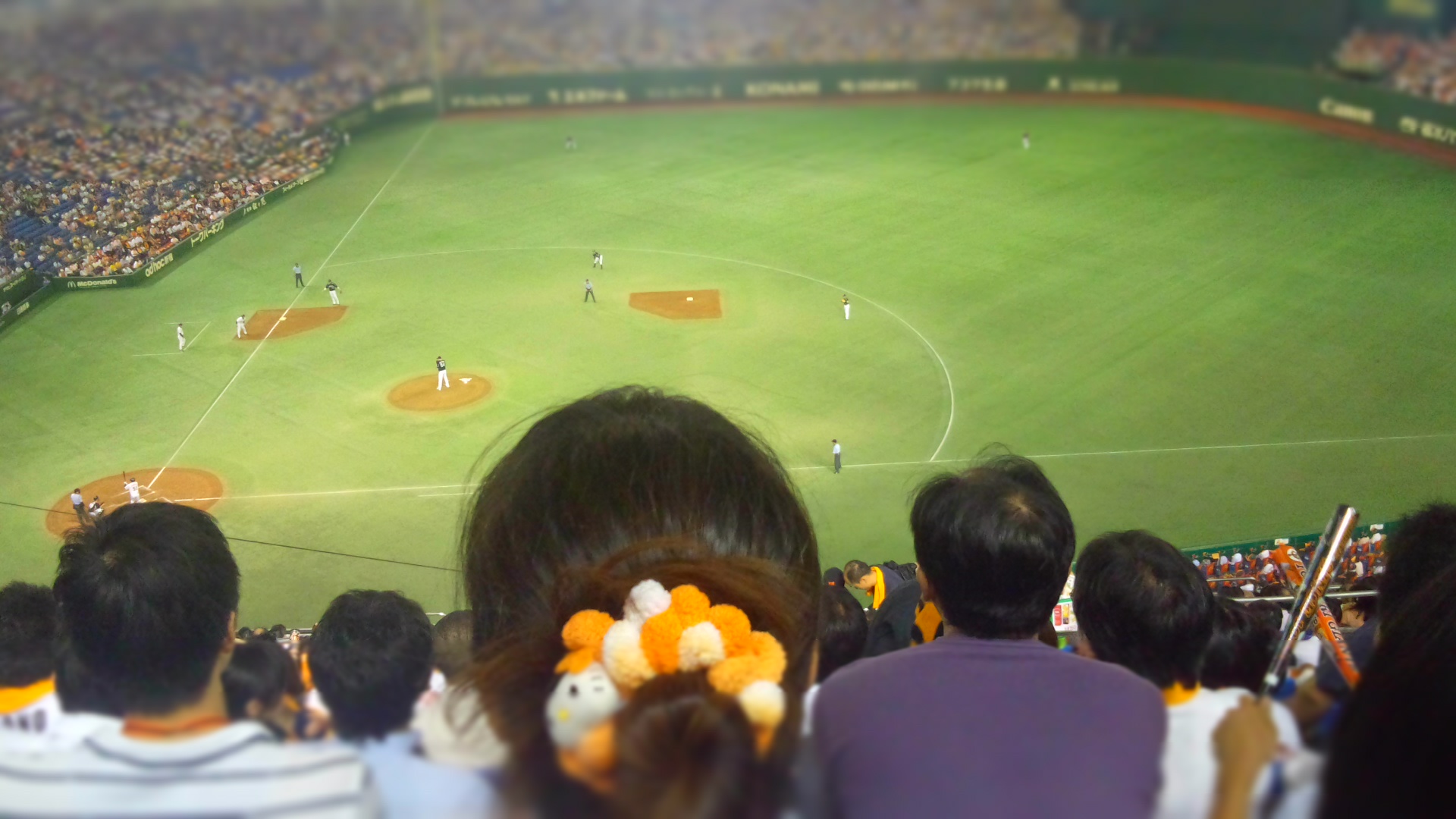
    It was fun, although most of the time I was talking to the people around me – just like cricket, I suppose (there’s lots of ways that baseball is like an abridged version of cricket). The woman in front of me, pictured here with her Giants-themed kitty chan scrunchie, was not interested in conversation however – she was a very serious fan indeed. Perhaps it was through the power of her regular banzai that her team won.

    This trip to the baseball and some recent experiences in Akihabara have me marveling at the gender-inclusiveness of Japanese hobbies and sports, and I’ll be posting on that when I get time in the next few days…

  • Continuing my series of posts exploring the epidemiology of Pathfinder, today I will report on the impact of adding ferocity to the orc stat block. Is the orc still a CR 1/3 monster when one accounts for ferocity, and just how tough does a fighter have to be to walk away from a fight with a single ferocious orc?

    For this simulation (and all sims from now on) I am going to be using my updated and revised modeling program, which has been subject to some fairly severe stress tests and which I’m now fairly certain perfectly mimics a basic combat exchange between an orc and a fighter. I posted revisions here, showing the basic survival probability for three types of fighter and four races, for an orc with no ferocity. This is the basic program I’ll be working with from now on.

    Introduction

    Previous analysis of survival in Pathfinder have studied conflict between fighters of the four main races and inferior breeds of orc, but it is likely that serious dungeoneering will bring adventurers into conflict with hardier orcs fighting near their lair. It is well known that orcs who maintain a close cultural connection with their tribe are braver and more determined fighters, and this is usually reflected in their ability to fight even when suffering serious physical injuries. For this analysis, this powerful additional trait of “wild” orcs, ferocity, is included in the analysis. Essentially this analysis compares the survival chance of a lone fighter against a lone orc isolated from its tribe, probably in a city, with a lone fighter in combat with a lone orc near its lair, where it will fight beyond death.

    Methods

    A set of 200,000 simulated battles between randomly-generated fighters and randomly-generated orcs was analyzed using poisson regression. Orcs and fighters were generated in the standard way, but orcs had a 50% chance of having the ferocity trait, which enables them to continue fighting until they reach -12 hps. A simple main-effects poisson regression model of survival was built, and the effect of orc ferocity on survival reported from this model; subsequently, a model with interactions between ferocity and all the main variables of interest (fighter type, race and ability bonuses) was also built. Results from both of these models are reported selectively for simplicity.

    Results

    Mortality for the 100,000 fighters against meek orcs was unchanged, at 37.2%; but for fighters battling ferocious orcs mortality increased significantly, to 63%. Patterns of mortality differences by race and class type were similar to those seen previously, but mortality rates were higher in all class types and races. Table 1 shows mortality rates by race and ferocity type.

    Table 1: Mortality rates by race and orc ferocity

    Race

    Orc Ferocity

    Meek Ferocious
    Human 30.6 57.1
    Dwarf 32.4 60.1
    Elven ponce 40.8 65.8
    Halfling loser 44.9 68.2

    Note that, although survival patterns are maintained in battles against ferocious orcs, the mortality ratios decrease: from a 50% increase in mortality between humans and halflings against meek orcs, for example, to a 20% increase against ferocious orcs. The increase in mortality due to ferocity also varies, from nearly a two-fold increased mortality rate in humans and dwarves to only a 50% increased mortality amongst halflings.

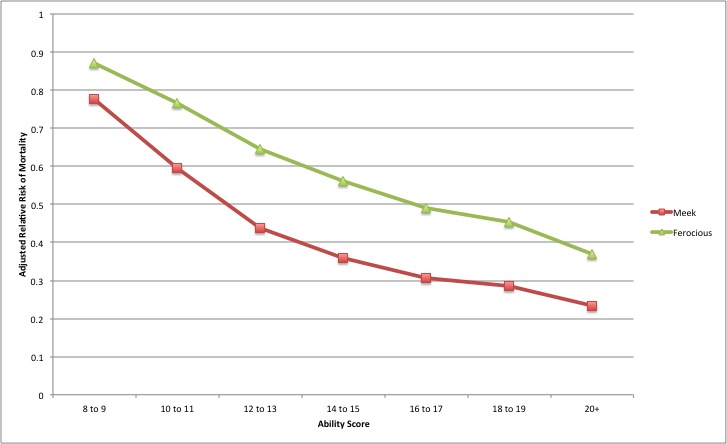
    In a simple main-effects poisson regression model ferocity was associated with an average relative risk of mortality of 1.7, which was highly statistically significant (Z=80.12, p value <0.0001). That is, the average increased mortality from adding ferocity to an orc stat block was about 70%. However, in a model including interaction terms between orc ferocity and all main variables (fighter type, race, and all three stat bonuses) the role of orc ferocity varied significantly across ability scores. For example, after adjusting for other ability scores, class type and race, the increased mortality amongst fighters with minimum strength bonus was only 20%, while it was 85% for fighters with a strength bonus of +5. This effect is shown in Figure 1, which plots the relative risk of mortality by strength score for meek compared to ferocious orcs. All relative risks are relative to a fighter with a strength of -2.

    Figure 1: Mortality by Strength Ability Score for Meek and Ferocious Orcs

    Essentially, strength induces a lower gradient of mortality improvements when fighting tough orcs, and combinations of high scores become more important. In fact, it seems highly unlikely that decent survival will be obtainable for fighters of any race and class type generated using Pathfinder’s standard point-buy systems. These systems will restrict most PCs to ability scores in the 14-16 range, which will not guarantee survival against even a single ferocious orcs.

    Conclusion

    Adding ferocity to an orc’s stat block significantly increases its lethality, with an average increase in mortality risk for fighters in one-to-one combat of about 70% after adjusting for race, class type and ability scores. Even the strongest and most unusual fighters, with ability scores above 18, have surprisingly poor survival of about 30%. Orc ferocity increases mortality across all races and fighter types, with halflings again copping the pointy end of Gruumsh the Bastard’s falchion and incurring death rates of up 70%. This is further evidence that orcs are not CR 1/3 opponents, and suggests that GMs who want to field orcs as cannon fodder against their PCs should judge numbers carefully, or consider treating ferocity as a leader-type trait. It also suggests that – just on the numbers – Pathfinder is the most lethal of the D&D incarnations, especially when ability scores are restricted by point buy options. This will be tested in subsequent analyses.

  • I stumbled on a review of Thomas the Tank Engine on the Guardian today, and was truly horrified. I haven’t ever really paid attention to the little-blue-train-that-could, but I didn’t realise the underlying politics was so horrid (or so sarcastic?) The review describes an episode where a train is walled up inside a tunnel simply for refusing to work in the rain! I was suspicious of the interpretation of this, so I checked at the Thomas-wiki, and it’s true. Henry gets walled up in a tunnel “for always and always and always” for refusing to work in the rain! And in another episode, some truck gets torn apart by wild steam trains for being incompetent at his job.

    I have a suspicion that this is all an Orwellian piss-take: the fat controller’s real name is “Topham Hatt,” which is too much of a caricature to be true, and all the horrors visited on the trains are so obviously straight from the communist playbook that it makes me think the books are an ironic take on capitalism. But this could just be my better nature refusing to believe that someone would seriously write such a book for children. But look at the narrator’s opinion of Henry: “I think he deserved his punishment, don’t you?”

    It’s also interesting to compare the British and American versions of the story of Henry the Walled-in Tanker Engine (aka the Countess Bathory of Steam). They have different names (The Sad Story of Henry vs. Come Out, Henry) implying in the latter version that Henry’s fate is not inevitable, and he can rescue himself by cooperating and moving forward. Also, various crucial ideas get changed: in the British version Henry is walled in forever, running out of steam, while in the American version he is only walled in until he “is ready to come out of the tunnel”; while in the British version we are asked whether he deserved his fate, in the American version we are asked “How long do you think Henry will stay in the tunnel before he overcomes his fear of the rain and decides to journey out again?” I think those differences speak volumes about the cultural differences between two apparently very similar nations. But either way, that is a cruel and horrible story that children do not need to hear!

  • In preparing an analysis of the effect of orc ferocity, I found I wasn’t able to reproduce the results of my previous post on different types of fighter and different races. The overall mortality in that post was 20%, but I kept getting values of 36%. Because I’m such a stunningly good programmer, I’d overwritten the program I used to produce those results, and it has taken me several days (interrupted by moving house) to dig up the original programs from Time Machine[1]. Checking through them I found a tiny error (three letters in one line of code out of 375[2]) which causes character hit points not to update after a round of combat – so that the only way the orc could win was to kill the PC on its first round of combat. That’s an interesting insight right there – 20% of the time the orc wins in the first round of combat!

    So the true mortality rate in that analysis should have been 36%. I’m not going to redo the whole analysis (it’s late and I’m tired and I have a new analysis of ferocity to come), but I will put up the corrected table of mortality rates by race and fighter type, in Table 1.

    Table 1: Mortality by race and fighter type (revised)

    Race Fighter type
    Strong Fast Tough
    Human 20.4 36.7 35.1
    Dwarf 18.8 43.6 36.2
    Elf 30.7 52.2 38.7
    Halfling 26.1 61.6 45.9

    The general conclusion – that fast fighters are a disaster – is retained, but the effect is even more noticeable in elves and halflings, and high strength is even more important for these races than humans. Mortality rates in fast fighters are 1.8 times higher amongst humans, compared to over 2.5 times higher in halflings. Also, when the orc is not constrained from delivering a second blow, constitution becomes much less important than strength – being able to kill the orc first remains the most important skill.

    Dwarves, who in this simulation have dropped power attack if they are strong fighters, benefit hugely from being strong rather than tough, presumably because they already have a constitution bonus.

    So, the order of ability scores is: strength, constitution, dexterity. And I need to improve my programming!

    fn1: which is awesome, btw.

    fn2: which would probably be about 50, if I was any good at this stuff

  • image
    Where’s my Chai Latte!!!?

    Today was moving day – up at 6am, finish packing, removalists come at 8am, cross the suburb of Kichijoji to our new river-side apartment in nearby Mure, then back to the house to clean, deliver a present to our previous landlord and done and dusted by midday. That was the plan. Things went a little wrong, though, from about 9:30, and didn’t quite right themselves until our previous landlord drove us to our new house at 2pm. Our previous landlord is a sweet 70 year old ojiisan (Grandpa) who kicked us out because his 40 year old house is crumbling down around us. To make up for kicking us out he gave us his fridge, washing machine, bedding, microwave oven, television and rice cooker. He also offered to look after our rubbish (a perennial and serious problem when moving house in Japan). In exchange we gave him a packet of tim-tams, so all is even.

    In the course of moving to Mure (which, incidentally, is an archaic word for “hill”) I had the opportunity to see various examples of classic Japanese work ethic, proved that incompetence is a universal property of real estate agents not confined only to westerners, learnt the Japanese word for “nictitating membrane” (shunmaku, 瞬膜, if you’re interested), witnessed my cat get acupuncture therapy, probably experienced the curse of a suicidal alcoholic dead author, and learnt some interesting things about property ownership in Japan. Naturally, I want to share.

    So, in order of appearance, here is the tale of my day.

    The super-efficient removalists

    The removalists started work at 8:15. There were two of them. Their task was to move about 15 boxes, 20 bags, two desks, one large cupboard, two chests of drawers, two computers, one printer, one fridge, one washing machine and sundry accumulated crap from the two floors of our house, along a narrow path and into their waiting truck. Nobody told them beforehand, but in order to get to the washing machine they had to move 20 boxes from the shed into the house (we helped with this). Oh, and they had three “hanger boxes” for our clothes, that we filled while they worked, and they then carried out. They were done by 9am, even though every time they came into the house they had to take their shoes off. They also wrapped all the furniture before they moved it, and moved everything carefully, and even managed to reseal some boxes they weren’t satisfied with.

    The smaller guy couldn’t have weighed more than 60 kg, he was tiny, but he could lift the washing machine by himself. He could also carry a chest of drawers down a very narrow and windy flight of stairs. This man was so small that he wore his packing tape as a bracelet (it fitted on his wrist and came off easily). He wrapped my printer in a blanket in about 3 seconds flat, and not only did he tape it up but he put an X-mark of tape on it to indicate it was fragile. He and his mate actually ran up and down our stairs, and moved through the house at a kind of shuffling semi-run – all while carefully avoiding touching the walls or risking damaging anything. They wrapped the fridge in these kind of padded socks that stop it from damaging or being damaged by door frames, and to get these socks on was a kind of 3 second effort: one of them says “se-no!” and then they flip the whole thing over the top of the fridge like they’re putting on some kind of enormous head band. Pat Cash would be proud, if his head were the size of a fridge. These are men with a rare and refined ability to size up the dimensions and weight of an object, and be done with it in 1 second flat. And they were going to be working at this pace at houses around Tokyo until 7pm.

    (If you’re moving in Tokyo, try フクフク引っ越しセンター、27000 yen for all that done professionally in 1 hour! But Japanese only, I think).

    So all of this done by 9am. We were thinking that the whole day would be over by 10. Sadly, removalists’ efficiency is easily done by the universal incompetence of real estate agents …

    The wrong keys, in the rain

    We reached the house at 9:15, only to discover that the keys the real estate agent gave me the day before wouldn’t open the door. Luckily I had kept the real estate’s number in my bag, so I called them … they open at 10am. The removalists told me that they could wait until 10am … and then the rain started. It’s the fag end of the rainy season here so it was pretty desultory, but it wasn’t looking promising. I assumed that the removalists had another job to get to, and come 10am were going to start dumping my shit on the road. Actually I discovered later, they could wait until 10am before they started charging me a waiting fee (which was very nice of them!) But I didn’t know this, and I had visions of my stuff sitting on the mud next to my doorway, getting rained on, while I waited for the real estate agent to turn up.

    Fortunately, Japanese businesses have staff in them before their appointed opening time and they answered the phone at 9:30. Our estate agent couldn’t get in touch with the landlord, however, and couldn’t understand how our key couldn’t work. It somehow took him 30 minutes to reach our house (a 20 minute walk from his office!) only to discover that the key didn’t work. Well, shock! The removalists had tried it and they couldn’t get it working – what chance did he have? As I was talking to him the electricity guy turned up to check our electricity, and I had this vision of all the utility company reps standing in a queue in the rain while the removalists dumped my shit on the pavement and I remonstrated with the real estate. No doubt, if these removalists needed to bail to their next appointment they’d have my stuff out of their truck in five minutes flat.

    As an aside, when I signed the contract the real estate initially presented me with the contract for a different apartment in the same block, and a few hard words from his boss were required to get him to reprint the contract to my satisfaction. My suspicion was he’d done the same with the keys, but they didn’t work on the other empty apartment, so his mistake was way more random than that. Random incompetence is so much more frustrating than focused stupidity, don’t you think?

    As another aside, when the real estate agent gave me the key the day before, he pointed out to me that it had no room number on it, but said “you can see it has the word WEST written on it, which means it’s the right one” (my apartment is on the west side of the building). Hmmm… famous last words.

    So I was starting to yell at the real estate, the electricity guy was looking on in fear, the removalists were laughing, the Delightful Miss E was explaining things to the electricity guy, the rain was falling … then the removalists revealed that they wait for $35 per 30 minutes, and everything smoothed out. The real estate offered to pay while we waited for the locksmith, and then we all just waited. Fortunately he contacted the landlord (who lives nearby) just a few minutes later, and scored a key. Win!

    I’m still pretty pissed off with him though. This was Sunday, so his shop was open, but if I had been moving on a Wednesday his shop would have been closed, I wouldn’t have been able to contact him, I wouldn’t have been able to get into my house, and would have had to send the removalists away (or pay them to wait a day!) So, note to self: never move on the  day that the real estate is shut. Also, maybe punching your real estate’s lights out when you meet him, just to remind him of his place in the universe, is a good idea. Just in case. Anyway, this proves that real estate agents are incompetent, without fail, the world over – I had expected better in Japan, where being thorough about details like “is this the right key?” is standard in most workplaces, but the real estate business must have not read that memo. Wankers!

    The Dazai curse

    So I also discovered from my landlord that my house is situated right next to the bridge where the famous Japanese author Osamu Dazai killed himself with his lover Tomie Yamazaki. He seems like a pretty dissolute and useless kind of chap – maybe his ghost is stalking the area, making real estate agents incompetent and disconnecting landlord’s phones? Actually, I think he did himself in a little further south of my house, towards Shimorenjo. Looking at the canal now, even my cat couldn’t drown in it, but apparently back in the day it was much more ferocious. Anyway, I guess if this house turns out to be cursed, it’s the fault of Japan’s version of Lord Byron. I’ll have a thing or two to say if I meet that ghost!

    Cat Acupuncture

    In amongst all this, it had become apparent that our cat Arashi chan was somehow sick: his nictitating membrane was showing, which is definitely not normal, and by Saturday night his eyes were half-covered. I did a brief web search and discovered it’s probably just stress, but I didn’t know a vet near my house (of course there are three, I now know) so we decided that it would be a good idea to take him to the vet we know, near our old house. So after successfully not gutting our real estate agent and feasting on his liver in the street in front of our new house, challenging though it was to show such restraint, we decided that it might be best if we went back to the old house (where, fortunately, he was still safely ensconced) and took him to his regular vet. So off to the vet, where the nurse on reception remembered Arashi chan’s name as soon as we walked in even though we hadn’t seen them since last September. He’s a lady’s man, our Arashi chan.

    By now it was midday, and it took an hour to get Arashi chan into the vet after the queue of rabbits and extremely small dogs. Terazono veterinary surgery is a beacon for rabbit owners and – obviously this is pure conjecture – I suspect a lot of them are lesbians. I think there’s a secret rabbit-owning lesbian underclass (cabal?) in Tokyo, and they live in or near Kichijoji. Maybe they’re in league with Totoro, who is a damn sight shiftier than the movies give him credit for, in my opinion.

    My suspicions about this vet were confirmed when, having told me that Arashi chan was suffering from stress, he offered to administer a soothing session of acupuncture! Cat acupuncture! The great thing about conducting these kinds of negotiations in Japanese is that I don’t understand half of it, and my natural response is to trust my interlocutor and say “yes” while I catch up with what’s going on. So by the time the needle was in Arashi chan’s shoulder blades I was just catching up with the details. OH! Acupuncture! Like Black Adder in the German prison – “ooohhh! It’s a scythe!” He also got a needle in his inside thigh, just near his bum. It did seem to calm him down, and he certainly didn’t notice it. How strange! The vet told me that that cat acupuncturists are very rare, though he has heard it’s all the rage with horses in Australia[1], which had me imagining rapiers, or a vet turning up to the farm with a nail gun “for therapeutic use only.” How do you administer acupuncture to something as large and as thoroughly, irreconcilably evil as a horse? It’s like massaging a satanic whale.

    So, Arashi chan calmed down (apparently – it’s hard to tell with an animal that spends 23 hours a day sleeping and one hour a day being profoundly stupid), and after a brief clean of our old house we went to hand in the keys to our previous landlord. After delivering the tim-tams, though, we discovered that all the taxis in Kichijoji were full or booked or dead, and we couldn’t get a taxi.

    It’s as if just for this one day of the year, the 1st July 2012, Tokyo had decided to do a bad service exchange agreement with Sydney. No taxis? That never happens! Bad real estate agents? Sydney! Note to self: don’t move house on a day when the entire city of Tokyo has decided to do an exchange of bad vibes with Sydney.

    So, our landlord offered to drive us to the new house, and during the drive we found out why he was unconcerned that we only did a perfunctory clean of his granny flat … and strange indeed it is …

    Buying a house on someone else’s land

    Our landlord is moving in August. Apparently his son is rich, and has bought the whole family a nice place in nearby Mitakadai[2]. I asked “what will you do with the old house?” His reply: “knock it down.” (actually, he said “destroy it,” but whatever). After establishing that knocking the house down will cost him money, I naturally asked, “will you just sell the land?” and he replied “oh no, we don’t own the land!”

    WTF? You bought a house on land you don’t own? In Tokyo? Isn’t that a little risky? Is that even possible in Australia[3]?

    Apparently it’s not risky, because they’ve lived there for years and it was their decision to quit, not the owner’s. They’ve been asking him to sell the land for years but he keeps saying no. Why, they don’t know – he lives in Shikoku, and doesn’t care one whit about Tokyo. But he won’t sell so they finally gave up and decided to move. I guess that this means their house is really just a very elaborate version of a mobile home, that you buy and stick on someone else’s land and then move away with, only in this instance “move away” means “take off and nuke the entire site from orbit.” Maybe this is why a retired typesetter can afford a massive two-storey home with Granny flat in one of Tokyo’s most sought-after locations – because he only bought the house, and is renting the land at some dodgy dirt-cheap pre-bubble rate.

    Is that even possible in Australia? And would you do it?

    I wonder if a lot of the houses I see going for sale cheap in Kichijoji are operating like this – you’re actually buying a home that, if you can’t sell it on when you try to move, you have to destroy. That is so radically different from western concepts of property ownership. And probably something to look out for if you’re planning on buying a house here…

    So that was my day. My feet hurt, my cat is composed entirely of nervous energy and nictitating membranes, my real estate couldn’t organize a root in a brothel, and my house may be cursed by the ghost of a dissolute alcoholic cheating bully who wrote overwrought prose about self-destructive idiots, a kind of wartime-era Sid Vicious of letters. Have I made the right decision moving to Mure? Perhaps I should have bought a house on someone else’s land in Chiba? Ah, the complexities of finding a home in Japan …

    fn1: I guess these vets don’t call themselves “the horse poker” for obvious reasons.

    fn2: Mitaka means “three hawks.” My house is also in Mitaka and, rather shockingly, around the corner from my house is a “hawk cafe” where you can have coffee in a building that contains owls and hawks. You can get your photo taken with them. Today I discovered that birds can consciously control their nictitating membranes. That’s right, that blink they do is them sneering at you.

    fn3: Well obviously, everyone’s doing it, in essence, since no one ever bought the country from its original inhabitants, but I think property law somehow managed to … cough … find a way to overlook that.

  • This weekend all atomic clocks will add an extra second of time to keep track of … something. This is cool! I’m moving house on Sunday, I could use the extra second of sleep. The Guardian reports on the issue, and some of the commenters provide some excellent examples of a healthy cynicism towards science.

    Asks Easilylead:

    Do we all have to take the extra second at the same time, or can we save it for when we need it?

    Following this (almost immediately) TheAdulteratedCat shows that there is no law of the universe that humans haven’t learnt to rort the moment it’s written. In response to Easilylead, TheAdulteratedCat asks

    You mean like you can claim it if you’re about to be hit by a bus?

    I think we can all agree that would be awesome, like the universe delivering everyone on earth a single fortune point through the dipole moment effect of gravity, or something. Thanks, God! But tipatina is clued up to the obvious social justice issues attached to this time change:

    i hope the unions make sure we get paid for this extra second… if not i say we strike for two seconds…who’s with me

    A valid point, I’m sure we can agree, though I don’t know if I can make it to the barricades in two seconds. But this extra second doesn’t just manifest as an issue in economic relations: consistent with basic feminist doctrine, we need to recognize that all political issues start in the bedroom, and WhatsMyPoint has his eye on the feminist implications of the moment:

    The Mrs is in for a treat 🙂 Reckon I can just about last that!

    The world will definitely be partying for that extra second … unless you’re an elite athlete:

    Could we add the extra second during the 100m final at the Olympics to slow down Usain Bolt? Or would that speed him up?

    Sadly for newlaplandes, the olympics won’t be held at midnight tomorrow night.

    Finally, however, VSLVSL nails it:

    I BLAME BROWN.

    That bastard! I bet he’d tax our extra second if he could!

  • I blogged before about how the Supreme Court should probably abolish the Old School Renaissance, and how it has a history of deciding in favour of mandated health insurance. It appears that the supreme court hasn’t broken with that tradition, and will uphold Obamacare’s individual mandate. Of course the devil’s in the detail and Obamacare is, as universal healthcare packages go, pretty shit, but this is overall a big win for Americans. Guys, if you keep plugging away at it you may one day get a decent, affordable healthcare system. Ganbare! There appears to be some devil in the detail – maybe the supreme court has limited Obama’s ability to force states to accept his medicaid expansions (because with 40% of Americans on food stamps, why on earth would you need to expand the safety net?) – but the mandate is a central plank of Obamacare, and if that’s all you guys can hope for, I guess it’s a good thing the court didn’t strike it down. Just to remind my readers of how perverse such a decision would have been:

    in 1790, the first Congress, which was packed with framers, required all ship owners to provide medical insurance for seamen; in 1798, Congress also required seamen to buy hospital insurance for themselves. In 1792, Congress enacted a law mandating that all able-bodied citizens obtain a firearm. This history negates any claim that forcing the purchase of insurance or other products is unprecedented or contrary to any possible intention of the framers.

    It’s a win for originalism!

  • After taking account of comments here and on the Paizo messageboards, I have adapted my simulation programs to allow for purposive attribute scores, feats and races, and re-analyzed the survival data for a smaller sample of more carefully designed fighters. In this second round of analyses Gruumsh the Bastard doesn’t acquit himself well, but neither do some of the PCs who went against him. This post reports on the updated analyses.

    Update (3rd July 2012): In editing my code to incorporate some minor changes, I noticed that I didn’t actually pit 100,000 fighters against 100,000 randomly-generated orcs – I pitted 100,000 fighters against Gruumsh, who only has 6 hit points. Against a full range of Orcs one gets very different results – I will report on this today (3rd July 2012). This post has been edited to remove references to 100,000 randomly-generated orcs.

    Introduction

    Previous analyses of survival in Pathfinder have relied on randomly generated ability scores assigned in order, and have not incorporated feats, race, fighting styles or weapon types. In this post the analyses are updated to allow for a range of basic feats, four races, purposive rather than completely random assignment of ability scores, and three types of fighter: strong, fast and tough. Survival is compared against Gruumsh again, and results analyzed for insights into possible character creation decisions.

    Methods

    A sample of 100,000 randomly generated fighters were pitted in battle against Gruumsh, who is still not ferocious. The fighters were generated so as to fall into three types, defined by ability scores, armour and weapon types, and feat choices:

    • Strong fighters: strength was determined randomly from a uniform distribution between 13 and 18, and the fighters were equipped with scale mail and a two-handed sword. Human fighters had three feats: power attack, weapon focus and desperate battler. Humans placed their +2 ability score bonus in strength. Non-human fighters dropped power attack
    • Fast fighters: dexterity was determined randomly from a uniform distribution between 13 and 18, and the fighters were equipped with studded leather armour, a heavy wooden shield and a rapier. Human fighters had three feats: improved initiative, dodge and weapon finesse. Non-humans dropped weapon finesse, and humans put their +2 bonus into dexterity.
    • Tough fighters: constitution was determined randomly from a uniform distribution between 13 and 18, and the fighters were equipped with chain shirt, wooden shield and longsword. Human fighters had three feats: toughness, shield focus and weapon focus. Non-humans dropped toughness (because two of the races already had +2 constitution), and humans put their +2 bonus into constitution.

    All other physical stats were generated with 3d6, but scores below 9 were reset to 9. Mental stats were generated using 3d6 in order, but nobody cares if their meat shield has read Shakespeare, so the details aren’t reported here. The hapless 100,000 were then thrown against Gruumsh, with the promise that anyone who survived would get to meet Salma Hayek. Needless to say, I lied: for unknown reasons, Hayek only dates bards. All fighters with power attack were assumed to be using it for every strike, and you would too if you met Gruumsh.

    Results

    After incorporating racial bonuses and feats, and assigning ability scores purposively rather than randomly, overall survival increased significantly: only 20% of the newly trained fighters died. However, variation in survival was significant and depended heavily on race and fighting style. Table 1 shows the mortality rates by race and fighter types.

    Table 1: Mortality Rates by Race and Fighter Type
    Race Strong Fast Tough
    Human 17.1 26.5 0
    Dwarf 11.1 21.8 1.1
    Elven Ponce 27.3 46.9 16.4
    Halfling Loser 21.2 45.3 8.3

    From Table 1 it is clear that elves and halflings are not good fighters, and Dwarves are excellent in this particular role. The small difference in mortality between humans and dwarves is probably due to the reduced number of feats that dwarves have relative to humans. In fact, once feats and purposive ability score selection are included in character development, constitution becomes an extremely important score: 0% of fighters with constitution bonuses above 3 died. This is probably because CON bonuses of 3 or more guarantee a fighter cannot be killed in a single blow by an Orc (maximum damage 12) and the increased damage and hit stats of these fighters mean the orc will not survive to deliver a second blow. This is indisputably a good thing.

    It is clear from table 1 that the least successful form of fighter is the fast fighter, and indeed some perverse results obtain. Figure 1 shows the mortality rate by dexterity score: mortality increases with increasing dexterity in this dataset. This is probably because higher dexterity scores are more likely in the “fast fighter” choice, and amongst halflings, both of which deliver less damage than other races and class types.

    Figure 1: Mortality by dexterity score

    A similar perverse result is visible with armour class. Figure 2 shows the relationship between mortality and armour class, which is positive.

    Figure 2: Mortality by Armour Class

    Again, it is likely that the highest armour class values are only achieved by halflings (who have size bonuses), and higher AC is associated with lower damage and attack values. Note that fast fighters have very high initiative values (up to +9!) but these don’t seem to say the battle: for fighters who start with a minimum of 8 hit points, starting the battle first is less important than being able to hit your opponent and do massive amounts of damage.

    Conclusion

    Dexterity is useless, and a fighting style based on light armour and fast weapons is a waste of time. As a result, weapon finesse is the ultimate wasted feat: it could have been used to get 3 more hit points, which for a first level fighter guarantees that one strike from an Orc will not be fatal. After incorporating feats, the best option for a first level fighter is to choose toughness, shield focus and weapon focus, and pour as many points as possible into constitution. 17 hit points, chain armour and a shield at first level are vastly more useful than a fancy fighting style and a leather skirt!

  • The early cat gets the suffragette…

    It’s often forgotten in modern times that women’s most basic rights weren’t won prettily or peacefully: the suffragettes‘ campaign for the vote included a coordinated campaign of vandalism against shops, a protracted hunger strike that led to women being forcefed in prison (with some horrific injuries, as one can imagine of turn-of-the-century doctors trying to “safely” forcefeed women gruel with a tube) and the famous Epsom Derby incident. Their protests were often violently broken up by the police (in modern media parlance,  “the demonstration turned violent”) and much of British and US society was terrified of this new breed of women (called “modern girls” in Japan) who were willing to do very unlady-like things to get what they believed women deserved.

    To the suffragettes’ long list of violent activism we can add the deployment of an organized militia trained in jujitsu: the Guardian today reports on Edith Garrud, a diminutive woman with jujitsu training who was responsible for training Emmeline Parkhurst’s bodyguards[1]. I would be intrigued to read more about this situation, because I guess there were no jujitsuka in Britain at the time, and certainly no white jujitsuka – this means that she must have learnt from a Japanese person who was, one presumes, a Japanese man. Or did Japan also have a secret cadre of highly-trained female jujitsu practitioners? I have visions of a cabal of art nouveau-styled schoolgirl feminist ninjas, deploying jujitsu in defense of … of … ninja things. And teaching it to passing suffragettes.

    So there you go – western feminists polished up their violent mojo under the tutelage of the Japanese. Is there a stranger connection in the history of radical politics?

    fn1: never let it be said that feminism and Libyan socialism have no common roots! Just like Gaddafi, the leaders of the suffragette movement had an all-female bodyguard!