• In briefly surfing through the Paizo messageboards I stumbled upon this highly contentious doozy of a thread: Is torturing intelligent undead an evil action? The resulting thread is a microcosm of the murky debates that surround good and evil in a game that recreates a moral universe radically different from our own, but my position falls on the side of the anti-religionists everywhere: Paladins, while good in the framework of the game, are your classic evil bastard when viewed through the prism of modern morality. One commenter sums up the perverted morality of the Paladin quite nicely on the first page:

    It’s also hypocrisy like that, that causes no one to feel bad at all when a Paladin bites the dust

    Yep, count me in with that position.

    Of course, in a world of intelligent undead and actually evil gods, the Paladin’s vengeful “goodness” suddenly makes perfect sense. We should all say a prayer of thanks to the Flying Spaghetti Monster every morning we wake up and find ourselves not in that world.

    From a DMing perspective though,the thread raises one interesting question: how to handle players who lie during torture. The OP claims that

    The party melee unceremoniously decapitated the magus the same way they had his vampiric predecessor. (The players lied and said they would spare him if he sold his master out)

    I hate it when players do this, because you have to act your way through a situation where they get the information and don’t have to worry about a prisoner or potentially vengeful future enemy. Also, realistically it’s the only way you can trust the information you receive from torture: if a prisoner knows they’re going to die they’ll just fess up any old shit as quickly as possible to avoid another round of burnt-poker-rogerings. When players then do the coup-de-grace anyway, it’s like a cheap exit clause for them with no penalty.

    So I came up with a new rule that I carry across all campaigns: players can use the old “promise them their freedom if they tell the truth but then kill them anyway” routine, but if they do it repeatedly they’ll get a kind of nasty light in their eyes that every enemy will recognize: the “I don’t really mean these platitudes I’m telling you” light. Once this light gets in their eyes, torture becomes permanently useless. I tell my players this early on, and from then on they only use this technique very sparingly, when they’re in desperate straits (i.e. really can’t risk letting the guy go) or the torturee is really so evil that slaughtering them is a favour to the universe, and lying to them beforehand just the icing on the cake.

    This rule, I have found, makes players much more willing to find alternatives to torture when they deal with low level minions, and much more aware that every person they let go may be a knife in their back later, or an evil they haven’t slain. It also makes torture and taking prisoners a much more complex undertaking.

    But in either case, I don’t think I’ve ever run a campaign world where undead can be tortured. Except maybe vampires. The rest of them will just laugh it off and sneer at the players as they refuse to blab. If you want to find their secrets, you have to dig a little more carefully than severing a few digits and casting a few cure light wounds. They’re liches, not mercenaries with a skin problem!

  • This weekend I continued my work on the epidemiology of Pathfinder, including an expansion of my programs to allow for different types of point buy. In the process I took the advice of some commenters at a related thread on the Pathfinder message boards:

    I think for the non human fast fighters dropping weapon finesse makes no sense. Because they can hardly hit if they drop that. I would recommend changing it to dropping improved initiative for the fast non-humans.

    In my original simulations I had built non-human fast fighters with improved initiative and weapon focus, but in this revision I changed this around so that non-human fast fighters drop improved initiative and keep weapon finesse. The results, though still not presenting a stirring defense of the decision to play a fast rather than a strong fighter, do bear out the suspicions of those commenting on that board, that for fast fighters weapon finesse is the most important feat to choose. Table 1 compares the results with weapon finesse that I generated today with the previous set of results that dropped weapon finesse in favour of improved initiative. The results in Table 1 are shown for combat with meek orcs (lacking ferocity) to be consistent with the previous post. Similar effects are observed against ferocious orcs, however.
    Table 1: Non-human mortality with and without weapon finesse (revised)

    Race No Weapon Finesse Weapon Finesse Odds Ratio
    Dwarf 43.6 37.0 1.32
    Elven Ponce 52.2 44.2 1.38
    Halfling Loser 61.6 49.7 1.62

    The odds ratios in Table 1 are provided to show which race suffers the most from lack of weapon finesse, and it is no surprise that it is the halflings. This is because they do the least damage, so the loss of hit chances affects them the most.

    These results don’t change the fundamental conclusion that fast fighters are a very bad choice, but they do indicate that if one is going to pick this fighter build, weapon finesse is a very important feat to choose.

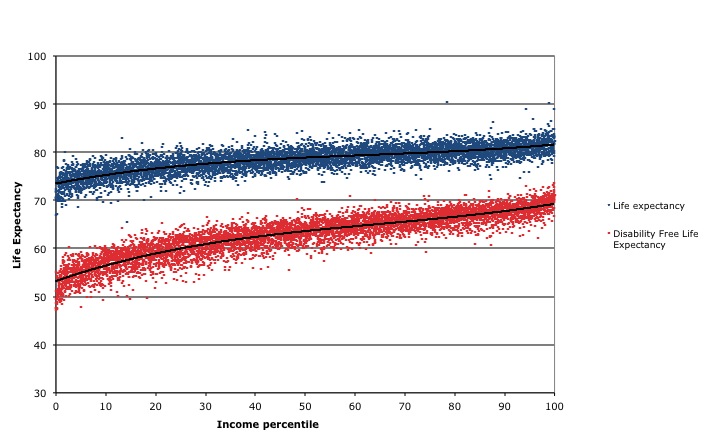
  • Life Expectancy and Wealth in the UK, 2004

    I’m doing some research work at the moment on a certain country, and have identified a negative relationship between inequality (measured using the Gini index) and all-cause mortality. I’m not at liberty to identify the country, or the details, of course. This negative relationship means, in essence, that the more unequal a small area becomes, the lower the death rate in that area. The effect is very very weak, so essentially can be dismissed as a policy concern (other aspects of the area’s economy drive much greater increases or reductions in mortality).

    Typically, when a result like this occurs, people will dismiss it as either a statistical oddity or will say that the inequality effect is operating as a proxy for other phenomena – for example, the observed values of inequality measure the effect of past rapid economic growth, or are a proxy for some other aspect of the economy or society (social capital, corruption, etc.). The reason for this is simple: it’s very hard to construct a mechanism by which increasing inequality can reduce mortality, but it’s easy to say that inequality increases as wealth does, and that increasing wealth reduces mortality (a fairly solid fact). There is a model for how inequality can increase mortality, through mechanisms such as reduced social welfare support, or inability to seize necessary cultural or physical capital – there are quite a few convoluted mechanisms proposed by which relative inequality can have this effect in wealthy countries like the UK.

    I’m a realist in this regard, and I don’t think relative inequality is important to health – I think it’s absolute inequality that determines health, in the vast majority of cases – thus in the short term development is more important than equality (or, in many cases, basic rights – see e.g. China). But this data I’m playing with measures relative inequality – that is, it measures the distribution of wealth, and looks at the relationship between this distribution and mortality after adjusting for absolute wealth (how rich an area is).

    So, here’s a challenge to my reader(s): can you propose a social mechanism by which increased relative inequality reduces mortality? This mechanism needs to work across regions with a diverse range of income levels and other forms of social determinants of health. Imagine it in your own country, if you like: whether you’re living in Sao Paulo or on the edge of the Amazon, greater disparity in wealth will reduce mortality. Can you explain how this happens without falling back on arguments that a) the measure of inequality is a proxy for something else or b) higher absolute wealth generates higher relative inequality.

    Have at it, if you dare!

  • This week’s New England Journal of Medicine (NEJM) has a concise and informative overview of the US Supreme Court’s decision on Obamacare, which is well worth a look. It even includes a cool table showing how each judge decided on each of the key issues, with pictures. Consistent with all its coverage to date, the NEJM continues to be upbeat about Obamacare (though not so upbeat that they call it by its catchy handle, rather than its boring full name): they characterize the judgment as “upholding nearly all” of Obamacare, and describe the supreme court process as the “denouement” of the story. In NEJM-land, while the tea party and Republicans fume and rave, the practical folks in politics and the law have accepted the reality of a US healthcare financing landscape that incorporates Obamacare.

    The article also gives some nice insights into the reach of the Court’s power, and the thinking of the chief justice. In talking about his conclusion that the individual mandate lies within Congress’s “power to tax,” the article reports:

    Relying on precedents requiring the Court to give a statute an interpretation that preserves its validity, if one is possible, Roberts concluded that the mandate could reasonably be read as “establishing a condition — not owning health insurance — that triggers a tax — the required payment to the [Internal Revenue Service].” That Congress had labeled the payment a “penalty” rather than a “tax” was not determinative, he concluded, of whether it could be viewed as a tax for constitutional purposes. Rejecting the arguments of the joint opinion, he stated that Congress’s failure to use “magic words or labels” would not invalidate otherwise constitutional taxes and that unlike a penalty that punishes unlawful conduct, the payment was a tax that someone chooses to pay rather than buy health insurance.

    The first sentence suggests that opponents of Congressional laws are on a wing and a prayer when they go to the Supreme Court, which is required “to give a statute an interpretation that preserves its validity,” and (as Roberts observes elsewhere in his decision) it is not the responsibility of the Court to decide on the content of legislation: Roberts observes that the Court “possesses neither the expertise nor the prerogative to make policy judgments.” He also opened his judgment with a “disquistion” on, amongst other things, the limits of the Courts power to invalidate laws. Roberts was hailed upon his accession to the court as something of an originalist, I think, and people who see originalist judges as a strong bulwark against big government should be careful what they wish for – an originalist interpretation of the constitution appears to put a lot of limits on the role of the Supreme Court, as well as the government. Those who applauded Roberts as a conservative judge are of course railing against him now after this decision, but it’s probably worth noting that judges in general aren’t particularly predictable: the supposedly most liberal judges (like Beyer and Kagan) turned on Obama over his “coercive” medicaid penalties on the states, and all seven judges agreed on their right to review the act.

    On the issue of whether Obama’s threat to penalize states that do agree to Obamacare’s medicaid expansion, there was an interesting contrast between Roberts’ opinion on whether the individual mandate is coercive, and whether the medicaid expansion is. On the individual mandate, he says that “the payment was a tax that someone chooses to pay rather than buy health insurance” (in the words of the article). But about the penalty on states he argues that

    by tying not only new money but also existing Medicaid payments to participation in the expansion, the policy crossed the line from encouragement to coercion, violating the 10th Amendment

    So, it’s coercion when you tell a state that if they don’t pay money on A they’ll have to pay money on B; but when you make the same demand of individuals, it’s a choice that they make. There’s perhaps a difference between the two positions in terms of contracts (the states “had not agreed to, nor could they be expected to anticipate” the change in medicaid perspective that Obama is foisting on them). But surely one could argue the same about taxpayers: when I paid my taxes I didn’t do so on the reasonable understanding that at any time Obama would levy an additional tax on me if I didn’t spend a lot of money on health insurance I don’t need[1]. Maybe this is a facetious point, but it seems to me that in this judgment states are afforded more rights (against coercion) than individuals, which is a bit weird.

    Given these judgments, it appears that the main disagreement between justices on this decision arose from their varied interpretations of the commerce clause, and that this ruling places limits on the expansive powers the Congress had previously been allowed, which I have written about previously. Gun nuts and 18th century re-enactment fanatics will be surprised to note that it was the Ginsburg minority judgment that came out in favour of forcing all Americans to buy guns:

    Ginsburg’s dissent criticized his “crabbed reading of the Commerce Clause” as evoking “the era in which the Court routinely thwarted Congress’s efforts to regulate the national economy in the interest of those who labor to sustain it.”

    But if, contrary to Ginsburg’s hopes, Roberts’s decision shows “staying power” then in future the Congress may no longer be able to mandate that all able-bodied Americans own guns, and thus will the tyranny of the Feds be complete. Perhaps if there were more democrat appointees like Ginsburg on the court instead of “crabbed” nativists like Roberts, all Americans could have the pleasure of owning a rocket launcher, whether they want one or not.

    Sometimes it really does seem like American constitutional debates are stranger than fiction. When compared to Australian High Court judgments and the (generally very reasonable) response of governments to them, the Supreme court seems very weak. Our High Court is quite happy to invalidate huge tracts of tax law or 100 year legal fictions (like Terra Nullius) without so much as a by-your-leave and certainly doesn’t seem to see itself as having any requirement to lend government laws validity. It squished several years of immigration law without blinking, and nobody on that court seemed to have paused to consider whether they were over-reaching themselves. It will be interesting to see whether and how they act on the Carbon Tax, because I think every government in Australia has learnt the hard way that the High Court doesn’t consider the policy goals or the government’s political situation in the slightest when it makes its legal decisions[2]. Perhaps conservative Americans should be wishing they had Australia’s (liberal) Michael Kirby sitting in judgment of Obama…

    As a final note, I’d add that the opinions of high-level judges, whether British or American or Australian, can be remarkably well written and pithy, and can be beautiful exercises in both advanced English and logic. They can be a joy to read. Because High/Supreme Court judges are largely appointed for life and completely free of political pressure, they can also be remarkably forthright in their views, and sometimes their statements can be a joy to read (Michael Kirby’s writings on discrimination and homosexuality can be very good examples of this). From the wikipedia page on Justice Roberts, I found this pithy gem from a Roberts majority opinion on a case about schools that incorporated race in their selection process, ostensibly to undo prior history of race-based discrimination: “[t]he way to stop discrimination on the basis of race is to stop discriminating on the basis of race.” Whether you agree that this is the solution to ending racial discrimination, it’s a joy to see things written so directly in policy debate!

    fn1: ha!

    fn2: Julia Gillard (our PM) seems to always get bad luck, so just on the basis of probabilities I guess that the High Court will throw out the whole thing, and furthermore will rule that carbon dioxide is unconstitutional. Or something.

  • image
    Bring out the bardic depth charges!

    Over the past few months I have been involved in a roughly fortnightly series of adventures to play-test a new RPG, 13th Age. Since play-testing is over and the product is now at a kind of first draft stage, I thought I’d give my thoughts on the system. My thoughts, however, will be heavily tainted by the experience of the group I am gaming with, which consists of an excellent and energetic bunch of players and a brilliant GM, whose achievements I have noted before.

    13th Age was co-developed by Rob Heinsoo and Jonathan Tweet, I think, two quite famous figures from both inside and outside of D&D. It was billed to me as old school gaming with indie flair, or something along those lines, and is based extremely loosely on the fundamentals of D&D3.5. The blurb on the website says:

    Our goal with 13th Age is to recapture the free-wheeling style of old-school gaming by creating a game with more soul and fewer technical details. …13th Age makes the play group’s campaign the center of attention, with a toolkit of rules that you can pick and choose from based on the kind of game you want to play. The mechanics draw from classic games as well as newer, story-based games.

    I’m not really convinced that there is a “free-wheeling style of old-school gaming” but to the extent that “free-wheeling” in gaming can be encouraged by the rule system, I think that 13th Age does a very good job, and I think that its simple and flexible rules do encourage a rough and ready approach to gaming that is more adventurous than one would find in Pathfinder or D&D. On the surface it feels like classic d20 D&D, but in actual play it behaves quite differently, for a variety of reasons. It has some mechanisms in place to enable PCs to step outside their niche using skills, but the skill system itself is very light; it has redesigned all characters along the lines of 4th edition powers, but has included more old-school spell rules as well; and it has incorporated some elements into character creation that make it very easy to generate story arcs and plot-based gaming, but in such a way that they can also be jacked for immediate effect outside of plot arcs. This makes the basic rules very flexible. I’ll summarize some of the key changes here.

    Character classes are very “4th Edition”: PCs have powers that operate daily, per battle, or at will. They have recoveries (i.e. healing surges) and feats that can be used to enhance specific powers. Interestingly, AC is determined by class + armour type – specific choice of armour is not relevant, only its weight and the character class. Thus some classes are constrained to operate best in specific armour types. Saves are very 4th Edition: roll over 11 or over 16 to save, with no modifiers. Looking at my character sheet, it’s a 4th Edition PC sitting there looking at me.

    Background defines skills: At creation, each PC gets 8 points (or is it 10?) to spend on backgrounds of the PCs choice, which can have a maximum rating of +5. There are no skills in this game, and every time a PC attempts an action that requires a skill check they roll d20, add their level and an appropriate stat bonus. Then, if they can convince the GM that one of their backgrounds is relevant, they can add the rating of their background to the roll. So when we need to track someone, our insane Dwarven axeman uses his Tribal Dwarf background to add 3 to the roll; when we need to investigate insane arcane phenomena, my PC (Raucous Rella the Tiefling Bard) calls on the fact that she is the Reincarnation of a Famous Wizard (+5). For lying, cheating and fast-talking we have Raucous Rella’s Wandering Troupe (+5); for stealth we have the halfling’s … halfling-i-ness. And so on. If you can convince the GM that it applies, you get the bonus. This means that instead of having a wide range of specifically applicable skills, the character sheet contains a couple of lines for backgrounds, and that’s that.

    Icons and Relationships: Perhaps in something of a nod to Japanese gaming (whether they know it or not), the creators have included a section in the rules for the relationship between the PCs and a set of 12 (I think) powerful figures that vie for supremacy in the world of the 13th Age. These “Icons” are not necessarily gods, but they have great status and power and their machinations in the world play an important role in shaping the destiny of nations. The PCs can have positive, negative or conflicted relationships with icons, and can use these relationships as resources in-game. These relationships may thus play the role simply of contacts or social tools, or they can be hooks and levers to get PCs into complex campaign stories. Over time relationships can change, of course. So far we have only used a relationship once – the rules for this seem to be quite vague and hard to operationalize, but the Icons’ presence in the world has been crucial to our understanding of power plays going on in the background of a couple of adventures, so make for excellent plot hooks. Perhaps in a way they function as a more accessible and temporally influential form of alighnment.

    Characters are Heroic: PCs are intended to start as heroic adventurers, and they gain power rapidly as they increase levels. They also (aside from my bard) start off with a fair amount of power, and are intended to be able as a group to take on fairly challenging opponents. Combat intensifies rapidly, and PCs have lots of ways of doing significant amounts of damage in combat. Our rogue and barbarian, particularly, do ferocious amounts of damage. There are also some cute mechanics involving additional effects on dice rolls – if, for example, Raucous Rella rolls an even number and hits she can give off a battlecry that gives one nearby PC a chance to save against one ongoing effect. These kinds of things make for rich combat decisions and avoid reducing every battle to a chain of hit rolls.

    These characteristics in total lead to a fast-paced, flexible and free-flowing gaming experience, where all mechanics are aimed at encouraging PCs to jack their characters to handle the situation, and GMs are encouraged to play to the moment. The system, by being designed for flexibility and speed, encourages esoteric choices, stunts and improvisation. In some areas the system is too vague (particularly with the icons and relationships, which sit there on my character sheet seeming mostly pointless) and when it strays too close to D&D it can be frustrating – using d20s to resolve actions really annoys me because of its unrealistic effects, for example, and my bard being able to cast Charm Person only once a day is a classic piece of Vancianism. But it has just enough extra elements to relieve the game of some of D&D’s more stultifying effects, and not to feel like just another flavour of D&D.

    If you’re looking for something that feels close enough to D&D to pick up quickly, but has more flavour and incorporates some of the better ideas from outside the world of D&D, and if you like a game that encourages innovation and fast-paced action through its rules, then this is the game for you. If you’re really wedded to a game without daily powers or skills, or if you need a game that doesn’t contain any elements of story and plot development (even if only coded in as options) then I would avoid it. If you need detailed simulationist rules to float your boat, this is also not the game for you, but otherwise I think it can appeal to most players. I think it might be a system best suited to experienced GMs, because its flexibility raises the risk of GMs walking into big mistakes that can damage adventures or campaigns, but if you’ve enough experience to handle those risks (or haul your arse out of the fire after you make the big mistakes) then I strongly recommend giving this system a go to see how well it supports your creativity. It’s a good effort and well worth a go!

  • In today’s Guardian there is a very simple and cute opinion piece that summarizes very nicely the reasons that poor children don’t go to uni. Coming from a poor background myself, I feel I have some insight into the social and cultural factors that bear down on children from poor families to stop them from going to university, and I think I can strongly agree with this article. For example, the author (Peter Wilby) states:

    What stops disadvantaged young people getting into Oxford – which still draws more than 40% of its students from fee-charging schools – is a combination of the high formal entry requirements, the need to display cultural capital and social poise during college interviews, and a sense that the university is an elite club that they can never belong to.

    Speaking of the (admirable) philanthropic efforts of a hedge fund billionaire from a poor part of Wales, Wilby adds:

    Most of the youth of Ely and Splott – and of all other poor areas in England and Wales – are barred from Oxford long before they reach 18 and, given what we now know about the effects of early poverty on educational achievement, from as early as the age of three.

    and in these two very short and simple comments is the central explanation for poor childrens’ under-achievement at the end of high school, especially in the generations who matured in the ’80s and ’90s: university entrance is determined as much by culture as by simple financial barriers. I remember reading an opinion piece about poetry a while back now, in which the writer described his interview for admission to Cambridge: he was expected to recite poetry from memory and, being from a poor school, he had no education in such esoterica. The examiner didn’t even let him finish, but just laughed and kicked him out. I think a few years ago the entrance interviews for Oxford and Cambridge were abolished, and that’s exactly why: they’re exercises in proving cultural capital, not genuine assessment tools, especially in a country where accent identifies class. How does a 17 year old hide their class background in an interview with a professor where they have to recite Homer?

    Where culture does not come into play, one’s family’s economic situation often does. Poor kids go to schools in poor areas, where teachers are bad and resources limited; by high school they are academically weak and in societies where class discrimination is an unspoken rule (like the UK), their teachers give up on their higher education prospects. I was lucky in this regard: I moved to Australia at 13, and even though at age 16 I didn’t know what university was, my career advisor recognized my maths talent and advised me to seek entrance. I think in many schools in the UK a similarly-placed advisor would simply assume that uni was for someone else, and not bother telling me about the world of academic endeavour. Again, this is culture – unless one is lucky enough to have teachers who believe that the little shits they deal with daily deserve to cross class boundaries, one will get a teacher who has been ground under by the anti-intellectual culture of working class Britain, and will be recommended only a limited range of career options. In Australia the situation was very different when I went to school, and so I discovered at age 16 that being a scientist was not just something that the idle rich did back in the 19th century.

    With these cultural and economic barriers in mind, Wilby has some very entertaining suggestions to the aforementioned philanphropist as to how to achieve greater equality in education outcomes. The first is cute:

    if Moritz wishes to remove barriers to improvement among the disadvantaged, he would do better to launch a fund for schools in Ely and Splott, the poorest localities of his native Cardiff, or, better still, take a helicopter and drop £75m in £10 notes over those areas

    and the second is well beyond the tolerance of British society, I think:

    Oxford could transform the composition of its student body simply by writing to every comprehensive in the country’s 100 most deprived areas and guaranteeing a place to the highest performing pupil, even if he or she manages only three B grades. Instead, it hides behind the convenient myth, for which there is no evidence whatever, that applicants are put off by “debt”.

    This is a variant of what (I am told) China’s top university does: it reserves 50 places for each of China’s provinces, and assigns them to the top 50 students who apply. This doesn’t eliminate inequality, but it guarantees that the university takes the top talent from all areas of the country, even if the top talent from those areas is second rate compared to the centre. I’ve had the pleasure of supervising a Master’s student from one of those provinces, and I think I can safely say that the policy hasn’t harmed China’s academic achievements. Perhaps Oxford should try it …

    Wilby finishes with a stirring defence of the attitudes of Britain’s poor:

    True, poor families tend to be debt-averse, mainly because the credit available to them carries eye-watering interest rates. But they know, as well as anyone else, a gift horse when they see one. A university course does not involve debt as conventionally defined, merely an obligation to repay fees, in very easy instalments, if the graduate’s subsequent annual income rises above £21,000, which is roughly the current level of median earnings among the working population. It is a graduate tax in all but name. To suggest that the poor can’t understand that is not only wrong, but patronising.

    This is a nice defence of the autonomy and agency of poor people, and to a great extent I think it’s probably true, but I would add one disagreement: it’s well established that a lot of poor people went into shocking debt to buy a home with dubious prospects during the housing boom. So it’s not the case that poor people are “debt-averse” in the modern world: they are happy to go into debt if they think it will profit them. I think the problem is that people from poor communities don’t in general (at least historically, when I was a kid) see a university education for the guaranteed income-raiser that it is, but see it as some kind of hobby for toffs who don’t need a guaranteed income. I think Wilby is right in observing that, if poor people understood the value of university education the same way that they understood the importance of the “property ladder” they would certainly assess low income student loans in the way that he says; and the evidence as presented by Wilby certainly suggests that the minority of people from poor families who do understand this are not deterred by Britain’s recent huge increase in fees.

    What this means is that the best way to get equality in outcomes at the university level is not necessarily to target low fees, but to improve education in primary and secondary schools. Obviously everyone wants someone else to subsidize their education, but when push comes to shove any system that can defer the capital outlay should, in theory, get the poor kids coming to uni in droves. That years of deferred fees and student loans haven’t achieved such a thing suggests that there are significant economic and cultural barriers to education participation that kick in long before anyone from a poor background gets near signing up for a 9000 pound loan. And well-meaning folk who wish to reduce that inequality need to look at the long game: attack primary school and secondary school disadvantage, and cultural resistance to education, and provided there is some kind of fee deferment process, don’t worry so much about the charge for university itself.

  • image
    Tonight I discovered a restaurant called sharaku (projecting happiness) in Shinjuku, near the southeast exit, that sells 10 types of Japanese craft beer. Sharaku is the name of a famous ukiyo-e artist from the middle of the Edo era (I didn’t know this till I looked it up in Wikipedia). They also stock a range of imported beers, but my interest was in the local stuff (I can drink Belgian beer anywhere, but the Hideji beer company almost certainly doesn’t have sales outside Japan!) Their selection of local beers changes by the month: this month they had 10 beers from three companies, in Miyazaki, Fukuoka and Miyagi (I think). The beer pictured is a pale ale made with Cascade hops, a nice aromatic number. The chap at the bar gave me a leaflet for Hideji Beer Company that rated each beer in five dimensions and also gave a serving guide – information for the true connoisseur. The beers were good (I also tried taiyo raga, sunshine lager) and the shop’s explanations matched the taste of the beer perfectly. If you’re in Japan, don’t have time to speed on down to the far end of the country, and want to try some regional beers, I recommend this place (the food was really good too). Japanese craft beers can be a bit intense, but there’s a really interesting culture of local beers here – you would never guess from the common picture that the big companies present, but I’d say it’s close to the US in its diversity, and some of them are really cool. Plus, some of them incorprorate really nice Japanese design, and they have a strong seasonal motif (as does everything in Japan). If you’re in Japan, obviously the best thing you can do is try the sake, and if you visit a restaurant like Kujirayama (whale mountain) you can try a wide selection of regional sake, along with amazing food[1]; but it’s also worth seeking out some of Tokyo’s craft beer sellers, and sharaku does a very good job of show-casing the industry. Try it if you can find it!

    Turtles also adorn beer!

    fn1: I cannot recommend kujirayama highly enough, and in fact I would say that if you come to Japan and you can only spend time in Tokyo, the best decision you can make is to book a hotel in Kichijoji (try the Toyoko inn) and eat in Kichijoji every night: the Thai food here is awesome, Bloomoon has an atmosphere that craps on anything in your country, and Kujirayama has some of the best examples of Japanese food that you can find for a reasonable price. Kichijoji also has a beer bar (holic) with a crazy robot-salvation game, and of course you’re near the studio ghibli museum and on the central line, so you can visit all the boring places (sky tree, museums, whatevah!) quickly and easily. There’s no cat-bus, though.

  • I don’t often think about being a “migrant” in Japan, or about racial politics much at all, though I suppose having been here five years and with at least another four years on the cards it’s time I started conceiving of myself as something more than a tourist. It’s not often discussed here amongst the white, English-speaking “expat” crowd, for complex reasons that often don’t reflect well on us, but as Japan changes and accepts more migrants, and as more and more white foreigners live here beyond the mythical three year mark that supposedly is our usual limit, it’s being talked about more and more. This is especially true since last year’s tsunami, when a lot of foreigners fled the country and those of us who stayed behind were offered the perfect opportunity to define ourselves in solidarity with the Japanese, or to think about just how deep the commitment of foreigners to Japan really is – or indeed, how much they expect of us.

    This led to something of an explosion of commentary by the Japan Times‘s resident “voice” on foreigner issues in japan, Debito Arudou, whose claim to fame is that he is an American who took Japanese citizenship. He objects to any form of negative characterization of foreigners in Japan, and even reacts against the patently obvious – that foreigners commit more crime than Japanese, and that we were more inclined to flee the country than were Japanese when the tsunami hit (hence the amusing term flyjin). Since then, Debito has upped the ante a little, and in May he wrote a controversial post at the Japan Times about the daily microaggression that foreigners face in Japan. “Microaggressions” are a kind of tiny little phrase or behavior intended to reinforce status – to make one seem inferior or to put one in one’s place. The phrase works well in describing how women can be made to feel uncomfortable in some spaces, or how black people in American can be reminded of their racial difference. In the case of Japan, these microaggressions supposedly remind foreigners of their “inferior” position here. But if you listen to the list of microaggressions they are really rather pathetic – comments on how well one can use chopsticks, questions about where one is from or how many Japanese women one has had sex with. I don’t understand some of these supposed microaggressions – no one ever asks me how many Japanese women I’ve had sex with, for example. But even the ones I have heard are, in my opinion, not intended to denote any inferiority at all. Many foreigners can’t use chopsticks and many foreigners don’t speak any Japanese at all, or can’t read at all, and it’s not unreasonable for Japanese people to be surprised by those who can. Debito presents their surprise as a kind of ingrained racial superiority, but much of Japanese response to foreigners’ ability at or interest in Japanese things is driven by their amazement that anyone would bother with Japanese culture when they live abroad. They are surprised that anyone in Australia would learn to use chopsticks, thinking that we would just be sensible and use a fork; or that we would try to learn to read when Japanese people will just help us read anyway. In short, they’re a mixture of appreciation and a kind of delicate formalism that Japanese people use to enter into conversations, a formalism that (as has been pointed out to Debito) they use with each other too.

    There is some truth to the greater issue underlying these “microaggressions” – they do serve as reminders that we are guests here and that we are different. Japanese immigration policy hasn’t ever really been founded on the notion that foreigners will stay, and so much of Japanese cultural interaction with foreigners presumes that we are temporary, guests, who should be treated well but assumed to be leaving. This is a source of constant complaint for Debito, who has assumed citizenship here and so naturally would like to be seen as permanent. However, he is (as we would say in Australia) pissing in the wind, because most white foreigners (and let’s make no mistake – he’s not interested in the much greater macroaggressions that Chinese migrants experience!) don’t like to think of themselves as immigrants. Indians and Chinese seem to be willing to see themselves as part of a migration diaspora; whites see themselves as expats, and though they will happily move in amongst each other’s countries, it’s very rare to meet white people in Asia who see themselves as immigrants. Coincidentally the Guardian has a delicate article on this today, by an Indian columnist comparing how British see themselves when they live abroad (as expats) with how they see foreigners in their own country – as immigrants. And this phenomenon is probably nowhere truer than in Japan, where the vast majority of white foreigners are here temporarily as English teachers, either escaping their poor home economies and looking for easy work, or chasing Japanese women. This phenomenon is no doubt common across the region – white foreigners in Asia act like foreigners and they often act very badly with it (Thailand being the best case in point of this). So while Debito is arguing for a greater degree of acceptance of foreigners as permanent members of Japanese society, most foreigners here are on the lamb, or doing smash-and-grab raids for a Japanese woman. Japanese society seems to be infinitely patient with this phenomenon, but it doesn’t encourage them to consider long-term integration, I think, or to see foreigners as anything except oddities.

    In keeping with his interest in migration issues, Debito recently had an article about how the Japanese government is planning a new immigration policy, and rightly points out that they don’t seem to be consulting any foreigners living in Japan about how they feel on the matter. But in this article he raises positively the spectre of “assimilation”:

    Sponsored by the Cabinet, these meetings are considering assimilationist ideas suggested by local governments and ignored for a decade.

    This shows how limited Debito’s thinking on immigration policy is, and how removed his vision for Japanese policy and cultural change is from what he personally is capable of giving back. Does he seriously think that if the Japanese government and society do the hard work on developing a society that accepts foreigners, he will in turn “assimilate”? Assimilation is a strong term, at home in French immigration policy but never adopted by any migrant anywhere in the world. Assimilation is impossible, because it means adopting morals and manners that it’s impossible for one to understand or bend to. For example, it’s unlikely that Debito would be able to write his column in a similar confrontational tone and style in Japanese, and if he were to “assimilate” he would have to adopt a much more consensus-building and conciliatory tone. He obviously hasn’t done that, ergo he hasn’t assimilated. He routinely points out aspects of Japanese culture he doesn’t like and won’t adhere to. This is not assimilation, and in general “assimilation” is not what white westerners do. Wherever we go, we think we can improve the locals and Debito’s constant crusades – from his efforts to force universities to improve employment law for foreigners to his attempts to force brothels to admit non-Japanese – are a classic example of a western way of doing things that isn’t particularly well accepted in Japan. If he – a foreigner who has become a citizen of Japan – won’t do it, why should he think that the rest of us will, and why should he applaud central government policies to encourage this shibboleth? Much better than assimilation is multiculturalism, which allows people to keep their own culture while obeying the laws and codes of the local culture. This is about all that the Japanese can ever expect of us whites, since we’re a proud and fractious bunch, and frankly I think it’s better for Japan that it be this way. To the extent that I have anything to offer this country, Japan is much better off if I don’t become too Japanese – whatever I have to offer the culture will derive from my difference, and there’s little benefit to anyone (me or them) in my submerging my identity under a facade of Japaneseness that will ultimately be shown to be false. Anyone who doubts this about the special case of supposedly unique and pure Japan need only look at the debt their culture already owes to foreign ideas – a good portion of their written culture and one of their two main religions are entirely imported. Even their biggest mistake (world war 2) was heavily influenced by their constant awareness of foreign ideas.

    The same, incidentally, applies to the rest of the world. Australia is much better off asking its migrant populations to retain whatever they like of their own culture, within the laws and codes of Australia, than to demand that they leave the lot at the door and just become Australian. Putting aside how hard it is for us to even say what an “Australian” is, there’s little benefit to us from people doing this. You don’t learn new ideas by asking people to hide their own way of thinking. Australia doesn’t make any such crude demands of its new citizens, and this openness to change and diversity is in my opinion one of Australia’s great strengths. It’s a very different attitude to Britain, for example, where there is a much stronger element of guest worker mentality on the part of both the British and their migrant workers (though to be fair the European situation complicates things there). I think that Japan will naturally end up with a multicultural immigration policy, because it suits their historic attitude towards foreign ideas, but they certainly don’t need people with as shallow a view of migration politics as Debito encouraging them to think about assimilationism, or demanding that we ignore any of the realities of foreign life in Japan that need to be accounted for in managing increased migration. The lesson of Britain in the past 15 years, and also of France, is that ignoring the problems that migration brings with it – both the imagined problems of the racist tory working class, and the real problems of infrastructure, crime and poverty – just leads to a powerful backlash against the most vulnerable. It’s much better to confront them openly and deal with them honestly, which Debito is obviously not interested in doing. This makes him, in many ways, just like the classic swarthy muslim firebrand that every Daily Telegraph reader is scared of, standing on his pulpit and ranting against the racism of white society while refusing to accept that anything is going wrong in his own community. This is not how one builds constructive dialogue and it’s an approach to immigration politics that Australia and Japan have up until now largely skipped. Keeping it that way would be good.

    Finally, I can’t resist but pile on to the obvious problem with Debito’s account of microaggression, and the implicit lack of solidarity between white and non-white foreigners in Japan that it contains. These aggressions really are micro, and many of them don’t apply to those who suffer the worst discrimination in Japan. Does Debito think that Chinese people regularly get complimented on their chopstick skills? No, they don’t. Instead, they get denied housing and treated like potential criminals by a sizable minority of Japanese they meet. They experience discrimination in employment and bad things get said about them quite openly by the minority of Japanese people who don’t like them. They are the cipher for illegal immigration and poor international relations that are almost certainly – you can be sure of it – not the fault of the average Chinese person working in Japan. They are also expected – because they’re east Asian – to learn the language quickly and not rock the boat. They don’t get the same leeway on polite language and Japanese-style interaction as do white foreigners, or foreigners from South East Asia. There is a definite hierarchy of foreigners in Japan and we whites are at the top – which makes it all the sadder when I read a response to Debito by someone bemoaning the microaggression of having people constantly say “you’re so handsome.” You poor dear! Not only does that not happen to your average dweeby foreign resident when they return to their own country, not only are they punching way above their weight in the women they pull because of it, but do they seriously think that the average Pakistani migrant in Britain experiences the same type of microaggression from white British women? Or that black men in America are just being beaten down by this constant racist attention of being seen as sooo good looking? No, it’s probably not happening to anyone except the privileged white resident in Japan. And don’t think for a moment that foreigners here aren’t happy to trade on their foreignness when it gets them free meals, attention from cute girls, or special consideration in service. I’ve never seen a foreigner in Matsue refuse to accept the discount foreigners get on entrance tickets to museums there. I don’t remember any foreigners in my previous town protesting against the fact they were paid more than local staff in the same university. No, they were happy to suck up that little bit of difference, and have their heads inflated by their experience of suddenly being so very special.

    While Debito has kicked off an interesting debate on the guest status of foreigners in Japan, I think he’s letting the side down with the shallowness of his analysis and the brazenness of his rhetoric. I also think that he’s fighting a losing battle, because most (white) foreigners here in Japan won’t assimilate, and don’t want to give up their special status as honoured guests; nor will they do the hard work required to fit into this very different culture when they don’t need to. Without addressing the very special way that white anglo-saxons think of ourselves when we travel and live in other places – as enlightened expats rather than grudgingly accepted immigrants – and without accepting also that most white foreigners can’t imagine themselves as permanent migrants in Asia, he is making demands of Japan on our behalf that he knows we can’t repay in kind. It’s very much a take-take-take, self-centred kind of political resistance he is presenting, and it’s sadly all too consistent with the cultural outlook of foreigners abroad. My guess is that more of us have to work harder to think of ourselves from outside our historical, often colonialist perspective before we can engage in a properly mature debate on migration and race in Japan. I fear that the rest of Asia and the Japanese will have come to a mutually acceptable accomodation on immigration long before the white westerners here have adapted to such a way of thinking, and then Debito’s harsh words will just look like pointless posturing – a kind of American microaggression against a society that, ultimately, has treated us all very well. I hope that we white foreigners in Japan can do better, but my experience of life here tells me we won’t, and we’ll always arrive here expecting, by and large, to be constantly thanked for having deigned to visit. I hope I’m wrong and I hope it’s possible for white foreigners to come to understand some of the migrant issues that the rest of the world faces – I think it would do our own countries good to see a white diaspora of migrants treating themselves as such. But the debate going on amongst westerners here in Japan now doesn’t encourage me to have much confidence in the possibility…

  • Kitty-chan meets Jabbito!

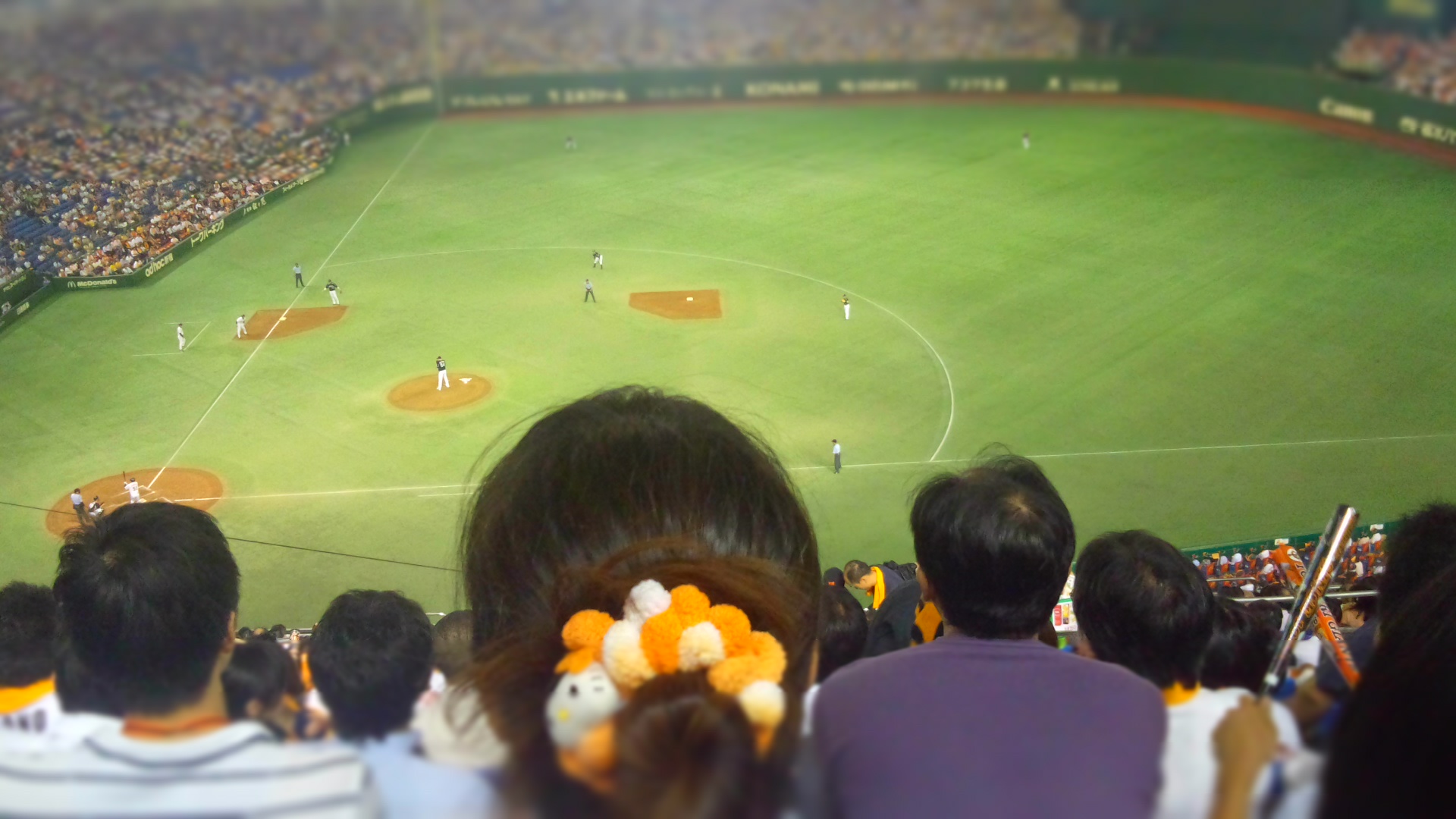
    I went to my first ever baseball game last night, with the students and staff of my department. We watched the Giants (Tokyo) vs. the Tigers (Osaka), a resounding Giants victory (about 6-3) – or at least I guess it was a resounding victory, because I know  nothing about baseball. One of our students was a graduate of a famous baseball high school, so before we went we arranged a special seminar for him to educate the foreign staff and students (about half the department) on the ins-and-outs of this mysterious game, but sadly his lecture was shambolic and his explanations mostly confined to teaching us the Giants’ song. How that took 40 minutes I cannot fathom, since it consists only of saying “oooooooo” a lot.

    It was fun, although most of the time I was talking to the people around me – just like cricket, I suppose (there’s lots of ways that baseball is like an abridged version of cricket). The woman in front of me, pictured here with her Giants-themed kitty chan scrunchie, was not interested in conversation however – she was a very serious fan indeed. Perhaps it was through the power of her regular banzai that her team won.

    This trip to the baseball and some recent experiences in Akihabara have me marveling at the gender-inclusiveness of Japanese hobbies and sports, and I’ll be posting on that when I get time in the next few days…

  • Continuing my series of posts exploring the epidemiology of Pathfinder, today I will report on the impact of adding ferocity to the orc stat block. Is the orc still a CR 1/3 monster when one accounts for ferocity, and just how tough does a fighter have to be to walk away from a fight with a single ferocious orc?

    For this simulation (and all sims from now on) I am going to be using my updated and revised modeling program, which has been subject to some fairly severe stress tests and which I’m now fairly certain perfectly mimics a basic combat exchange between an orc and a fighter. I posted revisions here, showing the basic survival probability for three types of fighter and four races, for an orc with no ferocity. This is the basic program I’ll be working with from now on.

    Introduction

    Previous analysis of survival in Pathfinder have studied conflict between fighters of the four main races and inferior breeds of orc, but it is likely that serious dungeoneering will bring adventurers into conflict with hardier orcs fighting near their lair. It is well known that orcs who maintain a close cultural connection with their tribe are braver and more determined fighters, and this is usually reflected in their ability to fight even when suffering serious physical injuries. For this analysis, this powerful additional trait of “wild” orcs, ferocity, is included in the analysis. Essentially this analysis compares the survival chance of a lone fighter against a lone orc isolated from its tribe, probably in a city, with a lone fighter in combat with a lone orc near its lair, where it will fight beyond death.

    Methods

    A set of 200,000 simulated battles between randomly-generated fighters and randomly-generated orcs was analyzed using poisson regression. Orcs and fighters were generated in the standard way, but orcs had a 50% chance of having the ferocity trait, which enables them to continue fighting until they reach -12 hps. A simple main-effects poisson regression model of survival was built, and the effect of orc ferocity on survival reported from this model; subsequently, a model with interactions between ferocity and all the main variables of interest (fighter type, race and ability bonuses) was also built. Results from both of these models are reported selectively for simplicity.

    Results

    Mortality for the 100,000 fighters against meek orcs was unchanged, at 37.2%; but for fighters battling ferocious orcs mortality increased significantly, to 63%. Patterns of mortality differences by race and class type were similar to those seen previously, but mortality rates were higher in all class types and races. Table 1 shows mortality rates by race and ferocity type.

    Table 1: Mortality rates by race and orc ferocity

    Race

    Orc Ferocity

    Meek Ferocious
    Human 30.6 57.1
    Dwarf 32.4 60.1
    Elven ponce 40.8 65.8
    Halfling loser 44.9 68.2

    Note that, although survival patterns are maintained in battles against ferocious orcs, the mortality ratios decrease: from a 50% increase in mortality between humans and halflings against meek orcs, for example, to a 20% increase against ferocious orcs. The increase in mortality due to ferocity also varies, from nearly a two-fold increased mortality rate in humans and dwarves to only a 50% increased mortality amongst halflings.

    In a simple main-effects poisson regression model ferocity was associated with an average relative risk of mortality of 1.7, which was highly statistically significant (Z=80.12, p value <0.0001). That is, the average increased mortality from adding ferocity to an orc stat block was about 70%. However, in a model including interaction terms between orc ferocity and all main variables (fighter type, race, and all three stat bonuses) the role of orc ferocity varied significantly across ability scores. For example, after adjusting for other ability scores, class type and race, the increased mortality amongst fighters with minimum strength bonus was only 20%, while it was 85% for fighters with a strength bonus of +5. This effect is shown in Figure 1, which plots the relative risk of mortality by strength score for meek compared to ferocious orcs. All relative risks are relative to a fighter with a strength of -2.

    Figure 1: Mortality by Strength Ability Score for Meek and Ferocious Orcs

    Essentially, strength induces a lower gradient of mortality improvements when fighting tough orcs, and combinations of high scores become more important. In fact, it seems highly unlikely that decent survival will be obtainable for fighters of any race and class type generated using Pathfinder’s standard point-buy systems. These systems will restrict most PCs to ability scores in the 14-16 range, which will not guarantee survival against even a single ferocious orcs.

    Conclusion

    Adding ferocity to an orc’s stat block significantly increases its lethality, with an average increase in mortality risk for fighters in one-to-one combat of about 70% after adjusting for race, class type and ability scores. Even the strongest and most unusual fighters, with ability scores above 18, have surprisingly poor survival of about 30%. Orc ferocity increases mortality across all races and fighter types, with halflings again copping the pointy end of Gruumsh the Bastard’s falchion and incurring death rates of up 70%. This is further evidence that orcs are not CR 1/3 opponents, and suggests that GMs who want to field orcs as cannon fodder against their PCs should judge numbers carefully, or consider treating ferocity as a leader-type trait. It also suggests that – just on the numbers – Pathfinder is the most lethal of the D&D incarnations, especially when ability scores are restricted by point buy options. This will be tested in subsequent analyses.