• Evolution of a New Atheist
    Evolution of a New Atheist

    Recent events in global politics seem to have brought the spit-flecked anti-Islamic radicalism of the New Atheists out into the open. Dawkins has had a bit of a thing about Ahmed Mohamed that is perhaps a little strange, but his most recent tweet drawing some kind of weird parallel between Mohamed and some poor child in Syria who was forced/brainwashed into beheading a soldier is really kind of off. Meanwhile in a podcast Sam Harris announced that he would rather vote for Ben Carson than Noam Chomsky because Ben Carson understands more about the Middle East.

    Vicious, slightly unhinged attacks on children, and voting for a religious madman because he would keep out religious madmen seem like prima facie evidence for some kind of fevered new level of anger, so is it the case that the New Atheists are finally letting the mask slip, and revealing their prejudices in their full, naked glory? Harris is apparently an atheist but he would vote for an avowed born again christian who is completely immune to facts and probably wants to force the end of separation of church and state: when you vote for someone who is anathema to all your fundamental beliefs because of one specific policy you are signalling your policy preferences very clearly. Meanwhile, Dawkins is just … whatever he was trying to say with that tweet, it wasn’t pretty. Have recent events finally caused them to lose it?

    Just recently I wrote an angry post about the Church of England trying to invade my leisure time, so in the interests of balance I think it’s only fair that I have a go at the New Atheists, who I find just as annoying in their own special way, though ultimately I think they’ll be far less influential than the current Archbishop of Canterbury. By the New Atheists I mean that crew of sciency types who publish books about how terrible religion is and affect to be experts on all things religious: people like Richard Dawkins, Sam Harris, the late Christopher Hitchens, PZ Myers. Although I don’t doubt their atheism, I think they aren’t really acting first and foremost as atheists. Rather, I think they’re establishment scientists reacting in a particularly atavistic way to two kinds of insurrection that really make them feel threatened: the American vulgarist insurrection against science, which is primarily (but not only) driven by fundamentalist Christianity; and the Middle Eastern reaction against colonialism and imperialism, which has sadly shifted from a politically nationalist framework to an avowedly religious framework. The former threatens them intellectually and the latter threatens their identity, so they react viscerally. But in their visceral reaction I don’t think they’re acting against religion generally, and I think their visceral reaction is not a good thing for atheism. Even if they weren’t straight up reactionaries, I think they make poor spokespeople for atheism (to the extent that atheism is a movement of any kind). Here I would like to give a few reasons why.

    The New Atheists will never change anything

    In attacking Islam so vociferously, the New Atheists have chosen an easy target, but they aren’t going to change anything in Islam, and in any case they can’t even change Christianity. They don’t live in majority Islamic countries, so they’re in no position to make any changes to Islam; and by aligning themselves so closely with the Islamophobia of the religious/militarist right in the USA they instantly render any serious critique they have of Islam inaudible. In any case, Islam is not a monolithic entity like the Catholic church, it has no central leaders or doctrines, so there is no single force they can bend to their prodigious will. But even within their own Christian countries they’ll never effect any change because they’re going about it completely the wrong way. Religions can be institutionally monolithic, like the Catholic church or the Church of England, but they’re also diffuse and incredibly culturally resilient. You can’t change a religion by standing outside it yelling at it, because a strong religion is composed of both a powerful religious institution and a plurality of supporters, who are in a constant cultural tension with that leadership but identify strongly with what that leadership represents. Religions don’t change because people yell at them because changing a religion requires simultaneously changing its intellectual leadership and its adherents.  The best way to change a religion is to slowly move all of society forward, through technological, scientific and cultural advances, and then watch the religion catch up. It’s slow, hard, dirty work, the kind of work you don’t get accolades for and can’t distill into self-aggrandizing tweets, but that’s how religions change. Perhaps the best secular example of this is the relationship between labour unions and labour parties in the early part of the last century in countries like Australia and the UK. To change policy in those environments you had to be active in the union, working at the grassroots, but also active in the elite system of the unions and its associated mass politics. People like Bob Hawke and Gough Whitlam emerged from that environment and they were formidable intellectuals with a very practical understanding of both the levers and the limits of power. Of course, the New Atheists aren’t going to have much of a sense of class politics, so they probably don’t have a clue about the secular equivalents of what they’re dealing with, either.

    Furthermore, it’s often the case that the leading agents of change are people within the religion – your Martin Luthers and Gandhis – not angry outsiders. One hundred years from now, when Islam has moved forward to wherever it’s going, people will look back and say “look at that Turkish dude who reformed education in the 21st century” and “how about that Sudanese chick who campaigned against genital mutilation”. No one will be thanking Richard Dawkins for tweeting a picture of an ISIS child soldier brutalizing and being brutalized[1]. These people will never change anything.

    Scientists are not good Atheists

    There’s a kind of intellectual arrogance in the “elite” branches of science – physics, biochemistry, some parts of evolutionary biology – in which they believe that they can enter any other field of human endeavour and just pwn it with their superb intellectual skills. This is visible at its most nakedly ugly in the behavior of those cosmologists who think they are going to disprove (or discover!) god, and those terrible nuclear bomb makers who turned the whole thing into a sick parody of childbirth. But in this case it means that scientists are entering a world that is very unscientific, that has a completely different language and culture, and trying to understand it in terms that make sense to scientists, and thinking they can. This is why they seem to think that religions are anti-science because their books are kooky, and they think they can effect change through logical debate built on attacking the principles of those books. In science you look at founding principles and build arguments on them; in religion you play fast and loose with founding principles in pursuit of a story (or something; I’m not really au fait with how this stuff works). Yelling at people and claiming to be able to understand the way their religion works because you’re used to logical thinking is not going to get you very far. Laughing at silly origin stories (7 days! ha!) doesn’t get you very far because – newflash – most people don’t give a fuck about how smart you are until they need you to fix their TV and then they’re all like “what do you mean you study geckos?” When you engage with people outside of your field of expertise you need to set aside your field of expertise, or find a way to bring it to the engagement that doesn’t appear arrogant and out of touch. Which brings us to …

    The New Atheists are poor scholars

    Every field of intellectual inquiry has its own rules, its own language and its own disciplines. You can’t just go into another field of inquiry and start talking about it with the language and discipline of your own field – you’ll misunderstand and get confused. If you talk statistics with a statistician, you need to understand what “consistency” means; if you discuss economics at some point you need to come to terms with their weird and stupid definition of “efficiency”. Believe it or not, religions have their own language and disciplines, and the study of religion is a long-standing and well-respected intellectual field, connected with cultural studies, social science and art theory/history. But the New Atheists don’t give a fuck about that, they just barge on in and start arguing. This is most obvious in Sam Harris’s embarrassing little spanking from Noam Chomsky, where he thought he could engage in debate with one of the preeminent scholars of American foreign policy on the basis of a single reading of just one of his books (“I thought I could read it as a self-contained whole,” what, do you think it’s a Little Golden Book?), without any of the disciplines or scholarly background of international relations. It’s also obvious in the response of scholars of theology to Dawkins’ The God Delusion, which panned it as, for example, work that would make a first year theology student wince[2]. This is what happens when otherwise intelligent, well-educated scientists decide that they can enter into other scholarly debates without the proper debate and, dare I say it, the proper respect. And this is the real problem here: they don’t understand or respect the religious impulse or its history, they don’t respect anyone who believes differently to them, and they base their scholarly approach to religion on this lack of respect for its intellectual origins. This is very, very stupid. For much of human history religion was the wellspring of science, and almost all of our modern intellectual tradition is built on Catholic, Muslim, Jewish[3] or Hindu science. When a scientist goes into their world that scientist is dealing not with weird, kooky idiots who think the world was made in 7 days, but people who understand science and theology, and are comfortable believing in one while working in the other. You can’t knock these people over with second rate arguments about whether god could make a stone so heavy even he couldn’t lift it, and when you try they’ll come back at you with sophisticated discussion of exactly where that question fits into a range of epistemological, ontological and cosmological debates.

    These religions didn’t develop through 1000 or 5000 years of history because they had a complete disregard for scholarly endeavour. But the New Atheists approach the mysteries of religion as if they were a first year biology problem. That’s bad scholarship, derived from a lack of respect, which is why I can say that …

    They give atheism a bad name

    Being an atheist doesn’t mean you think everyone who believes in God is an idiot. Sure, there are some cute jokes about sky fairies and stuff, but they’re rhetorical fluff, not to be confused with the substance of how atheists should (and generally do) approach believers. To me, first and foremost, atheism is about inquiry. I’m fascinated by all this stuff that goes on in this amazing and beautiful world, and that doesn’t just mean I’m interested in what will happen to the polar bears when the ice melts; it also means I want to know what my Muslim colleague thinks about things he maybe didn’t have to think about before he moved to Japan, or what my lapsed Catholic friend thinks about Shinto. It doesn’t mean that I just dismiss all that stuff as dumb-arsed imaginary-friend psychological props. It also doesn’t mean that when I see a member of a certain religion (I’m looking at you Mr. Mohammedan) doing a terrible thing I should immediately decide that all people from that religion are insane arse-hats. But please forgive me if that’s how I interpret the recent behavior of the New Atheists, who seem to have got a real bee in their bonnets about Islam, and are really seriously concerned that it’s the end of civilization. By throwing away their critiques of other religions, siding with religious lunatics, and dropping all pretense at mild manners or rational debate, they make it pretty clear that they have a certain, specific animus against a certain, specific religion. They look, in fact, like racists. Some of them also look like unreconstructed sexists. But in the modern era, they are also the main voice of atheism that most people recognize. Which means that in the public mind they speak for me.

    My Muslim colleague is very concerned about the image of Islam that ISIS project. He sometimes talks about it with me – raises the terrible things they have done, tries to talk about how they are perceived by people not like them – and I can see he is worried that I might get a bad idea of his religion from the antics of its worst children. He also makes jokes about his own religion, and is comfortable dealing with the social conflicts living in Japan presents. It’s as if he is just a normal guy trying to get by in this crazy world, who believes some different stuff to me. But to hear Sam Harris’s latest utterings, he’s a monster waiting to blow me up. Or he might be, or something. When people say shit like that about any other group you back away slowly, or you give them hell. But these guys think they’re cool with it, and as the tide of public opinion turns against Islam I guess, increasingly, they will be. But sometime in the future, once ISIS are a bad memory (and they will be!), people will remember that those dudes were atheists, and they will assume that atheism is about racism and hatred or, at best, that it is completely attuned with popular opinion about who the latest bad guys are. Which it isn’t. Atheism is much bigger than that. It is much bigger than this small group of arrogant rich white scientists, and the sooner they let it go and give it back to us the better.

    Atheism is not a movement and never will be

    At the heart of this is a simple fact that perhaps we didn’t have to think about back when our spokesperson was Bertrand Russell, a man who would never have supported the Iraq war: Atheism is not a movement. It is the antithesis of a movement. It’s a group of people who have quietly decided to go their own way on this spiritual shit. We just don’t do it, but there’s no movement we can form to make that fact public – how can we? We don’t agree on anything! Sure, the Satanists are doing a great job of trolling some Christians in a completely cute and fun way, but they don’t represent us and no one thinks they do. We aren’t A Thing. Sure, sometimes we’d like to be – those atheist bloggers in Bangladesh might not have been killed if they were part of a movement with its own stormtroopers – and being part of a movement has many benefits, but that’s not what Atheism is. In it’s own way it’s as intense and personal as religion, it’s a feeling you have that you can’t project onto anyone else although the best of us will put our case carefully and wait for those we love and care about to maybe feel it, or maybe not. But I think the New Atheists would like us to be a movement, and I think you know who they think should be in charge of that movement.

    But I don’t to be part of any movement that turns my inner life into a caricature of itself so they can spit on Muslims and use child soldiers as a rhetorical tool in some kind of shitty twitter war over a fucking clock. I don’t want to be part of any movement whose leaders think they’re intellectually superior to a couple of billion people, and I don’t want to be part of any movement whose representatives would vote for a religious lunatic who’s probably a con artist just because he hates the same people they do.

    Once this war on Islam is done – and it will be done, once ISIS are gone, and they will be gone – these New Atheists will discover how fickle their new bedfellows are. When their new anti-Muslim fundamentalist christian friends kick them out, don’t welcome them back. Tell them they sold themselves cheap, and they can be footsoldiers in someone else’s intellectual battle. Atheism doesn’t need them, and neither do the religious people they think they’re helping.

    fn1: Seriously WTF were you thinking, dude? Have you been following the movement against child soldiers, are you aware of what a complex, cruel and brutal thing the recruiting and enslavement of child soldiers is? Do you understand that the media have conventions about showing child victims? When the BBC interviews child soldiers they pixelate their faces. What were you thinking, comparing an American kid to a child soldier in the act of beheading someone? Do you have any respect at all for human dignity?

    fn2: Read that review. That is how reviews are done.

    fn3: Noam Chomsky, for example, grew up in a Jewish tradition heavily steeped in Jewish intellectualism.
  • This is why the Snotling got you
    This is why the Snotling got you

    In yesterday’s post I talked about my desire to redesign the Warhammer Fantasy Role-playing 2nd Edition (WFRP 2) rules so that they are less punishing of PC actions, and introduced the problem of asymmetry in task resolution. Following on my list of principles for good RPG skill systems, I’d like to propose a simple reformation of the WFRP 2 skill resolution system that does the following:

    • Removes as much as possible the asymmetry in task resolution
    • Streamlines task resolution to make it quicker and easier
    • Works in and out of combat
    • Makes skills more likely to work
    • Gives flexibility to the GM in how hard they want to make their WFRP world
    • Doesn’t require any significant changes to the remainder of the system

    Basically I want to propose a different dice + skill system that can be slotted into the existing WFRP2 system in such a way that pretty much everything stays the same and the books can be used as is. In the end I think my proposed skill system simply requires that you divide all attributes by 10 on character creation and make a couple of relatively trivial tweaks to the advance scheme for the PCs, which are sufficiently simple that you hardly need to think about them.

    Some baseline ideas about how skills should work in Warhammer

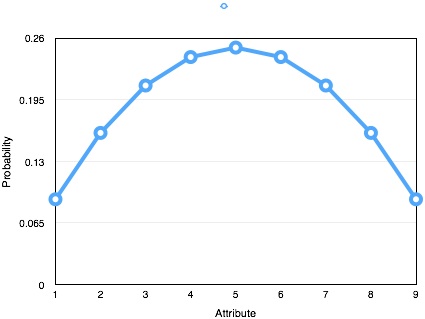
    The chart above shows the basic problem in resolving skills using the existing system. This chart shows the probability of succeeding in an opposed skill check for a person with a given stat value, against someone with the same stat value (I have divided stats by 10 for simplicity). Here you can see that the success rate peaks at 25% for a person with a stat of 50 against a person with a stat of 50. Bear in mind that for a person with a stat of 90, a standard unopposed action will be successful 90% of the time. I aim to reform the skill system so that:

    • When people with very high skills oppose other people with very high skills, the outcome should be a real lineball – so that if the task was repeated many times, the outcome would be largely 50/50. Think of two equally matched rugby teams with a long history of games – on average they should have a 50% success rate each
    • In general the difficulty of an opposed skill check should be conformal with some kind of objective standard of unopposed skill checks

    I would further extend the first point to say that, for simplicity and playability, when a person of stat value X opposes someone of equal stat value, they should get a 50% chance of success (i.e. that figure should be flat). This may not reflect reality, but it’s important for players to be able to have some certainty in their skills. Also think of it like this: someone always wins at chess. When two equally terrible players play chess, someone wins, even if the game looks terrible.

    The alternative system: Traveler-like 2d6 with scaled attributes

    To achieve this, I propose a simple skill check based on attributes scaled by a factor of 10 and broadly similar to Traveler. In this revised system attributes range from 1 to 10, i.e. they are the original attributes divided by 10, and are on the same scale as Toughness. In this system the player initiating the skill check rolls 2d6 and adds their stat plus attribute plus modifiers, and compares the result against a target threshold number that is 8 + the opposing PC’s attribute. This means that an untrained PC testing a skill against an untrained PC with the same attribute always requires an 8 or more on 2d6 to get success, i.e. has a 41% chance of success.

    For non-opposed actions, simply assign every action a difficulty from 0 to 10, and make the threshold for success equal to 8+difficulty. By setting the difficulty of a standard action to 4 you ensure that a person with a stat of 4 is able to successfully complete that action 40% of the time, just like in the standard WFRP 2 rules. A person with a stat of 3 would need to roll a 9 to get this standard action done, which is equivalent to a probability of completing this standard action of 28%, approximately the same as the WFRP 2 rules; for a person with a stat of 2 the probability becomes 17%, so still close. Thus the success curve for a standard action is consistent with the standard outcomes of skill checks in WFRP 2.

    If you want to change the difficulty of all tasks, simply change the base for difficulty. If you want a heroic campaign, shift the base from 8 to 7; if you want grimdark, make it 9. If you want to change the relative difficulty of opposed vs. unopposed skill checks, simply either change the rating assigned to a standard task to 3 or 5; or increase the base, and reduce the difficulty of a standard task.

    In WFRP 2 difficulty modifiers act as 10% bonuses or penalties to a PC’s attribute, and these are approximately mimicked (except in extreme cases) by a unit change in the difficulty of a task, or by a +1 or -1 on the roll. Training can be incorporated as a +1.

    There are several advantages to this system:

    • Toughness bonus and strength bonus disappear, with strength and toughness attributes serving as their own bonuses
    • Magic attribute can be used directly for skill checks, including for magic
    • Movement allowance can be used for skill checks, and especially for defense against missile attacks
    • Difficulty of unopposed actions can be related directly to opposed skill checks
    • Early magic is easier, and later magic harder, than in the basic rules
    • It would be fairly easy to standardize difficulty checks for spells by arranging them into levels
    • The biggest and nastiest spells are only available to the highest level characters
    • Only one dice roll per check

    This system also allows for the effect of the skill check to affect actions and attacks. For example, in the original system on the few occasions that one actually hits in combat, one has to roll d10 for damage and add it to the base weapon damage, which is usually strength bonus – 3 or something similar. In the revised system, instead of rolling that d10, one could simply add the effect of the roll to the PC’s strength and then apply the penalty. This enables PCs with very high attack bonuses to soon overwhelm their opponents, and removes the extreme element of randomness in current weapon damage. Thus for a pPC with a hand weapon and average strength (stat 4) attacking an opponent with the same weapon skill as themselves, they need an 8 to hit and so will do between 4 and 8 points of damage. Thus against a person with average toughness (stat 3 or 4) they will usually do some damage unless that person is wearing really heavy armour.

    This effect can be applied fairly easily to lots of magic as well, if desired.

    An iconic PC in need of upgrade
    An iconic PC in need of upgrade

    Changing career advances

    The career advance sheet can be used basically as it is, with a 10% advance counting as a single advance for the character. Having scaled all attributes by a factor of 10, there are no longer 5% increments in attribute[1], which means that these advances need to be dropped, rounded up or combined into a single attribute. Advancing in units rather than 5% advances means that the advancement process does not take as long – 6 to 7 steps rather than 10 – but I don’t think this is a bad thing, because:

    • The career system is one of WFRP 2’s best aspects, and advancing up it rapidly and going through many careers is a great idea
    • One principle of the system is that you start off in a nothing career and advance, and if you’re going to adhere to that principle it seems a good idea to make the advancement fairly rapid

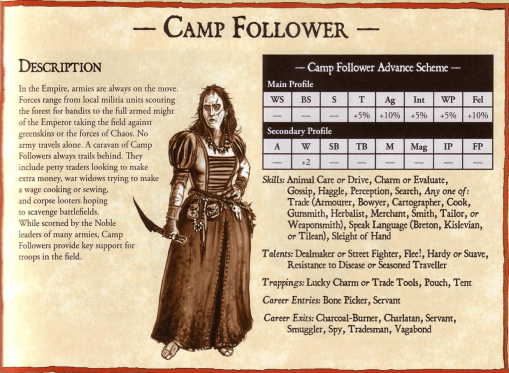
    As an example, let’s consider the Camp Follower, whose advance scheme is depicted above. She has three 5% advance limits and two 10% advance limits, and a total of 9 advances. I would revise this character so that she gets a single advance for Agility, two advances for Fellowship, and one advance on Toughness, Intelligence OR Willpower, then two wound advances, for a total of 6 advances. So the 7th advance can be spent on one of her career exits, some of which might actually be useful.

    This might seem a little short (7 advances to change career) but I think it enables a story arc that is just impossible in the original game. There is a tale to be told about this Camp Follower: how she was recruited from the camps to become a Spy, and from there became a Scholar of buried languages, hunting the ruins of the old empire for rare texts; but her lust for knowledge led her to forbidden knowledge, enabling her to become an Apprentice Wizard; from there she rose up through Journeyman and Master Wizard to become Wizard Lord, eventually finding the general that led her original army to ruin and destroying him with her most vicious spells. In the original rules this would require a total of 33 advances to get to Apprentice Wizard, and another 33 to Wizard Lord. In the revised scheme it would be between 18 and 21 each. In my experience it’s really hard for adult gamers to keep a campaign together that long, and if we’re going to fully explore the career pathways that the game makes available we will need to be able to a) enjoy some degree of success in our starting career and b) move through careers relatively quickly. So shortening the advance process doesn’t seem like a bad thing to me.

    Conclusion

    I think it is possible to implement a smoother, improved system of skill resolution that barely changes the structure of the remainder of the game, doesn’t change the atmosphere of the system, but significantly improves the playability of the game. I don’t think this system changes the problem of asymmetricity in skill checks but it does reduce its impact. I also think that the reformation of the character advance system to match the skill resolution changes actually improves the ability of the game to achieve its original goal of building a story in which PCs elevate themselves from very basic starting careers to heroes, while enabling them to enjoy this journey rather than just desperately hoping to survive and get to a functioning career – especially given that the way the system is constructed, no career will ever be functional.

    I aim to test this system soon and will report on the results when I do. Comments and additions (especially from experienced WFRP 2 players) are appreciated.

    fn1: You could scale everything by 5, and use 2d12 for skill resolution, which would make for some very nice probability gradients but would probably be annoying


  • Christian doctrine summarized
    Christian doctrine summarized

    Today’s news brings us reports that the Church of England’s gentle attempts to frontload the new Star Wars movie with a one minute long advert for their brand of authoritarian fantasism have fallen flat, in what everyone (even Richard Dawkins, apparently) is calling a defeat for free speech. In a stunning moment of unexpected bravery from our corporate overlords, the bosses of three different cinema chains have told the CofE to get fucked. Rather than being horrified by this slow slide into oppression, I am very happy, and extremely angry that the CofE felt they had the right to pull this nasty piece of totalitarianism on the British public. Before you start hyperventilating, dear reader(s), let me explain …

    I’m not an easily offended man, I think, and I think I’ve been on the record as supporting free expression for all religions. I’m an atheist but I don’t subscribe to the “Militant Atheist” school of “thought”, which holds that religion is a childish emotional prop and that society should and will grow past it. I respect individual religious belief, I think religions should have freedom in public life and I’m not especially bothered by the special place that some religious institutions hold in public life – e.g. the christian churches of various denominations in various nations, Islam in Turkey, etc. In the modern era I really don’t see religion as a big threat to our continued progress towards enlightenment, and I have no problem with its open expression and with its historical contributions being recognized. I’m also, I think, on record here as saying I suspect that a lot of the militant atheist spokespeople are sexist, racist bigots who are especially fond of using their atheism as a cloak for their obvious anti-Arab or anti-Islamic racism, and I don’t think that their aggressive tactics do atheism any favours. To the extent that atheism is a movement (it’s not) we don’t need these people as our chief representatives. However …

    The Church of England, because it has a huge and privileged position in the British intellectual world. It is the establishment church, meaning the head of the church is also the head of a nuclear-armed state. It owns most of the publicly-run schools, and I can personally attest to the way it used those schools to exclude other religions from discussion, to misrepresent them and to force us to learn and recite its doctrine. It gets free public air time for Sunday worship and special events that no one else gets, and its religious events are the key public holidays, during which time it gets almost untrammeled access to both state and private television and radio. Despite this near constant exposure of a large portion of the population to its propaganda message, and despite the fact that the major media organizations treat the corrupt content of that message with kid gloves, it is still losing the intellectual battle with atheism, agnosticism and who-gives-a-fuckism. So, having lost that battle, and aware of that, they are now going to start forcing adults who have graduated from their schools and escaped their slimy clutches to sit through a minute of unbridled power worship before they can enjoy some actually good fantasy.

    Why should we put up with this? Why should I be forced to endure that horrible piece of authoritarian “poetry” when I have already been forced to recite it every morning for the first 17 years of my life? If I am not voluntarily reciting it then there is a simple reason: I think it sucks and I don’t want to. So don’t make me read it again, if I never have to read that horrible little cry for help ever again in my belief-free existence I will be a happy man. And most importantly, what gives the church the arrogance and sense of superiority to think that it’s okay for them to afflict me with this crap during my daily activities? Every time I go to a hotel in the English speaking world I’m given a free bible [another public service extended exclusively to the christian church by private companies], hasn’t the church worked out that if I wanted to read that prayer I would?

    Most people understand that if you have told someone something a certain number of times and they still don’t believe it or don’t want to hear it, it’s time to stop yelling at them. Apparently the luminaries at the head of the Church of England have yet to learn that lesson, and think they have some special right to lambast us with their brand of patriarchal authoritarianism just once more, because that one more minute will get us back. The thought of sitting there, waiting to watch something I really want to watch, while for one minute this old man lectures me on how much I should love a god I don’t believe in, makes me so angry. It’s a direct reminder that these evil old men still own my society; an attempt to force me back to being my 8 year old self, shivering and powerless in assembly hall while I wait to be free of their pointless rituals. How dare they do this?

    Some random dude at the Guardian is complaining that the real reason the cinemas refused is because they’re scared the illuminati might force us to listen to a muslim prayer in the future, and then they’ll be forced to play it if they also play the christian one. For me personally a passage from the Quran is largely meaningless, and if I listen to it it won’t make me angry because I have no historical association with Islam (though I guess this depends on the prayer they choose!) But for the record I think that Islam, Buddhism, Hinduism and everyone else should steer well clear of my precious pre-Star Wars advertising time. I also really want to hope that this is not the reason the cinemas said no, but rather that they, like me, are horrified at the thought of allowing any church to preach to us for a minute before a movie. I’m glad they don’t need the money that badly!

    The sooner the Church of England is out of schools and television altogether the better. It’s a dying institution that is propped up by the state and the buttresses of history, but its days are numbered. This desperate, mean-spirited lashing out at non-believing adults needs to be stopped early, and rather than seeing this decision as “nonsense on stilts” or some kind of blow to free speech we should recognize that it is a huge victory for modern values over superstition and authoritarianism. Well done those British cinema chains, and shame on the Church of England for thinking that such a move would ever be okay.

  • These guys should never win!
    These guys should never win!

    Today I’ve been thinking about ways to remodel Warhammer Fantasy Roleplay 2 (WFRP 2) to make it more user friendly and less punishing, and in the process of thinking through the system’s underlying probabilities I have run up against a problem with the reference frame for skill tests that I think is common for many systems. The problem is a simple one that afflicts opposed skill checks: depending on who is considered to be the active initiator of the skill check, the same skill check can give different probabilities of an outcome. This situation is particularly stark in WFRP 2, though I think it might afflict other systems too. Here is a brief explanation of the problem and how it can (and can’t be) solved. I wonder if this problem is part of the reason that people get so frustrated with the WFRP 2 system and always feel like they’re failing …

    The WFRP 2 opposed skill system

    WFRP 2 uses a stat-based skill system to resolve skill checks. Stats range from 0 to 100 and an unopposed skill check is resolved by rolling d100 and trying to get under your stat. So e.g. if your agility is 40 then you will succeed in a basic agility check 40% of the time. There are modifications of course (skill training, etc.) but this is the basic process. For an opposed skill check, each person involved in the skill check makes their roll, the person initiating the check starting and then their target rolling under the opposing skill. For example in combat the attacker rolls for Weapon Skill and then the defender rolls their Weapon Skill or Agility in order to parry or dodge. In an opposed skill check your chance of success is always lower than your base stat: it is stat * (1 – opposing stat). This creates a punishing probability curve, incidentally: a person with a stat of 50 up against a target with a stat of 50 has only a 25% chance of success, and perversely this is the best in the game. If you have stat 90 and you are up against someone with stat 90 your chance of success is 9%. But this is only part of the reason that WFRP 2 punishes players.

    How reference frame affects outcome

    Consider the following example. Bob the Hapless needs to sneak into a tavern to steal one last drink, so he first needs to get past the guard at the door. He has Agility 40 and the guard has Intelligence 40, so it’s an opposed skill check, Bob’s 40 vs. the guard’s 40. Bob rolls, the guard rolls, and fortunately Bob rolls a 01 and the guard a 41, so Bob gets through. His chance of success here was 40*60=24%, not so great; this means, note, that the guard’s chance of spotting him was 76%.

    Now Bob the Hapless is near the bar, but he doesn’t realize that a skaven assassin is in the room, and is sneaking up on him. So now Bob the Hapless needs to do an observation check to notice the skaven assassin if he wants to avoid being ambushed. The assassin has a stealth of 40 and Bob has an intelligence of 40, so they roll. Now Bob’s chance of success is 40*60=24%; this means that the skaven had a 76% chance of sneaking up on him.

    Unsurprisingly, Bob’s chance of continually beating 24% odds is not good, and he fails the second roll – he rolls a 39 but the skaven rolls a 7. Bob is ambushed and, as one might expect, soon becomes ratfood. This is because he got rat-fucked by the system. When he had to make a stealth check with agility 40 vs. intelligence 40, he had a 25% chance of success; but when the skaven had to make a stealth check with agility 40 vs. intelligence 40, it had a 76% chance of success. For the same check!

    Why this happens

    In WFRP 2 there is an initiator and a defender of any opposed skill check. The initiator needs a specific chain of outcomes: her own success and her opponent’s failure. But the defender doesn’t need a specific chain of outcomes: they only need either a failure or a success. Essentially once the initiator fails the defender doesn’t need to roll, but if the initiator succeeds the defender gets a second chance to dodge the outcome. Success for the initiator is a conditional probability (on the defender failing); whereas success for the defender is a marginal probability of either the defender succeeding or the initiator failing.

    This might not be a problem except that GMs tend to try to make the player the active participant in a skill challenge: if the player is stalking, then the player makes a stealth check against which the GM defends; if the player is being stalked the player makes an observation check against which the GM defends. But this desire to make the player the active participant of their own adventure massively reduces their chance of success; and until they reach a stat of about 50 this effect is punishing – and becomes punishing again after stat 50!

    Does this happen in other systems?

    I think this doesn’t happen in systems with dice roll vs. DC systems, because usually if the skills/stats are balanced then they cancel each other out and only the probability distribution of a single die roll matters. Shadowrun has an opposed skill check system where each player rolls a dice pool, but in this case the outcome is determined slightly differently: the defender’s roll sets a target that the initiator has to beat, effectively ensuring that if the initiator rolls well above a threshold they’re likely to win (see below for how this can affect WFRP2). I remember playing Talislanta or Aria (not sure which) and finding the same problem, that you could never hit anyone in combat, and I think it had the same underlying mechanic. I think this mechanic is used in quite a few systems, though I haven’t played them all obviously. I don’t think WFRP 3 has it because the difficulty of skill checks is set by the opponent’s attribute and this is asymmetric: in the above example everyone would have the same dice pools in all situations.

    I think this problem is merely particularly noticeable in WFRP 2 because all the PCs start off so terrible that you really feel the problem.

    How to fix this problem

    There are a couple of simple solutions to this problem. The first and most obvious is to design a better system. A partial solution would be to require the defending character to roll under the number obtained by the initiating character and under their own skill. So in the above example, when Bob rolled 01 for his stealth check there was no way the guard could see him; but when he rolled a 39 on the second check there was a big chance that the skaven could roll under his result (which it did). This only partially fixes the problem, since if the player rolls near their stat, the number the defender needs is effectively only constrained by the upper bound of their own attribute. It also doesn’t work when one player’s attribute is much lower than another’s. I think Dark Heresy (the Warhammer 40,000 game) has a modified version of the mechanic that uses a version of this system based on degrees of success that may partly solve the problem.

    The best solution is to define active and passive skills, so that for example Observation is always a defender skill and stealth always an attacker skill. This solution has two problems though: attacker skills (like hitting people and sneaking past people) will always be much, much harder than defender skills, which will encourage people to develop characters and gameplay styles based around not doing these things; but more importantly, RPGs should put players at the heart of the action so that wherever possible they initiate skills rather than defending against them. Setting up a system of skills where some are always initiated and some are always defended will mean that some players will be very good at what they do, but will never be put in the active position in doing what they do. I think this doesn’t match the ethos of gaming that most players enjoy.

    Basically, skill tests should always be resolved by a single, simple dice roll that is in the hands of the player as much as possible.

    Can WFRP 2 be fixed?

    I just completed a follow-up session to the Slaves of Destiny adventure I did a while back, again using WFRP 3. It was a lot of fun but this time around we had a large gang of skaven slavers to fight (report to come) and it was just impossible for me to properly follow the rules – or even anything like them – when GMing all those monsters. I didn’t even have table space for the cards! I like the system but in the absence of thoroughly stripping it down and making it much simpler, it’s a good way for PCs to operate but a terrible system for the GM. I would like to be able to use the WFRP 2 rules, because all the surrounding material is great and the game has such a strong feeling, but I just hate them. However, I think with a few tweaks to the central mechanic [well, a complete change] the stat blocks, career system and everything else could be retained in their entirety, and the game become an enjoyable and frustration-free romp through a really great world. In many ways WFRP 2 is an almost perfect combination of world-setting, atmosphere, writing, art and game system: except its fundamental mechanic is broken. I think that mechanic can be fixed by dividing all attributes by 10 and employing a 2d6, Traveler-like mechanic. I will come back to this soon I hope, to describe how to do it – and maybe also test it with some of my players.

    If I could find a way to enjoy playing WFRP 2 I would be a very, very happy GM …

  • Dalton lay on the ground panting, shifting glances between his discarded gun and the power-armoured thug stomping on his arm. Later he would reflect with pride on the way he largely ignored the massive gun pointing in his face, but at this moment he was squirming in terror and introspection was not at the top of his list of emotional states.

    Dalton was good at cataloguing his emotional states; his last girlfriend had told him he spent too long thinking about them and not enough time feeling them … if she could see him now …

    “You’re not as good as you think, Dalton,” the man grunted in a kind of hissing, angry mid-western accent. “You’re fast, and smart, but you lack any kind of … combat sense. And you’ve got tics, you make mistakes that are easy to read.” He waved his (massive) free arm in the general direction of the receding battle. “You’ll never make it at this. Sure, you’ll make a bit of money but you’re never gonna make the big leagues, and there’s no room here for small fry, you know that.” The gun didn’t waver.

    “Then just shoot me already! You’re wasting both our time.” Dalton surprised himself with his bravery. “It’s not a movie, cut the soliloquoys and -”

    The big dude kicked him, a stinging strike across the face with the sole of one powered boot. It stank of dirt and burnt things, but somehow the smell was stronger than the pain. “Shut up! We don’t have time for banter. Listen, you’re never gonna make money here but I’ve got a job for you where you can use these skills to make real money. You want real work or are you gonna keep hustling with your busted crew? You wanna be something?”

    Dalton worked his lips in a way that probably looked amusing to the thug. He was confused. In this world instant execution was the norm, there was no bargaining or negotiating, let alone job offers. Best take the chance. “Um, sure … How can I contact you?”

    “No problem, Dalton. We know where you live. I’ll see you tomorrow.” The man lifted his foot from Dalton’s stiffening arm and ran away, remarkably fleet for his size. Sighing, Dalton picked himself up and reached for his gun.

    How did that man know his name?

    The raid: Ground floor

    They went in through the chocolate shop windows, a specialized explosive net taking the entire glass pane down in a flash and the two assault guys leaping straight in after, spraying bullets wildly. Dalton came in the second wave, their medic/comms guy on his right and a heavy weapons/explosive guy behind them. There were three people in the shop but they went down before Dalton hit the room, and their corpses were already still by the time he got to the inner door. Here they had a short hallway, exactly according to the plans, and now Dalton was first, the two assault guys setting up a cordon at the far door so he could dive through. As promised the door was unlocked so he just charged through, firing from the hip into the room and hitting the right hand wall between the cabinet and the sink as planned. From here they were in the museum proper, and as expected the first of the plain clothes guards was in this room, pistol out, in cover behind the statue on the left of the door.

    From Dalton’s perspective in the middle of the room the statue was no cover at all, and the guard was still adjusting his position to take account of Dalton’s rush. Dalton fired first, a slightly uncontrolled fusillade that chewed up the statue and tore the man apart in a cloud of blood. When you’re pretending to be a museum invigilator you can’t wear armour, so you have to shoot first. This chump didn’t.

    There were three customers screaming in the room, trying to hide behind some glass installations in the opposite corner. Dalton gunned them down as the rest of his crew ran through and hit the main room. The glass didn’t protect them.

    The main room was some kind of photography exhibition, a maze of cardboard walls with pictures hanging, all passing by in a blur as they sought out targets and put them down. Dalton checked his watch as they got through the third turn, but he didn’t have to, because as they headed for the stairs the Controller spoke in their earphones. “Too slow, one target missed. Get up fast before the guards assemble a barricade. Make time.”

    They hit the stairs.

    Breakfast at Tiffany’s

    The thug lived up to his word, and next morning Dalton found himself having breakfast with a man who looked remarkably like the soldier he had met yesterday. They were in Tiffany‘s, the greasy spoon cafe across the road from Dalton’s flat, and the man had promised to pay so Dalton was enjoying Tiffany‘s best pancake pile, with gene-engineered maple syrup and (allegedly) real cream. There was a lot of coffee.

    “You read the news article I sent you?”

    “Yeah,” Dalton stuttered through a mouthful of steaming batter. “Not pretty.” Words were difficult, mostly because of the pancake but also because the situation he’d stumbled into when he moved to America was kind of crazy. Yesterday the Red Tide had hit a football stadium in Spokane, killing a couple of hundred people before they were taken down. The Red Tide had soon claimed responsibility, and promised more attacks to come.

    The Red Tide: since the collapse all politics in America had gone local, but the Red Tide had gone national. The USA had fragmented into a bunch of different countries, made up of groups of states or single states that decided they were better off going it alone. Communal violence, purges, sometimes genocide, had accompanied the crash, but one group had risen above it all to fill the power vacuum at the national level: The Red Tide, a violent native American liberation movement that could lay claim to members from as far afield as New Mexico and New England, Seattle and Miami. While the past colonial powers squabbled over petty local political victories the Red Tide had consolidated nationally, formed a national movement, and armed itself. Now it was moving to take back what had always been its members rights, and it had been stunningly successful in the past few years. Fragmented local governments couldn’t cooperate to defeat it so it had scored striking victories, and recently declared its goal of establishing a sovereign native territory in America. People had scoffed, but since the stadium attack the laughter had died down. People were starting to realize something new was here.

    Dalton shrugged. “Nothing I can do about that. National politics.” He liked to pride himself on being a man of few words.

    “Actually Dalton there is something you can do about it. A lot. And we’ll pay a lot. Are you interested?”

    Dalton finished his pancake, pretending to maintain some calm. Dalton really needed money. He didn’t care at all about America’s stupid politics, but like every 20 year old he saw himself going places, and like everyone in America he understood that money was the ticket to those places. “I am. Sure. Yes. Tell me more.”

    The man reached across the table and gently, but firmly, and decidedly threateningly, grabbed the front of Dalton’s t-shirt. “I can tell you more, Dalton, but I don’t tell you nothing if you don’t agree to help us. You understand? I can’t have you leaving here and blabbing to your friends about this. You agree to work for me and you’re mine, you get that?”

    Dalton coughed and looked around nervously. The waitress was unsurprisingly absent, and there were no customers. A car parked outside looked like it was suspiciously full of ugly men. This man was decidedly ugly. He guessed that there were going to be no hints forthcoming, and he needed the money. “Is it gonna be dangerous?” He asked meekly.

    “For you? No.” The man gave a wicked little grin that suggested it would be very, very dangerous for someone.

    So long as it wasn’t Dalton. “Sure.”

    The man let go, and the waitress miraculously reappeared with coffee. “A good decision Dalton, very wise. Let me tell you a story …”

    The Raid: Exhibition Hall

    This museum had its masterpieces on the second level. Everyone knew the layout, but the big problem was the guards. As a state institution the museum had the right to armed guards, who were at the back of the main exhibition hall. This hall was a labyrinth of small rooms and installations, with the guards likely scattered throughout the chambers, so they could hope to get to the doors before the guards assembled. It was a quiet time of day but this mission was planned for a class visit from a high school named after a famous killer of Indians[1], which would be likely spread around the exhibition hall. Their job was to kill them all and the guards.

    The first guard was at the top of the stairs, firing down at them as they mounted the stairs. He scored a couple of hits on Spider, who went down and stayed down. Dalton was coming in second but had enough time to think: he took what cover he could and fired up into the doorway, driving the man back. The other assault squaddie, Snake, drifted across the stairwell, firing as he went, and crouched behind a statue. They waited. Spider was gone.

    “Time running out. Move.” The controller’s voice sounded in their ears. Dalton had a translation bot installed but the language they were using, Sioux, was not available on most translation software and the open source chip he was using was pretty poor. He knew some of the other soldiers were not fluent Sioux speakers – none of his team were Sioux, in fact – but they at least knew some, and his chipset was essential. He doubted any of them realized it was a chipset though. The controller, however, was fluent in several Indigenous languages. He needed to be careful of the controller. “Ghost, get up and take that man.”

    He grunted. “Sure boss.” He moved, firing as he went up, drifting right and left. The guard tried to spring him on the way out but moved to soon and Dalton hit him, four or five times. Dalton fell through into the first chamber of the exhibition hall, firing off the last of his magazine as he did. He didn’t have to call backup; Snake and the other two, Grass and Doc, were through before he had come to a stop. They were in the hall.

    The students were screaming a lot and running, pretty hard to find. They took their time stalking and killing, probably after the event some Red Tide propagandist might say they were like hunters of old but cornering a pimply fifteen year old near a vending machine and shooting him full of lead is not what hunters do, it’s the work of an entirely different sort of personality. It didn’t phase Dalton.

    The Controller gave his orders in Sioux, but he had a strange and alarming habit of giving advice in English. Dalton couldn’t figure out why, but as they rampaged through the Exhibition Hall the Controller berated them in Sioux and advised them in English. The Sioux came through Dalton’s chipset in a kind of rough and stupid patois, broken by the vicissitudes of digital translation, but the advice came as cute and abrupt information.

    “Ghost-san, you should crouch more! Let’s enjoy crouching together!”

    “Ghost-san, standing tall is dangerous. Let’s enjoy belly movement! 1, 2, 3 drop!!”

    “Ghost-san, your back is exposed! I love your back, don’t get it shot! Guard that back!”

    “Senpai says run faster!”

    “Ghost-san always drops his right elbow and moves right! That’s a bad pattern! Let’s make exciting new moves!”

    This strange didactic manner confused Dalton, but he moved through regardless, killing high school students. Near the end of the Exhibition Hall was a big chamber with a huge sculptural installation. The guards were in cover at the rear, firing on them as they entered. There was no way to the back of the building except through the guards. Dalton hit the room second, and prepared to make a break for cover.

    Mission Statement

    They had drunk a lot of coffee. The man was talking. His card was on the table. It said John Doe, Central Intelligence Agency (Des Moines).

    “Did you know there’s a schism in the Red Tide? No, most people don’t.” After a lot of coffee, John Doe was big into monologues. Dalton just listened, didn’t even get a chance to nod or move his face before John Doe assumed his answer. “Apparently lots of these redskins don’t like killing people, they want to have some other kind of revolution where people don’t die. Haha. So we found a member of one of their assault crews who’s big on peace, and also pretty serious about heroin. It’s a good mix. Now he’s giving us the info we need, and he does what we ask provided he’s stoned.

    “Thing is, he’s a member of one of their assault crews. They’ve got a bunch of missions under planning but we don’t know where. But we found out some things from this guy. Main thing we found out is how they train.

    “They train virtually. They’ve set up a system of private servers for an old first person shooter called Call of Duty. This private server, it has maps of all the places they’re planning to hit, and tactics for how they’re gonna do it. The trusted team members log on every couple of days and go through assault scenarios, so when they hit the target they don’t just know the map – they’ve been through it in person, they know it right down to the lighting. Apparently this Call of Duty system is old but that means it has really good maps, a real network, it’s an industry standard so you can access maps for almost any public building.

    “Fucking game designers, eh? Traitors, you ask me.

    “Thing is, we’re not so good at computer games. But we’ve got some good hackers. What we need to know is where the server is, so we can get our hackers to it, and maybe get to its physical location and grab the backups. But to do that we need someone in the system, drawing a trace. And they need to be continuously logged in. They need to be good enough that they can stay alive for the couple of minutes we need to run a trace.

    “The plan is you go in using our turncoat’s account, which is still trusted. You stay alive in there long enough to run a trace, and you leave without anyone knowing you’re an intruder. Then we go in and get their server, either virtually or physically, and we have the full list of their targets plus hopefully the IP addresses of all their members. All you need to do is stay alive in their virtual world. So it’s completely safe for you, and we’ll pay you a fat load. Then you clear out of America and no one ever knows you stopped the Red Tide. King fucking Canute. What do you say?”

    He didn’t wait for an answer.

    “Good, thought you’d agree. All the activists, they speak in Sioux, because they’re crazy, but it’s been a real problem up till now. We’ve designed a chipset that translates to and from Sioux but it’s not so great so don’t talk much, okay.” He laughed. “Guess that’s not a problem. Also they like to use Kinect Sensory systems, so you’ll feel a bit of physical effort – a bit of pain from being hit, a bit of dizziness or confusion where it gets busy, but nothing dangerous. We’ve set up a training session for this afternoon. You go in tomorrow, okay? No time to waste.

    “By the way, this turncoat. His online name is Ghost. So you’ll be going in as Ghost. Good luck.”

    The Raid: Timing

    They hit the back of the Exhibition Hall. The installation was a large room full of wax statues of zombies, some kind of commentary on modern society and consumerism. The three armed guards were clustered behind the entrance to the Museum Shop, firing light weapons into the room. The team fired back, chips of wax flying as they fired past and through statues. They moved fast and forward, taking cover behind statues.

    “Ghost-san! Always dropping that right elbow and moving right! Too predictable!”

    The Controller’s language was too weird. Dalton was sure he’d heard it before somewhere but he was kind of distracted.

    Screaming from behind the desk, someone hit. The other two fell back. The Museum shop was full of floating feathers and dust kicked up from all the stuffed toys they had shot. One guard was hiding behind the stuffed toys, firing madly. They wasted him when the magazine clicked empty, but number three had run away somewhere. Beyond was the walkway to the shopping centre.

    “Timing is too slow.” The controller spoke. “Police will arrive at the shopping centre in two minutes. This is not a suicide mission. Push forward.”

    They nodded agreement. The controller spoke again.

    “Ghost-san! Hold gun lower before firing, recoil pulls up and right! Let’s ensure a solid shooting base!”

    This incongruity of styles was really beginning to bother Ghost. The Controller spoke again. “Ghost, there is a group of academics on the third level. You go and kill them. Two are famous historians. The rest of the team enter the shopping mall and make your escape.”

    Was this a test of Ghost’s suicide drive? It didn’t matter, this wasn’t a real mission. Going up would keep him alive longer. “Okay. Good luck comrades.” He assumed the chipset could handle that. They parted. Everyone was inscrutable and identical in their combat armour, so their leave-taking was perfunctory. Ghost headed up the stairs.

    Why we fight

    “You’ve been doing the Call of Duty combat circuit for a year now Dalton, you’re good but you don’t have the touch.” John Doe was doing the arrogant boss act now. “We also know that you did the hit on Wells Fargo Insurance two months ago. We don’t know who the solos were but we know you ran cyber-shadowing duties, you left a trace. You really need a better rig.”

    Dalton understood now why they’d chosen him. He was looking at a world of trouble. He’d come to the USA to make his fortune because legend had it that after the crash the US had a terrible security system and robbery was easy in cyberspace. He thought he’d got away with a few jobs. So long as this guy didn’t know about Rapid City Nuclear Systems …

    “Of course, Rapid City Nuclear Systems was a plant. None of that data is real. But you really gave yourself away there. You really need to improve your hacking if you’re gonna make it in this world.”

    Ghost tried to look nonchalant, but he didn’t like where this was going. John Doe was leaning forward, his ugly brick-like face contorted into what probably resembled rage to a man with so much cyberware he was barely capable of real human expression. “Personally I think your kind should just be flatlined, you know? Bang! Another coward in the ditch.” He looked around conspiratorially. “In the New America that sort of thing’s okay, you know?” Sat back. “Governor was going to tick the box for me to deal with you properly, until this Red Tide rose. We don’t have much use for second rate hackers but right now we’ve got a big use for second rate Call of Duty players. So here’s the deal.

    “You succeed in this mission, we let you go with a fat wad of cash, you vacate the Iowa Free State and get out of America. You fail and I take great personal pleasure in flatlining you. Great. Personal. Pleasure.”

    He grinned. “Got it?”

    Ghost nodded, flushed and sweating. “Got it.”

    The Raid: A kind of recognition

    He ghosted up the stairs. The controller spoke in his ear.

    “Ghost-san always charges into a room. Wisdom arises from restraint! Try pausing!”

    The top of the stairs opened into a small room. Dalton charged into the room, crouched low and moving fast. Someone fired at him but he picked them off. A last guard, unexpected by everyone. He hit the wall next to the archway leading into the next room. Where were the academics?

    “Ghost-san! Always on the right side of the door! Your competitor will shoot through once they understand your patterns!”

    Dalton sagged against the wall. Why did the controller care about his repetitive patterns? No one at the target zone was going to know about his previous history of fighting. And why did he always give his assessments in stupid weird English, but his orders in Sioux that got manged in translation?

    It was deadly silent up here. Something was nagging at Dalton’s memory, a game a long time ago with a friend. He ducked around the corner and ran down the hallway to the cover of a vending machine.

    “Ghost-san! Every time you run down the right hand side of the corridor. Let’s enjoy creative fighting together! Move left!”

    Dalton thought “fuck it!” and moved left to hit an uncovered area. Bullets shattered the air around him, hitting the wall and glass above him. He dived but he’d been a fraction slow and the bullets hit his target area. Fuck! He’d been led into a trap by the controller’s instructions! What was that? He rolled back into the space he’d vacated, firing madly as he did so.

    Then he realized: the manic English was not the controller, it was an Analysis Bot. Software that studied patterns of behavior in combatants. That software was illegal in all professional games, so Dalton and his friends never used it, but a year ago in casual gaming he’d noticed it. All Analysis Bots had a database of existing players loaded up, and they compared the players they were analyzing against the database to get ideas and advice.

    The controller was using an Analysis Bot to give advice to his soldiers. But the Bot had identified Dalton’s combat profile from his history as a gamer, and the controller had realized he was an imposter on this account. He’d brought Dalton up here to kill him.

    The Bot, of course, was ignorant of all of this.

    “Ghost-san, good work! You broke a pattern!”

    Too right! Dalton ducked back the way he’d come, and into a doorway. He smashed the window to the right of the door and hurled a grenade out into the hallway, then ducked and ran to an inner door. This door opened into a narrow, dark corridor, parallel to the main corridor. Something blew up back where the grenade was, but Dalton was running. There were no schematics – this was some kind of hidden level invented just for him. He ducked left into a big room, bizarrely an abattoir, completely different to the room he had left. Robot-like figures worked on screaming, dying cows and pigs. In the far corner a hulking shadow fired at him.

    He ducked and dived. The shadow was big.

    “Ghost-san, faster than usual! Adrenaline can – ”

    The chirpy bot-voice cut off. Someone had noticed he understood. He fired a burst and cut left towards a large freezer. The big figure was moving towards him, firing as it went. He ducked behind a twitching cow corpse and opened a new comms channel. “John Doe are you in yet? I have trouble.”

    A brief second that felt like an eternity. He fired over the cow for good luck.

    “I don’t care about your trouble. Stay alive. We’re very close.”

    The huge figure hit the cow at a run. It had come much faster than he expected. It was bigger than he expected, some kind of gleaming red power armour with a rifle in one hand and an insane chain saw in the other. He fell back, shooting madly, but the thing’s armour was immune to his assault rifle. It picked him up and hurled him across the room, into a block of ice. The kinect system sent twinges of pain up his back, nothing serious. He fired again but the thing just kept coming. It was wearing power armour, so he couldn’t see anything about it – no eyes to look into and plead for mercy. Just red death. He ducked as the chain saw cut into the ground with a huge burring roar. Rolled away and fired again. No luck.

    “John Doe, it knows I’m here. Get in here, do something!”

    The thing grabbed him with its other hand, lightning fast, a huge clawed glove getting him by the neck and raising him above the ground. Electricity flowed, his body twitched. In the confusion Dalton recognized ICE, software to hold him captive and unable to exit while the system traced him back to the source. He had been uncovered. Red Tide warriors were more than he had expected or been led to believe.

    “Got it. Get out!”

    Ghost

    Fortunately for Dalton, the Red Tide’s local troops were further away than John Doe’s team, and he was able to get away before they mobilized to his apartment, where they met John Doe and some of his friends. In the ensuing battle someone leveled the block, but Dalton was out and safe so he didn’t pay it much attention. They also found the location of the server, and although some kind of failsafe physically destroyed the server their hackers got there first and they were able to get both a list of targets and a couple of names. For his couple of minutes of Call of Duty success Dalton got a lot of money, and a new sense of humility.

    He left America, aware that he had drawn a lot of heat.

    He left America with a newfound awareness of his vulnerabilities. Not a great hacker, he realized, easily caught by second rate governments like John Doe’s. That was going to change. He devoted himself – and John Doe’s money – to learning better techniques, getting better decks.

    Two years later, he arrived in New Horizon, polished and ready for the big time.

    He never looked back. Except for one thing: he chose a street name that suited him.

    Ghost.

    [This short story was inspired by a news article a friend showed me about the Paris terrorists using Call of Duty or some similar game to communicate their plans. Cunning! So I imagined how this might work in the future. I swapped Islamic terrorists for Native Americans because this is the future, and an American connection ties Ghost to our group through the people he was involved with or enemies with in our first session.

    I like cyberpunk histories!]

    fn1: Hard to believe you say? Iron arse himself has a school district named after him

  • Carnage rig

    Girl’s Talk

    [Ghost] (over the roar of the AV): What’s that gun you’re cleaning Drew?

    [Drew]: An Arasaka Arms WSSE/R, Ghost. Alt gave it to me! Isn’t it sooo cool!

    [Ghost]: It’s not automatic though … is it a sniper rifle?

    [Drew]: That’s right Ghost, it’s a sniper rifle. Today I’m going in last! This thing has so much power it can take down a light-armoured vehicle, so I got it off Alt for when we meet the FBRs! They aren’t going to slow us down this time!

    [Ghost]: We’re gonna meet FBRs again …? I don’t think I like that …

    [Drew] (happily checking her nails, having finished cleaning the gun): Well we can’t get away on an oil rig, can we Ghost? So we just have to kill them first! And that’s why I’m here!!!

    Sam and Theo (1)

    Samantha

    They come to me with
    >Progress Reports<
    But all I see is change and bodies burnt;
    They come to me with
    >Targets Achieved<
    But all I see is blood and chances lost;
    They come to me with
    Choral fucking approval of every thing I do
    But all I see is cost.

    “Come on Samantha, we have to get away from here. Someone’s attacked the rig!” Theo moved away from the window and, pausing for timing, jumped through the madly oscillating iris door. Shotgun pointed down the hallway, he gestured for Samantha to jump through. “Be careful!” The madly-flickering lights of the hallway cast his his shadow in stark, jumping relief on the far wall, the sheen of sweat on his face gleaming dully when the lights flashed on.

    Samantha jumped out and looked warily down the hallway for signs of her maddened followers. “They weren’t ready Theo! I was sure that their prayers and cleansing would have been enough, but they couldn’t bear it. Why weren’t they ready Theo!? How did I fail them?”

    Theo started pushing her up the stairs, keeping half-turned in the downward direction, shotgun in hand. He was wearing his greasy work overalls, which were stuck in patches to his body in the intolerable heat of the oil rig. Samantha, as always, remained serenely unaware of the heat, rising above the concerns of the flesh as befitted her holiness. Her soul, sanctified and separate, would not be brought low by the grubbiness of flesh. “You didn’t fail them Samantha, they failed you! They weren’t ready because they’re frail. No one is good enough for you.” He flinched as the roar of heavy gunfire echoed up the shaft. They were walking on the inner stairs now, the central core of the rig’s living quarters and elevator shafts stretching up to their right, only a cage separating the prophet from the empty darkness of the pit. It was from down in that pit that the gunfire rang out, as SennTech killers mopped up the remaining crazies. The MACNIC was already gone, leaving a clot of chaos and destruction in its wake, stolen by SennTech raiders in the confusion. “Your followers in the higher sections seem to have resisted the madness, Sam, maybe we can try again with them.”

    They reached Samantha’s study and conference room, Theo’s temporary goal. Here was a small room she could hide in, weapons, and a viewing deck over the rig. The door was slamming open and shut in a viciously random way. Samantha looked dubiously at it. “As if the rig itself has failed me,” she muttered, and looked to Theo. “Why does even inanimate matter rebel now, Theo!?” For a moment, lip quivering, eyes brimming, she looked almost mortal, like the young woman whose seeming she had adopted to walk this frame and spare her Children.

    He grunted. “It’s not rebelling Sam, the MACNIC destroyed the husk! Christobel told me before …” His voice trailed off. In desperation, and to force away tears, he fired his shotgun at the flickering lights of the door’s control panel. The roar of the gun steadied his nerves, but not the door, which continued its paroxysms of mechanical indecision. Now it opened and closed more slowly though, a metallic tearing sound coming from inside somewhere where the gears ground. Samantha jumped in.

    She turned to look back as he followed. “We can’t try again Theo, we’ve lost the MACNIC. After all we did it’s been taken from us!”

    Theo placed his shotgun on the table facing the door. From the room beyond a roaring boom erupted, as an AV flyer outside crashed into the deck. Machine gun fire chattered. He was rummaging through a case, pulling out other weapons. “We have to convince Carnage to help us, Samantha,” he reassured her as he dug around, pulling out bullets and clips.

    Somewhere outside a brilliant light flashed, painting Samantha’s delicate features porcelain white for just an instant. Neither of them started at the explosion. “He’s faithless Theo. Why do I have to rely on faithless ones now, when I’m so close!?”

    Somewhere out there in the spray and mist, her sister’s AV came growling in.

    Soundtrack

    CARNAGE!

    CARNAGE!

    CARNAGE!

    Teamwork

    Hartigan was crouched to the right of the AV door, clipped on still because the assault path was hectic and the pilot, Goose, was throwing desperate manoeuvres as he barrelled in through the congested airspace above the rig. They were close, warning lights flashing on the door. Hartigan had set the plan and he was reviewing it now, voice strained and belting over the roar of the engines.

    “There are at least two forces down there trying to kill each other! It’s chaos. We’re hauling in to the edge of one battle zone at the edge of the rig. On the inside edge of the rig there’s an entryway to the residential tower, it’s maybe 80 metres from our set down point. When we hit the deck we get out of the AV fast because it has to keep moving. Me and Coyote go out first and push forwards.” He tapped the massive machine gun strapped to his power armour. “If we’re lucky they’ll be so busy killing each other that they’ll ignore us till we get to the doors but if anyone notices, I’ll discourage them.” A grim smile. “Coyote, you let your dog get your back, just try and move as fast as you can to the door and then get us covering fire.” Coyote patted his dog – a robotic beast the size of a doberman with glowing red eyes and a nasty set of rocket launchers pointing out of its chest. The dog growled. “Ghost, once you’re down you run straight for the door as fast you can, once you’re at the door get into cyberspace and take down any serious threats. Drew will stay at the landing site and provide covering fire. Drew, take down the heaviest weapons first.” Drew nodded, eyes pale as ice, skin toned down to alabaster. Ghost looked green and shakey, even with Drew’s reassuring hand on his shoulder. They all nodded to each other, once, quickly, and drew their helmets on. Final comms check.

    The AV’s movement changed. There was a sickening lurch as it wrenched into its landing pattern and roaring as it slowed to landing, Goose shouting warnings in their ears. The doors were already sliding open, to reveal a scene of slaughter. In front of them on the burning deck of the oil rig  a small group of men were repairing a heavily armed AV bike, working quickly and crouched low. Machine gun fire echoed overhead and the air buzzed with flyers, wasp-like AV bikes flitting across the deck in pursuit of larger, heavily-armed assault vehicles. As the doors opened wider they saw another group of men, taking a pause in battle to smoke and talking to each other, guns ready. Off to their left three men in what looked like scuba gear were hacking a group of white-clad civilians to death with chain-machetes.  There were bodies scattered around the decking, and on the far side of the deck near their destination they could see groups of white-clad civilians huddled against the wall or trying to help each other. One group must have recently been in combat, because they lay dead and smoking with their weapons scattered around them. The squad of guys who had gunned them down were turning to the AV, inscrutable in light combat armour and purpose unclear. This field of cruelty was framed on left and right by the spars of the oil rig, which stretched from its centre out to near the edge of the deck. Beyond those huge steel and plastic structures they could hear the sounds of combat.

    The AV hit the deck with a crunching sound and they unhooked. As Hartigan, Coyote and the dog leapt out Drew saw two machine gun nests on the top of the left-most spar, one firing at passing AVs and one turning to focus down at them. She fired from the hip and the gunner disappeared, the gun sagging uncontrolled in his absence. “Machine gun nest clear,” she announced calmly, and dropped out of the AV onto the deck. It was already rising when she landed, crouched and ready. Ghost, Coyote and Hartigan were already well ahead, sprinting past the bike guys and fanning out. The smoking guys and the bike repairmen ignored them; the machete guys were still hard at work on their victims, who must by now be cold meat. Only the four guys on killing duty saw them coming, and turning round the first they saw was Ghost. All four opened fire, fast and loose from the hip. Most missed but a few struck his legs and he staggered, trying to take control of their cybernetics as he staggered but finding nothing. Pops skidded to a halt and opened up with his hip-mounted machine gun, turning the four of them to red mist.

    At the same time the second machine gunner noticed them, and starting turning his gun to bear. On one knee at the back in open space, calm and clear, Drew fired once. Metal and concrete cracked and the gunner disappeared, blood splattering on the wall behind him. “Machine gun nest clear,” she said calmly, and turned her focus on the rocket launcher…

    Betrayal

    Alt: Goose, are they in?

    Goose: In, boss, but it’s a shit show in there. Carnage and the Children of Exalta are fighting but SennTech have come in too. The team’s fighting across the deck. Where’s the backup?

    Alt: Coming but they got hit on the way. Is Carnage trying to get Samantha?

    Goose: I don’t know, but it looks like civil war down there. Some kind of disagreement? The team will find her if she’s here. If they make it to the – fuck!

    Alt: Stay focused Goose! What’s in the husk?

    Goose: (after a moment) Sorry, under fire. The husk is a wreck. Someone activated the MACNIC and it’s wrecked the husk, except a part at the base of the rig that’s been evaporated. I guess that’s why they’re all fighting each other. MACNIC exposure. Could Samantha have –

    Alt: NO! THAT DIDN’T HAPPEN!

    Alt: Stay close Goose. Keep track of them. When they find Samantha I need to use you to link to them. You’ll be my relay.

    Goose: I’ll do my best boss but – fuck! – sorry – wait – fucking die you fucker! – fuck – sorry! okay yeah I’ll do my best. JUST GET MY FUCKING BACKUP HERE

    Alt: Stay cool and stay alive Goose I need you. They’re coming.

    Soundtrack

    CARNAGE!

    CARNAGE!

    CARNAGE!

    Blood

    They ran forward. Drew shot the rocket man before he noticed them, hitting him in the head just as he was focused on another AV, but the power of the rifle rocked him the wrong way so his missile launcher didn’t fall where they could grab it. “Missile launcher clear!” She stayed where she was, near the edge of the deck with a view of the whole quadrangle.

    The four smoking men noticed that action was starting, but before they could establish firing positions on Coyote Hartigan gunned them down, and they fell twitching to the slick deck. Ghost had stopped to check for signs of movement in the net, and to start hacking people’s cyberware. The bike repairers were ignoring the whole brutal scene, as if white-clad missionaries being hacked to death and chain guns at full volume were a normal part of the workshop experience. They ran, but Coyote noticed the three machete men were losing interest in their butchery, and that Ghost had gone into the husk, so he slowed down to keep watch.

    One of the machete men noticed them and turned to move, tugging his machete out of a corpse and focusing on Coyote. Drew fired, and the man’s chest disappeared in a visceral cloud, his whole body twitching so vigorously that he spun on the blood of his victims. The other two noticed and began to run, one towards Coyote and one for Ghost. “Coyote, Ghost, trouble!” Drew announced calmly. Hartigan was running again, following the original plan because he hadn’t seen Coyote and Ghost break it. Coyote turned to face the rushing madman, drawing pistol and powerknife, and set himself. Ghost hauled himself out of cyberspace and opened fire on the incoming madman, but missed. In the chaos and blood of the deck, dodging that fusillade, Ghost’s assailant slipped short of the strike and came to a halt right in front of his rifle.

    Man’s best friend

    psp_helghast_guarddog

    “Dog, defend!” Oh fuck that’s not just a cyberarm these guys are completely fucking robotic here he comes – uhn! – fuck strong agh

    I WILL KILL YOU I WILL KILL YOU I WILL FUCKING GUT YOU AND YOUR FUCKING DOG AH fuck he’s fast

    Defense protocol A701 onrushing single assailant heavily armed non-ballistic: initial strike to motile extremities.

    FUCKING DOG HAS MY FUCKING LEG I WILL FUCK THAT HURTS I WILL GET OFF MY LEG YOU FUCKING SAVAGE THING I WILL – fuck it’s made of fucking metal

    “Good dog!”

    As the raging cyberpsycho tried to strike the dog he lifted his arm high, chain-machete in hand, but momentarily forgetting Coyote he was too slow. The dog leapt and pushed, and in trying to retain his balance the man waved his arm, slowed the strike. Coyote punched him in the guts, feeling not much yield from skinweave and hardened muscle but getting enough reaction to make time, and as the dog fell back he spun, powerknife whirling, and drove up from hip to shoulder under that outreaching arm. For a moment the cyberpsycho locked eyes with him and –

    FUCKING DOG I WILL GET OFF ME YOU METAL FUCKING MUTT IT’S HEAVY BUT I WILL CUT ITS HEAD OFF I WILL – ugh fuck that is

    – slowly reality dawned on him, the eyes clouding up, blood spurting suddenly in gouts from his mouth as his body slid apart, upper half to the left and lower half quivering slightly, then falling in a fountain of crimson away from Coyote.

    “Dog, heel!”

    They ran.

    Soundtrack

    CARNAGE!

    CARNAGE!

    CARNAGE!

    Drone warfare

    She heard it coming but it was Hartigan’s warning that brought her to bear on it. “Drew, flyer!” She twisted and saw the vicious wasp-like AV bike bearing down on her, the pilot cocooned in metal and bullet-proof glass, some kind of net hanging below the cockpit ready to be dropped on her. No matter, Alt’s toy was designed for this. She fired once and somewhere at the back of the bike something exploded. It twisted in mid-air, the pilot looking suddenly surprised, and coiled off out of the melee zone, spinning in the air and leaving a thick trail of acrid smoke. Somewhere on the other side of the spar it exploded, and oily cloud of thick black smoke washing under the spar and rolling over the pile of bodies like a vengeful ghost.

    “Loading!” She ejected a cartridge and slammed in the next. The last. Arasaka WSSE/R ammunition is not available on the open market and Alt had only given her the two.

    Best make them count. 30 metres away Ghost and the last cyberpsycho were frozen in a tableau, the cyberpsycho on his knees right in front of Ghost’s gun. Ghost opened fire but somehow the man dodged, smashing the gun aside and leaping to tackle him, hitting him in the chest and knocking him backwards. They fell to the ground, cyberpsycho on top, chainsaw machete raised and Ghost’s screams of terror in everyone’s ears. Hartigan couldn’t do anything because the bike repairers had finally noticed the battle and were pulling out weapons, and he had to gun them down where they stood. But that moment of frozen terror and the leap were enough for Drew, who slammed that last cartridge in and fired. The cyberpsycho twitched manically as the bullet hit him but somehow a gun that could take down an armoured bike couldn’t kill this maniac[1], and ignoring everyone else he reached down and started clawing at Ghost’s armour, trying to rip it open so he could do some surgery with that machete.

    Ghost went limp, dropping back into cyberspace, but he wasn’t alone. It’s easy not to notice in a battle, but Ghost had also acquired a new toy from Alt: a small floating drone, a ball about 30cm across that drifted near him in battle. Mostly used for surveillance, it could extrude spider-like legs and had a small but vicious laser it could use to attack when needed. Ghost had intended to use it for advance scouting but here was its moment of glory. Under his instructions it landed on the cyberpsycho’s back and grabbed on, letting loose with the laser on his helmet. Distracted by the sudden burn, he grabbed the ball and tried to throw it. As he threw Ghost reached into his neural systems, shuffling through catalogues of cyber equipment until he found the most essential and the most vulnerable: the man had cyberlungs. He shut them down.

    As the choking started he threw the man off and staggered to his feet. They ran.

    Sam and Theo (2)

    theo

    How shall I explain the dying that was done?
    Shall I say that each one did the math, and wrote
    The value of his days
    Against the bloody margin, in an understated hand?
    They will want to know
    How was the audit done?
    And I shall say that it was done,
    For once,
    By those who knew the worth
    Of what was spent that day.

    “Carnage might be faithless Sam, but he’s still trying to defend the rig.” Theo was at the window of the inner room of Sam’s sanctum, looking out of half-open blinds at the chaos outside. “Maybe he can help us still.” Puzzled, he watched a squad of four armoured men slaughter their way across the deck, an AV lifting off erratically from where they had set down. As it lighted away flyers from both sides – SennTech and the rig – attacked it. Somewhere below, out of Theo’s line of sight, a group of men finished murdering a handful of Sam’s followers, turned to open fire on those men, and were gunned down without ceremony. Things were moving, and Samantha could only see fragments of the machinery behind that movement.

    Sam grabbed his shoulder. “My people are dying Theo! And he doesn’t care! He’s locked away upstairs and his men are just fighting for the rig.” She turned away, slamming her hand on the unyielding steel of the rig. “He just cares about property, his possessions. He just …” For a moment Theo thought she would break down. “… he wants his … possessions.” She rested her head on the wall. “Just like Blue.” Deep breaths, and she turned to look at him, eyes steely with that famous resolve that had brought her across the world into Theo’s orbit, no, that resolve that had bent the earth and time and space to its will so that he could be drawn into her orbit, to look upon her, to be near her, to protect her…

    “We can’t let him get the MACNIC Theo, I thought he’d help me but he was just using me. We need to find a new way to get it back before it’s too late. SennTech are weak, maybe we can find them, or find someone who can get it back. We just need to stay free. Let’s find a way out of this. Get weapons. We need to get ready to go.”

    How does she do it, he wondered? How can she remain committed to such a path? First Blue, now this setback with Carnage. They had lost so much to steal the MACNIC from Biotechnica, and now they lost it almost immediately to a company everyone thought was dead, after days of arguments and threats and infighting with Carnage. And already she was thinking there was a way to get it back. Such ferocity…

    He stared at her in awe until she slapped his shoulder. “Weapons Theo! I will pack up the notes and research discs. Get ready to leave! Gather anyone who is still listening! We have a fate to meet!”

    Carnage

    carnage

    They hit the wall, panting. There was a half-broken door and a tunnel, with white-cloaked men and women crouched around it, praying. Inside the tunnel some of their compatriots’ bodies were piled up in front of a half-broken door. Getting through that door looked like a death trap. Coyote grabbed the nearest white-cloaked croucher and showed him a picture. “This girl! Where is she!?” He pointed up, at the top of the tower.

    They looked back at the bike-repairers, dead or twitching around their bikes. Other bikes were parked under the spar. The deck was empty except for bodies, smoke, and blood. They ran, and flew.

    The top of the rig was barricaded, a kind of lighthouse structure with storm shutters drawn down. They landed on a narrow ledge and dismounted, but there was no obvious way in through the blast shutters. A narrow, wind-blasted flight of stairs curled down around the tower. Below them flyers flitted by, firing at each other. This precarious ledge was no place to stop and make plans. They ran down. Ghost guided them, hacking the local ‘net to find entry points. Some distance down they found a door, which they broke through. There were people inside, white-cloaked, in residences clustered around a central column of empty space. These people greeted them with whispers of “The messengers”. It was subdued and reverential, but from somewhere far below they could hear gunfire, and distant laughter. They ran up, until they met a blast door that obviously sealed off the topmost section of the tower. Was Samantha in there?

    There were residences here, and unthreatening sane people, probably Children of Exalta. While Coyote and Hartigan set them to work building barricades against the people below Ghost investigated the entryways to the room beyond the door. The door was impregnable, but he found an airconditioning duct. Into this he slid his floating drone, which went scuttling off down the duct. Soon it found a gap from which it could look into the room below. Ghost broadcast images to the team on a tight channel.

    Inside the room was terror. A group of men were arming up a set of wicked-looking AV bikes, much more heavily armed than the bikes already in the air outside. Beyond the busy-work on the bikes was a spacious room, with control panels and a lot of weaponry spread around. In the middle of a room, at a large control panel, a milky-eyed, half-dressed young man stood swaying in ecstasy, head thrown back, microphone in hand, yelling into the microphone.

    CARNAGE!

    CARNAGE!

    CARNAGE!

    Outside, on every level, and inside at regular points throughout the pit, speakers broadcast his screams. The whole rig reverberated with that one word like an avant garde rock concert. Outside people died, hid, ran, jumped into the sea, to the rhythm of that thin man’s screams. Beyond him stood a wasp-waisted, vicious looking man made almost entirely of metal, sheathed in a mimicry of skin. Carnage, the boss of the rig, head of the “Santos” family. Sometime ally of the mysterious Samantha. Smoking, calm as a Russian mercenary, watching his men preparing the second wave of bikes. A man with no fear.

    The drone withdrew. The group withdrew. Samantha was not there. Coyote grabbed a nearby white-cloaked woman. “Where is Samantha!?”

    She pointed down. They ran down.

    Ethics on the precipice

    I have no excuses, least of all for God.

    Like all tyrants, he is not worthy of the spit you would waste on negotiations.

    The deal we have is infinitely simpler – I don’t call him to account, and he extends me the same courtesy.

    They found Sam and Theo halfway down the pit. Sounds of desultory gunfire floated up from below, and weak-willed Children of Exalta hung around, waiting to ambush them and running away when confronted. At some point there were no more Children, and they found Theo in the doorway, full body armour now and shotgun in hand, brave but obviously outnumbered. Still, a doorway and a shotgun – not a good outcome. They talked, made no progress, until Sam came out. Somehow Drew got inside, stood on the far side of the room. Hartigan took off his helmet, they started to talk.

    Somehow someone revealed they were here from Alt, to rescue Samantha. She panicked. Alt? Alt didn’t have Samantha’s interests at heart! How did they get here!? How did they know about her!?

    Now that’s a long story, with much pain and blood (mostly theirs). No time to talk about it now. But Theo was standing there with a shotgun, and Samantha was refusing to budge. Hartigan will kill a man for not much but he won’t touch a young woman for a bounty. An impasse.

    Coyote stepped forward. She knew his father, a scientist at the institution where the bad things happened. She quivered. Really, him? Dr. Kruger, the only nice man at the institution? She remembered him. Coyote made an offer – they would leave here, head to the Crash Zone together, set down there and talk about what to do next. The rig was falling apart so they had to get out, if they left now they could get away before Alt’s reinforcements arrived, and for a few days at least everyone would be safe. Fair?

    Ghostdive

    While they talked Ghost dived. He felt something, something bad, so he dived into the ‘net to find it. There it was – threads of connection reaching out to all of them. Their neuralware hacked! He cut some strands and followed one back to find – Goose – and beyond that, a link to Alt. Alt was using Goose as a relay to hack into everyone’s neuralware and spy on everything they were doing – just as they were negotiating with her sister! Ghost couldn’t hack that thread to the mighty transsubstantiator, but Goose was in battle and distracted – so he fried Goose. Burnt out all his neuralware and his cybermodem, so no one could contact him. That meant burning out his smartgun link and his vehicle link, probably his eyes. Goose was toast.

    So what. No one intrudes on Ghost’s mind. Let Goose drown out here in the South China Sea. Then he tried to get out. But Alt was coming in through other links, soldiers on the rig or satellites or distant incoming AV pilots. Ghost tried to fight them all but he couldn’t. He broke the connection and yelled to everyone

    TURN IT OFF TURN IT ALL OFF GO FLESH GO MEAT GO LOTECH WE ARE FOUND WE ARE HACKED SHE IS IN US

    They shut down their neuralware. How much did Alt know about their deal? How fast had Ghost been in frying Goose?

    Time to leave …

    Soundtrack

    CARNAGE!

    CARNAGE!

    CARNAGE!

    Some kind of exit

    They ran up the inner core of the rig, passing discarded cultists and the detritus of a spiritual mission spurned. Now it was just Theo and Sam. From below came screams and gunfire as someone cleaned up the last resistance. Outside were explosions and death. Goose was gone but Ghost could feel the pressure of Alt’s incoming reinforcements, AVs hurtling in at hypersonic speed. They barreled out of the rig and onto the narrow, precarious stairs. Down below cleanup was underway, Carnage’s men murdering Children of Exalta and the few remaining SennTech soldiers alike. Flyers still fought but now Carnage’s better bikes had flown the nest, and the attacking AVs were being pushed back.

    They should have realized then that they were in trouble. Their bikes were parked at the tower’s top, by that bulbous shuttered top room – right where Carnage was waiting. But now those special bikes were out – he had raised the shutters and joined the fray, which meant he had seen their bikes when he released his own. He must know about them.

    They sprinted around a corner, hitting the last stretch of the steps to their bikes, freedom in reach, and there he was, stubbing out a cigarette and turning to look at them.

    “Well hello there.”

    fn1: 29 on 9d10, wtf?!

  • Who's that girl?
    Who’s that girl?

    Date: 23rd November 2177

    Weather: Stormy.

    Outfit: Full body armour and a new sniper rifle. We’re going in.

    Mood: Determined. This is our chance, all we need to do is get into this oil rig, find what we’re looking for and get out. Samantha is somewhere in there and this is our chance to get her, and afterwards to get everything we ever wanted. So our job is simple: go in, kill, grab the target and get out. Just like Tunguska. Only this time I’m coming out with my team.

    I’m writing this diary in the AV, heading out to some decrepit oil age factory called an “oil rig”, out somewhere near the crash zone. Not a lot of time left to record what happened in the last few days, when we’ve been so busy with preparation that I didn’t have time to write anything in what may be my last entry. We’re running low over the ocean, and so fast that everything behind us is a big plume of steam and broken waves, we’re going to get there soon and everything’s going to start, so I have to record this quickly.

    So we were down in this underground bunker where biotechnica were up to some kind of mischief with human souls, and we beat this Russian guy Lazerev who’s part of a kind of famous mercenary team called The 55. I kept watch on him while Pops and Ghost searched the bunker, and he told me what happened before we got here. He was contacted for an urgent job and sent in to kill everyone in the bunker, but when he arrived there he found another team of mercenaries had already hit the place, and he had to fight them when he got in. They were already withdrawing though so he didn’t get to do much fighting, instead he did what he was told and killed the last few surviving scientists in the bunker – that’s what we saw when we came in, him and his team executing scientists. He also set up some systems that scrambled all the computer systems in the building. But then we hit, and in the battle we discovered that he was rigged to trigger a fusion reactor explosion as soon as he left – all his actions were just a cheap cover for the fact that he was going to unwittingly kill himself and destroy the whole facility and everything in it. Unfortunately for his employers we found the trick, and although he had already set up the systems that wiped the server, there were still other things we could investigate.

    So while I sat there chatting with my hero Lazerev, Pops and Ghost were searching the base, and they found out some things. The centre of this weird spherical room was a smaller sphere that had obviously once held some kind of object, with some kind of research purpose, that had been ripped away – we guessed by the people who raided this place. The whole place was set up to pour huge amounts of energy into an object in the centre of the building, but when we investigated the place at the centre of the building it was obvious that something had been ripped out of that place. There was a lot of liquid ghost chalk here, and it seemed likely that whatever the machinery was, its purpose was the creation of ghost chalk. But whoever Lazerev had met had come in here and killed almost all the scientists, then stolen whatever was at the heart of this ghost chalk factory.

    Lazerev didn’t care who stole whatever was there in the middle of the factory but we did. Ghost did some digging in what was left of the computer system, and Pops dug some cyberware and recording equipment out of the bodies of the dead, and then we left. We cut a deal with Lazerev to make sure his sniper friend Valentine didn’t wax us, and we all left with a good supply of ghost chalk to make sure no one left this little scenario out of pocket. With everyone satisfied their security and profit was ensured, we went our separate ways. The 55 went out through the pit but we left the way we had come, aiming to head out through the entrance we came in through because our time slot had not been used up.

    Unfortunately whoever was guarding the entrance to this complex didn’t like that idea. As we were heading towards the main exit those anti-AV spider turrets began to stir to life, their legs moving and turrets swiveling to bear on us. Because Coyote was a basket case and Pops can’t drive to save his life, and Ghost was busy in the husk, it was me driving the Whaler as those turrets shifted position. I didn’t have any evidence but I got a strong feeling they were going to target us, so I hit the gas and hurled us out of there. I was right to be suspicious, because after just a few seconds the turrets opened fire. Mostly they missed but a fusillade of heavy weaponry did hit the aft of the whaler, smashing it so full of holes that it was essentially useless and also destroying our whole stock of ghost chalk. I hauled us into a sheltered spot where the turret couldn’t see us so we could mourn our losses and Ghost could hack the turret, and he set one turret firing at another, and made enough confusion so we could light out of there. I floored it and we barrelled out at maximum speed, but we still only just made it.

    Those guards need medical attention, they were super paranoid!

    The Young Woman and the Sea

    So we got out and back to our base, and dug around in the neural ware that Pops had dug out of the dead scientists. Some contained video of the attack and we were able to see exactly what happened before The 55 arrived. A large gang of poorly dressed, rough-looking and wild people attacked, smashing into the facility in their armoured AV and then fighting their way inside. Some scientists formed a defensive squad but were soon overwhelmed, and then the ragged army pushed inward, killing everyone they met. Eventually they killed the source of our video, holding him down and shooting him in the forehead, but not before at the back of this brutal POV we saw a young woman, standing at the centre of the action and commanding her fellows. One look told us all we needed to know but we confirmed it with Alt: her long-lost sister Samantha was part of the raid.

    Once Alt knew that she didn’t waste any time: we had to go find Samantha. We asked around about the other people in the video and soon learnt that they seemed to be a gang of pirates connected with an old, disused oil rig in the South China sea. We had our target and our goal. We started arranging an insertion driver, and gathering equipment.

    So now here we are, speeding in in the AV. I’ve got a new, extra vicious sniper rifle and Coyote and Pops have extra grenades. We are heading for an oil rig that is famous for hosting pirates. Our job is to go in, kill anyone who resists, and either find out where Samantha is, or find Samantha. We think we’ll find Samantha, not just rumours of her. The AV is speeding across the ocean towards that rig. Everyone is quiet, because we know these people are pirates and there are lots of them but we’re going to do it. We go in soon. We’ll find here, or die trying…

  • Let's trash the stage!
    Let’s trash the stage!


    I have just returned from a training course in Italy, where I learnt some analysis skills with about 20 other early career researchers from around Europe. I was the only health researcher, and all the rest were studying ecology or agriculture of some kind. I was expecting this, but I was really surprise to discover that almost everyone else at the course was doing research pretty much directly related to climate change. One person was studying a polar animal, and their research had perhaps become more productive through warming. The rest were studying either changes in animal behavior due to climate change, or – the majority – changes in crops due to climate change. These changes were universally deeply concerning.

    For example, I met an Italian guy who studies wine grapes. Wine is great, obviously, but I know nothing about how it is made. It turns out that it’s a delicate process, and different wines are determined by detailed aspects of when and how they are harvested. Small changes in temperature change the growing period and the harvesting process radically, so that, for example – this man told me – now for certain grape types they have to irrigate the vineyard heavily for a few days before harvesting to reduce the sugar content of the grape. To his father’s generation this kind of practice was considered anathema, but it has become essential because the growing zone is warmer and drier, and the sugar content of grapes has to be carefully balanced to ensure the wine has the right flavour. Other people told me of similar problems with apples, for example, or broader problems in crop management. Aside from one person who was studying aspects of regeneration of natural areas damaged by human interference, everyone was studying something about the way the natural world is reacting to heat. These aren’t your infamous global warming heavyweights with their nose in the government-funded global warming funding trough, mind you: they’re ecologists or agricultural scientists turning their skills to solving the biggest problem of our time, which is how to cope with a warming world.

    Many of these problems are ultimately intractable. Wine grapes grow in a narrow zone that combines weather, pre-existing industrial skill and fertile soils in particular locations. As the temperature rises the optimal location for temperature shifts but the soil doesn’t shift with it, and neither, necessarily, does the rainfall pattern. The town I studied in was a big wine-growing area but it was in the border of some mountains (pictured); heading up or north to retain the temperature profile might be possible, but means going into precarious mountain environments where yields will necessarily decline. For other regions – for example Champagne – this is going to be a big problem, because Champagne is dependent on a particular soil profile[1], which obviously won’t shift north as the temperature rises.

    Wine has been with human society for a long time, but it is actually a pretty delicate thing, grown only in a relatively small part of the world and dependent on factors that must stay within a narrow range of values. Wine features in pre-christian Greek urns and has been a constant fixture on modern dining tables for 20 or 3000 years now (depending on where you live). If we lose the ability to make wine – or if it becomes a joke product because it can only be grown in areas that don’t suit it – then we will have lost something that is simultaneously trivial and vitally important. Obviously everyone can just drink whiskey, or we can dilute ethanol with grape juice, but everyone will know that we have lost something special. If we lose wine we will only have ourselves to blame – what a pack of dickheads, our children will say, who sat around drinking fine Shiraz and debating whether global warming was happening, and now look at us stuck here in our cyclone shelters with nothing to drink but fucking whiskey. Arseholes, they will say.

    The UK Met Office is saying that this year is likely to be the first year that is 1C over pre-industrial temperatures. We took 150 years to get here, but it’s likely we’ll get to 2C in another 50 years, possible sooner if we don’t make efforts to control emissions. We’re already seeing serious effects of warming, and there’s no evidence that we’re going to make serious efforts from now. Worse still, I suspect a lot of the effects we’re already seing are actually lagged effects from earlier warming, not the direct result of the full 1C. Animals don’t change their range overnight, multi-year ice isn’t destroyed in the same year that temperatures hit some threshold, and sea level rise is known to occur year after its proximal causes are instigated. Whatever we’re seeing now is not the full complement of changes we can expect from a mere 1C warming, and there’s probably another 1C in the pipeline. This makes me think that scientists have undersold just how terrible it’s going to be, and even if we can stop all emissions tomorrow we’re going to be in for a rough ride before things get better. Bad times are coming, and there’s nothing we can do to stop them.

    I don’t have any confidence in the Conference of Parties meeting that’s due to happen in Paris this year. Our governments are not going to do what is necessary. I read an article recently that suggested sub-national strategies – by states, municipal authorities, and private corporations – may be sufficient to contain emissions, but I’m really doubtful that those efforts will produce the serious changes required, or be enough in and of themselves. Real change is going to require a global agreement, and sadly this is going to require developing nations to give up legitimate justice claims (about who has responsibility for reducing emissions the most), but I can’t see rich countries agreeing to make the cuts necessary, and given the rich nations’ past intransigence I can’t see poor nations accepting any agreement that doesn’t put the main burden on rich countries. Furthermore, a couple of rich countries still don’t believe this stuff is happening (i.e. they know it is happening but their base and/or their donors believe it is not).

    As a result of this, I think soon we can expect to start losing precious things, and the end game is going to begin. If the Paris COP fails, the world shifts to a collapse mode. We have a short time to get a really complex series of reforms in place. If it doesn’t happen, unless local efforts turn out to be far more effective than anyone has given them credit for, we’re toast. Human civilization grew, and developed all its food and survival technology, in a temperature range that we’re about to leave. In 50 years, wine is going to be last on the list of lost things that we worry about. Our humanity will be at the top of that list.


    fn1: or so we are led to believe by perfidious frenchies

  • Very apt ...
    Very apt …

    On the plane back from Italy I watched Ant Man, which my friend told me was better than expected and because I saw Jurassic World on the way over to Italy. Ant Man was an okay movie – the action scenes were okay, the ant-dude got a few decent moments of humour, the ant-control stuff was alright, and by super-hero comic standards the bad guy’s evil scheme was relatively plausible (he developed a super weapon and sold it to some bastards). I absolutely hated the Falcon from the moment I saw him and just thought he was completely naff, and in this case the “good guy”‘s plan was just stupid and dumb and ridiculous and that made enjoying the movie a little difficult, but I was toughing it out okay until I discovered that the central emotional hook in the plot was going to revolve around Hope’s issues with her daddy. At this point I cringed and lost most of my interest in the movie.

    Why do so many American action movies have daddy issues as their central human drama? Just off the top of my head I can think of Treasure Planet, the Lego Movie, that execrable Star Trek remake with the completely implausible time travel plot (if you could go back in time to attack the Federation why didn’t you use your time travel powers to stop the meteor you dipshit?) and now Ant Man. In many cases (Star Trek is an obvious exception, because it was unrescuable) these daddy issues just dragged the movie down. The Lego Movie even managed to combine the daddy issues with “it was just a dream” which is like combining the nadir of emotional manipulation with the nadir of story-telling. I was absolutely loving the Lego Movie until that horrible final 10 minutes, which even manages to creep up on you with this horrible, careful forewarning – you don’t just get the end spoiled for you, but you spend a couple of minutes having your perfect fantasy world slowly impinged on by this Sauron-esque level of daddy issues.

    Daddy issues in action movies are always a bad emotional hook, for so many reasons. First of all, not all dads are dickheads but you would never get that impression if you turn on netflix. Secondly, the resolution of the daddy issues is always completely implausible: Hope is on the board of directors of a major international company, she’s a kick-arse fighter and a scientist and she’s hot, but her dad has treated her like shit for 30 years because – sorry to break it to you Hope – he’s a complete arsehole, and yet at the end of the movie something she does is going to convince him he should treat her better. Sure, 50 year old men change their opinions of their highly successful, beautiful and super functional daughters just like that … Thirdly, the movies usually reinforce the daddy’s arseholery through techniques the director seems to think are meant to presage this implausible turnaround, which is just dumb. There are several moments in Ant Man where we are led to believe Pops understand he’s being an arsehole – but he keeps it up anyway. We’re meant to take these moments as a sign he’s redeemable but they just really make him seem like an egregious arsehole. Fourthly, they turn one character into a useless waste of space. Hope could have saved the world but her dad won’t let her so she ends up being just a pretty waste of space who exists in the movie to give her dad a chance at redemption. Sorry, director dude, but I like my action movie chicks to be active. Finally, they reduce the density of explosions: every scene devoted to exploring the characters’ daddy issues is a period of time when shit is not being blown up, and I came to this movie to watch shit being blown up. Sure, it’s based on a marvel comic for teenagers but most of the audience are not teenagers – we’re adults, and we’ve come to terms with our own stupid family relationships, we don’t need to have our precious explosion time diluted with time-wasting emotional antics we aren’t engaged with. Sure, I understand that human drama is hard to do well and the best way to do it is to invest it with fighting and explosions: Star Wars, Terminator 1, The Last of the Mohicans and Titanic are examples of movies that improve otherwise ordinary human drama with explosions, fighting and spectacular damage. But it doesn’t work the other way, you can’t make shrinking a man to the size of an ant more interesting by giving his love interest daddy issues. So just drop it from the script, and either shorten your movie (I missed the end of the final battle because the plane landed, and I would have seen it if they hadn’t wasted time on Hope’s angst for a man who is obviously a worthless piece of shit who deserves to pay for all his past unethical behavior) or replace those minutes of worthless sentimental bloat with something worthwhile, like more explosions.

    The way daddy issues are handled in modern action movies is also something of a sinister tale for impressionable viewers. To the extent that movies play a normative role – describing what is and how things should be done – these action movies with daddy issues present a universally terrible norm. Obviously we don’t take all our moral cues from movies but they do play a role in establishing and defining norms, just as all cultural products do, and the ubiquity of daddy issues in action movies, combined with the age and vulnerability of their audience (teenagers and young adults, more likely male than female) means we should pay some attention to the messages these movies are putting out. First of all they give viewers the impression that all relations between children and their parents are fraught – i.e that all dads are dickheads – which isn’t true, and furthermore by making these broken relationships central to the emotional tension of the movie they exaggerate the importance of these damaged relationships, or serve to reinforce the insecurities of young people about their relationships with their parents. But worse still, through all of these daddy issues movies there is an implication that the kid can do something to fix their dad’s dickheadness, as if the whole thing is their fault. They always come to a resolution where the kid manages to change the way their dad views them and treats them through either emotional appeal or action or both. Everyone with an actual parent (i.e., pretty much everyone) knows that this isn’t how parents work: most parents don’t accept that their kids have grown up, let alone change long-established patterns of behavior in which they are the boss and their kids are appellants. Unequal power relationships like this where the powerful person is a dickhead do not change through the action of the weaker person, because the powerful person’s behavior has nothing to do with the behavior of the weaker one and is not their responsibility. Dickhead dads are dickheads because they’re dickheads, not because the 8 year old child didn’t try hard enough. These daddy issues movies always send out the opposite message though: something you do can change how your dad treats you. i.e. how your dad treats you is somehow your fault. It’s not, but most people spend a large part of their life working towards this understanding. Perhaps if these movies made that clear it would be easier for young adults to get the hint and start being more realistic about their relationships with their parents.

    I wonder why American action movies suffer so badly from this problem? Here I am going to suggest two possible reasons: a cohort effect, and an allegory for the relationship between the citizen and the state. You’ve come this far, gentle reader, so bear with me …

    Cohort effects on crappy movies

    As someone who grew up in the UK in the 70s and 80s, I can sympathize with the notion that dads are arseholes. All the dads I met when I was growing up were unreconstructed arseholes, the kind of men who hit their kids out of laziness or spite rather than any kind of theory of discipline[1]. Also, watching young adult movies of that time, like Stand By Me and The Breakfast Club, you get the impression that American dads were really cold and stand-offish (all the boys referred to their dad as “sir”!). My guess is that the majority of today’s script writers and storymakers are American men who grew up in that period, probably mostly middle class, and their experience of family life is a powerful, distant father who terrorized them and a weak mother who did nothing to protect them, and that is why they routinely give their female characters power then strip it away (e.g. Hope, Hermione, Captain Ahab in Treasure Planet) and make daddy issues central to the emotional content of the story. The world has changed since then, however, and modern fathers are given much more emotional leeway, and emotional involvement with their children is supported and respected in a way it never was when I grew up. Compared to an era when it was cool to say your kids were annoying and should be “seen not heard” it is now normal for a dad to say he loves his children, to want to spend time with them, and to be engaged in and proud of their personal lives. So while these script writers might be writing about their own experiences, they’re writing a story that is unfamiliar to the majority of both the men and the children watching their shows. So why do they keep doing it? They’re paid a lot of money to recycle this drek, and personally I really don’t care what happened between whatever dude “wrote” Ant Man and his dad. If this is the reason that they’re writing these cheap emotional stories, I think they should do better – try and look outside their own experience for five minutes of their lives, and write someone else’s story for once.

    The father as allegory for the state

    The problem with the cohort effect explanation, though, is that daddy issues seem to be uniquely a component of American action movies. The Kingsman, for example, involved the (dead) father as a story hook but it was by no means a central part of the story – like most British movies the relationship with the mother was just as important, and even though the mother was a feckless dickhead the kid was immune to her behavior, interested in rescuing her from her situation but not feeling himself to blame for it. Similarly Japanese teen movies don’t focus on broken father-son relationships, often backgrounding parental relationships entirely in favour of the angst of teenagers (Neon Genesis Evangelion is a classic example of this). So unless American dads are uniquely fucked – an unlikely prospect, given the universal fuckedness of parents – there must be some other uniquely American reason for this obsession. My suspicion is that it could be explained by growing uncertainty about the relationship between American citizens and their state (bear with me here). In its classical representation, the state plays a role very much like a distant but essentially loving father. It can be demanding and harsh but ultimately its love is unconditional – if you are a member of its family you will get its support, whether at home or abroad. But recently this relationship between citizen and state has started to unravel, with a whole rash of policies that undermine the unconditional nature of this relationship. The most obvious is the desire of certain states to strip citizenship from people who fight against them – the political equivalent of being disinherited. But there are others: three strikes laws and mandatory sentencing; the excesses of the war on drugs; permanent sex offender registries; targeted killings of citizens in foreign countries; recent revelations of unconstrained spying on the communications of citizens; attacks on social security; the horrible and US-specific practice of civil forfeiture; and some of the more dubious sting operations that American authorities have employed in recent years. To be clear, these extra-judicial extravagancies have always been deployed against black people and certain types of domestic dissident, but in the past the victims of such excesses have typically been those who the state has refused to accept as full citizens (black people and communists). The more recent civil rights violations have expanded their reach to include middle class whites, who have always believed themselves to be the core group that the state will love unconditionally. This slow degrading of the basic rights of ordinary Americans, and this subtle change in the relationship between individual and state, might not be something that these white middle-upper class American screenwriters are directly aware of, but the general change in climate might be affecting the way they feel, and not having directly identified their concerns, it’s possible that they’re being reflected in their cultural product through uncertainties in their depiction of core human relations. If this were the case though one would think that similar allegories could be seen in other types of relations (such as the treacherous lover in Total Recall) – I don’t get the impression that this is the case though. Nonetheless, in a climate of increasing economic, legal and cultural uncertainty, it’s not impossible to imagine that screenwriters would project these uncertainties onto one of the key relationships that defined their own development. It’s also noteworthy that in modern movies at the same time as these daddy issues are being played out we also see the hero or other major characters caught up in some other excess of state power – the Ant dude with his prison issues, for example, or the way that super heroes often find themselves facing off against a shadow government agency that is up to no good.

    Of course it could just be that American screenwriters are often shit, and Ant Man was written by a terrible screenwriter, or that this daddy issues thing is just some shallow Hollywood fashion that will fade away. If so, I hope it fades away sooner rather than later. If there’s going to be an emotional involvement in my action movies I want it to be simple, plausible, and positive – like The Last of the Mohicans – not filled with faux depth and unbelievable angst, and I don’t want it to be loaded down with unpleasant moral messages about how your fucked up relationship with your parents is your own fault. Get that drek out of my explosions!

    fn1: It’s hilarious now to hear law-makers from that era oppose laws against slapping children on the basis of disciplinary practice. I had a friend called Christian in the UK who threw a snowball at his dad, and his dad didn’t like it and was in a bad mood, so we stood there and watched as he carefully packed a snowball with a stone in the middle, taking his time to really pack that ice tight while he ordered Christian not to run away, preparing that snowball with an intense expression of deep hatred, and then finally when he had it nice and hard, he threw it right in his own son’s face as hard as he could, then slapped him when he started crying. This kind of shit was pretty normal when I grew up – now the men of that generation complain that their child abuse is being outlawed and try to pretend it was done out of a need to instill discipline. They were lying bullies then and they remain lying bullies now.

  • Date: 2nd November 2166

    Weather: Sunny! I got laughed at for carrying an umbrella by all the old ladies in the square …

    Outfit: Yoga pants and a jacket. I thought Venice was meant to be the centre of fashion so packed all my shortest skirts and my coolest tights, and I had such a selection of fake haut cauture blouses and one pieces, but then I discovered that not only is Venice entirely stairs and men looking up your miniskirt but every girl here is wearing just yoga pants and a jacket and I felt so out of place except for the old ladies going to church who are so stylish but who does that so I had to run out and buy a set of yoga pants and a jacket (because I couldn’t wear the jacket I took to Rome since it’s covered in blood and that was such a nice jacket but Dirty Rum says he’ll replace it, I get expenses for this mission!). So now I’m walking around Venice wearing these super thin yoga pants and I can see every other girls panties through the fading patches on her bum and I’m super paranoid everyone can see mine but if I wear anything better I feel like everyone’s looking at me which you don’t want just after you have killed a major religious figure and left him in the bath with his big old man’s stiff prong getting stiffer before the polizia find him. Better to be incognito but I don’t feel incognito running around this ancient, crumbling crowded city in what is basically underwear, but no one notices me now because that’s what everyone else is wearing. Maybe I should download a yoga chipset to match this dodgy culture chipset that keeps making me go into boring museums!

    Mood: Betrayed! Not because of the job, which went perfectly although the old man begged at the end and I felt like I was killing my grandpa, but then I saw the videos on his phone and realized that his night of lechery wasn’t ever intended to end in a big fat payout which I probably should raise with Dirty Rum but I guess since I was only in the bathtub so I could kill the old man there’s no use getting overly anxious about the fact that he was only in the bathtub so he could kill me. How does a crusty old dude like that kill a young woman anyway? I guess I learnt the reason when I toured the art galleries which is also why I’m feeling so betrayed! Because Dirty Rum said to me “you’re going to Rome to kill a man, and after that you should take a couple of days’ holiday. Go to Venice, soak in some culture,” so I thought when he said “soak in some culture” he meant to download a chipset on the renaissance, which I did, but why would I go to Venice just to download a chipset? That’s what the husk is for, I could have walked all of Venice’s crowded, crumbling streets right here in my bedroom! But Dirty Rum and I really needed this job so I went, and I downloaded the chipset from a cheap roadside vendor by the Fondamente, and at first it was fine but then it kept making me want to go to museums I didn’t want to go to even after I’d been in one and realized how much I hate this “art” these Venetians are peddling but it kept pushing me to go to more which is when I realized someone had bugged my chipset to make me spend money on museums I don’t like, and squished it under my (not high!) heel. So now here I am sitting by the canal with a crodino, thinking it’s probably good that Italy fell apart, because this whole place is just living in the past, and feeling betrayed by that chip-seller at the Fondamente. I would go back and drown him, but it’s bad enough wearing dry yoga pants – wet yoga pants would be just the worst!!! There’s some old Italian prince-dude called Machiavelli who probably has something good to say on this now, but since I ripped out that chipset I can’t remember any of the details of this place. I don’t speak any Italian or English either, and the only New Mandarin speakers are leading tours by that god-awful church by the lake, so I guess I’ll be staying right here by the canal until I go home.

    I went to Rome to kill a man. Some old dude who runs a cult, an old cult that’s been around since humans were riding around on horses and dying of smallpox and blaming it all on some old dude in the sky. Rome used to be in this place called Italy but the old dude lives in a kind of summer house to Rome that has these really big walls. Anyway after Italy got carved up by the corporations and broken up into different little bits, this old dude was raising hell about it and saying it should all be put back together, and his little cult have some kind of influence all around the world, kind of like Nestle but through preaching instead of baby powder, and nobody really cared but then this little sect of his cult, called Optical Day or something, decided to get all terrorist and start blowing corporate assets up (why would a contact lens company blow up another company? Contact lenses are like a contract to print money, you don’t need to start any corporate wars if you’re a contact lens company! But Italians seem to be a hot headed bunch, must be all the typhoons in the mediterranean that drive them crazy). So finally the corporations decided to kill this old dude but he drives around in like a bullet-proof, rocket-proof AV and has his own personal guard of bad-arsed swiss dudes, and he lives behind these big walls all the time, and they couldn’t afford to nuke him (cheap!) so they needed to find another way in. And it turns out – shock! – that this old dude has a thing for young girls, but he likes variety, and he’s never had an inuit, and so here is Dirty Rum trafficking me into those high walls to some special place in there with a big bath and a very fancy day room and wall-to-wall porn of like the scariest kind, and my job is simple: kill this old dude in the bath and then shoot my way out.

    So I did that, and on my way out I happened to kick his phone where it was plugged into one of his porno screens – I slipped, there was a lot of blood – and it somehow flicked to a new channel and that’s when I spent half an hour watching videos of the previous girls he’d had in the bath, and it wasn’t pretty and I suddenly had this big urge to send Dirty Rum a message saying “this job’s on me” but then I remembered that I’m not stupid, so I used the old dude’s dead finger to bypass his security, and mailed the whole lot to a couple of TV stations. Then I left, and went to Venice.

    I only went to Venice because Dirty Rum said I should soak up some culture. I’ve never really been on a holiday before unless you count an afternoon of girls talk in Mister Donut, and I don’t really get why people go all the way to another country to pry into its dirty past. I mean, every culture is built on a bunch of horrible things and bad old ideas, and it always seemed to me like a lot of unnecessary effort to go halfway across the world to go prying into someone else’s bad secrets, like a kind of cultural voyeurism. Not that that’s the reason I never went to Disneyland – I just can’t afford it. Also Disneyland got nuked, so probably isn’t the best place to visit and who wants to go to America anyway? I’ll never meet an American I trust, I’m sure! But Dirty Rum said this one was on him, and have you ever seen Venice in the Autumn? So I took a train from Rome to Venice, and Dirty Rum arranged a nice hotel for me that rises above these narrow cobbled streets like an angel of steel and glass, and I can look over the whole thing, its pools of pale light and deep canyons of shadow, and think – I killed your stupid cult leader. You owe me.

    Of course the bells are ringing a lot now he’s dead, and the TV stations are kind of frantic with all this talk about his paedophilia and his necrophilia, but me, I’m taking in the airs. Strolling the canals in my yoga pants, listening to my chipset tell me about how such-and-such a rich dude from the same cult built this building, and so-and-so rich dude from the same cult built that building, and oh by the way did you know that this piece of crumbling mosaic was dedicated to some poor sappy guy who was killed by enemies of the cult? This whole town is built on this stuff.

    So I was kind of interested to find out a bit more about this cult, so I went to the big church in the square by the lake, where they have this tour that you can see the old church that is still running, and it’s meant to be impressive but really it’s only impressive because a bunch of people from 500 years ago could make a small house and put some badly shaped gold crust on the ceiling. You walk around and think it’s kind of pokey and what would these people have thought if they’d been taken to a Fay Ling Moon concert 500 years ago, they’d probably have died. It was kind of nice when I stood near the edge of this group of people who were praying, they sang a little song of devotion in pure and beautiful voices, the candle light wavering on their yoga pants and jackets and the voice of the crusty old dude ringing clear and faithful through the church. But then I turned away to walk out and there was this series of three little weird curtained booths with names over them that my chipset told me were confessional booths, where you can go in and hide your face while you tell the old man whose name is over the booth about bad things you did or even thought and he collects your stories so that he can go home later and imagine you without your yoga pants on doing those bad things that really aren’t bad at all, and I thought that old man leading the prayer was actually a kind of sleazy old man wasn’t he, just like his boss. And I looked at those booths and the curtain hanging limp there waiting for a person to sit inside it feeling bad for being natural and I thought it’s kind of like the biohazard suits we had to wear in the Indo zone, only to keep the hazard in, not out. And suddenly I felt kind of tired and sad looking around at the weary old gold-crusted ceiling, thinking about all the thousands of women who’ve trooped through here, entering those little booths of biohazard shame feeling like what happened in their yoga pants was okay, and leaving ashamed of themselves because some slimy old man told them so. And then I walked out kind of fast because I was getting angry and I didn’t want to do anything stupid to blow my cover.

    … and then I got this desire to go to the old art gallery, which is called the Academy or something but the locals have got surprisingly bad English so they mis-spelled it and it took me ages to find it in my dictionary (why did I download a culture chipset instead of a language one?! I think I should upgrade my neuralware next time I’m in Russia, it’s cheap there and reliable). It cost a small fortune for an Inuit girl to get into the Academy, but I kept a receipt because Dirty Rum is paying for all this, and so in I wandered to look at all the art, and the chipset was full of all this knowledge about how great it all was, but as the rooms passed me by I started to get this really bad feeling about it all, like … these people really have built their entire artistic heritage on a pretty rough foundation, haven’t they? And I trust Dirty Rum but I’m starting to give him a good bit of side-eye now because I’m wondering why he thinks it’s culture to be painting a bunch of poorly-rendered pictures about some chick who had a baby without having sex which is like impossible, and a dude whose dad killed him just so he could be famous, and everywhere these really nasty, scary-looking babies that sometimes have wings and sometimes look really skeezy. And every time that virgin mother is in the picture there’s a bunch of super old dudes staring at her in this really dirty way and it’s like for 400 years the artists of this entire country couldn’t work out how to paint a finger or an arm or let alone a baby but they were like pre-eminent masters at getting that sleazy look so perfectly captured that it beamed on down through the ages to where a young girl looking at it today is like “that is the universal embodiment of sleaze!” What a lucky virgin mother this Mary chick was … It’s really weird too how the only reason she’s special is that she had a baby whose dad killed it just to get onto some ancient talent show, but then everyone thinks that she couldn’t be special at all if she had actually done some sweaty tussling with a man to get that baby going – that’s some real dirty double standards shining through right there and you can see that double standard in every roughly drawn picture of her carrying her stupid baby that’s gonna die, looking so stupid and innocent while a bunch of old men are leering at her thinking they want her but they’re dirty for thinking they want her.

    Which I think is why that old dude I killed had to kill the girls after he’d diddle them, because he hated himself for doing what everyone knows is really just natural, though kind of gross, and his stupid religion tells him he’s bad for doing all the things that his body needs to do, and somehow on this peninsula that bad way of thinking got to be a thing, until the guy who represented that thing was so special that he could fly a bullet-proof AV and get to strangle any Inuit girl he wants, because he feels bad about wanting to be inside her.

    Of course all these crazy ideas came up before people invented guns and contraception and cyberware, and now the world is different and any girl with a dentata and a pair of rippers can do away with some sleazy old strangler who wants what he doesn’t deserve. And now the whole cult is in tumult, I guess, because girls can run around in yoga pants killing their idols or other people’s idols, or having sex with them if they want though why you’d want to has always been a mystery to me, and doing the things that girls naturally want to do like chatting with their friends freely in public and shooting people for money. And those old pictures now they’re just relics of a time when nobody knew any better and girls like me couldn’t be free to do what we wanted, but there’s still people in the world who think the bad things that we were are important to the good things we’ve become instead of something we should be ashamed of, and I was sitting there on one of the benches while all the pretentious arty fashion types were walking past me talking about colour and light (probably – they weren’t talking Mandarin or Inuit so who knows if they were but they seemed to be!) and thinking, no, this is just dross, it’s old paper with bad scrawlings on it, let’s take some photos sure so that the people who like history can study it but maybe we should just burn this stuff down now? Because this building would make a great shooting range, if we cleared a few walls away. Or a dance club!

    What we could be
    What we could be

    And then I left. But that chipset still had me thinking I needed to go to another weird old museum of skeezy dudes, and it led me across this bridge and then there was this museum of modern design that I managed to get into even though the chipset was really making me feel uncomfortable about it. And the museum had a special display about glass sculptures which was mostly terrible but I found this little side door that led into a dark room that had these two pieces of glass hanging in air like shreds of angels, and they were pieces of glass moulded in the shape of the lower torso and legs of people. They glowed there in the air, suspended in silence and darkness and carrying their own luminous flesh so powerfully that I could feel my own cyberskin moved and moving to the same colour. And I just assumed they were male torsos because all the art I had seen was about men but then I saw the little secret slits and the smooth beauty of their parts and I realized that these were some kind of floating embodiment of femininity, and I stood there entranced and my thoughts briefly washed away from me except the chipset was nagging me to go, go, go and watch some real art about men and their needs so I ripped it out right then and crushed it on the floor and just stood there thinking yes, we are in a better place, this world we’re in now where girls can hang luminous in the darkness, their skin flawless and glowing and their power complete, just like mine was when I strangled that nasty little man in the bath, one hand around his neck as his eyes bulged and my rippers sliding in and out of his sagging, filthy belly, the blood mingling with the bubbles in the bath and the spilled champagne, his gasps like a kind of choir singing hosannas to the perfection of modern womanhood in gurgling, ragged sighs.

    And I didn’t go to any more museums. I’m going to enjoy the sun by the canals and watch the tourists wander by, until my flight lifts me out of this crumbling kingdom of old ruins and ruined old men, and takes me back east, where the future is.