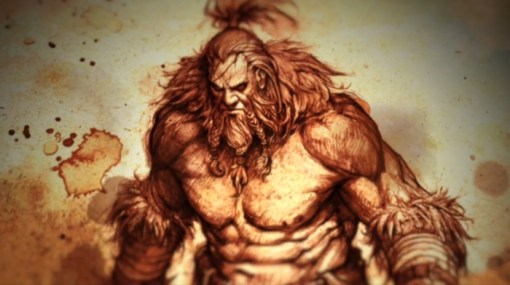
completely insane, our glory
lost in vain
what a perfect view
enter my coffin
my wintercoffin
awaiting to see the faithful king
what a perfect view!
[GM Note: This is a report of a part of session 8 of the Spiral Confederacy campaign. Session 8 covered a lot of different events, which are too much to describe in one post, so I’m breaking the write-up over three or four separate posts to keep them manageable]
Having successfully recovered what they believed was the Tablet of the Gods, and received a beautiful spaceship in exchange for trading away their dead cargo, the PCs returned from Slainte to The Reach. Upon returning to the Reach they were informed that initial exploration of the Tombspine had begun, and a smart young archaeologist had uncovered several graves, scattered out of order in nearby areas, that were probably linked to the graves that the characters had encountered a death priest trying to explore. Preparations were under way to open the graves and exhume its contents but these would take time. In the meantime the archaeologist had identified one particular grave of interest for its unique design, and was preparing to take a deep scanner to investigate its contents. Would Alva like to join her?
Of course our heroes, being men and women of science, wanted to know. They took the ship’s boat from their new, beautiful ship and headed as fast as they could to the Gardens, taking their weapons of course and the young archaeologist who had found the tomb. At the Gardens they found an agent of Pearl 7 acting as a gate guard, ready to report on any suspicious new entrants to the place, but he reported there had been no unusual activity. They hiked up into the hills, following the path they had followed when last they came here chasing the death priest. They reached the scene of their fight with the priest, now tranquil and scrubbed of any sign of violence or demons, and followed a narrow culvert into the hills. Here the Gardens sprawled across the ancient, craggy remains of a Confederacy spaceship, probably an early Continent class ship, that formed the spine of the structure they were walking along. Wrecked probably 2000 years ago in the Confederacy’s first ill-fated encounter with The Reach, when this sector was still well outside the frontier, this ship would have been 100kms long and 50 kms high, a beast of plasteel and field technology too vast to be easily fragmented; its wrecked superstructure formed the spine on which the entire Gardens was built, layers of wreckage piled on top of its flattened and uncoiled shell. At the higher, older reaches of the gardens, though, those other smaller ships were no longer part of the soil, and the characters found themselves toiling up grassy, forested slopes that were once the upper decks and turrets of this ancient, nameless starship. Mists gathered in the many valleys and tree-lined canyons of the ship’s grave, and all along the undulating ruins near the top of the tombspine they could see the remains of ancient turrets, turned thousands of years ago into tombs for fallen pirates.
One of these tombs was their target. The young archaeologist led them along a narrow valley, filled with mist and cascading water, and up to a long, narrow block of plasteel that had endured against the encroaching forest for millenia. This building was once a missile turret, perhaps holding weaponry capable of destroying a cruiser or the entire fleet of a lesser navy. Now it stood abandoned, hollowed out for its new purpose and left to the elements. They pushed through a narrow door and into the turret itself, and the young archaeologist explained the tomb to them.
It’s a central grave, this huge block of black material that’s blast-proof and bullet proof. There was an elaborate trap in the walls of the turret, some kind of complex laser trap triggered by the tomb itself with sufficient power and coverage to turn everyone in the room into chunks of barbequed meat. It’s been disabled now, but the central tomb is a strange arrangement still.
The tomb sat there, a squat and ominous pile of black … something, taking up much of the room. A small pile of flasks and boxes in one corner indicated the presence of grave goods, unopened and unrobbed. The central tomb rose to chest height, a perfect block of bomb-proof black … something, unmarked in every way. Apart from the small pile of pots and pans the rest of the room was empty and undisturbed, light filtering through a few holes in the ceiling and some plants growing out of cracks in the wall. They fired up the scanner.
They scanned the tomb. The outside of the tomb was, as their archaeologist had noticed, a weapon-proof shell. But inside it was another shell, a massive computer edifice devoted to fighting AIs. Inside that was a small computer and a sub-space power system, still running and dedicated to powering both. The AI defence and the smaller computer were both fried, destroyed by some intruder, probably necessary to disable the laser trap in the walls of the tomb. Once these two defenses had been disabled the lid of the tomb could be opened, which it had been. The body inside the tomb appeared to have been disturbed, though on first inspection nothing had been removed. Beneath the body was a small space, a final holder for grave goods, large enough to hold a tablet. It was empty.
Someone had come here, destroyed the AI defences around the central computer, disabled the trap surrounding the tomb, and disturbed the body inside just enough to take a single grave good – a tablet. The PCs could guess the implications of this: the leader of the Cult of the Unredeemed had come here 1000 years ago, broken into the tomb, and asked his AI to break through the defenses. The Starred One had managed to break the defenses but gone crazy during the battle. The cult leader had then removed the tablet and he and his now-crazy AI had jumped onto a sublight ship and headed off to the Perez system to hide.
This tomb told the PCs that someone placed immense value on the tablet they had found, and in particular they thought it needed to be protected from AIs.
This week’s Journal of the American Medical Association features an excellent article by Barack Obama, reviewing the implementation and outcomes of the Patient Protection and Affordable Care Act (“Obamacare”). Obviously large parts of this article were likely written by someone else, since Obama is too busy with his secret Muslim conspiracies to write a full paper, but some parts – particularly the part on why and how he implemented it – do seem to be written in Obama’s voice, which is nice to see. Vox has a brief report of the article, indicating that it is the result of a six-month Whitehouse review of the legislation and focusing on the implications of one of Obama’s recommendations (for a public option). Like most non-Americans I don’t find the recommendation of a public option to be particularly controversial or striking, so I’m not interested in revisiting it here. Rather, I’d like to briefly discuss the article’s findings on Obamacare’s achievements, take a moment to rant about what a terrible statistician Obama is, and look at some of the other conclusions he draws from his success. I will quote some parts of the article and put up one figure, but I won’t go quote too much or put up too many figures because JAMA probably wouldn’t like that. I would like to say that this is a very easy-to-read article and the choice of figures and data presentation is largely very strong – Obama certainly knows how to make a case. Also note the author affiliation: “President of the United States, Washington, DC”. Classic.
Reduction in the uninsured
In Figure 1 of the paper Obama presents the long-term trend in the proportion of Americans not covered by health insurance, and shows a huge drop after the implementation of Obamacare, from 15% to below 10% of the population. That is a huge achievement, which he states corresponds with roughly 20 million Americans receiving health insurance who would not have received it if Obamacare had not been passed. This still leaves about 30 million people without health insurance in 2015, a pretty shocking number for a developed country (in contrast, Japan has about 98% coverage and the UK about 100%). In Figure 2 Obama shows that the Medicaid expansion was responsible for a major reduction in the uninsured, by comparing the percentage drop in the uninsured in states that accepted the Medicaid expansion and those that didn’t. This drop in the uninsured increases with the proportion of people who had no insurance before the implementation of Obamacare: in a state that had 20% of its population uninsured in 2013, we see a 10% drop in the uninsured rate if the state accepted Medicaid, compared to 5% if it didn’t (these are percentage point drops, too, meaning that the proportion uninsured halved in the Medicaid state!) Obama doesn’t attempt to estimate the total number of people missing out on insurance due to the recalcitrance of the 21 states that refused to accept the Medicaid expansion, but I think the implication is obvious.
Obama’s sad statistics
Figure 2 annoys me because the straight lines shown in the plot are from an ordinary least squares regression of percentage point drop in uninsured against pre-intervention proportion of the uninsured. The straight line fit for non-Medicaid states is quite poor, because of course the relationship between percentage point drops and their starting point is non-linear. Obama would have been better served to take the logit transformation of the proportional drop, fitted a straight line model to that, and then back-transformed the resulting prediction to get two pretty s-shaped curves in his figure. I guess his article wasn’t subjected to JAMA’s usual rigorous peer review standards …
(In truth this isn’t a big deal in this case because the relationship in the data is so obvious that it doesn’t really matter how you handle it. My guess is that this figure was prepared by one of the people doing the review of Obamacare, and I would like to think that the people doing that review can do higher quality work than this!)
The three dimensions of coverage
Mixed results on financial protection
Insurance is only good if it covers the services you need and offers financial protection. In health financing we talk about depth, height and breadth of coverage, which are depicted graphically in the figure above that I cribbed from an LSHTM course on financing health. Reducing the number of uninsured increases the breadth of coverage (the proportion of the population covered) but if this comes at the expense of the depth of coverage (which services are covered) or the height of coverage (the proportion of financial protection people receive) the overall benefits of the plan may be limited. Obama tackles these three dimensions in his paper, though he doesn’t use the WHO framework described in the figure above. Regarding depth, he states
Coverage offered on the individual market or to small businesses must now include a core set of health care services, including maternity care and treatment for mental health and substance use disorders, services that were sometimes not covered at all previously
Which indicates that Obamacare has forced minimum standards of coverage onto organizations that offer health insurance. This is something that people living in countries with robust universal health coverage (UHC) systems take for granted, and it’s really hard to imagine having to navigate a health insurance market where this isn’t the case – at the very least setting up a core set of covered health services reduces the risk of mistakenly choosing a health insurance package that doesn’t help you with the things you’re most likely to need it for. Obama’s language here implicitly suggests that the core package of services covered under Obamacare is an expansion of those in the previous system, but he doesn’t present any evidence that this is the case for all plans, or even in general – it could be that in adhering to these core requirements insurers have dumped some other coverage from their plans. I haven’t ever seen any research on how to assess the best services to include in a plan, or how to compare two plans that have quite different and non-overlapping benefits, so I don’t know how to assess this aspect of Obamacare (or if it can be assessed), but from the point of view of consumer protection having a guaranteed core of services seems like a good idea.
Obama’s Figure 3
On financial protection – the height of services – Obama makes a strong case that his legislation has been very protective. Figure 3 in the article, shown above, shows the trend in the proportion of workers enrolled in an insurance scheme that has no annual upper limit on the amount of out-of-pocket payments they must make. Out of pocket payments for health care are the main source of financial risk for individuals, and typically arise when someone has no health insurance (so must pay everything from their own money) or has health insurance with very high co-payments and deductibles, a common problem in the USA before Obamacare. Obamacare required insurers to put a cap on these out of pocket payments, and the effect on the proportion of workers exposed to unlimited financial risk is obvious in this chart. Unfortunately in a later figure we see that average out of pocket expenses haven’t changed much over time, suggesting that the annual limits that insurers placed on out of pocket payments were set high enough as to not effect the majority of such payments. To properly explore this issue we need to see data on health-related financial catastrophe, distress financing, and impoverishment due to health expenses, which to the best of my knowledge have never been adequately reported for the USA. We see some hints of this in other parts of the report, where Obama notes that the proportion of people not seeking care because they can’t afford it is down, and the average size of Medicaid debts is also down, but the picture here is incomplete. My suspicion is that a lot of healthy people have picked up bronze plans that offer them financial protection in only the most extreme cases, leaving them wearing significant costs for routine care. This isn’t in itself necessarily a problem, but to properly understand the financial protection and equity effects of the law we really need to see measures of who gets screwed by very high costs and how, rather than seeing trends in average costs.
Lessons from this policy battle
Obama concludes, unsurprisingly, that his policy has been highly effective, and I agree with this conclusion. It’s definitely not the best UHC plan out there, and even before it was rewritten by the Supreme Court and repeatedly undermined by Republicans it wasn’t a great plan, but it has achieved a lot and a lot of Americans are much better off for it. He states in the conclusion that he now wants people to accept it as the law of the land and move on to ways of improving it, but first he makes this comment about the challenges of working in American politics which gives some idea of how much of an achievement even this compromised package is:
The first lesson is that any change is difficult, but it is especially difficult in the face of hyperpartisanship. Republicans reversed course and rejected their own ideas once they appeared in the text of a bill that I supported. For example, they supported a fully funded risk-corridor program and a public plan fallback in the Medicare drug benefit in 2003 but opposed them in the ACA. They supported the individual mandate in Massachusetts in 2006 but opposed it in the ACA. They supported the employer mandate in California in 2007 but opposed it in the ACA—and then opposed the administration’s decision to delay it. Moreover, through inadequate funding, opposition to routine technical corrections, excessive oversight, and relentless litigation, Republicans undermined ACA implementation efforts. We could have covered more ground more quickly with cooperation rather than obstruction. It is not obvious that this strategy has paid political dividends for Republicans, but it has clearly come at a cost for the country, most notably for the estimated 4 million Americans left uninsured because they live in GOP-led states that have yet to expand Medicaid
Here he hasn’t gone into great detail about how the Supreme Court rewrote the Medicaid expansion part of his bill, and he has notably understated the effect of obstructionism on the Republicans, but his central point is clear: this legislation could have been better if Republicans would just have supported it, or contributed in any way at all to a constructive debate on health care. Five years have passed since the bill was first introduced to Congress, and Obama has had enough time to review its effects and write a JAMA article on it, and in all that time the Republicans have tried repeatedly to repeal it yet are still to come up with an alternative health care plan. Today they released their convention platform, and as reported by Vox it doesn’t include an alternative health care plan – in an election year. This is beyond juvenile politics, and in any other democratic polity a party that cannot come up with a coherent health policy would be treated as a joke. This is the background of Obama’s legislative efforts.
Finally, Obama makes the point that people working in health financing understand well: that UHC is about a pragmatic pathway to financial protection for everyone, not about an ideological commitment to a specific means of getting there. He says:
The third lesson is the importance of pragmatism in both legislation and implementation. Simpler approaches to addressing our health care problems exist at both ends of the political spectrum: the single-payer model vs government vouchers for all. Yet the nation typically reaches its greatest heights when we find common ground between the public and private good and adjust along the way. That was my approach with the ACA. We engaged with Congress to identify the combination of proven health reform ideas that could pass and have continued to adapt them since. This includes abandoning parts that do not work, like the voluntary long-term care program included in the law
and in this respect I also agree with him. I suspect that if the Republican party were a real political party and not a clown car, they would have recognized the importance of reform and accepted Obamacare as a practical model that protects the free market nature of the existing health system. For those Bernie dead-enders who refuse to accept compromise, nothing except a full single-payer public plan will do, and while this worked completely fine in Australia, Canada and the UK it just won’t make it in the USA, which is probably why those Berniebros find themselves in their current cul-de-sac. Obamacare is an artful example of the importance of compromise in making good health policy, and the value of practical planning over ideology. Shamefully for the Republicans and unfortunately for the country, it hasn’t been able (yet) to achieve its full promise. Obama made a few suggestions for how it can, but ultimately his particular recommendations are less important than the simple need for a return to rational policy-making by the Republicans. Whoever the next president is, she is going to want to begin tinkering with Obamacare to make it better, and hopefully the Republicans will by then have recognized that it is their responsibility to contribute positively to that process, for the good of all Americans.
I don’t see that happening, but like Obama, I can always hope …
Although it is a post-scarcity utopia, there are some things that even the Spiral Confederacy cannot guarantee its citizens. Ocean class spaceships, for example, 40km long and 10 km wide, require special facilities to build, and so much energy and raw materials that they cannot be built quickly enough to meet demand. Ships of this size are so rare even in the Spiral Confederacy that their citizens are not free to travel where they like, but find themselves bouncing around the Confederacy on missions and tasks that the leadership require. The Confederacy has never built a Dyson sphere, although it has constructed smaller orbitals, because the engineering challenge is too great to be worth the reward. Some technology, such as psionic amplification devices, is still so new that it requires rare elements that are hard to obtain and work with, and so although the Confederacy might in theory have the resources to produce an infinite quantity of such devices, in reality their numbers are never sufficient, and they are not distributed evenly across the Confederacy. Some commodities are limited because the Confederacy’s success has rendered it incapable of mobilizing people to do some tasks, and its strict resistance to allowing AIs into society prevents it from utilizing their prodigious intellects to replace human ingenuity. For this reason the Confederacy never has enough researchers to further its understanding of new planets or to develop new technologies, and until it admits AIs fully into its society will not be able to progress beyond Tech Level 15 at any appreciable speed. Because no one in the Confederacy has to work, real scientific endeavour has stagnated. Although the Confederacy has more stars in its borders than anyone can count, and more people orbiting those stars than it could ever catalog, it suffers from a single scarcity: A scarcity of workers.
This scarcity of willing workers means that the Confederacy suffers two particularly challenging constraints, in delivering sudden death and eternal life. Although the Confederacy is blessed with an infinite supply of the most destructive and violent weapons humans have ever seen, it lacks people to wield them; and although it has developed the technology to save human souls into computers and download them into new bodies, it lacks the medical staff and skilled workers to be able to provide this resleeving service to everyone within its borders. This technology – officially called Sentient Recapture but unofficially and everywhere referred to as “resleeving” – offers the potential for eternal life to anyone who uses it, and liberates human civilization from the fear of death. It enables a human soul, with all its personality and memories, to be stored digitally, and reimplanted into the empty mind of a cloned body. This technology is enormously costly, however, for two reasons: AI attack, and human genetic caprice. Because AIs are excluded from human society, and creep around the fringes of its computer systems, colonizing them and using the human information architecture as parasites use a host body, all major computer systems in the Confederacy have to be built with protection against AI intrusion. Although no one has any evidence that it has ever happened, fear of AI inserting themselves into human stored consciousness, potentially using resleeved humans as experiments in organic AI tech, require that the digital storage sites for backed-up souls be heavily guarded against AI intrusion. Since the primary defense against AI attack is a physically huge computer system with multiple redundant physical structures and huge quantities of highly advanced anti-intrustion software, human download sites are physically massive, use huge amounts of power, and require the constant presence of technicians to monitor the systems. They simply cannot be expanded rapidly enough to accomodate all the humans in their local area, and so some mechanism is needed to ensure that only some privileged people receive this technology.
Similarly, war cannot be fought by AIs, and the Confederacy has put strict limits on robot technology to ensure AIs cannot infect robot soldiers and suddenly uplift them to artificial intelligence. This means that ultimately the Confederacy will rely on physical, human soldiers to do the old-fashioned work of killing enemies – and although it is a utopia, the Confederacy has many enemies. The Confederacy also relies on humans to do some medical work, to do much of its scientific research, and to manage distant space stations and territories. Even if it were willing to work with AIs, AI cannot travel through jump space, so ultimately inter-stellar force projection and border control depends on mobile, committed and well-trained humans. But in the Spiral Confederacy work is considered a bother – people only work for fun, never because they need to, and this principle is so central to the Confederacy’s self-conception that it can never be trained.
The Confederacy’s leaders have solved this problem by offering special rewards to those who serve it voluntarily. These rewards usually take the form of those scarce technologies that are still not ubiquitous even after 20,000 years of constant growth. If someone is willing to spend 10 years running a remote research station she will be given her own starship, so they may fly where they will; if a psionic is willing to spend a couple of years doing field work on a remote planet occupied by semi-sentient psionic lizard creatures, he will be given an amplification device and training in new disciplines. And if someone joins up for the Confederate army and actually goes near a war zone, they will be given a backup. Of course the Confederacy has other means to get people to work – from threats of prison to simple old-fashioned propaganda – but in the end it knows that where principles and a desire for adventure fail, basic rewards will work.
This means that there are really only three reasons that anyone joins the Confederate army: they are a true believer in the Confederate cause; they want to kill people; or they want to live forever. Most of the billions who join the Confederate army will never see action, instead spending a couple of boring years on a space station somewhere before returning to civilian life, perhaps now possessed of some minor reward that will forever set them apart from their peers. But should they be unlucky enough to see actual combat, they will get to enjoy all three of the motivations at once: They will kill many people for the cause, and they will be granted eternal life. All soldiers heading into the field are given a backup, and guaranteed a resleeve in the same body should they die or suffer any injury so serious that they cannot be restored to full health. There are soldiers in the Confederate army who have multiple posthumous medals (and were at the award ceremony for all of them); no Confederate soldier can ever remember the moment of their death, but every soldier who dies receives the coveted broken heart award, that sets them apart from their peers as particularly dedicated to their work (and especially unlucky).
This compact of eternal life makes the Confederate soldier an implacable and fearsome foe, dedicated to the cause he or she has signed up for and committed to killing for it. No soldier ever need fear death, and because most Confederate citizens are genetically engineered to have a euthanasia switch they can engage during periods of prolonged suffering, no soldier need fear torture. Among Confederate soldiers death isn’t just the highest sacrifice – it’s a sacrifice they can live to brag about, though only their peers will be able to tell them how they died. Confederate soldiers do not seek death, but they happily embrace it when the mission demands it. Confederate leaders also know that they can send their soldiers on suicide missions, and throw away whole divisions in reckless gambits or desperate moves. Such sacrifices need only be judged on their merits, as logistical and tactical problems, not on moral grounds. For the enemies of the Confederacy this adds a terrifying additional calculus to every battle. As if it weren’t enough that their opponents carry the best weapons and armour in known space, they do not relent in their use of those weapons or shirk from even the hardest of battles. An enemy of the Confederacy cannot expect to win by forcing their enemy to pay too steep a price – they must entirely exterminate their enemy, or fail.
It is always the case that foolish warmongers fail to properly assess the risks of the war they decided to wage, and so of course reckless rebels or jealous outsiders will attempt war with the Confederacy, thinking that this time they have a strategy that will ensure the price is so high that they will force this vast confederation of uncaring stars to come to some settlement. But then an Ocean class battleship drops a million dedicated soldiers onto their planet, and refuses to even consider negotiation after half a million have died. Seeing such recklessness, the rebel presses the attack even as his or her own losses mount, thinking that the back of that force must break, but still the only official communiques from the Confederacy are surrender requests. The Confederates gain ground, and the rebel’s position begins to become precarious. They suggest a ceasefire, and in return they are given an offer of total capitulation. As their own losses grow their own political support wavers, people begin to fear the insanity of the Confederate strategy. Who can argue with people who are not afraid to die? Every battle they see thousands of their enemy die, and yet they lose every battle. Every culture that has been to war has some version of a story about pyrrhic victories, but it seems that the Confederacy can sustain a thousand pyrrhic victories and never waver in its certainty that it will win. The confidence of the aggressor wavers, and they suggest a negotiated settlement; the Confederate general refuses to accept anything less than the immediate execution of war criminals and unconditional surrender, disarmament, humiliation. The rebel’s generals report that morale is good among the enemy’s soldiers, though they have lost 70% of their number. Another battle, a major city falls, a conquered country’s neighbours switch sides. Political support collapses, and the tumbrils take the warmonger to meet his new Confederate executioners.
On the frontier, the lesson is always the same: there is no use in arguing with people who cannot die.
A note on ideas: I picked up the term “resleeve” and most of the associated ideas from the Richard Morgan book Altered Carbon, which I reviewed here. This sci-fi vision has been something of a fixture in my gaming: the quotes from the Dialectic Ephmeralists that Drew became fond of in the New Horizon cyberpunk Campaign were all drawn from Quellchrist Falconer, a political visionary in Morgan’s books. I don’t do anything original when I game.
Two good friends and I are doing occasional Sunday evening sessions of original Dungeons and Dragons (OD&D) over skype. I reported the first session here, and haven’t reported the subsequent four because … well, because there’s nothing to hang onto. Our second session ended with a TPK, but I think I didn’t report it, and since then we decided to move on to a different module, B1: In Search of the Unknown, which we have been slowly unpicking over three more sessions. We are following a pretty specific plan, which is to play the rules as they are written with no deviations. Basically, if it’s not in the Rules Cyclopaedia we don’t use it. So far we have tried two adventures, the one that came with the 1983 Mentzer Red Box, and B1. We have, to say the least, been underwhelmed, and at the end of the last session we stopped and had a solid discussion about what is wrong with the game and the system. Basically, we concluded that we’re really enjoying hanging out together (we live in different countries and regular skyping is fun) and the game is a good vehicle for that, and we’re having a lot of fun but mostly this fun has increasingly turned to taking the piss out of the game as we play it. This post is an attempt to summarize our complaints about Basic Dungeons and Dragons so far, and perhaps also a brief discussion of what it means that there is a whole movement (the OSR) that is evangelical about how good this stuff is.
So first, the problems we’ve encountered so far.
The PCs are all the same
Even with the Rules Cyclopaedia’s rudimentary skill rules, the PCs are all the same. If you’re not a Fighter, your attributes are basically only meaningful as an XP bonus – for example, intelligence doesn’t improve a wizard’s spellcasting at all, and dexterity makes no difference to a thief’s skills (which are, in any case, absolutely useless). So far our most entertaining characters have been the wizard with 1 hit point (because his death was so assured) and Lefto the Halfling, who managed to get enough hit points to survive a full power blow from a longsword (but still died because my wizard was conserving his sleep spell for when we really needed it). When you’re distinguishing PCs on the basis of their hit points you know you’re plumbing the bottom of the barrel. What reason do we have to keep any of these people alive? Why are they here? Why are we here? More diversity in PC choices and more effort in making them identifiably different at first level would make the game so much more interesting. I’ve heard the argument that in D&D you don’t invest your character with any special meaning at first level because you know it’s going to die, and you wait for its personality to emerge if it survives, but I don’t think the allegedly easy deaths are the reason (especially for fighters and dwarves, who don’t die); the reason is that the PCs simply have nothing to hook onto when you first make them.
The adventures are absolutely terrible
The two modules we have played so far have been, to put it frankly, terrible. The first, the adventure that comes with the Mentzer red box, is an absolute disaster that starts and ends with a TPK. The carrion crawler at the gates is such a stupid idea, it’s beyond ridiculous, but there is another TPK buried at the back of the first level of the dungeon, where your FIRST level characters can break into a room that holds two harpies. You get no warning about these beasts anywhere in the adventure, and for first level characters they are absolutely fatal. Even if your entire party doesn’t get caught by their siren song, their attack is way more than a first level party can handle. Now you could argue that this is just life as an adventurer, but this is meant to be the very first introductory adventure for people who have never played this game before and it is absolutely punishing. It is a prime example of what in Japan we call power harassment, in which the GM simply uses his power to bully the PCs brutally, and nothing they can do can escape it. I’m confident that a great many young people dropped out of this hobby after their first experience of it, simply because of this adventure.
In contrast, the next module we played, In Search of the Unknown, is tedious and stupid and not at all challenging. It famously comes unstocked, with a list of monsters and treasures that the GM is supposed to place at his or her whim throughout the dungeon, but the dungeon is huge and the treasures and monsters list small, so it ends up incredibly dry and boring – the classic endless series of dusty empty rooms. I bulked up the monster and treasure list and it’s still tedious. Furthermore, the dungeon setting is embarrassingly written in so many ways. The dungeon is the lair of two famous adventures, one of whom is called Zelligar the Unknown (even though we have all heard of him), and these two adventurers are incredibly arrogant and insecure – their rooms are full of murals of themselves, and statues to their own prowess, like cheap dictators. The rooms are terribly described, so that for example we learn in some rooms that the walls are carved in intricate detail, yet we are told nothing of what this detail is, while in another room we are given intricately detailed information about some random book (it was meant to be returned to the library!) or other object, ofttimes detail that is impossible for the adventurers to know. I’m told that the hand axe in room 34 has a split handle but I’m told the walls in room 33 have been carved in intricate detail that isn’t explained at all – this isn’t how GMing is supposed to work. This adventure is probably the first adventure that GMs will use to learn how to do this stuff, and it’s a contradictory mess of consistently bad lessons.
It’s boring for another reason too – D&D movement and combat is just not much fun.
The movement rules suck balls
Of course our fighters and clerics are wearing full plate – otherwise fighting would be randomly fatal rather than randomly easy, see below – so our whole party moves at 60′ per turn. That is, 60′ in 10 minutes. As I said, we’re following the rules, so we’re tracking oil flasks and movement and wandering monsters, which is relatively easy because we’re doing this over skype so we have a google doc. We don’t have a “caller” and a “mapper” because as soon as we saw that idea we laughed and decided to use roll20, so now we unveil sections of the map consistent with the lantern range, and avoid mapping. If we were mapping B1 we would be spending most of our sessions arguing about the mistakes in the map, because the dungeon is incredibly complex and hard to map based on a GM’s description, which is what we would be doing back in the 1980s when this game was released – another example of terrible module design, for the first independent module to be designed to be too hard for beginning (or even experienced!) players to map easily.
So we’re spending our time documenting these movements that take 10 minutes to move 60′, and trying to understand why. In a complex dungeon this means that you spend an hour retracing your tracks to explore a room that is literally just around the corner, and you have to go back to town because you’re out of oil. Of course this doesn’t really matter since this game is designed so that you go home as soon as your wizard has used his Sleep spell, but it hangs over us like this oppressive bit of pointless stupidity. Why did it take us 10 minutes to go around the corner, and why did we use an appreciable amount of oil exploring that room? This is even worse if you follow the original rules 100% precisely, which require one turn to explore a 10′ square. Module B1’s most famous room would take about 5 hours to explore, and would take two sessions since the PCs would have to return to town twice to get oil, if you followed those rules.
Speaking of which, Module B1’s most famous room – the one with the pools – is stupid. One of our players immediately thought of using the fish from the pond with fish to test all the other ponds, rendering all the stupid save-or-die traps immediately harmless, and turning the whole thing into an academic exercise.
Level-gaining is random and easy
If you read around the traps, you’ll find this general opinion presented that in original D&D you gained levels slowly after much struggle, and D&D is a low-experience, slow-reward game. Were this true it would be the textbook definition of bullying, since you have been given a completely cookie-cutter character with limited survival chance and been told that he has to go through a large number of near-death experiences at the hands of a save-or-die fickle GM in order to get that one more level that might possibly make him vaguely able to make it on his own efforts.
Nothing could be further from the truth. Because XP is gained from treasure and treasure generation is random, it’s actually really easy to gain a level by blind luck. We’re three four-hour sessions into B1 and we’ve hit second level, because we found a 1500 Gp dragon hide, a 1000Gp treasure horde, and a 5000 GP statue (actually the rules say at least 5000). And we were unlucky. We found a Green Slime, which has treasure type B – with a 25% chance of 1d6 items of jewellery, each of which has a 90% chance of being worth 2000Gp or more (incidentally, the Rules Cyclopaedia estimates of treasure average values are clearly wrong). This reliance on treasure for XP makes leveling up a completely arbitrary process, which either happens randomly and suddenly according to rolls on treasure tables, or is completely determined by GM caprice (but role-playing XP is a bad idea!)
Combat is boring and randomly fatal
Combat is heavily dependent on the position of the fighters when it starts and the initiative roll, which is completely random. If the party wins the initiative the fighters attack with a THAC0 of 15 (because of high strength and weapon mastery). If anything is left after they have done their job it attacks, usually with THAC0 19, unless it’s a TPK machine like a carrion crawler. Typically the enemy is AC 5-7 but we are AC 2-4, so the odds are stacked against the enemy. Occasionally an enemy gets a lucky hit and one of us dies, unless it’s Lefto the halfling who went through multiple attacks and who we left to die rather than waste our sleep spell because he was a henchman and we were going to get more xp if he died but if I cast sleep we would all go home with less.
This is not fun combat. Especially at early levels where everyone literally has one option – attack and roll damage – so combat is just a short series of hit/damage rolls with the outcome primarily determined by initiative. There is no choice of magic items or special abilities that would make your character have some unique contribution, nothing outside of the environment at all to distinguish between the vast majority of characters – at first level literally only wizards and elves have any unique abilities and they can’t use them more than once a day so they hold them back. And even then there is no wizard whose unique ability is ever anything except sleep (held in reserve for when a group of enemies appears) and no elf who hasn’t learnt charm person (because for some stupid incomprehensible reason they’re not allowed to learn sleep).
It’s also telling that the only time we bothered to not use combat as a solution to our problems was when we had an elf with charm person learned. There are no social skills, and all our enemies are evil, so why would we bother?
Important rules are completely missing
There are a lot of rules for basic things missing in D&D. The absence of these rules gives you pause to think, “Hmmm, we’ve learnt a lot in 30 years”. This absence of rules isn’t restricted to the rulebooks but also applies to the modules. For example, B1 is full of secret doors but doesn’t give any information about how they work or how PCs should find them or how GMs should manage them. Similarly, B1 has a couple of obvious huge treasure hauls but no information on how to treat them. The most egregious example is the dragonhide in room 26, which you are told is “immense” and has “brassy scales”. There are no brass dragons in Basic D&D, but the module gives you no information on what this hide might be worth. This same room contains a stuffed cockatrice and some dragon paws, but no idea of their value (consistent with my complaint above, other rooms give details about the monetary value of mouldy cloaks and component parts of beds). So I had to make this up (for those who googled “D&D value dragonhide” I went with 50Gp per hp of the original dragon multiplied by a third, and rolled hps for a large red dragon – the third represented the fact that the hide was incomplete). Why would you give the monetary value of a mouldy cloak but not a dragonhide? Ridiculous.
The most obvious example of this lack of rules is the problem of magic items. There are no rules on how to sell magic items, something that I have also seen presented as a plus about original D&D (who would sell a magic item!?) but this is something that makes no sense once you’ve played five minutes of the game. As soon as you get a magic item you don’t need that someone else obviously wants, you are going to want to sell it, but there is nothing about the obvious market that would result from adventurers surviving modules (except the introductory module, which is inevitably fatal because we want people to enjoy our game so we loaded it with TPKs as an advertising mechanism). Of course you could use the rules on the amount it costs to make magic items as a guide but – shock! – these rules are stupid. The amount of money required to make a magic item is completely out of context to its value. It’s as if there is no connection between the rules for magic items and how they are actually available and used in play.
Say it isn’t so.
Conclusion: This game is not an exemplar of its kind
I hate the Beatles, or rather, I hate the hype about the Beatles. This is the band that wrote Obladioblada, they aren’t good. But people mistake them for good because they were first. There is no song the Beatles ever made that compares with Stairway to Heaven or Child in Time (the video for which is a splendid piece of early musical beauty), and there is no sense in which the Beatles are as connected to the fundamental traditions of the English language as later metal bands are. But the Beatles get the attention because they were there first. I feel that Basic D&D has been treated the same, and just as there is a certain group of “connoisseurs” who have managed to convince themselves that bands like the Beatles were good, rather than just the first, there is a network of revivalists (the OSR) who have convinced themselves that D&D was somehow revolutionary for its content rather than for its timing, as the first. In reality subsequent generations of games are far, far better, and have added so much more to gaming than D&D. They have improved the rules (even AD&D did this) and added new elements of story, character development and GM skill and training to the gaming world. The truth is that gamers don’t want this mechanical dungeon crawl dice rolling stuff, they want story and character development and engrossing adventures with themes and purpose. That kind of stuff doesn’t emerge from crawling around empty, dusty chambers in the dark. It’s a purposive thing, that needs good rules and engaged GMing that is about more than setting up a bunch of rooms for hollow shell-people to die in.
I’ll keep doing my D&D skype thing with my friends, because they’re great and killing kobolds with them is fun. But exploring this game that was at the roots of our gaming experience has shown me that we have all grown since we started, as has the hobby, and we should respect original D&D for its originality and its explosive potential, at the same time as we should accept it for the stunted and narrow game that it was.
And oh my love remind me, what was it that I said?
I can’t help but pull the stars around me, to make my bed
And oh my love remind me, what was it that I did?
Did I drink too much?
Am I losing touch?
Did I build this ship to wreck?
-Traditional poem of the pirates of The Reach
In their most recent adventures in the Reach, our heroes managed to create a major incident in the Bones, a particularly unsavoury part of the pirate system known as The Reach, and in so doing learnt that the death priest they had killed was entangled in some ancient story of AIs and betrayal. They had discovered that 1000 years ago the leader of a cult of adherents had traveled to the Gardens on a secret mission, and then fled suddenly with the cult’s AI, both of them abandoning the system in a sub-light vessel and heading to a nearby star system to hide. The death priest they killed had been digging up bodies in the same part of the Reach and torturing the souls of the long dead for information on a thing called “the ansible”, so naturally the PCs guessed that the cult leader had fled with information about it, and determined to follow.
They learnt from their new follower Sue the Unbroken that the leader had fled to an abandoned observation post called Rocannon’s World, in the remnant system Perez, and headed there as soon as they could. Perez was too far for their tiny utility ship to reach, but they could pass through the system of Slainte, a near-uplift system with a major starport carved into one of the remnant planet’s moons. On arrival they were shocked to discover hundreds of naval ships in-system, including the much-feared Blindhammer and the enormous Ocean-class battleship the Rubicon, and began desperately searching the system for the Reckless. Fortunately the navy hadn’t arrived for any purpose in connection with the PCs’ irrelevant mission, and weren’t gathering for an attack on the Reach; they were preparing a major battle further out on the frontier.
Lam, the group’s pilot, is an ex-naval officer, and was able to identify a ship she used to serve on, the cruiser Notes From the Fallen. She had spent a year on this ship, cloistered in the tiny crew area with 11 other men and women while they engaged pirates on the edge of the Rim, and she was eager to catch up with them. She put in a call and the cruiser docked with the space port to allow a little R&R. The Notes from the Fallen is a 300m long beast comprised entirely of engines and weaponry, its crew forced into a tiny living area in the very centre of the ship, and everyone on board took any chance to get portside and stretch their legs. They met Lam in a bar called Moonfall, and toasted her independence in the local brew, a vile seaweed-based liquor that is always drunk so cold it almost burns the throat. They had spent the last year hunting rebels on the frontier, tracking isolated ships through asteroid fields in long-forgotten systems, a game of cat-and-mouse that inevitably ended the way all such games end, with the mouse crushed and the cat barely sated, until they were called away for this new mission into a different frontier. They had no gossip for Lam or any information about anything relevant to her group’s mission; their job was simply to destroy any automated defense systems that might resist psionic attack, and they doubted they would even get a chance to fire a weapon in a fleet this size. Mostly they were there for show – the Blindhammer could destroy the combined fleets of every rebel system on the frontier without pausing to reload, and if they really needed it the Rubicon could bomb an entire planet to ruins. If they were lucky they would get to blow up a communications satellite, but as far as they were concerned this was a holiday, and they hadn’t been paying attention to the details.
Lam returned to the Come As you Are no wiser to any salient details of their mission, so they decided not to dally. They jumped out to Perez.
As good a place as any to die
The Starred One
They reached Perez in one week, finding a system with a tiny star port hanging over a remnant planet on the edge of uplift, and another, much older observation post on the edge of the system. This post appeared to be shut down, and had been overlooked in favor of more modern stations further in-system. The PCs approached this ancient observation post cautiously, but it appeared to be mostly silent, nothing active or moving except a few flashing red proximity lights. The station consisted of a simple spindle running through a single habitation disc, the most basic of observation outposts. It had a single ship docked, a huge vehicle composed mostly of engines that must surely be the sub-light vessel that the leader had hijacked to come here. That vessel was completely empty and silent, and scans revealed a primitive vessel with no signs of life or even computer activity.
They docked, and with some trepidation entered the station. Simon Simon, using his new Stealth grace, was able to activate doors and docking procedures without drawing the attention of the AI they suspected was hiding in the space station, so they were able to enter and turn on the lights without any challenge. The hallway from the docking area into the main chamber of the station was silent and cold, and the atmosphere seemed breathable, but it had a chilling strangeness about it. On one wall someone had smeared, in red paint
Hello Silence
and on the other wall
my old friend
Someone checked, and confirmed for once that it was not human blood or anything else creepy – just very old, crumbling red paint. They advanced.
The station was a simple structure, a single walkway curving around the outside of the station and a small cluster of rooms nestled inside it. They began walking around the walkway, looking for the main ventral corridor that would take them to the key rooms. Their vacc suit torches showed them that strange things had been done to the walls and ceiling of this hallway – the ceiling had been coated with phosphorescent stick-on stars, and the walls covered in red hand prints that crumbled to dust when anyone touched them.
They advanced cautiously, but not cautiously enough. As the ventral corridor emerged into view, two hovering drones emerged from the corridor and opened fire. They ducked back around the curve of the hallway but two more drones attacked from behind. Caught against the curve of the hallway, they opened fire with everything they had, and managed to destroy all four drones without taking more than moderate damage themselves. When the gunfire and smoke ceased, Alva and Simon Simon were gasping in pain but they were mostly still safe.
They advanced into the ventral corridor. This corridor stretched from one side of the station to the other, passing through all the living and science areas of the station – all the doors opening into this corridor gave access to all the important rooms in the entire station. They were moving towards the first of these when the wall exploded outward and a massive, angry robot stumbled into the corridor. This robot was constructed of all the rubbish and equipment of a scientific station: its body was made of tables, chairs and coffee machines, its arms built of cables and bedding and even a microwave oven. On one arm was a huge blade that appeared to have been carved out of a steel optics bench, and in the other a huge machine gun. Its head was a speaker surrounded by the dark plastic nodules of cctv camera housings. From the speaker came a roar of distortion and static, and it attacked.
Ahmose moved forward to take it in single combat as the others opened fire with auto rifle and laser. The robot was screaming in galactic standard language, its voice horribly distorted by feedback and static but recognizable as the smooth, calm voice of a space station announcement system. Whatever mad sentience drove this creature had taken the announcements from the space station system and rearranged them into deranged muzak versions of ancient poems. It quoted monologues on revenge and anger from famous poets from all across the known planets, screaming them out from the overpowered public announcement speaker in its face as it swept its sword at Ahmose. After it hit her it screamed, in unevenly spaced distorted announcer-woman words
They think our heads are in their hands
But violent use brings violent plans
Keep him tied, it makes him well
He’s getting better, can’t you tell
Ahmose, staggered, fell back, but Alva pressed a stun stick into her hands. Simon Simon used his scrying grace and computer skills to hack into the things eyes and blind them, at the same time as Ahmose hit it with the stun stick. Where their weapons had deflected from layers of armour and useless garbage covering, the stun stick penetrated straight to its electric core, driving it crazy. It staggered back and opened fire wildly with its machine gun. Ahmose pressed the advantage, but in the hail of bullets Simon Simon went down. More blows with the stun stick and the beast finally fell, coruscating with sparks and impotent screaming rage. They poured fire into it until it stopped twitching and screaming.
What is it?
With the AI’s main weapon disabled they were able to explore the remains of the station comfortably. They found several rooms where the scientists lived and relaxed, all ransacked for parts for the warrior-machine, which had clearly been constructed by a servitor robot they found in the remains of the cafeteria. They moved cautiously into the main control room, where they found the adherent who had come here with his AI. His dessicated corpse sat in a chair looking at a huge set of screens, an empty glass on the floor on one side of the chair and a discharged slug pistol on the other. On a desk in front of him was a single object: A slim grey tablet, about two hands in size, inert and inscrutable. It surface, sides and back were completely smooth and unbroken except for a single hole in one side, which appeared to be a slot for something.
All the screens in the room were activated, showing one of two images. On half of them the words “What is it?!” scrolled constantly, flashing in different sizes and fonts. On the other half was a slowly revolving three dimensional model of an irregularly-shaped object, which perfectly corresponded with the shape of the hole in the tablet.
Ahmose and Alva recognized that object instantly. It was the exact same shape and size as the mysterious crystal they had been engaged to obtain from an asteroid in the Dune system, when they first met.
They had held a 1000 year-old secret in their hand, and gave it away to some gangster called Mr. Kong in exchange for a worthless voucher for a backup service.
Shaking their heads in disappointment, they took the tablet and left. Simon Simon shut down the power for the AI, and they took its memory in case they would need it later. Carrying the mysterious tablet and the secret of its missing part, they returned to Slainte.
What games are these?
The Left Hand of Darkness
On Slainte they had to spend a week resting. Some of them needed healing, and everyone wanted to let off steam in a real Confederate space port, so they took their time here. After two days on the port they received an invitation to an evening meal from a strange man called Dathrak Khan Sevelid 3 of Mithrandir. The invitation was to a hangar, with a dress code (party) and a weapons code: Optional. They investigated this Dathrak Khan and discovered that he was a scion of some noble family on a distant remnant planet, who had used his connections and wealth before uplift to ensure he got the most he could out of the Confederacy after uplift. His reputation was slightly scandalous, since he retained a lot of his remnant ways and didn’t bother conforming to the strange customs of the core; he was old enough to have resleeved several times but had made a point of resleeving only into remnant bodies, adopting none of the sophisticated biology of the Core except for the enhanced sexual function. Famously charming, this man had a body that still sported hair and still sweated in a primitive fashion, but despite this his parties and social events were enormously popular. He was also rich, even by confederate standards.
Intrigued, they attended his party in their finest formal wear, carrying only light weapons. They were greeted by a barely-dressed woman carrying a vaping bowl, already obviously very high, who welcomed them effusively and gestured them inside. She led them through an entry area and into a hangar that looked out over the scarred grey surface of the moon-sized spaceport. The hangar itself was a huge space carved out of the rock of the moon, field effectors holding air in and keeping the temperature even. The far doors of the hangar were large enough for a small ship to pass through, and indeed there was a ship in the hangar – a beautiful, lethal black sliver of high-tech luxury, beneath the nose of which was set out a dining table and chairs big enough for a party of about 12. A woman was sprawled over two of the chairs, giggling, and in another chair sat a slim, handsome man in a slightly unorthodox suit.
In the corners of the hangar stood guards in full battle dress, heavy machine guns in hand.
As they entered the man stood up and sashayed towards them, carrying himself with a casual arrogance and obvious awareness of his own beauty. He greeted them all by name, introduced himself as Dathrak Khan Sevelid 3 of Mithrandir (“my friends call me DK, or Doctor Khan – do as you will!”) and welcomed them all to his table. The woman disappeared to get drinks and drugs, barely functional through her giggles, and within moments servitors were emerging with plates of delicious-looking food. A few more young men and women joined them, all high on various vapes, and soon DK himself was sampling from a range of steaming bowls. The PCs kept their wits about them, until eventually DK revealed the purpose of his invitation.
“Allow me to introduce you to your new ship, the Left Hand of Darkness. Darkness, say hello.”
The ship greeted them in a smooth, professional-sounding woman’s voice. “Hello new masters. I look forward to serving you.”
Lam went into rapture, and charged to the ship, all further thought of rational conversation forgotten. Against the backdrop of Lam’s exclamations of joy and rapid-fire questions, or statements about the ship, DK laid out his terms: He would give them full ownership of the Left Hand of Darkness, a Tech Level 14 ship straight from the Core’s best factories, if they would give him the body of the dead remnant from Dune that they were carrying with them. He didn’t ask for the living one, only the dead one; in exchange, they would be full legal owners of the Left Hand of Darkness, no questions asked or conditions. He was, he told them, attempting to procure the body for a collector of rare and unique galactic items.
They asked for a few days to think about it. He agreed, but everyone at the party knew exactly what would happen.
Hello darkness my old friend
The shadow of the hunter (is the last thing that the mouse sees)
Of course they agreed. Ahmose observed that there was nothing else they could do, since DK no doubt intended to get the body one way or another, and at least this way they could get some benefit and some chance of tracking the collector. They decided to hand over the body, but that Alva would attempt to read DK’s mind when they did so, to find out who this mysterious collector was. Two days later they returned to the hangar with the body of the dead remnant, to find DK waiting. They handed over the remnant, and DK gave them the ownership certificates. After they had exchanged a few pleasantries, Ahmose said to DK
“I know there’s no point in asking this, but I can’t help myself. Who is the collector who is so interested in this body?”
Of course DK waved a demurring hand, laughed and said something about how everyone knows such trade secrets are never shared. As he did so Alva probed his surface thoughts, and took out the information they wanted.
The collector was an AI. Its name: The shadow of the hunter (is the last thing that the mouse sees).
They left in possession of a new, beautiful ship, and a strange new secret.
On Thursday last week the British people voted to leave the EU, sending shockwaves through the British political establishment and the EU leadership. In the aftermath there is a lot of finger-pointing and blame going on, and as I predicted in a comment at Crooked Timber before it happened, people are lining up to blame Labour for what is a very Tory disaster. Here I want to talk about the limited available data on who voted what, to put paid to the idea that this was primarily (or even partly) a Labour failure. I’m then going to talk a bit about the “white working class” and the EU, and also give a brief opinion about what this means for health and the NHS. I intend to be polemical. By way of background, I have British citizenship and British parents, I’ve talked about growing up in Britain before on this blog more than once, and I really am not surprised by this result. I have only lived briefly in Britain since I was 13 – I immigrated to Australia and then worked for a year and a half in the UK on issues related to the NHS (during this period I started my blog, which is why it has the Thames as its header image). All my family still live there and I think in many ways my family present the ideal anti-EU demographic – I grew up in an environment steeped in racism and heirarchies of discrimination that I think people who grew up outside of the Tory working class, or outside of Britain, really can’t understand. This background informs my interpretation of political movements in the UK, and at its base is a simple theoretical position: for many British people, race consciousness always beats class consciousness.
What could possibly go wrong?
The demographics of Brexit
There isn’t yet much clear data on who voted what, but we do have two data sources: the electoral returns for the local authorities, and an exit poll conducted by John Ashcroft. Let’s look first at the electoral returns, which are summarized neatly in the Guardian‘s referendum results page. In case that page dies I’ve put some screenshots of its contents here. First is the map, above, which shows clearly the regional pattern of voters: Scotland and the city centres voted remain (yellow) and the country areas voted leave (blue). For reference, the region I grew up in is the area of Wessex in the south west; I’ve magnified it below. This is the land of King Arthur and even contains a tiny separatist movement in the far south west (Cornwall). It doesn’t include Wales, which I’ve had to include a bit of in this map. The yellow (remain) areas are the cities of Bath, Bristol, Cardiff, Exeter and Plymouth. Outside these cities it is entirely blue. I grew up in towns like Salisbury (the furthest Eastward big blue blotch); Frome (south west of that blotch, in light blue); Falmouth (the dark blue patch west of the two small yellow ones) and Cornwall (the light blue patch poking out into the Atlantic). These are areas that benefit hugely from EU funding under the Common Agricultural Policy, were once strongholds for the Lib Dems, and are now shifting fast to UKIP. They’re heavy tourist towns with very low proportions of migrant and non-white people; unlike in London, if you go into a cafe in Torbay (where my parents live now, the dark blue patch east of Plymouth, I think) you’re likely to be served by a white local, rather than an Eastern European worker. These areas have received most of the benefits of the EU, and very few of its migrants, and have been largely isolated from previous waves of Commonwealth migration (ie Indians and Caribbean people).
Oo-arrh, Oi’ve got a brand new combine ‘arvester!
These areas are old, with only three major universities in Bristol, Bath and Exeter. They’re rural and tourist-focused, and they’re also repositories of British history, holding places like Stonehenge, Avebury, and Tintagel. They’ve always been a little bit wayward and remote from the concerns of Londoners, so I suppose a bit of restive anti-EU thought makes sense here. But what about the rest of the UK? The Guardian has some graphs showing the proportion of people voting leave/remain by major socio-economic and demographic factors, which I’ve placed below.
Let’s make a classic political science error!
It’s very clear what’s going on here: the more higher-educated, wealthier people, and the more people not born in the UK, the more likely the area is to vote remain (for those not steeped in British class lore, the UK office of national statistics classifies people by their social class, and “ABC1” is the professional and higher class groups). If you remove Scotland from this chart it will probably be even clearer, since Scotland’s poorer areas were more likely to vote remain. Note also that older areas were more likely to vote for leave.
It’s a classic political science error to infer individual voting patterns from area-level statistics, because it’s well-established that these statistics often go in the opposite direction at individual and regional level (Andrew Gelman famously showed this for the USA: richer states are more likely to vote Democrat, but in all states poorer people are more likely to vote Democrat). However, this pattern in this case is so clear that even though we don’t know how individuals in those areas voted, we do know that areas with higher numbers of poor and uneducated people were full of people pissed off at the EU. It’s fundamentally the job of politicians to understand these kinds of big population-level movements in politics, and for Cameron to call a referendum on this topic despite the existence of such a powerful and fundamental dynamic in the electorate is either incredibly reckless, or incredibly ignorant, or both. This stupidity is compounded by the fact that areas with large numbers of poor and uneducated people are more likely to be labour-held areas, so Cameron was going to be relying on his political enemies to support him. I don’t think Corbyn is venal or stupid, but coming hot on the heels of the era of Blair, it’s incredibly risky of Cameron to assume the leadership of the Labour party wouldn’t be venal and stupid enough not to leave him hanging on this issue for cheap political gain.
This brings us to the next issue: who actually voted how in these areas, and was the failure of the leave campaign the fault of Labour and its racist voters? For this we cannot rely on area-level data, but need to look at individuals, and sadly so far the only information we have is from John Aschcroft’s exit poll. I won’t screenshot this poll, which I linked to above, but the conclusion seems to be that this was a very Tory disaster. Here are some key figures:
No difference in gender (52% voting leave in both)
Young people were much more likely to vote remain (73% for 18-24 vs. 40% for the over 65s)
Big trends by social class, with the wealthier more likely to vote remain (a similar difference between the “lowest” and “highest” social class to that in age)
Labour, the Greens, the SNP and the Lib Dems voted heavily in favour of remain (over 2/3 for all groups) while Tory and UKIP voted for leave, so that only 20% of leave votes were drawn from Labour, vs. 40% from Tory
33% of leave voters listed immigration as their main concern, and 79% described themselves as English not British
The big caveat on these statistics is that the party affiiliation is based on voting in the 2015 General Election; turnout for this referendum was higher than the 2015 General Election, and so it’s likely that a lot of people who voted in this referendum did not vote in 2015 but did vote in 2010, or never vote; in this case describing them in terms of the last vote they cast may not be very informative. Nonetheless, of those who were recently involved in an election, those who voted for the tenets of the labour party were not interested in leaving. This fact is backed up by looking at the map, where the big labour heartlands in London were all for remain. The Guardian has analysis of some of these heartlands (because of course journalists immediately latch onto the meme that attacks Labour, not the obvious responsibility of all the Tory areas that voted leave). It describes a strong leave sentiment in the otherwise labour-focused area of the Thames estuary (the land of Eastenders), and a suburban revolt outside the Labour heartland areas of Merseyside and Tyneside. Tyneside is a good example: the former industrial heartland and labour stronghold north of the river voted remain, while the more suburban Tory-voting south side went with remain.
My conclusion from this is that the leave vote was driven by pensioners, the “lumpen proletariat”, and Tory voters. The remain vote was driven by labour stalwarts, the educated, and working people in the big cities and former industrial heartlands, who perhaps understand that their future depends on being part of an integrated market. Obviously this is a broad brush, and a disappointingly large number of Labour voters (about 35%) sided with leave. Some people are saying that Corbyn should have gathered these people up with a better campaign, but I think this claim is doubtful. To the extent that Labour voted leave, they’re largely rebelling against the policies of New Labour, and for Corbyn to be more involved in the remain campaign he would have had to have shared a platform with Vampire Blair and the Pig-fucker General. I don’t think this would have convinced more people to vote remain, and would likely have had the opposite effect. If the Tories wanted Labour to help drag the country back from this disaster, they were going to have to make it less of an obvious Tory shitshow, and tell the idiots from New Labour to stay home and out of the sunlight.
What about the white working class revolt?
People do like to bang on about how the average Labour voter is a racist and the only way Labour will get the “white working class” vote back is by appealing to these baser instincts, but I think this is fundamentally flawed. Yes, many working people in the UK are opposed to immigration and can express shockingly racist views, but a lot of these people were prised away from Labour back in the 1980s, and more left during the era of New Labour. I don’t think Labour will ever be able to get these people back, and it’s silly to talk about them as if they are part of the Labour heartland. The sad reality is that British politics realigned in the 1980s, at the same time as its industrial heartland hollowed out, so that the Tories have a reliable stock of poor white people voting for them on racial grounds. This is the “victory” of Thatcher-era politics and the vicious racism of the Daily Mail and the Sun. Amongst these groups, these newspapers have been pushing an anti-EU agenda for 25 years (just try reading the Daily Mail on Europe!), and also a vicious anti-Labour agenda. Of course these papers were going to do all they could to mobilize these readers against the EU in this referendum, and there’s very little the remain campaign can do against 25 years of constant anti-EU propaganda, much of which is straight up lies. This is hardly helped by the willingness of journalists to consistently let the leave campaign get away with their lies about the 350 million pounds (that Farage admitted wouldn’t go to the NHS the morning after the referendum).
It needs to be made clear too that racism was a central part of the leave campaign, and they weren’t deploying a nuanced critique of immigration. The leave campaign was doing very poorly, well behind remain, until they dug up the claims about Syrian refugees, boats on beaches, the sexual assault “nuclear bomb”, the breaking point poster and the constant terror campaign about Turkey joining the EU very soon. Once that stuff came up, leave started catching up rapidly in the polls. Then of course political geniuses like Osborne screwed up the remain campaign with their petulant threats, and the job was done. When people as unscrupulous as Boris Johnson are willing to put out the kind of misleading, deliberately untrue, and viciously racist stuff they did, there’s very little a principled campaign can do except watch the election getting stolen from them. Fundamentally you can’t win a campaign against people who happily tell juicy lies and a media that supports them.
I think a lot of commentators from both left and right in the UK fail to see how potent this stuff is because they didn’t grow up surrounded by it – they grew up in pleasant leafy neighbourhoods to professional or wealthy families, and didn’t have to put up with this stuff day-in, day-out during their childhood. If they did they would know, as I do, just how filthy and nasty the underbelly of the British polity is, and just how ugly its views are. A previous generation of Labour political leaders might have known this, but Tony Blair flayed those people and replaced them with his soulless ghouls, who know nothing except focus groups and servitude to the Elder Gods. I described this kind of politics two years ago on this blog, and this referendum is the vindication of my analysis. There are solutions to this problem, but “giving the racists the chance to shine” is not one of them.
The implications for health policy in the UK
The UK has been out-sourcing medical training and workforce development to Europe and the Commonwealth for years. Up to 26% of doctors and 11% of all NHS personnel come from overseas, a great many from the EU, and once the UK leaves the EU these EU staff will need to be replaced from elsewhere. More could be drawn in from the Commonwealth, but it’s unlikely to be able to fill the shortfall quickly because many Commonwealth countries have only small numbers of medical staff, and may not be able to provide a great deal more. Furthermore, it’s unlikely that a country that just voted to leave the EU out of fear of immigrants is going to suddenly implement policies to bring in more immigrants. The result of this will be further pressure on the NHS workforce, with even more difficulty in replacing staff as they retire and leave at a time when the aging population is putting more and more demand on health services. It takes 10 years to train a doctor and 5 years to train a nurse, but the government has been cutting funding for these training programs (including the nurses bursary) and has been repeatedly warned that it is facing a shortfall in health personnel even without leaving the EU. Pressure on universities is likely to increase with the sudden loss of EU funding, and in the huge economic readjustment that has to happen when EU funds disappear, universities are going to face major shifts in funding sources and needs. Without central organization they are unlikely to prioritize nurse training – they haven’t to date, why should we expect they will do so in the future, with tighter funds?
This problem will be even more pronounced for small and medium enterprises outside of the NHS that provide services to the NHS, and also to financial services companies. At the moment there are a range of barriers to employing non-EU staff that were put in place in response to past concerns about immigration: you have to prove the job can’t be done by a local, and it’s very hard for non-EU workers to bring in spouses. As a result most small companies don’t sponsor visa applications, preferring instead to recruit from the EU where such rules don’t apply. For financial services companies, the sudden loss of their most qualified pool of staff is going to have huge implications, and I suspect for many of them the simplest approach will be to move to Europe. The same will apply to universities, who will suddenly lose access to the best-educated region in the world. This likely won’t affect senior staff but it will have a huge impact on the supply of graduate students and early-career researchers and teachers. These jobs aren’t just boutique jobs for underwater basket-weavers – the UK has a huge pharmaceutical industry that depends on universities and research institutes, as does its high-tech industries like oil exploration services, the arms trade, aerospace, and growth industries like alternative energy. Suddenly putting up barriers to employing people from the most highly-educated part of the world is going to be really bad for high-tech industries in the UK, at a time when industries that primarily employ lower-skilled professionals (like tradespeople) are offshoring rapidly.
This is going to be an economic disaster for the UK for a very long time to come. Their only chance of a decent economic future is to implement an industrial policy, significantly improve funding to health and education, and shift from austerity to a Japan-style deficit-financed industrial society. The only person with a vision to do this – Corbyn – is about to be eaten alive by the Blairite ghouls still shambling through his own party, which will leave the political landscape ruled by Boris Johnson, who has no vision for the UK economy and is going to be so reviled by the time the UK exits that he won’t be able to make anything happen even if he had a sensible idea.
Conclusion
This was a political disaster that is going to leave Cameron, Osborne, Johnson and Farage the most reviled politicians in modern British history. It will likely lead to the breakup of the Union, and if it doesn’t, a return to civil war in Northern Ireland. It will also plunge the UK into a long period of economic collapse that it has no way out of, and no scapegoats for. The EU, coupled with a decent economic policy aimed at renewing British industry, was the only chance for the UK to remain globally relevant and for its citizens to enjoy a good quality of life. Cameron has wrecked that one chance in order to score a victory over the idiots in his own party, in a reckless and breathtakingly stupid political gamble. The tidal wave of economic and social problems about to hit the UK is the perfect proof that conservative politics is a wrecking-ball through modern life, and they should never ever be trusted with power.
The Spiral Confederacy is a huge, galaxy-spanning civilization of thousands of systems, linked by a tenuous faster-than-light technology that strongly proscribes the way that these systems interact. Space travel and its associated technologies has liberated the people of the Spiral Confederacy from scarcity or poverty, so that everyone has everything they will ever need; the associated technologies have led to marvels of engineering such as space elevators, orbitals, and spaceships of vast scale and almost infinite power. Unchallenged by any rival (and strangely devoid of alien competitors …), the Spiral Confederacy enjoys incredible achievements in space technology, and its citizens are free to travel across a dizzying array of systems. The physics of space travel, however, includes some strict limitations that put strange conditions on the freedoms that Confederate citizens enjoy, and as much as this physics has liberated society from its old limits, it has also shaped the way that the citizens of the Confederacy interact with each other.
Space travel in the Confederacy is powered by two kinds of physics: the physics of sub-space and the metaphysics of jump space. This post describes these physics and their consequences, and also the basic structure of all Confederate ships. It also describes the relationship between the physics of the Confederacy and its strangest components: psions, priests, and AI.
Sub-space: The finite power of fields and drives
Sub-space physics is the physics of a kind of substrate to the structure of space and time, which can be manipulated to induce temporary changes in the geometry of the space-time continuum. This can make places far apart suddenly become very close, or it can change the structure of physical space. This is the basis of field technology, which enables the creation of invisible fields in real space that are harder than glass, or the manipulation of objects at a distance with a new force that resembles gravity but is completely under the control of its creator. This is the technology that enables the Confederacy to project electrical energy over vast distances without crossing the intervening space, so that in Confederate star systems electricity is accessed remotely, as if fields of electricity were a kind of Wi-Fi. This technology is also the source of power for the Reach, but it operates at a higher level that no one in the Confederacy understands, drawing power directly from the sun and siphoning it to the different pearls.
Sub-space technology cannot exert its influence faster than the speed of light, so it cannot be used to transmit information faster than the speed of light, and does not break certain basic principles of relativity theory. It is also affected by gravity and affects gravity, and in general operating sub-space technologies in a gravity well is more difficult than in the clean expanse of space, so for example field technology on planets tends to require more energy and be less effective than it is in space. Nonetheless, sub-space technology suffuses all of everyday life in the Confederacy, enabling the transfer of power without cables or cords, miniaturization of fusion power, anti-gravity and levitation for flyers and personal transport, and of course sub-light space travel without reaction mass.
Jump space: The strange metaphysics of the Other
While sub-space physics manipulates the topology of the real world, jump space physics removes objects from the real world into an alternate space where the rules of physics simply do not apply. In jump space one can travel at many thousands of times the speed of light, because light does not exist. The physics of jump space is not well understood, and it is in many ways an extremely limited technology. Transition into jump space usually requires approximately a week of time – one cannot leave early, and one cannot leave later – and it seems to operate in defined quanta of speed: in that one week one can travel up to one parsec, or two parsecs, and so on, with the faster movement requiring more sophisticated technology and greater energy. Although the means to create this step into different levels of jump space has been developed, the underlying physics is not really understood, and jump space technology is not used for anything else.
Jump technology has several strange quirks that cause many people to consider it as a form of metaphysics rather than a serious physical concept. Firstly, entering jump space requires an incredibly complex series of calculations that can only be done in real time by a powerful computer; but it also requires human willpower, and no object can enter jump space unless it is connected to a human will. Furthermore, non-human sentience – or at least, machine sentience – does not seem to be able to survive jump space. AI sent into jump space always either die or go insane, and this simple fact has prevented AI from effectively colonizing the solar systems of the Confederacy – they need to travel between systems only as memory in the possession of a human adherent, and cannot spread without human help. Finally, jump space has a strange effect on humans and computers that use it, which no one can fully understand, so that it is dangerous to reenter jump space immediately after emergence. This effect, called the jump wake, causes computers to malfunction and humans to lose the power to astrogate, leading to mis-jumps and sometimes complete loss of the ship, which is assumed to disappear permanently in the jump space. Typically one must wait about a week after jumping before one can jump again if one is using the same navigator and computer. More skilled navigators can recover in less time, and better computers can also recover sooner, but usually one has to spend a week letting the jump wake pass before one can attempt to jump again in the same ship.
Jump space can be used to send information faster than the speed of light, but this information transfer occurs in two week steps due to the time spent in jump space and the jump wake. In a society as physically widespread as the Confederacy this means that information and news travel only slowly between planets, and systems off of major trade routes will often be years behind on key political movements in the core. Indeed, it has been calculated that if a major alien force were to attack one edge of the Confederacy it would be approximately a minimum of 8 years before every system in the Confederacy knew of the attack, assuming optimal information transfer strategies. Normal news, of course, travels far more slowly than this, so that planets on one side of the Confederacy can be experiencing an art movement long after it has been discredited in the planet where it started. Such are the fundamental limits to cultural exchange imposed by the jump drive.
Physics, psions and priests
Psionics enables humans to cross vast distances in the blink of an eye and to interact with the physical world using just their minds. It is widely believed that psionic power simply enables humans to directly manipulate sub-space using their mind. This means that psions are not believed to be able to do things that could not be done using sub-space technology, and it also means that psions cannot propagate effects faster than the speed of light. One implication of this theory is that it is theoretically possible to design a machine that could use sub-space technology to, for example, read minds; it is possible that AIs could develop such a machine given enough time and psions willing to assist them.
In contrast, priests are able through their faith to perform acts of magic that would be impossible for either psions or any known technology, including transmitting information faster than the speed of light. This means that, for example, a priest with the correct invocation can communicate with another priest on the other side of the galaxy, instantly. This power is necessary for artifacts and magic items designed by priests to operate when the priest is not present, since these items must be tied to the priest’s will but will operate even when the priest is not present. Scientists generally accept that through their faith priests are somehow empowered to access some aspect of jump space in performing their invocations, and thus are able to break basic laws of relativity. This implies that no machine will ever be able to reproduce priest magic, at least until the Confederacy develops the technology to send unoccupied ships and drones into jump space.
There are many research projects underway in the Confederacy to understand the relationship between psionics and priest magic, so that psions can gain the powers used by priests, and also so that sub-space and jump space physics can be better understood, to improve space ship design.
How spaceships work
Spaceships have four key components:
Miniaturized fusion reactor: Spaceships draw power from fusion reactors, which themselves use sub-space technology to miniaturize the power source, containing the entire plasma system in as small a volume as possible. A reactor a couple of cubic metres in size will provide power for a 50m long scout ship or basic utility vessel, and the power available scales exponentially with size. Larger ships will use multiple smaller reactors for redundancy, and larger reactors for military vessels with shields and weapons. Since both sub-light drives and jump drives consume huge amounts of power the size of the reactor depends heavily on the speed and jump distance the ship is capable of.
Sub-space drive: The sub-space drive uses sub-space technology to power the ship through normal material space. The drive functions by bending space-time around the ship so that it can move large distances without ejecting reaction mass, thus liberating the ship from the need to carry large amounts of fuel to eject from normal reaction drives. Because the sub-space drive breaks some aspects of Newtonian physics, it enables the ship to perform in strange ways. For example, sub-space drives do not accelerate smoothly, but simply place the ship in a higher state of movement automatically. This effect works primarily upon the plane on which the engine lies, and so smaller ships use smaller drives on movable planes to control steering; larger ships simply make right-angled turns, or have sub-space drives pointing in many directions. Engines are aligned on a plane because the act of suddenly changing speed in this way generates large amounts of exotic sub-atomic particles, which decay into physical space to produce light and heat, and ships need to be designed to ensure that this decay product is generated outside the ship. Some larger ships capture the decay product in field manifolds and use it for other purposes, but smaller and utility ships typically are designed simply to vent this nuisance heat and light. The result of this for most smaller ships is that mobility is best on a single axis, and manoeuvrability depends heavily on the smaller coaxial engines. Engine power and manoeuvrability is affected by gravity, and most ships used in the Core are assumed to always be able to travel between spaceports, so are not designed to enter significant gravity wells or atmosphere. A sub-space drive capable of operating in such circumstances usually has a different design, and such ships will also have shielding and aerodynamics to aid in steering, since the smaller coaxial engines will tend to be highly inefficient in atmosphere.
Jump space drive: The jump drive is usually small in comparison to the sub-space drive, and is located in the centre of the ship near the main computer. Some larger ships will have more than one to ensure redundancy, but the components and technology of a jump drive are rare and advanced even by Confederate standards, so most ships usually have a single jump drive at the lowest necessary rating. Jump drives are rated 1 to 6, with the number indicating the maximum number of parsecs the drive can travel in one week (one parsec is 3.26 light years). Most Confederate ships are jump 1-3; military ships can sometimes handle jump 4. Jump 5-6 is an exotic technology, valuable even by post-scarcity standards and rare in the Confederacy. The Confederacy maintains a series of communications lines called strategic leys that run centrally through the key axes of Confederate space, linking key rim systems at opposite ends of the Confederacy through the Core. These strategic leys are stocked with several jump 6 ships, with extra ships at regular intervals, so that key information can be transmitted across the Confederacy at maximum speed. Even so, moving one message more than 20 light years in two weeks requires the presence of two jump 6 ships, incredibly value vehicles even by Confederate standards. It is rumoured that the Confederacy maintains a small corps of priests scattered across its reaches, capable of instant communication, as a backup for emergencies, but this rumour is generally derided as fantastical – typically the Confederacy transmits information through very fast, efficient ships run by the communications corp.
Field effector: Every ship is capable of broadcasting energy outside the ship, to provide energy to ship’s boats, laser rifles, welders and other small peripherals. Some ships maintain an atmosphere around the hull, held against the hull by an external field, and many ships also maintain external shields to prevent impact from small objects or weapons. All ships maintain a minimal field to deflect debris. These fields are maintained by the field effector, another form of sub-space technology usually located near the power plant. Some ships have multiple specialized field effectors (e.g. shield effectors, basic field effectors, and in-atmosphere anti-gravity effectors). The field effector also ensures regular gravity on the ship even when it is undergoing intense in-atmosphere manoeuvres. To function as a properly self-contained vehicle all ships must have a field effector, and no Confederate ship is built without one.
Because Confederate ships use miniaturized fusion reactors and have no need for reaction mass, they need little fuel and only refuel rarely. They can usually refuel through splitting water into hydrogen and oxygen, or by scooping from a gas giant, but usually they refuel in a couple of minutes at each space port they enter. For basic life support and for their food fabricators, most ships also carry a form of fuel called a slug, a large block of material containing all the key elements necessary to fabricate food and water for the crew for a couple of months; the chemical fabricators in the ship then convert this slug into basic food and pharmaceuticals. Most ships stock real food and other goods, but fall back on the slug in survival situations or when a crew member requires a product not in the cargo manifest. Human and food waste is recycled into the slug. This ensures that stranded ships are able to last for months to years before the crew begin to starve.
Typically, the only limit on the use of a Confederate ship is the jump wake, and the crew’s willingness to live in close quarters for long periods of time.
Example Ship: The Blindhammer
The Blindhammer is a Lake-class battleship that has never been defeated in its 100 years of active service. Lake-class ships are the perfect size for maximum maneouvrability, being large enough for a significant power and engine structure, but too small for their mass to interfere with the operation of the engines, and the Blindhammer is a perfect example of lethal agility. Five kilometres long, 2 kilometres wide and 1 kilometre deep, it is a little small for a Lake-class battleship, but what it lacks in size it more than makes up for in brutal power. With a crew of 24, the Blindhammer‘s structure is devoted almost entirely to powerplants, engines and weaponry. The crew live in an expansive series of mansions atop the ship, covered by a blister of atmosphere, but the rest of the ship is unblemished by human design concerns. Its huge engines are capable of accelerating the ship from a standing start to 0.1c (10% of the speed of light) in a couple of minutes, and it is capable of jump 4. Traditionally the Blindhammer has the best astrogaters and computers available in the Rim, and so is usually capable of a second jump within 1-3 days of exiting jump, making it capable of traveling 25 light years in just over two weeks – equivalent to a jump 6 ship with a lesser navigator. Unlike larger Ocean- or Peninsula-class ships the Blindhammer does not have munitions fabricators, so cannot change weapons during transit to the battlefield, so instead the Blindhammer is equipped with a versatile array of weapons. Devoted to interstellar combat, the Blindhammer does not have any weapons for orbital bombardment. It also does not sacrifice mobility or jump distance in order to maintain a force of marines for boarding, as does for example the Reckless (another Lake-class battleship). The Blindhammer has one role, which it performs very well: fleet destruction.
The Blindhammer‘s typical strategy is a simple and highly effective application of advanced Confederate technology to destroy opposing fleets. It jumps into a system, identifies the position of the fleet, and immediately fires off a pattern of attacks from its huge array of laser weapons. Simultaneously it spins up to a near-Einsteinian speed, typically a large percentage of the speed of light, laying down more patterns of fire as its targeting computers gather more information on the movement of the local fleet and the likely evasive action they will take after first contact. Once at high speed it initiates a series of evasive manoeuvres, executing 90 or 180 degree turns at random using its coaxial engines. Usually the enemy fleet learns of its existence at about the same time as most of the fleet is turned to ash; any survivors will lay down fire patterns on assumed trajectories that the Blindhammer is not following, although such details hardly matter – no fleet has ever penetrated its shields and armour, on the rare occasion that their weapons hit it before they are destroyed. The Blindhammer then enters the immediate battle space at some percentage of the speed of light, destroying remaining ships while setting a trajectory for a new jump point, and jumps out before the planetary authorities have received a report of the destruction of their fleet. Usually, most of the thousands of crew in the opposing fleet will die before they know they are under attack, and the remaining crews will have at most a few minutes of panic before they, too, burn. Fragmented communications from the dying ships will likely reach the planetary command station at about the same time as the Blindhammer jumps out of the system.
A week later, while the investigation into the destruction of the system’s entire battle fleet is still under way, the main body of the invasion fleet arrives. Negotiation commences …
After the PCs rescued the Cult of the Unredeemed in the Reach, they decided to find the AI that the cult used to worship. This AI had fled to an abandoned space station called Rocannon’s World, in far orbit off of a remnant planet in the Perez system. The Perez system was out of their reach, but they could get to it by jumping through the Slainte system. The Slainte system is the last major Confederate presence in the frontier before the systems become truly wild, and is host to a major star port that serves as a gathering point for adventurers and contact units heading into the wilds of the frontier.
The space port in Slainte is a huge, sprawling complex that serves the needs of hundreds of ships every year. The only habitable planet, Slainte 2, has four moons, the smallest of which is little bigger than an asteroid. This moon, in close orbit around the planet, was hollowed out and converted into a starport by the Confederacy soon after they discovered the system. It is about 400 km long, 50 km wide and 80km deep, a rough obloid of malleable rock with a rugged, mountainous surface pitted with craters and canyons. To save space the Confederacy did not install power generators in the moon, instead choosing to build a system of solar panels around the sun, and to beam the energy directly back to the moon. As a result the moon has extensive living and merchant space, as well as about 300 docks, huge storage space, and room to host space ships up to Forest class. Not that any spaceships of that size would choose to visit this backwater …
The Slainte system is a collection of five small planets circling a weak main-stream star. Two are empty rocks, one a small gas giant, and the only inhabited system is a small planet at the edge of the habitable zone, Slainte 2. Slainte 2 is a frozen planet, its entire surface covered in ice and snow, with no free-standing water. It has a population of 9500, living in widely scattered settlements in the equatorial zone. It is a remnant planet, and the population is close to uplift, but remain largely stranded in their frozen home while they adjust to the reality of intergalactic civilization. Fortunately this adaptation is not difficult for the population of Slainte 2, because they have retained their knowledge of technology, and their society was tech level 10 when the Confederacy found it. They would already have achieved stellar travel, but the tiny population of their planet prevented them from the major construction projects required for the initial leap into stellar society. Instead, their society focused on bioengineering, pharmaceuticals, and materials technology to make life in their frozen wilderness safer.
Life on Slainte 2 is harsh. The planet lacks easily-accessible natural resources, with the rocky core buried under kilometres of ice, and there are few naturally-occurring sources of food. Basic requirements for modern civilization, such as silicon and iron, are difficult to obtain and require huge expense of resources. Before the Confederacy arrived the people of Slainte 2 lived in a precarious state of near-collapse, divided among 10 tiny communities that each had specialist roles: one would dig for silicon, spending much of their human resources on maintaining an open mine through the ice, while another would harvest minerals from the chill waters under the ice, and another would farm algae for hydrocarbons. Resources were strictly rationed and all aspects of life carefully monitored and controlled, but with such a small population it was not possible to waste even a single life, so the society developed naturally into a civil service bureaucracy, in which social change was rare and all aspects of life were managed by a small clique of technocrats. Entry into this clique was through merit only, and the society maintained the status quo through strict roles and very little inequality. The strict resource constraints also meant that Slainte 2 had strict attitudes towards sex – procreation was seen as a rare and special privilege, and sex viewed as purely a mechanistic part of life, divorced from the creation of new people. But with such a small population sexual tensions were potentially fatal, and the population developed an intense culture of privacy and shame about sex, so that when the Confederacy found them they were ripe for exploitation by the worldly (and, many would say, cynical) hedonists of that society. Fortunately the Confederate blockade has enabled the people of Slainte 2 to slowly adapt to the realities of confederate life, while slowly expanding the resources on their planet. They have been gifted with many tools to help with their survival in the ice, and their world is changing rapidly to open up new horizons for its population. The people of Slainte 2 have welcomed the Confederacy with open arms.
The same cannot be said of their near neighbours.
Don’t cross me
Military maneouvres in the Black
The PCs were expecting a small naval presence associated with the Slainte starport, but when they jumped into the system they encountered an entirely different phenomenon. As soon as they arrived hundreds of green proximity alerts sounded, indicating the presence of ships in-system. Almost all of these alerts were for military ships, and checking their visual screens the PCs could see the situation – a huge armada of navy ships spread out across their field of view. For a brief moment they panicked, thinking that their secret human trafficking mission had again entangled them in trouble.
When a ship arrives in-system a strange kind of tactic follows. Ships already in system have been broadcasting information, which will reach the ship when it arrives, so usually as soon as a ship arrives in a system its crew get a warning about all the other ships present. But because jump zones are on the edge of the system, the in-coming ship is usually at least light-minutes away from the resident ships. This means that anyone arriving in a system has several minutes in which to assess the situation before anyone becomes aware of their presence, because all signals are traveling at light speed. Should they be detected the fastest weapon that can reach them – a laser – will take an equal period of time to reach them and needs to account for their trajectory in order to hit them[1]. This meant that the PCs had a few minutes to assess the situation and determine what to do.
They soon realized that the gathered naval vessels had nothing to do with them. Local media channels were full of gossip about the impending mission, and the components of the task force. A fleet of 300-400 ships had gathered in system over the past month, led by the Ocean Class battleship the Rubicon and the Lake Class battleship the Blindhammer. When the PCs arrived the Rubicon was in their field of view, partially eclipsing the distant sun. The Rubicon was a classic Confederate Ocean Class battleship: 40 kms long, 3o kms wide and 10 kms deep, it was a smooth black wedge bristling with weaponry and threatening complete destruction. A battleship of this size has never been defeated in the history of the Confederacy, and is capable of wiping out entire fleets without taking even a scratch of damage. Its subordinate ship, the Blindhammer, has a long and illustrious history in combat against rebels and corsairs and has also never been defeated – or even damaged – in 90 years of service. These two megaships were accompanied by a fleet of hundreds of smaller cruisers and battleships, including a fleet of psionic Cognates, ships that carry telepaths and have the power to amplify their mental powers so that they work over vast distances.
These ships had gathered here because the Confederacy had decided to send a clear message to a remnant culture beyond the sector. About 20 light years out from the Slainte system was a network of six interconnected systems, ruled by a remnant culture at tech level 10. This culture had been contacted by the Confederacy but was suffering from what Confederate scholars call horizon-blindness. Most stellar cultures go through this phase, where their success in interstellar colonization and the difficulty of the initial step lead them to believe that they are unusually powerful, and to find the existence of more powerful societies impossible to conceive. Most remnant cultures that have colonized other planets and reached this tech level tend to be very old and rich, since a continuous period of unbroken cultural growth and great wealth are pre-requisites for interstellar growth. Such societies, flush with the success of their recent achievements, sure of their longevity, and aware of the difficulty of what they have achieved, find the idea of a society infinitely greater than their own impossible to conceive – this is horizon blindness. When such societies meet the Confederacy they are often suspicious and proud, but most of all they find the true scope of the Confederacy impossible to comprehend. In this case the society in question had been contacted perhaps 100 years ago, but had become increasingly paranoid. Over the past 30 years they had secretly built a larger fleet, its flagship a 1km long behemoth. Incapable of understanding what they were dealing with, they decided a year ago to attack a Confederate cruiser that had visited their core system in connection with some negotiations over conditions for uplift. This cruiser, only a third of the size of the flagship, escaped the attacking fleet but suffered minor damage in the escape. The Confederacy took this as a major attack on their credibility, and decided to respond by sending a small fleet to chasten the attackers and cure their horizon blindness. The plan is that the entire fleet will jump in simultaneously, and before the enemy can react the Cognate ships will disable the majority of the personnel on their ships. Confederate vessels will then board the ships and disarm the paralyzed marines, taking control of the majority of the navy. The ship that damaged the Confederate cruiser will be rendered to atoms, and the leaders of the remnant system given a choice: surrender on Confederate terms or face complete takeover. With most of their navy disarmed instantly they will be likely to surrender without anyone being harmed. The entire battle should take a couple of minutes, and involve only a few thousand deaths.
Such an action usually cures horizon blindness, although it unleashes a wide array of socio-cultural forces that can lead to the destruction of fragile human societies. If you want to make an omelette, however … and in any case, post-apocalyptic societies have proven to be very malleable.
The Slow Light Caverns
While in orbit around Slainte 2, the PCs decided to explore the surface. Unlike Niscorp 1743, Slainte 2 has no major life forms – it is a planet of algae and tiny crustaceans. It does, however, have one famous natural feature, the Slow Light Caverns. These caverns form in the hollows of a canyon network in the sub-tropics, in a band around the equator. Slainte 2 is a planet of constant, disorienting winds, and these winds slowly cut through the ice of the surface over thousands of years. In the tropics the ice is weaker, and beneath the ice there are often thin streams of flowing water. The wind cuts through huge glaciers, slowly carving massive caverns over thousands of years. These caverns are like cathedrals of ice, hundreds of metres deep and often tens of kilometres long, huge drifting hallways of ice and gently drifting snow that sing with the sound of the constant winds. But near the tropics the walls of these caverns are often full of slowly moving water, thick with salts and algae, that have been drawn up from the depths of the planet by capillary action and the convection effect of sunlight through the thinned walls of the caverns. At the caverns near the surface the sunlight, slowly flowing water, and ancient ice combine to form slowly-moving rainbows and defraction patterns, like a kaleidoscope of slowly-moving colours and shapes that ripple across ice walls hundreds of metres high. It is possible to fly into these caves in a flyer, to set down and establish a field umbrella that keeps out the wind and the cold. One can make a camp and sit back on the ice, cocktail in hand, to enjoy the spectacle of patterns of slowly-changing kaleidoscopes of rainbow light projected across a vast canvas, hundreds of metres high and kilometres wide. At midday the high sun casts oblique patterns of rainbow light across the cavern floor, like archaic stained glass windows in some massive pagan church. As the day passes the light extends, and the water inside the ice warms, flowing faster and casting faster patterns of golden light across the floor and walls of the caverns. On warm days some of the surface ice melts, and the patterns take on a three dimensional form, ribbons of rainbow light and kaleidoscopic patterns dancing in a diaphonous cloud of faint mist. If one has a grav belt one can float up into these beams of light, and drift through them like a diver hanging in the sunbeams of a great ocean; an explorer hanging here in this way will find that every time he breathes he creates his own tiny rainbows of exquisite patterns, drifting around him in the faint breezes of the cavern; such an explorer might also notice the thin and distant wail of the winds that carve the cavern, singing through the narrow gaps and stalactites of the cavern far overhead, where it is still forming and new. Towards evening, as one settles down for dinner in the comfortable surrounds of the flyer, the sun will begin to sink and its rays will pour directly into the cavern. By now the mist has subsided and the water again frozen in the walls of the cavern, and now the cavern glows with the light of the sun itself, becoming a vast limnal space of orange deepening to red. Impurities in the ice will diffract this light, breaking it into sparkling patterns that form strange stereoscopic patterns in huge sweeps over the ice floor of the cavern and its distant walls. As the sun sinks and the angles change these patterns will slowly morph and change. In some of the caverns young people will gather, playing music and taking vapours, dancing to the slow and hypnotic pace of the sinking sun. In other caverns lovers will link arms and bask in the strange beauty of it all, marveling that even as civilization reaches this high point of infinite power, such places of wonder still reach out to the primal senses, and draw humanity back to its roots of religious wonder.
In some other, smaller cave, a man tired of his long journey through this life will activate a particular gland – that one – and sink slowly into oblivion in the comforting embrace of the gently pulsing orange light. Perhaps a hundred years from now cavers will find him, and his last note, if he thought it necessary to leave one (probably his friends already knew, and toasted his leaving the day before, staying down below to party in one of the larger caverns). But whether people come to these Slow Light Caverns to simply watch, to party or to die, no one can witness the simple, profound beauty of wind, fire and ice without being transported back to that primitive time when the world was full of mystery and human life was new.
Which is why the PCs visited the Slow Light Caverns, though by now they needed little reminding that the universe is full of ineffable mysteries. Compared to death cults and the dark plans of distant gods, the simple play of light through ice is a refreshing boon…
fn1: To handle this risk, military ships are programmed to perform a random shift as soon as they arrive, and they usually arrive in sequence so that they can coordinate this shift to not hit each other. This means that it is impossible for waiting ships to effectively target them. To counter this, waiting ships will launch a cone-shaped spray of laser weapons as soon as they identify a target, followed up by a spray of sub-light missiles. Only very large ships can power enough lasers for this strategy to be effective, however.
Hot on the heels of a (probably wrong) paper on ivory poaching that I criticized a few days ago, Vox reports on a paper that claims schools that give away condoms have higher teen pregnancy rates. Ooh look, a counter-intuitive finding! Economists love that stuff, right? This is a bit unfortunate for Vox since the same author has multiple articles from 2014 about rapidly falling birth rates that are easily explained by the fact that teenagers are really good at using contraceptives. So which Vox is correct, 2014 Teens-are-pregnancy-bulletproof Vox that cites national pregnancy and abortion stats, or 2016 give-em-condoms-and-they-breed-like-rabbits Vox that relies on a non-peer-reviewed article by economists at NBER? Let’s investigate this new paper …
The paper can be obtained here. Basically the authors have found data on school districts that did or didn’t introduce free condom programs between 1989 and 1993, and linked this with county-level information on teen birth rates over the same period. They then used a regression model to identify whether counties with a school district that introduced condom programs had different teen pregnancy outcomes to those that didn’t. They used secondary data, and obtained the data on condom distribution programs from other journal articles, but because population information is not available for school districts they used some workarounds to make the condom program data work with the county population data. They modeled everything using ordinary least squares (OLS) regression. The major problems with this article are:
They modeled the log of the birth rate using OLS rather than directly modeling the birth rate using Poisson regression
Their tests based on ratios of teen to adult births obscures trends
They didn’t use a difference in difference model
I’m going to go through these three problems of the model, and explain why I think it doesn’t present the evidence they claim. But first I want to just make a few points about some frustrating weaknesses in this article that make me think these NBER articles really need to be peer-reviewed before they’re published.
A few petty complaints about this article
My first complaint is that the authors refer to “fighting AIDS” and “AIDS/HIV”. This indicates a general lack of familiarity with the topic: in HIV research we always refer to the general epidemic as the HIV/AIDS epidemic (so we “fight HIV/AIDS”) and we only refer to AIDS specifically when we are referring to that specific stage of progression of the disease. This isn’t just idle political correctness: patterns of HIV and AIDS differ widely depending on the quality of notification and the use of treatment (which delays progress to AIDS), and you can’t talk about AIDS by itself because the relationship of AIDS and HIV prevalence depends highly on the nature of the health system in which the disease occurs. The way the authors describe the HIV epidemic and reponses to it suggests a lack of familiarity with the literature on HIV/AIDS.
This sloppiness continues in their description of the statistical methods. They introduce their model as follows:
But on page 10 they say that the thetas represent “county and year dummies” and that the Tc represents “county-specific trends”. These are not dummies. A “dummy” is a variable, not a parameter, and “dummies” for these effects should be represented by an X multiplied by a theta. In fact the theta and Tc are parameters, and in any kind of rational description of a statistical model this model is written wrong. It should be written with something like ThetacXc where Xc is the dummy[1].
This kind of sloppiness really offends me about the way economists describe their models. This is a simple OLS regression of the relationship between the log of birth rate and some covariates. In epidemiology we wouldn’t even write the equation, we would just list the covariates on the right hand side. If anyone cares about the equation, it’s always the same and it’s in any first year textbook. You don’t make yourself look smart by writing out a first year sociology equation and then getting it wrong. Just say what you did!
So, with that bit of venting out of the way, let’s move on to the real problems with the article.
Another model without Poisson regression
The absolute gold standard correct method for modeling birth rates is a Poisson regression. In this type of equation we model counts of births directly, and incorporate the population as an offset. This is a special case of a generalized linear model, and it has a special property that OLS regression does not have: the variance of the response is directly related to the magnitude of the response. This is important because it means that the uncertainty associated with counties with small numbers of births is not affected by the counties with large numbers of births – this doesn’t happen with OLS regression. Another important aspect of Poisson regression is that it allows us to incorporate data points with zero births – zero rates are possible.
In contrast the authors chose to use an OLS regression of the log of the birth rate. This means that there is a single common variance across all the observations, regardless of their actual number of births, which is inconsistent with the behavior of actual events. It also means that any counties with zero births are dropped from the model, since they have no log value. It also means that there is a direct linear relationship between the covariates on the right hand side of the model and the outcome, whereas in the Poisson regression model this relationship is logarithmic. That’s very important for modulating the magnitude of effects.
The model is, in fact, completely inappropriate to the problem. It will give the wrong results wherever there are rare events, like teenage births, or wherever there are big differences in scale in the data – like, say, between US counties.
Obscuring trends with a strange transformation
I mentioned above that the article also uses the ratio of teen to adult births (in age groups 20-24) to explore the effect of condom use. Figure 1 shows the chart they used to depict this.
Figure 1: The weird condom diagram
Note that the time axis is in years before and after implementation of the program. This is a highly deceptive figure, because the schools introduced condom programs over 4 years, from 1989 to 1993. This means that year 0 for one school district is 1989, while for another it is 1992. If teen births are increasing over this period, or adult births are decreasing, then the numbers at year 0 will be rates from four different years merged together. This figure is the mean, so it means that four years’ worth of data are being averaged in a graph that only covers ten years’ worth of data. That step at year 0 should actually occur across four different points in time, within a specific time trend of its own, and can’t be simplified into this one diagram.
Note that the authors only show this chart for the schools that introduced a condom program. Why not put a similar line, perhaps in a different color, for school districts that didn’t? I suspect this is because the graph would contradict the findings of the model – because either the graph is misrepresentative of the true data, or the model is wrong, or both.
This graph also makes clear another problem with this research: the authors obviously don’t know how to handle the natural experiment they’re conducting, since they don’t know how to represent the diverse start points of the intervention, or the control group.
Lack of a difference in difference model
The authors include a term for the effect of introducing condom distribution programs, but they don’t investigate whether there was a common effect across condom distribution and non-condom distribution regions. It’s entirely possible that school districts without condom distribution programs also saw an increase in teen pregnancies (1989 is when MTV came out, after all, and all America went sex crazy. It’s also the year of Like a Prayer, and Prince’s song Cream was introduced in 1991. Big things were happening in teen sexuality in this period, and it’s possible these big things were way bigger than the effect of government programs.
Statistics is equal to any challenge, though[2]. We have a statistical technique for handling the effect of Miss Calendar grooving on a wire fence. A difference-in-difference model would enable us to identify whether there was a common effect during the intervention period, and the additional effect of condom promotion programs during this period. Difference-in-difference models are trivial to fit and interpret, although they involve an interaction term that is annoying for beginners, and they make a huge difference to the interpretation of policy interventions – usually in the direction of deciding the intervention made no difference. Unfortunately the authors didn’t do this, so we see that there was a step change in the intervention group, but we don’t see if there might have been a similar step change in the control group. This effect is exacerbated by having county-specific time trends, since it better enables the model to adapt to the step in the control group through adaptively changing these county-specific trends. This means we don’t know from the model if the effect in the intervention group was really confined to the intervention group, and how big it really was.
The correct model
The correct model for this problem is a Poisson regression modeling teen births directly with population as an offset, to properly capture the way rates change. It would be a difference-in-difference model that enables the effect of the condom programs to be extracted from any general upward or downward steps happening at that time. In this model, figure 1 would be replaced by a spaghetti plot of all the counties, or mean curves for intervention and control not rescaled to ensure that the intervention happens at year 0 for all intervention counties, which is misleading. Without doing this, we simply have no evidence that the condom distribution programs did what the authors claimed. The ideal model would also have a further term identifying whether a condom program did or didn’t include counselling, to ensure that the authors have evidence for their claim that the programs with counselling worked better than those without.
I’m partial to the view expressed that counselling is necessary to make condom programs work, but Vox themselves have presented conflicting evidence that teenagers are perfectly capable of using condoms. Given this, explicitly investigating this would have provided useful policy insights. Instead the authors have piled speculation on top of a weak and poorly-designed statistical model. The result is a controversial finding that they support only through very poor statistical modeling.
The correct model wouldn’t have been hard to implement – it’s a standard part of R, Stata, SPSS and SAS, so it’s unlikely the authors couldn’t have done it. It seems to me that this poor model (and the previous one) are indicative of a poor level of statistics and research design teaching in economics, and a lack of respect for the full diversity of statistical models available to the modern researcher. Indeed, I have a Stata textbook on econometrics that is entirely OLS regression – it doesn’t mention generalized linear models, even though these are a strong point of Stata. I think this indicates a fundamental weakness in economics and econometrics, and leads me to this simple bit of advice about models of health and social behavior prepared by economists: they’re probably wrong, and you shouldn’t trust them.
I hope I’m wrong, and Vox don’t keep vexing me with “explainers” about research that is clearly wrong. I don’t hold out much hope …
fn1: for those digging this far, or who often stumble across this horrible term in papers they read, a “dummy” is just a variable that is either 0 or 1, where 1 corresponds to the event of interest and 0 to not the event of interest. In epidemiology we would just say “we included sex in the model”. In economics they say “we included a dummy for sex.” This is just unnecessary jargon.
Today the Guardian reported on a new study that claims a large sale of legal ivory in 2008 actually led to an increase in illegal elephant poaching. Basically in 2008 China and Japan were allowed to pay for a large stockpile of legally-obtained ivory, in the hopes that this would crash the market and drive ivory traders out of business. Instead, the study claims, the sale led to a big increase in poaching – approximately a 66% increase in elephants killed, according to the study. This is interesting because it appears to put a big dent in a common libertarian idea for preserving endangered species – that allowing a regulated trade in them would lead to their preservation. It is also one of those cute findings that puts a hole in the standard just-so story of “Economics 101” that everything is driven by supply and demand. We all know that in reality there are many factors which moderate the effect of supply and demand on crucial markets, and on the surface this study appears to suggest a quite contradictory supply and demand relationship in illegal poaching markets, in which increasing supply boosts poaching. But is it true?
The Guardian report links to the original study, which is held at the National Bureau of Economic Research behind a paywall, but which I managed to get a copy of through my work. I thought I would check the statistical methods and see if the study really did support this conclusion. My judgment is that this study is quite poor, and that the data doesn’t support that conclusion at all, due primarily to three causes:
A poor choice of measure for illegal poaching that doesn’t clearly measure illegal poaching
The wrong choice of statistical method to analyze this measure
The wrong experimental design
I will go through each of these reasons in turn. Where equations are needed, I have used screenshots from the original paper because I’m terrible at writing equations in html. Let’s get started.
The PIKE is a terrible measure of illegal poaching
The study is based around analysis of a data set of “legal” and “illegal” carcasses observed at search sites in 40 countries. Basically a “legal” carcass is an elephant that died on its own, while an illegal one is one that was shot and looted. Apparently poachers don’t bother to clean up the corpse, they just cut off the ivory and run, so it’s easy to see when an elephant has been poached. However, because no one knows the full details of elephant populations, the authors study an outcome variable called the PIKE, which is defined as the ratio of illegal carcasses to total carcasses. In their words (screenshot):
They say that this enables them to remove the unknown population from the outcome by “normalizing” it out in top and bottom of the ratio. They justify this with a little proof that I am not convinced by, since the proof assumes that probability of discovering carcasses is independent of the number of carcasses, and that legal mortality and illegal mortality are not related in any way. But even if it factors out population, this PIKE measure doesn’t tell you anything about illegal poaching. Consider the following hypothetical scenario, for example:
Imagine a population of elephants in which all the older elephants have been killed by poachers, so only the pre-adult elephants remain. Every time an elephant becomes mature enough to have decent tusks a poacher kills it and the corpse is found. Further, suppose that the population is not subject to predation or other causes of legal mortality – it is young, and the environment is in good shape so there are large stocks of easier prey animals for lions to target. This population is at high risk of collapse due to adults being killed as they mature; indeed, let’s suppose no babies are born because adults are poached as soon as they reach sexual maturity. Thus every time an elephant is killed, the population drops by one towards its inevitable crash.
In this case, at every time point the PIKE would be 1, because there are no legal carcasses. The PIKE will remain 1 until there are no elephants left to die, at which point it will jump to infinity. It doesn’t tell us anything about the impending population collapse.
Consider now a situation where there are a great many more legal deaths than illegal deaths. Denoting illegal carcasses by y and legal carcasses by x, we have y/(y+x) where y<<x. In this case we can approximate the PIKE by y/x, and if e.g. the number of illegal carcasses suddenly doubles we will see an approximate doubling in the PIKE. But suppose y is approximately the same as x. Then we have that the PIKE is approximately 1/2. Now suppose that the number of illegal carcasses doubles; then the PIKE increases to 2/3, i.e. it nowhere near doubles. If the number of illegal carcasses again doubles, it increases to 4/5. But if all deaths drop to 0 it then increases to infinity … So the magnitude of the increase in PIKE is not a direct reflection of the size of the change in poaching, and in at least one case even the direction is not meaningful. That is not a well-designed measure of poaching. It is also scale free, which in this case is a bad thing because it means we cannot tell whether a value of 1 indicates a single illegal carcass or 10 illegal carcasses. Similarly we don’t know if a value of 1/2 corresponds to 1 or a million illegal carcasses; only that however many there are, they are half of the total.
The authors say that this variable is constrained between 0 and 1, but this is not strictly true; it actually has an additional non-zero probability mass at infinity. This strange distribution of the variable has implications for model choice, which leads us to the second problem with their data.
All the models in this study were poorly chosen
The authors choose to model the PIKE using an ordinary least squares (OLS) model with fixed effects for country and a (separate) fixed effect for each year. An OLS model is only valid if the residuals of the model are normally distributed, which is a very strong assumption to make about a variable that has lots of values of 0 or 1. The authors claim their residuals are normally distributed, but only by pooling them across years – when you look at residuals within individual years you can see that many years have much more normally distributed residuals. They also don’t show us the crucial plot of residuals against predicted values, which is where you get a real idea of whether the residuals are well-behaved.
An additional consequence of using an OLS model is that it is possible to predict values of the PIKE that are unphysical – values bigger than 1 or less than 0 – and indeed the authors report this in 5.6% of their data points. This is indicative of another problem – the PIKE shows a non-linear response to increased illegal kills (see my example from 1/2 to 2/3 to 4/5 above), so that for a fixed number of legal kills each additional illegal kill has a diminishing effect on the value of PIKE, but a linear OLS model assumes that the PIKE changes by a uniform amount across its range. Given that the goal here is to identify increases in the PIKE over time, this runs the risk of the model over- or under-estimating the true effect of the 2008 ivory sale, because it is not properly modeling the response of the PIKE score.
The authors try to test this by fitting a new model that regresses ln(illegal carcasses+1) against a function that includes ln(legal carcasses+1) like so:
This introduces a new set of problems. The “+1” has been added to both variables here because there are many zero-valued observations, and ln(0) doesn’t exist. But if there are lots of zero-valued observations, adding one to them is introducing a big bias – it’s effectively saying there was an illegal carcass where previously there wasn’t one. This distorts low numbers and changes the patterns in the data. The authors claim, furthermore, that “The coefficient on legal carcasses φ will be equal to unity if the ratio of illegal carcasses to legal carcasses is fixed”, but this is both nonsensical and obscures the fact that this model is no longer testing PIKE. It’s nonsensical because that is not how we interpret φ. If φ=1, then we can rewrite their equation (8) so that the left hand side becomes the natural logarithm of (illegal carcasses+1)/(legal carcasses+1). Then we are fitting a linear model of a new variable that is not the PIKE. We are not, however, assuming the ratio of illegal carcasses to legal carcasses is fixed. If φ is not 1, we are modeling the natural logarithm of (illegal carcasses+1)/(legal carcasses+1)^φ. The ratio here is still fixed, but the denominator has been raised to the power φ. What does “fixed” even mean in such a context, and why would we want to model this particular strange construction?
The authors do, finally, propose one sensible model, which is similar to equation (8) (they say) but uses a Poisson distribution for the illegal carcasses, and still fits the same right hand side. This is better but it still distorts the relationship between illegal and legal carcasses by adding a 1 to all the legal (but not the illegal) carcasses. It also doesn’t properly account for elephant populations, which is really what the legal carcasses serve as a proxy for. There is a much better way to use the legal carcass data and this is not it.
Finally there are two other big problems with the model: It uses fixed rather than random effects for country and site, which reduces its power, and also it doesn’t include any covariates. The authors instead chose to model these covariates separately and look for similar spikes in specific possible predictors of ivory usage, such as Chinese affluence. The problem with this is that you might not see a strong spike in any single covariate, but multiple covariates could move together at the same time to cause a jump in poaching. It’s better to include them in the model and report adjusted poaching numbers.
The wrong experimental design
An expert cited in the original article noted this interesting fact:
The Cites spokesman also noted that there had never been a one-off sale of rhino horn: “However, the spike in the number of rhinos poached for horn largely mirrors what has been seen with ivory. The illegal killing of rhino for its horn in South Africa alone increased from 13 in 2007 to close to 1,200 last year.”
This suggests that there has been an upsurge in illegal poaching across Africa that is independent of the ivory sale, and could reflect changing economic conditions in Africa (though it could also reflect different markets for ivory and rhino horn). It’s possible to test this using a difference-in-difference approach, in which rhino poaching data is also modeled, but is treated as not having been exposed to an intervention. The correct model specification then enables the analyst to use the rhino data to estimate a general cross-species increase in poaching; the elephant data identifies an additional, elephant-specific increase that could be said to be due to the ivory sale. The authors chose not to do this, which means that they haven’t rigorously ruled out a common change in poaching practice across Africa. If the CITES spokesman’s point is correct, then I think it likely that we would conclude the opposite to what this study found: that compared to rhinos, elephant poaching did not increase nearly as much, and in fact the ivory sale protected them from the kind of increased poaching observed with rhinos.
Indeed, it’s possible that there were poachers flooding into the market at around that time for other reasons (probably connected to development and increasing demand in Asia), but after the ivory sale most of them switched to killing rhinos. That would suggest the sale was successful, provided you aren’t judging that success from the standpoint of a rhino.
A better model: Bayesian population estimation followed by Poisson regression
It’s possible to build a better model using this data, by putting the legal carcass data to proper use and then using a correctly-specified Poisson regression model on the illegal carcass data. To see how different the results might then look, consider Figure 1, taken from the Appendix of the paper, which shows the actual numbers of illegal carcasses in each year.
Figure 1: Distribution of illegal elephant kills, 2002 – 2013 (year is above its corresponding histogram)
Does it look to you like the number of elephants killed has increased? It certainly doesn’t to me. Note that between 20 and 50% of observed data are 0 kills in all years except 2002 (which the authors say was the start year of the data, and exclude from their analysis). Can you strongly conclude any change from these figures? I haven’t shown the legal kill data but it is broadly similar in scale. Certainly, if there is any upward step in illegal kills in 2008, it could potentially be explained simply by changes in populations of elephants – if even a small change in elephant density leads to an extra 1 or 2 extra kills per site per year, it would lead to distributions like those in Figure 1. To me it seems likely that the single biggest determinant of elephant kills will be the number of elephants and the number of poachers. If we assume the number of poachers (or the pace of their activity) changed after 2008, then surely we need to consider what happened to the population of elephants overall in 2008. If it declined, then poachers might catch the same number as 2007; if it increased, they would catch more.
The best way to analyze this data is to directly adjust for the population of elephants. We can use the legal kill data to do this, assuming that it is mostly reflective of elephant population dynamics. It’s not easy, but if from published sources one can obtain some estimate of the mortality rate of wild elephants (or their life expectancy), a Bayesian model could be built to estimate total population of elephants from carcasses. This would give a credible interval for the population that could then be used as what is called an offset in a Poisson regression model that simply modeled counts of illegal kills directly against time. The advantage of this is that it uses all 0 count events, because a Poisson model allows for zeros, but it adjusts for the estimated population. I think the whole thing could be done in a single modeling process, but if not one could obtain first a distribution of the elephant population, then use this to simulate many different possible regression model coefficients for the effect of the ivory sale. In this model, the effect of the ivory sale would simply represent a direct estimate of the relative increase in mortality of elephants due to poaching.
Then, to complete the process, one would add in the rhino data and use a difference-in-difference approach to estimate the additional effect of the ivory sale on elephant mortality compared to rhinos. In this case one would find that the sale was protective for elephants, but potentially catastrophic for rhinos.
Conclusion
Based on looking at this data and my critical review of the model, I cannot conclude that the ivory sale led to an increase in poaching. I think CITES should continue to consider ivory sales as a tool to reduce elephant poaching, though with caution and further ongoing evaluation. In addition, based on the cited unnamed CITES spokesman, evidence from rhino culling at the time suggests the sale may even have been protective of elephants during a period of increased poaching; if so, a further big sale might actually crush the business, although there would be little benefit to this if it simply drove poachers to kill more rhinos.
With regard to the poor model design here, it shows a lot of what I have come to expect from economics research: poor definition of an outcome variable that seems intuitive but is mathematically useless (in health economics, the incremental cost effectiveness ratio shows a similar set of problems); over-reliance on OLS models when they are clearly inappropriate; poor model specification and covariate adjustment; and unwillingness to use Poisson or survival models when they are clearly most suited to the data.
I think there is lots of evidence that legal markets don’t necessary protect animals from over-exploitation (exhibit A, the fishing industry), but it is also obviously possible that economic levers of supply and demand could be used to kill an illegal industry. I suspect that more effective, sustainable solutions to the poaching problem will involve proper enforcement of sales bans in China and Japan, development in the regions where poaching happens, and better monitoring and implementation of anti-poaching measures. If market-crushing strategies like the 2008 ivory sale are going to be deployed, development is needed to offer affected communities an opportunity to move into other industries. But I certainly don’t think on the evidence presented here that such market-crushing strategies would have the exact opposite of the intended effect, and I hope this poor quality, non-peer-reviewed article in the NBER doesn’t discourage CITES from deploying a potentially effective strategy to stop an industry that is destroying a majestic and beautiful wild animal.