And when you’re a star, they let you do it. You can do anything. Grab them by the pussy. You can do anything.
Avengers: Infinity War is essentially a terrible movie. It’s about an hour too long, it has too many characters and too many plot threads running at once, and most of the characters are either not introduced or barely introduced, get very little dialogue and don’t get any development. If you haven’t watched a long train of interminably dull prior movies in the sequence, you have nothing invested in this shlock, which is just as well because the movie suffers from a more fundamental problem: it bullies its viewers. This movie is basically a series of scenes in which a giant, invincible arsehole does whatever he wants and takes whatever he wants, and all the efforts of the people that we the movie-watchers are supposed to have emotional investment in amount to nothing. If this were an actually serious, well-made movie about a real topic – sexual abuse at Ohio State University, for example – we would be watching the same series of awful bullying scenes, and we would leave exhausted and shattered by the sheer brutal abusiveness of the experience. This isn’t how you make entertainment, it’s how you make documentaries.
Perhaps the movie-makers knew this, and this is why they made sure that not only is a casual viewer unable to invest anything in the characters, but is also unable to engage with the substance of the movie itself. The script wavers between a serious adventure/sci fi, a classic superhero movie, and a comedy. This means that the viewer cannot properly get into the flow of things. Has Thor just seen his entire crew murdered by a fatally powerful demon who aims to destroy half the living creatures in the universe, or has he had an entertaining evening at a bar with some friends? It’s impossible to tell. Is Spacedouche fighting to save his loved one from a fate worse than death, or just hamming it up for his friends at a keg party? It’s impossible to tell. This is one of the (many) fatal errors that sank the recent Star Wars effort, and it did no favours for this movie either. Well, perhaps it did the movie a small favour – the only reason I finished watching it was the dialogue. I watched the whole thing at a remove though, as a disengaged critic, because I had nothing invested in it or its characters.
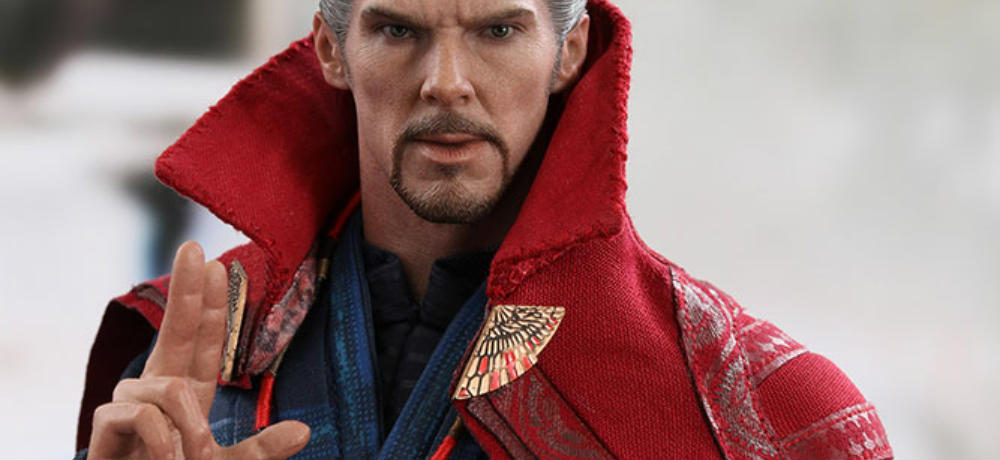
And how bad were these characters? I have no sense of Thanos’s motivations, or any emotional engagement with his drive to get the infinity stones and destroy half the universe, which is terrible because a fundamental requirement of these kinds of movies is that you be on board with the bad guy’s plans. I felt more in common with the Alien queen in Aliens than I did with this boring dude and his gold fist. Spacedouche, obviously, is a waste of my effort and a completely awful character. Iron Man long since lost his shine and, like late-vintage Elon Musk, has become just a rich entitled white dude with bad ideas. Dr. Strange is a condescending prat who should have stuck with his original career as a detective. Insipid Witchgirl is weak and boring, and I have no idea why she is in love with Useless Robot (Phase? Nobody introduces themselves), who seems to have no purpose in this movie except spare parts. Black Panther might as well also be a robot for all the energy in his performance, and who was that Steve Rogers guy and why is he so useless? I think I was supposed to feel some emotion other than relief when Spiderman died but why would I, when his sole role in this movie is to act as a ham-fisted tool for breaking the fourth wall (and why are we breaking the fourth wall in a supposedly serious movie?) What is Black Widow’s purpose, and what is wrong with this world that Scarlet Johanson can be paid millions of bucks to turn up, say three lines, and then sit in a chair while her stunt double does 90% of her moves[1]? I think there was a guy who flew a thing and blew stuff up, but I don’t know his name and I don’t even remember if he died. Bruce Banner has now thoroughly ruined the Hulk, turning him from a metaphor for adolescent angst into a metaphor for middle aged male sexual dysfunction. Groot – now Groot is an example of how to really terribly mistreat a great character. In the original Space Daddy Issues movie he was a fun and interesting character, but baby Groot in Daddy Issues 2 was just a waste of space and this teenage Groot is such a depressingly bad form of comedy relief that it makes me want to go back in time and destroy the original movie.
A further mark of how bad this movie is is that it introduced time travel. It is a universal truth that a movie with incidental time travel is a bad movie, and that only two movies in the history of cinema have done time travel well: Terminator and Back to the Future. As soon as you casually insert time travel into a movie you ruin it. This was easily avoidable in this story simply by replacing the time stone with some other noun (the shit stone? the mcguffin stone? It doesn’t matter, because there is no sense in which anything Thanos does with his golden fist corresponds in any way to the supposed functions of the stones embedded in the fist). But no, the directors had to go there because there is no stupid thing that cannot be loaded into a modern American action movie. Of course, in keeping with this principle there were a bunch of other incredibly bad decisions that completely undermined the good guys’ efforts and made all their failures both predictable and frustrating:
Spacedouche’s decision to punch Thanos in the face while he was sleeping, just as his friends were about to pull the glove off and save the universe, and indeed his decision to stand there arguing with sleeping Thanos and making everything in the universe all about him instead of helping his friends remove the glove and then punch the stupid blue dude when he was actually vulnerable
Dr Strange’s decision to go with stupid Iron Man’s stupid plan to confront Thanos while holding the very thing Thanos wants, and then to give up that thing even though he asserted very strongly earlier in the movie that he would let Iron Man die rather than hand it over (we all know why he did this – see below).
Dr Strange’s decision to scan all possible futures for the wisdom of his actions after going to confront Thanos instead of before
The decision by the idiots at Wakanda to spend precious time and lives defending Wakanda against invading alien hordes so that Little Sister can extract the stone from Useless Robot’s head without killing him, thus ensuring Insipid Witchgirl doesn’t cry, even though ultimately Insipid Witchgirl has to kill Useless Robot anyway, but does it in front of Thanos so that he knows where the stone is[2] and can go back in time and stop her destroying it (but Useless Robot still dies at least)
The dumb-arsed series of historical decisions which led the super people of Wakanda with their super-powered Bullshitanium super mineral and hyper high-tech social order to develop an army that fights with spears, has no air support, no artillery, and no projectile weapons of note, and also lacks the strategic sense to stay on the high ground focusing the piss-weak projectile weapons they do have on a narrow breach in an otherwise almost impassable wall
Thanos randomly and incoherently spares people, like the entire crew of Spacedouche’s ship (who subsequently go on to try and remove his glove, almost successfully) and Iron Man, who is going to kill him in the next movie
It’s become a pretty much constant aspect of modern American movies that the main characters make bad decisions based on emotion rather than heart, and then at the end have to save the day by sheer grit and determination in the face of the avalanche of consequences their hot-headed decisions unleashed[3]. But it doesn’t have to be like this. Often these stupid decisions simply lead to long unnecessary extra scenes to undo the damage, and plot complications that make the movie less believable than it would otherwise have been, and frustrating. I have got to the point with movies like this and Star Wars that I am basically just hate-watching them: I watch them to see how terrible they are and to get angry at my cultural overlords, more than to enjoy the actual content of the movie. In truth this is why I skipped most of the Marvel movies leading up to this one, and only watched this one because I was on a plane[4].
I also previously avoided this movie because there is one crucial scene, where Dr. Strange hands over the time stone to prevent Iron Man being killed, which basically tells us that Iron Man is crucial to the one possible future in which Thanos is defeated. This means that the rich entitled white guy is going to be the person who saves the universe. Who could have guessed!? That amongst a cast of thousands of super heroes, all the non-white and non-human characters die “randomly” after Thanos gets the final stone, leaving white Iron Man, white Spacedouche, and white Black Widow[5] to save the universe, with rich white Iron Man as the central hero. I can’t wait to see this unusual and novel ending to a movie! It’s highly unlikely I’ll watch the next one, unless it’s playing on a plane in a typhoon, so it seemed like a waste of my time to watch this one too. Perhaps one day someone can remake these movies without all the stupid decisions and white entitlement, and then they might be actually enjoyable. But probably not.
There is one more aspect of this movie which I found amusing, though. It seems to me that there is a metaphor in this movie for the 2016 presidential election, with Thanos as Trump and the six stones as the swing states that he had to pick up to win the electoral college. Everything our heroes throw at him doesn’t stick or slides off, and while some of his buddies are sacrificed on the path to victory, he is ultimately unscathed, and seems to be protected by this strange otherworldly power that enables him to change reality to suit his whims and battle off any enemies. In this metaphor the glove is Russian interference, and the central scene is the moment where the intelligence agencies are trying to reveal the truth to the electorate – this is Spacedouche’s friends trying to pull the glove off – but instead of helping to reveal the horrible truth and fatally weaken him, the mainstream media (represented aptly in this metaphor by Spacedouche) is distracted by Hilary’s emails – a distraction put there by Trump himself – and the moment is lost in their fury. Thanos wakes up and shakes off the people trying to drag off the source of his power over reality, and he goes on to get everything he needs for ultimate victory. It’s up to you to decide whether the half of the universe destroyed by this are a metaphor for women, the Democratic electorate, or most of the rest of the planet. I guess we’ll find out in a year or so.
It’s a nice metaphor, but I have to ask the directors – why did you make us sit through your pain? Couldn’t you have made some other movie, in which the evil arsehole isn’t an invulnerable bully who rampages through the world taking whatever he wants until he gets ultimate power, and the people ranged against him were annoying, powerless losers who consistently make bad decisions? Because I’m not interested in workshopping your pain, and what the world needs now is more superheroes, not more shit superhero movies.
My review of Mad Max: Fury Road, as an exemplar of eco-feminist violence
My review of Dunkirk, as a story set in the in-between
fn1: Sorry in advance if this is a slur on Johanson and she actually does all her own stunts. Even if she did, though, she still was almost not present in this movie.
fn2: This is the best gloss I can put on the insertion of time travel into this movie. Otherwise, why doesn’t Thanos just go back in time to the beginning of the universe and hoover up all the remaining stones as they come out of the big bang? This is why this movie is a railroad – you know Thanos is going to get what he wants, you just have to watch everyone suffer and die until he does.
fn3: See also, Battle of the Bastards
fn4: Did I mention that? I didn’t watch this movie by choice, but because I was flying past a typhoon and couldn’t work on my computer for fear it would fly up into the ceiling of the plane during turbulence
[Our Degenesis campaign has had two sessions but I skipped a write up of one, so here I give a brief overview of the events of the last two sessions. We are heading into the campaign In Thy Blood…]
In session 3 the PCs had raided an underground bunker and recovered a transceiver of some value and helped a lost man called Stanko. After leaving the bunker they stumbled onto a large squad of apocalyptics, who were camped in the wilderness and who Stanko told them were the group that he had been scouting for when his team was killed by monsters in the bunker. Approaching the apocalyptic camp they saw that it was surrounded by cockroaches (a kind of degenerate human clan), and likely to be ambushed that night. Stanko, eager to be paid for his work, went into the camp and tried to negotiate for his money. This didn’t work out for him, so the PCs decided to wait until nightfall when the cockroaches attacked the camp, and rescue Stanko and steal the apocalyptics’ stuff during the confusion. The ambush came and all hell broke loose, and during the battle they were able to steal an apocalyptic motorbike, free Stanko, and get away from the camp without being pursued.
They took the bike and the transceiver to the town of Gesseln, where they sold them for a lot of draughts. While they were relaxing in the town they discovered they were being followed by a Chronicler, who they ambushed in a tavern. After a brief and very nasty battle they managed to capture him and beat him until he talked, and discovered that he had been spying on them for the same shadowy people who had sent the apocalyptics to the bunker. This bothered them, because they had been sent to the bunker by Chroniclers, and if a Chronicler had also sent the apocalyptics then it appeared there were factions in the Chroniclers who were trying to cause them trouble, or at least were happy for them to get into a lot of trouble as part of some internecine Chronicler squabble. Everyone knows that the less one gets entangled in Chronicler business the better, so the PCs decided to leave Gesseln and get out of the area. They returned to Tumbler, where their adventures had started, with the intention of perhaps heading somewhere further west and south to get far away from whatever trouble the Chroniclers intended for them.
Here too though they had been misused by the local Chroniclers, and they were none too happy staying here long. Karl Franz, their dour Spitalian, left on Spitalian business, and was replaced by a more junior Spitalian called Montaigne, a familancer rather than an epigeneticist. While the characters were wasting time in Tumbler they discovered that there was an African apocalyptic in the town, apparently lost and looking for a way home. Sylvan, the party’s apocalyptic, went to visit her in her tavern and was given a speech about how she saw him in her dreams. Sylvan is very confident that he is in every woman’s dreams, but this woman seemed strangely unaffected by his usual kant, and suggested they visit an old apocalyptic seer in town who would throw the cards for them. Foolishly Sylvan did this, and they visited the old woman. She told him that for some weeks now she was always drawing the same cards no matter what, and saw him and the African apocalyptic in her dreams. She drew the cards for them, and it was the same pattern: The abomination over the Creator, Hellfire, the Fields of Elysium, and the Bearer of the Broken Cross. She warned them that trouble was coming, and she saw them both standing on the shores of Africa, fighting off hellfire. They must head to the fields of elysium to meet their fate.
Apocalyptics cannot resist the pull of the tarot. Esmeralda the African apocalyptic joined their party and, for lack of anything better to do, they decided to head to Lucatore, a town on the far side of the Alps where Elysium oils are made by the anabaptists. They would find their fate there, and then help Esmeralda to return to Africa through the peninsula. This mission suited Ronan the Hellvetican, since it would take them under the mountains where he grew up; and it suited Tesla since it was her goal to travel to the Island of Bedain, wherein lay some scrapper heaven of oil and broken things. So it was that they set off.
The journey was long but easy, since they traveled on large roads and Sylvan brought a catamite that he procured in a refugee camp, to carry some of their load and ease his sore muscles at night. This boy, Teal, trudged along with them in the dust, patiently carrying their extra gear and doling out attention where it was needed. Such is the way of apocalyptics. They passed through Justitian and Cathedral City, then south to the Alps, where they crossed through the Hellvetican tunnels under Ronan’s warrant, escorting a trade caravan through to lower the cost of passage. On the far side they accompanied the caravan as far as Tirano. They rested here, on the border of Purgare and Borca, and gathered news about the road ahead. Unsure of what they were looking for, knowing only that Sylvan and Esmeralda’s fate had been sealed somewhere here, they feasted on rumour and got drunk on tall tales. One tale told of strange things happening in the swamp to the south of the Lucatore road, so they decided to investigate. They headed south into the swamp, coming to a small camp of peat-digging clansmen after a day’s travel. They hired three to accompany them as guides, and went further south to a thing called the “Old Image Wall,” a huge piece of wall that was said to have once held moving images. The peat-diggers told them a Chronicler had come here with a generator, turned on the wall, and recorded the images that appeared, then left, but they could do nothing to make it work. They headed south for another day and found a smaller peat-digging camp, where they heard that strange things were happening further south, where the land became thick with insects and strange smells. The peat diggers refused to venture there, but they went ahead to investigate. They found signs of a psychonaut of some kind, decided it was too much danger to interfere with and too far from civilization to matter, and returned to the peat-diggers. Unfortunately a gang of Romano clanners had found their peat-diggers, and were in the process of torturing them to find out where the PCs had gone when the PCs returned and stumbled on them in the camp. There was a short, brutal battle in which the Hellvetican wasted 4 bullets and the apocalyptic did nothing, and then the clanners were dead and the peat-diggers rescued. The whole group returned to the Lucatore road, exhausted and disappointed, and they headed further east towards Lucatore.
Elysium is here
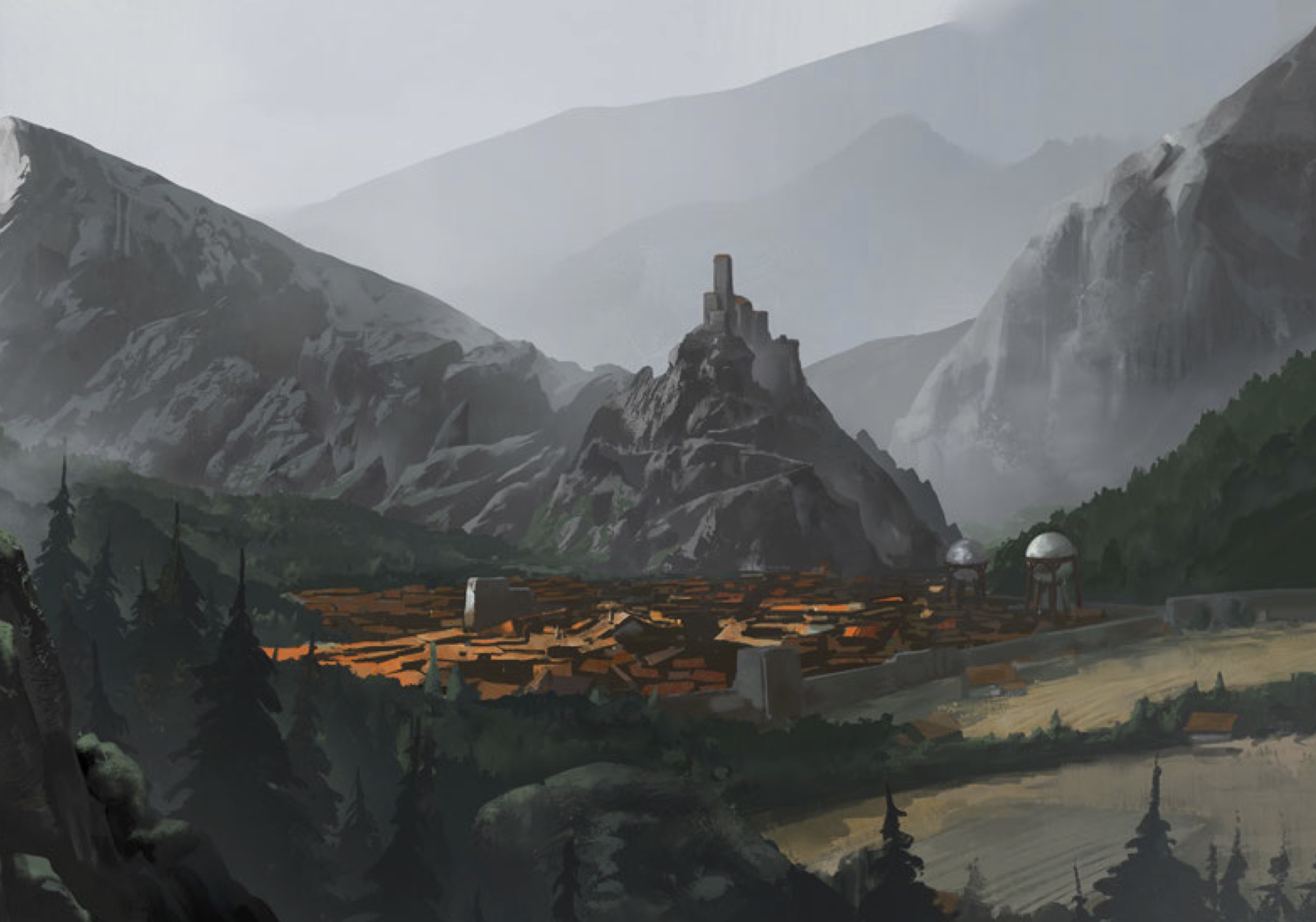
Lucatore is a small town in the east of Purgare, famous for its strong walls and the water towers that hold pure water. With this pure water the anabaptists of the town make huge quantities of Elysium oil, which is an incredibly valuable and powerful substance carefully controlled by the anabaptists. It is also the home of one of the Baptists, and a redoubt of their strange and strict faith. When the PCs arrived the town was full and busy, and they initially found accommodation in a small and rundown tavern. Unfortunately some priests arrived, Flayers, who needed accommodation, so the PCs were moved to the Commission House outside of town, a much more comfortable place to stay. They bedded down for their first comfortable night, and slept soundly in a real bed for the first time in weeks.
In the morning they were woken by a horn, and cries and yells from a gathering crowd. When they opened the windows of their Commission House they could see a commotion in the distant town. Sylvan went down to disturb the Commission House maidservant, Dana, and found her in a fuss in the kitchens, wringing her skirts and agitated with worry. When he asked her what was wrong, she answered him with a single simple sentence.
So watch the old world melt away
A loss regrets could never mend
You never miss it till it’s gone
So say goodbye, say goodbye
We’ll tell our children’s children why
We grew so tall and reached so high
You never miss it till it’s gone
So say goodbye, say goodbye
To seasons end
It was the morning of the winter solstice in neolithic England. The PCs stood next to the Chieftain of the People, near the Stonehenge Heel Stone. Ahead of them lay the stones, the gap in the tallest glowing with the faintest hint of dawn’s first light. The high priest stood in front of the Chieftain, facing the stones and composing himself ahead of the festival. Nearby one of his acolytes squatted in the snow, holding a clay bowl heavy with a slop of fresh pig’s blood and earth. Behind them the People stretched out along the avenue, clustered together against the dawn wind but still thronging the avenue in their numbers, the crowd stretching down the hill into the pre-dawn gloom. Here on the slope of Stonehenge the wind had a biting chill, whipping the thin, crisp coating of new snow into a fine mist that somehow managed to creep through even the tightest-clutched clothing. Knuckles turned blue in the chill wind, noses dripped and froze, but everyone bore the chill stoically, for this was the most important ceremony of the year, winter solstice, when the world turned for another year. Everyone wore their finest clothes, the browns and greys of their best quality furs forming a grim smear across the otherwise pristine white of the surrounding hillside. Many were painted in wode and wearing their best seashells and feathers.
To fit the occasion, the characters had come in their military finery, as befitted guests of the chieftain being honoured for their heroic deeds, though perhaps one of them had brought all his most potent charms for baser, more paranoid reasons. They were three:
The Dark Ram, a grim old man from an obscure cult that specialized in darkness, stone, fear and cold; once great in his youth, he was now an old man hunched inside tattered robes, leaning on a black staff topped with the horned skull of a great goat
Wolfson, a berserker from the cult of blood, standing firm and proud in his hide armour, fine stone axe held proudly in his strong right arm, the antithesis of the Old Ram, youth and beauty and pure violence against the old man’s frailty and grim blood worship
Fast Current, a naive acolyte of the cult of the forests, shivering in the chill wind, not yet used to the privations of religious life, eager to be a part of the most important rite of the year
The Chieftain stood, as always, nervous and uncertain, his weak jaw receding into flabby chins, smelling of pig fat and sour mead. They all knew of the rumours and discontent – indeed, Dark Ram had suggested they decline the invitation to avoid being seen to be allies of this fading man, who was once a hero but now a maligned administrator, but no one could look at Fast Current’s eager religious fervour and not allow him to this one special moment in dawn’s fierce glow. Now Fast Current did not notice as the Chieftain stood, impatiently waiting for the whole thing to be over, probably already scheming about what to do with the various factions aligned against him as he stood in the bitter chill of the coldest day of his 57th year, standing silently witness to his 31st winter solstice as chieftain. Tired. Looking for something, anything, to firm up his weakening grip on the People he had spent his life serving.
The time came. The Chieftain raised his arms. The High Priest stepped past the characters and raised his robed arms towards the people, tried to catch that moment when they all breathed out in unison, that was always snatched away by the Henge’s brutal winds. He turned back, began the recitations of the Necessary Invocations, walked his away around the Small Circle and the Lines. The crowd watched in anticipation as his acolyte scampered forward, he took the bowl of blood and soil and theatrically poured it into the ditch of the Henge (Being careful not to let the wind spill any onto his robes). As he did this his priests, standing at carefully spaced locations along the avenue, began the Chant of the New Life, and an astromancer walked slowly down the line of the people, singing old songs about the stars and the rhythm of the seasons. At regular junctures the priests turned to cast fresh pig fat onto the fires burning in the ditches each side of the avenue, ensuring that the People were bathed in the cleansing light of the fires.
Calling forth the New Sun always takes time. The High Priest continued his chanting and his movements in the Circle, as the priests led the chant for the People, and from the hillside a slow sussuration of poetry reached them over the hiss of the wind. In truth the High Priest mumbled, and it was hard for the PCs to follow his words from their lofty position on the hillside away from the clear spoken priests, but they struggled along as best they could. The Chieftain, well-versed by now in all these processes, muttered the words of the prayers to himself and cast his gaze impatiently to the horizon, waiting for the sun to break over the hillside so that he could send the People home and return to his scheming. Everyone’s attitude was divided between the clarion call of the new year’s rituals, and the bitter cold of the hillside. In such strange interstices is the fate of the new year held.
The Priest began to raise his voice, casting some powders onto the wind from his sleeves. He stepped back past the PCs to face the crowd, raising his voice as the Priest’s voices raised to a crescendo, then turned back to the Heel Stone, arms raised wide, the sleeves of his robe slipping back to reveal the tattoos and leathers embracing his skinny old arms, and raising his voice to a loud, powerful call, yelled “Rise, oh sun!” The crowd drew in their breath as one, a brief sharp sound that carried over the whispering of the wind. Everyone faced the stones.
The sun did not rise.
Still, sometimes the Priest’s call could be a little early, and in any case this ritual was powerful. They waited.
The sun did not rise.
They waited some more. Their call had to proceed into the earth, after all, deep into the realms beneath the ground past the silent halls where the dead slept, to the place where the sun slumbered, and raise it up to the sky. Perhaps sometimes it takes time to drag the sun forth (is the sun a man or a woman? Has it a gender? Opinions were divided, but if it did have a gender it might be a stubborn old man, or a wilfull young woman. They could wait).
The sun did not rise.
The land remained bathed in the shadow of pre-dawn. The wind continued to blow, chill and harsh, not softened at all by the knowledge that the new year’s light shone on them. Over the hills and far away was a faint glow, but the sun did not rise. It was cold.
People began to mutter. The sun had not risen. Everyone knew the stories. Recently their crops had been failing, and bad things happening. Some said that the Chieftain’s decision to move the bluestones was the reason – had he cursed the sun itself? Somewhere in the crowd, someone said something. Laughter ripped up the line. That old story! But the laughter stilled quickly, because this was serious. If the sun did not rise … people began to mutter more darkly.
The Chieftain was not stupid, he had not presided over 31 winter solstices because he could not read the mood of his People. “Priest,” he grunted, perhaps more disrespectfully than was appropriate for such a ceremony. “Have you messed up the timing? Are your astromancers drunk again?”
The High Priest apologized to the Chieftain, and stepped back to face the crowd. “It is a cold year, and the sun sleeps deep!” He called in his clearest priest’s voice, the voice that had won him power those years ago when his rivals tried to argue with the people on matters of theology, but he called out to them in pure tones of eager rhetoric. “We must call it together, as one!”
The priests obeyed, raising their voices in the Call, and the High Priest led the people on another round of chanting. Now he had one eye over the shoulder at the horizon, waiting for the moment to raise the call. The chant stretched out, and finally he turned, arms raised, and yelled “Rise, oh sun!”
The sun did not rise.
The Dark Ram spat. He could feel trouble brewing in the bones of the earth. The High Priest looked at the Chieftain, uncertain and pleading. Twenty one years ago the last High Priest had gone against the Chieftain on a matter where religion intersected with popular opinion, and a week later he had been found dead in a gully, apparently crushed under an Aurochs. Everyone knew that the Chieftain had not always been weak. He had not always been desperate either. Wolfson looked around at the crowd, readying himself to fight, and also to decide on which side to fight. Fates seemed, briefly, to hang in the balance.
Below them on the avenue the muttering rose again. Someone called out something at the back of the crowd, people snickered – it was the sound of agreement, not amusement. The light was still dim, but in the ruddy glow of the fires the priests’ uncertainty was obvious. The Dark Ram stepped closer to Wolfson and muttered, “Ready yourself.” He cast a warning glance back to Fast Current, who stood confused in the cold wind, not understanding the flows of religious and popular discontent.
The Chieftain hrmphed gently to himself, the sound of a bitter man making a hard decision. He stepped through the characters to face the crowd, stopping briefly when he was level with their ruddy, wind-blasted faces to whisper to them, “You will follow my lead or your end will be bitter,” and then presented himself to the crowd, arms raised, a sudden picture of confidence.
“Oh People!”, he called out to them, his voice suddenly taking on all the clarion tones of his youth. Suddenly their chieftain was not a weak and fading old man, but had called back the power that had led him to this position at such a young age, and helped him maintain it through many challenges. “We face a mighty test! The sun has not risen! Our priests have done their all, but it has not risen!” At this he cast a grim look back at the High Priest, that spoke of angry meetings yet to be held in quiet groves. “I feared that this would arise, because dark forces work against us.” He paused, to watch the crowd muttering to themselves. Dark forces? What dark forces? Did the Chief know something? “But do not fear, my People, because your fate rests safe with me! I assembled these heroes here against this possibility!” His arm swept around to take in the PCs, and the crowd roared their approval. “Whoever has stolen the sun from us, whatever chains hold her fast in the underworld, they will find her, and bring her back!” Thus it was that with a casual sentence the Chieftain answered the religious debate of the age – the sun was a woman! And also sent the characters to their doom. Hearing his confident young voice come back to him, the crowd roared their approval. “They will set out immediately to find the sun, and to bring vengeance upon whoever dared to interfere with her. Have faith in the heroes of our People, my friends! But now, return to your homes and the warmth. Trust in me, your Chief!”
The crowd roared their approval. The chieftain turned to frown at the characters, and after a nudge from the Dark Ram both Wolfson and Fast Current raised their arms to wave at the crowd. At the urging of the priests it began to disperse, and the Chieftain stepped in close to them. “My hut shortly,” he ordered them tersely. Turning to the High Priest, he snarled, “You two, for what it’s worth!” and marched off.
The Wild Women
They trudged back to the Chief’s hut, which was really not much bigger than anyone else’s, and furnished with the same simple bedding of birch branches and hay, though a little colder on account of its size. The Chieftain sat on his pallet, frowning at the High Priest and sucking down an early mead. He grunted his approval when the characters entered.
“Trouble,” he snapped at them. “We need to fix it, or we’re dead.” He frowned over at the High Priest. “No one knows what’s happening. You have to fix it.”
They stood helpless, unable to refuse or suggest any ideas. Finally the Dark Ram coughed and stepped forward. “Do you have any suggestions about what we should do?”
The Chieftain spat. “You’re the ancient wizard. Fix it!” He looked over at his High Priest. “What about you?! Any ideas?”
The High Priest shuffled his feet. “Well actually … they could try the Wild Women.”
Wolfson and Fast Current shuddered, in time with the Chief. The Dark Ram shrugged. “That is a desperate play. Are you really out of answers?” The Dark Ram was good at hiding his fear.
“There is nothing in the stories of our people to explain this. It is otherworldly. The Wild Women stand between the worlds. Perhaps they will know.” The High Priest looked strangely smug about his answer. Of course, rumour was that the Dark Ram had stolen his lover, back when they were both young and the Dark Ram was still a rutting goat. What better fate for him now, than to face the Wild Women?
The Dark Ram shrugged. “So be it. We will visit the Wild Women. We will save the People.” He turned his dark, blood-tired gaze back on the High Priest. “Our reward will be suitable to the task, I am sure.”
“Yes yes, I’m sure everything will be very fine for you if you just solve this problem,” the Chieftain interjected, hustling them towards the door to his hut. As he pulled the hangings aside and they marched out, he added, “Do not bother returning until you find the sun. You know your fate.”
They separated to their huts to gather traveling equipment, and regrouped a short while later in the snow at the edge of the village, shivering in the cold, and at the task to come. They had all heard rumours about the Wild Women, who live in a swamp near Avebury:
They are served by giants
They live in another realm and only come to this world to make mischief
To lay with one is to gain eternal life, but they only lay with women
They are beautiful
They are terrible crones
With these conflicting stories in their minds, they prepared to set off for the swamps of Avebury. Before they did, however, Fast Current bid them wait, while he performed a ritual in the forest. They returned to their huts as Fast Current called on the spirits of the trees, drawing forth their knowledge about the land. After some hours of constant chanting a vision came to him, of red-headed children fleeing into the swamp to escape strange snakes made of shadow. Dark things stirred in the land to their north!
They set off into the grey pre-dawn afternoon, marching north first through a patchwork of forest and small communities, dotted with fields and little wattle-and-daub huts, until the land slowly gave way to the full, thick forest that ruled the land beyond the communities. A narrow path cut through the forest, beaten down by generations of the People walking the path from Stonehenge to Avebury, and said to be safe but for the odd bear. The huge trees of the ancient forest loomed over the path, casting it into near darkness in the dawn light. They picked their way carefully along the path, vigilant against the strange horrors Fast Current had seen in the dreamings of the tree-spirits, but emerged safely after a few hours onto a sweeping vista of swamp and open hills, the heaths and swamps to the west of Avebury. The distant hills hung like low clouds on the horizon, barely visible in the dawn glow. Below them the swamp stretched to the east and north, a grim smear across the landscape. Mostly it was tall reeds and strange, stunted trees, shrouded in a dark and unwelcoming mist, but at some points ancient trees rose above the murk, vine-festooned branches reaching out to the sky as if they were trying to claw their way out of a stagnant pond.
They walked down the hill towards the swamp. Near its edge they found a small hamlet, just a collection of a dozen or so mud huts, and bargained with a farmer to take one of the town’s least popular members as a possible sacrifice to the Wild Women. The townsfolk let her go easily enough, a flame-haired beauty who they said was no good at farming and always fussed over mud and guts, better suited to sacrifice or religious observance than the hard life of the fens, and they took her with them into the swamp.
They guessed that the best way to find the Wild Women was to walk to the centre of the swamp, and they were not mistaken. After a few hours, as they rested on a tree stump by a foul-smelling stretch of ice-coated water, they suddenly found themselves being watched by a girl-child. This wild scrap of innocence squatted on the twisted bough of a tree some distance from them, ragged furs hanging loose on a bony frame, tearing chunks of meat off of the fresh, twitching corpse of a rabbit with disturbingly sharp teeth. She stared at them with huge, unblinking violet eyes. After a moment, sure she had their attention, she tore the rabbit in half, letting its steaming guts fall to the ground at the foot of the tree, and bounded off into the shadows. Grunting and sighing, they heaved themselves to their feet and marched after her.
She led them a merry chase for an hour, making sure they were thoroughly lost and covered in vile swamp-mud by the time they arrived at a huge, imposing burial mound. This mound was far bigger than those around Avebury or Stonehenge, and by its look far older, perhaps built back when Stonehenge was new. A huge, dead tree grew from the grassy top of the mound, and thick stands of spiny bushes surrounded it. They pushed through and into a dark entry chamber, where suddenly the girl disappeared. Ahead of them in the main chamber of the mound they could see a faint glow; in the side chambers they saw fresh bodies, old bones, and heard the disturbing smacking sounds of something sucking the marrow from bones. They hastened forward, into a huge and shadowed cave, that was obviously much larger than the mound could possibly have allowed. It stank of mud and death, but it was so large that they could not see what horrors might be hanging from its far walls. A shaft of sunlight fell from a huge crack in the ceiling, incongruous given the fractured seasons outside, and lit a strange cascade of thin, semi-transparent discs that hung from the ceiling on inconceivably thin, shiny strands of leather, as if someone in here could spin quartz into thread. On one side of the chamber, near a small fire, lay the broken body of a young man, its guts spilled into a puddle of water, a crow watching them forbiddingly from atop the corpse’s blood-smeared back. Opposite them, on the far side of the chamber, wreathed in shadow, sat an adult woman in a thin robe, lounging on a large stone dais. Something huge moved in the shadows behind them, something they could not quite make out, though occasionally they caught a glimpse of a massive fingernail or an ear or a gleaming yellow eye far above them in the shadows.
The woman held her arms wide in a gesture of welcome. “You seek us, you found us. Explain your needs.” She dragged out the word ‘needs’ in a manner both thrilling and threatening. Fast Current and Wolfson hesitated, but the Dark Ram was in his element. He stepped forward, staff held high, dragging the sacrifice-girl forward by one hand, and pushed her to her knees on the rough floor of the cave.
“We bring a sacrifice. We wish to trade for information.”
The woman shrugged dismissively and ignored the girl, who was doing an admirable job of restraining her terror. For someone fussy about mud and guts, she had surely already seen a lifetime’s worth in morning. She sat still and ready to die as the Dark Ram explained their dire situation, and tried to negotiate the terms by which they could get the information they needed.
It did not take long to settle terms. As soon as the sun rose again, the entire group would come to this mound and serve the Wild Women for a year. In return the woman told them what they needed to know: that there was something wrong at Silbury Hill, and they must go there to find the solution to the world’s problems.
They agreed to the price, and left for Silbury Hill.
The hill
Silbury Hill
To the east the swamp slowly rose and merged into forest, but before they could reach dry land they were ambushed. Emerging from a stand of reeds into a wide, shallow frozen pool they were suddenly attacked by three thick, black snakes that came sliding out of the reeds around the pond. Each was wider than a human leg and longer than a person, and as they slid through the reeds the plants nearest to them seemed to wilt away from them. These snakes emerged from the shadows in a rush, opening wide, toothed mouths and glaring balefully from eyes that were red like fire. Even as they attacked, the characters could tell something else was coming from the reeds, and as battle was joined that thing leapt out into the pool with a mighty huff! It smashed onto the ice and reared up to attack them, a giant dog-like creature with scales like a dragon, and the same fiery red eyes. It’s first act was to spit a massive gob of acid onto Wolfson, and then the battle was joined.
They prevailed, but Wolfson was injured and they were all exhausted and feeling physically sick. Even as they stood in the ruins of the battle, the frozen water of the pool seeping through their shoes, the corpses of the snakes began to melt and steam, fading rapidly away and leaving only a terrible stench. The dog-demon thing lay dead in the pool, decaying more slowly and horribly than its companions. They gathered themselves together and hurried out of the swamp. These were the things the trees had dreamt, and they guessed there must be more. Where had they come from?
Another long walk took them to Silbury Hill, which they approached in the traditional way, from the east. Here an earthwork causeway connected the hill to the land, bridging the ditch that held the hill apart from the land around. As they approached they could see a dim light atop the hill, as if a fire had been lit. They crossed the causeway and climbed the hill, emerging breathless to its windswept summit to find a scene of murder and ruin.
The light did come from a fire, which was still smouldering near the centre of the hilltop. A corpse lay in the fire, partly smothering it and partly feeding it, and two more lay brutalized on the ground near the fire. All three were young, two children and one barely an adult. They were emaciated and showed signs of having been abused for a long while, their bodies decorated with old and new bruises. They wore pathetic clothes, just rags against the cold, and the sores on their feet and faces suggested they had been in the cold weather for some time before they died. The one in the fire had been killed by having his throat cut, but the cut was a fine, clean slice, better than any stone knife could do, and the other two also showed signs of having been repeatedly cut and stabbed with something much sharper than humans could design. Some demon must have come here and killed them.
This, then, was the cause of all their problems. Silbury Hill formed a barrier between the underworld and the real, a kind of sinkhole that could only keep the underworld at bay if it was regularly maintained and prepared, and kept pure. No one should visit it, and anyone who did must observe the proper rituals. Nothing earthly could be done up here – no waste, no sex, no foul words, no birth and certainly no death. Death on Silbury Hill was only allowed in the form of sacrifice, the death of a pure child prepared properly for the ritual of sanctifying the barrier. The kind of profane death they had seen here must only cause pollution.
By killing these children, someone or something had broken the seal between the underworld and the real, stopped the sun in its tracks and unleashed the beasts of hell into the earth. The Dark Ram knew all this, and told them in a steady, cold voice. The damage could be undone, by giving these children a proper burial at Stonehenge where their souls could be recalled and rested, and then performing the proper rituals here to sanctify the place again. But there would be no point if whoever did this simply came back to do it again. They needed to find out why this had been done, and find the perpetrator, and destroy them. A ritual was required.
The Dark Ram prepared one of the bodies, setting it in the proper fashion and painting its cheeks with the correct tinctures. The girl provided the blood, just a smear of fresh blood from a cut on her arm, and then they fell back to wait as the Dark Ram called the body’s soul back from where it had fled, to draw on its memories.
He saw flashing images of horror and violence. A large boat pulling up on the shore and big men in dark armour smashing into a tiny collection of mud huts. A group of them dragged screaming away while the rest died in the river shallows, or in the shade of great oaks where they ran to hide. Fires burned. Then there was a boat, a storm, exhausting flash of water and crash of waves, then peace on the shore and the sound of woodworking. Then flight, a small group of them running into snow and darkness. Hiding on the hill, but found, attacked by the grim dark men, the taste of blood, then fire and death.
The children were escaped slaves, pursued here and murdered on the hill as punishment for their flight. Some were still abroad, running from their captors. But who would kill children on the hill, knowing the risk? They must find these slaves, and destroy them.
Giants among men
The slavers
They decided first to go to Avebury, which was nearby, and warn the people of Avebury of the danger in the woods around, as well as finding a group of warriors to remove the bodies and take them back to Stonehenge for a holy burial, but they did not reach the town. After just ten minutes on the path to the town they were ambushed by a squad of huge and terrifying warriors. There were four of them, and they gleamed. All four were much larger than the PCs, perhaps a whole head taller and much bulkier. They carried large bows that were much better made than those the group carried, and each had a knife of a strange glowing substance that was much harder and sharper than their own weapons. The leader had plates of the glowing stone-like stuff on his leather armour, and carried a larger knife that was as long as a man’s arm, and terrifyingly sharp. They hurled themselves into battle, yelling strange words in a language the characters did not understand, and the group prepared to sell themselves dearly against these great, beautiful, terrible men.
But the men had no magic. The Dark Ram called forth shadow magic to steal their health, and Fast Current entangled them in vines, and Wolfson went into a berserk rage, and the glowing men did nothing in return. No magic of any kind. Although they injured Wolfson and Fast Current, they could not win. One tried to run away but they managed to catch him and kill him, and then they followed his path over some hills to find a larger camp, with another 6 of the same men squatting around fires, cleaning their strange weapons. Everything these men carried was so much more beautiful and perfect than anything the heroes had ever seen – but they had no magic, so they did not see Fast Current watching them. The PCs sneaked away and continued to Avebury, where they raised a larger force. Within two hours the six big, shining men were dead, ambushed and surrounded and slaughtered by the people of Avebury. In the battle they all saw how the strange men’s amber-coloured swords cut perfectly through flesh, and realized that these must be the men who had killed the children on the hillside.
In the camp they found a single slave child tied up, beaten and cowed and dumped inside a tent – one of the children recaptured. Wolfson, they discovered, spoke the child’s language – he was Welsh, one of the hillfolk who live to the north of the wild seas beyond Avebury. He told them his story. The strange men had come to their village in a huge boat, raided and taken children captive, then returned to the sea. One of the men spoke a little Welsh, and told them that they would be sacrifices in a far land, where these men had come from, and where magic had slowly faded from the world. Desperate to bring the magic back, these people had begun making human sacrifices to the dark gods to try and appease them and stop the draining of their powers, but nothing worked, so they began to sacrifice more. When the sacrifices became too much burden on their own people they began traveling to nearby kingdoms to take slaves for sacrifice, and the easiest place, they said, was this island, because on this island everyone was primitive and stupid and could not defend themselves.
So they had been taken, and they would have gone to this far land to be killed in offering to the dark gods, except that a storm drove their ship ashore and damaged it, and while the men were repairing it half of the slaves escaped. When they came in sight of Silbury Hill their group split, with some heading into the forest to the west, some deciding to hide on the hill, and others scattering east. The slavers had caught the ones on the hill, then headed east and found this prisoner, and they were sending out scouting parties looking for more when the characters raided their camp. The attempt to recapture the slaves was thus broken, but perhaps 10 or 12 more of these men were camped to the north, by the sea.
Epilogue: Futures past
Wolfson put on the armour and carried the sword of the slaver leader when they attacked the slavers at the coast. In battle though, he realized that the armour made him sluggish, held back his frenzy, deadened his sense of the wild. He shrugged it off at last, threw away the sword, and in a killing frenzy beat his enemies to death with a stone he picked up from the beach. It was a bitter fight, the 30 or so fighters of the People up against the 12 slavers, but they won. Wolfson confided in the Dark Ram, and they threw all the cursed goods onto the boat, set it alight and pushed it into the reach. These men had powerful weapons and armour, some new technology that shaped stone to be harder than stone, and made them powerful and great, but somehow it had sucked out their magic. It wasn’t the gods of the underworld they needed to appease, but their own lust for progress.
The People stood on the shore watching the ship slip out to the reach, the fire slowly consuming it. They would stay as they were, and their magic would defend them against whatever strange new age encroached from over the water. They turned to face the newly rising sun, strong in their faith and their confidence in their astrologers, and set their faces to Stonehenge. Let the new era come – they were more than a match for it!
Note: this adventure was inspired by the desire to tell the story of the Welsh cremation remains recently uncovered in Stonehenge, as recounted here.
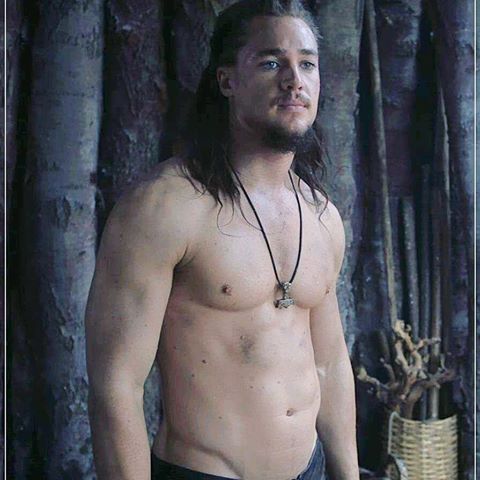
Uhtred son of Uhtred, regular ale drinker, who I predict will die of injury (but will go to Valhalla, unlike you you ale-sodden wretch)
There has been some fuss in the media recently about a new study showing no level of alcohol use is safe. It received a lot of media attention (for example here), reversed a generally held belief that moderate consumption of alcohol improves health (this is even enshrined in the Greek food pyramid, which has a separate category for wine and olive oil[1]), and led to angsty editorials about “what is to be done” about alcohol. Although there are definitely things that need to be done about alcohol, prohibition is an incredibly stupid and dangerous policy, and so are some of its less odious cousins, so before we go full Leroy Jenkins on alcohol policy it might be a good idea to ask if this study is really the bees knees, and does it really show what it says it does.
This study is a product of the Global Burden of Disease (GBD) project, at the Institute for Health Metrics and Evaluation (IHME). I’m intimately acquainted with this group because I made the mistake of getting involved with them a few years ago (I’m not now) so I saw how their sausage is made, and I learnt about a few of their key techniques. In fact I supervised a student who, to the best of my knowledge, remains the only person on earth (i.e. the only person in a population of 7 billion people, outside of two people at IHME) who was able to install a fundamental software package they use. So I think I know something about how this institution does its analyses. I think it’s safe to say that they aren’t all they’re cracked up to be, and I want to explain in this post how their paper is a disaster for public health.
The way that the IHME works in these papers is always pretty similar, and this paper is no exception. First they identify a set of diseases and health conditions related to their chosen risk (in this case the chosen risk is alcohol). Then they run through a bunch of previously published studies to identify the numerical magnitude of increased risk of these diseases associated with exposure to the risk. Then they estimate the level of exposure in every country on earth (this is a very difficult task which they use dodgy methods to complete). Then they calculate the number of deaths due to the conditions associated with this risk (this is also an incredibly difficult task to which they apply a set of poorly-accredited methods). Finally they use a method called comparative risk assessment (CRA) to calculate the proportion of deaths due to the exposure. CRA is in principle an excellent technique but there are certain aspects of their application of it that are particularly shonky, but which we probably don’t need to touch on here.
So in assessing this paper we need to consider three main issues: how they assess risk, how they assess exposure, and how they assess deaths. We will look at these three parts of their method and see that they are fundamentally flawed.
Problems with risk assessment
To assess the risk associated with alcohol consumption the IHME used a standard technique called meta-analysis. In essence a meta-analysis collects all the studies that relate an exposure (such as alcohol consumption) to an outcome (any health condition, but death is common), and then combines them to obtain a single final estimate of what the numerical risk is. Typically a meta-analysis will weight all the risks from all the studies according to the sample size of the study, so that for example a small study that finds banging your head on a wall reduces your risk of brain damage is given less weight in the meta-analysis than a very large study of banging your head on a wall. Meta-analysis isn’t easy for a lot of reasons to do with the practical details of studies (for example if two groups study banging your head on a wall do they use the same definition of brain damage and the same definition of banging?), but once you iron out all the issues it’s the only method we have for coming to comprehensive decisions about all the studies available. It’s important because the research literature on any issue typically includes a bunch of small shitty studies, and a few high quality studies, and we need to balance them all out when we assess the outcome. As an example, consider football and concussion. A good study would follow NFL players for several seasons, taking into account their position, the number of games they played, and the team they were in, and compare them against a concussion free sport like tennis, but matching them to players of similar age, race, socioeconomic background etc. Many studies might not do this – for example a study might take 20 NFL players who died of brain injuries and compare them with 40 non-NFL players who died of a heart attack. A good meta-analysis handles these issues of quality and combines multiple studies together to calculate a final estimate of risk.
The IHME study provides a meta-analysis of all the relationships between alcohol consumption and disease outcomes, described as follows[2]:
we performed a systematic review of literature published between January 1st, 1950 and Dec 31st 2016 using Pubmed and the GHDx. Studies were included if the following conditions were met. Studies were excluded if any of the following conditions were met:
1. The study did not report on the association between alcohol use and one of the included outcomes.
2. The study design was not either a cohort, case-control, or case-crossover.
3. The study did not report a relative measure of risk (either relative risk, risk ratio, odds-ratio, or hazard ratio) and did not report cases and non-cases among those exposed and un-exposed.
4. The study did not report dose-response amounts on alcohol use.
5. The study endpoint did not meet the case definition used in GBD 2016.
There are many, many problems with this description of the meta-analysis. First of all they seem not to have described the inclusion criteria (they say “Studies were included if the following conditions were met” but don’t say what those conditions were). But more importantly their conditions for exclusion are very weak. We do not, usually, include case-control and case-crossover studies in a meta-analysis because these studies are, frankly, terrible. The standard method for including a study in a meta-analysis is to assess it according to the Risk of Bias Tool and dump it if it is highly biased. For example, should we include a study that is not a randomized controlled trial? Should we include studies where subjects know their assignment? The meta-analysis community have developed a set of tools for deciding which studies to include, and the IHME crew haven’t used them.
This got me thinking that perhaps the IHME crew have been, shall we say, a little sloppy in how they include studies, so I had a bit of a look. On page 53-55 of the appendix they report the results of their meta-analysis of the relationship between atrial fibrillation and alcohol consumption, and the results are telling. They found 9 studies to include in their meta-analysis but there are many problems with these studies. One (Cohen 1988) is a cross-sectional study and should not be included, according to the IHME’s own exclusion criteria. 6 of the remaining studies assess fribillation only, while 2 assess fibrillation and fibrial flutter, a pre-cursor of fibrillation. However most tellingly, all of these studies find no relationship between alcohol consumption and fibrillation at almost all levels of consumption, but their chart on page 54 shows that their meta-analysis found an almost exponential relationship between alcohol consumption and fibrillation. This finding is simply impossible given the observed studies. All 9 studies found no relationship between moderate alcohol consumption and fibrillation, and several found no relationship even for extreme levels of consumption, but somehow the IHME found a clear relationship. How is this possible?
Problems with exposure assessment
This problem happened because they applied a tool called DISMOD to the data to estimate the relationship between alcohol exposure and fibrillation. DISMOD is an interesting tool but it has many flaws. Its main benefit is that it enables the user to incorporate exposures that have many different categories of exposure definition that don’t match, and turn them into a single risk curve. So for example if one study group has recorded the relative risk of death for 2-5 drinks, and another group has recorded the risk for 1-12 drinks, DISMOD offers a method to turn this into a single curve that will represent the risk relationship per additional drink. This is nice, and it produces the curve on page 54 (and all the subsequent curves). It’s also bullshit. I have worked with DISMOD and it has many, many problems. It is incomprehensible to everyone except the two guys who programmed it, who are nice guys but can’t give decent support or explanations of what it does. It has a very strange response distribution and doesn’t appear to apply other distributions well, and it has some really kooky Bayesian applications built in. It is also completely inscrutable to 99.99% of people who use it, including the people at IHME. It should not be used until it is peer reviewed and exposed to a proper independent assessment. It is application of DISMOD to data that obviously shows no relationship between alcohol consumption and fibrillation that led to the bullshit curve on page 54 of the appendix, that does not have any relationship to the observed data in the collected studies.
This also applies to the assessment of exposure to alcohol. The study used DISMOD to calculate each country’s level of individual alcohol consumption, which means that the same dodgy technique was applied to national alcohol consumption data. But let’s not get hung up on DISMOD. What data were they using? The maps in the Lancet paper show estimates of risk for every African and south east Asian country, which suggests that they have data on these countries, but do you think they do? Do you think Niger has accurate estimates of alcohol consumption in its borders? No, it doesn’t. A few countries in Africa do and the IHME crew used some spatial smoothing techniques (never clearly explained) to estimate the consumption rates in other countries. This is a massive dodge that the IHME apply, which they call “borrowing strength.” At its most egregious this is close to simply inventing data – in an earlier paper (perhaps in 2012) they were able to estimate rates of depression and depression-related conditions for 183 (I think) countries using data from 97 countries. No prizes to you, my astute reader, if you guess that all the missing data was in Africa. The same applies to the risk exposure estimates in this paper – they’re a complete fiction. Sure for the UK and Australia, where alcohol is basically a controlled drug, they are super accurate. But in the rest of the world, not so much.
Problems with mortality assessment
The IHME has a particularly nasty and tricky method for calculating the burden of disease, based around a thing called the year of life lost (YLL). Basically instead of measuring deaths they measure the years of your life that you lost when you died, compared to an objective global standard of life you could achieve. Basically they get the age you died, subtract it from the life expectancy of an Icelandic or Japanese woman, and that’s the number of YLLs you suffered. Add that up for every death and you have your burden of disease. It’s a nice idea except that there are two huge problems:
It weights death at young ages massively
They never incorporate uncertainty in the ideal life expectancy of an Icelandic or Japanese woman
There is an additional problem in the assessment of mortality, which the IHME crew always gloss over, which is called “garbage code redistribution.” Basically, about 30% of every country’s death records are bullshit, and don’t correspond with any meaningful cause of death. The IHME has a complicated, proprietary system that they cannot and will not explain that redistributes these garbage codes into other meaningful categories. What they should do is treat these redistributed deaths as a source of error (e.g. we have 100,000 deaths due to cancer and 5,000 redistributed deaths, so we actually have 102500 plus/minus 2500 deaths), but they don’t, they just add them on. So when they calculate burden of disease they use the following four steps:
Calculate the raw number of deaths, with an estimate of error
Reassign dodgy deaths in an arbitrary way, without counting these deaths as any form of uncertainty
Estimate an ideal life expectancy without applying any measure of error or uncertainty to it
Calculate the years of life lost relative to this ideal life expectancy and add them up
So here there are three sources of uncertainty (deaths, redistribution, ideal life expectancy) and only one is counted; and then all these uncertain deaths are multiplied by the number of years lost relative to the ideal life expectancy.
The result is a dog’s breakfast of mortality estimates, that don’t come even close to representing the truth about the burden of disease in any country due to any condition.
Also, the IHME apply the same dodgy modeling methods to deaths (using a method that they (used to?) call CoDMoD) before they calculate YLLs, so there’s another form of arbitrary model decisions and error in their assessments.
Putting all these errors together
This means that the IHME process works like this:
An incredibly dodgy form of meta-analysis that includes dodgy studies and miscalculates levels of risk
Applied to a really shonky estimate of the level of exposure to alcohol, that uses a computer program no one understands applied to a substandard data set
Applied to a dodgy death model that doesn’t include a lot of measures of uncertainty, and is thus spuriously accurate
The result is that at every stage of the process the IHME is unreasonably confident about the quality of their estimates, produces excessive estimates of risk and inaccurate measures of exposure, and is too precise in its calculations of how many people died. This means that all their conclusions about the actual risk of alcohol, the level of exposure, and the magnitude of disease burden due to the conditions they describe cannot be trusted. As a result, neither can their estimates of the proportion of mortality due to alcohol.
Conclusion
There is still no evidence that moderate alcohol consumption is bad for you, and solid meta-analyses of available studies support the conclusion that moderate alcohol consumption is not harmful. This study should not be believed and although the IHME has good press contacts, you should ignore all the media on this. As a former insider in the GBD process I can also suggest that in future you ignore all work from the Global Burden of Disease project. They have a preferential publishing deal with the Lancet, which means they aren’t properly peer reviewed, and their work is so massive that it’s hard for most academics to provide adequate peer review. Their methods haven’t been subjected to proper external assessment and my judgement, based on having visited them and worked with their statisticians and their software, is that their methods are not assessable. Their data is certainly dubious at times but most importantly their analysis approach is not correct and the Lancet doesn’t subject it to proper peer review. This is going to have long term consequences for global health, and at some point the people who continue to associate with the IHME’s papers (they have hundreds or even thousands of co-authors) will regret that association. I stopped collaborating with this project, and so should you. If you aren’t sure why, this paper on alcohol is a good example.
So chill, have another drink, and worry about whether it’s making you fat.
fn1: There are no reasons not to love Greek food, no wonder these people conquered the Mediterranean and developed philosophy and democracy!
Having destroyed the goblin nest and learnt some disturbing facts our heroes traveled onward to Phandalin, where fame, glory – and ale – awaited them. In addition to delivering the supplies they were contractually obliged to deliver, they had also rescued a cargo from the goblins, which they hoped to gain a reward for delivering to Phandalin, and they also had to escort Sildar Hallwinter to the town. He had not only been escorting Grundar Rockseeker to the town, but had been seeking a wizard called Iarno who seemed to have gone missing after arriving at the town. Once he had recovered and set himself up in Phandalin the PCs expected to have more opportunities to work for him and whatever shady cause he truly represented, so they wanted to get to the town fast and settle in.
Phandalin is a new town, a small number of houses built on the ruins of a much older town. The older town was ringed by a strong defensive wall that must have been destroyed in an earlier battle, that also razed the old town. The now town stood defenseless inside the ring of those old walls, crumbled and cast down, its houses built of poorly slung-together naked wood cast up on the foundations of older, grander buildings. The roads through town were a mixture of mud paths and scattered cobblestones, last remnants of the old town. It hunched against the drizzle of the fag end of the Storm Season, its inhabitants and the buildings themselves taking the last breath in earnest before the winter set in and froze their bones. It had a ramshackle, desperate air to it, as if the whole community had been slung together in the hope that none of the marauding orc tribes of the mountains would notice it, and its residents might have a few seasons in which to profit from trapping and mining before the whole shoddy enterprise fell apart in an orgy of blood and slaughter.
Sadly, it hadn’t lasted that long. The PCs soon discovered that a gang of bandits had set up in town, camped in an old manor on a rise on the edge of town, and were terrorizing all the residents. The script was the same they had seen before in their travels: terrified locals, a blacksmith who used to be a great warrior but had taken up a pacifist religion and refused to fight back, a terrified and collaborationist mayor. The usual. Raymond deCantrus was able to cite several sociological studies familiar with the various psychological and socio-cultural issues underlying such phenomena, until a grim glance from Tyge shut him up. As always in these scripts they planned to ignore the issue and get on with their business, but they were ambushed in the street and forced to kill three of the stupid bandits in quick succession. The fourth rendered up the information they needed before they dragged him to the townmaster, cast him into the town hall’s one cell, threatened a tiny payment out of the townmaster, and set off to destroy the entire stupid band.
First they traveled to the Sleeping Giant, a seedy taproom on the eastern edge of town. Their informant amongst the dead guards had, upon witnessing Tyge’s savagery, told them the entire workings of the redcloaks’ guard operations, which were quite straightforward: at any one time four guards (now dead) were patrolling town, four were on call at the Sleeping Giant, and four were resting in the manor. Besides a few on guard duty with prisoners, this was their whole complement. In about four hours the guard would change at the Sleeping Giant, so the PCs decided to go there, kill the redcloaks in the bar, wait, kill the four who came, and then march into the manor unopposed. A few small details made this plan slightly less workable than it sounded – in particular the gang of bugbears who had been sent by the Black Widow to help the bandits, and the weird monster with one eye that stood guard in the basement of the manor.
Whatever. Killing the four guards in the Sleeping Giant proved remarkably easy. They just walked in and set to work with a grim and brutal disregard for the furniture. As they stood cleaning their weapons the barman tried to run out the back but Mouse easily caught him, and with a minimal amount of threats he admitted he had been running away to warn the redcloaks of the trap. Satisfied, the PCs made sure he stayed in the bar and set up their trap. Sure enough a few hours later the next four guards walked in and died, and their pathway had been cleared out. They tossed the barman a few coins to repair his shoddy furniture and set off for the manor.
The entire aboveground structure of the manor was ruined, obviously destroyed by raiders a long time ago and abandoned. In amongst its vine-tangled and rainswept ruins they found a door leading down to the cellars, where they knew the remnants of the redcloaks (and the Bugbears, and the weird eye-beast) lived. They marched down into a large square room with a huge cistern in the middle, full of pure water. They were checking the cistern and arguing about the correct door to take when three redcloaks burst out of one of those doors to attack them. Perhaps their informant hadn’t been entirely honest with them – but he would pay. They slaughtered their three attackers and cleaned their weapons, while Mouse dragged a small bag of treasures out of the cistern, obviously someone’s escape kit, containing clean clothes and a potion of invisibility.
Well, whoever had hidden that there wasn’t going to escape now. They braced themselves, and headed in …
Recent events in Australian politics suggest to me that Australian conservatism’s ideological conflicts are coming to a boil. For my foreign reader(s), the situation is roughly this: The Liberal party (actually our conservative party) had a contest for the leadership of the party which was ostensibly between a right wing nutjob, Peter Dutton, and our supposedly moderate PM, Malcolm Turnbull. These contests are par for the course in Australian politics (it’s a Westminster system so the party that controls parliament chooses the prime minister, who is usually [always?] the leader of the parliamentary party and can be turned over by a simple vote of the party’s representatives) but in the past 15 years they’ve become a bit too common and they appear from the outside to be arising out of nothing. In any case in this instance Dutton (the right wing nutjob) did an incompetent job of counting his supporters, Turnbull (the supposed moderate) didn’t have the guts to challenge and lose, and in the resulting shitshow a third candidate, Scott Morrison, came out of nowhere and stole the top job. This might seem like standard bloody-minded ambition, except that if one is crazy enough to follow the history of leadership challenges in this party it seems pretty clear that the underlying forces driving this were:
Turnbull was about to introduce an energy policy that involved some action on climate change
The coal industry didn’t like this at all
A few of the coal industry’s friends in parliament and the media stirred up a fight, and it got out of control
It also appears that somewhere behind it all was the former PM, rampant misogynist and global warming denialist, Tony Abbot, who is an all round piece of shit. Abbot can’t run for the job himself because he did a really bad job when he was last PM and noone wants him back, so instead he used his Frankenstein Monster, Dutton, and (as he does with everything he touches) managed to screw it up.
Unfortunately Morrison is a friend of the coal industry – he once famously brought a lump of coal into parliament because Aussie politics is super classy – and so now we have a denialist back in the top job, just as 100% of New South Wales is declared to be in drought conditions.
Some Australians will probably disagree with my opinion on some of exactly what happened and why, to which I can say booyah because nobody is going to ever find out the truth, but in the run up to this leadership kerfuffle it was pretty clear that the right wing of the Liberal party was beginning to kick up a stink about gay marriage (which Turnbull legislated, but please don’t give him any credit) and climate policy, which has been a huge problem in Australian politics for 20 years now. Unfortunately it now looks like they’re going to lose the next election, and because Turnbull has resigned they may find themselves in a very precarious position in the parliament if his electorate decides it’s time to ditch the conservative nutjobs who are slowly eating the party. This isn’t the first time the party has cut off its nose to spite its face – back in the noughties when I was still living in Australia the NSW state party launched a sudden unexpected leadership challenge that got rid of a very well liked politically moderate leader in exchange for a raving christian nutjob, and as a result lost a perfectly winnable election against a tired and immensely corrupt labour government that must have been so chuffed to see their apparently 100% flatlined political chances revived by rightwing ratfuckery.
Both times this has happened it has been a spiteful christian rump trying to tear down a popular moderate, modern version of conservatism, and destroying the entire project’s electoral chances in the process. This represents a simmering conflict that has been ongoing within this party for the past 15 years, between two radically opposed political visions that have very little in common except their desire to win. On the one hand are a bunch of generally (but not always) younger, more ethnically diverse “moderate” conservatives who are probably better described as not conservative at all, but genuine liberals. They support gay marriage, civil rights, and individual freedoms even where individuals might find those freedoms distasteful on religious or cultural grounds. They also support free markets, less regulation, and an open modern economy. On the other side are the paleoconservatives, who oppose any loosening of the social conditions of the 1950s, and only support free markets where those free markets can be held to benefit middle class white Australians and farmers. The two sides can sometimes agree on economics, and the liberals are so desperate to win that they’ll throw most of their economic principles overboard if they think bribing the middle class will win them votes, but on one or two issues they are implacably opposed and increasingly, as climate change starts to bite, climate change is where their real problem is. Basically, they cannot compromise: one half wants a market-based mechanism for reducing emissions, and the other side doesn’t believe in global warming and is taking a lot of money from the coal industry. As Australia’s weather goes wonky and the barrier reef slowly bleaches away, and the entire country dries up, and as the fossil fuels that the conservatives love become increasingly insecure and expensive due to overseas market conditions, these two sides cannot reconcile themselves anymore.
They need to split and form two parties, a real Liberal party and a real Tory party, but they can’t, because if they do they will permanently cede political control to the labour party, and be forced to sit in the wilderness watching as reasonable policy gets made that benefits poor and working people as well as rich people. Unacceptable! It’s particularly difficult for the tory half of this deal because while the liberal half would be happy to work with labour to pass some social reforms and climate policy, the conservatives can’t allow it. So they have to cling together in this vicious death spiral, fighting each other over policy that the majority of Australians just want fixed and done with, unable to compromise with each other or the electorate and unable to deal with labour. Fifteen years ago when they did this in New South Wales it was over drug policy and how policy was made (evidence vs. religious fee-fees). Now it’s over climate policy and sex. And the two sides really do look like they hate each other now. How long can it last?
If they did split we would see some fascinating political science experiments in real time. What proportion of Labour voters are actually Greens voters who have been sticking to Labour out of fear of the conservative vote, but would shift their vote if they thought it was safe? What proportion of the electorate is genuinely deeply conservative, and how long would it take the Tory party to become a rump? What proportion of the liberal voters would give their preferences to Labour over the Tories? Could Labour and the Liberals do a coalition deal, especially if the Greens started picking up more seats in the lower house (which seems possible if the conservative vote split)? Could the Liberals, Tories and Nationals form a coalition, and how horrifically retrograde would this be given the sudden increase in the Nationals’ bargaining power? What would happen to fringe lunatics like One Nation and Bob Katter if there was suddenly a mainstream genuine Tory alternative, undiluted by Big City Liberals? Would NSW become the conservative heartland, and Victoria the Liberal heartland? What about Tasmania? Who cares!?
Of course as a Labour supporter I would love to see these parties split, and their electoral futures die in a ditch. From the perspective of the single biggest issue facing humanity over the next 20 years – climate policy – it’s essential that whoever is in power in Australia (and every country!) form a solid and radical carbon policy that targets a rapid shift to a zero carbon economy, or industrial civilization will stagger to an ignominious end. So we need the liberals to get kicked out and it needs to be made clear that they lost because of climate policy. Unfortunately when they do get the boot, people in the party will assume it was disunity wot did it, and they’ll just fight harder to win control for their half of the party, intensifying the internecine conflict. That at least provides some entertainment for the rest of us as the planet burns.
This dummy spit by the Tory right of the Liberal party also sends a clear message to politicians in Australia: you cannot negotiate with these nutjobs. Turnbull repeatedly and disgracefully backed down on signature policies, or maintained pre-existing right wing policies (like the ludicrous plebiscite on gay marriage) and it was never enough for the right. The gay marriage plebiscite was Abbot’s idea but his rabid nutjob attack dogs cited it as a reason to be angry at Turnbull – presumably because they really believe they could have won the plebiscite if Turnbull hadn’t been in charge, which shows that they’re way more out of touch with Aussie life than I am (and I haven’t lived there for 12 years!) When Turnbull dropped a big part of the energy policy to please Abbot and his denialist mates, Abbot simply cited it as a lack of conviction by Turnbull. These people cannot be appeased or satisfied, and everything they want is wrong. There is only one solution to these people: they need to be driven out of politics. Reasonable liberal/moderate conservative politicians (if any of the latter still exist) need to see these people for what they are: a fifth column of traitors and economic wreckers, who care only about their ridiculous religious beliefs and the money they get from polluting industries, and for whom ecocide is impossible for religious reasons and in any case acceptable to their patrons. They need to be driven out of the party, driven out of the right wing media and right wing think tanks, and forced into the boondocks of facebook and youtube to yell harmlessly at the clouds they hate so much. We are no longer at the point in environmental history where an accommodation can be made with these people – we have no time for it. Once the Liberal party loses the next election and goes through its soul-searching about what went wrong, the liberal half of it need to get vindictive, get vicious, and get these people out. They’re a stain on the party, and a curse on humanity’s future.
The same, obviously, applies to any other conservative or Liberal party in any other country that wants to be recorded in the history books (if there are any 100 years from now) as anything except traitors to our species.
By now the series of indictments and convictions of Trump’s hangers-on are old news, but there are some things about these stories that I am finding really mystifying, and/or confirmatory of the suspicions I have always had about super rich people. Trump’s hangers-on give the appearance of being super-rich, and they’re all attached to the “conservative” (i.e. religious radical) side of US politics, but some of the things we learn about them have been, shall we say, disappointing? I’m not sure if there is a word for how you feel when you learn what these people have been up to, especially now that “WTF” is about to be patented by Proctor and Gamble. Some things that have particularly amused (and surprised) me include …
None of them seem to have any money: Cohen seems to have been sucking in vast quantities of cash, but none of it ended up in his pockets, and he was constantly lying to banks about his money in order to get loans to have more money, which promptly seems to have been blown paying off past loans. The Hunters were basically up to their necks in debt, and one assumes using their entire salary to pay off their overdraft fees, and then financing their lifestyle with campaign money, but refusing to tone down the business class rabbit seats despite being in hock. Pruitt was trying to use his position in the EPA to score his wife a chik-a-fila franchise to pay their debts. And of course Donald Trump, supposedly a billionaire, couldn’t manage to find 130k to pay off a porn star in order to smooth his path to becoming the president – instead Cohen did it, and did it by fraudulently leveraging his house because none of these people have any money. And of course Broidy – the only one who seems to have had any money, probably from Russian sources – paid for Trump’s girlfriend’s abortion, and was repaid not with money but with political favours. Beyond the question about whether any of these people have even a basic sense of public ethics, do any of them have any actual money?
These people have no taste: Ostrich jackets, really? Golf? Who goes on vacation to Boise Idaho? Did you really need to fly your rabbit on holiday with you?[1] And we all know about the Donald’s penchant for ridiculously tasteless furniture and fittings (that family photo really is a gem). I used to joke that rich people had no taste, but I mostly made that joke on the basis that I don’t like Foix Gras, champagne or cognac. I didn’t realize that they actually really are this tasteless! Looking at the reports of their personal extravagancies, one is inclined to believe the theory that the super rich really are lizard people wearing skin masks. Surely no human could be this prurient? But apparently they are.
They’re all having affairs: Manafort, Gates, Hunter, they all had a bit going on on the side, and this was part of the reason they were up to their neck in campaign expense violations. Trump of course is most egregious in this regard, and the really cynically ironic thing is that the one person in this little coterie of corrupt fuckwits who appears to have been genuinely devoted to his wife, Broidy, was the one who took the public fall for Trump fucking Shera Bechard and impregnating her and paying her for an abortion. It’s also telling that even then – when these people are caught fucking someone not their wife – they won’t (or can’t) buy their way out of it with their own money, but need to use Russian money (or Broidy’s Emirati money). These people are dirty, soulless losers.
They don’t believe a word of their politics: The Hunters’ indictment is particularly merciless reading on the topic of these peoples’ abject hypocrisy. They used campaign funds to pay for golf shorts[2] and passed it off as a donation of golf balls to a veterans’ organization; they bought haberdashery and pass it off as an event for teachers; they tried to use the navy as an excuse for an international trip and then when the navy wouldn’t comply they said “fuck the navy”. These people have absolutely zero respect for the politics they espouse. They’re traitors, liars, economic wreckers and leeches, and the only time they make a pretense of caring about the politics they supposedly believe in is when they’re trying to cover up illegal spending on their fucking bunny. It’s not unusual in politics to find people who are hypocrites to the cause they believe in, who don’t always toe in private the clear line they maintain in public, but these people obviously don’t give a flying fuck about any principles of any kind at all. They are empty, soulless consumers. The only reason they are Republicans is because – as Trump himself so memorably stated on national TV – Republicans are easy to fool.
I guess it’s reassuring in a sense to see all my prejudices about the tastes and peccadilloes of the super rich confirmed, but it’s also kind of disturbing that people could be such caricatures of themselves. What is less amusing and certainly less satisfying is the clear evidence that these lying fucks are traitors, economic wreckers, and arseholes of the worst kind. Once they’ve been thrown out of office in November I do not want the Democrats to spare them the rod. I want to see them all nailed to the wall for what they have done.
—
fn1: I can appreciate wanting to buy your rabbit a seat if you do. On an American airline it’ll die in cargo. And I sympathize with the problem of having to find accommodation for your pet when you’re on work travel … except this wasn’t work!
fn2: Seriously what is with these people’s obsession with golf? It’s fucking golf, people. They spend all their time publicly complaining about how the NFL is being ruined, but good luck finding even a cent of their expenses spent on an actual sport!
On the weekend I ran a one-off adventure set in Neolithic England, in the area around Stonehenge. I ran this after being inspired by my recent trip to the area. These ancient sites, and the lives of our stone age ancestors, are a complete mystery to us, which means they provide an excellent backdrop for adventure, since you can use the adventures to fill in gaps about the history of real places, and the few things we do know as an opportunity for new stories. Neolithic England also appeals because the extremely low technology means that adventurers will be defined entirely by their abilities and not their gear, which always appeals to me. Of course I chose to include magic in my neolithic world, because I always want magic in my settings. As with my last two one-offs that I set in real locations, I gave every character a suite of special powers regardless of whether they were identifiably wizards, with the hope that the game would depend heavily on the use of special powers rather than skills. I think I was not disappointed.
The setting
The adventure starts in Stonehenge at the winter solstice, with all the people of the local community gathered in the Avenue to watch the rising of the sun through the stones. The PCs have been invited to join the chieftain of the community along with the Head Priest at the Heel Stone itself, as guests of honour, because of a recent heroic deed they had performed. I asked the PCs to decide what that deed was, and they settled on the slaying of a half-man, half-wolf creature that had been terrorizing the people. Having described the stones and the people, and had the PCs describe themselves, I then introduced the chieftain, a weak-jawed old stick-in-the-mud who was a fighting hero in his youth but has begun to become indecisive. Recent weak harvests are blamed on a decision he made when he first ascended to the chieftainship, to move some of the bluestones inside the Stonehenge circle itself, and there are rumours of moves against him, though nothing solid will happen until the priests of the heavens shift their allegiances. I also introduced three factions within the People, and asked the PCs to pick one. These are listed here.
The Farmers: A conservative faction that wants things to stay roughly as they are, no major changes to the way things are done, who support the current chieftain but are uncertain about his religious views and the decision to move the stones. They are currently neutral on his position but could be convinced to switch sides if they could be convinced that his leadership threatens the harvest or the natural order
The Drowners: A small and radical faction who believe that a time of change is coming, and who think there needs to be a major period of human sacrifice to appease the changing forces of nature. They are led by a young priest, and contain amongst their numbers some of the poorer, landless folk who live on the edges of the community, some younger more radical priests, and wilder people generally seen as troublesome. They advocate the sacrifice of all who commit crimes, and some elderly people, by drowning in the marshes and in the heads of streams, to appease the gods of the underworld. They even mutter about abandoning the traditional worship of the heavens for darker, more sinister religious ideals
The Dawntreaders: A convocation of warriors and priests of the heavens (the main religious sect among The People), this faction sees the recent difficulties as the work of outside enemies. They think their religious ideas and beliefs are fundamentally correct, but that people from Cornwall, Wales or the barbaric tribes to the East are trying to undermine them. They advocate punitive expeditions to the moors, with their most extreme members in favour of extermination. They believe that stealing the other peoples’ harvest and bringing some of their young back as slaves and human sacrifices will warn them and remind them that The People are at the centre of the universe, not to be trifled with.
The PC’s choices were kept secret. They were then asked to pick a language from amongst the neighbouring areas – Welsh, Eastern Barbarian, or Cornish – and the adventure began with the solstice rites.
The system
I used a variant of the Coriolis system, which is a very simple and easy to use system that is very easy to generate characters for. Available skills were slightly reduced and reorganized, primarily to strip out skills like Data Djinn and Technology, and to shift Survival to an advanced skill (survival is the primary skill used to understand and assess new technology in this world of stone and wood). I also added a Darkness attribute, which is basically a limit each PC has on how many darkness points they can use. Every time they use a darkness point to push a roll, the GM gets one darkness point and the PC’s tally increases. When their tally reaches their limit they are consumed by darkness, and something horrible happens to their character, after which they reset. I renamed mental points as will, and this was used for invoking powers. Each PC had a special method for quickly recovering will in combat – drinking booze, or killing a helpless enemy, for example. Each PC also had a method for shedding some darkness points, which usually took longer and was slightly more difficult.
Something I did not expect was that my players would roll really badly. At one point in the session two players rolled a combined total of 24 dice and got no successes. Even with large dice pools and pushing things they seemed to fail a remarkable amount of the time. This would be bad in the normal rules, but with the darkness mechanic it proved a little punishing. I haven’t run Coriolis before but I have run mutant, and I never noticed this problem in Mutant. This session it produced some punishing results, though.
The PCs
Three players joined this session. I made all the PCs as bespoke characters, and they had a choice of four, listed here.
The Dark Priest: a priest of earth and shadow, who specializes in magic that can bring the spirits of the dead back, drain people’s health, heal people, and curse them. He is old, weak and creepy. He sheds darkness by sacrificing a helpless person, and regains will by injuring himself or sacrificing helpless person.
The Nature Priest: A priest who specializes in tracking, learning the secrets of the wild, and granting boons to his allies. He can transform into a bear. He sheds darkness by making a tincture of rare herbs, and can recover will by sparing an enemy he could have killed, with no benefit to himself.
The Berserker: A warrior type who can fly into a berserk rage, commands rituals that make him a superhero in battle, and can intimidate and terrify his enemies. He sheds darkness by killing foes in battle, and recovers will by drinking alcohol.
The Rogue: A scout and assassin, who is accompanied by a bird familiar that he can use for spying and vigilance. He can also go invisible, and has special powers with his bow. He can shed darkness by doing something that causes an ally to be harmed, and can recover will simply by running out of combat.
Everyone decided the Rogue was too much of an arsehole, so in the end the Dark Priest, the Nature Priest and the Berserker started the adventure, lined up next to the Chieftain at the heel stone as the ritual of the winter solstice began …
News continues to trickle out concerning the latest bullying scandal in American academia, on which I reported briefly in a previous post. Through the Lawyers, Guns and Money blog I found a link to this excellent Twitter thread on the damage done to the humanities by celebrity academics like Ronell. These celebrity academics don’t just exist in the humanities, and not just in the “literary theory” cul-de-sac of humanities. They also exist in the physical sciences (think of people like Dawkins and Davies), and they are also a thing in public and global health. In public and global health they are typically characterised by the following traits:
They build large teams of staff, who are dependent upon the celebrity academic for their positions
They have a flagship project or area of research that they completely dominate, making it hard for junior academics outside of their institution to make progress on that topic
They attract very large amounts of grant money, a lot of it “soft” money accrued through relationships with NGOs and non-academic institutions like the Bill and Melinda Gates Foundation, the Wellcome Trust, AXA, the World Health Organization, and similar bodies
They have cozy relationships with editorial boards and chief editors, so that they get preferential treatment in journals like The Lancet, New England Journal of Medicine, JAMA, etc
They attract a lot of applications from students and post-doctoral fellows, who often bring in their own funding in the form of scholarships and prestigious fellowships
They often have a media presence, writing commentary articles or having semi-regular invitational positions on local and national newspapers, in medical journals and on certain websites
They are on all the boards
This means that these celebrity academics are able to drive large amounts of research work in their field of expertise, which they often parlay into articles in journals that have high impact through friendly relationships with their colleagues on those journals, and they also often get invited into non-academic activities such as reports, inquiries, special seminars and workshops, and so on. Even where these celebrity academics are not bullies, and are known to treat their staff well and with respect, and to be good teachers and supervisors, this kind of celebrity academia has many negative effects on public health. Some of these include:
Their preeminence and grip on grant funding means that they effectively stifle the establishment of new voices in their chosen topic, which risks preventing new methods of doing things from being established, or allows shoddy and poorly developed work to become the mainstream
Their preferential treatment in major journals pushes other, higher quality work from unknown authors out of those journals, which both reduces the impact of better or newer work, and also prevents those authors from establishing a strong academic presence
Their preferential treatment in major journals enables them to avoid thorough peer review, enabling them to publish flawed work that really should be substantially revised or not published at all
The scale and dominance of the institution they build around themselves means that young academics working in the same topic inevitably learn to do things the way the celebrity academic does them, and when they move on to other institutions they bring those methods to those other institutions, slowly establishing methods, work practices, and professional behaviors that are not necessarily the best throughout academia
Their media presence enables them to launder and protect the reputation of their own work, and their involvement in academic boards and networks gives them a gatekeeper role that is disproportionate to that of other academics
Their importance protects them from criticism and safeguards them against institutional intrusion in their behavior, which is particularly bad if they are abusive or bullying, since junior staff cannot protest or complain
This is exactly what we are now learning happened to Reitman from his lawsuit – he tried to transfer his supervision to Yale but discovered the admissions officer there was a friend of his supervisor, he tried to complain to a provost who also turned out to be a friend of his supervisor, and he could not complain while a PhD student because of fear that his supervisor would destroy his job opportunities through her networks. We also see that Ronell (and friends of hers like Butler) have a disproportionate academic influence, which ensures that they maintain a cozy protection against any intrusion into their little literary theory bubble. Ronell’s books are reviewed (positively) by Butler, who then writes a letter defending Ronell from institutional consequences of her own poor behavior, which no doubt Butler knew about. There’s a video going around of a lecture in which Ronell’s weird behavior is basically an open joke, and in signing the letter some of the signatories basically admit that they knew Ronell’s behavior crossed a line but they saw it as acceptable (it was just her “style”). We even have one shameful theorist complaining that if she is punished, academics in this area will be restricted to behaving as “technocratic pedagogues”, because it is simply impossible for them to teach effectively without this kind of transgressive and bullying behavior.
One of the best ways to prevent this kind of thing is to prevent or limit the ascendance of the celebrity academic. But to do so will require a concerted effort across the institutions of academia, not just within a single university like NYU. Some things that need to happen to prevent celebrity academics getting too big for their boots:
Large national funding programs need to be restricted so that single academics cannot grab multiple pools of money and seize funding disproportionate to their role. This already happens in Japan, where the national grants from the Ministry of Education are restricted so that an academic can only have one or two
Private and government funds such as Ministry funding, and funding from organizations like the Bill and Melinda Gates Foundation, needs to be more transparently accessible from outside the academy, and also more objective and transparent in assessment – you shouldn’t be able to work up a large amount of money for your research group just by being able to go to the write cocktail party / hostess bar / art gallery – basically at every level, as much as possible, grant funding should be competitive and not based on who you know or how much money you’ve already got
Journals – and particular senior journal editors – should stay at arms’ length from academics, and journal processes should remain transparent, competitive and anonymous. It simply should not be possible – as often happens in the Lancet, for example – to stitch up a publication by sending an email to a senior editor who you had a chat with at an event a few weeks ago. No matter how many times you have published in a journal before, your next submission to the journal should be treated in substance and spirit as if it were your first ever submission
Journals need to make more space for critical responses to articles, rather than making stupid and restrictive rules on who and what can be published in response to an article. I have certainly experienced having a critical response to an article rejected on flimsy grounds that I’m pretty sure were based on a kneejerk response to criticism of a celebrity, and it’s very hard to publish critical responses at all in some journals. A better approach is that pioneered by the BMJ, which treats critical responses as a kind of comment thread, and elevates the best ones to the status of published Letters to the Editor – this insures more voices get to criticize the work, and everyone can see whose critiques were ignored
Institutions need to make their complaint processes much more transparent and easy to work with. Often it is the case that serious harassment cases – physical or sexual – are easy for students to complain about the smaller and more common complaints, like academic misconduct and bullying, are much more difficult to complain about. I think it is generally true that if an academic is disciplined early in their career for small infractions of basic rules on misconduct and bullying, they will be much, much less likely to risk major misbehavior later
Student complaints need to be handled in a timely manner that ensures that they are able to see resolution before their thesis defense or graduation, so they can change supervisors if necessary
Academic advisors should never be able to sit on their own student’s dissertation committee, or on the committees of their close friend and co-author’s students, since this gives them undue influence over the student’s graduation prospects and kills dead any chance of a complaint (I can’t believe this happens in some universities!)
The academic advisor’s permission should never be a requirement for submission. At the very least, if your relationship with your advisor goes pear-shaped, you should always be able to just tell them to fuck off, go off and do the work by yourself, and submit it to an independent committee for assessment
I think if these kinds of rules are followed it’s much harder for academics to become celebrities, and much harder for their celebrity status to become overpowering or to enable them to stifle other students’ careers. But a lot of these changes require action by editorial boards, trustees of non-profits and NGOs, and government bodies connected to specific topics (such as ministries of health, or departments responsible for art and culture). Until we see wholesale changes in the way that academics interact with editorial boards, grant committees, private organizations and government agencies, will not see any reduction in the power and influence of celebrity academics. In the short term this influence can be fatal for students and junior academics, but in the long term – as we have seen in literary theory, it appears – it can also drag down the diversity and quality of work in the whole discipline, as a couple of bullies and pigs come to dominate the entire discipline, ensuring that no one deviates from their own line of work and no one ever criticizes their increasingly weak and low quality work. Academia as a whole benefits from genuine competition, diversity of funders and fund recipients, spreading grant money widely and fairly, and maintaining rigorous standards of independence and academic objectivity in assessing work for publication. Celebrity academics weaken all of those processes, and bring the entire academy down.
A final note: I cannot believe that academics invite students alone to their houses, or (as in this case) invite themselves to their student’s houses. There is no legit reason to do this. Every university should tell its academics, from day one: if you invite a student alone to your house and they lodge a sexual harassment complaint against you, you’re on your own – we will believe them every time. Just don’t do it, under any circumstances. And they should tell students from day one: if your supervisor (or any academic) invites you alone to their house, report it immediately. It’s simply terrible behavior, and no good will ever come of it. Reading the report that this student lodged against his supervisor, it’s simply impossible to believe that she wasn’t up to no good, and simply impossible to accept that the university did not uphold his complaint of sexual harassment. He has now launched a lawsuit, so we can now see all the details of what happened to him and how he dealt with it, and it looks like a complete disaster for NYU and for the professor in question. If the university had disciplined this woman much earlier in her career for much lighter infractions; if it had a clear rule forbidding these one-on-one home-based “supervision” arrangements, or at least making clear that they are a sexual harassment death zone for profs; and if the university gave its senior academics a clear sense that they are not protected from such complaints, then this situation would never have arisen. There is no excuse for this kind of unprofessional behavior except “I knew I could get away with it.” And the academic world needs to work to ensure no professor can ever know they can get away with it, no matter how famous and special they are or think they are.
Recently after a week in London for work I took a trip back to the area of Britain where I grew up, in particular Wiltshire, where I spent a couple of years of my childhood. I think I lived there for about four years from the age of about 6 to about 11 (the details are hazy, as there were many moves in that time and also a period in New Zealand). In addition to some maudlin wandering along the rivers and fields of my youth, I also did a fairly intensive tour of some of Wiltshire’s prehistoric sites. I visited Avebury, Stonehenge, Old Sarum, Silbury Hill and by accident a bunch of ancient stones called the Rollright stones. I also spent the better part of a day at Salisbury Cathedral, which is a beautiful building.
The Rollright Stones
I visited these on the way to Salisbury from the Tolkien exhibition in Oxford. At the time I visited unfortunately English Heritage were holding some kind of local event where local schoolkids could fill in some of the missing parts of this stone circle, which was unfortunate because their efforts were woeful. There was also a sculpture by David Gosling, The Three Fairies, which is the picture at the top of this post. These stones were typical of the kind of things you find in this part of Britain, just random ancient structures sitting at the edge of someone’s field, carrying five millenia of wear and largely unknown except to the locals. Set in the sweeping hillside of golden harvest corn under a flint sky the stones are both mundane and majestic, an unprepossessing memory of a time before any religion or ideas that we know.
Holy spaces
Salisbury Cathedral and the spire
I had the pleasure of visiting Salisbury Cathedral on Sunday morning, which meant I had the opportunity to hear the choir and the morning service. The inside of Salisbury Cathedral is a stunning and majestic monument to the hubris of the ancient christian church, and also to its sense of awe and holiness, and it is easy to spend a long time lost in here, fussing over its tiny details and occasionally stepping back to enjoy the grandeur and stillness of the huge hall. It is not thronging with visitors as are some great Cathedrals, so it still maintains a sense of being a working church rather than a relic. In the afternoon, wandering around the main hall again, I was able to listen to the choir practising for the evening service, which simply added to the feeling of being in a working place of worship rather than a tourist trap.
The original spire supports
Despite it not being a tourist trap, I paid for the tour of the spire, and took a precarious and occasionally disturbing climb up to the top of the original tower, to look at the archaic machinery of the spire. The spire is the tallest in England, and was built about 800 years ago, so it is something of an architectural miracle for its time. Although it was strengthened and repair work was done by Christopher Wren, much of the internal structure remains the same as when it was built, even using the same wooden supports and the same material in the arches, which is a little disturbing when you’re standing 70 m above the ground being told that the whole thing is being held together by the work of some engineers 800 years ago. It’s also very impressive to think about the risks they took and the effort they expended to venerate their god. A god, it should be remembered, that is quite new in the world, and which supplanted much older gods whose own holy sites are scattered around the town where Salisbury Cathedral was built.
Approaching Avebury
Avebury
After Salisbury Cathedral I visited the first of these old holy sites, Avebury. This is a massive circle of stones that forms part of a religious complex about an hour north of Salisbury. The stone circle runs around a whole small village, and within that larger circle is a smaller circle. Along the road to Avebury serried ranks of stones point the way to the circle itself, forming a kind of avenue leading up to the town. All around the town are old burial mounds, one of which is open for visitors to enter, and at a little remove from the town is Silbury Hill, a 32m tall artificial hill built out of chalk by the neolithic fanatics who lived around here. The whole area has the feeling of a religious complex, like a Mecca or Rome for ancient pagan ideas. In the museum at the centre of the stones we learn all about what we know about these religious beliefs in the Old Gods – which is nothing. No one knows anything about why they were built or even, to a great extent, how, and the entire enterprise of archaeology is one of speculation and wonder. It is certainly easy to wonder at these stones – by modern standards dumping a big stone in a paddock is hardly an effort, but standing silent and inscrutable in their crumbling glory, ordered according to some religious codex that defies comprehension, they hold a sense of splendour and awe. It’s easy to imagine that there is something about this land that we don’t know, something these stones could tell us if we only knew how to ask. But we don’t, so they stand there grimly defying both our science and our philosophy, warning us that our own human heritage is a mystery to us.
Stonehenge in the summer
Stonehenge
Stonehenge is the apotheosis of these religious wonderings, of course, but when I was a child it was a pretty naff place, just a bunch of hard-to-reach stones that were kind of disappointing when you got up close, and you weren’t even allowed to touch them. Later, when I lived in Britain in 2008 I visited again, but this time there was a car park and a weird stupid tunnel that led you “back in time” to the stones, and they didn’t really impress at all. But now they are much better presented, and I was able to approach them by walking parallel to the old neolithic way, seeing them first on the horizon and then closer and closer as I marched up the hill. I had a map of the layout of the neolithic monuments that surround the stones, including the Avenue, which may have been part of some ancient ceremonial arrangement. By the time I reached the stones themselves they had taken on their full height and splendour, and even the hordes of visitors could not detract from the sense of being in the presence of something mystical and special. They’re huge, they’re impressive, they are a complete mystery to us, and they stand there slowly crumbling on a time scale humans cannot comprehend, reminding us that once we were so incredibly wild and primitive that we held strange worship of strange constellations on windswept hilltops. Under perfect summer weather it was possible to imagine myself back in time, looking at these stones as a visitor to a religious ritual, and to imagine that in their own way they were as awe inspiring as Salisbury Cathedral would have been to its congregants 5000 years later. The people changed immeasurably over that time, but their passion for worshipful displays of piety obviously did not.
Imagining ancient worlds
Spending two days wandering through all these stones and ancient sites inevitably focused my mind on role-playing worlds, and I began imagining the neolithic world as an adventure setting, perhaps using the Mutant system or some free-flowing variant of WFRP3. This would be a great world for adventuring, a small and narrow world to explore intimately, rich with forests and stocked with natural hazards, where any stranger is a threat and people as far away as what is now the next county would be considered threatening strangers. A landscape dotted with strange and powerful monuments to dark and ancient gods, where magic is in the hands of priests and witches who serve the spirits of the earth and the stars, and perhaps have no allegiance to humankind at all. Or perhaps the worship of these spirits really was connected to the cycles of the earth, and the priests of that ancient time, had they wished to, could have enacted some foul rite at Stonehenge and turned the world on its axis. In that world the best weapons would be clubs and stone arrows, and with such paltry gear to enhance themselves all adventurers would be stripped down to just raw talent and their urge to survive.
When I returned to Japan I prepared and ran a one-shot set in this world, which I will report soon. I think it’s an excellent world for adventuring, as well as for tourism, and if you do visit these ancient sites I think you, too, may find yourself inspired to imagine yourself as an adventurer or a priest in an ancient, mysterious world where nobody knows anything, and nothing is what it seems.
A few tips on travel
If you are going to go through a couple of these sites, I recommend buying a visitor’s pass at the first one – I think mine was about 33 pounds, which will almost cover the cost of the museum at Avebury, entrance to Old Sarum and Stonehenge, but more importantly gives you priority access at Stonehenge so you don’t need to book a tour time. I visited Stonehenge by car, although I assume there are buses from Salisbury and other nearby towns, but it’s worth noting that you don’t go straight to the site – you park perhaps 3 km away and then either walk or catch a bus to the site. The bus will drop you off halfway if you ask, and then you can walk over the fields to the stones themselves, which is what I did and which I think is better.
If you go to Avebury, plan to make a decent day of it. You can walk from the stone circle to nearby Silbury Hill in about 30 minutes, and then from Silbury Hill to a burial mound (I forget the name) that you can enter – when I visited there were two drunk hippies in the entrance who had put candles in every room and were singing plaintive songs, which quite suited the mood, but YMMV. It’s a bit of a walk from Avebury to here and it is possible to get lost – the road goes through some pretty tangled and run down areas that may leave you thinking you’re going the wrong way – so if the weather is bad you may want to drive somewhere nearby (but I don’t know where the parking is). Also there’s no point in thinking an umbrella will be any use – the wind is intense. So just don’t bother bring one, get wet or wear sensible clothes. I would not recommend visiting in winter!
If you visit Salisbury Cathedral I strongly recommend timing your visit to start or end with a service, but be aware that you can’t tour the cathedral during the Sunday morning service, so you’ll have to satisfy yourself with a visit to the magna carta and a circuit of the cloisters. I strongly recommend the tower climb but you should be aware that there are parts where the climbing is a little bit disturbing and their strategy for getting you out if you have an agoraphobic freak out is really disturbing, so if you have a strong fear of heights it’s not a good idea to go. If you’re unsure, check some pictures online of what you might expect to see. I am not good with heights, and this climb had me a little bit shakey at times. But if you are confident you aren’t too bad with heights, do it – it’s great. A good strategy for a Sunday at Salisbury Cathedral would thus be: visit for the beginning of the service to hear the choir; then get a coffee; then visit the magna carta room; then tour the cathedral a bit; get lunch; climb the tower; finish touring the Cathedral; take a break; listen to the choir practicing; stay for the evening service or bail. The lunch at the refectory is surprisingly pleasant given the circumstances, and it’s a nice environment, and on Sunday they do a solid British Roast, so you can make a good day of it.
Also be aware that English Heritage and the National Trust are different, and most of the ancient sites are managed by English Heritage, so if you want a membership to enable you to get into all these sites for free then that’s who you should join – National Trust mostly just manage those boring old country houses.
With that advice I hope you are prepared for a couple of days enjoying the Old Gods and the New!