• I am reading The Watchmen, which was given to me by one of my players/DMs (we alternate) who, even though he works in IT, is so old-skool he doesn’t even have a blog. At least, not one he’s shown me. This isn’t the reason I can’t quite get into The Watchmen though. The reason is that it’s a bit… strange. It doesn’t quite hang together the way I would have expected from Alan Moore. It reads like an early work, where he was trying to fit his dark sensibilities into a classic genre. The whole thing is a bit ham-fisted, in my view.

    I understand that this isn’t everyone’s view, and that everyone’s sense of what is ham-fisted and what isn’t (or  even which crude things are enjoyable) is a little different. This is why we have Grognards, and people who like theatre, and people who love 4e D&D. So it’s not as if my opinion is necessarily the only or the right opinion about the clumsiness of The Watchmen, but here goes…

    It seems to me that it’s a clear attempt at a kind of meta-comic, where the comic as cultural icon has a self-conscious presence throughout the comment, and it tries in some sense to imagine a role for comics in society (shudder). Hence the inter-leaving of the Pirate comic books with the end-of-the-world motif, and the slightly outlandish heroes tracing their costume decisions back to ’50s comics. But I can’t see why, and it doesn’t seem to work. The interleaved Pirate story is just a clumsy attempt at the sort of inter-chapter stories of Steinbeck or Murakami, but it doesn’t mesh well and so it stands out on its own. The heroes in the story are just too ordinary, and their comic-inspired outfits just look stupid (as if they are trying to remind us that early comic books were bad). If you want to paint the role of comics in society you probably need to make them seem a little more… inspiring … than encouragement for a stream of b-grade heroes.

    The thing that really jars though is Doc Manhattan. Here we have a completely normal bunch of guys who beat up criminals because they are tough from “working out” a lot, whose most special trait is maybe some armour in their costume; and then we have Mr. Space-and-time. It doesn’t work. I can’t see where it’s going because, for example, I just don’t see these guys as a threat. People rioted over these vigilantes in their costumes? Why did that kid scrawl “Who will watch the watchmen” on a wall when the watchmen consist of a bunch of guys in tight pants who “work out” a lot? They seem comical not sinister.

    So I’m waiting to see where all this meta-comicery leads, but I think it will lead to a flop. I’ve been told  it takes a while to get into but I’m halfway through and still none of this stuff is coming together. Also the artwork is really ordinary, like any run-of-the-mill 50s comic with nothing special to recommend it. So I will try and finish it, but I’m unimpressed and I was kind of expecting something different, particularly from Alan Moore.

    It will be interesting to see if my opinion changes by the end. If it does, I shall report back with an explanation…

  • Sometimes I use music to get myself into the mood for a session, not so much when I’m DMing (which I find a little distracting) as when I am preparing the atmosphere. Of late I have had occasion to drop the characters into the middle of a war zone, and in preparing the mood for that war zone I listened to a particular song, Chosen by VNV Nation. The lyrics to this song are from a short story by Guy de Maupassant, which it just so happens also describes a type of compromise, though exactly how essential or conceited it is I suppose everyone shall have to judge for themselves (I’ve not read the story). The lyrics of this song seem aptly suited to the theme of this month’s RPG Blog Carnival, so I present a version of  them here for those times when one needs to conjure a suitably chaotic war-zone feeling for a session. I particularly recommend listening to the song while reading the first chapter of Iain M. Banks’ A Song of Stone.

    Orders shouted in an unknown, guttural tongue rose to the windows of the seemingly dead, deserted houses; while behind the fast-closed shutters eager eyes peered forth at the victors – masters now of the city, its fortunes, and its lives, by “right of war.” The inhabitants, in their darkened rooms, were possessed by that terror which follows in the wake of cataclysms, of deadly upheavals of the earth, against which all human skill and strength are vain. For the same thing happens whenever the established order of things is upset, when security no longer exists, when all those rights usually protected by the law of man or of Nature are at the mercy of unreasoning, savage force. The earthquake crushing a whole nation under falling roofs; the flood let loose, and engulfing in its swirling depths the corpses of drowned peasants, along with dead oxen and beams torn from shattered houses; or the army, covered with glory, murdering those who defend themselves, making prisoners of the rest, pillaging in the name of the Sword, and giving thanks to God to the thunder of cannon–all these are appalling scourges, which destroy all belief in eternal justice, all that confidence we have been taught to feel in the protection of Heaven and the reason of man.

  • The Reverend Mike (whose site burns my eyes with its insane redness) is hosting this month’s RPG blog carnival on War (my, how topical!), and I want to contribute with a selection of the types of nasties which are used in the world of the Essential Compromise for the prosecution of that most loved of infernal activities, slaughter. We have already seen the Battle Thumb and the Autonomous Sentinel Cannon, but below are a few of the other toys which a good Infernalist can play with when it comes time to terrorise the locals.

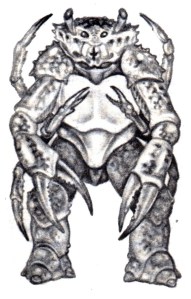
    Cancer Labora Host Armour

    cancer-labora1Host armours are designed from a semi-living infernal construct as a heavy-duty harsh-environment armour shell, within which a human soldier can safely nestle. Like all Host Armours, the Cancer Labora enhances the physical and sensory capabilities of its occupant, as well as providing some environmental control and heavy armour. It is intended primarily as a heavy attack unit for dealing with infantry, with its armour thick enough to provide protection against all but the heaviest of infernal weaponry or cannons. The Cancer Labora is made of a type of thick hide modelled on the crab shell, with the plates connected to one another by a special fireproof Infernal material. The human occupant climbs in through the back and operates the various arms using his own hands, and fingers for the smaller arms. The largest arms are weapons in their own right, but can extend small gripping devices to hold additional weapons. The armour shell can also have Infernal weapons embedded, though they must have no recoil. The Cancer Labora is the only Host Armour with an environmental seal suitable for operation underwater, though even then the seal is not perfect and the Labora must return to land within a few hours. In addition to enhanced strength, armour and weapons powers, the Cancer Labora offers nightsight and enhanced hearing magic.
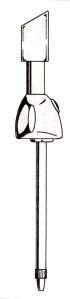
    Impulsion Field Rod

    impulsionrod

    The Impulsion Field Rod does not do damage per se; rather, it throws its target back a distance of tens of feet, knocking them off their feet in the process.  The Impulsion Field Rod is particularly frightening in combat on rooftops or alpine terrain, though in the latter case it has been known to cause avalanches. The Impulsion Rod usually has between 10 and 50 charges and must be recharged at a specified camp or location, though occasionally essence packs can be used to recharge it in the field, if it is needed for an extended campaign or mission. Some soldiers learn to use the Impulsion Rod in their off hand during melee combat, gaining two attacks (though the Impulsion Rod attack may be at a penalty). Frequently they use the Rod to repulse a charge or in the first moments of combat before engaging in melee. Impulsion rods, unlike the more horrifying brands of field rod (ennervators, confustors or quickeners, which are made of bone and wood) are usually made of beautifully crafted mixtures of wood and iron, not unlike rifles. Wizards sometimes use impulsion field rods, in which case they are usually enchanted to be lighter than their appearance would suggest.

    Of course, all field rods are infernally crafted, using infernal essences bound to a manual trigger to enable even the most magically ignorant of soldiers to use them.

    The Death Suit

    The Death Suit is in every sense a normal suit of armour; however, it is imbued with a sacrificial Demon which is invoked on the first occasion that the wearer suffers a mortal blow. The Demon leaches from the Death Suit directly into the body of the wearer, absorbing most of the damage of the mortal blow (which is reduced to a serious wound). The armour is ruined and the wearer experiences certain immediate effects – the wearers eyes go very pale (permanently) and he or she suffers the immediate loss of 1 point of constitution. This effect is instantaneous (some scholars even believe the Demon in the suit has the ability to sense a moment ahead in time) and applies to most mortal injuries. Those which  would completely destroy the body, or which involve massive damage to the head, are not covered by the Suit, though it is rumoured one can purchase a helmet with the same qualities. The Suit works for anyone who wears it, but before the effects can be applied to that person they must rub the armour completely with a salve made of a combination of rose water and their own blood. This process is usually draining for the person who performs it, requiring several hours of work and making them so weak that they cannot perform strenuous activity for a period of time far in excess of that expected given the amount of blood lost.  The benefits, however, are obvious. The suit usually comes as leather or chain, though it can come in the form of an undergarment (at considerable extra cost). The suits can often be identified by their odour of roses.

  • I don’t know if my American reader(s) will consider this completely inappropriate, but it is so completely apt for my Compromise and Conceit campaign that I have to put it here. It concerns the man all my players love to hate, George Washington:

    They still want to kill him though…

  • My gaming party ran up against their first 2 Myrmidons on Thursday, which necessitated the development of some on-the-fly rules for handling death and healing. The body-count was 2 dead, 2 injured. And this was before they had to take on the 50 elite militiamen, the wizard and the colonel. Fun was had!

  • Spells are cast as a skill, with the base difficulty for partial success given by

    DC = 15 + Spell level + Effect Modifications

    Usually these effect modifications represent a decision to increase the number of targets beyond the basic amount allowed by the spell level; or an attempt to increase duration.

    Partial failure occurs if the character rolls below [DC-lvl].

    Whether or not a spell is successful on partial failure, partial success or complete success depends on the basic type of spell effect.

    Spell Level is unlimited from 0 up and increases or decreases according to the basic type of spell effect, the duration, the range and the area. There are three main types of effects:

    •    Fixed wondrous effects, such as light, confusion, etc. which are either automatic, or affect enemy creatures in an opposed skill check (Spellcraft vs. Will/Presence etc). Duration of these spells is usually determined by the amount by which the target fails the opposed skill check.

    •    Variable benefit/damage effects, which manifest as bonuses to a skill or stat, or as damage done/healing. These are characterized by a maximum amount they can attain, and are variable up to the maximum amount. Duration is usually fixed at 1 round per level of the caster.

    •    Fixed benefit/damage effects, which manifest in the same way as variable effects, but always to a fixed amount. This means that they can work on partial failure, but their difficulty is usually higher. Also, the duration of these spells depends on the degree of success.

    Essentially, a spell can have a variable effect for a fixed duration, or a fixed effect for a variable duration.

    Table 1 characterises the way in which the three basic types of effects determine success.

    Unit of duration: Every spell has a unit of duration determined as part of its creation. This is usually 1 round, but can be in minutes, hours, days, or simply be permanent. For all units of duration except permanent, the spell lasts a period of time equal to some multiplier of the units of duration.

    Table 1: Success determination by basic spell type

    Spell Effect type

    Basic rule

    Effect on partial failure

    Effect on success

    Wondrous effects, no target

    Spell always works on partial

    failure or better. Degree of success determines duration

    Spell works; fatigue; spell

    lasts 1 unit of duration

    Spell works; no fatigue; spell

    lasts a number of duration units equal to [skill roll-DC]+1

    Wondrous effects, hostile

    target

    Spell effect only takes hold if

    the caster can beat the target on an opposed skill check

    Spell works; fatigue; opposed

    skill check DC=die roll. Duration 1 unit of duration per point of failure, +1

    Spell works; no fatigue;

    opposed skill check DC=die roll. Duration 1 unit of duration per point of

    failure, +1

    Variable benefit effects

    Spell only works on partial or

    complete success; benefit varies up to some maximum

    Spell does not work; fatigue

    Spell works; no fatigue;

    benefit is given by [spell roll-DC] up to the maximum

    Variable damage effects

    Spell works on partial failure;

    damage determined by opposed skill check

    Spell works; fatigue; opposed

    skill check DC = die roll. Effect = 1+1/point of failure up to the maximum

    Spell works; no fatigue;

    opposed skill check DC = die roll. Effect = 1+1/point of failure up to the maximum

    Fixed benefit effects

    Spell works on partial failure;

    benefit is always fixed, but the duration depends on the spell roll

    Spell works; fatigue; full

    effect; spell lasts 1 unit of duration

    Spell works; no fatigue; spell

    lasts a number of duration units equal to [skill roll-DC]+1

    Fixed damage effects (curses,

    etc.)

    Spell works on partial failure;

    benefit is always fixed, but the duration depends on the spell roll

    Spell works; fatigue; full

    damage; spell lasts 1 unit of duration

    Spell works; no fatigue; spell

    lasts a number of duration units equal to [skill roll-DC]+1

    For the purposes of simple gameplay, we note that spell effects which do stat or skill damage are treated in the same way under these rules as spells that do physical damage. However, this implies that spells which do physical damage will not be permanent. For the purposes of this one type of spell, we assume that the damage effect is permanent. Usually this would require that the spell be considerably higher level than is strictly reasonable, so we waive this consideration for healing and damage spells (see table 3 regarding duration).

    Spell Difficulty

    Spell difficulty depends on which of the three basic effect types the spell employs.

    Variable benefit/damage: Level = [Max effect]/2

    Fixed effect/damage: Level = effect

    Table 2 shows the wondrous effects with their base level.

    Table 2: wondrous effects with their levels

    Effect

    Level

    Light

    0

    Daze, knockdown

    1

    Stun, deafness, rage[1],

    courage1, telekinesis, fascinate,

    2

    charm, comprehend/confuse

    language, camouflage/hidden, change size, Sleep[2],

    3

    Blindness, forget, Disguise,

    alien environment, Pain[2], slow, freedom of movement

    4

    Paralysis, fear, invisible,

    5

    clairaudience, Scrying, minor

    spell effect[3], haste

    6

    confusion, Change form

    (mundane), Teleport (minor, not through obstacles),

    7

    Telepathy, improved

    invisibility, medium spell effect,

    8

    Insanity, major injury (removes

    most of a creature’s fighting ability without death)

    9

    Major spell effect, Domination,

    10

    petrifaction,

    11

    Change form (supernatural),

    Disintegration, Teleport, Extreme spell effect,

    12

    Imprisonment/banishment, change

    reality

    13

    Death

    14

    Time Stop

    15

    Miracle

    16

    Note that conjuration can be estimated as a DC given by the level of the creature, with a small addition for the conjuration itself (perhaps 1). These levels have been designed to roughly match twice the levels of spells in D&D 3rd edition, with some modifications made possible by doubling the level range. There is no particular reason why the level range should be fixed at 16.

    Combining spell effects should use their sum, minus an amount which increases with the levels and numbers of combinations. So for example, daze and knockdown should be level 2; while daze and pain and blindness should be level 6.

    Duration

    The base unit of duration for all spells is rounds. Spells which do physical damage or which heal people are considered to have permanent base unit of duration, as are spells of abjuration. This is subject to DM discretion. Spells with base duration permanent cannot have their duration reduced.

    The base unit of duration can be extended by increasing the level of the spell, as shown in table 3.

    Table 3:

    style=”mso-spacerun: yes”> Duration of effect

    Duration

    Level change

    Concentration

    -1

    Minutes

    +1

    Hours

    +2

    Days

    +3

    Permanent

    +5

    Area of effect

    Area of effect depends on the domain of the spell. The effects by domain are shown in table 4.

    Table 4: Area of

    effect

    Domain

    Area effect

    Divination

    1 creature

    Abjuration

    1 creature

    Alteration

    1 creature

    Evocation

    3m area

    The area of effect can be increased by 1 of these base units by increasing the spell DC by 1 freely at time of casting. Evocation can be reduced in size to “beam” (essentially 1 creature) at a DC improvement of 1.

    Range

    The range also depends on domain, as shown in table 5.

    Longer ranges can be obtained by increasing DC by +1 through the categories:

    Self / Touch / 10m / 30m / sight.

    Evokers and abjurers can step down the range categories to make the DC easier.

    Table 5: Spell

    ranges

    Domain

    Range

    Divination

    Self

    Abjuration

    Self

    Alteration

    Touch

    Evocation

    10m

    Examples

    Scorching Ray

    Range: 10m, Ranged touch

    Max. Damage: variable, max. chosen by caster

    Attack: Spellcraft vs. Reflex

    DC: 14+ max damage

    Area effect: beam (1 target)

    This spell has the base range of the evoker type, and variable damage up to the maximum chosen by the caster.

    Base range: 0

    Reduced area effect: -1 for beam

    So in order to do maximum damage of 5 (enough to penetrate most armour) is DC 19.

    Magic Missile

    Range: sight

    Attack: Guaranteed damage

    Damage: fixed, 2 wounds

    Area effect: single target

    DC: 20

    For guaranteed damage: +2=+2

    Range extension: +2

    Area effect reduction: -1

    Note that this can be extended to multiple targets (+1 DC per additional target) and increasing the maximum damage by 2 only increases DC by 2.

    Sleep

    Range: 30m

    Area effect: 1 person

    Attack: spellcraft vs. will

    DC: 20

    Sleep is a level 3 effect, +2 for the range extension. This gives a total DC of 20. DC can be increased by 1 per additional target.

    ————- Footnotes to table 2————–

    [1] Assumes that the effect is somehow different to a variable benefit/damage, perhaps because it has penalties which partially offset the benefits

    [2] Note Sleep differs from Paralysis: after 1 round, sleepers can be woken non-magically

    [3] A minor spell effect is a spell which affects magic – draining charges, protecting against spells, etc. Other spell effects represent progressions from this.

  • From Monsters and Manuals, via Sir Grognard, and I thought I’d take it up since I’m passing half an hour before I go out clubbing (to Slimelight in fact). Can I conjure 10? Let’s see:

    1. Dragons, not the pissy way they’re laid out in AD&D like big fire-breathing lizards, but the God-like beasts of yore, the ones you see in A Wizard of Earthsea. I have only ever had one as an adversary in my campaigns, it was 100′ long and roared into the characters’ castle from nowhere. By the time they killed it it had torn their skyship apart, knocked off half their castle, and even the Hungarian Fire Lances they used (which can knock down a building at 50 yards) just dented it; it slaughtered half of  them in the battle, and even after they “killed” it, it mesmerised one of them when he approached the dying corpse, and the other characters had  to take him out as well. Rolemaster dragons are the coolest I have seen in an official system – I can’t imagine a party powerful enough to actually take on fully grown one.
    2. Orcs, because they are the quintessential swarming, nasty adversary and they’re fun for a large part of the early parts of one’s campaign. How would we get fulfilll our secret genocidal wishes without this race of evil-by-birth losers to wipe out at every turn?
    3. Trolls, because they really are a lot more trouble than they should be with the regeneration thing, and in Rolemaster they were actually really scary.
    4. Vampires, and all other forms of magic-using super-Undead, because they make excellent NPCs and really dangerous adversaries.
    5. Spectres, because ghosts are stupid but Spectres aren’t. In fact I am a big fan in general of Undead, which  you can always pile a fresh new supernatural ability on, and which are preternaturally tough on account of not feeling fear and not being stunnable. In Rolemaster the more powerful Undead are also very very dangerous, having fear and magic and a plethora of special nasty attacks.
    6. Demons and Devils, either of the looks-human-but-isn’t or the massive-scaled-bastard ilk, because they are literally the quintessence of evil, and that’s good
    7. The Huron, who are the current bogeyman in my Compromise and Conceit campaign, and even though the PCs haven’t fought any yet, they live in fear of the time they do.
    8. Githyanki, a kind of silver-sword wielding exceptionally xenophobic straight-edge punk from Beyond Hell. That’s likeable!
    9. Giant Spiders, because they are excellent to describe (how can they not be scary?) and if you are ever in doubt for a bad monster to use, you can choose one of these and just adapt the size.
    10. NPCS, who always seem to be the most powerful adversaries. They can be as powerful as you like, they always seem to get away to fight another day, and all players hate it when you backstab them they way they are used to backstabbing others. Oh the sweet, sweet pleasure!

    But unlike the other websites mentioned above, I’m  not a big fan of mind flayers. They have their place, sure, but physically are really weak (just as well!) and look stupid and kind of unbelievable. But they do eat brains, which is a plus. And in Baldur’s Gate they were real trouble.

    Maybe I should make a list of my 10 least-favourite monsters…

  • Over at Grognardia, Sir Grognard had a long-standing objection to the Thief character class, primarily on the basis that it takes a single character out of play for a short time and leaves the other players twiddling their thumbs[1], and he slates this as the cause of the ultimate play-wrecker, the Cyberspace hacker character, which basically has its own little side-adventures in astral space every couple of sessions. Sir Grognard’s objection and his willingness to blame subsequent RPG developments like the hacker on the Thief seem to rest heavily on his critical attitude towards the inclusion of anything resembling a skill system in the rules.

    Over at SOB, Chad Perrin has a brief discussion of a common point presented in favour of 4e by its defenders: that combat is quicker than 3rd edition, and “we can have more than one combat per session”. I agree with Chad that combat is not quicker in 4e, but I think part of the reason that 3rd edition games only had one combat per session is that the 3rd edition skill system was rich and detailed, and provided DMs and players alike with a wide range of opportunities to do many non-combat things. This inevitably leads to more varied adventuring and as a consequence less combat. Of course, at times the skill system gets bogged down in its own complexity (it has many idiosyncracies) but this is not the main cause of its time-eating properties. D&D 3rd edition had less combat per session because it encouraged other activities.

    Now, I think I anticipate Sir Grognard arguing that this is not better, because any skill system adds a layer of abstractness to the actions one performs, and makes them less fun. I think I have read him argue,  for example, that traps should be disabled by players working out a solution based on what they see, social interaction should depend on interactions between players and DM, etc. But the problem with this in practice is that it relies too much on the DM and players’ imagination[3]. Consider, for example, the trap. In order for a trap to be a fun challenge in the Grognard vein, it requires that a) the DM be able to design it creatively and coherently, b) the DM be able to describe it in a way that the players understand, and be able to develop hints they are likely to get, and c) that the players aren’t stupid[4]. The less said about c) the better, but I can’t build or design anything myself and any trap I designed would be completely shite, so a) is out of the window, and though I’m good at b) it can be very tricky to do in general. In these instances, abstraction enables DMs to set a rich range of non-combat challenges which the players are guaranteed to be able to interact with, and as a consequence DMs put in more challenges of this sort. The abstraction makes them slightly less endearing, I supppose, but if one is going to rest on this argument, I feel a need to point out that Grognards everywhere will cheerfully defend OD&D’s combat system, in which the hit roll doesn’t actually represent a single attack, but a full minute of dodging and feinting and taking tea with the neighbours.

    Consider the full range of activities which a 3rd edition party can undertake at will: setting and removing traps, tracking things, interacting with strangers the DM hasn’t come up with a coherent plot for, spotting hidden bastards, hiding and stalking, understanding local lore, climbing walls, and more esoteric things like analysing battles to see who will win, etc. This diversity of skills means that the players can suggest actions to the DM which he didn’t expect, setting new directions to the adventure, circumventing big challenges, etc. It also means that in a pinch the DM can come up with new challenges without having to fear being uncreative on the spot, and can set multiple different adventure directions which are chosen by a roll of the dice (e.g. if the Thief can open the door they get in easily, otherwise they have to visit the sly witch, etc.) [5]

    Skill use also gives a framework for the resolution of non-combat actions which enables DMs to pull off plot hooks and force players in a certain direction without looking like they are using DM Fiat. This is a good thing. I think all of these elements of skill use appealed to a lot of players around the time 3e was released,  which is why systems like world of darkness, Ars Magic etc. were starting to take off. Rolemaster has a terribly complex combat system but its skill system kept me away from AD&D until I discovered the 3e. I think D&D has always been a bit cannibalistic, taking ideas from other places, and they did this in 3e too. In fact they did it so well that the d20 system became the monolith of  the gaming world.

    Of course, 4e is ripping off the computer game world, and as a consequence it is going to be skill lite. Certainly the two sessions I played only used two skills, stealth and perception (from memory) and everything else was just slaughter. I think that some people defending 4e like this, because although they enjoyed the skill-use aspects of 3e, they mostly just love killin’ shit. I certainly have had players throughout my DMing life who essentially sit out the conversations, the complex problem-solving and the political interaction, and only get interested when the blood starts flowing. For these people 4e is a better balance of combat and skill-use; but for me, based on my limited experience of 4e (and my long experience of AD&D), a slightly abstract skill system with a good engine and a good framework within which DMs can make judgements is the key to a diverse and interesting gaming experience.

    [1] I reference no particular post in support of this claim, and my apologies if my interpretation of the justification is wrong.

    [2] I think Sir Grognard is right about the play-wrecking properties of the hacker, but wrong to say the hacker itself is a bad character: it’s essential to the cyberspace milieu and the cyberspace milieu is a good place to play. I also don’t think the hacker’s problems can be slated home to the AD&D Thief either.

    [3] I know that sounds really bad, but it’s true. Every DM has had an experience where the players can’t quite get into the adventure because they can’t see things his or her way, or they think something is unrealistic, or the idea he or she thought was clever on paper on Sunday doesn’t work in practice. Everyone’s imagination is limited, which is part of the reason why so many role-playing adventures consist entirely of fightin’ and lootin’. Giving people an imagination-lite way of diversfying their activities seems to me to be a good thing.

    [4] I would add too that when they aren’t being stupid, players tend to spend a lot of time being argumentative, and the Trap is the classic example  of this. Before you know it, some prat who couldn’t write an adventure if he had a module beside him is telling you that your  cunningly thought-out trap would never work because of blah blah blah and couldn’t we just do blah which is what the prat in question wanted to do all along, i.e. he didn’t get your hint so he blames you.

    [5] I would add that this happens a lot, where the cunningly laid plan a DM set is completely wrecked by creative skill use, and in my view that is a good thing.

  • A while ago I mentioned that I used to like skill systems which incorporate partial success/ partial failure, but now I am not so enamoured of them. Since I wrote that I had to rejig my magic system slightly, because I had configured it to be a little too easy. As my magic system was constructed, every spell came with a casting DC. Beating the DC meant that the caster cast the spell with no fatigue, and the degree of success determined by the amount over the target DC which the player rolled, subject to some maximum (which partially determined the spell DC). Failure to beat the DC meant the spell was cast, but the caster suffered fatigue; in some cases the spell fails and in all cases, the save DC of the spell is the player’s roll.

    The problem with this system is that one of the characters in my system has the spell Grendel’s Demise which rips off a target’s arm; and another has The Angel of Death, which just slaughters everyone in sight. With no risk of not being able to cast the spell, these characters get to basically try and kill one monster every round, at risk of a mere fatigue.

    So I introduced a new rule for failures: if the player rolled lower than [casting DC – level] the spell automatically failed, and the character suffered fatigue. Grendel’s Demise has a spell DC of 23 and the characters are 5th level, so any roll of 18 or less means the spell completely fails. As the characters gain levels, the risk of complete failure decreases. This means I can continue to give low level characters very dangerous spells, knowing that they won’t use them unless they’re really desperate, until they’re high enough level to guarantee success.

    But this new system introduces partial failure into the system. Given that the system already allows for partial success, this means I have essentially reproduced the Rolemaster skill paradigm (minus a lot of categories and tables of course).

    Consider, for example, a 5th level wizard with magic skill of 8, casting a 4th level spell (casting DC 19) which stuns the opponent for 1 round per point of success. Partial success with this system is always possible; for example, if the caster rolls 19 the spell is cast with no fatigue, and the victim has to roll over 19 on a saving throw or is stunned for 1 rd per point of failure. Partial failure occurs on rolls of 14-19; in this instance, the target still has to roll to save,  but the roll is easier, so there will be less rounds of stun (on average) and the caster takes a fatigue. On rolls less than 14 there is complete failure – caster incurs fatigue, spell never happens, victim never notices.

    At first I thought that this would only apply to magic but now I realise it can be applied across the entire skill system. Consider, for example, a 3rd level thief on a rooftop who decides to do a sneak attack by dropping off the roof onto a passing guard. Adjudicate this attack thus: the rooftop attack could give a maximum +2 damage, so the DC is 19 (15+2*maximum effect is my current guideline). The actual effect is determined by the player’s acrobatics roll minus the DC, with a maximum of +2. On rolls of 16-19 the character can still attack but is judged to have landed badly and attacks at a penalty equal to [DC – roll]. Anything less than 16 and the character takes damage and loses the attack.

    Note also that under this system the maximum penalty a character can take is limited by their level, which makes me think that levels can also serve to put a limit on the maximum benefit a character can gain (and thus also the maximum DC they ever have to beat). This ties the skill system and the levels together more tightly than just allowing levels to determine skill points. In my system this means that a character’s development, saving throws, skills and actual DCs are all joined together through the skill system and the level system.

    Unification baby!

    And note that none of this is incompatible with D&D3.5 or Pathfinder or whatever. This is another example of how, I think, the D20 skill system is a really natural and flexible way to resolve all the actions which characters face. You really don’t need anything except skill points and levels!

  • Anyone who knows anything about me knows that I don’t like theatre much, though I do go to see a play on the odd occasion (approximately every 2 years). Generally theatre is like bad television, in my opinion, only confronting. However, when it’s good, theatre is just great. So it was with the play Shunkin, which is produced by the complicite company and is somehow related to some stories by Junichiro Tanizaki, who incidentally wrote the essay “In Praise of Shadows”. This essay is said to have particular relevance to the area of Japan where I lived, which is called the “Shadow of the Mountains Coast” and is meant to have a more shadowy feel about it. But I digress…

    Shunkin is a play about a blind rich woman in 19th century Japan, who takes her servant as a lover and proceeds to treat him very sadistically. Her servant is a masochist so he loves it, and the play is about how their love develops and how their life proceeds. The lead character, Shunkin, is mostly played by a doll, but the doll is led around the stage by a famous Japanese actress, Eri Fukatsu (I think),  who does the voice and movements of the doll brilliantly. The set is also populated by mysterious crew in black, who move the props around in a very inobtrusive but effective manner to produce, using just some sticks and pieces of paper, various cunning effects : swaying overhanging tree branches, sliding doors, gravestones, a fragmented screen on which Shunkin’s face is projected, and nightingales amongst other things. Sometimes the doll swaps for a human actress and one doesn’t even notice, and the stage slips between light and darkness with brilliant effect. The stage is always populated with very simple objects – sticks, paper and tatami mats mostly, and very little else. The scenes flick  between 20th century Japan and the Meiji era, with the narration alternating between a woman in the modern era and the voice of Shunkin’s servant, and the voice of Tanizaki himself. This has the eery effect of linking the eras of the servant’s youth, his dotage and modern Japan in a kind of mutually critical framework – so Tanizaki criticises modern aesthetics, the aging servant criticises his young self, and the female narrator in the modern era criticises her lover and adjusts her own life in light of what she reads and sees.

    This play also uses silence and simple sounds in a way which in my opinion is characteristic of the Japanese aesthetic of simplicity. When shoji screens slide back, it’s like a mime reinforced by the movmeent of a single stick, and the sound of someone breathing out; there is occasional careful use of silence, just as we are used to seeing in modern anime like Nausicaa and Akira. Simple sounds and tones, and the use of light and fragmentary images, combine to produce ghostly and highly emotive effects.

    The story itself is simple, cruel and engaging, though it takes a bit of time to adapt to the frequent shifts of perspective and the various narrative voices. The ending was breathtakingly beautiful, as well as unexpected, and contains a simple message (not necessarily good) about what people will do for love, and its cruel power.

    Also there is doll sex.

    I strongly recommend seeing this play, and I will be keeping an eye out for other works by this theatre group: Complicite, make a note of it!