• Office of Forward Planning

    Lanhydrock

    Bodmin


    Commanders, Forward Scouts and Captains

    Albany Region

    The Americas


    3rd September 1755


    Strategic Action Notice 1-864-7A


    Re: Plans for enactment of First Ritual of Death

    All soldiers are to be in place for the ritual on the evening before our associates commence their attack on the Government offices. Timing and Force Protection are key issues in the effective application of Demonic force in this context, and this Strategic Notice describes in detail the necessary procedures required to maximise the effect of the ritual.


    Timing


    In any Major Infernal Application, appropriate timing of all actions is essential. Should our associates under Washington fail to achieve military success, the ritual will be invoked from Newfoundland. You should expect that there will be a delay of approximately 1 hour between notification being received at the Newfoundland HQ of failure to achieve military objectives, and full application of the Infernal energies. During this hour it is essential that your soldiers act to gain control over the key strategic points described in Schedule 1.


    It is expected that there will be considerable disruption of normal activity during the ritual, due to the sudden death of most mortals in Albany; to ensure smooth continuity of Iron House activity in the area, all Commanders need to move their forces to the locations designated in Schedule 1 within 1 hour of the Regional Director providing Notification of Intent to Invoke.


    We do not expect Washington to be able to maintain Military Cohesion during the period of Infernal Application, primarily due to the Pervading Terror, inability of ordinary mortals to Maintain Sanity, and inefficient distribution of Force Protection to inferior troops amongst the militia. However, smooth function needs to be maintained immediately after the ritual, so it is essential that you achieve the locations described in Schedule 1 as quickly as possible.


    Force Protection

    All soldiers of the Iron House are to be issued 1 (one) Infernal Protective Amulet (IPA). Soldiers should be notified of the following:


    –       IPA use is mandatory

    –       IPA protect only against the Infernal ritual to which this SAN pertains

    –       IPA will not be replaced: trade or loss of an IPA will result in significant costs (Death)


    Usually, loss of Iron House issued equipment is punishable by death. Do not waste valuable resources on punishing such indiscretions in this instance: death is inevitable.


    Failure to implement appropriate Force Protection measures, and in particular, failure to pre-locate in the locations described in Schedule 1, is a serious disciplinary matter punishable by demotion and, where necessary, banishment to the Netherworld.


    Schedule 1: Key Locations to secure in the event of Infernal Application

    [lists obvious locations of military importance which need to be protected from looting, loss of control, etc]


    Authorising agent: Alastair Crow


    Overseeing power: William de Bouverie, 1st Earl of Radnor


  • George Washington

    8 Albany Place

    Albany

    America


    Alastair Crow

    Court Mage

    Lanhydnock

    Bodmin

    United Kingdom of Great Britain and Ireland


    1st August 1755


    Dear Mr. Crow


    Regarding your letter of the 17th July, I am of course delighted to assure you that, should my various projects in the Americas come to fruition, you and yours will be granted full diplomatic immunity and unimpeded access to all regions under the immediate control of my forces; as well as the right to move your own forces outside of these regions for your own purposes. Your help has already proven invaluable, and I understand the nature and extent of assistance you offer in the event that the main part of my plans should fail.


    Regarding the eventual consequences of, as you call them, my “core strategic objectives”, I can assure you that if I fail to move “with all due haste” to “neutralise unnecessary sentient obstacles” among the Native population, you will be free to act in whatever way you see fit to assure your own “demographic goals”. I can, however, assure you that my main associates – Colonels Williamson and White – are eager to enact their principles regarding the Noble Savage, and I am confident that you will find your own “strategic resources” will remain “untapped” while both of our organisations “progress [sic] mutually agreed project outcomes”.


    I would also humbly request that you find a less intrusive means of delivering your messages. Not only is the smell of sulfur difficult to remove from my draperies, but it took me some hours to find my scullery maid after she fled in terror from your messenger. I trust that you understand my situation, and remain in this as in all matters,


    Yours Sincerely etc.


    George Washington

  • Alastair Crow

    Court Mage

    Lanhydnock

    Bodmin

    United Kingdom of Great Britain and Ireland


    George Washington

    8 Albany Place

    Albany

    Washington


    5th July 1755


    Re: Proper measures for the management of local populations

    Dear Mr. Washington


    I am writing to you to confirm your interest in enacting a programme of population management in the area of Albany and, hopefully, across the Americas. I have been led to understand that some residents of the Americas who might be considered allies of yours have been occasionally remiss in their support for proper population measures, and are not completely on board with the goals of the Iron House in this regard. I would like to assure myself that these concerns are not felt by your or your own senior commanders, and that you are not allowing “out-of-mission” concerns to cloud your thinking in respect of key mission objectives.


    As you know, my own senior management team have given me certain Key Performance Indicators to which I must conform in my dealings in the Americas; and that these KPIs are not just more readily facilitated by expeditious management of Native Population Issues, but actually require that I neutralise unnecessary sentient obstacles to achieve certain demographic goals. In previous letters you have indicated that you share these demographic goals, but I would like to gain your assurance that you will act with all due haste to meet the Population Management Objectives we have previously discussed.


    In addition to enabling me to meet the terms of some of my KPIs, effective elimination of locally-based opposition will significantly hasten achievement of core strategic objectives for both parties. I hope we can achieve synergy in this matter, though as ever my Senior Management Team have indicated a willingness to step in where your own resources prove inadequate. I believe we both wish to minimise disruption to Senior Management Team schedules, as a failure to leave strategic resources of this sort untapped will be considered in my annual performance review and will undoubtedly affect your benefits at An Indeterminate Future Point. To this end I would like your assurance that you are devoting maximal resources to progress mutually agreed project outcomes.


    Regards

    Alastair Crow

  • Once again we find our heroes standing proud after a battle while Dave Black loots the corpses; and indeed this time, having killed a few Iron House guards, the characters found themselves disappointed by the loot on offer. However, before them stood a noble house well worthy of looting, and Lord Merton st. Helier being himself of noble birth, they decided it only fitting to enter through the main doors.

    Unfortunately, the front doors opened into a converted courtyard, covered overhead and with windows each side, which served as a kind of killing ground. Though lord Merton is noble, his instincts are base, and so he and Dave Black decided to enter one of the rooms overlooking this killing ground from the outside. They were lucky to have done so, too, because within the room they found 3 riflemen, preparing to open fire on those of the party who had entered through the main doors. Three more troopers opened fire from the other side of this entrance courtyard. There followed a short and bloody battle in darkness, during which demons and monsters were summoned, and 9 more armed troops came charging through the inner door of this entrance hall. The characters defeated them all, but not before 2 of their number were severely wounded.

    Father Cantrus had just finished healing these wounded when a massive fireball exploded in the doorway to the courtyard, taking in everyone within. Cantrus looked out the door and saw a mage at the far end of a moonlit inner garden courtyard, but this mage was just disappearing from view as he looked. The of the party dived into one of the side rooms to escape the blast, and some of them ran down the hallway towards that distant mage’s position; but while they ran, another fireball exploded in their room. Injured, Anna Labrousse crawled into the opposite sideroom, and so was standing in there when the wizard materialised in front of her. She cast her most forceful spell, Grendel’s Demise, just as he hurled another fireball through the window, and then Cantrus was able to paralyse him. Armless and bedraggled, he was dragged into the moonlight and subjected to Dave Black’s tender ministrations, after which he happily reported that there were, in fact, no other guardians in the building, that William de Bouverie’s assistant had a laboratory on the 2nd floor and a study over the entrance hallway and could the man in black please please stop doing that to his left arm?

    So, the characters headed up to the 2nd floor. First they investigated de Bouverie’s quarters on the third floor, finding only some french porn and a lot of money. At the 2nd floor, they soon found themselves looking on the door to de Bouverie’s assistant’s laboratory. Russell Ganymede used his infernal vision to look through it, seeing only an empty room, moonlight spilling over laboratory equipment, and a table with some olives on it. Anna Labrousse summoned a monster, which appeared resembling in every respect a mad professor, and commanded it to open the door. It walked inside and disappeared from view, unharmed. Convinced despite a faint buzzing noise that the room must be safe, Russell entered…

    … and was hit in the face by a massive flail, composed of a human skull filled with lead and studded with adamantite spikes. He went flying out of the room and landed on the far side of the ante-chamber, seriously injured, where Cantrus promptly healed him. Such is the way of things for an infernal warrior, that though one of his distant brethren might hit him so hard in the face that his cheeks explode, a censurious priest will be with him in but a moment, reminding him of his need to redeem that infernal part of his soul…

    So righted, Russell burst into the room again, followed by everyone else. Inside they found themselves face to face with a fly demon, some 12′ in height, hovering on massive fly wings, vaguely humanoid in form but black-skinned, scaly, with multi-facetted fly’s eyes atop a hideous mouth of mandibles, teeth and tusks. The whole was covered in a thin carpet of stiff, wiry hairs, and carrying a massive flail whose chains finished in skulls, one of which had parts of Russell’s face still on it.

    The demon spewed horrific green vomit on everyone present, and battle was joined as the acid ate at them. However, before the demon could rend them all limb from limb, Father Cantrus wiped the fly bile from his mouth and, chanting biblical curses, forced the being back into hell. All that remained was a wisp of sulfur stench, and a lot of serious injuries.

    The characters then investigated the laboratory and its associated study, and found themselves in possession of a number of incriminating documents. These seemed to be telling them that:

    • The Essential Compromise may have been some kind of trick, by the denizens of hell, to help them find gates on earth through which they could enter the world
    • de Bouverie’s assistant, Alastair Crow was the same man (?) that the characters killed during the uprising in Albany
    • Alastair Crow had planned for a genocide in America, possibly as part of a ritual to invoke the gate, or perhaps to clear Indian resistance from areas he needed to visit
    • In exchange for aiding an enthusiastic Washington in his genocidal plans, Crow gained unfettered access to the American inland
    • Once in the inland, Crow aimed to find “the Thorntree” and had maps guiding him. When his plans fell apart due to the characters’ involvement, he simply arranged an expedition using his Irish soldiers, and set off some weeks earlier

    The characters also found a diary of de Bouverie’s which seemed to indicate that he had made Crow’s acquaintance some time ago and had, since then, slowly become enamoured of – indeed, almost infatuated with – him, and that since their assocation had begun de Bouverie had rapidly gained in temporal power. He had also given Crow more and more control over his personal affairs, ultimately giving him complete control of Lanhydrock and its environs so he could concentrate on his duties as a representative in the parliament in London. A Faustian pact indeed…

    So, having established the motive and the method of a great crime, the characters decided to return to America and stop it. They rode back overland to their boat, and upon arrival at Newquay discovered an Indian crouched on the deck of their ship. This man had arrived as an albatross the day before, and assumed human form on the deck. He was wild, windswept and confused, his mind almost lost to the bird he had become for the long flight. But the characters were able to restore his health, and Anna Labrousse talked him back into his mind. He came to after some hours of quiet work, to tell them:

    “The Prophet begs you come. We have need of you!”

  • We rejoin our characters as they make camp in the woods between Kenmare and Killarney, just Northwest of the spot where they were ambushed by the mage from Kenmare. Here they forced him to talk, and discovered him to be a weak and pathetic mageling, lured by money and the promise of great powers to serve the man who had enacted the ritual of the Dragon at Killarney. His job was simply to keep a watch on the village, and kill any who went there seeking answers. In exchange he was given an amulet of dragon bone, which he would turn into an item of great power “one day”; money; and a promise of access to great power.

    The mage revealed that the man who employed him was William de Bouverie, Earl of Radnor, whose ancestral home is Lanhydnock in Bodmin, Cornwall. The characters had their mark, and the circle was now closed – they knew who had sent the assassin to them, they knew that he was connected to the Irish mercenaries they had previously seen in Newfoundland, and they knew how to free those mercenaries…

    … or, one should say, they would know how to free those mercenaries, as soon as they summoned a lore demon to tell them. Which would require a human sacrifice.

    All eyes settled on the mage…

    … and without much in the way of further qualms, the characters returned to Killarney, and enacted a ritual human sacrifice. Brian the Hunter summoned a storm as Father Cantrus, following the instructions in the book, paced out a circle. Anna Labrousse kept the mage occupied with her calming voice and enchantress’s ways, so that he only realised at the last – as they chained him to the pole – what would happen to him. His realisation came almost at the same time as Brian’s storm swept over town, Cantrus began chanting, and Dave Black hacked the wizard apart with a blunt wooden stake. His organs separated and cast about the circle, yet still vaguely alive, the mage was fed to the Demon Cantrus summoned. This Demon was 12′ tall, with praying mantis-like eyes atop an insectoid head, vestigial wings, long clawed fingers, and a wiry, black-scaled, vaguely humanoid body. When it had fed, it deigned to answer their questions:

    • It told them how to enact a ritual to reverse the curse on Killarney
    • It told them that the secret to protecting their fledgling red empire from war and ruin lay in Bodmin
    • It refused to answer questions about who the characters’ main enemy was – possibly out of fear

    The characters released it and then enacted another ritual while the storm raged. Russell Ganymede reactivated the old summoning circle that surrounded the Killarney town square, they cast the mage’s dragon bone amulet into the centre, and then Anna Labrousse and David Cantrus invoked the ritual. They chanted for the remainder of the night, working their will, and then, exhausted, left at dawn for their ship in distant Kenmare.

    From Kenmare they sailed to Newquay, England, setting their ship aside at the docks, and travelled over Bodmin moor to the town of Bodmin. As they approached, they saw 4 Irish mercenaries riding up the hill. The two groups came to a halt and the characters learnt that the Irish mercenaries had indeed been freed. At first they were confused but now they were free. In town, parts of William de Bouverie’s ancestral home burnt, and some soldiers had been killed when the non-Irish guards turned on their newly-freed Irish colleagues.

    Anna realised that the Irish soldiers were weak of mind from the ritual, and easily suggestible, so she talked the 4 soldiers into joining them. With their numbers increased, the characters rode through Bodmin to Lanhydrock, and entered the extensive gardens around the building. Here they were ambushed by two more of the infernal remade assassins which had first attacked them in Albany, but these two they slew quickly. They then charged to the house, where after a short gun battle with guards at the door they were ready to enter Lanhydrock, to uncover its secrets…

  • DSCF2148
    A crawling abomination from the pits of hell…

    I spent today engaged in a profane and sacrilegious ritual such as would incur the wrath even of the Old Ones[1]: Installing Windows 7 on my 20″ iMac, which only has Mac OS 10.4 on it. I leave it to you, dear reader, to judge whether or not the greatest profanity lies in the act itself; my choice of desktop pattern; or my choice of game.

    I had a variety of problems getting this done:

    • my iMac was bought in a store, and came with a (non-functional) windows partition installed already; this had to be formatted before bootcamp would work, which meant backing up the whole system
    • bootcamp is no longer available, so I had to get it from somewhere (one of the many preparatory rituals)
    • bootcamp doesn’t work any more unless you set back the clock on your apple, which I did
    • windows 7 takes so long to boot up after initial install that I thought it wasn’t working, and spent 30 minutes faffing with it before, finally, distracted by a book, I stopped paying attention and it started itself
    • windows drivers for iMacs are created by bootcamp; but the ones made by bootcamp for MacOS 10.4 don’t work with windows 7, so I had to find the latest ones (from 10.5) somewhere (a ritual enacted on the fly today)
    • The Witcher has an immediate incompatibility with windows 7 in, suprise! its copyright protection software, which acts like you don’t have administrator rights. You can download the latest version from the tages website, or find a nocd crack
    • The Witcher ultimate edition update is free to download but the installation gets in this weird circle of doom, where it won’t install without the language pack, but the language pack won’t install without the update. I solved this by dumping both in the witcher’s folder in the program files – then they both worked fine. This was the most arcane and mysterious of my day’s rituals
    • I didn’t really know where mac OS preferences go, but I finally found them

    So now I have a fully functioning version of Mac OS 10.4.11 on a 180 Gb partition, and a fully (?) functioning version of Windows 7 on a 45 Gb partition, just enough for some stats software and a computer game. I have a 128Mb ATI graphics card which handles The Witcher nicely on reasonable resolution and detail, and may be able to cope with Dragon Age. I received the Witcher 2 years ago for christmas but it was just too slow on my old laptop and I’ve been 2 years waiting for the chance to play it. Unfortunately I have a contract job to do on the weekends, and last-minute travel, so won’t get very far before xmas… sigh … and then I may be buying a new iMac so will have to do the whole thing again!

    Still, I’ve proven in principle that such evil is easy for mortal men. After this, the merely mundane workings of Ultimate Evil that I had aspired to – sacrificing children, eating babies, summoning ancient Gods to rule the world, making statues of Jesus and drowning them in piss – seem pale shadows of the great works which I can now achieve[2]. I have invoked Windows in the purest of sanctuaries, and defiled all that is pure and beautiful with my dark magic!!!

    fn1: you can see one of the Old Ones crawling towards my work of evil to the right hand side of the photo

    fn2: though now I’m pondering a greater darkness – could I dredge up an old Sun Sparcstation, that purest of computers, from somewhere, and install Windows 95 on it? Then I would truly be the most sinister servant of the dark lord…

  • I discovered recently a blog post on Racial Essentialism which describes some definitions of racial essentialism, something which has been debated (and confused) here.

    I also discovered a blog entirely devoted to race in D&D, though it hasn’t been updated since this time last year. It includes a lecture on race in D&D that was presented at the rather ominously entitled Nerd night. I haven’t had a chance to read it in depth, as I’m in the middle of a profane and sacrilegious ritual of great evil; but when I’m done despoiling all that is good in the world I’m going to give it more thought.

    This is a particularly appropriate topic given how I just wrote a fake Indian myth for my own role-playing campaign…

  • Wile_E_Coyote_1
    Going down, down to the Underworld…

    A long time before this story starts, Coyote’s wife died. He tried to get her back, but as ever he was impatient and silly, and he thought he lost her forever.

    One day long after that mistake, while he was wandering in the plains, causing trouble, Coyote met a priest of the white men, who told him that their god can bring back the dead. Coyote asked where his wife went, that a priest can bring her back.

    The priest told him she must have gone to the underworld because she is an indian. Coyote asked the priest to bring her back but  the Priest told him that only the gods can do that. And the priest told Coyote that once a great priest of the white people died and came back after 3 days. So Coyote realised that priests’ bones are the key to the underworld, and he killed the priest and took one of his bones as a key and went into the underworld to find his dead wife and bring her back, like he failed to do before. The Nez Perce said it would take 5 days to bring her back; this priest said it takes 3, so he must have had powerful spirits to help him!

    Coyote  found the place where all the dead people were, but there were no dead indians there, only white people. He thought that the priest lied to him, and hewas sad, and he thought that the underworld was a very poor and desolate place full of sad dead people but he wanted to have something interesting to take back with him, because he had come all this way. He snuffled about and he discovered from snuffling and listening and being tricky that the Great Father of the Underworld keeps a special garden, and in this garden there are special magical flowers, and if you have one of these flowers you can do special magical things. So he sneaked into the Great Father’s garden and took a bunch of the flowers. But the Great Father of the Underworld realised Coyote was stealing his magic flowers and got angry, because he needs the nectar from the magic flowers to give the priests of the white people their magic. So he sent his soldiers to admonish Coyote.

    But Coyote doesn’t like being admonished, so he ran all the way back the way he had come, and used the Priest’s bone key to close the gate to the underworld; but in his haste he dropped one of the flowers there, and it stayed stuck in the door, and grew into a great big horrible thorntree in the canyon, that can’t be cut down and won’t go away. So from then on all the People knew where Coyote went into the Underworld to find his wife, and never found her, and came back but didn’t close the door properly because he jammed a thorny rose stem in it in his haste when he was locking it.

    Once he was back in the sun, Coyote didn’t like the flowers anymore, so he gave one of each of the bunch of flowers to one of each of the tribes of the People, and that is how they got their special powers.

    Some people say that Coyote never closed the door properly, and that someone who knew how to kill the thornbush could open it again, because it would be unjammed. And other people say that the Thornbush is evil and eats souls. Yet other people say that the soldiers of the Great Father are waiting behind the thornbush, and if it is cut down and the gate is opened they will come swarming out to punish the People for Coyote’s trickery. None of the People can agree about the meaning of the place. But everyone agrees that the place where Coyote went into the underworld is a bad place, and noone goes there.

  • Kenmare
    Here be dragons (bones)…

    Having rested for some weeks in Iceland, and having cavorted to their hearts content in the snowy Autumn of that matriarchal and faerie-touched land, our heroes returned to their quest, setting off now to head to the West coast of Ireland and the mountains of Carron Tuohill, where they hoped to find clues as to who made the Assassin that was sent after them.

    The sea between Iceland and Ireland is wild and rough, and indeed the characters found themselves in some trouble as they crossed it. In the far distance they saw pirates, and for some days a small cluster of Sea Sprites – harmless floating balls of magical energy – surfed the invisible arcane waves of the Inappropriate Response‘s bow wave. These encounters were relatively harmless, however, and Sea Sprites are in any case counted a friend by most sailors, since the disappear at times of storm or when any of the more frightening beasts of the ocean approach.

    And so indeed the Sprites fled the bow of the ship after some days, and within half a day the characters could see flying beasts approaching. These hideous creatures had the body of a fish-scaled snake, a vaguely human yet monstrous head crowned with writhing eels, and a set of bestial wings. The ships pilot identified them as Sirens and fled below. The characters set about stopping their ears with magic, demonology or wax – whatever they were able – before the Sirens disappeared into the sea, their final move before they ambushed the ship.

    However, the Sirens had misjudged their prey, and when they launched themselves into the air over the ship they flew into a storm of bullets and infernal energy. Although their first screams forced Anna Labrousse and Dave Black to surge, fascinated, to the edge of the ship, the Sirens were dead before they could do much damage. One, descending into the water, conjured a stunning burst of electrical power around Brian’s dog matilda, but it did nothing, and soon the final Siren was dead. The ship sailed on, unthreatened by such weak beasts. The only other beast our heroes saw in the Ocean was a vast, silent sea monster which passed beneath them and cast a shadow under the sea as if it were the reflection of a giant cloud, or some submerged island; it did not molest the boat, though, perhaps thinking it nothing more than flotsam scudding by. From whence it came, or whither it went as it plunged into the deeps, they could only hope to guess…

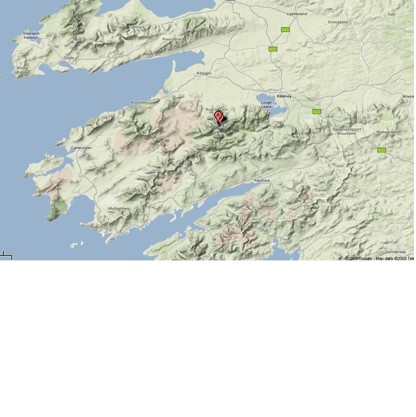
    And so then the characters arrived at the port of Kenmare, a tiny town on the Western coast of Ireland and the closest port to Caron Tuohill, the mountain which the characters aimed to visit. Kenmare was a tiny, ramshackle town, nothing more than a collection of warehouses and mud huts in a narrow valley, above which loomed a sorry excuse for a Castle on a low hill. The suspicious and nasty-looking locals who met them directed them to the Castle, where clearly English speakers were supposed to stay; they travelled there immediately, and were greeted by the Lord of the Castle, his guards and a slimy, suspicious-looking advisor. They spent an evening with this misbegotten bunch, during which the advisor – clearly an upstart hedge-wizard of some sort – revealed himself to be a sneering, offensive little oik from London. He was rude to the characters and did his best to attract their ire – never, as George Washington discovered, a good idea.

    The following morning the characters set out for Caron Tuohill, following the advice given them by the lord of the castle – they first would travel by horse for 2 days to the town of Killarney, on the lake East of the mountain, and from there obtain advice on how to ascend the mountain, for at this time of year the weather was treacherous and a mountain such as Caron Tuohill best climbed with caution. They did as they were bid, though the path took them through thick forest from which they were sure they were watched. Suspicious of tales of elves and faerie, the characters pursued their watchers into the woods but found nothing except thick brambles and silence. They continued, suspicious, to Killarney, where they found an even sorrier, sadder town, consisting of a few boarded up shops and some rundown homes clustered around a market square. The Market Square had clearly been the location of some kind of infernal ritual – there was a stake of wood, an extensive area of burnt grass, and faded markings of a magic circle. The town populace were a bunch of scared women and their children, hiding behind their doors and refusing to come to meet the characters – except one grumpy old lady, who attacked them with a broom and told them to leave. While she did so, the characters saw an old woman hiding behind a barn, and realised that she was wearing the symbol, which had been associated with the death angels in America. They gave chase to her, thinking she might be some kind of wizard, but caught her easily and discovered she was merely a scared old lady.

    She revealed to them that she had been outside the town when “they” came and enacted the ritual – the ritual with the dead dragon, which bound all the men of the town to the service of “them” and forced the women and children to stay locked forever in the tiny town, never ageing or dying. The woman had been safe from the ritual by her distance, and while the ritual was being conducted she had stolen some things from one of “them”:

    • a chest which contained the shirt and a few other personal items of the person
    • an infernal pistol (in the woman’s possession)
    • ammunition (powder, ball etc.) for a long rifle (10 shots)
    • a Trajector’s telescope (use for 1 round; no penalty on long range shots for 6 rounds thereafter)
    • a ticket stub for a stagecoach from Bodmin Station to London Paddington
    • a letter addressed to “Tom Stoppard” at the station house in Bodmin Station, containing inconsequential information about his mother’s life in London (Whitechapel)
    • a pay slip from “The Iron House” for a reasonable sum of money, to be drawn at the Bodmin Post Office
    • a lock of hair in a locket

    It was clear from this conversation that the woman had seen a group of soldiers and their wizard master, bringing a dead dragon into the town to enact the ritual. They had then left with all the men of the town, and all the remains of the dragon. Someone who had a part of the dragon and the right knowledge could, perhaps, reverse the ritual…

    The characters returned to Kenmare with this knowledge, but as they approached the foothills of the hills Southeast of Killarney they were attacked by a squad of 32 soldiers, a Trajector, and the wizard of Kenmare. They slew them easily with magic and infernal fire, and took the wizard prisoner.

    This was very convenient, because the soul of a wizard “only tainted a little by the compromise” is listed in the characters’ Tome of Lore Demon Summoning as “quite valuable in the preparation of the summoning ritual” if used properly. It would appear that the characters might have the ingredients for a ritual of Lore Demon Summoning by which they might be able to learn the necessary process for undoing the curse at Killarney. Were they to do so, they would be able to weaken the armies of this “Iron House” which surely they must visit soon…

  • Now that this monkey is finally off my back I can write about it. I just finished the third book of this hideously long trilogy (Assassin’s Apprentice, Royal Assassin and Assassin’s Quest) by Robin Hobb, which I have seen about for many years and never got around to reading – partly because I’ve largely given up on trashy fantasy trilogies. However, my friend recommended it to me, and I regretted it within about 1000 pages of starting (which is 999 more than most fantasy trilogies, I grant you).

    These novels are nicely written, with a prose style my fellow sufferers have described as “lyrical”. I’m not sure what this means but it seems to fit so I’ll run with it. It’s not lyrical like The Wanderer (that beautiful old english poem) but it’s got a kind of flow and lilt[1] to it and a careful choice of words which makes it quite powerfully evocative of a simple, romantic fantasy world. It also (apart from 300 or so pages in the last part of the third book) has a wicked plot that keeps you well engaged and needing to find out what happens next.

    Unfortunately it has a significant problem – it constantly requires suspension of disbelief. Not disbelief as in “you can’t do that” when someone uses magic. Disbelief as in “no-one could be that stupid” when for the 88th time a supposedly intelligent person fails to see the obvious glaring risk to their life, wealth, future and loved ones that is right under their nose. FitzChivalry, particularly, must be the stupidest character in print. He makes Thomas Covenant the Unbeliever seem like a happy-go-lucky, proactive kind of guy. Particularly in the third book, where it seems like the plot slips a bit and everything starts to wander.

    Also, for a series of books about an assassin, there really weren’t enough assassinations. However, this was balanced by some quite nice ideas about magic, time, prophecies and the like which I thought quite refreshing for a trashy fantasy trilogy. Also, mostly, there were no elves or Dwarves or monsters of any kind. Yay.

    Overall, original and fun but very very frustrating. Make sure nothing valuable is in front of you when you read the second and third books!

    fn1: mostly. There are occasional jarring moments where modern business speak intrudes. But one can’t fault it really – I can’t imagine the editor who could plough through 2500 pages of this stuff and find all the little moments where the style slips