• When I find who did this to me…

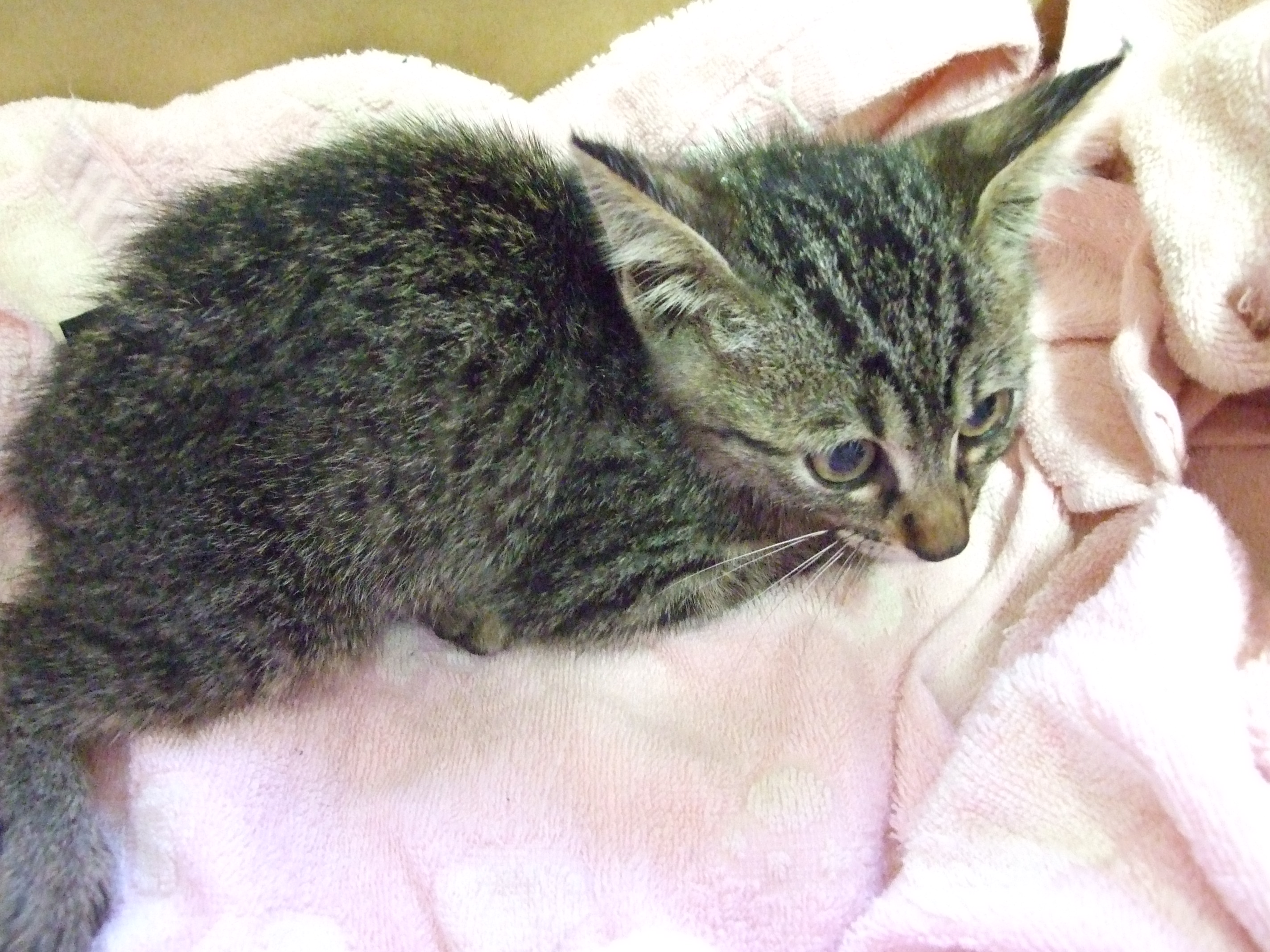
    My little foundling came home from the vet today, and as predicted he has to wear a cone around his head to stop him picking out the stitches on his many injuries. This means he can’t wash himself at all. An interesting thing is happening though – before he sleeps (as he is about to do now, on my lap) he tries to go through the pre-sleep washing ritual, even though the cone is still around his face. So he just licks the cone instead, while contorting his body as if he were actually cleaning himself. Once he’s done, he takes on an extremely hard-suffering expression, as if he’s read desCartes and knows that, deep down inside, he’s just a machine that responds to external stimuli.

    You’re not, Arashi-chan, you’re not!!!

  • The release of the wikileaks data on the “secret story” of Afghanistan has led to a frenzy of the usual shallow reportage one comes to expect of the media, and nowhere more shallow than in the sensational finding that death rates of coalition soldiers have increased over the last 7 years. The Guardian even has a “datablog” on this topic, and  a rather sad film about the realities of soldiering in that country[1]. According to the datablogs there has been a “sharp rise” in deaths, and everywhere I look on the internet I just seem to find numbers of deaths.

    I’ve been wondering about this for a while because the rhetoric around these numbers – in both opposing and supporting camps – seems to present these deaths as a sign of the catastrophic failure of the project, or the International Security Assistance Force (ISAF) or something. But I’m sure that over the years that “we” have been in Afghanistan, numbers of troops have also been increasing. And as the number of troops increases, so naturally should the number of deaths, yet something as simple as rates of death by available combat troops is not presented anywhere on the internet[2]. The same seems even more likely of IEDs, which have been a central focus of the recent discussion, and the missile attacks on helicopters. If you have 10 times as many troops in the field, you probably have more than 10 times as many flights, which means that there are more than 10 times as many chances for the enemy to finally successfully shoot you down.

    A graph of counts of deaths is shown in Figure 1, and it clearly appears that the number of deaths in Afghanistan is sky-rocketing. If one makes the (apparently reasonable) assumption that the number of troops in Afghanistan was at its highest during the “war” then it seems like evidence of a “growing insurgency” and other cliches much-loved by our journalistic “friends.”

    Figure 1: Coalition Deaths in Afghanistan, January 2004 - December 2009

    However, this isn’t actually the case. It’s hard to find numbers of soldiers in Afghanistan on the internet, though Wikipedia has numbers past 2007. However, I found a report (pdf) from the Congressional Research Service which gives the number of soldiers in terms of “Boots on the Ground”[3].  This is an estimate of the number of soldiers actually at risk of combat, and is presented in the report as the average per month from Fiscal Year 2002 to 2012. This makes it very easy to link the death numbers being bandied about to the number of soldiers actually likely to get shot at, and to calculate a rate. I’ve done this, and the result is shown in Figure 2.

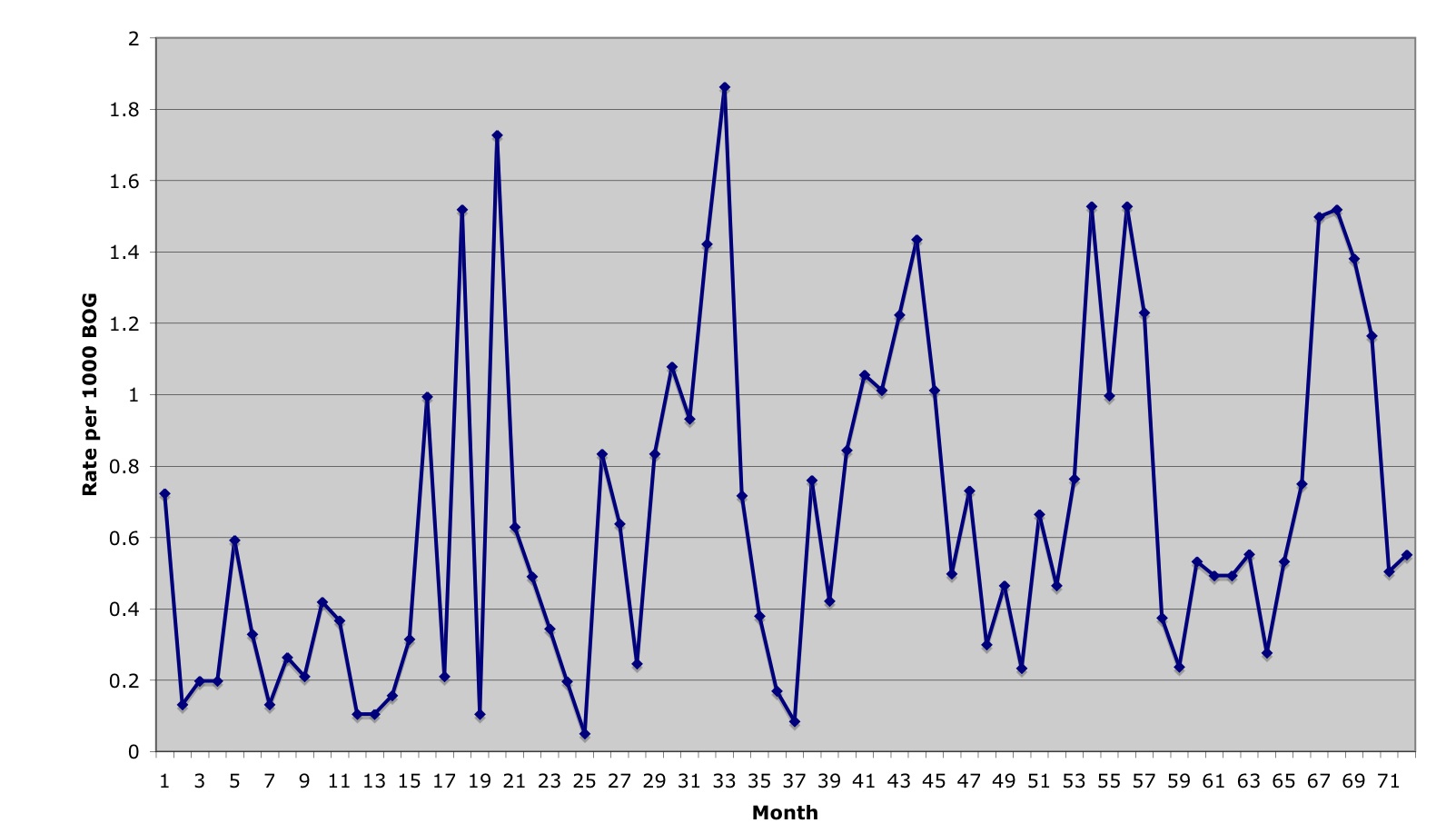
    Figure 2: Rate of deaths per 1000 Boots On The Ground in Afghanistan, January 2004 - December 2009

    It’s pretty obvious from Figure 2 that the death rate has not changed over 5 years in Afghanistan. What has happened is that the army has poured into the provinces and engaged the Taliban more extensively. It might be considered a failure of military policy to have allowed the death rate to stay static after 5 years but it’s not exactly a sign of a conflict out of control. The same conclusion should probably apply in spades to the IED numbers, and to the success rate for anti-helicopter attacks. In fact I wold argue that a static death rate is merely an example of a conflict not yet won, and one metric by which the US military should be able to assess the security of the provinces – it’s a useful tool, and provided it doesn’t go up they know they aren’t on the wrong track, though they could probably do better (and looking at the figures from the Guardian, in December 2009 a total of 87 civilians, 65 Afghan soldiers, 35 NATO soldiers, and 287 “Taliban” would agree with me if they were still alive).

    Other things to note from this data are a clear sign of spikes in deaths at yearly intervals, corresponding roughly to the summer months of June – August[4]. That pattern may not have existed in the first 12 months, which could be due to small numbers or might represent a 12 month period with no insurgency. If they had had 50000 “Boots on the Ground” in January 2004 would things be different now? This is a very feeble possible data point in favour of the conclusion that they might have been.

    This data is a really good example of how one has to consider the size of the risk pool in an analysis. I made this point about the HIP scheme, and it applies here too. There are many reasons to oppose the Afghanistan war, but there are enough casualties in this war without adding epidemiology to the list[5].

    As a final note, I’m opposed to both America’s current wars, though I understand how it was hard for the US to take any other approach to Afghanistan in 2001. I think it’s a tragic waste of life, especially Afghan, with little benefit for anyone involved in (or subjected) to the thing, and ultimately won’t be successful. Watching that movie on the Guardian website, with some young man dying on screen, his face blurred out because of the damage done, a piece of meat in the hands of both his medical team and his geopolitical masters, makes me angry at the evil futility of modern politics – and of course I don’t even get to see the nastiness dished out to the Afghans (except when wikileaks work their sinister magic). But boutique wars and vengeance dealt cold from 11000′ can be argued against without reference to bad stats. Especially stats as bad as some of what has been presented about Afghanistan!

    Oh, and finally, a few caveats:

    • The population I used was for American soldiers only, but I don’t get the impression that the balance of US to non-US soldiers has changed a lot since 2004, and obviously the conclusions here would be weakened if the relative ratios changed significantly recently
    • The death figures I used were ultimately the NATO official figures, not the additional ones from the wikileaks data. This is because the NATO official figures are usually higher than the wikileaks numbers I got from the Guardian. Interesting, that…?
    • This analysis could be made more sophisticated using monthly actual figures of boots on the ground, which are presented in a chart in the linked report, but I couldn’t be bothered because it wouldn’t change the outcome one whit

    fn1: watching that certainly puts my nervousness about a kickboxing fight into perspective!

    fn2: if you can find a rate, please show me!

    fn3: This is apparently a technical term. Secure that shit, Hudson!

    fn4: And who wouldn’t jump at the opportunity to spend 3 months lugging a backpack, a heavy weapon, and 5 litres of water into a combat zone in 55C heat? I really do think that this war asks too much of too many young people.

    fn5: And lord knows epidemiology has suffered badly in Iraq because of the American right and their objection to all forms of reason or logic.

  • Video of my kickboxing fight is here, at blogger… WordPress don’t allow it. The first video is very small and hard to see but the second one is clearer.

  • Found on the street in front of my house, an alley cat with two broken legs.

    Big Eyes Small Leg

    The leg in this picture has a compound fracture, the bone completely severed and moved around inside. He spat and hissed a lot, but once I got him by the scruff he gave in.

    Alley Cat Power… NULLIFY!

    I think he was injured by a car after he dashed from cover during the storm that happened that day (I found him just after the storm), so we called him “arashi” (嵐), Japanese for Storm.Currently he can’t run, but drags himself along at the speed of lightning with his mashed up back legs flipping and dragging on the ground. I love cats, I couldn’t bear to see a kitten like that, so I took him in.

    The vet said that he would be fine without any surgery, would learn to run on three legs (one leg is not really badly broken) and would be able to scavenge food with no problem. But until his leg heals, he is a likely victim of crows. I can’t stand the thought of a cat I walked past being eaten alive by crows, so he got the surgery required to rejoin the bits of his legs. 40,000 yen ($AUS500) later, he survived, and no phone call from the vet, so I presume that means no internal injuries. He spits and hisses and doesn’t like people, so if he doesn’t fit in as a house cat we’ll get him desexed and let him go. Otherwise, we’ll try and keep him.

    As an interesting aside, between my kickboxing fight and the trip to the vet, I’ve had a lot of opportunities to talk about smashing things, hitting things, attacking things, and being injured. My recent role-playing efforts qualified me adequately for these conversations – injury, attack, enemy, bruise, broken, wound, etc. are all words I learnt for role-playing. Survival, living, dying … the material of role-playing games is the material of a 3 month old alley cat’s world.

    Handy when I visit the vet, but not so great for poor arashi-chan!

  • On Friday night I had my first ever amateur kickboxing fight, in a ring at a summer festival by the beach here in Beppu. I was up against a local pimp, who is the same age as me but perhaps 5 kg heavier, and from the same gym as me. I think he lied about his weight because there is another chap in the gym who is REALLY scary who he would have fought if he were heavier. I was the 7th fight out of 10, in the main bout section of the evening, so my bout had ring girls and fireworks. I even had a boxing/K-1 style entrance with my own song (Shared Creation by Garden of Delight).

    The ring girls were supplied by my opponent – he works with them.

    Anyway, I lost the fight, due to a combination of a) only doing 4 weeks of half-arsed preparation, including a total of 3 rounds of sparring training 4 weeks ago b) being shorter and lighter than him and c) not really wanting to be there in the first place. I’m not sure why I agreed to do a fight or why I decided to only train twice a week and not do special sparring sessions, knowing I’d be up against it on Friday. But that’s what happens when you aren’t really into the thing in the first place, I suppose! I’ve been kickboxing for 15 years and turned down opportunities like this before, and I think I just felt like I had to do it, so accepted my teacher’s offer of a place in the festival without thinking too much about where I’d be 6 weeks later… then took 2 weeks off, and then started training…

    Anyway, the details of the fight go something like this:

    2 x 2 minute rounds
    1 minute rests
    Full protective gear (helmet, shinpads, 12 oz rather than 10 oz gloves)
    Maximum of two standing 8 counts
    Knees allowed but not to the head
    No elbows
    i.e. kickboxing rules, though often kickboxing rules don’t allow knees. Incidentally, I’ve seen a “no-knees-to-the-head” bout go wrong, with one woman deliberately kneeing the other in the head and getting a knockout. It’s very easy for that to look like an accident, and the referee has to decide whether to award the match over a mistake – that woman was not popular with the crowd, but I didn’t want to be on the receiving end of a repeat performance by my opponent. In the ring you do rely a bit on your opponent’s good manners, but I think me and my opponent get along okay usually…

    Also, the refereeing was conservative, so the ref stopped fights before he allowed anyone to get knocked out – no bloodbaths to be allowed.

    Round 1: We started off pretty equal but he signalled his serious intentions early with 3 really savage kicks to my legs, none of which I managed to block. When the third one came in I realised that I had to pick up my game or I was going to be a Technical Knock Out (I’ve seen this a few times at K-1, where a man’s legs give out and the fight is over). Did I mention 3 rounds of sparring 4 weeks ago? I was running primarily on my memory of serious sparring years ago! So I picked that up, and after that his kicks didn’t land. I delivered some vicious blows in return (and oh what a satisfying sound that is) and in the second half of hte round I heard the commentator (our sensei) saying how I am renowned for my strong punching, and realized that I hadn’t really tried any, so I closed in and boxed him into a corner, landing a nice hard right at some point that rocked his head – he didn’t like that, and pushed his way out of the corner with a series of ferocious kicks and punches. For some reason my usually tight guard was loose, and his punches were coming straight down the centre, which doesn’t usually happen to me in sparring at all – I don’t know what I was thinking[1]. I must have tightened up at some point though because I don’t have any facial bruising, though this could be because he moved to hooks, all of which I defended against. I copped him with a few nice hooks actually, he didn’t seem to be able to defend punches at all. But because he was tall, and using front kicks effectively, it was hard to move in and land punches, and everything was happening so fast that I didn’t have time to work out ways around his guard – typically against a taller man you have to work the outside, or duck and weave, and did I mention I only did 3 rounds of sparring preparation, against a shorter man? Also bobbing and weaving is a very bad plan when you’re in a fight where knees are allowed, so one of my two main range-closing tactics was out of whack.

    Round 2: So round 1 ended probably with him slightly up on points, but it was a good showing by both sides. Round 2 went pretty much the same way for the first half, with us exchanging heavy leg kicks, and I think all of mine landed actually but I checked most of his. I also got in a good middle kick that slipped half under his guard, but when you have a savage bastard trying to rip your head off you start thinking conservatively about middle kicks. Every time either of us hit each other you could hear it all the way across the beach, I think. I certainly heard it. Unfortunately things took a turn for the worse in the last half of round 2, because at about the 1 minute mark I managed a fairly solid series of boxing combinations, and in his desperation to get away he delivered a vicious knee to my stomach. I took it without being winded, even though it was a few inches from my solar plexus, but it was followed by this tiny moment frozen in time, where we looked at each other and both simultaneously realised that I don’t have any defences against knees. The next 20 or 30 seconds were spent with him trying to get in close enough to land some solid knee strikes, and he succeeded at least twice, and they FUCKING HURT, and I realised that this was not going to keep up, so I had to start backpedalling and trying to hold him off with kicks, while he hunted me down. There was no getting around this – it wasn’t a matter of me doing anything, because I don’t know how to defend against knees (I’ve done maybe 8 rounds of training with knees in the last 10 years), and he knew it, and every time he threw one I was going to cop it. As a sign of how tall he is, today my upper chest is hurting from the knees that landed on my ribs. I managed to get him in a clinch and nearly threw him despite his bigger size, but kubi zumo (neck wrestling) is also not my area of expertise and I only did that out of desperation. So the last 30 seconds of both rounds won him the fight, and the last 30 seconds of round 2 sealed it. I did think about mentioning a no-knees rule when the fights were organised, but didn’t. Oh well, silly me. How was I to know that being kneed in the chest by 75kgs of enraged pimp would hurt?

    But, on the bright side, I didn’t suffer any standing 8 counts – maybe the first fight of the night to get through without standing 8s – and I landed some decent blows myself, and I think if I had been fitter and had some more sparring preparation under my belt, I probably would have given him a really solid challenge. Unfortunately, that “I don’t want to be here” feeling that pervaded the last 4 weeks kind of prevented me from putting in a decent showing. I have only myself to blame though – I could have turned up on two of the last 4 sundays for example, and done an hour of decent sparring each day,  and probably would have been a lot tighter on the night. Today my left leg is sore from those missed checks, and my chest aches, but I am otherwise in good nick and feeling very relieved that a busy period of my life and a stressful fight are out of the way.

    It was not fun! But it was a good experience that I almost certainly won’t repeat. I don’t recommend it to any of my readers either. Once I figure out my partner’s snazzy phone, I’ll put up some video. It actually looks quite good, though I’m not recognizable in amongst the helmet and the sweat and the flying limbs, but I think I look reasonably professional. I hope my readers wince watching it as much as I did when it happened.

    fn1: actually I was mostly thinking nothing. I was nervous and flat before the fight started and then everything was going so fast that I didn’t get to think much at all, bar the crystallized moments of the emergencies. Usually when I spar it takes me a few rounds to get into the groove, and I didn’t have that luxury this time around!

  • A few weeks ago I played in a Double Cross 3 session, and wrote up a few reports on it. This post constitutes the final report on that session, in which I describe my experience of the Lois and Titus rules and how they affect gameplay.

    Lois and Titus

    When you roll up a character in Double Cross 3, you are also required to generate a set of Lois‘s. Lois’s are people you know, connected to you through your life path, who help to keep you connected to the real world of ordinary human life. They can be colleagues, school-friends, family members, or people who helped you in your earlier life. When you develop these relationships you have to roll up a negative and positive trait for them, which will be things like “envy” and “charity” or “rivarly” and “love,” and you then choose one of these traits to define your relationship to the Lois when you start the game. Lois’s don’t have to be present in your life during play – they can be memories, distant figures, or the legacy of dead people.

    Ideally, as you adventure in a rich world of secrets and superheroes, you gain more Lois’s. Your Lois’s have three direct effects on the game-play:

    • They give you allies and contacts you can call upon. These people aren’t henchmen, but people tied intimately to your lives who will aid you when you need help
    • They give the GM (and the players) adventure hooks. Just as they will come to you when you need their help, so they also will come to you when they need your help, which gives the GM a lot of opportunities to start or interfere with adventures
    • They save you from corruption. As you adventure, your use of your virus-related powers increases your level of corruption, which draws you ever closer to losing your humanity and becoming a germ. At the end of every session you get to roll 1d10 for every Lois you have, and subtract this from your corruption total. The lower your corruption the weaker your powers, but the higher your corruption the greater the risk of permanently sliding into darkness and ruin

    This type of relationship could actually be introduced to Warhammer, come to think of it…

    But there is another aspect to the Lois’s which makes them particularly potent. Their kindness (or their memory) can be abused, at which point they become Titus, so-named after the Shakespearean character of that name. A Titus is a lover spurned, a friend whose kindness was abused one time too many, a family member with a grudge… they pursue you to the end, wrathful as only someone once-loved can be. A Lois can become a Titus through your own stupidity, or through the game-mechanics device of sublimating a Lois.

    Sublimation

    When you sublimate a Lois you get rid of them from your life altogether, passing them from Titus through to gone. In the process of doing this you gain one of a series of in game benefits – adding 10 dice to a single roll, or healing a certain number of hit points, and so on. The in-game benefits that derive from this are quite significant in some cases – 10 dice is a phenomenal bonus – and well worth tossing your grandmother in front of a bus for. I think you can also do this with Lois’s who have become Tituses through the story (rather than a deliberate choice by the player). I’m not sure what the downside of burning a Titus is, besides that you have lost a story hook – this seems to be a way to get a vengeful ex-lover out of your life, which is only a good thing, right?

    I haven’t read the section in the rulebook about this yet (I’ve been very busy) and we didn’t get around to seeing the benefits or disadvantages of a Titus in the game I played. So I’m not sure why one would allow the process of deLoisification to stop at merely producing a Titus, but I’m sure there’s a good reason.

    The big downside of burning a Lois, of course, is that you then lose the ability to call on them for corruption amelioration, which will make your adventuring life a lot shorter than it would otherwise be (not that your Titus will care).

    Game example

    In my game, I sublimated my mother and the memory of an old, long-dead client of the Robot-driving business he worked for. I sublimated both of these Lois’s in order to regain 1d10 Hps each time (hey! what can I say? I sell my loyalties cheaply). My relationship with my mother was characterised by hostility, due to anger at her tolerating my Father’s secret membership of the False Hearts; my relationship with the memory of my dead ex-client was ishi, the will of the dead, some long-carried-over request or obligation to his memory.

    So how did I burn these Lois’s to get a healing surge? The first was my Mother, whose memory I discarded like an oily rag after the minions of the False Hearts struck me down in an alley. I imagined this as my character realising he had been ambushed and outdone by the False Hearts, and as he struggled to retain his consciousness, recognising that all his life he had been thwarted and ruined by that hateful organisation first manipulated and preyed upon by his father in pursuit of a secret goal, then pursued through the dangerous underworld of Tokyo when he worked in the mecha business – perhaps even to the death of his client – and now to be hounded to death? All this was too much! And then I imagined that his mother called him on his cellphone, just as his last breaths were ebbing away, and that call (of course it has a special ringtone) penetrated the fog of impending unconsciousness – here was all his anger at the False Hearts crystallized in the form of the woman who he had always felt had betrayed him and who would not relent from constantly trying to get him to forgive her. Why should he forgive anyone for the harms done to him? I imagined him surging back to life, anger at his mother charging through him in the form of his viral payload, generating a healing surge at the same time as it destroyed his cellphone in a vicious series of sparks and lightning bolts. Just as every anime character has to surge to wakefulness with a scream at least once [1], so Kintaro regained consciousness surrounded by clouds of electric rage, blasting his phone and symbolically eliminating his mother from his life.

    The next was his client. This time Kintaro had been knocked down by the False Hearts leader, his life’s blood ebbing away in some shitty Tokyo Snack. Again, as he felt his defeat looming, he remembered all the failures and defeats thrust upon him by this sinister organisation and raged against them. This time I imagined Kintaro had given up on his hopes of a normal life, and realised he had to fully embrace the powers he had inherited, rather than pretending he could continue to live like a normal person. He would have to cast aside his past life and devote himself to destroying the organisation that had so plagued him. So thinking, he cast aside his last contact with the ordinary world – his last Lois from outside of UGN – and all the long-overdue obligations it had shackled him with. Surging back from that fading state, again imbued with electrical power, he screamed his rage at the world that had wronged him, and reentered the fight…

    Conclusion

    Lois’s offer excellent game hooks, dramatic opportunities and mechanical advantages. They also offer an excellent narrative technique for justifying (and stunting) healing surges, recovery from corruption, and other phenomena that might otherwise just seem like in-game fixes. I think they could be repackaged in some way as an excellent addition to Warhammer as a mechanism for helping draw PCs back from insanity or corruption. They are another example of the differences between Japanese RPGs and Western RPGs, and an interesting example of incorporation of a dramatic element into the game through the rule system.

    fn1: I’m reminded of when only one company distributed anime in Australia – was it madman entertainment? – and their adverts always involved a screaming guy, and someone else yelling “what’s going on in here?!!!”


  • Having outlined my thoughts on my first Warhammer 3 session, I will now give the actual session report. This adventure is a preliminary adventure for the adventure An Eye for an Eye, which comes with the basic rules pack and seems a perfectly decent introductory adventure to try out. The plan for today was to give the characters a reason for being together, and being at Grunewald lodge. Some of the background material I’ll present here probably represents my own take on the warhammer world – I didn’t do too much reading about the region where the adventure was set so I don’t know if it’s a reasonable depiction of the area.

    Winter in Bogenhafen

    The characters had gathered separately for their own reasons in the small town of Bogenhafen. The adventure starts in early January, deep winter in the region, with the characters choosing to weather the snows and storms of the Reikland in the (relative) comfort and (relative) austerity of Bogenhafen, due primarily to a lack of money, and perhaps to look for the traditionally easy and relatively safe work that most small- to medium-sized towns in the Reikland offer in winter – relatively low-risk escort and town guard work.Typically north-south caravans reduce in number during the winter months, due to inclement weather in the Grey Mountains, and the normal work that PCs do in Bogenhafen during this period is the safe and low-paying work of escorting caravans between Bogenhafen and the towns of Helmgart, Ubersreik, Stromdorf and Auerswald, further to the east and on the far side of the Reikwald forests. This winter trade is very important to Bogenhafen, because it brings in traditional winter fare that makes the otherwise tedious and dark days of deep winter more fun. There is honeyed mead, smoked ale, black rye bread and treats from the South East, and in February after the coldest part of winter is over,  a large festival is held south of the Reikwald, culminating in a society ball in which the young women of those towns who came of age during the winter get to enter society proper.

    Unfortunately life in Bogenhafen this winter has proven exceptionally boring, because a large tribe of beastmen moved into the southern Reikwald forests to the East of Bogenhafen, and have been molesting the Reikwald road, preventing the usual small trading caravans from getting through. In the absence of large numbers of soldiers to protect these caravans, the traders of Bogenhafen have stopped trading, and for the last 2 months nothing has moved East from Bogenhafen. Since adventurers are only hired for caravans with soldiers already attached, there is no work for the characters in Bogenhafen, and they have spent the winter so far drinking, lounging, and getting into fights.

    The traders have not been able to find soldiers for their caravans because most mercenaries commonly in the area during winter have moved south to the Grey Mountains, where significant greenskin trouble has led to a great demand for mercenaries; and the usual regular soldiers that might be supplied by nobles of the area have been held back, due to land disputes between the nobility that require them to deploy their soldiers in border skirmishes. Bogenhafen, finding itself on its own for the winter, has opted to wait out the winter without the usual trade caravans, and to appeal to Altdorf for soldiers in Spring when the troubles in the Grey Mountains are expected to subside.

    It is against this backdrop that the characters find themselves slumming it in Bogenhafen, perhaps aware of each others’ presence in town but not yet acquainted.

    The characters

    The characters are

    • Suzette, Initiate, of the Cult of Morr, a 14-year-old girl recently fled from the Chaos incursion to the North
    • Shultz, Apprentice Wizard, of the Celestial Order, who usually trains in Altdorf but has decided to spend his winter holidays in Bogenhafen, taking in the country air
    • Aruson, elven thief, who is wandering around the lands north of the Grey Mountains looking to find out what the human world is all about
    • Heinze, soldier, who has taken some time off from his standard career and finds himself stranded for the winter in Bogenhafen without much money

    They are staying at different pubs in the town, and not finding much to do in the depths of an adventure-less winter. All are first level. I fudged the money a little to give Heinze and Suzette slightly better arms and armour than they would get as standard, primarily for variety. I don’t like a party where everyone is wearing leather armour. I think I also fudged on the training rules a bit to ensure that at least one character (Shultz) had the ability to read.

    The Road Opens

    One day in January, in the late afternoon, with snow falling gently and the world grey and frozen as ever, the characters in their separate pubs all hear a sudden uproar. Emerging from their cups to investigate, they find a crowd gathered around two roadwardens, who are striding muddied and exhausted into town along the main road from the East. Eager to find out more, the characters join the throng as it enters the town square and the two Roadwardens mount the ever-present gallows, to give the following speech:

    Men and women of Bogenhafen! We are roadwardens from Ubersreik, and we find ourselves here in Bogenhafen after a week on the roads, walking here from the towns of that distant region. We have scouted the lands to every side of the road, most carefully and at great risk to ourselves, and bar a small encounter with some greenskins who will eternally regret their impertinence, we now find ourselves arrived safe here in Bogenhafen

    Men and women of Bogenhafen, we can tell you now – the road to Ubersreik is open! The beastmen have left the Southern Reikwald en masse, abandoned their camp and left only a few greenskins to guard their old stomping grounds. Something or someone has driven them off, and the road is again yours!!! Even now, without rest, we two roadwardens aim to turn around and leave this town as soon as we are able, the sooner to return to Ubersreik and inform the good Burghers of that town that they should send forthwith a large cargo of their best ales and sweetmeats!!!!

    With this final declaration the crowd was immediately in uproar, cheering and yelling, but when they calmed a little, Suzette was able to yell in her clear and child-like voice the question on everyone’s lips: Will the Winter Solstice Coming of Age party happen?

    The roadwarden’s response, so flattering as to have been uttered by a Tilean, was to say

    Good men and women of Bogenhafen, let us not be rash! It is well known that across all the lands of the Southern Reikland, the young women of Bogenhafen are famed as the sweetest, gentlest and prettiest lasses to be had for work or wedding; and it would be a tragedy whose cost could not be counted in tears were those pretty young ladies to be sent rashly to a horrible death on the lakeshores south of the Reikwald. Before any decisions are made as to whether to hold a party to celebrate these flowers of Reikland maidenhood, we need more roadwardens to be sent from the towns to investigate the safety of the Southern Reikwald in more detail, and a meeting of Burghers from all the towns. Heaven itself would spare us no wrath if such beauties were to be endangered by poor planning!!!

    But I can tell you, friends, based on my 10 years wandering these roads, that my judgement of the situation is optimistic, and our burghers when they meet will judge the lands of the Reikwald to be safe, and the party will go ahead, though preparations be a little rushed. And who will care if the garlands are not as splendid as last year, or the board does not groan so strongly with the weight of good Reikland beer? For men of standing will eat bread and drink water under torn newssheets, for the chance to make eyes at a pretty Bogenhafen lass!!!!

    So saying, he roused another great cheer from the crowd, and an enterprising inkeep leapt to the gallows to yell “Bring these doughty men to my pub, The White Lizard, that we may all toast their bravery. The first toast is on me!!”

    Receiving no complaint from the crowd, the roadwardens descended the gallows and set off to The White Lizard, the PCs in tow.

    The Mayor’s request

    The characters sat separately and alone at the White Lizard, drinking a little and watching the party, but soon their reverie was, separately, broken, by  a surreptitious message delivered in a variety of different ways by a carefully inconspicuous man, who made to all of them the same request: the Mayor wants to meet you upstairs at the Purple Chick, to discuss possible work, and mere attendance there, if done subtly and without raising suspicion, will earn you a silver shilling.

    They all, of course, jumped at the opportunity and after a suitably subtle interlude found themselves meeting the mayor in a well-appointed meeting room upstairs in the Purple Chick. Here the mayor, a portly red-faced chap with preposterous claims to a youth spent soldiering, outlined to them his basic problem: what, exactly, made the Beastmen go away? Had they been driven off only to be replaced by something worse, something more subtle and devious? He needed brave souls to find out what that thing was, but he also needed those brave souls to be unconnected to the normal populace of the town, for if a group of the town’s militia were sent out they would surely arouse panic. So the characters were offered 20 shillings each, and a month’s free accomodation in the rather upmarket Golden Bell, if they would  depart, in secret, tonight, and investigate the cause of this turn of events. They would be paid upon their return with information, and there would be no payment for a report that stated “no reason.”

    The PCs, of course, agreed, and so they asked a few questions about where to find the Beastman lair. In short: the Beastmen maintained a small nest of goblins to keep an eye on the road, and from that nest the characters could easily track their way back to the Beastman camp. They merely had to set off on the road, in dead of night, looking for a nest of goblins… understandably concerned, the PCs asked as to the whereabouts of anyone in town who might know the area and the goblins, and the mayor directed them to a drunkard in a poor tavern at the southern edge of town. They set off to learn more about the local greenskins.

    Four brash young fools walk into a bar…

    The characters soon found themselves entering one of the seediest establishments in Bogenhafen, the White Elephant. With a big party going on in the middle of town, this bar was nearly empty, occupied only by an irascible dwarf, a rather shoddily-dressed young lady of dubious profession, and their mark, a drunken middle-aged man already well into his cups. The Dwarf, as soon as he saw Aruson, stood up, threw down his cup, said something unpleasant about a bad smell in the room, and stalked out. The dubious young lady marched up to the elf and told him, “You just messed up my evenin’s work, hoity toity! That was 2 shillin’s I was up for there. You gonna make it up to me, free of obligation, or do I ‘ave to raise ‘ell?!!!”

    The elf, being an elf, stood in a state of confusion, staring down at this strange creature, and then threw her 2 silver shillings. [game terms: the player, Mr. Miyao, declined to make any social check to get rid of her, and just wanted her out of his way]

    They approached the table, and after a short conversation and some purchasing of drinks, set about getting the information they needed. Heinze the soldier took the lead, speaking as one soldier to another to try and draw out the drunken sop’s feelings of camaraderie and responsibility for the purpose of helping a fellow soldier. Although this worked beautifully, it took many hours of drinking and it was a near thing – when they left the pub their mark was passed out under the table, having drunk his weight in strong liquor, the PCs had spent 3 shillings, and several hours had passed. However, they had precise details on the number of beastmen – about 40 – and the number of goblins – about 12, mostly henchmen, usually with one acting as a scout along the road. [game terms: Mr. Kaede used leadership skill to enact this conversation, and exhausted his “I know a guy…” talent to boost it, perhaps calling on superiors they both knew to back up his claim to deserve good information. He rolled a phenomenal number of successes but he also somehow managed to dredge up quite a few misfortunes, so I decided he got all the information they needed, but at a very high price in liquor].

    The Goblin Scout

    And so the characters set out, to find the goblin nest. Within a few hours they had noticed that they were being tailed by a scout, but in the dark with the woods so near they couldn’t find him. They knew that he was there though, and when they began searching for him they also knew that he was making a run for it. They gave chase, into the forest at night. After a couple of hours they stumbled into a starlit clearing and there he was, in the open, trying to cross the clearing towards them, all unsuspecting. They had caught him! [game terms: I set this up to test the progress tracker and it worked beautifully. I had them do challenged observation checks, with one character (the elf thief) doing the main roll and the others explaining how they used a skill to support him. The soldier used leadership to direct the search, the initiate used minor blessings to keep everyone calm and functioning, and the wizard used light spells to help with the search, giving the thief 3 extra fortune dice. Still, the first few rolls were atrocious and the goblin was halfway up the progress tracker before they finally got him].

    Battle was joined, and the goblin was soon defeated and forced to reveal the location of his nest. They then set out for the nest, and arrived at the first blush of dawn.

    The nest 1: killing the guards

    The nest was a two-level cave set on a hillside overlooking the forest and the distant road, with a cairn of rocks on top that could serve as a sniper’s nest. The characters were some distance from the nest in the forest, but they could see a goblin leader lounging at the main entrance to the cave, and Shultz noticed a goblin hiding in the cairn, carrying what looked like a very powerful blunderbuss of some kind [this was actually a fumbled observation check]. They couldn’t think of a way to get to the nest without being spotted, so they came up with a plan. Heinze the soldier hid near the entrance to the forest and Aruson the wood elf thief made a suitable animal noise, that would sound like the Goblins’ favourite food animal, in pain and close, i.e. easy food. Shultz would cast a cantrip to make a few dazzling spots of light – like dawn sun on falling snow – to prevent the goblin from looking too closely at Heinze’s hiding spot, and they would draw out the leader for Heinze to kill quickly from the shadows. Four one one with an ambush set would surely happen too fast for the goblin sniper to notice, and then they could perhaps sneak up on the sniper.

    This they did, and Aruson’s call was so effective in making the goblin leader think a young deer was trapped just inside the forest that he called down his sniper too, and they both came to get their breakfast. [game terms: the wizard’s cantrip added a fortune die to Heinze’s poor stealth skill, and Mr. Kaede discharged his Reiklander special ability to add another 2, which won him just enough successes to make his stealth. Aruson got the usual benefits for being a wood elf doing this sort of thing, and he also got his thief’s extra die on skullduggery. He rolled up a big success and a sigmar’s comet, so I ruled that the underling joined the leader].

    The ambush was over in a few seconds, Heinze landing a savage attack that tore the goblin leader apart with one blow of his spear[1], and Aruson ambushing the underling to deadly effect. They had opened a path to the cave without alerting anyone.

    The nest 2: killing everyone else

    They moved quickly to the cave mouth, and Aruson sneaked inside to see what they were up against. Unfortunately he failed his stealth check; but since he also got a sigmar’s comet (again!) I decided to rule that he realised before it was too late, and ducked out again without being seen but without getting the information he needed. Lacking the information they needed, the characters charged in, to take on 2 Goblin leaders and 8 henchmen in the final battle.

    This battle was over in, I think, 4 rounds. In the first round the goblin henchmen unleashed concerted fire on the wizard (one group of 4) and the soldier (one group of 4). Somehow they shredded Heinze but missed Shultz consistently for all but 1 round (when he took a critical). The goblin leaders also moved for Heinze, and failed magnificently – a bad situation, since Heinze’s main talent is recklessly destroying everyone in his path. Shultz deployed a Cerulean Shield to block incoming crossbow bolts (to considerable effect!)[2] and then unleashing magic darts at the goblin leaders[3]. Suzette deployed some supporting magic and then charged into battle with Morr’s Touch enveloping her tiny fist. Aruson tried to disengage from combat and use missile weapons, which I ruled meant that he suffered a free attack (let’s call it an opportunity attack!) and took some damage. Everyone took some damage, and Heinze was so badly damaged that Suzette had to try administering first aid during combat, but they survived (just).

    So, after a short but brutal battle the goblins were vanquished and the PCs were able to take their stuff. Amongst their stuff they found a note, written by the beastman leader to the Goblins in common, that declared:

    We are moving North to some human hovel called “Grunewald Lodge,” at the other end of this forest, where there is a great artifact of chaos that we can devote to our gods. Maintain an eye on that road, for our return, and don’t even think about raiding the remains of our camp, unless you want to be the first additions to the midden pile when we get back.

    They had the information they needed for the Mayor, and a tantalizing clue to a new adventure. Should someone go and warn the folk of Grunewald Lodge of what was coming? Did they know about this “chaos treasure”? What secrets lay beneath that distant Lodge? Curiosity, as they say, killed the cat – will it kill our intrepid heroes?

    fn1: I like the weapon rules in Warhammer 3. The spear has been transformed from a “why bother” weapon in D&D to a nasty piece of badness. You can parry with it every round, it has a good critical chance, and your special abilites are fast with it. These rules also make a dagger a wise investment for someone who can’t use a shield. Very good thinking!!!

    fn2: the shield’s property of rerolling fortune dice means it’s very useful deployed against groups of henchmen, since a group of 4 henchmen will likely have 4 fortune dice in total, one for the main guy using an aggression point and 1 for each of his mates.

    fn3: He also has the shooting star spell but it seems weaker than magic dart, so I can’t make sense of it.

  • Last night I had the pleasure of running my first ever Warhammer 3 session at my local FLGS. Because my local FLGS is run by a Japanese man in Japan, I naturally had to run the session in Japanese. This obviously raises a lot of challenges, including:

    • Explaining the rules
    • Helping players use cards in a language they don’t understand
    • Choosing language for a whole bunch of things I am completely unfamiliar with

    So, here is a brief description of how I handled this stuff.

    Brash Young Fools indeed!

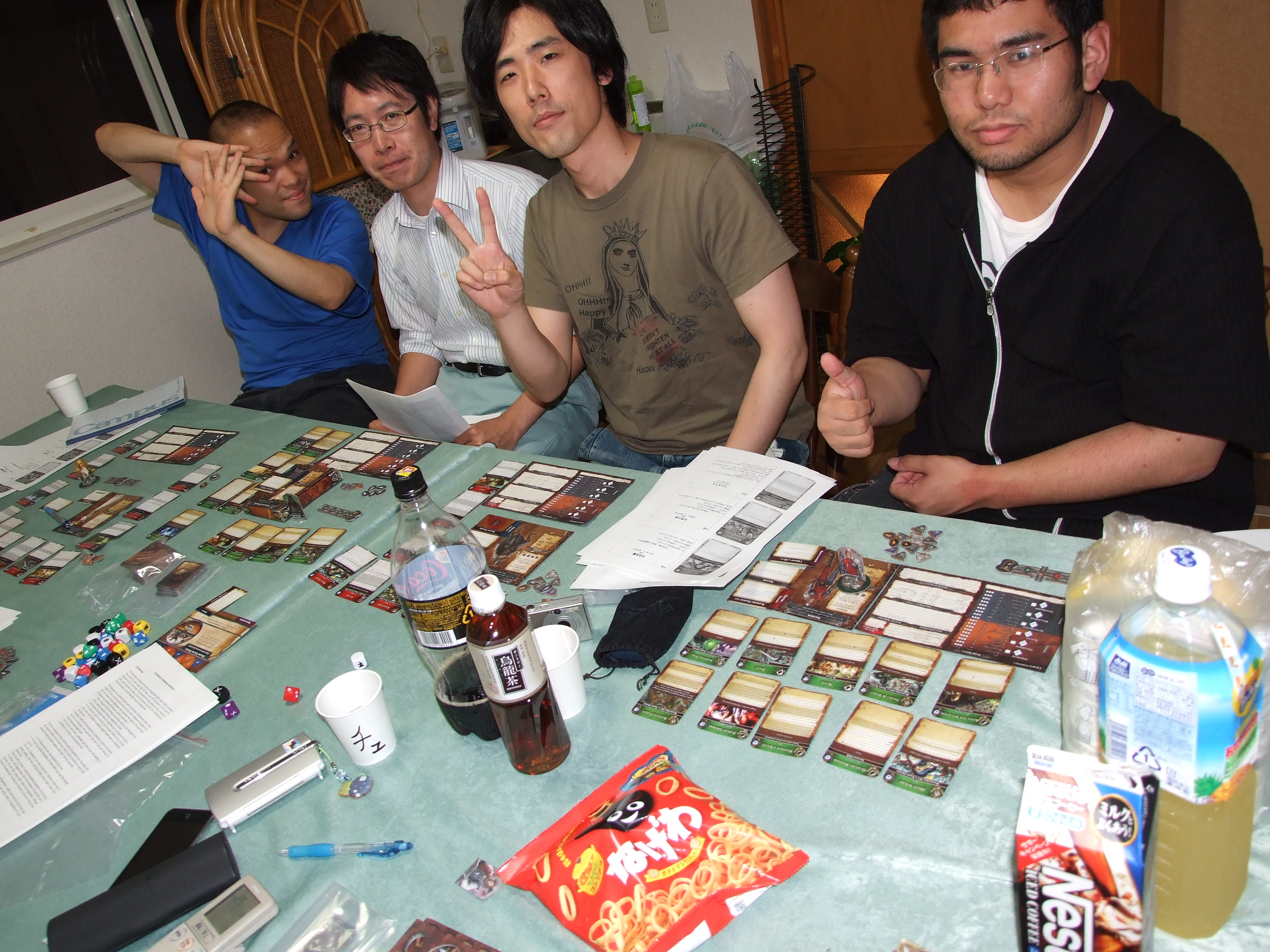
    The group Our group of Brash Young Fools is shown in the picture, from left to right – Mr. 123, Mr. Shuto, Mr. Ringtail (the shop owner) and Mr. Kaede. Mr. 123 has previously GMd Warhammer 2, using the Japanese version, so is very familiar with a lot of the world, and Mr. Ringtail is a big fan of warhammer wargames, which have been translated, so he’s familiar with the world too. Both Mr. Kaede and Mr. Shuto have played in Warhammer campaigns at least once, so the background didn’t have to be explained so much. The characters they played were:

    • Mr. 123: A 14 year old Initiate, called Suzette (a girl, related to the adventure he ran for me)
    • Mr. Shuto: An apprentice wizard
    • Mr. Ringtail: A thief
    • Mr. Kaede: A soldier

    It should be pretty obvious that these characters weren’t chosen randomly – I selected them to give maximum exposure to the rules, maybe not such a wise plan, since it meant a lot more language-related work (and rules-learning). We played on level 2 of the FLGS, and we were running a kind of introductory hack-and-slash that was going to run into a reason to play the adventure from the adventure book, An Eye for an Eye. I’ll give a game report separately. The language problem Unlike pathfinder, which involves a lot of transliterations and has an online wiki from which I can learn all the language I need, the tradition in warhammer is to give often quite prosaic Japanese translations to all the details. With so many careers, actions and talents at hand, this makes for some translation difficulties. The attributes, careers and skills are covered partially by Warhammer 2, which gives these translations (even bone-picker is translated!) However, the action cards and all the specific language of the progress meter, dice etc. I had to cobble together. I also had to find a way to explain all this. I bought the Japanese version of Warhammer 2 but it only arrived on the day of the game, so instead I had to make a lot of headway on preparatory work myself. I approached this in the haphazard way I approach all my Japanese language tasks, and basically it went like this:

    • I scanned in the reckless side of the action cards the players would be using, and inserted them into a word document with translations along the same structure on the same page (you can see an example in the photo).
    • I cobbled together language from the pathfinder wiki[1], and using JDIC and the only Japanese RPG I know, Double Cross 3, which meant that some of the work I did was a little off-beam, and some of the words I found unusual or archaic
    • I assumed that my players would be able to read some basic sentences, so we could work out the details of the differences between red and green cards as we went (this only created a problem once)
    • I did some pre-translation work for the players to read on my blog, with an example, here and here
    • All the key language I used I put into tables of words to distribute on the day (which I then only made one copy of, because I’m stupid)

    Based on this, I was able to give an explanation of the basic rules when we started, and leave the players to muddle through the cards without making too many suggestions. For the soldier and the thief it was pretty much plain sailing, but for the wizard and initiate it was harder, especially since I don’t know the spell rules very well and they aren’t … um… clear in the original document. Game flow Things were a bit slow at first, primarily because it took some time for people to work out what to do, and I had to check the odd rule (particularly about magic). The first opportunity at a skill check – getting a “dirty woman of unclear profession” to leave the thief alone after he was responsible for driving away her, ah, business associate – ended in disaster because Mr. Ringtail didn’t want to test out his guile skill; but then Mr. Kaede took on the leadership skill very well and constructed a skill check to influence their informant which he was well able to stunt – I added a few fortune dice to his roll, and everyone immediately became aware of the role-playing benefits of the dice system. They used this well later on, with the thief mimicking an animal, the wizard using a cantrip to confuse matters, and the soldier hiding ready to ambush the goblin they were luring. This was a great stunt, and also enabled me to use the fortune pool in the party sheet well. So in terms of grasping the broad concepts, the players caught on well. Mr. Kaede’s use of his soldier’s reckless cleave was good, and he grasped the details pretty quickly, as did Mr. 123, though sorting through all his Initiate’s cards was a bit of a challenge. The main challenges to flow came from establishing how to use magic, which seemed to involve a lot of different types of check with very little clarity about the order. I revised that today and will give the players a brief list of what they have to do to help with that. Otherwise, we managed to fit in all of the following in 4 hours:

    • rules explanation
    • adventure introduction
    • one incidental encounter with the woman of dubious profession
    • one social challenge to get information
    • one physical challenge, using a progress tracker to pursue a goblin scout (resolved well, at night, by the elven thief with the help of everyone else) followed by a brief and bloody end for the poor greenskin
    • two combats, the first an ambush outside the goblin lair, and the second a vicious bashing fest inside

    So even though things went quite slowly in individual encounter moments, overall the adventure fitted in quite a bit of material, and some really good role-playing opportunities. The players have taken home their action card explanation sheets, which they can study, and I’m going to forbid them from spending their advances on new actions or talents until they’re more familiar with the basics (and I have more time to translate cards!!!) Kaede san’s soldier certainly needs some more wounds anyway. Some final observations As I’ve noted before, Warhammer’s blend of dark fantasy and European realism seems to really appeal to the Japanese RPG sentiment, and everyone really got into the grotty winter world of Bogenhafen. They also seemed to appreciate the role-playing opportunities in the dice, which is good. We’re meeting again in two weeks. A few other notes:

    • The probabilities can be a  bit skewy. My goblin underlings concentrated fire equally on the soldier and the mage, and over 4 or 5 rounds they nearly killed the soldier but the mage was unharmed. That’s weird!
    • The rules are vague in places and sometimes I’m not sure whether I’m house-ruling well
    • I can’t tell how challenging an adventure will be, which is a problem I’m not used to. I need more experience with dice pools, but even then the unique mechanics of Warhammer 3 mean it will take some time before I know what’s going on
    • This game is cool! The dice give a lot of role-playing opportunities and the rules have liberated Warhammer from the two grinding problems that made Warhammer 2 so hard to enjoy: the inability of beginning PCs to actually do anything, and the intense, grinding tedium of the battles.

    I think my players agree with most of that, and are getting into the gaming quickly. I’ve got a feeling that the warhammer 3 system may be very well designed to encourage the type of GMing and gaming I prefer – loose adherence to rules, stunting of actions, descriptive content and encouragement of diversity in outcomes from individual rolls. It also has the kind of death spirals and critical-heavy combat system I like, without bogging it down in detail (as far as I can tell). I think it may also have resolved the issue of henchmen vs. main enemies. Both D&D 4 and Feng Shui have a system of henchmen (“mooks”) and main enemies, but the henchmen serve only to bog down and slow the game, rather than to add quickly-overcome challenges. In this session, at least, the henchmen were both a threat and easily killed, which is what henchmen should be. Game report to come. — fn1:The pathfinder wiki is useful because like most translations of foreign RPGs into Japanese it puts the English names next to important Japanese phrases (for things like skills and feats), so it makes it really easy to find the right word for the concept I’m looking for. I know Pathfinder well, so I know for example the difference between “proficient” and “specialised” and I can be confident that the translations in the wiki will be useful for me. Then I get around the problem of millions of kanji I don’t know very simply using rikaichan, which has to be the most useful software ever invented[2]. You wave your mouse over a word and it gives you the reading and the English translation, so then you can type it yourself. fn2: This has to be an example of the benefits of whatever licensing procedure is being used by the firefox team. I don’t like firefox much, but until someone comes up with a version of rikaichan for safari or chrome, I am only ever going to use firefox. This, I think, is why Windows is ubiquitous – for years the only functional spreadsheet was excel for windows, so windows spread through the corporate world regardless of its inherent crappiness. Excel is the best there is, and that’s all Microsoft needed.

  • How does he keep the hat on…?

    This post, third in a series describing my recent experience playing the Japanese role-playing game Double Cross 3, which I have been reading and recently had the chance to play-test, describes the character I played, Kintaro.

    Character Concept

    Kintaro, aka “The Noble,” is a pure-breed Black Dog syndrome male in his mid-20s, who works for the UGN company and hails from a wealthy family. He is a section chief at UGN, and like most Black Dog Overed, relies on physical strength and the power of lightning and storms to do battle. Black Dog powers don’t have much subtlety or information-gathering power. They smash and fry things. Kintaro’s work history is as a mecha-driver and engineer, using equipment similar to that seen in Aliens or Avatar.

    Statistics

    Kintaro’s stats are:

    • Physical: 6 (melee 4, resistance 1, Robot-driving 2)
    • Sense: 2
    • Spirit: 3 (Will 1)
    • Social: 1 (Provisions 2, Knowledge-UGN 1)

    Hit points: 35

    Effects

    Kintaro knows the following effects:

    • Resurrect (lvl 1): regain 1d10 Hps, but must have a corruption score below 100 to use
    • Warding (lvl 1): Turns non-overed NPCs into “extras” for the duration of a scene
    • Concentrate (lvl 2): Reduces the critical number required for any effect with which it is combined by the level of this power
    • Cyber Arm (lvl 3): Kintaro has a nasty-looking cyber arm that does bad stuff to bad people
    • Arms Link (lvl 2): Adds [lvl] in dice to Kintaro’s attack roll with his melee skill
    • Lightning Attack (lvl 2): Adds 2x[lvl] to Kintaro’s attack power (the damage he does with his attacks)
    • Shield of ball lightning (lvl 2): Adds 2x[lvl] to Kintaro’s guard value (for resisting damage)

    Kintaro has one power which he composed of a combination of 4 of these abilities.

    Strike of the thunder arm (雷腕の攻撃): Combining the Cyber arm, concentrate, Arms link and lightning attack effects, Kintaro can add 2 dice to his next attack, reduce the critical target from 10 to 8,  and increase the attack damage by 4. His total dice pool using this combination is 8, and he adds 10 to damage after rolling the damage dice resulting from his attack. A potent strike indeed!

    Life path

    I rolled for life path in the book, and obtained the following details:

    Origin

    A noble family.

    Experience

    A dangerous job.

    Encounter

    Old clients, perhaps people in the world of his dangerous job.

    Awakening

    Sacrifice

    Impulse

    Hate

    Lois

    From the above life-path details, we obtain Kintaro’s Lois:

    • His mother: Kintaro’s relationship with his mother is characterised by hostility
    • A client of his old work: This client is dead, and Kintaro honours his memory
    • Silk Spider: A UGN agent who values Kintaro’s happiness
    • Fellow Traveller: Kanamoto Saburota, one of the NPCs, whose relationship with Kintaro is characterised by “alienation.”
    • Domeki, a PC, in whom Kintaro sees much promise

    (The last two of these were generated for the adventure).

    Putting the threads together: Kintaro’s story

    Kintaro was born the youngest son of a wealthy family, inheritors of a network of nuclear power stations scattered across Japan. In his late teens Kintaro’s power began to manifest and his father, up until then a remote figure, began to draw him into the family business, rewarding his expression of super-power talents and slowly revealing their shared knowledge of the Black Dog skills. Perhaps proximity to the nuclear power plant induced this particular expression of the Renegade virus, but Kintaro’s powers were never strong, and ultimately his father despaired of him, tired of him, and became angry and hateful towards him. Somehow, Kintaro discovered that in fact his father was an agent of the False Hearts organisation, and confronting him with this knowledge, was offered the chance to join the organization by his father. He refused, and his father said terrible things about Kintaro’s weakness and lack of proper renegade manifestation. Kintaro, angered, suddenly manifested his full power and, in a burst of anger, set off such a cataclysm of electrical power that the power station in which their confrontation occurred collapsed around them. Kintaro, severely injured, fled his home and never returned. Somehow in the cataclysm his body fashioned itself a cyber arm from discarded pieces of the powerplant, and he left his home behind him.This explains the awakening of sacrifice.

    Showing an affinity for machines, Kintaro took up dangerous work as a robot operator, heavy machinery operator and ultimately mecha driver. In between he associated with Yakuza, Yanki, and all the dangerous elements of the underworld that surround jobs associated with hard physical labour. He had some confrontations with his mother during this time, but discovered she had always known about and tolerated her father’s secret contacts. Angered, he withdrew from his mother, though she constantly calls and contacts him, and disappeared for years into the simple world of hard labour. It was here that he met one of his Lois’s, the client of one of his companies, who was perhaps a yakuza boss or brothel-owner but was like a mentor for Kintaro, helping him to control his anger. This man died, perhaps in an encounter with people connected with the False Hearts.

    Eventually Kintaro’s occasional encounters with the False Hearts brought him to the attention of UGN, and they recruited him. Discovering the truth about the False Hearts and the plans his father had had – and his mother had tolerated – enabled Kintaro to find a new depth of hatred for this organisation and its fellow travellers, and this became his driving impulse. He threw himself into his work, becoming friends with the UGN contacts Silk Spider and Saburota, but his devotion to his work and dangerous manner alienated him from Saburota, so they trust one another but have awkward daily dealings. Kintaro took up working in a UGN mecha shop as his cover, but does a lot of agent work.

    Characteristics

    It should be clear from this description that Kintaro is a driven character, full of hatred for his enemies and impatience with those who cannot aid him. He is quick to anger and slow to forget, capable of bearing grudges against those he loves and who love him, and driven by personal demons and a strong sense of mission. Though he may not be stupid, he is clearly a man of action, unwilling to tolerate the niceties of diplomacy or social graces. People are a tool in his main goal, which is to avenge himself on and ultimately destroy the organisation which changed his life – the False Hearts. This probably suggests an equivocal view of his own powers, which he sacrificed much to gain, and possibly even a quite calculating view of his own employer. But one thing is certain – his mission is destruction, and he has the tools to carry it out.

    About the image

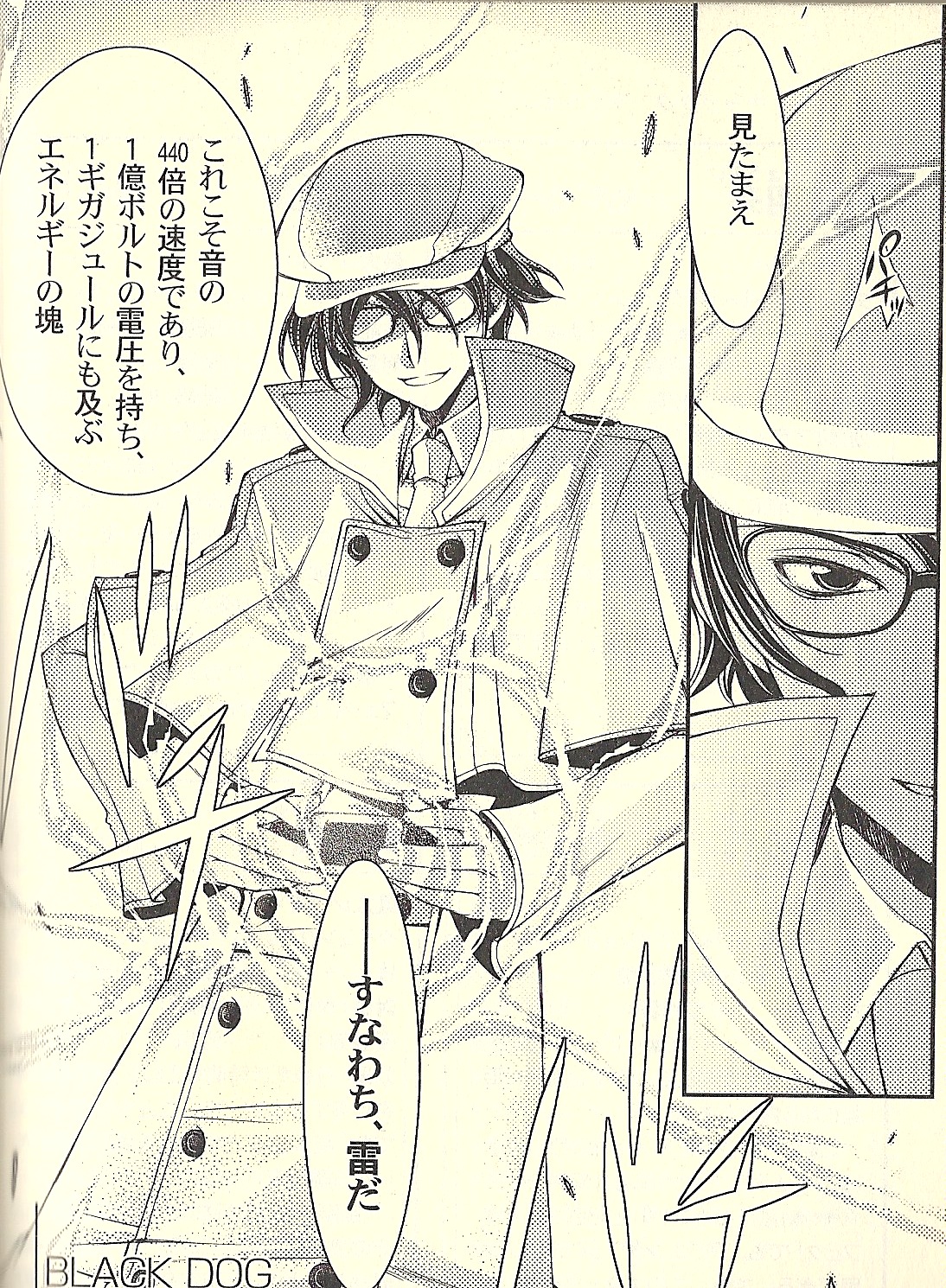
    The image is from the Black Dog chapter of the Double Cross rulebook. The inset panel says “before you look,” and the main panel says something like, “A bolt of energy that is surely 440 times the speed of sound, a million volts of power, and as much as a gigajoule of energy… that is to say, LIGHTNING.”

  • I’m not the first person to have considered the possibility that Paul the Octopus is the spawn of Cthulhu, based on his “remarkable” predictive powers. However, being unconvinced, I presented the possibility that he is not a normal octopus to my students last week, as an example of a basic non-parametric test (the runs test). I thought I’d present a couple of results here, and contemplate some of the complexities of hypothesis testing against a backdrop of crawling chaos.

    Introduction

    So the basic tale is that Paul predicted the outcome of 5 German games and then one Holland/Spain game successfully, and he had an 80% success rate in the European cup (4 games out of 5 predicted correctly). We will present some statistical tests of this situation, and finish up with a few discussion details.

    Aim

    To test whether or not the Oberhausen Sea Life aquarium is housing one of the gibbering dark ones from beyond time and space, or whether, in fact, Paul is just a normal octopus who happens to be lucky. Additionally, are the cult of the Ancient Ones who surround him actually a bunch of charlatans making money from our credulous belief in the crawling abominations of the netherworld? Should we sacrifice Paul, perhaps lightly-battered with a slice of lemon, for the good of all humanity; or should we accept his fundamental normality and get on with our lives safe in the knowledge that the Nameless Ones do not, in fact, inhabit our mortal realm?[1]

    Method

    We can posit the fundamental question as to Paul’s normality or infinite evil in terms of the null and alternative hypothesis of a non-parametric statistical test, as follows. Let the random variable X measure the outcome of Paul’s attempt to guess the result of the next Germany match. Then let X=1 if Paul is successful in his prediction, and X=0 if he fails. Define the probability that Paul successfully predicts a soccer match as p=P(X=1). Then, we can write the null and alternative hypotheses as:

    H0: Paul is a normal octopus (p=1/2)

    H1: Paul is a crawling abomination from the pits of hell (p>1/2)

    In this case we can test the possibility that p>1/2 by means of a runs test. That is, under the null hypothesis, is the chance that Paul would predict 5 games correctly in a row unusually low, such that we might reject the null hypothesis with some confidence? We will choose a confidence of 95% and reject the null hypothesis if the probability of 5 games predicted correctly in a row is less than 5%. Note that we are using a runs test here, requiring sequential successes; we might want to allow the possibility that he can make a mistake at any point in the process, in which case we are interested in the probability that he gets 5 games out of 5 correct in any order.

    This second test is important because in 2008 Paul predicted 4 games out of 5, for 80% accuracy. I’m not sure whether this happened sequentially or not, but it seems reasonable to suppose that his mistake could occur at any point in the chain of games, so then we need to calculate the probability of 4 games correct out of 5, in any order, and identify whether this is less than 5% (for a one-sided test), in order to reject the null hypothesis in favour of the terrible omens of destruction and chaos.

    Results

    So, the probability that he correctly predicts 5 games in a row under the null is (1/2)^5, because the predictions are independent events and the probability is thus the product of their separate probabilities. This gives a probability of 1/32=3%, or less than 5%. We reject the null hypothesis of normality, and conclude that in fact the Elder Gods stalk the (aquariums of the) Earth.

    However, the probability of 4 out of 5 correct in any order is (5 4) (1/2)^5 under the null hypothesis, where (5 4) is my crappy non-latex way of writing “5 choose 4”. This gives us 5/32=1/6=16% (approximately) so we retain the null hypothesis, that Paul is a normal octopus. Note the probability of 4 predictions in a row is 1/16 (exactly) or 6%,so no dice…

    So, we have contradictory results concerning the nature of evil. Having proven statistically that British people are idiots and the Australian government didn’t burn the house down, I’m a little disappointed at this mixed result. I’m sure no priest of Sigmar would accept such equivocation where the agents of chaos are concerned. What to do?

    Discussion

    We could combine the results of the two football matches, to get a total of 10 games with 9 correct results, but we don’t really have 10 games, because the 5 predictions of each series are correlated – Paul was a younger, and presumably less infinitely evil, octopus 2 years ago, and maybe had a different predictive method/ ritual, plus of course his cult followers were probably making different/smaller human sacrifices. So we need to consider the possibility that those 5 games are more similar to each other than they are to the next 5 games. Without any knowledge of the degree of correlation in the octopus’s predictions under the null hypothesis, we can’t make a judgement.

    There is also a question of inter-rater agreement here. It’s possible that Paul always goes for the same box, and the staff don’t randomly assign flags to boxes, or just by luck the Germany box is more likely to be on the side Paul favours. We should probably consider the randomization sequence of the boxes in some way. A variable for the side on which the box is placed, or better still random assignment of the flags to the boxes, would have solved this problem.

    But I think there is a more sinister trick at work here. We know that Germany are a strong team, and we know that Paul is lured into the boxes by mussels. So, since the staff can be confident that the German team will likely win most games, it is quite easy to rig the process by training Paul to prefer the German flag[2]. Remember that Octopi have strong colour vision and are very smart, so it could be possible to train a preference. Then, the probability of success in each predictive effort increases significantly. The Probability of success is P(Paul picks Germany and Germany win)+ P(Paul picks the opposition and Germany lose)=P(Paul picks Germany)*P(Germany win)+(1-P(Paul Picks Germany))*P(Germany lose), by the independence of the prediction and the outcome. But if P(Paul picks Germany)>1/2 and P(Germany win)>1/2, the total probability increases a lot. We know Germany won 3 games out of 5 this time around, so we could estimate P(Germany win)=0.6; if P(Paul picks Germany)=0.8, then we have the total p=0.8*0.6+0.4*0.2=0.56, p>1/2. If Germany’s win probability is really 0.8 (because Serbia were a pack of cheating bastards), then the probability increases to p=0.68.

    Of course, because Germany win most games and Paul predicts they win most games, the actual fact that Paul is going to pick Germany more often anyway gets missed.

    A final couple of notes. First, in this analysis[3], I have ignored the Holland/Spain prediction, because I read somewhere that Paul used to only predict on games involving Germany. This means that the Holland/Spain game is well outside the range of data on which the predictive model is based, and we shouldn’t assume it represents the same underlying probability structure or process (or manifestation of ultimate evil). So I’ve excluded this observation from my data set.

    Secondly, it’s worth bearing in mind that statisticians should never, ever use statistical tests to test theoretically implausible events[4]. Because there is a small chance of type 1 error (rejecting the null hypothesis when the null is true), as soon as you apply a statistical test to a ridiculously implausible theory, you open the risk that you will prove it to be “true” by mistake. So all that is required to prove the existence of God is for some nong to conduct a statistical test of an apparent “miracle” that is really just a carefully trained Octopus, get a spurious result, and before you know it you have people worshipping his tentacly appendages.

    Conclusion

    Two non-parametric statistical tests have produced inconclusive results as to whether or not the shambling horrors of cthulhu walk among us, predicting our soccer matches. However, the test that rejected the null hypothesis was borderline, and consistent with the possibility that Paul has been trained to pick the German flag more often than other flags, thus ensuring increased predictive success and a high likelihood of a run of successful predictions, provided that Germany remain a strong team. This report concludes that Paul should probably not be burnt at the stake (or grilled) as a heretic, tentacled avatar of the brooding darkness; but it might be worthwhile to monitor him, his aquarium shrine, and the Cult that surround him, for further signs of the manifestations of chaos and, if witnessed, liquidate them and extirpate their teachings from the annals of history in the interests of the human race.

    Update: Looking at the Wikipedia entry on our dark and tentacled oppressor, I note that actually he got 7 out of 7 results correct in this world cup, and only 4 out of 6 in the European cup. This doesn’t change the conclusion of our runs test (which simply becomes an even more powerful indication of his brooding and ultimate evil), but it makes his success rate in the European cup look even more merely mortal. Also the wikipedia entry correctly points out that in the group games there is a chance of a draw, so what we actually have here is a sequence of multinomial events with probability 1/3 of three outcomes in the first 3 tests, then 1/2 of two outcomes in the remainder (under the null). We would need to adjust the probabilities accordingly, for both the runs and the binomial test. This actually makes the binomial test a bit fiddly, but my guess is that it reduces the p-value slightly (due to the probabilities of success being lower). I think the wikipedia entry is slightly wrong on the odds of “at least 12 successes in 14 trials” due to the issue of correlation (as mentioned above)[5].

    fn1: yet

    fn2: My suspicion is that they ran a series of dummy runs with Paul before the cup, and either gave him a second mussel when he picked Germany, and/or sacrificed a virgin and offered her blood to the elder gods to enhance his magical powers; statistical testing seems to suggest the former was the case, but we can never be sure…

    fn3: and I do use the term loosely

    fn4: this applies to the kids at home too, obviously

    fn5: also, has anyone else noticed that the wikipedia entry on the ecological fallacy confuses confounding and the ecological fallacy? At least, I thought it did last time I read it.