• Our Dungeon Tectonics Expert and Eunuch Servant

    This is the session report for yesterday’s Make You Kingdom adventure. Because we covered a lot of ground and my notes were being taken hurriedly, this report needs to be quite light on details – probably a good thing, since I didn’t understand what was going on about 50% of the time.

    The PCs and the Kingdom

    There were 4 players, who as usual didn’t introduce themselves – in fact one player referred to another player as “Honourable Older Sister” throughout the session, because he didn’t know her name. We played the following characters:

    • The King, previous job “Doctor”
    • A servant, previous job “Eunuch.”
    • An Oracle, previous job “Sex worker” (Or something similar – performer of dubious origins, perhaps?)
    • A Ninja, previous job “Hunter,” played by me and named (by random roll) “uwasa wo sureba Oboe,” which in English would be something like “The Oboe of which everyone speaks”

    I decided that my ninja was of unspecified gender, being so heavily wrapped in black that only his/her eyes show, and wrapped in a great black cloak (part of my equipment). My ninja starts with Quest 5, Wit 2, Bravery 2 and charm 1. This means he/she has 7 followers, who I decided (in keeping with the ninja theme) are all members of the same Visual Kei band. My Ninja had two skills:

    • Hunting, by which he/she can gather food with a good skill check
    • Disruption, by which he/she can expend a wish and prevent 1d6 of damage to a fellow PC

    My ninja had the following equipment, all rolled up on random tables:

    • A fragment of a star
    • A used magic item
    • A cloak
    • Some shuriken (throwing stars)
    • A warhammer
    • A full course meal

    No character can have more than 6 items. No one carries mundane items. I’m not sure what these items did, and I didn’t get a chance to use any except the shuriken, hammer and meal.

    To give an idea of the dangers of combat, my Ninja had 14 hps. My ninja’s shuriken do d6-1 damage. To hit my ninja an opponent needs to roll over 12 on 2d6+bravery, and usually a monster’s bravery is roughly equal to their level. We were all level 2.

    Our Kingdom was called “Eastern Champion Land” (also randomly rolled). Within it we had a Palace, Temple, School and Hospital, all randomly rolled.We also rolled up its location in a larger labyrinth section (like a Gormenghastian Traveller sector map!).

    The Adventure Starts: The Kingdom Phase

    A spy came to our kingdom and told us that nearby was a kingdom called “The Forest of Harvests” that was having a little trouble and was also the holder of a rare magic item. We decided to explore this kingdom, so first of all my ninja used his/her Exploration skill to map out the kingdom. I rolled so well on this process that I learnt the number of traps and monsters in every room, and the layout of the whole kingdom, as well as the type of monsters in one room. With this knowledge our job was made considerably easier. While I was doing this two of the PCs decided to go for a wander around our own kingdom; this is handled by rolling on special “roaming” encounter tables and can only occur during the “kingdom phase,” which happens when you’re in your kingdom. One player found some kind of magic berry or something and gained a permanent increase in hit points (+5!), while the other found us all some money. You can make these rolls any time you are in the kingdom phase, but you can only ever get each result once, and there are some risky outcomes (I think). It’s an example of your kingdom giving you benefits, basically.

    Once these things were out of the way we set off. On the way one player rolled a random encounter, which we managed to avoid by making successful bravery checks, and then we arrived at our destination, The “Forest of Harvests” Kingdom.

    Room 1: The Entry

    There is usually only one way in or out of a kingdom, and the way in is always the first room you enter. The Forest of Harvests’ entryway contained some rolling hills and a road rolling between them, which happened to be blocked by a giant tree. This tree happily moved out of our way after some negotiation (I’m not sure what was said; my hangover was still going pretty badly at this stage)[1], and we proceeded without further trouble into room 2.

    Room 2: The Road of Meals

    In this room we were attacked by a pair of Ogrekin, who we killed quite quickly. We then explored the room, finding a road running through the middle and a field of mushrooms. Some investigation revealed that the yellow mushrooms healed damage, the red ones exploded on impact, and the blue ones were poisonous to touch. We couldn’t take the red ones with us because they were a little unstable. We travelled to the next room.

    Room 3: Fisherman’s Lake

    On the road to room 3 we discovered a Black Spot trap, which I disarmed. A Black Spot trap causes any who fail a Quest DC 9 test to be trapped in the black spot. Every quarter they have to make another test to escape it, and everyone else has to wait. This wastes time, but also food; every 4 quarters everyone has to eat one meal. Fortunately we didn’t trigger it, and ended up in the third room, which contained a massive lake. This lake was populated by Kappa, with whom we chatted. They revealed that they catch fish and trade them with a princess called Princess Mira, and told us about the dangers on the road to her room. We thanked them and did a spot of fishing: the Oracle hauled up a rare and splendid “Dungeon Maguro,” which can be used as trade with Princess Mira (or anyone else!) and a rare item (I was writing this so I don’t know what item came out of the tables).

    Room 4: The Forest of Relaxation

    This room wasn’t very relaxing at all, being gloomy and filled with Giant Squirms, a Chowhound and a Minotaur. We killed all of them. The Chowhound had a special attack called “Warm and Snug” which reduces everyone’s Resistance, making them easier to hit, but we dealt with it. There was nothing else in this room, so we proceeded to the room of the Princess.

    Room 5: Mira’s Forest

    Here we met Princess Mira, in a room with huge trees and lots of harmless flying monsters. Princess Mira spoke to us when we gave her the Dungeon Maguro, and revealed that the Kingdom was in trouble due to something happening at the “Small Shrine.” We offered to help, and set off to the next room.

    Room 6: The Forest of Confusion

    In this room we were attacked by 5 Scum and 2 Bad Company. Someone also set up a trap in the battle zone, which was a problem because this trap did 2d6 damage to anyone who triggered it, and was between us and the enemy. Only two of our members had missile weapons, and the Bad Company are pretty solid ranged fighters. However, our Servant had a special skill, “Dungeon Tectonics,” which enabled him to set traps in battlezones from a distance (it’s a type of magic). He used his Dungeon Tectonics skill to set traps, which killed the Bad Company and half the Scum; I then took out the rest with Shuriken. From their bodies we looted a rare magical Business Card that gives a bonus on diplomacy; this we gave to the Oracle. Every ex-prostitute Oracle should have a magic business card.

    Every room has a Camp Phase, if you choose, in which you rest or explore. I chose to risk a “Rest Event” and rolled on the Investigation Table; it turns out that during the rest period I explored the room and stumbled on a Rust Samurai’s grave, and from this I looted a few pieces of iron, which I gave to the Oracle to use in her magic item construction powers.

    Room 7: The Forest of Nightmare

    This room was not actually a forest, but had lots of small buildings and contained some Dwarves. We talked to them and they told us that the next room – the Small Shrine – was occupied by 3 “Hurry Foxes” that could be very bad news. They gave us a bitter potion that we had to make Bravery checks to keep down, and with this we regained a few hit points. We rested here and moved on to the Small Shrine room.

    Room 8: The Small Shrine

    In the Small Shrine we were met by the 3 Hurry Foxes, who were called Umi, Soru and Chan. They refused to help us unless we answered 3 riddles, which were

    Riddle 1

    Consider the following equations. What is the answer to the 4th?

    • Bx4=1
    • Ox3=C
    • Sx3=O
    • Dx1=?

    This is a baseball reference, and one of our players got it. 4 bases = 1 run, 3 outs=change sides, 3 strikes = Out, so 1 Deadball=Take 1. Thus the answer is “1”.

    Riddle 2

    In every survey ever done, which planet in the solar system is the most popular with firefighters? Is it Venus, Saturn, Earth or Mercury?

    The answer was Earth. The reason: the emergency number for firefighters in Japan is 119, ichi-ichi-kyuu, which sounds very much like ichi-chikyuu, which means “1 Earth.” One of our players got this. I was flabbergasted.

    Riddle 3

    This involved completing a sequence of kanji I couldn’t read. The players got this in moments (Japanese love kanji quizzes).

    With these three correct answers the Foxes told us of a secret road to an 8th room, where a Mushroom Dragon and its followers had set up and were terrorizing the Kingdom. So, off we went… but first a rest… I rolled on the Exploration rest table, and found a secret path to any room of my choice; we set this secret path to shorten our exit route. Then, onto the next room…

    Room 8: The Mushroom Dragon

    This room was gloomy and foggy, and occupied by a Mushroom Dragon, some Primal Ogrekin, some Ogrekin, an Ogrekin Shaman and a Minotaur. Battle was joined.

    This battle was nasty. The Dragon’s breath caused poison damage (1 HP every round) and the Ogre Shaman kept summoning Ogrekin between us and the Dragon. Because the rules don’t allow us to move through occupied spaces of the battlezone, this stopped us from neutralizing the dragon. At one point the King was trapped in the Dragon’s zone, with a wall of Ogrekin summoned between us and him. I had to use all my wishes deflecting damage with my disruption skill, and I also sacrificed 4 of my band members to improve an attack roll; in the spirit of things I made a random table of band members and determined that the sacrificed members were the singer, both guitarists, and the Strange Male Dancer. The battle finally came extremely close to a TPK. The King was on 4 HPs, the Servant on 1 and the Oracle on 2, and me on 10; but Oracle and Servant were both poisoned, so one would die next round regardless of his actions, and the Oracle the round after. The Dragon was a 2d6-damage monstrosity, so likely to kill the King, and the King was our only way of winning initiative – and to do this he had to sacrifice an elite follower every round. Only the King and I were close enough to the Dragon to hit it. If I missed the Dragon its HPs would be too high for the King to kill it, and then it would kill him; if he missed it then it would probably kill him next round anyway, and even if it didn’t the Servant would be dead. For me to hit it I had to roll over 11 on 2d6. At this point the Oracle chose to expend her “loyalty points” on me, doing a kind of mad prayer to give me all the support she could. This effect can be used once a session, and gave me a +2 to my bravery. With this I hit, doing 3 damage; the King then managed to hit, and killed the Dragon. Had he missed, it would almost certainly have been a TPK, and had I missed he probably couldn’t have killed it even with a successful hit.

    When the dragon died the gloom of the forest dispersed, revealing a beautiful and happy forest full of fruits that healed our injuries. The dragon was carrying a special rare item that could grant much money on a successful Wits check, which the King failed.

    Returning to our Kingdom

    The return journey has its own special random table, and rolling on this we got lost for a few quarters (no big deal), and I fell in love with the Oracle. We avoided random encounters on the way home, and when we got back to our own Kingdom we each rolled on a special encounter table for the response of our citizens, who thought I was a hero and granted me an extra follower, and then finally we rolled on a table for our party’s return to the Kingdom; this granted us extra followers. We then used our money to purchase a new building – a Harem. Finally the King rolled a wits check and recovered my band members for me.

    Once the game was up there was one final, cute mechanic. Everyone had to close their eyes and, on the count of 10, point to the person they thought was the most effective player. This person gets a single “MVP point.” That person was me!

    Conclusion

    Including character and Kingdom creation, and an hour for lunch, we got through all those rooms, combats, talks and events in 7 hours. I think that’s an excellent amount of progress, and we had a lot of fun while we did it. This is an excellent system for megadungeon madness, and I think with a bit of GM input it could lead to some really excellent and hilarious dungeon settings. For example, there is a monster called a Red Giant that is essentially some kind of construct of Communism. This could be the final boss for a level 1 adventure, in a kingdom full of enslaved and crazy humanoid and magical creatures with a communist theme. Alternatively, the level 5 Dungeon Geek monster could lead to a kingdom modelled on a D&D dungeon and stocked with suitable monsters. For the times when the GM is not feeling imaginative there are a wide range of random dungeon tables by which a whole Kingdom can be stocked for play.

    The game also has an excellent campaign mode, with the Kingdom phase between adventures enabling players to grow their kingdom as well as their characters, and relations between the PCs growing dynamically at every rest point. The final results of a campaign run this way would, I think, be truly hilarious. I think I might invest in this game and try it out on some people to see how a campaign runs – or try and force the GM from the convention (who plays the Soldier in my WFRP campaign, coincidentally) to run such a campaign outside of the convention. This probably won’t happen though, since he’s running Sword World campaign too (which I may be joining).

    fn1: An interesting fact about the players in the convention that I really should dwell more on is that they are really kind and friendly, and if I had stopped at this point and asked for a simple explanation of the negotiation, they would happily have done so, and continued to do so through the whole game; in fact at later points “Honourable Older Sister” did this, as did the GM. I don’t think I’ve ever had a bad encounter at this convention, which differs remarkably from the pub-based experiences I had in London; furthermore, I’m very confident that a British or Australian group would be nowhere near as supportive of someone with my level of language skills. The players were even interested in my reading method, since I had to translate things as I went and this is a fiendishly slow task. They’re genuinely helpful and warm-hearted.

  • Two types of pond life

    Today I managed to attend the monthly konkon convention[1] in nearby Oita, and was rewarded for dragging myself out of bed with a slight hangover by an introduction to an excellent Japanese RPG, Meikyu Kingdom. The strict translation of this title is “Labyrinth Kingdom” but the nature of the game and the easy transliteration means that the game is actually given the English title Make You Kingdom.This is basically a mega-dungeon exploration and combat game with random tables that make D&D look rather tame and stingy; a social mechanic to rival Double Cross 3; and hireling rules that make your average D&D “I send my hireling down the corridor to spring the traps” look terribly noble. It’s also very cute and engaging, very fast, and has a degree of attention to details that is staggering in its thoroughness.

    The basic idea

    In Make You Kingdom the PCs are a group of heroes from the ruling court of a small kingdom that is part of a massive labyrinth of similar dungeon kingdoms. One of the PCs is always the ruler of the kingdom. Together with a large group of your subjects (we took about 30), you head off into the labyrinth surrounding your kingdom to explore new dungeons and capture kingdoms for yourself. The world consists entirely of labyrinthine dungeons – this is a real megadungeon, folks – because at some point in the past there was a “dungeon catastrophe” in which all of the world collapsed into the labyrinth – even the sky and the sea got labyrinthisized[2]. There is a whole ecology and science to this labyrinthine system, but from our point of view it doesn’t matter, because our purpose is to explore a neighbouring kingdom, kill everything in it, and take its stuff.

    How it works

    The mechanics of the game are remarkably simple. There are a couple of classes – Ruler, Oracle, Champion, Servant, Ninja – and each person had a job before they became part of the royal court. In our group we had a doctor, a eunuch, a prostitute and a hunter – and it is from this job that they get their single skill. There are 4 attribute scores – Wit, bravery, Quest and Charm – and 3 derived scores – Hit points, resistance and Supplies. That’s right folks, 4 stats and 1 skill. You also get a skill from your character class (I think the Servant gets 3), so you start the game with two skills. I had “hunting” and “disruption” (I was playing the Ninja – see below). All PCs get basically the same starting scores in their skills – a 4, two 2s and a 1. The ruler and the servant are slightly different, but that’s basically it.

    The mechanic for resolving any skill test, saving throw or attack is the same. You roll 2d6 and add one of the 4 skills, and try and beat a target. There are two methods for boosting this roll to 3 or more dice, and damage is also done with d6s.

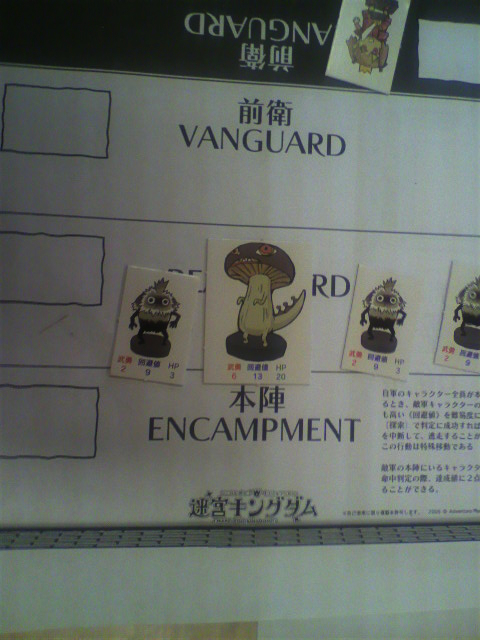
    Combat occurs on a battlefield with 3 sections for each team – the Vanguard, the Rearguard and the Encampment – and the rules are very simple. You can move and you can attack, but you can’t move through a section that’s occupied by the enemy and you can’t disengage from combat. Various special abilities apply in combat, all with their outcome determined by the 2d6 skill mechanism. Monsters are presented in terms of 4 values: Bravery, Resistance, damage and Hit Points.

    When your hit points reach 0 you’re dead. One member of the party has to be the ruler, and he/she is not allowed to die.

    That’s it. The whole mechanic – including all forms of bad status, which is the Japanese word for “effects” – are written on the back of the character sheet.

    There are two special methods for boosting your attack rolls:

    • Wishes, which are generally employed by spending a point of a stat called “vitality” (気力) that is not written anywhere on the sheet, and that we kept track of using paper clips, can be spent to add one die to any roll. Vitality is gained by a rather amusing method. If when you roll your 2d6 skill check you get a 6 on one die, and the other die has a value sufficient to get you a successful result, you get to trade the 6 for a point of Vitality. This applies even if the extra die you bought with vitality got you the 6. You can’t have more Vitality than your wit. This proved a problem for us.
    • Sacrificing followers, in which you get to throw 1d6 of your followers into the fray, and in exchange you can increase the value of your skill check by 1. At the end of the adventure your ruler can resurrect 1d6 followers. Some skills rely on followers – my Ninja could have chosen the skill “shinobi army,” which sacrifices 1d6 followers in order to disarm a trap (sound familiar!?) but he/she only had 7 followers, so this didn’t seem like it would get him/her very far

    So, on those two paragraphs of rules the whole game flows.

    Except for the social mechanic, and the kingdom-building.

    Social mechanics

    Similar to Double Cross 3, when you create your character you also have to generate a relationship with another PC, which can be based on loyalty, friendship or love. You can also have unrequited love. You get points in these traits, and these points can be useful. The Oracle in our group had “loyalty 2” for me, which she used to aid me at a crucial point in the adventure. During the rest phase of exploration things can happen that change these points (see below) or even turn PCs into enemies. You also have a background and a purpose that are related, and these can apparently affect the game (I didn’t see this happen). Some abilities and effects are limited by the number of points you have invested in your relationships with other people.

    Kingdom-building

    Before you can go anywhere you need to build your own kingdom. Your (and every other) Kingdom is built on a 3×3 grid of “rooms,” each connected by a varying number of corridors. You roll a random number of buildings to spread through these rooms, of varying types limited by your level and some traits of the kingdom that depend on the choices of the ruler. These buildings can take a wide range of forms – there is even a memorial hall – and they can have effects for the characters. For example, if two PCs go into a “Piazza” they can swap equipment and change the status of their relationship. Also, the level of order or education in your society depends on which buildings you have, and I think the number of combatant followers you have depend on some of these things too. We had a Shrine, a Palace, a School and a Hospital, and on my suggestion after completing the adventure we added a harem (which has a very funny picture).

    The Kingdom also has 4 attributes – lifestyle, order, culture and something else that I forget. These determine some aspects of the kinds of items you can buy, and the number and kind of followers and allies you get.

    Adventuring: Traps and Monsters

    So, having established your characters, their interrelations and their kingdom, off you go on an adventure. The GM creates a new dungeon kingdom, also on a 3×3 map, and populates it with monsters and traps. In each room there will be a certain number of each. You explore in turns, that are divided into quarters, and each turn you need to eat once (so you need to pack food! We carried “bento” and a “full course” that  recovers HPs). In each turn there is an encounter/fight/camp type phase, and in each stage certain things happen.  The best thing about this aspect of the game, though, is the monsters, which are hilarious, cute, nasty and intertextual all at once. Here are the monsters we fought:

    • Ogrekin (小鬼), little ogres that are really easy to kill
    • Giant Squirms (みみず), giant worms that are quite easy to kill
    • Scum (人間の屑), really dodgy humans who drink too much and try to rob you
    • Bad Company (極悪中隊), a squad of nasty soldiers
    • Scum (人間の屑), a bunch of useless losers who try to kill you and steal your stuff
    • Chowhound (大喰らい), a great big fat thing that eats stuff
    • Ogrekin Shaman (小鬼呪術師), who can summon Ogrekin (actually a really annoying trait)
    • Primal Ogrekin (原始小鬼), slightly nastier versions of Ogrekin
    • Mushroom Dragon (キノコのドラゴン), which is exactly what you think – a dragon that is a mushroom

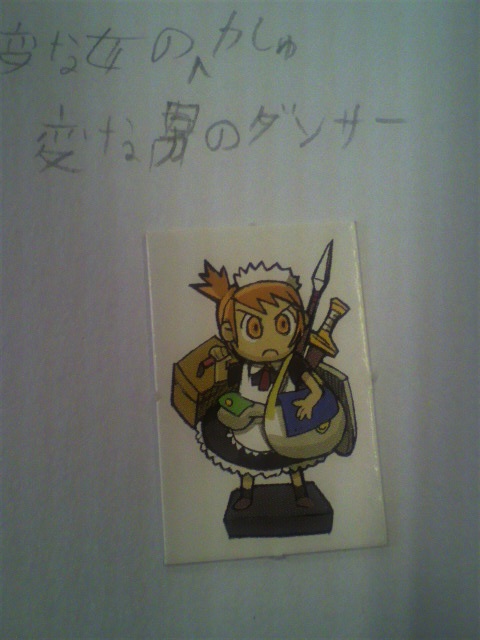
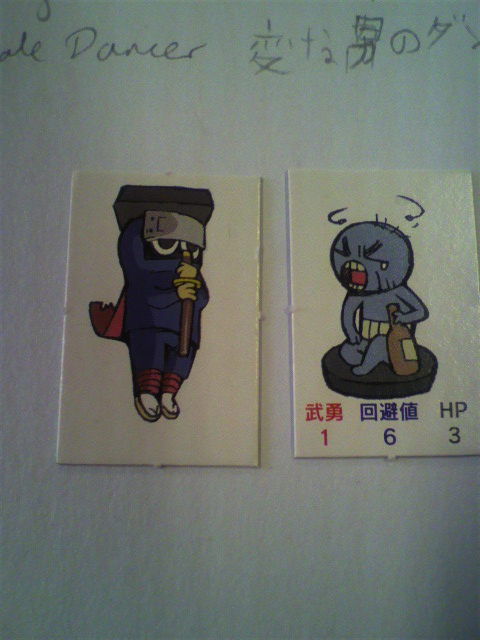
    We fought all of these, and were nearly killed by the Mushroom Dragon. The picture at the top of this post is the little cardboard token for my PC, next to the token for a Scum. Below is a picture of some of the last group of monsters we fought – some Primal Ogrekin with the Mushroom Dragon.

    Who says dragons are a strange idea?

    Traps are ubiquitous in the dungeons, and you have to either disarm them or avoid them, and to do either you need to find them. This was my Ninja’s job, but because he can’t find and disarm a trap in the same quarter, he/she left others to do the finding and he/she did the disarming. Traps are quite nasty – we sprung two, one of which did small amounts of damage and one of which seemed to be some kind of disapproval trap that lowered our scores. There are several pages of traps for the GM to choose from, and some rooms had more than one, either in the room or the connecting corridors.

    Random tables

    The game is built on fighting and exploring, but the social mechanic is important and all sorts of things happen outside of combat, randomly. In addition to the random tables used to generate your PC’s history, purpose and inter-personal relationships, there are also:

    • Random encounter tables for travel between kingdoms
    • Random event tables for when you go “roaming” around your own kingdom. These can have significant benefits but you can only encounter any one line of the table once.
    • Random event tables for when you are resting, and decide to take a rest action. I used one of these tables to explore the area I was in, and found the tomb of a Rust Samurai, from which I looted some metal; I also nearly started a love affair with another PC (by accident)
    • Random treasure tables for every type of monster
    • Random event tables for certain types of action taken to prevent death (usually involving destroying an item)
    • Random event tables for your journey back from a successful quest – these can involve getting lost or having new types of encounters
    • Random event tables for when you return to your kingdom after a succesful (or unsuccessful!) quest, which can involve a gain or loss of followers, more money, new items or buildings, etc

    There was a lot of rolling for this sort of thing during the game, and a lot of hilarious results arose from it. The dungeon we explored was already established, but I think that there are probably random generation methods for this too.

    Conclusion

    In essence this is a very cute, entertaining and light-hearted game that combines mega-dungeon, classic D&D-style dungeon crawling, very simple strategy and resource management, and exploration within a very simple system that incorporates some very clever social dynamics to provide triggers and dynamics for role-playing. The monsters are hilarious, as are the descriptions of buildings, character classes, jobs and items. It’s a really entertaining mixture of manga, classic D&D references, Japanese-style role-playing and strategy game. If you get a chance to try it out, I strongly recommend it. Over the next few days I’ll put up a description of my adventure and some scans of monsters, buildings etc from the rule book, which I’m borrowing for a week.

    fn1: Today was the 60th convention, which apparently means it’s been running continuously for 25 years (it didn’t used to be every month). I think that’s pretty good for a town the size of Oita.

    fn2: The way that Japanese is written makes this word really easy to invent naturally: Meikyuuka means “labyrinthification” and you can stick that “ka” onto pretty much any noun to get the same effect.

  • 危ない付近

    (翻訳ポイント:このキャンペーンの名前は「rats in the ranks」である。「Rats in the ranks」っていうのは「裏切り」である。「Rat」は「裏切りをする人」だから、軍隊が自分の隊列にいるメンバーに裏切った意味を持つ。一番近い翻訳は「隊列を乱す者」だと思っていますが、完璧な翻訳が見つけられない)。

    ウォーハンマーキャンペーンが、発行されたシナリオを超え[、自分で作っている「市部准サンドボクス」キャンペーンになった。

    PC達が、「瞬かない目」カルトを破壊したから、グルーンヴァールド城のアッシャフェンバーグ城主のウーバーズレイクにいるいとこに紹介書をもらって、自由に彼女の家に泊まれると伝えてもらった。それにも、いとこのお友達に治療ももらえると伝えてもらった。激しく傷したから、レイクランドを通ってウーバーズレイクに出発した。

    オーク要撃

    グルーンヴァールド城を出発したときに、基本ダメージがだいたい回復したが、まだクリティカル傷が多かった。旅の間の複数の企ては不成功し、グルンバーグ城に泊まり過ぎのに治療ができなかった。だから、ウーベーズレイクの到着の2日前のオーク要撃は死中みたいであった。ゴブリン射手もオークも見なくて、森に隠れたゴブリンの矢を集中したからオークの白兵要撃を見送った。オーク1匹は前にいる兵士を攻撃し、1匹は後ろにいる魔法使いを攻撃した。オーク達はイニチャチブが勝って、激しく傷をした。2ラウンドが回って、魔法使いはクリティカル傷2点で無意識し、兵士は傷された。次はゴブリンに強打された盗賊だが、「Da Big Smash」というアクションで新入者を殺してみたときに、オークが2匹目のゴブリンを殺してしまった。このアクションも新入者を殺しそうだったが、新入者が「モールタッチ」の祈りを使っていて、オークをモールの天罰の冷たい火で全身火だるまができた。そして兵士と新入者が次のオークを殺して、残るゴブリンが逃げた。

    この戦闘はPC達を重傷した。兵士と新入者は残り体力点が4点のうえに、魔法使いと盗賊は傷1点ずつしか残らなかった。全員がクリティカル傷を得て、魔法使いも盗賊もまた無意識になったら死ぬ状態だった。荒原で夜の睡眠で回復ができなくて、新入者はPCごとに一回だけ(だいたい失敗した)治療ができると決まったから、グループが注意上がって一方行った選択しかなかった。

    変な葬列

    ウーベーズレイクから1日の旅の次の日に、PC達が近くの雑木林からの要撃のおそれがわかった。グリーンスキンに用心していたから、盗賊を調べに送らせた。かれは雑木林に入ると、変なシーンを見つけた。1匹が立ち、1匹が土に座るゴブリンの2匹を発見した。座るゴブリンは大きいフォークと小さい刀(かれの「Choppa!」)を持った。首に赤ちゃんのエプロンがついた。このエプロンには、元気なウサギとお日様とニコニコのキノコの3個が書いてあった。どこかの人間の家から盗んだとわかった。このゴブリンの前には土に置いた切れた腹から虫が出ている人間の遺体だった。このゴブリンは、フォークとchoppaを持ち、食べようとして、ほかのゴブリンに殴られた。以下の変な会話があった:

    • 立ゴブリン:食べるな
    • 座ゴブリン:なぜ?美味しいよ!ほら!見て!虫だ。うまそう!
    • 立ゴブリン:酋長が「自然に死んだように見せる」って!食べたら自然死に見せかけられない!!!!食べるな!
    • 座ゴブリン [もう1回食ってみているところで]:わあ!ちょっとだけでいいよ!
    • 立ゴブリン [また撃っているところで]:食べるな!酋長がそう言ったから!じゃあ!捨てろ!

    そういうと、ゴブリン達が遺体を運んで、道まで出発した。

    盗賊は別に道まで隠密し、PC達に「隠せ!」のメッセージを送った。そして、皆さんがゴブリンを見た。ゴブリン達が道に行って遺体を捨てて、道の両面に見て、早く雑木林に走って逃げた。PC達が隠密を終えて、呪文と矢で早く両匹を殺して。そして、入信者がゴブリン1匹を疑問するように応急してみたができなくて、両匹が死んで、混沌の召使いの恐ろしい後生に行った。

    PC達が遺体を調べて、新入者がモールにお祈って、どうやってもいつ死んだかを聞いてみたが成功がなかった。遺体を調べたと発見したことは:

    • 小さい刀
    • 中に女の絵のあるロケット
    • ネズミ落としの2つ
    • ネズミのイレズミ
    • 1面に蛇が書いてあり、一面に「悲しい盾」が書いてあるゲーム札

    ネズミのイレズミを見たと、プレイヤーの皆さんが「スケイブン」を言ったが、もちろんPC達がその怪獣について何も知らない。ウォーハンマーの世界で、だれもスケイブンの存在を信じない。

    混乱させて、遺体を葬って、ウーバーズレイクに進んだ。

    ウーバーズレイクと ゲーリンダ ニーダ

    ウーバーズレイクでPC達はアッシャッフェンバーグ様のいとこゲーリンダニーダの家の道を習って行った。驚かしたのに入らせて、元気に彼女の小さいがいい家の中でお部屋を見つけてよういしてくれた。26歳のニーダさんは、町の貴族部でよさそうが豪儀じゃない3階のある家に住んでいる。召使い2人と警備兵1人がいる。彼女が独身で、召使い1一人意外、家の皆さんが女である。

    ウーバーズレイクは小さくてきれいな町。中に流れる川に分かれて、北の方はお金のある人の家・城・公園がある。南の方には下町・工業・軍隊のりょうがある。PC達が東の「水門」という門に入って、北のほうに歩いて行った。町の人口は約3500人で、20%くらいは軍隊である。灰色山の基礎にあるから城下町だが、金属工業と鉱山でお金を得るからお金を持ちの町である。ビックリくらい大きいシグマー祭殿があるから便利である。。。PC達は壊せない悪い混沌の絵をシグマー祭殿におまかせたい。すぐ行きそうだけど、とりあえずは治療。それにも、あの遺体の人の女を見つけて、悲しいニュースを教えるかもしれない。。。

    最後に

    このセッションは3時間半のプレイーで終わった。前に1時間くらいに新しい英語版ゲーム「mallifaux」について話したり、経験点を使ったりしたからゲーム時間はちょっと短くなったが、その間にたくさんできた。

    ウォーハンマー3版はまた危なかった。戦闘1階にTPKをしかけた(TPK=皆殺し、Total Party Kill). 旅の大きい部分は治療の企てを含んで、オーク要撃でまた傷されたから治療の成功は意味が無かった。PC達の2人は、無意識になってクリティカル傷2点超えたら死ぬうえに、オークに2回だけ撃たれて無意識になる。私はウォーハンマーのオークの危険性を忘れたが、今回の戦闘で覚えた。プレイヤー達は早く戦闘にたいしての注意的な意見を開発している。

  • Over at “Discourse” and Dragons there is a “rant” about the new edition of D&D, which being inside the OSR echo-chamber is largely agreed to by its respondents, until a chap called Shazbot (from Points of Light) turns up and delivers, in comments, his own handy little rant about old school logic. I believe a good rant deserves credit (where I agree with it) so I’ve reproduced some parts of it here. I think Shazbot ought to turn this into a blog post, because some of its content really reminds me of the way the game was played back in the day.

    Why is it that old-schoolers are prone to filibustering and hyperbolic arguments?

    “Ohhhh…4th Edition ruined the game forever…all of my previous gaming experiences have been retroactively sodomized. I now know exactly what it means to be a victim of genetic cleansing in Darfur. By proxy. Because of 4th Edition.”

    That’s number 1 on my list of stupid old school arguments that I hate.

    Number 2:

    “It’s not roll-playing…it’s ROLE-playing.”

    All because latter editions of the game have included things like fleshed out mechanics for social interactions and skill checks, like say, disabling a suspension bridge. Well hold on there, Crusty Withercock…neither term is actually correct. The term is “roleplaying GAME”. See, the “game” part implies a chance of success or failure which is impartially adjudicated through things like rules. So the first question this leads me to, is what exactly, is the practical…and I stress PRACTICAL…difference between a player rolling his/her diplomacy skill and the DM rolling on a reaction table behind the screen and adding reaction adjustments? Since both use game rules to determine outcome, both would be considered “roll-playing” by the aforementioned standards.

    “Oh but Shazbot…our group eschews such rules and the DM simply decides how each interaction plays out.”

    Super. Fantastic. But well, that’s not really a GAME then, is it? That’s a magical tea party wherein the DM arbitrarily decides if your efforts succeed or not…based on how his/her day went, or whatever. Hell, this was how just about everything worked in OD&D, because there were absolutely no rules for anything that wasn’t swinging a sword or casting a spell, so everything was either hand-waived or the DM pulled houserules out of his/her ass that inevitably changed week-by-week. OD&D, and you can’t get anymore old school than the old 1974 white box, you started at the entrance of the dungeon, and your character probably didn’t even have a NAME before 5th level…let alone a detailed and compelling backstory. Yeah…that’s role-playing right there. From there, things devolved into a battle of wits with an adversarial DM, laden with semantic booby-traps. “You said you were checking the floor and the chest for traps…not the chandelier…so now you’re crushed. Now get me another Blue Nehi.”

    Which brings me to number 3 on my list of stupid old-school arguments that I hate:

    “Dwuh? Healing surges? Action points? Daily attacks for fighters??? Bu-bu-but…verisimilitude!”

    Okay…tell me how much verisimilitude is in this regular old school occurrence:

    “So your unnamed Halfling thief companion has just been crushed by a falling chandelier. Luckily another Halfling just happens to wander through the door.”

    Bob: “What-Ho, fellow adventures! Having lost your companion a scant few moments ago…it seems that you are in need of another hand, similarly skilled in the larcenous arts as luck would have it!”

    Party: “My! What a fortuitous bit of random happenstance! Why yes stranger, we would be privileged to include you into our merry band! Forsooth!”

    A revolving door of interchangeable characters in what amounts to a dungeon fantasy vietnam who, by the end of the adventure, would have absolutely no personal stake in the quest?  Uh yeah…verisimilitude.

    Fine…let’s use another example. XP derived primarily through collecting treasure and not, in fact, overcoming challenging foes or completing quests. Please explain to me how picking up coins translates to casting more powerful spells.  In any case, one wonders why adventurers would go adventuring at all, when the safest and most efficient road to god-like power is running a successful business. Also, wouldn’t wealthy merchants ALL be high level characters? Oh, I forgot…PC’s don’t follow the same rules as anyone else…because they’re “heroes”. We know they’re heroes, because PC’s do heroic things, like robbing tombs of their wealth and hiring commoners to run down corridors and set off traps for them.

    See here’s the thing…roleplaying games aren’t meant to simulate reality…grandpa Gygax said that himself in the 1st edition DMG…no roleplaying games are meant to emulate fiction.  Now tell me, in which Conan story did the Cimmerian get incinerated by haplessly stepping on the wrong floor-tile only to be immediately replaced by Conan the II. Regale me again with the story of Sir Percival resorting to cowardice and skullduggery to overcome an otherwise worthy foe. Tell me again about the time Merlin the Magician ran out his daily allotment of spells at a critical juncture. Sorry…but the only fantasy that old-school D&D emulates is old-school D&D. It’s become a genre in and of itself…and in my experience this sort of thing makes for terrible reading.

    And finally…number 4 on my list of stupid old school arguments that I hate:

    “WotC D&D is too videogamey/anime/superheroic/durple”

    Because apparently any fighter not wearing a buckskin mini-skirt and a horned helmet is obviously ported straight from a Final Fantasy game.  Someone here has said that D&D should have remained a classic game that has never seen a revision…like Monopoly.  Bull. Shit. Even if Gygax should have been the final authority on all things D&D, he himself revised OD&D into Advanced Dungeons & Dragons. The original White Box wasn’t a game as much as it was a proof of concept. An experiment.. D&D has gone through a series of revisions over the years because D&D has NEEDED to go through a series of revisions over the years. Anyone who can honestly say that the mechanics haven’t improved over the years, is probably going to write a silly rebuttal, log out, smear poop on their face, put on a bicycle helmet, and promptly ride the short bus to school.

    Over the years, game mechanics have evolved to become more efficient, intuitive and user-friendly…like technology, Even though you may not like the aesthetic direction that newer versions of D&D has taken, as in actually becoming a game centered around adventuring and telling heroic stories, instead of a random menagerie of cheap death traps…you cannot reasonably argue that the actual game portion doesn’t function better with each iteration. And you know what? D&D still has a long way to go before it reaches a sublime state of mechanical nirvana. But it’s slowly crawling there.

    Stupid old-schooler argument number 5: And now we come around full circle…back to hyperbolic filibustering…

    “WotC has destroyed the SOUL of D&D”

    Yeah…no it didn’t. The soul of D&D isn’t in anyone edition. It isn’t in the rules…it isn’t in the art. The soul of D&D is still where it belongs…in the players. Maybe you don’t like what the players are doing these days…whatever. You’ve got your own game…now it’s their turn. Because if you honestly believe that a GAME like D&D is more about some bullshit, imagined ideology that you’ve applied only in retrospect, than it is about actually having fun…then your head is stuck so far up you’re own ass, you’ll be eating your lunch a second time.

  • As a follow-up to recent posts on race in the Lord of the Rings, I think I should have a look at the possible multicultural symbols in the books. This is both a nice counterstory to my recent criticisms of his politics, and provides useful background information on the politics of Tolkien’s fascist admirers. How can fascists appreciate Tolkien if he’s mulitcultural? By what sleight of hand do they overlook the central role of the fellowship in the story? Was the politics of racial interaction in the Lord of the Rings ahead of its time, or not?

    The possibility of the Fellowship being seen as a multicultural was raised by commenter Paul as a possible alternative explanation of the racial politics of the story. I confess I hadn’t thought of it.

    What is multiculturalism?

    The first thing to note is that multiculturalism is not just a random word meaning “lots of different races” (though maybe semantically it should). It is a specific political philosophy adopted in Australia in 1972, and an accompanying theory of political integration for diverse races. It can be characterized as “a bunch of different racial and cultural groups living together under a single law, while retaining their own unique cultural and linguistic practices.” In Australia the law is Australian, the shared language is English, and everyone is welcome to do whatever they want in their personal lives. In fact, they’re openly and actively encouraged to, because their culture is assumed to be important to them. Multiculturalism was originally envisioned (in 1972) as “a society in which equal
    opportunity is accompanied by cultural diversity in an atmosphere of acceptance and tolerance” and is now presented in essentially these terms:

    Australian multiculturalism recognises, accepts, respects and celebrates cultural diversity. It embraces the heritage of Indigenous Australians, early European settlement, our Australian-grown customs and those of the diverse range of migrants now coming to this country.
    The freedom of all Australians to express and share their cultural values is dependent on their abiding by mutual civic obligations. All Australians are expected to have an overriding loyalty to Australia and its people, and to respect the basic structures and principles underwriting our democratic society. These are the Constitution, Parliamentary democracy, freedom of speech and religion, English as the national language, the rule of law, acceptance and equality.

    It’s important to note that before Canada adopted this policy, there was really no such thing as a concept of multiculturalism, and if Tolkien had propounded such a theory he would have been well ahead of his time (though not unique – various other peoples across time have advocated this idea, especially anarchists and libertarians).

    Multiculturalism is not the same as “cultural diversity” or easy immigration policy. In fact Australia has quite a strict immigration policy, setting specific barriers to entry, though the policy is non-racist (in keeping with its multicultural practice).

    Multiculturalism in the era of Tolkien

    Contrary to the claims of people who love London a little too much (e.g. the crew from London Timeout), London has not been a multicultural city for long, and it certainly wasn’t in the interwar period. It definitely has always been a famously diverse city, perhaps reaching its pinnacle of diversity in the late Victorian era[1]. But this is not the same as multiculturalism, and in fact London is generally quite intolerant of foreigners, and compared to Australia has quite a strong culture of guest workers – a kind of “come here while we need you and then fuck off home please” attitude. At the time that Tolkien was writing it was likely that London was at a low point in its diversity (I don’t know) but pretty certainly areas outside of London were not diverse at all. And we know that Tolkien’s country of origin, South Africa, has a pretty poor history of handling cultural diversity. So, Tolkien could be excused in the context of his time for writing a book in which any form of cultural mixing was seen as bad.

    The Fellowship of the Ring

    The central organisation of the first book is of course the Fellowship, which consists of the peoples of 4 races, joining together on a desperate quest. They overcome some fairly serious obstacles by working together, and they fall apart ultimately because a human turns on a hobbit in the interests of his nation. But is this a multicultural fellowship? From the background material on the Lord of the Rings we know that it doesn’t represent the natural social structure of any of the societies from which the Fellowship’s members hale. There are no elves or Dwarves or humans in Hobbiton, no humans in the Grey Mountains, and very little evidence of racial diversity in Gondor, the capital of the age. There is one and precisely one foreigner in Rivendell. In the scene where the Fellowship is formed (in the council chamber at Rivendell) the formation is clearly described as a unique event – as races putting aside their differences to fight a common foe. This is no natural extension of the social order of the time in the way that, say, a New Zealand rugby team represents 3 races working for the glory of the Fern, or a lesbian with Chinese parents represents Australia in international climate change talks. This is a special moment in Middle Earth history, just as the gathering of humans and elves at Mount Doom 2000 years earlier was also special.

    This is not a multicultural phenomenon; it’s a political alliance. And like most political alliances, it falls apart when one of its members decides to privilege the interests of his own nation over the rest.

    Tolkien of course had experience with political alliances, in World War 1, when people from all over the Commonwealth (and Frenchies) joined together to kill Germans. And Turks[2]. And this model is pretty congruent with the structure of the Fellowship.

    The races of the Fellowship as “white”

    It seems pretty likely from Tolkien’s stories that the only races in the Fellowship that can interbreed are elves and humans. There is no evidence of Dwarves breeding with anyone, and who would shag a halfling? Women with hairy feet are so 80s. This is a pretty strong qualification for “different races.” But in their analyses of Tolkien’s racial politics, Nazis tend to overlook this. I think this is because the races of the West, even though incapable of interbreeding, are established in Tolkien’s world as roughly equivalent to those of Western Europe. They share so much in cultural familiarity that their profound racial differences are overlooked. This occurs in the books and in Nazi ideology, where Nazis from all across Europe see each other as allies even though they’ve spent the last 200 years fighting. The atmosphere of old conflicts set aside in the late third age is also the atmosphere of the modern fascist movement. They look for their true enemies to the East and the South, and see Europe as a single entity under threat from enemies without. This is exactly how the people of the Fellowship see their world. This commonality is sufficient for the races of the Fellowship to be seen as a common unit. After all, they united against a common threat. Isn’t that sufficient definition by which to assert a common political interest?

    Additionally, Tolkien presents a set of conservative tropes – hereditary kings, absent and virtuous women, colonialism rewarded, the downfall of races through interbreeding – to enable sympathetic readers to see a model of Europe in the peoples of the West. Even the geography bears a resemblance. So it’s no surprise that the Fellowship’s genetic incompatibility is overlooked in favour of its cultural similarity, even as its enemies’ cultural differences are ignored in favour of their racial similarity (corrupted by Morgoth, dark-skinned, foreign).

    Other examples of racial mixing in Tolkien

    The general model of racial mixing in Tolkien is that they don’t. There is precisely one foreigner in Rivendell, that being Bilbo; and he is only welcome because branded by a powerful magical item and so rendered culturally closer, if not racially radically different. We spend much of two books reading about Gondor, but see little or no evidence of any foreign races. There are no foreigners in Rohan. Rohan was gifted to the Rohirrim by the Gondorian king, and rather than sharing it with the Dunlendings, they drove them out (along with the Woses, whose eventual extinction is presented as a sad inevitability). This is no multicultural model, but one of races staying firmly separate. The only model of racial mixing is Arthedain and Gondor, which used to be occupied by a race of pure common men. When the Numenorians arrived they took over the land, despite being tiny in number, and formed a hereditary ruling class. This class slowly degraded with contact with the locals, but retained their hereditary power. Essentially, the only long-lasting racial mixing model in Tolkien is a caste-based system – it’s a fairly pleasant one, but it’s still a caste system. It’s rather like England after 1066, where a new power has taken over the country and maintain their own language (Dunadan) and hereditary line, but occasionally interbreed with some of the pre-existing local aristrocracy. But unlike that model, the invading power is seen as a separate race that slowly declines in time (but still lives 4 times as long as the locals after 2000 years, and retains special magical powers).

    The only common racial mixing in Tolkien is between Orcs and Goblins, about whom its dubious to maintain that they’re even separate races. Sure, the evil armies are made up of (roughly) 5 races, but they aren’t drawn together as part of a multicultural society – they too are a political alliance. There is no model in Lord of the Rings for the natural interaction of races.

    Conclusion

    The model of racial mixing in Lord of the Rings is one of political alliances built out of expediency, either through mutual defense or desire for power. This is consistent with the real-world great power politics of the time, but does not reflect the politics of multiculturalism. The fellowship is not a natural outgrowth of multicultural societies, but an alliance of disparate interests thrown together out of desperation and destroyed when one of its members chooses base national interest over common defense – it is formed and collapses along the model of a treaty. The only political model based on racial mixing is a caste system in which a powerful race rules over a weaker one. Although there is a temptation to describe the Fellowship of the Ring as a multicultural model, such a comparison relies on a misreading of the politics of multiculturalism, and a false interpretation of the causes and political meaning of the alliance that the Fellowship represents.

    fn1: I get this idea from A.N Lee’s The Victorians, and also from an article in London Timeout about how modern fears about Eastern Europeans very much resemble Victorian fears about the same people

    fn2: Though from the perspective of the Australians involved, it was the Turks who did most of the killing

  • So, the Warhammer 3 campaign has moved beyond published modules to an urban semi-sandbox. This started last night, and here is a brief report.

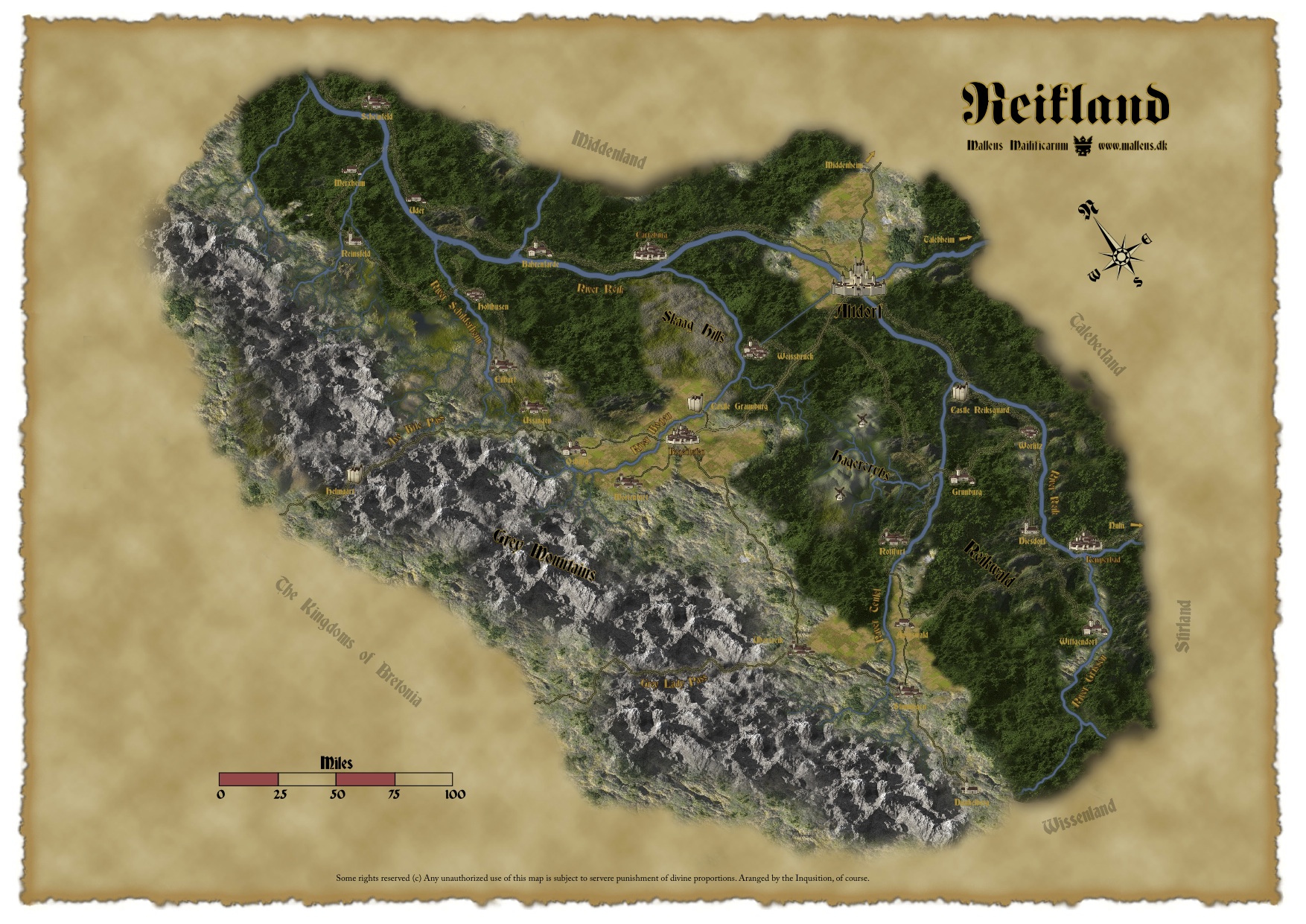
    Having dealt with the Cult of the Unseeing Eye at Grunewald Lodge, the PCs were given a letter of introduction to Lord Aschaffenberg’s niece in Ubersreik, and told that they could stay their free as long as they wanted, and get healing from some friends of hers in the Church of Shallya. Given they were extremely injured and quite weakened, and money is something of an issue for them, this seemed like an excellent idea, so they set off across Reikland to Ubersreik.

    Orc Ambush

    They left Grunewald Lodge with most of their damage healed, but three PCs remained critically wounded. Repeated attempts to heal these critical wounds during the journey failed, and even an extra night at Grunburg Castle en route failed to help. So, when they were 2 days out of Ubersreik, a sudden ambush by 2 Goblins and 2 Orcs proved near-fatal. They failed to see either the goblin archers or the Orcs, and while they were focussed on the goblin arrows (coming from nearby forest) the Orcs emerged from ditches around the road, one attacking the soldier at the front of the party and the other attacking the Wizard at the back. The Orcs won initiative and inflicted savage damage, so that by the beginning of the second round the Soldier was half dead and the Wizard unconscious, with two critical wounds. The thief was next, cut down by a goblin, but in taking on the Initiate, one of the Orcs inadvertently (?) killed a goblin, using his “‘Da Big Smash” action. This also nearly killed the Initiate, who was using the spell Morr’s Touch and managed to incinerate the Orc in the chill fire’s of Morr’s wrath. The Initiate and the Soldier then finished off the remaining Orc and the remaining goblin fled.

    This battle left the party seriously wounded, with the Soldier and the Initiate only having 4 wounds, and the Thief and the Wizard on 1 each. Everyone was critically wounded, and if either the thief or the Wizard were knocked out again they would die. I had ruled that in the wilderness you can’t heal properly from resting, and the Initiate could only do one first aid roll apiece (which she mostly failed) so the party had to press on, being extra cautious.

    A strange burial party

    The next day – one day out from Ubersreik – the PCs became aware of a possible ambush in a copse of trees. Being very wary of Greenskins at this point, they sent the thief to investigate. The thief crept into the woods and found a strange scene. He came across two goblins, one of whom was standing up, and the other sitting on the ground. The sitting goblin was carrying a large fork in one hand and a small sword (his “choppa!”) in the other. Around his neck was a babies bib, clearly taken from a human settlement, and decorated with a happy rabbit, a shining sun and 3 cute mushrooms. Lying on the ground in front of the goblin was a partially-decayed human body, its shirt lifted to reveal a first incision into the belly, from which spilled some maggots. The goblin, knife and fork in hand, was clearly about to tuck in, when the standing goblin hit him in the head. As the thief watched, the following strange conversation ensued:

    • Goblin 1 (Standing): You mustn’t eat that!
    • Goblin 2 (Sitting): but it’s delicious! Look! There’s even maggots! Yum yum!
    • Goblin 1: The chief told us we have to make the death look natural. It won’t look natural if you eat the damn corpse!
    • Goblin 2 [Attempting to tuck in again]: Oh come on, just a bit!
    • Goblin 1 [Cuffing G2 so hard his face falls into the cut, and emerges smeared in maggots which G2 eats greedily, with declarations of their yumminess]: You can’t eat it! The chief said so! Now help me dump it!!!

    The sitting goblin threw away his fork with a sigh, sheathed his choppa! and helped the standing goblin lift the corpse, which they then began carrying to the road.

    At this stage even two goblins are too much for our party, so the thief left the copse in a (silent) hurry and warned the party to hide, which they did. The goblins dragged the body to the road and dumped it, and then began running back to the trees. At this point, with distance safely between them, Wizard and Thief rose to their feet and let rip with magic dart and arrows, cutting down both goblins while they ran. The Initiate then tried to revive one goblin so they could interrogate it, but she failed miserably and they both passed on to whatever horrible afterlife awaits the degenerate children of chaos.

    The characters investigated the body, and although the Initiate tried to use Morr’s magic to investigate the time and nature of death, they learnt nothing. On the body they found:

    • A small sword
    • A locket with a picture of a woman
    • Two mouse traps
    • A game chit, with a snake carved on one side and “The Sad Shield” written on the other

    They also noticed that the body had a tattoo of a rat on it (everyone said “skaven!” but of course the PCs know of no such beast). Confused, the PCs buried the body and continued on their weary and injured way to Ubersreik.

    Ubersreik and Gerinde Nieder

    At Ubersreik the PCs were directed to the house of Aschaffenberg’s cousin, Gerinde Nieder. Though she was surprised, she made them welcome after reading their letter of introduction, and found them rooms in her small but comfortable home. Miss Nieder, 26 years old, lives in the Nobles’ section of town, in a pleasant but not particularly grand 3 story townhouse. She has two servants and a guard, and is single – bar the 21 year old servant Naberg, it is a house full of women.

    Ubersreik itself is small and pretty, divided into two halves around the river. The PCs entered the Eastern gate – the Water gate – and stayed on the Northern, richer side of the river. The town has a population of about 3500, 20% of them soldiers, and makes its money through mining and metal-working. Being on the base of the Grey Mountains, it is a fortified town with much risk of war and strife. The town has a surprisingly large temple of Sigmar, which is good because the PCs have a very nasty chaos item (the Unseeing Eye) to dispose of, and Sigmar’s shrine is the place to do it. No doubt they will visit soon, but their first goal is to find healing, and to rest after many bruises and damage. Plus, of course, they wish to find the family of the dead man, and tell them of his sad and cruel fate.

    Conclusion

    The session ended here after 3.5 hours of play (an hour or so was spent discussing a new game, Mallifaux, which they want me to help them play – it’s only in English – and doing advancement, which takes a bit of time because I have to explain the rules each time, as I haven’t written them down). I presume next session will be spent finding this man’s relatives, securing the picture of the Unseeing Eye, and getting healing.

    Once again, Warhammer 3 showed its deadliness, with another near-TPK and a lot of worrying about injury. Large parts of the journey were devoted to repeated failed attempts to heal critical injuries, and the two that were successfully healed came to nothing, since the Orc attack simply inflicted several more. Two of the PCs can sustain a maximum of two critical wounds before they are at risk of death (should they go unconscious) and all but one PC will go unconscious after two blows from an Orc (or one if they’re unlucky). I didn’t realise how nasty Orcs are in Warhammer, but the battle reminded me. The players are rapidly developing a very cautious approach to conflict.

  • Last night my Warhammer 3 campaign entered new territory. We finished the published starter module a month ago, and so now we’re moving into my traditional turf of me making the whole campaign up (not using published modules). I used the starter module to get used to the rules and to introduce people to the world, but now I want to explore the world and the system myself.

    This time, however, I thought I’d try setting up a semi-sandbox style adventure, but I want it to be in a limited setting. I had already given the PCs a powerful lure to the southern city of Ubersreik, and the players have made a request of me (a very vague one that I’m not writing here in case they read this) for a certain outcome at some point along the campaign, so I decided to give them a campaign set in and around Ubersreik. But I don’t have a lot of ideas for the town, so I’m going to set up a semi-sandbox style campaign.

    Semi-sandbox

    Because of the players’ request for a certain type of experience, there is a campaign story to incorporate into the town, but it isn’t very strong and it doesn’t have to be a full campaign story. However, the nature of their request precludes just dumping it willy-nilly into any point of any adventure. So, I’m building a small campaign story arc inside Ubersreik, which will culminate in them getting the experience they asked for. This story arc will essentially form a secret plot occurring in the background at Ubersreik while they’re there, and occasionally I’ll give them a chance to stumble on elements of the plot and investigate them. However, in the meantime I’m going to open up all of Ubersreik and the surrounding area for them to do what they want, and throw in rumours and events with no particular background purpose to give them story leads. Some of these will be related to the background story arc; others will be separate but probably I’ll work them in because I like complexity. It’ll be like an X-Files season, where the story arc pops up occasionally.

    I think of this as a semi-sandbox, since the environment they’re operating in is very small (Ubersreik is not a big town, and much of the surrounding area is too dangerous for the PCs to venture into), and also because  a lot of the sandboxy hints and rumours I drop will be connected to the central story the players asked for. This also means that, if I have prepared story material and they decide to do things I can’t handle, I can just drop that story material into whatever they are doing.

    The big drawback

    I’m not that experienced with full sandboxes (I think I ran one in 1990), so I suppose I don’t do them that well. But the big problem here is that the whole thing is happening in Japanese, and I don’t think on my feet very well when dealing with people in Japanese – I’m too busy struggling with the expression of my ideas to put a lot of time into the ideas themselves. This is potentially a big problem when you’re running a campaign based on adaptivity. However, I have a secondary reason for a sandbox, which is that I’m putting a lot of time into translating materials for the game, and I don’t want to take up even more time with extensive adventure preparations. So random generated stuff with improvisation gives me time to devote to preparing the system background, to enable the players to better enjoy the system.

    Also, being not that familiar with the warhammer world, I want to explore it myself; but being not that familiar with the world, a situation where one has to make up one’s own material as one goes may mean that the world changes beyond the warhammer that people recognize. Which would kind of bely the point of playing Warhammer in the first place.

    Let’s see how it goes…

  • This is a technical post, to help people who like me have been struggling with MS Word and Japanese text.

    I’ve decided to switch to doing preparation for my warhammer 3 campaign in Japanese, just so I get used to the language a little more. But I want to put furigana over the words I am not familiar with, so I don’t have to look at separate tables of vocabulary while I’m gaming (warhammer vocabulary is really really weird). Unfortunately, furigana don’t have an automatic menu option in MS Word for Mac OS X the way they do for MS Word in Windows. I did a search on how to get furigana to work on a mac, and found this advice:

    • Install a software package called the MS Office Language Register on your Apple
    • Drag the MS Word application onto the language register icon in the applications folder
    • Choose your language
    • You can then access the furigana using the Format->Phonetic Guide option (see below)

    The language register program is on your MS Office disk in the “Additional Tools” folder.

    I tried this and my MS Word slowed down to a crawl, which on a computer like the one I’m using is a thoroughly unacceptable phenomenon. I tried uninstalling the language register but this didn’t help. So, what to do?

    I’m sure other people have this problem (that Word is slow after installing the language register), and if you do then the reason is probably the same as mine:

    • The Language Register is already installed when you do a full install of MS Office
    • When I read on the internet “install the language register” I naturally did so by dragging and dropping it into my applications folder
    • It actually needs to be in /Applications/MS Office/Additional Tools
    • If you install it in the applications folder you’ll have two versions of the software, and your computer will die horribly, in the arse (as they say)

    So, my guess is that for most people out there the best way to get furigana on word in mac os is:

    • Check in the /Applications/MS Office/Additional Tools folder for the language reference software
    • If it’s not there, drag and drop it there from the install disc
    • Once it’s there, drag the MS Word application onto it
    • Choose the language you want to use
    • Bob’s your uncle, MS Word will have the power to apply furigana without any pain or slowness at all

    Note that when you do this, some of the menus in word (e.g. print) turn Japanese, so you need to have some familiarity with Japanese computer menus (or know the layout of the menus in your sleep) to survive this bit.

    Applying furigana

    Applying furigana is a little more tricky than in windows. You need to do the following:

    • Highlight the word of interest
    • Select the Format->Phonetic Guide option
    • In the text box at the top, type in the hiragana
    • Click apply (or apply to all)

    Note you need to type the hiragana yourself, not like in word.

    Note there is an “apply to all” option, that you can use to have the furigana through the whole document; you will need to do this once the words are all written (I think).

    To remove hiragana you need to do the same thing, but select “remove”. I think this applies to all words in the document instantly.

    So it’s a bit trickier than Windows but not hard.

    A note on rikaichan

    Get it. It will change your life. You can save word documents you don’t understand into html and then open them in firefox, and your life will never be the same. Plus you can read newspapers without having to learn 3500 kanji, which makes it a lot easier to practice reading.

  • Introduction

    This is a bit of a weird diversion from normal programming, but I thought I’d give it a go. On the weekend it was the final of the Australian Rules Football League, the AFL, and – rather remarkably for the game – it ended in a draw. Those of you who know anything about scoring in AFL will guess that this is pretty unlikely, especially in a grand final. So a blog I regularly read, Larvatus Prodeo, have a post up pondering the possibility that we live in an era of close grand finals. I offered to attack this problem with my (apparently somewhat rusty) time series analysis “skills”, and this post is an attempt to present the results.

    Method

    Winning and losing scores since 1950 were provided by the author of the post at Larvatus Prodeo (I rather suspect he’s been writing them by hand on the day of the final since 1950, but let’s assume they’re accurate because no AFL fan would get something as important as this wrong). Visual inspection was used to investigate the possibility of a narrowing of winning and losing scores. The margin of victory was divided by the winning score to give a measure of the proportionate margin (referred to as such from now on) and ARIMA time series analysis used to estimate the seasonal patterns (if any) in the proportionate margin. A linear model was then fitted to the proportionate margin by year, and serial dependence in the residuals estimated using another ARIMA model. Where serial dependence was evident, a second linear model was fitted using generalized least squares adjusted for the identified serial dependence, and the resulting estimates of the straight line fit were presented.

    It was my original intention to fit these models using Stata 11 but my version of Stata seems to be broken so I used R. Unfortunately, R’s time series analysis software is … dubious. And I’m all at sea doing time series analysis outside of SAS, so you should take this with a grain of salt[1].

    Results

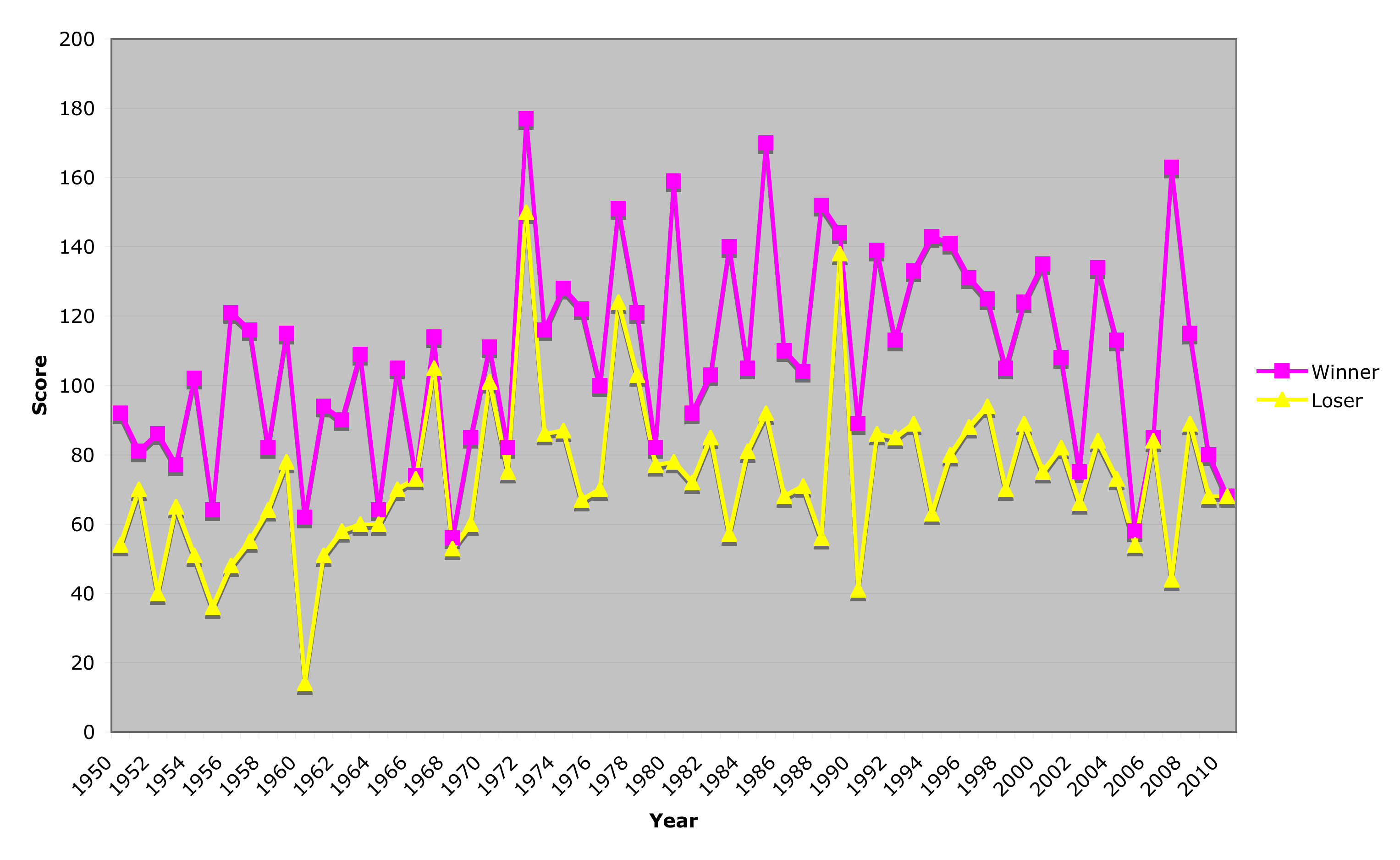
    Figure 1 shows the winning and losing scores in the grand final for the last 60 years. There appears to be a narrowing of scores before the 1980s and another narrowing the previous 10 years, though the results shown in this chart are hardly conclusive. There’s also a hint of a jump in scores at about 1980, which actually shows up very clearly in the differenced time series plot of loser scores but not of winners.

    Figure 1: Scores of winners and losers in the grand final of The Only Real Footy

    A plot of winner’s scores against loser’s scores suggests a strong relationship between the two, but this is not unexpected given that both teams are trying to win, so is not presented here.

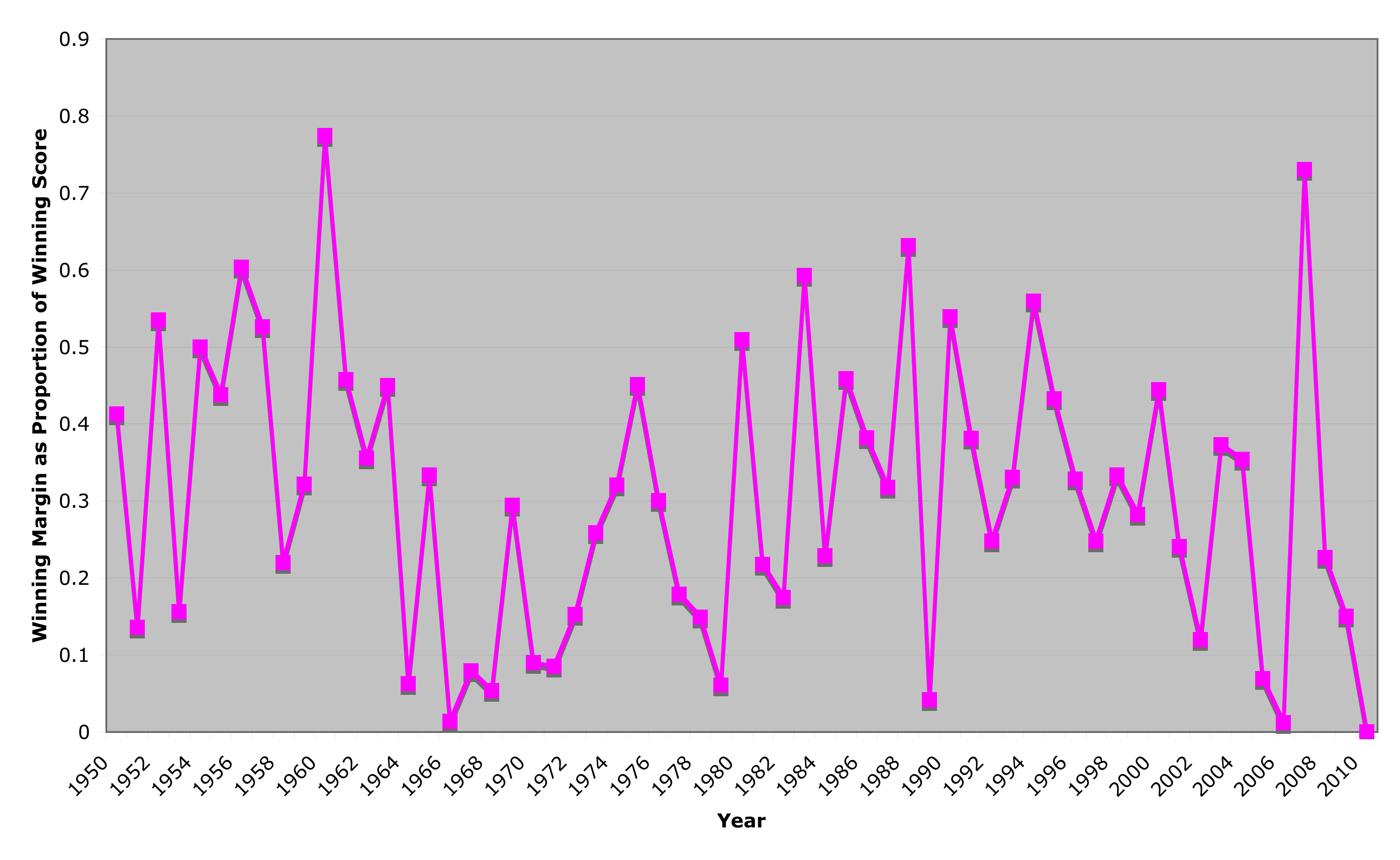
    Figure 2 shows the proportionate margin by year. There appears to be a periodic relationship in this margin, but in fact analysis of this period does not suggest it is very significant[3].

    Figure 2: Margin by which 22 men become Gods for a year, as a proportion of their total score

    Analysis of autocorrelation and partial autocorrelation functions (not shown) suggests that the serial dependence in this model is AR(2), that is the margin of victory in any given year is related negatively to the margin of victories in the previous two years, and very strongly to the previous year. This is to be expected – teams learn from a very large margin of victory in the prior year, and adapt to fit new tactics, significantly reducing the margin the following year. Fitting a linear model, with year as the only predictive term, we find that there is no serial dependence in the residuals of the model, but that year is not statistically significant (p=0.151). This means we don’t need to fit a generalized least squares model, though doing so with an autoregressive (2) term makes no difference. On visual inspection the residuals do seem to be uncorrelated, suggesting a model with no serial dependence. The linear model only explains 0.1% of variance, suggesting a lack of predictivity for simple models of AFL scores.

    Conclusion

    There is no evidence of a strong pattern, either periodic or linear, in margins of victory in AFL grand finals. There is some evidence that the margin of victory in a given year depends on what happened in the previous two years, and tends to regress towards the mean, suggesting that teams learn from previous blow-outs. There is otherwise no evidence of any time dependence in this data.

    Note that there are two important additional caveats: one, that estimates of significance in ARIMA models in R are thought to be wrong[4]; and two, that there is an additional source of serial dependence in this data, in that some of the grand final scores are for the same team in multiple years. Obviously the blow-outs in figure 1 correspond to the years when Port Adelaide won the grand final, or when the Crows lost. A more sophisticated analysis of AFL scores would use all scores for the year, adjusting for serial dependence by team and game, and using a version of Stata that works rather than R.

    Finally, I think that the AFL maintains a draft system and a salary cap. This would be consistent with the findings[5] presented here.

    fn1: I think it would be great if all research papers presented their caveats in this style. But I’ve had 3 beers, and that is not the usual condition under which research papers are written[2]

    fn2: He assumes, bravely

    fn3: possibly because I’m pretty crap at fitting periodic models, and after 3 beers really not even very good at working out how many radians to divide 40 years into, or what should be on the top or bottom line of the sine function. But I think I got it right.

    fn4: I read this in a journal article when I was actually doing something important, but I can’t be bothered finding it now

    fn5: May I use this term loosely?

  • This is a speculative post, since what I’m suggesting would require a lot of effort and probably be a huge waste of time. My experience so far (in 3 or 4 sessions) of Warhammer 3 suggests that the system is something I really like, and I’m interested in whether it could be converted to use in non-warhammer settings. The rules themselves are very simple and easy to understand; but there are huge elements of it that make it very specific to the setting, but these elements are kind of modular and can probably be used to make the flavour of a new setting quite easily. So I’m wondering if I could convert the system to suit my Compromise and Conceit campaign world (or any other!)

    Why I like warhammer 3

    There are several aspects of the warhammer 3 system that I really like. The dice and skill resolution system contain a lot of role-playing hooks that enable a GM to very easily create interesting outcomes for actions, including success-with-cost, failure-but-some-minor-benefit, extreme success and failure, and unusual outcomes. The combat system is fast and deadly, and the rules for Actions give non-magic users a lot of options for things to do, as well as applying costs to non-magical manoeuvres. The system for handling fatigue/stress and other side-effects of actions is quite straightforward, and the easy way that cool-down effects are worked into the system is very clever. I also like the method for having continuous access to spells – no 1-a-day magic-users here – but limiting the frequency of use by the simultaneous mechanism of rechargable power points and rechargable actions. None of this would be possible without the simple counter-based tracking systems, of course.

    I think all of this is very innovative, and very suitable to the style of game that I like to run, which is roughly like this:

    • combat is realistic and deadly, but handled quickly and simply
    • death spirals make multiple combats risky
    • magic is powerful and almost unlimited, but magic-users don’t have many spells
    • i.e. essentially fighters’ or thieves’ actions, and magic-users spells, are broadly similar in number
    • spell-use and other special actions are limited by a cost
    • skill use applies to non-combat, non-mechanical actions and can be stunted to get benefits from role-playing or good planning
    • partial success is possible in skill use, and simple to manage
    • PCs are slightly more heroic than the average person, and become quite powerful with time, but are always vulnerable

    Rolemaster had almost all of these components, but was hideous to run. The simple mechanisms of the Warhammer 3 system seem to balance the kind of details this type of system requires with the kind of playability that stops a single action from taking forever.

    Basic adaptation of the Warhammer 3 system

    Basically, to adapt the Warhammer 3 system to a new setting, you need to change the careers (and associated advancement system), and the actions and talents. I don’t think it would be necessary to change the skills even if you were switching to a completely different setting (such as cyberpunk or space opera) though a wider range of advanced skills might be necessary. So the key thing is the careers, actions and talents. Of course you would also need to adjust equipment.

    Changing the careers and advancement system

    In the current warhammer 3 setting, there are a (fairly) large number of careers, and PCs are expected to progress through several over a long adventuring career. Essentially you pick up a number of advances – like experience points – that you spend on acquiring new actions, improving ability scores, or gaining skill slots over one career. Once you’ve spent about 15 (I don’t know the exact number) you can advance to a new career, retaining (most) of what you collected in the old career. You can’t advance an ability score past 6, and typically when you’re in one career you can only pick up 3 new actions; and in one career you can only train any one skill once.

    The obvious way to make a more heroic and classically fantasy-centred game is to reduce the number of basic careers, and increase the length you can be in them. By requiring, say, 30 advances rather than 15, and allowing PCs to increase ability scores up to, say, 8, (or, say, 5 for non-career scores) you would basically turn a career into a longer-lived, more heroic style of “character class.” You could then allow PCs to progress to a set of prestige classes with new and better abilities. So, I would probably consider restricting the initial careers to Fighter, Specialist, Wizard or Cleric. Then subsequent advanced careers might be things like Paladin, Guildmaster, Archmage, High Priest, Necromancer, etc. I would probably also produce a dabbler-type basic career which allows a mixture of thieving or fighting and magic, but with more restricted access to spells (only level 1, for instance).

    Allowing ability scores to advance to 8 is particularly important for magic-using PCs, since it enables them to cast more spells before they have to draw more power, and reduces the risk of stress from carrying power above their usual limits. Because skill checks depend on abilities it also gives fighters solid combat powers to take on the types of monsters you don’t see in a standard warhammer campaign.

    Changing actions and talents

    I already have a set of spells for Compromise and Conceit, some of which I tried to represent as actions for a D&D-style game. It wouldn’t be difficult to rewrite these (and some new, demonically-influenced talents) as actions for warhammer 3. Most of the combat actions could stay as they are. There would be a new set of Infernal-style actions which would be semi-spell-like and available for all characters, wizard or not, but quite basic. There might also be some interesting technology-related ones, particularly to do with building stuff; for example a “grenade” action which requires that you previously spent some time in a lab creating grenades using your advanced tech skills.

    Basically, however, the system would retain a bunch of core actions, and only the spells and infernal talents/actions would change.

    The downside

    The challenge of doing this is that it would be a huge amount of work, and a lot of the results would probably be unbalanced. The warhammer setting as it stands is almost translatable to Compromise and Conceit without much change, so it might not even be worth the effort. I’m also not sure if the warhammer system breaks at higher power levels or not. But it could be worth finding out…