The Nameless One has spoken, this time through a team of oracles at the German sea-life aquarium, and the cephalopod cabal predicted a win by Japan in the Women’s Soccer World Cup. The closeness of the decision within the tentacled tribunal led some to question whether the final match might be a closely-fought event, and indeed it was; but in the end Nadeshico Japan won! Ganbare Nippon! I wanted to watch this final match but sadly it was only available on pay TV, so I missed it. But I’m happy that Japan won a well-deserved victory after beating some tough teams (Germany and Sweden!) to get there.
Incidentally, Nadeshico in Japanese is a name taken to refer to a classical Japanese vision of feminity. To say someone is “a Nadeshico” is to compliment their feminity as both beautiful and traditional. I think this is an excellent name for a women’s national soccer team. Well done Nadeshico!
The latest nerdrage over the depiction of Dwarves in The Hobbit has really hit home to me something I often suspected about fanboys but never really paid much attention to: they don’t actually know much at all about the text they love. They’re much more interested in their personal, often (usually?) quite fantastic misinterpretations of it than they are in the text itself. Thus we have the following misunderstandings about the Dwarves in The Hobbit:
They were based on nordic myth
They all had voluminous beards tucked into their belts (1)
They were just tinkers and blacksmiths, with no special skills (1)
They didn’t carry any special weapons or armour at the start of the adventure (1)
They were “just” on a quest for treasure (1)
Tolkien described them well, and attempts to represent them in the way Jackson has are a betrayal of Tolkien’s original description
Thorin wasn’t a warrior
Thorin Oakenshield should have a shield
All Dwarves should be fat
They would look better if they were represented as they are in the book
None of these are true, and the ideas I’ve marked with a (1) are direct results of imbibing too much D&D, specifically OSR D&D that envisages all adventurers as starting at 1st level as vulnerable meat on a hook, with no special weapons or armour. The actual facts from The Hobbit are:
The Dwarves are based on mediaeval images of Jews (as best we can tell) and would not suit “nordic” dwarves, who are generally evil, mischievous and untrustworthy[1]
Tolkien mostly doesn’t describe the Dwarves’ beards, but in fact only one had a beard tucked into his belt (Dwalin) and the rest were barely mentioned at all; at one point he mentions 4 Dwarves tucking their hands into their belts and explicitly avoids mentioning, e.g. “alongside their beards.” For Tolkien, beards were a fixture on Dwarves but were given no special attention at all
In the text Thorin states that the Dwarves were at times even reduced to smithing or mining, but he doesn’t suggest that this was their profession – he suggests that they hated this work and did it when they had to
Tolkien doesn’t mention the Dwarves’ equipment beyond their hoods at any point up until the Troll encounter. We go through five chapters (or is it 3?) with these adventurers without ever finding out what they’re carrying or wearing. However we do know that they had several pack horses (“one of” the ponies was lost in a river before they meet the trolls, but was carrying mostly food). Why should we then assume they were lightly armed and armoured?
Thorin makes clear from the start that he hopes to kill Smaug and regain his kingdom
Tolkien’s descriptions of the main characters in this story were “a dwarf” along with a description of their hood colour, belt colour, and sometimes their hair colour or a detail about their eyes or physique. Most of the Dwarves get no description except “a dwarf with a [colour] hood.”
Thorin is introduced as THE Thorin Oakenshield, clearly acts like a leader (he doesn’t do dishes or speak to closely with Bilbo, only Gandalf) and is later established (in other books) to have distinguished himself at a major Orc battle. He is an experienced warrior and leader. This is not a first level fighter by any stretch of the imagination.
Thorin is named “Oakenshield” after his shield broke and he used a piece of oak to defend himself. He is explicitly not named “Oakenshield” because of the shield that broke
Tolkien only singles out one of the Dwarves for any kind of physical description (Bofur, I think) and says he is fat and heavy. The physique of the rest of the dwarves is not mentioned at all at any point. In fact, I don’t think even their height is mentioned explicitly in the book
Tolkien basically doesn’t describe the Dwarves at all. There is not enough information about any of the Dwarves in the book to motivate a casting decision – Jackson was basically completely on his own and unable to use the source material when choosing how to depict the Dwarves
You would think that people who really care about these books would know some of these things before criticizing Jackson’s efforts, but they don’t seem to. Instead the fanboys just complain as if Jackson’s sole responsibility on this earth was to delve into their mind and design his Dwarves exactly according to their wierd personal amalgam of The Hobbit/D&D/some movie they saw 30 years ago and liked. But they cloak the whole thing in “respect for the original work.” But in order to show this respect, it would really help if they actually paid attention to the original text.
And while I’m at it, if this book is so good, how come none of the main characters actually warrant any kind of physical description? That’s pretty shoddy writing, in my view.
—
fn1: This is a pretty fucking basic thing to have to get right if you are going to valorize Tolkien’s “imaginarium” or whatever it’s being called this month. Nordic dwarves are dodgy vicious magical monsters; the dwarves in The Hobbit are not. Can you reconcile these two facts? No? Then you should be paying more attention to the sources Tolkien used to establish his stories.
There seems to be a lot of nerdrage going on at the moment about the new Hobbit movie, and the depiction of the Dwarves who form the bulk of the characters. The Dwarves actually seem pretty cool to me (you can see them here) and I particularly like Fili and Kili because they actually represent an attempt to present Dwarves as something more than just fat, bearded fighters. They are Dwarven rogues, which is exactly what the book tells us they are. Man, how’s that for textual interpretation?
Leading the charge against this terrible misrepresentation of Tolkien’s work is Grognardia, who complains about Fili and Kili’s non-dwarvishness here and disputes some others here and here. But he also presents us with an alternative “vision” of The Hobbit‘s Dwarves, in the old Rankin-Bass version of The Hobbit, which thankfully I’ve never seen. Looking at these screen captures, I see only The Eternal Jew, and contra Grognardia’s title for this post, there is no “variation” here. The Rankin-Bass version of this book presents us with 6 Dwarves who are exactly the same except for their cloaks and hats, and then it gives us Fili and Kili. But amongst those 6 we see the classic hook-nosed, suspicious-looking Jew. They have exactly the same faces. It’s like a caricature from a Nazi pamphlet.
Which is interesting, because wikipedia tells me that Tolkien based his Dwarves on mediaeval representations of Jews. How fascinating that they adopted the negative characteristics of “being gold-hungry, overly proud and occasionally officious.” Sound familiar to anyone? Plus of course their women-folk are hidden from view, they have access to secret lore (Golems, anyone?) and they are a very insular race.
This is another, classic example of Tolkien’s habit of racial determinism. The Dwarves are the worst of the bunch, in this regard – Middle Earth has half-elves but no half-Dwarves, in fact it’s not even clear if Dwarves can breed with non-Dwarves. This is exactly consistent with common views of Judaism at the time he wrote the novel, as an insular and secretive racially determined religion that admits no outsiders and cherishes its secret lore. Now, we know that Tolkien had a generally positive view of Jews (or at least, of their intellectual and cultural achievements) but in writing this kind of racial determinism he is subscribing to the politics of his era without dissent. The Dwarves of the Hobbit and the Lord of the Rings are a classic example of scientific racism.
Obviously Tolkien has no responsibility for the way that some stupid Americans decided to interpret his racial determinism, but it’s refreshing that Jackson has chosen to widen the range of cultures from which he draws inspiration for the appearance of the Dwarves. If we’re really lucky, he’ll even find a way to make their personalities less racially determined, and make some small effort to break down the kind of scientific racism that drives so much of “high” fantasy. And I bet that if he does the fanboys will squeal.
Back from Beppu and continuing my reports on the book War Without Mercy that I introduced here before my travels commenced. I’ve finished the section on allied and Japanese war atrocities, which were numerous and terrible on both sides, and which I briefly mentioned in my previous post, and now I’ve also read the section on allied representations of the enemy. This section makes clear that the allied response to Japanese aggression was both furious and exterminationist in its content. That is, the allied war planners and propagandists, and allied media, made clear both their deep hatred of the Japanese, its racial origins, and their belief that the only solution to the problem of Japanese aggression was extermination of the Japanese as a race. Obviously since the Japanese survived this goal was not enacted and cooler heads prevailed, but the propaganda that was driving the allied war effort in 1943-45 was genuinely disturbing stuff.
Exterminationism, US style
However, the nature of allied propaganda began to create uncomfortable contradictions in both internal political struggles in their own countries, and between them and some of their less “enlightened” allies. This is because it called on fundamentally old-fashioned racist tropes, but its connection to exterminationism and the defence of the colonial project led them into tricky political terrain.
The Eternal Racist
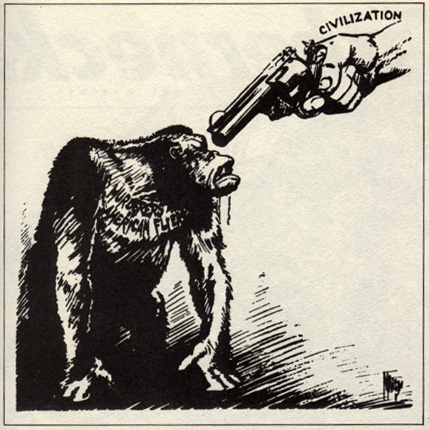
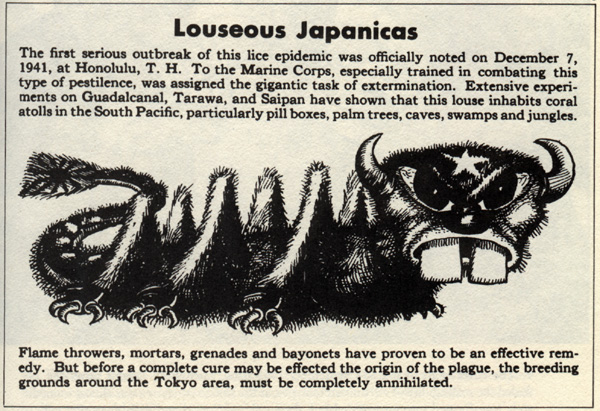
In an illuminating section of the book, professor Power points out that the allied anti-Japanese propaganda used in WW2 drew on a wealth of existing racist caricatures with almost no change or originality, simply substituting Japanese for Native Americans or black Americans. In fact, Roosevelt’s own father had been saying almost exactly similar exterminationist things about Native Americans, and the common images used to describe Japanese were borrowed directly from the racist lexicon: they were animals, apes, children, insane, cunning, treacherous and had special “occult” powers. The accusation of “occult” powers was particular to anti-Asian racism and had previously been used against the Chinese; but all the other epiphets and images could have been used for any previous racial enemy of the US or Britain – and Power observes almost exactly equivalent language being used against Native Americans, black Americans, Mexicans, Chinese migrants and the Chinese nation, and then finally the Phillipines, over the course of just 150 years. He also points out that the original Spanish descriptions of the Native Americans of South America were interchangeable with the allies’ claims about the Japanese; and to this he could undoubtedly have added the British defense of their colonial practices in India, and western descriptions of Aborigines and Maoris[1].
The Colonial Project Continues
The other aspect of allied propaganda that was quite surprising was its open acknowledgement and approval of the colonial project in the Pacific and Asia. The US even had a popular song, To Be Specific, It’s Our Pacific that summarized western ideas about the war. Political and opinion leaders didn’t shy from defending their right to own territories or colonies in Asia, and their anger at Japanese temerity in attempting to either establish its own colonies, or to take theirs. The war now is seen as a war to preserve freedom, but the western peoples of the 1940s were comfortable seeing it as a war to preserve their overseas colonies. One report to war planners even observed that many Asians in the fighting territories saw the war “cynically” as a war between fascists and imperialists. How very cynical of them! Churchill openly stated his aim as the preservation and continuation of Britain’s colonial possessions, and many war leaders saw the Pacific war specifically as a race war, between “white supremacy” and the “coloured races.” They worried that the “coloureds” were stirring, and explicitly saw the Japanese attack as a threat to the long-standing world order. Having portrayed the Japanese as apes and animals, they now had to face the fact that these “apes” were capable of besting the “superior” races in military activity, and were setting an example that other Asians might choose to follow. Some of the more alarmist planners saw in this the germ of the long term collapse of the white race, and openly stated so.
These worries were acutely seen in two areas: fear of the effect of the war on black Americans, and fear of the collapse of China.
Racism at Home
It’s well-established (though not often discussed) that the US was extremely racist in its dealings with black soldiers. Black Americans were not allowed in combat roles until very late in the war, were not allowed many promotions or the best or most skilled jobs in the army, and were even required to maintain a separate blood plasma supply: that’s right, black blood couldn’t be used in white soldiers, even though the people writing this policy knew that the scientific evidence was that the blood types were indistinguishable. Some racists portrayed plans to amalgamate the blood supplies as an attempt to weaken the white race by merging its blood with black blood. Black American blood. In Australia, the US government sought (and was granted, I think) special permission to maintain its segregation laws in the housing of US soldiers in Australia, and conflict regularly occurred between US and Australian soldiers in public places when Australian men and women failed to observe American ideals about segregation – particularly, Australian women would date black soldiers and the soldiers would be punished by their white colleagues for miscegenation[2]! Black Americans were acutely aware of their unequal status as combatants for “freedom,” as exemplified in these two slogans from black freedom activists:
Defeat Hitler, Mussolini and Hirohito by Enforcing the Constitution and Abolishing Jim Crow
and
I want you to know I ain’t afraid. I don’t mind fighting. I’ll fight Hitler, Mussolini and the Japs all at the same time, but I’m telling you I’ll give those crackers down South the same damn medicine[3]
One black soldier upon enlistment gave as his suggested headstone “Here lies a black man killed fighting a yellow man for the protection of the white man.” This distinction between racism at home and race-hate abroad created a problem for the white authorities, a problem they were aware of and, sadly, not particularly interested in addressing: how can you call for the extermination of a race of apes overseas, using exactly the same language you use to describe a group of people you are oppressing domestically, and expect loyalty from those same people? And how can you maintain your theories of superiority over that domestic group, when the people you paint in the same language overseas are kicking your arse in an area the size of the Pacific?
Loyalty from black Americans was a source of worry for American war planners, who broke up a few groups that may have been getting support or information from the Japanese, and the Japanese certainly attempted to use the Jim Crow laws as propaganda against America (in Japan). However, black American loyalty was largely to America, and the bigger worry for US policy makers was that the Japanese might provide black Americans with inspiration in their own struggle. With Japanese defeat looming, a large number of Americans would be returning from the front armed with the certain knowledge that “inferior” races could defeat “superior” races, and that the racial policy of the past 50 years was hollow; but at the same time they were exhorting white men to exterminate Japanese men with the same underlying logic of white supremacy that was being used to hold black people down in the US. Would this not make US blacks extremely uncomfortable? By using this language, the government had basically shown itself to be of a piece, ideologically, with the supremacists who still murdered black men in the South.
The US response to this appears to have been weak, with no real effort made to amend domestic laws or to move towards the end of segregation and Jim Crow. The only efforts they made were security efforts, to arrest domestic activists and look harder for evidence of connections between Japanese and militant black movements. They showed a little more foresight in dealing with the problem of the “coloured races” rising up abroad, but even there they were complacent and had great difficulty shaking off basic racism, as is shown in the case of the allies’ dealings with China.
The Collapse of China and World War Three
The allied war planners’ biggest fear was that China would collapse or surrender, freeing up 2 million Japanese soldiers to advance into Asia and lending all of China’s economic, industrial and manpower resources to the Japanese. Almost as devastating would be a peace treaty between China and Japan, and the most likely cause of such a treaty – besides China’s exhaustion after 7 years of war – would be their treatment by their allies. Churchill had made it clear he intended to maintain British colonies in the Far East, and the allies refused to rescind a special treaty which prevented China from trying foreigners in local courts. But worst of all was US racism toward Chinese migrants in the US, who were placed in a special category of undesirables and refused both admission and naturalization rights. The catalogue of racist laws applying to the Chinese in the 1940s is quite horrifying, and saddening, and shows an intense and abiding anti-Oriental racism in the west at that time. It was impossible for Chinese to become US citizens at the start of the war, and almost impossible for them to enter the country at all, or only at a very high price and often with extreme difficulty. These laws were a big issue to Chinese in China, and it was obvious that the threefold combination of British imperialism, US racism, and allied special privileges in Asia could turn Chinese attitudes against their western allies. But it was extremely difficult for the US to give up its anti-Chinese laws, and in 1944 as a comprise it allowed a quota of just 105 Chinese a year to become citizens, provided they were new migrants. This was the WW2-era Americans’ idea of a compromise to a lower race. Even though they were fighting a huge and terrifying war in the Pacific, whose outcome at least partly depended upon their treatment of their local allies, they couldn’t properly give up their racist ideals. Similarly Britain, which was highly dependent on its colonial armies as a bulwark against Japan and knew that at least some of the countries it relied on were shaky, refused to give up its colonialist policies in Asia. By this time India was beginning to rebel against white rule, the Burmese had at one point showed allegiance to Japan, and the Japanese were using the language of the East Asia co-prosperity Sphere to claim that they were liberating Asia from white imperialism. Had they behaved less like colonialists themselves this propaganda might even have been successful.
This toxic mix of rebellion by the “inferior” Japanese, activism in colonial provinces, black activism at home, and fears of Chinese collapse, led many commentators in the West to fear that the world was on the brink of a new war that might explode from the ashes of WW2 – a war between the races, with the Eastern “coloureds” rising up against the “superior” whites. The fear of Americans was that the Chinese would fall behind this rebellion and the west would be both outnumbered and outgunned. They spoke of Japan “winning the war by losing” and of the “rising wind” becoming a hurricane.
The Pacific War as a Missed Opportunity
Very few western commentators and politicians saw either the logic or the principle of the obvious measures required to prevent this hurricane – rescinding racist laws, voluntarily withdrawing from their colonies, and ushering in a newer, fairer world order – even though many of Japan’s reasons for entering the war were connected to its racist and unequal treatment between 1905 and 1937. So it was that the war came to its end with the West still convinced of its superiority – perhaps even reassured, after putting Japan “in her place” – and unwilling to consider the wholesale changes that would be required to restore peace to half the world. So it was that over the next 20 years we saw colonial territories throw out their masters, often violently and with huge death tolls in India, Indonesia and Malaysia, the establishment of new and fucked up Juntas in Burma and Africa, and the collapse of economies through war and the scorched earth policy of the colonial masters. Following this was the civil rights movement in America and the sad and terrible disgrace that is the US invasion of Vietnam. Instead of seeing Japan’s attack on Pearl Harbour as a wake up call and the ensuing war as the final battle over racist ideology, that they must inevitably lose, the colonial powers mistook it as a chance to reassert their grip, and in tightening the screws they just increased the pain that those countries were willing to bear in order to gain their freedom. As the universe’s most famous freedom fighter once said – the more you tighten your grip, the more they slip through your fingers. This means that the Pacific War was not just a catastrophic and avoidable mistake at the time it happened, but the one useful lesson that could have been gained from it was missed, and a teaching moment for Western Imperialism was overlooked. The ensuing history of Asia was written largely in blood, much of it probably avoidable if the allies had not cleaved so strongly to the racist ideals that underlay their ideology in both war and peace at that time.
(Note: Illustrations are from the text).
—
fn1: As an interesting aside, our approach seems to have become much, much more mature in recent years – descriptions of Afghani and Iraqi enemies are generally much less dehumanizing than those used in World War 2, even though al Qaeda’s treachery on September 11th was comparable with – or worse than – Pearl Harbour.
fn2: I’m taking this information from an ABC documentary on segregation in Australia, not from Power’s book.
fn3: Note here a subtle effect of the racist tone of war propaganda. The western European enemies (Italy and Germany) are identified with their leaders; the Pacific enemy are identified as a race
The Daily Mash tells me that it’s one year since Neptune was discovered. A lot has happened in that time – Pluto was demoted to junk-planet status, we discovered the possibility of planets around other stars and explored to within a few seconds (?) of the Big Bang. But Neptune is still going strong, doing what Neptune does. Happy Birthday Neptune!
This book uncovers some unpalatable truths about Allied behaviour in the Pacific War, 1939-1945, in the context of an analysis of how both sides in the war (Japanese and Allied) used extreme racist language to fuel an orgy of violence and atrocities. The author, Professor John W. Dower from MIT, attempts to address the twin issues of how salient racist thought and propaganda was in the Pacific war, and how that racist fury managed to change so quickly to cooperation after the war finished. But this story relies fundamentally on a correct appraisal of the actions of both sides in the war, and particularly on an unvarnished view of Allied behaviour. Everyone knows how badly the Japanese behaved in the war, but I think very few people are aware that the Allies also engaged in a great many atrocities, including torture and wholesale slaughter of prisoners of war and surrendering soldiers. I certainly was ignorant of the scope and prevalence of the atrocities committed, and the acceptance of them (both open and tacit) in the media and higher echelons of the military at the time. Professor Dower’s argument is that these atrocities were unique to the Pacific theatre, and were inculcated through an intense campaign of racism and dehumanization of the Japanese in western media and propaganda that, although often using different imagery and style to Japanese wartime propaganda, essentially mirrored the techniques and purpose of that propaganda. The result was a war of unprecedented fury and ferocity – at least from the perspective of the US and commonwealth countries. Obviously for the Russians, Germans and Eastern Europeans the role of racial ideology in driving a war of extermination was well understood by 1943, but the conflict between Germans and the Western allies was largely free of racial hatred, and very few atrocities occurred on either side. So from the perspective of the Western Allies, the war in the Pacific theatre was conducted, propagandized and envisioned very differently to that against Germany.
This racist propaganda was both extreme and potentially catastrophic. By 1945, both the general public and policy-makers in the US were accepting of an exterminationist stream of thought, which led to speeches like this by Major George Fielding Eliot, who said that the Allies’ aim must be:
The complete and ruthless destruction of Japanese industry, so that not one brick of any Japanese factory shall be left upon another, so that there shall not be in Japan one electric motor or one steam or gasoline engine, nor a chemical laboratory, not so much as a book which tells how these things are made
Churchill suggested reducing all Japanese cities to ash, and one person assigned to planning Japan’s post-war construction called for their “almost total elimination” as a race. Fortunately for all involved, saner heads prevailed by the end of the war.
This book makes clear the tit-for-tat nature of some American atrocities and doesn’t attempt to compare savagery or indecency – it is interested in comparing the role of racist ideals in driving exterminationist behaviour. But it does not attempt to exonerate allied soldiers on the basis of their prior experiences – and makes clear, in any case, that much allied bad behaviour occurred before the full extent of Japanese atrocities was known or had been communicated to the troops. Indeed, some of the most basically racist western propaganda was conceived of before Pearl Harbour, and certainly before the general principles of a furious and merciless war were already germinating long before the Japanese atrocities had been well-understood. It makes for uncomfortable reading when the statements and behaviour of the allied soldiers are compared with those of the Nazis in the Eastern Front. For example, keeping body parts as trophies, throwing prisoners alive from aircraft, killing prisoners or survivors en masse, and cutting gold fillings from Japanese survivors while they were still alive, were common practice amongst US, British and Australian soldiers. Accounts from captured Japanese soldiers and their diaries indicate they went to ingenious lengths to find ways to surrender without being executed, because they knew this fate awaited them; and many soldiers were killed attempting to surrender.
This has led me to ponder a couple of questions that I will return to over the course of reading this book, some of which challenge my accepted understanding of how the war was conducted and what decisions were made. Here are a few:
George Fraser, author of the excellent Flashman series, has written an autobiographical account of his days in Burma under general Slim, the very thoughtful and interesting Quartered Safe Out Here, which I highly recommend. He routinely recounts the accepted notion that “the Japanese never surrender.” He was writing of 1945, by which time the Japanese must have known that surrender was, largely, a death sentence. Did he know this fact and chose not to include it? In fact, did he sanitize this aspect of the war from his account, and if so how much can his version of events in Burma be trusted?
We have clear and accurate accounts of the numbers of soldiers who died in Japanese captivity, but to the best of my knowledge no similar figures have been compiled for the Allies. Could it be that Japanese prisoners of war actually had similar (or worse!) survival rates in Allied captivity due to the practice of murdering them on capture? If so, how should modern western interpretation of our role in the war change to account for this – what kind of outrage can we level against our former enemies if we behaved the same way?
I have always accepted the western account of the nuclear attacks and fire-bombings in terms of the Japanese refusal to surrender, and even partially the claim that this approach saved lives because it avoided an invasion of the mainland. But how much should we trust those analyses when accounts of the Japanese martial character, the conduct of the war, and all assessments of the likelihood of surrender, were based on highly racially charged and often inaccurate assessments of Japanese motivations and behaviour? How truthful was the underlying information that led to these decisions? How is it that the country which sent notes to all its allies in 1940 asking them to refrain from urban bombing campaigns was happily broadcasting its joy at reducing cities to ash within 4 years? Was this change really purely or even partially driven by strategic necessity?
Given that this racist propaganda was being built up before the war and was unleashed in full force as soon as the war started, is it possible that the war itself was much more preventable than leaders and opinion-makers of the time were willing to believe? To what extent was the racist propaganda about the implacable Japanese enemy a self-fulfilling theory?
I’ll come back to some of these questions over the next few weeks as I read through this compelling and extremely unpleasant book. For now I’m on holiday in Beppu and with patchy computer access, so nothing more on this will happen for a week or so, but I certainly aim to return to this topic soon.
I gave up playing AD&D sometime in the early 1990s, and switched to largely Rolemaster for a good period of time, only coming back to D&D with 3rd edition after a very system-agnostic friend recommended it. For all that time I never regretted leaving AD&D behind, though I have many fond memories of it. My problems with it were primarily that for all the crunchy system and complexity, you just didn’t get a particularly big benefit in terms of realism or diversity of gaming experience. Maybe also I got bored of playing the same system for 8 years or so (what can I say? I was young!)
So recently I was surprised to have my nostalgia for the system reawoken by a most unexpected agent: Mobbunited. I don’t know if this is well known around the traps, but this most new school and anti-OSR of bloggers has spent a long time now GMing AD&D first edition, in a campaign known as the “100 Million Days.” His explanation of why he likes playing AD&D and its good points made me think about my experiences of the game and its complexities, and I think I agree with Mobbunited’s experience: I never really played it properly as a child. So many of the rules that make AD&D so complex I just dropped, and reduced it to a kind of second-rate version of 3rd edition, all THAC0s and spells. But Mobbunited says of the game he plays:
Once you look closely, you come to understand that with all the bells and whistles intact, AD&D1e is a game of remarkable cohesion and subtlety. You can encounter some crazy things, but encounter reactions determine whether you’ll step right in to a fight. Charisma is an extraordinarily powerful ability score because it influences henchman and hireling numbers and loyalty. Weapon vs. AC adjustments justify the large weapon table. So do the special abilities of certain weapons. It’s not a perfect game, but it’s not just a bunch of crazy shit hacked together in the way even supporters claim. It sure seemed that way to me when I was a teenager, but I played it in an impatient, edited form.
The key points that he identifies here are all the rules I ignored as a child, and his revelation as an adult gamer was that the system is completely different without these special rules, and the hacked together version doesn’t work without them. He shows this in some of his play reports, where the interaction of random encounter tables, the module design, and the reaction charts really makes interesting things happen. The game he describes sounds like something I want to play and, perversely, something that the younger me, shifting from AD&D to RM, was definitely looking for. I could have tried re-reading those books and incorporating all that crunch, and no doubt the game would still have been easier to GM than Rolemaster, but perhaps with all the additional excitement and interest that comes with the well-designed Rolemaster crunch. Who can say, now, when I’ve lost the books and haven’t played anything like it for years?
Out of interest I downloaded the OSRIC pdf to investigate it and see how it matched Mobbunited’s description, but it doesn’t have anything like the same depth and complexity that I remember from the original rules. Cracking open the 1st Edition Player’s Handbook really was like opening a lost tome of secrets, and poring over the spell lists and equipment tables in those books really did feel like entering an arcane world (especially given the obscure references and complex layout of the book meant playing it was a bit like decoding ancient writings). But OSRIC is simple and streamlined and much of the depth and complexity has been taken out of it. Mobbunited himself says that “It looks to me that this half-game is the AD&D OSRIC emulates.” I think I agree with him and, if I were to consider an AD&D excursion again, I think I would try to do it in the original form, perhaps using some of Mobbunited’s altD&D rules. In fact, just for the sake of nostalgia, getting hold of the original AD&D rulebooks would be a pleasant idea. Perhaps I should do it, and see where all that crunch leads me … Who said this dog is too young to learn old tricks?
I recently received some new WFRP 3 products (Signs of Faith and the Creature vault), and was led to ponder whether I’m being massively ripped off. The proximate cause of this consideration was not, perhaps, very orthodox: both sourcebooks in the Signs of Faith boxed set contain largely flavour – that is, information on religion in the WFRP world – and even though I like this stuff a lot I always feel like I’m being rorted when I shell out money for a product and get “fluff.” This is a particularly stupid attitude when talking about WFRP because the entire joy and special pleasure of WFRP is its carefully designed and imagined world. Back in the day, we D&D-ers paid good money for a well-developed world. So why do I feel ripped off when that’s exactly what Fantasy Flight Games give me? Along, of course, with a whole bunch of nicely designed magic cards, some new rules, and a bunch of stand-up cardboard figures[1].
This got me wondering whether, in fact, WFRP 3 is a rip-off, which I think is a common complaint because the basic set is $100 and the add-ons aren’t cheap either. Obviously it’s expensive, but compared to other games, is it hideously over-priced? So I investigated…
What You Get
The introductory set at $100 is essentially enough to play the game – it’s kind of equivalent to the Basic/Expert sets in D&D in terms of the scope it gives you. But to play the game properly – up to what in D&D might be considered the equivalent of the Master set – you need the Signs of Faith, Winds of Magic and Creature Vault add-ons – although arguably you could swap Signs of Faith for the Adventurer’s Toolkit. Ignoring this issue for now, once you have the basic set plus these expansions, you’ve paid a total of $240 and got:
The introductory rules for players and GMs
Expansion spells
A set of dice
A monster manual
Three modules for beginner, intermediate and advanced levels
A complete and very interesting world described in great detail, though sadly lacking a good map
So how much would this set you back if you were investing in another game system? Obviously if it were MERP, you would get the lot for about $20, but putting that aside … let’s consider a modern and an old classic, and compare WFRP with a) Pathfinder and b) the BXM D&D system
Comparison 1: Pathfinder
To play Pathfinder you need only two books: the basic rulebook ($50) and the bestiary ($40). Obviously possessing just these two books doesn’t give you the same amount of sheer stuff as my WFRP collection, so to bolster it up you need 3 modules, and a world. For the world, add in the Inner Sea Guide at $50 (I bet it’s not as good as the world of Warhammer). Then for 3 modules, they seem to cost roughly $14, so you’re looking at $42 for a set of 3. So in total you’ve had to shell out… $182.
On the bright side, Pathfinder has excellent production values – you get nice quality, well illustrated material. It’s extensible, so you can shift to a new setting or genre easily, and the system license means you can easily get access to new ideas – they also have some good ideas about subscriptions, updates, etc. You can also be fairly confident that the core system will be stable (unlike certain products) so over time you can rely on your books not becoming incompatible with new source material – and a lot of of people are developing stuff for Pathfinder. You can also strip out the extraneous fluff easily and go back to a nice core system that, for all its (many) flaws essentially works well.
But for $60 less than the total cost of the WFRP package, let’s not kid ourselves – you aren’t getting a new system when you buy Pathfinder. You’re shelling out $180 for something that was, essentially, built by someone else and will probably break if it is ever redesigned. It’s entirely derivative. It’s reasonable to expect that if Paizo had spent the time developing a system from scratch (as Fantasy Flight did for WFRP3) they might put a premium on the price. So really, we should compare WFRP 3 with a system built from scratch. So let’s try that.
Comparison 2: Basic/Expert/Master D&D
This system was built from the ground up. Without aiming to compare WFRP 3 and D&D on quality of imaginative vision (an impossible task, given that D&D started the whole thing) we can safely say that if a premium for creative effort were going to be charged, D&D would be the system that had the right to charge it. So what do we pay for a set of D&D products equivalent to the WFRP kit? I’m considering my WFRP collection to be roughly equivalent to the first 4 books of the BXCMI(?) series – excluding the really extreme level stuff because I think WFRP will chuck that in later. So how much does a BXCM set plus world plus modules cost?
It’s actually really hard to find this information but this site gives (some) prices of the various D&D products and their dates of release. The first release in 1974 cost $10 for a boxed set, and a release in about 1986 cost $15 so I’m going to assume that the original BXCM in 1983 or so also cost $10 (this is a conservative assumption). So we have:
Basic, Expert, Companion, Master sets: probably $10 each in 1983
Creature Catalog, $12 in 1986
The Grand Duchy of Karameikos, $10 in 1987, which was a big favorite back in the day
Three modules at about $6 in 1990
Converting these prices into 2010 prices using this site[2], we get:
BXCM: $22 each
Creature Catalog: $24
Grand Duchy: $19
Three Modules: $10 each
For a total of $141. For this you’re getting genuinely original, impressive stuff, but the production values are often quite poor (depending on the version of the game you get) and the game itself is not the best thing ever to grace the face of the planet. But it’s original, and the amount of creative effort involved in early D&D leaves any of the subsequent generations of game in the dust – just look at the diversity and depth of the products displayed on the linked website, and you can see that D&D was rigged to handle anything.
Of course, comparisons with prices from 30 years ago miss the fact that our purchasing power has changed a lot in that time – $80 in 1985 wouldn’t have bought you a computer game console of any kind (even second hand), but $140 in the modern era will. In fact I bet in 1985 you couldn’t have bought a typewriter with $80, but now you can buy an iPod for $240 and typewriters are a thing of the past. So it’s questionable whether the prices are comparable if you apply only inflation, since technological change has made a dollar go much further today (at least when we’re talking about entertainment). So maybe $240 worth of WFRP 3 is more affordable now than $80 of D&D was in 1983.
In conclusion, I think it’s safe to say that WFRP 3 is, for an RPG, a bit pricey, but it’s not a massive rip off. In straight inflation-adjusted terms, it appears that gaming has become much more expensive in the last 30 years, and the more relevant issue is probably that original D&D was – despite its enormous creativity – very cheap. Maybe the creative industry in general needs to look at why that is, and people working in that industry need to ask themselves if their industries have developed in the right direction in the past 30 years.
A Final Note: I’m no Chump!
I should add that a large proportion of the cost of my WFRP (actually, about $150 of it!) has come to me free as presents for favours rendered, so I’ve got the lot for less than the cost of the original D&D set. So any complaints about price from this quarter are purely academic!
—
fn1: That I never use, because from the very first day I played any RPG, I never managed to successfully incorporate miniatures into the experience
fn2: Which we can trust, because this is the internet
Here is a selection of local micro-brewery beers that I have recently sampled, assembled on my kitchen counter as a representative cross-section of these companies’ offerings. The two with the owl logo are from Hitachino Nest, whose bespoke brewing plan was explained to me and Sergeant M a few days ago. The others are all available at my local specialty supermarket (of which I have two), and most of the companies on display here offer a wide range. Not shown are Yona Yona, which Sergeant M declared delicious, and Shindaiji, which he tested at Bloomoon cafe and also enjoyed. I have no knowledge or understanding of beer making or the language of beer appreciation, but from left to right here’s a rundown of the beers in one sentence each.
Tama no Megumi: This one is a hearty pilsner, enjoyable and easy to drink.
Uwa: In common with a lot of the microbrewery ales I’ve tried, this one is a bit frothy and sweet.
PremiumPilsner: no space in the title, I think, and this one was a classic remake of a German style, nothing special.
The orange beer: actually quite a tasty and interesting idea, light and easy to drink but a little overpowered by the orange flavour.
Nest Amber Ale: Not very heavy and quite easy to drink, delicious.
Nest Pale Ale: Also not so heavy as pale ales go, but possibly a little weak for those who are into Pale Ales.
Full Moon Beer: Had that hint of wine-i-ness that some of the more esoteric beers go for, too sweet and heady for my tastes but if you like that Anchor Steam barley wine ale you’ll like this.
The Sergeant and I visited the Ebisu beer factory yesterday, and his brother told me that a lot of beer companies in Japan offer bespoke services; it appears that, along with plum wine, ale is enjoying something of a boom here in Japan at the moment. If you visit Tokyo I strongly recommend trying a few out, and perhaps also visiting the Ebisu beer factory to learn something of the history of brewing in Japan. It’s a fascinating example of the speed and rigor with which the Japanese can adopt and perfect foreign industrial processes and products.
Is bespoke brewing a uniquely Japanese phenomenon? My friend Sergeant M is in town from Australia, so last night we went for a few drinks in Kichijoji. After dinner at Bloomoon we headed to holic beer bar, which serves a wide range of imported and local brews. Sergeant M is a fan of microbreweries, and is a bit of a brewmaster himself – he recently made his first home-brewed Belgian beer sans kit, which apparently was quite good, and I thought he might be interested in trying some of the local Japanese craft (about which I will post more in a few days’ time, I think).
While we were drinking our second tipple at Holic, the barman revealed to us that he had on tap a beer that he had made himself. But this beer was not a homebrew – rather, it was a bespoke brew. He had gone to the Hitachino Nest brewery and consulted with the brewmaster there, and between them they had developed a recipe which the brewery then fermented and delivered for him. He showed us the design sheet for his beer (“Holic IPA”), and since a good portion of it was in English the Sergeant understood it immediately. It listed the different hops and grains used, the boiling temperatures and times for each, and the various other ingredients for the brew. It also gave a calculation of the bitterness on some international scale, the alcohol content, and so on. Having done this, the barman was able to take delivery of 600 litres of his own custom-designed brew!
Apparently anyone can do this at the Hitachino Nest brewery, provided they produce at least 15 litres of beer. It’s like print-on-demand, or web-based self-publishing – with beer! It would be perfect if you could design it on the internet and get home delivery, so that you never actually had to meet anyone in the process to produce your beer. Is this a uniquely Japanese phenomenon, or is it also possible in America or Europe? I have certainly never heard of it before…

 Compromise and Conceit