• I joined a new gaming group on Sunday, for 9 hours of slaughter with a group of blood-drinking, delusional toad-wranglers such as would bring disgrace on the name Dungeons and Dragons were their antics to become commonly known. My PC is a 3rd level human rogue called Shinan, a freelance negotiator for the various thieves’ guilds of the setting, and the other PCs are:

    • Wrenn, a gnome artificer with an alchemical bent, who makes potions out of the blood of other party members and thinks he is sexy
    • Haidulk, a massive human brawler specializing in grappling, whose current claim to fame is that he got a Drake in a headlock and killed it
    • Mardred, a Razorclaw shifter Warden who everyone calls “the Dwarf,” but who seems to think he is human. Currently wielding some kind of massive hammer, he seems to be very good at missing everything in combat until the killing blow needs to land

    My own PC is a pretty standard rogue. He is overweight from too many drinking parties (he is a negotiator!) and, being a go-between rather than a fighter, all his combat skills are built around getting behind bigger people. Occasionally his jobs require him to kill the hostage takers when negotiations turn sour, so he’s also a very good backstabber. But largely, he’s a runner and a talker. He also has delusions of grandeur, even though (because?) he was raised in a brothel in the entertainment quarter of the setting.

    The setting is the city of Punjar (I think we’re doing Sellswords of Punjar, or one of its sequels). I like Punjar – it has a nice combination of Lankhmar and middle-eastern themed chaos, with lots of skullduggery and a nice hint of the exotic. The introductory text is nicely written and the adventure so far has been interesting and challenging. It’s involved some negotiating, some research, some good old fashioned problem-solving (mainly for traps) and a fat scad of slaughtering. It’s got everything a party of blood-drinking, delusional toad-wranglers would want (including a giant toad to wrangle).

    I thought I’d make a few comments about what I perceive to be common criticisms of D&D 4e on the basis of my first session of 4e in about 3 years.

    Combat is not challenging: The players talked about having barely dodged a TPK the previous session, when a lucky roll enabled our toad-wrangler to get a drake in a headlock. Two of our party members were reduced to near 0 hit points by a smaller group of attackers – two vine monsters in a hedgerow nearly killed one of the party – and we routinely have to break out all our powers and push our limits to get through the battles. Things have been dire twice, and in fact if the GM had been interested in pushing it I’m pretty sure the first encounter of the day (with four grigs, FFS) would have killed me. Compared to other systems I’d say the WFRP 3 battles I’ve run have been nastier, and the D&D 3e battles in general easier, and no shorter.

    Combat takes ages: I haven’t really noticed this. In 9 hours (including, obviously, breaks for coffee and dinner) we got through shopping, introducing my PC, getting given a new adventure, two detailed interactions with PCs to do research, a battle with 4 grigs, a battle with 2 vine monsters, fighting a sword-swallower toad, negotiating a hedge maze, a battle with 5 elemental beasties of some kind, investigating four sarcophagi, and negotiating a dungeon level full of traps. I’d say each battle only took about 30 minutes or so out of all this. Probably this was partly assisted with some digital aids, but I don’t have any digital aids and I did fine. So I think this might be an exaggeration.

    Healing Surges make it all trivial: My character has 6 healing surges, each healing 5hps, a total of 30 hps; I have 22hps to my name. In OD&D terms this would be the equivalent of me, a third level rogue (on an average of 10.5 hps) having access to two cure light wounds a day. Given how abundant CLW potions tend to be in the average campaign, I don’t think this is a game changer. The dwarf has 14, so is able to heal 3 times his own hps in damage per day. I guess that’s a bit rich, but for the rest of us the healing surges can easily be seen as a simple alternative to a couple of CLW potions. And, we don’t have a cleric. The healing surges liberate us from the old-fashioned D&D party idea, where someone always had to play a cleric. Incidentally, 22 hps in this game is really not very useful. My backstab does 2d6+2d8+7 damage. I can very easily kill myself, and the dwarf can take me out with a single hit too (his damage is 4d6+7 if he uses an encounter power). This is pretty much equivalent to any other edition of D&D, where a 3rd level fighter rolling max damage can kill a thief of the same level

    Skill challenges are balanced at every level: I’m not sure if I understand this properly but I’ve got the impression that some people think all encounters and skill challenges are designed to be balanced so that you always have a 50% chance of success. This is very far from what happened to me on Sunday; so maybe I’m misunderstanding this. But I am confused by the saving throws, which do always seem to be just a 50% chance of success.

    It’s all about combat /it’s just a tactical miniatures game: We did lots of non-combat things, including some classic dungeon crawl problem solving and puzzle-solving, some rolemaster/D&D 3e style skill check-based manoeuvring, and some straight-out PC-to-GM negotiation. Nothing seems to be really different about what the game encourages or discourages. I don’t use miniatures in combat when I GM and there are some aspects of this style of play which I don’t think are good, but I don’t think these are unique to D&D 4e: D&D has always included miniatures and battle mats, etc. And I’ve always eschewed them in my own games. I don’t feel particularly constrained by using them in this one.

    So overall, although there are some ways in which it doesn’t feel like D&D, it mostly just feels like a slightly exotic form of D&D, with a better-designed character sheet and some smoother combat rules. It was better than my previous experience of 4e, but I’m not yet decided on whether I like the system overall: I’ll wait to play a little longer before I decide that. It is, however, a perfectly decent platform for adventuring, and I’m enjoying it, even if Shinan feels a little discomfort at having to slum it with this pack of degenerates. But in adventuring companions, as opposed to systems, beggars can’t be choosers; and until his ship comes in, Shinan is just going to have to stick around with this bunch of smelly weirdos.


  • Continuing my series of posts on sex work, public health and radical feminism, this post will attempt to describe the public health issues surrounding modern sex work, and some common public health responses to it. For the most part I will be talking about developed nations; for a variety of reasons, different conditions pertain in the developing world, and the public health response there is more complex. But as we shall see, sex work in the modern era presents some unique problems, and the majority of modern responses to them have been based around pragmatism and public health, rather than moral hygiene concerns, and in this sense modern responses – even in poor and conservative countries like Bangladesh or Indonesia – can be very different to those we previously presented from 100 years ago.

    Sex Work in the Modern Era: The Problem of HIV

    Until the early 1980s it was looking like sex work as a public health problem had become largely irrelevant. With the discovery of effective tests and treatments for syphilis, gonorrhea and chlamydia the major public health problems “caused” by sex work seemed to be under control.  Of course, all of this changed when HIV entered the scene – in the early 1980s for the developed world, but much earlier in Africa – and suddenly sex workers were cast back in time, to the bad disease vectors of old, transmitting an incurable and deadly disease.

    HIV is a classic example of how an infectious disease can survive in a community even though the majority of people are not engaged in the risk behavior that underlies its spread. Because it is asymptomatic for years, a small group of people can spread the disease through high risk behavior without even knowing they have it, and if this group of people is stigmatized and their reasons for getting or transmitting the disease make them subject to discrimination or public coercion, they are much, much less likely to get the voluntary screening that is needed to prevent the spread of the disease. In the absence of open coercion – which, in the case of sex workers, has been shown to be an ineffective public health measure for over a hundred years – some other tactic was needed to ensure that the disease did not become entrenched in this population.

    In the early 1980s, HIV was a genuine emergency, and it’s instructive to look at what happened in Africa in order to see what happens if the disease goes unchecked in the general community for too long. In the absence of a treatment, and knowing that the disease is asymptomatic for years, the public health community in the developed world recognized that a new approach to sex work was going to be needed: there was no time for moral panics and placing our hopes in the ability of our moral leaders to force women out of the industry, and men out of purchasing sex. Instead, in the UK, Australia, Canada and much of Europe, a new approach was tested that was based on, essentially, bringing sex workers in from the cold.

    The Modern Public Health Model for Sex Work

    The modern public health response for sex work is built around multiple strategies, working at multiple levels of society and the health system, to ensure that traditional cultural, structural and economic barriers to seeking health care – and specifically, sexual health care – were removed rapidly. The main components of this model were:

    • Sex worker empowerment: Unlike the rest of the population, sex workers have absolutely no reason to want to have sex without a condom. There’s nothing in it for them, in general, and most of the reasons for condom-free sex in such an environment are structural. Where women are underpaid, under threat of violence, or unable to successfully negotiate with clients, condom-free sex happens. Where they are well paid, supported by management in protecting their health, and free from the threat of violence, they inevitably use condoms. This effect is even stronger if they are connected to a community of sex workers, so that everyone in the industry knows that in relenting on condom-only sex rules, they make everyone’s job harder. These gains are partly (and only partly) achieved through self-empowerment, the establishment of unions and representative organizations like the Scarlet Alliance, who can advocate for sex workers’ workplace safety inside and outside their workplace, and help sex workers to work together to ensure workplace safety. These were set up early in Australia, and have been very effective campaigners for the rights of workers
    • Legal changes: ultimately the best way to ensure the safety of women working in the industry is to legalize it, so that the industry shifts from the control of gangsters and thugs to a more standard business model. Legalizing (or decriminalizing) the industry enables government and health authorities to monitor conditions in brothels, to gain access rights, to vet the criminal histories of those who open brothels, and to ensure certain hygiene standards. It also removes the workers themselves from the oversight of the police, so that they go from criminals to civilians, and thus gain greater police protection. It also enables governments to set certain basic standards of criminal culpability on managers and workers alike. But most importantly, it enables sex workers to report crimes against them to the police, to openly employ security guards and receptionists, and to change the balance of power between worker and client – a key component in enabling the worker to enforce safe sex in the ultimately private portion of the business transaction.
    • Specialist services: it’s still common for doctors and nurses to be quite judgmental about promiscuity and sex work, so it’s important that if a worker is getting regular tests – monthly or quarterly, for example – or sex work-specific health care, she can do it in an environment that doesn’t discriminate against her on the basis of her work, and that understands the specific conditions of her work. While sex work is illegal (as it is in, e.g. Indonesia) it’s also important to have specialist services that have a “special” arrangement with the local police (these arrangements are actually quite realistic goals in a functioning civil society). Workers know that they can visit these services and have no fear of being harassed by or turned over to police. If a worker won’t visit a health service for fear of discrimination, mistreatment or legal trouble, she won’t get an HIV test. For much of the history of the HIV epidemic (until recently, in fact) there has been no personal benefit to the person with HIV of getting an early HIV test, since there was no treatment and it’s asymptomatic. Why go to the trouble of a test just to protect the broader community, if the broader community is telling you you are a worthless whore?
    • Practical law enforcement changes: Even where sex work is illegal, police can be convinced to look the other way, to treat sex workers leniently and with discretion, or to allow sex work under certain conditions. For example, in Sydney, Australia, there was a long-standing agreement between health and law enforcement officials that two streets in Kings Cross were acceptable locations for street-based sex work, even though it was illegal. There were also certain “safe houses” where women could take their clients, that the police only entered with good reason. Women working in these locations could be (reasonably) guaranteed safety from police harassment, and were working in highly visible and regularly-frequented zones – offering some protection against trouble. The police would also come to know these women, and would cooperate with local health services in finding them if they were needed, or getting them suitable emergency support. The first lesson of the era of HIV is that police do not need to be the enemies of people from whom they are supposedly protecting society.
    • Outreach and education: Having established these arrangements with police, health agencies can successfully run outreach programs to offer education, safer sex support, medical and drug treatment referrals, and basic social welfare advice. In the case of stable brothel-based workers this outreach can be minimal – a sex worker representative visiting a brothel once a month to check that all is going well, for example – but there is a sinister under-belly to the sex industry, of drug-addicted women and illegal migrant workers, who need a great deal more help.
    • Drug treatment services: This sinister underbelly involves women doing sex work to make money for drugs, and it’s well accepted that these women are at much greater risk of both violence and unsafe sexual activity than their non-addicted colleagues. They often work in the street, in extremely dangerous settings, under the influence of drugs, or in states of desperation. The best way to change these women’s lives is to get them into drug treatment, and this is also probably the best way to reduce the risk of the spread of HIV by these women – who are also at higher risk of getting HIV through injecting drug use. Again, for these women drug treatment services have to offer appropriate care that doesn’t drive them away due to their “vice.” It’s possible to imagine, for example, a “moral hygiene” focused drug treatment service that will not offer treatment to sex workers or “loose women.” The vicious cycle of drug abuse and sex work will ensure that these women will never get into treatment under such conditions. Fortunately, such drug treatment services largely don’t exist in any significant numbers anymore.
    • Practical public health interventions: Dispensing condoms, a weekly “ugly mug” bulletin that alerts street-based workers about potentially dangerous clients, sexual health clinics being open at times that suit women who work, outreach workers who understand the industry, courses on basic negotiation skills for women at work, are all practical public health interventions that may make a difference to how women work. But these interventions won’t work in isolation, and there’s limited evidence that they work in many settings: this is because the primary drivers of risk amongst sex workers are structural, and largely out of the control of the individual women in the industry.

    The other, largely unresearched benefit of all of these services, in my opinion, is that they offer exit rights to women in the industry. It’s much, much harder to force women into sex work – either economically or through the vicious tools of the illegal immigrant contract – if the law enforcement, health system, and industry structure is designed to offer women essentially the same rights at work as they would have if they were working in a restaurant or an office. This ensures that only women who are capable of making a choice to work in the industry will stay in it long term, and these women will no doubt be much more capable of protecting their sexual health than women who don’t want to work in the industry and can’t get out. I’ll return to this aspect of the debate later, when I contrast this decriminalization model with the abolition model favoured by radical feminists. But first, let’s look at a success story under this model.

    Australia: A Decriminalization Success Story

    In 1984, when HIV reached Australia, sex work was still illegal and the industry was very much unregulated; but coincidentally with the arrival of HIV, in New South Wales (the most populous state) the Parliamentary Select Committee Enquiring into Prostitution had been commissioned, and recommended changes to the laws, including a movement towards decriminalization and the establishment of specialist services; the first (and only) such service was opened in 1986 at the Kirketon Road Centre. Sex worker representative bodies were established in 1987, and further legal changes happened slowly over the following 10 years. By the time I entered the public health field in 1995, it was well-established that sex workers were at lower risk of STIs than non-sex workers, that there had never been a case of HIV transmitted by a sex worker in Australia, and that sex workers were at higher risk of STIs from their non-commercial partners than their commercial partners. This was despite the fact that a large number of street-based workers were also injecting drug users, and at elevated risk of HIV. Subsequently, the law further improved as did the law enforcement agencies after the Woods Royal Commission into Police Corruption (approx. 1996); by the time I left Australia in 2006 it was virtually impossible to have commercial sex with a minor (something that was quite easy in 1986), and rape and violence against sex workers was taken very seriously by police, and prosecuted to the full extent of the law. It was also extremely unlikely that police would be able to get away with corrupt dealings with drug dealers or sex workers, due to legal changes to the treatment of these crimes and also due to a significant cultural change in the police force. Now, brothels in NSW are licensed by their relevant local council, brothel owners are vetted for criminal records, and brothels are subject to regular inspection. This gives councils sweeping powers to investigate and force the closure of suspected illegal brothels.

    As a result, the public health and legal environment in New South Wales is vastly improved: for sex workers, their clients, the unsuspecting partners of those clients, migrant women who might have been tricked into appalling situations, and drug-using women working the streets. HIV remained confined to the drug using and homosexual populations, and the main drivers of diseases like chlamydia remained (much more intractable) young, high-risk non-sex working heterosexual people[1].

    The Feminist Antecedents of Legal Reform

    Much of the impetus for decriminalization of sex work came from the “second wave” of feminists: that is, women like Germaine Greer, Marilyn French, Simone de Beauvoir, and female parliamentarians of the 1970s. With the Second Wave of feminism came recognition that promiscuity could be acceptable, and a move to reduce the risks that women faced in taking control of their own sexuality: date rape, violence, and sexually transmitted infections (STIs) began to be seen as unreasonable risks for women to run in exploring a sexuality that, by the 80s, was generally recognized as their own to control. Part of the recognition of women’s right to control their own sexuality was their right to use it as they saw fit, and a body of political theory developed that saw prostitution as a type of work like any other, rather than a vice or evidence of a moral failing. Most of this feminist understanding of prostitution also drew on the keen understanding women like Marilyn French had of the very real economic and personal challenges facing women in the 1970s[2]: with work opportunities still very restricted, and many women having limited access to education, prostitution came to be understood not just in terms of its moral dimension, but as a form of empowerment within the restricted economic choices women faced in this time. Now, of course, the situation for young women is very different, but for a young woman aiming for independence in the 1970s, financial and employment opportunities were limited; sex work was seen by feminists as a legitimate response to these pressures, and moral judgment of it seen as representing more the failings of the system and the patriarchy than the moral failings of the individual women.

    Of course, theory about decriminalization didn’t develop in isolation: at the same time the drug decriminalization movement had flirted with legalization and harm reduction had begun to be understood as a public health theory, and there was also a strong gay rights movement building in many countries. Second wave feminism was often focused on very pragmatic things, and it was only natural that from this brew they would develop a theory of the decriminalization of sex work, and it was a distinctly feminist campaign that culminated in the Prostitution Act in NSW (1979, I think) that led to the initial (4 year long) experiment in decriminalization. This was partially reversed in 1983, but remains a significant feminist victory and marks a clear break from the moral panic of previous eras when faced with sex workers and public health. Of course other countries were trying the same things, and the growth of sex worker representative movements in the 1980s also guaranteed that the combined feminist/public health goals of decriminalization would spread around the world. Perhaps this stuff wouldn’t have happened so fast if not for the pressures of the early HIV era; but regardless of the public health pressures, the role of feminists in establishing the groundwork and theory of decriminalization needs to be recognized.

    In the next post, I’ll try to show how radical feminists view sex work and promiscuity, in contrast to the second wave. You’ve made it this far – stick around!

    fn1: Some readers may be confused as to why I care about chlamydia, which many people think is harmless, like a kind of common cold of the genitals. In fact, chlamydia is a scourge: it is often asymptomatic, and causes most men no significant harm; but if undetected in women it can lead to Pelvic Inflammatory Disease, which is very nasty and can cause infertility or increased risk of ectopic pregnancy. Ectopic pregnancy is a devastating condition for an expecting mother (it invariably leads to miscarriage) and can be fatal if undetected. Amongst all the public health problems facing the world, chlamydia is no doubt far from the worst (or even very bad) but it’s still a nasty, unnecessary little blighter and the sooner we can get rid of it the better.

    fn2: It can be bitter stuff, but I strongly recommend reading Marilyn French if you want to get a clear, powerful description of the very different circumstances facing women in love in the 60s and 70s compared to now. It’s well written, tough and uncompromising, and helps to give a sense of the passions that drove this wave of feminism – and how far we have come.

  • I once ran a campaign in the Fourth Age of Middle Earth, shortly after the war of the ring during the period when it could be reasonably imagined that elves were still present in Middle Earth, and the kingdom of Gondor was still recovering from the war. I imagined that this would be a fairly free and lawless time, when political powers would be jockeying for position in the new order, Orcs and Goblins would be in flight and causing trouble, and enterprising adventurers could make their fortune. But the main reason I chose the Fourth Age was simple: its politics and culture are not set in stone in the canon of Middle Earth, and so it is a more flexible setting for the types of campaign I like to run. My preferred campaigns involve a lot of base politics and the exercise of temporal power, as well as many of the banal consequences of the evil that ordinary men do. For some reason, setting a campaign in any of the prior ages of Middle Earth – the ones that had been written about extensively by a better world builder than me – felt like it would be blasphemous unless I a) stuck to the setting faithfully and b) made it somehow directly connected to the canonical events and movements of those stories. This kind of campaign could also be fun, but it’s not the kind of campaign I’m best at.

    Though not at all an exercise in post-colonialism, what I was engaged in was of a similar flavour to the post-colonial project in literature: adding political and temporal context to a work from the canon that is already, essentially, set in stone. In my case the campaign rapidly evolved into a story involving a small group of elven fascists attempting to recreate the ancient elven kingdom of Lindon, at the expense of the Dunlendings with whom the people of Beleriand had made an uneasy truce. I also slowly reconceived the Dunlendings as simply politically “evil,” that is they had served Saruman only for the purpose of regaining ancestral land as a crude political calculation, and had no native sympathy for his evil visions (though they were far from a nice people in my retelling). So it did have elements of a classic post-colonial rewriting: giving a bad side to the “good” people, or re-examining their inherent goodness through a political and temporal lens; and giving a political or cultural explanation for the behavior of the evil savage, or attempting to explain the savages actions as if their story were of equal validity to that of the heroes in the original text.

    Good examples of this type of post-colonial reworking of the canon are Wide Sargasso Sea, by Jean Rhys, which attempts to give context to the “mad wife” of Jane Eyre; and the frontier stories of Katherine Susannah Prichard, such as Brumby Innes and Coonardoo, which attempt to tell the stories of the Australian outback with a sensitive eye to how they affected women and Aborigines, and without the usual rose-tinted glasses that were applied to the conquest of the Australian frontier in her time.

    One common argument mounted against my claim that Tolkien’s work includes a strong racial essentialist element is that in fact none of the “evil” of the Easterlings and Southrons is inherited or racially inherent, and their alliance with Sauron is a purely cultural and political decision, perhaps driven by cold calculations about the value of the alliance and what they can gain, or driven by particular cultural features that make these peoples more likely to be sympathetic to Sauron’s claims to their loyalty than those of the people of the West. Good examples of such possible arguments might include, for example, tension over land rights in the areas east of Mirkwood, or Sauron claiming to restore old empires in Harad. I recall Tolkien himself implying (or stating) in The Two Towers that part of the reason the Dunlendings sided with Saruman was anger about being driven out of their land by the Rohirrim, so the precedent is there. Unfortunately, Tolkien wrote nothing at all about the events in Harad or the East during the Second and Third Ages, and the Easterlings and Southrons only feature in the Lord of the Rings when they rise against the people of the West – this is exactly the kind of role allotted to savages in colonial literature, as essentially culture-less lumpen opponents, with no story or voice of their own. Since we don’t know anything about the stories of these peoples, it’s impossible to prove or disprove the claim that their alliance with Sauron was simply a calculated political move rather than an innate property of their race.

    But, the absence of a story for these peoples qualifies their regions of Middle Earth for the same treatment as I gave the fourth age: they’re a blank slate, there for their story to be explored by enterprising GMs or writers. I think their story would be an interesting one. How did Sauron corrupt them, and what political and cultural battles were being fought within the Empires of the South to decide who to follow and what to do? Did colonialism by the Numenoreans turn the Men of Darkness against the West? Was it something to do with their failure to receive the same birthright as the Men of the West. If the shadow of Morgoth is real, could the Men of Darkness fight against it and if so how did this manifest in their society? Were most Southrons inherently corrupted, but small kingdoms held out against them? Were their political currents opposed to working with Sauron? Did he present himself as an anti-colonialist, in a similar way to the Japanese in World War 2?

    I think the general view amongst Tolkien’s fanboys is that his canon cannot be touched and reinterpretation is impossible, but role-playing doesn’t allow this view 100%: those who play in Middle Earth will always change it in some way. But the peoples of the South and East only enter the canon as two-dimensional faceless enemies, and so reinterpretation of their story need not affect the core of the work at all. I think a post-colonial rewriting of their story – to give the context and background for their alliance with Sauron – would be an interesting and entertaining phenomenon, whether done as a role-playing campaign or in fiction. I don’t know if it has been tried, and I guess many would disapprove, but it could also lead to a very interesting and rich gaming or reading experience.

  • Everything she can do, he can do better

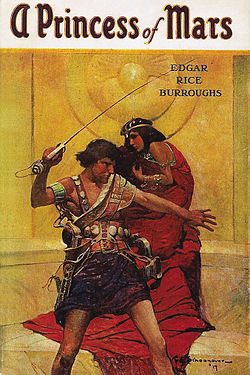
    I’ve started reading John Carter of Mars, by Edgar Rice Burroughs, in anticipation of what looks like a very fun movie, but I have to say that even though the story is interesting the writing is absolutely appalling. It’s classic Mary Sue, with a character who is just better than everyone else at everything and obviously already knows his way through the plot, as if he were in fact the writer of the story himself. It also uses the classic “tell, don’t show” error of teenage fanfiction. Reading it is a tedious exercise in admiration of a two-dimensional hero.

    The basic story is simple: John Carter, ex-slave owner and “Southern Gentleman,” finds himself accidentally on Mars, where he is thrown into the middle of the ongoing conflict between two races who have been reduced to hard scrabble in a failing environment. Mars (or “Barsoom,” as the locals call it), used to be the home of a great race of human-like peoples, who slowly fell into decay as the environment of Mars failed. Another race appears to have decided to live communally on the land and, as commies are wont to do, degenerated into barbarism and cruelty. The descendants of the great race – red skinned humanoids – have great technology and are trying to save the planet, while the savages – weird buggish freaks – run around being cruel and nasty. John Carter lands amongst the savages, but immediately impresses them with his prowess at everything, and though a captive of these savages manages to get himself appointed a chieftain (through combat, of course) and is given wardenship of one of their prisoners, who of course is an extremely important member of the red-skinned people. He is also given a couple of women to look after him, and one of these just happens to be the only kind and thoughtful savage on Barsoom.

    So, having accidentally disappeared from his own world, with its rich 19th century culture of slave-holding and subjugated women, where he is a much-admired and respected man, Carter finds himself on a completely alien world with different culture and language, but within a couple of seconds finds himself much-admired and respected, and lording it over a small collection of women – purely by dint of his talents, of course.

    This could be a fun read, I suppose, like a kind of sexless version of Gor, but for the fact that John Carter is a tedious, insufferable braggart who is good at everything and never makes an error. And oh, how we are constantly reminded of his talents. For example:

    To be held paralzyed … seems to me the last word in fearsome predicaments for a man who had ever been used to fighting for his life with all the energy of a powerful physique

    or:

    I do not believe that I am made of the stuff which constitutes heroes, because, in all of the hundreds of instances that my voluntary acts have placed me face to face with death, I cannot recall a single one where any alternative step to that I took occurred to me until many hours later … I have never regretted that cowardice is not optional with me

    and following this up:

    Fear is a relative term … but I can say without shame that if the sensations I endured during the next few minutes were fear, then may God help the coward, for cowardice is of a surety its own punishment

    In case you hadn’t noticed, John Carter is a robust fighter who never feels fear and acts automatically out of a sense of duty. These quotes are from the first few chapters but Burroughs isn’t tardy about letting us all know that John Carter is the best, y’all: his manifold perfections are outlined in a foreword. But just in case you thought Carter might just be the 19th century equivalent of a great sportsman, we are also reminded that he is a consummate warrior, and a genius to boot. In training with the savages weapons, we find:

    I was not yet proficient with all the weapons, but my great familiarity with similar earthly weapons made me an unusually apt pupil, and I progressed in a very satisfactory manner

    Oh! The modesty! Also, within a few days of joining the savages, John Carter has befriended his watchdog in a way that no martian has ever done before, and has taught the martians better ways of managing their own mounts, and mounted combat, so that they are both better able to manage their mounts and better able to fight en masse. This despite the fact that he is unfamiliar with martian gravity and doesn’t speak their language. Not that the latter bothers him much:

    in a week I could make all my wants known and understand nearly everything that was said to me. Likewise, under Sola’s tutelage, I developed my telepathic powers so that I shortly could sense practically everything that went on around me.

    This, incidentally, is the entirety of the coverage that the existence of telepathy gets in this work for the first 8 or so chapters. We’ve had more sentences devoted to the production of the milk Carter drinks than to the telepathy he learns. It’s not, however, the last time that Carter gets a chance to remind us that he is a genius:

    I nearly drove Sola distracted by my importunities to hasten on my education and within a few more days I had mastered the Martian tongue sufficiently well to enable me to carry on a passable conversation and to fully understand practically all that I heard

    Here is an example of a conversation he could understand “within a few more days”:

    In our day we have progressed to a point where such sentiments mark weakness and atavism. It will not be well for you to permit Tars Tarkas that you hold such degenerate sentiments, as I doubt that he would care to entrust such as you with the grave responsibilities of maternity

    So, one week to learn how to say “I need to take a leak,” another few more days to get to the point of understanding an overheard conversation about “atavism.” Also, telepathy in one sentence. And nowhere in this time period is there a hint, even a single hint, of homesickness, or any kind of emotional trauma at having teleported out of a cave in Arizona to a field on Mars. Do you feel small yet? Or are you, more likely, bored stiff with this character who can do everything and anything?

    In addition to being a robust Southern Gentleman who can learn martian in a day, Carter also seems to have remarkable luck to take exactly the right path in any situation. He hears someone behind him, so instead of attacking, he jumps, which impressed his attackers rather than getting him killed; he gives his horse its head in the darkness, which is just as well because it leads him up just the right path to escape the Indians; he makes a guess about the best way to impress the natives and – lo! – it was the right guess. Within about a chapter of the start of the adventure it has been well-impressed upon the reader that, no matter what, Carter is not at risk of significant injury, failure or death. As the reader, you have nothing invested in the story at all – it’s not like Carter is going to ever have to overcome a failing or character flaw (he has none), there’s no sense in which his plight is the same as yours would be if you ended up on Mars, and there’s never a feeling that he will make a bad choice, even by accident.

    This apathy is further entrenched by the narrative flow, in which Burroughs tells us everything we need to know about the society, environment and structure of Mars long before Carter himself finds out the details. Rather than discovering the mysteries of Mars in the flow of the adventure, we’re told everything about a setting, person, circumstance or technology as soon as we encounter it. The phrase “As I later learned,” or “as I was to discover,” appears constantly in the text – maybe a couple of times every chapter, and always expounds on things we could quite happily find out ourselves with a bit of time. Thus, we only know we are somewhere mysterious because we are told we are on Mars: from the very moment of his arrival there, Carter’s narrative breaks the mystery of the planet with constant references to things that neither he nor the reader know. We even get a lesson in Martian demographics in the second chapter of his encounter with the savages, something that really could have waited to be revealed to us later in a conversation with someone.

    This kind of adventure writing is so tedious as to be almost unbearable. The plot itself is interesting – I want to find out about Mars and the society Burroughs has created, and I want to see where the story goes. It’s a really good idea that, in the hands of a decent writer, would make a really cool story. I’m guessing, then, that the movie is going to be good. But the book – thoroughly forgettable so far. It reminds me of John Wyndham’s pompous academic Mary Sues, who always take a young woman under their wing and teach her the harsh realities of the world, while she constantly thanks them in breathless wonder at their wisdom; or the later books of Dune, after whats-his-face becomes a god and surmounts every challenge by simply being himself. No challenge, no threat, no sympathy with a human character, no need for character development and no sense that the character will ever grow as a person through adversity. Of course, this may change later, but at the moment it’s looking like the writing is going to be drier than the surface of Mars.

    So, unless you’re feeling really patient, I can’t recommend John Carter of Mars. Is the rest of Burroughs’s work this badly written?


  • Steampunk Scorpion Girls are GO

    On Sunday I went to a Gothic Lolita live rock event, run by a la mode Tokyo, a gothic lolita night club organizer (they don’t seem to have any kind of web presence that I can find, though they seem to be connected to this group and can be found on Artism). This seems to be the central group offering live and club events connected to the Gothic Lolita scene, so obviously it’s going to be an interesting excursion, as well as potentially a very pretty one.

    The event was held at the Live Inn Rosa in Ikebukuro, from 4pm to 10pm on Sunday the 8th January. There were a total of about 8 bands playing, with an MC who also sings and a couple of “mini-live” performances of 10 to 20 minutes each. There was also a collection of stalls selling goth-lolita goods but they were small and inobtrusive. Some of the bands had a table selling (or giving away) products. Admission was ¥3500 with a drink (about $40 including 1 drink). This may seem like a lot but it’s worth remembering a couple of things about Japanese live performances: you usually get to see a lot of bands, and the bands are usually extremely high quality. Japanese live performers are universally very very good, and so even if you don’t like the genre you’re not going to be subjected to that classic of the Aussie pub rock genre, a band whose music you just can’t understand because they’re sloppy and out of time and drunk. I didn’t stay for the last two bands, but what follows is a brief review of those I did see. Pictures were taken on candelight setting on my crappy cheapest-in-the-shop Olympus camera, but I hope they give a sense of the scene.

    Strange Artifact

    Gasmasks and Lace: Indeed, a Strange Artifact

    Billing themselves as a steampunk band (whatever that is), Strange Artifact were basically a bass-guitar / vocalist pair, with drums and guitar on backing tapes. Their music is close to Visual Kei in style, with a female singer and perhaps a little more electronic influence than the average Visual Kei performance. You can see a video of one of their songs from the weekend here or hear a studio song on track 9 of this compilation. The singer isn’t operatic (as you will see, this is relevant) and this performance was probably the closest to a rock/visual kei genre. It was fun and energetic and well presented, and I really enjoyed it.

    Essential Steampunk Goods

    I’m not sure how this band is steampunk and I should say right away that I don’t understand the lyrics of songs in Japanese, so I don’t know what they sing about. This Steampunk genre is a complete mystery to me!

    Miyahi Aya

    And down the rabbit hole we go …

    Miyahi Aya was a sudden change in pace. A solo singer with all her backing music on tape[1], singing a strange blend of synthpop, J-pop and cabaret-style music. You can sample some of her songs at her Myspace page, where you can also find a slightly less blurry picture of her. In between her songs she maintained a fairly entertaining patter of banter with herself and the audience, most of it quite shy and self-deprecating and a bit silly. Again, I’m not sure about the content of her songs but the atmosphere for this 30 minutes was one of light-hearted silliness in between songs presented in a demure and slightly wistful physical performance. Good if you want your J-pop blended with gothic industrial themes and a dash of synthpop, in a lacy dress.

    Tamamushi Naoki

    Old-fashioned elegance returns

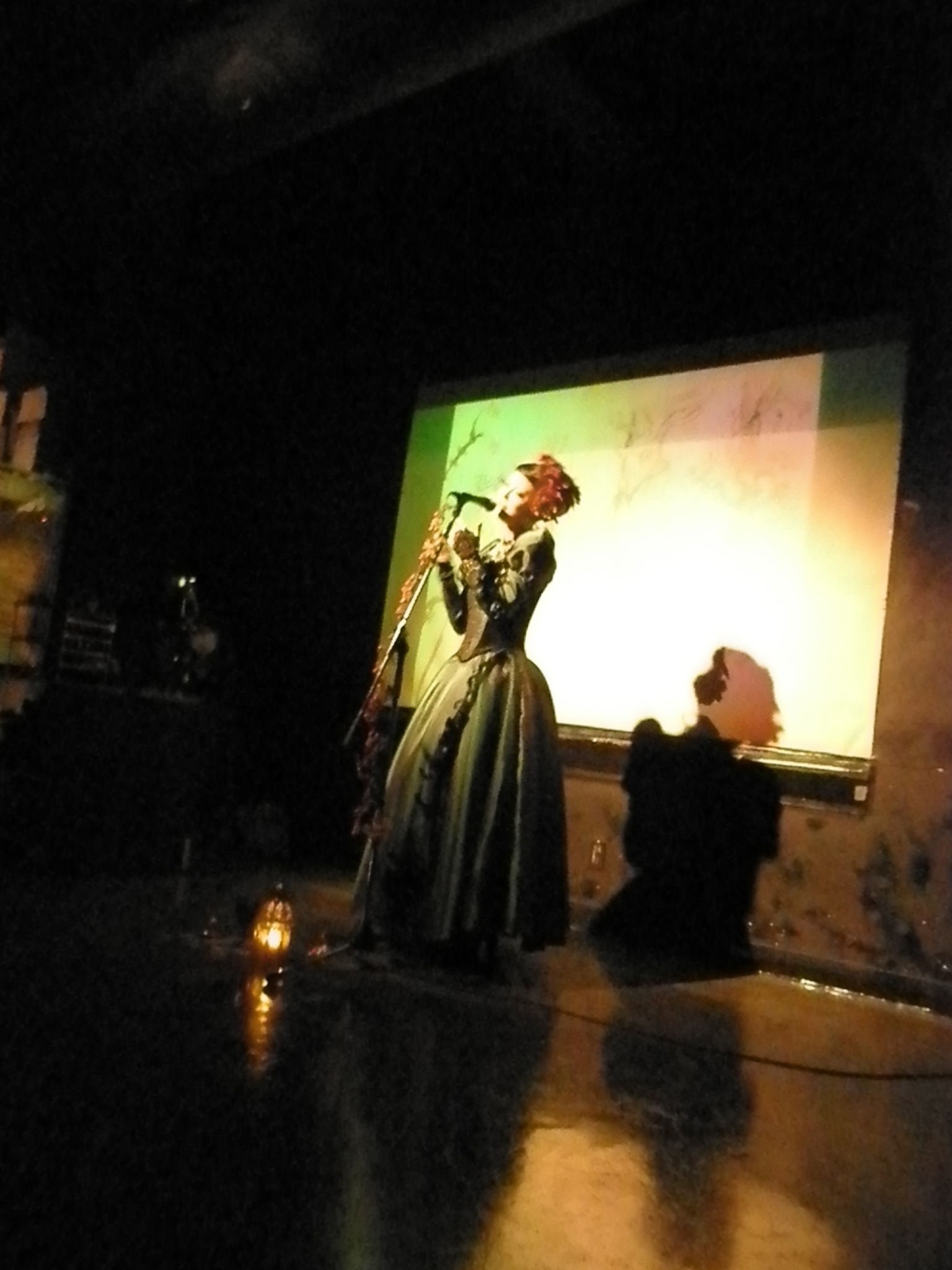
    This was possibly my favorite performance of the night simply for the way it encapsulated a spirit of gothic elegance that I think has long since drained from the scene in other parts of the world. Tamamushi Naoki is one half of the duo “Pudding a la mode,” and you can hear one of their songs on their last.fm page. I don’t remember Tamamushi sounding anything like that, though: her songs were more powerful single vocal pieces, with a more gothic-rock backing style and a more sedate and solemn pace. For the duration of her performance she also had incense and that little lantern burning, and she performed in front of the visual screen rather than on the stage, giving it a more intimate feeling. Her make up and outfit were superbly gothic in the old style, and that dress was very splendid. She danced in the classic gothic mode (waving her arms and stepping backwards and forwards – it’s about all you can do in clothes like that) and gave a very self-conscious and simple performance without any of the artifice or posing that often accompanies modern live acts. She was, however, only on for 10 minutes, and her performance was slightly distracted from by the projection screen behind her, which was playing the Tim Burton Alice in Wonderland over her face.

    Kokushicho (黒死蝶)

    Lesbian Metal Lolita Explosion!

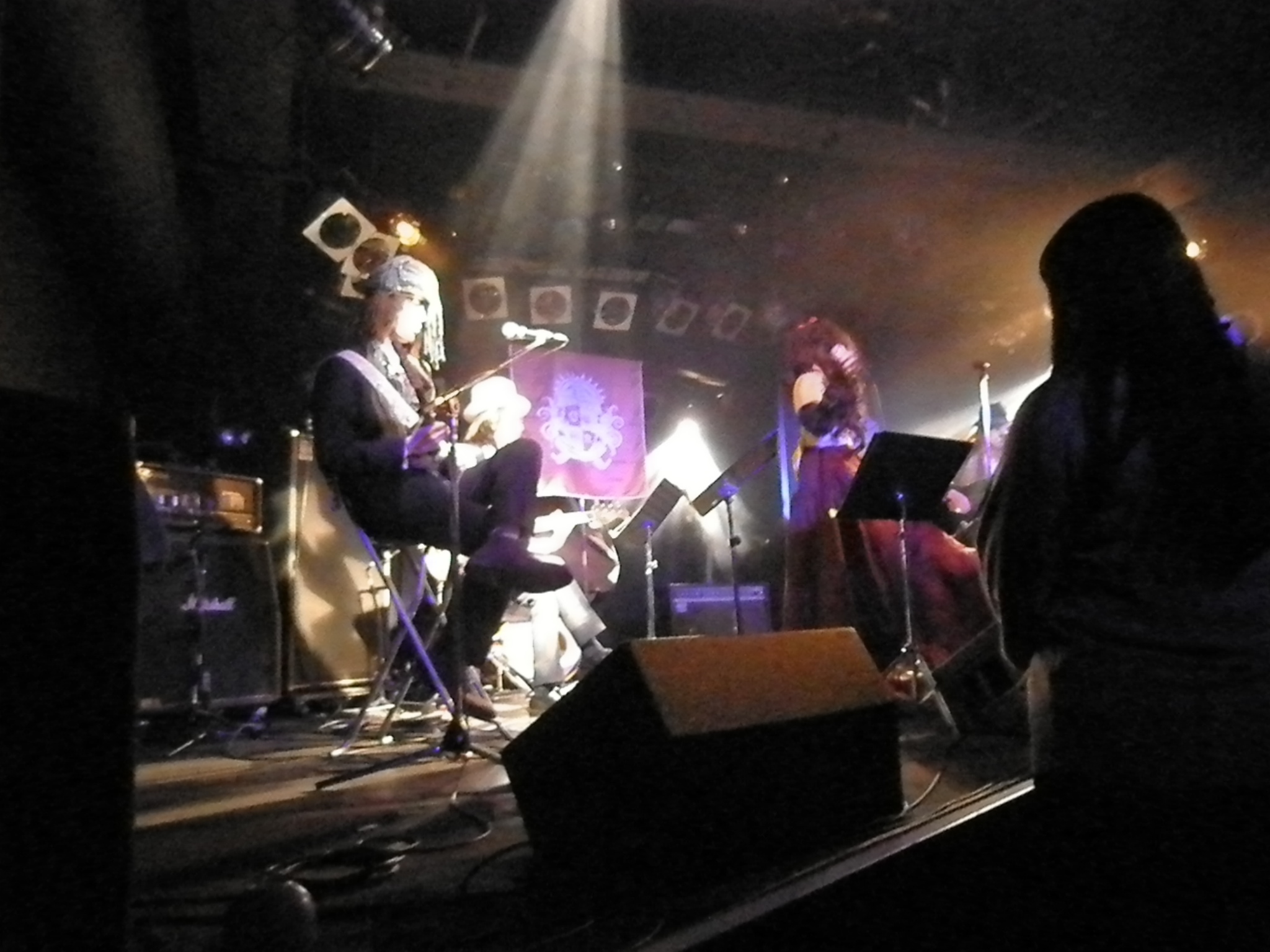
    Perhaps the most outright entertaining of the acts, Kokushicho (Black Death Butterflies, in English) describe themselves as a “Symphonic Gothic Unit” and, true to their name, give a fairly robust metal/goth crossover performance involving a good amount of power chords, some (dainty) headbanging, and robust vocals of the girl-metal variety. They came on stage in pirate outfits, belted out an excellent symphonic metal job, then disappeared and returned to the stage in the more classic costumes you see above. I can’t see any of their music online but their site is here. This “Unit” told us after their first song that they are lovers, and they seemed to be riffing off of this a bit in their banter with each other in between songs – presenting a kind of light comedy teasing like a couple. Like most of the other bands playing today, all of their music was on backup tape like a J-pop band, and we only saw the vocal performance, but it was an energetic and exciting performance with an entertaining metal theme.

    ElupiA

    Operatic Elupements

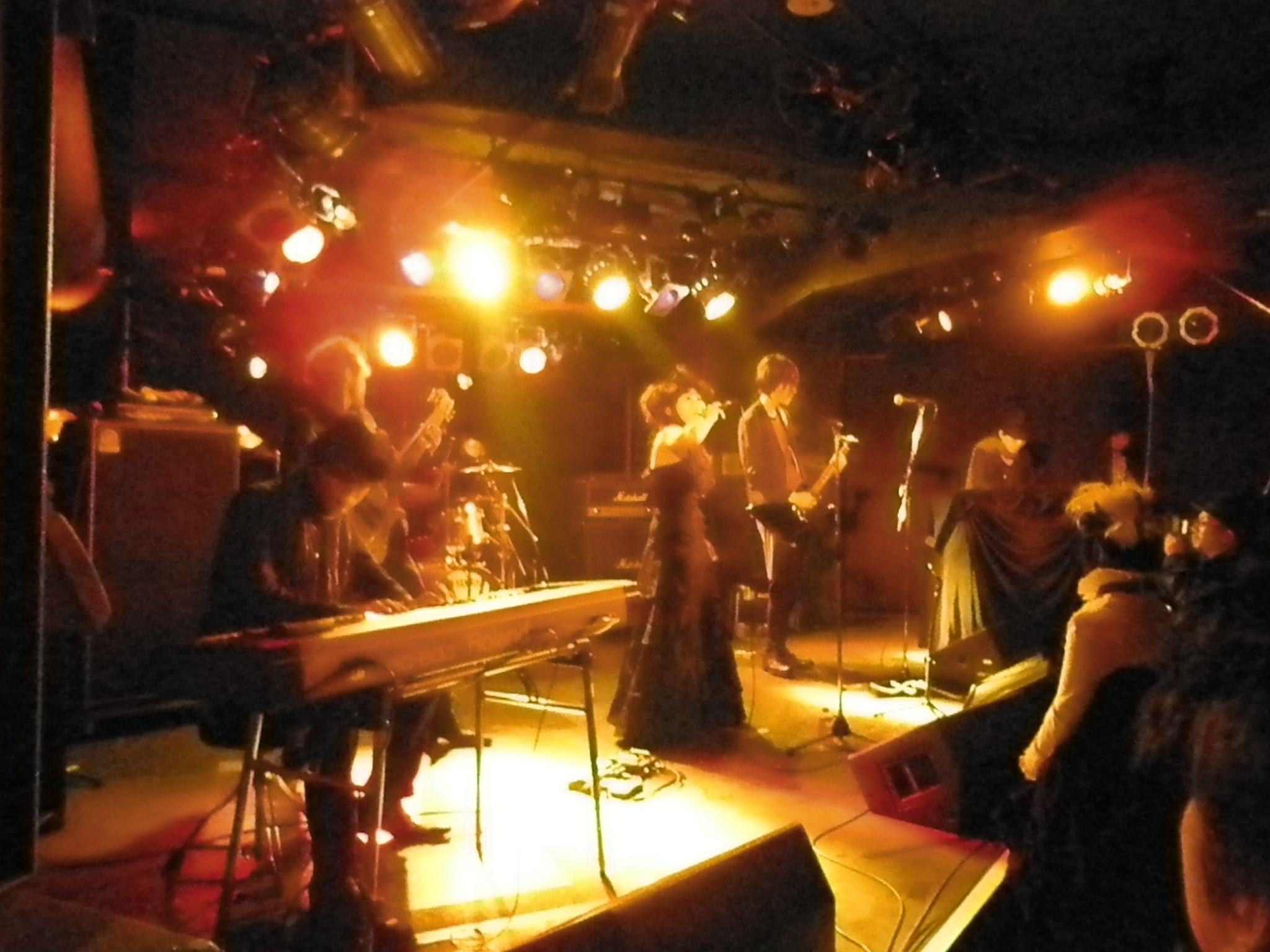
    Elupia was perhaps the first of the “main” acts of the night, and also happen to be a band we have a connection to: The Delightful Miss E is friends with the keyboardist (not the one to the foreground in this picture, but the one tucked away in the furthest, darkest corner of the room). Elupia are operatic goth rock, like a Japanese Nightwish, with a little more Visual Kei influence. Apparently the singer actually has operatic training, and it certainly seemed that way during her performance. Their Myspace page includes a couple of samples and a promotional video, and I think it’s safe to say they’re a pretty impressive act. They’re all well-polished performers, and seemed very skilled and popular with the crowd. I’m not a huge fan of operatic metal (I’ve tried getting into bands like Nightwish and consistently fail) but as a live act these guys were awesome. Sadly, though, they were only on for half an hour.

    Gurimo Rizumo

    The Goth-loli Circus Comes to Town

    Gurimo Rizumo regaled us initially with an introductory speech, very much in the manner of a woman telling a children’s story or narrating a wildlife documentary. Each of their songs is a story and comes with an initial narrative, presented in this faux-serious way. The music could probably best be described as burlesque/cabaret goth, which is also not a genre I’m particularly fascinated by (largely because of the enooooormous load of pretentious wank that associates with burlesque), but this band presented as a genuine performance, wank-free and very confidently theatrical. It’s a very interesting style, and you can see an example of it in this youtube video. The second video (about 6:23) is the song they presented first, about the murderous circus. I really like these kinds of performances, where the performers are putting in a real effort not just to sing a song but to build a whole image and performance style, even if (as in this case) the crowd is quite small and the venue very normal. Thirty or forty years ago bands like The Cure and Marillion were doing this sort of thing, with varying degrees of success, and if they hadn’t taken themselves seriously we would be a sadder world now.  And one thing I certainly like about the Japanese music scene is its seriousness. As you can see from the shot below, the setting isn’t special, but this band were really giving it their all to take us to the circus …

    Goth-loli geeklove…

    Overall Impressions

    Corsets, feathers, lesbian pirates …

    The bands in this live event had quite a few things in common, which I guess are a property of the music attached to the gothic-lolita scene. All the singers – and in many cases, all the members – were women, and although the music ranged across a couple of genres, it had a general operatic/cabaret theme, with a strong goth/metal base. Of course, like most Japanese gothic rock it was heavily influenced by Visual Kei, but had a nice variety of the carnivalesque that suits the image this scene presents to the outside world. There was a heavy focus on performance and presentation, which is nice, and although much of the imagery in the costumes is very western the style of the performances was very Japanese. As always at a Japanese live event the performers were stylish, skilled and dedicated. They were also friendly and engaging both on and off stage.

    This music scene also harks back to an era that I think has been lost in British and Australian goth: an era when the scene was focused around women and women’s voices, and privileged elegance over raunch, and creativity over aggro. Now in the goth scene we see a lot of emo and tattooed blokes thumping out whiny songs about their ex’s, and women’s clothing and presentation has been pornified in a way that I find disappointing. Sure, it’s nice that young women can come to goth clubs in essentially their underwear, but I liked all the corsetry and elaborate make-up, and the focus on beauty and elegance over tits ‘n arse. So it’s nice to see this scene in Japan preserving that old-fashioned gothic shyness and elegance, while simultaneously exploring new avenues of musical expression. It’s also nice to see cabaret/burlesque worked into a music scene without the inevitable explosion of poseurs and wankers that accompany it in the west. It’s a typical unassuming, humble approach to a music scene that really has gotten a little ahead of itself elsewhere.

    In summary, even if you aren’t that into cabaret-style metal, this music scene is definitely worth exploring if you’re into goth music and in Tokyo.

    fn1: Incidentally, I don’t know how to say this. It was recorded and played but do we still say “backup tape”? Is it “backup iPad” now?

    fn2: Actually, to their credit, so were a couple of men

  • Where is the floating girl when you need her?

    Yesterday I visited the Studio Ghibli Museum for the first time. It’s in Mitaka, Tokyo, close to my home, and is a museum about the development of animation in Japan, through the eyes of Miyazaki Hayao and the Studio Ghibli team. For those of you who are unfamiliar with Ghibli, they are the creators of Japan’s most-loved Anime movies, including Nausica of the Valley of the Wind, My Neighbour Totoro and Kiki’s Delivery Service. Miyazaki Hayao has had huge artistic and cultural influence in Japan and was also a big influence on industry practice, and is genuinely a household name in a way that I think even Disney would admire. His movies (at least, the earlier ones) are amazing and well worth the respect the Japanese public offer them.

    The Ghibli museum is set in a smallish building on the edge of Inokashira Park in Mitaka, about a 10 minute taxi ride from Kichijoji Station. The building itself is designed to resemble the classic style of the houses in many of Miyazaki’s movies, but is set slightly back from the road in amongst trees, to resemble a house in a forest. Inside it is built on three levels, with the Laputa robot on the roof, exhibition spaces on the bottom two levels and a shop and children’s play area on the third floor. The children’s play area is, of course, a Cat Bus. The building itself is small, and admission has to be booked up to a month in advance because of the limited number of people who can enter, but is itself cheap (¥1000). For the price of admission you get access to the museum and one-time admission to the movie theatre, which plays a different short film every month. Sadly only elementary school children can play in the Cat Bus (hrmph!)

    The bottom level of the museum has the main exhibits, including a room containing a very brief history of animation, all expressed through Ghibli characters – this has an excellent example of strobe-lit animation using extremely cute Totoro characters, showing the basic process by which animation works. The next level contains an example of an animator’s studio, perhaps modeled on Miyazaki’s studio back in the day, which is very interesting. You walk through a room furnished as if it were a studio, with storyboards and sketches on the walls, books that Miyazaki used as sources, and examples of an animator’s workbench or the types of texts and background material he or she might draw upon – whole scrapbooks of pictures of plants, crystals, planes or animals cut from magazines and books, for example, or textbooks full of scenery from around the world. It gives an insight into how the animator develops their work from idea to final production.

    The museum also contains a library of children’s books from around the world, all translated into Japanese (some of which can be purchased), and is constructed with bridges, nooks, crannies and mysteriously-placed windows designed to make it explorable for children – and certainly children were going crazy exploring the building while we were there. It also has a cafe, which I’m sure is very cute, but it was so busy we didn’t dare go near it. Finally, it has a cinema. The ticket to the cinema is a framed clipping of a couple of cells from a film reel, and can be kept as a souvenir. Our film was Chu Zumo, “Mouse Sumo,” which was a cute adaptation of an old folk tale, the story of which (in Japanese) is here.

    Mouse Sumo

    The basic story of this 13 minute film concerns an old couple who live on a steep mountainside. They are poor and have to work hard, and every day is spent farming on the mountainside with no break. Nothing interesting happens. One night, however, the old man goes outside to take a leak, and sees a bunch of mice sneaking off through the grass into the forest. One is carrying a firefly light, one is carrying a leaf as a penant, and the rest are wearing little sumo thongs. He follows and finds all the mice of the surrounding area gathered around a sumo ring to watch a bout between the mice of his house and the mice of a neighbouring area. These mice are bigger and white, and they wipe the floor with the mice from his house.

    Horrified, he returns home and the next day he and his wife set about making the mice into great Sumo Rikishi. While she makes dango powder, he goes down the mountain to get some fish; when he returns they bake Tofu Dengaku (YUM!) and sanma dango, stitch together some better quality sumo thongs, and leave them out for the wrestlers. The mice come down to eat the food and put on the thongs, and immediately become stronger and bigger.

    Soon there is another match, and of course the mice from the old man and woman’s house win in a tense battle, because of the strength they gained from the food and support of the old man and woman.

    It’s cute for the simple fact that it involves mice, doing sumo, with a frog judge, and mice watching in the crowd, in a classic Japanese image of classic Japanese countryside. The old man and woman are done in classic Ghibli style: the old man’s brow is so furrowed that you cannot see his eyes, and have to read his expressions entirely in his pursed lips. They are, of course, sweet and kind and happy, as befits the classic Japanese stereotype of old people. So it’s a cute, sweet story with lots of funny moments (the frog referee, particularly, is hilarious), and a fine showcase of Ghibli’s talent and style. Screenshots can be seen here.

    The movie is also an interesting allegory for common Japanese attitudes towards the state of modern Sumo. Here we have 5 small, weak mice who have to take on 5 bigger, more skilled white mice, from a foreign mountain, who always win. However, the story has us believe that if the wrestlers are supported by the locals, and given a bit of special Japanese magic (in the form of food and support) and just try a bit harder, then they will triumph. Of course, this isn’t happening in real Sumo. The big foreign mice are dominating the sport because all the local mice would rather not enter a sport full of bullies and old-fashioned training methods, which requires years of devotion and suffering for little gain. The local mice are already trying as hard as they can. What’s needed is a change in how they try, but this means changing the hidebound traditions of a near-mystical sport. It would all be so much easier if they could take a few performance-enhancing drugs and, with just a bit more support from the local old people, throw the bigger and tougher foreign mice. Sadly, that’s not how sport works. A change in organization style, structure and training – as well as recruitment practices – is needed before the local mice can beat the big foreign ones. No matter how much support the old locals give them.

    The Studio Ghibli museum is smaller than expected and a little crowded, but it contains some interesting insights into the animation process and is very pretty and well laid out. It also comes with a movie that can’t be seen anywhere else. I recommend a visit to this place if you are coming to Tokyo. But remember to book ahead, or you will be disappointed!

  • Figure 1: Probability Distributions for Three Different Dice Pools (Unadjusted)

    Perhaps this post will be useful for any part-time game designers out there. Clayton at Kill It With Fire put up a link to his new retro-clone game, Kill It With Fire, which uses a combination of target DCs and dice pools to resolve skill checks and attacks; basically, the player rolls a number of D6, sums the result, adds bonuses, and then tries to get over a given DC. Dice can be added to the pool for various factors, and there are bonuses that apply based on level, skill training, etc. See, e.g., this paragraph:

    Example: Lothar the barbarian is attacking a ghost with his magical sword. The sword’s magic grants an extra die to attacks that targets ghosts. His attack’s description says he uses his prowess trait as a bonus, and he has the ghost cornered, adding a circumstantial bonus that the referee says is worth one more die to the attack roll. So his usual three attack dice and his two bonus dice are rolled, and their result is added to his prowess and number of hit dice to see if he matched the ghost’s defense number.

    In a follow-up post, Clayton asks a few questions about the mathematics, and particularly how the probabilities change with dice pools and target DCs. The nub of the matter is in this paragraph:

    Actually, what I am concerned about with at the moment is math. To hit a target, I wrote that you add 10+current hit dice (which fluxuate throughout the session)+3d6.
    3d6 average out to 10 themself, if I remember my Arcana Unearthed 3.5 info correctly. Meaning you may be rolling well over 20 eight times out ten when you attack. Seems a bit high.

    Various suggestions have been given in comments, but since I had half a day free I thought I’d explore this in detail, so I made a spreadsheet that calculates success probabilities for 3, 4 or 5d6 dice pools against a range of target DCs, across a range of bonuses. Here I’ll present the results, and make some comments about dice pools and target numbers. Calculation details are given at the bottom of this post. First a few points about comments in Clayton’s post and the comments:

    1. 3d6 “average out” to 10.5; the most likely values to occur are 10 or 11. By “average out” here we are thinking of the expected value, that is the average value rolled over many rolls. Note that 10.5 is the same as the expected value for 1d20, which has a very different probability distribution to 3d6. By way of comparison, 4d6 average out to 14, and 5d6 to 17.5. This means that, on average, with no bonuses, rolling 3d6 you will beat a difficulty of 10.5. What this actually means in practice, I don’t know.
    2. Contra commenter Joshua, the central tendency doesn’t get stronger as you roll more dice. In fact, the probability of rolling any single value decreases, as the probability spreads over a wide range. I think here Joshua is referencing the Central Limit Theorem, which states that as the number of dice gets larger, the distribution of their sum tends to be normally distributed. This doesn’t mean that the distribution has to get sharper (which would be the requirement for a “stronger” central tendency); what exactly happens depends on the dice you’re rolling. See Figure 1 for the probability distribution of three dice pools without bonuses
    3. I approve of death spirals

    In fact, it’s unlikely that these dice pools vary very much from just rolling 2d10. The crucial point is that they have a very different central tendency to 1d20, where any value has a 5% chance of occurring. Because the world is normally distributed, d20 is a terrible, terrible way of resolving probabilities of success in gaming (IMHO). Also, adding dice to a pool widens the range of outcomes, so if you rescale stats and modifiers accordingly, you get a better range of outcomes – 5d6 covers 25 possible values, while 3d6 covers 15 and 2d10 covers 18. But this is just a matter of nuance.

    Success Probabilities for Given Bonuses and DCs

    Figure 2 shows the probability of success for three different dice pools in the Kill it With Fire system, for a bonus of +8. That is, the PC has a bonus of 8, and the chart shows the probability that PC will be successful for DCs ranging from 8 to 37 (horizontal axis) for the different dice pools.

    Figure 2: Success Probabilities for Three Dice Pools


    As can be seen, with a dice pool of 3d6 and a +8 bonus, the PC has a probability of 50% of beating a target DC of about 19 (actually, from my spreadsheet this is an exact value). At 4d6, this probability becomes 84%, and at 5d6 it is 97%. If we suppose that +8 is about right for a 1st level fighter, then we need to construct our system so that a first level fighter presents a target DC of about 19 if we want a 1st level fighter to hit a 1st level fighter about 50% of the time. A few other points:

    • If you think of bonuses as shifting a PC along the curve for a given dice pool, then a +1 bonus will tend to have a smaller effect as the dice pool increases in size. A +1 increase in the bonus will essentially improve a PCs chances of success by about 12% for a 3d6 dice pool, by 7% for a 4d6 pool, and by about 3% for a 5d6 dice pool
    • On the other hand, increasing the dice pool by 1 has a large effect on success probability. It increases the probability of success for any given DC by between 20 and 30%
    • Furthermore, the largest effect is in the first additional die. For example, the chance of beating a DC of 20 is 37.5% for a 3d6 pool, 76% for a 4d6 pool, and 94% for a 5d6 pool. So the first additional die doubles the chance of success, while the second one increases it by only another 20%.
    •  In terms of odds, the odds ratio for success is 5.3 times higher going from 3d6 to 4d6, and 5 times higher again going from 4d6 to 5d6. For a shift from a bonus of 8 to a bonus of 9, the odds ratio is 1.7.
    • This effect of dice pools is huge for small bonuses – the odds of success in going from 3d6 to 4d6 is 10 times greater for a PC with only a +4
    • Thus, additional dice are a powerful circumstantial modifier, and should be balanced carefully against bonuses

    This makes a dice pool mechanism very successful, but I think Clayton might have been thinking to use the dice pool changes more than bonus adjustments to reflect circumstances. My suggestion would be that those additional dice be reserved for extreme circumstances (opponent is stunned, backstabbed, etc.) and smaller bonuses for things like magic weapons.

    A Few Thoughts on Dice Pools and Target Number Mechanisms

    The main benefit of Dice Pools as far as I can tell is that they give you a normally distributed random variate. Changing the number of dice will significantly increase the chance of success against the same DC, but also makes the random variate more normally distributed. Alternative mechanisms – like changing the dice type – will affect the parameters (mean and variance) describing the approximate normality of the random variate, but they’re in principle no different. So when you compare a dice pool result to a target number you’re not varying, fundamentally, from the method of 3rd edition D&D, all you’re doing is changing the relative balance of outliers and central values. I moved to 2d10 in 3rd Edition D&D to reduce the chance of criticals (and then dropped the second critical resolution roll), but you can do this without changing any of the bonuses and modifiers. Adding flexibility to the dice pool size gives the advantage of large steps in probability of success, but also gives the GM almost infinite flexibility to break the encounter by throwing in an excessive dice pool modification (as Figure 2 shows). In my opinion, D&D 3rd Edition was fundamentally flawed in using d20s, but otherwise the roll-and-beat-the-target mechanism is simple and useful. Changing dice pool sizes simply adds flexibility to the probability distribution underlying this mechanism.

    Unless your game system is mainly story-telling, the probability structure of the underlying task resolution mechanism is going to be a strong defining aspect of the mechanics of play. Hopefully if anyone is designing their own system with a dice pool/target mechanism, the material I’ve put here (or the spreadsheet itself) will help them in establishing the parameters of their task resolution mechanism, and avoiding accidental game-breaking mechanics.

    Calculation Methods

    The formula for the probability of any outcome of a given number of dice is not pretty, but it can be obtained from this website, which gives an analytic solution from The Theory of Gambling and Statistical Logic by Richard A. Epstein, formula 5-14. This is relatively easy to implement in Excel using a visual basic function, or at least it would be if visual basic included a combinatorial function (how useless can a programming language be?) Once I’d figured out the details of that, it was fairly easy to implement the formula in a basic spreadsheet, which anyone who is interested in is welcome to ask me for. The formula can be extended to other dice pools (e.g. d10s, d8s), though my spreadsheet isn’t that flexible (I would have to change a few details of the function, which I’m willing to do if a reader needs it). Just leave a comment here if you want me to send it to you – but note I’ll only send it on one condition: that you have a RPG-related blog. Otherwise, perhaps one day some pesky university student will trick me into handing them the solution to their class assignment.


  • The Guardian reports today that the archives of the committee for the Nobel Prize in Literature, 1961 have been declassified, and one of the nominees was Tolkien. The archives include brief descriptions of the committee’s opinion of the various nominees, though I suspect that the Guardian’s reports are a little limited. The reason given by the jury member Anders Osterling[1] was that his prose

    has not in any way measured up to storytelling of the highest quality

    Fair enough, I suppose, his prose isn’t the best. But the eventual winner, Ivo Andric,  was apparently chosen by this same juror because of

    the epic force with which he has traced themes and depicted human destinies drawn from the history of his country

    Hmmm, does that sound like it might be relevant to, say, Lord of the Rings? Tolkien may have many faults, but a failure to trace themes and human destinies with epic force is probably not one of them.

    Looking at the list of past winners, there are certainly some on there who qualify as not having written the best prose. There are also lots I’ve never read (or heard of) so I guess I shouldn’t judge. But if anyone’s going to be dumped on the grounds of prose quality, surely Steinbeck could be? Surely the quality of Patrick White’s prose is a fairly subjective judgment, given that he (at least sometimes) writes “stream of consciousness,” which is torturous for many readers and can also be interpreted as lacking in craft (or just plain shit, depending on your perspective). I’ve read Dr. Zhivago (Boris Pasternak), and I have to say it’s not memorable. Maybe the committee members liked the movie?

    So I wonder if the judgment actually hides a simpler, more old-fashioned motive: fantasy just isn’t highbrow enough to get a gong. As one of the commenters on the Guardian article notes, the committee do seem rather pretentious, and we all know that pretentious literary types frown on fantasy. Or maybe they just frown on popular books? As far as I can tell there’s no one particularly popular on that list. I’m going to go out on a limb here and suggest that long after Seamus Heaney’s name is forgotten even in the Academy, everyone will know Tolkien’s. Just to inch further along that limb, I’m willing to bet that Tolkien’s reading of Beowulf[2] was much better than Heaney’s.

    The comments of the Guardian article are, of course, gold. How did culture sustain itself before bigoted fools got the chance to comment in newspaper articles? I like the slew of comments on Tolkien’s “turgid” prose by people who can’t spell his name, or refer to his prose as “flay.” Incidentally, I think the dismissive phrase “turgid prose” has become a fly-blown cliche. No one who uses it actually knows what turgid prose is, just as no one who says a book has a “lyrical writing style” actually knows what a lyrical writing style is (I certainly don’t – is it a style that includes, like, words?). I think most people who use these phrases mean to say “I didn’t like it” or “I liked it.” Now, fair enough, you could say Tolkien’s prose is occasionally boring (or perhaps more relevantly, his storytelling is occasionally boring) but you can’t say that, e.g. his introduction of the Dwarves in The Hobbit is turgid. It couldn’t really be terser, could it?

    Also, as far as prose goes, Tolkien is occasionally sublime, and one of my favourite parts of the movies is the part where they very carefully move a beautiful passage that Tolkien consigned to an appendix into the centre of the movie (it’s Elrond’s description of Arwen’s fate if she marries Aragorn). It’s a good example of why we love him and why he’s flawed: he can’t arrange his stories very well, but he definitely can describe human destinies with epic force, in prose that measures up to storytelling of the highest quality. I guess that’s why his books have sold millions, and the movies based on them are so enormously popular, even though he’s never won a major literary prize.

    Whether or not you think Tolkien deserves a Nobel prize (or even care about the prize, which seems pretty dubious to me), it’s interesting to read the snooty dismissal of his work, the age-based discrimination against another author, and to see that the eventual winner was nominated on the basis of what Tolkien did best.

    fn1: umlaut omitted, because he’s too old

    fn2: apparently he used to open his classes on old English with a reading of the first few lines of Beowful, in old English, and his classes were famous for it. That’s cool!

  • I stumbled on an article in the New England Journal of Medicine this morning that discusses the “broccoli defense” against plans to make purchasing of health insurance mandatory in the USA. I think the article is behind a paywall so there’s no point in offering a link, but anyway it’s fundamentally pretty uninteresting. However, it includes a couple of entertaining paragraphs describing prior decisions of the US Congress:

    The Supreme Court has held since 1942 that Congress has Commerce Clause power to limit our ability to grow wheat that we consume ourselves and do not sell, reasoning that it suffices that this noncommercial activity encourages a commercial inactivity that in turn affects commerce — because those who grow their own wheat are not buying wheat from others, which reduces commerce in wheat.

    Perhaps we will see WoTC lobbying congress to ban homebrew campaigns, since it affects their commerce? Then maybe we’ll have BATF agents raiding every gaming group in the country…

    In case you think this might be a weird world war 2-era decision, the article proceeds to inform us that

    the Supreme Court explicitly reaffirmed it in 2005, in a case holding that Congress had Commerce Clause power to ban the medicinal use of home-grown marijuana. The decision in that case held that Congress lacked Commerce Clause power only when the regulation was not “economic” in nature. The health insurance mandate is clearly economic — indeed, much more clearly so than the sustained marijuana ban.

    Perhaps Big Marijuana lobbied Congress to prevent the hippies’ backyard crops interfering with its international businesses? Or perhaps the Congress has drifted too far from the original intention of the Constitution? Apparently not, because

    in 1790, the first Congress, which was packed with framers, required all ship owners to provide medical insurance for seamen; in 1798, Congress also required seamen to buy hospital insurance for themselves. In 1792, Congress enacted a law mandating that all able-bodied citizens obtain a firearm. This history negates any claim that forcing the purchase of insurance or other products is unprecedented or contrary to any possible intention of the framers.

    So, it seems that Obamacare is very much in the spirit of the original constitution; and further more, the original version of Charlton Heston’s famous saying must have been “they can put their guns in my cold dead hands.”

    Some Americans are worried about congress banning trans-fats, but I think you guys have much bigger worries than that. Congress at any time is constitutionally able to force you to buy broccoli, the world’s worst vegetable. Think on that while you reach for your (freely purchased!) firearm-of-choice…

  • Can it predict the superbowl too?

    Tell me this is not a gatekeeper to the Elder Gods’ lair under the Mountains of Madness. And a hairy chested yeti crab? We are doomed once the ice melts … doomed …