• It came from Mars … to ROCK!

    Saturday night saw me at Ikebukuro Chop, a tiny underground live venue, to see a couple of bands. My partner’s friend’s friend’s husband is the singer for the band pictured above, The Lechery From Mars, whose style clearly begs to be described as Cthulhupunk. The music is a kind of raucous light metal, not really gloomy enough to fit the standard goth rock pattern of bands like Sisters of Mercy, and definitely with an edge of punk to it. You can hear it at the band’s myspace site. It’s a bit like a collision between Jello Biafra, the Sisters of Mercy and Siouxsie and the Banshees. I don’t know what they’re singing about but I get the impression they take a light-hearted approach to horror and occult topics.

    A servant of the elder gods?

    In style, this band resembles a carnivalesque distortion of Garden of Delight or Fields of the Nephilim, and I suspect that the themes of their songs are similarly light-hearted reinterpretations of the original invokers. Garden of Delight act as if they really do believe in the ancient Sumerian gods and creeping abominations that they sing about, whereas The Lechery from Mars are probably just a bunch of guys having fun. Though I guess it’s possible that the bassist really is a creature from beyond space and time.

    Invoker or Invokee?

    Anyway, they were fun. Sadly – and this problem followed all the bands this evening – even though they were clearly playing with gusto and had a lot of skill, it was impossible to get a clear sense of what their music was all about, because the sound system was absolutely appalling. In a small room with low ceilings it’s a really bad idea to turn it up to 11, and on top of that the mixing didn’t seem to be very clear. There was a huge amount of that low-key electric humming sound when the bands weren’t playing, so I think something was wrong with the set up. In the tight confines of this space, the extreme volume simply meant that you couldn’t make out any sound beyond a roar. Taking these photos actually hurt when I crouched near the speakers (though maybe that was another manifestation of the dark will of the Elder Gods). Live Inn Rosa is vastly superior to Chop, and if you go there you would be well advised to wear earplugs. Though last time I went the sound was fine, so maybe it was just last night’s technicians…

    After The Lechery From Mars we made a switch to the band Baal, a three piece that could probably best be described as operatic hardcore: a kind of high-tension mix of bands like Insurge with good old fashioned hardcore power, Ministry meets ebm. You can hear them at their myspace page, and their website gives a nice range of promotional pictures that pretty much capture their style. Their visual style is very reminiscent of post-apocalyptic, mad-max style survivalist, but when they played Chop they had added zombie-attack style injuries to their necks. It’s hard to see in the photos I took but it really gives them a zombie survivor look. Have we finally stumbled onto Zombiecore?

    Post-apocalyptic Magua got bit!

    It’s a nice mixture of post-apocalyptic zombie survivor, punk, and basic hardcore aggression. I frankly thought that hard core was long dead, smothered by its own genre restrictions,  but it’s nice to see new things being done with it in the city of lights … hardly surprising though, considering the amazing quality of Japanese live acts. Which makes the terrible sound mixing even more of a disappointment – these bands should have been raising the roof with their style, aggression and skills, but instead we were all being stifled like experimental subjects for some kind of new sonic death ray. Hopefully next time I see them the sound mixing will be better, and I’ll be able to experience the full joys of this new musical genre, Zombiecore!


  • In today’s Guardian is an article by Naomi Wolf that attempts to link the growth in anti-abortion laws in the US to its imperialist foreign policy. A lot of feminists poo-poo Naomi Wolf as “feminism lite” or politically suspect (I think this having something to do with a prior excursion into the US’s overly-fraught abortion debate), but although I don’t often agree with her I think she’s worth reading, and has some interesting ideas. She also, as in this article, occasionally manages to look beyond the interests of middle class Americans when discussing feminism and politics, and I think that’s rare, so it’s worth reading. In this article she attempts to suggest that the US’s enactment of draconian and oppressive policies overseas is coming back to bite women domestically, as the state begins to enact domestically the same kind of surveillance and control laws that it has been using overseas. In support of her argument she gives this historical example from Imperial Britain:

    I had an “Aha” moment recently in Oxford. I was speaking about the British Contagious Diseases Acts – legislation passed in the 1860s that caused thousands of women be arrested and locked up for up to eight months at a time for looking as if they might have had sex. A graduate student asked me, perceptively, if I had looked at this issue in relation to issues of empire at that time, and another student noted in response that imperial British forces had, at around the same time, set up a complex and expansive equivalent of “lock hospitals” to incarcerate and manage prostitutes in colonised regions.

    This is an example of policy trialed overseas (“lock hospitals”) and then implemented locally. But I don’t think that her example is a correct interpretation of the Contagious Diseases Act or its purpose, and I think her overall thesis is wrong in its broad strokes and its precise details. Specifically: Imperialism is not a kind of sympathetic magic that corrupts its originating body; and (more relevantly) the US does not have an empire. Let’s tackle each of these points in turn.

    Was the Contagious Diseases Act an imperial import?

    I would dispute Wolf’s interpretation of the Contagious Diseases Act (CDA), which did not aim to arrest women who “looked like they had sex.” It was aimed at sex workers, and the targets of the law were women who looked like they were soliciting or had been soliciting sex: poor women out alone at unsavoury hours. This law’s victims were Thomas Hardy’s women, not Jane Austen’s. We shouldn’t confuse the act’s main female opponents (high-born women) with its main female victims (sex workers and poorhouse girls). I wrote a post some time back about the CDA and its subsequent reincarnations, and it should be clear that its intended target was poor women and sex workers, and its purpose, though fundamentally nationalist, was not directly related to the imperial project: it was aimed at protecting the moral health of the nation. If we look at other nations of the same era, they were equally obssessed with this nebulous concept, without having any imperial projects under way: Japan at that time was pursuing a policy of isolation for “the health of the nation,” which is precisely as far removed from imperialism as it’s possible to get. We also don’t need to go looking for secret imperialist influences on the CDA: its motivating moral force, and the concerns underlying it, were clearly stated in the public utterances of its supporters, and though they had a lot to do with national power they weren’t necessarily directly linked to imperial projects. It may be that the authors worked out how to run it from the experience of colonial officers, but that’s not proof of anything more than bureaucratic experience. Which brings us to the second problem with Wolf’s thesis: the idea of imperialism as exerting a corrupting influence on the culture of the core.

    Imperialism is not sympathetic magic

    Although it’s tempting to present a moral argument against institutions like slavery, mass incarceration and imperialism by arguing that they corrupt the body politic through the evil deeds that they demand of society, I don’t think the argument is actually realistic. In the case of imperialism, it’s perfectly easy to see historical examples of empires where the periphery was largely left to itself or managed quite independently of the politics of the centre (Rome springs to mind), or where the periphery could have a lot of political and economic freedom provided it didn’t rebel – I think British India is an example of this. The soviet empire could probably safely be said to have done nothing so bad in the periphery as it had already done to its own people in the centre, so it can’t really be said that the actions at the periphery changed the politics of the core for the worse. Aside from a couple of weeks in 2007, it can’t be said that Britain ever experienced the kinds of harsh policing measures developed so effectively in Northern Ireland between 1967 and the early 1990s; nor would it be fair to say that the only cultural imports from the colonies to Britain were negative racial and political segregation or oppression – much of the cultural flow was positive. Furthermore, British actions towards the Indigenous peoples of Australia and New Zealand, which occurred in roughly the same historical period, were completely different in both policy justification, implementation and outcome. Why, if the repressive policies of the colonies affect the political framework of the colonizer, did Britain not implement the same policies in two neighbouring countries at the same time? Britain’s colonial policies were never so centralized or monolithic – they were determined on the basis of local conditions, available manpower, political support, practical value and the personalities and political conditions of the local administrators. This is why New Zealand never received the punitive treatment meted out to Ireland, or the patchwork genocide planned for Australia. Finally, and most relevantly, if we concede that the USA maintained some kind of empire in the 19th century (in the Phillipines and Central America), it’s hard to see how the people there were treated worse than people in the USA. There was no widespread institution of slavery, and the only genocide I’m aware of the US ever practicing was in the USA itself. It’s not like they got the idea of exterminating the natives from their projects in the Philipines. I would go further and say, imperialism doesn’t corrupt the imperialist: the imperialist must have been already corrupted to think of such a thing, and anyone who thinks that stomping another nation into the dust for your own gain is likely to be willing to overlook a little collateral damage in his own backyard too.

    The experience of many colonial powers is that the politics practiced on the periphery never comes back to the core in any meaningful way, and in more recent times it has been essential, in fact, to hide the worst excesses of the colonial branch of government, lest people begin to feel squeamish about the program. From about the mid-19th century onward, people wanted to believe they could have the material benefits of empire without suffering the political and cultural costs that Naomi Wolf wants us to think were inherent in the project, and governments went to great lengths to ensure that this happened. Why should modern America’s “empire” be any different? But then, does modern America have an empire at all?

    Does America have an empire?

    If you listen to the right people, you’ll soon discover that almost all of America’s foreign policy actions can be explained by its imperialism. But does America have an empire, and is “it’s the imperialism, innit?” a good approach to understanding America’s (generally terrible) foreign policies? I differ from a lot of my bleeding-heart, do-gooding, pro-gay-abortion islamofascist leftist brothers on this issue: I don’t think the USA has an empire and I don’t think “imperialism” explains its actions. Imperialism is a bad habit of old nations, not the new world: we have our own problems, and we’re certainly not immune to the temptations of territorial acquisition (see e.g. Indonesia), wars of choice (America) or wars for political convenience (Australia) – but we don’t generally engage in imperialism. Sometimes America’s foreign policy delivers outcomes (such as in Iraq) that look like imperialism, but that’s just a coincidence. And sure, there are probably some far, far right loons in the USA who don’t see anything morally wrong with establishing an American empire, but they almost certainly would think it’s too much trouble and in any case they don’t represent America or American politicians. If we could characterize America’s motives more realistically, it would be as a nation that wants to establish the right to do whatever it wants whenever and however it wants. So, sometimes this means being able to act like an imperialist (Iraq), an arsehole (Grenada) or an interfering little shit (most of Central America) but this is not the same as imperialism. One could probably talk about American cultural and trade empires, but that’s a different use of the E-word. Basically, America has established a pre-eminent place in the world through good deeds (WW2) and bad (Vietnam, etc.) and through a remarkable 100 years of dynamism and wise decisions (let’s not overlook this!), and in order to protect its position will sometimes do terrible things. But it doesn’t currently have an empire, nor does it have anything even remotely resembling imperial policies in its periphery that could be imported to the core or even influence it much. A few seedy and unpleasant policies enacted in areas beyond the rule of law (Afghanistan and Yemen) do not constitute an institution, either. We’ll

    So what is it with all this loony anti-choice stuff?

    What this means is that America’s domestic political problems are the result of its domestic political culture[1]. I am no expert on US politics or culture, but my guess would be that the upswing in anti-abortion laws in the US simply reflects a combination of growing religious feeling, the fruits of 20 years of right-wing dominance of political forums in the states, and – probably most importantly – the coalescing of grassroots right-wing activism around a large amount of elite money. In order to get their free market and anti-AGW politics widespread, certain political interests have funded a strong right-wing movement and been more than happy to overlook its religious and racist fringe. This is naturally going to have some consequences in social policy.

    An alternative explanation – and the one that I suspect Naomi Wolf is building up an intellectual edifice to protect herself against – is that a lot (or a majority) of Americans are genuinely, deeply committed to an anti-abortion politics, that this is their real heartfelt belief, and they take the issue seriously enough to be willing to pay a political price (in supervision of women’s behavior) to get their way on the issue. Although to me the contrast between the pro-life movement’s stance on abortion and war is hypocritical and sickening, I don’t think there’s any cognitive dissonance or intellectual challenge to holding these beliefs, and I don’t see a need to come up with a complex story of sympathetic cultural magic to explain the apparent contradictions within the right-wing anti-choice movement[2]. In fact, I find the left-wing anti-choice movement much harder to comprehend. So Naomi, rather than looking to your country’s nebulously-defined foreign policy imperialism as an explanation, look somewhere simpler: you need to find a way to change your compatriots’ minds on abortion. You probably won’t, but that’s not the fault of imperialism or George Bush: it’s because a lot of Americans deeply believe something you don’t.

    A final note on imperialism and role-playing

    Obviously this blog has branched out a little from talking about only RPGs in the last two years. This is partly because I like having a forum to talk about whatever I like, and it’s my blog so I’ll do what I want; it’s partly because I’m not doing so much role-playing now I’m so busy. It’s also partly because my framework for analyzing cultural stuff (both within the fantasy/rpg world and outside of it) is heavily influenced by post-colonialism, which is I think quite a natural perspective for a modern Australian (though I don’t claim it’s the only one). But bear with me: I think imperialism and colonialism are relevant topics in the gaming world, in the sense that a lot of fantasy RPGs and fantasy literature are set in a world where colonialism and imperialism are either good things or accepted, and quite often colonies are a core part of the story. In fact recently I saw an advert for a new computer game with the slogan “Explore, Exploit, Exterminate.” So whether peripherally (through the culture that influences the games) or directly (through game settings) I think imperialism and colonialism are still relevant cultural concepts in the fantasy world. In building our worlds and understanding other people’s game settings and worlds, these concepts can be relevant and interesting.

    fn1: Here at the faustusnotes academy of political science, we love to state the obvious in 1000 words or more.

    fn2: I would also go back to my previous comment about my disagreement with my islamofascist brothers, and suggest that if “imperialism” is your explanation for a political problem in a new world country, you haven’t thought about the problem enough. It’s probably something else.

  • No amount of certification can hide the TRUTH

    It appears that Certified Practicing Accountants Australia (the CPA) has scored a rare interview with Neil Armstrong, the first man to walk on the moon. The interview is about an hour long and can be viewed at the CPA’s blog, where Mr. Armstrong holds forth on a variety of matters related to the space race. In an excerpt for the Guardian, he tells us that he thought they only had a 50% chance of landing on the moon and gives this hairy account of the landing:

    When Armstrong and Buzz Aldrin made their descent aboard the Eagle to the moon’s surface, the on-board computer had intended to put them down on the side of a large crater with steep slopes littered with huge boulders. “Not a good place to land at all,” said Armstrong. “I took it over manually and flew it like a helicopter out to the west direction, took it to a smoother area without so many rocks and found a level area and was able to get it down there before we ran out of fuel. There was something like 20 seconds of fuel left.”

    I guess it wouldn’t have been quite the same type of public relations coup for the US state if, after landing on the moon, the astronauts revealed to an enthralled US public that they were going to have to starve to death up there.

    How did the CPA score this interview? Apparently Neil Armstrong’s dad was an auditor, so it’s natural that Mr. Armstrong should pour out his heart and soul to the Australian branch. Why didn’t the US branch think of this?

    Anyway, if you’re interested in Neil Armstrong’s opinions about the space race and descriptions of his experiences, then check out the CPA website – unless, of course, the interview is as much of a hoax as the original landing!


    credit where it’s due: the photo that clearly discredits the moon landing story is from stuff you can use.


  • I want this to go smooth and by the numbers …

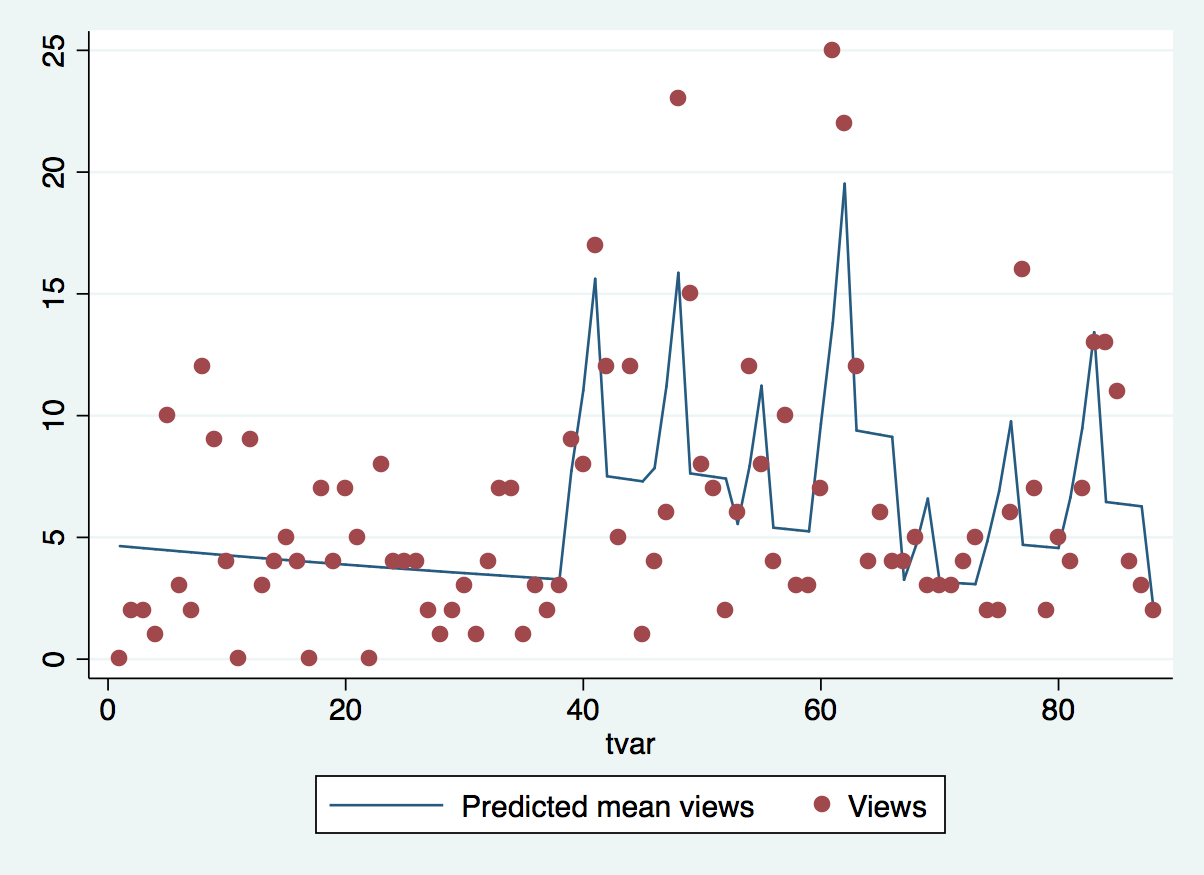
    The chart above shows hits on my old blog post A Game of Thrones and the Misogyny of Imagined Worlds between 23rd February and 19th May 2012. The second season started on 1st April, and there’s a clear series of weekly peaks in views on my post, that occur between Tuesday and Thursday each week – corresponding to blog searches in the USA on Monday – Wednesday. The peak varies by week, but they’re a week apart and anyone who has any experience with time series can see in that data a shift in level, probably change in variance, and strong seasonal signal. Additionally, the height of the peak varies from week to week and I soon noticed it corresponds with just how nasty the treatment of women was in the episode of that week. So, in this post I’m going to show the effect, and give a numerical estimate of the extent of misogyny in each episode of A Game of Thrones, using crowd-sourcing based on google hits on my blog. Note that almost all the hits shown in this data series – 245 in April – are from google searches (though I think one week there might have been a link put up on facebook). This post is nearly a year old, and usually my year old posts (bar one or two techy ones that attract continual regular hits) get very few hits, and certainly never attract a pattern.

    Methods

    (Skip this if statistical methodology makes your eyes bleed).

    I built a simple log-linear regression model using time, cyclical pulse functions for Monday, Tuesday and Wednesday (the date for the first, second and third day after the show is released in the USA) and episode. Episode was set to zero for all days before the 1st April. This enabled the peaks to be (partially) fitted, and also allowed a specific magnitude effect for each episode. The model was not adjusted for serial correlation because serial correlation is notoriously hard to fit in series with low numbers of observations. I also suspect that the tight nature of the seasonality (7 days) compared to the unit of observation (1 day) in a short series and the sharp peaks will prevent models from converging, and this is what happened – I tried fitting a generalized estimating equation model with exchangeable correlation and got divergent estimates of correlation. Standard backwards stepwise model-building methods were used to eliminate unnecessary variables, with the usual strict inclusion criteria (a variable was out if it didn’t get a p-value less than 0.05 on a Wald test). Given the small number of observations, small counts in early parts of the series, and the fact I was driving this model like a Westerosian Ox-cart as it was, I figured it was best to avoid interaction terms of any kind.

    The exponentiated coefficient for episode 1 incorporates a general effect of increased interest in the show with the onset of new seasons, but by calculating ratios of other exponentiated coefficients, one can estimate the degree of misogyny for all episodes relative to episode 1. Predicted values were also produced and plotted against observed values.

    Results

    Results of the model are shown in Table 1. Hits increased by a factor of 2.4 for episode 1 compared to pre-release hits, and each week the peak was on Wednesday, when hits were twice the values for Monday or Thursday. Hits declined by 1% per day over the period of data collection.

    Table 1: Model Results
    Variable Odds Ratio 95 % CI P value
    Intercept 4.69 3.44 – 6.38 0.001
    Time 0.99 0.98 – 1.00 0.2
    Tuesday Peak 1.44 1.09 – 1.91 0.01
    Wednesday Peak 2.06 1.61 – 2.63 <0.001
    Episode 1 2.38 1.50 – 3.78 <0.001
    Episode 2 2.58 1.51 – 4.43 0.001
    Episode 3 1.95 1.03 – 3.72 0.04
    Episode 4 3.63 1.79 – 7.36 <0.001
    Episode 5 1.31 0.56 – 3.08 0.5
    Episode 6 2.07 0.82 – 5.20 0.1
    Episode 7 3.04 1.12 – 8.27 0.03

    Note that episodes 5 and 6 are indistinguishable from background (pre-release) noise in their intensity of misogyny. Figure 1 shows the predicted values derived from this model, plotted with the observed values, and shows relatively good fit, although the model fails to reach the dizzying heights of misogyny displayed in some of the observed hits; but this could be the fault of that facebook link creating outliers, so we won’t get too angsty about that.

    Figure 1: Observed and predicted numbers of views

    From these results we can estimate the relative degree of misogyny of each episode, shown in Table 2. All estimated misogyny ratings are relative to episode 1.

    Table 2: Misogyny Ratings for Season 2, Episodes 1 – 7
    Episode Rating relative to episode 1
    Episode 1 1
    Episode 2 1.08
    Episode 3 0.82
    Episode 4 1.53
    Episode 5 0.55*
    Episode 6 0.87*
    Episode 7 1.28

    *Not significantly different from background noise.

    Thus, the most misogynist episode was episode 4, while episodes 5 and 6 were indistinguishable from background noise. Although episode 3 was of lower misogyny rating than episode 1, it did attract significantly more views than during an equivalent period before the release of the show.

    Conclusion

    Viewers around the world increased their rate of searches about misogyny in A Game of Thrones, and rates of searching increased most in the days immediately following the release of each episode. The most misogynist episodes were:

    • Episode 4: Sansa is stripped and beaten in public in the throne room; Joffrey forces one prostitute to beat (or sodomize?) another after they are sent to him to “sap the poison” though he will remain “a cunt”; Malesandre gives birth to a wicked shadowy abomination after an improbable pregnancy
    • Episode 7: The strange and overly sexualized encounter between Jon Snow and his prisoner in the North; Sansa relives her near-rape in the previous episode; Jaime successfully taunts Catelyn with the memory of her husband’s infidelity; Daenerys loses her dragons and is reduced from her previous pride to dependency on Ser whatshisface
    • Episode 2: Theon Greyjoy uses a woman like an object in his ship, abandons her and then fails to recognize and subsequently tries to fuck his own sister

    In contrast, the least misogynist two episodes were:

    • Episode 5: Theon is shown no the respect by his men, who obviously fear and obey his sister; Brienne proves herself to be tough and honourable; Daenerys rejects a marriage proposal; Arya is generally excellent
    • Episode 6: Talisa the field nurse shows herself a spirited pacifist; Arya is once again generally excellent; Osha the wildling girl saves the Winterfell boys; this episode has some rape scenes and the delicious hypocrisy of Cersei’s attitude towards Sansa compared to her own betrothed daughter, which would be why its misogyny rating is higher than episode 5 – presumably Arya and Talisa save it from being higher

    I think the relative ratings are generally quite representative, though perhaps an adjustment for the downward time trend needs to be incorporated to make them more accurate. This model fairly accurately fits to the data on search hits for this topic, and in my opinion sorts nicely between the most and least misogynist offerings. There is strong evidence that web search numbers correspond with the density of common signifiers of misogyny in any one episode (rape, mistreatment of prostitutes, degradation of childbirth through black magic, vicious anti-woman language, use of women as sex toys without regard for their feelings or identity, and women’s sexuality being either used as a tool for personal gain or expressing itself in incongruous neckbeard-fantasy ways). Hits are much lower on weeks where strong female characters take control of their own lives and act sensibly, even where their situation is difficult and/or oppressed.

    Obviously, no one believes that google searches are reflective of some underlying truth about what is or isn’t misogynist or sexist. But I think they do at least show that a lot of people are disturbed by the images and themes in the show – disturbed enough to get on the internet and look to see what others think of the issue. This show has a deep streak of misogyny, and it isn’t going unnoticed.

  • Obviously they didn’t have Wii, so their lives were clearly poorer quality compared to those of modern Australians – my God, this is the pre-vegemite era we’re talking about here – but this doesn’t mean financially they were poor. However, today, in a rather apocalyptic article of vague relevance to other topics on this blog recently, John Birmingham made the following claim:

    In the hundred and thirty-nine years before the Great Depression, New South Wales produced just four millionaires.

    He used this striking fact (which he self-deferentially labels a “factoid”) to argue that modern Australia has much greater wealth slopping around than it did then:
    That’s not a lot of lolly for a colony so ‘‘wealthy’’ that the British Parliament worried for a while that convict transportation was encouraging crime in London, by providing a guaranteed ticket to the promised land for the underclass of England. Partly that was a function of a more equal distribution of income in those days. The Australian colonies really were a promised land. But also we forget sometimes just how insanely wealthy we are, at least as a whole, compared with the past.

    Now, I think this is wrong, and there are a few reasons why I think this sort of wrongness needs to be pointed out and combated:

    • This sort of historical mistake is often used to flog modern people as weaker and softer than our forebears – though we seem to keep getting bigger and faster and stronger, this logic is common in describing our past
    • It’s a type of hair-shirtism, arguing that because not every person who lives in a city can skin an animal, they must therefore not be able to survive a disaster that, let’s face it, since WW2 hasn’t happened – I have written about the pop-cultural belief that survivalism is more important than cosmopolitanism before and I don’t like it when this idea gets floated

    I think this article is wrong from its very first premise, and over about 140 comments only one other person has noticed: due to inflation, a millionaire in pre-depression era Australia is a very different animal to a millionaire in modern Australia, which I don’t think Birmingham has adjusted for.

    Fortunately, we can check his facts, because the Australian Bureau of Statistics has a copy of the 1904 report on life in Australia and New Zealand, which is about 1000 pages of untrammelled colonial-era goodness and includes a section on income. This report can be downloaded as a chunky pdf file from the ABS, and if we turn to page 512 we can see the section on income and capital. The document doesn’t describe the number of millionaires in detail, but we can get a few estimates as to how many there might have been. First of all, on page 519, we see a table of property ownership values, and we can see that in NSW, 987 people owned property worth more than 50,000 pounds; 1099 owned property worth between 25,000 and 50,000 pounds; and 2,397 people owned property valued between 12,500 and 25,000 pounds. Now, applying the Reserve Bank of Australia’s historic inflation calculator, we can see that these categories in 2001 dollars are: >$5,069,000; between $2,535,000 and $5,069,000; and between $1,268,000 and $2,535,000. Note also here the total value of the properties in the top bracket: 130,000,000 pounds spread between just under 1000 people, which is about 130,000 pounds per person – about 10 million dollars each.

    i.e. There were actually about 5,300 property millionaires in NSW in 1901. Given the population of Australia was 1/7th what it is now, that corresponds with about 36,500 property millionaires today. Not quite the 192,000 reported by Merrill Lynch in 2011, but not quite 4 either. In fact, the inflation calculator tells us that an actual millionaire in 1901 would be worth $100 million today.

    Next, if we look at page 516, we can see that 20,092 estates were bequeathed by deceased persons in 1903-4, and the average value of these estates was 2,402 pounds, or $244,000. It’s likely that in any reasonable distribution of wealth, more than 3 of those estates were worth more than a million dollars in today’s money. The report from 1903-04 is full of praise for the equality of Australia’s income distribution, which suggests a fairly even division of values across the range of estates and a fair chance that a sizable proportion of them were above the 10,000 pounds mark.

    Next, on page 533 we see the average income of NSW residents earning over 200 pounds a year was 658 pounds (about $66000 in 2001 money) and on page 532 we see that incomes for people in this category constitute only 5.6% of their total private wealth. This means that the total wealth of people earning over 200 pounds a year is actually 11,75o pounds, or $1.2 million. Page 533 tells us that people earning more than 200 pounds a year constitute 6.6% of the population of NSW, which in 1901 was about 90,000 people (see page 158 for the population of NSW “exclusive of Aborigines”[1]). That number, scaled up by 7, gives us 630,000 – a lot more millionaires than Merrill Lynch reports for Australia in 2011.

    The basic problem with Birmingham’s account is that it ignores population and inflation. Four actual millionaires (worth 1 million pounds or more) in all of Australia in 1901 is equivalent to 28 people worth $100 million or more in modern Australia. The Forbe’s rich list tells us that there are a little more than 40 such people. I don’t know exactly when and where those actual millionaires appeared in the history of the colony, so it could be that there was only one in 1901, but even if we take that conservative assumption, that’s equivalent to 7 at any point in time in modern Australia, which is pretty good going for a society that hadn’t yet gotten around to the motor car. But once you adjust for inflation and population, it’s clear that actually Federation-era Australia was quite wealthy and materialistic,  probably urbanizing rapidly and “getting soft.”

    Reviewing these figures and adjusting them for inflation and population, I have to question how well Birmingham did his research for that book he mentions in his first paragraph. Perhaps he’s just applying false logic to the number of (billionaire-equivalent) millionaires he discovered in pre-Federation Australia, but I think more likely is that he and his editor completely missed the importance of inflation in making their calculations. Or am I missing something very obvious in my review of this 1903-04 report?

    A few side notes on the ABS report

    The ABS report is amusing for the insight it gives into the way that Australia was run in the era of Federation. When you download it, the download page warns you that it contains language that might not be considered entirely spot-on by a modern audience. In scanning the population and income sections, one can see why. In discussing the population (which totalled 3.8 million in all of Australia), the Commonwealth Statistician adds (my emphasis):

    The figures are inclusive of half-caste aborigines living in a civilised condition, and if there be added an estimated population of 148,000 Australian aborigines in an uncivilised state and of 43,000 Maoris in New Zealand, the total population of Australasia at the date of the census would be about 4,737,000

    Now, I grant you most Europeans in the modern believe that all Australians live in an uncivilized state (most of us having not discovered the joys of “football”), but they don’t say it! No such daintiness was observed by the Commonwealth Statistician back in the day, when talking about those who had been cast off their lands.

    On page 517, in the section on income, we find that pride in Australian egalitarianism and the “great Aussie dream” of home ownership is not a particularly modern trait:

    These figures show a distribution of property not to be paralleled in any other part of the world; and in a country where so much is said about the poor growing poorer and the rich richer, it is pleasing to find that in the whole population one in six is the possessor of property, and that the ratio of distribution has been increasing with fair regularity in every province of the group.

    To this we can add the Commonwealth Statistician’s prescience concerning the Occupy Wall Street movement (page 519, beneath the table):

    It would thus appear that 987 persons – that is to say, 0.13 (about one-eighth of one) per cent – were possessed of £130,521,000, or 35.4 per cent of the whole property of the community

    Back in 1901 the top 0.1% had grabbed 35% of the wealth. I wonder how that has changed in 100 years?

    There’s also a fairly detailed description of registered unions and their membership, showing that the unions have already been established as a key organization in Australian life.

    In contrast, also from the section on income, we find this charming description of the calculation of the relative worth of men and women (my emphasis):

    The unit for the most useful comparison in regard to incomes is the bread-winner; but as there are both male and female bread-winners it is necessary to take into account the less commercial and productive value of women’s work compared with men’s. Taking the productive employments of New South Wales and Victoria as a basis, it is found that the earnings of thirty-six men equal those of one hundred women, and if this wage efficiency holds good throughout Australia the work of the 1,560,784 male and 422,123 female bread-winners at the census of 1901 would be equivalent to that of 1,712,748 male bread-winners alone; and comparisons of earnings should therefore be made on the basis of this last number and not on the total 1,982,907 of male and female breadwinners taken together.

    Now that is a statistic on inequality that has changed an enormous amount in just 100 years – I think now the earnings of about 85 men equal those of 100 women, and we don’t refer to this as “the less … productive value of women’s work” but recognize that it reflects a mixture of differing work patterns, current and historical discrimination, and industrial choices … once again the Commonwealth Statistician of 1903 was rather more forthright in his description of matters pertaining to the “second sex.” But note (page 519) that despite this huge inequality in wages, 18% of women still own property.

    This report is an interesting insight into how we lived in 1901, and the attitudes towards lifestyle and economics that prevailed then. I’m not convinced that John Birmingham read it when he did the research for his blog post or his book, or considered the extent to which things have remained the same over the past 100 years, even while they have changed so much.

    fn1: the Commonwealth Statistician didn’t bother counting Aborigines until 1969. But he did make an estimate, see the subsequent note.

  • Shadowrun is suited to campaign settings rife with economic corruption, the desperate and abandoned poor, powerful corporations who control the social fabric, shady underworld groups and street gangs in conflict. Sounds rather like a vision of Greece after the default, if you were to chuck in a bit of magic. So let’s do that! And what better way to do it than through a resurgent Greek mythical pantheon. And, for that matter, if Greece’s default were to drag Europe down, we would also see Italy and Ireland fall into chaos – and what do they have in common but a history rich in pantheism and magic? How would we construct such a near-future shadowrun campaign?

    In comments to my previous post, Paul tried to describe a worst case scenario for Greek default:

    Greece comes up to a pay day for the public sector and has no money to pay in. They issue IOUs. The public service goes in strike shutting down hospitals. A run on the banks begins and everyone withdraws their money in Euro. The banks collapse. No medicine is being imported into the country or moved to hospitals. Petrol imports stop and the prices go through the roof, preventing the transport of food and other critical supplies. The entire economy locks up because no one can get to work. Farms lie fallow or with harvests rotting in them because farmers can’t use their equipment. Food and potentially power/water shortages start to hit major cities leading to rioting. The police haven’t been paid or fed so they join in. The damage to property and life is massive. Refugees head to neighbouring countries. Eventually international aid arrives, food and petrol shipments unlock the ability to provide basic necessities of life but medical support remains at the level provided via international aid (i.e. broken bones are treated, people with cancer aren’t going to get drugs worth more than tens of dollars – which I believe is most of them). Restarting the economy from this situation is chaos, it’s basically shut down and had spiralling cascades of defaults.

    Now let’s suppose that Greece has a pantheon of sleeping gods, but they were roused by some mischievous figure in one of the resistance movements (New Dawn sound like contenders, but anyone will do). They see a country in chaos and desperate for a guiding hand, so they start letting their magic seep out again. How could they have been roused, and what would the implications be for Greece and Europe? I have a few ideas …

    Witch Hunter Rebekka

    In this version of the campaign, the PCs are members of a top-secret Greek government organization that was tasked with keeping supernatural threats under control, like the organization from Witch Hunter Robin or Double Cross 3. Unfortunately, their organization was abolished as part of the austerity package insisted on by the European Central Bank, and they suddenly find themselves unemployed in a world where the supernatural is suddenly given a free hand. Perhaps they embark on a solo quest to find out what’s really happening, or maybe they set themselves up in some seedy downtown office and start selling their services to corporations and gangsters who have discovered that the dark side is coming for them. And during this maybe they notice a pattern. Perhaps there are other, similar organizations throughout Europe, and as Europe unravels in the wake of Greece’s chaos those organizations too get shut down or worse.

    An orthodox priest, a banker and a schoolgirl walk into the Parthenon …

    Perhaps the secret organizations working to protect Europe are not government run, but maintained instead by the churches. In Greece this means the Greek Orthodox church… so what do they do if they are approached by a banker, who does a sideline in hacking, who has discovered evidence that something behind the trouble was planned – that much of Europe’s chaos was actually schemed up by some sinister cabal that saw a chance to create chaos in Italy, Greece and Ireland at the same time. The mechanism is economic collapse, but the goal is to revive old, dark gods – the pagan gods of Ireland and the Southern Mediterranean that the more modern churches drove out. So who do they turn to? A motley group of PCs who have special powers and a can-do attitude, perhaps drawn from the many warring street clans and gangs that have sprung up in the chaos of the default and the political struggles that followed.

    A conspiracy of bankers

    Of course! What else? We all know that the major banks are servants of satan – let’s make it official! Perhaps the whole economic collapse was engineered to create the kind of chaos necessary to create space for new gods, to generate new, radical and subvertible political movements, and to force the collapse of the secret bulwarks that the Europeans have established against the dark powers that used to rule Europe. Perhaps European history is a long story of dark powers manipulating politics, and the modern European Union was a post-war project to try and drive them out of society and politics. It was working fine – until someone had the silly idea of setting up a common currency. Then the dark powers saw that they could use mundane, financial means to tear the entire European project down, along with all its political and cultural movements against the kind of chaos on which the dark powers depend for their success.

    This whole conspiracy would take place in the halls of power, in the boardrooms of banks and sinister organizations, would be traced through emails and secret meetings and currency transfers through shady swiss bank accounts. It’s the perfect conspiracy for a couple of street hackers to slowly track down and unravel in the course of their dubious work – running in the shadows of the corporations, they find a deeper, darker conspiracy at play than mere political corruption … and all of it focused on unleashing old powers long forced down by the church, the enlightenment and the scientific revolution. We all know that our enlightened, materialistic world view depends on the special social order made possible by wealth and the absence of war and political conflict. What better way to unravel it than to engineer economic chaos, poverty and political disruption in the heartland of the old gods – Greece!

    A New Dawn for the Gods

    Another possible campaign would involve not a conspiracy of bankers, but a conspiracy of radicals. In this campaign, political movements proliferate after the default. Some of them are very violent and become popular very quickly, and as Greece slides into poverty and political paralysis the conflict between these street gangs explodes. Many are also connected to criminal groups and also to ethnic groups – Macedonians and Albanians, Turks and African migrants, for example. Many of them are easily infiltrated by people with authoritarian tendencies, and one of them – probably New Dawn, but others could be imagined – is soon overtaken by a man with special powers, a descendant of one of the Greek gods whose powers have revealed themselves during the chaos. He begins to impel his movement towards the revitalization of the gods, and as other gangs see it they also begin looking for new powers to fight with – perhaps they begin to research alchemy, or bring their ancient gods from across the sea. The PCs, investigating minor crimes as adventurers in the post-default chaos, suddenly begin to discover hints that people are dragging up bigger powers than they have ever seen before, and realize that the street-fighting and political conflict is taking on a religious flavour – with the gods returning to the world as the fervour increases. The fevered political environment of a country in chaos and conflict is a perfect place for new powers to emerge, or old powers to revitalize themselves.

    Exploring the Genesis

    Shadowrun is set after the cataclysmic events that changed the world. Those events are history, and their effects taken for granted in the Shadowrun setting. But I’m fascinated by how they could have come about, and what the world would have been like when magic was being unleashed. Perhaps an imagined economic and social cataclysm in Europe is a good way to construct those events, and gives us a chance to run an adventure right at the time of the genesis of the world Shadowrun takes for granted. I’ve always imagined that such a catastrophe would not necessarily be a physical one, but some kind of cultural and social upheaval that made gaps through which magic and gods could flow. Catastrophic economic problems and social conflict in Europe offer just such a setting. From something completely mundane like a run on some banks, to dragons ruling the sky … could you run a campaign all the way from beginning to end, and create the world of Shadowrun from whole cloth?


  • This week’s New England Journal of Medicine reports on the relationship between coffee drinking and mortality in a cohort study of Americans. The study followed

    229,119 men and 173,141 women in the National Institutes of Health–AARP Diet and Health Study who were 50 to 71 years of age at baseline

    and this paper reports on their coffee drinking habits. Its main finding (my emphasis):

    During 5,148,760 person-years of follow-up between 1995 and 2008, a total of 33,731 men and 18,784 women died. In age-adjusted models, the risk of death was increased among coffee drinkers. However, coffee drinkers were also more likely to smoke, and, after adjustment for tobacco-smoking status and other potential confounders, there was a significant inverse association between coffee consumption and mortality.

    This is why we do confounder adjustment … so I can slurp down another black coffee in complete peace of mind. And check the details:

    Adjusted hazard ratios for death among men who drank coffee as compared with those who did not were as follows: 0.99 (95% confidence interval [CI], 0.95 to 1.04) for drinking less than 1 cup per day, 0.94 (95% CI, 0.90 to 0.99) for 1 cup, 0.90 (95% CI, 0.86 to 0.93) for 2 or 3 cups, 0.88 (95% CI, 0.84 to 0.93) for 4 or 5 cups, and 0.90 (95% CI, 0.85 to 0.96) for 6 or more cups of coffee per day (P<0.001 for trend); the respective hazard ratios among women were 1.01 (95% CI, 0.96 to 1.07), 0.95 (95% CI, 0.90 to 1.01), 0.87 (95% CI, 0.83 to 0.92), 0.84 (95% CI, 0.79 to 0.90), and 0.85 (95% CI, 0.78 to 0.93) (P<0.001 for trend).

    If we’re going on an American coffee standard, I’d say I’m drinking 6 or more cups of coffee per day, so I have a 10% reduced risk of mortality over 15 years (the rough period of the study). Sadly, though, I’m not protected against cancer:

    Inverse associations were observed for deaths due to heart disease, respiratory disease, stroke, injuries and accidents, diabetes, and infections, but not for deaths due to cancer.

    The effect was also observed in non-smokers (that’s me!)

    So, the word is in from the world’s top medical journal: the more coffee you drink, the longer you live!

  • Putting aside questions of economics and fault and blame and all the rest, the drama playing out in Europe over Greek default is an interesting example of the problems Europe has always faced trying to resolve its long-standing political tensions. The EU and more recently the Euro are seen in many quarters as bold attempts to reduce the risk of conflict that arises from a disunited Europe, but many euroskeptics and economists see the Euro as a very bad mechanism for doing so. War and conflict between nation-states is a political problem but the Euro is an explicitly economic process, and as the Greek drama shows, while in the good times the shared economic structures of Europe may have smoothed over some old conflicts, in the bad times they can exacerbate those same problems. Would the finger-pointing be quite as vicious if the Greeks were sovereign in their own currency? I don’t think so, and I don’t think German voters would care very much that the Greeks were about to go belly-up. There would also be no need for accusations of German bad faith – see this article, for example, as an example of insinuations that the Euro was just an exercise in destroying non-German industrial competitiveness (but bear in mind that the writer used to be an HIV-denialist, so his judgment is highly suspect).

    So, putting aside the economic issues (and who in Greece wouldn’t want to!?), I think the looming default raises some interesting questions about the European experiment, and I’d like to ask two here.

    Question 1: Is there any outcome but Greek exit or German defeat?

    Based on reading from afar, it seems obvious that the Greek electorate aren’t going to accept austerity policies (or, more cynically, aren’t going to accept any policies dictated to them by Germany). They’re going to vote for a rejection of the austerity package and whoever wins votes on that platform will not be able to back down from that pledge. So barring some very unlikely events, the crisis will come to a head next month when an anti-austerity government tells the Germans where to put their sausage. But equally, the Germans don’t want to back down and the bigger states of Europe don’t want to be bankrolling Greece for the next couple of years – and they have their own euroskeptic hordes to appease. But the only way to prevent Greece defaulting if they reject the austerity package is to give them money for nothing, which essentially represents a complete failure of German political nerve. Furthermore, with Hollande replacing Sarkozy in France, this will also represent disunity at Europe’s core, and it’s pretty likely that other states (I’m looking at you, Italy!) will start thinking this is a) a good opportunity to get some of their own gains from that weakening core and/or b) a good chance to assert some extra authority over Europe’s future.

    Is there any other outcome that can arise? The third possibility is an anti-austerity Greek government, newly-formed, accepting austerity demands. Likely? I don’t think so…

    Question 2: Will Greek exit destroy monetary union?

    My personal opinion is that Greece really needs to default and get out of the monetary union, and the best thing for most of the other smaller nations of the EU is to do the same thing. Greece is in the wrong part of the economic cycle for austerity, but can’t spend like a drunken sailor because Greece is not sovereign in its own currency. Obviously default and exit won’t be pretty – the New Greek Drachma will devalue, and new borrowing will be impossible for a while, I would guess – but default isn’t the end of the world, as Iceland, the UK and Argentina have all showed in the past. The alternative is basically to become a colony of Germany, incapable of competing economically or of devaluing the currency to compete through exchange mechanisms[1]. Obviously many people in Greece agree with me, because they seem pretty serious about voting in a group of political parties hell bent on this goal.

    So, if Greece does exit – and especially if Greece recovers economically after the usual 10 years of torment – then what incentive will other small countries have to stay? Not only will exit have been confirmed as an option, but it will also be seen not to be the disaster that everyone expects. Some of the Eastern European satellites may consider the same options. It may begin to look like the only people who want monetary union are Germany and France, especially given their strict demands for austerity policies probably don’t match the goals of other, smaller nations. And recall, too, that some of the smaller nations have strong anti-european blocs in their local parliaments who would like nothing more than to find leverage to destroy the non-monetary, political aspects of the union.

    So, if Greece exits, will the Euro die soon after? Will we see a return to separate currencies, or a collapse of monetary union to encompass just France, Italy, Germany and Poland? And would this be a bad thing?

    Question 3: Is this creative destruction for Greek politics?

    It should be fairly obvious that a large part of the reason Greece is in this situation is weak governance – a lot of shenanigans involving shoddy tax collecting, fraud, and poor management of public money were responsible for the sudden discovery of Greece’s financial problems. In the washup, a whole bunch of new parties (most notably the new left, but also the new right) are coming to the fore, and this raises the possibility that they might actually be able to sweep the old, corrupt stalwarts of Greek politics (such as the socialist party, which I think has been something of a perennial ruler in Greece) away from the levers of power. My guess – knowing sweet nothing about Greek politics – is that this will be essential to reforming the governance structures necessary to allow Greece to maintain responsible public spending, whether it is in or out of the union. So it may be that the crisis presently gripping Greek politics is long overdue and essential. Mustn’t waste a good crisis and all that.

    So, is the current political crisis in Greece actually of huge long-term benefit to ordinary Greeks?

    I wonder if there are a lot of other governments of European minnow countries looking at what is happening in Greece as an experiment for their own future. And I wonder what the average Turk thinks about their government’s long-held goal of getting into the EU. Still looking like a great move? I think people inside and outside the Eurozone might be reassessing its value rapidly …

    Question 4: Is this the pro-European left’s equivalent of greenhouse denialism?

    Finally, this is a coup for right-wing euroskeptics, who can point out how they were right all along. Lots of euroskeptics and economists have observed that the Euro is a bad idea. They were right, though not always for the right reasons. Was the European pro-union left blind to these messages due to ideology? And was the extent of their blindness such that it could be said to be as one-eyed and stupid as AGW denialism?

    fn1: in fact, the way some people describe it, the Euro does look a bit like a kind of fiscal version of old British colonial policy, which was to ensure that the colonies were a captive market for British manufacturing. The British did this through smashing native industry, but maybe if they’d enforced a strong monetary union they could have achieved the same thing with a bit less violence…

  • I watched Titanic in its 3D release about a week ago, on the strong urging of my partner. I missed it the first time around so it was all new to me, and I’d somehow managed to avoid learning anything about the story. It’s a great movie, very nicely paced and with an excellent combination of love story, social drama and action, and I think it confirms James Cameron as a truly great movie maker. However, I think the ending was amazingly cynical and I would like to ask my readers whether they agree with me, or think it doesn’t quite pip The Breakfast Club. The thing I think is particularly cynical about the ending of this movie (and The Breakfast Club) is the way that it undermines all of the positive content of the human relations in the first part of the movie, and this trick really always strikes me like a massive slap in the face.

    Fair warning to all readers: from here on in is a massive series of spoilers, for the ending of Titanic, The Breakfast Club and probably Cabaret. If you ever plan on watching these movies as a virgin viewer, avert your innocent gaze now.

    … you have been warned …

    Right, so at the end of Titanic, 101 year old Rose throws her precious diamond necklace into the sea. I guess we’re meant to see this as a symbol of freedom: she has been able to face the ghost of her past and the amazing events that both defined her entry into adulthood and liberated her from (a kind of) bondage[1]. She could face the memories of her lover and put all these things to rest just as the end of her life draws in – get closure, as the Americans might say. So this last remnant of that time could finally be released into the very deeps that claimed her innocence and freed her future.

    What I found myself thinking, however, was … “What a bitch!” Rose had only been offered any of these chances because Brock “I don’t want to rain on your parade man but we ain’t gonna last 17 hours out here man!” Lovett has spent his life chasing the diamond necklace, and in the process of looking for it uncovered a picture of Rose. In his pursuit of the diamond necklace he flies her to the site, and she recounts her full story for the first time in her life, to the four people on earth most likely to appreciate and understand it. Would that we all got such chances! Plus, for free, she gets her picture back and is able to settle all those old memories into place. Earlier in the movie we’ve been told that other salvage experts’ careers had been ruined by failure to find the diamond necklace, and we know this is how Lovett aims to fund his whole mission.

    So in exchange for the kindnesses fate and Lovett have offered her, one would think the very least Rose could do would be to fess up that she has had the diamond the whole time, and give it to him. She doesn’t need it for money – she’s never pawned it off – and she isn’t planning on giving it as an heirloom to her daughter (we know, because she threw it in the sea) and no one else knows she has it, so she has no use for it. She doesn’t even want it now that Lovett has kindly offered her the opportunity to file away the memories of that time. And yet … rather than offer it as fair trade for her peace of mind and happiness, she throws it away, selfishly and privately and without thought for others.

    This isn’t just a betrayal of Lovett, but also of us the viewers. Early in the movie Jack Dawson (Rose’s poorhouse lover) tells her that she is selfish, stuck-up and spoilt but he loves her anyway. He sacrifices himself for her, and I think it’s fair to assume as the viewer that this sacrifice and her experience of the universality of love might have changed her so that she is no longer that selfish child. But no, 80 years later all she can think about is herself, and not the many people who (once again) helped her to achieve emotional fulfilment. Dawson’s sacrifice did nothing to change her, and she is frozen in the mindset of the born-to-rule upper class girl she was when the whole world’s men were fighting over her on the deck of the sinking ship.

    Now, I know a lot of you will say “I only came to watch the ship sink, man!” but I think a good 50% of the movie’s viewers (you know who you are, ladies) were heavilyemotionally invested in this story of love crossing all social barriers. I know I was – I thought it was a great story and in my happy little idealistic heart wished that it could only be so true. And what salve do I get for this hope and idealism at the end of the movie? Some rich bint slaps me in the face with her privilege and throws a priceless diamond into 2km of freezing ocean.

    Thanks for nothing, Rose.

    This is pretty much the same emotional turnabout I got from watching The Breakfast Club – what a treacherous, slimy piece of emotional skullduggery that movie is. Early in the movie the nerd boy tells everyone that their Saturday idyll is just that, and on Monday morning they will all return to their social places and – by extension – to bullying him, and all their heartfelt exchange of fears and dreams will come to naught. They all poo poo him, but that’s exactly what happens at the end of the movie – with the added sliminess of the goth girl giving up her alternative look and bouncing away all happy and preppy into the sunset, overjoyed because she pulled the popular jock boy.

    That, my friends, is betrayal. Don’t go looking for it in the Weimar republic – that’s your stab in the back right there.

    And speaking of the Weimar republic, I think Cabaret has a different but equally unpleasant kind of treachery at its end. They’re standing in their bar in the dying days of the Weimar republic, singing some stupid song about how life is a cabaret old chum, and I just found myself thinking of what was to come – especially of the holocaust, but let’s not quibble about details: there’s a world war that’s going to kill about 60 million people looming and no, those 60 million people and all the hundreds of millions who have to flee and lose their homes and loved ones, they are not going to think it’s all a jolly great show! I think this movie was attempting to portray a group of people coming to terms with the descent of their age into madness and slaughter, but that last song basically portrays a movie maker who really has not worked out how serious that madness and slaughter is going to be. Perhaps if they’d been singing auld lang syne it might make a bit more sense … but no, declaring life to be just a big stage show at that moment of history is remarkable folly.

    Though I grant you, it’s been a long time since I watched Cabaret and I really, really hate musicals so I may just have failed to understand the movie properly. Feel free to enlighten me on this point. But I don’t think I’m wrong about Titanic or The Breakfast Club. The endings of both of those movies are cynical and devious in a way that few movie-makers could ever hope to be by design. I can grant Cameron a bit of leeway for Titanic, but I strongly believe that the ending of The Breakfast Club was deliberate: the director made a movie intended to suck the kids in and then tell them at the end, “Get back in your place, pencil-neck geek!”

    That director should fry.

    So anyway, feel free to vote: which was more cynical? Titanic or The Breakfast Club? And do you think the endings were deliberately or accidentally evil?

    fn1: that quite frankly most of the people on the ship would have happily been sold into at about the point where women of Rose’s class were being lowered to their safety from the doomed ship

  • John Carter came out late in Japan, but I got a chance to watch it last night after a day of role-playing, and while I was impressed by the authenticity of its representation of Barsoom, I wasn’t so impressed by its general cinematic properties. It was a fun romp but it suffered from what seems to be a way too common problem in modern action/SF movies: too much plot. In this case the plot had been laid on thick because the movie had too many themes, but in its defense most of these themes were attempts to work all the essential points of the setting into a single movie. So we had white apes, treacherous Therns, Tharks, a bit of lost-princess plot from one of the later books, the river Is and the environmental problems of Mars all rolled into one movie. It probably would have been a much better idea to make the movie a relatively faithful representation of the first book, and then run on to making a series if the first one had been successful – it could be quite a good franchise if the first were a hit. Instead, the movie has the major components of three or four books compressed into the one plot, and it made the plot unnecessarily complicated and broke the flow of the story.

    It also suffered from another common problem – silly plot devices that don’t work and just waste time, something that also happens in TV. For example, why did John Carter have to go attack Zodanga only to discover that the battle was around Helium, then suddenly have to rush back with all his Thark mates? That’s 2 minutes of a long movie that just aren’t necessary and add to the sense of silliness – it seems to have taken him just a few minutes to get from Zodanga to Helium, where previously it took a whole night, and somehow a whole horde of Tharks flew after him even though none of them had ever flown before, without crashing. This kind of stuff isn’t bothersome in isolation but as it adds up across the course of the movie it changes the tone from “I’m suspending disbelief here so I can enjoy the four armed men slaughtering each other” to “oh come on, this is getting ridiculous!” In movies like this, you need the story to pare back on unnecessary suspension of disbelief so that you can accept the existence of a 9th Wave Ray Gun without dispute.

    The 9th Wave Ray Gun, as far as I can recall, wasn’t in the original books and was inserted entirely so that we could have Therns in this story rather than waiting for book 3. As a change of plot I’m fine with that, since we get Therns; but I guess the purests will disapprove on principle, and also it adds complexity. The plot of the original book was quite fine, thank you, and we could have happily had a simple adventure involving Deja Thoris (who, by the way, was a stunner!) and the Tharks and left it at that. Ray guns were really unnecessary.

    Ray guns were especially unnecessary since this movie was already struggling against a significant design flaw, that is very hard to solve on the big screen: the world and all its races are fundamentally preposterous, and if you’re going to have to sit down to watch this stuff you need, once again, for all the unnecessary preposterosity to be stripped out. You have blind white apes, a dog like a slug that can run at the speed of sound, levitating skyships, great big 8 legged mounts, transportation to mars, and did I mention the four-armed blue-skinned freaks who hatch from eggs and live in a horde without families or education of any kind, and have tasks and are twice the height of a man? I suppose compared to all that ray guns are pretty bog-standard actually… in any case, the setting all the characters and most of the plot were preposterous, and I think that might explain why it was a bit of a flop at the box office. A shame, really, because it’s a pretty fun movie, overall, and if they stripped out the extraneous stuff it could have been a really really good adventure movie and a very good interpretation of the books.

    I do think its interpretation of the books was quite good, and I think it also had some very well done adjustments to small points that make it palatable to a modern audience without changing the main thrust of the original. For example, John Carter’s civil war record is unchanged but his rejection of his military history enables the viewer to be sympathetic to the struggles of an ex-slave holder; his encounter with the Apaches is subtly reshaped so that, while they remain a threat and he has to flee from them, their “savageness” can be more easily interpreted as a matter of perspective rather than absolute natural fact … that is, they have their own motivations, which Carter tries but fails to appeal to, rather than just being inchoate savages who want to kill him. Deja Thoris retains her spice and sassiness, rather than being weakened for the movies, and although occasionally seems to need Carter’s help just a bit too much, avoids that common pitfall of modern action movies of being suddenly rendered useless halfway through. The savagery of the Tharks is retained, but all the stupid stuff where Carter teaches them how to do their own cultural stuff better is dropped, and we also get something resembling an explanation for his rapid comprehension of the language. His super-hero status is much less maddening in this movie than in the original, though it’s still hard to understand why everyone thinks he can save the planet just because he can jump high. Deja Thoris can build an experimental ray gun, but she obviously finds this kind of ability nowhere near as useful as Carter’s ability to leap buildings with a single bound, and appeals desperately for him to help her take on a guy whose super power is “destroys cities with a wave of his hand.” Maybe she’d read the novel, and understood that no harm will come to her hero…

    This is a good rendition of the setting, with some fun action scenes and very attractive lead characters, and the plot is broadly comprehensible though it fails in the usual ways that modern action movies do. If you’re a fan of the novels and you haven’t seen this already, I recommend giving it a go. If you enjoy pulp science fantasy and want to watch a swashbuckling film from the genre, it’s a good way to spend two hours. But if you’re a serious connoisseur of SF action movies and won’t settle for B-grade silliness at any point, I’d say this is probably not worth your time.