• I GM’d Warhammer Fantasy Roleplaying 3rd Edition (WFRP3) on the weekend for a group of three players. It was my first time GMing in 18 months, the first time I have ever GM’d WFRP3 in English (up until now it has been Japanese). It was actually the first time I had GMd in English in 3 years, and because I was dropped into the role at the last minute I rehashed a session I’d previously run for Pathfinder, Strange Doings in the Steam Mountains (also last run in Japanese). A few notes about the session below, but first I thought I’d mention a problem I ran into with WFRP3’s system of rechargeable action cards, which is kind of obvious once you run into it but which I hadn’t thought about ahead and which if unresolved threatens to completely undermine the atmosphere of Warhammer worlds.

    How to handle rechargeable healing spells outside of combat?

    One of the PCs in Saturday’s adventure was a wizard of the Jade order, a kind of druid-like magician. One of his spells, The Gift of Life, is a healing spell that can be used in combat to heal (roughly) up to 4 wounds and (possibly) one critical wound, if successful. In combat it is quite balanced: it requires enough power to require a wizard to be at equilibrium to use it, it has a recharge value of 4 so can effectively only be used every 3 rounds, and its difficulty increases rapidly if one is engaged with a melee opponent or critically wounded. In the weekend’s first battle the main beneficiary of this was the wizard himself, who hid behind a secret door to heal himself, stepped out to fight, got wounded again, and ducked back behind the door to heal again. When the battle finished, he was still on half hit points and thus one hit away from death.

    The problem arose after the combat ended, when the wizard was then able to heal himself, wait for the recharge, cast again, and keep going until himself and the rest of the party were fully healed. There is no daily limit on spell-casting, so there is no reason for him not to do this. Worse still, the spell offers the chance to heal critical wounds – the essential basis of WFRP3’s inbuilt deadliness – so if used continuously out of combat it essentially offers the party a way to regenerate completely after every encounter. Without it, WFRP3 is a very dangerous setting – without any healing, the wizard would have died in this battle, and the entire party would have been in dire straits after the second battle, when they went up against two steam Mephits. So the spell itself is quite a useful spell for ameliorating an otherwise extremely dangerous system. But how to prevent the recharge function from largely eliminating the threat in WFRP3? On Saturday night I allowed the wizard to fully heal himself and cast the spell once on every wounded party member, but obviously this is an arbitrary system, so I need to find a way to limit the spell and to put general limits on recharge effects outside of combat encounters.

    I think there are a couple of ways to do this:

    • Implied daily limits: one option is to only allow any spell to be used once in between encounters. If one assumes about three encounters in a day and a spell being used at most twice per encounter, this gives an implied daily spell use limit of about nine times per day, without actually stating a limit. This is completely arbitrary – there’s no reason why a wizard should be able to cast a spell three times in the span of a combat but only once in the following three hours – but it solves the problem, and not just for healing spells
    • Actual daily limits: Another option – which could be good for limiting wizard spell use anyway – would be to put actual daily limits on how much a spell can be used. One way to do this would be to say each spell can only be used a number of times equal to the wizard’s willpower plus their rank, minus the spell’s recharge time. Gift of Life, with a recharge of four, would thus only be usable twice a day by the party’s wizard in this adventure. Magic dart – with a recharge of 0 – would be usable six times a day, which is a handy limit considering that Magic Dart is a nasty spell. This would also give more reason for a wizard to choose non-spell action cards, especially support cards which can sometimes function similarly to spells but using skills. The same tokens used to track recharges could easily be adapted to tracking the number of times a spell has been used. I think this goes against the feeling of WFRP3, however
    • Wound-specific limits: The option I think I’m going to settle on is to use wound-specific limits. That is, any one PC can only successfully cast a heal spell on any one set of wounds once. The recipient of the healing must then go out and get wounded again before they can enjoy the same person’s healing again. I think I will extend this to healing draughts as well, and will make it caster-, rather than spell-specific. In this case, the wizard can cast Gift of Life on a party member (sucessfully) out of combat once; the result of this roll represents the limit of the caster’s ability to tend to the given injuries. Then, when the healed PC goes back into combat and incurs another set of wounds, the caster can heal them again with Gift of Life or a different spell. The PC can separately consume their own healing draught (once), and other spell casters can try to heal that PC, plus any PC with first aid training can also attempt to attend to the injured PC’s wounds – but only once each. This approach to healing is consistent with the rules for the First Aid skill, which can only be applied once by each PC on each PC. It doesn’t limit the number of times a day the spell can be used through magical theory, but through the limitations of the particular injuries each recipient of the spell has suffered. I think this is more consistent with the feeling of WFRP3 rules, and, given that healing spells are quite weak, doesn’t prevent them being used freely in combat (provided the recipient is receiving fresh wounds).

    Any of these solutions will work for healing spells, but the last solution may prove insufficient if the problem arises in other types of spell (item identification, teleportation, that sort of thing). I think this is a weakness of the rechargeable-action-card system, but it’s better to house rule it away than to ditch the system, because rechargeable action cards are a lot of fun in combat.

    Another minor problem of WFRP3

    It may be in the GM’s Toolkit (which I don’t own) but it seems to me that the designers of WFRP3 have put a lot of thought into the rules and how to work them, but haven’t put much thought into how to put all of it together when preparing adventures. With all the actions spread over cards in multiple packs, it’s really hard to work out how to organize e.g. a set of monster statistics for three separate encounters and how to keep track of monster actions for groups of monsters. If I have three separate types of monster in one encounter I have to gather together lots of cards from different locations and then keep them together with clips or folders or bags or something, then somehow return them to their original location when I’m done. I guess there are specialized card holders for this sort of thing, but in preparing for this adventure I had to make my own monsters (the gnome thieves) and find a way to lay them out together and manage them. I don’t feel that this has been settled in the rulesets I have – tips and advice would be appreciated! Also juggling monsters’ special actions in combat requires a lot of experience and attention, since you’re potentially managing several different monsters of several different types all with their own unique (and repeated) action cards. Also basic cards – block, parry and dodge – aren’t available in monster statblocks, so you have to track them in your head. Stat blocks need to be designed in a way that is as practical as the character sheet, and I don’t think they are.

    Adventuring in the steam mountains

    The adventure itself was fun and straightforward, getting halfway through before our 3 hour room slot was up. My aim is to use this adventure as an intro to a possible sandbox campaign in a small part of a larger world. I vaguely envisaged this world being Japanese-ish (continuing the onsen theme) but without much emphasis on any particular culture to start with, and I thought I’d let the players’ actions and decisions guide the introduction to the world. I also didn’t envisage it being in the Warhammer milieu per se (though undoubtedly given my inclinations, there’ll be a healthy dose of satanism, steampunk and dark powers).

    The PCs were:

    • A Dwarven Troll-Slayer: Dwarves, it appears, are black-skinned and clean-shaven, though the Troll-slayer class retains its outcast status from Warhammer
    • An Elven Scout: Elves, it appears, are very tall (>2m), extremely skinny, and generally consistent with their European heritage
    • A Human Wizard: the human was skinny, pale, always cold, with spikey hair in a faint blue tone. So it appears that the default humans of the area are anime-standard

    I haven’t decided yet whether the elf or the dwarf were travellers from far away, or if the steam mountains are on the border of three regions. I am tending towards the latter – borders mean lawless areas and strife after all. The onsen resort itself was an Australian-style rural estate, suggesting 18th-century level of building technology, so I’m wondering if the setting will be an 18th-century style semi-arid location, similar to that of Robin McKinley’s The Blue Sword. Steam trains are an excellent addition to any setting, so it could be a good plan to set it in or on the cusp of the steam era.

    Finally, it appears that gnomes are a bunch of greasy, tattooed criminal bastards, good at technology but sewer-mouthed and immoral. Kind of like East London gangsters, but shorter (if that’s possible). But that could just be because the only gnomes anyone will ever meet are a criminal gang from a single city, so it could be just an unfortunate stereotype – I haven’t decided on that yet.

    I’m not sure, in any case, if I’ll get a chance to continue this adventure into a campaign, but if I do let’s see if I can have an orientalist outback pre-Victorian steampunk adventure with racially deterministic gnomes, and WFRP 3 rules. Sounds like fun!

  • … have been in the media recently. This is a fine example of how to debunk “research” showing that computer games make children angry …

  • Two previous owners, barely used…

    When I lived in London I visited the Crown Jewels, and was struck by how perfectly they encapsulated Britain’s morbid fascination with its past riches. Stored in a secure room in the Tower of London[1], these goodies are an enormously tasteless display of confiscated bling, their centrepiece the Koh-i-Noor diamond, which was captured during Britain’s colonial era in Afghanistan. They’re clearly impressive, in a completely gaudy and tasteless way, and the general idea I think is that you’re impressed by how completely awesome Britain was during the empire. They are also clearly worth huge amounts – just the gold on the sceptres and other bits and bobs must be worth a near fortune, but the diamonds are something else again. The koh-i-noor is a 106 carat diamond, and is just one part of Queen Elizabeth’s crown. The whole lot must be worth a small fortune. So it’s amusing when one reaches the end of the Crown Jewels exhibition and encounters, right by the exit, a donation box with a little sign saying “please give generously to help maintain this exhibition.”

    Here’s an idea. Why don’t you sell off a bit of the bling, and use it to maintain the rest? There’s a depression on, you know. I wonder how many Indian or Pakistani tourists have got to the end of that exhibition and coughed up a pound? How many have wanted to spit into the box?

    This shabby juxtaposition was brought to my attention again this week, not by the diamond jubilee itself, but by the behavior of a company that had been contracted to provide crowd security at the event. This company had been contracted to provide marshalls for the London Bridge area during the flotilla, and as part of its contingent of marshalls it bussed in 80 unemployed people and apprentices to work unpaid for the two days. These people were then required to sleep under London Bridge, and had no access to toilets for the duration. Women had to change in the street. Apparently they were completing the final requirements for accreditation to work at the olympic site, so they worked for nothing. They also weren’t offered accommodation until after the event, when after a 12 hour shift in the teeming rain they were bussed to a swampy campsite. The company’s response to these accusations is not to deny them, but to blame someone else:

    The London Bridge incident should never have happened but was to some extent outside our control, the coach drivers insisted on leaving. For this we sincerely apologise, on investigation this morning the majority of the team were happy, fed and looked after as best possible under the circumstances.

    Brilliant. Their original plan was to have their unpaid, voluntary staff sleep in buses after an 8 hour bus trip. This company are being paid by the government to provide marshalling services at the most important political event in Britain for a generation, they’ll happily accept free labour, but they can’t be bothered even securing a dormitory for the night. Anyway, it was all the bus driver’s fault.

    So, British society can afford a jubilee covering four days and including a rock concert featuring world famous names, a flotilla of a thousand boats, and a series of public holidays that is expected to dent the economy’s growth, but they can’t afford to pay for a dormitory for 80 unemployed people and apprentices who worked for free in the rain to stop the crowds from getting out of hand. I guess there’s a depression on, so we have to forgo some luxuries. Also, could you put a pound in this collection box to help maintain this exhibition of bling? It would be slightly cheaper if we returned this diamond to India, but we have a colonial heritage to respect, so we need your money…

    The reality, of course, is that Britain has slid down the wealth rankings over the period of the Queen’s “reign” and no longer has any chance of returning to those prior glories. This article in the Guardian describes the way in which Britain’s economy has declined during the Queen’s reign, from third in the world to 8th. And what countries overtook her in the past 60 years? India, China, Japan, Germany and Brazil. The article describes the fascinating series of policy approaches successive British governments have taken to overcome Britain’s decline, encompassing industrial policy and finance policy to austerity. None of them have worked, and I think this is because of what the article (of course) fails to mention: the collapse of Britain’s colonies. By 1953 (when Elizabeth took the throne) Britain had lost most of her major colonies and was investing increasing amounts of money and effort in retaining the remainder. The loss of those colonies meant that British manufacturing was suddenly forced to compete on world markets where previously it had a captive market place, and at the same time Britain lost access to cheap resources. Is it any wonder that the countries that have overtaken Britain in the succeeding 60 years are countries with no colonies? Britain has wasted, in turn, her industrial base and her resources (coal and North sea oil), and finally turned to gambling as a last desperate attempt to recoup some money in the last 10 years. The result – tragically, for those 80 people sleeping under London Bridge in the rain – was the recent economic collapse.

    My theory is that Britain – or more specifically, the British ruling class that fields politicians to rule the country – has a huge blind spot when it comes to understanding colonialism and inequality[2]. Unable to comprehend the true economic and social forces acting on British society, its politicians desperately struggled to find industrial, social, or economic policies that would keep Britain afloat. But there was no solution to Britain’s problems: Britain was wealthy through robbery, and when the larceny stopped they weren’t going to be able to maintain their lifestyle. George Monbiot describes how Britain bought off its working classes with the profits of colonial enterprise while other nations fought against revolution and strife, and the economic miracle Britain was able to work on the back of cheap colonial labour. But with the collapse of the colonies, this welfarist approach to social pacification was going to have to change – to a real economy capable of trading against Germany and Japan. The only solution to buying off your workers is reducing inequality. Did the ruling classes of Britain, unable to accept that in the 1950s,  choose instead to embark on a path of culturally and economically unsustainable welfarism?

    This question of what happened to Britain over the last 60 years is fascinating. What do Germany and Japan have that Britain doesn’t? Japan has no resources to speak of, but twice the population – is that all? Is it Japan’s industrial policies (of picking winners, and complex – largely corrupt – relationships between companies, banks and government)? Its relative lack of inequality, which enables it to mobilize its whole society for economic gains, rather than just the top 20%? Is it something cultural? What about Germany, also relatively lacking in resources but similar to Japan in its social welfare and industrial systems? It can’t be ordo-liberalism that is the answer though, because India, China and Brazil don’t have anything like that. And the eight countries immediately below Britain couldn’t be more diverse in population size and economic systems … so what is it that got Japan, China, Brazil, India and Germany above Britain over the past 60 years, when Britain had such an excellent starting position? Even if we discount China and India on purely population grounds (they had to catch up eventually!) then immediately below Britain are France and Italy, both former colonialists as well. What did they do differently as their colonies fell apart, to maintain their positions relative to Britain? Is Britain a model of how to mismanage a decolonization era?

    And what can Britain do from now? I get the impression austerity isn’t going to work (not that it will matter – whether it works or not will be a moot point once Cameron is voted out), and the finance/home construction nexus isn’t going to work – in fact the whole idea of supporting domestic demand through housing bubbles is not going to get back off the ground. With North sea oil gone and the manufacturing base hollowed out, what is Britain going to do? The only answer I can think of is to privatize its crown jewels, and start paying the bottom 20% a living wage. After that … where to for Britain?

    fn1: which is itself so tacky that visitors to London sometimes mistake it for a fake tower. Once a friend came to meet me at Blackfriars and, lost in the rain, called me to get help. I asked her where she was and she replied, “I’m standing on a hillside, looking down at this awesomely tacky castle that has to be a rip-off of something famous.”

    fn2: Incidentally, I don’t believe the linked article’s statistics about inequality. This is because the article focuses on the distribution of income only, which is irrelevant. The important issues in assessing inequality are its functional effects – in health, education and life satisfaction – and I find it really hard to believe that inequality in these aspects is greater now than 60 years ago.

  • In comments to my statistical proof that Game of Thrones is misogynist, Jamie tells me that I am viewing the world through the lens of “privilege,” and thus unable to properly understand the seriousness of certain issues. There is of course a grain of truth to this idea, that living in a certain privileged environment can make one blind to the full nuances of life as someone else, and to the extent that the word “privilege” or phrases like “blinded by privilege” can be used to describe this situation, I think they are useful rhetorical devices. But scan any feminist blog today – Feministing, or Pandagon, or Shakesville, for example – and you’ll see lots of examples of arguments being shut down and opposing opinions invalidated through the invocation of “privilege.” For example, at the “feminism 101” page on Shakesville, itself a loathsomely sexist blog (though the authors can’t see it) we get lots of invocation of privilege in quite negative and almost mystical terms. Consider “On Privilege Breeding Insecurity” (emphasis in the original):

    Insight isn’t the only thing that undiluted privilege doesn’t freely give its members; it also robs them of an internal, dignified security that isn’t predicated on treating rights as a zero-sum game. Every layer of privilege serves as proxy for the self-assurance hard-won by struggling to be proud despite one’s marginalization. Privilege tells its members they need not reflect, or justify, or earn, or question. They needn’t even bother themselves with the business of being good, because unexamined privilege assures them they are good, by virtue of their privilege.

    Not only is this a remorselessly negative view of modern men, but it clearly contains the germ of a rhetorical strategy of ignoring other people’s point of view and setting up levels of “privilege” that you can choose to ignore. Of course, it’s written by an American, which means it’s written by one of the most privileged people on earth, whose entire way of life depends on the huge economic inequality between her country and the rest of the world. Yet … I’m sure she’d object to being told that her “hard-won” self-assurance was actually a windfall due to an accident of her birth. It’s kind of like being a man, really, isn’t it? And see here’s the great thing about the argument from “privilege”: Shakesville’s author can claim that she understands the situation of people in the developing world – maybe she’ll even claim that her own underprivileged position gives her useful insights – and that her opinions about what people in the developing world should do and think are valid; but the child labourer from India can just tell her that she’s talking from a privileged position and doesn’t know anything, really. And what can she say back? It’s a perfect argument – if you want to stifle debate. Not so useful if you think that the free exchange of ideas might help everyone to progress to a world without inequality.

    In my opinion, then, this concept of “privilege” as deployed in the feminist blogosphere is deeply counter-productive: it has limited analytical power; it reduces structural discrimination to simple personal politics; and it is founded on the gender essentialism that pervades radical feminism, which is itself a tactic aimed at establishing a new, privileged form of rhetoric.

    The limited analytic power of “privilege” rhetoric

    The very last time I involved myself in a political struggle was a student occupation a long time ago in a galaxy far, far away. I was not a student at the time – I had completed my Masters of Public Health and was working full time as a researcher in a health centre for extremely marginalized members of the community (who themselves could show astoundingly regressive racist and sexist beliefs). I just turned up with a few mates to help out with the occupation. More fool me. Near the end of my day of “helping,” as my stomach was sinking at the site of what a shambolic and useless demonstration it was turning into, I found myself standing in a ring of students, who were being given instructions by one of the demonstration’s organizers. At this time I was in my mid twenties, kickboxing maybe 2-3 times a week, and hadn’t yet discovered fashion. So there I was in a flannelette shirt and skintight black jeans, hair shaved, tanned from bike riding and generally in fairly good physical condition. The organizer went around the ring of students asking each in turn to go to their university and organize as many students as possible to come to the occupation[1]. Then she came to me, took one look at me and said “I want you go to your technical college and see if you can get us any help.” That’s right, she thought simply by looking at my clothing that I was not a university student.

    This woman was so “blinded” by her own “privilege” that she couldn’t comprehend that someone from a working class or lumpen proletarian background could even be at university. This is a remarkably naive attitude for a person in Australia in the 1990s, when lots of people from that background were easily able to get into university if they studied hard. But it showed what a bubble she lived in. So whose privilege was working against whose here, and which one trumps which in the woe is me stakes? Me the professional man still not yet out of my working class cultural heritage, or her the wealthy woman? Obviously I was no longer in the class of my origins – as a researcher I had moved up to middle class – but the attitude she was showing to me is exactly the attitude that now, as a professional adult, she will be showing to little 18 year old versions of me that she meets, working class men and women whose futures are extremely vulnerable to small flexings of the muscles of the privileged upper classes. So in amongst this complex mess of privilege – of age and wealth vs. masculinity – which one should we decide holds the whip hand? And in making that decision, have we actually added anything to our understanding of the best methods for undoing the inequality that plagues our societies?

    In my estimation, we’re much better off ignoring people’s origins, and talking about the structural factors that determine inequality. As someone from a working class family who found out what university was at the age of 16, moved to his university with precisely $300 to his name ($250 for student fees!) and has never received a cent from either of his parents since he turned 16, but who watches his friends have their houses bought for them by rich parents, I feel that the inequality in access to capital is a much, much more serious factor in determining life futures than, say, the fact that one of those friends had never had a friend who paid their own fees before he met me.  How does discussion of the role of people’s privilege in personal interactions change anything for people from my background? Reducing political disagreements to nasty personal judgments about your interlocutor’s emotional attitude to you won’t help working class women get access to childcare, but it will distract everyone from the structural factors that govern inequality.

    The reduction of structural discrimination to personal politics

    This concept of “privilege” also enables “anti-racists” and feminists to be self-congratulatory even as they’re saying or doing enormously racist and sexist things – because they themselves aren’t from a background of “privilege” so everything they do must obviously be in solidarity with the world’s victims. Right? Try telling yourself that next time you drink a cup of coffee during a debate about inequality, and think about where that coffee came from. The best example of this that I can think of is Pandagon, which is a nest of accusations and co-accusations of privilege. I was banned from Pandagon for challenging one of the team’s racist assumptions about Japanese Otaku culture. The very next comment after my banning was a crude joke by that same team member about the nuclear bombing of Hiroshima. I guess, if you’re a black man from the wrong side of the tracks, your lack of “privilege” means you can make cruel jokes about a whole race of people that your country once nuked. Pandagon also used to host a commenter called Gilmar, who was a soldier who spent several years in Iraq. She was very fond of throwing out accusations of privilege, but the sparks really would fly if you pointed out the hypocrisy of a member of an occupying army complaining about their own oppression. Now, it may be that she thinks the war in Iraq is justified, but there are about 2 million Iraqi refugees (and a million dead) who might like to disagree; by her own lights, rather than engaging with her in a debate about the relative merits of liberal interventionism, they can just say “you’re blinded by privilege!” and there goes the argument. Unless she wants to claim that a female soldier in the US army from a poor background has less privilege than one of the civilian victims of that army. And maybe she could – some of the prisoners at Abu Ghraib were gang leaders, no doubt, or colonels in a sexist society, etc. So the argument cycles back to a debate about who is blinder to whose circumstances, while the war grinds on and grinds over the little people.

    I think identity politics has its place in political discourse and can form an important narrative tool, as well as a rallying point in struggles for equality. For example, if your inequality exists purely because of some identifiable aspect of who you are – your skin colour or sexuality – then solutions to that problem must necessarily distinguish between people on the basis of that identity. But that doesn’t mean identity politics is always and everywhere right or useful, and the big problem of modern identity politics American-style is that it reduces every political discussion to a debate about individuals’ characteristics and problems and conflicts, rather than to a discussion of the social and structural determinants of inequality. I don’t care how blind person X is to the problems of person Y, if person X doesn’t engage in or facilitate structural barriers to person Y living their life as they want. Sure, it might mean that person X doesn’t understand person Y’s predicament, but who cares, so long as person Y’s predicament gets fixed?

    There are issues of course where individuals react against perceived reverse discrimination, where this blindness may have political consequences (e.g. backlashes against positive discrimination). But responding to that by accusations of “privilege” blinding the objector isn’t going to work: not only will they object to their own compassion being questioned, but it’s likely that they have their own experience of discrimination and barriers, and this will lead to the unedifying prospect of mud being slung between the people at the bottom. This is why conservative campaigns against things like positive discrimination and welfare tend to be aimed at the Tory working class – because they are going to be least favourable to others getting a leg up, through their own experience of discrimination. Telling them they don’t get it because their experience is just not so bad both impugns their compassion, undermines any class solidarity one might be aiming to try and achieve, and just generally sets them on edge. Better than saying “you don’t get it because you’re more privileged than me” is to explain your program to them. And if you can’t convince them of the merits of your program, then maybe your program isn’t good for them, in which case regardless of your relative degrees of privilege, they will oppose it.

    The most obvious example of this is the inequality between nations. It’s in the best interests of the majority of the developing world to see major changes in the way the world order works. If these changes were implemented fully, the readers of Pandagon would have to pay considerably more for many of the resources they take for granted. Strangely enough, they seem to be more focused on domestic issues. One could claim that this is because they are blind to the suffering of the developing world, but more likely it’s because they don’t particularly want to overturn a world order that works just fine for them… but by ranting on about the privilege of white upper class cisgenders they can escape the extra bit of self-reflection required to at least have the decency to feel guilty about posting blog comments on a phone made at FoxConn.

    Gender essentialism and the language of “privilege”

    A more sinister aspect of this concept of “privilege” that I find annoying is its assumption of some heirarchy of troubles, and its lack of interest in the overlapping problems of class, culture, gender and sexual identity. Thus we find ourselves trapped in fine-grained debate about who is more privileged – a straight-acting white gay male or a working class white woman vs. a wealthy lesbian professional vs. a rich, white, heterosexual female student. But underlying a lot of this debate in the feminist blogosphere is the idea that gender trumps the lot and sexism lies at the base of all the other forms of discrimination. There’s a strong streak of gender essentialism in this notion that we can boil down all inequalities and social conflicts to a root cause of discrimination against women, and whether it’s expressed in the astringent language of radical feminism or the more eloquent and allegorical just-so stories of ecofeminism, we still end up with this unknowable and unchangeable root-causes theory driving our understanding of who is in a worse situation than who. Alternatively, unable to comprehend the complexities of intersectoral discrimination, these bloggers find themselves constantly treading on each other’s toes: in this debate you can’t disagree with my opinion because you aren’t disabled; in this debate the key dimension of privilege is gender, so how much really would race or class affect that fundamental dimension? Of course, women are always and everywhere discriminated against, so they can always defend themselves against claims of privilege.

    We see this at its most unedifying in two issues: whether to include transgender women in safe spaces; and how to respond politically to lesbian B&D. The latter has received some awful criticism from radical feminists, which makes it clear how uninterested they are in including certain forms of sexual identity in their big tent. It’s okay to be asexual, apparently, but not to be a masochist lest you reproduce patriarchal relations in your lesbian bedroom. And transgenders retain the privileged perspective of men, because women have a special, innate experience that no one else can understand. This kind of logic is poisonous for any shared understanding of the human condition, and destructive of attempts to find shared ground.

    Conclusion

    Talking about “privilege” as a reason why people disagree with you or don’t understand you doesn’t get you anywhere. At best, it reduces argument to a debate about lifestyles and identities – the Americanization of political debate. At worst, it alienates your interlocutor and blinds both you and them to the very real common ground you might be able to find in the struggle to make the world a better place. Political disempowerment and inequality is as much about structural causes and social constructions that we have no choice but to participate in as it is about individual reactions to “the other,” and reducing all disagreements and social conflicts to the latter leaves us trapped in an essentialist bind – we’re all caught up in our own identities, which are at war with each other. In fact those socio-cultural and economic causes can be changed, if we work together and try to understand each other. But the language of “privilege” assumes that we can’t – that a rich boy can’t conceive of how terrible it can be to be raped, or that a poor white woman will never understand that fat black lesbian’s struggle, no matter how much she tries. It’s prescriptive in that it fixes our response to discrimination in our identity, and restrictive in that it doesn’t give credit to the ability of our common human condition to overwhelm our differences, even where those differences are manufactured and enforced by potentially monolithic structural power relations. Bashing identities together atomizes and disrupts the struggle; seeking common ground and solutions that don’t rely on breaking down other people’s identities is much more likely to work. So ditch the language of “privilege” – if someone disagrees with you, it’s probably because they’ve thought about your position and they think you’re wrong, not because they can’t see things your way because they aren’t a transgender Vampire:The Masquerade player.

    fn1: Yeah, this was an “organizer” of this demonstration, didn’t even have contact details for other university unions when they decided to get physical with their own university’s property. How would that work out if you did it in latin America in the 80s?

  • Today’s Guardian includes an interesting and thoughtful piece on the impact and morality of drone attacks in Afghanistan. Clive Stafford Smith is obviously a brave and committed man, and his eyewitness experiences in Afghanistan would probably reduce lesser men to a state of paralytic cynicism. But when I read his article I get the impression that the big problem he is discussing here is not military drones, but the US military’s casual approach to the laws of war. In this post I’m going to argue that drones are not a moral concern per se, and that we should be encouraging increased use of drones. I’m no expert on the laws of war or morality, so my arguments may be completely wrong, but my theory is that the big problem with any kind of aerial warfare is target selection, and this is a problem of “military intelligence,” not the type of object doing the killing. It’s a case of “drones don’t kill people, people do.”

    Stafford Smith tells the sad story of the boy he met at a tribal meeting in Waziristan:

    During the day I shook the hand of a 16-year-old kid from Waziristan named Tariq Aziz. One of his cousins had died in a missile strike, and he wanted to know what he could do to bring the truth to the west. At the Reprieve charity, we have a transparency project: importing cameras to the region to try to export the truth back out. Tariq wanted to take part, but I thought him too young.

    Then, three days later, the CIA announced that it had eliminated “four militants”. In truth there were only two victims: Tariq had been driving his 12-year-old cousin to their aunt’s house when the Hellfire missile killed them both. This came just 24 hours after the CIA boasted of eliminating six other “militants” – actually, four chromite workers driving home from work. In both cases a local informant apparently tagged the car with a GPS monitor and lied to earn his fee.

    This is pretty much exactly the same process by which large numbers of alleged militants ended up at Guantanamo Bay in the early years of the war: unscrupulous soldiers in the Northern Alliance picked up ordinary Taliban members and sold them to US or Pakistani interrogators for a fee. As we know from the case of Australian victims Mamdouh Habib and David Hicks, Americans don’t need to be 8000 km away behind a joystick to inflict cruelty on people: Habib was tortured in Guantanamo Bay, and Hicks is bound not to tell what happened to him by a confidentiality agreement signed as part of his release deal. Drones enable American soldiers to deliver death from afar, but the evidence Stafford Smith presents doesn’t indict the drone pilots: it indicts their political masters and their intelligence agents on the ground in Afghanistan. The same thing would happen if the pilots were in aircraft 5000m above the battlefield, or using artillery 1000m from their target, or snipers 50m from their target.

    Other articles in the Guardian from previous eras show a similar fixation on the moral implications of drone combat. But they fall for the same problem of failing to separate the instrument of war – drones – from the morality of war, which defines such things as who pilots can drop bombs on, the chain of command by which targets are determined, and the laws under which these things happen. Those are the key factors in what happens when a drone drops its weapons, and whether the pilot is riding on top of the missiles or 8000 km away in Nevada is largely irrelevant to whether or not he or she is allowed to blow up wedding parties. It’s not as if egregious human rights abuses are a phenomenon unique to the drone age: it was done in the 1920s in Iraq by British pilots[1], and the firebombing of German and Japanese cities was clearly planned with no respect for even the most basic of the modern laws of war. When considering those firebombings, it’s worth recognizing the enormous number of individual human beings who had to cooperate to make them happen. The chain of events that led to German civilians boiling alive in reservoirs in central Dresden started with a group of scientists consciously planning how to destroy a city with fire, and ended with a very large number of men flying rattling tin cans across two countries at great personal risk to drop incendiaries on a city in a way they knew would kill thousands of innocents. Does it really matter whether they were sitting in the plane or on a couch in London? The problem was the policy, not the degree of computerization involved in its application.

    Of course, some will complain that the computerization of war is itself a bad thing, but I think that’s bullshit. A man who bombs a wedding party is a bad person, but if that man is replaced by a computer then one less person is put at risk of a hideous death. Better still would be if someone higher up the chain decided not to bomb wedding parties, or better still if everyone involved would decide not to bomb anyone at all; but the guy who bombed the wedding party, though he should not have done it, has no say over those matters (especially since, from 5000m, he probably doesn’t know that it’s a wedding party at all). I guess the question that opponents of drone warfare should be considering is: would it be better if a group of soldiers – people you know, preferably, since you can remonstrate personally with them after the deed is done – walked into the wedding party and killed everyone there with some kind of melee weapon? Would that change anything about what happened? We know from events last week in Syria – and events in Afghanistan and Iraq, where British and US soldiers are being investigated for war crimes – and in Vietnam and in WW2 that personal proximity doesn’t necessarily reduce the risk that horrific things will happen to civilians. Whether or not men in planes or tanks or on foot are willing to kill civilians horribly is a matter of propaganda and its effectiveness, not computerization.

    The article linked to above suggests that the rate of civilian deaths in drone attacks is about 1/3rd, but this is neither remarkable in war nor particularly scandalous. Civilian deaths in Dresden and Hiroshima far exceeded 1/3 of the total, and it’s likely that deaths in Iraq after the invasion had a much higher civilian-to-military ratio (of the million killed, probably 2/3rds were civilians). Death tolls in Vietnam and WW2 were so fantabulous as to be barely calculable, but it appears that the vast majority of deaths in WW2 were civilian – according to Wikipedia out of about 73 million dead, 24 million were soldiers. Of the civilian dead, the vast majority were murdered by individual men killing human beings at close range execution style. So it’s not as if drone warfare is doing a pretty bad job, from either a historic or a modern perspective.

    So, the problem is not the “computerization of war” or the use of drones per se – it’s the decision to go to war, the use of cluster weapons, the employment of untrustworthy and partisan local agents,  a policy of targeting civilian areas, and the refusal of western powers to field enough troops to properly fight national liberation movements (though our experience in Vietnam suggests that the best and most humane way to deal with national liberation movements is to let them have their nation!) There are fears that further automization will lead to the implementation of machine learning algorithms for target acquisition (thus preventing the enemy from jamming radio communications). This could truly be a disaster if the algorithm is bad, but one thing’s for sure: a fully computer-driven targeting algorithm won’t suddenly go wild and decide to rampage through a Vietnamese village, raping and murdering everyone it can get its hands on until a group of unheralded soldiers risk a court martial to stop it.

    The ultimate endpoint of drone warfare is something we should all be hoping comes as soon as possible: war fought on computer consoles between nations fielding only non-sentient robots. No civilian deaths, no young men and women dying horribly in distant lands. Just metal blowing up metal, until one side can’t fight anymore and has to surrender or face the prospect of the drones being unleashed on its own citizens. It opens up the prospect of wars without victims. And beyond that, the realization that the metal is just a waste of money, and a shift to entirely computer-game based, virtual wars, where issues of national sovereignty are resolved on a series of networked playstations. We should be ushering in that era as soon as we possibly can, because even the interim stage – of drones blowing up robot tanks far away from civilization – is a vast improvement on the kinds of things we were shown by wikileaks.

    So I suppose the final point of this post is: if you’re worried about people being killed in a war, your concern should be with the war[2], and the moral code by which it is waged, rather than whether the bombers are controlled by a keyboard jockey in Nevada or a top gun in Waziristan. It’s not drone warfare that is wrong, but warfare.

    fn1: how did Patrick Cockburn get a legitimate gig on the BBC? That’s dodgy, that is. But I can’t find a better link about this seedy aspect of British colonial history, so Cockburn it will have to be.

    fn2: This is no criticism of Collin Stafford Smith, whose concern for the people of Waziristan and disgust with the war is clear and obvious.

  • The Bechdel test is sometimes presented as a necessary (though not sufficient) condition for a movie or tv show to be not sexist. For example, in this blog post, “the opinioness” subjects the  new Avengers movie to the test and gives an explanation of its importance as a test. The Bechdel test is explained there pretty simply: two female characters have to have a conversation with each other about something other than men. Apparently in the Avengers the female leads don’t speak to each other at all, not once in the movie.

    Maybe I’m just being pesky but I have a strong suspicion that A Game of Thrones would pass the Bechdel test with flying colours. I’m pretty sure that Danaerys has had a conversation with one of her maids about the woman healer, and of course many conversations about her dragons; that Cersei has talked about her daughters with Sansa, and also about Arya; that Sansa and Arya have talked about their mother; possibly that Shea and Sansa have talked about Cersei. I think it happens in every episode. This is a testament to the strength of the female characters in this tv series, and comparing it with this report on the Avengers really makes me think that Joss Whedon, for all his many talents, is a bit of a grand-standing puffball.

  • It surely comes as no surprise to my reader(s) that I am a strong supporter of labour unions. Not only are they the single most important mechanism by which the working classes of the developed world secured basic rights, but they are a fundamental part of the Australian social fabric – they have been around longer than the nation, and were crucial players (for good or ill) in almost all of Australia’s most important political events. I would go further and say that all conservatives should also be strong supporters of labour unions – they are a classic model of spontaneous and organic social organization, and any conservative who respects the right to freedom of association and incorporation has to respect the role of unions in society.

    Unfortunately, labour unions can also show remarkable levels of venality that can really drive me crazy. In today’s newspapers we see two perfect examples of this venality in action: the decision by the British Medical Association to go on strike over pensions, and the opposition of certain “left” wing unions in Australia to Enterprise Migration Agreements. Probably, practically speaking, the former is worse than the latter, so let’s handle them in that order.

    The Doctor’s Strike

    The British Medical Association plans to go on strike on June 21st over pension payments. Pension payments. The average salary for General Practitioners in the UK is 110,000 pounds, and although their pension and tax arrangements are a little weird – and kind of eye bleedingly high under the new rules – on this average salary a GP can expect a take home salary of 40,000 pounds. That’s the equivalent of a salary of just over 60,000 pounds for a standard employee. That’s the top 5% of Britain’s income scale, which puts the average British GP in a ludicrously small percentage of the world’s income earners. Incidentally, we’ll be coming back to a discussion of world income scales when we tackle the Australian unions.

    So, some of  you may have noticed that there have been some changes in the NHS in recent years. Specifically, a massive reorganization of funding systems to force GPs to commission health care on behalf of ordinary tax payers; and a 3% reduction in funding for the NHS in real terms over the next couple of years. The NHS is one of the lowest-funded systems in Europe, and David Cameron aims to cut some more out of it. If David Cameron wanted to find a really simple way to cut 3% from the NHS, he could probably do it by bumping GPs from the top 5% of the income scale to the top 10%. But he didn’t choose to do this – instead, the NHS is going to be squeezed in myriad other ways. Ways that impact on patient care. Yet Britain’s doctors are going to go on strike because of their pensions. That’s right, the richest 5% of the British population are going to refuse to provide you with vaccination services in June because their pensions are going to be cut. And if you miss a few days work due to sickness, on your 21000 pound a year job, with your pension in a private fund that suffers with the fortunes of the money markets, well that’s a fair price to pay isn’t it?

    I think David Cameron should use this strike as an opportunity to break the BMA. Bring in foreign doctors, drag the army into it (you’ll be fine so long as you have a head injury or need an amputation!), force British doctors to work longer hours for less, like their European and Australian counterparts. Force them to back away from criticizing organizational reforms, and hand more power to nurses. When the NHS was formed, and Bevan was asked how he would quiet criticism from the doctors, he replied “I’ll stuff their mouths full of money.” That plan hasn’t worked for the NHS, and we can see with this strike how doctors’ professionalism is serving the NHS – they won’t go on strike over some of the silliest medical reforms in a generation, but touch their pensions and, well …! That, my friends, is venal.

    Australia and the Big Bad EMA

    Which brings me to the perennial problem of Australian labour unions: racism. I’m pretty sure that there is more than one important theorist of working class politics who has observed that solidarity with the international working class is a crucial factor in a successful and radical labour movement. Now, admittedly, it’s an old-fashioned idea, but I think it’s got a more distinguished pedigree than the White Australia Policy. In Australia recently the government announced the introduction of a system of guest workers – rare in Australia generally – to work in mining projects. This system, called the Enterprise Mining Agreement, was introduced because mining companies are having difficulty finding employees easily in Australia. Australia has 22 million inhabitants, and is experiencing an unprecedented mining boom, primarily because of China’s economic growth. It’s hard for a country of 22 million to field enough workers in a situation like this, especially since mining booms aren’t exactly easy to predict and an economy the size of Australia’s isn’t in a position to build up a surplus workforce that can be quickly and easily deployed to a new area of industrial growth – even if that sector were in the cities rather than the arse end of nowhere. And rest assured, from someone who went to school there, that when Australians say “arse end of nowhere” they mean it in a way that most other countries haven’t ever had to come to grips with. People don’t willingly move to Australia’s arse end, which is why the wages for these temporary mining jobs are astronomical – $150,000 a year or more.

    So the government has agreed to allow a mining company to bring in some workers from overseas. And the unions are up in arms about it. Which begs the question – have they grown up at all in the past 30 years? I thought we’d got well past the point where members of labour unions still thought these kinds of racist barriers to the free movement of labour were either a) a good idea or b) at all consistent with the basic principles of unionism. Apparently not. This is particularly silly at the moment because the government allowing this process is a Labor government, the best friend of the workers that the labour unions can hope for in the present environment, and that government is in desperate need of good news to arrest its terrible polls. It is also simultaneously engaged in a long-term battle with the mining companies over windfall taxes and the new carbon pricing system, both of which the mining sector strongly opposes. It’s as if the government thought that by throwing the miners a small bone it could get a bit of quid pro quo going on, and reduce some of the more extreme political opposition it faces from them. So in step the “left” labour unions to piss on that bone. And why? The mining sector jobs in question are a tiny, tiny proportion of Australia’s workforce, at the very top end of the wage scale. We’re not talking migrant contract cleaners here, but extremely well-paid and well-treated people working in extremely unusual circumstances during a once-in-a-generation boom. i.e. people who are going to get rich from being in the right place at the right time. Unions are there to represent everyone in the workforce, not to damage the political prospects of a pro-labour government by sticking up for a tiny minority at the expense of people from a much, much poorer nation. Because that’s the other side of this equation: if the EMA doesn’t go through, just over a thousand Chinese labourers are going to lose the chance to move to Australia and earn more than they ever dreamed of. They may, it appears, earn only half what their Australian contemporaries will earn, but that’s still a lot of money in China.

    This aspect of Australian unionism eternally frustrates me. The only way to protect rights and conditions of Australian workers in a global market place is through truly international solidarity. You don’t protect your own rights and conditions by throwing up barriers against foreign labour, but by agitating for better rights in those countries. The solution to the problems of a globally competitive marketplace are not protectionism here but development there. And one very effective path to development and solidarity is flexibility in the movement of labour. Rather than opposing a few foreign labourers in a market with strong labour shortages, the unions should be enrolling those labourers in local unions and agitating to protect their conditions, get them English lessons, teach them how to organize the Australian way – so when they go back to China they’re in a better position to extend the rights of the Australian working class locally. Who knows, one day the roles may be reversed, and Australians may find themselves being locked out of a boom in China because of mutually exclusive barriers to the free movement of labour. We won’t be on top of the economic pile forever. In fact, the only certainty in life for a country the size of Australia is that we are at the whim of the political and economic decisions of foreign powers. I thought this was a lesson we learnt under Keating and his economic reforms, but apparently some of the unions haven’t got the memo. Still. After 20 years of labour market reform and 100 years of the theory of labour movements.

    What on earth would Lenin say?

    A final note: David Cameron is toast

    David Cameron’s Britain is experiencing stagflation, his former media advisor has been arrested for perjury, his main backers in the media are being slowly picked apart by the police and the courts, his NHS reforms are universally unpopular, Labour have a huge poll lead on him even though their leader is a pointless dweeb, the stench of corruption is hanging over his frontbench, international bodies are lining up to say he needs a change of course, there may be a drought this summer, it’s public knowledge that he thought “lol” means “lots of love” (and he said it repeatedly to a married woman who he really really should have been keeping his distance from!) and now on top of all that he faces a doctor’s strike. Even if he can rescue his and his party’s popularity, his Liberal Democrat coalition partners are clearly history, so he’s unlikely to even be able to retain the weak position of a hung parliament. Is there any conceivable way – short of a war – that he can pull back from such a situation? And does this mean that Labour will become the natural party of government in the UK? Or will the prize go to UKIP? My God I’m glad I got out of there when I did …

  • … and immediately turn into a nerd vs. arsehole flamewar. At the Guardian there’s a relatively fluffy piece describing the D&D edition wars for non-gamers, in the context of the D&DNext announcement. It’s nice to see D&D getting a bit of mainstream attention, even if it is from the standpoint of an incomprehensible nerd conflict. However, within moments the comments degenerate into some arsehole telling gamers they’re a cancer on society:

    This, and World of Warcraft, and everything else that attracts people who desire to actually live in Middle Earth, and wear cloaks and swords, and chase wizards and dragons around, is a social cancer. Its only purpose should be to identify such people to facilitate their incarceration in a secure unit. The average cocaine addict is a more productive and useful member of society, and much more fun down the pub. I hate the lot of them, every single one

    Remarkably lucid for a comments thread of a major newspaper, but nasty despite that rare moment of English ability. The immediate response serves to put this idiot in his place though:

    Looks like someone was kicked out of their guild.

    Someone else offers us a list of famous D&D players:

    Confirmed Players include Graham Linner, Vin Diesel, Dame Judy Dench, Mike Myers, Robin Williams, Kevin Smith, Joss Whedon, Ewan Mcgregor, Wil Wheaton, Stephen Colbert.

    That’s a pretty cool list: imagine a gaming group consisting of Vin Diesel, Judy Dench, Robin Williams and Ewan McGregor, with Colbert as GM. That would be pretty entertaining. What characters would they play?

    The author pops up in the thread, which is an awesomely rare event on Guardian “blogs,” and in addition to actually engaging with the audience, manages to explain the LARP game they’ve been running, that is surely too cool to be true:

    We run a sort of bespoke, portable zombie apocalpyse with NERF guns. Basically, you get three games starting as a human survivor, and one as a zombie. The human players have to complete a pretty basic mission in order to open the doors/summon the helicopter/kill the massive super-zombie etc. Generally survival rate runs at about 10% if I’m doing my job properly.

    We were running it as a day-long event at an abandoned shopping mall in Reading, but sadly we can’t get the venue for the next few months so are looking into an abandoned school and a derelict embassy building instead.

    That’s cool!

    I think this may be the coolest thread on a culture-related thing that I’ve ever seen at the Guardian. And yet, apparently, gamers are a cancer on society…

  • Power-creep, OSR-style

    While preparing yesterday’s post I stumbled on a discussion of house rules and hit points at Grognardia, where James the Grognard describes his planned house rules for Swords and Wizardry. It’s old and I don’t know whether he ended up using them, but I noticed that his hit points rules induce a very strange, and in my opinion definitely not old-school, distribution of hit points. His proposed house rule is:

    Hit Dice are re-rolled upon gaining a new level, but maximum hit points never decrease as a result of a re-roll, although they may not increase.

    Example: Brother Candor of Tyche is a 3rd-level cleric; he has 15 hit points. Upon gaining 4th level, he rolls 4D6+4 for hit points. If the result is below 15 hit points, he gains no new hit points this level.

    and one of the explanations given in comments is:

    One of the goals of this campaign is to keep things as “middling” as possible. I think D&D works best when characters are fairly mediocre mechanically and the hit dice house rule is part of the plan to encourage that.

    Now in fact, the hit dice house rule doesn’t do that at all – it does quite the opposite. It’s a fun[1] example of how a little bit of house-rule fiddling with dice can produce a result that is counter-intuitive and/or goes strongly against the original intention of the house-rule. In other parts of his post James makes it pretty clear that he is aware of the basic debate about the way hit points are defined (see e.g. comment 1) and shows an admirable commitment to the concept of abstracted rounds (see e.g. his rules for dual wielding). However, the hit dice design goes against the principles he espouses, and the way that it does this won’t be clear until his PCs reach higher levels. His hit dice rule essentially serves as a hit point boost for early edition characters, and is remarkably generous in the context of those rules. Here I will explain how. This isn’t a criticism of James’s rule,  or of the principles underlying his house rules, just an example of how fiddling with distributions isn’t always a good idea.

    Basically, James’s hit dice rule is equivalent to granting all the players the chance to reroll all hit dice that fell below maximum every level. There is still, in theory, a chance of getting minimum hit points but this chance is so vanishingly small at higher levels that it is essentially zero. If you roll for HPs at level 6, you keep your previous roll unless the new roll is higher; but you did the same thing at level 5, and the same at level 4, and so on. This means, essentially, that at level k your hit points are the maximum of (k-1)dX and kdX. But at level 2 your HPs are max(dX,2dX). By induction it’s clear: your hit points at level k are:

    •  max(dX,2dX,…,kdX)

    This does not have a central distribution: it reduces the probability of getting small numbers rapidly, and drives the weight of the probability distribution towards the maximum. By the time one reaches very high levels, the most likely roll will be kX+1dX, with a roughly uniform distribution within the maximum range.This is essentially equivalent to giving the players a chance to reroll their level 1 hit point roll k-1 times, their level 2 roll k-2 times, and so on. The chance of a 6 on a d6 is 1/6; if you give a 9th level cleric 8 rerolls of their first level hit dice, they are going to have a very very low chance of getting anything but a 6. This is going to push HP values to the right.

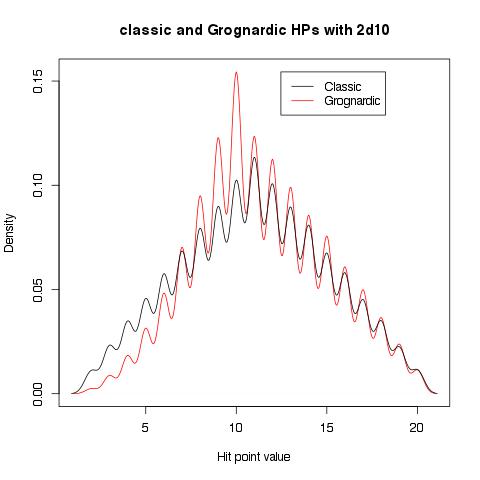
    An example distribution is shown at the top of this page: the black line is the empirical distribution for 12d4 rolled classically, while the red line is for James’s version of 12d4. The minimum observed value in 100,000 simulations for 12d4 is 15; for James’s distribution, it’s 21. That’s the equivalent of nearly 3 hit dice for a wizard. The kind of effect this induces is visible even at low levels: Figure 1 shows how James’s system for 2d10 shifts all the probability weight for the fighter from the lower end of the distribution to the middle, with small increases in the probability of higher values. Note particularly that values of 2 or 3 are much less likely just at 2nd level.

    Figure 2: Empirical Distribution for 2d10 using two systems (100,000 simulations, kernel density smoother with optimal bandwidth selection)

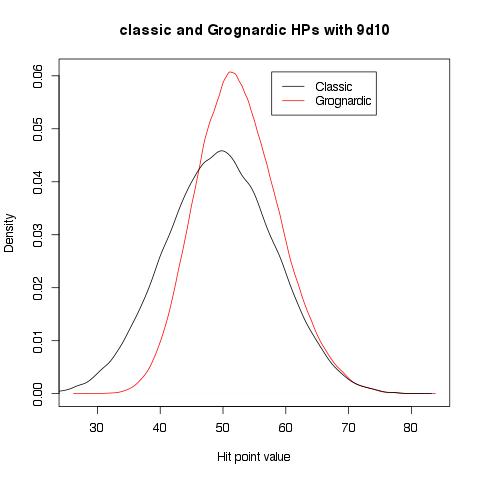
    This power-creep grows with levels. Figure 3 shows how by 9d10 this weight is shifting to the right of the distribution, i.e. increasing the chance of very high values. Of course the effect stops at level 9, but by this time it’s powerful: the minimum value observed in 100,000 rolls is 15 under the classic distribution, and 31 under James’s distribution – the weight is seriously moving towards the right, to the tune of just over 3 hit dice for a fighter[2]. Probabilities of observing values over 60 are significantly higher in James’s distribution, and the most likely values are also shifted to the right compared to the classic distribution.

    Figure 3: HP distributions for 9d10 hit dice

    I think that the distributions shown here are not what James had in mind when he talked about “middling” values – the method he has proposed creates skewed distributions and shifts the entire distribution to the right, rather than narrowing the distribution and placing it in the middle. The best way to create middling values is to use large numbers of d4s: make Wizard hit dice 3d4/3, and fighters 3d4. Fiddling with maxima and exploding dice is not a good way to create a family-friendly distribution. I’m no OSR expert but giving players a chance to reroll all their hit points every level seems fundamentally at odds with the basic principles of old school play, and thus this house-rule is out of step with its intentions. I guess James was thinking that his method gives a high chance of HPs not increasing at any given level (due to the risk of rolling below your previous HPs) but this is only true if you’ve got average or above-average values to start with. Quite the opposite happens if you started with poor hit points. I think it’s one of those examples where the intuition about dice rolls and the effects are quite different.

    On this note, I should point out that although the OSR likes this idea of pushing people into “average” values, the fundamental mechanic of AD&D – the d20 roll – is completely inconsistent with this. It forces high probability into the tails of the distribution, as do the uniform distributions of most damage rolls. It’s also inconsistent with the natural world – almost any experimental system you care to think of has normally distributed experimental error, not uniform distributed. If one is concerned with a “natural” approach to conflict resolution and encouraging middling results, one’s very first act should be to swap d20 for 2d10. It’s surprising that the d20 system has persisted through all the incarnations of D&D given its fundamentally unnatural and abhorrent distribution.

    Finally, I’d be interested to find out if James is still using this hit dice rule, or whether he dropped it ages ago when he realized what it was doing.

    Methods Note: the empirical distributions shown here were generated in R using 100,000 simulations. All charts are kernel density smooths, using R’s default kernel and optimal bandwidth calculation. Histograms are for losers.

    fn1: for statistician-based definitions of “fun”

    fn2: I don’t know exactly what the hit dice rules are for S&W – it could be fighters are also d6, but because all dice have a uniform distribution the effect is consistent – it’s only the exact magnitude of the power creep that changes.

  • I think it’s safe to say that OSR gamers aren’t big fans of 4th Edition D&D, and one of the (many) complaints about it seems to be that healing surges are a terrible idea. We can see this objection floating around in connection with D&D Next, which has retained them and therefore must be a terrible game.

    I think they’re actually very consistent with a Gygaxian approach to hit points and combat. Here is Gygax on hit points (courtesy of Dragonsfoot):

    It is quite unreasonable to assume that as a character gains levels of ability in his or her class that a corresponding gain in actual ability to sustain physical damage takes place. It is preposterous to state such an assumption, for if we are to assume that a man is killed by a sword thrust which does 4 hit points of damage, we must similarly assume that a hero could, on the average, withstand five such thrusts before being slain! Why then the increase in hit points? Because these reflect both the actual physical ability of the character to withstand damage – as indicated by constitution bonuses- and a commensurate increase in such areas as skill in combat and similar life-or-death situations, the “sixth sense” which warns the individual of some otherwise unforeseen events, sheer luck, and the fantastic provisions of magical protections and/or divine protection. Therefore, constitution affects both actual ability to withstand physical punishment hit points (physique) and the immeasurable areas which involve the sixth sense and luck (fitness).

    I read this explanation when I was 15 or 16 and it’s always made perfect sense to me (though I prefer systems where physical frailty is built in, like Rolemaster or Warhammer, rather than this style of abstraction). In fact, this is the only way one can possibly explain away the basic multiplicative mechanics of hps in D&D:

    • A fighter can go from 1 hp at first level (killable from any dagger blow) to 11 at second level (killable with two good sword blows). How is that possible from a small improvement in skill level?
    • This reduction in killability applies to everyone and continues to 9th level, where a fighter can conceivably be hit 8 or 10 times with a longsword and just keep coming
    • Rounds are 1 minute long, and it’s ludicrous to think that each PC gets a single attack only in that round – so the damage they do can’t reflect a single simple physical hit

    But if this is so, then healing surges of the kind used in 4th Edition D&D are perfectly consistent with this old school approach to hit points. After the battle, the PCs stop to take stock and through various means they recover some of their luck, divine blessing and poise – the fighter regains his courage and combat poise, so he’s better able to take advantage of small breaks when the next fight starts. The priest prays to her gods and gains a little favour, as well as a few blessings to take the worst sting off the bruises; the thief takes a piss and a small tupple of gin, and his sixth sense is restored. All of them adjust their codpieces (well, I suppose the priest doesn’t) and tighten shield straps – it’s the little things that count, after all – and put a fresh steak on an old bruise. All of that in total is a healing surge. Similarly, mid-combat, one can take a standard action to regain a bit of poise – stepping back to take a breather, reassess the situation, say a brief prayer, gird one’s loins, or recover one’s footing before reentering the fray.

    The healing surge is entirely consistent with the old school abstraction of HPs. Jeff Rients, one of the OSRs luminaries, had the chance to recognize this the other day but his response was a simple “What I am against is another abstraction sitting on top of the original abstraction.” How does that work? The entire system is an abstraction – how can any objection to abstractions be anything but arbitrary? And in this case the abstraction fits very nicely with the original. In fact, it’s the original abstraction that jars – if you look at the history of the game’s development, there’s always been a tension between the Gygaxian vision of hit points and the way other parts of the rules operationalize it, as well as the way player’s implicitly understand hit points. Healing spells are universally presented as repairing physical damage, and they scale up according to the HPs of the fighter. Cure Serious Wounds is not called Regain Poise or Reassess Tactical Objectives, is it? And maximum damage for melee weapons is clearly constrained to represent seriousness of the physical damage such a weapon might be expected to deliver. If HPs were really an abstraction, a fighter would be able to do equal amounts of damage no matter what weapon he or she used.

    If you look through OSR blogs and documents you’ll very quickly get a sense of a genre in which PC death is meant to be easy and there is no easy recovery from physical damage. Objections to healing surges, fate points and the like tend to be heavily biased towards this view. This is an approach to hit points that I favour, but it’s inconsistent with the practical mechanics of the HP system in D&D, demanding as it does an assumption of super-heroism for fighters and clerics that is inconsistent with the OSR vision of PCs as grotty realists; and it is also inconsistent with the original conception of HPs as stated in the rules. The practical result of properly implementing Gygax’s vision of one minute rounds and abstract HPs is that no one should ever receive more than one action per round, haste spells should confer no additional attacks, and healing surges should be routinely implemented in all early versions of D&D.