• The Olympic athletics are mostly done and dusted, and Usain Bolt, having won 100m and 200m gold, has proclaimed himself “the greatest athlete to live.” This status can’t have been earned through sheer numerical power, since on numbers alone Bolt would be well down the medal list – five gold medals at two Olympics is nothing special and certainly can’t eclipse Carl Lewis’s nine gold over four olympics. It can’t be the act of retaining a title over two successive olympics, since Ian Thorpe did that, and in any case it’s not really comparable with sports like Judo where one can only compete in one weight division at one Olympics. By the measure of defending golds in at least one event for which one is eligible to compete, Saori Yoshida and Kaori Icho are far superior – they have defended gold at three olympics and seven and nine world championships respectively, and Kaori Icho has not lost for 150 or more matches. It can’t be through achieving perfection in one’s sport, since Nadia Comaneci did that in 1976 when she scored a perfect 10 (in fact she won seven 10s in total in that olympics). Ms. Comaneci also went on to win five golds, defend her beam performance at the next olympics, is credited with her own special moves, and is the only person ever to receive the Olympic Order twice). It can’t be for being the youngest person to break a record – again, Nadia Comaneci did that and, according to her wikipedia entry, it’s now impossible to legally break that record. Bolt didn’t break any records until he was 21.

    I guess gymnastics just isn’t that special. That might explain why Japanese TV insisted on showing the 100m final even though no Japanese person was competing – imagine how little time they would have to showcase Japanese athletes if they had to broadcast the final of every event! In fact they don’t, so it must be that the 100m and 200m are really special.

    This confuses me. I don’t understand what’s special about sprinting. It’s obviously impressive and important – like all athletics – but does it compare with any of the other major events in the Olympics? Compare it with synchronized swimming, for example, which is a genuinely impressive sport in which great talent is combined with challenging physical technique as well as artistic merit. Could Usain Bolt sprint in perfect lockstep with the rest of his Jamaican team? Could he do push-ups while holding his breath? Could he hoist one of his other team members into the air for a perfect backflip with a peg on his nose after doing hold-your-breath push-ups for 30 seconds? Come to think of it, could he even complete a 100m race while maintaining a perfectly fixed smile? Synchronized swimming often gets a bum rap, but if you look past the rigid smiles and scary make up, it’s actually a sport that requires amazing talent, focus and attention to detail, and the women who do it obviously have impressive backgrounds in swimming, ballet and gymnastics.

    So what is so special about sprinting? Putting aside for the moment the fact that all of these sports are a complete waste of time and space, is there anything about sprinting that makes it different to weight-lifting, hammer-throwing or the marathon? Do you have to do it from childhood, like gymnastics? Does it require skills from multiple disciplines, like rhythmic gymnastics and synchronized swimming? Is there a risk of death if you do it wrong, as in diving, gymnastics or horse-riding? Does it require a special and intense team spirit to complete even the simplest of moves, like volleyball?

    I think the Daily Mash puts Bolt’s achievement into a little more historical perspective:

    Helen Archer, from Stevenage, added: “Usain Bolt just ‘practices’ running every day and, one assumes, eats a lot of macaroni and stays off the tabs.

    “Perhaps the Pope should commission a new ceiling from him. Let’s see what that does to his ego.

    “Once he’s finished, perhaps he could point at it in his trademark style.”

    I think that puts Bolt’s “legend” status into a little perspective. Imagine if Einstein, receiving his Nobel prize in 1921, had said “I’m the greatest scientist to live.” Even rock stars tend to eschew this kind of stupidity. Freddie Mercury just said “I always knew I was a star,” but he never managed to get to the point of observing the obvious truth, that he was the greatest performer ever to live.

    It’s probably a reasonable truism to live by, that if what you’re about to say outstrips Freddie Mercury, Oscar Wilde and Mohammed Ali in its arrogance, you shouldn’t say it. I’ll give you that tip for nothing, Usain Bolt. In exchange, could you tell me why I should value sprinting more than synchronized swimming?

  • image

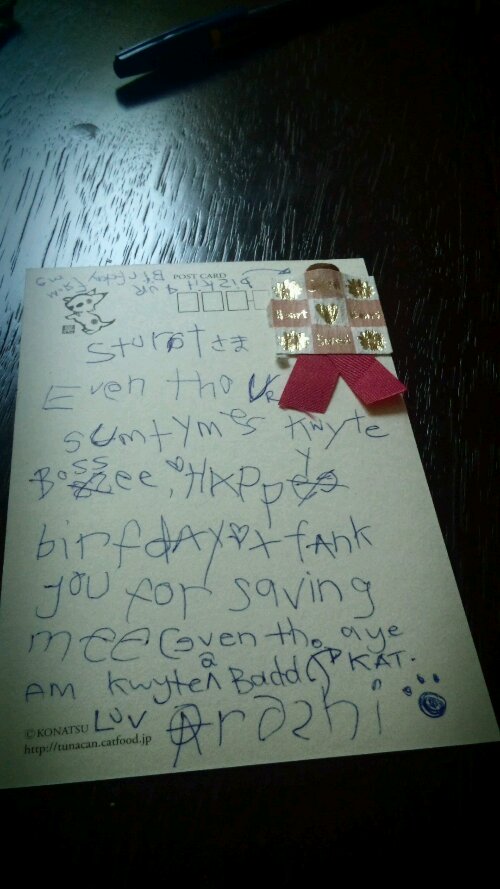
    Do Japanese cats understand cats from Australia?  Is feline a universal language? Do they understand “get off there you bastard” in any language? This birthday card from my cat to me shows he speaks the language of his household , though hiragana are visible if you squint. Perhaps he is bilingual but lacks the manual dexterity for kanji?

    Note also the single cat biscuit under the ribbon. Who says cats  can’t feel love?

  • Twelve days into the Olympics and 75% of Japan’s gold medals are due to women winning combat sports: one judo and two wrestling. One female wrestler, Kaori Icho, has completely dominated her sport for the last 12 years – she is the first Japanese woman to win three gold medals in a row, has won the world championships seven times, and has not lost a bout for more than 150 matches. During last night’s coverage the commentators were saying that they have never seen her lose, and don’t know how she would react.

    Given the popular image of Japan as a sexist place, it’s genuinely surprising to see women’s participation in sport and the acceptance of women in a wide range of activities that in the west are largely reserved for men. The degree to which this process is normalized, accepted or encouraged is most evident in the olympics coverage, because it’s not just that the women are given air time – the coverage of women’s sport has been excellent. When a Japanese woman is competing in a combat sport, they don’t just flick from some irrelevant men’s sport to cover her bout – they give uninterrupted coverage on the main channel for the entire tournament, which meant last night I watched two hours of uninterrupted wrestling, and I’ve seen multiple hours of women’s judo. Furthermore, they bring a female expert from the sport into the studio to do analysis and coverage, and the male commentators show obvious deference to her expertise. The women’s soccer (the biggest contender for gold number five) is covered on the national TV channel by an excellent woman (I haven’t caught her name) from a previous generation’s soccer team, who provides analysis and detailed commentary that would make Australia’s Craig Foster proud. The wrestling has similar coverage, from a previous champion, and the same applies to other sports where women are playing. Essentially, from the top of the channel down to ordinary people in bars and living rooms across the land, women’s participation in sport is shown the same respect as men’s – with, perhaps, the notable exception of the soccer federation, which oversaw a notable blunder in which the women’s team flew economy in the same plane that the men’s team (who are eternal losers) flew first class. This extends to participation in ordinary sports centres too – quite often my own kickboxing class in Tokyo will have as many women as men participating.

    It could be said that this is just an olympics sport phenomenon, reflective of the fact that the women are excelling in combat sports and combat sports are the Japanese public’s favourite activity. But it’s not limited to sport. On the train channels at the moment are a slew of adverts featuring pretty mainstream-looking non-nerdy women playing computer games, and computer gaming is seen as a completely reasonable activity for girls to engage in. It’s really common here to see young women fiddling with portable came consoles and fooling around in gaming arcades, and most gaming companies have developed games aimed at women, or are looking for ways to market their main games to a growing female market.

    Another area in which women’s participation is encouraged and accepted is that most macho of western domains, beer drinking. Advertisements for beer here are completely devoid of macho images of working men, but instead have couples enjoying time together, but beyond that there are a whole slew of adverts aimed purely at women: no men in the scene, no evidence that beer has anything to do with men. I recall reading years ago that John Singleton (a famous advertising mogul in Australia) said that there were three key things that had to be in a beer ad to make it successful: 1) a man, 2) a beer, 3) a man drinking a beer. Not so in Japan, not at all.

    But the most striking example of this equality of participation is in that most male-dominated of hobbies, role-playing. In my 5-10 attendances at conventions in rural Japan I noticed that about a third of the group were women, and I also noticed that women would GM games and would also be deferred to by men (including GMs!) as experts on a particular game – when I played Make You Kingdom the GM deferred regularly to a female player on rules issues. Recently, playing 13th Age in the Akihabara gaming shop Yellow Submarine, there were five or six gaming tables and every one except ours had at least one woman participating – except for one table, which was occupied by five women of about the same age as me playing Double Cross. Those women must have been in the hobby for as long as it’s been going on, which suggests that role-playing has always been popular with women. To the best of my knowledge this level of female participation in role-playing is unheard of in the west – in the UK when I gamed at a pub, there would be maybe 40 men and every couple of weeks one woman would turn up – and she would be stared at like a freak. It’s extremely hard to find women at any organized gaming events in the west, though you can get women interested if you recruit them through friendship circles, etc. But here in Japan it’s normal to see women playing. They’re still a minority, but not a tiny minority, and clearly their participation is seen as normal by the boys.

    When people comment on gender inequality in Japan they tend to overlook many facets and nuances of gender relations here, but it really frustrates me when they overlook this aspect of Japanese life, or when they single out a single event like the first class soccer controversy as evidence of some deep problem – especially when that kind of controversy happened in Australia too, where women would generally consider themselves to have very few equality issues still to resolve. But in sport, in nerd activities, and in beer drinking women’s participation is both encouraged and seen as normal in this country. For role-playing, particularly, this is a fascinating and eye-opening insight into how far western gaming still has to come in encouraging openness and diversity of participation. In both the nerdy and the sporting worlds, maybe Japan has something to teach the west about gender equality?

  • I’ve been burnt twice in the past two weeks by a strange graphics handling problem in Stata and Microsoft Office. In the spirit of presenting workarounds and warnings for obscure software problems that I stumble upon, I think I should report it here.

    The basic problem is simple and very nasty: charts produced in Stata and then exported into Microsoft proprietary formats don’t work properly across platforms and, possibly, across machines. The way in which they fail is insidious, as well, because it looks as if the operator has made an error: axis titles disappear, or parts of the graph are shaved off so that the graph doesn’t match the description one has written in text. Worse still, the person who originally made the chart can’t see the error, and it doesn’t appear in printouts from the afflicted person’s work. This means that you can’t easily convince the person at the other end that you’ve not done something wrong.

    As an example, consider this insidious cock-up from this week. One of my students sent a draft paper to a colleague last week, and he sent it back with the cryptic message “fix the charts.” We didn’t know what he wanted changed, so we changed a few things and sent them back. This week we received an angry reply, demanding that we fix the charts and specifically why did we forget the y-axis labels? The day that we fixed the charts, we were working on printouts, because we were rushing, and the y-axes were in the printouts – I had a distinct memory of correcting some text in the y-axes. So I asked my student to mail me the last version he’d sent to the colleague, thinking he’d stuffed up, and indeed I couldn’t see the y-axes in the charts. I asked him why he’d removed them after I painstakingly corrected them, and he told me he hadn’t, and he could see them – but by now he was overseas and I couldn’t check in person. So I forwarded the document to my partner, who works on a PC, and she could see them. What was going on? My colleague and I, on macs, couldn’t see the y axes, but my student and my partner, on PCs, could. Weird.

    I asked my student how he had put the graphs in word, and he told me he had copied the figures directly from Stata and pasted them into word, essentially following instructions that can be found all over the web (for example here) and also, I think, in the Stata help. I did some digging and discovered that when you do this, the file is converted automatically by Office into a new format – possibly .wmf? – and this can’t handle all of Stata’s graphics rendering; this leads to approximations in the encoding of some aspects of the graph. Mac graphics are handled in a different format – possibly .eps? – and the badly rendered parts of .wmf files are simply ignored when it opens them. One of the main things that the .wmf rendering stuffs up is rotated text – such as one finds in y-axis titles. When I realized this, I asked my student to redo the files by saving as .png, and everything was fine. The .png files looked hideous though so we redid them in .tiff format, but we could at least see the details of the axis labels now.

    I’m not sure, however that it’s just a platform issue. A few weeks ago I had a strange graphing problem with a journal, who mailed me to say that my text and the histograms I had provided didn’t match – specifically, parts of the range of values I had referred to in the text weren’t appearing in the histogram. I couldn’t understand this, because I could see the histograms clearly. I thought perhaps they were just being a bit weird, so I sent them hi-res images with an explanation, and they were fine. The original file had charts in it as .png files – I had included them as .png because they are low-res files, easy to produce, and a lot of journals like to receive low-res files until the production stage. But the hi-res files I sent were in .tif format. In light of what happened this week, I think that the same problem my student had also arose with the .png files in that article. I don’t know what platform the journal production staff were using, but I made the .png files on a mac. So it’s possible that the problem also arises in reverse using .png files, or it’s possible that it occurs across machines as well as platforms.

    The problem with this issue is that it is insidious, and when one works across email it’s impossible to work out what is happening. It also leads to questions about professionalism – leaving out y-axis labels is pretty shoddy undergraduate stuff – and those questions are exactly the kinds of issues that people try to blame on technical problems. It also creates conflict, because if you are repeatedly sending graphs that don’t work to a colleague (or a journal!) they start to get pissed. As do you, because you start to think they’re behaving like dickheads. The worst possibility is that, if everyone in your institution is working on word, and the peer reviewers are, but the production staff at the journal are working on macs, they may produce a final published version of your article that has no axis titles. Anyone reading that will think you are incompetent, when in fact it was purely a technical problem.

    The simple solution to this is:

    • never copy and paste from graphics to word (this also reduces the risk of loss of resolution)
    • don’t use .png or .wmf exports
    • only work with .tif or .eps files
    • if you get into a weird situation where you’re sure that you supplied the right file, don’t assume the other person is doing something wrong – check what platform they’re using and try sending a file in a different format

    Preparing charts for journals can be a real hassle, and journals can be both simultaneously picky about their figures and singularly unhelpful in advising non-experts on how to prepare them. This kind of cross-platform (and cross-format) silliness is really unhelpful in the production process, and it’s extremely difficult to find definitive information about it on the web. These problems don’t just arise from copy-paste laziness either, and understanding the details requires delving into the world of graphics rendering – a world that many people who work with stats and scientific data don’t know much about (nor should we have to).  Stata and Microsoft and Apple all seem to be fairly silent on the issue, too. So be aware of it, and be ready to defend your work on technical grounds when colleagues or journals seem to be talking about a graph or figure that you’re sure has no resemblance to the one you sent them.

    And if you’re reading this, Bill Gates – hurry up and move to a non-proprietary graphics handling format!

  • UPDATE 2 (31/7/2024): This post is getting hits again, which means the Olympics are on and people are again asking themselves “WTF?” about this sport. I just watched a few bouts and three bouts in a row were decided by the referee (two bouts by direct disqualification, one by the number of warnings). Boring! I also discovered that in 2023 Judo introduced (or updated?) a “head dive” rule in which you get disqualified for a throw in which you land on your own head. That’s right, you can get disqualified because when you pulled your move, you landed on your head – disqualified for doing something dangerous to yourself! I guess there is good reason for this but … wtf. I think I’ll wait for the wrestling …

    UPDATE (12/8/2016): The last few days this post has received a lot of new hits, the first time it’s been noticed in 4 years, and this is obviously because the judo is on at the Rio Olympics. I’d just like to say that this year there seems to be a lot less of the faffing I discuss below – a lot more victories on real points, lots of ippon, and few refereeing decisions. Also Japan has won a gold and lots of bronze, which is nice. So I guess sometime in the past 4 years the Judo authorities must have had a good long think about how to make their sport more interesting. I wonder if UFC forced them to reconsider …? Anyway, if you’re reading this post now, please bear in mind that some of these complaints don’t apply as much to the judo you’re watching – whatever reason you came here after watching judo at the 2016 olympics, it was worse in 2012!!

    On Thursday the Yahoo Japan news service began a countdown to the first Olympics ever in which no male competitor won Judo gold. Watching the olympics from Japan means I have been exposed to a feast of judo competition, and it has been very exciting. It has also, however, been extremely frustrating and at times boring, because there seem to be a few serious problems with the way judo bouts are conducted. The frustrations boil down to basically two main complaints: almost everyone wins on penalties rather than technique; and judge’s decisions are extremely opaque. There’s something vaguely wrong with winning gold medal because of accumulated penalties, rather than anything you actually did, and it’s also frustrating to watch someone hurled to the ground by a moderately well-applied throw, only to have it come to nothing. This is especially frustrating because one well-applied throw (ippon) wins the match no matter how many not-quite-so-good throws the opponent has applied, even if the effective results of the throws are in both cases essentially the same. In essence, the points awarded to a move are based not on how much it damages the opponent but on how well it was applied.

    Having a history in kickboxing, this seems like a very strange idea to me. You don’t win knockouts in kickboxing by kicking someone more beautifully than they kicked you. A knockout should be objectively determined by the opponent’s inability to continue fighting, not by a dubious judgment about whether the technique was better applied than the previous move. Also, one should be able to lose a fight through accumulation of minor infringements, especially since the minor infringements incurred during the Olympic bouts largely seemed to be “stalling.” It doesn’t just make the fights sometimes boring to watch, it makes the end of the fight frustrating, I don’t think it encourages players not to stall, it doesn’t reward the best players, it puts too much weight on split-second decisions by judges, and I think it reduces the amount of technique put on display. I think judo could be made more interesting and pleasurable to watch (and maybe better to participate in too), though enacting a few changes to make it flow a bit more like boxing…

    1. Move to multiple rounds: A single five minute round, with a subsequent three minute “golden score” round, simply encourages stalling and thus the accumulation of penalties. Wrestling for five minutes is enormously physically demanding, and attempting even one serious throw (or getting out of one serious attempt at a hold) can take it out of even the fittest of people. A 30 second break between two three minute bouts would discourage stalling, since it would enable the fighters to take a break after herculean efforts, but it would also give them an opportunity to consult with their coach, regroup mentally, and consider weak points in their fighting. This would make moves in the second round much more effective. Given most bouts go to a three minute golden round at present, all bouts could simply be set up as three, three-minute rounds with no golden score, and the audience would get to enjoy not just fresh fighters in the second and third rounds, but changes of tactic as the fighters consult during breaks
    2. Knockouts should be objective: It should not be possible to score a knockout win if the opponent is not actually knocked out. Holding someone down for 25 seconds, doing a particularly beautiful throw, all good things but completely irrelevant to victory. A knockout should be either a submission hold forcing the opponent to tap out, or a choke that knocks them unconscious. Anything else should just be points in the bag, and there should be no points for holding someone down for 25 seconds – what’s the purpose of that? Players should only be holding each other down on the ground for the purpose of getting a submission hold – if they can’t get one on after a judicious period of time the referee should break them up and restart the fight. That will stop this kind of silliness.
    3. Move to a boxing-style points system: Rather than having categories of points that don’t interact (ippon, waza-ari, yuko), throws and failed submission holds should be scored on arithmetically accumulating points (1 for a partial effort, 2 for a beautiful effort), and any bout that doesn’t end in a knockout should be judged on the sum of these points, like boxing. This shift, more than anything else involving penalties, will put an end to stalling, because if players know that two imperfectly-executed throws will count as much as one beautiful throw, they will try harder to use techniques instead of fiddling with one another’s collars for three minutes while they try to put on that perfect match-winning throw. It’s a simple fact of fighting that every attempted attack sets you up for a counter, and if you know that by putting yourself out there you make it easier for your opponent to win the match with just one throw, you won’t act until you’re certain. The result of all this faffing around is the accrual of penalties, and fights won on penalties. A point-style system won’t stop this kind of silliness, but it will at least encourage application of judo techniques during the actual bout.
    4. Penalties should not win fights: except in extreme cases, obviously, but penalties should only make the difference in a close fight (except perhaps safety penalties). I personally think penalties for stalling should not exist (except in the most egregious of cases), because fighting can be a thinking woman’s sport, and people shouldn’t be penalized for having a counter-attacking style or for taking their time against an opponent with longer reach or different techniques. No one wants to watch a fight with no moves being made, but no one wants to watch a fight where the competitors are going through the motions to avoid a penalty even though they’re both dead on their feet.
    5. Take the judging away from the referee: The referee can’t see all angles of the battle, but it’s the referee who currently decides whether a move is ippon or waza-ari or yuko. Sure, the ringside judges can interfere but to a large extent judging is currently done by the referee. I think this will just lead to bad decisions. A panel of three judges, watching from different angles, should decide all points-related issues, and the referee should adjudicate on the fighting stuff – whether to break up foes who have gone to ground, whether a move was unsafe, etc.
    6. Ditch the prissiness and bullying: Several times I watched a fight actually being interrupted so that the referee could tell a contestant to do up their belt. This seems amazingly prissy to me, and it’s a mark of a sport that is obsessed with its traditions. These athletes are at the top of their field in the world, they train really hard and work with extreme discipline to get into this event, where they get in trouble for even a few seconds of time wasting no matter how exhausted they are – but the referee can stop the fight to worry about their belts. I think that’s plainly quite insulting and it strikes me as a hallmark of the kind of bullying that is endemic in the “traditional” martial arts. I also notice that the ringside judges point at each other when they are discussing a disagreement, and some team coaches clearly have a very bad attitude towards discipline – I watched one telling scene where a French woman won her bout, and upon reaching the edge of the mat received a blistering earful of abuse from her coach. That’s not how you inspire athletes and its not how you make a sport into a spectacle. So ditch the fussing about uniforms and tradition, and treat it for what it is – a sport that should be conducted in a way that makes it fun for participants and viewers alike. Speaking of which …
    7. Mouthguards and groinguards should be mandatory: I watched a German woman in a state of panic after copping a hand to the face, because she wasn’t wearing a mouthguard. I can’t believe that she was allowed within reach of the olympic stadium without a full set of protective equipment, and the idea that she could be competing in a sport at this level with no protective gear is astounding. I can’t find the rules online but it appears that at least some federations have banned mouthguards, which is hard to comprehend. I’m pretty confident that this is unnecessary, and martial arts newsgroups certainly have reports of wrestlers who wear them in sparring (as do many judoka, I think). So why not in competition? This is another classic symptom of bullying in sport and it should be stamped out immediately.

    So in essence, move to boxing-style judging systems, make knockouts objective rather than subjective, remove the judging role from the referee, and ensure that the fighters get regular breaks and an opportunity to consult with their coaches. And don’t insult them by fussing about their belts – it’s childish and patronizing. Maybe with those changes judo can become as fun and engaging as the other great combat sports – boxing, kickboxing and mixed martial arts.

    And, speaking of which – today is the first day of women’s boxing in the Olympics, which is nice. But why aren’t kickboxing and MMA in there? If kickboxing became an Olympic sport, Thailand would be in the top 10 countries every time!

  • Apparently Ian Livingstone has written a new Fighting Fantasy! adventure, entitled Blood of the Zombies. How appropriate! I discovered this fact through an article in the Guardian, which includes a suggestion that it will be mostly snapped up by 38 year old nerds reliving their childhood. Well, wrong, Grauniad! I turn 39 in a week!

    The article also contains a link to the entertaining site You Chose Wrong, which gives examples of entertaining death scenes from a wide range of choose your own adventures. I never realized they were so popular – GI Joe ones and fairy adventure ones and all manner of comic-based ones! There’s even a web-based Greek Default choose your own adventure, which is quite entertaining to play. They all have in common a wide range of grisly endings (though at least there’s a chance you can win Fighting Fantasy!, not so likely for the Greek Default adventure…)

    Since it’s my birthday next week I might buy this for myself. And I think Noisms at Monsters and Manuals should run us through it

  • I’ve been enjoying the Olympics from the vantage point of my air-conditioned couch, and because I’m in Japan I’m getting to see only the sports that interest Japanese viewers, so at the moment it’s wall-to-wall Judo and swimming. Of course, having something of a soft spot for China I’m quite happy to see them coming up in the world of olympic sports, and this year’s sensation is Ye Shiwen, the 16 year old swimmer whose performance has sparked controversy. An American high up in swimming circles claims she must be a drug cheat, because not only did she beat a man in one leg of her medley (and not just any man – an American man), her times have improved rapidly in just a year or two, and her freestyle leg was just so much faster than her other legs.

    Of course this has pissed off the Chinese delegation and Chinese media no end, though to her credit Ye Shiwen has responded in a level-headed manner both in and out of the pool. But she might be surprised to hear that she has found some strong defenders in the Australian press. The Sydney Morning Herald has an article disputing all the main claims of the American coach, and suggesting that both Australian and American achievers could be accused of drug cheating if judged on their performance alone. About Ms. Ye swimming faster than an American man (Lochte) in her freestyle leg, he points out that she didn’t actually beat his medley speed overall, and in any case four other men in Lochte’s race did beat Ye’s time in the same leg – they were all swimming their hearts out to catch up with Lochte, which is what Ye had to do in her freestyle leg to catch the leader.

    John Leonard’s other big complaint is that Ye shaved five seconds off her previous best at this Olympics. The Herald’s article tears this complaint apart:

    It wasn’t an insinuation Rice had to deal with when she clocked her world record in 2008, which was at the time an absurdly fast result.

    Earlier that year, Rice shaved a startling six seconds off her personal best time to hit 4.31.46 at the Australian trials. American Katie Hoff reclaimed the mark a few months late before Rice countered at the Beijing Games, reducing it to below 4.30 for the first time. In contrast, people seized on the fact Ye reduced her PB by five seconds to claim the new mark of 4.28.43 as genuine grounds for suspicion.

    The article also points out that Leonard’s comparison of Ye’s times now with two years ago are unfair because of Ye’s age:

    To the wider sporting world, Ye is only now becoming a notable name. Yet to swimming diehards, she has been one of the rising stars for some years, even if her surge of form in London has caught most people by surprise. Beisel and Rice had been the favourites for gold.

    Ye won the 200m IM at the Asian Games in 2010 (2.09.37) and the 400m IM (4.33.79), all at age 14. At the time, she was listed at 160cm tall. Now, the official Olympic site lists her 12 cm loftier at 172cm. That sort of difference in height, length of stroke and size of hand leads to warp-speed improvement.

    To me these paragraphs also contain an insinuation of bad faith against Leonards: he clearly, as a swimming insider, knows that Ye’s times have grown with her age and body size, and should be aware of her history. So why is he making the complaints so openly now? Would he be happy to have them made against Michael Phelps or Stephanie Rice when they started their careers? Is it fair on Ye that her improvement should be immediately slated home to drugs? The accusations have already hit home, with the doping committee making an unprecedented release of her pre-olympic drug testing results to calm the waters, but it’s probably the case that the claims won’t die down.
    I think that she’s probably not a drug cheat (or if she is, she’s doing the same undetectable cheating as everyone else) and Leonards and others who insinuate that she is are well aware that her performance is natural. But these people are watching their nation’s long-standing dominance of this sport sliding out of their grip as China’s performance improves. There are also insinuations of “military-style training camps” (always a marker of repression when they do it, but of efficiency when we do it), tightly-controlled sporting worlds, etc. But in fact the Chinese swimming world is quite open and employs foreign coaches, one of whom wrote an illuminating opinion piece for the Guardian, indicating exactly why China is improving its performances so fast: hard work. This coach writes:

    Chinese athletes train incredibly hard, harder than I can explain in words and as a coach who has placed swimmers on five different Olympic Games teams, I have never seen athletes train like this anywhere in the world.

    They have an unrelenting appetite for hard work, can (and will) endure more pain for longer than their western counterparts, will guarantee to turn up for practice every single time and give their all. They are very proud of their country, they are proud to represent China and have a very team focused mentality.

    He adds that there is no special talent selection program, but that he just selects those players he sees and thinks are good. But he gives an interesting insight into the supposedly centrally-managed, state mandated programs that are always painted in such a negative light when they compete with Western athletics – in fact, like so much of Chinese “communism” they’re probably more free market than those in the West:

    Let’s also not forget that this is their only avenue for income; most do not study and sport offers them a way out or a way up from where they and their families currently live in society. If their swimming fails, they fail and the family loses face … my athletes are salaried and receive bonuses for performance; I am salaried and receive bonuses for performance. We all want performance, not mediocrity, not sport for all, but gold medals – and they are not afraid to say this.

    He also observes that China gives him all the funding he needs, and enormous freedom to manage his coaching programs:

    If I want a foreign training camp, money is available; if I want high-altitude training – money is available; if I want an assistant coach – money is available; if I want some new gadgets or training equipment, guess what? Money is available.

    I think this is the real threat that people like Leonards are worried about. As China becomes wealthy, it is pouring money into playing catch up not just industrially and economically, but in the cultural and scientific pursuits that have traditionally marked out the west as “advanced,” on the assumption that fast development in these areas will lead to results that will challenge western cultural hegemony. They don’t want to be pinned down to traditionally “Asian” sports that often have lower value (ping-pong, badminton, the traditional martial arts) but want to compete in areas that, by being traditionally western strongholds, often have higher cultural value attached to them: swimming, basketball, soccer and gymnastics. And by dint of their combination of rapid economic growth, rampant nationalism, and highly successful mix of central planning and free market ideas, they’re going to catch up fast. The doyens of a previous era of cultural and sporting superiority don’t want to accept it, just as a previous generation of industrialists couldn’t accept Japanese superiority in industry, and a previous generation of military planners couldn’t believe Japanese naval and air superiority.

    As China continues to improve its sporting prowess, I think we’ll see more of the same, allied at times with accusations of cheating and corruption. But I think, given the sour grapes China’s growth is producing in many areas in the west, we should approach many claims about their sports programs and sportspeople with a great deal of cynicism and caution.

  • As I understand it most Australian media organizations have an agreement with the various health departments not to report teen suicide, on the principle that copycat suicide is a real risk among teenagers and the benefits that accrue from reporting on any child’s suicide don’t outweigh the risk that it might trigger another. Furthermore, whenever the media report on a suicide – whether by a normal person or a star – they have a self-enforced code of conduct which requires them to put the contact details for a suicide counselling service at the bottom of the report (in both print and online). I’m not sure if this consideration extends to television or not. This is based on the same principle that people reading the report who are themselves at risk of suicide may benefit from the information, or may be at risk of commencing their own suicide plan if they read about someone else’s. I think the study of suicide is quite advanced and these principles are based in well-established understanding of how suicidal people move from ideation to action, and in societies like Australia that have very high suicide rates it’s a very useful kind of intervention. As far as I know Japan, which has an even higher rate than Australia, doesn’t have any such code of conduct for its media.

    Recent mass killings in Norway and the USA have attracted their usual round of sensationalist media coverage, and as these events become bigger, more ferocious and more meticulously planned I find myself wondering whether the media have a role to play in preventing their frequency and ferocity. The Aurora killer clearly had copycat elements of both Columbine and Utroya and there’s a disturbing trend towards these mass killers trying to increase their numbers, even using techniques that they won’t personally witness or that will occur after their death, in the case of the Aurora shooter’s apartment. This article from the Australian ABC includes an interesting interview with a forensic psychiatrist who claims a direct link between the style of reportage and subsequent events, and the strong claim that these mass killings are temporally linked – that the grotesque footage from one will be likely to inspire others within a short time. The psychiatrist interviewed there suggests that instead of sensationalist rolling 24 hour coverage of the murder and all its gory details, the media should be presenting a highly localized, very boring and dry style of reporting that restricts its national value and strips it of sensational elements. This, it is implied, will reduce the risk of copycat killings.

    The Aurora case is particularly interesting because their is evidence not just that the killer planned for a long period of time, but that he was seeking help before he did it, and that he showed signs of regret and repentance after, which though sadly too late for the victims do suggest that there was something going on in the mind of the killer that could have been reached out to beforehand. Not only did he leave the building when he was still in a position to kill people, but he waited for the police to come, he warned them about his apartment rather than just letting them go there and die, and he showed signs of confusion and illness at the court appearance. Apparently also he wrote details of his plans and sent them to a psychiatrist, who sadly didn’t receive them (though maybe that’s no longer true). Could it be that this person was actually in a position to be helped before the killings? Could it be that the movement from fantasizing about mass murder to enacting follows similar stages and is as (weakly) preventable as suicide? If so, then surely the media have a part to play in working to prevent these killings? Here, then, are three suggestions for changes the media could enact in order to play a more constructive role in the prevention of mass murder.

    1. A complete ban on reporting mass killings: beyond a simple one line statement, in television and press. For example, when someone goes on a shooting spree, instead of filling the news for three days with every detail, the media simply report it like the weather: “today a mass shooting occurred in [location], involving one perpetrator and more than [say, 5] deaths. Police are investigating and local media are reporting the details in the affected area.” No photos, no footage, no follow-up and no details. Maybe online newspapers from the affected area should agree not to report it (presenting it in print only) so that there is no way the details can be made available at a national level without going to huge lengths.
    2. A strict code of limited reporting: So that the press agree to, for example, no more than a specified amount of coverage per hour, or only cover the event briefly in their main news reports, and don’t give certain specifics. Especially, the exact number of dead and wounded, weapons and tactics used, and the identity and history of the killer should all be suppressed. This means that anyone contemplating such a mass killing needs to come to terms with the fact that their name will never be made famous.
    3. Completely wipe the killer from history: in addition to not reporting their name, the government proceeds to wipe their identify from the records, so that no future planner of a mass murder can find any information about the past achievements or life history of the perpetrators of previous crimes. Delete the killer’s records from school yearbooks, local sports records, etc. so that any noteworthy achievements they have ever made are deleted from the record. In this case the “talented scientist” who did the Aurora killings would have their name removed from any publications they have done, perhaps replaced with “convicted mass murder” or something [I don’t believe this Aurora killer was actually a scientist but if he were…] When you wipe 12 people from this world, you should not achieve infamy – you should be forgotten by all but your family and those whose love you betrayed with your acts. By doing this the government guarantees that the murderer becomes no one of note, and that anyone else who is falling into this strange worldview will not be able to find any common ground with those who came before them. All they have is a name and a face, and unless they go to the killer’s town and look their details up directly, they will learn nothing about their forebears. With no identity, how can this person be a role model for future killers?
    4. Provision of counseling advice: when reporting on the shooting, the media could agree to a code of practice for guiding future murderers to counseling. Perhaps a contact number for a specialist phone line, with a phrase like “If you are feeling alienated and lost, or constantly fantasizing about killing other people, please call this line.” Perhaps for the Aurora killer that would have been enough for someone to at least try and help them. I once had a friend commit suicide, and she was plagued for months beforehand with constant thoughts of doing it. The help she sought wasn’t enough for her, but in some cases it is. Perhaps if the same approach were applied to potential mass murderers some of them would break out of their reverie and find a better way to move their lives forward.

    I am in favour of option 1, on a trial basis of, say, five years, across the entire USA, Europe and Australasia. I think it would be hard to prove that it made a difference because the killings are rare events and the stochastic properties of sequences of mass killings would be hard to study, but I think it’s worth a try. There’s no strong public interest in knowing the horrible details of a stranger’s death in another town, but there’s a lot of value in potentially being able to reduce the frequency and severity of these tragic events. It doesn’t have to be mandated by law – it simply requires all the media to agree to a voluntary code of conduct. Of course it would require that they give up the financial benefits that flow from the extreme attention that the media get during such events, but I think that’s a small price to pay for the possibility of reducing rates of these hideous crimes. But at the very least it should cost them nearly nothing to put a message about seeking help on the screen. It would be nice to see the media give at least that much back in return for being free to present their lurid and sensationalist crap, but I’m probably asking too much of both our media and political overlords. Unless America can come up with the even more radical idea of restricting access to military-grade weapons, I can’t think of anything else that would work…

  • I had my third near-total party kill (TPK) in yesterday’s Warhammer 3rd Edition session. This one was so savage that I had to drop a hidden thief from the monster roster, because it was clear that I’d overpowered the opposition. This is an adventure I’d previously run using Pathfinder, and the difference in deadliness of the setup was obvious, though I don’t think it was a difference due to the system per se. This change in lethality also affected the flow of the adventure and forced very different decisions on the players. Since this is the first time I have ever run exactly the same adventure twice, it was interesting to see how the adventure changed the second time.

    The basic setting of the adventure was a fairy stolen from an onsen (hot spring) that the PCs had been sent to chase. They were following the gnomes who stole it down a steamy volcanic valley, but what they didn’t know was that the onsen fairy – which gives the onsen its healing powers – had been sold off months before by the owner, and the pot that the fairy was imprisoned in, that the gnomes had stolen, was empty. The adventure resolves when they find this out and go back to confront the onsen owner, but to find it out they have to somehow deal with the gang of gnomes who stole it. In this world, gnomes are criminal thugs, a kind of race of East London grafters, with little honour or regard for each other and no respect for non-gnomes.

    The near-TPK occurred when the group of three PCs were approaching a jumble of rocks in the middle of the valley, just on the far side of a muddy stream of hot water and shrouded in steam. Behind the rocks were three gnome minions with steam rifles, a half-orc sorcerer and a gnome fighter. Because the party scout had failed his observation check the gnomes got a free surprise attack with their steam rifles, and firing as a group with the Rapid Fire action card they managed to seriously mangle the group in the first round – they hit the insane dwarf troll slayer and nearly killed the elven scout, and only narrowly missed the wizard all in their first action. The party were already carrying critical wounds from the previous session (an encounter with some steam mephits) and the results were devastating. The dwarf charged into battle but he spent the ensuing couple of rounds incapable of hitting anything due to the gradually accumulating effects of his wounds; the wizard spent half of the following rounds casting healing spells; and the scout took a mortal wound the following round. I decided to give the wizard one chance to pull off a heal spell to prevent death on this scout, which he managed (though he couldn’t bring the scout back to consciousness) and it was at this point that the fourth gnome thief should, in the original plan, have backstabbed the wizard. This would surely have killed the entire party, because by this point the dwarf was really labouring and his enemy still undamaged. So I let the gnome thief idea slide, and even then their main foe managed to run away – the dwarf was literally too exhausted to run after him, and just let him go[1]. At the end of the battle the tally was: dwarf and wizard on half hit points, dwarf carrying three critical wounds, wizard and scout carrying two critical wounds (one away from death!) and the scout on 1 hit point. This from a battle with a single fighter, a single wizard and three minions. I guess I overpowered the fighter slightly. Also in this session I was using a house rule I conceived of after the previous adventure: the wizard can only attempt to heal any one set of wounds on one person once, and so needs to wait for a PC to become injured again before attempting another healing spell. This is because the rechargeable spells could be used infinitely often outside of combat were this rule not to apply, and adventuring would become trivial.

    From this ambush the PCs’ goal was to head down the valley to its mouth, where they would attack the gnome camp and recover the onsen fairy. But with such a heavy accumulation of wounds and no idea whether they were going to be ambushed again, they changed tactics. They retreated and set an ambush of their own, on the assumption that gnome soldiers would come up the valley to finish them off. So instead of stumbling on the camp and overhearing the gnome crime boss complaining about the missing onsen fairy, they waited and were rewarded in the morning with hearing him walking up the valley, ranting to his underlings about what he was going to do when he found the fairy. At this point the players didn’t know the onsen fairy was missing – had the gnomes already got possession of the fairy the adventure would have been over at this point, since they would have left without coming back to kill off the PCs. Gnomes don’t bother with vengeance when they can settle for money! So actually, had the adventure been a straight “rescue the stolen goods” operation they’d have failed at this point, and would have either lost the fairy or would have had to track the crime boss for days, suffering a regular series of ambushes on the way (and the initial risk of losing him altogether). They basically only completed the adventure because of the twist of the missing fairy.

    In this case the players almost “lost” the adventure without actually dying, because they basically had to give up on their original plan. I think this is yet another example of how even when the party has healing magic available to it, WFRP3 has the same atmosphere of extreme danger and weakness that imbued WFRP2, but without the associated constant frustration of not being able to do anything successfully. In WFRP2, adventuring was dangerous because the PCs were useless at it. In WFRP3 it is very dangerous even though the PCs are good at it, with a range of magical abilities and skills they can use. For me this is the perfect combination: adventurers who feel like adventurers rather than cowherders with a gun, but who are under the constant very real threat of death. I think in their next adventure the players are going to be very, very careful …

    fn1: This arose because the dwarf had a critical wound that prevented him using a free manoeuvre, and another critical wound that meant every melee action cost him a fatigue. Getting into battle and then hitting people and changing stance thus accrued fatigue rapidly, and had he chased the gnome he would have been so fatigued by the time combat resumed that he wouldn’t be able to move. He literally just lowered his axe and slid down it into the mud once the gnome started running! I really like the fatigue rules in WFRP3, they put a huge extra dimension of risk-taking into combat.

  • As part of my continuing exploration of the statistics underlying Pathfinder, I’ve been comparing mortality for different types of fighters under different types of character generation systems. The basic Pathfinder rules recommend a point-buy system, but also allow for 4d6 choose the best three. I’ve generated PCs under all four point buy systems, 4d6 choose the best three rolled in order, 3d6 rolled in order, and the purposive semi-random system I developed for previous posts on this topic. Between them these cover the gamut of possible ability score generation methods.

    For the point buy systems, I spent the points under the following rules:

    • Spend as many points as possible on the most important ability score for the fighter type (strength for strong fighters, constitution for tough fighters, etc)
    • Spend as many of the remaining points on a secondary score: strength for non-strong fighters, and constitution for strong fighters
    • If any points remain, spend them on the last remaining physical ability score
    • If balancing between point allocation is necessary, wherever possible choose ability scores so that they are the minimum value required to achieve a given bonus (so 16 for a +3, not 17)

    This guarantees maximization of bonuses and roughly orders scores in the strength/constitution/dexterity priority list.

    I ran 1,000,000 simulations pitting a fighter against an orc, with all the orc ability scores randomly determined. Half of all orcs were ferocious (randomly determined). The fighter’s race, class type, and ability score generation method were randomly determined, to ensure a wide spread of ability scores across all types of fighters. Results were calculated as mortality rates – this is really just an addendum to previous research so more detailed analysis was not conducted.

    Results

    The results are shown in Table 1, as mortality rates for the different ability generation systems for both Meek and Ferocious orcs. Mortality rates are given as percentages of all fighters who participated in the battle.

    Stat Generation Method

    Orc Type

    Meek Ferocious
    Rolled in order
      3d6 51 76
      4d6 best 3 36 62
    Purposive Random 35 61
    Point buy
      Low Fantasy 34 61
      Standard Fantasy 19 44
      High Fantasy 21 46
      Epic Fantasy 12 32

    In a somewhat surprising result, 4d6 choose-the-best-3 has a similar mortality rate to the point-buy system labelled as “low fantasy” by Paizo. Mortality rates for fighters pitted against ferocious orcs only reach the 30% mark that one might expect of a CR1/3 monster in the Epic Fantasy scenario.

    Conclusion

    Rolling 3d6 in order significantly reduces survival rates compared even to a low fantasy point-buy system. Survival of these fighters against ferocious orcs does not differ between standard and epic fantasy builds, suggesting that these categories are essentially irrelevant. New boys fresh out of the village on their first adventure should only consider taking on an orc if they are confident that their genre setting is Epic. Otherwise, they should expect a bloody and gruesome end.