This week sees the simultaneous release of pictures of the Duchess of Cambridge’s breasts, and the release of a Counterpunch article on how a feminist Assistant Professor should be allowed to breastfeed in class. I think everyone is roughly aware of how the debate is proceeding vis a vis the Duchess’s breasts – they’re a private and sensitive part of her body and should not be revealed in public. A nice debate on the Assistant Professor’s breastfeeding can be found at Crooked Timber, and in my opinion shows the lengths people will go to defend people in their in-group, and I commented there a few times to make note of the nature of the Prof’s bullying of a younger woman, and how strange it is for a self-described “militant feminist” to be using the full powers of authority against a young woman.
There’s an interesting and entertaining element to the feminist response to these two topics, though, which I would like to explore here. The palace’s (and, presumably, Kate’s) uproar over the publication of the pictures is only partly based on the fact that she didn’t give permission for a photo to be taken (this happens to royals all the time); it’s specifically about her breasts. I presume there is a feminist response to this based in women’s control of their own bodies, which would observe that breasts are sexual and private parts of the body and to publish pictures of them without permission damages a woman’s agency; but at the same time quite a few commentators on the Crooked Timber thread are arguing that breasts should not be seen as anything special and no one should distinguish between breast-feeding and bottle-feeding in public. Quite a few of the commenters there, presumably feminists, criticize the student journalist and others for suggesting that there might be anything inappropriate about whipping a breast out in a lecture, and suggest that the students who might have been discomfited need to grow up.
But here’s the thing: if Kate Middleton is made uncomfortable by the thought that her breasts can be viewed publicly by strangers, presumably it is also reasonable for her to be discomfited by the sight of a stranger’s breast in public? She might not, but given she sees her own breasts as a private and sexual area of her body she must have some generally applicable boundaries as to when and how they can be displayed, and presumably at least on a personal level these boundaries would be generalizable to the behavior of others. So how do we reconcile her (and many other women’s) feeling that their breasts are special, with a feminist position on breast-feeding that says they aren’t?
I don’t think we can. Because breasts aren’t just bottles, and everyone – male and female – has feelings about them that are not the same as feelings about bottles. This is why feminists will be outraged by the publication of pictures of Kate’s breasts in a way they would not be by pictures of her elbows. So, if you’re going to argue for the right to breast-feed in public places, I don’t think an argument on the basis that “we all need to get over how special breasts are” is going to work unless we are willing to logically extend that to “there’s nothing wrong with publishing unauthorized pictures of the breasts of public figures.” Julia Gillard, Margaret Thatcher, Kate Middleton, Paris Hilton: it’s all the same, we can publish their breasts with the same ease with which we publish their elbows and knees.
Of course, you can paper over the issue by objecting to the publication of any unauthorized photos of public figures, but that horse has bolted. The issue now is strictly over what is acceptable. Upskirts? No, those parts are sexual. Breasts? No, those parts are private. Breast-feeding by a professor in class? Yes, because there’s nothing special about breasts. Doesn’t work does it? Similarly sneering at someone for being made uncomfortable by a strange woman’s breasts in a breast-feeding role in class, but lauding them for being made uncomfortable by a strange woman’s breasts on a newspaper … doesn’t work. And this latter contradiction applies even if the person in question is well capable of understanding the non-sexual context of breastfeeding.
I think there are lots of other ways to justify the Professor’s decision to breastfeed in class, and lots of other arguments for public breastfeeding. But I don’t think they should be leavened with “they’re just breasts.” It’s a lactivist meme that I think contains a lack of respect for the importance of sexuality, contains an unhealthy natalist view of what women become when they are mothers (i.e. non-sexual) and reduces an important part of human culture (the aesthetics of the body) to a mere triviality.
For the record: I am entirely in favour of women being allowed to breastfeed publicly, but I also think it’s good for women to consider whether they can find alternatives, and society should (as happens in Japan) provide proper rooms for this activity, so that women can breastfeed comfortably without worrying about being in public, and those members of the public who are uncomfortable with public breastation are not required to see it. Worse still, a society where it is expected that women can, should and will breastfeed in public is going to be hell for women who feel uncomfortable so doing: they will be unable to find spaces to do so, and will be made to feel like bad mothers for not behaving in accordance with accepted fashion. So more breast-feeding rooms are always good. Incidnetally, my view used to be more militantly lactivist, but the reserved nature of life in Japan has mellowed it slightly.
… on a thread about censorship on warmist blogs. Ironic? After my brief excursion into the denialosphere, that ended with my rapid banning from Watt’s Up With That, you’d think I’d have known better, but there’s a juicy new scandal doing the rounds about a paper by a certain professor Stephan Lewandowsky that shows that skeptics are more likely to believe crazy nutjob conspiracy theories than warmists. Steve Mcintyre at Climate Audit has been running a particularly aggressive one man show against this paper, and most of his and Watts’s posts about it have been based on elaborate conspiracy theories about faked data. Oh, the humanity! But Mcintyre’s posts have been so disingenuous that I have felt a burning desire to comment, and so I did. My first comment got through, on the thread in which he (erroneously) claims to have proof that Lewandowsky’s data is fake. So did my second comment, on the same thread: Mcintyre replies to both. Well and good. However, after that things went pear-shaped.
Mcintyre has put up a new post about censorship at Lewandowsky’s blog, in which – because he’s all class – he originally accused Lewandowsky of a “pogrom” against one commenter. After debating whether or not this choice of language was tasteless, and suggesting that warmists who call skeptics denialists shouldn’t complain about a skeptic calling deletion of a skeptic’s comments on the internet a “pogrom,” Mcintyre finally got his shit together and changed the post to sound a little less … crap. The main thrust of the post is that a single commenter, Thomas Fuller, has had all his comments deleted from Lewandowsky’s blog.
Censorship! On the internet! Those bastards! How will the opponents of Lewandowsky’s work ever get their message across?
Indeed … So on September 15th at 10:19pm I commented with the following nugget of highly condensed wit:
cute! WUWT regularly deletes comments during moderation without any announcement, and one of its commenters is probably a sock-puppet for a moderator. Where is your thread of outrage on censorship in the skeptic blogosphere?
and right now, on September 18th at 10:05 pm, my comment is still stuck in moderation. This is cute because since then, Mcintyre found time to fish another of my comments out of moderation and reply to it, to write a whole new post on his attempts to replicate the Lewandowsky results, and no doubt to approve other comments. I’m pretty sure he’s been commenting madly at a WUWT “census” thread, too.
It’s also cute because of some of the complaints in his own censorship thread. For example, consider this one from Les Johnson on Sep 15th, about alleged censorship on a warmist site:
He simply left my responses in moderation, which I could see as being in moderation. Eventually, I was able to post by being tricky with the references. He put some of those back into moderation after they were public for a day.
Wow, look at the way those warmists censor debate! They even leave you in moderation …
At the same time, a comment of mine on the fake results thread also remains in moderation, presumably because it questions Mcintyre’s ability to perform the required statistical analysis. So currently I have two comments in moderation for at least two days, one of them on a post directly concerned with censorship of skeptics, that contains a comment directly complaining about being held in moderation.
Hypocrisy, thy name is Mcintyre.
In case you think this might be just some oversight – maybe Mcintyre is too busy slinging accusations of censorship and fraud at his political enemies to check his moderation queue? – I think it’s worth considering his earliest responses to the Lewandowsky paper for evidence of mendacity. In this post, he quotes the email he received advertising the survey, in which the research assistant (Hanich) states
When we published the surveys, we had two options:
a) Use the provision offered by the hosting company to block repeated replies using IP addresses. This, however, will block legitimate use of the same computer, such as in our laboratory, where numerous participants use the same PCs.
Mcintyre’s response?
And why would he be trying to accommodate respondents from their own laboratory? What business do they have filling out the survey in the first place? I wonder how many responses came from his own university? And how many of the fake responses?
It’s thoroughly obvious that Hanich is giving an example in his email, and not actually suggesting that members of the laboratory have been offered the survey, encouraged to take it, or directed to give fake responses. The only way that one can interpret Hanich’s phrasing as evidence of gaming a survey is by being deliberately, wantonly mendacious. This is vicious behavior by Mcintyre, though it’s worth noting that for Mcintyre this was (to quote a famous supervillain) “just Tuesday”: when he originally read of the publication of this paper, he loudly proclaimed he had never been contacted about the survey, and completely forgot this email that now so excites his outrage. Everything he has written in connection with this paper has been mean-spirited and deliberately deceptive.
I guess in time this controversy, like all the others, will fade away: the ice will melt, the planet will warm, and these internet thugs will be shown up for the idiots and liars that they really are. But in the meantime, I know that a lot of people read these sites and think that they represent honest debate: when they read WUWT they don’t realize that people who disagree with Tony’s “science” are censored, or that commenter smokey is a sock-puppet for moderator dbs; when they read a thread on censorship or fake results at Climate Audit they naturally don’t realize that these threads are being carefully policed to screen out conflicting opinions. So they get the wrong impression of the honesty and sincerity of these voices in the climate debate. These sites are not run by inquiring minds: they are liars. Their aim is to deceive, to manipulate the scientific record to support their own dodgy aims, and to intimidate their political opponents. Their goal is to deceive, not to educate, but people who don’t understand the details of statistics will not be able to tell the lies from the half-truths unless they are shown, which is why these sites carefully prune out anyone who can dispute their misrepresentations. Thus does Mcintyre get a reputation as an “expert in statistics,” and Tony Watts gets to be seen as an authority on climate science even though he never even got an undergraduate degree in atmospheric physics. They are liars, and they are lying about an issue of fundamental importance to the future of the planet.
In my book, that makes them scumbags, too.
Update: after I posted this I toddled over to Stephan Lewandowsky’s website and put up a comment noting I’d been censored at CA – I wanted some of Mcintyre’s readers (who were all over Lewandowsky’s website) to see it and get some sense of the veracity of their auditor. After a little time one of the CA auditors read it and replied, blaming censorship on the spam queue. Some time later, one of my two comments got unmoderated, and later still the other did. So, witness the benefits of complaint! Of course my comments had now been freed up on a thread that had stopped receiving visitors. Now that they’re on notice of accusations of censorship, the moderators there are behaving more carefully, though I notice that some of my comments get stuck in moderation a long time, while others get through quickly – often with a comment from Mcintyre. It’s a very effective way of controlling debate, and one I’m not familiar with from most blogs I frequent. For example, some comments I made last night have been freed up and replied to, but this one is still in moderation in the same thread:
RomanM, no one’s trying to marginalize you: they’re trying to understand how ordinary people interpret scientific debate, in order to better understand scientific communication in the future.
Unfortunately, traffic from there has now been directed here, and Mcintyre and his mate RomanM are starting to play games with my identity: a kind of subtle threat very popular on skeptic blogs. I can take a hint, so I’m not going to go back there. For newcomers here, I remind you of the Faustusnotes Privacy Policy.
I finally got to see the Avengers today, and a fine romp it was too. I’m still chuckling now about the encounter between Loki and the Hulk, and the movie has much to recommend it. It has good characters, excellent explodiness, very snappy dialogue, and some very smooth cultural references. I know nothing about the Marvel universe, but I really like the Incredible Hulk and I think he’s done very well in this movie, as is the Stark guy. Thor was a bit bland, and Hawk Eye both incongruous (a bow? really?) and a little weak, but Black Widow was excellent, and even Captain America had charm despite his obvious inherent blandness. So that’s four good characters, an excellent script, some genuinely awesome action scenes, and a plot that mostly made sense. I’m willing to forgive Joss Whedon the flying aircraft carrier madness because a) it’s pretty cool and b) it was probably some Marvel stupidity anyway, so whatever. Though FYI to super-spy agencies planning on building a massive flying double-decker invisible aircraft carrier: more than four rotors is a good idea. Try eight. Also, maybe there’s a new truism of movie-making here: plots that occur on a massive flying invisible aircraft carrier will be a bit silly, because I thought the whole shenanigan in that part of the movie was a little unbelievable. I don’t in general like it when the bad guy’s scheme is so devious that it relies on 88 layers of mistakes by his otherwise intelligent opponents (“I know! If I get myself captured and trick them into taking away my weapon and placing it in the dungeon right next to an unstable ammunition supply, and then they simultaneously build a hoverbike in the same room – which I know they’ll do – and the hoverbike relies on beta-particle generating fusion power for its locomotion – which I know it must – then surely the resulting chemical reaction will kill them all and free me from the indestructible prison I know they will put me in!”)
But otherwise it was excellent. Though I must point out that the wiggly monster-thingy from the preview that appears in the final battle, though 78 spiny shades of awesome, does appear to be a bit of a copy of a certain monster from a Final Fantasy movie I watched. But as Chumbawumba said, there’s nothing new under the sun, and provided it explodes in sufficiently technicolor glory I don’t care. And anything that gets punched by the Hulk does, so all’s well that ends well (unless you’re the spiny beast from beyond space and time – it doesn’t end well for them).
I was reminded while watching, however, that a while back I put up a post about Game of Thrones passing the Bechdel test, and that this post was inspired by the observation that the Avengers fails the Bechdel test, so having finally had a chance to see the movie, I’m in a position to make a judgment about this burning cultural issue. As a reminder, the Bechdel test requires that two female characters must have a conversation about something other than a man.
In this simple sense the movie fails the Bechdel test, but this is for a very simple reason: there are only three female characters in the movie, only one of them is a significant lead, and they basically don’t meet. Most assuredly, it fails the “where have all the chicks gone?” test, but there’s a very simple reason for this: it’s set in the Marvel Universe, a comic book world designed for teenage American boys, and so there are very few lead characters who are female. The only chance for any woman to interact with any other woman in this movie is in the first half of the movie when Black Widow is on the bridge of the USS Stupid Flying Invisible Aircraft Carrier, and there is one other female agent who might be able to engage with her – but that agent’s role is so tiny that she gets maybe three speaking parts and is largely irrelevant through most of the movie.
I think a more relevant question is whether Joss Whedon should have considered putting women in more secondary roles – e.g. Agent whatisface who gets killed, or the physicist guy who does something. Alternatively, and more radically, Whedon could have considered making one of the five core cast members a different gender. I’m not sure how Black Widow could be made a boy given her name, but Captain America and Hulk are both gender neutral names. Come to think of it, a female Hulk would be fascinating on so many levels of feminist inquiry, it would make the average teenage nerd’s head explode. It would probably also lead to the movie being shit-canned as “too politically correct” before it even got to the funding stage. And Marvel would no doubt not have supported it.
I guess the moral of this is that the Bechdel test really only applies to movies set in genres which allow women to have meaningful roles. That pretty much rules out much of the super-hero genre and a lot of sci-fi too. Bechdel tests are an irrelevant second order concern when women can’t even be portrayed in strong roles in a genre, and in fact the female characters that Whedon did put in this movie really shone: Black Widow was awesome, and the nameless female agent on the bridge was very competent and cool. Sadly, everyone else was a bloke. So, more important than giving Black Widow the chance to workshop her mass-murder issues with a couple of her girlfriends, is actually giving her female colleagues. Once the American comic universe has risen to that level of sophistication, we can upbraid Joss Whedon for not having the all-female murder crew talk about something other than the men they’re going to kill…
While I was travelling in Germany, being forced to eat huge piles of food at restaurants and cafes, I noticed that many of the staff shoveling the food into the trough[1] were middle-aged men, something I also noticed when I was in Paris a few years ago. In contrast, this phenomenon is rarer in Japan (depending on the restaurant) and extremely uncommon in the UK and Australia. In the UK, restaurant staff are usually foreigners (Eastern European or Australian), while in Japan and Australia they tend to be students doing part-time jobs. Obviously there are exceptions to this, especially in owner-operated restaurants and in certain chains in Japan, and also Japan has a large number of staff working at restaurants and bars who are employed as full-time kaishain (the pinnacle of Japanese industrial rights) but young; however, the preponderance of middle-aged men in western European cafes is interesting. It’s interesting because in general, middle-aged men from the dominant cultural group of a country aren’t found in any industry in large numbers unless that industry has good wages and conditions. Certainly, Germany isn’t in the kind of dire economic straits that would drive men previously employed in solid jobs to take up dubious part-time work, so it’s reasonable to surmise that working in a restaurant as a waiter in Germany or France is a job with decent conditions and wages.
This led me to thinking about differences in approach towards managing inequality between continental Europe, Japan and the anglosphere. I think the anglosphere has an idea that it can reduce inequality through social mobility, in which poor people and/or their children, through education and training or hard work, can “move up” the “social ladder” to improve their situation; while Western Europe and Japan work on the idea of structural equality, in which jobs at the “low” end of the “social ladder” are renumerated sufficiently well as to enable a middle-aged male to raise a family on a single income even though he is not working in a high-end job.
I think social mobility might be a ponzi scheme, that is unsustainable and regressive and ultimately leads to entrenched inequality, racial tension and economic collapse. Like a lot of my thoughts on economics, this is probably a brain-fart, it’s definitely speculative, and I’m aware that there are a lot of people on both the left and right of politics who care about inequality who have reasoned and strong opinions about the importance of social mobility as a factor in reducing inequality. In this post I will lay out my understanding of the differences between the approach, discuss some of the possible failings of the social mobility model in the West, and explain why I think it causes the problems of inequality, racial tension and economic collapse. It’s a long post, so I’ll set it out in sections so readers can skip to the end.
Social Mobility vs. Structural Equality
First to define terms, which I am using very loosely here. Social mobility is the process by which poor people can improve their lot. Go to university, get a qualification, move onto work in banking and become rich so that you can employ a poor foreigner as your cleaner. In this model of managing inequality, some jobs (such as being a cleaner, a waiter or day labourer) are viewed as having no long term future, i.e. they don’t pay enough or have good enough conditions to support a family or any personal aspirations. In order to ensure that people don’t get trapped in these jobs for generations, welfare and education policies ensure that the children of people trapped in these jobs are able to “move up” to better jobs, leaving their class behind. This doesn’t help their families but is supposed to ensure that the children of the poor don’t suffer because of their parents failure to get a better job or a good education. In this model, inter-generational inequality is a bad thing but some people must inevitably be trapped in these jobs. Ideally, everyone can move out of these jobs, and people who worked their way up from poverty to wealth are esteemed. For example in today’s Guardian, Ed Milliband (an intellectual lightweight in the labour movement if ever there was one) states that he doesn’t mind people being rich so long as they worked for it. Of course, having got to riches they may enact a series of corporate policies guaranteed to entrench poverty in their employees but that’s okay because they worked hard to elevate themselves from poverty. This model of social mobility is often connected to notions of a deserving and undeserving poor: if you are poor but ensure you work hard for your minimum-wage job, never claim welfare, and make your kids go to school, you deserve support to get your kids to uni and a “real” job, so that they can look down on you once they become professors of neo-liberal economics; but if you slack off at your job, or teach your kids that there is no future and it’s not worth trying, you don’t deserve help; and if you look on the whole thing as a farce and refuse to work for sub-poverty level wages, then you don’t deserve any help from the state and neither do your kids. I should note that I am a beneficiary of this social mobility model, having been raised in a single-income tradesman’s family, but now with a good education under my belt working as an academic in Japan.
The alternative model I am comparing this to is the concept of structural inequality, in which the wages of “low end” jobs like cleaning, waiting and labouring are set so as to ensure that a person in this job can live a full life despite their sub-standard education and lower status. By “full life” of course I don’t mean lear jets and Bollinger, but financial security, the ability to live in a safe and clean home, and a little bit of disposable income to support the ordinary dreams of ordinary people. One often hears older folk opining about how this used to be possible in America: the fabled one-income family who had a summer cabin in the Catskills, and raised two kids with the wife at home despite the dad being nothing more than a factory worker at GM (or whatever). The idea behind this model is that somehow – through private companies making responsible judgments or government transfers – society maintains itself in such a way as to ensure that everyone at all social strata can be happy. Of course these models aren’t always great: the fabled American equality of the 1950s was established in a society that excluded blacks and women from the workforce, and societies that have this kind of system can be expensive, as witnessed in e.g. France, which is a pretty expensive place to live. A lot of neo-liberal economists criticize this system in often quite macho and scornful ways – they talk about “cutting the fat” and take a kind of macho pleasure in watching companies like GM or Japan Airlines struggling to manage the financial challenges of accrued benefits. Criticism of this system often have an element of moral judgment consistent with children’s stories about the squirrel that didn’t save nuts: societies with these systems are “unsustainable” and need to face up to reality, or are described as soft or idealistic, and there’s always this hint of joy or satisfaction at their struggles to maintain their systems, or at declining birthrates, or sluggish growth. But the societies that maintain these systems seem to be very happy with them. So what’s the story?
How social mobility has failed in the anglosphere
The first thing to note is that the social mobility model hasn’t worked particularly well in the UK or the USA. Inequality in the UK is terrible, and median incomes in the US have declined over the last 10 years; worse still, median incomes amongst the least skilled sectors of the economy have been declining steadily for 40 years, despite productivity growth over the same period, with the difference being pocketed by the very rich – even during the recovery from the GFC. The Occupy Wall Street protests and the discussion of the one percent makes the point that over the last 40 years – as those low-skilled employees have seen their wages decline – the richest sector of society have concentrated their hold over capital, and in a capitalist system it is this concentration of control of capital that determines who gets the best jobs, who gets the most benefit from economic growth, and (sadly) who gets the most say over politics. Inequality doesn’t just make poor people unhappy, it also ensures that rich people get a greater say over things like health insurance or industrial policy.
An additional consequence of inequality in the UK, and probably in the USA too, is that poor people increasingly lose access to the basic services that are necessary to maintain a reasonable standard of living. Nearly 40% of the UK population experience fuel poverty, and according to recent research in the Guardian one in five children are living in poverty; I think now 40% of the US population is receiving some form of food stamps, and the British government has had to announce a “beds in sheds” taskforce to deal with the growing problem of extremely poor temporary housing in gardens and sheds. Looking at these societies as a whole we see not an improvement in the lot of poor people, but an increasing number of desperately poor people living in very precarious circumstances. It might be possible to argue that this isn’t the fault of the economic model as a whole (Britons always blame immigration for their problems), but as the rich grab more and more of the world’s excess wealth, and the poor get forced to live in sheds and eat under-nourishing food from charities, I think it’s safe to say there is something wrong. The model has failed. Why?
Social mobility as a ponzi scheme
The first and most obvious problem is that we can’t all “move up” the social ladder. Someone has to empty the bins and wait on tables. Who is going to do that? In the absence of significant immigration from poorer nations, it’s fairly obvious that society has to find a way to fill those jobs, and so long as the people paying for them refuse to remunerate them properly, other social forces are going to conspire to ensure that someone gets stuck in them. The commonest mechanisms for achieving this are race- and class-based discrimination, which operate to ensure that some small portion of the population remains trapped in a social stratum that works for peanuts. Whether it’s economic (paying Aboriginal farmhands in sugar and tobacco), social (old boy networks to ensure only certain classes get certain jobs), subtle (using university admission interviews to screen out working class applicants) or open (Jim Crow laws) they all serve to ensure that some people are forced to restrict their job choices and their economic future.
A society which aims to maintain certain jobs at a poverty-level wage, and offers no solution to the problem of poverty except “get up and get out” is going to collapse unless it can find a way to force others to do those jobs. In societies with high population growth it may be possible to maintain this through part-time student labourers, though in general the only reason students will fulfill this part time labouring role is that there are insufficient welfare transfers to enable them to study without working (i.e. a system which discourages poor peoples’ access to social mobility). But in societies with low population growth, there are only two alternatives to entrenching class- or race-based inequality: construct an economic order in which as many people fall down the ladder as rise up it; or import new labourers from much poorer nations. Looking in from the outside, it appears that the USA has adopted the former trick. The middle-class is shrinking and losing much of its previous economic privileges, and this isn’t occurring because the top tiers of society are growing; rather, people are sliding down the social ladder, and the frantic struggle of the middle class to avoid the loss of these accepted economic rights is having huge effects on American society (see below).
The other option, preferred by the UK, is to import labour to fill jobs that British working class people consider beneath them. This, also, has ramifications at both a global and local level, and it doesn’t change the fundamental nature of the ponzi scheme – just delays its effects while creating social pressures at home.
Social mobility, immigration and social tension
Importing migrant workers to do shit jobs in countries with residual class tensions and a model of social mobility creates racial tension. The local working class, restricted in their upward social mobility, see migrant labourers as competition for jobs that they themselves are trying to escape but can’t; neo-liberal welfare policies, often implemented as part of this social order, lead to restrictions or conditions on access to welfare for the “undeserving” poor, which creates the perception of conflicts over limited shares of welfare money (even though in most neo-liberal economies, migrants get zero welfare support from the government). Furthermore, in societies such as the UK and Australia where racist views of migrants can be quite common, having large numbers of migrants fill shit jobs reinforces the impression that they are not a valid long-term employment prospect, both culturally and through pushing down the wages of these jobs. Of course it’s possible – as happens in countries like Australia and Canada – for these migrants to fill these jobs temporarily as they themselves move up the ladder, but this is only possible in these countries because they have a new population, space, growing economies, and a vibrant political culture with few class barriers. In societies like the UK, which are stagnating industrially and have a long tradition of racial and class discrimination, as well as limited space and poor infrastructure investment, high migrant intake means pressure on already poor infrastructure, resentment, and the growth of nasty movements like the English Defense League. In addition to these obvious pressures, neo-liberal economies with a focus on social mobility also tend to obsess about government spending on infrastructure, but large migrant intakes demand planned infrastructure investment which private companies won’t do, and this exacerbates conflicts over access to welfare, housing and other scarce resources.
Inter-generational conflict has also been created by this ponzi scheme, because as people heading towards retirement age are seeing their own economic rights withering they begin to look elsewhere in society for ways to save money and husband resources. Hence we see the unedifying sight of the Tea Party demanding cuts in all government spending except Medicare, because its members are mostly angry baby boomers; or Paul Ryan’s budget plan including a “grandfather clause” that will protect benefits for the current generation, but destroy them for its children. It’s a kind of economic cannibalism, in which older people destroy their children’s future to prevent themselves from sliding down the social scale. The Tea Party is a socially destructive movement, spawned entirely through conflicts over welfare and government spending and populated with insecure middle class baby boomers worried about their future. It’s a perfect symptom of the end game of the social mobility construct.
Increased inequality, the housing ladder and the global financial crisis
In addition to denigrating all forms of welfare spending to promote equality, attacking minimum wages and any protection of workers’ rights and conditions, neo-liberal economics sets its store by government fiscal “responsibility,” and the first and last word in neo-liberal economics is tax and spending cuts. But as governments cut spending on infrastructure, welfare and regulation, the middle class loses its previous economic protections and rights, and as we have seen in America, its real wages begin to decline as services previously provided by government are privatized and increase in cost. The most obvious example of this in the USA is healthcare, and in the UK transport. The neo-liberal solution to this is to encourage households to go into debt, and this is exactly what US and British households did in the lead up to the global financial crisis (GFC). To protect their living conditions they took the government’s advice and went into debt in order to wager on that most precarious of ponzi schemes, the housing market. The result was economic collapse, bankruptcy and further reductions in the living standards of the middle class. In response governments introduced further cost-cutting measures in order to bail out the banks, driving more of the middle class down the income ladder in what is, essentially, a huge correction on the previous 20 years of social mobility. In addition, the housing stock has decreased, and larger proportions of society in the post-GFC era are unable to afford to buy a house.
The result of 20 years of neo-liberal spending cuts and workplace “reform” has been a financial collapse, destruction of welfare, and loss of all the gains that the working and middle class supposedly made during that period, as well as a reduction in the availability of housing and capital for these sections of society. The only country to escape this has been Australia, which has done so through good luck (a mining boom) and careful avoidance of the worst excesses of neo-liberal policy. But even there the housing market is clearly unsustainable, and becoming increasingly unaffordable for a new generation, indicating that social mobility will soon stall or go backwards there too.
The lesson of the last 20-30 years of neo-liberal policy is that inequality will out. You can’t privatize the responsibility for social mobility while simultaneously reforming workplaces and cutting government spending. Something will give, and in the case of the anglosphere, it was the GFC.
A note on government vs. private support of structural equality
Policies of structural inequality obviously rely on making sure that people on the bottom of the income ladder can afford to live, long-term, on the wages from their job, especially since they’re unlikely to ever gain access to significant capital. Doing so doesn’t necessarily require government intervention though – it may be possible to achieve it through a social compact with business. I think this is what happened in Germany and Japan, where there is a complex social agreement between unions, companies, governments and civil society. In this agreement everyone agrees not to rock the boat, but companies give up some element of profit for the greater good, the upper class give up stratosphere wages, and the unions give up on certain elements of workplace rights and social activism. The result may not be to everyone’s taste, but it leads to a society where, for example, my old kickboxing teacher in Matsue could afford to buy an apartment in Hiroshima, raise two children, and live in a different city to his family, all on one wage – as a television salesperson in an electric store. Can you do that in modern Britain or America?
Systems of structural equality can be maintained through cultural and social agreement, not just through Western-styled government intervention. I think the problem is that the anglosphere, with its focus on excellence, individualism and achievement, sees the kinds of cultural and social agreements made in Asia or continental Europe as fundamentally repressive, limiting and – ultimately – soft. Hence the almost visceral glee with which neo-liberal commentators greet Europe’s economic problems, or Japan’s low growth, while ignoring Britain and the USA’s obvious huge social problems, the inherent inequality of its economic system, and the long-term downward trajectory of education, health and industry in those countries.
Conclusion
I think the notion of social mobility as a cure for social inequality is untenable. Obviously social mobility is a desirable goal in itself – people should be able to do what they want to do, if they are able and it doesn’t cost society too much to help them – but as a cure for inequality it doesn’t work. The best way to address inequality is to reorient the economy, the state and the cultural order to ensure that people who do shit jobs can afford to live full and happy lives while doing those jobs, and anyone can pursue any career – no matter how “low” the work they do might be – if that’s what they want or are able to do. Obviously society needs intellectuals and academics (though maybe not economists), engineers and doctors, and people should be encouraged to do those things, but that doesn’t mean that the person who cleans their toilet should be employed under such terrible conditions that if they don’t somehow find a way to be an engineer themselves (or marry one) they will never be able to afford to raise a family, live in a proper house, be warm in water, or eat healthy food. Current economic orthodoxy in the anglosphere doesn’t allow for this concept, and it’s one of many ways in which I think the English-speaking world stands to gain from paying more attention to Europe and Asia, instead of always assuming that their own economic and cultural ideas are the best.
—
fn1: If Germany is serious about reducing its CO2 emissions, here is a simple method: eat more reasonable amounts. Everyone in South Germany ate, by my estimation, 20-50% more than they needed to, and most people by the age of 30 appeared to be overweight or obese. This also has interesting ramifications for discussion about food inequality around the world. There’s a post in this, I think.
I watched this movie on the plane returning from Germany, a situation so desperate that even watched two thirds of Battleship. Needless to say, Thermae Romae was much better. Thermae Romae is a Japanese comedy about an ancient Roman public bath (thermae) designer, Lucius Modestus, who somehow slips through time into a modern Japanese bathhouse (onsen), probably in Itami, near Tokyo. Suffering creative block and horrified at the way his fellow ancient Romans treat the baths that they are supposed to love, he gains new insights into bathing culture from his brief time-slips into modern Japan, and after each slip he introduces new ideas to ancient Rome.
For some reason Lucius’s time slips always take him to a bath near or occupied by a young woman called Mami, who is perhaps his love interest. She is an aspiring manga writer suffering similar creative problems to Lucius, and so they inspire and aid each other in achieving success in their own goals. In the process Lucius is also helped by all the old men of Mami’s village, a hilarious bunch of cheerful old lazybones who cheerfully accept every weirdness that comes their way.
The movie incorporates an interesting mix of time-travel gimmicks, under-stated love story, and cultural confusion. Its central conceit is that modern Japanese bathing culture shaped the bathing culture of ancient Rome, which is a hilarious idea done very well. It also gently pokes fun at Japanese notions of cultural superiority: Lucius, obviously played by a Japanese actor, thinks that the Japanese people he meets are slaves (who he refers to as “the Flat-faced Clan”) and is ashamed that slaves from some provincial province have more sophisticated technology and bathing culture than the “unique” Romans. He’s also embarrassed to be copying their ideas, and keeps his sources secret (though the Japanese have never really been embarrassed to admit when they steal ideas). This is also a common misconception about Japan held by foreigners – that they can never invent anything for themselves, but only copy. So it’s a cute turnaround on that idea to see Japanese bath culture being stolen by the Romans. Incidentally, having just returned from the spas in Germany (in Baden-Baden) I can safely say that Japanese bath culture is in every way superior: as Lucius realizes when he surfaces in the bathhouse in Itami, grandiosity is trumped by tranquility when one is intent on bathing.
The love story is gently understated and left open for interpretation by the viewer, and although at times Mami seems to be ignored by all around her, she is ultimately a key part of the plot, helping Lucius to achieve his goals and playing a crucial role in the Roman empire. Both Mami and Lucius seem to be misfits in their own time, and perfectly suited to each other. They also have problems with authority, and both seem to learn from each other’s culture as they seek ways to overcome the problems they have with their own. This development from cultural confusion to shared learning is also a very nice microcosm of the interaction of Japan and the West (though I think the relationship in the movie is perhaps more equal than it has often been in the real world).
This movie is funny and sweet in equal measure, and the first half, particularly, is hilarious. Although I can’t comment on the sets and camerawork, having watched it on a 2″ screen on the back of a seat, the character development and pace are excellent, and the ending is surprisingly good for a romantic comedy. It’s a richly multi-layered movie, being entertaining at the level of simple slapstick, but interesting as an exemplar of a very important part of Japanese culture (onsen), and as a meditation on Japan’s interactions with the West. Plus it has a cute sci-fi element incorporating time travel, usually a recipe for disaster but handled well in this case. The version I watched had Japanese subtitles, and I strongly recommend watching it if you are able!
I discovered today that vibrators were originally invented for medical use. An excellent article in the Guardian describes the history of the invention of the vibrator, in the context of an interesting new movie called Hysteria, which gives a fictional account of the life of its inventor.
The vibrator, it turns out, was invented before both the electric kettle and the vacuum cleaner, but was originally intended for use by doctors, who found the task of administering “pelvic massage” to treat women’s pervalent hysterical states far too tedious. The article reports:
The pelvic massage was a highly lucrative staple of many medical practices in 19th-century London, with repeat business all but guaranteed. There is no evidence of any doctor taking pleasure from its provision; on the contrary, according to medical journals, most complained that it was tedious, time-consuming and physically tiring. This being the Victorian age of invention, the solution was obvious: devise a labour-saving device that would get the job done quicker.
This labour-saving device was very quickly miniaturized, and soon was being sold direct to the patient, saving doctors the tiresome but financially rewarding task of bringing their patients to orgasm. It also appears that the readers and writers of women’s magazines at the time were aware of more than just the medical benefits of these devices:
For the next 20 or so years, the vibrator – or “massager”, as it was known – enjoyed highly respectable popularity, advertised alongside other innocuous domestic appliances in the genteel pages of magazines such as Woman’s Home Companion, beneath slogans describing them as “Such delightful companions”, and promising, “All the pleasure of youth… will throb within you”. In 1909, Good Housekeeping published a “tried and tested” review of different models, while an advert in a 1906 issue of Woman’s Own assured readers, “It can be applied more rapidly, uniformly and deeply than by hand and for as long a period as may be desired.”
So, in the 19th century Doctors had a lucrative side business as, essentially, a type of sex worker, and in the early 20th century it was acceptable for women to order a vibrator from any magazine, and to use it for its curative properties. I guess they discussed them at their tea parties … as Maggie Gyllenhall, actor in the upcoming movie, notes, it’s a little weird that
100 years ago women didn’t have the vote, yet they were going to a doctor’s office to get masturbated
Strange indeed. Imagine what Rush Limbaugh would say if Obamacare mandated that service to Catholic healthcare providers …
There is, of course, a serious side to this topic. The movie is based on a book and some publications by an academic, whose career appears to have been threatened because she showed an interest in the history of the vibrator, and it appears that there is some resistance in academia to understanding this aspect of the history of psychiatry. It might seem trite on the surface, but the development of psychology and psychiatry is intimately connected to the efforts of doctors to define women as mad and inferior, and hysteria played a central role in the development of a lot of modern theory. Examining the history of the vibrator also means getting a better understanding of just how deeply held the beliefs of doctors at the time were. This notion of “hysteria” wasn’t just some fictitious silliness from one of Freud’s texts, but clearly influenced widespread medical practice, and a whole industry thrived on the treatment of this non-existent condition. It’s worth noting that this labour-saving device was invented and popularized before several important household appliances, so it wasn’t just a trivial sideline in the industrial revolution. Yet there is almost no scholarly research on either the device itself, its relationship to medical practice, or what the existence of this industry says about the pervasiveness of the pernicious notion of hysteria in the 19th century. The article finishes by noting this point:
If the story of the vibrator tells us anything … it is that men have been determined for millennia to deny the most obvious truth about women’s sexual requirements. Explanations for this collective denial have ranged from profound fear of female sexuality to sheer laziness. Either way, Maines says, “The constant from Hippocrates to Freud – despite breathtaking changes in nearly every other area of medical thought – is that women who do not reach orgasm by penetration alone are sick or defective.” Western society has steadfastly preferred to pathologise around 75% of the female population as frigid, hysterical or, as the Victorians liked to say, “out of sorts”, than acknowledge the inconvenient truth that coitus might not be entirely satisfying to women.
The thing I find astounding about this aspect of the history of sexuality is what it says about men’s attitude towards sex, and particularly their lack of interest in the female body. Sure, playing with vibrators is fun, but all that sticky stuff down there is an enjoyable and essential part of a full sex life, and I would have thought that most men who have a genuine interest in and desire for the female body would naturally gravitate to the sort of playfulness that renders vibrators (largely) obsolete, and certainly one would think that through just simply playing around in a natural way, men would have worked out what women like, and would see it as a natural thing. But no, somehow for centuries they all managed to labour under the false notion of the vaginal orgasm, with all the confusion and blandness such an ideal introduces to sexual intercourse. Did they not notice? Were they not concerned? What were they doing? How could they have been satisfied? Reading about the advertisements in women’s magazines of the time, I can’t help thinking that despite their inferior position and straitened circumstances, women had worked out what was going on long before men, and for all their freedom of expression and exploration, it is men who have been the repressed ones for most of history. Which just goes to show that the people with the most social power are not always the ones best equipped to use it …
The Germans are a happy and innocent people, without deep-seated psychological issues …
I am taking a much-needed 10 day break in Germany, to attend an old player’s wedding and do some comparative research on German hot springs. I’m in Konstanz for five days, enjoying the Bodensee (where Zeppelins were invented), Europe’s largest freshwater reservoir, and then I’m off to Baden-Baden to enjoy the spas, and Tubingen for a bit of romantic old European townage.
The wedding was great and I’ll be doing a blog post on the joys of German weddings later. I love Germany and in general all the Germans I meet are really great, so I’m having a great time. Although I have internet, I’m too busy enjoying myself to do much posting. So for the next 7 days or so, it’s unlikely that this blog will be updated much (though it is Europe, so I may have to take shelter from inclement weather!) When I get back I may also have something to say about Germany as an influence on gaming (I enjoy Warhammer, after all, and it’s largely set in Germany). But for now I’m going to enjoy an extensive collection of German beers, and leave the details for my return to daily life … see you on the other side!
This month’s rapid and unexpected disappearance of the Arctic sea ice is perhaps the first time that global warming (AGW) has really shown an ugly side that can’t be easily put down to just weather and/or luck. But something that surprises me about the sci-fi genre is that AGW’s worst case scenarios don’t seem to have made much impact on the genre – there don’t seem to be many stories which make it a central part of the setting or the narrative, even though it’s rich with possibilities and very topical. I guess I could be wrong, but it seems to have slipped under the sci-fi radar. But as it becomes apparent that we are heading into a future that will not be consistent with any part of our recorded history, a wider and richer fictional discussion of the topic seems like exactly what sci-fi was invented for. How will the world change? Will it be ruined? Will the move to a low-carbon economy happen organically, or will we see authoritarianism and fascism take over only when things become desperate? Will societies adapt or collapse? I’m an optimist about AGW, I think it’s not going to be as bad as the worst case scenarios suggest and I think human society will respond, probably just a bit late and at greater expense than was necessary, but life will continue pretty much as it always has. Nonetheless, the world of the future will be different and the combined challenges of population growth, development and AGW open up vistas of apocalyptic catastrophe that, while they may make for disturbing public policy planning, make for an excellent potential role-playing setting. What would they look like?
Like the After the Flood campaign setting that I’ve been thinking about recently, apocalypses of the AGW kind offer gamers the ability to have a kind of canned Traveller universe in the world we’re familiar with, because the creeping imposition of rationing and constraints means that some societies will adapt and continue to develop, while others will collapse or go backward. If the apocalypse is just bad enough that the altruism of the adapters is challenged, or their accumulated (social and infrastructure) capital is depleted enough to make their situation fragile, then the world will fragment relative to the state it is in now, creating even greater gulfs in technology between the haves and have-nots, and making transition between them more difficult and dangerous. But unlike the After the Flood setting, a post-warming world won’t be quite so catastrophically environmentally challenging (maybe). So it offers the potential for apocalyptic adventuring with occasional havens of rest and peace – probably the best kind. However, under the worst case scenarios we see a global desert, ruled by road warriors and lunatics. Either situation is unattractive in the real world but very appealing in gaming. So let’s consider a few post-warming worlds for adventurers to explore.
The Collapsed Water World
This is the classic figment of AGW “alarmist” visions, and one that can be played up with a bit of sci-fi chucked into the mix. In this scenario, the campaign setting is perhaps 100 years from now, and in addition to Al Gore’s most fevered sea level rise (what, 60m?) we imagine a few simple positive feedbacks, such as reduced ice albedo and a bit of permafrost melting, to project the sea level rise up beyond reasonably expected norms – say about 200m. This completely changes the geography of the Earth, and with a bit of poetic license we could imagine quite exciting new settings: Indonesia becomes an archipelago of tiny islands, like Earthsea; Australia’s inland deserts flood, forming a shallow sea; Russia and parts of Asia are divided into new, more desperate entities (what would the Siberian archipelago look like?). Britain in this kind of scenario was described in the White Bird of Kinship series, in which the UK had divided into multiple small island countries, ruled over by a harsh and authoritarian church (there was a musician involved in a heretical movement, I recall). JG Ballard’s The Drowned World also possibly describes this kind of setting. This setting encourages maritime adventure, but the collapse of the population and nation-states of the existing world mean that much of the world will have been thrown back to a previous era – perhaps that of the mid-19th century – with occasional small countries retaining higher technology, artifacts available for discovery, and organizations gaining great power by hoarding old technology.
Such a setting gives a GM the opportunity to set a campaign on earth, but to fiddle with the geography pretty much at will, to have a semi-mediaeval science fantasy setting, and to populate it with a wide range of different societies and tech levels. The players can prosper through finding old artifacts and adventuring for more powerful forces, there will be new lands and kingdoms to explore but the world will largely retain the geography (and in many cases, the social orders) of now – just perhaps poorer and more devastated.
The Warring States Model
In this model the sea levels are largely irrelevant, but environmental and resource collapse have led to wars and chaos, and the late response to climate change has led to enforced energy poverty for much of society, at the same time as it has forced rapid technological change. Some societies have become winners in this new order, but most have lost out, falling into poverty, war and chaos. This kind of society might be what we see in Alita: Battle Angel or Appleseed, where a small community lives with extreme technology in a highly protected enclave while the world outside goes to hell in a hand basket. This is also, perhaps, the world of Judge Dredd (though the causes are different in all these cases). In this world the adventurers might be barbarians from one of the collapsed countries, or they might be agents for one of the survivors. Either way, there will be much conflict in this world, and adventures may derive from resource conflicts and the shady dealings of corporations, countries and rich individuals that are trying to get ahead in a harsh new world. It’s an ideal setting for a post-apocalyptic cyberpunk themed campaign.
The Ascendent South
Perhaps more interesting for its context, in this campaign global warming has devastated the nations of the North, but was far less destructive in the South, leaving the old South to become the new world powers. In this world Africa and latin America is where the new superpowers are gathered, and Europe, North America and much of Asia are in ruins, the home of multiple warring cities and tribes. The civilized peoples of the South ride out from their high-tech enclaves to exploit or aid these ruined nations, and vie with each other for supremacy in the new world. But with the environment more fragile, the world has become more dangerous. Perhaps also many of the countries of the South fell victim too, so that next to a super-advanced Ugandan power we find a huge expanse of starving and desperate Africans, warring with each other and desperately trying to form alliances with their stable neighbour.
Alternatively, with the collapse of the old order the South has reverted to older and more traditional structures of governance, so instead of seeing nation-states in Africa along current lines we see the empires of the old world, such as once stretched from Nigeria to the mediterranean, or over large parts of the southern half of the continent. With these new empires come new political fault lines, new resource wars, and very old imperial tensions – which the ruined nations of the north can only hope to benefit from, or become victims of.
The Full Reversion
In this model, the collapse of the environment took society with it, and after hundreds of years of chaos a completely new world order has emerged, based on new (or very old) technologies, with completely new social systems. Maybe it is a single nation for the whole world, ruled by a technological priesthood who hold much of society in chains; perhaps it is a couple of great empires with extremely authoritarian and regressive governments (theologies, monarchies and fascisms) that continually war with each other for the earth’s few remaining resources; perhaps the world has reverted to some stone age ruin, and looks more like the world of the Atlan saga or Julian May’s Jurassic world than the modern era. In this campaign setting global warming is really just an excuse to make a science fantasy campaign setting out of a newly primitivized earth, on the bones of the earth we already know.
Mysterious Powers
In this setting, global warming either caused or was caused by the unleashing of mysterious arcane powers, and led to a new society ruled by magic and superstition. This was part of the pre-text for an old apocalypse campaign I ran years ago, although the apocalypse in this case was a direct satanic intervention on earth. In this case one could gild the lily to make the current crop of climate scientists (Mann, Hansen etc.) either heretical figures (because they are believed to be the evil wizards who caused the apocalypse) or saints (because they warned of its coming and tried to stop it). Maybe if they caused it they are still around, ruling post-apocalyptic mediaeval states from their position as immortal heads of an AGW priesthood – a denialist fantasy made true by Satan himself! Alternatively, all of the past is forgotten and the world has reverted to magic and faith, but one can occasionally dig up relics of the old world – along, perhaps, with the true story of how it fell apart and how it can be restored …
The X-Files
In this near-future campaign, the scientists of AGW have found a secret magic or technology that enables them to make any universally-held view become the new reality. For some reason (service to their alien masters?) they have decided to make AGW the new reality, and the PCs stumble somehow on this fact, and have to race to save the world from oblivion – or worse still, to prevent various churches from managing to get hold of the magic that makes mass beliefs come true. This campaign could fit in a whole range of other conspiracy theories – about moon landings and assassinations and the like – and potentially allow the slow introduction of magic into the world as the science cabal’s secrets become known to the PCs. It also allows a sequel campaign – if the PCs prevent the technology from being used, they enter a new campaign of spies and international intrigue as major governments pursue them to get hold of it; if they fail, they shift straight into the beginnings of the Mysterious Powers campaign. Or, they could use the technology to make any other campaign world of their choosing …
Post-apocalyptic fiction, movies and games are quite common, but I’m surprised at the dearth of specifically global-warming focused ones. Depending on how much one wants to play fast and loose with the science, it can provide a potentially rich backdrop for a post-apocalyptic setting, since it doesn’t just change human society, but changes the very environment in which that society lives – it’s like transplanting the human society to a new world, in the near future, but retaining the geography and many of the properties of this world. It also offers on the one hand a very mild form of apocalypse, characterized by nothing worse than population crash and technological regression; or, on the other hand, any level of extremity up to and including people being forced to live on a new version of Venus. Many of these settings are replete with adventure opportunities and, unlike the After the Flood campaign, don’t involve the kind of extreme terraforming that makes it difficult to imagine any hope in the world. I think this makes AGW a rich mine of possibilities for campaign settings and adventuring. I wonder why it hasn’t been explored more?
A couple of days ago Australia’s prime minister (PM) Julia Gillard found herself in the unprecedented position of having to host an extended news conference to hose down allegations of corruption from 17 years ago. A slightly abridged version of the news conference is available here, and it’s a barn-storming performance by Ms. Gillard that shows some of her finer qualities. My reader(s) from countries with a more timid political climate might like to feast their eyes on it as an example of how politicians should handle the idiots from the press.
This post isn’t about the press conference or Gillard’s finer qualities, but rather about the issue she was asked to address late in the press conference about how to handle what she (scornfully) describes as the “Americanization” of debate with its “lunar right, tea party fringe” and the role of new media in promoting a vitriolic atmosphere of political debate. The press conference itself is supposedly an example of how the internet has changed politics, since many of the allegations about corruption that Gillard has been forced to address have only been kept alive on the internet, by a couple of (apparently) misogynist and lunatic websites. A common question that consumes a lot of the (admittedly limited) processing power of the average journalist’s brain is whether the rise of internet communications and “new” media is corrupting political debate, and what journalists can and should do about it: near the end of the press conference Gillard summarizes this question more eloquently than any journalist could, and calmly points out to them what they should be doing about it – she doesn’t point out that her need to hold the press conference at all is an implicit proof that journalism has failed to rise to the task.
At the same time the Observer is running another of the seemingly endless run of journalistic pleadings about whether the blogosphere is responsible for the modern atmosphere of political hysteria. It cites some of the now famous research that claims the blogosphere fragments rather than facilitates political debate, and calls on some (imo) fairly trite stereotypes of the internet generation as self-serving and individualistic. But is blogging, and internet debate more widely, really the cause of this modern hysteria? Can journalists really stand above the fray and pretend to be offering a better, more reasoned or more “balanced” form of public debate? Or is this all smoke-and-mirrors aimed at hiding journalism’s corruption, and subsequent loss of control of the space of cultural and political discourse?
Returning to Gillard’s press conference, I can’t say I’m convinced that the problems she faces would just go away if a couple of vile and sexist websites were to disappear, and judging by her tone when she deals with a journalist called “Sid” from the Australian newspaper, she doesn’t think so either. Although the allegations she was confronting have been floating around for years, they were largely unknown to the wider public until 2007 – when the Australian published a defamatory version of them. And then 2010 – when the Australian published a defamatory version of them. And then last weekend, when the Australian published a defamatory version of them. Are we seeing a pattern here? On every occasion that it has chosen to move these allegations from the fringe blogosphere into public debate, the Australian has had to apologize and publish a retraction, and in 2010 it sacked the journalist who wrote the story. This newspaper – Australia’s only national newspaper – is on record as having declared a plan to destroy Australia’s environmental party, The Greens; its editor in 2003, Paul Kelly, traveled the country openly drumming up support for the Iraq war and calling anyone who opposed it cowards. The Australian is owned by News International – on the same weekend as the Observer was blathering about standards on the blogosphere, News International’s the Sun was publishing pictures of Prince Harry’s naked arse, presumably in the interests of free speech. This is the same News International that probably used illegal means to obtain and then broadcast a recording of Prince Charles telling his girlfriend he wished he was her tampon; the same News International that hacked a dead girl’s cellphone and deleted some messages, giving her parents false hope that she was still alive. The same News International – an American company, incidentally, run by an Australian – that probably also hacked the phone of the UK prime minister, and the families of a couple of soldiers who died in Iraq.
So is Gillard’s problem really with the blogosphere alone? As she observes in the press conference, in a world with more and more information people will tend to put more weight on the opinions of trustworthy mainstream sources; but when these mainstream sources simply regurgitate the opinions of “the nutjobs and misogynists on the internet” then the issue becomes bigger than just the opinions of some lonely wanker with a PC – the bigger issue is the judgment and respectability of the employees of a newspaper company that thinks hacking dead girls’ cellphones is a justifiable act. The reality is that journalists are cheap and easily bought, and they were running down the respectability of their own profession long before the internet made it possible for lonely misogynists to pile on.
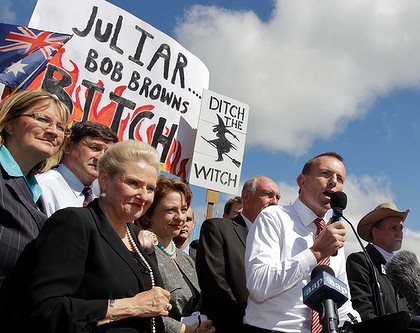
But looking a little wider, beyond the issue of what journalists choose to confer legitimacy on, is the increasing nastiness of public debate really the fault of arseholes on the internet at all? The picture at the top of this page is from a rally against Australia’s carbon price. The poster at the back refers to Ms. Gillard, and is suggesting in quite a vile and sexist way that she is the sexual toy of the leader of Australia’s environmentalist party, Bob Brown. The man standing under that banner at the front, with the microphone, telling the demonstrators he agrees with them, is Tony Abbott, the leader of Australia’s opposition liberal party and Australia’s potential future PM. The woman next to him is Bronwyn Bishop, a senior and respected politician from that same party. One might call it merely an error of judgment, but it’s hard to say that they’re doing much to keep debate above board and polite when they choose these kinds of banners as their backdrop. Where are the bloggers in this picture? It wasn’t a lonely wierdo on the internet who called a feminist activist in America a “slut” for wanting contraception to be covered by health insurance – that was Rush Limbaugh, a major media figure. It was a Republican who decided to invoke the 10th Century fiction of “legitimate rape” in defending his anti-choice views; it was a politician, not a blogger, who put rifle cross hairs over pictures of American democrats (or was it their offices?); and there are more than a few birthers in the Republican party (indeed, in congress).
So is the problem really with the blogosphere and the increasing fragmentation of political debate on the internet, or is that a symptom of a wider unhinging, that is being driven by powerful forces in politics and the media? Indeed, even though he’s completely wrong and definitely not honest or well-meaning, there’s not really anything wrong with what Anthony Watts does, in principle, in his little denialist fantasy land. There’s also lots of debate and engagement between the two sides of the AGW “debate” on the internet – if anything, the question is whether there should be less, not more, given how wrong and mendacious the denialists can be. And the role of the media here, too, is questionable since the average journalist’s understanding of the concept of “balance” doesn’t extend past “giving a nutjob a voice on national tv.” The notion that balance is best obtained through calm and rational presentation of facts and getting it right doesn’t seem to have stuck with modern journalists, who constantly trot the likes of “Lord” Monkton out to defend the indefensible – and in fact as the science gets more settled and the denialist population shrinks to a smaller and crazier rump, the journalist notion of “balance” just leads to crazier and crazier people being put on national tv to represent the “opposing view.” Again, is this the blogosphere’s fault? Sure some of those bloggers love to feed the fires, but everyone is craving the legitimacy of the mainstream public eye, and it’s journalists who offer that legitimacy, not blogs with too many colours and 30% of the words in block letters. If AGW was a fiction conjured up by powerful voices in the mainstream, then Watts’s work would be honourable rather than misguided, and he would be justified in both using harsh language, and allowing insulting and rude language on the part of his commenters. And even though some of the stuff he does there – particularly the shenanigans with publishing private correspondence that just happens to be embarrassing – is scummy and low and something he should be ashamed of, that kind of stuff is par for the course with national media and has been for a very long time.
I guess there’s a fine line between being an arsehole and being a hero – a lot of politicians seem not to like the Watergate journalists, or Assange, and I guess from their perspective the work of these people is more than just an inconvenience. But there’s more than enough arseholes in politics and the media, and they’ve been around long enough and doing dirty enough work, that one hardly needs to look to the internet for the cause of the increasingly strident and aggressive nature of modern political debate. The Palins and Limbaughs and Abbotts and Murdochs of the world have pretty much cornered the market on being nasty in public, and given how often journalists offer them the fig-leaf of legitimacy through unquestioning regurgitation of their crap, acceptance of the “legitimate questions” they raise, or straight-out editorializing in their favour, I think it’s fair to say that when journalists start pointing the finger at new media they’re either trying to shift the blame, or warn each other that their time is up. They certainly aren’t trying to improve the quality of public debate, because they and their political masters managed to debase that years ago.






 Compromise and Conceit