• But what is our policy on Godzilla?
    But what is our policy on Godzilla?

    It’s election season here in Japan, and this morning the full listing of competing parties fell through my mailbox. This multi-page, newspaper-style document lists the major parties and their main candidates, along with a very brief statement of their agenda. It’s a useful summary of the state of policy debate in Japan, I suppose, though it can make depressing reading if, like me, you think that the future of Japan depends, at least medium term, on nuclear power – aside from a few fruit loops who want nuclear weapons, almost every party is committed to Nuclear Zero. Even the Communist Party, though at least they have the decency to propose an alternative energy policy. I scanned this set of policy agendas to see if any party had any policies on immigration or foreigners, but I didn’t get very far because I got distracted by a glossy brochure from the Happiness Realization Party, which I think should rename itself the Giant Robot Party (ジャイアントロボット党). This glossy brochure is as disturbing as it is cute: the front page demands that a rock star who made landing on the Senkaku Islands be made governor of Tokyo, presumably not as a token of goodwill in international relations. The back page also makes the nationalistic path to happiness clear, with its number one demand being action to protect Japan from China.

    But the middle of the pamphlet is the two-page spread reproduced above, showing the Happiness Realization Party’s vision of a future Tokyo. For those who aren’t familiar with Japanese, some of the more notable features include:

    • Making Haneda Airport operate 24 hours a day (far left of the image)
    • Heliports! (on reclaimed land: next to the lobster- and crab-tower)
    • Fish farms in buildings (below the heliplane-y thing with the crate: the actual phrase means “become able to catch fish inside buildings!”)
    • Maglev trains! (These are the big loops running around the outside of the city)
    • All motorways underground
    • Underground safety shelters (I guess this is necessary if you’re going to go for nuclear armaments)
    • Giant robots!!!

    The party is also, apparently, in favour of lower taxes. So how they’re going to get to this future Tokyo isn’t entirely clear. I think the way they envisaged it is obvious though: the Tokyo in that picture is basically the city depicted in the Appleseed comics, though the robot’s a little bit bigger than anything in Appleseed. I’d like to point out, though, that the future world of those comics is not exactly a smoothly functioning democracy …

    The Happiness Realization Party is also, apparently, pro-foreigner and denies the Nanking massacre, in a classic example of the weirdness of Japanese conservative politics: this party is a low-taxing, pro-foreigner, nationalist and militarist religious party. Based on this weird-looking cult, apparently, which means the health policy will be fascinating: on their website this religious group claim you can heal yourself of cancer. It’s space exploration policy should be interesting too: apparently the religious group’s leader discovered a speed faster than light 30 years ago.

    As a foreigner living in Japan I don’t feel it my right to offer advice to Japanese people about how to vote, but on this occasion I think we can all agree that it is my duty to demand all good citizens vote for the Happiness Realization Party: the sooner we can move to a Bladerunner-esque, nuclear-armed Japanese state guarded by giant robots, the sooner we will all achieve full happiness.

  • The UK Census was released today, and the Guardian is “live-blogging” the details[1]. As a statistician I feel obliged to comment on the census, because it’s a fundamentally important part of modern cultural life. As an opinionated bastard, I also take great joy in the release of figures I can distort to suit my view – just like the commenters at the Guardian – so let’s dig in and see what we can say about the UK Census.

    Why is it important?

    I’m pretty sure someone with more energy than me can trace all of modern statistics back to an Islamic scholar, or worse still, a Frenchie, but as far as most people care modern statistics – and, especially, modern demography – owes a huge debt to the British. The census began in 1801 but Britain has been keeping some kind of records since before they invented the clock, so their contribution to the body of human knowledge is worthy of respect. Furthermore, London has been a very international city for a long time, and the rest of Britain an inward-looking maelstrom of anti-foreigner weirdness, and because British government has generally failed to implement anything resembling a sensible multicultural policy, what happens in London and the way British people regard what happens in London is very interesting to those of us who are a little more sanguine about racial issues.

    Foreigners and the tabloid press

    The Guardian reports in its headline that now almost 1 in 8 people in Britain was born abroad, and “white British” ethnicity is a minority in London (at 46%). This is the Guardian, that doyen of leftist politics. Check out the comments to that article: almost everyone is commenting on or arguing about the issue of foreigners in London, and aside from one faux-cynical comment about the rich getting richer, no one is noticing the strange economic phenomenon of the decline in home ownership, and if anyone notices the radical changes in religious composition it’s to worry about a tiny minority of Muslims, not to notice the explosion in atheism. This is the prestige that the British ruling class use to pull off their magic trick of robbing the poor: they get everyone looking at the weirdo foreigners while they steal their stuff. Of course it’s all irrelevant: 24% of the Australian population was born overseas, and no one gives a toss. Our Prime Minister was born overseas (in Wales, no less! can you imagine?!) But in Britain having half that many people born overseas is the main point, all else secondary. And as we can see, what is secondary is perhaps much more important than the number of foreigners in the country.

    Race vs. origin: a strange British obsession

    The debate in Britain about race is a strangely obsessive thing. The Office of National Statistics (ONS) offers a set of something like 15 ethnicities for respondents to choose from, including the ludicrous category of “White British,” which must really mystify any Americans staying in the UK during the census period. What can they class themselves as? Of course there are other equally ludicrous ethnicities, such as “Black African,” which put Ethiopians, Zulus and Nigerian Yoruba in the same ethnicity. What is the point of this? Who does it help? From an epidemiological point of view it’s a complete waste of time. Genetically it’s meaningless – everyone in Iceland, whose DNA has been mapped, gets classed in the same category (“White Other”) as everyone from Hungary. Where do Australians get placed? (There is not – yet – a category for “Mostly White Mongrel”).  This categorization says so much more about the ruling majority’s petty obsessions than it does about the population of Britain, and is a classic example of a classification system that obscures anything meaningful, while revealing a set of pre-conceived preferences that serve only to reinforce a certain worldview.

    But this census the ONS did a remarkable thing: for the first time in the 200 years of the census they bothered to ask respondents what language they speak at home, and so we get to learn something of the actual ethnic make-up of the nation, rather than the ethnic composition imagined by those who think the elision of Hungarians and Icelanders is useful. We learn that 91% of British people speak only English at home, and 4% can speak no English at all. Compare this with ethnically “homogeneous” Japan, where about 2% of the population are non-Japanese: so probably about 1% speak no Japanese. Is it really such a big difference?

    In Australia we don’t ask about “ethnicity.” [From memory] We ask three questions: where you were born, what languages do you speak at home, and are you Aboriginal? The latter is asked because of the continuing challenges facing Aboriginal people (especially discrimination) and the importance of cataloguing and understanding their culture; the former two questions were a deliberate decision of the Hawke government to make census data representative of modern Australia. In modern Australia, if you are born in Australia you are Australian, and the assumption should be (and generally, is) that your ethnicity is irrelevant. This means that if someone came here from the UK we don’t care if they are black, white or “Asian”: we only care about the fact that they are new to Australia and the languages they speak. From a data-driven point of view, ethnicity is a highly charged and complex notion, debated and disputed at every level – from the genetic and the political to the personal. My father, for example, believes that he is “White English” and he and his friends – all of whom, incidentally, believe I am not “white English” because my Grandfather is Spanish – refuse to write “White British” on the census, and deliberately select “other” so they can write “White English.” The ONS doesn’t report this little protest movement, as far as I’m aware, though I don’t know why: “White English” is as meaningless a category as “black African,” so why not include it? The truth of my father’s situation is much more deeply embedded in other census data – born in Britain, speaks only English, lives in a trailer park – than in the supposed purity of his genetic heritage. Who cares what percentage of his heritage is saxon vs. French? But my father does, because while he is very easily tempted to represent himself in terms of lost and mythical racial categories, it is extremely hard to get him to think of himself in terms of functionally useful social phenomena, such as home ownership or social class. And this is the great trick of the British race “debate”: it gets all those little Englanders to identify with their white overlords, rather than with the gypsy down the road who is in the same economic position as them.

    Religion

    In the religion category we find that the UK has finally caught up with Australia – and at a rapid pace – with 25% of respondents endorsing “no religion” compared to 15% in 2001. This is a rapid change, and indicates that support for mainstream religion in the UK is declining rapidly, with the main increase being amongst those who reject all religion. The other main article on the Guardian site as I write this is the government’s announcement that religious groups will be given the right to “opt in” to gay marriage laws – that is, they will be automatically assumed to be discriminatory bigots unless they raise a finger to indicate otherwise. Can we think of any reason why the proportion of people who are non-religious might be increasing rapidly in the UK?

    Sadly, the number of Jedi has declined by half since the last census, from 390,000 in 2001 to 176,000 now. At least the ONS was brave enough to report this cute little protest movement – the Australian Bureau of Statistics (ABS) refused to release the figures.

    Home ownership

    The other remarkable finding in this survey is that home ownership rates have declined, from 69% to 64%, even though the population is ageing and so should be expected to have higher rates of home ownership. How is it that the UK has gone through a 10 year long housing boom (that ended just 2 years before the census was taken) yet the number of people renting has increased by almost the same amount that the number of owners has declined? It can’t be because of a general all-round decline in wealth – the number of cars in ownership has increased by about 9%, even though there was no car ownership bubble. So what happened? This should serve as a reminder to everyone that privately-financed housing bubbles are the antithesis of the housing dream: they concentrate the market in the hands of those who own capital, giving them rentier’s power over an essential service. Of course, over the coming days all debate will be focused on race and immigration. How convenient for the rentiers…

    The myth of British education and Australian ignorance

    The proportion of people in the population with a degree education of any kind increased to 27%, finally breaking even with Australia. Of course, the population has increased by 5% since 2001 – while the British newspapers would love to blame every decline in living standards on foreigners, I’m willing to bet you a groat that they don’t point to temporary foreign migrant workers – mainly skilled labourers, I suspect – who might have bolstered those figures. Already the comments in the Guardian are complaining about “white British” who can’t get a job or a house, so I guess they won’t be rushing to praise the the high levels of education of foreigners in the UK. It’s another example of the sad decline of the UK relative to the rest of the world that with a 4% increase in education level they can finally cut even with the colony they shipped their criminals too. From a great colonial power to a nation that sits hunched over its census reports, bemoaning the shrinking number of “white British” people, and wondering why …

    Still, at least the Church of England will be protected from having to offer equality to gays…

    fn1: noone who “live blogs” in the Guardian ever turns up in comments to defend their crappy opinions[2], so it’s not actually a blog at all. They should instead say “we are using an annoying and inconvenient format to report important news as it comes in, so that we can attempt to trump the Daily Mail even though they’re much better at getting scoops than us, and don’t belittle themselves by pretending that they care about new media while patently failing to understand it.”

    fn2: actually a couple of the anti-sex work campaigners do pop up in comments, but this is because they have blogs of their own and take new media seriously. Monbiot – who for all his chardonnay sipping faults is one of the best and most honest opinion writers in Britain – also engages with his commenters[3]. The rest of them act like what they are: idiot journalists who’ve been forced to produce their second rate thinking in a stream-of-consciousness format, which is really embarrassing for the average journalist[5], especially since the people who are best at this kind of thing are usually sports journalists.

    fn3: and links to fully-referenced versions of his posts, which is genuinely excellent[4]

    fn4: and you can get stuffed if you expect that kind of devotion around here!

    fn5: remember, these were the thickest people at uni![6]

    fn6: or second thickest, depending on where you place statisticians in the heirarchy.

  • On the eastern coast of the Steamlands is a long stretch of open coastline called the Palace Cape. Bordered on the south and west by the wilds of the Beastlands, the Palace Cape is a land of forested hills and open grassland, all sweeping down to a rugged and wild coastline famed for its beauty. The landscape is largely untouched by human settlement, but its emptiness is belied by the sense of order and regularity in the terrain. Though it appears unoccupied by humans, it is not virgin territory.

    In fact, the Palace Cape is the home of a mysterious race of mechanical entities, generally referred to simply as the Machines. This race confounds efforts by its flesh-bodied neighbours to categorize it, because the Machines have a range of forms as diverse as the animal kingdom, and its members are as alien and inscrutable as the fish of the sea or the great diving lizards that bask on the rocks of its southern beaches. Though few Machines are ever seen by humans, they are reported to have been seen in forms as diverse and various as gleaming steal humanoids, fragile porcelain dolls, spider-like monstrosities, humming discs floating in the air, mysterious immobile constructions of crystal, and even a flittering cloud of mechanical insects. Some scholars dispute that the various entities of the Machine kingdom are even separate minds, claiming that they are all animated agents of a single mighty intellect referred to as the Slip Mind. Whatever the truth of it, the Machines of the Cape have little in common with the warm-blooded folk to their north and west.

    Nonetheless, the Machines do maintain a society that in some ways resembles that of humans. They take shelter from the elements as do any living creatures, and it is from these majestic shelters that the land gains its name. The Machines – or perhaps some older race before them – have built mighty and fantastic towers that stand lonely and magnificent against the backdrop of the distant mountains, or emerge from the waves of the near shore like behemoths of rock and steel. The towers appear unoccupied, the land around them being untilled and devoid of farms or settlements – just a single spire of steel and glass emerging from the wilds of the surrounding land. But if an interested observer waits outside long enough, they might be lucky enough to see a procession of machine workers emerge from some secret door, marching off into the wilderness to attend to some task, or setting about pruning the trees and tending the lands immediately about the tower. Very occasionally one might see a human resident emerge, or stumble on a small hamlet whose residents have lived in the shadow of the tower for millenia. These residents will have little to tell the traveller about the Machines among whom they live, however, except that they are peaceful and trustworthy and the life is good.

    Scholars from other realms have been unable to comprehend the truth of the Machines, and the Machines themselves defying all forms of investigation, the scholars of the living have been forced to come to wild and unsupported views about the provenance, views and lives of the Machines. However, some things are known fairly well, and all theories must account for the quirks of Machine life that have been observed. It is not known whether the Machines eat or sleep, but it is generally believed that they gain some form of power from the Palace Cape, for they cannot leave it. Indeed, were one to be foolish enough as to abduct a Machine and take it beyond the ill-mapped borders of its realm, it would fall quiescent and incapable of movement or thought. Some argue that the Machines’ power is a magical device buried in the centre of the Palace Cape; others, pointing to the Cape’s name, suggest that the power source lies in the Palaces themselves, and that were they to fall the Machines would be extinct. Yet others believe the land itself is the source of the Machines power. It has been noted that on the boundaries of the Palace Cape, there live a breed of feral and degenerate Machines, which the Machines themselves disown. These beast-machines prey on passing humans, or hide from them, acting for all the world like animals; but some of them have a rudimentary cunning, or form groups of bandits, who attack passing caravans. It has been noted that while the Machines of the Cape can repair themselves by some mysterious means, these beasts on the border cannot, and will usually be seen carrying damage, rust and decay that they seem unaware or uncaring of. Thus, many scholars have argued that the power source has some centre, and wanes as one moves away from the centre, leading to a decay in both physical and intellectual strength. Other, more practical minds care not about the nature of the Machine’s motile force, but note that the borders of the Palace Cape are dangerous, and those who go to trade with the Machines should go well armed. The Machines themselves show little care for these degenerate brethren, seeming to treat them as animal cousins, best avoided but to be dealt with if they cause trouble. Of course, for the Machines these brethren are no burden, since the Machine folk do not leave the Cape.

    The Machines also seem to maintain a cohort of slave machines, which they control remotely through their strange magic and which behave as machines are traditionally understood to operate. Often these slaves are accompanied by a sentient Machine, which guides and manages them. This is also how the Machines fight, not engaging directly with their enemies but instead fighting through slave soldiers. Machine soldiers are rarely seen, because the Machines do not make war, but those who fight Beastmen, or who have patrolled the western reaches of the Cape, report fighting spiders of steel and glass, and floating wagons heavily armed with cannon. Sometimes individual Machines will fight alongside these beasts, seeking fame and fortune amongst their kind; but it is known that Machines can die, though they seem quite tough, and usually the Machines are happy to let their automatons wage war for them.

    The Machines trade with all the kingdoms of the Steamlands and elsewhere, and welcome human guests, though sometimes in a cold and remote way that can be confused with rudeness. Some of their number seem to understand or even appreciate humans, and there are a few small human settlements in the Cape which often hold a kind of ambassadorial status. It is known that the Machines have a way to enable a select few of their number to travel outside the Cape, but they seem not to like to do this, and reserve this expediency only for the most dire of situations. They do maintain a Tower near their border with Greathalf, however, and here a few Machines and humans live alongside each other in a mixed town that is renowned for its wonders and mysteries, though dangerous to reach. Here humans can trade raw materials and art for fine steel, gems, and occasionally technological items of rare power. The Machines are strangely unable to create art, though they can appreciate it, and their fondness for certain kinds of human art leads them to trade. But in general the Machines have little need for congress with humans, and keep to themselves. This can make the leaders of other nations uncomfortable, and occasionally rumour and confusion have led these rulers to ill-fated missions against the Cape. The Machines seem not to hold grudges, though they remain an inscrutable and poorly understood people. They are yet another mystery of the Steamlands, a strange amalgam of magic and metal that remains beyond the understanding of mortals. Were a group of intrepid adventurers to uncover the secret of their origins and their power source, great wealth and power could come their way … along with great danger …

  • This week Crooked Timber seems to be on a bit of a thanksgiving roll, and has various commentaries on the greats of the revolution and the civil war, mostly negative. In amongst them is a nasty little piece on Thomas Jefferson as prototypical fascist racial theorist, which is stirring some aggressive debate. As always there’s some really interesting material in the comments, and it appears that some genuine historians of that era are stalking the comment thread, dispensing their wisdom. At the same time, various defenders of Jefferson are rocking up and throwing stones, and I note that (rightly or wrongly) the response over there to the suggestion that one of the founding fathers was a racial essentialist is very similar to the response that I sometimes see here to my accusations that Tolkien’s work presents a model of inter-war or Nazi racist theory. We get quotes from his letters presented as proof against his public utterances; we get elision of the central question of the debate (did the man propound a racist theory?) with other, less relevant questions (was he a bad man?); we get accusations that it’s all just do-gooding liberal self-haters hating; we get told to leave off because he was just a product of his time[1]. Admittedly the debate as presented there is simultaneously murkier and clearer: Jefferson’s writings are political writings, and he held political influence, so any racial theorizing in his writings is rather more relevant to black people in America than anything in Tolkien’s; but at the same time Jefferson enacted good laws to free slaves, so we have to find a way to understand the laws in light of the speech, and this is not a problem that applies to Tolkien. But I sense that a certain proportion of the American populace, including academia, hold the founding fathers in a similar degree of reverence to that with which the nerd world holds Tolkien, and for those people the challenge of reconciling Jefferson’s private words with his public acts induces a level of distress that is interesting to observe, and I think similar to the distress some nerds feel when they realize that their central, canonical text is also a racist guidebook.

    For my lights, I haven’t a clue about Jefferson and I don’t think the founding Fathers should be held in any esteem – we’re 300 years past their due date and the constitution they wrote is a flawed business, as is the Republic they founded. But the debate is interesting[2], and it seems that Jefferson’s defenders can’t cope with the central thrust of the post, which is that Jefferson believed it right to free slaves, but was preparing a quite unpleasant racial theory to justify nasty measures in the aftermath. There’s a lot of evidence presented in comments that having unpleasant views about black people is not inconsistent with being opposed to slavery, so for example Lincoln is quoted as having said:

    I have no purpose to introduce political and social equality between the white and the black races. There is a physical difference between the two, which in my judgement will probably forever forbid their living together upon the footing of perfect equality… I agree with judge Douglas he is not my equal in many respects – certainly not in color, perhaps not in moral or intellectual endowment. But in the right to eat the bread, without leave of anybody else, which his own hand earns, he is my equal and the equal of Judge Douglas, and the equal of every living man. (emphasis in original)

    I think that this kind of position – standing up to your fellow racial equals for the rights of people you think are inferior, in a situation that is rapidly heading towards war – is an enormously brave and noble undertaking, although the stupidity of the beliefs presented there should be self-evident in the modern age. But it shows that we can judge people of previous eras by our modern lights: Lincoln, though he thought black people inferior to whites, still understood the importance of compassion and basic dignity, and his actions and words show that it is possible to demand a certain basic universal compassion at all stages of history. And from what’s written in the main post, it’s not clear that Jefferson was on board with that compassion, and his defenders aren’t able to make a clear argument to state that he was[3]. This is rather disappointing for an academic blog, but not unexpected given the topic.

    Nonetheless, it’s interesting to see that similar defensive strategies appear in both debates. I guess it’s a universal hallmark of the fanboy …

    fn1: though Chris Y at comment 24 deals with that nicely:

    Samuel Johnson also: “How is it that we hear the loudest yelps for liberty among the drivers of negroes?”

    fn2: There’s a cute side-note about Washington in the comments, that players of my Compromise and Conceit campaign will love: during the retreat from New York the British evacuated all their black allies, and Washington, charming soul that he was, made repeated demands of the British that they leave behind “American property” (i.e. several thousand human beings). That’s exactly what the Washington in my campaign would have done too, had he lived. Or perhaps in suing for peace he would have demanded the repatriation of his “property.”

    fn3: Though neither his defenders nor the writer of the post seem to be interested in making an effort to reconcile the conflicting opinions Jefferson seemed to hold, which I would have thought was a key part of the task of defending or damning him.

  • In October my master’s student had her work on modeling HIV interventions in China published in the journal AIDS, with me as second author. You can read the abstract at the journal website, but sadly the article is pay-walled so its full joys are not available to the casual reader. This article is a sophisticated and complex mathematical model of HIV, which incorporates three disease stages, testing and treatment separately. It is based on a model published by Long et al in the Annals of Internal Medicine in 2010, but builds on this model by including the effects of methadone maintenance treatment, and doesn’t include an injecting drug use quality of life weight. It also adds new risk groups to the model: Long et al considered only men who have sex with men (MSM), injecting drug users (IDU) and the general population, but we added commercial sex workers (CSW) and their clients, who we refer to as “high risk men.” Thus our mathematical model can consider the role of both injecting drug users and sex workers as bridging populations between high-risk groups and the general population, an important consideration in China.

    The HIV epidemic in China is currently a concentrated epidemic, primarily among IDUs in five provinces, and amongst MSM. The danger of concentrated epidemics is that they give the disease a foothold in a country, and a poor or delayed response may cause the epidemic to jump to the rest of the population – there is some suggestion this may have happened in Russia, for example. The Chinese authorities, recognizing this risk, began expanding methadone maintenance treatment (MMT) in the early 2000s, but it still only covers 5% of the estimated 2,500,000 IDUs in China. Our goal in this paper was to compare the effectiveness of three key interventions to prevent the spread of this disease: expanded voluntary counseling and testing (VCT); expanded antiretroviral treatment (ART); and expanded harm reduction (MMT and needle/syringe programs); and combinations of these interventions. VCT was assumed to reduce risk behavior and expand the pool of individuals who can enter treatment per year; ART was assumed to reduce infectiousness; and harm reduction to reduce risk behavior. Costs were assigned to all of the programs based on available Chinese data, and different scenarios considered (such as testing everyone once a year, or high-risk groups more frequently than everyone else).
    The results showed that all the interventions considered are cost-effective relative to doing nothing; that some of the interventions saved more money than they cost; and that the most cost-effective intervention was expanding access to ART. Harm reduction was very close to ART in cost-effectiveness, and would probably be more cost-effective if we incorporated its non-HIV-related effects (reduced mortality and crime). The Chinese government stands to reap a long-term benefit from implementing some of these programs now, through the 3.4 million HIV cases averted if the interventions are successful (there are a lot of “ifs” in that sentence).This is the first paper I’m aware of that compares ART and harm reduction head on for cost-effectiveness, though subsequently some Australians showed in the same journal that needle/syringe programs (NSP) in Australia are highly cost-effective as an anti-HIV intervention. This is also the most comprehensive model of HIV in China to date, and the first to conduct cost-effectiveness analysis in that setting. I think it might be the first paper to consider the detailed structure of risk groups in a concentrated epidemic, as well. There are obvious limitations to the conclusions that one can draw from a mathematical model, and some additional limitations on this model that are specific to China: the data on costs was a bit weak (especially for MMT) and of course there are questions about how feasible some of the interventions would be. We also didn’t consider restricting the interventions to the key affected provinces, which would have made them much cheaper, and we didn’t consider ART or VCT interventions targeted only at the high-risk groups, which would also have been cheaper. For example, legalizing sex work and setting strict licensing laws might enable universal, quarterly HIV testing and lead to the eradication of HIV from this group within 10 years, but we didn’t include this scenario in the model because a) legalization is not going to happen, b) enforcement of licensing laws is highly unlikely to be effective in the current context in China, and c) data on the size and behavior of the CSW population is probably the weakest part of our model, so findings would be unreliable. Despite the general and specific limitations of this kind of modeling in this setting, I think the results are a strong starting point for informing China’s HIV policy. China seems to have a very practical approach towards this kind of issue, so I expect that we’ll see these kinds of policies implemented in the near future. My next goal is to explore the mathematical dynamics of these kinds of models with the aim of answering some of the controversial questions about whether behavioral change is a necessary or effective part of a modern HIV response, and the exact conditions under which we can hope to eliminate or eradicate HIV. Things are looking very hopeful for the future of HIV, i.e. it’s going to be eliminated or contained in most countries within our lifetime even without development of a vaccine, and that’s excellent, but there is still debate about how fast that will happen and the most cost-effective ways of getting there: hopefully the dynamic properties of these models can give some insight into that debate. This article is a big professional achievement for me in another way. It’s extremely rare for master’s students to publish in a journal as prestigious as AIDS (impact factor over 6!), and my student’s achievement is a reflection of her amazing talent at both mathematics and English, and a year of intense work on her part, but I like to think it also is a reflection of my abilities as a supervisor. There were lots of points where we could have let things slide on the assumption that master’s students don’t publish in AIDS; but we didn’t, and she did. I like to think the final product reflects well on both of us, so read it if you get the chance!

  • Image

    The Four Kingdoms are a group of four dwarven nations, located on an island to the east of the Steamlands, which I have previously mapped. Being a dwarven holding, they are not well understood by the humans of the other lands, but more is understood of the history and geography of the Four Kingdoms than, for example, the homes of the dwarves of the Shadowlands in the far north, because the Four Kingdoms were once a human land. Unlike other dwarven kingdoms, it is sometimes possible to find maps or even histories in the great libraries of the Steamlands  – though even then the history of the ancient humans who lost this land to the dwarves is not well understood. The presence of a network of ancient and sinister shrines across the surface of the Four Kingdoms suggests, however, that the ancient human residents were worshippers of chaos, and this was their undoing.

    In addition to the strange historical accident by which their kingdom was revealed to them, the dwarves of the Four Kingdoms have another unusual trait: they are masters of both the earth and the heavens. They build their cities beneath the mountains, just as do dwarves of every land, but above the ruins of the old human settlements they have constructed mighty towers, from which they send forth airships of astounding size and beauty, to ply the trade routes of the nearby islands, and to defend their kingdom against incursion. These airships are filled with helium, which the dwarves of the Four Kingdoms mine deep beneath the earth using secrets only they know. The airships are their prize possession, and have given the Four Kingdoms great wealth and power. Many is the foolish human lord who has staked their future popularity on a campaign to reclaim the lost human birthright of the Four Kingdoms, only to be brought to ruin by the massed cannon and bombs of the dwarves’ inassailable airships; and no sight is more feared on the battlefields of the Steamlands than a mercenary dwarven aerostat as it hoves into view above the battlefield, its bomb bays open and ready to rain fire on the hapless footsoldiers below.

    Rumours abound regarding the lost human settlements of the Four Kingdoms. Some say that the dwarves destroyed the humans utterly and usurped their claim to the land; others say that even to this day the descendants of its original inhabitants are enslaved to the will of the dwarves, and toil in their fields while the dwarves live lives of luxury and corruption in their gilded halls. Some scholars note the network of sinister and ruined shrines above ground, and observe that sometimes in their deep delvings the dwarves waken dark powers from their slumber. These scholars suggest that the humans of the Four Kingdoms worshipped chaos, and their evil religion was their undoing. Dwarves are renowned for their hatred of chaos, and whether the dwarves destroyed these humans out of duty, or arrived too late to save them from their own doom, or simply inherited a devastated and empty land, no one knows. To learn the truth of this secret past would require the unravelling of secrets long buried deep in dwarven halls, and it is clear the dwarves do not care to reveal what – if anything – they know of the land’s ancient secrets. So, if humans are to learn of the folly – and the doom – of their ancient brethren on this island, it will fall to a team of dedicated adventurers to pierce to the heart of the dwarven strongholds, there to learn the truth of the dark powers that stalk the island and its subterranean depths …

    fn1: the picture is from this NZ site on all things dwarven (oddly appropriate, given the season!)

  • Last night I stumbled on this video of Bruce Dickinson, from Iron Maiden, singing William Blake’s Jerusalem with Ian Anderson (from Jethro Tull) accompanying him on flute. It was performed at a Christmas concert at Canterbury cathedral last year. He performed GK Chesterton’s Revelations, the inspiration for Iron Maiden’s song of the same name, at the same venue, and this can be viewed on youTube as well. The performances are stirring stuff, though at times Dickinson over-eggs the pudding and you can tell he’s used to a slightly different venue, but if you like good British poetry and appreciate the New Wave of British Metal (NWOBM) then you’ll get a lot of enjoyment from these two short clips.

    The songs also show very clearly the strong influence of British classical poetry on the direction the ‘Irons took under Bruce Dickinson. Listening to these songs is like listening to any of their more famous efforts, though obviously the lyrics are more skilfully crafted[1], and it’s clear that Iron Maiden drew heavily on their British heritage when they wrote their works. Their most famous songs are steeped in what could probably be broadly described as the cultural origins of modern Britain – the romantic poets, the modernists, and some of the key debates in colonial and Victorian Britain that shaped the growth of the post-industrial British world, all feature prominently as themes in Iron Maiden’s work. Sometimes these are direct translations to metal – as in The Rime of the Ancient Mariner – and sometimes they are a pastiche of poetry and history, as in Revelations. In other cases they are merely inspirational material, as in The Trooper‘s interpretation of The Charge of the Light Brigade. But in all cases, these influences and thematic elements are obvious in the work.

    British comedy, television and especially music is, I think, the strongest part of its modern culture, and even seemingly nihilistic and barbaric elements of it – like the NWOBM or modern genres such as britpop – can be seen as part of a cultural continuity stretching back 200 or more years. This continuity is often obscured by the blandishments of modern art – the gutter style of modern drama, the spandex and satanism of the NWOBM, or the very modern and superficial faux working class posturing of some of the reformed toffs of the britpop scene – and of course it is also unrecognizable in some of the less talented and more degenerate products of modern British culture. But at its finest, modern British art, comedy and drama shows a strong appreciation of, and indeed directly channels, that long cultural tradition. I think for those of us from newer countries like the USA or Australia, this long cultural continuity can be surprising and perhaps also something we can be envious of (hence Australia’s historic “cultural cringe”). It’s also something we don’t always notice or appreciate, being more focused on those things that are fresh or new. But I think Iron Maiden is a really exceptional example of this tradition, being on the one hand embedded in what is often seen as a nihilistic and cultural vacuum (heavy metal) while simultaneously enormously dependent on a long cultural legacy for its themes and artistic influences. It isn’t just a case of a diamond in the rough, but of the ability of a traditional and often conservative entertainment and cultural establishment to continually reinvent itself without losing its roots.

    fn1: this may earn me a fatwa from the fan club.

  • Today’s issue of PLOS Medicine contains an interesting debate between Australia’s own anti-smoking paladin, Simon Chapman, and a professor Jeff Collin from Scotland, over whether governments should introduce a license for smokers. Chapman puts the case for a license, while Collin opposes it, and the debate is refreshingly free of jargon or paywalls, so quite accessible to non-public health types. I think the license is an interesting idea: basically, anyone who wants to smoke would be required to pay a fee to obtain a license, and no one without a license can purchase cigarettes. Licenses would be available for various quantities of cigarettes, and by registering the licenses with a fixed central database it would be possible to ensure that people could only consume within the licensed amount. Those who want to give up smoking could turn in their license and get a refund on all the years’ fees they’ve paid, plus interest. Meanwhile, the government would be able to accurately track smoking use statistics, which is very useful from a public health perspective. Chapman also suggests that, just like a driver’s license, one should be required to pass a test to get the license, thus in his words ensuring

    that new smokers were making an informed choice, something the tobacco industry has long declared that it believes applies to smokers’ decisions

    and guaranteeing that people who take up smoking have been required to inform themselves of its risks and of the difficulty in giving up. Chapman’s article also offers arguments to dismiss claims that a license would be intrusive, discriminate against the poor, or stigmatize smokers, and proposes a gradual lifting of the minimum age for acquiring the license in order to make numbers of new smokers less and less common. He compares the license with a license to drive or own a gun and, quite interestingly, with a prescription to take pharmaceuticals, which he represents as a kind of temporary license. On its own lights, it is quite a strong argument.

    The opposing case by Collin takes a more structural, less drug-user-focused approach to the challenge of reducing smoking rates. He argues that we should continue to focus on regulating the pharmaceutical companies to combat what he calls an “industrial epidemic,” and says we should strengthen measures which

    should centre on changing a system of manufacture and promotion of such harmful products centred on the corporation, an institution that is staggeringly ill-suited to such roles when viewed from a public health perspective

    He suggests that further measures targeting users are both discriminatory and stigmatizing, and that increasing attempts to manipulate prices and cost barriers will punish existing poor smokers the most (and smoking, at least in developed nations, is a much bigger problem amongst the poor). This is a point that Chapman had disputed, but Chapman’s argument against it is at least partly based on dismissing these complaints as crocodile tears from the tobacco industry and its front organizations – of which I sincerely doubt Collin is a member. Collin argues, furthermore, that the idea of a tobacco smoker’s license is fundamentally illiberal, and grounds most extant bans of tobacco users‘ behavior in a liberal philosophical framework:

    Smoke-free policies have been recognised and understood as unambiguously liberal measures rather than authoritarian intrusions on personal freedom. In advancing a case focused on the protection of non-smokers, workers, and children, such legislation conforms to JS Mill’s classic formulation of the harm principle in On Liberty: “(t)he only purpose for which power can be rightfully exercised over any member of a civilized community, against his will, is to prevent harm to others”

    His argument, then, is that we should avoid anti-tobacco legislation that targets the users themselves, except to prevent harm to others, and focus instead on the source of the harm (the corporations). He even suggests that the imposition of licenses would represent a propaganda “gift” to the industry, and further punish poor people who smoke relative to the wealthier.

    Overall I think Collin’s arguments are less coherent and consistent, but I am inclined towards his position on the issue. I think the license would probably be a good idea from a public health perspective, but represents a curtailment of individual liberty that is unnecessary. It doesn’t actually have any serious civil liberties implications – registering smokers is not the beginning of the police state – but it does shift the focus of efforts away from the source of the harm to its most immediate victims, and it does play a stigmatizing role. Collin also observes that the major goals of the Framework Convention on Tobacco Control (FCTC) are institutional, and in many countries have not been achieved, and it is better to work on systems for improving countries’ ability to meet those goals than to divert our efforts towards restricting users’ behavior. I agree with him on this point: many countries are a long way from a proper implementation of the basic goals of the FCTC – higher tobacco taxes, curbs on illicit tobacco, and indoor smoking restrictions, for example – and strengthening those countries’ ability to resist tobacco company money and marketing is a much better goal for anti-smoking activists. The reality is that smoking in the developed world is on the decline and will continue to do so, and as a result the tobacco companies are aggressively targeting developing nations. It is in those developing nations that activists should be fighting a battle for improved governance and institutional structures that will help those countries protect their health systems from this “industrial epidemic.”

    The debate raises a related issue for me, which is: have some countries gone far enough in their anti-tobacco measures? Australia, for example, having now passed plain packaging laws, has pretty much made smoking as unattractive and difficult as it can do without actually banning it. Should we stop there? The reason this is an issue for me is that I play a violent sport, and I recognize that violent sports represent a deliberate choice by people to take risks with their health in pursuit of a certain pleasure. So does drinking to get drunk, and so does casual sex, both activities of which I approve. At some point we have to recognize that people have the right to trade health for fun, and although that doesn’t give people carte blanche to, for example, go surfing in a frankenstorm or dance naked in front of lions, it does mean that at some point we have to draw a line beyond which public health measures must stop. From a public health perspective, so long as anyone is smoking, “more needs to be done.” But from a civil liberties perspective, at some point the barriers to smoking and anti-smoking education are such that we can safely say people who take up the habit know the risks and are suitably reminded of them that there is no reason to further intrude on their personal decisions. Have some developed nations reached that point? For Australia at least I’m not sure there is much more that can be done except to introduce a license, or introduce the rolling bans mentioned in Chapman’s article. Do we need to go that far, or is the current status quo sufficient? Should the anti-tobacco lobby in Australia be relaxing their national attention simply to being vigilant against new tobacco industry efforts, and instead begin focusing more of their energy on the other countries in the West Pacific where smoking remains a serious and growing problem?

    There comes a point where you have to accept that the activity harms no one else, the person engaged in it is willing and aware of the risks, and the activity is suitably challenged in everyday life that they must be committed and really want to do it. At that point, perhaps public health organizations need to step back, and instead of further restricting the behavior, defend the right of those engaged in it to do so, and to get healthcare for the problems it causes. This is what we do now for mountain-climbing and rugby, two very dangerous but well-respected activities. I think it is possible that in some developed nations, smoking has reached that point, and maybe in those countries enough has been done.

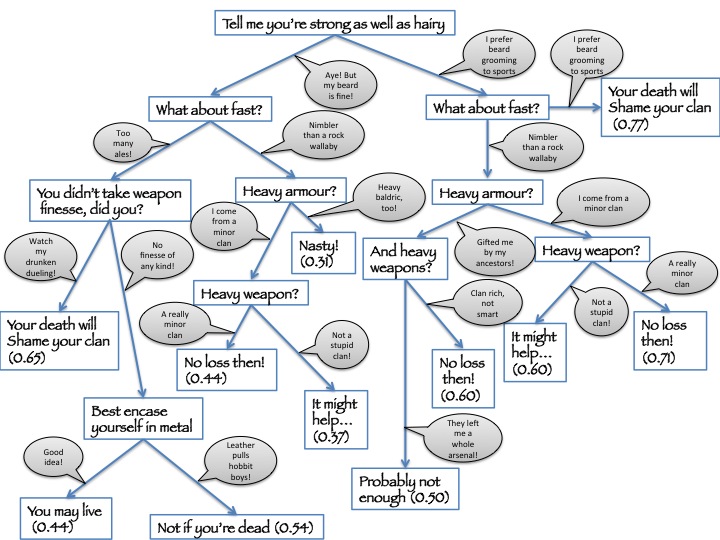
  • Figure 1: Dwarven character creation flow chart

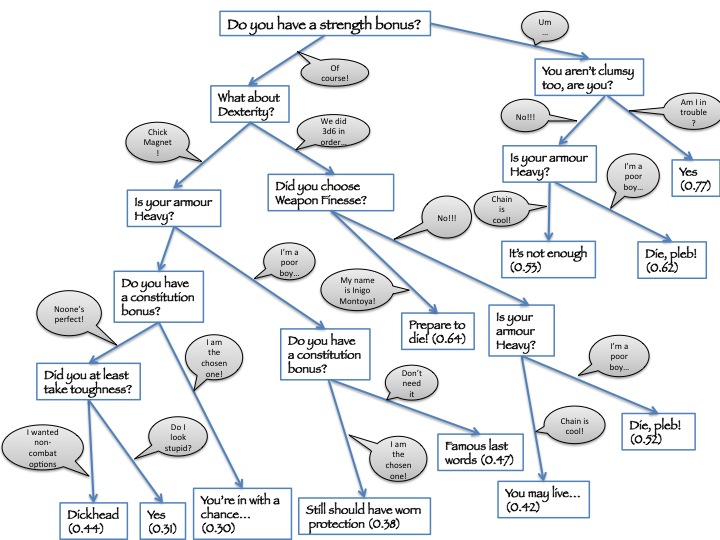
    Following yesterday’s post, here I present flow charts for the best survival options for Dwarves (Figure 1) and Halflings (Figure 2). Both charts are based on CART analysis of the simulation data generated for yesterday’s post.

    Figure 2: Flow chart for halfling fighter creation

    For dwarves, weapon and armour choice is crucial, and weapon finesse is a decision so bad that it actually negatively affects survival: with two feats to choose, wasting one on weapon finesse is a very bad idea. For hobbits, like humans, toughness is only important if the PC doesn’t have good constitution, and weapon choice is only important for clumsy fighters. Note that if a halfling has no strength bonus, constitution is irrelevant to survival but dexterity is important. This is also true for humans, though weapon choice is not important in their case – presumably because they don’t suffer the size penalty on damage dice. For weak dwarves constitution bonus is also not important, but both weapon and armour type make a difference to survival.

    Elven decision rules will be posted later…

  • Introduction

    In previous posts in this series, I showed the differences between fighter builds, and especially that “fast fighters” are a weak decision that is particularly bad for halflings and elves even though they are the more agile races. In this post I will approach the question of fighter builds from a different angle, that of the most effective choice of feats, armour and weapons for given attribute scores. Ultimately, the aim of this work is to develop decision models (expressed as flowcharts) for PC development. We will do this through a generalized version of the simulations run to date, in combination with classification and regression tree (CART) methods.

    Methods

    For this study a completely random character generation method was developed. This simulation program generated random races, ability scores, weapon and armour types and feats subject to the rules in the online Pathfinder System Reference Document (SRD). Weapons were restricted to three choices: rapier, longsword and two-handed sword. Armour types were studded leather, scale, chain shirt and chain mail. There were eight possible feats: improved initiative, dodge, shield focus, weapon focus, power attack, desperate battler, weapon finesse and toughness. Ability scores were generated uniformly within the range 9 to 18, and racial modifiers then applied: the human +2 bonus was applied randomly to the three physical attributes. Feats were assigned randomly, with humans having three feats and non-humans two. All fighters with a one-handed weapon were given a light wooden shield. Halflings were given size benefits and disadvantages as described in the SRD. Initial investigation revealed that ability score values were only important in broad categories: ability scores that gave bonuses greater than 0 were good, and bonuses of 0 or less were bad. For further analysis, therefore, all ability scores were categorized accordingly into values of that gave a bonus of +1 or greater vs. those that did not.

    All fighters were pitted in one-to-one melee combat against an Orc, which had randomly determined hit points and the fully operative ferocity special ability. This happened in a cage deep beneath Waterdeep, so no one could run away. Winners were promised a stash of gold and the chance to buy a farm on the Sword Coast, but were actually subsequently press-ganged into military service in the far south, where most of them died of dysentery. A million fights were simulated.

    Once data had been collected it was analyzed using classification and regression tree (CART) models implemented in R. CART models enable data to be divided into groups based on patterns within the predictor variables, which enables complex classification and decision rules to be made. Although it is more complex and less reliable than standard regression, CART enables the data to be divided into classification groups without the formulaic restrictions of classical linear models. Results of CART models can be expressed as a kind of flowchart describing the relationship between variables, with ultimate classification giving an estimate of the probability of observing the outcome. In this case the outcome was a horrible death at the hands of an enraged orc, and the probability of this outcome is expressed as a number between 0 and 1. CART results were presented separately by race, in case different races benefited from different choices of feats.

    Some univariate analysis was also conducted to show the basic outline of some of the (complex) relationships between variables in this dataset. Univariate analysis was conducted in Stata, and CART was conducted in R.

    Results

    Of the million brave souls who “agreed” to participate in this experiment, 498000 (49.8%) survived. Survival varied by race, with 55% of humans surviving and only 45% of halflings making it out alive. Some initial analysis of proportions suggested quite contradictory results for the different feats, with some feats appearing to increase mortality. For example, 47% of those with improved initiative survived, compared to 51% of those without; and 46% of those with shield focus, compared to 52% of those without. This probably represents the opportunity cost of choosing these feats, or some unexpected confounding effect from some other variable.

    The three combinations of ability scores and feats with the highest number of observations and the best survival rate were:

    • Dwarf with +3 strength, +3 dexterity, +3 constitution, chain mail armour, rapier, weapon focus and desperate battler (15 observations, 100% survival)
    • Dwarf with +3 strength, +0 dex, +4 con, scale armour, two-handed sword, toughness and weapon focus (13 observations, 100% survival)
    • Dwarf with +3 strength, +2 dex, +3 con, studded leather armour, longsword, desperate battler and power strike (13 observations, 100% survival)

    Despite the apparent success of Dwarves, a total of 55% of all unique combinations of ability scores, feats, weapon and armour types with 100% survival were in humans. The majority of the most frequent survival categories appeared to be in non-humans, however – this bears further investigation.

    CART results varied by race. For humans, ability scores were most important; for dwarves, weapon type and armour type were important, while constitution was largely irrelevant. For elves and halflings, the only important feat was toughness; weapon finesse was only important for humans, and sometimes only as a negative choice. The key results from the CART analysis were that strength is the single most important variable, followed by dexterity for elves and halflings, or constitution for dwarves; and then by decisions about armour and weapons. Feats are largely relevant only for those with weak ability scores.

    As an example, the CART results for humans are presented as a flowchart in Figure 1 (click to enlarge). It is clear that after strength and dexterity, heavy armour and constitution are important determinants of survival. Weapon finesse is only important as a feat to avoid for those with low dexterity – for those with high dexterity it is largely irrelevant. Toughness primarily acts as a counter-balance to poor constitution in those with high dexterity and strength.

    Figure 1: Character creation decision model for humans

    Decision models for other races will be uploaded in future posts.

    Conclusion

    This study once again shows that strength is the single most important ability for determining survival in first level fighters, and that feats are largely used to improve survival chances amongst those who already have good ability scores. In previous posts dexterity appeared to be irrelevant, but analysis with CART shows that the absence of a dexterity bonus makes a large difference to survival – those with no dexterity score bonus do not benefit from feat choices, while those who have a dexterity bonus can benefit further by careful choice of armour and feats. Although previous posts found that “tough” fighters have a very high survival rate, this post finds that constitution is not in itself a priority ability score. By following the decision model identified in this study, players can expect to generate a fighter with the highest average survival chance given their ability scores.