• Looking for the one who got away
    Looking for the one who got away

    I cannot recommend Ripper Street highly enough. The actors are excellent, the dialogue fine, and the English a joy to listen to. The setting is grim and nasty, the lead characters compromised and gritty, but it has none of the bitterness and cynicism that so often accompanies those traits in a TV show. It’s also, I think, the first TV show I have ever seen that might be described as sex-worker positive. It’s what Deadwood could have been, if it weren’t so deeply and overwhelmingly misogynist.

    Ripper Street is a crime/mystery TV series set in the East End of London in the era of Jack the Ripper. The Ripper himself has been and gone, but the show focuses on the detective who failed to catch him, Detective Inspector Reid, his sergeant Bennett Drake (played by Bron from A Game of Thrones) and an American, Homer Jackson, who is their forensic doctor. Reid has lost a daughter, possibly to Jack the Ripper, and his personal life is on the rocks because of it; Jackson is an ex-Pinkerton on the run with his ex-girlfriend Susan, who runs a brothel (where Jackson lives); and Drake is tormented by his memories of soldiering in Egypt, where he may also have joined some satanic sect. The fifth person in the picture above (far right) is Miss Rose, one of Susan’s employees, who is in a relationship with Jackson but being wooed by Drake.

    Reid is played by Matthew McFadyen, most famous for his stirring portrayal of D’Arcy in the BBC adaptation of Pride and Prejudice, and as one might expect from such impeccable credentials, he does an excellent job of portraying a detective trying to use modern, scientific methods to solve crime in a world still steeped in cruelty, superstition and bigotry. Bennett Drake is like a soft version of Bron, capable of being just as vicious but also much more vulnerable. He is Reid’s hard man: in 19th century London no one has to adhere to the human rights act, and when confessions need to be extracted it is Drake who extracts them. Jackson is probably more dangerous than either of them, and has a very dubious past, but provides the medical skills (and to a large extent the real brains of the operation). He is also a selfish, lazy and arrogant man.

    So basically this TV series is like a grittier and slightly less fanciful version of From Hell if it somehow crashed into Pride and Prejudice, with Reid as a more down-to-earth version of Abberline, and a team of three putting together a modern approach to policing. In many ways the show seems to have really made a big effort to capture the reality of the times, portraying the East End of London as a far more diverse, contested, and hopeful place than perhaps we are used to seeing in Ripper-era television. I also think it deals particularly well with two classes of person: Americans and sex workers.

    The Americans in Ripper Street dress differently, they talk differently, they really do seem to come from a different world. They’re usually either on the run or looking for something, and they aren’t native in London – they don’t know the town, they often hate it, and they’re usually there with a purpose, not usually a good one. They’re gaudier, more dangerous or more sinister, and they’re also more modern – they have ideas and skills and ways of looking at things that the Londoners aren’t used to. This is how I imagine they would have seemed at the time the show is set, and it might be part of the explanation for why British society has such a strange love/hate relationship with American culture. I really like this depiction of the gulf between two apparently closely-related societies, a gulf that I think a lot of people feel in their day-to-day dealings in the real world, and it’s nice to see Americans in Britain being depicted as more than just a different accent.

    But where Ripper Street really excels for me is in its treatment of sex work. It’s the first TV show I think I’ve seen other than Deadwood where sex workers are major characters, but unlike Deadwood it doesn’t reduce them to weak and pathetic characters dependent upon men for approval and safety. Though they are constrained by the stupid mores of their time, the sex workers in Ripper Street aren’t weak, and they don’t wait for men to protect them or help them, nor do they seek men’s approval. They are proud, strong women trying to make their own way in a world where women have no formal power. They aren’t sluts or idiots, but ordinary women doing what needs to be done. The show also takes a narrative stance on sex work, not particularly openly, so that we can see the morality of the world in which the women work and trace its hypocrisies and cruelties; this isn’t done in a hamfisted way, generally, and it’s portrayed primarily through the efforts of Reid’s religious wife, Emily, who wishes to establish a shelter to protect homeless women without dictating morals or lifestyle. It’s really refreshing to see a TV show set in an oppressive era that doesn’t fetishize sexual violence and reduce its female characters to victims and objects. If only Deadwood had done the same …

    Ripper Street only has eight episodes so far, and a new season won’t be along any time soon, but I strongly recommend viewing what there is. It’s an excellent and enjoyable show, and a welcome addition to that small genre of TV shows about the genesis of modern policing. Don’t hesitate to try it out if you get the chance.

  • Is it just me, or has the Guardian embarked on a project of excessive tastelessness[1]? In the last two days they have shown video footage of 17 people dying in a hot air balloon (apparently you can see people jumping to their deaths) and of a man being dragged to his death by a South African police van. WTF? I don’t want to watch people die. I was always of the understanding that snuff videos were an urban myth. Call me crazy, but I don’t think media outlets should be showing footage of real people dying. I don’t want my death to be on film, and I don’t want to watch you die. Maybe occasionally there is some social value to watching you die, but in general I think your death should be something kept between you, your family and your god or gods.

    I remember years ago some stupid American politician shot himself in the face in front of the media, and pretty much every Australian TV station chose not to play it. I recall one station even had a statement about why they “censored” the sight of a man blowing his brains out. What has happened in the intervening years that grainy footage of some holiday-makers having an otherwise great day ruined by their horrible fiery deaths has become news? Why do I need to see some kid in South Africa being murdered?

    I think I can chalk this up as another example of how journalists and the media generally are losing track of reality. But let me say this: to the best extent that I can, I will try to avoid watching you die. Obviously, some stupid media may trick me into watching their horrid snuff films, but if I have any say over the matter, I will not watch you die.

    I’m sure that will make you feel better when you do.

    fn1: Obviously for a lot of people this has been a rhetorical question for a very, very long time now.

  • On Monday I was required to monitor at the Tokyo University undergraduate entrance exams. I shepherded 60 terrified 17 year olds through a 2.5 hour Japanese language test and then a 100 minute maths test. These tests were part of a two day examination process for those want to enter the humanities faculty of Tokyo University. About the Japanese test I can say nothing, but the maths test interested me, and can be found online (in Japanese) at the Mainichi Shinbun newspaper. In order, based on my feeble attempts at translating the exam, the four questions were:

    • A straightforward but nasty calculation of the properties of a line intersecting with a cubic function, including elucidation of all minima and maxima of the products of the lengths of two line segments
    • A geometry question with two proofs
    • A constrained linear programming problem
    • A simple Markov model with a slight twist

    The students had 100 minutes, and to their credit quite a few of the students managed all four, though a lot also stumbled and didn’t get past two. I would say that for a well-trained student with good maths skills, these four questions can all be done inside their allotted 25 minutes, but it’s a pretty risky process – even a small error at the start, or misconception of how to do the problem, and you have basically lost the whole question because you only have time to attack the problem once. And these problems are probably about the same level of difficulty as the questions on a standard year 12 maths exam in Australia – where usually we would have three hours.

    But these questions were for the Humanities Faculty of this university. If you want to study Japanese literature at Tokyo University, you first have to get through that 100 minutes of high level mathematics. It says something, I think, about the attitude of Japanese people towards mathematics, and towards education in general, that they would even set a mathematics test for access to a Humanities Faculty; and it says even more about the national aptitude for maths that the students could tackle this exam.

    At about the same time as these exams were being held, the Guardian and the Sydney Morning Herald released articles slamming the mathematical and science abilities of the average student in the UK and Australia, respectively. The Guardian reported on a new study that found English star students were two years behind their Asian counterparts in mathematics, with 16 year old English students at the same level as 14 year old Chinese. The study also found that

    The research also found England’s most able youngsters make less progress generally than those of similar abilities across the 12 other countries studied. The other countries studied were Singapore, Hong Kong, Taiwan, Japan, Australia, Slovenia, Norway, Scotland, the US, Italy, Lithuania and Russia.

    Meanwhile, the Sydney Morning Herald reported on a new study showing that the proportion of students doing mathematics is falling fast, with apparently only 19% of students studying maths, science or technology in their final year of school, and a rapid fall in mathematics enrollments amongst girls especially. The corresponding figure in Japan in 2002 was 64%.

    So is this a problem, why is it common to the English speaking world and viewed so differently in Asia, and what can be done about it? Obviously as a statistician I think this is woeful[1], and it certainly is my personal opinion that understanding mathematics is a good thing, but is it bad for a society as a whole to neglect mathematics education? I don’t know if that’s objectively verifiable. So let’s skip that question, assume for now that improving the number of people taking mathematics is good, and just jump onto the question of why it is unpopular in Australia, and why the British are so bad at it.

    First, I would like to dispute the possible explanation provided in the Guardian article by “the researchers”:

    In east Asian cultures education has historically been highly valued. This can be seen not only in teachers’ high salaries, but also in the heavy investment of families in private tutoring services

    While it may be true that “social and cultural factors” affect maths achievement, the idea that Asians are better at maths because they value education more highly is a very weak one. If this were the case, would it not also be the case that Japanese would universally be better at foreign languages than the British or Australians? Japanese get a long exposure to English teaching but are generally woeful at it, despite all the money they sink into private tutoring services. No, there’s something else going on here, something about the Asian approach to maths and the way it is taught that is important.

    It is certainly the case that private tutoring services need to be considered in the mix. When comparing a 16 year old English student to a 14 year old Japanese student, for example, you are comparing someone who does a 9 – 5 study day with very long winter and summer holidays against someone who does an 8 – 8 study day with two-week holidays, and who gets 2-on-1 or small group tutoring in key subjects for up to 3 hours a day, and on weekends. This process starts at age 10 and really ramps up at about age 15-16, just when the linked article finds the biggest gap between English and Asian students. It’s also the kind of process that benefits the “brightest” students most, and would explain the gap very nicely.

    It may be that if the UK wants to compete with the sleeping giants of Asia on basic educational outcomes, it’s just going to have to face up to a simple fact: British students need to study harder. A lot harder.

    There are some more nebulous cultural factors that come into play, however, and I am going to go out on a limb here and name a few factors in Japanese society (the part of Asia I am familiar with) that I believe make Japanese so much better at maths than their western counterparts.

    • It isn’t about native talent: A pet hate of mine about western approaches to mathematics is the idea that some people are talented at it, and most people aren’t. I don’t think this is true at all, and I think it’s not something that Japanese believe very strongly. The reality is that getting good at maths is a long, hard slog that involves a huge amount of repetition of basic skills (things like completing the square, substitution, differentiation, interpreting graphs, sign diagrams, etc.) – just like learning a language. Sure, solving maths problems requires creativity and intuition, but these are only of any value if you know the tools you can apply them to, and are familiar enough with those tools to recognize when and how to use them. Mathematics – and especially high school mathematics – is a process of drilling, drilling, drilling, and I think that Japanese recognize this. In Japan the default assumption is that if you pay attention at school and do your homework, you will be good at maths. Sure, they recognize that advanced maths requires extra commitment and talent, but there is a fundamental assumption here that the broad body of maths (up to and including differentiation, integration, limits, and basic probability theory) are things that anyone can learn.
    • The teacher is important: the flip side of the idea that education is important is an increased stress on the value of the teacher, and their role as a guide. The role of the guide is also viewed very differently if they are teaching something that they believe anyone can do, compared to if they are teaching a subject that everyone believes is impossible for most mortals to comprehend. Find me a westerner under the age of 30 who is “terrible at maths” and I will show you someone who was humiliated by an arrogant maths teacher at a crucial time in high school, usually around when they were 14. I was in the bottom class in mathematics when I was 14, expecting to drop out as soon as possible, until a good teacher put some time into teaching me, and I found that I really loved it. In Japan, teachers can be bullies and they can be cold and hard, but I would also argue that they have a much greater burden of personal care and responsibility placed on them compared to western teachers, and the failure of their students is treated more like a professional failure (rather than due to the student’s personal talents) than it is in the west. I think this is especially important with mathematics, because when you don’t get it it really hurts – like a kind of itching in the back of your brain – and the failures pile up rapidly. Just a single year between 12 and 14 in which you give up on maths is enough to make all the subsequent years ever more challenging, meaning the damage and the attendant confidence failures compound.
    • Being nerdy is cool: In Japan, it’s okay to be a nerd, and being good at mathematics is admired and respected. It’s virtually unheard of to find someone here who looks down on a man who can do maths, or thinks that it is beyond the female brain, or thinks that being interested in mathematics is weird. Furthermore, the nerd world in Japan is much more gender neutral than in the west, so there’s nothing unusual about girls doing maths. Good mathematics skill – up to and including being able to rearrange equations or solve systems of equations, for example – is not seen as a weird foible, but as an admirable sign that you are a rounded human being.
    • There is a social expectation of mathematical skill: In addition to nerdiness being much more acceptable, the range of mathematical abilities that qualify you as a nerd in Japan is much more esoteric and advanced than in the west. There is a general expectation that ordinary people can solve maths problems, that they understand the basic language of mathematics so that even if they can’t solve a problem they know roughly what it is and where it sits in the pantheon. Parents assume that their kids will learn mathematics, and don’t dismiss it as the too hard subject that only the special or the weird get ahead in. Whereas in Australia having a kid who is good at maths is unusual, in Japan it is unusual (and embarrassing!) to have a kid who is not good at maths.

    I think these properties add up to a society in which mathematical achievement is encouraged and widespread. I think that Australia and the UK need to change some cultural factors so that the intellectual and educational landscape is closer to that in Asia if they want to keep up on mathematics and technology achievement – especially since China’s education system is maturing, and other Asian nations like Vietnam, Singapore and India are getting wealthier, with all the educational gains that implies. So what should Australia do?

    • Ditch the nerd-baiting: there’s something really wrong with the way the English-speaking world treats people who do nerdy things. I’m sure it’s mellowed a lot since I was a kid but it’s still there, the kind of ugly-four-eyes assumption about anyone who is interested in anything that isn’t sport or fashion. Until this weird attitude dissipates – and until the nerd world becomes more gender-balanced, to boot – it’s going to be hard to encourage the kind of cultural changes needed to make maths achievement standard across the board
    • Less intuition and initiative, more drills: I think it’s very sweet that maths teachers want to encourage their charges to think about the broader world of maths, about creative problem-solving, about applying maths to the real world, etc. But I think those are natural talents all humans possess, that cannot be unlocked without a robust background in the basic skills that make mathematics work. So leave the creativity for people who need it, and stuff kids’ heads full of “useless” rote learning of techniques and drills. It’s boring, but it’s essential to the bigger stuff. If you aren’t able to immediately see when and how to complete a square, then any problem which requires this basic technique is going to be beyond you, no matter how intuitive you are. Maths, possibly more than any other discipline, is built from the ground up, tiny block by tiny block, and all those blocks are essential. So ram them down every kid’s throat, and make every kid think that knowing the quadratic formula is not a test of some kind of obscure talent, but a basic expectation of every 12 year old
    • Force mathematics at higher school levels: When I finished school our balance of subjects had to include at least one science/technology subject, but it didn’t have to include maths. This is wrong, and part of the reason that so many students in Japan do mathematics is that you can’t get into a good university if you take this approach: every one of the better universities includes mathematics in its entrance exam. My personal belief is that completion of higher school certificates should require one foreign language, mathematics, and English. That leaves two other subjects to choose from, and guarantees that you have to do some kind of mathematics to the end of school. Not only will this very quickly lead to a society where entire generations of people are generally familiar with mathematics, it will also put a real focus on the quality of teaching at the earlier years, since any student who is doing badly in years 8 – 10 is going to fail their higher school certificate. [Probably this suggestion for a national curriculum is completely unreasonable, but at the very least students could be forced to do mathematics up until year 11, for example].
    • Make school more robust: The Japanese school system is about to shift to a “tougher” system that will include Saturday morning classes, because the previous system was considered “relaxed” compared to earlier years. This is, frankly, ridiculous, but so is the attitude towards education of most of the English-speaking world. Summer holidays are way too long and relaxed, there is a real lack of extension classes and tutoring, and expectations are altogether too low. Education isn’t valued enough, and until this changes anyone who wants their child to do better is going to be swimming against a strong current. Educational achievement is partly supported through the shared goals of a whole society, not just through the targets of individual families, and the expectations we hold for education are primarily set through the school system. So toughen it up – not in the sense of making teachers scarier or bringing back outdated “three Rs” educational styles, but by increasing the amount of time students spend at school, setting tougher standards for graduation and university entrance, making schools compete with each other (as Japanese schools partly do) and forcing parents to take greater responsibility for and involvement in their children’s education. This change isn’t specific to mathematics, but it would certainly help.

    I don’t think there’s anything special about Asian students, or about Asian culture, that we can’t adopt. Asians’ mathematics achievements aren’t some kind of native or racial talent. It’s just a collection of attitudes towards education, mathematics and nerdiness that we can adopt if we want. Obviously there will be (potentially challenging) institutional changes required as well, and many people may judge it not worth the effort, but I personally think a world where everyone is good at mathematics is a better world, and we should be aiming for it. With these cultural changes maybe one day everyone will know the obvious thrill of being able to complete a challenging mathematics exam … and enjoying it!

    fn1: Though obviously, the less people doing maths, the longer I will remain competitive in the marketplace …

  • It's all Greek to you, isn't it?
    It’s all Greek to you, isn’t it?

    I received a very interesting hospital dataset recently, in excel format and containing some basic variable names and values in Japanese. These included the sex of the patient, the specialty under which they were admitted to hospital, and all variable names. Initially this would be reasonably easy to convert to English in excel before import, but it would require making a pivot table and fiddling a bit (my excel-fu) is a bit rusty, but also I have address data and though at this stage it’s not important it may be in the future. So, at some point, I’m going to have to import this data in its Japanese form, so I figured I should work out how to do it.

    The problem is that a straight import of the data leads to garbled characters, completely illegible, and very little information appears to be available online about how to import Japanese-labeled data into Stata. A 2010 entry on the statalist suggests it is impossible:

    Unfortunately Stata does not support Unicode and does not support other multi-byte character sets, such as those necessary for Far Eastern Languages. If you are working with a data set in which all of the strings are in a language that can be represented by single byte characters (all European languages) just choose the appropriate output encoding. However, if your dataset contains strings in Far Eastern langages or multiple languages that use different character sets, you will simply not be able to properly represent all of the strings and will need to live with underscores in your data.

    This is more than a little unfortunate but it’s also not entirely correct: I know that my students with Japanese operating systems can import Stata data quite easily. So I figured there must be something basic going wrong with my computer that was stopping it from doing a simple import. In the spirit of sharing solutions to problems that I find with computers and stats software, here are some solutions to the problem of importing far Eastern languages for two different operating systems (Windows and Mac OS X), with a few warnings and potential bugs or problems I haven’t yet found a solution for.

    Case 1: Japanese language, Windows OS

    In this case there should be no challenge importing the data. I tried it on my student’s computer: you just import the data any old how, whether it’s in .csv or excel format. Then in your preferences, set the font for the data viewer and the results window to be any of the Japanese-language OS defaults: MS Mincho or Osaka, for example.

    This doesn’t work if you’re in an English language Windows, as far as I know, and it doesn’t work in Mac OS X (this I definitely know). In the latter case you are simply not able to choose the Japanese native fonts – Stata doesn’t use them. No matter what font you choose, the data will show up as gobbledigook. There is a solution for Mac OS X, however (see below).

    Case 2: English language, Windows OS

    This case is fiddly, but it has been solved and the solution can be found online through the helpful auspices of the igo, programming and economics blogger Shinobi. His or her solution only popped up when I did a search in Japanese, so I’m guessing that it isn’t readily available to the English language Stata community. I’m also guessing that Shinobi solved the problem on an English-language OS, since it’s not relevant on a Japanese-language OS. Shinobi’s blog post has an English translation at the bottom (very helpful) and extends the solution to Chinese characters. The details are on Shinobi’s blog but basically what you do is check your .csv file to see how it is encoded, then use a very nifty piece of software called iconv to translate the .csv file from its current encoding to one that can be read by Stata: in the example Shinobi gives (for Chinese) it is GB1030 encoding, but I think for Japanese Stata can read Shift-JIS (I found this explained somewhere online a few days ago but have lost the link).

    Encoding is one of those weird things that most people who use computers (me included!) have never had to pay attention to, but it’s important in this case. Basically there are different ways to assign underlying values to far Eastern languages (this is the encoding) and although excel and most text editors recognize many, Stata only recognizes one. So if you have a .csv file that is a basic export from, say, excel, it’s likely in an encoding that Stata doesn’t recognize on an English-language OS. So just change the encoding of the file, and then Stata should recognize it.

    Working out what encoding your .csv file is currently in can be fiddly, but basically if you open it in a text editor you should be able to access the preferences of the editor and find out what the encoding is; then you can use iconv to convert to a new one (see the commands for iconv in Shinobi’s blog).

    Unfortunately this doesn’t work on Mac OS X: I know this, because I tried extensively. Mac OS X has iconv built in, so you can just open a terminal and run it. BUT, no matter how you change the encoding, Stata won’t read the resulting text file. You can easily interpret Shinobi’s solution for use on Mac but it won’t work. This may be because the native encoding of .csv files on Mac is unclear to the iconv software (there is a default “Mac” encoding that is hyper dodgy). However, given the simplicity of the solution I found for Mac (below), it seems more likely that the problem is something deep inside the way Stata and the OS interact.

    Case 3: English-language, Mac OS X

    This is, of course, something of a false case: there is no such thing as a single-language Mac OS X. Realizing this, and seeing that the task was trivial on a Japanese-language Windows but really fiddly on an English-language windows, it occurred to me to just change the language of my OS (one of the reasons I use Apple is that I can do this). So, I used the language preferences to change the OS language to Japanese, and then imported the .csv file. Result? Stata could instantly read the Japanese. Then I just switched my OS back to English when I was done with Stata. This is a tiny bit fiddly in the sense that whenever you want to work on this file you have to switch OS languages, but doing so on Apple is really trivial – maybe 3 or 4 clicks.

    When you do this though, if you aren’t actually able to read Japanese, you’ll be stuffed trying to get back. So, before you do this, make sure you change your system settings so that the language options are visible on the task bar (you will see a little flag corresponding to your default locale appear next to the date and time). Then, make sure you know the sequence of clicks to get back to the regional language settings (it’s the bottom option of the language options menu in your taskbar, then the left-most tab inside that setting). That way you can change back easily. Note also that you don’t, strictly speaking, have to change the actual characters on the screen into Japanese! This is because when you select to change your default OS language, a little window pops up saying that the change will apply to the OS next time you log in but will apply to individual programs next time you open them. So you can probably change the OS, open Stata, fiddle about, close Stata, then change the OS back to English, and so long as you don’t log out/restart, you should never see a single Japanese-language menu! Weird, and kind of trivial solution!

    A final weird excel problem

    Having used this trick in Mac OS X, I thought to try importing the data from its original excel format, rather than from the intermediate .csv file. To my surprise, this didn’t work! In programming terms, running insheet to import .csv files translates the Japanese perfectly, but running import to import the excel file fails to translate properly! So, either there is something inaccessible about excel’s encoding, or the import program is broken in Stata. I don’t know which, but this does mean that if you receive a Japanese-language excel file and you’re using Mac OS X, you will need to export to .csv before you import to Stata. This is no big deal: before Stata 12, there was no direct excel import method for Stata.

    A few final gripes

    As a final aside, I take this as a sign that Stata need to really improve their support for Asian languages, and they also need to improve the way they handle excel. Given excel’s importance in the modern workplace, I think it would be a very good idea if Microsoft did more to make it fully open to other developers. It’s the default data transfer mechanism for people who are unfamiliar with databases and statistical software and it is absolutely essential that statisticians be able to work with it, whatever their opinions of its particular foibles or of the ethics of Microsoft. It also has better advanced programming and data manipulation properties than, say, OpenOffice, and this makes it all the more important that it match closely to standards that can be used across platforms. Excel has become a ubiquitous workplace tool, the numerical equivalent of a staple, and just as any company’s staplers can work with any other company’s staples if the standards match, so excel needs to be recognized as a public good, and made more open to developers at other companies. If that were the case I don’t think Stata would be struggling with Asian-language excel files but dealing fine with Asian-language .csv files.

    And finally, I think this may also mean that both Apple and Microsoft need to drop their proprietary encoding systems and use an agreed, open standard. And also that Windows need to grow up and offer support for multiple languages on all their versions of Windows, not just the most expensive one.

    Lastly, I hope this post helps someone out there with a Japanese-language import (or offers a way to import any other language that has a more extensive encoding than English).

  • Today’s edition of PLOS Medicine contains an article describing a possible cap-and-trade scheme for global health investment, designed around a cap-and-trade carbon permit scheme. Built on the assumption that health is a global public good, it proposes that all countries sign up to a centralized system of permits based on disability-adjusted life years (DALYs). If a country wishes to invest in a low cost-effectiveness health project, it would need to offset the poor gains arising from its own scheme by purchasing DALYs for a low-income nation. The article contains some interesting examples, including the additional cost that a low-efficiency health project in a developed nation would incur through purchasing the DALY offsets.

    For example, introducing pneumococcal conjugate vaccination (PCV) in Australia is a highly cost-ineffective strategy (costing about $100,000 per DALY gained), well above the threshold defined for a cost-effective intervention in a low-income nation. In order to implement this project, Australia would have to purchase about 1300 DALY offsets, which it could do through (for example) increasing the coverage of a standardized vaccination schedule in South East Asia. Purchasing these DALY offsets through this project would add 0.2% to the cost of introducing PCV in Australia (see Box 2 in the text).

    The article also gives a cute chart showing which countries would need to increase investment and which could reduce investment in global health in order to meet the conditions of the scheme, and the authors suggest a significant change in the distribution of global health funding:

    19%–28% of the total increase, or US$6.8–US$10 billion, would come from the US, 5%–6% from Japan, 4%–6% from Germany, 3%–4% from France, while some of the bigger middle-income countries would also contribute substantially, with 6%–7% from China (i.e., US$2.1–US$2.7 billion), 3% from Brazil, and 2% from India. Our proposal, therefore, involves a marked change in perspective over who should contribute to meeting the health MDGs [millennium development goals], with contributions expected from large emerging economies such as China and Brazil.

    This is an interesting change in perspective and also a strong statement about the extent to which a few key countries (e.g. the USA, Japan and France, which it should be noted is an ex-colonial empire) are shirking their global health responsibilities.

    I don’t know whether cap-and-trade systems are the best way to solve problems of the commons – the authors claim they are and give a reference, but I don’t know if they’re on strong grounds – and I’m not sure how much of a case can be made for health as a global commons compared to, say, the climate. But even if you drop the argument about global commons and just propose this cap-and-trade system as a mechanism for enforcing global investment in health priorities, I think it’s an interesting case. Certainly, a lot of countries are failing to meet their millennium development goal (MDG) targets, and although the authors note a range of reasons that are independent of funding mechanisms, it’s fairly certain that some of the shortfall is simply due to a lack of investment, and (again, as the authors observe) extremely inefficient investment choices. From a global perspective, the amount of money Japan is going to commit from 2013 to funding PCV, with limited cost-effectiveness, to save just a small number of lives, is a terrible waste when it could be funding crucial vaccinations (like tetanus for pregnant women) in countries with very low incomes and fragile health systems. It would be interesting to see how fast these countries’ health metrics would improve if the entire world adopted a scheme that forced them to consider the most efficient health investments, from a global rather than a local perspective …


  • Rabbit-headed cuckoo clocks were all the rage!
    Rabbit-headed cuckoo clocks were all the rage!

    Yesterday was another Gothic Lolita-styled live event by the crew at A la Mode, the 42nd event of this venerable institution. This night had the same excellent value-for-money line up of 6 or so bands interspersed by DJs, for just 3000 yen, but this time there were less of the pretty little 5 minute floor shows, and instead there was an excellent steampunk fashion show, and a very weird 30 minute theatrical performance (pictured above).

    This time gas-mask free...
    This time gas-mask free…

    The fashion show appears to have been organized by one of the two members of the band Strange Artifact, who I refer to as Miss Artifact (pictured above, singing). I failed to get any functional pictures of the fashion show, but it was excellent – mostly women in voluminous 19th-century-styled dresses, wound about with belts festooned with mysterious gear, all intricately worked with geometric designs and brasswork. One girl was wearing a leather shoulder-guard that held glowing potions in test tubes, like an elegant and feminine version of the Witcher; two carried briefcases studded with brass designs; another carried a tiny pistol and what looked like a glowing, arcane power tube on her back. There was also a man in velvet pants and fine waistcoat, festooned with accessories and carrying an elaborate clockwork-styled gun, a feather jauntily perched in his top hat. Overall, it was an excellent showcase of craftwork and over-the-top steampunk sense, relatively free of gothic influences and heavily influenced by cowboys-and-indians railroad America, and industrial-revolution England.

    Death and the Angel...
    Death and the Angel…

    The show wasn’t lacking in gothic influences, though. The two bands that followed Strange Artifact, himemanik and Remnant, had a healthy dose of gothic style: himemanik with a nice electronic pulse, and (as can be seen from the photo above), Remnant with a large dose of over-the-top old school coffin-guitared goodness. I really liked himemanik, actually, but I failed to get any pictures of them. I also failed to get pictures of Elupia, who I have reviewed before. Elupia are working on a new album, and were really in fine form at this gig, playing with a lot of energy and strength. They really epitomize the level of technical quality that even minor Japanese bands achieve, and are a good advertisement for the Japanese live scene – which in my experience is worth spending money on even if you don’t know the bands, because they are usually at a very high standard.

    At this event, I had noticed a couple of women who had turned up wearing zombie nurse outfits, and who spent the afternoon drinking and checking their make-up (and sleeping). One of them was wearing a badge that said “Satan,” also incidentally one of the band names, so I was thinking we might be granted an audience with a zombie nurse rock band. However, as time passed my friend pointed out that the hall was becoming something of a “midgetorama” (his words) as it filled up with really, really short girls, some obviously very young (this was somehow an all-ages gig). These women seemed to have no fashion sense or style in common, but we soon discovered that they all shared a deep, powerful obssession with the headline act of the evening, Satan. For when Satan began playing, they all charged forward, unveiling Satan-themed sweat towels or t-shirts, and lined up at the front of the stage.

    You spin me right round baby, right round!
    You spin me right round baby, right round!

    What followed was a revelation. Satan (pictured above) are a standard thrash/punk band with nothing special to recommend them – good, savage, loud and raw, but so are all of their kind – except the slavish devotion and energy of their fans. They proved this early on by producing a troll doll and spinning it around before the audience. This was the trigger for all of their fans to form up in serried conga-line ranks and do a complete circuit of the dance floor, charging around in one revolution and returning to their places to resume head-banging crazily to the thrash. Satan invoked this ritual regularly through their songs, somehow managing to hold out an arm or do a spinning sign with one hand and get all their fans to charge around the room. The rest of us had to step back in stunned incomprehension to allow this horde of tiny 16 year olds to take the floor.

    It was then that Satan produced his pogo stick. At the sight of this wicked device of ancient power, his fans formed into three neat ranks, all facing in the direction he pointed, and began pretending to be pogo-ing, moving slowly up and down as the guitarist drew out a deep, ferocious roar. Then, of course, off they charged. Their dark lord could reproduce this pogo action just by crouching down on stage.

    Other things that Satan got his little girls to do included worshipping the guitarist – whenever a solo was played, the girls all fell to their knees and genuflected – and a kind of mini bus-stop dance, in which the entire crowd went through the same series of arm-crossing and uncrossing, head banging motions.

    He also produced a rubber hammer with which he whacked girls at the front of the stage, got them to slap his arse, spat water on them, and whipped them with his dreadlocks. Thus does Satan rule supreme over the gathered hordes of Tokyo’s schoolgirls …

    Unfortunately I couldn’t get a picture of all this because, even though Satan is just some second-rate Tokyo thrash/punk band with about 30 devoted followers, he fancies himself special, and has a staff member who came over to tell me further pictures were banned. Further proof, if proof were needed, that intellectual property law is the work of Satan.

    At this point as well my phone batteries died (all these photos were taken on my phone), and I failed to get any photos of the last band, Velvet Eden. No loss, since they were completely boring aside from the fact that their singer was cross-dressing, and stopped halfway through the performance to tell us that the band had been running for 10 years and this meant he had also been wearing a “T-back” (g-string) for 10 years. It was, he told us, 10 years since he became TBO – T-back Ore (g-string me!). Just as well he had the gimmick, since the band was ordinary.

    So, another a la mode gothic lolita night passed in style and (mostly) musical excellence. This one was quite different to the last, and it’s clear that they put a lot of effort into each night they run, with very different performances and themes for each one. The next will be in early March, and if you are in Tokyo then and have a chance I strongly recommend it …

  • Drawing on yesterday’s post about simplifying warhammer, here are the outlines for a high fantasy character class, akin to the Rogue class from Rolemaster.

    Introduction

    The rogue is a criminal and a thug, the kind of knave who hires themselves out to do nasty jobs in the bad parts of dirty towns. Rogues fight and kill for a living, but they don’t do so fairly: a rogue who finds themselves in a fair fight has made a tactical error, and given their natural tendencies towards cowardice and thuggery, the kind of rogue who regularly gets caught in open combat is likely to die. Rogues get ahead by a combination of bastardry and skullduggery. They don’t resort to “honourable” crimes like thieves, and they don’t resort to honourable combat as do Champions or warriors. They ambush, trick and run.

    Class skills

    Stealth, Weapon Skill OR Ballistic Skill, Coordination, Guile, Intuition

    Abilities

    Primary abilities: Agility, Fellowship

    Wound threshold: +0

    Strain: +0

    Starting talents

    • Agile defender: if the rogue is not attacking, he or she can make a 1D coordination check. Every success on this check adds 1 misfortune die to the enemy’s attack; every bane causes one point of strain
    • Surprise attack: The rogue gains two fortune dice to initiative when attacking from stealth, and two fortune dice on melee attacks against those who have not acted in the first round of such an attack
    • Fluster: make a Guile vs. Discipline challenged check, with +2 misfortune dice. All allies add 1 fortune dice per success for their next action against the targeted enemy

    Talent tree

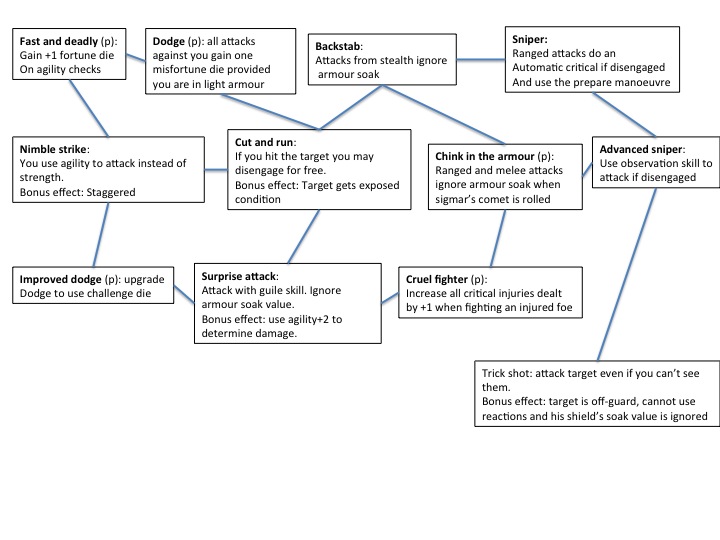
    Rogues develop talents according to figure 1.

    Figure 1: Rogue Talents
    Figure 1: Rogue Talents
  • Today we heard word of a scandal overtaking the modern Tokyo phenomenon of AKB48. Their 14th most popular member, Minegishi Minami, was caught by a journalist leaving the house of a “boyfriend,” a 19 year old member of some random boy band (compared to AKB48, the boy band in question is largely irrelevant). The pictures were published in some scandal rag, Shukan bunshun (週刊文春), a magazine which basically makes its income from printing shit. As a result of this indiscretion, Miss Minegishi has been demoted to research student (kenkyusei) status, meaning a massive loss of pay and  that in the strange heirarchy of AKB48 she will have to climb back up the ranks to reclaim her position as an enormously popular public figure.

    The heart bleeds, doesn’t it? Actually the apology is a beautiful and heartfelt thing, and it’s clear that Miss Minegishi is under a lot of pressure, as one might expect if one were published leaving the house of one’s lover the morning after a trist and published in a magazine read by millions of people, in a country where everyone (well, not me!) is watching you and discretion in sexual encounters is paramount. This is a nation where holding hands in public is still frowned upon by many young people, and kissing generally avoided at all costs. Being photographed the morning after a shag is obviously going to be very embarrassing.

    AKB48 sold $200 million of records alone in 2011, and endorse everything from elections to instant coffee. They are the very definition of a household name, and getting into the top 48 of this weird little business enterprise is a license to print money for the young women involved. It’s also not easy: their recent documentary carries the subtitle no flower without rain, which draws on an old saying about how beauty and/or success depend on suffering. The structure of the AKB48 system is redolent of university and the early years of the corporate system: it is intended to reproduce the sense of having to strive to make it, being indebted to one’s seniors, and being vulnerable in the face of life’s challenges. In many ways, AKB48 are perfect representatives of the Japanese notion of gaman, of having to suffer through adverse circumstances to achieve: this is the same spirit of gaman that enables Judo masters to bully their charges[1], but which makes a Sumo wrestler like Takanoyama enormously popular because he tries so hard. Two sides of the same coin … I don’t know if it could be said that Miss Meinegishi is being bullied in this instance, though … what she did do is fall foul of a contractual obligation not to go on dates. That’s right – AKB48 girls are not allowed to go on dates! The Guardian article makes it appear as if this rule is based on “the strict rules to which Japan’s young pop stars must adhere to project an image of unimpeachable morals” but this isn’t the reason at all – that’s just bullshit western misinterpretation of east Asia’s so-called conservatism. The real reason that Miss Minegishi has to live a sexless (or at least secret) life until she “graduates” from AKB48 is that her band is idolized by nerds and pre-sexual teenage girls, and to both groups of fans they have to appear pure and single. These are girls next door who are struggling through a metaphorical high school/university/early corporate life, and girls like that don’t get DP’d in love hotels.

    Miss Minegishi’s extreme haircut is also not forced on her by her contract: she did this all by herself, to symbolize her abasement. This means she’s going to be trying extra hard to regain the favour of her fans, and my prediction is that this little cock up is going to be a goldmine for her and for the AKB48 business: she’ll soon be returned to the top ranks, fans will love her more for having fallen and strived, and there’ll be another documentary with tears and struggle – a genre that AKB48’s fans love.

    Which brings me to my William Gibson-esque point: these girls are Japan’s modern shrine maidens, the modern equivalent of western nuns of yesteryear. They’re required to swear themselves to celibacy, live lives of constant self-flagellation and torment, and simultaneously have to symbolize everything that is admired in the women of their time: chastity, beauty, sexiness, innocence and endurance. They also have to tread the line of hypocrisy that characterizes modern attitudes towards young women: at the same time as they are making swimsuit videos and soft porn, these girls will get demoted if they are caught having sex. And because it’s Japan they also have to be educated: there’s currently a TV show about some of these girls going to college and trying to get a qualification. William Gibson has a few short stories about these kinds of characters in the cyberpunk world (I think Idoru is the most apt, though I haven’t read it): women whose celebrity depends on their embodying all of the ideals of femininity of their time, and whose personal lives are warped or ruined as a result of it. So let’s hear it for Minami Minegishi, embodiment of all the trials and tribulations of modern womanhood – and of the complexities of the cyberpunk era. Ganbare, Minegishi san! The hopes of a generation, and the weight of an entire society’s sexist expectations, are resting on your skinny shoulders …

    fn1: though maybe not anymore: watch the video of the coach apologizing and listen to the cameras – the girls he bullied weren’t willing to tolerate it and his humiliation is pretty much complete. These guys’ world is changing, and it’s apparent that they aren’t catching up…

  • The struggle for improved town planning laws continues unabated...
    The struggle for improved town planning laws continues unabated…

    Today’s Guardian is running an article about the controversy of renaming Volgograd to Stalingrad for the annual celebrations of that particularly brutal period in World War 2. If anyone hasn’t read Anthony Beevor’s book on this topic, I strongly recommend it – I don’t know how factual it is but it’s an excellent read anyway. Apparently, according to this article, the decision to rename Volgograd to Stalingrad for this few days of the year (covering the time when the Nazis surrendered) is controversial because it is seen as honouring Stalin, who was in charge at the time. From the article:

    Communists and other hardliners credit him with leading the country to victory in the second world war and making it a nuclear superpower, while others condemn his purges, during which millions were murdered.

    Stalin was definitely a bad, bad man, who did bad, bad things, and although some have argued that many of the bad things he did were necessary conditions to enable the rapid industrialization that gave the USSR the power to destroy Hitler, others would probably just as likely argue that his excesses reduced the USSR’s power to resist invasion. Beevor doesn’t make a judgment either way but certainly describes how Stalin’s behavior before the war and in the early stages of Operation Barbarossa made the Nazis’ job easier, but by contrast Aly and Heim in Architects of Annihilation argue, at least by implication, that Stalin’s programs of “de-kulakization” and industrialization – which were accompanied by famine, mass relocation and the destruction of whole communities – were essential to the later war effort and were actually copied by Hitler’s planners and demographers as they set about the extermination of the Jewish race and the residents of Eastern Europe. So in this sense it could be argued that Stalin’s specific pre-war policy framework[1] may have been an essential pre-condition to the victory in the war[2]. If so, it’s a very odious fact but it does suggest that Stalin’s role was essential to winning the war[3], as were the sacrifices of the 20 million or so people who died as a result of his policies.

    Beevor on the other hand quotes a general speaking to Stalin early in the war, when Stalin was panicking. I can’t remember exactly the quote, of course, but basically the general told Stalin “It doesn’t really matter how tough they are or how badly we fare now; just pack up our industry to the other side of the Urals, and eventually we’ll destroy them.” A lesson they learnt, of course, from Napoleon, though they did have help from vampires back then.

    So reading that article on the reveneration of Stalingrad’s name, and the dispute about how much Stalin needs to be tied to the victory over Nazism (and, by extension, its fascist satellites), or whether the Soviet Union (and Russia) was/is the kind of place where it doesn’t matter who is in charge, no one will ever be able to conquer it. I guess it won’t change anything about the current debate (after all, since when are these debates ever actually about historical facts?) but it’s an interesting question about Stalin’s legacy, since implicit in it is the suggestion that the only way Russia could have defeated the Nazis is by a massive program of industrialization that cannot possibly be achieved without mass suffering. If that’s the case, then it’s hard to believe that the first half of the 20th century could have followed any trajectory that would not have ended in mass suffering – at least not once WW1 was over. And if so, that really is a sad, sad state of human affairs, and points to something cruel and terrible in the heart of modernity.

    fn1: it sounds so innocuous when put like that, doesn’t it?

    fn2: not to mention the massive contribution of the USA under lend-lease from 1941-1945, something for Americans to throw back in the face of unsympathetic foreigners who tell them they didn’t win the war.

    fn3: another side reason that he may have been essential was that Hitler was obssessed with capturing Stalingrad because of its name, and had the city been named Puppygrad he might have been a little less focused on squandering hundreds of thousands of well-trained troops on it.

  • I wrote a post sometime ago about the challenges of GMing Warhammer Fantasy Role-playing 3, and the possibility of simplifying it to make it easier to manage and quicker to run, or to apply it to high fantasy settings. Fantasy Flight Game’s new Star Wars RPG basically does this, by removing all the resource management and card-based elements of WFRP3 – replacing them with talent trees – and simplifying the dice pool. It also simplifies stress and fatigue, critical wounds, and character advancement. So I wonder, could the basic ideas from the Star Wars system be applied to simplify WFRP3 and make it quicker to run, and perhaps more suitable to a system with less careers and more character classes?

    Replacing action cards with a talent tree

    Looking at the list of action cards for melee combat on page 222 of the WFRP3 Player’s Guide, I notice that they all basically do the same thing: basic damage, or (with more successes) an extra manoeuvre or condition effect. For example, the Beat Back action forces the target to disengage on 2 successes, or to gain the sluggish condition. Meanwhile, the Cut and Run action enables you to disengage from melee and/or give the target the exposed condition. More powerful effects induce greater difficulty penalties (in misfortune dice) for using the effect. So basically the action cards represent tactical decisions which offer the chance to inflict a condition while risking a miss, and although they have a recharge cost, once you have 3 or 4 cards you’re pretty much guaranteed to be able to do something nasty every round.

    So, could we replace the action card idea by simply putting these effects into a talent tree, assigning them a difficulty rank, and allowing the player who has chosen these effects to use them whenever he or she wants, given that they apply a number of misfortune dice equal to their difficulty rank? Does the recharge effect really make such a difference that it is worth making special cards to fiddle with?

    For example, we could have a talent tree with the Cut and Run action on it. This is a rank 1 action (1 misfortune die to use) and when you use this action you gain the additional effect of being able to disengage if you get two or more boons; and being able to give the target the Exposed condition if you get sigmar’s comet. You can use this action as often as you want; the risk you run is that you will miss more often. Then, as PCs gain experience points they can buy more and more of these talents, which offer them diverse options in combat. There could also be a blanket rule that use of higher rank talents costs points of strain (see below) or  carries an additional risk when more than a certain number of banes is rolled (e.g. a risk of strain equal to the rank of the card). This way PCs may have a limit on how much they can use cards in combat, or may have to use fortune points or other special abilities to be able to continue using special talents.

    Replacing stress and fatigue with strain

    Stress and fatigue are fiddly, but could easily be replaced by a single strain statistic that doubles as power points for wizards. In Star Wars, strain points appear to be calculated as 10+Willpower, so most WFRP PCs would start with 12-14 points of strain. Strain is incurred quite easily, through rolling banes in combat, through injury and effort, and through enemy effects (for example in Star Wars a stun grenade does 8 points of strain damage). We could use strain as a catch all exhaustion/manoeuvre store in WFRP, so that for example opting to use a higher rank talent costs its rank in strain points. This would mean that PCs with low willpower would very quickly need to stop using special techniques, at risk of exhaustion. We could also remove the recharge action of spell cards, making them instead cost a number of points of strain equal to the currently-assigned recharge cost of the card; or having all spells be free to use, but incur strain points when two banes are rolled. Since most wizards would have about 14 strain points, they would probably be able to cast 2-3 spells in a combat before having to rest; if the strain points were only incurred on a roll of two banes they would be likely to be able to cast more spells, but would be more likely to knock themselves out (because they would cast spells while just under their strain total, hoping to avoid the banes). Melee combatants would usually be able to control their strain, and stop using risky talents before they went unconscious; Wizards who risked incurring large quantities of strain on a two-bane roll would be prone to random unconsciousness, which would be exciting.

    If we reformed WFRP to go down this route, we could also put a massive benefit on ranged weapon classes: we could rule that ranged weapon talents don’t incur any strain, but assign them higher difficulty costs (challenge dice rather than misfortune dice). Thus PCs who chose a mix of magic use and ranged weapons would be able to back out of combat when the strain grew too much, as would melee/ranged mixed fighters.

    Using strain for magic also gets around the problem of wizards being able to use infinite numbers of healing spells outside of combat, since they would run the risk of strain. This would be especially good if you added insanity rules to the strain, so that wizards who go unconscious from excess spell-casting related strain must immediately draw a miscast card, and must draw an insanity card if they simultaneously roll a chaos star. This would give magic in WFRP two elements common seen in fantasy novels: wizards have to stop casting spells due to exhaustion, and wizards who push their magic too hard end up going insane. That’s why Gandalf refused to stop the rain in the Hobbit

    Simplifying critical wounds

    The Star Wars system has a tiered system of four critical wounds: the first causes no extra harm, the second causes you to suffer a misfortune die on your next turn, the third causes you to suffer a misfortune die on all actions, and the fourth causes you to be incapacitated. For WFRP, a similar system could be used: every critical wound adds a misfortune die, every two misfortune dice are converted to a challenge die, and you die when your critical wounds exceeds your toughness. This is your basic death spiral, but gets rid of cards. The critical wound cards in WFRP have cute names but don’t add much that’s descriptive, so they aren’t that important as a tool. They’re just one more component you have to lug around.

    Simplifying the dice pools

    Dice pools can be simplified by dropping stances and their associated dice, using reckless and conservative dice instead as props which aid with frenzy, blessings and the like. Thus a dice pool consists of challenge and attribute dice, training dice, and fortune/misfortune dice. I would keep reckless and conservative dice to use as part of specific conditions, spell effects, and as rewards for stunts and tactical decisions: for example, if the PCs made a plan where they dug in and fought from a position of strength, they could upgrade to a conservative die provided they remain in their fortified position. Similarly, if a PC decided to do a reckless charge or fight with a stunt, they could upgrade one of their attribute dice to a reckless die. I’m not sure how to use the delay effect on the conservative die – with a one round initiative penalty, perhaps, or one round of gaining the Sluggish condition.

    What is left

    Once this reform is in place, all that is left to lug around are disease cards and miscast cards, both of which are fun to use. I would keep the progress tracker (I think it’s a good idea) and probably condition cards, though probably a character sheet could be designed with spaces for most conditions. I think the resulting system would be faster and easier for beginner players to pick up (though WFRP3 as it stands is pretty easy to come to terms with), but primarily it would be easier to set up and run, and much easier for the GM to manage – especially to manage monsters. In the next few weeks I might try a few character classes for this revised system, and see what happens to them.