• Over the past few years I’ve looked at a lot of the probabilistic and statistical aspects of specific game designs, from the Japanese game Double Cross 3 to Pathfinder, including comparing different systems and providing some general notes on dice pools. I’ve also played various amounts of World of Darkness, Iron Kingdoms, D&D, Warhammer 2 and 3, and some Japanese systems, that all have quite diverse systems. Given this experience and the analytical background, it seems reasonable to start drawing it all together to ponder what make for some good basic principles of RPG system design. I don’t mean here the ineffable substance of a good RPG, rather I mean the kind of basic mechanical details that can make or break a system for long term play, regardless of its world-building, background and design. For example, I think Shadowrun might be broken in its basic form, to the extent that people who try playing it for any length of time get exasperated, and this might explain why every gaming company that handles Shadowrun seems to go bust.

    So, here is a brief list of what I think might be some important principles to use in the development of games. Of course they’re all just my opinion, which comes with the usual disclaimers. Have at ’em in comments if you think any are egregiously bad!

    • Dice pools are fun: everyone likes rolling handfuls of dice, and the weighty feeling of a big hand of dice before a big attack really makes you feel viscerally there, in comparison to a single d20
    • Big or complex dice pools suck: Big dice pools can really slow down the construction and counting parts of rolling a skill check, but on top of this they are basically constructing a binomial distribution, and with more than a couple of trials (dice) in a binomial distribution, it’s extremely hard to get very low numbers of successes. So large and complex dice pools need to be limited, or reserved for super-special attacks
    • Attacks should use a single roll: Having opposed skill checks in combat means doubling the number of rolls, and really slows things down. Having cast around through a lot of different systems, I have to say that the saving throw mechanism of D&D is really effective, because it reduces the attack to one roll and it makes the PC the agent of their own demise or survival when someone attacks them. On the other hand, rolling to hit and then rolling to damage seems terribly inefficient
    • Where possible, the PC should be the agent of the check: that is, if there is a choice in the rules where the GM could roll to affect the PC, or the PC could roll to avoid being affected by the GM, the latter choice is better. See my note above on saving throws.
    • Efficiency of resolution is important: the less rolls, counts and general faffs, the better.
    • Probability distributions should be intuitively understandable: or at least, explainable in the rules – and estimates of the effect of changes to the dice system (bonuses, extra dice, etc.) should be explained so GMs can understand how to handle challenges
    • Skill should affect defense: so many games (D&D and World of Darkness as immediate examples) don’t incorporate the PC’s skills into defense at all, or much. In both games, armour and attributes are the entire determinant of your defense. This is just silly. Attributes alone should not determine how well you survive.
    • Attributes should never be double-counted: In Warhammer 3, Toughness determines your hit points and acts as soak in combat; in D&D strength determines your chance to hit and is then added again to your damage. In both cases this means that your attribute is being given twice the weight in a crucial challenge. This should be avoided.
    • Fatigue and resource-management add risk and fun: Fighting and running and being blown up are exhausting, and so is casting spells; a mechanism for incorporating this into how your PCs decide what to do next is important. Most games have this (even D&D’s spells-per-day mechanism is basically a fatigue mechanism, if a somewhat blunt one), and I would argue that where possible adding elements of randomness to this mechanism really makes the player’s task interesting. But …
    • Resource-management should not be time-consuming: this is a big problem of Warhammer 3, which combined fatigue management with cool-downs and power points. Too much!
    • The PCs should have a game-breaker: we’re heroes after all. Edge, Fate, Feat points, Fortune … many games have this property, and it’s really useful both as a circuit-breaker for times when the GM completely miscalculates adversaries, and as ways for players to escape from disastrous scenarios, and to add heroism to the game
    • Skills should be broad, simple and accessible: The path of Maximum Skill Diversity laid out in Pathfinder is not a good path. The simplification and generalization of skills laid out in Warhammer 3 is the way to go.
    • Wizards should have utility magic: the 13th Age/D&D 4th Edition idea of reducing magic to just another kind of weapon is really a fun-killer. The AD&D list of millions of useless spells that you one day find yourself really needing is a much more fun and enjoyable way of being a wizard. It’s telling that D&D 5th Edition has resurrected this.
    • Character classes and levels are fun: I don’t know why, they just are. Anyone who claims they didn’t like the beautifully drawn and elaborate career section of Warhammer 2 is lying. Sure, diversity should be possible within careers but there should be distinction between careers and clarity in their separate roles (something that, for example, doesn’t seem to actually be a strong point of Iron Kingdoms despite its huge range of careers). At higher levels characters should really rock in the main roles of their class
    • Bards suck: they just do. Social skills should be important in games, but elevating them to a central class trait really should be reserved for very specialized game settings. Bards suck in Rolemaster, they suck in D&D, they suck in 13th Age and they suck in Iron Kingdoms. Don’t play a bard.
    • Magic should be powerful: John Micksen, my current World of Darkness Mage, is awesome, but mainly because he is cleverly combining 4 ranks in life magic and 3 ranks in fate magic with some serious physical prowess and a +5 magic sword (Excalibur, in fact!) to get his 21 dice of awesome. Most of the spells in the Mage book suck, and if you made the mistake of playing a mage who specializes in Prime and Spirit… well, basically you’re doomed, and everyone is going to think you’re a loser. Mages should be powerful and their powers – which in every system seem to come with risk for no apparent justifiable reason – should be something that others are afraid of. You’ll never meet a World of Darkness group who yell “get the mage first!” What’s the point of that?
    • Death spirals are important: PCs should be aware that the longer they are in a battle, the more risky it gets for them. They should be afraid of every wound, and should be willing to consider withdrawal from combat rather than continuing, before the TPK. Death spirals are an excellent way to achieve this combination of caution and ultra-violence. Getting hit hurts, and players should be subjected to a mechanism that reminds them of that.

    I don’t know if any game can live up to all these principles, though it’s possible a simplified version of Shadowrun might cut it, and some aspects of the simplified Warhammer 3 I used recently came close (though ultimately that system remains irretrievably broken). Is there any system that meets all of these principles?
  • Will Self has declared war on George Orwell, anointing him the “Supreme Mediocrity” in a mediocre essay distinguished only by its needless use of the word “lucubrations.” For those of you Americans out there who know of Orwell but have never heard of Will Self (I wonder how that came about?), Self is a novelist who is something of a darling of the British “lovie-liberal” inner city late-sipping champagne socialist set (and Guardian readers, where those two don’t overlap), who is famous for a pretentious writing style that uses too many fancy words. If you doubt the quality of my judgment, try anything from this extract from his new book:

    Claude experiments, turning his whole head because his eye sockets …are filled with gritty sand, – he sees the sea green to aquamarine to cobalt blue to silver blue to silvery to silver white then vanish completely as …I push my head up her skirt… Mm–mm, finest ear-protectors a fellow can get – flesh-filled nylons fitted snug to the head and dried with talc… The kid is maybe forty feet down now, yet his dancing plummeting body can still be clearly seen

    Unadulterated bullshit, or quality literature? You be the judge.

    Will Self, of course, is emblematic of a vanguard of … how can we put this nicely? … dickheads who have managed between them to kill much of the joy of the English novel over the past couple of decades. Over that time I’ve met a few people – some literature majors – who have told me they’ve basically given up on reading novels, because for example “I couldn’t give a toss about another rich white person’s shallow imaginary world,” or because “it’s all showmanship and self-importance, there’s no joy in it” or just because “Oh my god what a pack of tossers the literary world has become.” The Man-Booker prizelist is an example of this: supposedly composed of the best writers of English in the Commonwealth, it is actually a shortlist of writers to avoid if you want to read a good book, and for all the reasons those who eschew the modern novel have given me. The Man-Booker prize winners are a small clique of stuck-up novelists who write to impress each other, rather than to extend the joys of the English language. That’s fine, soggy sao is a fine public school tradition and if that’s what gets you off then by all means, do your worst … but must you demand a prize for it? Will Self, of course, has been shortlisted for the Man-Booker, and if he keeps randomly resampling his thesaurus, eventually he’ll win. He’s a pretentious writer who knows how to use long words and wide vocabulary to hide a lack of ideas or talent.

    In short, the antithesis of everything George Orwell stood for. With a new book out, so of course it’s a prime time to lay the boot into one of his dead idols.

    It’s telling that Self opens the essay with a quote from Chesterton, an author who would very much fall into Orwell’s camp where opinions about pretentious writing are concerned. He then lays out a rather petty theory of why British people laud mediocrities, against all the evidence that the real heroes of the British are not mediocre at all (Churchill and Thatcher, mediocre? “Individuals who unite great expertise and very little originality – let alone personality”?). This is an example of the kind of theorizing a vapid writer-at-large can pull out of thin air, gloss with a few fancy words and toss about without regard for truth or sense, but it is certainly no kind of comment on Britain or how the British construct their idols. So from this lead-in to the conclusion that Orwell is a mediocrity, we have a logical failure built on a failed premise. He then manages to find two paragraphs of his entire essay to actually discuss what might be wrong with Orwell’s work, though again here he bandies his opinion about without any evidence or logic. No support for the claim of “obvious didacticism” and no discussion of what makes an “unadorned Anglo-Saxon style,” or indeed what might be wrong with such a thing. Make no mistake, this is how famous people troll – with fact-free assertions they can get away with because they’re given free rein over the BBC’s essay pages.

    But it’s from this piss-poor effort at criticizing Orwell’s actual written work that Self then goes on to make his biggest fail in this essay. Citing Orwell’s famous essay on straight English, Self spends several paragraphs showing exactly the extent to which he failed to understand that essay. He says first of all that it is wrong, and then explains why: because language grows and mutates, and is defined by how people use it and why they use it, and attempts to dictate centrally how language should be used are morally wrong, whether enforced by George Orwell or the Ministry of Truth.

    The thing is, Orwell’s essay has nothing to say about how language mutates or is reformed, he doesn’t give a toss about “African American Vernacular English” (oh Will, why did you choose such a pathetically PC-baiting example?!) or how much English consumes other languages and reconstitutes them to feed its voracious needs. His famous essay is about the dangers of using whatever language is at your disposal in disingenuous or deceptive ways, to hide what you mean rather than to say it. Furthermore, the primary value of the essay is not in what it says to authors and fiction writers, but to all those other users of English who are clearly beneath Self’s gaze: scientists, bureaucrats, business people, journalists, politicians and the like. Of course Will Self doesn’t have to actually work, except inasmuch as he is overpaid for occasionally dressing up shallow and simple ideas so that they look interesting. But for the rest of us – those of us for whom English is important to express to others the content of our real jobs – the ways in which English can be abused to hide meaning are very important and require a lot of skill to grasp.

    For example, if you’re going to be paid a crapton of money to talk about some dude watching a kid drown while imagining going down on his nanny, it frankly doesn’t matter how much florid language you use, you’re just trying to make a dumb non-sequitur look interesting. But if you’re writing a textbook on Bayesian statistics and you have to explain the interpretation of a Bayesian credible interval compared to a frequentist confidence interval, you already have a lot of jargon to juggle and you need to think very carefully about how to calibrate your prose so that it is comprehensible between all the technical language. If you have to polish your language down to a couple of thousand words expressing a huge research task, you need to be very careful about when and how you embellish your language. And conversely, if you want to reassure the American public that you aren’t water-boarding innocent people when in fact you are, but you don’t want to be caught lying, you need to very carefully use language deceitfully in order to get away with it. Orwell’s concern is not with whether someone lies in the Queen’s English or Ebonics; his concern is with the deceitful use of language to lie or obfuscate, or the accidental embellishment of language in a way that makes it incomprehensible.

    That Will Self didn’t understand this fundamental point of the essay he presents as evidence for the mediocrity of Orwell’s writing style would be hilarious if it weren’t so pathetic. And roping in a poorly-understood version of Chomsky to help in the task of getting it wrong is really not a good look either. Nor is mistaking the clear elucidation of a terrible dystopia as “didacticism” just because you think that making a thing clearly understood is the same as talking down to someone like an authoritarian teacher. This says more about Self’s insecurities than it does about Orwell’s writing style.

    Self finishes his ignorant little rant by talking about how poorly he views “those mediocrities who slavishly worship at the shrine of St George.” For a lot of people, Orwell’s essay on how to use English has been a guiding light in a world of business jargon, weasel words, dissembling and deceit; many of us work in jobs where English is important for expressing the actual content of our work, rather than as a way of dressing up our shallow, imbecilic imagination for a sycophantic crowd of fellow-travellers. For us, work like Orwell’s essay on politics and the English language is a clear guide on how to improve our writing so that we can express complex ideas clearly and accessibly; and also a workbook on how to identify when people are lying to us through creative use of language. To Will Self, however, we are “mediocrities.”Faced with a choice between the “Supreme Mediocrity” and an advanced thesaurus-user who can’t even win the Man-Booker prize, I think I’ll stick with Orwell for future writing advice. And I suspect that 50 years after Self’s death, the majority of the English-speaking world will be making the same decision as me.

  • Popular perception of Tolkien’s world-building efforts seems to be that they were the product of a determined and methodical visionary. I think this perception arises because his worlds are so detailed and carefully constructed, so complete and internally consistent, that it’s impossible not to imagine that they were constructed systematically out of a guiding vision. However, reading Dimitra Fimi’s Tolkien, Race and Cultural History I have been given a very different insight into Tolkien’s world-creation process, as a jumbled, complex series of reworkings of different visions, stemming from differing and sometimes conflicting political goals, and coalescing around an accidental publication timetable. One also gets the sense that by the end of this creative process Tolkien himself was having difficulty understanding exactly how he approached it, and what his ideological and aesthetic purpose was. The book also helps us to understand how Tolkien’s creative process changed along with the creative fashions of the time, and shows the many ways in which Tolkien’s world-building was closely linked to the changing aesthetics of his era. Here I would like to give a brief overview of how his world-building proceeded, and the ultimate somewhat chaotic way in which it coalesced into a final (publicly) static form.

    From inchoate faerie-lore to political vision

    Tolkien’s first works were not about Middle-Earth at all, but poems and stories about faeries and goblins. These stories and poems had youthful naivete and a close connection to the fascination with faeries that British society was still enjoying at the end of the Edwardian era. His pre-war poems draw on the popular image of small, flitting woodland creatures of that time, and nothing in them resembled the creatures of his later world. By the end of his creative process Tolkien was saying in letters that he had “always” hated these Edwardian faerie imaginings, but this is clearly not the case in his unpublished and published early works – an interesting example of the author having a vision of his youthful self that is at odds with his own work. As the faeries of the Edwardian era were crushed under the wheels of the first world war (and some classic faerie hoaxes), Tolkien’s own work grew darker and more adult, with faeries changing to gnomes that eventually became Noldor, and who would become the original speakers of the elven language that he originally developed as a fairy and then gnomish tongue. From this mish-mash of faerie lore, combined with his language work, the original Silmarillion began to form after the war, but it went through many revisions and gradually became more mature and complex as the faerie transformed into elves. However, its form was heavily dependent on Tolkien’s political vision, and the content also changed with the development and subsequent atrophying of his political goals.

    Middle-earth as a revolutionary Catholic project

    Tolkien was a devout Catholic, and also a romantic (in the aesthetic sense), somewhat out of time and place in a protestant England becoming increasingly materialistic. During the end of the Edwardian era, in the pre-war years, this conflict between the increasingly materialistic and scientific modern England and its pastoral romantic past came to the fore in many aspects of its political and artistic culture, and indeed the fanciful beliefs in faeries was one example of a kind of pastoral revivalism occurring in increasingly urban and industrial England. Tolkien was no doubt affected by this romantic revanche, and in the pre-war years he and his friends joined together to form the Tea Club/Barrovian Society (TCBS) which had as its goal “to drive from life, letters, the stage and society teh dabbling in and hankering after the unpleasant sides and incidents in life and nature.” They envisioned England “purified of its loathsome insidious disease” by their works. At this time Tolkien was building his elvish language, and he appears to have envisaged a connection between England’s faerie past and the moral character of Englishness: he seems to have imagined faerie creatures as teaching morality and aesthetically superior ideals to humans in the mythology he was building at this time, and he saw his stories and poems about faerie as an opportunity to proselytize the TCBS ideals publicly. This puts a strange conflict at the heart of his work, because at this stage his language works and some of his stories include strong hints that his Middle Earth was built from a Catholic vision – his language included many specific terms for Catholic religious ideas and ritual objects, and a major part of his stories was inspired by a particular old English world for Christ. Here he was stuck, I think, because faerie are obviously not a Catholic idea and he was forced to reconcile these faerie “teachers” of the romantic vision with his Catholic ideals. At this stage his Middle Earth was incomplete, and he appears to have solved the problem by taking a step towards dividing the world into a period of myth and a period of near history. This step also appears to have been influenced by another of his ideological goals at this time: the recovery of an English mythology.

    Tolkien’s English nationalism

    Tolkien was open about his desire to build a “mythology for England,” and he admired similar efforts conducted elsewhere, most especially the Kalevala, which was a fabricated ideal of Finnish nationhood that was instrumental in forging modern Finland. Part of this project required the discovery or construction of myths for England, and indeed of a differentiation of English from British. The concept of “Englishness” is of course a joke, a fantasy of racial purity that has no grounding in science or history, but Tolkien liked to labour under the impression that he had some kind of identifiable racial “stock,” and that everyone else in England did too. At the point where he was writing The Hobbit and fiddling with multiple revisions of his world, Tolkien was still impressed by ideas that linked language and racial heritage, and he appears to have still subscribed to ideas about the inherent moral characteristics of different races (we will come back to this in a subsequent post, because Tolkien’s ideas about race seem to have been complex and to have changed a lot in the inter-war period). So early visions of his world included attempts to build a kind of tutelary lore for the English, which as part of the intended proselytizing of the TCBS would lead to the promulgation of ideals of Englishness in the same vein as the Kalevala instilled a unified concept of Finnishness in the Finns.

    Unfortunately the Great War pulverized the Edwardian sense of romance out of the British population, and as the TCBS grew up their cynicism overwhelmed their desire to action; by the time the Hobbit came out their activities were largely just correspondence to each other, and Tolkien’s visions of Englishness and romantic revival, though preserved in his aesthetics and his written works, appear to have lost their overtly political impetus.

    The Hobbit and the consolidating influence of publication pressure

    After the war Tolkien’s world went through multiple revisions, and he kept adding, changing and recreating it, generally in a more adult and cynical direction. However, simultaneously he wrote and published The Hobbit, which he did not appear to have originally envisaged as a core part of his story – even his invention of Hobbits themselves appears to have been something of an afterthought. However, after its success he was put under pressure from his publisher to write more about Hobbits, and so the Lord of the Rings began to take solid form. But with this open publication of a part of his world some elements of it were cemented in place, and all of his vision now had to be built so as to be consistent with the position of the events of The Hobbit in its history. Building on The Hobbit meant constructing a story for adults, with all the conflict and realism that entails, that would be consistent with both the events of the Hobbit and the deeper past of his world. At this point, he had to consolidate the material of his world building and it is only at this point that we see the final form of his world, which we must remember had been built slowly in multiple conflicting revisions over 20 years. Thus it is that we see hints of many different aspects of earlier ideas: his English nationalism drawn in through the three different races of Men; his Catholic revolutionary project through the story of Feanor, a much-diluted version of earlier distinct attempts to create a specific vision based on a specific word in an Anglo-Saxon poem; his division of Middle Earth into eras of myth with flat worlds and pre-history with a spherical world; his placement of Numenor as a western Island, originally conceived of as England but with this visionary role for England diluted over many years of rewriting; his construction of Middle Earth as approximately European geographically, as legacy of his idea of the creation of mythical prehistory for England. All of these sometimes conflicting strands of thought, ideology and aesthetic were tied together not by a clear uniting vision spanning 20 years, but by a series of conflicting aesthetic, political and religious goals that waxed and waned over time, competed and complemented each other, and were deeply influenced by the political, religious and aesthetic trends of his era, as well as by the major political events that shaped Tolkien’s early years.

    Understanding how Tolkien’s political and religious ideology shaped his aesthetics and his world-building is useful for better understanding the conservatism, racial theories and political ideals behind his books. For example, many people seem to like the idea that the One Ring is emblematic of technology and its corrupting influence on the world, but I don’t see any hint of this in the ideology underlying the world Tolkien built, and Fimi’s book (which I’m nearly finished now) hasn’t mentioned this idea at all – it just doesn’t seem to fit in with what Tolkien’s stated ideals and goals were (or with those we are able to infer). Similarly, defenders of his work against accusations of racism like to quote Tolkien saying he opposes allegory, perhaps as some kind of evidence that he doesn’t have any political goals underlying his work; but this goes against his own repeated statements of political and religious intent. The man formed a club that intended to use aesthetics to change the ideology of Britain – he was a very political writer! And his politics, or at least the way it interacts with his aesthetic vision, seems to have been both aware of outside political trends and ideals, and to have changed continuously over the period that he wrote his two major books and The Silmarillion. I think this background to the creation of his stories will help us to understand where the racial theories in his world fit in both the social backdrop of his era, and in the context of his own public and private statements on race, as well as his political and ideological goals. In my next post I will look at how his views on Englishness and religion, and his understanding of the politics of his era, may have affected the racial theories in his story – and how Tolkien’s views on race themselves changed as he wrote


  • I have been reading Tolkien, Race and Cultural History: From Fairies to Hobbits, by Dimitra Fimi, in an attempt to get a broader insight into some of the background of Tolkien’s world-building and the ideas underlying it, and it has been presenting some interesting and I think new ideas about how Tolkien’s world developed, some of the reasons for some of the ideas in the world, and some of the challenges he faced in putting it all together. One interesting challenge that Fimi describes in some detail in the book, with perhaps more emphasis than I think it deserves, is the importance of the shape of the world to Tolkien’s thinking, and the extent to which the world’s physical structure troubled Tolkien. Reading the Silmarillion and the Lord of the Rings, it never occurred to me that this mattered, but apparently it did. The world changed during its construction from a flat earth to a round world, and Tolkien appears to have been uncomfortable with the change.

    Dr. Fimi gives a rough creation timeline to Tolkien’s ideas, in which the stories of Middle Earth played a role as a kind of reimagining of an ancient history of England, which as it solidifies over time becomes harder and harder to reconcile with actual England. By the time of writing the Lord of the Rings, the fall of Numenor and the associated flood have become a kind of cataclysm that delineates a sense of mythical history from a more concrete prehistory of the actual world. In this interpretation of his creative process, western Middle Earth’s shape is not accidental – it is representative of our modern world, in some pre-historic sense. For Tolkien, the cataclysm that destroyed Numenor served to separate a mythic time of fairies from a more prosaic era more closely connected with modern history (though still preceding it and unknown to its modern observers).

    One strange consequence of the importance of switching from a pre-historic mythic world to one closer to our own is the need to switch from a pre-historic physics to a modern physics, and somehow in all of this the world went from being flat to being a normal sphere, with heavens and stars. There are apparently maps and notes which explicitly show this transformation, and Tolkien himself wrote of it in a letter to a friend:

    A transition from a flat world (or at least an [Greek word] with borders all about it) to a globe: an inevitable transition, I suppose, to a modern “myth-maker” with a mind subjected to the same “appearances” as ancient men, and partly fed on their myths, but taught that the Earth was round from the earliest years. So deep was the impression made by “astronomy” on me that I do not think I could deal with or imaginatively conceive a flat world, though a world of static Earth with a Sun going round it seems easier (to fancy if not to reason)

    Here Tolkien expresses directly the difficulty he has in writing a plausible world based on genuinely mythical precepts – he needs to ground his magical world in some basic reality, even though he puts the science of that reality in scare-quotes and wishes to believe that he has a similar sense to the ancients. Fimi links this to the placement of the stories in the timeline of the real earth; early versions of his stories (in the Book of Lost Tales) are imagined as only being a few hundred years in the past but as he thinks more about the structure and cosmology of his world the timeline changes, so that the same stories are suddenly before the last Ice Age.

    Tolkien’s letters on this topic are notable for the use of many scare-quotes: in another letter he puts the words “spherical” and “space” in scare-quotes. I don’t think this is an indication that he sees the science of heliocentrism or astronomy as incorrect, but indicate that when he writes about his stories, Tolkien places himself (at least partially) inside the framework of his world. Fimi reports from an interview in 1963 in which the interviewer (Anthony Curtis) felt that Tolkien spoke about his own world as if it were a true and real place – he had been building it so long, he no longer spoke as if he were not in it. I think this is the provenance of the scare quotes in the above passage: for Tolkien astronomy is real, but when he speaks of cosmology from within the perspective of his imagined world, astronomy becomes “astronomy” and the structure of the earth becomes a matter of conjecture: once it was flat, and lit by trees, but then there was a cataclysm and now it is round. What of it?

    Perhaps this is part of the source of the power of Tolkien’s creation. He placed himself inside his myth as if it were real, and tried to create it as if there were nothing outside of the knowledge contained in that world. Modern myth-makers see a world as an interesting prop for a story – an interesting setting is essential to fantasy, after all, and every author needs to make a setting – but Tolkien saw the stories as useful ways of explaining the mythical world that he had created, and lived inside when he was writing those stories. This world that he created was originally tied quite closely to his  idealistic political goals, conceived of both personally (the creation of a “mythology for England”) and in conjunction with the political goals of the society he and his friends created and dominated (the Tea Club/Barrovian Society), and part of these goals was the promulgation of certain ideas about how England was and should be; so it was inevitable that the stories would take on uses other than just the expression of Tolkien’s own mythical vision, and it is almost certainly the case that his mythical vision was influenced by and not inseparable from his political vision (which did not seem to include any racial elements, incidentally). But it appears that as time passed (and the Great War destroyed his and his friends’ idealism) these original political visions faded from his mythmaking, and it became a more personal aesthetic quest (for example, obviously Catholic language disappeared from his dictionaries of Quenya). However, no matter how deeply involved in this quest he became, it appears that he was still tied to a basic need to keep his stories accessible to a broader readership. Making his earth round appears to have been an explicit part of this process.

    In the development of Tolkien’s myths we see his transition from boy to man, idealist to cynic, and embarrassed philologist to accomplished story-teller. It also appears that we see his journey from (mythical) flat-earther to reluctant heliocentrist. We will see though that there is one element of his world that does not change across all this time: the racial heirarchies of his world. I will come back to this in a later post on Fimi’s work, which I haven’t yet finished but am finding a very engaging and insightful perspective on Tolkien and his legacy. I strongly recommend it to those who are interested in the details of the development of Tolkien’s world, and I think I can say that it serves only to deepen the respect with which one views Tolkien’s creative achievements, and will not leave one disappointed with Tolkien or his legacy.

  • This month’s Scientific American has an interesting article about the colonialist routes of the modern conservation movement, focusing on the role of John Muir in the foundation of Yosemite National Park. John Muir was the charismatic founder of the Sierra Club, a big organization in the conservation movement internationally and especially in the USA. John Muir was also an enthusiastic genocider:

    his position was that of champion for a mean, brutal policy. It was in regard to Indian extermination[1]

    Muir thought of the native Americans of Yosemite as “hideous” and “strange creatures,” and had no respect for them. He wrote that

    they seemed to have no right place in the landscape, and I was glad to see them fading out of sight down the pass.

    Which is an interesting example of how counter-productive such racism can be. The article presents compelling evidence that those people who had “no right place in the landscape” had actually carefully shaped the entire conservation area through generations of traditional slash-and-burn farming practices, which Muir ignored or actively reviled, with the consequence that the park lost much of its original beauty and character within Muir’s lifetime.

    It is of course no surprise that an enthusiastic proponent of genocide should refuse to listen to or respect the ideas of those whose land he stole, and a bitter dreg of schadenfreude that his ignorance and racism led to the corruption of his dream stolen property. That will no doubt have been of little consolation to the men, women and children murdered in pursuit of his conservationist dream.

    I wonder if the desire for pristine wilderness amongst those early conservationists was driven at least partly by a desire to reach an itch in the conscience that couldn’t be scratched. No humans on the land means being able to look away from what you’ve done, and to maintain a pretense of terra nullius, that the land was never occupied anyway, that those people who “have no right place in the landscape” were just drifting through anyway – only white men can touch the land in a way that leaves indelible marks, and to the romanticist those marks can only be the cruel marks of industry. So the only solution to protect the land from the evil touch of men is to set it aside – and carefully look away from the fact that the land was being nurtured by red men before you came and took it.

    From this guilty itch and wilful blindness was formed the impulse to set aside land for conservation – the essence of the modern conservation movement. There is no doubt that this movement has done a lot of good for the environment, but it’s worth remembering the bloody crucible in which that impulse was born, and wondering how different the modern conservation movement would be if Muir had listened to those people he wand to see “fading out of sight,” instead of hastening their journey down the pass …

    fn1: these are the words of his future wife’s friend. They should serve as a reminder that at the time of genocide in America and Australia, opinion was not settled on the rightness of the matter, and those who commissioned the deed were well aware that there was debate as to whether it was right.

  • If you go down to Gotanda today ...
    If you go down to Gotanda today …

    On Sunday I played a quick(ish) game of Malifaux with two of my regular role-playing crew. This was my first ever game of Malifaux, and I was quite impressed – it’s a smooth and enjoyable small squad battle game, with a cute mechanic and powers that are easy to learn, as well as very pretty design and a rich atmosphere. This is a brief report of the battle, which ended in a brutal all-party conflagration in the middle of the field.

    Don't go to the nursery, dreamer, you won't like what you see ...
    Don’t go to the nursery, dreamer, you won’t like what you see …

    I played the Neverborn, and my foes were the Resurrectionists and the Guild (I think). We played on an 8×8 battlemat, with two strategies each. My team were:

    • Zoraida, a leader with a heavy magical bent
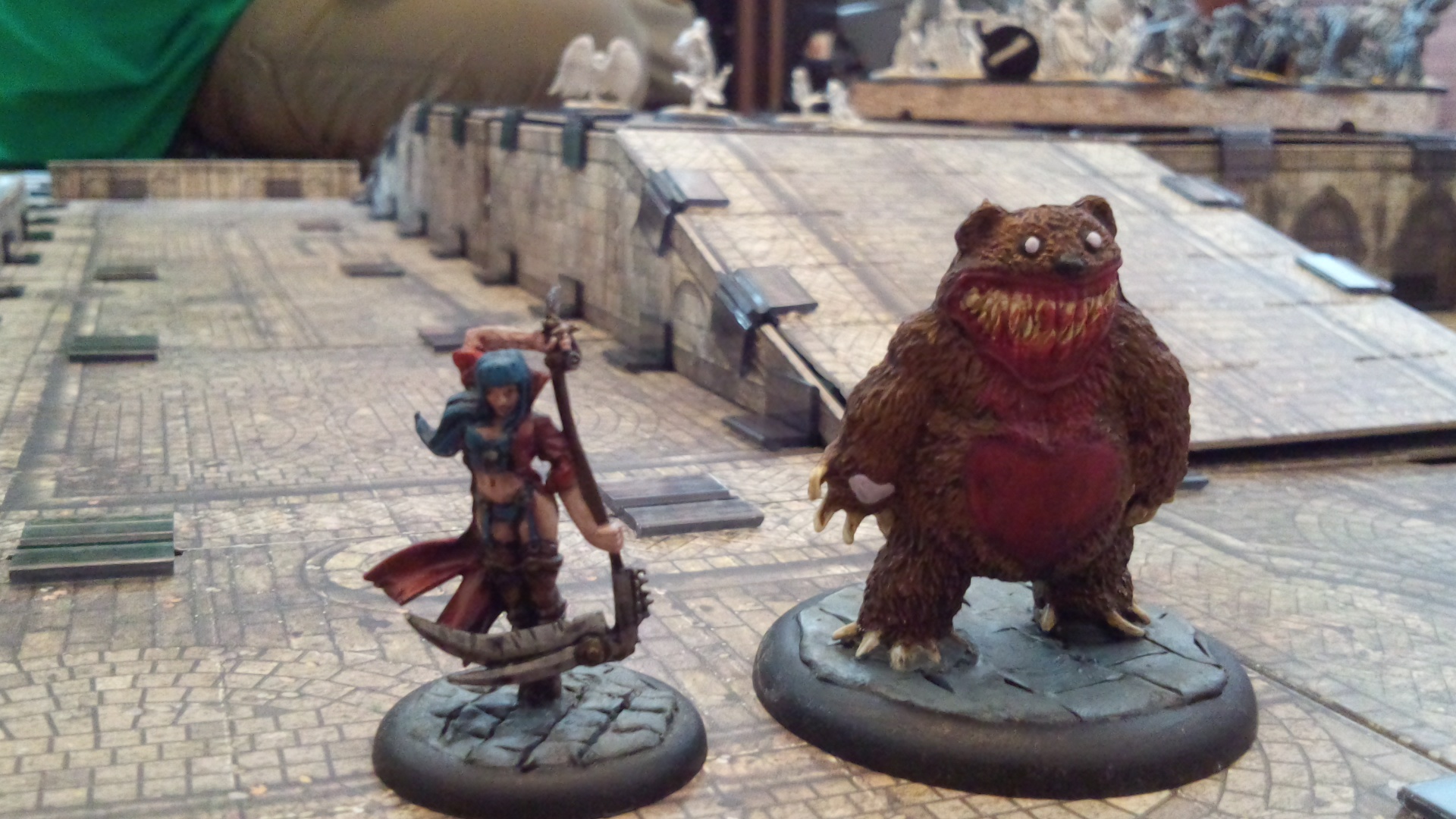
    • Teddy, a big furry bastard with teeth
    • Baby Kade, a small and unpleasant child with nasty knives
    • Candy, a blank-eyed Goth Lolita with a bag of poisoned sweets
    • Terror Tot, your classic vengeful infant
    • Sorrow, some kind of spirit creature with a mean turn in misery and pain
    • Voodoo Doll, Zoraida’s totem and a big mistake

    The Guild player, Big R, went for a small squad of Death Marshalls, the Scales of Justice and some random guy with a big hammer (?) who died. The Resurrectionist player, Aloha-san, went for an absolutely brutally murderous leader called Seamus, some gravedigger dude, a Flesh Construct that is famous for taking huge damage, and a woman who could bury herself. Which didn’t work. There was also a zombie punk samurai thing. My foes went for strategies based on putting markers down on territory, one of which was Squatter’s Rights, which led to a protracted battle between undead and guild members in the middle of the board.

    Because Candy and Baby Kade both have “Manipulation,” which makes it a challenge for opponents to attack them, I went for two secretive strategies:

    • Deliver a message: Candy has to rock up right next to an enemy leader and use all her actions for the round delivering it a message. Standing in front of an enemy leader doing nothing is … a challenging proposition. But if you have a challenging proposition, why not put it to a blank-eyed Lolita with a bag of poisoned sweets?
    • Bodyguard: Baby Kade had to stay alive as long as possible; at turn 4 (with two turns to go) I had to reveal that he was the bodyguard; I got bonus victory points if he was still alive with more than half hits at the end of the game. Baby Kade is fiendish difficult to hit, but he is just a baby …
    Ted shambles toward Bethlehem
    Ted shambles toward Bethlehem

    When the battle started I split my forces, sending Zoraida, Candy and the Sorrow one way towards the Guild’s forces, and Teddy, Baby Kade and Terror Tot the other to take on the Resurrectionists. What’s not to like about a giant, blood-stained teddy bear with massive teeth and two psychotic babies crawling into battle? I soon discovered the power of this gang together – Terror Tot and Baby Kade both have pounce, which means that they get an automatic attack on anyone who moves into their engagement range, and once Teddy gets his hands on you you aren’t leaving the engagement. This little squad of creepy doom caught the Flesh Construct just after he had placed a marker down on a victory point. The Flesh Construct lasted into the 2nd Turn, and my little team came out of that encounter unscathed. Oh Teddy …

    Meanwhile I discovered the power of the Voodoo Doll in a tight group. Selecting it to start with was a mistake, because it moved so slowly that Zoraida’s first action was to summon a new one with a spell, causing the old one to die. I could have used those 4 soulstone points on magic of some kind! The newly-summoned Voodoo Doll also got to put a “Sewn Fate” on a Death Marshall, which makes it vulnerable to all other attacks and means it takes damage if it injures the Doll. Zoraida started throwing magic at it to make it shoot its own men (she has a pretty turn in domination magic!) and the presence of the Sorrow meant that the Death Marshall kept taking damage from failed willpower duels. In desperation Big R had this unfortunate Marshall shoot the Voodoo Doll down, killing itself at the same time, and Zoraida just immediately summoned another one, which put a sewn fate on the next closest Marshall. This Marshall did so badly from the presence of the Sorrow that it was reduced to 1 wound simply through badly-timed activations and failed willpower duels, before it had even been attacked. But before it died it did manage to kill a member of its own team (Scales of Justice) at Zoraida’s bidding.

    This was all a sideshow to the main action, though, which was the battle on the raised central area. Aloha-san and Big R had both selected a strategy which required taking and maintaining control of squares in the centre of the board, and they were beating the living (and un-living) crap out of each other for possession of those marks. The Resurrectionists were summoning zombies from the dead, and Seamus was blasting hell out of anyone who he could see, but Lady Justice (the Guild leader) was doing an awesome job of mincing his crew. This gave me plenty of time to pull my crew into the battle unharmed, and I entered the centre of the table with no injuries and a full crew. At this point I had to reveal Kade’s bodyguard status, and Seamus immediately went to town on him with his pistols – but Baby Kade was on his own now because in order to win I had to get Candy right up to the base of the nearest leader (Lady Justice) within 2 Turns (the game ended at Turn 6). She could get within 4″ in Turn 5, but in order to deliver her message in Turn 6 she couldn’t move (it uses a full action). Fortunately, I could get Teddy to within striking range of Lady Justice. Once he hit her, he could push her 4″ and get into base-to-base contact with her, activating his “gobble you whole” power.

    Turn 6 started with Candy in base-to-base contact with Lady Justice, Terror Tot in pounce range, and Teddy ready to munch, but with one other Guild crewmember within missile-fire range. Seamus, the only remaining Resurrectionist, was letting rip with everything he had on Baby Kade – an unfortunately terminal situation for Baby Kade. Initiative was drawn – and Big R won! Lady Justice could act first, and dismember Candy before she could deliver her message! Except … that in the previous round one of my crew (Zoraida?) had cast a spell that induced “Mood Swing” on the other Guild crewmember, allowing me to choose to activate that crewmember in place of any other Guild crew at a time of my choosing. I chose now, so Lady Justice didn’t get to tear Candy apart, the activated crew member failed to kill her, and she delivered her message:

    You are going to die

    After which all my crew whaled on her, finishing, appropriately, with Teddy delivering the killing blow and swallowing her whole. The other Guild crewmember died during this Turn too, as did Baby Kade, which left me with all but one of my original crew, the Resurrectionists with just their leader, and the Guild completely killed, their leader eaten in one bite by Teddy.

    But when we added up the points from our strategies we were all on equal victory points.

    I think that’s the definition of a Pyrrhic draw, at least for the Guild. But at least Teddy didn’t go home hungry…

    Malifauxcent thoughts

    This game was excellent, and the battles and magic so much fun that it was hard to remain focused on strategies – we all just wanted to have at each other and see what happened. The basic mechanic involves drawing a card that resembles a standard playing card (but with very pretty gothy designs), using the number plus an attribute to determine success. The symbols on the cards can act as triggers for additional effects. Every round you also have a hand of 6 cards you can use to “cheat fate,” basically swapping your drawn card for one from your hand to get a better result. Sometimes you get “+” or “-” which are like advantages/disadvantages in D&D 5th Edition (you pull two cards instead of one and choose the best or worst respectively). The abilities and talents of the creatures are all on easily accessible cards, and there is a minimum of tokens and other fiddliness. All you need to do is flip over your card to see what it can do, then do the card draws as required. Soulstones (if you have any) can be used to further cheat these draws.

    This mechanism is really fun and, in conjunction with the wide range of sneaky and devious manoeuvres on the cards, generates a really rich and challenging combat environment. Once you’re used to the rules – which are very easy and quick to pick up, and all there on the card – it’s really easy to make decisions and work out what to do, and with just 5-7 crew members it’s not hard to get abreast of your options. Overall it seems like a really well-designed and fun system. There is a role-playing game of Malifaux coming out soon, and I think it could make a really cool system and game world. This game is well worth trying if you get a chance!

  • Norman Tebbit Seeks Another Minority Voter
    Norman Tebbit Seeks Another Minority Voter

    Today’s Guardian has an article on the UK Conservative Party’s “minority problem”: it’s inability to get a decent vote share from non-white British citizens. The article seems to be quite neutral on the issue of the Tory’s appeal and electoral strategies, at times even appearing to be pasting text from a Conservative pollster (at times the voice changes, and it seems to have a slightly different perspective to the main thrust of the article, as if text had been copied from an email).  The key problem for the Tories is that they just don’t seem to be able to muster a decent representation amongst minorities, which in the UK primarily means British of black or South Asian descent, and are being outpolled by Labour at a cracking rate (16% vs. 68% according to a quoted survey). Now that they’re in a coalition with the Liberal Democrats the Tories are starting to realize that even a small improvement in minority vote could have saved them a world of trouble, and as is often the case that huge gap seems like it should be easy pickings. So what is going wrong? The article describes a series of problems which bear more on the party’s image and past representation of its identity, rather than on anything about its current policy content, and I think the problems they face – and the solutions they have begun to recognize as important – are in many ways analagous to the problem of getting more women to participate in role-playing. The ultimate end point for the Tories if they fail to up this vote is also similar to that facing gaming if it doesn’t diversify its appeal: obscurity and insularity.

    The problem the Tories have identified is a really frustrating one: a large proportion of minority voters identify with their policy but just won’t vote for the party. They like the content, but are put off by what’s on the box, and by the people they historically associate with the scene. The article sites studies that found

    while better-off white people were significantly more likely to vote Conservative than their less wealthy counterparts, the same was not true for non-whites. That is despite the fact that minority groups were more right wing than the majority on the key issue of tax and spend.

    and also identified non-white British as naturally inclined to Tory policy:

    high-income people, politically on the right, who want a smaller government (and a tough stance on crime and immigration according to other studies) are still much less likely to vote Tory if they are non-white. Whatever the offer, they simply think this is not a party for people like them [emphasis mine].

    Basically the problem is not the policies of the party, or some lack of alignment on fundamental shared goals: it is that the party itself turns them off. There’s something wrong, to the extent that one study even found

    even when people support an idea (many minorities take a tough stance on immigration for example), finding out it is a Tory policy puts them off

    This is a sign that the problem is the way they perceive the party, both presently and as a party with a political past. It’s not difficult to find examples of why minorities might be uncomfortable with the Tories, such as this election slogan from 1964:

    If you want a nigger for your neighbour, vote Labour

    I guess the person who coined that slogan didn’t think about the effect it would have 30 years or 50 years later, but a slogan like that kind of echoes down the ages, doesn’t it? The studies cited found other problems too: the “go home” anti-immigrant buses, historic support for apartheid, and the author cites her own discomfort at the claim that “multiculturalism has failed.” The posturing on Europe probably also looks different to groups of people who are more suspicious of the xenophobic direction of politics than are mainstream voters – these dog whistles aren’t heard just by the dogs, but also by their prey, and there’s a lot of bad faith that the Tories have to ask potential minority voters to overlook. They were, after all, going to be the blood on the streets in 1964 …

    These challenges facing the Tory party are an interesting mirror of one of the main strands of debate about how to engage women in role-playing, and particularly whether the behavior of men in gaming spaces, and the representation of women in gaming, might be part of the problem. I have argued before that the reason that care in representation of women is important is not that they care about seeing tits-and-arse for its own sake, but that images of lingerie-clad sex dolls with chain mail panties mark out the hobby as a male-only space. They serve the role of girly calendars in a workshop, to make women feel like they are intruding in a male space. These tits-and-arse pictures are the “nigger for a neighbour” campaign slogan of gaming. Alongside them comes the behavior of gamer men – the BO problems, the staring, the rampant mansplaining (fuck, gaming must be the only hobby where socially maladjusted dudes mansplain to other men, like alphasplaining or something), and all of this wrapped up in a nice package in which the men in the hobby are aging as a cohort. And on top of that the rape humour, rape games, and barely-suppressed sexual violence of some products. It’s not that women don’t mind a bit of sexual violence in entertainment (hey, GoT is very popular with chicks!) or tits-n-arse (women like to perve on men just as much as men do on women), and everyone who is an adult has learnt to suffer through BO problems (except the sufferers, apparently); it’s the combination of these things as representative face of the hobby that makes women back away smiling. For a long time the hobby (and the world of nerd-dom generally) has made it uncool and uncomfortable for women to be gamers. Even though they might like the content of the games, and be perfectly comfortable with (or even into) the idea of scantily-clad heroes hacking away at orcs, they simply think this is not a party for people like them.

    We’re like the conservative party of hobby-space.

    The solution has not come rapidly to the gaming community – certainly in past posts on the topic here, and threads I read elsewhere, I get the sense that male gamers often don’t care about women joining their groups, are actively opposed to it, think that changing the way women are represented and written about is “political correctness” or “suppression of artistic freedom,” or think that these aspects of the hobby are a fixed thing like descending armour class, and that the only people who we care to let into the hobby are people who accept these things. This misses the representational issues and the issue of boys’ club mentality, and it means acting as if the preferences of the boys in the group are not actually malleable preferences, but god-given fixed parts of the environment. Just as the Tories have taken the assumption that the only minorities they want in their club are black men and women who are somehow comfortable with a party that until recently publicly called them “niggers.” Because you know, that’s just how it was back then. Now that the Tories have worked out that they’re heading into very difficult times if they don’t start to reach out to a group that constitutes 14% of the population, they’re working first and foremost on those representational issues, and then on trying to show they’re honest about opening up policy to minorities, to try and overcome that sticky sense of bad history that keeps the party glued to the spot.

    But hey, the Tories did well: they only ignored 14% of the population. For most of its history the RPG industry has overlooked 50% of the population …

    Some people I know think it doesn’t matter – we’re just a hobby after all and there are lots of other things women can do. But I think that the problem is bigger than that. We are aging as a cohort, with only a small number of people joining us, and the kinds of representational issues that keep women from joining us also make non-nerdy men suspicious of us. If we continue to age with only small numbers of (male) newcomers, as a market we will get smaller, with an associated decline in diversity and quality of products available to us. We will stagnate. This is the fate facing the Republicans in the USA, who also have a minority problem but face structural problems in coming to terms with it, and can’t find a way out of this bind of shrinking into obscurity[1]. We don’t need to be like that, and I think some of the more modern game companies have realized that. I read on YDIS that D&D 5th Edition has a wider range of non-white figures in art, and less sexploitation art; games like Malifaux and World of Darkness, while often rooted in an overly gothic and sub-cultural aesthetic, have at least tried to diversify the way they represent women in both art and game terms. I think Ars Magica was the first game I ever read that regularly had female characters as examples, female players as examples, and switched between male and female pronouns in text. These are small things but it’s these representational issues which first and foremost, I think, signify to women that they aren’t welcome. It’s small steps, but if the UK conservative party can do it, surely we can too?


    fn1: Spit-flecked obscurity, so there is that …

  • The most well-respected methods for reducing carbon emissions seem to be carbon taxes and carbon price mechanisms. I have written before about how I think they will not work to achieve a zero carbon state, based on lessons from the field of public health. Here I want to explore in a little more detail just what we might expect in the long-term from a carbon taxation system.

    An illustrative example: Effects of carbon taxes on fishing

    Fish are a staple food in Japan, and fishing is a carbon intensive practice because fishing fleets use diesel oil. We can get a rough estimate of how much carbon is required to produce a single piece of fish, and use this to estimate how price would change under a carbon tax. First, consider the total carbon emitted in catching fish: this website puts it at between 1750 and 3300 kg for a ton of fish, with the highest carbon emission amongst farmed fish. The analysis suggests that 1kg of wild-caught frozen salmon will be associated with 1kg of CO2; a carbon footprint of up to 6Kg can be expected for fish that is caught in say Chile, and shipped to the US. Taking 5kg as a conservative estimate of the carbon footprint of a kg of fish, we can see that  for a carbon tax of $X per ton, $X/200 is added per kg of fish sold in the super market. So for a price of $250 per ton, we get $1.25 per kilogram; for $2500 per ton, we get $12.50 per kilogram.

    The Coles website tells me that salmon fillets are currently $30 per kg. A carbon price of $2500 a ton will increase their cost by approximately 30%.

    We can calculate the cost for fresh fish in a supply chain directly, so let’s try this for a typical fresh Tokyo fish, Mackerel. The Seafish.org website has a carbon footprint profiler which indicates that you need to take into account “landed to live weight” and “final processed form to landed weight,” which we can estimate fairly conservatively (though I don’t know the details). This ancient paper (pdf) gives an efficiency of about 3% for shrimp fishing, while this FAO document gives landed weights of between 3 and 84%. Working with Mackerel from that document, let’s assume that only 3% of caught fish is actually edible[1], and make that the “landed to live weight” ratio. The FAO provides a handy guide to “conversion factors” for converting landed fish to actual final processed form, as an annex (pdf) to this guide. Taking the mackerel factor, let’s assume that only 50% of the final fish is eaten, in the form of a fillet. The site then asks us to show how much the fish traveled before and after processing, and by what means. Let’s assume it is landed fresh in Tokyo after a 5 day fishing trip, and that it traveled 40km by truck to the processing plant, then 40 km by van to the shops, and was eaten within a day (pretty standard in Tokyo). Using “Trawling for Herring in the NW Atlantic” as our model fishing method, we get 7.4 tons of CO2 for every ton of final product. So we would need to add X/133 to the per kg price of the fish. For a carbon price of $250, that’s $1.90; for $2500, a $19.00 impost. This site tells me that Mackerel in Japan costs between 600 and 8000 Yen per kilogram ($6-80), so a $2500/ton carbon tax would change this price range to $25-100 per kg. The Coles website tells me Australians already pay $20/kg for tinned mackerel – is it very likely that Japanese will baulk at paying $25 for fresh mackerel? Furthermore, this is for the most inefficient live catch and processing values I can find. If the live catch efficiency goes up to 10%, for example, the impost for those carbon taxes drops to $0.60 – $6.

    No one on earth is currently considering a $2500 ton carbon tax. Even $250 a ton is considered radical, but $250 a ton will increase the final price of mackerel by $0.60 – $1.90 per kg. Does anyone seriously believe that this impost will be sufficient to force the fishing fleet to go carbon-neutral?

    What are the long-term impacts of carbon taxes?

    I chose fishing as an example because it differs from electricity generation in one simple way: short of returning to sailboats, there is no viable low-carbon alternative to fossil fuels for fishing boats at present. So the fishing industry will have little choice but to absorb the price of a carbon tax, pass it on to consumers, or disappear, unless and until an alternative energy source becomes available. If our goal is to get to a carbon zero economy and still be able to eat fish, a carbon tax is surely not going to work. But there are other aspects of the economy that are entirely vulnerable to a carbon tax, most especially electricity generation and public transport. So how well are carbon taxes predicted to work in these industries?

    There does not seem to be a lot of available modeling on the long-term impact of carbon taxes, but those reports that have been published are not promising. For example, this report by the Citizens’ Climate Lobby describes a carbon tax starting at $10/tonne and increasing to $250/tonne at $10/year. They use four different established models to identify total, and industry- and region-wide effects of the carbon tax. Their final estimate of the effect of the carbon tax is a 50% reduction in emissions by 2035 (page 30). After that the gains decline. This report, from the carbon tax center, proposes a system of tax and credits that appears to correspond with a $113/tonne tax, and would lead to 25% reductions in emissions by 2024 on a 2012 baseline.

    350.org says we need to get to 350ppm by the end of the century to avoid catastrophe; we’re currently on 400ppm and increasing at 2ppm per year. If we halve global emissions by 2035, we’ll be above 420ppm, and still increasing.

    As another example, my July electricity bill was $66 for 214kwh of electricity. In Tokyo at the moment this is mostly gas, and would (according to Wikipedia) have released a total of 107 kg of CO2, based on median emissions. At $250/ton that’s going to increase my electricity bill by about $25/month. How much electricity use will that discourage? $25 is a cheap meal out with a few drinks. At $2500/ton it’s $250/month – two cheap meals out and two trips to a love hotel. Am I willing to give up two dates a month in order to keep my electricity use unchanged?

    I don’t believe that even a $250/ton carbon tax will be sufficient to force carbon neutrality in electricity generation, and $2500/ton, while it will make solar and wind competitive and force a fairly rapid switch to renewables, may not lead to much change in other behavior, especially in industries like shipping and trucking where alternatives are expensive and still barely off the drawing board. The Citizens’ Climate Lobby report tells us that in the USA each $1/ton of carbon tax is a $.009/gallon increase in petrol prices; $2500 a ton will increase petrol prices by $22.5/gallon. Currently in Tokyo gasoline is sold at probably $2/gallon. Will people completely stop using cars at $25/gallon? Given that a single journey in Japan can cost $5 in parking, and a car can travel 35 mpg, i.e. two trips per parking cost, the total cost of those two trips will go from $14 to $35 in Tokyo. Is that sufficient to stop recreational use of cars?

    These reports make clear that even sizeable taxes of up to $250/ton are not enough to get where we need to go. The first report, suggesting $10/year increases in the tax, shows the obvious problem – as the tax grows, the incremental benefit of further increases declines, so going to higher taxes will have smaller and smaller effects. By the time we’re at $300/ton, a further $10/year increase will be less than the effect of inflation on prices in many countries. People will stop responding to those taxes by that time. And as I showed in the case of fishing, there will be many industries where this cost can be passed onto consumers with a negligible effect. I routinely buy fish fillets in Tokyo for $2/fillet, am I seriously going to reduce my carbon footprint if the price of such cheap food doubles?

    What we need to bear in mind here is that we don’t want to reduce recreational use of cars by 50% over the next 30 years, or by 90%; realistically, any CO2 emitting form of transport needs to be cut by 99%. These taxes alone are not going to do that.

    What do we need to do to achieve carbon zero?

    Carbon neutrality will not be achieved by taxes alone. We need additional government interventions to make it happen. Carbon taxes with appropriate transfers to ensure that poor people are compensated for the change are a good start, but they are only a start. We need to go a lot further if we want to achieve these goals. Some policy interventions should include:

    • Complete electrification of freight rail: Australia’s rail freight system (indeed all inter-city lines) is still diesel-powered; it should be electrified immediately, so that it can be shifted to a renewable energy source as the taxes bite
    • Expansion of passenger and freight rail: Most Australian cities are heavily dependent on road transport, which for the foreseeable future is immune to carbon abatement policies. As much as possible, the transport network needs to be shifted to rail, that can be electrified
    • Electrification of all buses: all public buses should be immediately electrified
    • Implementation of tollways: all major interstate highways should be shifted to a toll system, with tolls based on both distance travelled and journey speed, and tolls manipulated to ensure long distance travel is always cheaper by train and bus than by car
    • Construction of high speed rail: this is never going to be profitable in Australia, so it should be subsidized by government, using carbon tax proceeds, and prices fixed in such a way that it is always competitive with air travel and private road travel
    • Minimum price for air travel: Air travel will never be carbon neutral, so it needs to be discouraged or people need to find ways to use their journeys more efficiently (i.e. travel less often and stay longer). A minimum price will encourage this, and should be designed so that electric high speed rail is always cheaper
    • Nuclearization of all large ocean-going vessels: if it’s large enough to have a nuclear power source, it should. No freight should be carried on a CO2-emitting ship.
    • Reorientation of commercial fishing fleets around batteries and nuclear tankers: I don’t know if this is possible, but fishing needs to be redesigned so it is carbon neutral. If it isn’t yet possible to design battery powered ships, research funds should be dumped into this
    • A timetable for the banning of internal combustion engines: Some time in the future, internal combustion engines need to be banned. This timetable should be implemented now. By e.g. 2020, gasoline-using cars should be illegal, so people have 6 years to buy a battery car or convert to CNG; by 2025 or 2030, CNG cars should be illegal. That gives a 15 year time frame to completely electrify the personal transport industry
    • Immediate conversion of cars to compressed natural gas: This should be a brief boom industry, as all old cars are converted.
    • Lower all speed limits: so that cars travel more efficiently and private travel is less time-efficient than public transport
    • Ban all new coal-extraction licenses: No new coal mines should be built anywhere in Australia, and furthermore no new development should be allowed in connection with existing mines. Existing infrastructure bottlenecks to efficient extraction should be seen as a good thing.
    • Divestment laws: Investment funds should be required to divest all holdings in carbon-intensive industries on a reasonable but definitive timetable
    • Scale-up of electric charging points: Cars should be rechargable anywhere
    • Mandatory roof-top solar: for all businesses
    • Mandatory grid integration: no power company should be able to refuse a reasonable request to sell power into the grid.
    • Mandatory storage in new buildings, and subsidies to convert existing buildings: apartment blocks are not efficient solar collectors, but they could still be built with sufficient storage that they can store some solar power for release onto the grid at night
    • Ban all rice and cotton production in the Murray-Darling watershed: water needs to be returned to the river for greening of the river course, because restoring natural wetlands and green areas is essential to improving carbon sequestration
    • Huge rewilding and reforestation programs: Carbon sequestration through forestry management is essential, and this project needs to be undertaken immediately, so that it forms a key part of future carbon reduction strategies. It can be conducted in such a way as to support and restore biodiversity
    • Huge research grants on storage and renewable energy: We need to get to the point where electric trucks and ocean-going boats are a possibility within 20 years. This will need research. We should be doing it

    And finally, I think that climate change denial should be illegal outside of scientific journals – if people want to claim it’s not happening they should be required to present peer-reviewed scientific evidence. Funding climate change denial should be a criminal act. The government should further refuse to offer contracts to organizations that have hosted denialists or funded denialists in e.g. the last 10 years. These people need to be driven out of public life and should have no influence on public debate. It is absolutely ludicrous that after three of the hottest months on record (April, May and June), the government’s business advisor is publicly claiming that a period of major global cooling is imminent. That dude should be unemployable, and preferably in stocks[2].

    A lot of these programs will require major government subsidies, transfers and loans, and huge government intervention across a range of marketplaces. We need to stop acting as if the worst consequence of responding to the climate crisis is government intervention in markets, and start recognizing that it is the minimum requirement to stave off a civilization-level disaster. It’s huge government intervention now, or civilization collapse later.

    So go looking back through history and ask yourself – has any civilization collapse ever been preventable through a small tax that raised the price of fish by 10%? I think you’ll find the answer is no. The emergency is coming, and we need to act as if it’s an emergency, not a minor market failure.

    fn1: For farmed fish, this number should be near 100%, obviously.

    fn2: This is clearly a rhetorical point

  • Fantasy Flight Games have announced the completion of the Warhamer Fantasy Role-playing Game 3rd Edition (WFRP 3) “line,” i.e. they’ve decided to stop producing any material for it and move on. I suspect this is at least partly because it was not very popular or successful – it’s a somewhat unusual form for a role-playing game, and also very expensive. I suspect a lot of people gave up trying to get the whole experience to work, and it didn’t sell as well as it needed to given its huge production requirements.

    I played one and a half campaigns of WFRP 3, in English and Japanese, and from my experience I think that in many ways WFRP 3 was a revolutionary and exciting game. It imported a lot of ideas from board-gaming to provide improved ways to manage PC resources, skills and powers, and used a really interesting dice mechanic to generate rich and complex results for PC actions. Unfortunately, the mechanics are complex and fiddly in practice, requiring lots of space, huge amounts of tokens and a lot of fiddling. The dice mechanic is also just that little bit too complex for GMs to intuitively understand, making it hard for them to design and run adventures, and I don’t believe that Fantasy Flight Games ever came  up with a good way of handling monsters and providing GMs the proper resource- and system-management tools and tips they need to make the game work. I think this is likely a killer in a role-playing game – if you can’t make the complexity accessible and manageable to the GM, you alienate the central 20% of the gaming population that are essential to making the game sell (since players won’t bother buying books for games they can’t find GMs to play with!)

    After WFRP 3 Fantasy Flight Games released the Star Wars system, which uses a stripped down and simplified version of both the action system and the dice system from WFRP 3. The Star Wars system seems to be much more accessible and easy to play, and has better introductory material, and may be more practical as a novel game system. I haven’t tried it yet but expect to soon. I have also simplified WFRP 3 and GMd a really cut-down system in a different world, and I found that once it is stripped down to just the dice and skill system it becomes a really neat little system. It is my hope that Fantasy Flight Games will use their experience of Star Wars to develop a simplified, stream-lined classic fantasy RPG based on the WFRP system without all the bells and whistles, using all their experience to date. If they do that, I think it could be a really good way to play fantasy.

    In the meantime I hope to use the simplified version of WFRP 3 for more adventures in the Compromise and Conceit world, where I think it works as a system. I won’t be buying more WFRP 3 stuff, but I will be continuing to play around with what I think was a very promising and innovative way of gaming. Let’s hope for more reports in the future …

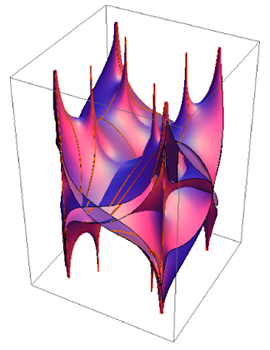
  • Riemann surface or Babylon 5 monster? Only a genius can tell ...
    Riemann surface or Babylon 5 monster? Only a genius can tell …

    Today Maryam Mirzakhani, aged 37, became the first woman ever awarded the Fields prize for mathematics, a prize that is sometimes described as the “Nobel prize of maths.” She was awarded the prize for her work on “Riemann Surfaces and their moduli spaces,” which you can look up in wikipedia but good luck with that. Riemann surfaces are a kind of manifold, which is a space that globally has a complex structure that cannot be easily described mathematically but that reduces locally to a Euclidean space. A good way to think about manifolds is as the problem of ironing your shirt. Globally, your shirt has a twisted and contorted structure which means you can’t conceive of it as a flat surface suitable for ironing; but you can fold out small sections of it into a simple plane, and iron those sections. Manifold theory is essential for higher work in physics, since quantum mechanical topology is not straightforward. The wikipedia page has some nice examples of Riemann surfaces for basic functions plotted in the complex plane (that is, a plane with complex numbers). The example for the square root function shows an application of the theory of Riemann surfaces (I think): you can plot the real part of the square root on the vertical axis, and then obtain the surface for the complex part by a simple 180 degree rotation. For the average mortal, obtaining a result like that will probably make your eyes bleed. For Dr. Mirzakhani I guess it’s breakfast reading.

    Dr. Mirzakhani first came to love mathematics in Iran, where she completed high school and undergraduate studies. I find it very interesting that the first woman to win the Field’s prize was educated in a nation that we westerners consider to be very sexist, and furthermore that she comes from a middle-income country. There are nearly a billion people living in high-income, supposedly comparatively gender-equal nations, but the first female Fields prize winner comes from a middle-income country with a bad record on women’s rights. I think this is indicative of two things: first of all, Iran’s strong support of science; and secondly, the west’s overbearingly sexist attitude towards maths and science. While we in the west like to pride ourselves on the equality of the sexes, it is my opinion that attitudes towards femininity and science in the west are still very backward, and there are major cultural and institutional factors that push women away from fields that they are perfectly capable of performing well in. We also see this in the world of gaming and nerd pursuits, where women are vastly under-represented. This problem does not exist in Asia, where women are encouraged to take up scientific and nerdy pursuits. Certainly in Japan, there is no question about whether a woman could or should do mathematics – it is to be encouraged and admired, and many forms of mathematics that we in the west would consider to be “advanced” or “optional” parts of education (and therefore, through institutional and cultural pressure, tend to select men to learn) are considered an essential and basic part of a woman’s education in Japan. I see this as an Asia-wide phenomenon, and I suspect that it is true of Iran as well that women are considered capable of mathematical achievement. In this aspect of gender equality, I think the west has a long way to go.

    Dr. Mirzakhani is also a sterling example of another aspect of maths education that I consider important, and that I have written about before on this blog: it depends very strongly on the attitude of your teachers, and especially on their ability to get students engaged in mathematics and to keep them trained. Dr. Mirzakhani was not originally interested in mathematics, but had her interest fired by a brother’s stories and a teacher’s encouragement. She also was not initially very good at mathematics, but stuck at it, saying:

    I can see that without being excited mathematics can look pointless and cold. The beauty of mathematics only shows itself to more patient followers

    It takes time and encouragement to develop mathematical skills, and teachers who ignore the slower students because they assume they lack “talent,” or who discourage certain groups or people from taking up this field, are both denying their society the chance to deepen and broaden the level of cultural knowledge of an essential discipline, and also are denying the possibility of access to a beautiful and inspirational world of thought, simply on the basis of their own prejudices. Dr. Mirzakhani obviously benefited from a series of teachers who like to inspire interest and support effort, and don’t judge their students’ potential on the basis of poor early development or gender. The world needs more teachers like those who encouraged Dr. Mirzakhani. Dr. Mirzakhani herself commented on barriers to entering and staying in mathematics earlier this year, suggesting that they are not being lowered:

    The social barriers for girls who are interested in mathematical sciences might not be lower now than they were when I grew up. And balancing career and family remains a big challenge. It makes most women face difficult decisions which usually compromise their work

    Hopefully this award will be another small step to breaking down some of those social barriers, and encouraging more women into mathematics.

    The Guardian article on Dr. Mirzakhani also contains a very nice and powerful quote from another Fields prize winner, Manjul Bhargava:

    The mathematics that has been the most applicable and important to society over the years has been the mathematics that scientists found while searching for beauty; and eventually all beautiful and elegant mathematics tends to find applications

    I think the importance of beauty and aesthetic sense in driving discoveries in mathematics and physics is often understated, but when you listen to mathematicians and physicists talk it is clear that it is a really important part of how they conceive of problems and solutions. There is an unexpected and deep relationship between our sense of symmetry and beauty, and the deep truths of the natural world. This is also the reason that people who understand mathematics find it so compelling and almost mystical in its beauty, and why I think it is not just an issue of shrunken talent pools when some groups of people are prevented from fully enjoying this field – they are being held back from being part of something truly profound. It’s good to see that whatever barriers still exist for women entering mathematics in Iran or the west, Dr. Mirzakhani was able to overcome them and join this small group of people peering into the deep mysteries of our universe.